Archive for Solar and Stellar Astrophysics

Three New Publications at the Open Journal of Astrophysics

Posted in OJAp Papers, Open Access, The Universe and Stuff with tags , , , , , , , , , on May 18, 2024 by telescoper

It’s time once more for the usual  Saturday roundup of business at the  Open Journal of Astrophysics. The latest batch of publications consists of three papers, taking the count in Volume 7 (2024) up to 39 and the total published by OJAp up to 154. We’re still on track to publish around 100 papers this year, compared to last year’s 50.
All three of this week’s papers involve use of data from the European Space Agency’s Gaia mission, which is proving an immensely rich resource for astrophysics.

First one up is “Asymmetric Drift Map of the Milky Way Disk Populations between 8 -16 kpc with LAMOST and Gaia datasets” which is by  Xin Li (Nanchong, China), Peng Yang (Chengdu, China) , Hai-Feng Wang (Nanchong, China), Qing Li (Jiangmen, China), Yang-Ping Luo (Nanchong, China), Zhi-Quan Luo (Nanchong, China), Guan-Yu Wang (Nanchong, China). This is a study  of the asymmetric drift, the difference of the local circular speed and the mean rotational speed of the stellar population, for various stellar populations in the Milky Way. It is in the folder marked Astrophysics of Galaxies and was published on Tuesday 14th May 2024.

Here is a screen grab of the overlay, which includes the abstract:


You can read the paper directly on arXiv here.

The second paper to announce is “On the formation of a 33 solar-mass black hole in a low-metallicity binary” by Kareem El-Badry (Caltech, USA). It discusses theoretical models for the formation of a black hole in a particular binary system discovered in Gaia data.

This one is in the folder Solar and Stellar Astrophysics and was published on 16th May 2024. The overlay looks like this:


You can read this paper directly on the arXiv here.

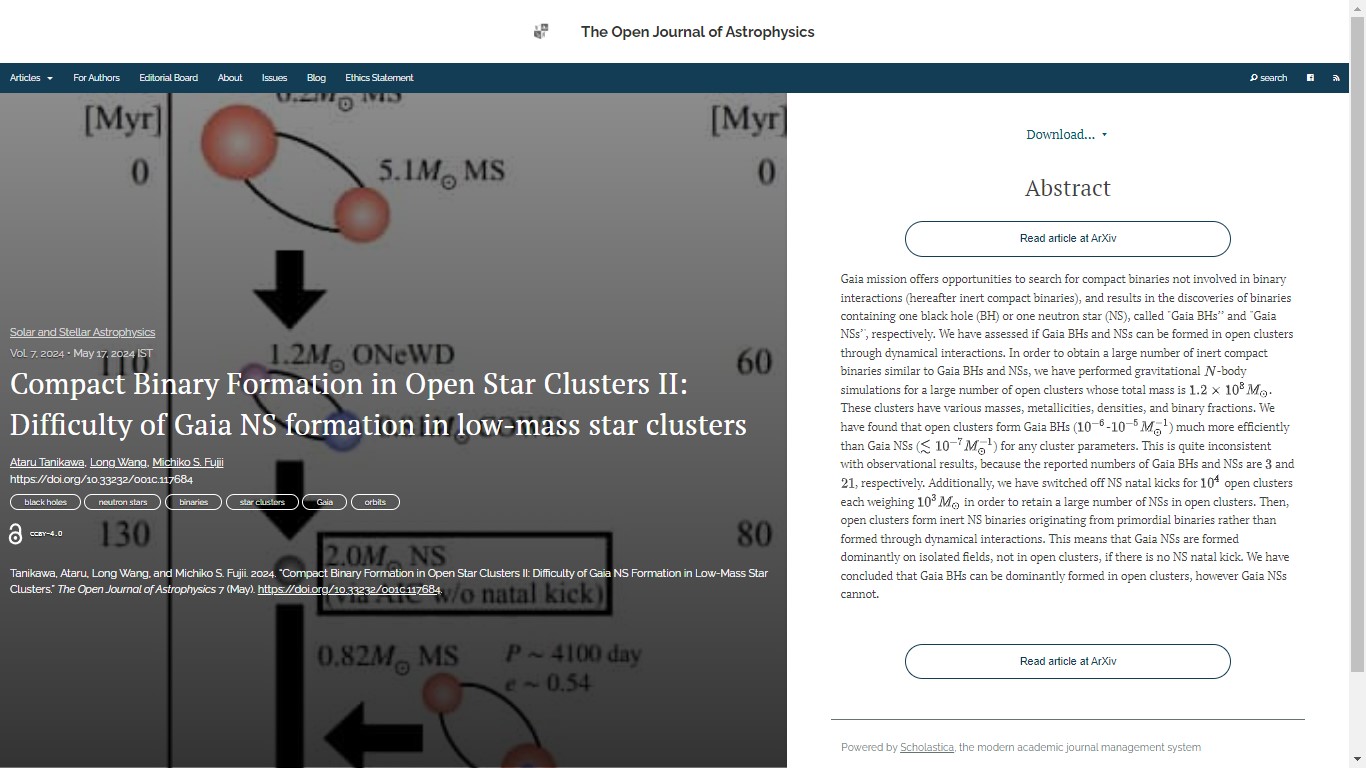
The last paper of this batch, also in the in the folder Solar and Stellar Astrophysics, is entitled “Compact Binary Formation in Open Star Clusters II: Difficulty of Gaia NS formation in low-mass star clusters”  and it presents a discussion of the formation of binary neutron stars and black holes found in Gaia data based on their orbital properties. It was published on Friday May 17th 2024 (i.e. yesterday). The authors are Ataru Tanikawa (Fukui University, Japan), Long Wang (Sun-yat Sen University, China) and  Michiko S. Fujii (Tokyo University, Japan).

Here is a screengrab of the overlay:


To read the accepted version of this on the arXiv please go here.
That’s all for now. Another update next week!


Three New Publications at the Open Journal of Astrophysics

Posted in OJAp Papers, Open Access, The Universe and Stuff with tags , , , , , , , , , , , , , on April 27, 2024 by telescoper

It’s time for the usual  Saturday roundup of business at the  Open Journal of Astrophysics. The latest batch of publications consists of three papers, taking the count in Volume 7 (2024) up to 30 and the total published by OJAp up to 145.

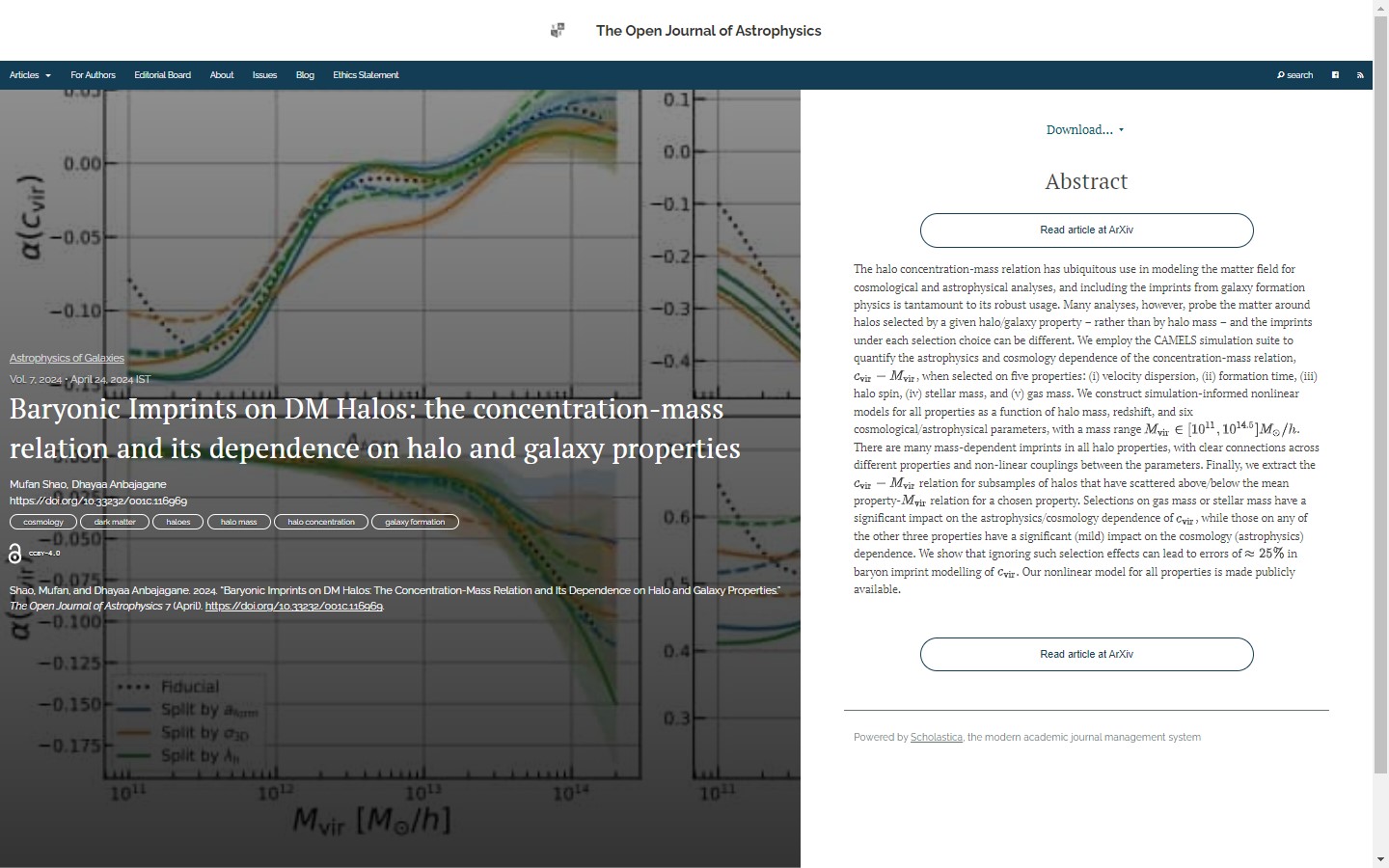
First one up is “Baryonic Imprints on DM Halos: the concentration-mass relation and its dependence on halo and galaxy properties” .  The authors, Mufan Shao and Dhayaa Anbajagane of the University of Chicago, USA, use  a non-linear model informed by simulations to study the imprint of galaxy formation physics on the concentration-mass relationship using various different choices of halo selection criteria. This one is in the folder marked Astrophysics of Galaxies and was published on 24th April 2024.

Here is a screen grab of the overlay, which includes the abstract:


You can read the paper directly on arXiv here.

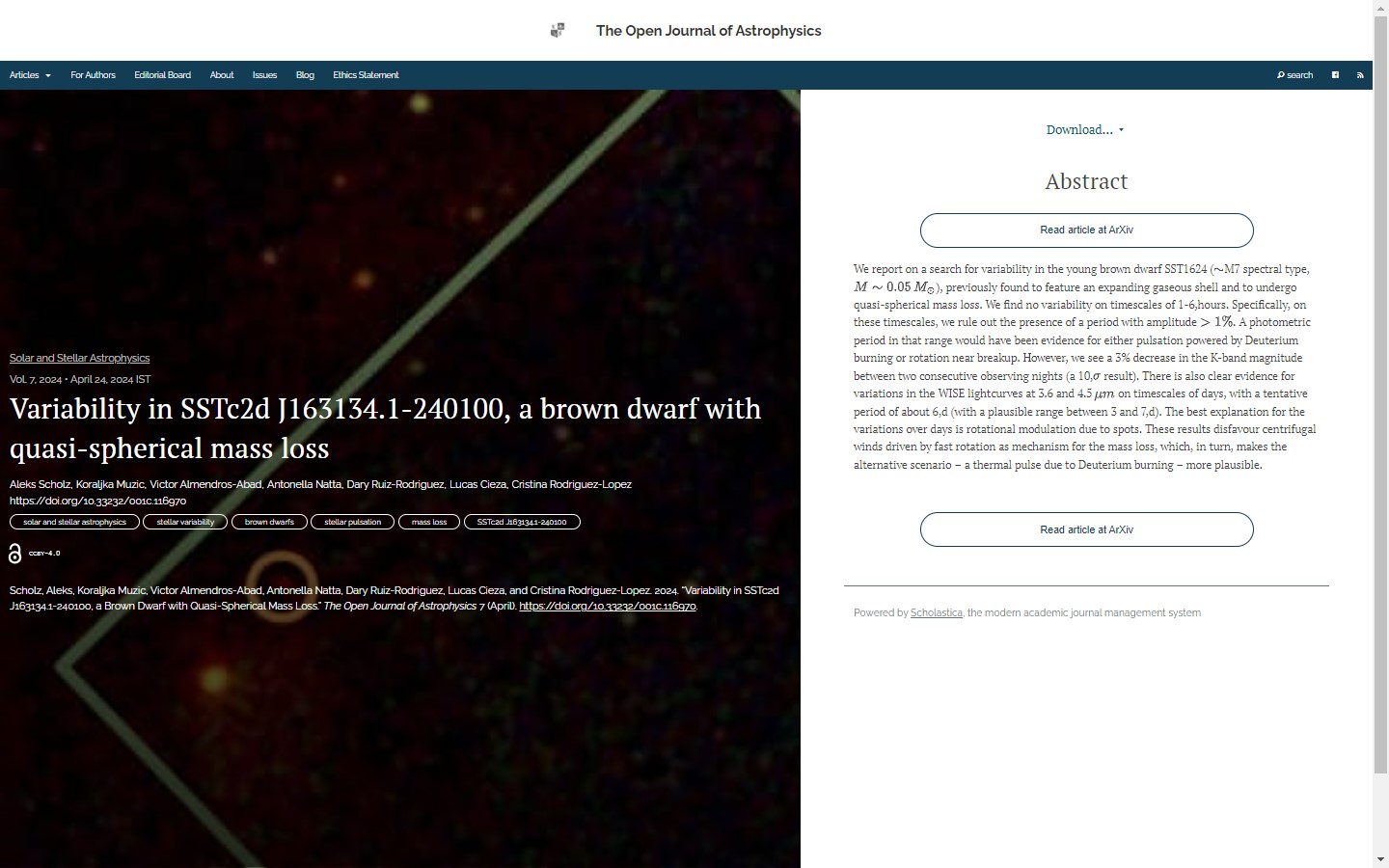
The second paper to announce is “Variability in SSTc2d J163134.1-240100, a brown dwarf with quasi-spherical mass loss” which describes a search for variability in a brown dwarf star known to be losing mass and the implications of the lack thereof for the reason for the outflow therefrom. The authors are Aleks Scholz (St Andrews, UK),  Koraljka Muzic (Lisbon, Portugal), Victor Almendros-Abad (Palermo, Italy), Antonella Natta (DIAS, Ireland), Dary Ruiz-Rodriguez (NRAO, USA), Lucas Cieza (Uni. Diego Portales, Chile), Cristina Rodriguez-Lopez (IAA-CSIC, Granada, Spain)

This one is in the folder Solar and Stellar Astrophysics and was also published on 24th April 2024. The overlay looks like this:


You can read this paper directly on the arXiv here.

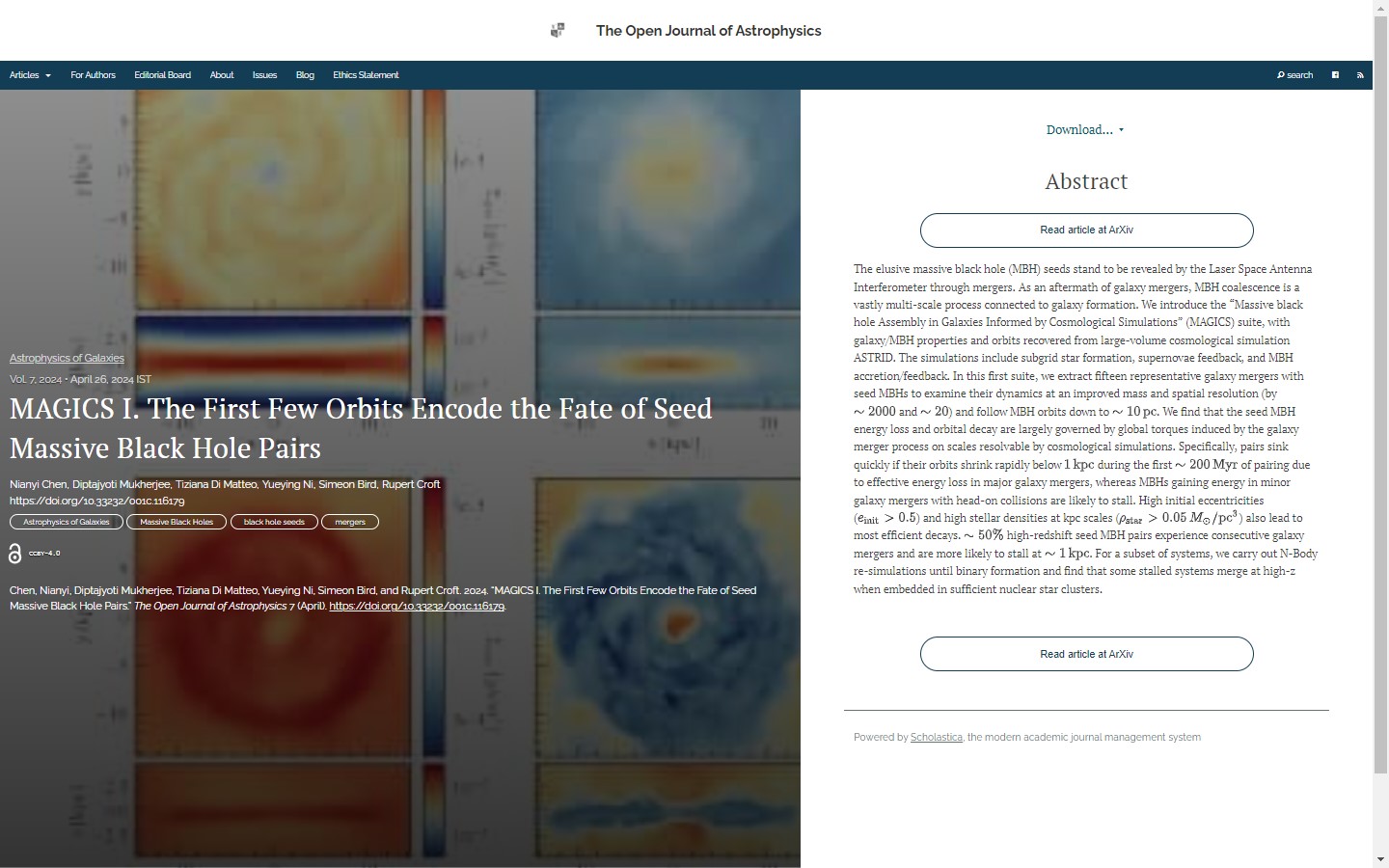
The last paper of this batch, also in the folder marked Astrophysics of Galaxies, is  entitled “MAGICS I. The First Few Orbits Encode the Fate of Seed Massive Black Hole Pairs”  and is a computational study of the process by which massive black holes are formed by merging smaller seed black holes. It was published on April 26th 2024 (i.e. yesterday). The authors are: Nianyi Chen, Diptajyoti Mukherjee and Tiziana Di Matteo (all Carnegie Mellon University); Yueying Ni (Harvard); Simeon Bird (University of California, Riverside); and Rupert Croft (Carnegie Mellon University). All authors are based in the USA.

Here is a screengrab of the overlay:


To read the accepted version of this on the arXiv please go here.
That’s all for now. More news in a week or so!


Five New Publications at the Open Journal of Astrophysics

Posted in OJAp Papers, Open Access, The Universe and Stuff with tags , , , , , , , , , on April 6, 2024 by telescoper

As promised a couple of days ago, I am taking the opportunity today to announce the batch of papers at the Open Journal of Astrophysics that were paused slightly while we updated our system. This batch includes five papers, which I now present to you here. These five take the count in Volume 7 (2024) up to 25 and the total published by OJAp up to 140. We’re publishing roughly two papers a week these days so we expect publish about 100 this year.

In chronological order, the five papers, with their overlays, are as follows. You can click on the images of the overlays to make them larger should you wish to do so.

This paper, by Yingtian Chen and Oleg Gnedin of the University of Michigan, is the 21st paper to be published in Volume 7 and the 136th altogether. It is a study of kinematic, chemical and age data of globular clusters from Gaia yielding clues to how the Milky Way Galaxy assembled. Here’s a screenshot of the overlay which includes the abstract. Note the new-style DOI at the bottom left.

You can read the article on arXiv directly here. This paper has a publication date of 20th March 2024, and is in the folder marked Astrophysics of Galaxies.

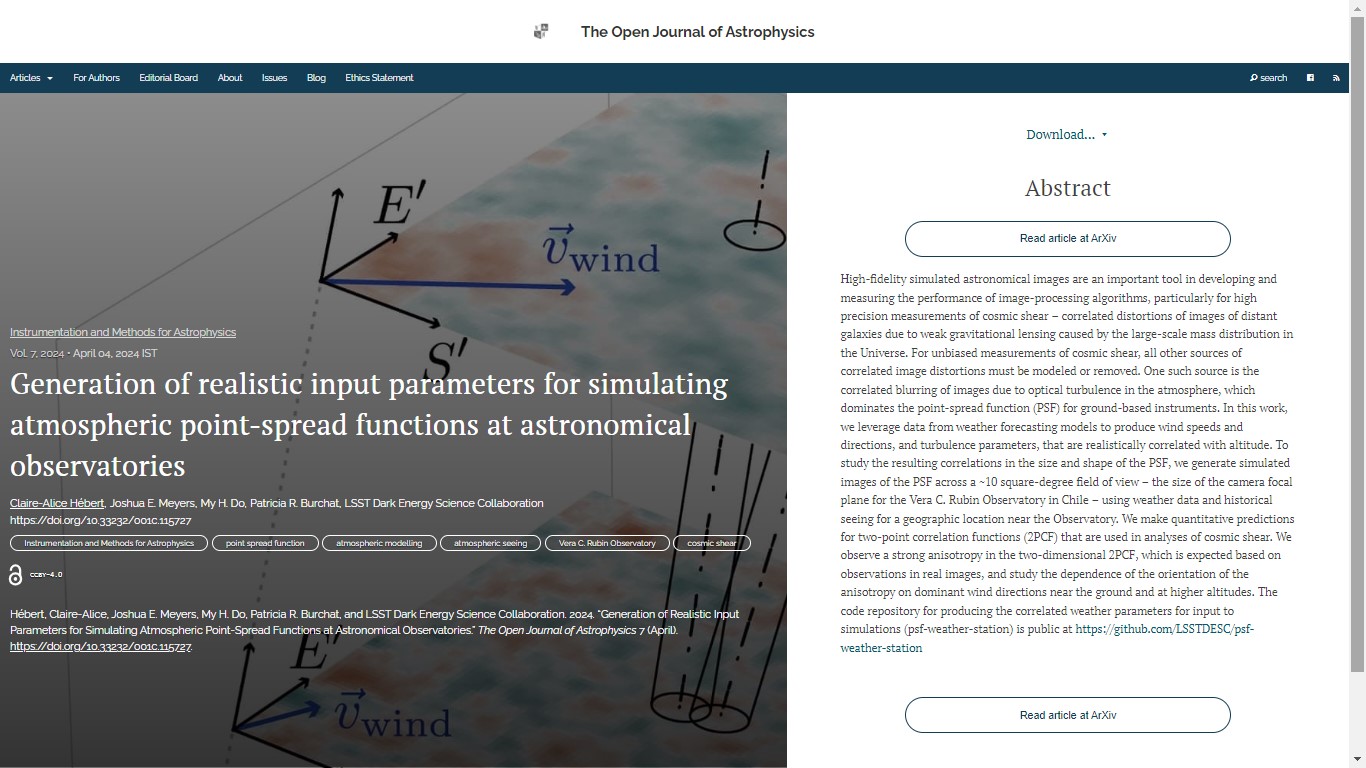
The second paper is “Generation of realistic input parameters for simulating atmospheric point-spread functions at astronomical observatories” by Claire-Alice Hébert (Stanford), Joshua E. Meyers (Stanford), My H. Do (Cal. State U, Pomona), Patricia R. Burchat (Stanford) and the LSST Dark Energy Science Collaboration. It explores the use of atmospheric modelling to generate realistic estimates of the point-spread function for observational work, especially for the Vera C. Rubin Observatory. This one is in the folder marked Instrumentation and Methods for Astrophysics and was published on 4th April 2024. Here is a screen grab of the overlay which includes the abstract:


You can find the officially accepted version of the paper on the arXiv here.

The third paper to announce is “Cosmic Dragons: A Two-Component Mixture Model of COSMOS Galaxies” by William K. Black and August E. Evrard of the University of Michigan (Ann Arbor, USA). This paper was also published on 4th April 2024,  is in the folder Astrophysics of Galaxies and you can see the overlay here:


The accepted version of this paper can be found on the arXiv here.

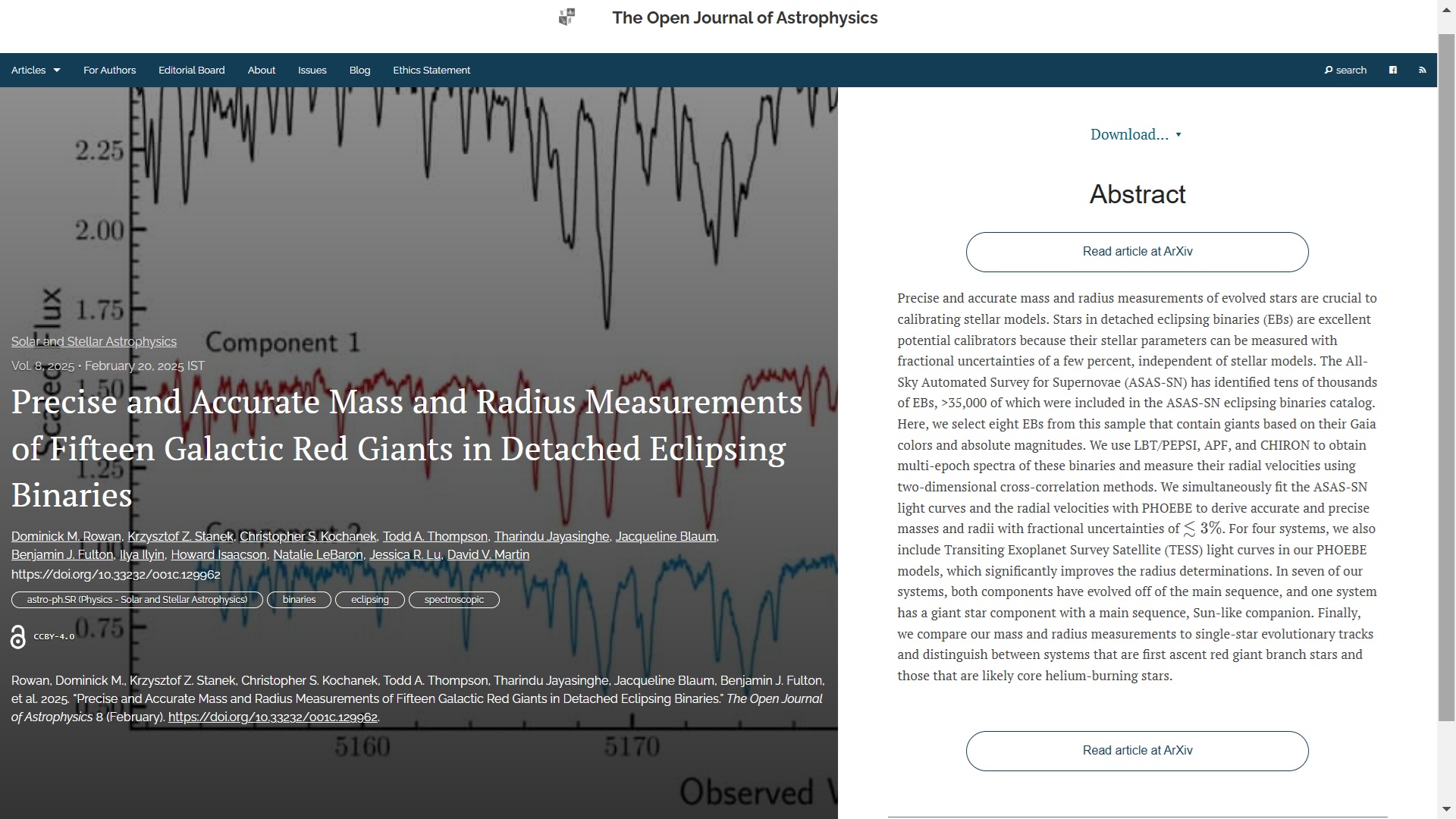
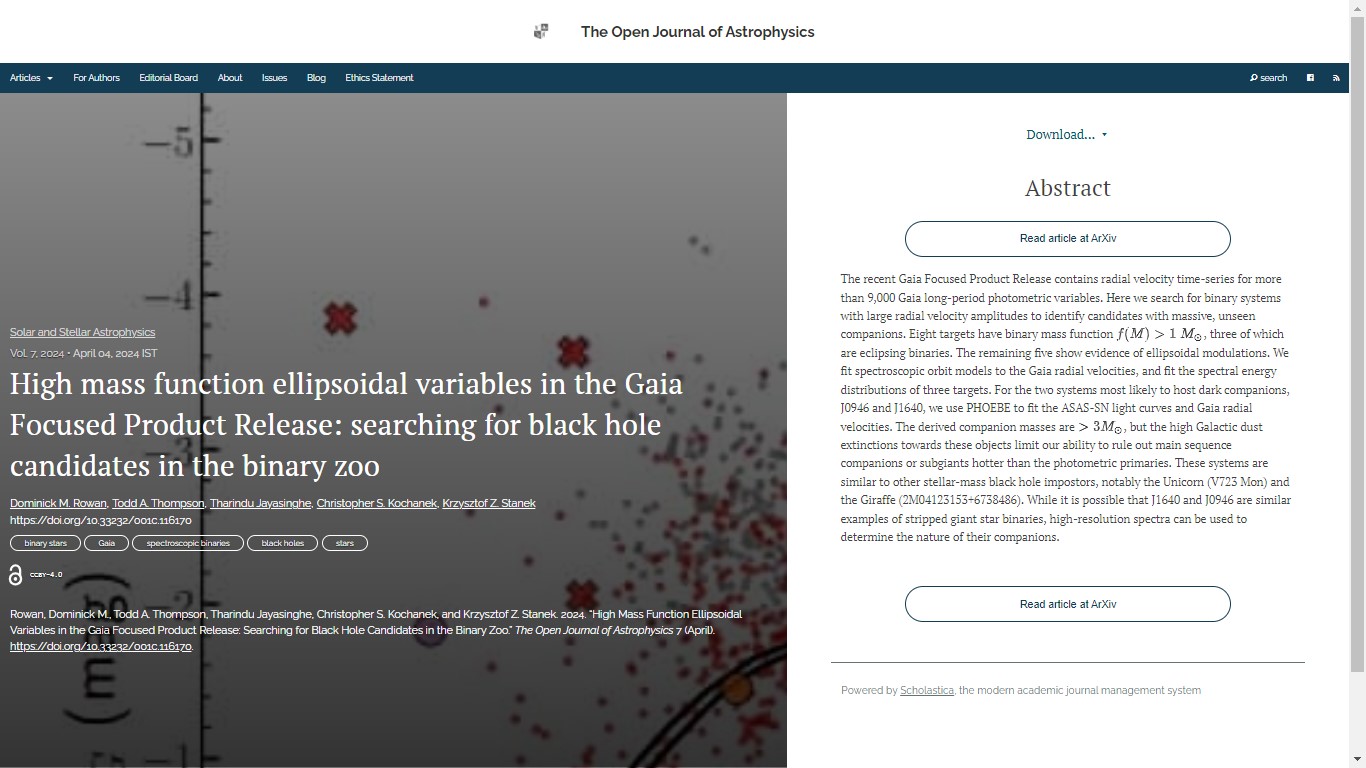
The next paper is “High mass function ellipsoidal variables in the Gaia Focused Product Release: searching for black hole candidates in the binary zoo” by Dominick M. Rowan, Todd A. Thompson,
Tharindu Jayasinghe, Christopher S. Kochanek and Krzysztof Z. Stanek of Ohio State University (USA). This paper, in the Solar and Stellar Astrophysics collection, describes a search for massive unseen stellar companions variable star systems found in Gaia data. This one was also published on 4th April 2024.

Here is the overlay:


You can find the full text for this one on the arXiv here.

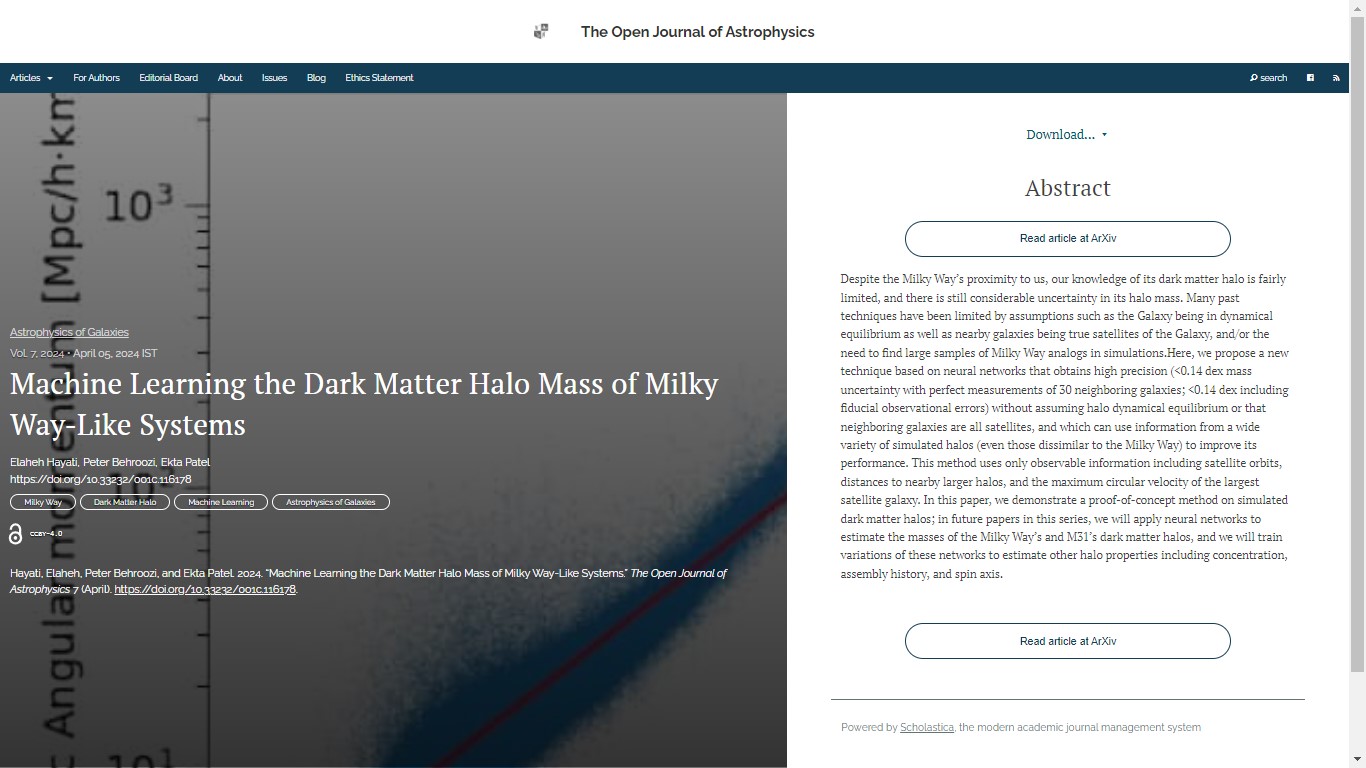
Last in this batch, but by no means least, published yesterday (5th April 2024), we have a paper “Machine Learning the Dark Matter Halo Mass of Milky Way-Like Systems” by Elaheh Hayati & Peter Behroozi (University of Arizona, USA) and Ekta Patel (University of Utah, USA).  The primary classification for this one is once again Astrophysics of Galaxies and it presents a method for estimating the mass of a galaxy halo using neural networks that does not assume, for example,  dynamical equilibrium:


You can click on the image of the overlay to make it larger should you wish to do so. You can find the officially accepted version of the paper on the arXiv here.

As you can see this is quite a diverse collection of papers. Given the increase in submissions in the area of galactic astrophysics we are very happy to welcome another expert in that area to our Editorial Board, in the form of Professor Walter Dehnen of the University of Heidelberg.

Three New Publications at the Open Journal of Astrophysics

Posted in OJAp Papers, Open Access, The Universe and Stuff with tags , , , , , , , , , on January 27, 2024 by telescoper

Once again it’s a good time for a roundup of the week’s business at the  Open Journal of Astrophysics. This past week we have once again published three papers, taking  the count in Volume 7 (2024) up to 7 and the total published by OJAp up to 122. Looking at the current work flow I expect there to be at least three next week too.

In chronological order, the three papers published this week, with their overlays, are as follows. You can click on the images of the overlays to make them larger should you wish to do so.

First one up is “The extraordinary frequency pattern variation in δ Scuti stars” by  Luis A. Balona of the South African Astronomical Observatory in Cape Town, South Africa. This paper, published on 22nd  January 2024, is a study of the (lack of) correlation in the structure of periodograms in Transiting Exoplanet Survey Satellite (TESS) data relating to a oscillating delta Scuti variable stars. This paper is in the category of Solar and Stelllar Astrophysics.

Here is a screen grab of the overlay, which includes the abstract:


You can find the officially accepted version of the paper on the arXiv here.

The second paper to announce is “The Millions of Optical-Radio/X-ray Associations (MORX) Catalogue, v2” by Eric Wim Flesch, an independent researcher based in New Zealand.  This presents the MORX catalogue of optical/radio/X-ray/ galaxy associations, containing over three million objects. The catalogue itself can be found in a number of locations on the web, e.g. here or here.

The paper was also published on 23rdJanuary 2024 in the category Astrophysics of Galaxies . You can see the overlay here:


The accepted version of this paper can be found on the arXiv here.

The last paper of this batch is  entitled “The runaway velocity of the white dwarf companion in the double detonation scenario of supernovae” and the authors are Jessica Braudo and Noam Soker of Technion, Haifa, in Israel.  This paper, which presents a study of ejection velocities in the double-detonation scenario of Type 1a Supernovae was published on 24th January 2024 and is in the folder marked High-Energy Astrophysical Phenomena.

Here is the overlay:


You can find the full text for this one on the arXiv here.

And that concludes the update.  As you can see, we’re getting a bit more diverse in terms of subject matter, which is nice. There’ll be more next week!


New Publication at the Open Journal of Astrophysics

Posted in OJAp Papers, The Universe and Stuff with tags , , , , , on September 15, 2023 by telescoper

Time to announce yet another new paper at the Open Journal of Astrophysics. This one is hot off the press and was published today (15th September 2023).

The latest paper is the 36th  so far in Volume 6 (2023) and the 101st in all. The authors are Kareem El-Badry (Department of Astronomy, California Institute of Technology, USA), Kevin Burdge (Kavli Institute for Astrophysics and Space Research, Massachusetts Institute of Technology, USA), Jan van Roestel (Anton Pannekoek Institute for Astronomy, University of Amsterdam,NL) & Antonio C. Rodriguez (Department of Astronomy, California Institute of Technology, USA).

The primary classification for this paper is Solar and Stellar Astrophysics and its title is “A transiting brown dwarf in a 2 hour orbit”.  The article reports the discovery of a brown dwarf in a very short orbit around a low-mass star with a discussion about the evolution of this orbit probably due to magnetic braking. Amazingly, the entire binary system would fit comfortably inside the Sun (although that’s not actually where it is).

Anyway, here is a screen grab of the overlay of the published version which includes the  abstract:


You can click on the image of the overlay to make it larger should you wish to do so. You can find the officially accepted version of the paper on the arXiv here.

Three New Publications at the Open Journal of Astrophysics

Posted in OJAp Papers, Open Access, The Universe and Stuff with tags , , , , , , , on August 30, 2023 by telescoper

Not unexpectedly because of holidays, August has been rather a quiet month at the Open Journal of Astrophysics, but with people returning to work this week business has picked up again and it’s time to announce the last batch (all published this week).

In fact, this week we have published three papers, which I now present to you here. These take the count in Volume 6 (2023) up to 34 and the total published by OJAp up to 99. Who will be the author(s) of the 100th? We will just have to wait and see! I’ll do a special post for whichever paper wins that honour.

In chronological order, the three papers published this week, with their overlays, are as follows. You can click on the images of the overlays to make them larger should you wish to do so.

First one up is “Bright common envelope evolution requires jets” by Noam Soker of Technion, Haifa in Israel. This is a discussion of the role of jets that a main sequence secondary star launches as it enters a common envelope evolution (CEE) with a primary giant star. The paper was published on 28th August, is just the fifth item in the folder marked Solar and Stellar Astrophysics and can be found here.

Here is a screen grab of the overlay, which includes the abstract:


You can find the officially accepted version of the paper on the arXiv here.

The second paper to announce is “Almanac: MCMC-based signal extraction of power spectra and maps on the sphere” by Elena Sellentin (Leiden), Arthur Loureiro (Stockholm); Lorne Whiteway (UCL); Javier Lafaurie (Leiden); Sreekumar Balan (UCL); Malak Olamaie (York); and Andrew Jaffe & Alan Heavens (Imperial).  This presents a new software tool called Almanac , which uses Hamiltonian Monte Carlo sampling to infer the underlying all-sky noiseless maps of cosmic structures, together with their auto- and cross-power spectra.

This one is  in the folder marked Cosmology and Nongalactic Astrophysics. The paper was also published on 28th August 2023 and you can see the overlay here:


The accepted version of this paper can be found on the arXiv here.

The last paper of this batch paper is in the Instrumentation and Methods for Astrophysics folder. It is entitled “Neural Network Based Point Spread Function Deconvolution For Astronomical Applications” and the authors are: Hong Wang, Sreevarsha Sreejith, Yuewin, Nesar Ramachandra*, Anze Slosar & Shinjae Yoo, all of the Brookhaven National Laboratory (NY) except * who is at the Argonne National Laboratory (IL), all based in the USA. This paper discusses a neural-network based deconvolution algorithm based on Deep Wiener Deconvolution Network (DWDN) and its performance in an astronomical context.

Here is the overlay:


You can find the full text for this one on the arXiv here.

Four New Publications at the Open Journal of Astrophysics

Posted in OJAp Papers, Open Access, The Universe and Stuff with tags , , , , , , , , , , , , , , , , on July 29, 2023 by telescoper

The rate of publication at the Open Journal of Astrophysics has now reached the point at which I think I’ll have to limit myself to weekly updates here rather than announcing every paper as it appears. We still announce individual papers on social media of course, meaning Mastodon, Facebook and the platform formerly known as Twitter…

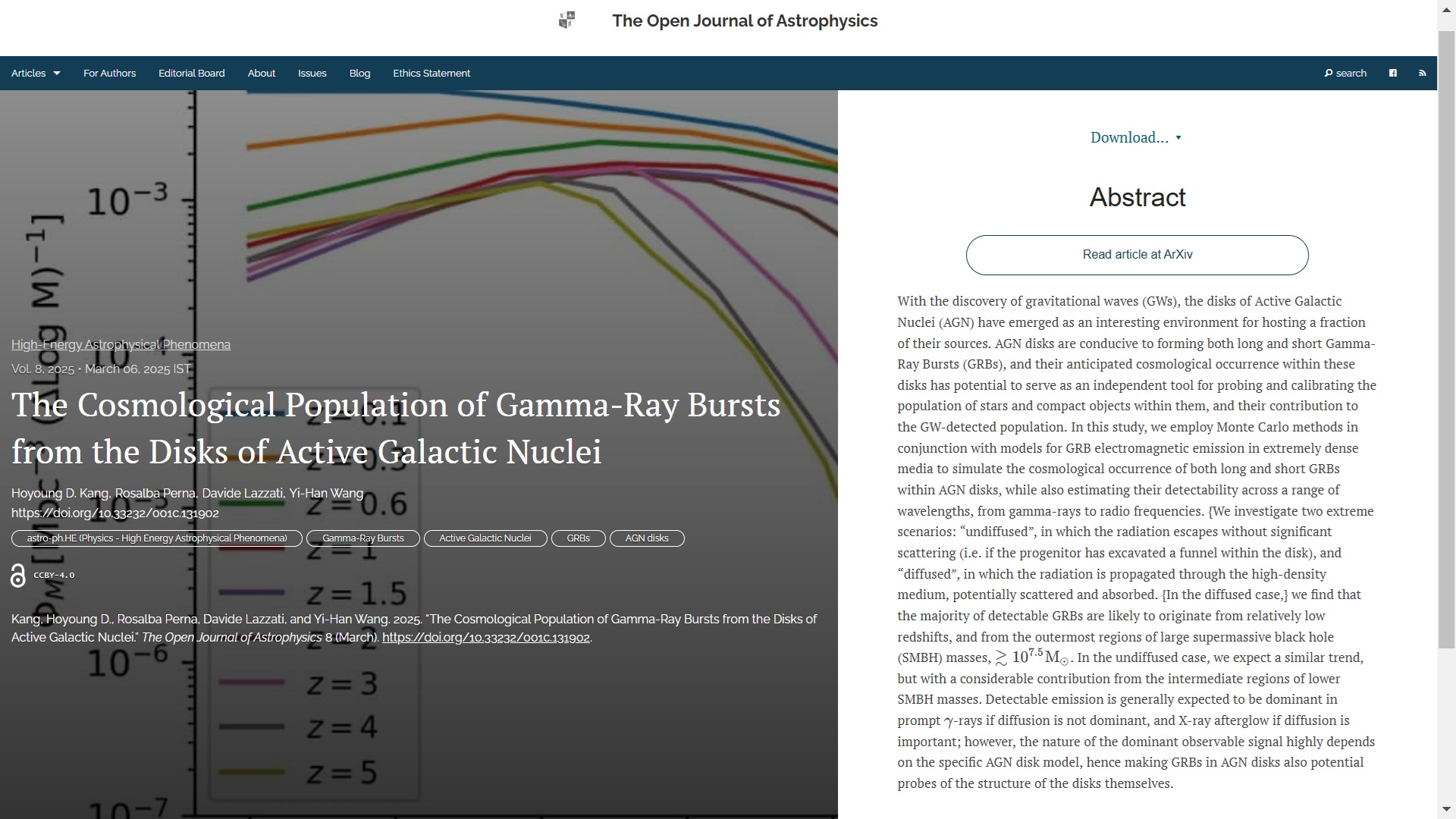
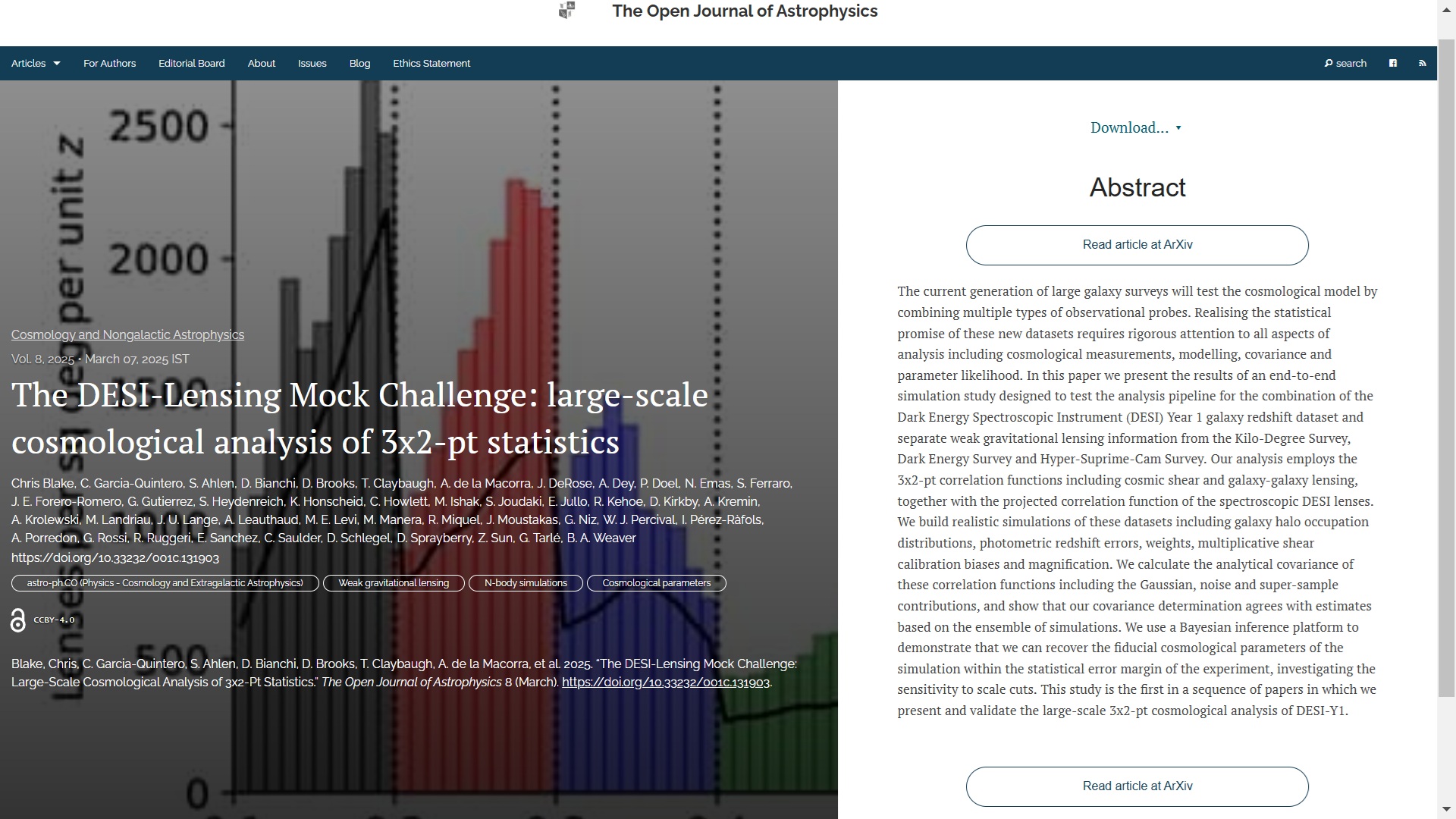
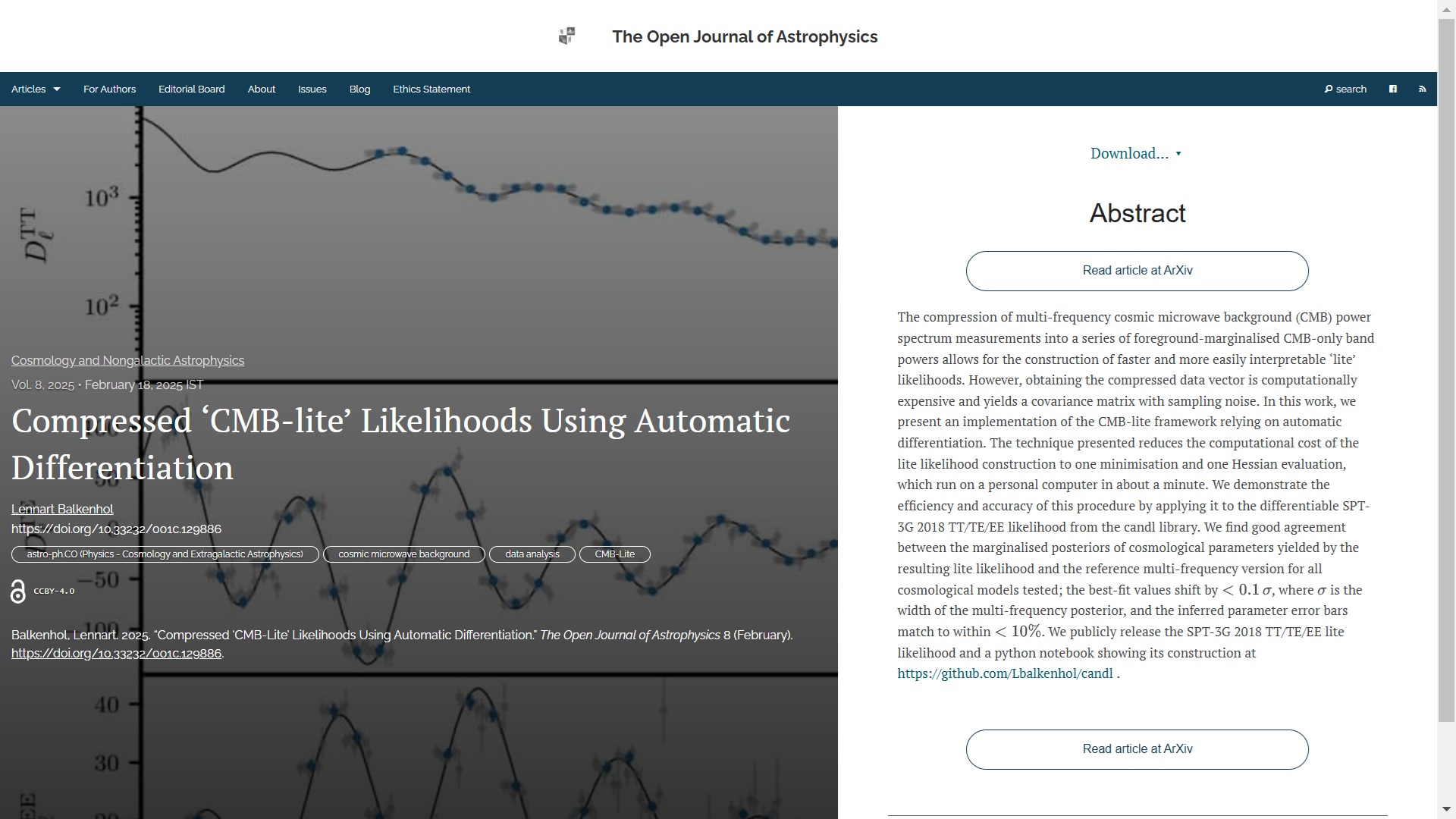
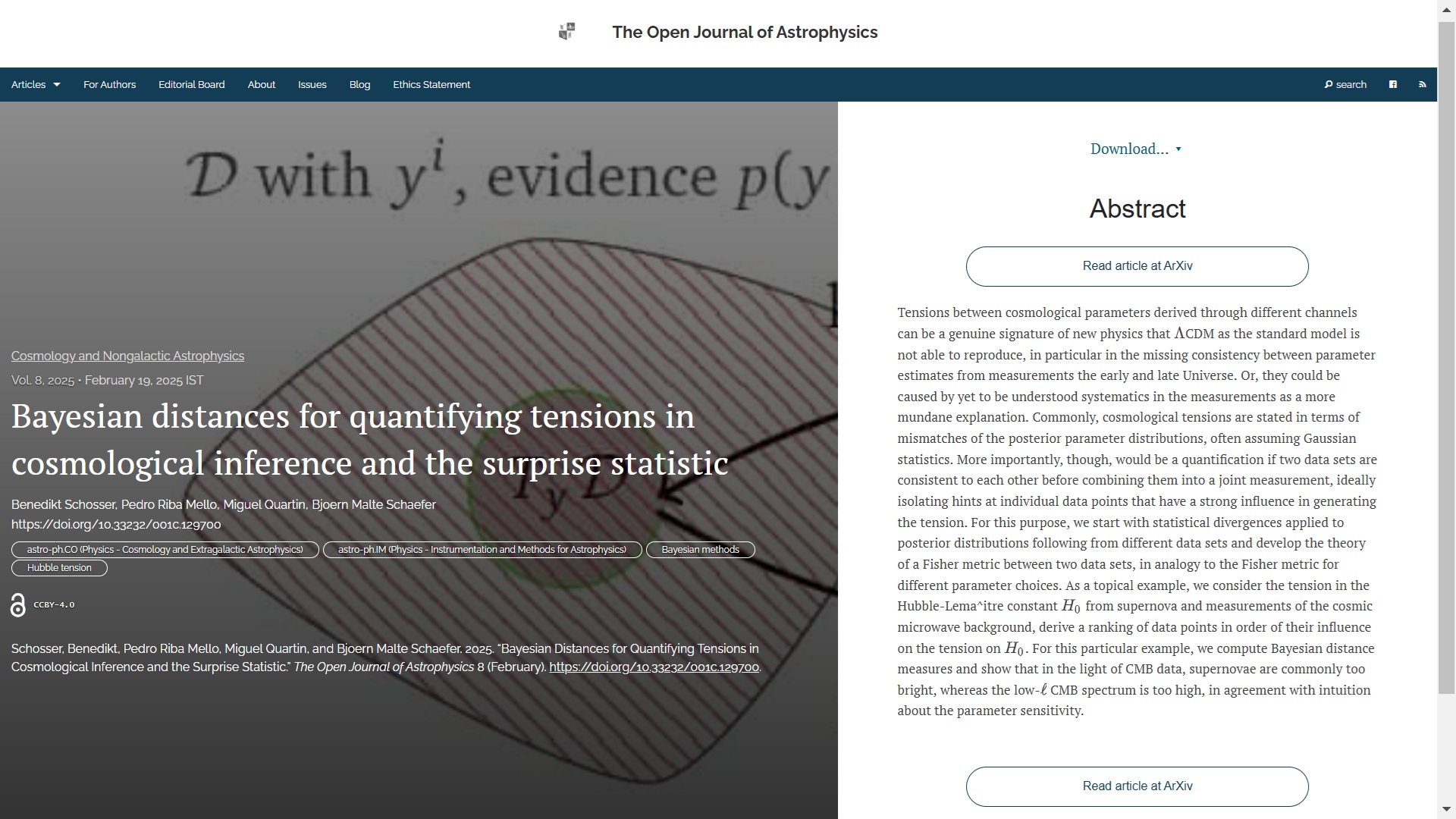
This week we have published four papers which I now present to you here. These four take the count in Volume 6 (2023) up to 31 and the total published by OJAp up to 96. I speculated earlier this year that we might reach 100 before the end of 2023, now it looks certain we will reach the century mark as early as August! It is gratifying to see the range of papers published increasing, with all four of these in different categories.

In chronological order, the four papers published this week, with their overlays, are as follows. You can click on the images of the overlays to make them larger should you wish to do so.

First one up is “M-σ relations across cosmic time” by David Garofalo (1), Damian J. Christian (2), Chase Hames (1), Max North (3), Keegan Thottam (1) & Alisaie Eckelbarger (1). The author affiliations are: (1) Department of Physics, Kennesaw State University, USA; (2) Department of Physics and Astronomy, California State University, Northridge, USA; (3) Department of Information Systems, Kennesaw State University, USA. This is a discussion of the relationship between black hole mass and stellar velocity dispersion discovered in low redshift galaxies and its evolution with cosmic time. The paper was published on 25th July, is in the folder marked Astrophysics of Galaxies and can be found here.

Here is a screen grab of the overlay, which includes the abstract:

You can find the officially accepted version of the paper on the arXiv here.

The second paper to announce is “The fastest stars in the Galaxy” by Kareem El-Badry et al. (21 authors. This one is the fourth item in the folder marked Solar and Stellar Astrophysics and it reports the spectroscopic discovery of 6 new “runaway” stars, probably the surviving members of binary star systems in which one star exploded in a Type 1a supernova. The paper was published on 27th July 2023 and you can see the overlay here:

The accepted version of this paper can be found on the arXiv here.

The next paper is in the Earth and Planetary Astrophysics folder. It is in fact only the second paper we have published in that area. It is entitled “WHFast512: A symplectic N-body integrator for planetary systems optimized with AVX512 instructions” by Pejvak Javaheri & Hanno Rein (University of Toronto, Canada) and Daniel Tamayo (Harvey Mudd College, USA). This paper presents a fast direct N-body integrator for gravitational systems, and demonstrates it using a 40 Gyr integration of the Solar System.

Here is the overlay:


You can find the full text for this one on the arXiv here.

Last but by no means least, published yesterday (29th July), we have a paper that asks the question “Can Einstein (rings) surf Gravitational Waves?” by Leonardo Giani, Cullan Howlett and Tamara M. Davis of the University of Queensland, Australia. The primary classification for this one is Cosmology and Nongalactic Astrophysics and it discusses the possible effect(s) of gravitational waves on gravitational lensing observations.


You can click on the image of the overlay to make it larger should you wish to do so. You can find the officially accepted version of the paper on the arXiv here.

New Publication at the Open Journal of Astrophysics

Posted in OJAp Papers, Open Access, The Universe and Stuff with tags , , , , on April 18, 2023 by telescoper

Back after a short hiatus due to the Easter holidays, it’s time to announce yet another new paper at the Open Journal of Astrophysics. This one was accepted for publication a few weeks ago but the final version only appeared on the arXiv yesterday. Since OJAp is an arXiv-overlay journal, we have to wait for authors to upload the accepted version before we can publish the overlay.

Anyway, the latest paper is the 12th paper so far in Volume 6 (2023) and the 77th in all. This one is in the currently under-populated folder marked Solar and Stellar Astrophysics and its title is “Predicting Stellar Mass Accretion: An Optimized Echo State Network Approach in Time Series Modeling”.

The authors are: Gianfranco Bino, Shantanu Basu & Ramit Dey (all at the University of Western Ontario, Canada), Sayantan Auddy (Jet Propulsion Laboratory, Pasadena, USA), Lyle Muller (University of Western Ontario, Canada) and Eduardo I. Vorobyov (University of Vienna, Austria & Southern Federal University, Russia).

Here is a screen grab of the overlay which includes the  abstract:

You can click on the image of the overlay to make it larger should you wish to do so. You can find the officially accepted version of the paper on the arXiv here.

New Publication at the Open Journal of Astrophysics

Posted in Open Access, The Universe and Stuff with tags , , , on July 17, 2022 by telescoper

Today is ten years to the day that I wrote the blog post that first proposed setting up the Open Journal of Astrophysics. It took a bit longer than I’d expected to get it going. The prototype site opened at the end of 2015 but owing to personal issues the project didn’t get going in full until after I moved to Maynooth in 2017.

It couldn’t have happened without enormous help from Arfon Smith, Chris Lintott, Adam Becker, Robert Simpson, Stuart Lynn and Mark Rohloff so many thanks to them for assistance in getting it off the ground. I also thank the staff at Maynooth University Library, especially Fiona Morley-Clarke, for their support and assistance. I also acknowledge financial support from the Gordon and Betty Moore Foundation.

I’d also like to thank the Editorial Team at OJAp, all unpaid volunteers, for their efforts and of course to all the authors who have trusted their research findings what was, at least at the start, an experimental venture.

Now seems an appropriate time to announce yet another new publication in the Open Journal of Astrophysics! This one, published last week, is the 10th paper in Volume 5 (2022) and the 58th in all.

The latest publication is entitled “V889 Her: abrupt changes in the magnetic field or differential rotation?” and is written by Teemu Willamo (Helsinki), Thomas Hackman (Helsinki), Jyri J. Lehtinen (Turku), Maarit Korpi-Lagg (Aalto) and Oleg Kochukhov (Uppsala). The first four of these are based in Finland and the last in Sweden.

This is another paper in the Solar and Stellar Astrophysics folder; the subject of the paper V889 Herculis is a young and very active dwarf star with some intriguing properties.

Here is a screen grab of the overlay which includes the (very short) abstract:

You can click on the image to make it larger should you wish to do so. You can find the arXiv version of the paper here.

New Publication at the Open Journal of Astrophysics!

Posted in OJAp Papers, Uncategorized with tags , , , , on July 29, 2020 by telescoper

To celebrate yesterday’s news, I have great pleasure today in publishing another paper in The Open Journal of Astrophysics.

A reason to be especially pleased with this article is that this is our first publication in the Solar and Stellar Astrophysics category of astro-ph. It’s good to be spreading out beyond cosmology and extragalactic astrophysics which is where most of our papers appear.

The intriguing title of the latest paper is The one that got away: a unique eclipse in the young brown dwarf Roque 12. There’s also a blog post by one of the authors that tells the fascinating behind-the-scenes story of this paper.

The authors of the paper are Aleks Scholz (University of St Andrews, UK), Dirk Froebrich (University of Kent, Canterbury, UK); Koraljka Muzic (University of Lisbon, Portugal) and Jochen Eislöffel (TLS Tautenburg, Germany).

Here is a screen grab of the overlay:

You might notice that we now have the volume number appearing on the overlay, a change we requested recently from Scholastica.

You can find the arXiv version of the paper here.