Archive for The Open Journal of Astrophysics

Weekly Update from the Open Journal of Astrophysics – 05/04/2025

Posted in OJAp Papers, Open Access, The Universe and Stuff with tags , , , , , on April 5, 2025 by telescoper

It’s time once more for the regular Saturday morning update of papers published at the Open Journal of Astrophysics. Since the last update we have published one new paper. The number of articles in Volume 8 (2025) is now up to 33 and the total so far published by OJAp up to 268.

The paper concerned, published on 2nd April 2025, is “The molecular gas content throughout the low-z merger sequence” by Mark T. Sargent (ISSI, Bern), S. L. Ellison (U. Victoria, Canada), J. T. Mendel (ANU), A. Saintonge (UCL), D. Cs. Molnár & T. Schwandt (U. Sussex), J. M. Scudder (Oberlin College, USA) and G. Violino (U. Hertfordshire). It is published in the folder Astrophysics of Galaxies and it discusses the observed properties of molecular gas in post-merger galaxies and interacting pairs and the physical origin of these properties.

Here is the overlay:

You can read the officially accepted version of this paper on arXiv here.

That’s all for this week. I’ll do another update next Saturday.

Weekly update from the Open Journal of Astrophysics – 29/03/25

Posted in OJAp Papers, Open Access, The Universe and Stuff with tags , , , , , , , , , , , on March 29, 2025 by telescoper

It’s time once more for the regular Saturday morning update of papers published at the Open Journal of Astrophysics. Since the last update we have published three new papers which brings the number in Volume 8 (2025) up to 32 and the total so far published by OJAp up to 267.

We’re almost at the end of March so I checked the records. In the first three months of last year we published 22 papers, compared to the 32 so far this year.

We were affected by a few gremlins in the works at Crossref this week which delayed some submissions. Since our DOIs are generated and registered with Crossref at the time of publication this delayed some papers a little.  I think these problems are ongoing but I know that the team at Crossref are working on them so expect will be fixed soon.

Anyway, in chronological order of publication, the three papers published this week, with their overlays, are as follows. You can click on the images of the overlays to make them larger should you wish to do so.

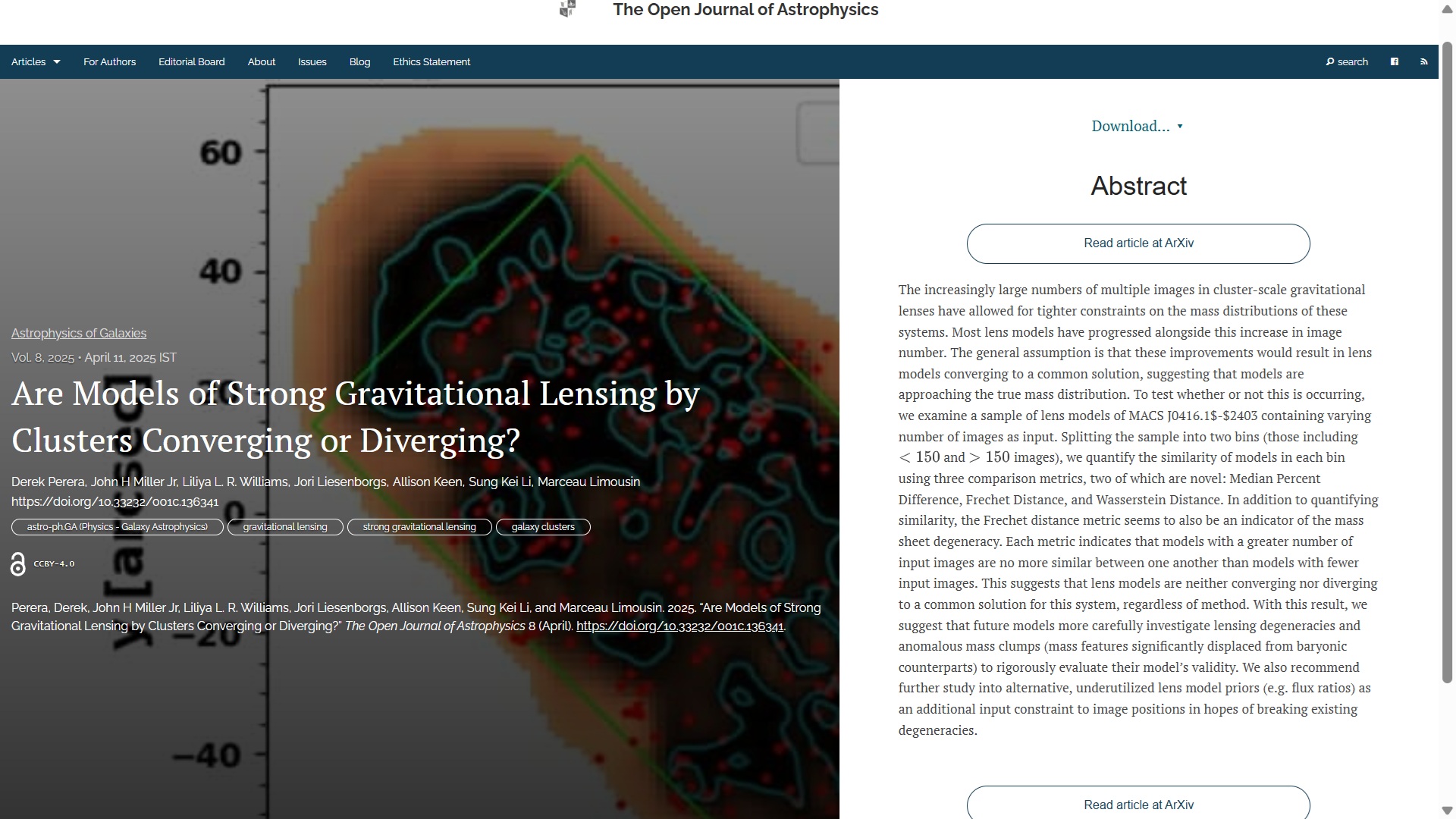
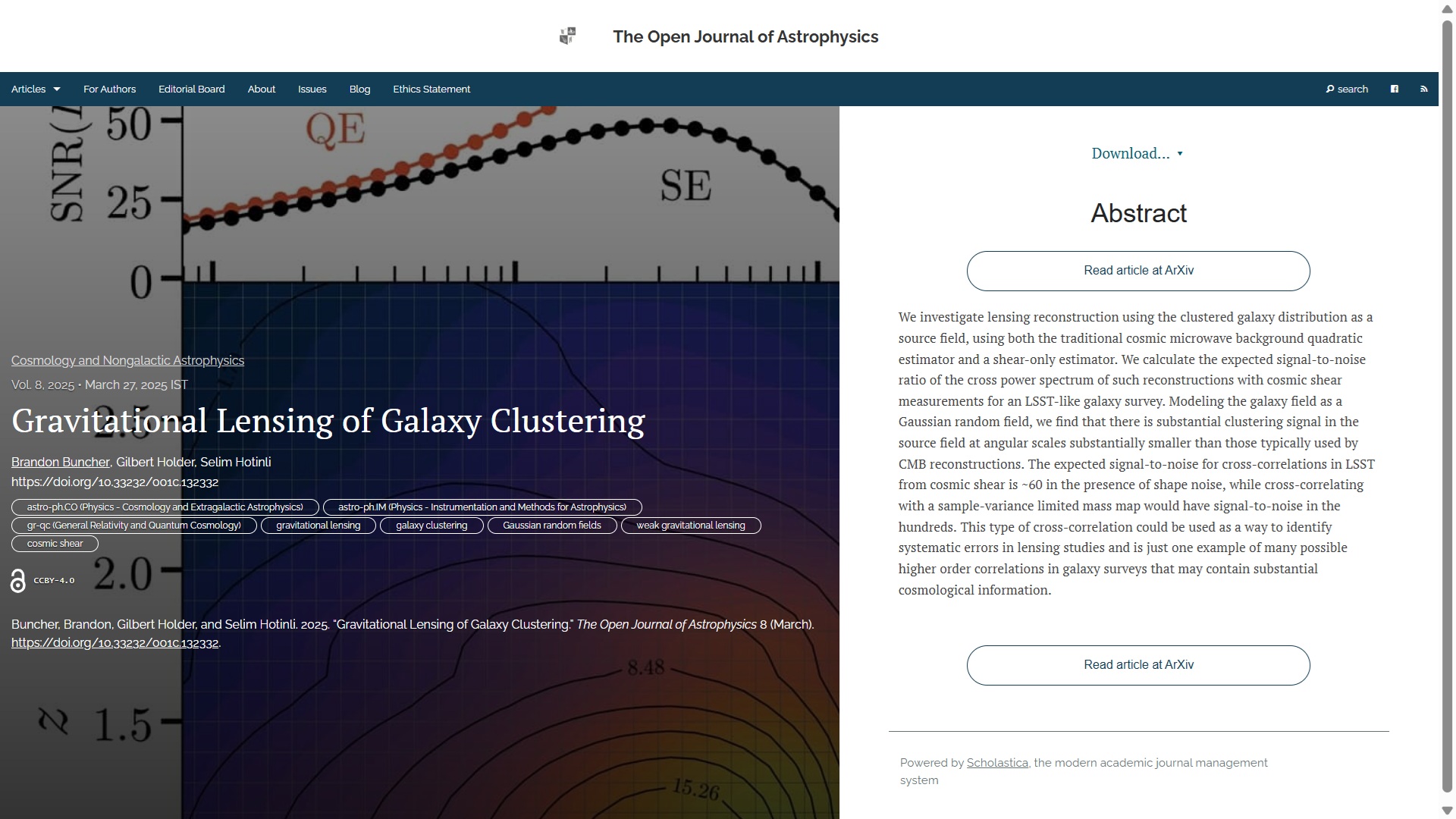
The first paper to report is “Gravitational Lensing of Galaxy Clustering” by Brandon Buncher & Gilbert Holder (University of Illinois Urbana Champaign) and Selim Hotinli (Perimeter Institute, Canada). This paper is in the folder marked Cosmology and NonGalactic Astrophysics and it was published on Thursday 27th March 2025. it presents a study of the cross-correlations between lensing reconstruction using galaxies as sources with cosmic shear measurements.

Here is the overlay:


You can read the officially accepted version of this paper on arXiv here.

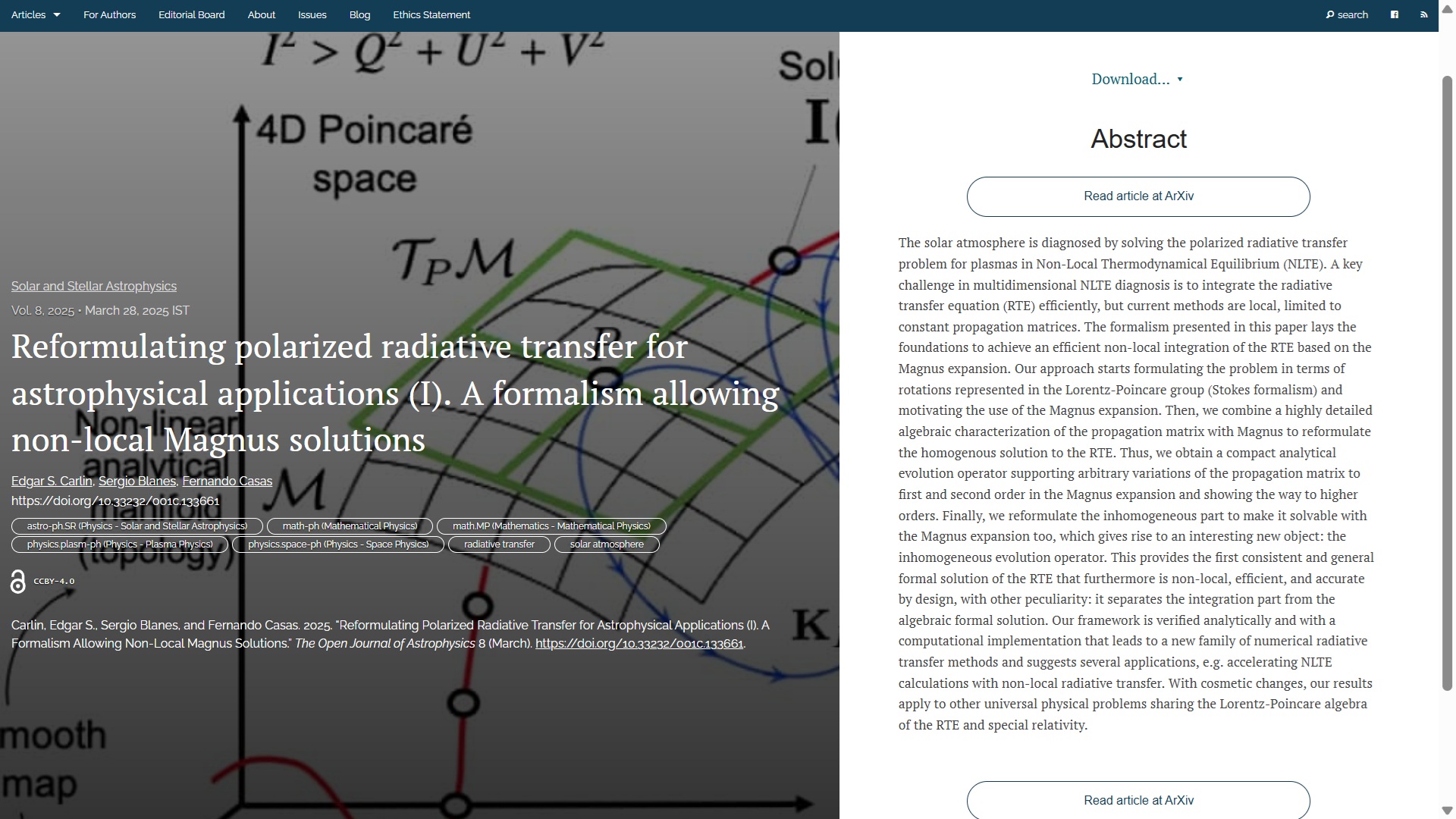
The second paper of the week is “Reformulating polarized radiative transfer for astrophysical applications. (I) A formalism allowing non-local Magnus solutions” by Edgar S. Carlin (Instituto de Astrofísica de Canarias), Sergio Blanes (Universitat Politcècnica de Valencia) & Fernando Casas (Universitat Jaume I), all in Spain.

It appears in the folder Solar and Stellar Astrophysics. It presents a new family of numerical radiative transfer methods and their potential applications such as accelerating calculations involving Non-Local Thermodynamic Equilibrium. This paper was published on Friday 28th March 2025.

Here is the overlay:


You can find the officially accepted version of this paper on arXiv here.

The final paper, also published on Friday 28th March, is in the folder
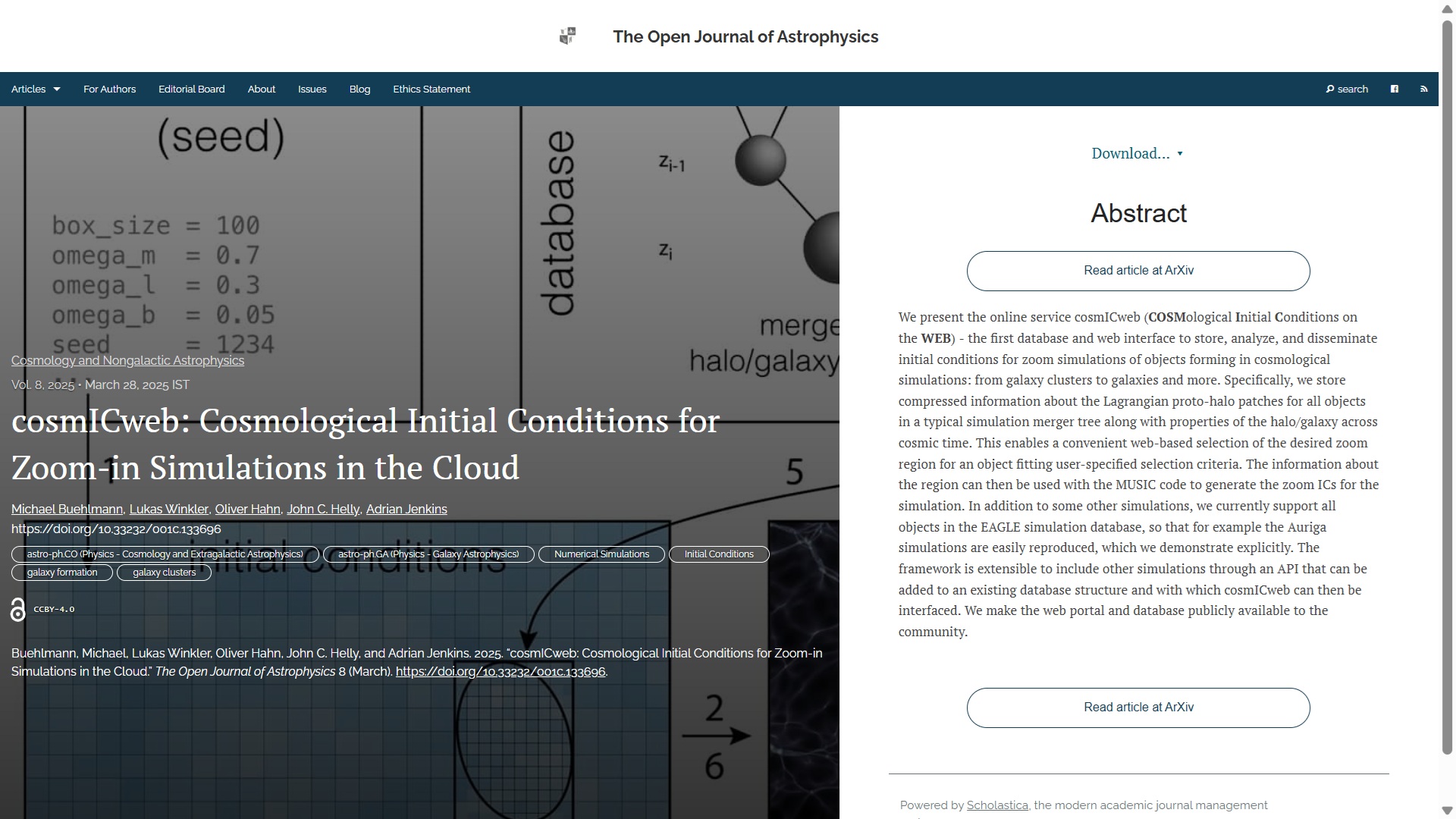
Cosmology and NonGalactic Astrophysics. The title is “CosmICweb: Cosmological Initial Conditions for Zoom-in Simulations in the Cloud” and the authors are Michael Buehlmann (Argonne National Laboratory), Lukas Winkler (U. Wien), Oliver Hahn (U. Wien), John C. Helly (ICC Durham) and Adrian Jenkins (ICC Durham).

This paper describes a new database and web interface to store, analyze, and disseminate initial conditions for zoom simulations of objects forming in cosmological simulations. The database can be accessed directly here.

Here is the overlay:


The official published version can be found on the arXiv here.

That’s all for this week. I’ll do another update next Saturday.

Weekly Update at the Open Journal of Astrophysics – 15/03/2025

Posted in OJAp Papers, Open Access, The Universe and Stuff with tags , , , , , , , , , , , , , on March 15, 2025 by telescoper

The Ideas of March are come, so it’s time for another update of papers published at the Open Journal of Astrophysics. Since the last update we have published two papers, which brings the number in Volume 8 (2025) up to 27 and the total so far published by OJAp up to 262.

The first paper to report is “Dark Energy Survey Year 6 Results: Point-Spread Function Modeling” by Theo Schutt and 59 others distributed around the world, on behalf of the DES Collaboration. It was published on Wednesday March 12th 2025 in the folder Cosmology and NonGalactic Astrophysics. It discusses the improvements made in modelling the Point Spread Function (PSF) for weak lensing measurements in the latest Dark Energy Survey (6-year) data and prospects for the future.

Here is the overlay, which you can click on to make larger if you wish:


You can read the officially accepted version of this paper on arXiv here.

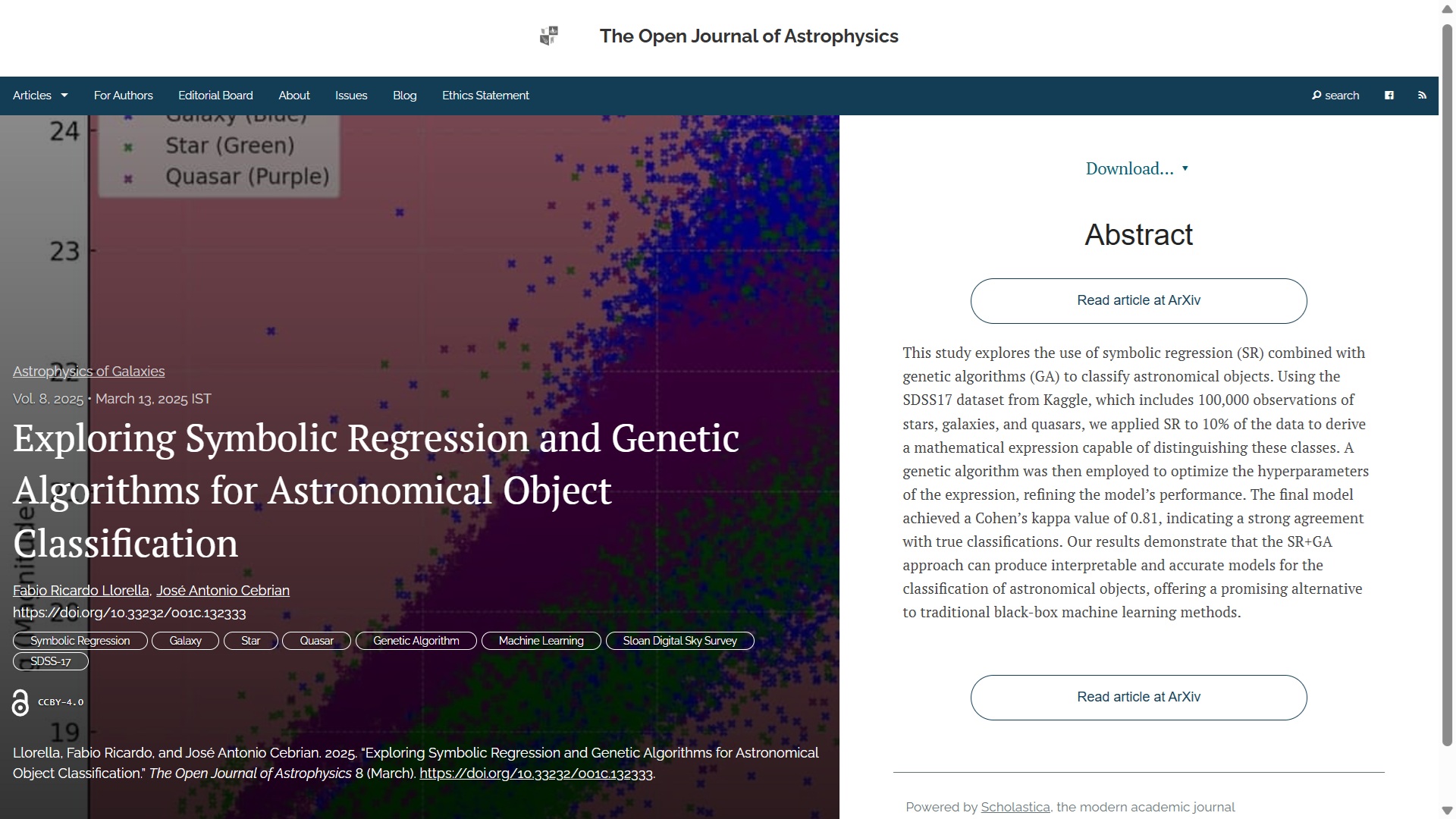
The other paper published this week is “Exploring Symbolic Regression and Genetic Algorithms for Astronomical Object Classification” by Fabio Ricardo Llorella (Universidad Internacional de la Rioja, Spain) & José Antonio Cebrian (Universidad Laboral de Córdoba, Spain), which came out on Thursday 13th March. This one is in the folder marked Astrophysics of Galaxies and it discusses the classification of astronomical objects in the Sloan Digital Sky Survey SDSS-17 dataset using a combination of Symbolic Regressiion and Genetic Algorithms.

The overlay can be seen here:

You can find the “final” version on arXiv here.

That’s it for this week. I’ll have more papers to report next Saturday.

Weekly Update from the Open Journal of Astrophysics – 22/02/2025

Posted in OJAp Papers, Open Access, The Universe and Stuff with tags , , , , , , , , , , , , , , , , , , on February 22, 2025 by telescoper

It’s Saturday morning again so it’s time for an update of papers published at the Open Journal of Astrophysics. Things have picked up a bit after a quiet couple of weeks. Since the last update we have published four new papers which brings the number in Volume 8 (2025) up to 18 and the total so far published by OJAp up to 253.

In chronological order of publication, the four papers published this week, with their overlays, are as follows. You can click on the images of the overlays to make them larger should you wish to do so.

The first paper to report is in fact our 250th paper:  “Untangling Magellanic Streams” by Dennis Zaritsky (Steward Observatory), Vedant Chandra (Harvard), Charlie Conroy (Harvard), Ana Bonaca (Carnegie Observatories), Phillip A. Cargile (Harvard), and Rohan P. Naidu (MIT), all based in the USA. This paper is in the folder marked Astrophysics of Galaxies and it reports on spectroscopic study aimed at teasing out the stellar populations of different strands of the Magellanic Stream. It was published on Tuesday 18th February 2025. Here is the overlay:

You can read the officially accepted version of this paper on arXiv here.

The second paper of the week  is “Compressed ‘CMB-lite’ Likelihoods Using Automatic Differentiation” by Lennart Balkenhol (Institut d’Astrophysique de Paris, France) which was one of two papers published on Wednesday 19th February. It appears in the folder Cosmology and Nongalactic Astrophysics and it describes an implementation of the CMB-lite framework relying on automatic differentiation to reduce the computational cost of the lite likelihood construction.  The overlay is here:

You can find the officially accepted version of this paper on arXiv here.

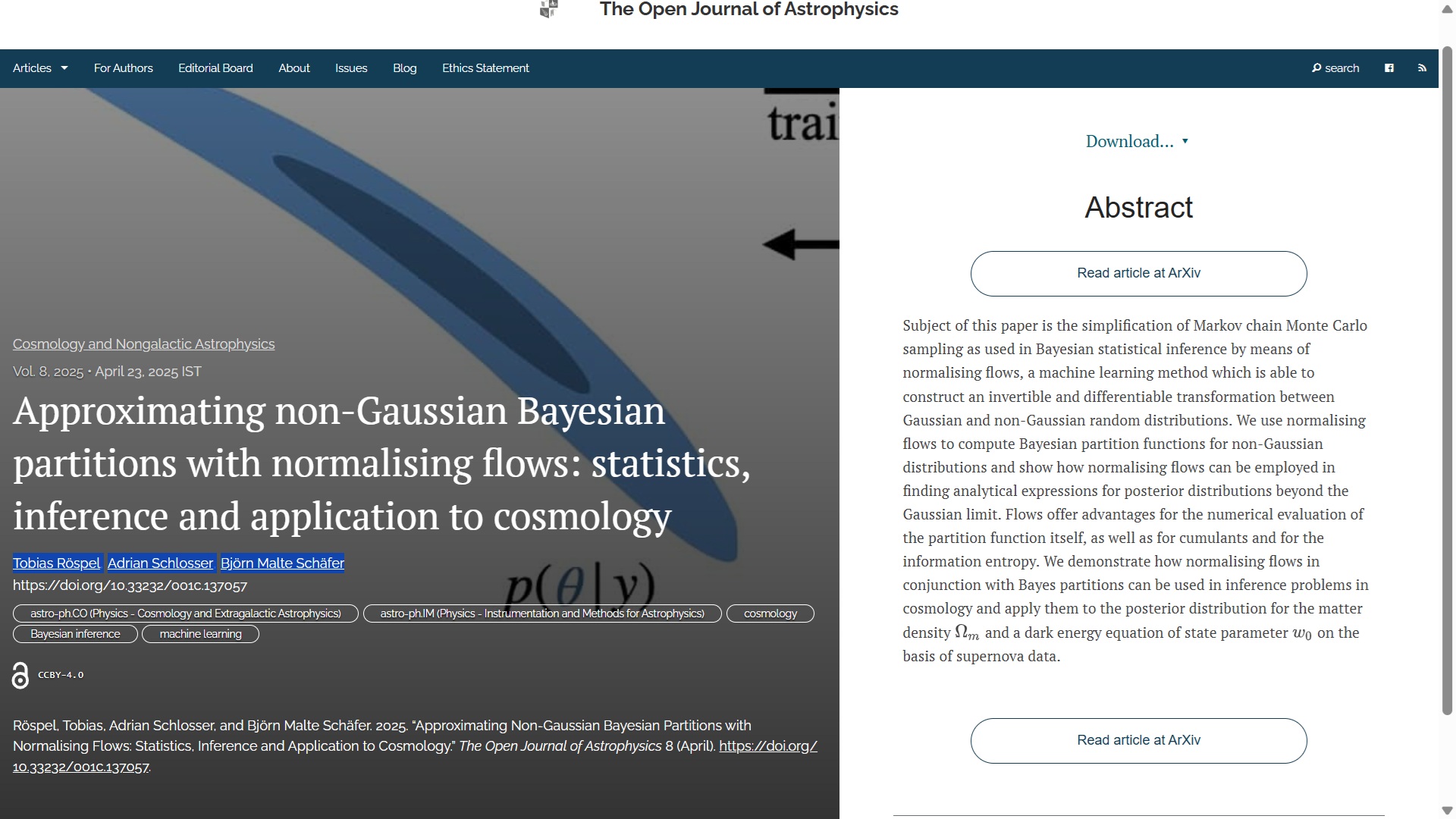
The next paper, also published on Wednesday 19th February in the folder Cosmology and Nongalactic Astrophysics is “Bayesian distances for quantifying tensions in cosmological inference and the surprise statistic” by Benedikt Schosser (Heidelberg, Germany), Pedro Riba Mello & Miguel Quartin (Rio de Janeiro, Brazil) and Bjoern Malte Schaefer (Heidelberg).  It presents a discussion of statistical divergences applied to posterior distributions following from different data sets and their use in quantifying discrepancies or tensions.

Here is the overlay:

The official published version can be found on the arXiv here.

Finally in this batch we have “Precise and Accurate Mass and Radius Measurements of Fifteen Galactic Red Giants in Detached Eclipsing Binaries” by Dominick M. Rowan,  Krzysztof Z. Stanek,  Christopher S. Kochanek & Todd A. Thompson (Ohio State University), Tharindu Jayasinghe (independent researcher),  Jacqueline Blaum (UC Berkeley),  Benjamin J. Fulton (NASA/Caltech),  Ilya Ilyin (AIP Potsdam, Germany),  Howard Isaacson, Natalie LeBaron  &  Jessica R. Lu (UC Berkeley), and  David V. Martin (Tufts University, USA).  This paper was published on Thursday 20th February 2025 in the folder Solar and Stellar Astrophysics and it presents a compilation of mass and readius measurements of red giant stars obtained using spectroscopic measurements together with light curves and the eclipsing binary models obtained using PHOEBE.

The overlay is here:

You can find the “final” version on arXiv here.

That’s all for this week. I’ll do another update next Saturday.

Weekly Update from the Open Journal of Astrophysics – 01/02/2025

Posted in OJAp Papers, Open Access, The Universe and Stuff with tags , , , , , , , , , , , , , , , , , , on February 1, 2025 by telescoper

It’s Saturday morning, so once again it’s time for an update of papers published at the Open Journal of Astrophysics. There were no papers to report last week but since the last update we have published four new papers, which brings the number in Volume 8 (2025) up to 11 and the total so far published by OJAp up to 246.

In chronological order of publication, the four papers published this week, with their overlays, are as follows. You can click on the images of the overlays to make them larger should you wish to do so.

First one up is  “A halo model approach for mock catalogs of time-variable strong gravitational lenses” by Katsuya T. Abe & Masamune Oguri (Chiba U, Japan), Simon Birrer & Narayan Khadka (Stony Brook, USA), Philip J. Marshall (Stanford, USA), Cameron Lemon (Stockholm U., Sweden), Anupreeta More (IUCAA, India), and the LSST Dark Energy Science Collaboration. It was published on 27th January 2025 in the folder marked Cosmology and NonGalactic Astrophysics. The paper discusses how to generate mock catalogs of strongly lensed QSOs and Supernovae on galaxy-, group-, and cluster-scales based on a halo model that incorporates dark matter halos, galaxies, and subhalos.


You can find the officially accepted version of this paper on arXiv here.

This paper, also published on Monday 27th January 2025, but in the folder Astrophysics of Galaxies, is “The Soltan argument at redshift 6: UV-luminous quasars contribute less than 10% to early black hole mass growth” by Knud Jahnke (MPI Heidelberg, Germany). This paper presents an argument that almost all growth of supermassive black hole mass at z>6 does not take place in UV-luminous quasars.

Here is a screen grab of the overlay, which includes the abstract:You can find the officially accepted version of the paper on the arXiv here.

The third paper to announce, published on 29th January 2025 in the folder Cosmology and NonGalactic Astrophysics, is “A Heavy Seed Black Hole Mass Function at High Redshift – Prospects for LISA” by Joe McCaffrey & John Regan (Maynooth U., Ireland), Britton Smith (Edinburgh U., UK), John Wise (Georgia Institute of Technology, USA), Brian O’Shea (Michigan State U., USA) and Michael Norman (University of California, San Diego). This is a numerical study of the growth rates of massive black holes in the early Universe and implications for their detection via gravitational wave emission.

You can see the overlay here:


The accepted version of this paper can be found on the arXiv here.

The last paper of this batch is “Forecasting the Detection of Lyman-alpha Forest Weak Lensing from the Dark Energy Spectroscopic Instrument and Other Future Surveys” by Patrick Shaw & Rupert A. C. Croft (Carnegie Mellon U., USA) and R. Benton Metcalf (U. Bologna, Italy). This paper, published on January 30th 2025, is about extending the applicationof  Lyman-α forest weak gravitational lensing to lower angular source densities than has previously been done, with forecasts for future spectral surveys. It is in the folder marked Cosmology and NonGalactic Astrophysics.

The overlay is here


You can find the accepted version on arXiv here.

Incidentally, we currently have 121 papers under review, including 81 under a revise and resubmit request.

That’s all for this week. I’ll do another update next Saturday.

Weekly Update from the Open Journal of Astrophysics – 18/01/2025

Posted in OJAp Papers, Open Access, The Universe and Stuff with tags , , , , , , , , , , on January 18, 2025 by telescoper

It’s Saturday morning so once again it’s time for an updated of papers published at the Open Journal of Astrophysics. Since the last update we have published three new papers which brings the number in Volume 8 (2025) up to 7 and the total so far published by OJAp up to 242.

In chronological order of publication, the three papers published this week, with their overlays, are as follows. You can click on the images of the overlays to make them larger should you wish to do so.

First one up is “Potential-density pairs for Galaxy discs with exponential or sech^2 vertical profile” by Walter Dehnen and Shera Jafaritabar (Heidelberg, Germany). This paper was published on Tuesday 14th January 2025 in the folder marked Astrophysics of Galaxies. It presents a new set of analytic models for the structure of disc galaxies. The overlay, which includes the abstract, is here:

You can find the officially accepted version of this paper on arXiv here.

The second paper, which was published on Thursday 17th January 2025 also in the folder Astrophysics of Galaxies, is “Quantifying Bursty Star Formation in Dwarf Galaxies” by Yuan-Sen Ting (Ohio State University) and Alexander Ji (U. Chicago). This paper describes an application of Gaussian mixture models to distinguish between discontinuous and continuous star formation histories in dwarf galaxies.

Here is a screen grab of the overlay, which includes the abstract:You can find the officially accepted version of the paper on the arXiv here.

The third paper to announce, also published on 17th January 2025 but in the folder Cosmology and NonGalactic Astrophysics, is “Fast Projected Bispectra: the filter-square approach” by Lea Harscouet, Jessica A. Cowel, Julia Ereza & David Alonso (Oxford U., UK), Hugo Camacho (Brookhaven National Laboratory, USA), Andrina Nicola (Bonn, Germany) and Anže Slosar (Brookhaven). This paper presents Presenting the filtered-squared bispectrum (FSB), a fast and robust estimator of the projected bispectrum for use on cosmological data sets.

You can see the overlay here:

The accepted version of this paper can be found on the arXiv here.

That’s all for this week. I’ll do another update next Saturday.

Weekly Update from the Open Journal of Astrophysics – 11/01/2025

Posted in OJAp Papers, Open Access, The Universe and Stuff with tags , , , , , , , , , , , , on January 11, 2025 by telescoper

Welcome to the first update of 2025 from the Open Journal of Astrophysics. For the new year we have started Volume 8. Since the last update of 2024 we have published four new papers which brings the total so far published by OJAp up to 239.

In chronological order of publication, the four papers published this week, with their overlays, are as follows. You can click on the images of the overlays to make them larger should you wish to do so.

First one up is “Weak-Lensing Shear-Selected Galaxy Clusters from the Hyper Suprime-Cam Subaru Strategic Program: I. Cluster Catalog, Selection Function and Mass–Observable Relation” by Kai-Feng Chen (MIT, USA), I-Non Chiu (National Cheng University, Taiwan), Masamune Oguri (Chiba University, Japan), Yen-Ting Lin (IAAAS, Taiwan), Hironao Miyatake (Nagoya, Japan), Satoshi Miyazaki (Nat. Astr. Obs. Japan), Surhud More (IUCAA, India), Takashi Hamana (Nat. Astr. Obs. Japan), Markus M. Rau Carnegie Mellon University, USA), Tomomi Sunayama (Steward Obs., USA), Sunao Sugiyama (U. Penn, USA), Masahiro Takada (U. Tokyo, Japan).

This paper, which was published on Monday 6th January 2025 is in the folder Cosmology and NonGalactic Astrophysics, discusses steps towards towards the extraction of cosmogical constraints from a sample of galaxy clusters selected via weak gravitational lensing

Here is a screen grab of the overlay, which includes the abstract:

You can find the officially accepted version of the paper on the arXiv here.

The second paper to announce, published on 7th January 2025 and also in the folder Cosmology and NonGalactic Astrophysics, is “Cosmology on point: modelling spectroscopic tracer one-point statistics” by Beth McCarthy Gould (Newcastle U., UK), Lina Castiblanco (Bielefeld, Germany), Cora Uhlemann (Bielefeld, Germany), and Oliver Friedrich (LMU, Germany).

You can see the overlay here:

The accepted version of this paper can be found on the arXiv here.

The third paper, published on 9th January 2025, also in the folder Cosmology and NonGalactic Astrophysics, is “Probing Environmental Dependence of High-Redshift Galaxy Properties with the Marked Correlation Function” by Emy Mons and Charles Jose (Cochin University of Science and Technology, India). This paper uses the marked two-point correlation function to measure the environmental dependence of galaxy clustering at high redshift.

Here is the overlay:

The final version accepted on arXiv is here.

Last of this quartet, also published on 9th January 2025, but in the folder Astrophysics of Galaxies is “The infrared luminosity of retired and post-starburst galaxies: A cautionary tale for star formation rate measurements” by Vivienne Wild (St Andrews, UK), Natalia Vale Asari (Universidade Federal de Santa Catarina, Brazil), Kate Rowlands (STScI, Sara L. Ellison (U. Victoria, Canada), Ho-Hin Leung (St Andrews), Christy Tremonti (U. Wisconsin-Madison, USA).

The paper proposes an extension of the semi-analytic formalism to weak lensing and thermal Sunyaev-Zeldovich (tSZ) fields directly on the full-sky, with an emphasis on higher-order correlations. The overlay is here:

You can find the official accepted version on the arXiv here.

That’s all for this week. I’ll do another update next Saturday.

New Publication at the Open Journal of Astrophysics

Posted in OJAp Papers, Open Access, The Universe and Stuff with tags , , , , , on December 28, 2024 by telescoper

I wasn’t planning to do the usual weekly update of activity at the Open Journal of Astrophysics this morning as I thought we wouldn’t publish any more papers between last week’s update and the Christmas break. However, one final version did hit the arXiv on Christmas Eve so I decided to publish it straight away. This brings the total for Volume 7 (2024) to 120 – a neat average of ten a month – and the overall total to 235.

Here’s a table showing the sequence of papers published over the last six years and the series formed from the aforementioned sequence:

Year201920202021202220232024
Papers1215171750120
Total16314865115235

Anyway, the new paper is “Galaxy evolution in the post-merger regime. II – Post-merger quenching peaks within 500 Myr of coalescence” by Sara Ellison (U. Victoria, Canada), Leonardo Ferreira (U. Victoria), Vivienne Wild, (St Andrews, UK), Scott Wilkinson (U. Victoria), Kate Rowlands, (STScI, USA) & David R. Patton (Trent U., Canada). It was published on 24th December 2024 in the folder marked Astrophysics of Galaxies. It comprises an investigation of the possibility that quenching of star formation is a consequence of galaxy-galaxy interactions and mergers. The overlay is here:

You can find the officially accepted version on arXiv here.

Well, that definitely concludes the updates for 2024. I’ll be back on January 4th with the first update of 2025.

Extrapolation of the Open Journal of Astrophysics

Posted in Open Access with tags , , on December 18, 2024 by telescoper

This morning I published another paper at the Open Journal of Astrophysics, taking the total number of publications for this year to 115 and the total altogether to 230. This means that we have now published as many papers this year as we have in all previous years combined. Here’s a table showing the sequence of papers published over the last six years and the series formed from the aforementioned sequence:

Year201920202021202220232024
Papers1215171750115*
Total16314865115230

(*=not out)

We’ll probably publish a few more by the end of the year – there seems to be a bit of a rush right now of people submitting papers before the break – so the final column may change. Anyway, the bigger question is I wonder what will happen next year? Extrapolating from the last two years using a simple model, we will publish about 230 papers next year, 460 the year after that, then 920, 1820, etc. Even at that optimistic rate it will take us several years to catch up to the big astronomical publishers, who publish thousands of papers per year.

As Niels Bohr once said “Prediction is very difficult, especially about the future” but I wonder if anyone would like to make a guess as to how many papers we will publish in 2025. This time next year we’ll see who was closest. The prize will be a year’s free subscription to the Open Journal of Astrophysics.

Still, after a slow start it’s very gratifying to be accelerating. I’m certainly glad that I managed to use some of my sabbatical time automating the publishing side of the OJAp operation otherwise I’d definitely be struggling to keep up!

Anyway, this gives me the opportunity to make a small announcement about the forthcoming Christmas break. The site will remain open for submissions throughout the festive season, but please be aware that our volunteer Editors all deserve a bit of rest – as do referees – so progress may be slow at this time.

You may or may not know that the Scholastica platform we use is actually two distinct websites: one for peer review (used by all editors and authors); and the other for publishing (to which I, as Managing Editor, have sole access). I will be taking a break over Christmas and also preparing Volume 8 (2025) for the new year, so publishing will be suspended from 24th December until 2nd January (inclusive). If you want your paper to be published in 2024 the final version must be on arXiv by Monday 23rd December at the latest, otherwise it will be held over until 2025.