Archive for ultra-faint dwarf galaxy

Weekly Update from the Open Journal of Astrophysics – 22/11/2025

Posted in OJAp Papers, Open Access, The Universe and Stuff with tags , , , , , , , , , , , , , , , , , , , , , on November 22, 2025 by telescoper

It’s Saturday again, so it’s time for the usual update of the week’s new papers at the Open Journal of Astrophysics. Since the last update we have published another five papers, which brings the number in Volume 8 (2025) up to 180, and the total so far published by OJAp up to 415.

The first paper to report this week is “Probing Anisotropic Cosmic Birefringence with Foreground-Marginalised SPT B-mode Likelihoods” by Lennart Balkenhol (Sorbonne Université, France), A. Coerver (UC Berkeley, USA), C. L. Reichardt (U. Melbourne, Australia) and J. A. Zebrowski (U. Chicago, USA). This paper was published on Monday November 17th in the folder Cosmology and Nongalactic Astrophysics. It presents a way of using data from the Souh Pole Telescope (SPT) in the CMB-lite framework to constrain the level of cosmic birefringence.  The overlay is here:
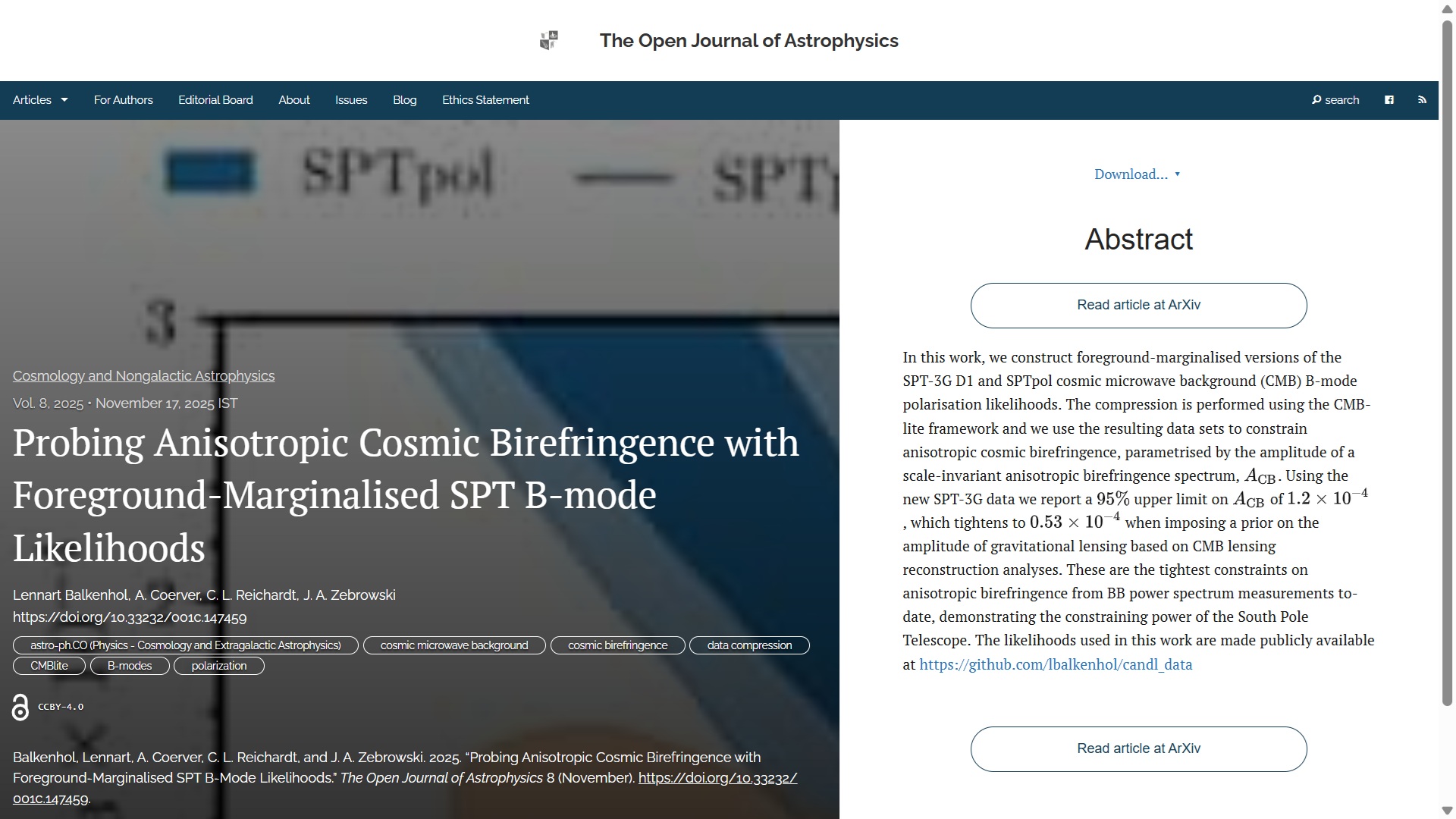
You can find the officially accepted version on arXiv here and the The Fediverse announcement is here:

Open Journal of Astrophysics

New Publication at the Open Journal of Astrophysics: "Probing Anisotropic Cosmic Birefringence with Foreground-Marginalised SPT B-mode Likelihoods" by Lennart Balkenhol (Sorbonne Université, France), A. Coerver (UC Berkeley, USA), C. L. Reichardt (U. Melbourne, Australia) and J. A. Zebrowski (U. Chicago, USA)

doi.org/10.33232/001c.147459

November 17, 2025, 8:43 am 1 boosts 0 favorites

The second paper of the week is “Radio Observations of a Candidate Redback Millisecond Pulsar: 1FGL J0523.5-2529” by Owen. A. Johnson & E. F. Keane (Trinity College Dublin, Ireland), D. J. McKenna (ASTRON, NL), H. Qiu (SKAO, UK), S. J. Swihart (Insitute for Defense Analyses, USA), J. Strader (Michigan State U., USA) and M. McLaughlin (West Virginia U., USA). This one was published on Tuesday November 18th 2025 in the folder marked High-Energy Astrophysical Phenomena and it describes a search for radio emission from a candidate “redback pulsar” J0523.5-2529 resulting in upper limits but no detection.

The overlay is here:
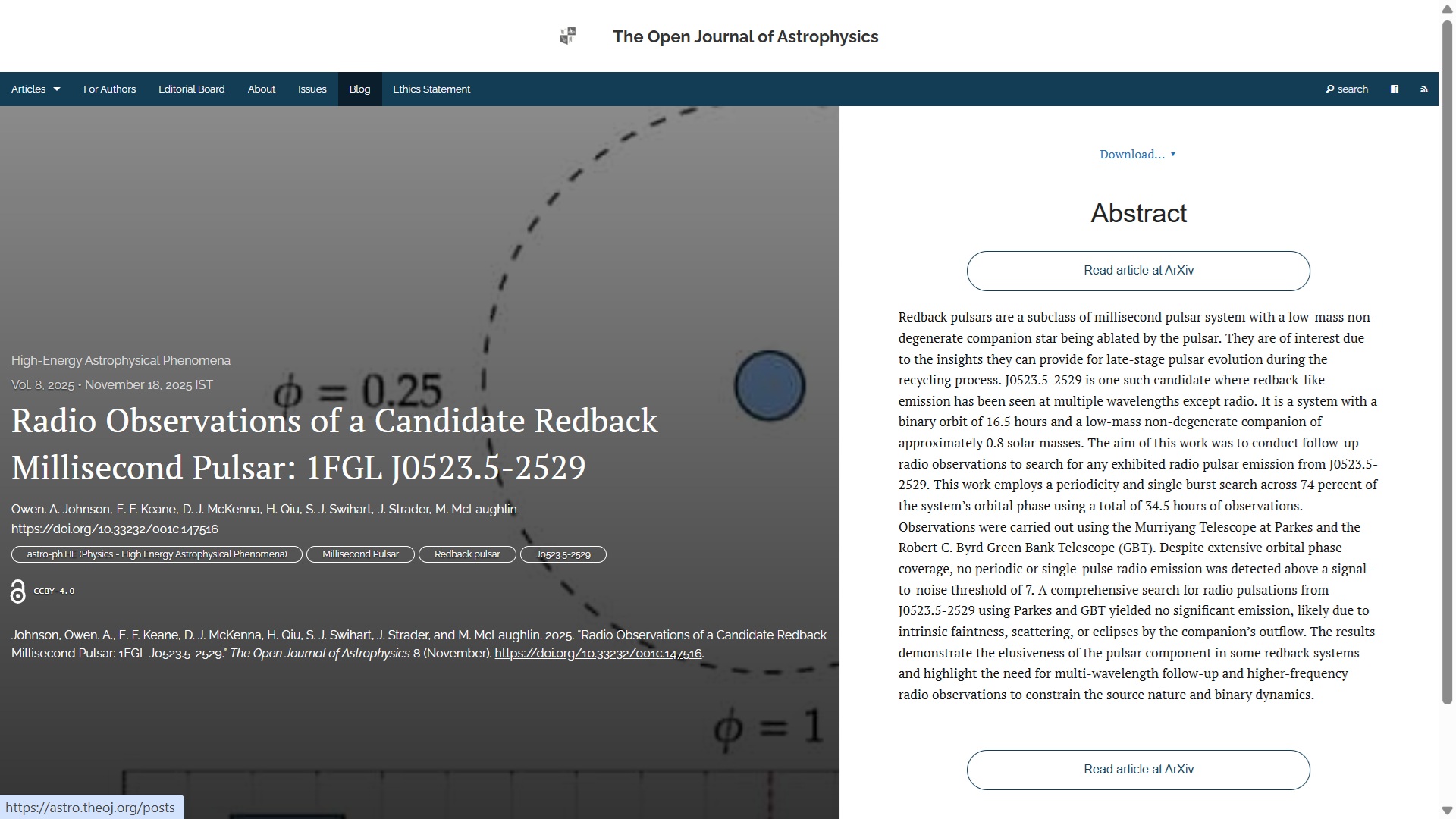
You can find the official version of this one on arXiv here. The federated announcement on Mastodon is here:

Open Journal of Astrophysics

New Publication at the Open Journal of Astrophysics: "Radio Observations of a Candidate Redback Millisecond Pulsar: 1FGL J0523.5-2529" by Owen. A. Johnson & E. F. Keane (Trinity College Dublin, Ireland), D. J. McKenna (ASTRON, NL), H. Qiu (SKAO, UK), S. J. Swihart (Insitute for Defense Analyses, USA), J. Strader (Michigan State U., USA) and M. McLaughlin (West Virginia U., USA)

doi.org/10.33232/001c.147516

November 18, 2025, 8:42 am 1 boosts 0 favorites

Next one up is “The role of turbulence in setting the phase of the ISM and implications for the star formation rate” by Tine Colman (Université Paris-Saclay, France) and 13 others based in France, Germany, Italy and the UK. This was published in the folder Astrophysics of Galaxies on Tuesday November 18th. It descrtibes using a suite of stratified box simulations to explore the link between star formation, turbulence and the thermal state of the multi-phase interstellar medium (ISM).

The overlay is here:
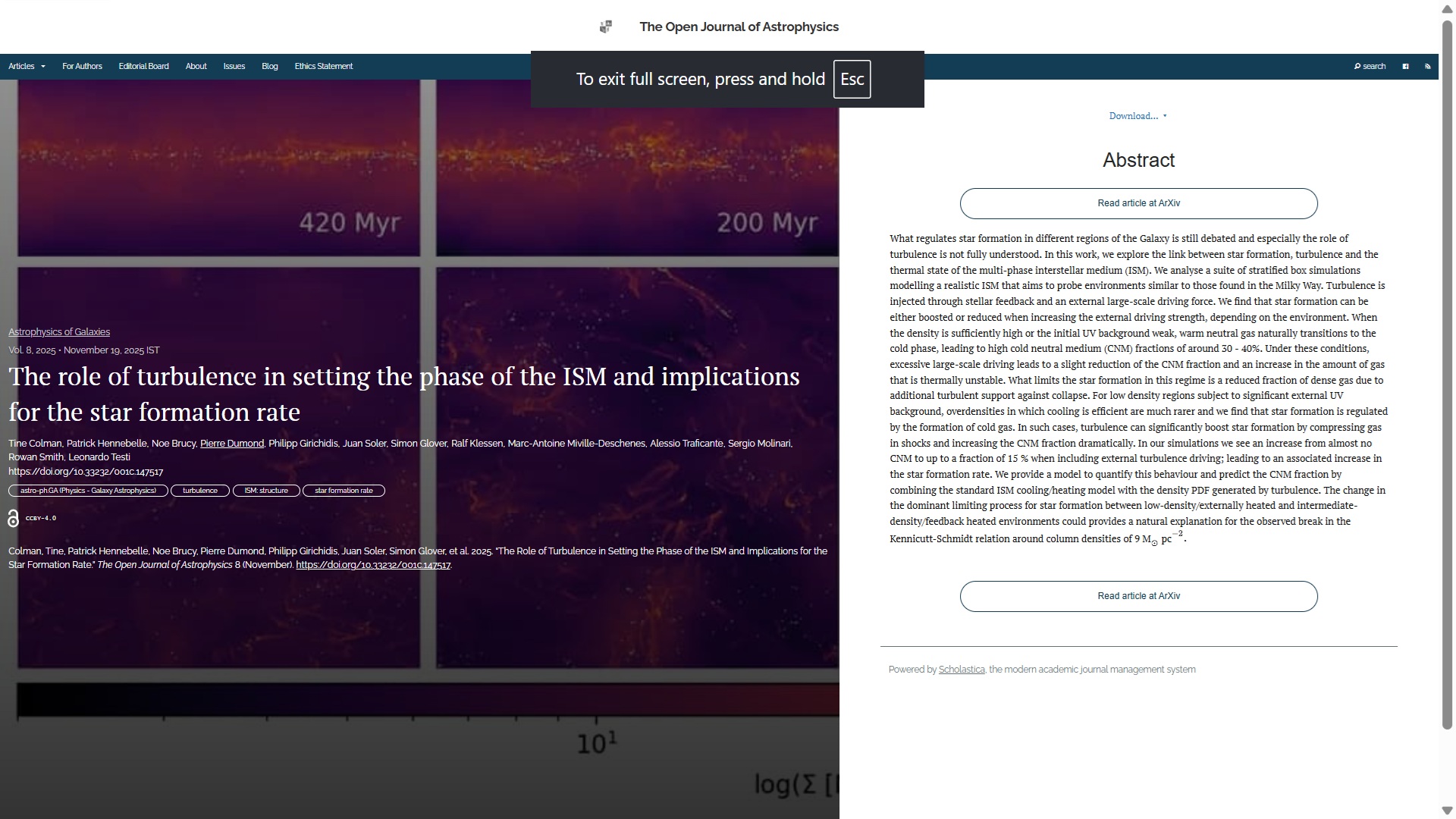
You can find the official accepted version on arXiv here. The fediverse announcement is here:

Open Journal of Astrophysics

New Publication at the Open Journal of Astrophysics: "The role of turbulence in setting the phase of the ISM and implications for the star formation rate" by Tine Colman (Université Paris-Saclay, France) and 13 others based in France, Germany, Italy and the UK.

doi.org/10.33232/001c.147517

November 19, 2025, 8:19 am 0 boosts 0 favorites

The fourth paper of the week is “A Bimodal Metallicity Distribution Function in the Ultra-Faint Dwarf Galaxy Reticulum II” by Alice M. Luna (U. Chicago, USA) and 8 others based in the USA, Korea and Canada. This was published on Wednesday November 19th in the folder Astrophysics of Galaxies. It decribes low-resolution Magellan/IMACS spectroscopy of 167 stars in the ultra-faint galaxy Reticulum II, revealing a clearly bimodal distribution.

The overlay is here:
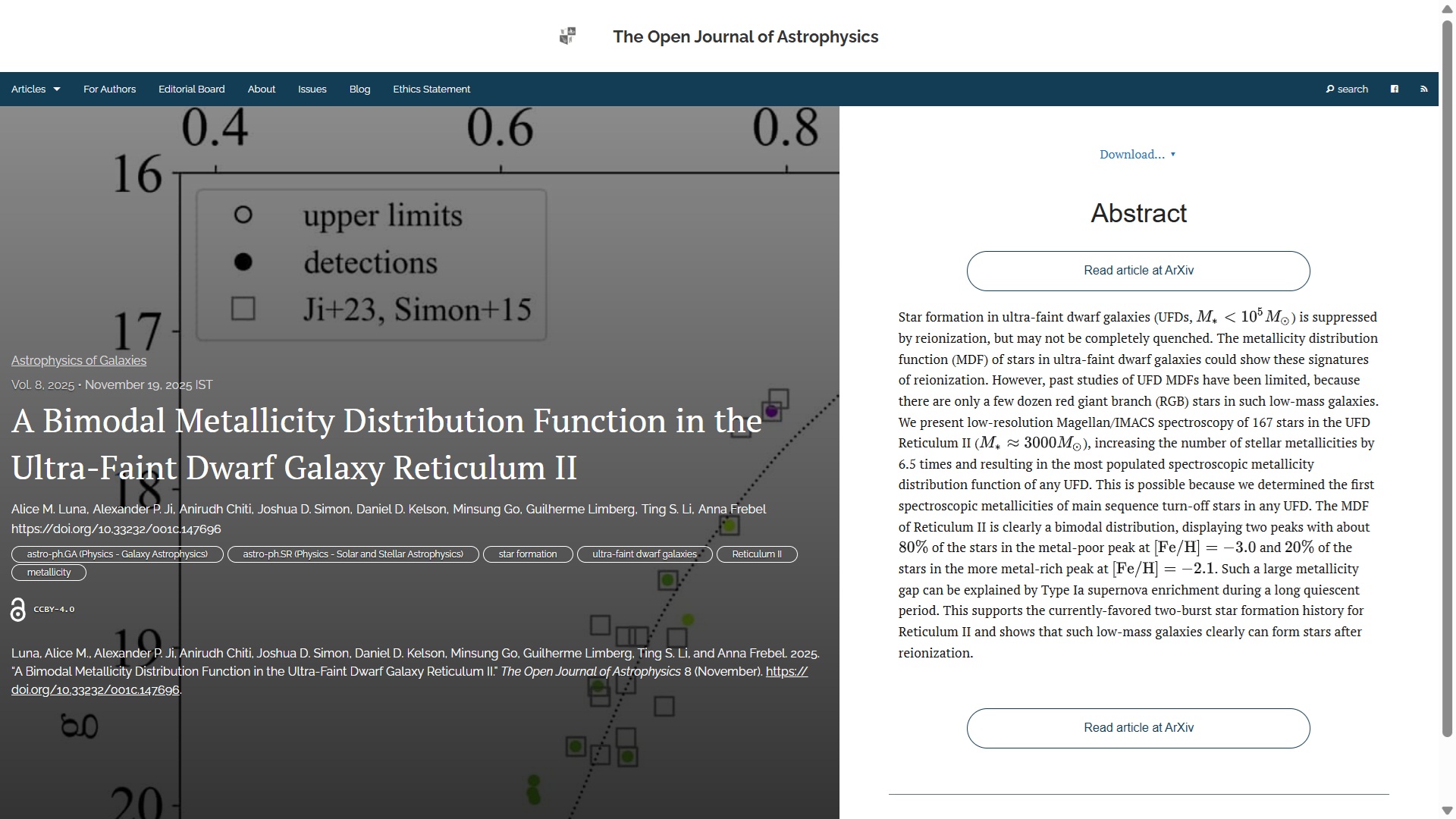
You can find the official published version on arXiv here. The Fediverse announcement follows:

Open Journal of Astrophysics

New Publication at the Open Journal of Astrophysics: "A Bimodal Metallicity Distribution Function in the Ultra-Faint Dwarf Galaxy Reticulum II" by Alice M. Luna (U. Chicago, USA) and 8 others based in the USA, Korea and Canada.

doi.org/10.33232/001c.147696

November 19, 2025, 8:37 am 0 boosts 0 favorites

The fifth and final paper for this week is “Cool Gas in the Circumgalactic Medium of Massive Post Starburst Galaxies” by Zoe Harvey, Sahyadri Krishna, Vivienne Wild & Rita Tojeiro (U. St Andrews, UK) and Paul Hewett (U. Cambridge, UK). This was published on Thursday November 20th in the folder Astrophysics of Galaxies.

The overlay is here:

The officially accepted version can be found on arXiv here. The Fediverse announcement is here:

Open Journal of Astrophysics

New Publication at the Open Journal of Astrophysics: "Cool Gas in the Circumgalactic Medium of Massive Post Starburst Galaxies" by Zoe Harvey, Sahyadri Krishna, Vivienne Wild & Rita Tojeiro (U. St Andrews, UK) and Paul Hewett (U. Cambridge, UK)

doi.org/10.33232/001c.147836

November 20, 2025, 9:02 am 1 boosts 0 favorites

And that concludes the update for this week. I will do another next Saturday.
Weekly Update from the Open Journal of Astrophysics – 11/10/2025

Posted in OJAp Papers, Open Access, The Universe and Stuff with tags , , , , , , , , , , , , , , , , , , , , , on October 11, 2025 by telescoper

It’s time once again for the usual Saturday update of the week’s new papers at the Open Journal of Astrophysics. Since the last update we have published six  more papers, which brings the number in Volume 8 (2025) up to 152, and the total so far published by OJAp up to 387. Not only have we passed the 150 mark for the year, but this week saw another record for the Journal, in that it was the first week in which we published at least one paper on every day.

Anyway, here are this week’s papers:

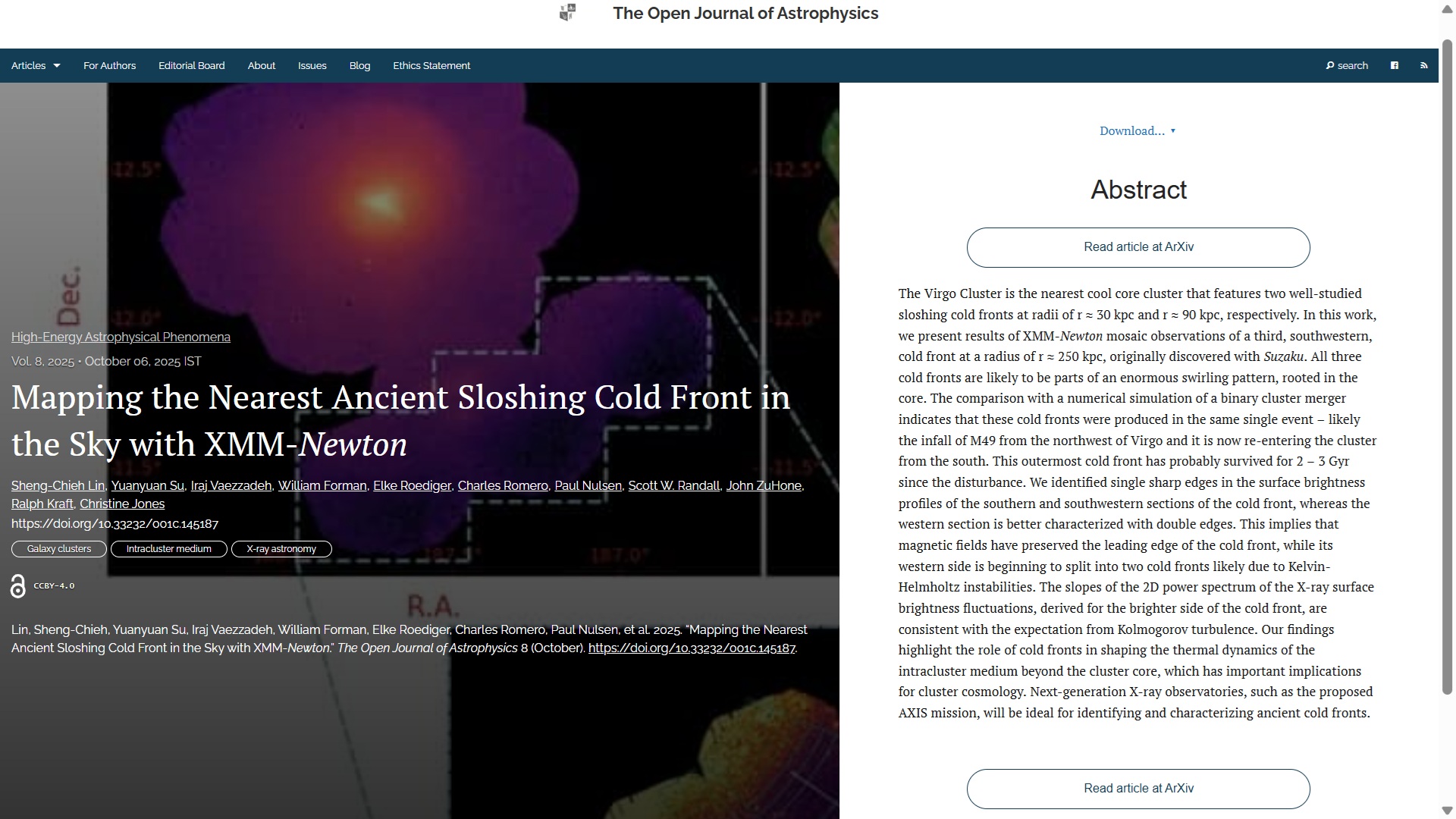
The first paper is “Mapping the Nearest Ancient Sloshing Cold Front in the Sky with XMM-Newton” by Sheng-Chieh Lin (University of Kentucky) and 10 others based in the USA, Spain and Germany. This article, published on Monday 6th October 2025, in the section High-Energy Astrophysical Phenomena discusses cold fronts in the Virgo Cluster, their importance in shaping the thermal dynamics of the intracluster medium beyond the cluster core, and their implications for cluster cosmology.

The overlay is here:


The officially accepted version of this paper can be found on the arXiv here.

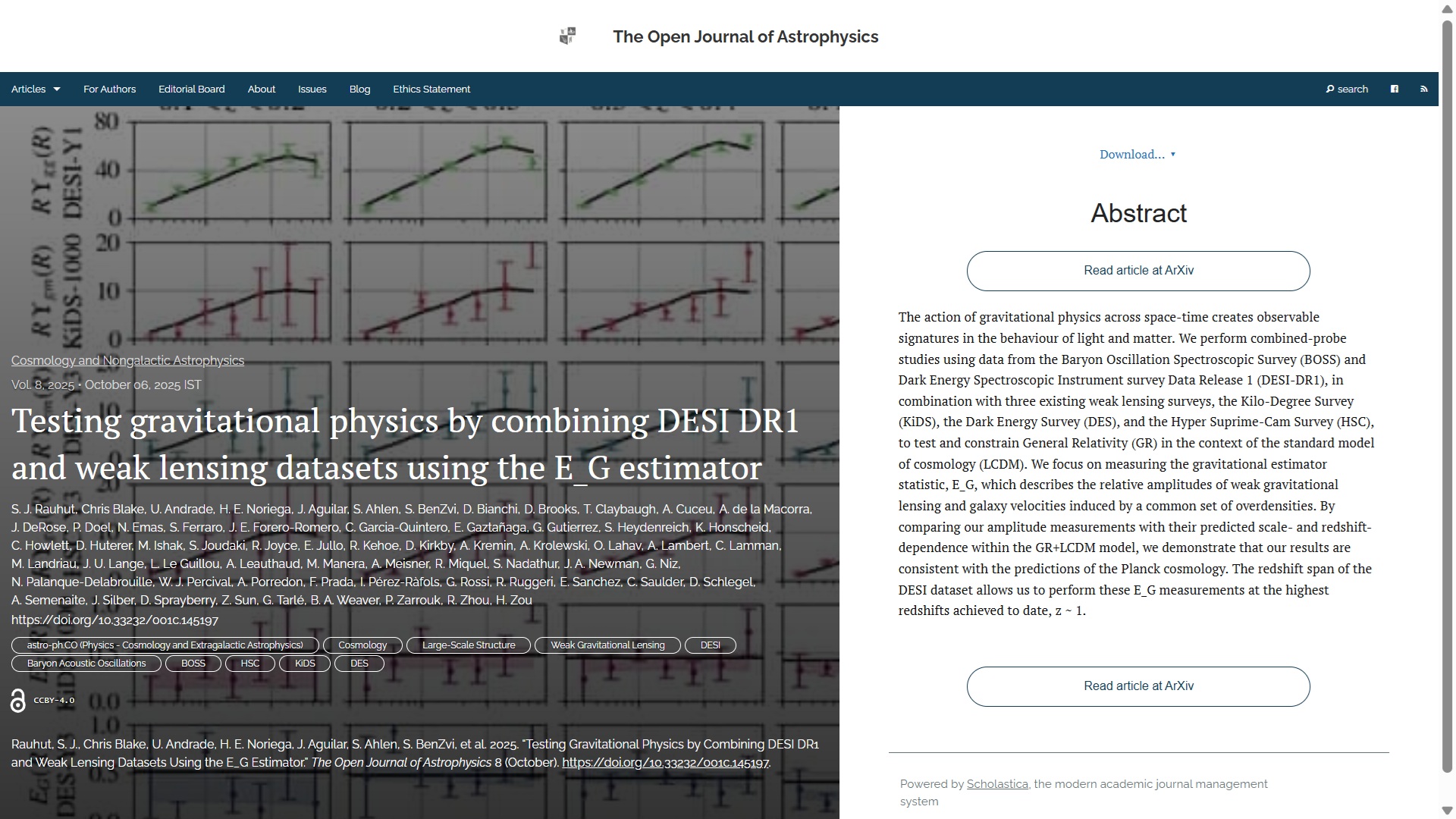
The second paper this week, also published on Monday 6th October, is “Testing gravitational physics by combining DESI DR1 and weak lensing datasets using the E_G estimator” by S.J. Rauhut (Swinburne University of Technology, Australia) and an international cast of 63 others. This one is in the folder Cosmology and NonGalactic Astrophysics, and it presents a comparison of  Baryon Acoustic Oscillation (BAO) measurements from BOSS, DESI with weak lensing from KiDS, DES and HSC showing that the results are altogether consistent with the standard cosmological model.

The overlay is here:

You can find the officially accepted version of this paper on arXiv here.

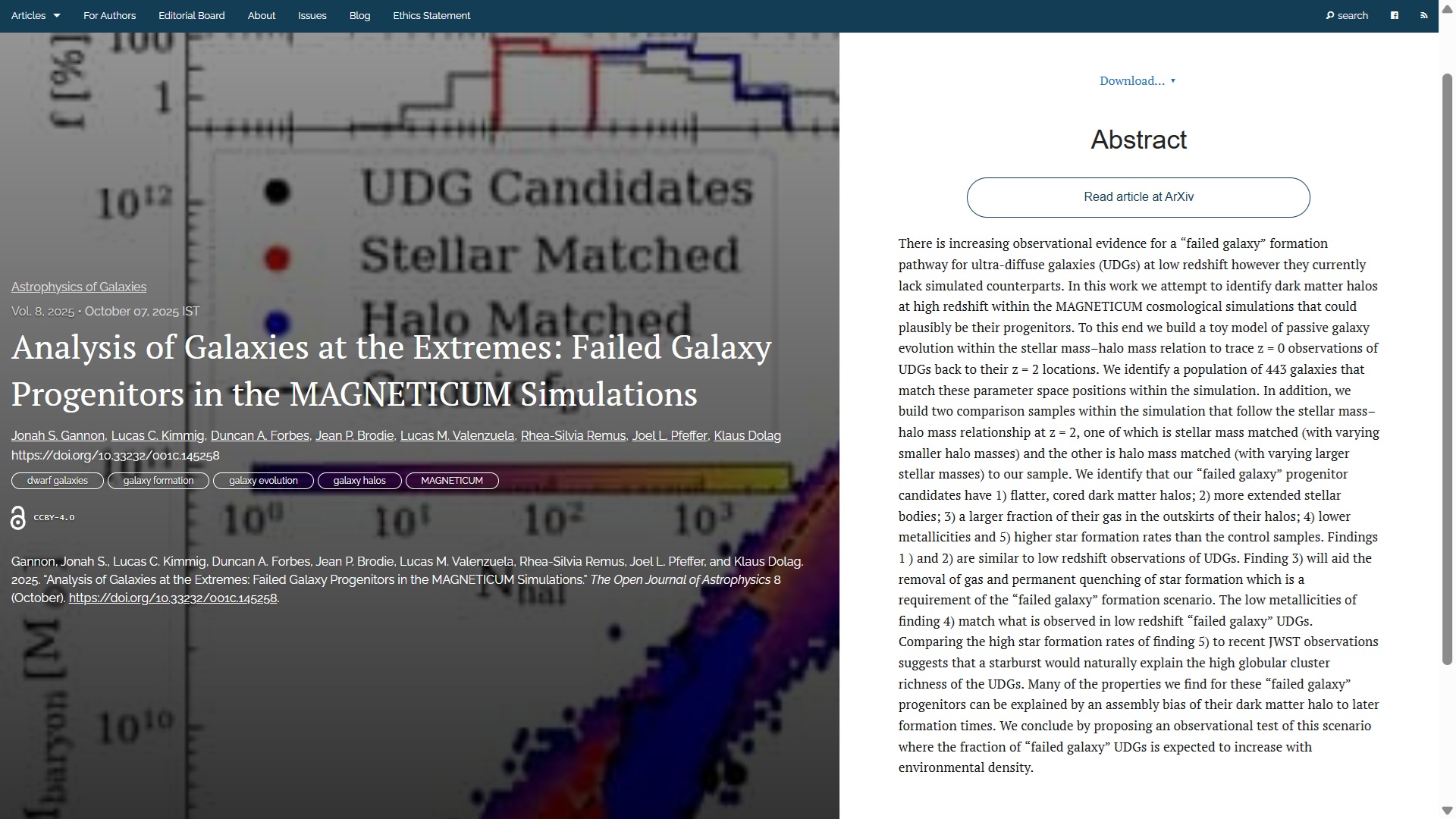
Next one up is “Analysis of Galaxies at the Extremes: Failed Galaxy Progenitors in the MAGNETICUM Simulations” by Jonah S. Gannon (Swinburne University, Australia), Lucas C. Kimmig (Ludwig-Maximilians-Universität, Germany; LMU), Duncan A. Forbes (Swinburne), Jean P. Brodie (Swinburne), Lucas M. Valenzuela (LMU), Rhea-Silvia Remus (LMU), Joel L. Pfeffer (Swinburne) and Klaus Dolag (LMU). This paper, published on Tuesday 7th October 2025, in the folder Astrophysics of Galaxies, discusses the business of identifying the possible high-redshift progenitors of low-redshift ultra-diffuse galaxies in cosmological simulations.

The corresponding overlay is here:

You can find the officially accepted version on arXiv here.

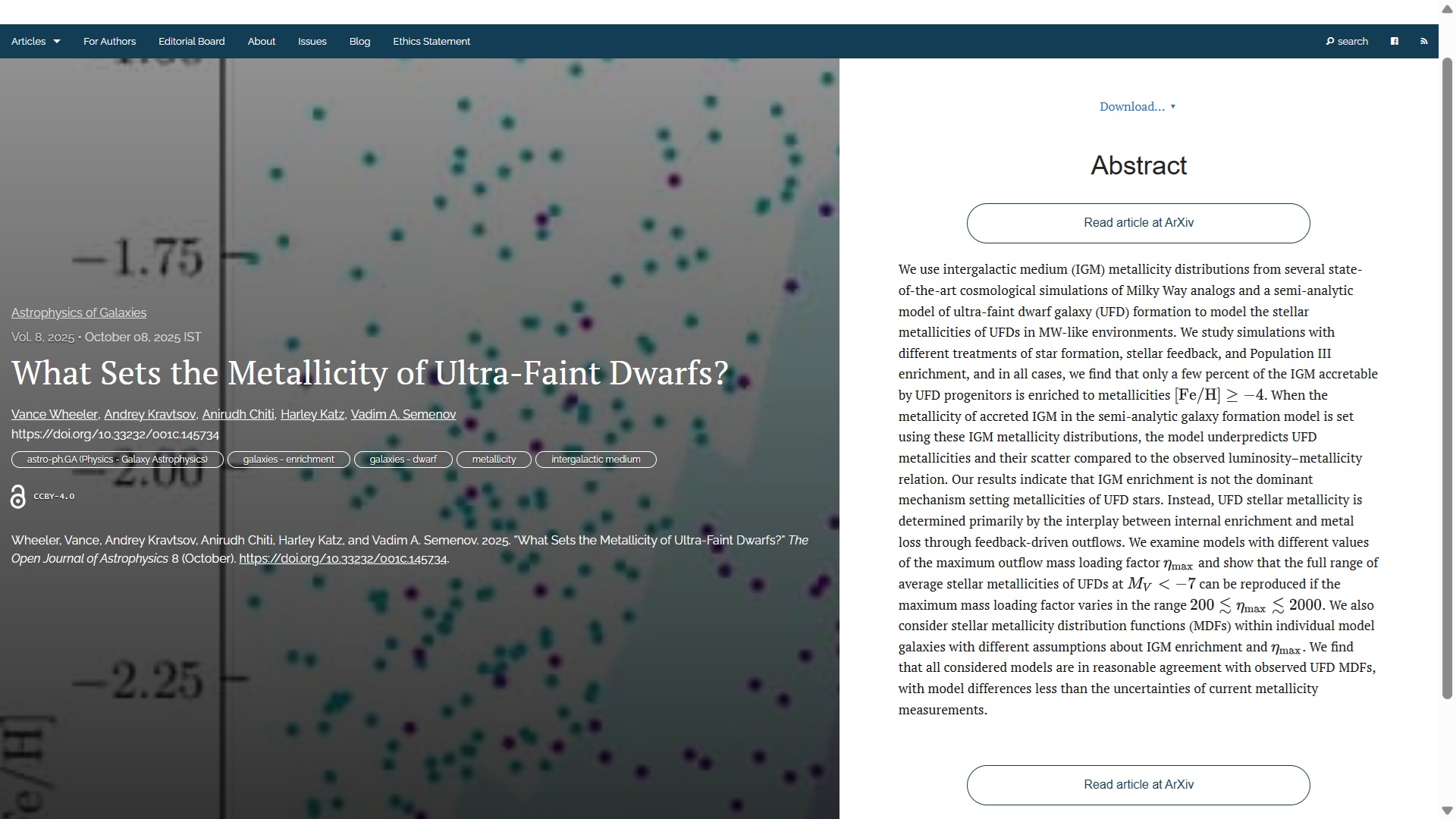
The fourth paper this week, published on Wednesday 8th October 2025 in the folder Astrophysics of Galaxies,  is
What Sets the Metallicity of Ultra-Faint Dwarfs?” by Vance Wheeler, Andrey Kravtsov, Anirudh Chiti & Harley Katz (U. Chicago) and Vadim A. Semenov (CfA Harvard), all based in the USA.

The overlay is here:

You can find the officially-accepted version on arXiv here.

Next, and fifth, we have our 150th publication of 2025, “Synthesizer: a Software Package for Synthetic Astronomical Observables” by Christopher C. Lovell (Cambridge, UK), William J. Roper, Aswin P. Vijayan & Stephen M. Wilkins (Sussex, UK), Sophie Newman (Portsmouth, UK) and Louise Seeyave (Sussex). This paper presents a suite of software tools for creating synthetic astrophysical observables for use in mock galaxy catalogues. It was published on Thursday 9th October 2025 in the folder Instrumentation and Methods for Astrophysics.

The overlay is here:

You can find the officially accepted version on arXiv here.

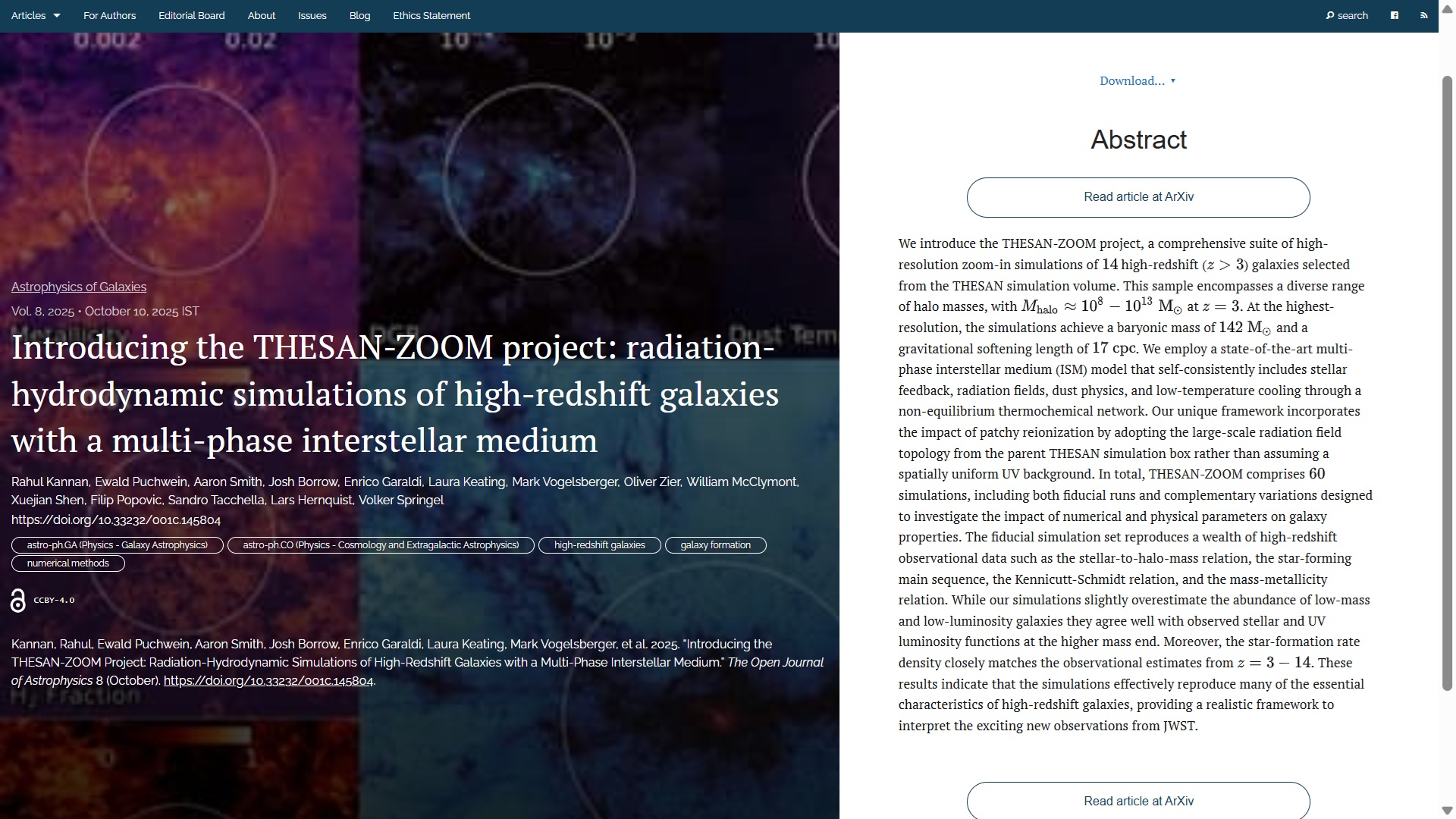
And finally for this week we have “Introducing the THESAN-ZOOM project: radiation-hydrodynamic simulations of high-redshift galaxies with a multi-phase interstellar medium” by Rahul Kannan (York University, Canada) and 13 others based in the USA, Germany, Japan, Italy and the UK. This one was published on Friday 10th October (i.e. yesterday) in the folder Astrophysics of Galaxies. It describes a comprehensive suite of high-resolution zoom-in simulations of high-redshift galaxies, encompassing a diverse range of halo masses, selected from the THESAN simulation volume.

The corresponding overlay is here:

You can find the officially accepted version of this one on arXiv here.

That concludes the papers for this week. I will, however, add a short postscript. This week saw the announcement of this year’s list of MacArthur Fellows. among them Kareem El-Badry who has published quite a few papers with the Open Journal of Astrophysics. His biography on the MacArthur Foundation page includes this:

He has published articles in Monthly Notices of the Royal Astronomical SocietyThe Astrophysical Journal, and The Open Journal of Astrophysics, among other leading scientific journals.

I’m pleased to see us listed with the established names. I mention this just in case there are still people out there who think it might damage their career if they publish with a non-mainstream journal. I guess we are mainstream now…

Weekly Update from the Open Journal of Astrophysics – 09/08/2025

Posted in OJAp Papers, Open Access, The Universe and Stuff with tags , , , , , , , , , , , , , , , , , , , , , on August 9, 2025 by telescoper

It’s Saturday morning so, once again, it’s time for an update of papers published at the Open Journal of Astrophysics. Since the last update we have published four new papers, which brings the number in Volume 8 (2025) up to 114, and the total so far published by OJAp up to 349.

The papers published this week, with their overlays, are as follows. You can click on the images of the overlays to make them larger should you wish to do so.

The first paper to report is “Caught in the Act of Quenching? – A Population of Post-Starburst Ultra-Diffuse Galaxies” by Loraine Sandoval Ascencio & M. C. Cooper (UC Irvine), Dennis Zaritsky, Richard Donnerstein & Donghyeon J. Khim (U. Arizona) and Devontae C. Baxter (UC San Diego). This paper was puvblished on Monday 4th August and is in the folder marked Astrophysics of Galaxies. It discusses a sample of Ultra-Diffuse Galaxies (UDGs) found to be post-starburst galaxies through spectroscopic analysis analysis of candidates selected from the Systematically Measuring Ultra-Diffuse Galaxies (SMUDGes) program.

The overlay is here:


The officially-accepted version can be found on arXiv here.

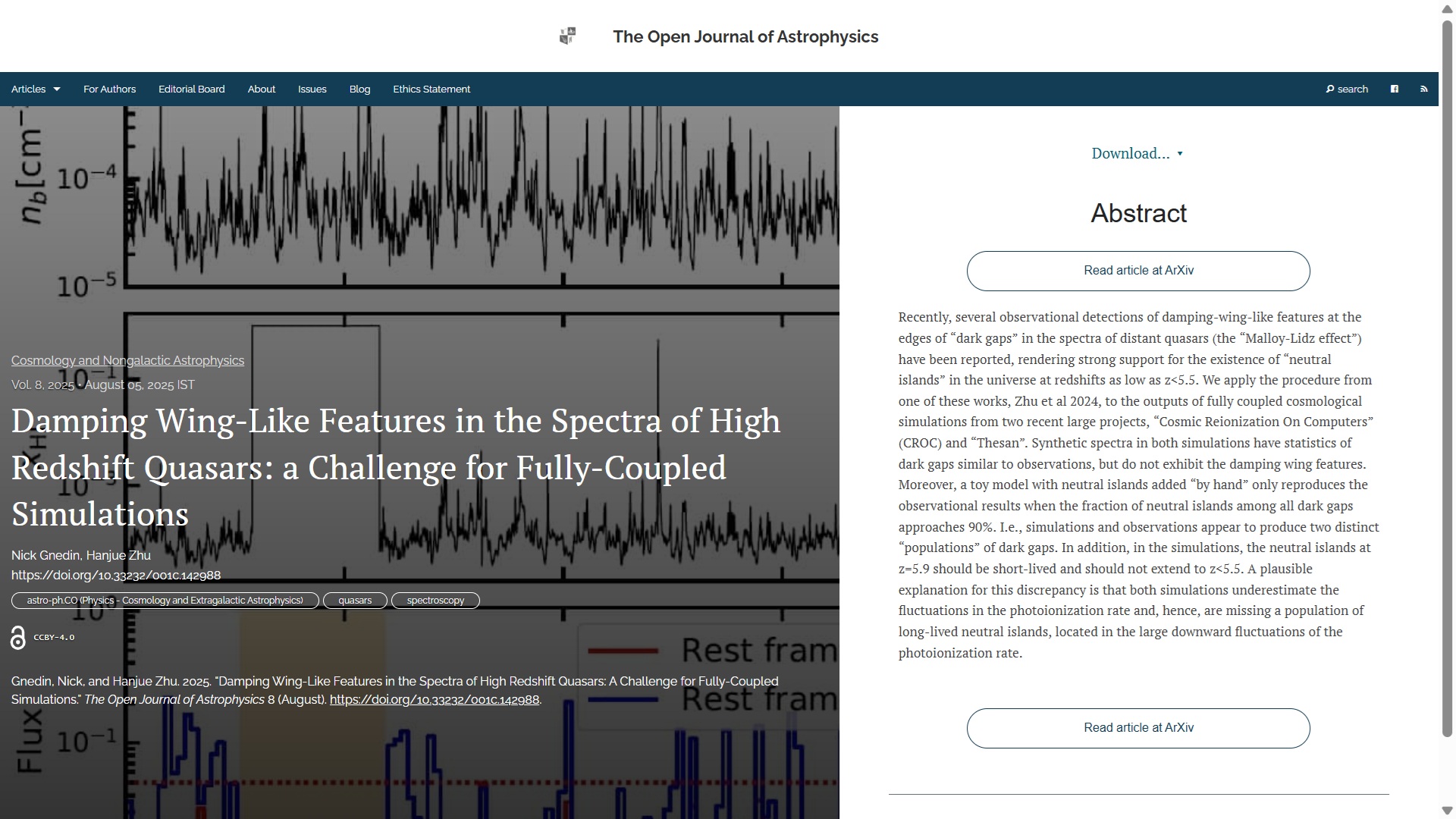
Next one up, published on Tuesday 5th August, in the folder Cosmology and Nongalactic Astrophysics, is “Damping Wing-Like Features in the Spectra of High Redshift Quasars: a Challenge for Fully-Coupled Simulations” by Nick Gnedin & Hanjue Zhu (University of Chicago, USA).  This paper presents a discussion of the difficulties that cosmological radiation transfer codes have in accounting for the existence of “neutral islands” in the universe at relatively low redshifts.

The overlay is here:


You can find the officially accepted version of the paper on arXiv here.

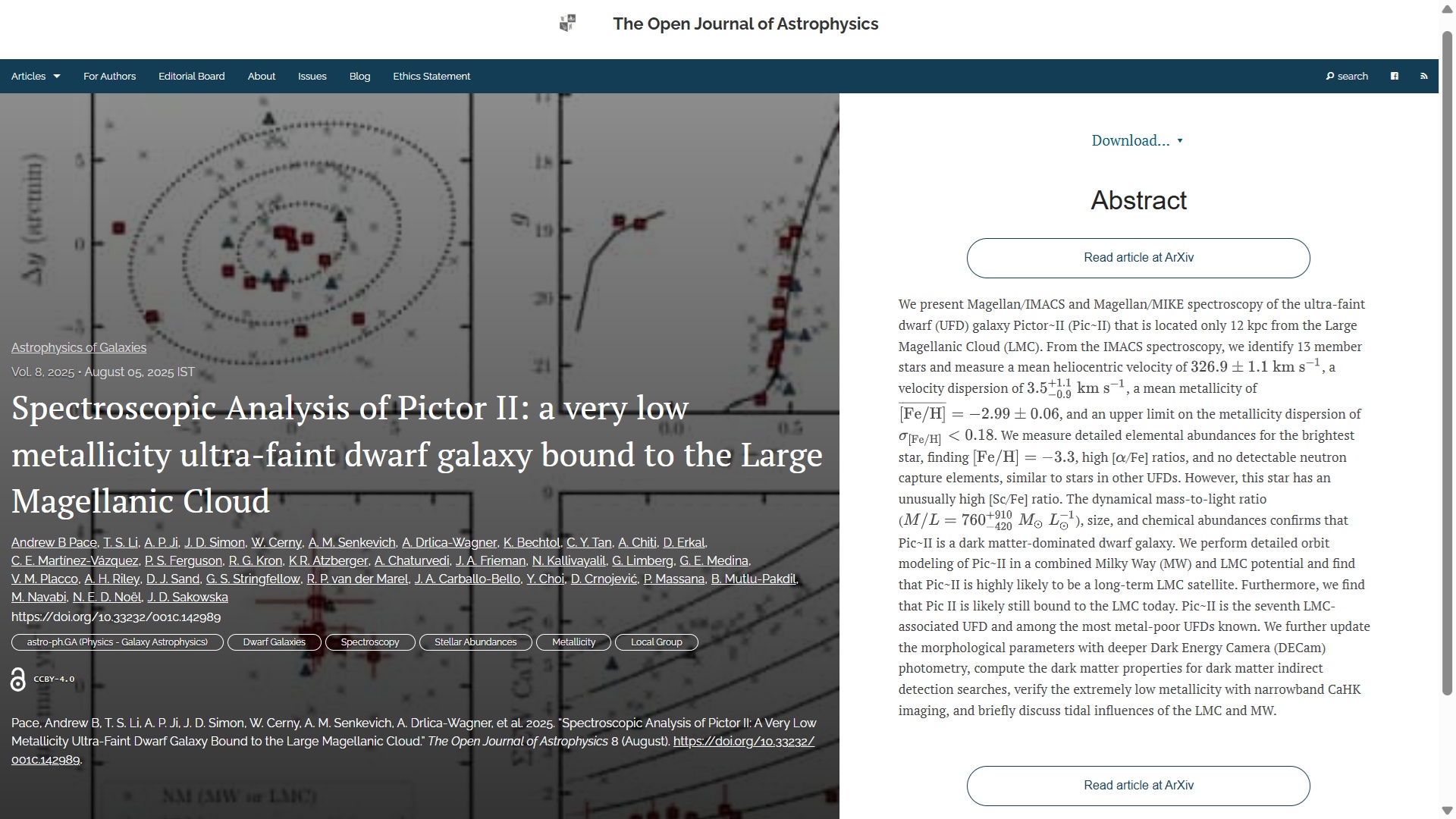
The third paper of the week is “Spectroscopic Analysis of Pictor II: a very low metallicity ultra-faint dwarf galaxy bound to the Large Magellanic Cloud” by Andrew Pace (U. Virginia, USA) and 32 others based in the USA, UK, Canada, Chile and Spain. This one was also published on Tuesday 5th August but in the folder Astrophysics of Galaxies. It describes Magellan/IMACS and Magellan/MIKE spectroscopy of the ultra-faint dwarf (UFD) galaxy Pictor II, which is located only 12 kpc from the Large Magellanic Cloud (LMC).

The overlay is here:


The final version is on arXiv here.

The fourth, and final, paper of the week, also published on Thursday 7th August, is “ASASSN-24fw: An 8-month long, 4.1 mag, optically achromatic and polarized dimming event” by Raquel Forés-Toribio (Ohio State University) and 22 others based in the USA, Austria, Chile and Australia. It is published in the folder Solar and Stellar Astrophysics, and it presents an observational study of an unusual dimming event likely to have been caused by eclipsing of a binary system by a dusty disk.

Here is the overlay:

You can find the officially-accepted version on arXiv here.

And that’s all the papers for this week. I’ll do another update next Saturday.

P.S. For those of you who missed the post I did earlier in the week, I have been looking at the accounts for the Open Journal of Astrophysics and can confirm that the cost to us per paper is less than $30 and will reduce with scale. We expect to publish around 180 papers in 2025 for which the total cost incurred by OJAp will be around $5000. Obviously if we increase by a factor, say, ten then that amount would become significant so we are taking steps to secure additional funding in the event that happens.