Archive for September, 2024

Random Gallery

Posted in Biographical, Maynooth with tags on September 21, 2024 by telescoper

In the absence of anything better to post, I thought I’d share a few random pictures I’ve taken around Maynooth University campus since I moved into my new office.

Oh, I’ll just add this little anecdote. I was away from campus on Thursday and after I had done the necessary I was required to take a taxi home. The taxi driver asked me what I did for a living and when I told him he said he was fascinated interested in nuclear physics and proceeded to ask me a series of questions including what heavy water is, whether plutonium occurs naturally, and what is measured in röntgen. It’s always nice when a member of the public shows an interest in physics.

Bluesky in the Dark

Posted in Biographical with tags , on September 19, 2024 by telescoper

I posted last month about how I’ve been faring on social media since I left Twitter. That piece included this:

The first thing I noticed was that my BlueSky account was suddenly getting quite a lot of new followers. I now have about 850, still a long way short of the over 7000 I used to have on Twitter, but the level of engagement is far higher.

Well the exodus from Twitter seems to be accelerating and I now have 1.2K followers on BlueSky including more than a few old contacts I left behind on Twitter. The total number of users of BlueSky has now passed 10 million, which led to this message which I received last week.

I’m quite proud of being among the pioneering 1% of Bluesky users. The Open Journal of of Astrophysics is also there among the first 10%:

I hope this message prompts a few more to take the plunge. I’ll also take this opportunity to reiterate my opinion that it is indefensible for my employer, along with most other universities, to maintain a presence on Twitter.

A Maynooth University Campus Question

Posted in Maynooth with tags , , , , on September 19, 2024 by telescoper
The TSI Building

Ironically, the day after access to this blog on Maynooth Campus was restored, I have to spend the whole day located elsewhere and without internet access. I will therefore leave those on and off campus to ponder a question related to Maynooth University campus.

In LHBS units*, how much did it cost Maynooth University for a palatial new office in the TSI Building for its President, Professor Eeva Leinonen?

(*1 LHBS = the cost of one Leinster House Bike Shed = €336,000).

Please place your guesses in the Comment Box below. FOI requests may be used.

Beating the Ban

Posted in Biographical, Maynooth with tags , , , , on September 18, 2024 by telescoper

Access to this blog is still blocked on Maynooth University campus. I was told that this was because of phishing activity, but IT Services are not replying to my requests for information about this alleged misconduct. If it were true I would have been subject to disciplinary action, and I haven’t because it is not true. I can only assume that it is a half-witted attempt at censorship.

I did originally think that the entire WordPress.com domain was blocked but I found that I could access the excellent blog by mathematician Terry Tao so it does appear I have been singled out for banning.

You can still read this blog off campus, but if you want to read it on Maynooth University campus, my posts are available in full federated form on Mastodon by following In the Dark on mastodon.social here.

That means you can read whole posts there rather than having to follow a link as on other social media (Threads, BlueSky, LinkedIn and Facebook).

Alternatively, you can receive posts via email here:

In the past I have used this blog, along with my other social media, to promote activities, courses, and job opportunities at Maynooth University. I will not be doing that until the ban is lifted. I have of course also posted items critical of the University management and will continue doing that.

UPDATE: By sheer coincidence (?), just a couple of hours after posting this item (from home), IT services contacted me and told me that this page has now been “reclassified as a blog” and is now accessible from campus (which is where I am writing this update). What it was classified as before is anyone’s guess, but access from campus has now been restored.

In Search of Stokes V

Posted in The Universe and Stuff with tags , , , , on September 17, 2024 by telescoper

Many moons ago I went to a seminar on the design of an experiment to measure the polarization of the cosmic microwave background. At the end of the talk I asked what seemed to me to be an innocent question. The point of my question was the speaker had focussed entirely on measuring the intensity of the radiation (I) and the two Stokes Parameters that measure linear polarization of the radiation (usually called Q and U). How difficult, I asked, would it be to measure the remaining Stokes parameter V (which quantifies circular polarization)?

There was a sharp intake of breath among the audience and the speaker responded with a curt “the cosmic microwave background is not circularly polarized”. It is true that in the standard cosmological theory the microwave background is produced by Thomson scattering in the early Universe which produces partial linear polarization, so that Q and U are non-zero, but not circular polarization so V=0. I knew that, but had asked my question because I had an idea that it might be worth measuring V (or at least putting an upper limit on it) in order to assess the level of instrumental systematics (which are a serious issue with polarization measurements). It might also help constrain variations from the standard model too.

Well, that thought came back today when I saw a new paper on the arXiv with the abstract:

V-mode polarization of the cosmic microwave background is expected to be vanishingly small in the ΛCDM model and, hence, usually ignored. Nonetheless, several astrophysical effects, as well as beyond standard model physics could produce it at a detectable level. A realistic half-wave plate – an optical element commonly used in CMB experiments to modulate the polarized signal – can provide sensitivity to V modes without significantly spoiling that to linear polarization. We assess this sensitivity for some new-generation CMB experiments, such as the LiteBIRD satellite, the ground-based Simons Observatory and a CMB-S4-like experiment. We forecast the efficiency of these experiments to constrain the phenomenology of certain classes of BSM models inducing mixing of linear polarization states and generation of V modes in the CMB. We find that new-generation experiments can improve current limits by 1-to-3 orders of magnitude, depending on the data combination. The inclusion of V-mode information dramatically boosts the sensitivity to these BSM models.

arXiv:2409.10424

It seems it might be feasible to measure Stokes V after all!

More Thoughts of Retirement…

Posted in Biographical, Maynooth with tags , , , , on September 16, 2024 by telescoper

Now that I’m back home from campus after work, and have access to this blog once again, I thought I’d share a little ethical question with you.

Less than a year ago, while I was in Barcelona, I posted an item about looking forward to retirement. Here are two paragraphs from that piece:

The fact of the matter is, though, that I can’t afford to retire yet. I have a mortgage to pay and I’ve only had five full years of pensionable service in the Irish system, so won’t get much of a pension. I have the frozen residue of my UK pension, of course, but that is subject to an actuarial reduction if I take the benefit before I’m 65, which is also the standard retirement age for academic staff in Ireland. I can’t be made to retire here until I’m 70, in fact, but I think I’ll be well beyond my best-before date by then and am not keen to overstay my welcome.

So it looks like I’ll have to stay until I’m 65 at the earliest. In fact I won’t be able to collect the State Pension (SPC) until I’m 66, so I’ll probably have to stay another year. That means that when I get back from sabbatical I will have four or five years left until I can retire. I don’t know what I’ll be teaching when I return but I hope I get a chance to teach a few new modules before the end. In particular some cosmology or astrophysics would be particularly nice. All this is predicated on: (a) me living long enough; and (b) Physics at Maynooth not being closed down; neither of these is certain.

Since I posted this I have made a firm decision that I will retire as soon as I’m able, which should be in June 2028. This is partly because I recently had a health scare which, though it is now seemingly resolved, has persuaded me not to take (a) for granted. There are things I’d like to do before I pop my clogs and I won’t be able to do them while still in full-time employment. I’ve done some calculations and should be able to pay off my mortgage early, perhaps even by the end of this year.

Anyway, this led me to the following ethical question, to which different colleagues have had different responses.

A PhD in Ireland typically takes a minimum of 4 years. That means that if I were to take on a new PhD student next academic year (starting in September 2025) then less than three years would pass before I would retire. If a member of staff is less than 4 years from retirement should they decline all PhD supervision requests?

Opinions through the Comments Box please!

PS. My two current students will both have completed well before 2028.

PPS. Another question is who would take over the Open Journal of Astrophysics…

16 Years In The Dark

Posted in Biographical, The Universe and Stuff with tags , , , on September 15, 2024 by telescoper

I just received the following message from WordPress.com reminding me that today is the 16th anniversary of my registration with them, which is when I took my first step into the blogosphere. That was way back on 15th September 2008…

I actually wrote my first post on the day I registered but, unfortunately, I didn’t really know what I was doing on my first day at blogging – no change there, then – and I didn’t actually manage to figure out how to publish this earth-shattering piece. It was only after I’d written my second post that I realized that the first one wasn’t actually visible to the general public because I hadn’t pressed the right buttons, so the two appear in the wrong order in my archive. Such was the inauspicious beginning of this “shitty WordPress blog”!

Since then I have published 6,974 blog posts posts which have altogether received over 5.5M page views. That doesn’t include the 2000+ subscribers who receive posts by email. The largest number of hits I have received in a single day is still 8,864 (in 2014, at the peak of the BICEP2 controversy). The most popular post in the last year was this one.

P.S. Blog traffic had been slow recently, but has increased dramatically in the past few days, perhaps because of the ban on access to it from Maynooth University campus

What is Weak Gravitational Lensing?

Posted in Euclid, The Universe and Stuff with tags , , , , , , on September 15, 2024 by telescoper

I haven’t posted anything about the European Space Agency’s Euclid mission recently but I can remedy that today by sharing a new video that describes one of the methods that Euclid will use to map the dark Universe. Here’s the video:

Here are the credits

Credit: ESA/Euclid Consortium/Cacao Cinema

License: ESA Standard Licence

And here’s the explainer that goes with it:

ESA’s Euclid mission is surveying the sky to explore the composition and evolution of the dark Universe. But how can Euclid see the invisible? Watch this video to learn about the light-bending effect that enables scientists to trace how dark matter is distributed in the Universe.

By making use of Euclid’s flagship simulation, the video illustrates how dark-matter filaments subtly alter the shape of galaxies. Light travelling to us from vastly distant galaxies is bent and distorted by concentrations of matter along its way. The effect is called gravitational lensing because matter (both ‘normal’ and dark matter) acts as a kind of magnifying glass.

Scientists distinguish between strong and weak gravitational lensing. In strong gravitational lensing distortions of background galaxies or other light sources are very apparent, resulting in arcs, multiple images or so-called Einstein rings. In weak lensing, background sources appear only mildly stretched or displaced. This means we can only detect this effect by analysing large numbers of sources in a statistical way.

The further we look, the more prominent the distortions from weak gravitational lensing are, because there are more dark-matter structures acting as lenses between us and the light sources.

Euclid will measure the distorted shapes of billions of galaxies over 10 billion years of cosmic history, providing a 3D view of the dark matter distribution in our Universe. This will shed light on the nature of this mysterious component.

The map of the distribution of galaxies over cosmic time will also teach us about dark energy, which affects how quickly the Universe expands. By charting the Universe’s large-scale structure in unprecedented detail, Euclid will enable scientists to trace how the expansion has changed over time.

Four New Publications at the Open Journal of Astrophysics

Posted in OJAp Papers, Open Access, The Universe and Stuff with tags , , , , , , , , , , , , , , , , , , , on September 14, 2024 by telescoper

Once again, it’s time for a quick update of activity at the Open Journal of Astrophysics. This week we have published another batch of four papers which takes the count in Volume 7 (2024) up to 77 and the total published altogether by OJAp up to 192. Things are picking up again after the summer lull, and we’re moving towards a double century. If we keep up a steady average of four per week we’ll be at 200 per year.

In chronological order, the four papers published this week, with their overlays, are as follows. You can click on the images of the overlays to make them larger should you wish to do so.

First one up is “Quasi-two-dimensionality of three-dimensional, magnetically dominated, decaying turbulence” by Shreya Dwivedi, Chandranathan Anandavijayan, and Pallavi Bhat of TIFR, Bangalore, India. The paper presents an analysis of numerical simulations of MHD turbulence using Minkowski Functionals, with implications for local anisotropies revealed therein. It was published on 9th September 2024 and is in the folder marked High-Energy Astrophysical Phenomena.

Here is a screen grab of the overlay, which includes the abstract:


You can find the officially accepted version of the paper on the arXiv here.

The second paper to announce, also published on 9th September 2024, is “mochi_class: Modelling Optimisation to Compute Horndeski In class” by  Matteo Cataneo (Universität Bonn, Germany) and Emilio Bellini (SISSA, Trieste, Italy). This article presents a cosmological Einstein-Boltzmann solver adapted to work with Horndeski gravity, together with validation tests. It is in the folder Cosmology and NonGalactic Astrophysics.

You can see the overlay here:


The accepted version of this paper can be found on the arXiv here.

The third paper, published on 11th September 2024 in the folder marked High-Energy Astrophysical Phenomena, is by Jonathan Katz of Washington University, St Louis, USA. The title is “The Sources of Fast Radio Bursts” and it presents a discussion of the possible physical origin of Fast Radio Bursts, arguing that they fall into two distinct groups.
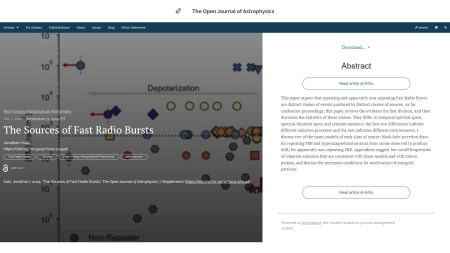
 

The final version accepted on arXiv is here.

Last in this batch, but by no means least, is “RMS asymmetry: a robust metric of galaxy shapes in images with varied depth and resolution” by Elizaveta Sazonova (U. Waterloo, Canada) with 15 other authors spread around the world (in Canada, USA, Australia, Italy, Chile, UK, Poland, Mexico, Germany, and Spain). This paper presents a method of quantifying distortion of galaxy images connected with mergers or other instabilities. It is in the folder marked Astrophysics of Galaxies and was published on September 12th 2024 with this overlay:
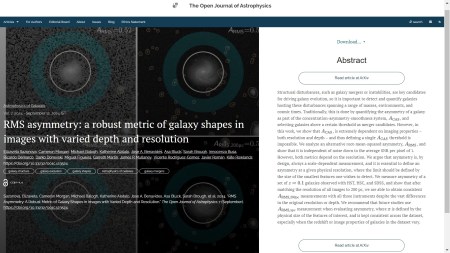
 

You can find the official accepted version on the arXiv here.

That’s all for now. I will post another update in a week.

A New Season at the National Concert Hall

Posted in Biographical, Music with tags , , , , , , , , on September 14, 2024 by telescoper

It was just over a year ago that I last went to the National Concert Hall in Dublin. That occasion was the opening of a new season of concerts for 2023-4 by the National Symphony Orchestra. After a year away on sabbatical, last night I went to the season opening of the next year of concerts by the National Symphony Orchestra, this time under the direction of Mihhail Gerts. I’m hoping to see more of the forthcoming season than I did the last!

The programme for the concert is shown in the picture. The first half was dominated by legendary mezzo-soprano Dame Sarah Connolly, resplendent in a turquoise frock, who sang six songs by Alma Mahler (born Alma Schindler) who was of course the wife of Gustav Mahler whose 1st Symphony we heard in the second half. Gustav famously (and reprehensibly) told Alma that she had to give up composing music when they married (which they did in 1902). Until then she had written not only songs but also piano music. Few of her compositions survive, however. Apparently she destroyed many of the manuscripts herself in later life. Of the fifty or so songs she is thought to have written, only 17 (including the 6 we heard last night) still exist on paper. She at least responded by outliving him by more than 50 years: Gustav died in 1911 and Alma Mahler passed away in 1964.

It’s very unfair to compare Alma Mahler’s settings with those of Gustav Mahler, who was a master of the orchestral song cycle. The compositions we heard all all quite short, three or four minutes, and are definitely influenced by Wagner. The first song, for example, deploys the famous Tristan Chord and there are passages that are clearly influenced by the Wesendonck Lieder. None of the manuscripts are dated, but in terms of style they do sound like late Romantic works from around 1900 when she was very young. Overall these works not at the same level of achievement of either Richard Wagner or Gustav Mahler but, with Sarah Connolly in fine voice, there was much to enjoy. I had never heard any of these songs before this evening, and it left me wondering what Alma Mahler might have achieved musically had she continued to compose. We’ll never know.

Before these songs we heard the concert overture In Nature’s Realm by Antonín Dvořák. This is also a piece that feels very late-19th Century (it was composed in 1891). It’s a sort of homage to the beauty of the composer’s native Bohemia with distinct echoes of Beethoven’s Pastoral Symphony, I thought.

After the interval wine break we returned for the second half which consisted of (Gustav) Mahler’s Symphony No. 1 in D Major. This is a very familiar concert work nowadays, but it’s worth remembering that it didn’t exactly set the world on fire when it was first performed in 1889 and Mahler revised it extensively before it arrived at the form now usually performed. Like all Mahler symphonies it covers a vast territory. One of the most famous Mahler quotations is “the symphony is a world”, but in the case of his own symphonies each movement is a world. The first movement begins in hesitant and fragmentary fashion before bursting into life with a metaphorical evocation of daybreak. The second movement is earthier and more forceful, quoting from folk songs and country dances. The third is my favourite, with its humorously up-beat references to Klezmer music before ending in a kind of funeral march. The final movement is tempestuous at first, then calm, then erupts into a glorious finale.

Last night’s performance was broadcast live on RTÉ Lyric FM but what radio listeners won’t have got was the thrilling sight of a symphony orchestra in full flood. At the end of the last movement, members of brass section stood up to give extra power to the climactic resolution of the piece. Mahler does “loud” very well indeed, but I was impressed by the spectacle too: the lights gleaming off the array of trombones and horns as they blasted out the final phrases (in another context I would call them “riffs”). Great stuff, and very well received by the audience.

P.S. On the way into Dublin to see last night’s concert I realized that the Irish Rail timetable had changed while I was away so, instead of terminating at Connolly (the station, not the mezzo-soprano), the train I was on went all the way through to Pearse, thereby saving me a bit of time walking. It only takes about 20 minutes (for me) to walk from Pearse to the NCH, in case you’re wondering, and I do like a bit of a walk to stretch my legs before sitting down for a couple of hours at a concert.