Archive for Open Journal of Astrophysics

Weekly Update from the Open Journal of Astrophysics 02/10/2026

Posted in OJAp Papers, Open Access, The Universe and Stuff with tags , , , , , , , , , , , , , , , , , , , , , , , on October 3, 2026 by telescoper

It’s Saturday again, so it’s time for another update of activity at the Open Journal of Astrophysics. Since the last update we have published a further 13 papers, including one correction to an article already published, bringing the number in Volume 9 (2026) to 229 and the total so far published by OJAp up to 677. This would have been a busy week even without the clutch of four MEGATRON papers announced on Wednesday!

I continue to include the posts made on our Mastodon account (on Fediscience); these announcements also contain a clickable form of the DOI for each paper. Our Mastodon account has regular updates and other announcements from OJAp too, including posts from the OJAp blog.

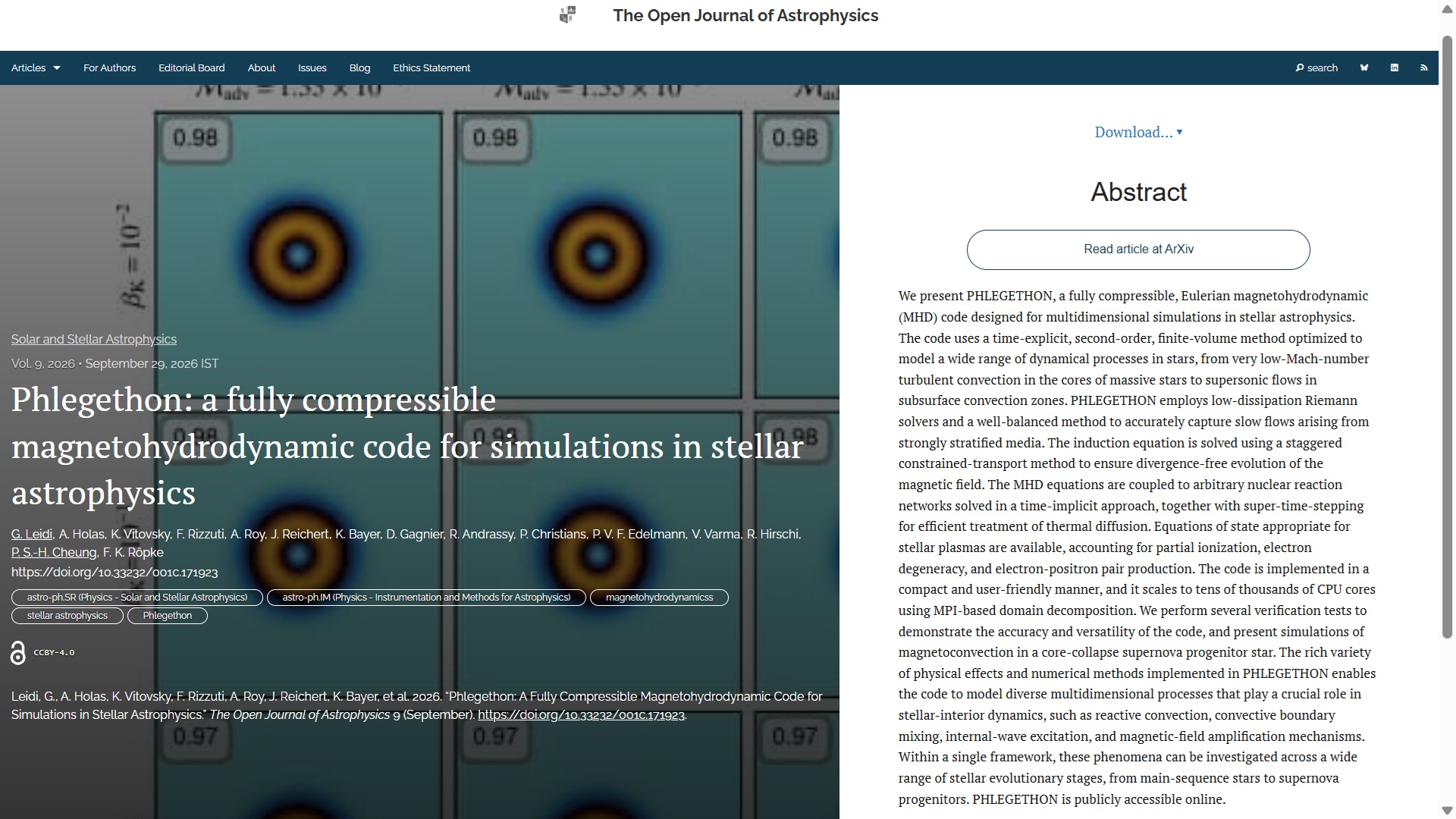
The first new paper this week was published on Tuesday 28th September in the folder Solar and Stellar Astrophysics. The title is “Phlegethon: a fully compressible magnetohydrodynamic code for simulations in stellar astrophysics” and it is by G. Leidi (Heidelberger Institut für Theoretische Studie, Germany) and 14 others. PHLEGETHON is a magnetohydrodynamic code designed for multidimensional simulations in stellar astrophysics, capable of modeling a wide range of dynamical processes in stars. It is publicly accessible online.

The overlay for this one is here:
You can find the officially accepted version on arXiv here and the announcement on Fediverse here:

Open Journal of Astrophysics

New Publication at the Open Journal of Astrophysics: "Phlegethon: a fully compressible magnetohydrodynamic code for simulations in stellar astrophysics" by G. Leidi (Heidelberger Institut für Theoretische Studie, Germany) and 14 others.

doi.org/10.33232/001c.171923

September 29, 2026, 7:22 am 1 boosts 0 favorites

The second paper for this week, published on Tuesday 29th September, is “The impact of source and survey modelling on the connection between [O III] emitters and Ly-α forest transmission at z ~ 6” by Luke Conaboy (U. Nottingham, UK) and 5 others based in the UK, India and Germany. This study improves theoretical work on the connection between galaxies and the intergalactic medium, using an empirical model and James Webb Space Telescope surveys. It is in the folder marked Cosmology and Nongalactic Astrophysics.

The overlay looks like this:
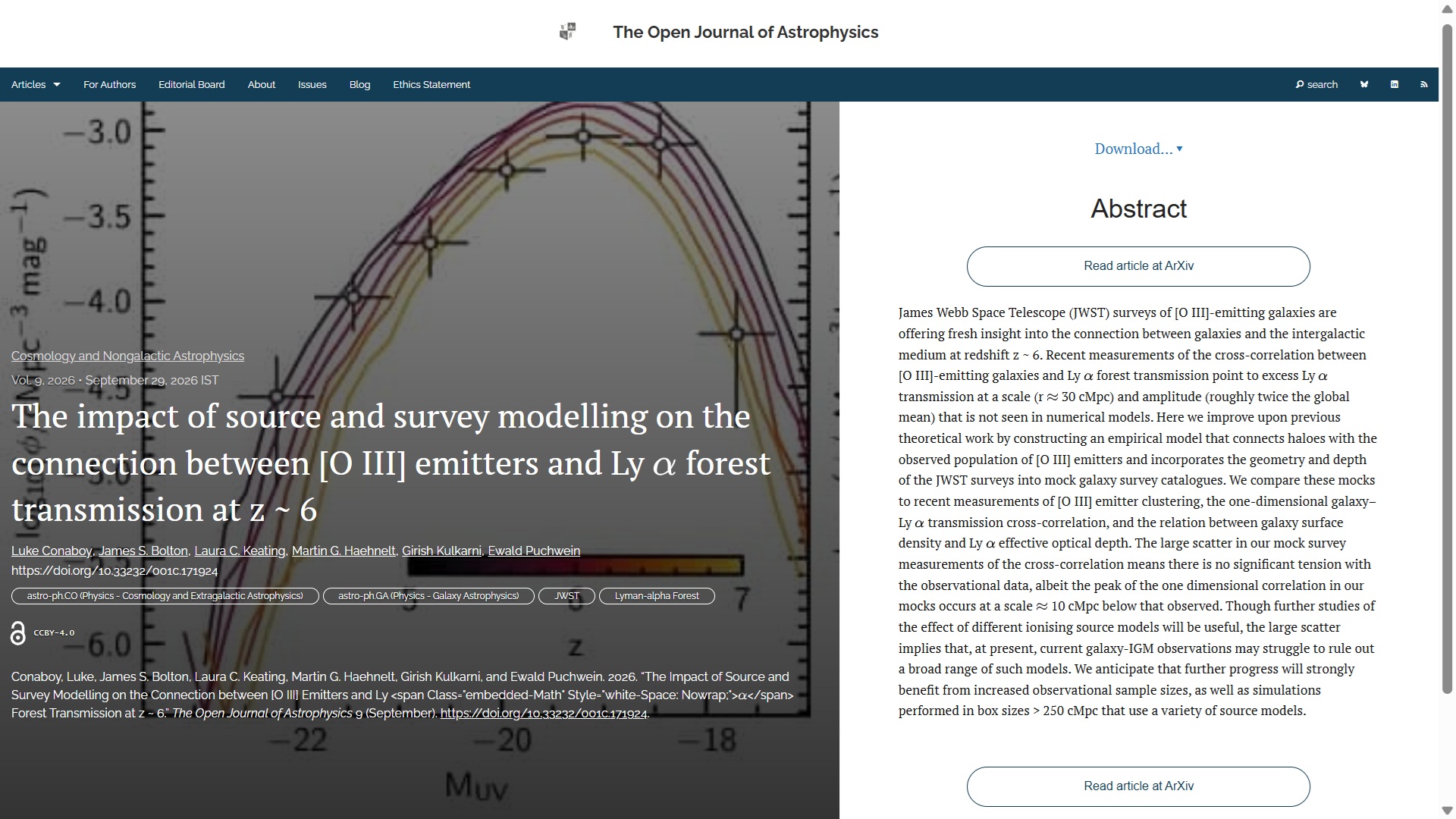
The official version of the paper can be found on arXiv here and the Fediverse announcement here:

Open Journal of Astrophysics

New Publication at the Open Journal of Astrophysics: "The impact of source and survey modelling on the connection between [O III] emitters and Ly-α forest transmission at z ~ 6" by Luke Conaboy (U. Nottingham, UK) and 5 others based in the UK, India and Germany.

doi.org/10.33232/001c.171924

September 29, 2026, 7:38 am 1 boosts 2 favorites

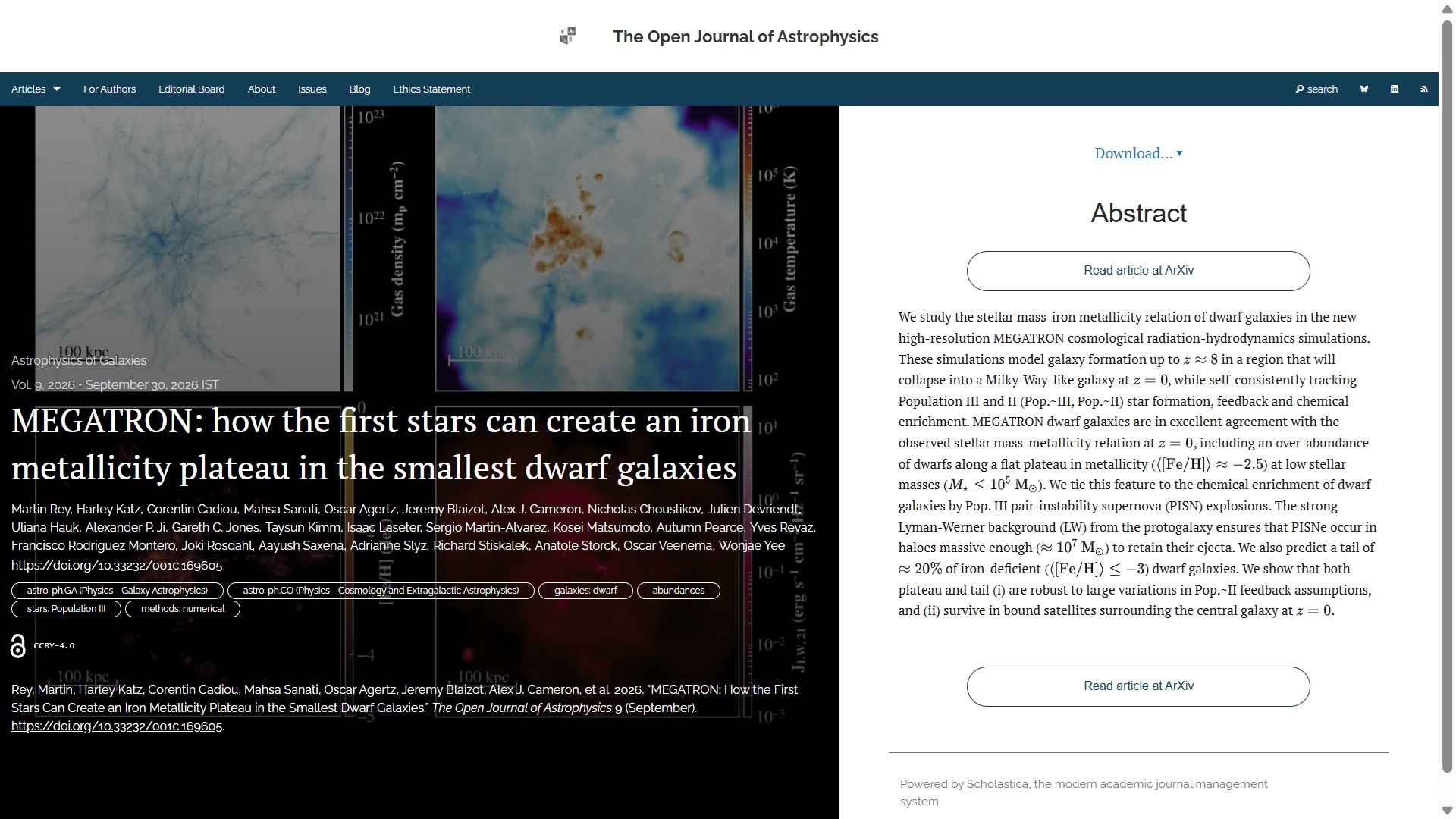
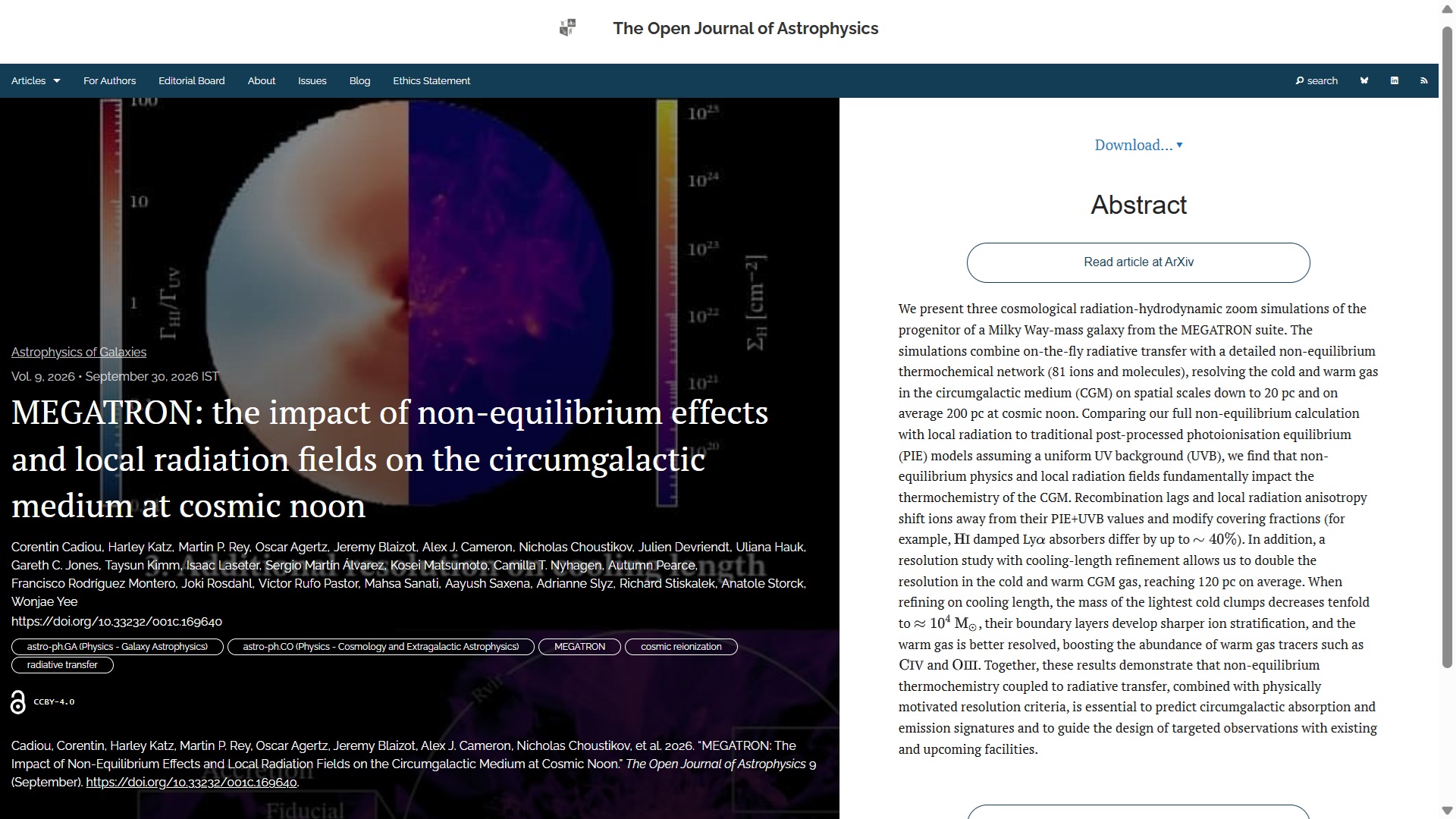
Next we have four related papers produced by the MEGATRON Project, led by Harley Katz (U. Chicago) and Martin Rey (U. Bath, UK), Corentin Cadiou (IAP Paris, France). These were all published on Wednesday 30th September in the folder Astrophysics of Galaxies.

I mentioned this in a separate blog post here, so I won’t describe them in detail again here. Here are the four overlays:
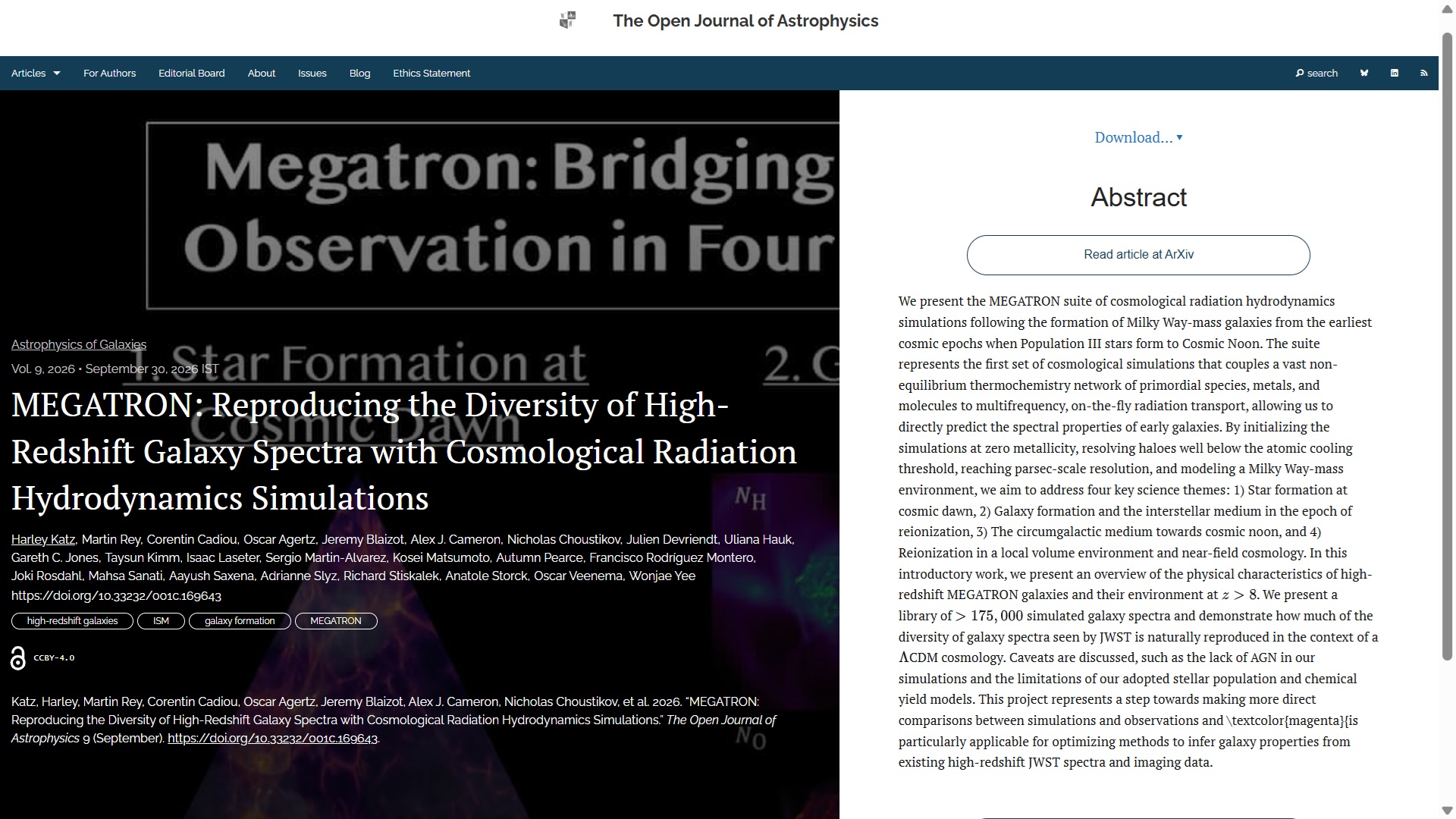
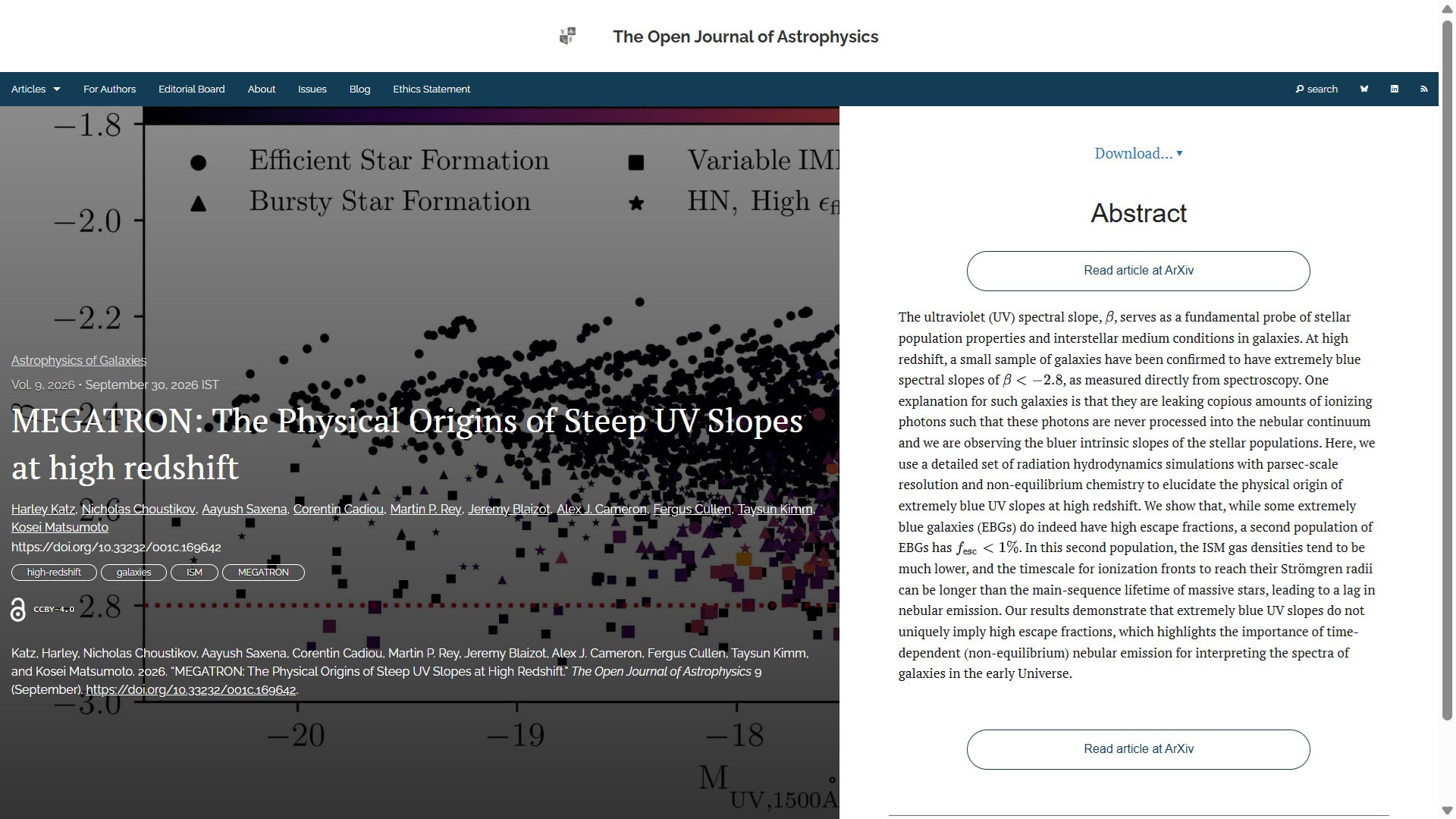
The Mastodon announcement for these is in the form of a thread:

Open Journal of Astrophysics

Today we have published four related papers produced by the MEGATRON Project, led by Harley Katz (U. Chicago) and Martin Rey (U. Bath, UK), Corentin Cadiou (IAP Paris, France)

These articles are announced in the following thread:

September 30, 2026, 1:24 pm 1 boosts 1 favorites

The four papers can be found on arXiv here, here, here and here.

The four MEGATRON papers were not the only ones published on Wednesday 30th September, however. We published “The Chirp-Mass Ladder: A New Rung Emerges” by Vaibhav Tiwari (U. Birmingham, UK) in the folder High-Energy Astrophysical Phenomena on that day too. This paper presents an analysis of 256 binary black-hole (BBH) events, suggesting a hierarchical merger scenario to explain the structured mass distribution, and encouraging further investigation into hierarchical mergers’ role in the BBH population. The overlay for this is here:
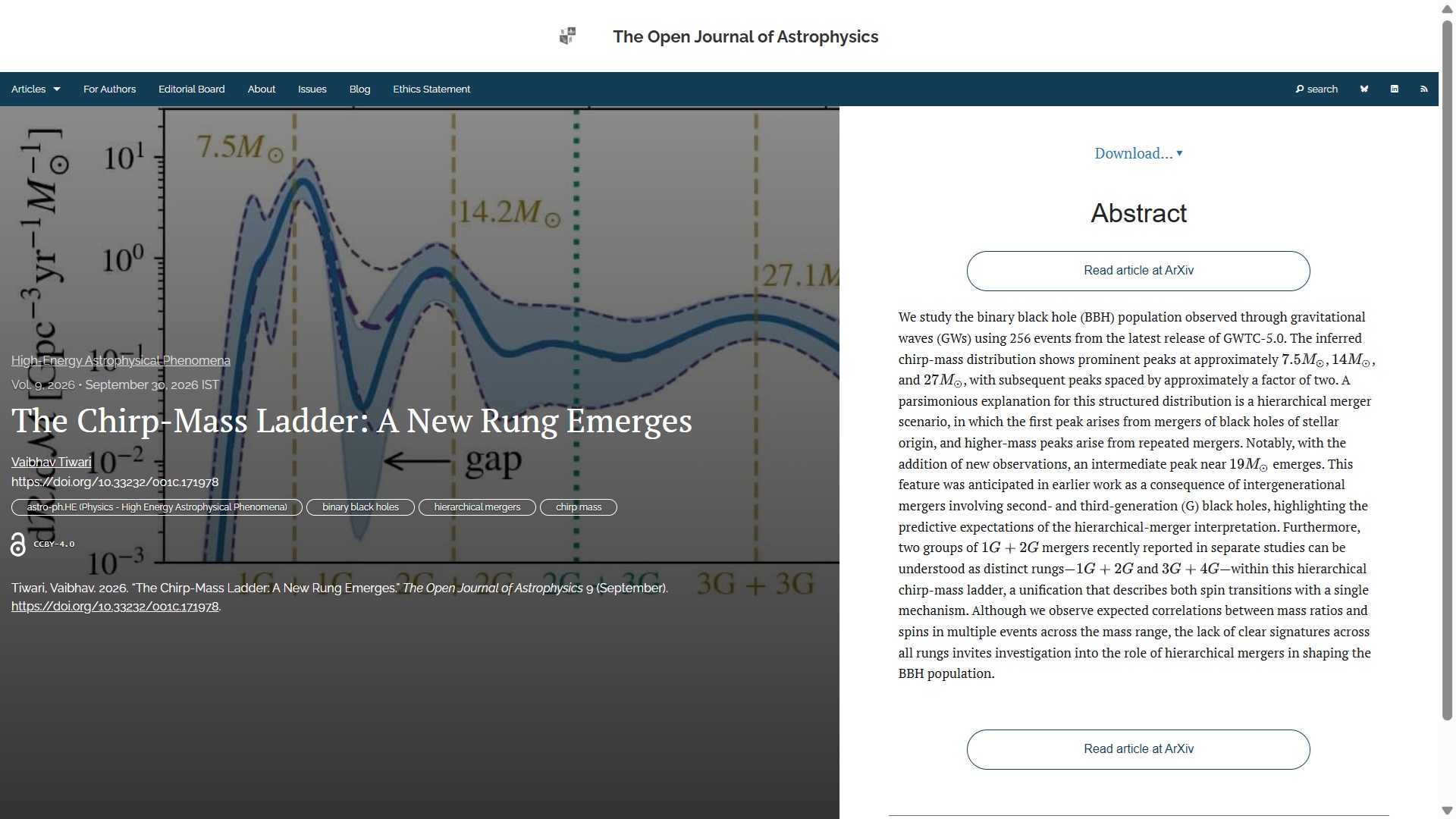
The accepted version of this one can be found on the arXiv here and the Mastodon announcement here:

Open Journal of Astrophysics

New Publication at the Open Journal of Astrophysics: "The Chirp-Mass Ladder: A New Rung Emerges" by Vaibhav Tiwari (U. Birmingham, UK)

doi.org/10.33232/001c.171978

September 30, 2026, 4:39 pm 0 boosts 2 favorites

The eighth new paper of the week, published on Thursday 1st October 2026, in the folder Cosmology and Nongalactic Astrophysics, is “A Consistent Implementation of Cluster Strong Lensing in Cosmological Simulation Light Cones” by Cian Roche (MIT, USA) and 11 others based in the USA, Germany and Italy.

The overlay is here:
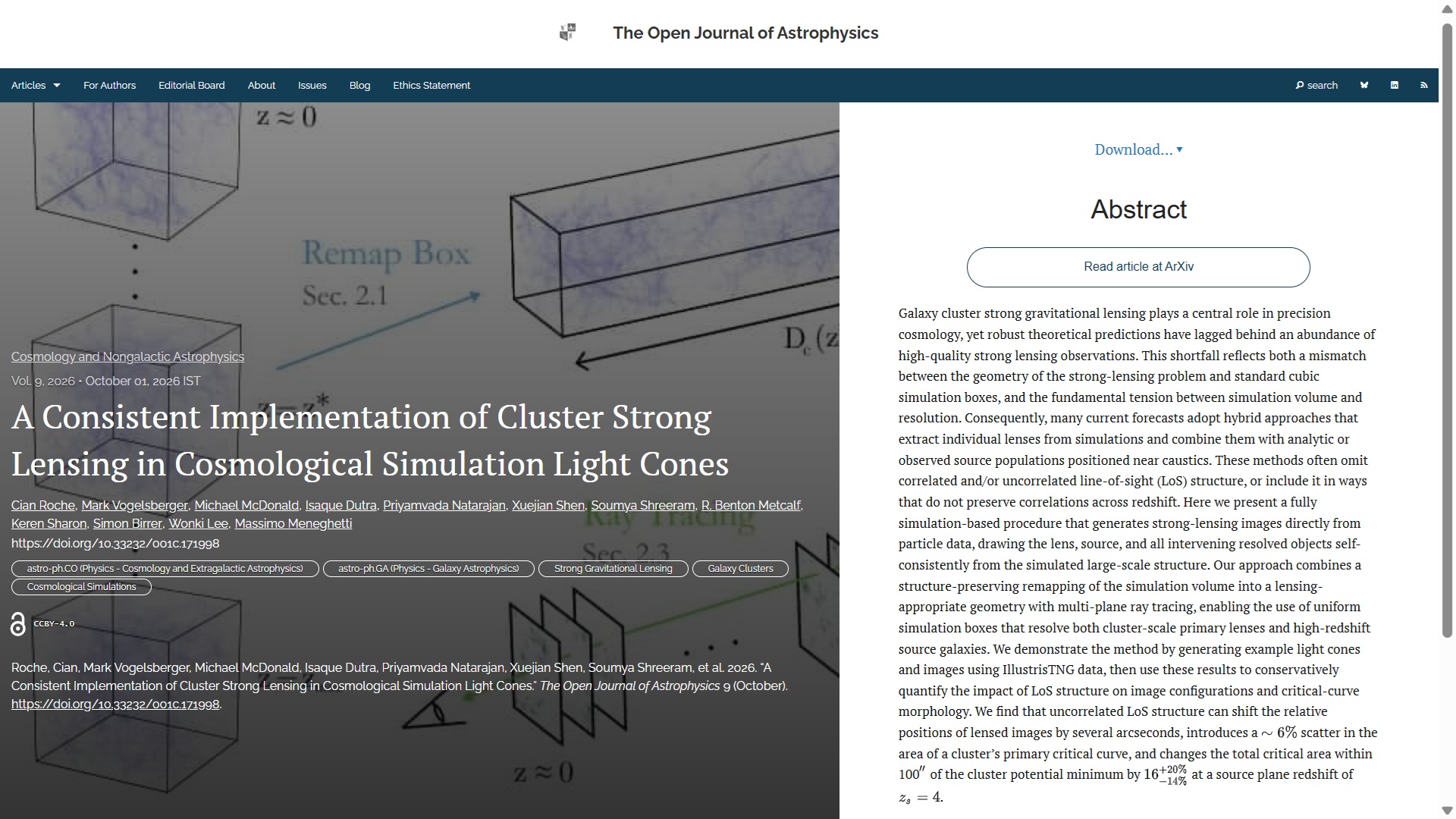
The official version of the paper can be found on arXiv here and the Fediverse announcement here:

Open Journal of Astrophysics

New Publication at the Open Journal of Astrophysics: "Kinematics of the Weak Cool-Core Cluster A3571 Observed with XRISM: Low Cooling Rate Balanced by Low Heating Rate?" by Hannah McCall (U. Chicago, USA) and 12 others based around the world.

doi.org/10.33232/001c.171549

September 22, 2026, 7:13 am 0 boosts 1 favorites

We now have four papers all published on Friday 2nd October (i.e. yesterday).

The first of this batch is “Analytical weak-lensing shear response of galaxy model fitting” by Xiangchong Li (Brookhaven National Laboratory, USA). This is in the folder marked Cosmology and Nongalactic Astrophysics: it explores how galaxy model fitting responds to weak-lensing shear distortions using a new algebraic system, quintuple numbers, within the AnaCal framework, keeping multiplicative bias low.

The overlay is here:
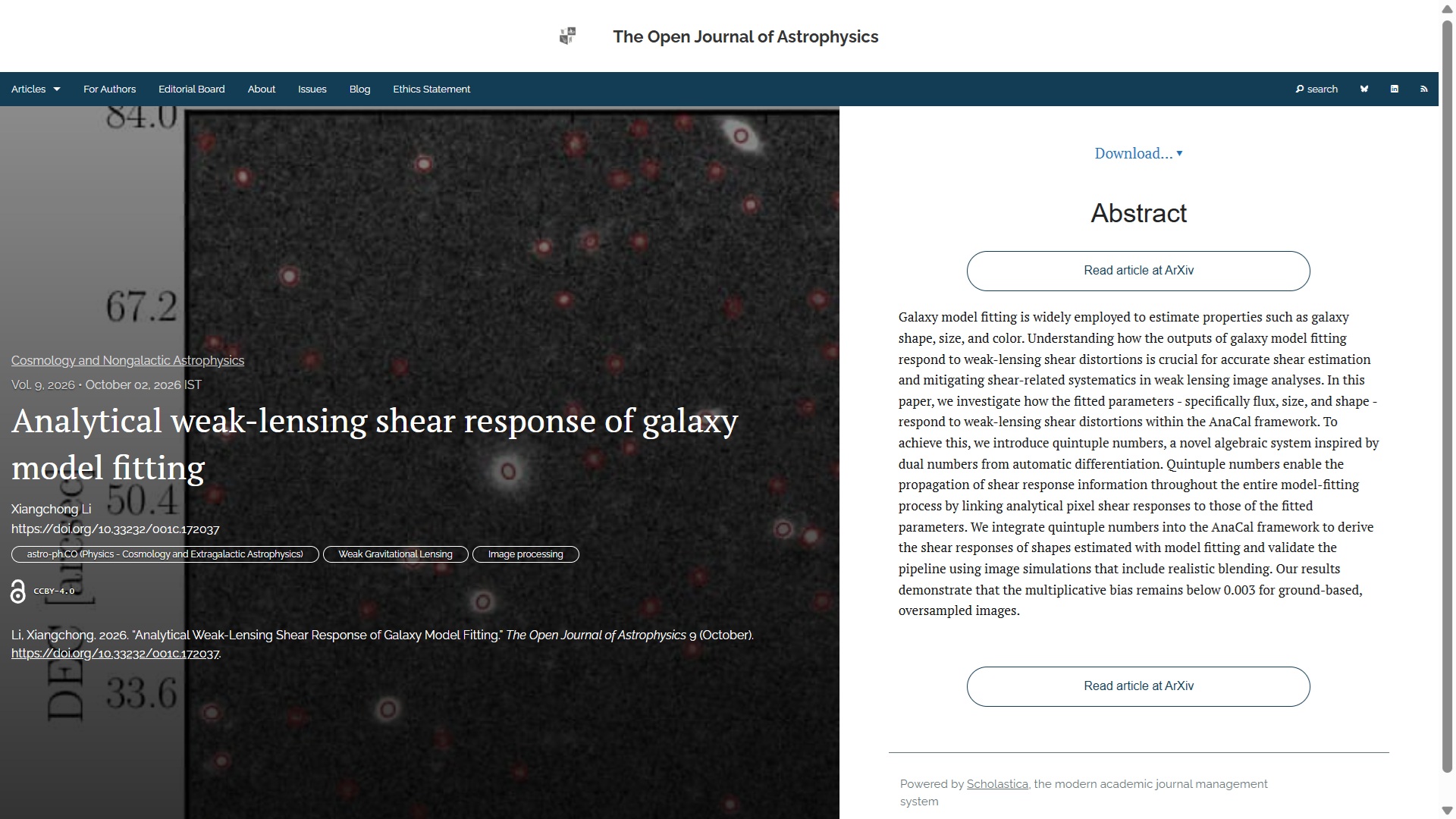
The officially-accepted version of the paper can be found on arXiv here and the Fediverse announcement here:

Open Journal of Astrophysics

New Publication at the Open Journal of Astrophysics: "Analytical weak-lensing shear response of galaxy model fitting" by Xiangchong Li (Brookhaven National Laboratory, USA)

doi.org/10.33232/001c.172037

October 2, 2026, 6:11 am 1 boosts 1 favorites

The 10th paper of the week is “Evidence for inefficient dust production in a massive, metal-rich galaxy at z=7.13 uncovered by JWST and ALMA” by Kasper E. Heintz (Cosmic Dawn Center, Copenhagen, Denmark) and 19 others in Europe, UK and USA. This article, published on Friday 2nd October 2026, in the folder Astrophysics of Galaxies, analyzes cosmic dust in high redshift galaxies, specifically A1689-zD1, using data from JWST and ALMA, suggesting dust formation and destruction processes differ for galaxies in the early Universe.
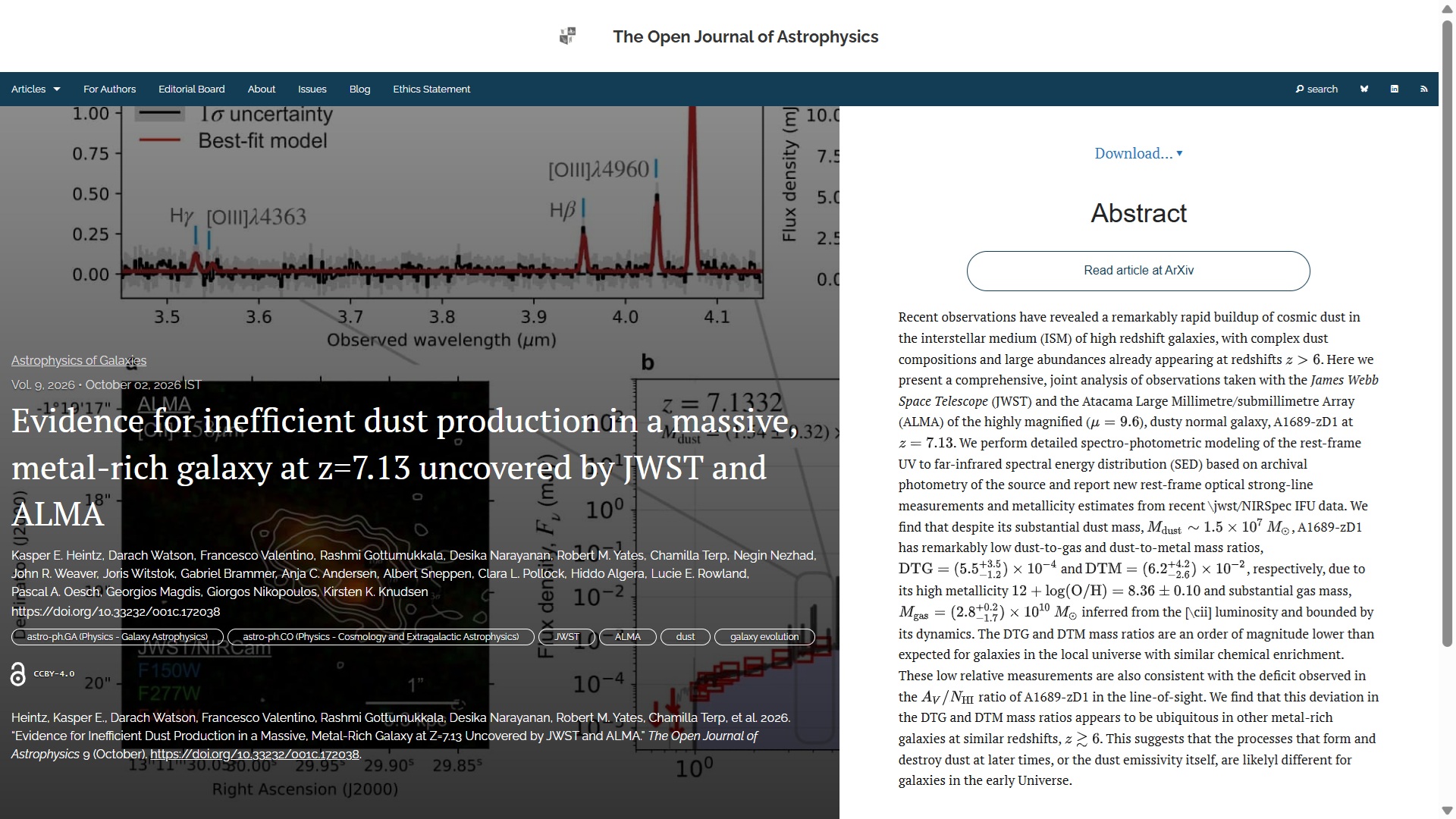
The officially-accepted version of this paper is on arXiv here and the Mastodon announcement on the fediverse here:

Open Journal of Astrophysics

New Publication at the Open Journal of Astrophysics: "Evidence for inefficient dust production in a massive, metal-rich galaxy at z=7.13 uncovered by JWST and ALMA" by Kasper E. Heintz (Cosmic Dawn Center, Copenhagen, Denmark) and 19 others in Europe, UK and USA.

doi.org/10.33232/001c.172038

October 2, 2026, 6:34 am 2 boosts 3 favorites

The 11th paper of the week is “Starbursts hiding in the main sequence: a pathway toward quenching?” by Florent Renaud (Observatoire Astronomique de Strasbourg, France) and 12 others based in France and UK. This article explores the “starbursts in the main sequence” (SBMSs) that intermittently appear in galaxy evolution, attributing their existence to earlier stellar mass assembly and frequent mergers. It was published on Friday 2nd October 2026, in the folder Astrophysics of Galaxies.

The overlay is here:
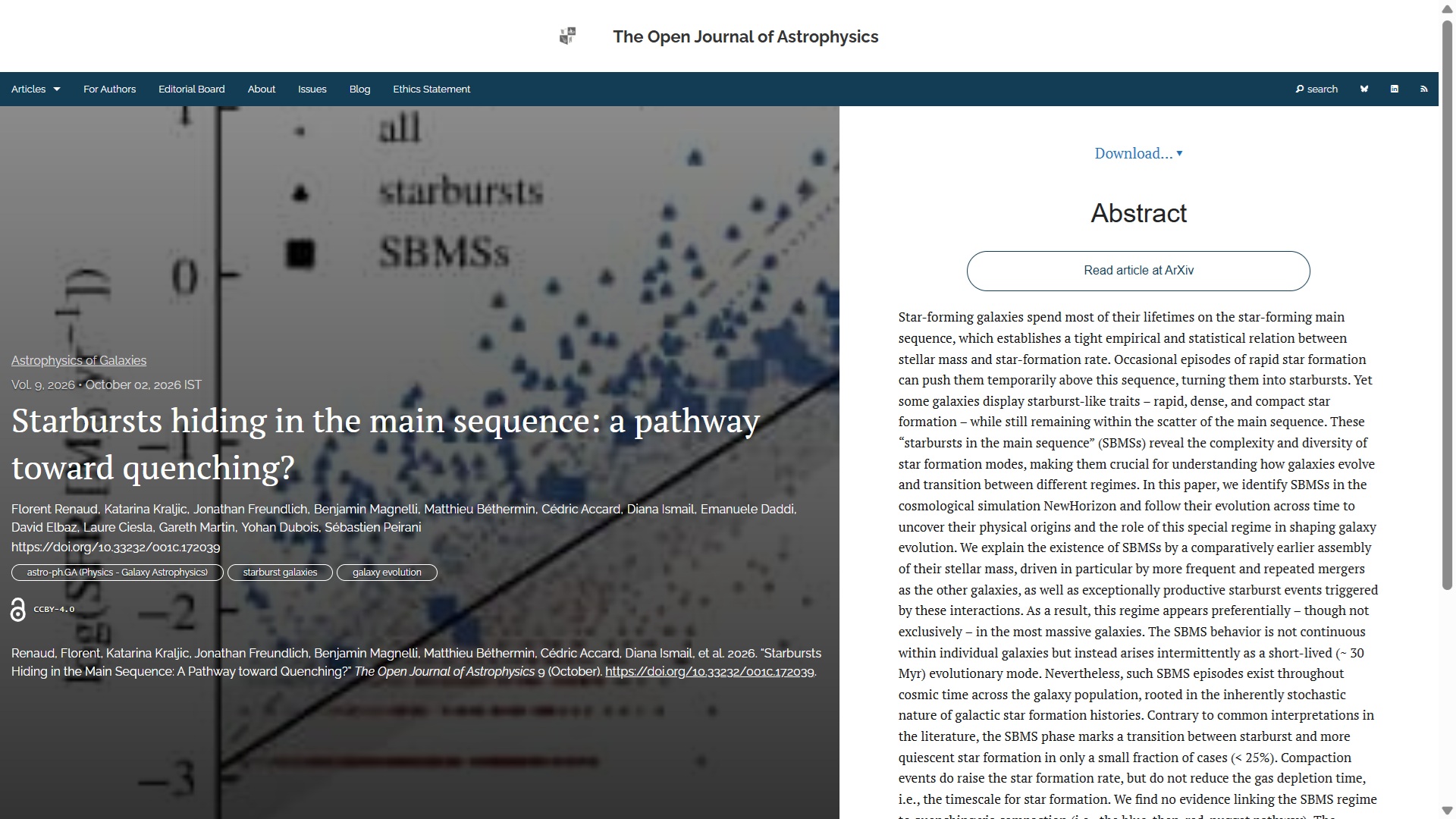
The officially accepted version is on arXiv here and the Mastodon announcement here:

Open Journal of Astrophysics

New Publication at the Open Journal of Astrophysics: "Starbursts hiding in the main sequence: a pathway toward quenching?" by Florent Renaud (Observatoire Astronomique de Strasbourg, France) and 12 others based in France and UK.

doi.org/10.33232/001c.172039

October 2, 2026, 6:49 am 1 boosts 1 favorites

The twelfth, and last, of the new papers for this week is “Ring Position Angles and Spin in M87* and Sgr A*” by Nicholas S. Conroy (U. Illinois at Urbana-Champaign, USA) and 6 others all based in the USA. This was also published on Friday 2nd October but in the folder High-Energy Astrophysical Phenomena.

The overlay is here:
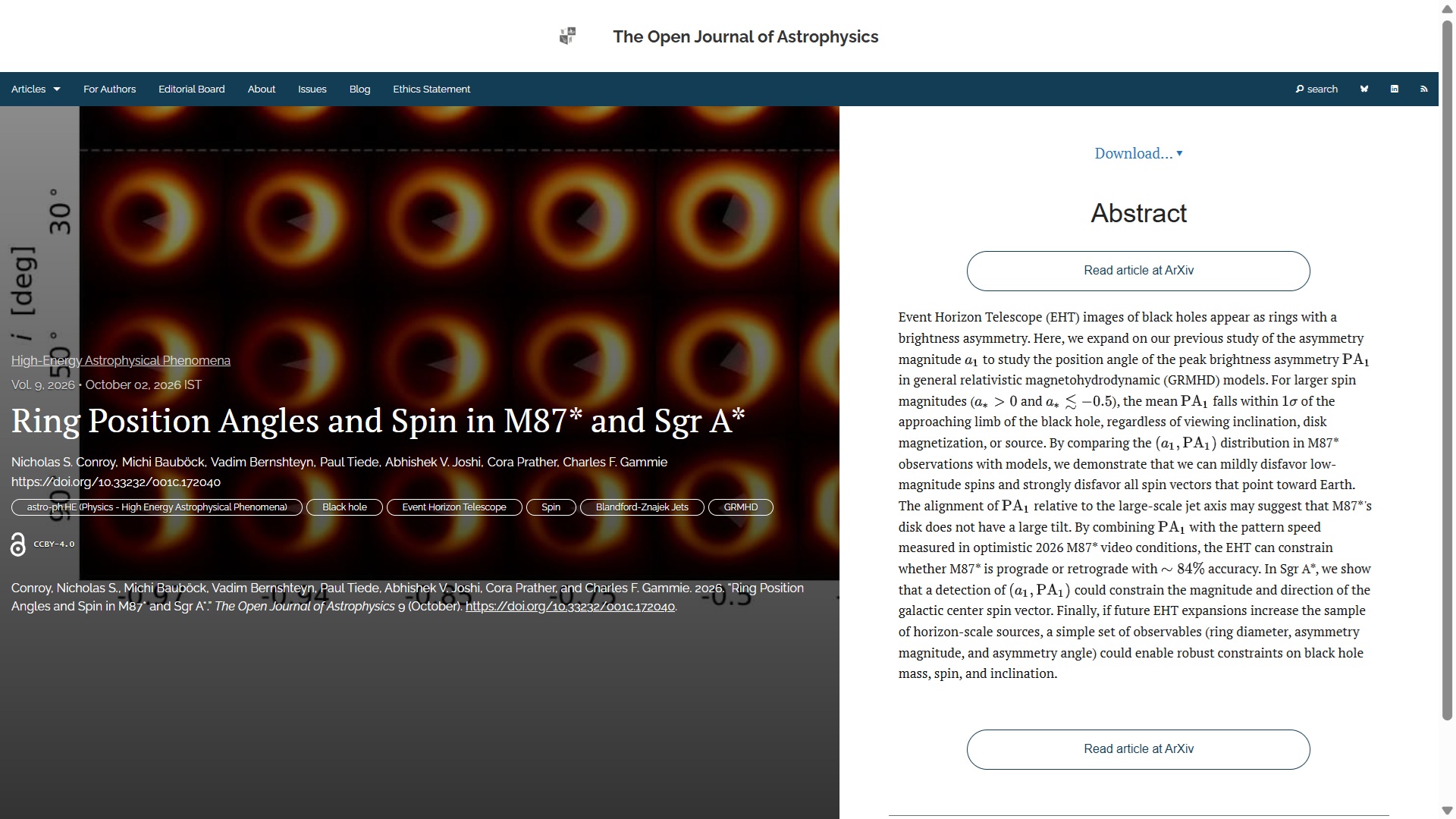
The final version of this paper is on the arXiv here and the Mastodon announcement here:

Open Journal of Astrophysics

New Publication at the Open Journal of Astrophysics: "Ring Position Angles and Spin in M87* and Sgr A*" by Nicholas S. Conroy (U. Illinois at Urbana-Champaign, USA) and 6 others all based in the USA.

doi.org/10.33232/001c.172040

October 2, 2026, 7:02 am 1 boosts 0 favorites

And finally, on Monday 28th September we announced one (minor) correction to a previously published article. The overlay of the correction notice is here:
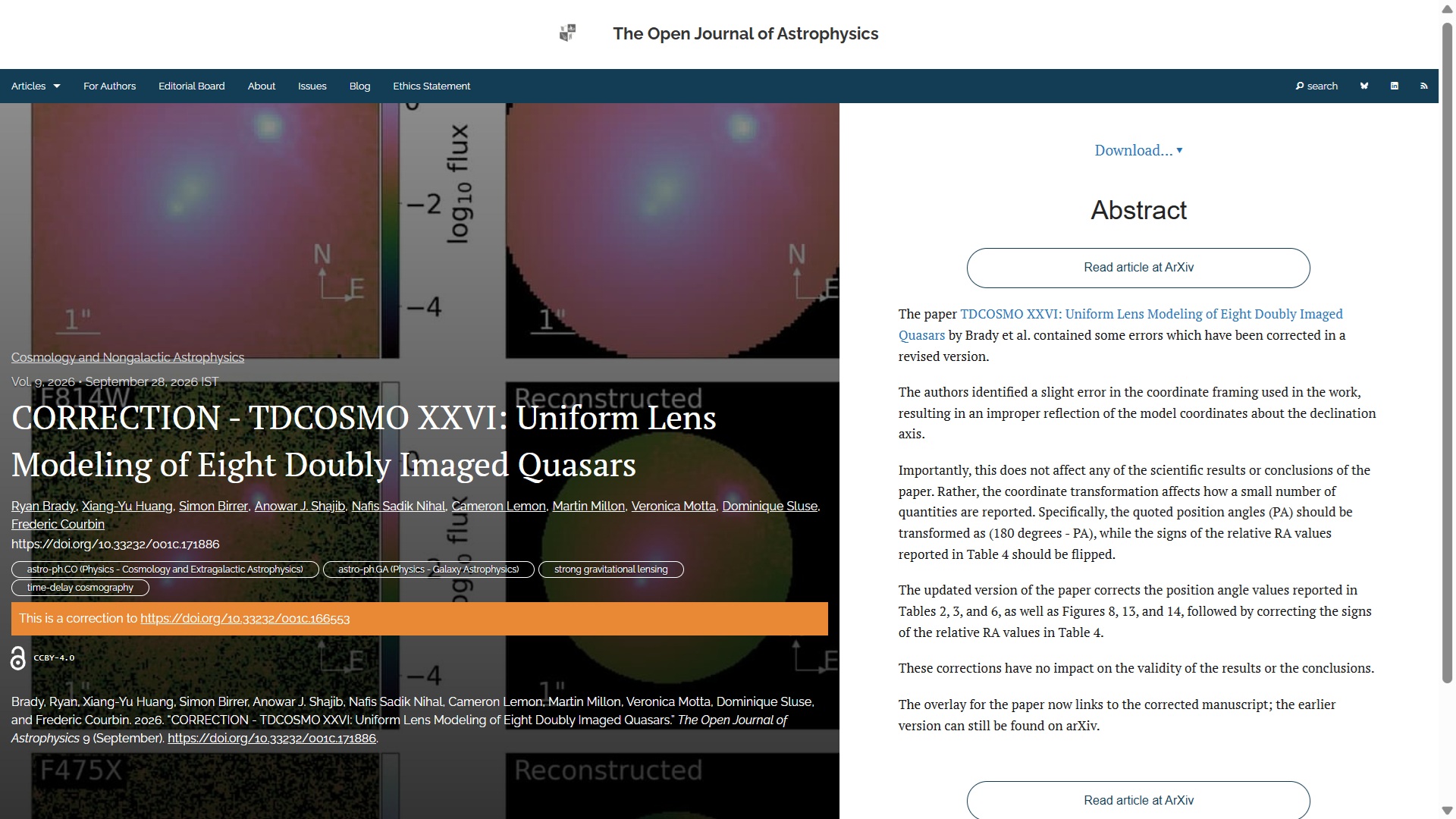
The mastodon announcement is here:

Open Journal of Astrophysics

Correction Notice issued at the Open Journal of Astrophysics: "CORRECTION – TDCOSMO XXVI: Uniform Lens Modeling of Eight Doubly Imaged Quasars" by Brady et al. (originally published 7th August 2026).

doi.org/10.33232/001c.171886

September 28, 2026, 7:49 am 0 boosts 0 favorites

The corrected version of this paper can be found on arXiv here.

That concludes this week’s update. As things are going we seem likely to publish over 300 papers this year, and may reach the 750 mark by the end of the year too. I’ll do another update next week.
The Number of the Beast

Posted in OJAp Papers with tags , , , , on September 28, 2026 by telescoper

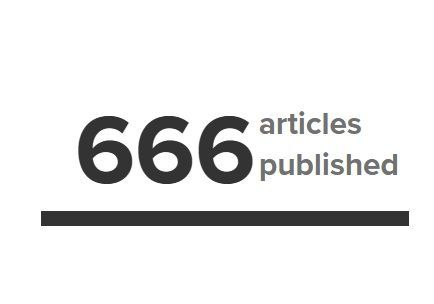
It won’t last past tomorrow, so I thought I’d post this today:

According to the Book of Revelation (Chapter 13 Verse 18):

Here is wisdom: Let him that hath understanding count the number of the beast, for it is the number of a man; and his number is six hundred threescore and six.

Does this mean that the Open Journal of Astrophysics is officially a beast?

A “Full House” at the Open Journal of Astrophysics!

Posted in OJAp Papers, Open Access, The Universe and Stuff with tags , , , , on August 26, 2026 by telescoper

In my recent weekly updates of activity at the Open Journal of Astrophysics, the latest of which is here, I’ve remarked that we had built up quite a backlog of papers accepted but yet to be published. This is no doubt due to August being a holiday for many researchers. Well, we seem to be catching up rather rapidly. So far this week we have published eight new papers, and it’s only Wednesday!

The recent burst of activity has led to us establishing a first, a week in which we have published a full house of at least one paper in each of the six sections of astro-ph on the arXiv. As a reminder, these are they:

  1. astro-ph.GA – Astrophysics of Galaxies. Phenomena pertaining to galaxies or the Milky Way. Star clusters, HII regions and planetary nebulae, the interstellar medium, atomic and molecular clouds, dust. Stellar populations. Galactic structure, formation, dynamics. Galactic nuclei, bulges, disks, halo. Active Galactic Nuclei, supermassive black holes, quasars. Gravitational lens systems. The Milky Way and its contents
  2. astro-ph.CO – Cosmology and Nongalactic Astrophysics. Phenomenology of early universe, cosmic microwave background, cosmological parameters, primordial element abundances, extragalactic distance scale, large-scale structure of the universe. Groups, superclusters, voids, intergalactic medium. Particle astrophysics: dark energy, dark matter, baryogenesis, leptogenesis, inflationary models, reheating, monopoles, WIMPs, cosmic strings, primordial black holes, cosmological gravitational radiation
  3. astro-ph.EP – Earth and Planetary Astrophysics. Interplanetary medium, planetary physics, planetary astrobiology, extrasolar planets, comets, asteroids, meteorites. Structure and formation of the solar system
  4. astro-ph.HE – High Energy Astrophysical Phenomena. Cosmic ray production, acceleration, propagation, detection. Gamma ray astronomy and bursts, X-rays, charged particles, supernovae and other explosive phenomena, stellar remnants and accretion systems, jets, microquasars, neutron stars, pulsars, black holes
  5. astro-ph.IM – Instrumentation and Methods for Astrophysics. Detector and telescope design, experiment proposals. Laboratory Astrophysics. Methods for data analysis, statistical methods. Software, database design
  6. astro-ph.SR – Solar and Stellar Astrophysics. White dwarfs, brown dwarfs, cataclysmic variables. Star formation and protostellar systems, stellar astrobiology, binary and multiple systems of stars, stellar evolution and structure, coronas. Central stars of planetary nebulae. Helioseismology, solar neutrinos, production and detection of gravitational radiation from stellar systems.

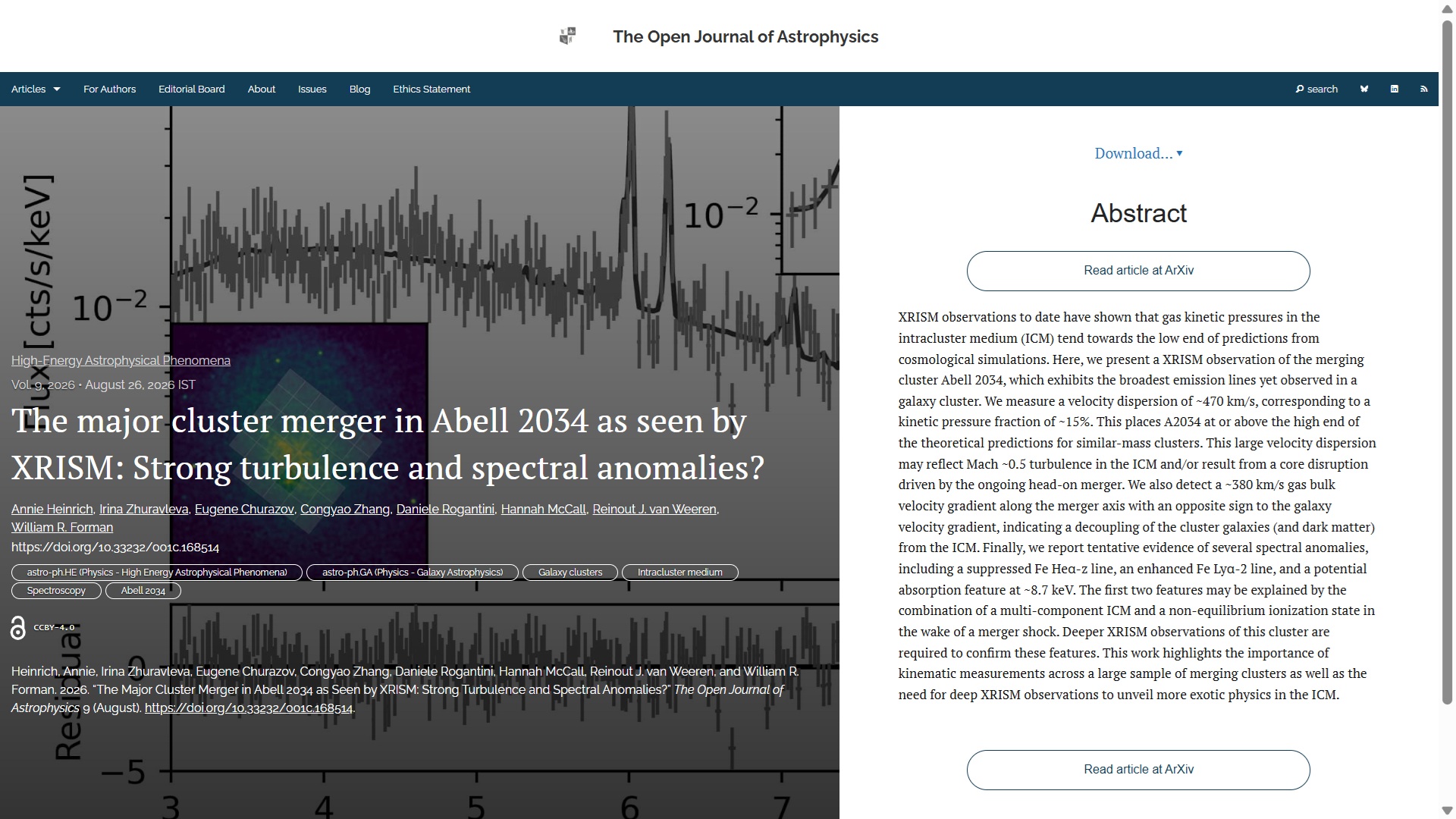
As of yesterday we had published in five of the six categories and were only missing a paper (in Number 4 – High-Energy Astrophysical Phenomena). Today, right on cue, from the queue, came this paper to complete the set:

There’s still a couple of days to go and we have more papers in the pipeline so it looks like I’ll have a busy time on Saturday morning when I do the next update!

Our Two-Million-Dollar Journal!

Posted in Open Access with tags , , , , on August 25, 2026 by telescoper

It’s exactly a year since I pointed out that the Open Journal of Astrophysics had saved the astrophysics research community worldwide a sum in excess of a million dollars in publication costs.

The Article Processing Charge (APC) for publishing a paper in Monthly Notices of the Royal Astronomical Society (MNRAS) is now £2356. Converting that to dollars at current rates (£1=$1.36) gives about $3200 per paper.

As of today, 25th August 2026, the Open Journal of Astrophysics has published 632 articles. Using the dollar cost of an MNRAS APC as a benchmark – many journals charge more – this means that we have now saved the global astrophysics community over $2M (for a total outlay of around $15K).

Yes, we are still a small journal but the size of that figure should help you understand how much money is being wasted globally on publishing fees that could instead be spent on actual research.

It’s good to see that more and more researchers are seeing the light and switching to Diamond Open Access. Today we published the 184th article in Volume 9 (2026) of the Open Journal of Astrophysics. At the end of August we will be about two-thirds of the way through the year so I expect we will publish more than 270 articles this year. I also expect that less than a year from now we will have saved our third million dollars.

I’d like to take this opportunity to thank everyone involved in running this journal: the Editors, staff at Maynooth University Library who help us, the host of volunteer referees, and of course our authors. I’m confident that, together, we can change the publishing landscape in astrophysics, and put the power (and money) back in the hands of researchers instead of greedy publishers.

This is a slightly-edited version of a post I made yesterday, when we had published four fewer papers, for the Open Journal of Astrophysics blog.

News from arXiv…

Posted in Open Access with tags , , , , , , on August 2, 2026 by telescoper

I saw recently an announcement that arXiv – which recently became a standalone nonprofit organization – now hosts more than three million articles. That message took me to a post on the arXiv blog from which I learnt that said blog is on WordPress which makes it possible to include embedded links from this WordPress blog, i.e.:

This in turn reminded me to answer a question that people sometimes ask about the Open Journal of Astrophysics, namely what would happen if arXiv went offline? Since OJAp is an arXiv-overlay journal this would appear to be fatal. We have been keeping duplicates of all the papers we publish, and associated metadata, in a local repository so that if arXiv went down we could reistate them fairly quickly. All we would need to do is alter the overlay to point to a different web address: there is no reason at all why the overlay idea can’t be adapted to other forms of repository.

Recently, however, arXiv decided to do a similar thing for all its articles. Here is a blog post about it:

I blogged about the first stage of this here.

Anyway, if you use arXiv at all – which will include most astrophysicists – then it would be a good idea to follow the arXiv blog as there is very important news on it, including information about alterations to the schedule of announcements.

A Ban on Publication Fees?

Posted in Open Access with tags , , , , , , on July 21, 2026 by telescoper

Yesterday I was going through the “onboarding” process via Zoom with two new Editors at the Open Journal of Astrophysics (OJAp) when one of them mentioned a recent policy decision at the USA which means we’ll probably get even more papers submitted from there. I wasn’t aware of the decision, but there’s an article in the Times Higher about it here.

In a nutshell:

Under proposed rule changes published by the Office of Management and Budget, all journal publication costs – “including page charges, article processing charges (APCs), or similar fees such as open access fees for professional journal publications and other peer-reviewed publications” – will become “unallowable under federal awards”.

It is important to stress that at this stage the change is proposed rather than actual and it remains to be seen whether it will stand. I think it should because publication fees, article processing charges or whatever you call them are a complete waste of money.

The Times Higher article frames this as “Trump’s ban on paying open access fees”. I was worried to be finding myself in agreement with Donald Trump on anything, but I very much doubt that Trump himself knows anything about scientific publishing or has had much of a hand in this decision. It seems to me to be eminently sensible to ensure that funds meant to be directed at research are not frittered away on page charges. If I were involved in running a research institution I would make it a disciplinary offence to spend money on publication fees.

Of course the academic publishing industry is upset about the proposal claiming that scientific publishing is “high cost”, which it is but only because the publishers rake in huge profits. The way forward, as I have argued many times (e.g. here), is Diamond Open Access, a exemplified by OJAp. The marginal cost per paper article published for OJAp is just $10 and we have at least as much impact as the other leading journals in astrophysics.

I have been surprised how many researchers from the USA are already using OJAp, including many from top institutions such as Harvard, Caltech, Princeton and Chicago. The surprise is basically that authors from the USA have for many years been used to paying page charges for publishing in the Astrophysical Journal and others from the AAS stable. This was the case even before digital journals came on the scene and well before the Open Access movement. I suppose American authors put up with page charges because they felt they had to, but that is no longer the case.

Will we get even more submissions from the USA as a result of this policy change? We’ll just have to wait and see…

P.S. This morning I published the 600th paper at the Open Journal of Astrophysics.

Editorial Opportunity at the Journal of Open Source Software

Posted in Open Access with tags , , , , , , , on May 11, 2026 by telescoper

The Journal of Open Source Software – known to its friends as JOSS – is is a developer friendly, diamond open access journal for research software packages which has been running since 2016 and is enormously successful, publishing Open Source software across many fields of science. Its UR, joss.theoj.org, is a giveaway that it is a stablemate of astro.theoj.org, aka the Open Journal of Astrophysics.

The driving force behind JOSS, responsible for getting it off the ground at the very beginning, is Arfon Smith whom I’ve known since Nottingham days and it iis fair to say that without his considerable help, OJAp would never have started. Both journals started off as speculative ventures, and OJAp has taken a considerable time to establish itself, but JOSS took off very quickly indeed and has now published over 3,500 papers. There are numerous differences between the two journals but, like OJAp, all publications in JOSS are free to authors and readers.

Arfon has held the role of Editor-in-Chief at JOSS since 2016 but in a recent blog post he explains that he is stepping down from his role as Editor-in-Chief, although he will remain at JOSS. The call for a replacement is here. It’s an opportunity that will appeal to anyone interested in open-source research software and open-access publishing so if that’s you then please consider applying. It will be a substantial investment of time, probably about a day a week. I quote:

Candidates should have the capacity to commit the time this role requires. For those in institutional positions, we ask for a brief letter or statement from your employer or supervisor confirming support for this commitment. Independent researchers, consultants, or others without a traditional institutional affiliation should include a brief statement describing how they plan to allocate the time.

P.S. Today OJAp published its 100th paper of 2026 so far…

P.P.S. I’ll be stepping down as Editor-in-Chief at OJAp in a couple of years, when I retire, and we’ll be doing a similar search nearer the date.

An independent arXiv

Posted in Finance, Maynooth, Open Access with tags , , , on April 9, 2026 by telescoper

I’m a bit late passing this news on, but a few weeks ago arXiv announced that from 1st July 2026 it will be establishing itself as an “independent nonprofit organization”. It has been hosted for many years by Cornell University. You can read here about the reasons for this and how it will work, and there is a lengthier article in Science magazine, but the quick summary is

This transition allows for faster technological development, greater organizational flexibility, expanded partnerships, and long-term financial sustainability. A platform built by scientists for scientists, the new arXiv will continue to serve researchers worldwide with the same dedication to free and open scientific discovery.

Such a move creates opportunities, but also carries risks. The sustainability of the new-look arXiv will depend on finding appropriate sources of income, for example. I wish arXiv well in this move. There’s an advertisement for the post of Chief Executive, if anyone fancies the job!

One possible future model for the Open Journal of Astrophysics is as a standalone non-profit organization of some sort, funded also by donations. Currently we are funded by the Library at Maynooth University, where I am based. Having made the decision not to charge fees of any kind, we lack any source of income other than the University. I am very grateful for that support, but we are run on a very tight budget. We keep costs to an absolute minimum, but are not free.

I have written before about what I think the future of Diamond Open Access could look like. I would like to see a range of Diamond Open Access journals offering a choice for authors and serving different sub-disciplines. Most universities nowadays have publishing operations so there could be network of federated journals, some based on arXiv and some based on other repositories and others with different models, such as SciPost. Perhaps institutions are worried about the expense but, as we have shown the actual cost, is far less than they are wasting on Article Processing Charges.

Everything is working well right now at OJAp, but it is not reasonable that the expense of running a journal that serves the global astrophysics community should fall entirely on one small University in Ireland. It won’t be sustainable in the long run, either, if we continue to grow at the present rate. Compare us with the Diamond Open Access publisher SCIPOST, which has a long list of sponsors covering its costs; we have none. My only hope at the moment of turning OJAp into an independent organization is to win the lottery!

Another thing makes me nervous. Many modern universities, which are nominally non-profit institutions, are managed by people who care far more about revenue generation than about academic scholarship and research. I worry that someone upstairs might pressurize us to introduce charges to generate income by threatening to close us down.

I know that money is very tight in astrophysics these days but if you have access to any potential sources of funding – then please consider supporting OJAp!

Paying for the Open Journal of Astrophysics

Posted in Finance, Open Access with tags , , , , , , on March 30, 2026 by telescoper

A couple of days ago I received an email from a publisher offering to buy the Open Journal of Astrophysics. This happens from time to time, but it’s interesting to see the offer price increasing. This time it was for $150,000. I don’t know how that valuation was arrived at but I think OJAp is worth a lot more. But then there is a difference between price and value…

The publisher in question this time was XLESCIENCE, which is based in India and which charges typical Article Processing Charges of $1,200 per paper. I wonder how they would plan to make a profit from OJAp, which charges nothing? If a publisher did buy OJAp and started trying to charge an APC, people would just stop using it!

(The offer price is not the only reason I dismissed the approach, however. One other reason is that I don’t want to do business with a commercial publisher. Another reason I wouldn’t consider selling the Open Journal of Astrophysics is that I don’t actually own it. I did think about offering to sell them one of the many other journals I don’t own, just for a laught, but that might have been construed as attempted fraud…)

This episode reminded that some time ago I wrote a piece about funding open access journals. Having made the decision not to charge fees of any kind, we lack any source of income other than Maynooth University. I am very grateful for that support, but we are run on a shoestring budget. We are run entirely by volunteers and keep costs to an absolute minimum, but are not free.

I have written before about what I think the future of Diamond Open Access could look like. I would like to see a range of Diamond Open Access journals offering a choice for authors and serving different sub-disciplines. Most universities nowadays have publishing operations so there could be network of federated journals, some based on arXiv and some based on other repositories and others with different models, such as SciPost. Perhaps institutions are worried about the expense but, as we have shown the actual cost, is far less than they are wasting on Article Processing Charges.

Everything is going well at OJAp, but it is not reasonable that the expense of running a journal that serves the global astrophysics community should fall entirely on one small University in Ireland. It won’t be sustainable in the long run, either, if we continue to grow at the present rate. Compare us with the Diamond Open Access publisher SCIPOST, which has a long list of sponsors covering its costs; we have none. I know that money is very tight in astrophysics these days but if you have access to any potential sources of funding – then please consider supporting OJAp!

The 500th Publication at the Open Journal of Astrophysics!

Posted in OJAp Papers, Open Access with tags , , , , , , on March 16, 2026 by telescoper

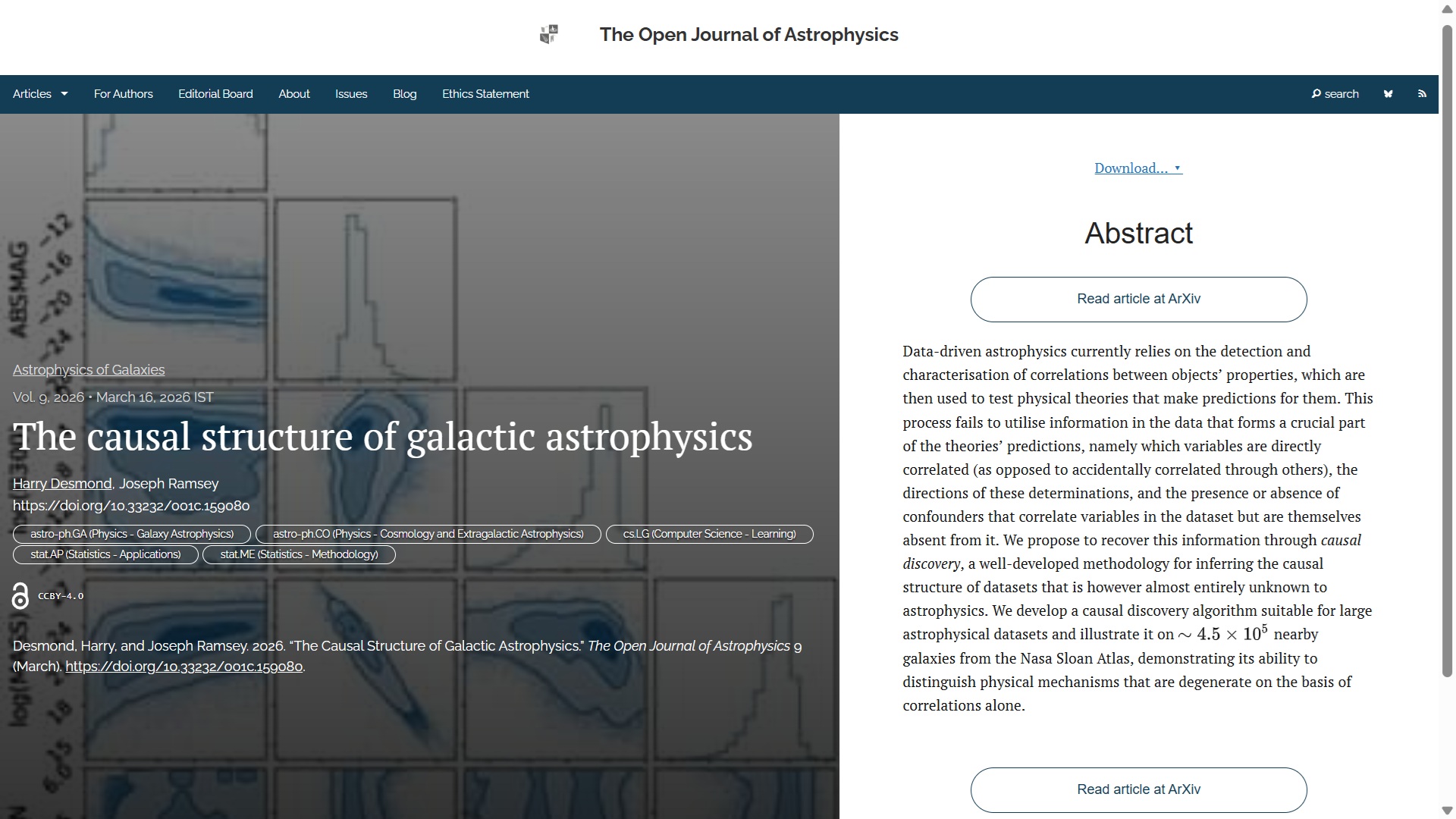
As I predicted in last weekend’s update of activity at the Open Journal of Astrophysics, this morning I was able to publish the 500th paper at the Open Journal of Astrophysics. The overlay is here:

The authors of this paper are Harry Desmond of the Institute of Cosmology & Gravitation at the University of Portsmouth (UK) and Joseph Ramsey of the Philosophy Department at Carnegie Mellon University in the USA.You can find the officially accepted final version on arXiv here.

Congratulations to the authors – as a prize they each receive a year’s free subscription to the Open Journal of Astrophysics.

P.S. If you’re interested we published our 250th paper just over a year ago. If we keep this rate up we’ll have published over 1,000 papers by the time I retire…