Archive for MEGATRON

Weekly Update from the Open Journal of Astrophysics 03/10/2026

Posted in OJAp Papers, Open Access, The Universe and Stuff with tags , , , , , , , , , , , , , , , , , , , , , , , on October 3, 2026 by telescoper

It’s Saturday again, so it’s time for another update of activity at the Open Journal of Astrophysics. Since the last update we have published a further 13 papers, including one correction to an article already published, bringing the number in Volume 9 (2026) to 229 and the total so far published by OJAp up to 677. This would have been a busy week even without the clutch of four MEGATRON papers announced on Wednesday!

I continue to include the posts made on our Mastodon account (on Fediscience); these announcements also contain a clickable form of the DOI for each paper. Our Mastodon account has regular updates and other announcements from OJAp too, including posts from the OJAp blog.

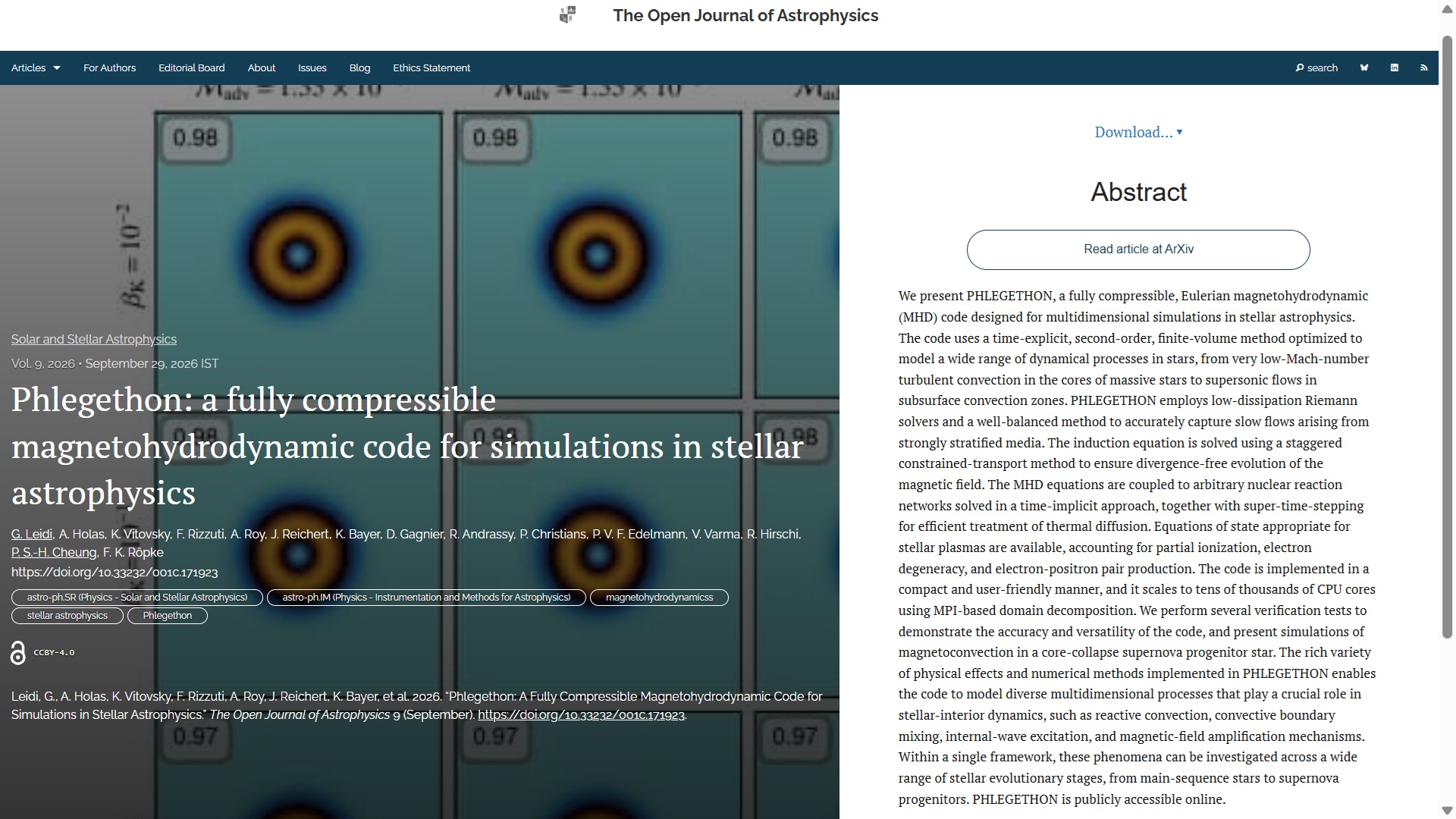
The first new paper this week was published on Tuesday 28th September in the folder Solar and Stellar Astrophysics. The title is “Phlegethon: a fully compressible magnetohydrodynamic code for simulations in stellar astrophysics” and it is by G. Leidi (Heidelberger Institut für Theoretische Studie, Germany) and 14 others. PHLEGETHON is a magnetohydrodynamic code designed for multidimensional simulations in stellar astrophysics, capable of modeling a wide range of dynamical processes in stars. It is publicly accessible online.

The overlay for this one is here:
You can find the officially accepted version on arXiv here and the announcement on Fediverse here:

Open Journal of Astrophysics

New Publication at the Open Journal of Astrophysics: "Phlegethon: a fully compressible magnetohydrodynamic code for simulations in stellar astrophysics" by G. Leidi (Heidelberger Institut für Theoretische Studie, Germany) and 14 others.

doi.org/10.33232/001c.171923

September 29, 2026, 7:22 am 1 boosts 0 favorites

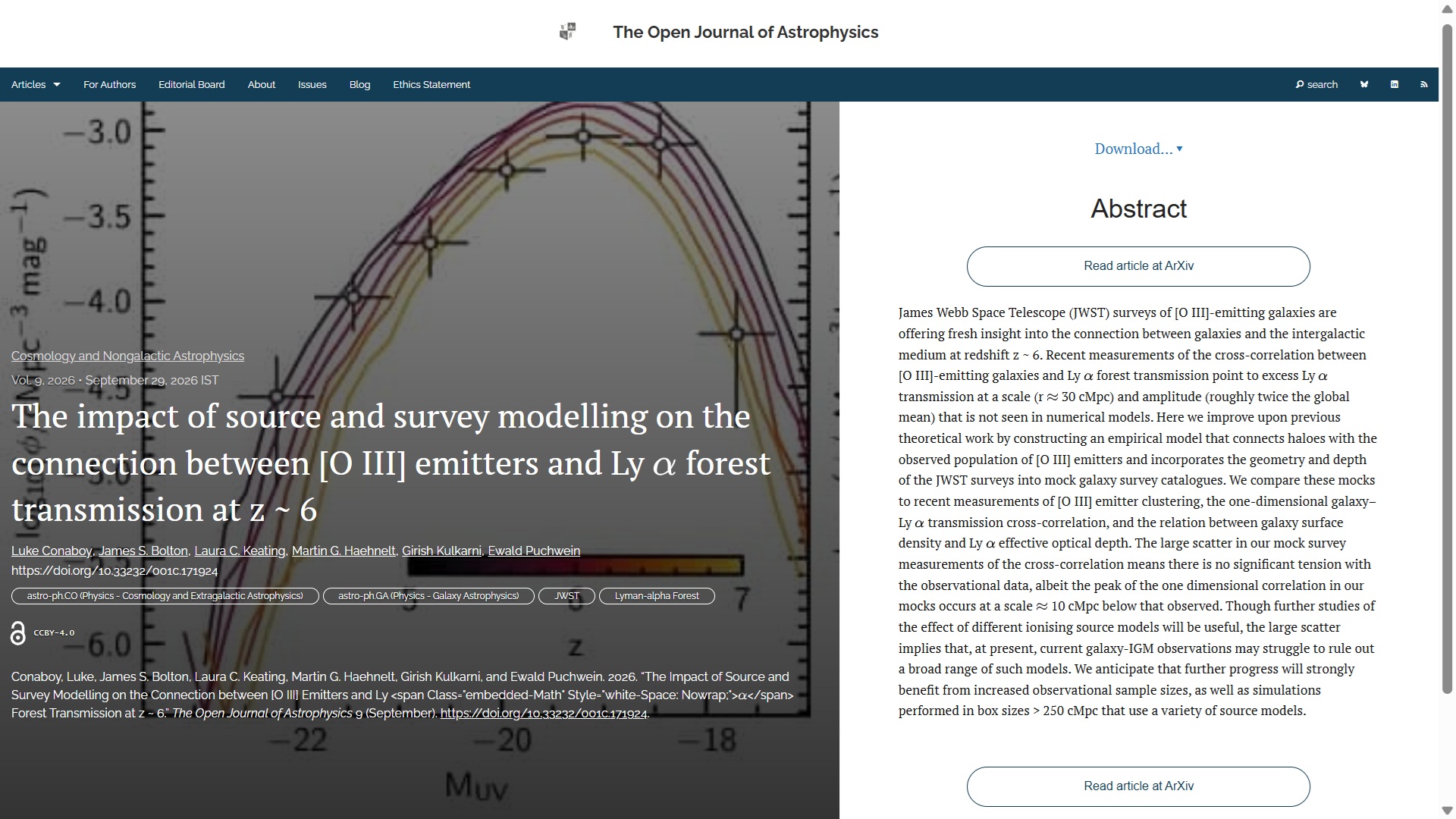
The second paper for this week, published on Tuesday 29th September, is “The impact of source and survey modelling on the connection between [O III] emitters and Ly-α forest transmission at z ~ 6” by Luke Conaboy (U. Nottingham, UK) and 5 others based in the UK, India and Germany. This study improves theoretical work on the connection between galaxies and the intergalactic medium, using an empirical model and James Webb Space Telescope surveys. It is in the folder marked Cosmology and Nongalactic Astrophysics.

The overlay looks like this:
The official version of the paper can be found on arXiv here and the Fediverse announcement here:

Open Journal of Astrophysics

New Publication at the Open Journal of Astrophysics: "The impact of source and survey modelling on the connection between [O III] emitters and Ly-α forest transmission at z ~ 6" by Luke Conaboy (U. Nottingham, UK) and 5 others based in the UK, India and Germany.

doi.org/10.33232/001c.171924

September 29, 2026, 7:38 am 1 boosts 2 favorites

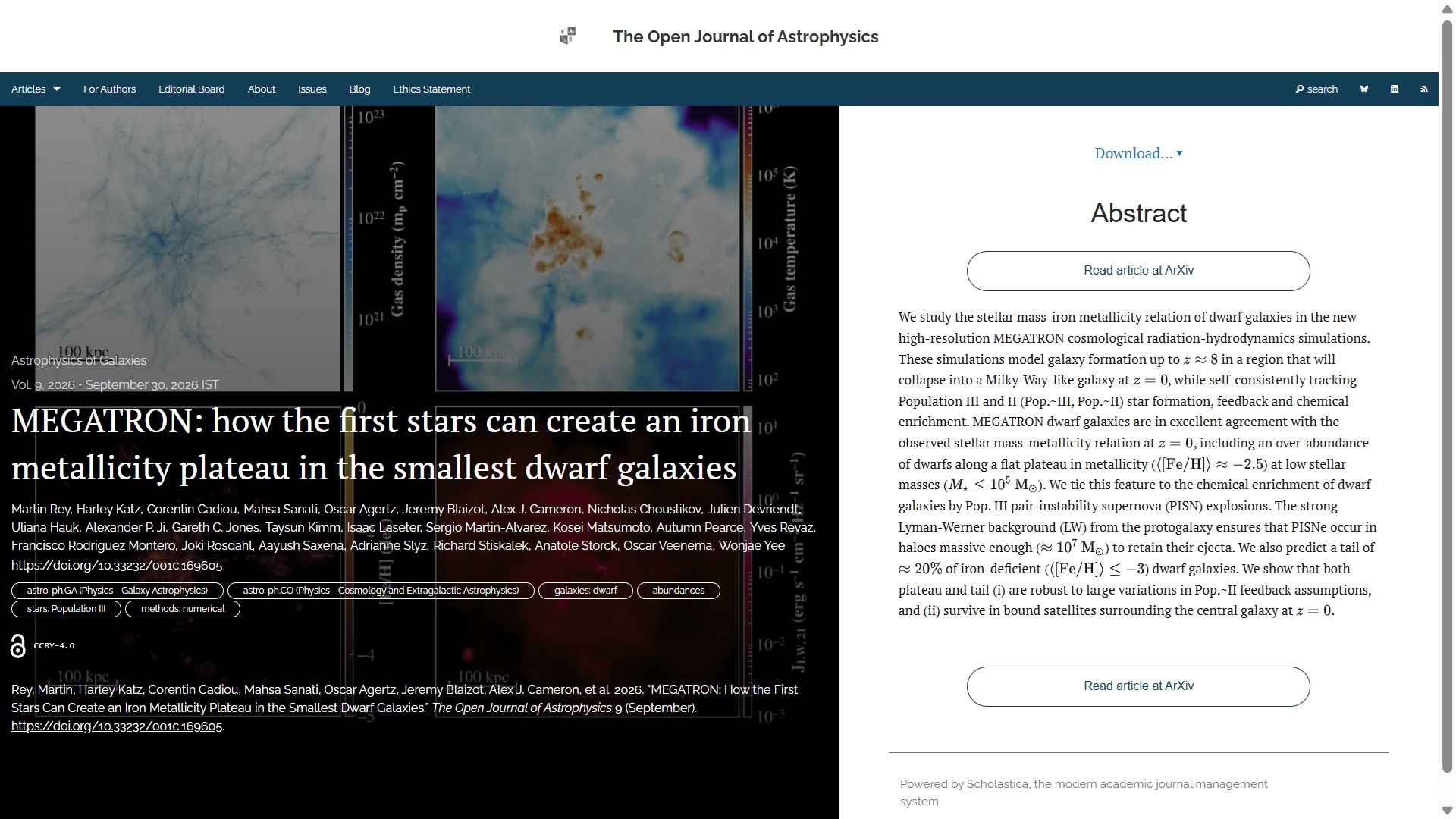
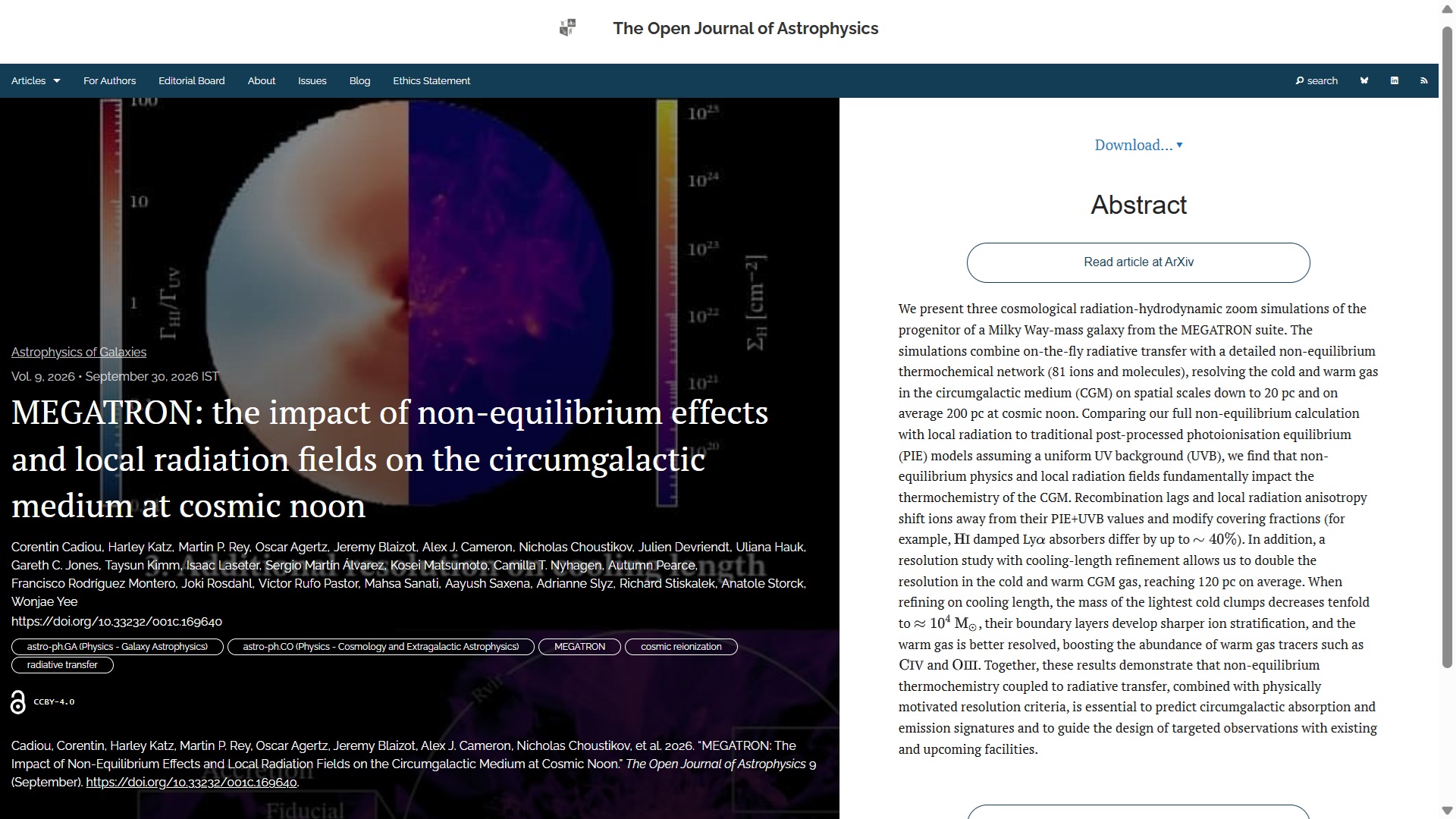
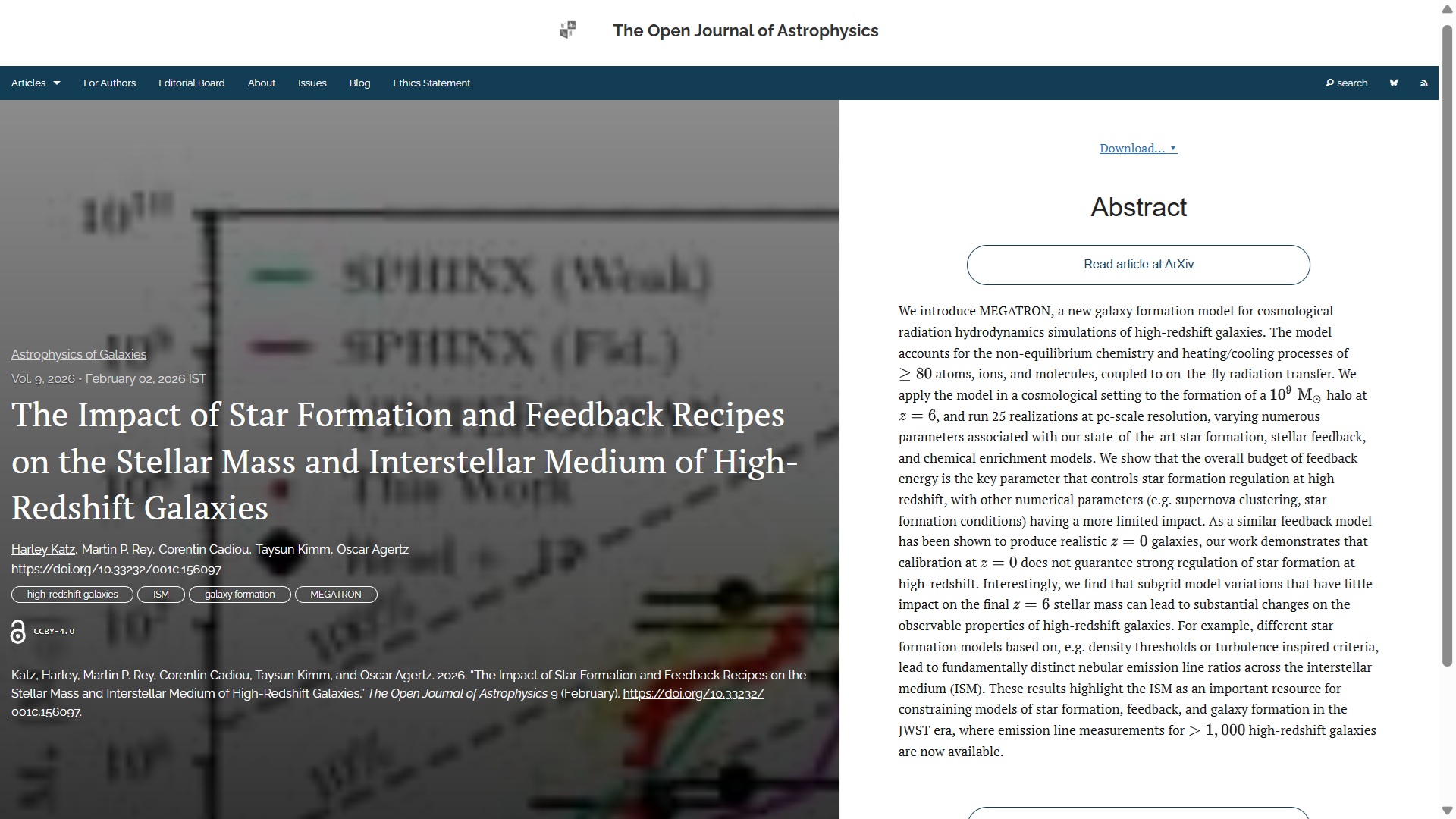
Next we have four related papers produced by the MEGATRON Project, led by Harley Katz (U. Chicago) and Martin Rey (U. Bath, UK), Corentin Cadiou (IAP Paris, France). These were all published on Wednesday 30th September in the folder Astrophysics of Galaxies.

I mentioned this in a separate blog post here, so I won’t describe them in detail again here. Here are the four overlays:
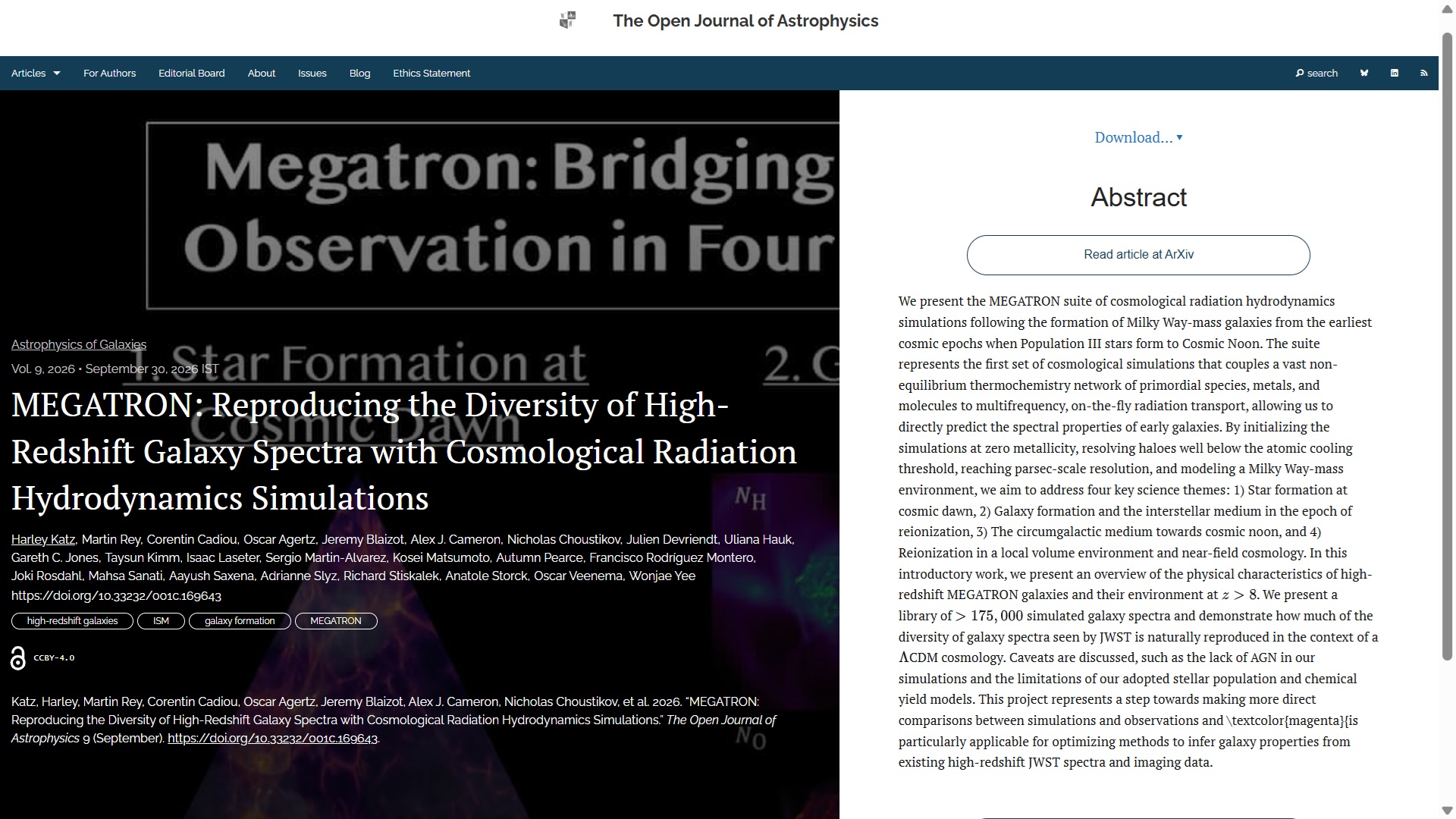
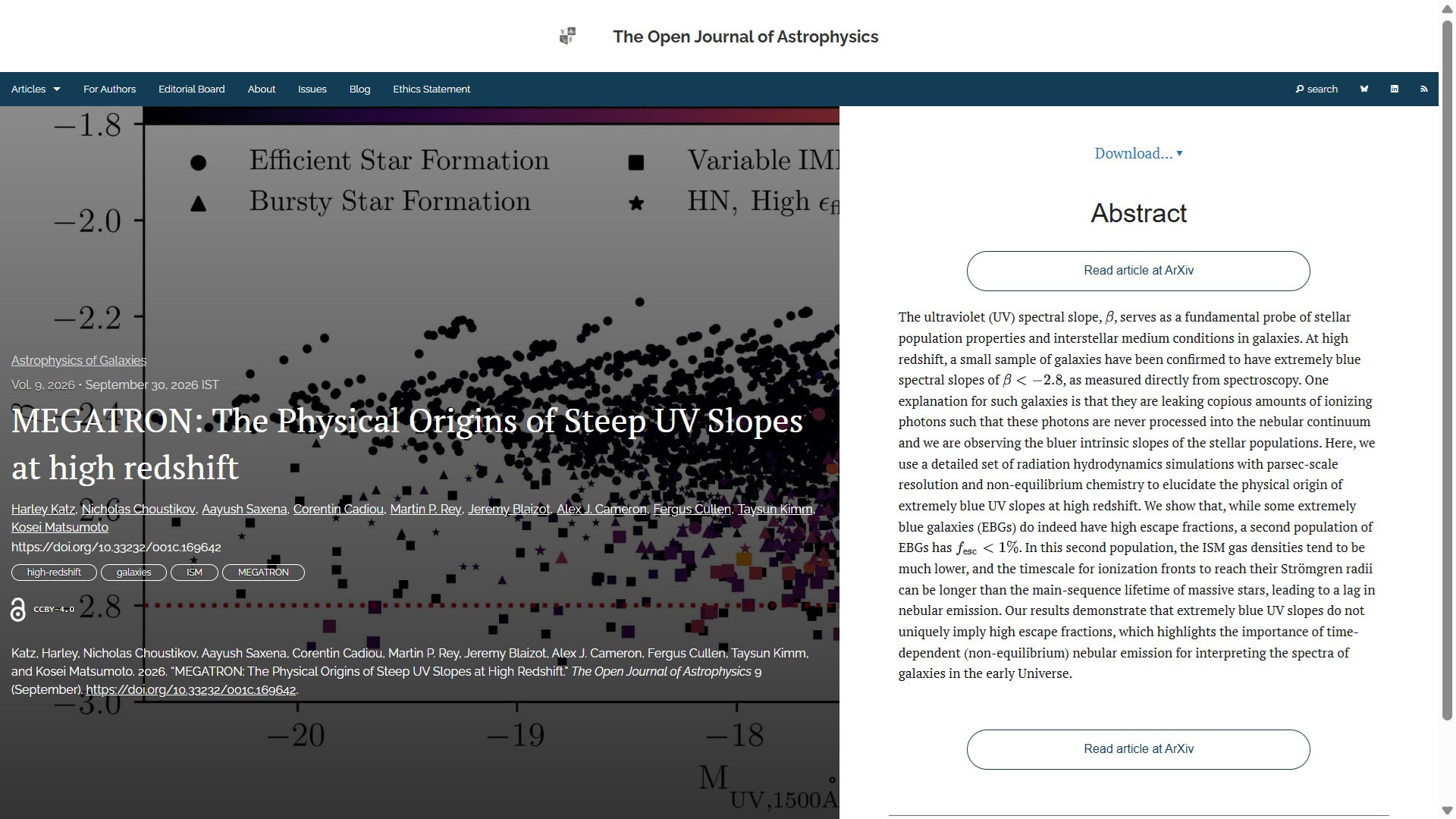
The Mastodon announcement for these is in the form of a thread:

Open Journal of Astrophysics

Today we have published four related papers produced by the MEGATRON Project, led by Harley Katz (U. Chicago) and Martin Rey (U. Bath, UK), Corentin Cadiou (IAP Paris, France)

These articles are announced in the following thread:

September 30, 2026, 1:24 pm 1 boosts 1 favorites

The four papers can be found on arXiv here, here, here and here.

The four MEGATRON papers were not the only ones published on Wednesday 30th September, however. We published “The Chirp-Mass Ladder: A New Rung Emerges” by Vaibhav Tiwari (U. Birmingham, UK) in the folder High-Energy Astrophysical Phenomena on that day too. This paper presents an analysis of 256 binary black-hole (BBH) events, suggesting a hierarchical merger scenario to explain the structured mass distribution, and encouraging further investigation into hierarchical mergers’ role in the BBH population. The overlay for this is here:
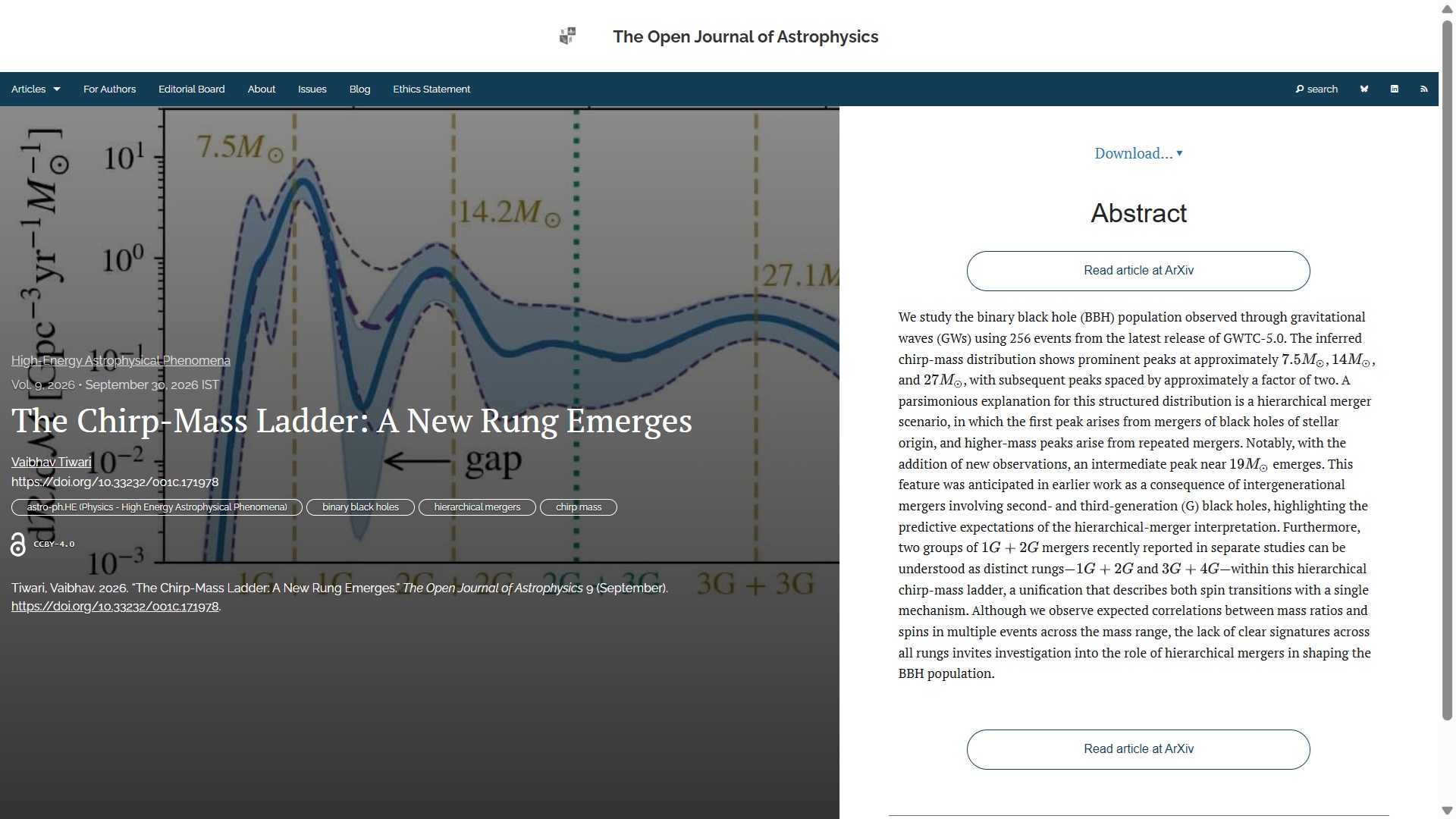
The accepted version of this one can be found on the arXiv here and the Mastodon announcement here:

Open Journal of Astrophysics

New Publication at the Open Journal of Astrophysics: "The Chirp-Mass Ladder: A New Rung Emerges" by Vaibhav Tiwari (U. Birmingham, UK)

doi.org/10.33232/001c.171978

September 30, 2026, 4:39 pm 0 boosts 2 favorites

The eighth new paper of the week, published on Thursday 1st October 2026, in the folder Cosmology and Nongalactic Astrophysics, is “A Consistent Implementation of Cluster Strong Lensing in Cosmological Simulation Light Cones” by Cian Roche (MIT, USA) and 11 others based in the USA, Germany and Italy.

The overlay is here:
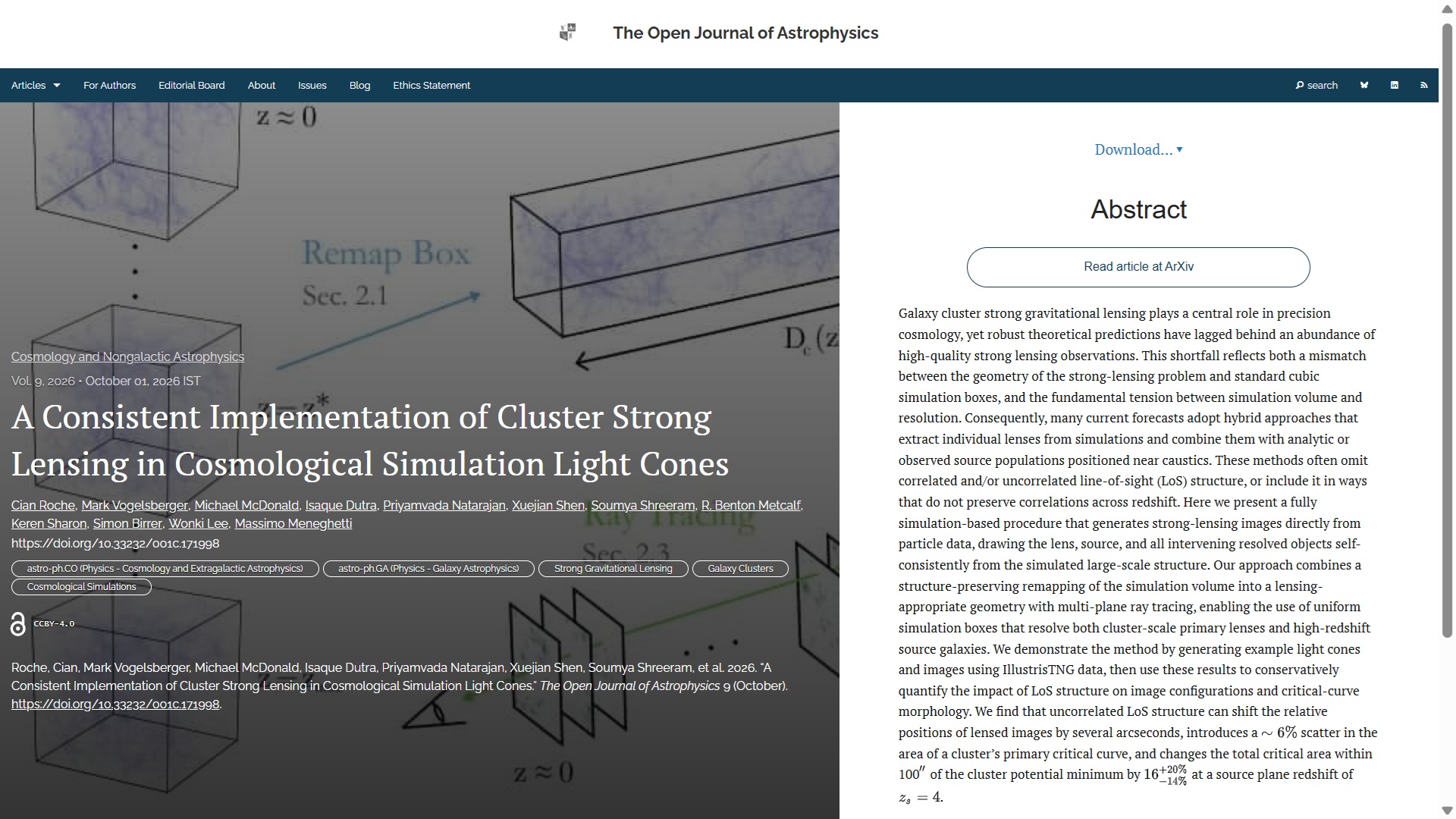
The official version of the paper can be found on arXiv here and the Fediverse announcement here:

Open Journal of Astrophysics

New Publication at the Open Journal of Astrophysics: "Kinematics of the Weak Cool-Core Cluster A3571 Observed with XRISM: Low Cooling Rate Balanced by Low Heating Rate?" by Hannah McCall (U. Chicago, USA) and 12 others based around the world.

doi.org/10.33232/001c.171549

September 22, 2026, 7:13 am 0 boosts 1 favorites

We now have four papers all published on Friday 2nd October (i.e. yesterday).

The first of this batch is “Analytical weak-lensing shear response of galaxy model fitting” by Xiangchong Li (Brookhaven National Laboratory, USA). This is in the folder marked Cosmology and Nongalactic Astrophysics: it explores how galaxy model fitting responds to weak-lensing shear distortions using a new algebraic system, quintuple numbers, within the AnaCal framework, keeping multiplicative bias low.

The overlay is here:
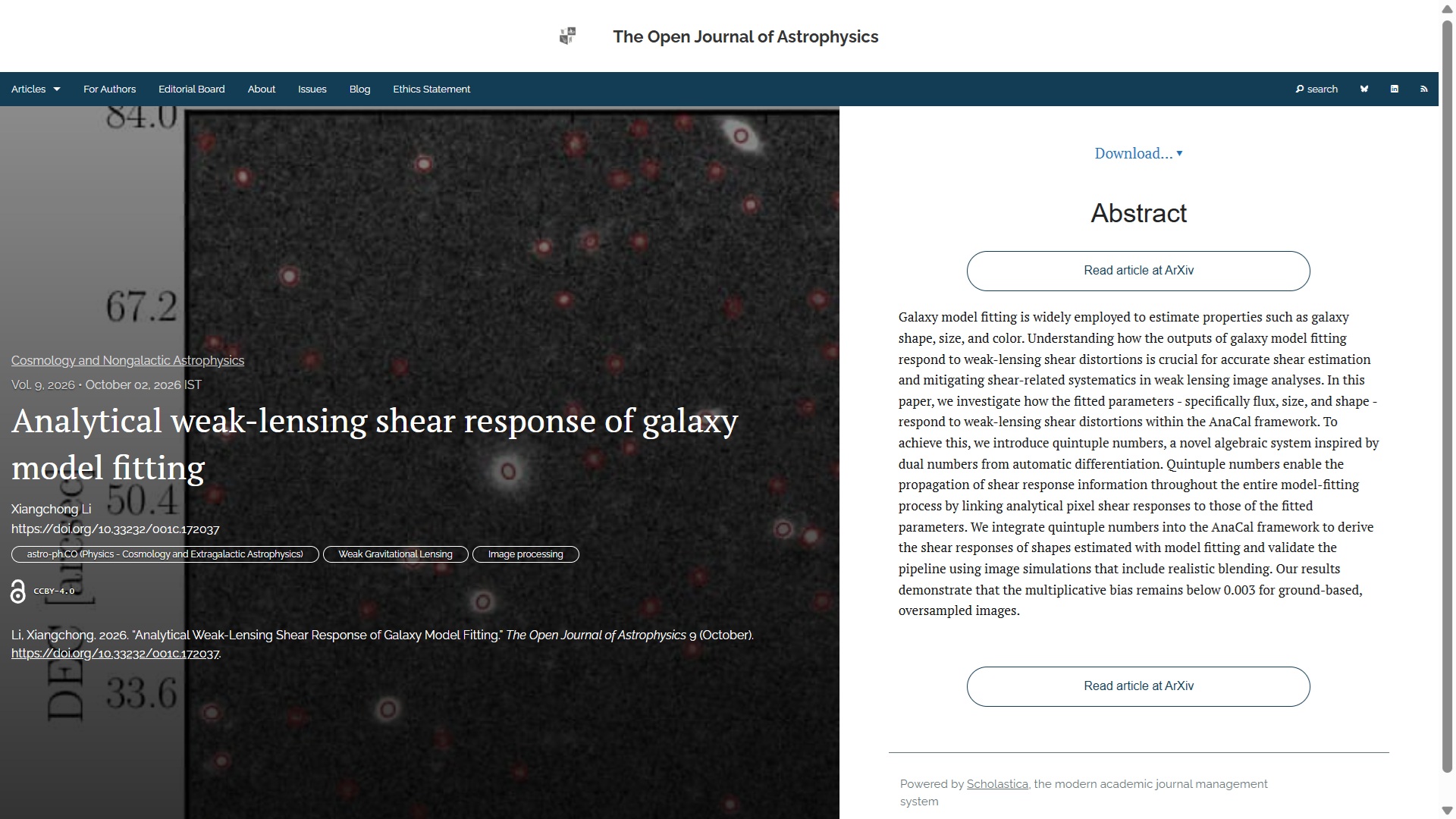
The officially-accepted version of the paper can be found on arXiv here and the Fediverse announcement here:

Open Journal of Astrophysics

New Publication at the Open Journal of Astrophysics: "Analytical weak-lensing shear response of galaxy model fitting" by Xiangchong Li (Brookhaven National Laboratory, USA)

doi.org/10.33232/001c.172037

October 2, 2026, 6:11 am 1 boosts 1 favorites

The 10th paper of the week is “Evidence for inefficient dust production in a massive, metal-rich galaxy at z=7.13 uncovered by JWST and ALMA” by Kasper E. Heintz (Cosmic Dawn Center, Copenhagen, Denmark) and 19 others in Europe, UK and USA. This article, published on Friday 2nd October 2026, in the folder Astrophysics of Galaxies, analyzes cosmic dust in high redshift galaxies, specifically A1689-zD1, using data from JWST and ALMA, suggesting dust formation and destruction processes differ for galaxies in the early Universe.
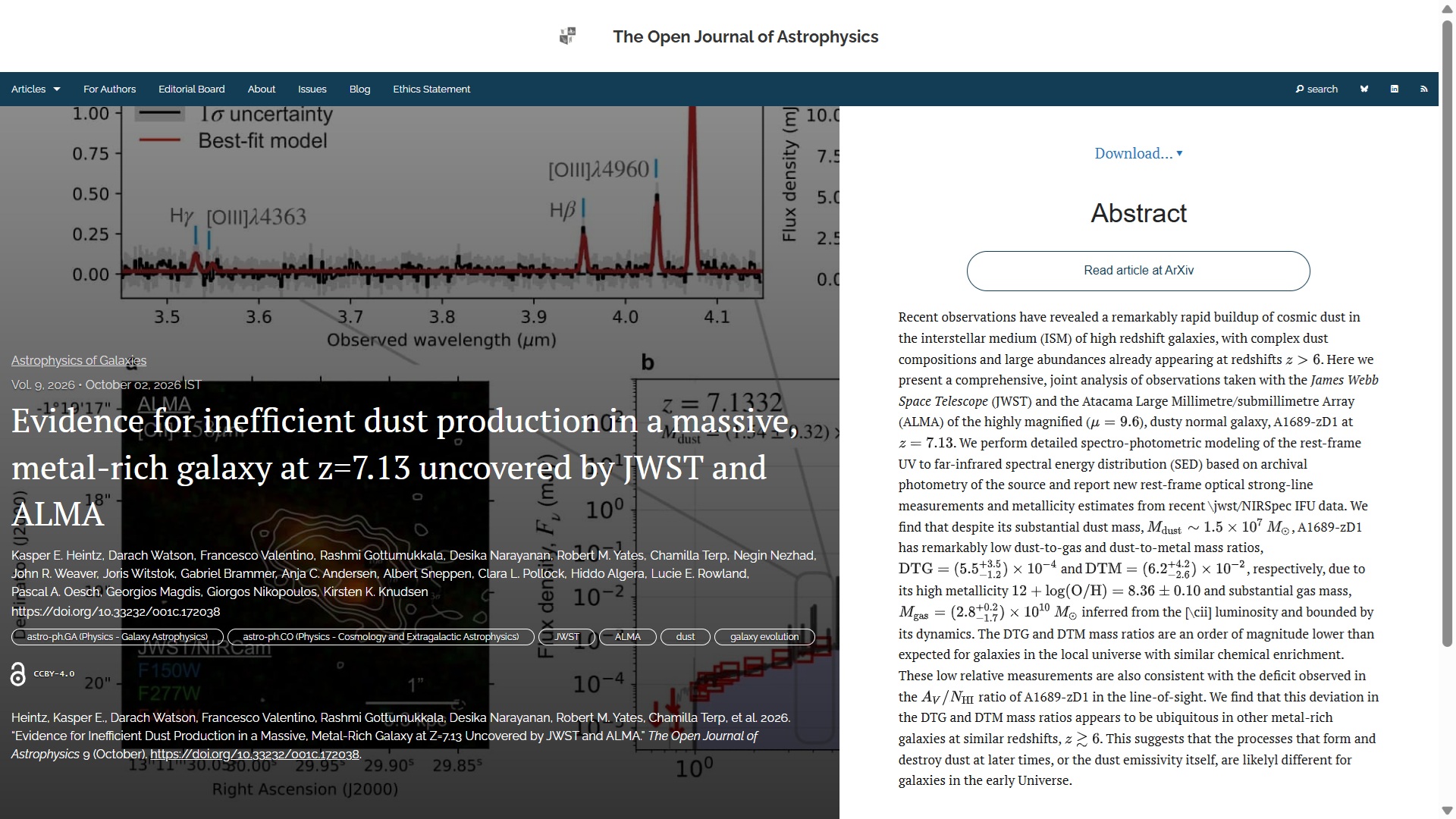
The officially-accepted version of this paper is on arXiv here and the Mastodon announcement on the fediverse here:

Open Journal of Astrophysics

New Publication at the Open Journal of Astrophysics: "Evidence for inefficient dust production in a massive, metal-rich galaxy at z=7.13 uncovered by JWST and ALMA" by Kasper E. Heintz (Cosmic Dawn Center, Copenhagen, Denmark) and 19 others in Europe, UK and USA.

doi.org/10.33232/001c.172038

October 2, 2026, 6:34 am 2 boosts 3 favorites

The 11th paper of the week is “Starbursts hiding in the main sequence: a pathway toward quenching?” by Florent Renaud (Observatoire Astronomique de Strasbourg, France) and 12 others based in France and UK. This article explores the “starbursts in the main sequence” (SBMSs) that intermittently appear in galaxy evolution, attributing their existence to earlier stellar mass assembly and frequent mergers. It was published on Friday 2nd October 2026, in the folder Astrophysics of Galaxies.

The overlay is here:
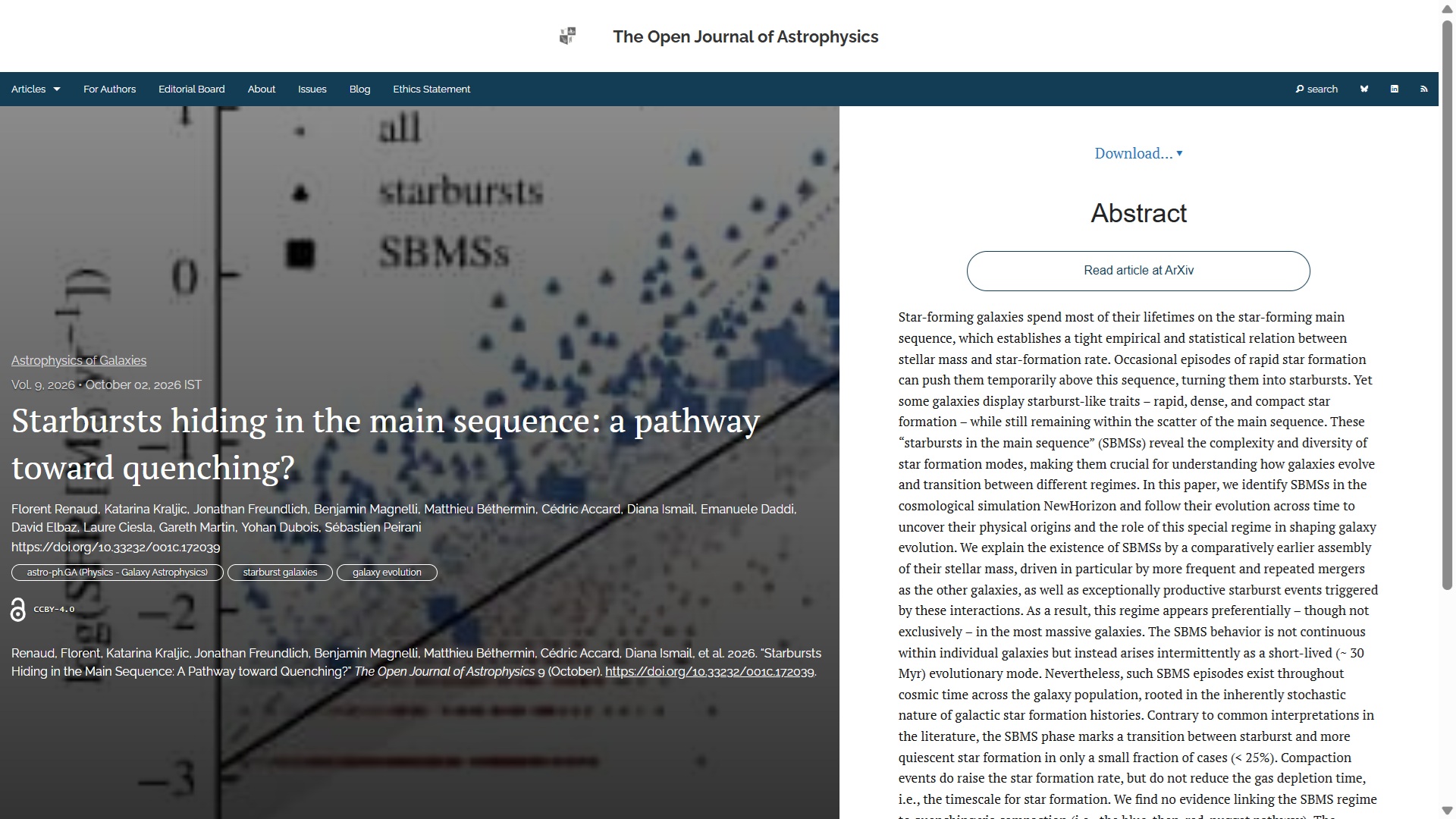
The officially accepted version is on arXiv here and the Mastodon announcement here:

Open Journal of Astrophysics

New Publication at the Open Journal of Astrophysics: "Starbursts hiding in the main sequence: a pathway toward quenching?" by Florent Renaud (Observatoire Astronomique de Strasbourg, France) and 12 others based in France and UK.

doi.org/10.33232/001c.172039

October 2, 2026, 6:49 am 1 boosts 1 favorites

The twelfth, and last, of the new papers for this week is “Ring Position Angles and Spin in M87* and Sgr A*” by Nicholas S. Conroy (U. Illinois at Urbana-Champaign, USA) and 6 others all based in the USA. This was also published on Friday 2nd October but in the folder High-Energy Astrophysical Phenomena.

The overlay is here:
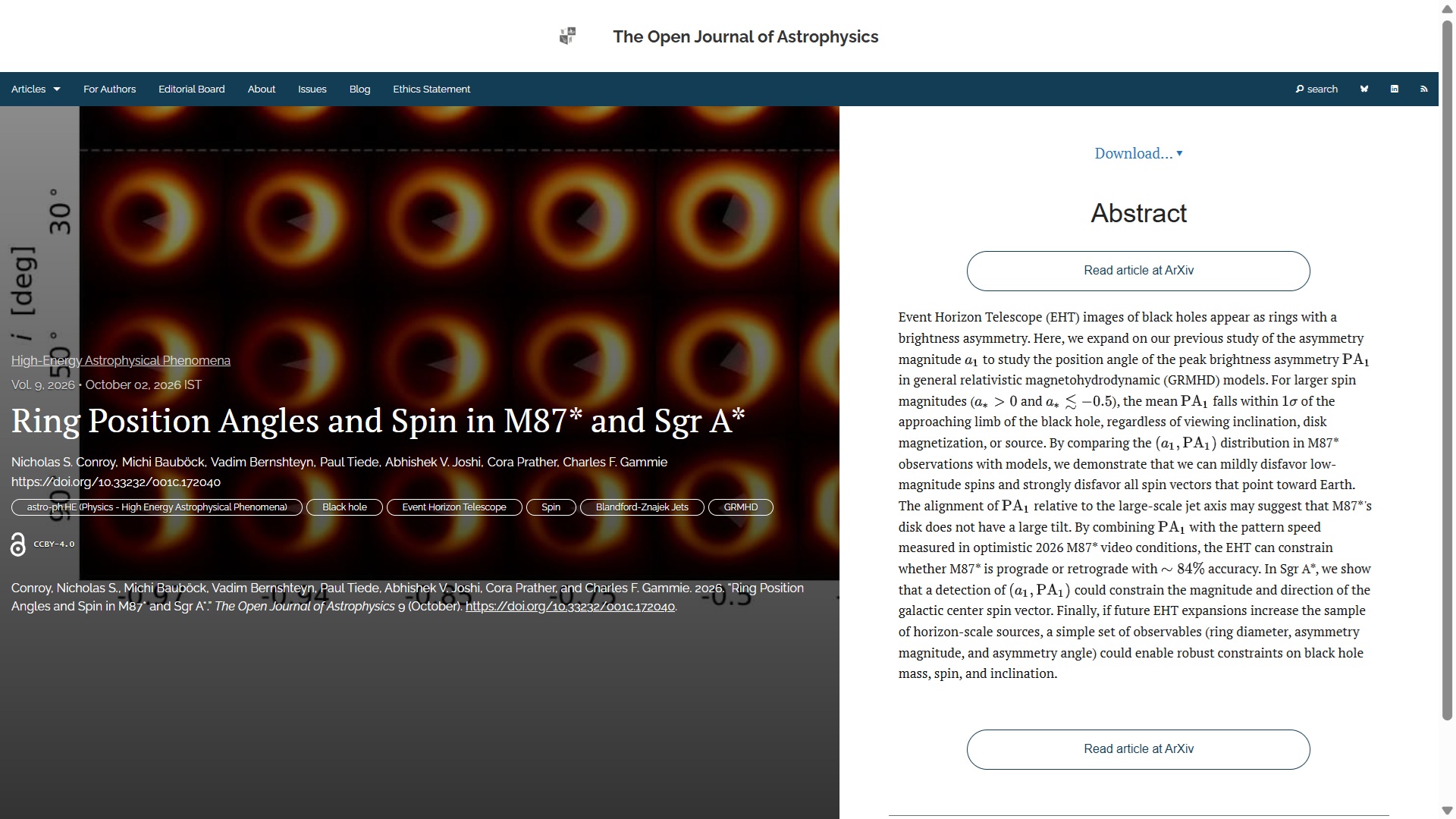
The final version of this paper is on the arXiv here and the Mastodon announcement here:

Open Journal of Astrophysics

New Publication at the Open Journal of Astrophysics: "Ring Position Angles and Spin in M87* and Sgr A*" by Nicholas S. Conroy (U. Illinois at Urbana-Champaign, USA) and 6 others all based in the USA.

doi.org/10.33232/001c.172040

October 2, 2026, 7:02 am 1 boosts 0 favorites

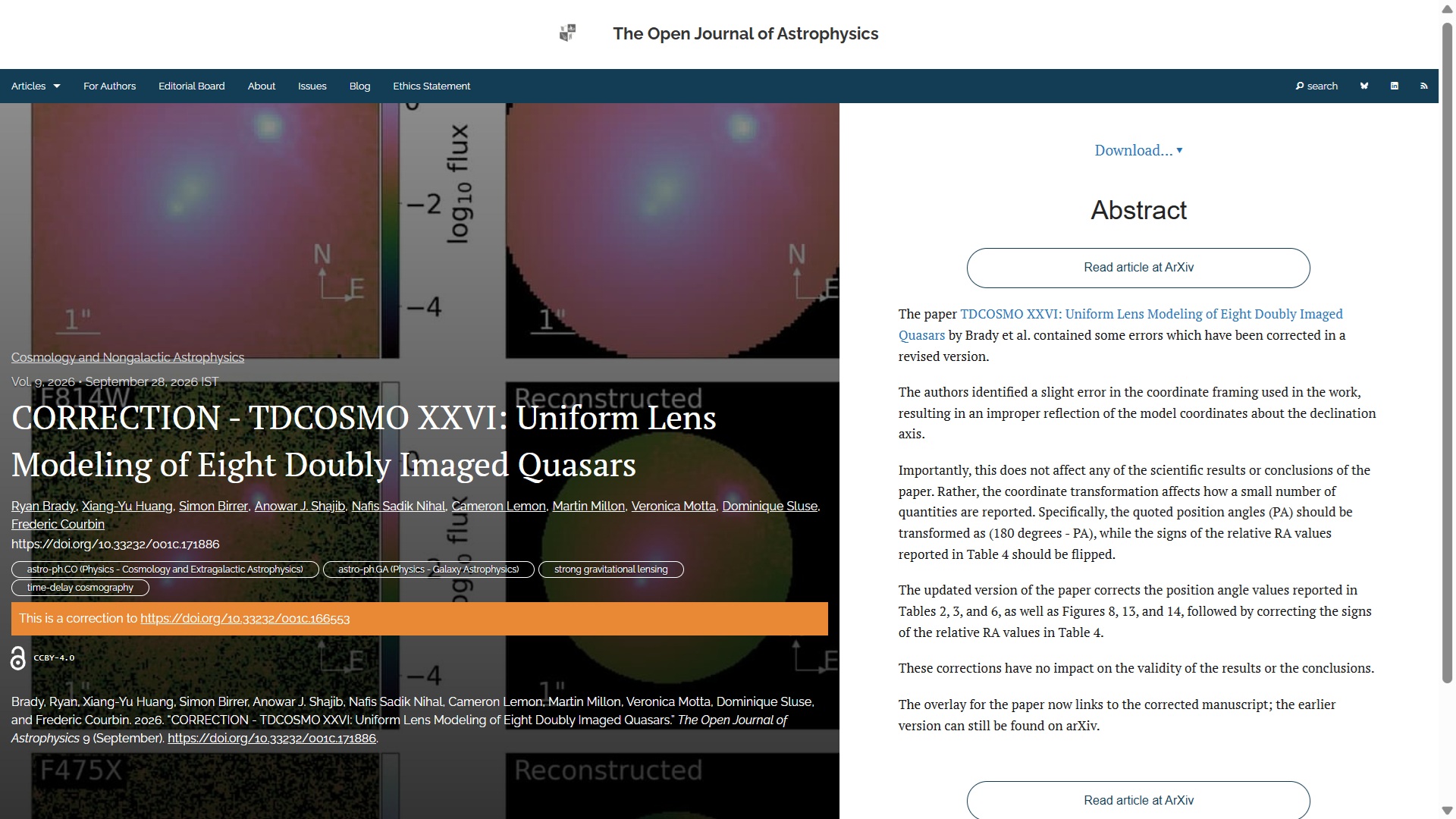
And finally, on Monday 28th September we announced one (minor) correction to a previously published article. The overlay of the correction notice is here:
The mastodon announcement is here:

Open Journal of Astrophysics

Correction Notice issued at the Open Journal of Astrophysics: "CORRECTION – TDCOSMO XXVI: Uniform Lens Modeling of Eight Doubly Imaged Quasars" by Brady et al. (originally published 7th August 2026).

doi.org/10.33232/001c.171886

September 28, 2026, 7:49 am 0 boosts 0 favorites

The corrected version of this paper can be found on arXiv here.

That concludes this week’s update. As things are going we seem likely to publish over 300 papers this year, and may reach the 750 mark by the end of the year too. I’ll do another update next week.
A MEGATRON Day!

Posted in OJAp Papers, Open Access, The Universe and Stuff with tags , , on September 30, 2026 by telescoper

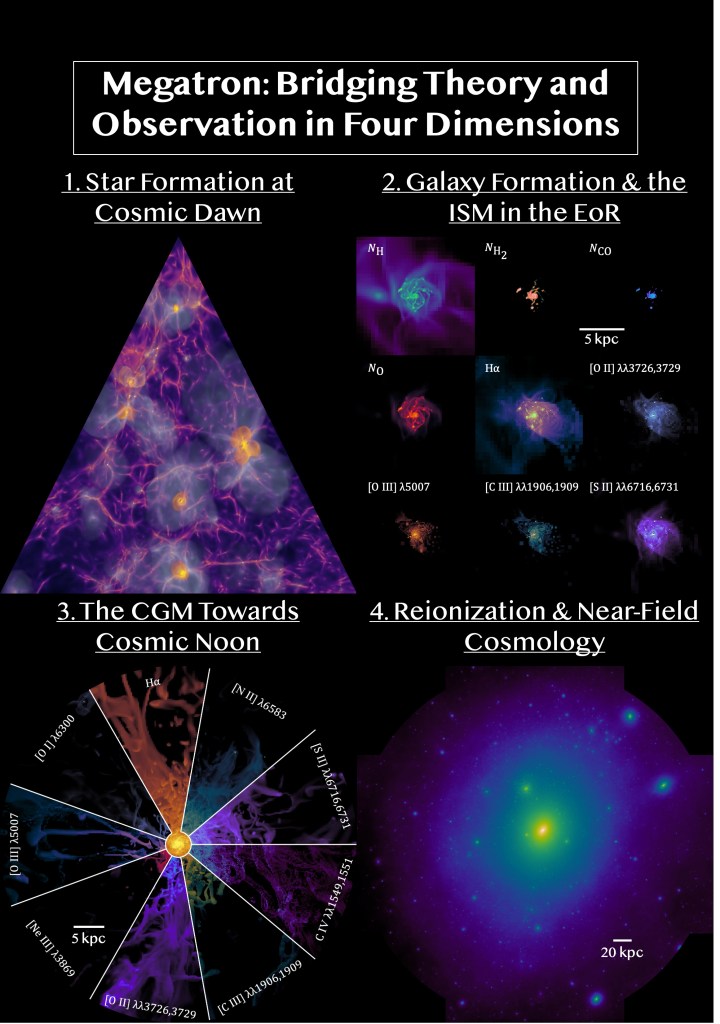
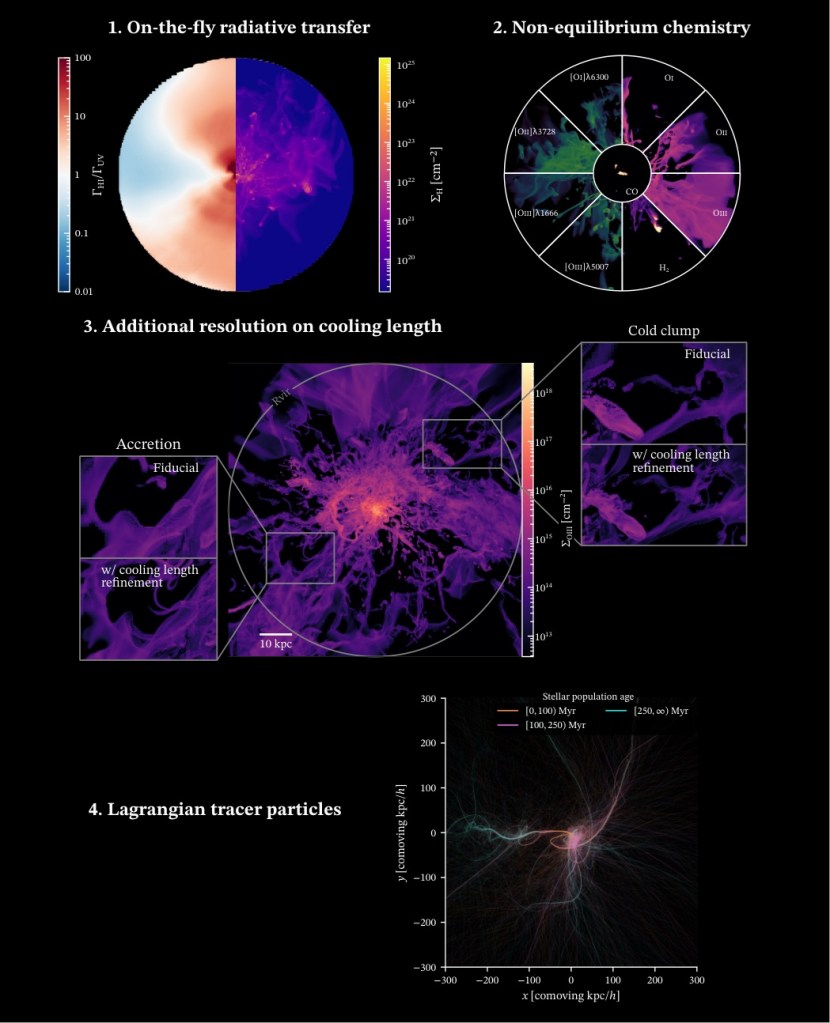
Today we published four papers at the Open Journal of Astrophysics all related to the Megatron Project which is co-led by Martin Rey of the University of Bath (UK), Harley Katz of the University of Chicago (USA) and Corentin Cadiou of the Institut d’Astrophysique de Paris in France. I will include this quartet in my regular weekly update on Saturday but there is a press release accompanying these publications so I thought I’d splash them a bit here too.

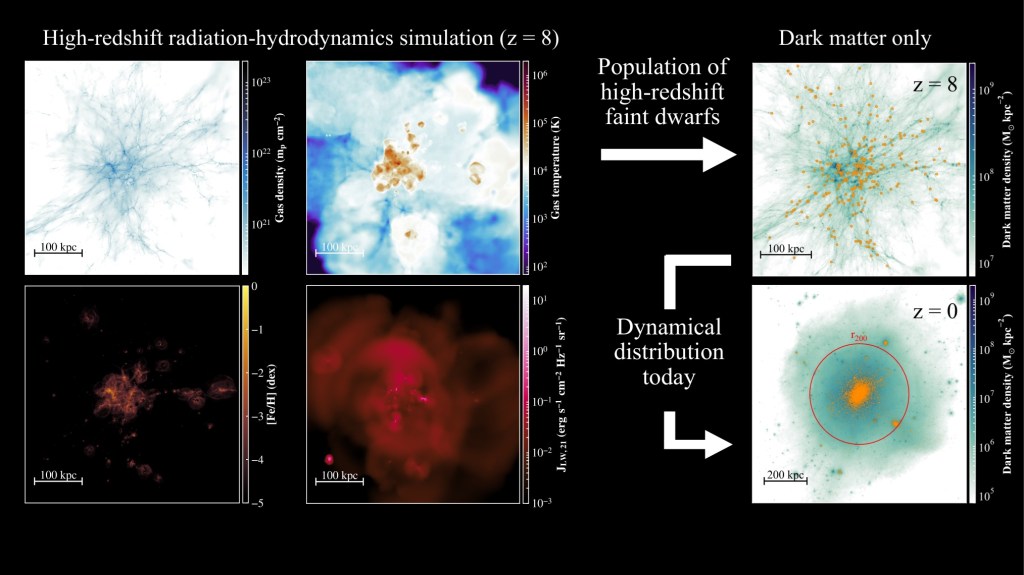
I’ll show the overlays on Saturday but in the meantime here are some pretty graphics from three of the papers:

In no particular order the four papers are:

MEGATRON: Reproducing the Diversity of High-Redshift Galaxy Spectra with Cosmological Radiation Hydrodynamics Simulations

MEGATRON: how the first stars can create an iron metallicity plateau in the smallest dwarf galaxies

MEGATRON: the impact of non-equilibrium effects and local radiation fields on the circumgalactic medium at cosmic noon”

MEGATRON: The Physical Origins of Steep UV Slopes at high redshift

The Press Release from the University of Bath is reproduced below. A Press Release in French can be found here.

–o–

New simulations connect the first stars to cosmic fingerprints still visible today

International MEGATRON project links space telescope observations of the infant Universe with the chemical fossil record of the Milky Way.

Researchers have used some of the most detailed simulations yet of the early Universe to investigate how the first stars and galaxies formed.

Led by researchers at the University of Bath, alongside collaborators at the University of Chicago in the US and the Institut d’Astrophysique de Paris in France, the MEGATRON project uses advanced simulations to explore how the first stars and galaxies lit up the previously dark cosmos and enriched it with the chemical elements that would later become the building blocks of everything around us.

Published today in the Open Journal of Astrophysics, four studies from the MEGATRON project combine cutting-edge cosmological simulations with sophisticated models of radiation, chemistry and galaxy formation. Together, these constitute the collaboration’s first substantial body of published results, with further papers expected to follow.

The findings from the study of the first stars show that accurately capturing the interplay between starlight, gas and newly forged elements is essential for connecting two previously separate views of the early Universe: observations of young galaxies by the James Webb Space Telescope (JWST) and the chemical clues preserved in ancient stars in and around the Milky Way – the galaxy that contains our Solar System.

JWST provides a direct view of galaxies in the infant Universe, while ancient stars act as a fossil record of cosmic history. By studying the chemical fingerprints of these ancient stars, astronomers can reconstruct the properties of the first stars and trace how they enriched the cosmos with the first chemical elements.

The simulations follow the evolution of a young galaxy that will eventually grow into a system similar in mass to the Milky Way. Using advanced computer models that simultaneously track the movement of gas, the propagation of starlight and the evolution of chemical concentrations, the team investigated how stars shape the gas in and around galaxies over billions of years.

The study suggests that simplified models may underestimate the influence of stellar radiation and complex chemical processes on the gas surrounding galaxies. By modelling these effects at exceptionally high resolution, the team resolved structures in the gas that are not captured by simpler models, helping to improve predictions for current and future astronomical observations.

A direct glimpse of the infant cosmos

Dr Martin Rey from the Department of Physics at the University of Bath and a lead contributor to the MEGATRON collaboration, said: “The James Webb Space Telescope gives us a direct glimpse of the infant cosmos, while stellar archaeology allows us to study the relics of those earliest times in our own Galactic neighbourhood. MEGATRON provides a physical bridge between the two.”

The simulations begin with pristine gas containing no heavy elements, mirroring conditions shortly after the Big Bang. They then follow the birth of the first stars, the radiation they emit, the supernova explosions that mark their deaths and the dispersal of newly forged elements into subsequent generations of stars and galaxies.

Understanding this process is central to one of astronomy’s most fundamental questions: where the elements that make up today’s Universe came from.

Dr Rey said: “The elements that make our world and life possible – carbon, oxygen, iron and many others – were forged by stars. To understand where those elements came from, we need to understand how the first stars formed and enriched their surroundings. MEGATRON allows us to test these ideas directly by comparing detailed simulations with observations from JWST and the chemical fingerprints preserved in ancient stars.”

Looking ahead, the team plans to use MEGATRON to strengthen links between theory and emerging observational data. As JWST continues to transform our understanding of the earliest galaxies, large-scale stellar surveys will provide increasingly detailed information about ancient stars in and around the Milky Way.

Dr Rey and his colleagues at Bath are already developing the next generation of simulations. The project has been awarded 40 million processor hours on the UK’s national supercomputers, equivalent to running five million laptops in parallel for a year. These resources will enable simulations with higher resolution and more complete physical models, allowing even more direct comparisons with JWST observations and the chemical fossil record preserved in ancient stars.

“MEGATRON provides a common physical framework for interpreting two of astronomy’s most exciting new datasets: JWST’s view of the earliest galaxies and the stellar fossil record,” said Dr Rey. “Together, these complementary observations allow us to test competing models of the first stars in ways that weren’t previously possible.”

The MEGATRON project started in 2023 and is scheduled to run until 2030.

Weekly Update from the Open Journal of Astrophysics – 28/02/2026

Posted in OJAp Papers, Open Access, The Universe and Stuff with tags , , , , , , , , , , , , , , , , , , , , , , , , , , , , , , , , , , , , , , on February 28, 2026 by telescoper

It’s Saturday once more, so it’s time for another update of activity at the Open Journal of Astrophysics. It has been a busy week. Since the last update we have published a further nine papers, bringing the number in Volume 9 (2026) to 45 and the total so far published by OJAp up to 493.

I will continue to include the posts made on our Mastodon account (on Fediscience) to encourage you to visit it. Mastodon is a really excellent service, and a more than adequate replacement for X/Twitter (which nobody should be using); these announcements also show the DOI for each paper.

The first four papers this week were all published on Monday 23rd February.

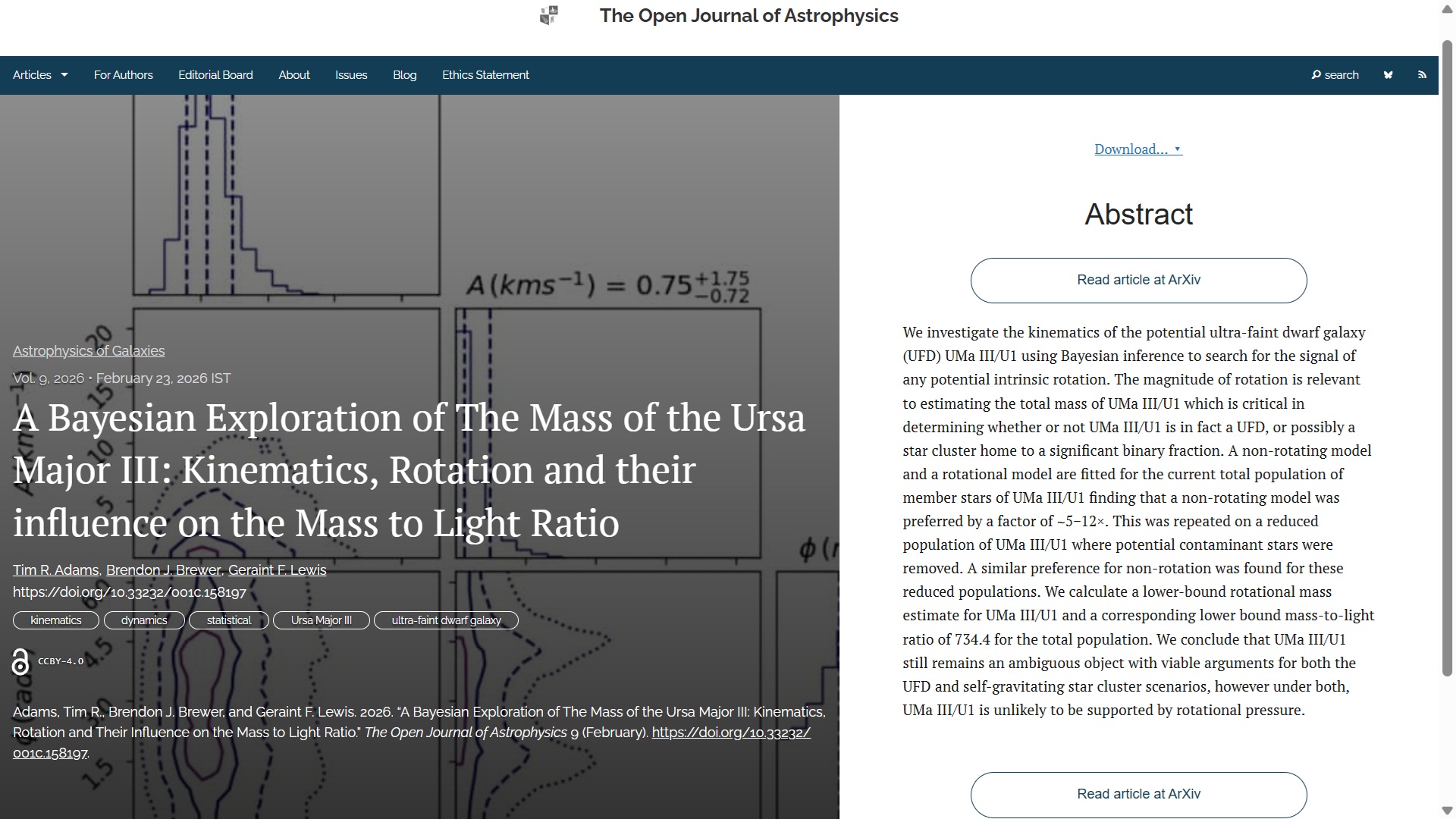
The first paper to report is “A Bayesian Exploration of The Mass of the Ursa Major III: Kinematics, Rotation and their influence on the Mass to Light Ratio” by Tim R. Adams (U. Sydney, Australia), Brendon J. Brewer (U. Auckland, New Zealand) and Geraint F. Lewis (Sydney). This paper, in the folder Astrophysics of Galaxies, describes an investigation of the kinematics of potential ultra-faint dwarf galaxy UMa III/U1, finding a preference for a non-rotating model; the object’s nature remains uncertain.

The overlay is here:

You can find the officially accepted version on arXiv here and the announcement on Fediverse here:

Open Journal of Astrophysics

New Publication at the Open Journal of Astrophysics: "A Bayesian Exploration of The Mass of the Ursa Major III: Kinematics, Rotation and their influence on the Mass to Light Ratio" by Tim R. Adams (U. Sydney, Australia), Brendon J. Brewer (U. Auckland, New Zealand) and Geraint F. Lewis (Sydney)

doi.org/10.33232/001c.158197

February 23, 2026, 7:35 am 2 boosts 1 favorites

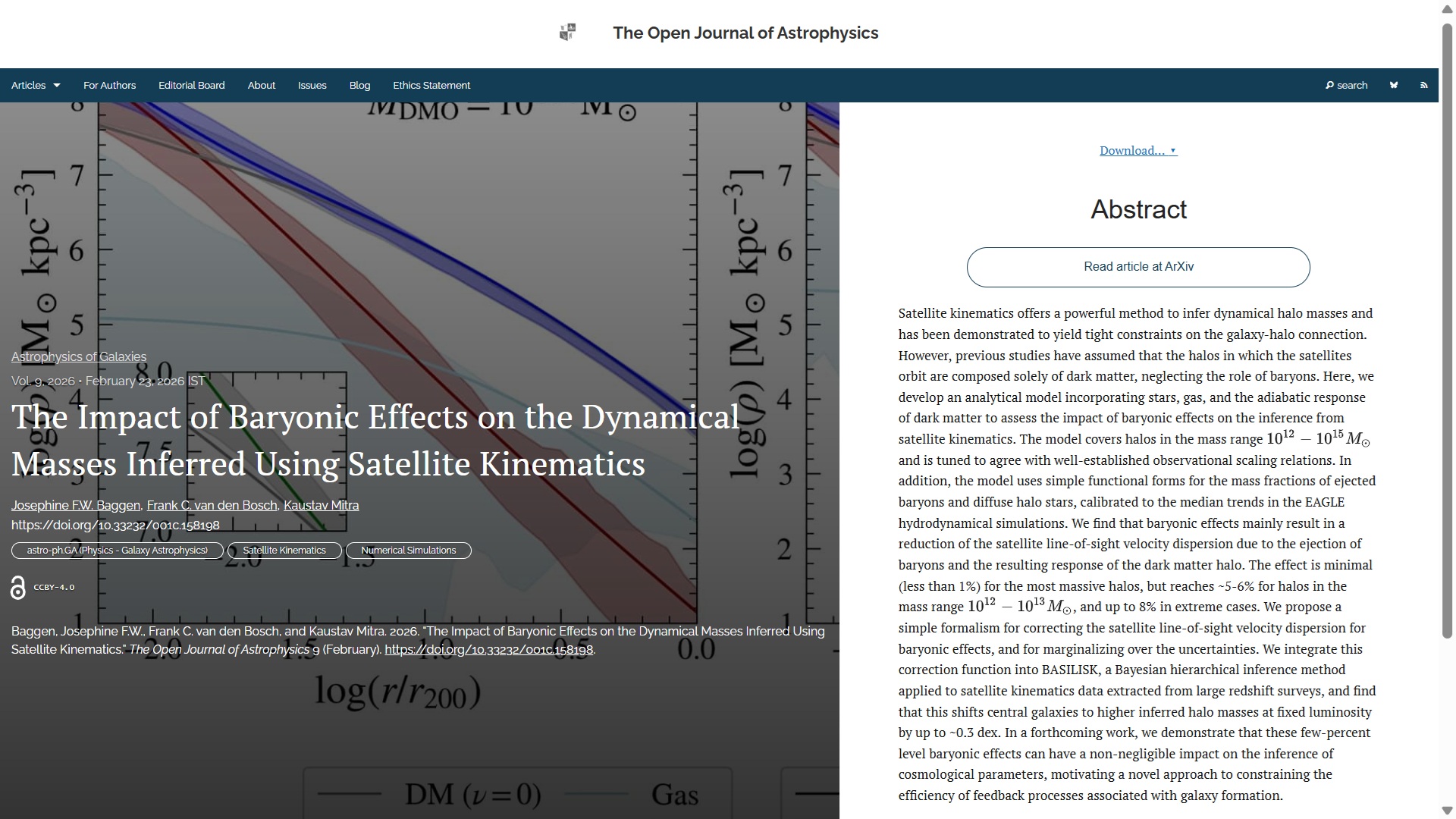
The second paper is “The Impact of Baryonic Effects on the Dynamical Masses Inferred Using Satellite Kinematics” by Josephine F.W. Baggen, Frank C. van den Bosch, and Kaustav Mitra (Yale U., USA). This paper, also in the folder Astrophysics of Galaxies, presents a model to assess the impact of stars and gas on satellite kinematics, showing that these baryonic effects can reduce the satellite velocity dispersion and increase inferred central galaxy masses.

The overlay for this one is here:

The official version of the paper can be found on arXiv here and the Fediverse announcement here:

Open Journal of Astrophysics

New Publication at the Open Journal of Astrophysics: "The Impact of Baryonic Effects on the Dynamical Masses Inferred Using Satellite Kinematics" by Josephine F.W. Baggen, Frank C. van den Bosch, and Kaustav Mitra (Yale U., USA)

doi.org/10.33232/001c.158198

February 23, 2026, 7:47 am 1 boosts 1 favorites

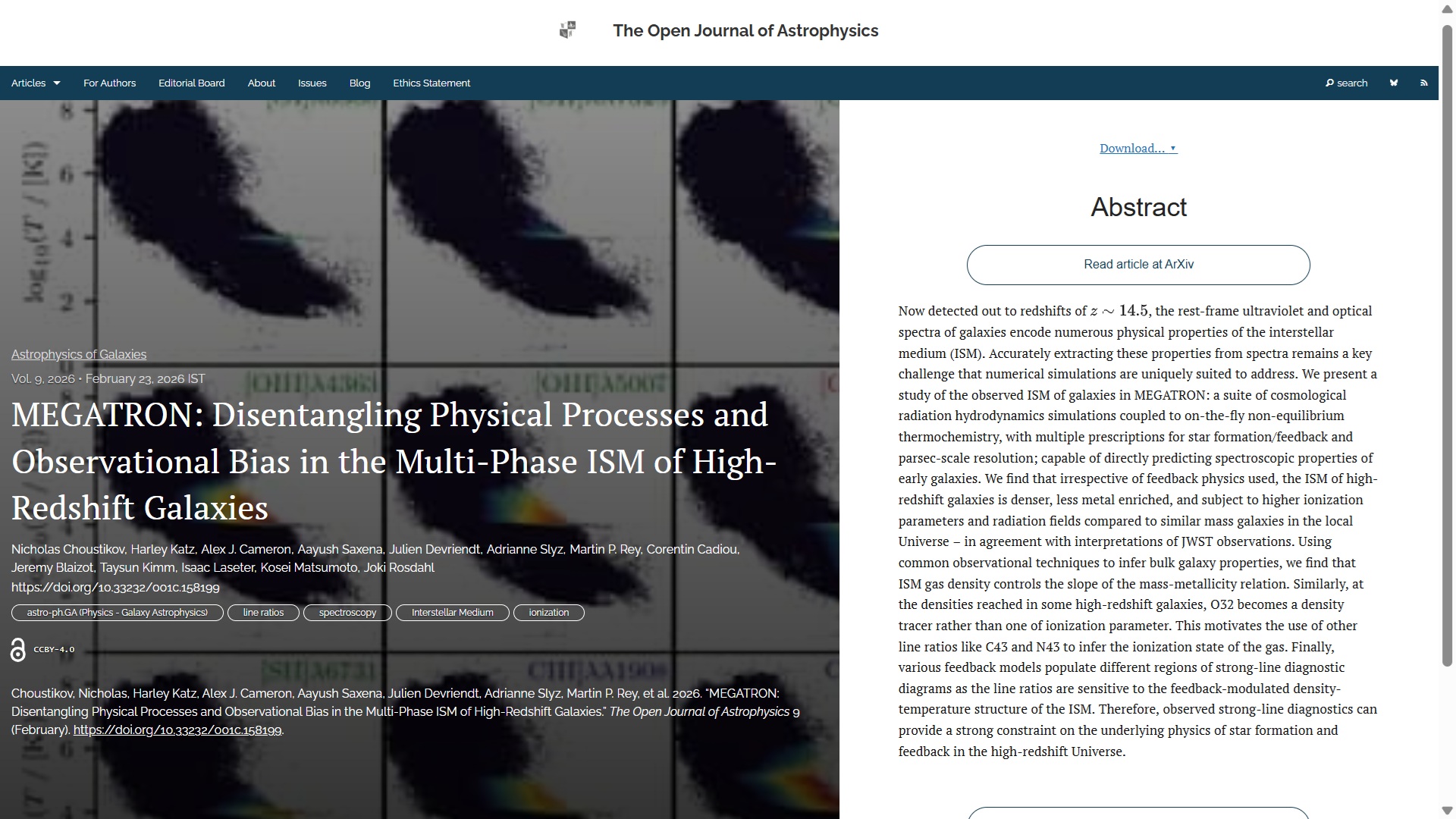
The third paper this week, and the third published on Monday 23rd February, and the third in the folder Astrophysics of Galaxies, is “MEGATRON: Disentangling Physical Processes and Observational Bias in the Multi-Phase ISM of High-Redshift Galaxies” by Nicholas Choustikov (U. Oxford, UK) and 12 others based in UK, USA, France, Korea and Belgium. The study uses MEGATRON simulations to analyze the interstellar medium (ISM) of high-redshift galaxies, finding it denser and less metal-enriched than local galaxies with implications for line ratios as diagnostics

The overlay is here:

The official version can be found on arXiv here and the Fediverse announcement is here:

Open Journal of Astrophysics

New Publication at the Open Journal of Astrophysics: "MEGATRON: Disentangling Physical Processes and Observational Bias in the Multi-Phase ISM of High-Redshift Galaxies" by Nicholas Choustikov (U. Oxford, UK) and 12 others based in UK, USA, France, Korea and Belgium

doi.org/10.33232/001c.158199

February 23, 2026, 8:02 am 2 boosts 1 favorites

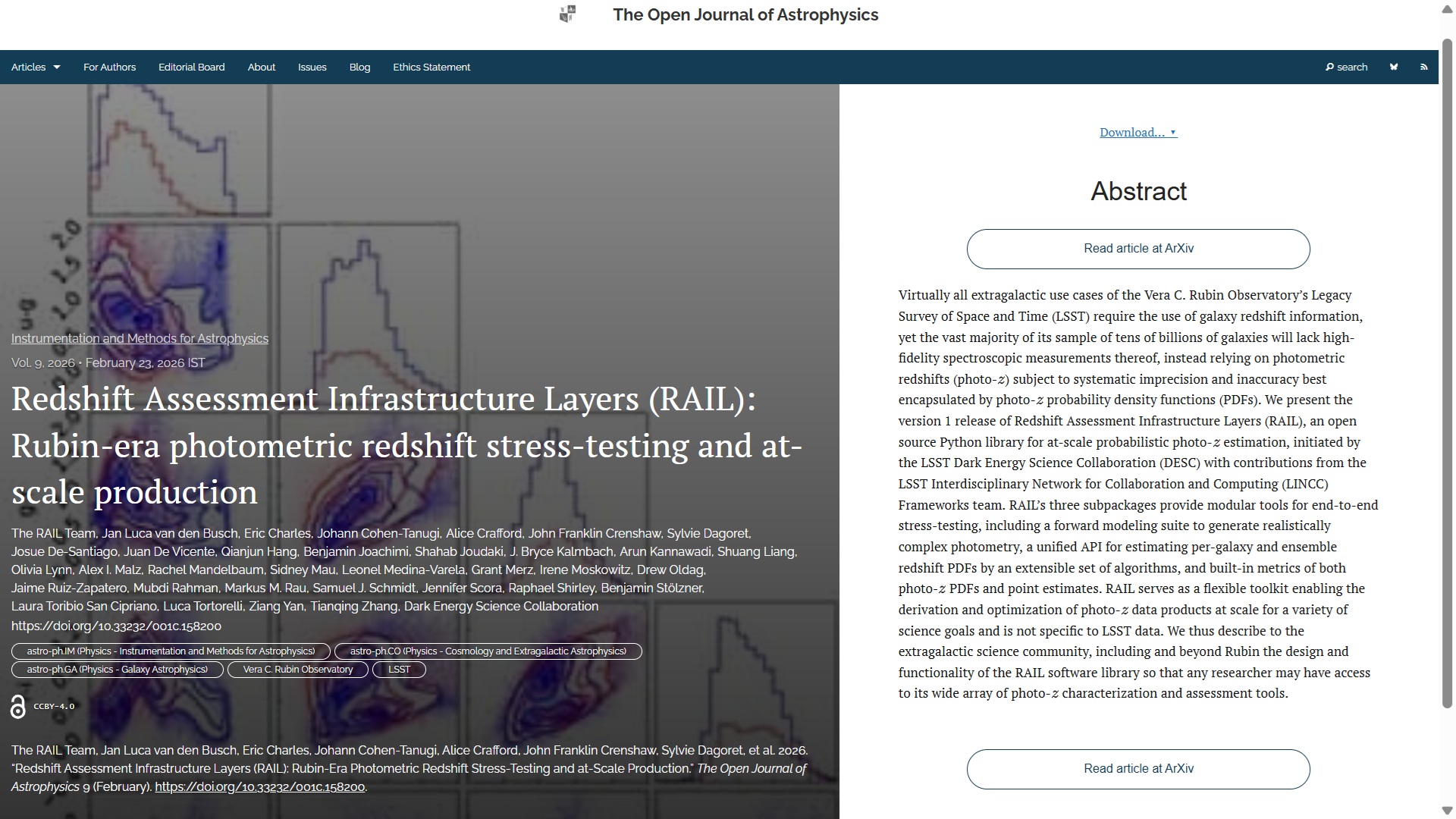
The fourth paper this week, also published on Monday 23rd February, but in the folder Instrumentation and Methods for Astrophysics, is “Redshift Assessment Infrastructure Layers (RAIL): Rubin-era photometric redshift stress-testing and at-scale production” by the RAIL Team (31 authors) and the Dark Energy Science Collaboration. The article introduces Redshift Assessment Infrastructure Layers (RAIL), an open-source Python library for large-scale probabilistic photo-z estimation, useful for extragalactic research and not limited to LSST data.

Here is the overlay:

The official version can be found on arXiv here and the Fediverse announcement is here:

Open Journal of Astrophysics

New Publication at the Open Journal of Astrophysics: "Redshift Assessment Infrastructure Layers (RAIL): Rubin-era photometric redshift stress-testing and at-scale production" by the RAIL Team (31 authors) and the Dark Energy Science Collaboration

doi.org/10.33232/001c.158200

February 23, 2026, 8:32 am 1 boosts 1 favorites

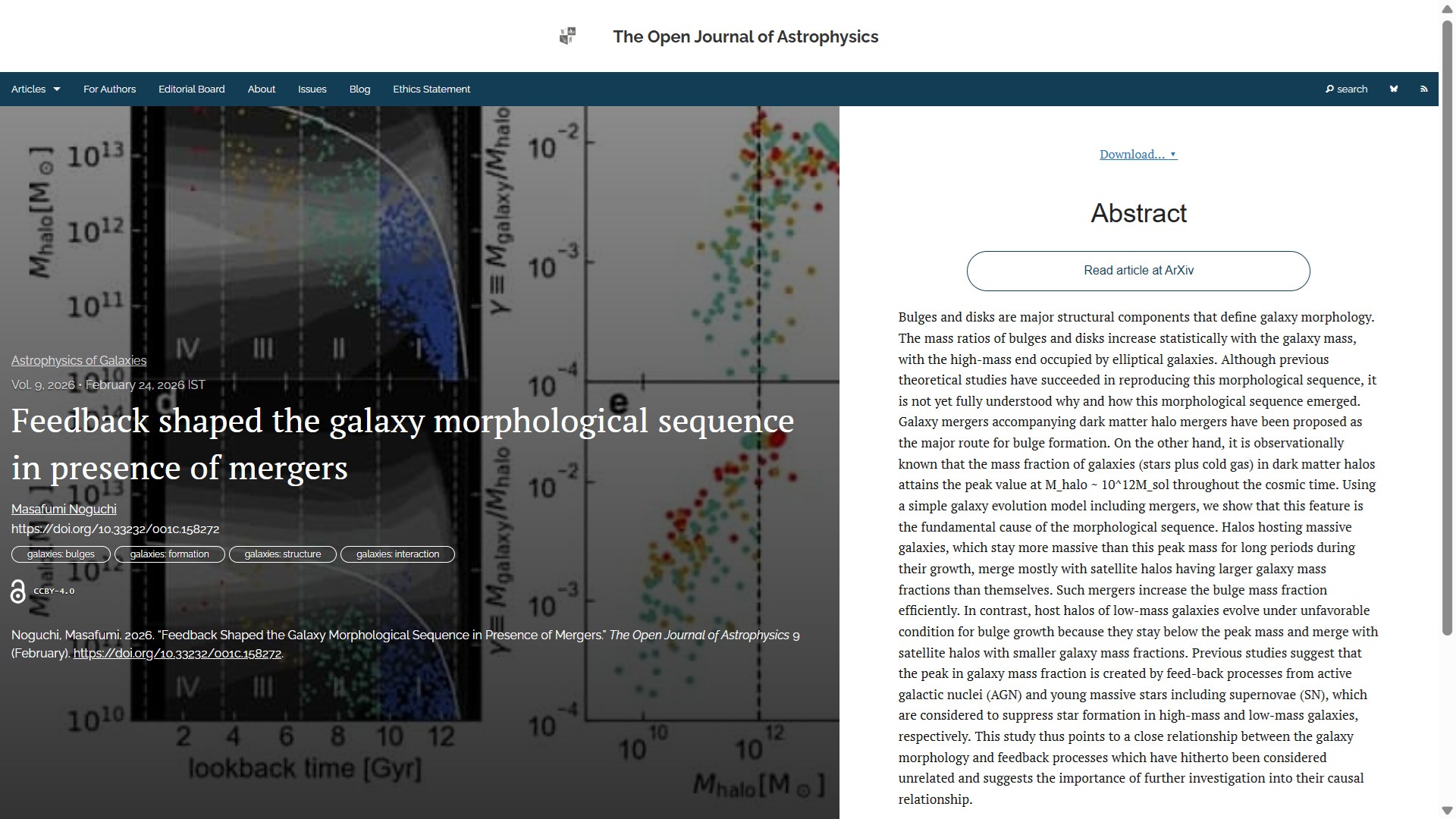
Moving on to Tuesday 24th February, the fifth paper this week, is “Feedback shaped the galaxy morphological sequence in presence of mergers” by Masafumi Noguchi (Tohoku University, Japan). This article was published in the folder Astrophysics of Galaxies. This study suggests that galaxy morphology, specifically the mass ratios of bulges and disks, is influenced by galaxy mergers and feedback processes from active galactic nuclei and supernovae.

The overlay is here:

The accepted version can be found on arXiv here, and the fediverse announcement is here:

Open Journal of Astrophysics

New Publication at the Open Journal of Astrophysics: "Feedback shaped the galaxy morphological sequence in presence of mergers" by Masafumi Noguchi (Tohoku University, Japan)

doi.org/10.33232/001c.158272

February 24, 2026, 7:21 am 1 boosts 0 favorites

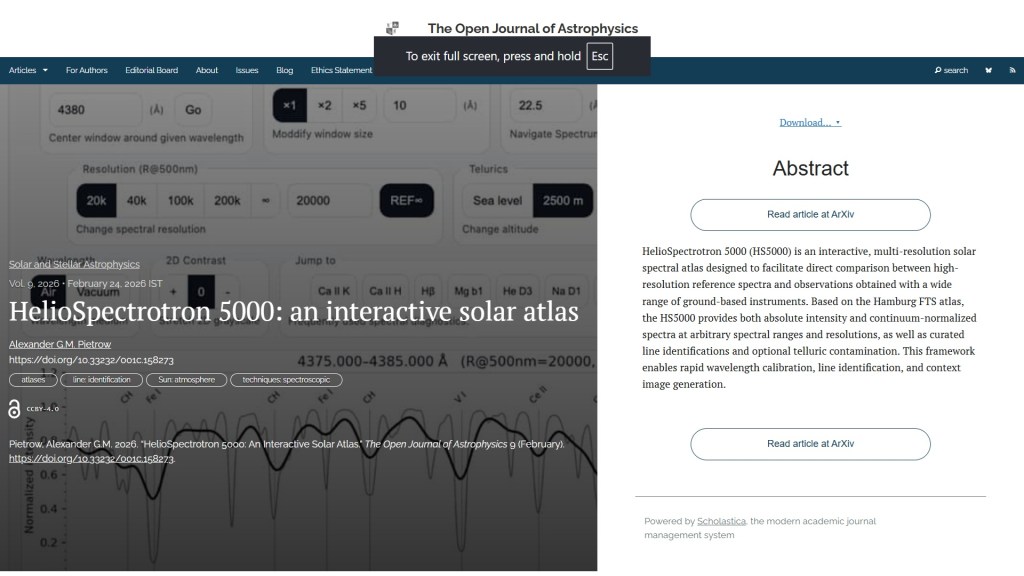
The sixth paper this week is “HelioSpectrotron 5000: an interactive solar atlas” by Alexander G.M. Pietrow (AIP Potsdam, Germany). This was published on Tuesday 24th February in the folder Solar and Stellar Astrophysics. This describes HelioSpectrotron~5000 (HS5000), which is an interactive solar spectral atlas that allows comparison between high-resolution spectra and ground-based instrument observations, aiding in wavelength calibration and line identification. The software can be found here; I had a play with it yesterday and it’s very easy to use!

The overlay is here:

You can find the officially accepted version on arXiv here and the Mastodon announcement is here:

Open Journal of Astrophysics

New Publication at the Open Journal of Astrophysics: "HelioSpectrotron 5000: an interactive solar atlas" by Alexander G.M. Pietrow (AIP Potsdam, Germany)

doi.org/10.33232/001c.158273

February 24, 2026, 7:35 am 1 boosts 0 favorites

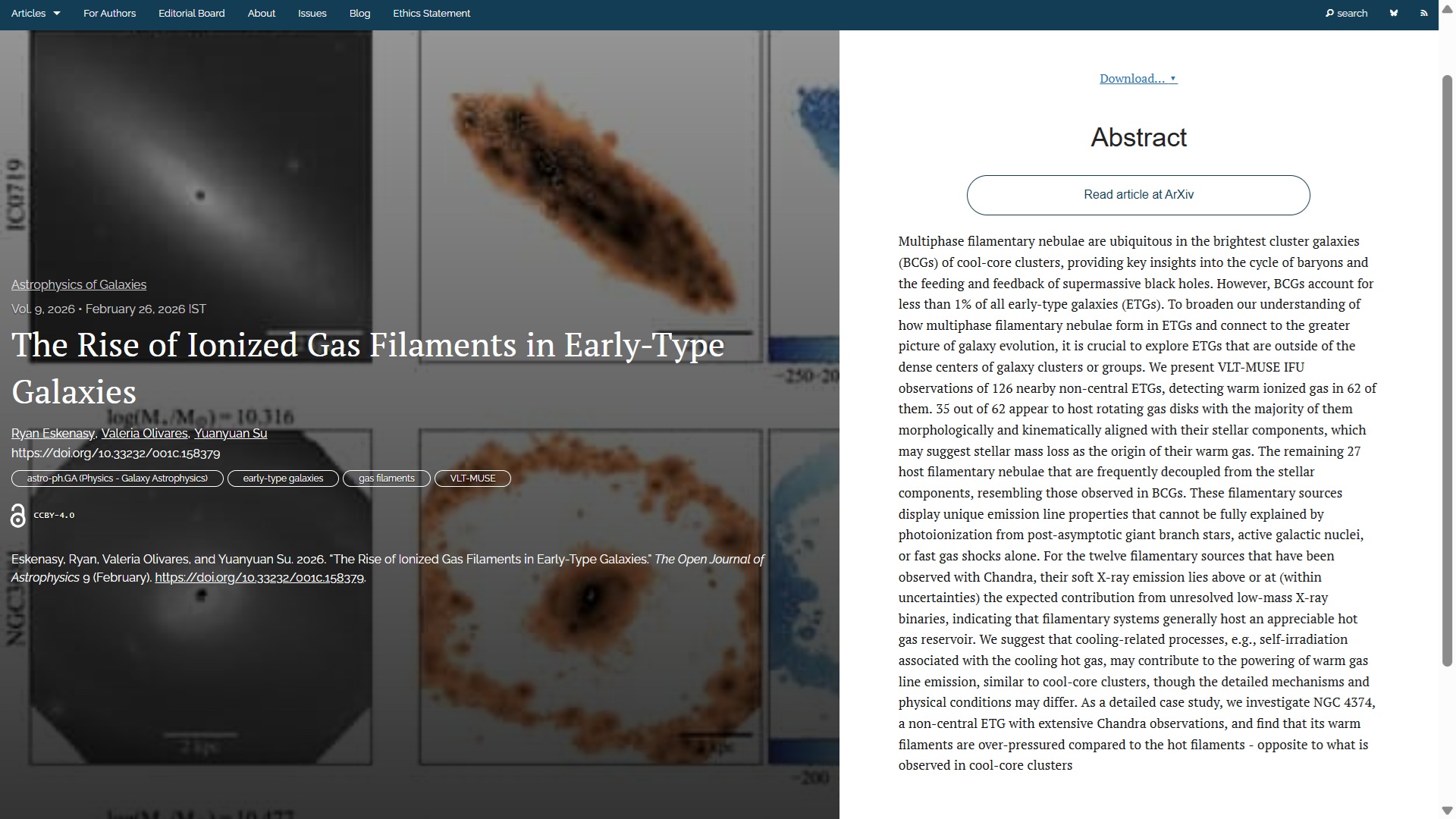
The seventh paper of this week was published on Thursday 26th February is “The Rise of Ionized Gas Filaments in Early-Type Galaxies” by Ryan Eskenasy (U. Kentucky, USA), Valeria Olivares (Universidad de Santiago de Chile) and Yuanyuan Su (U. Kentucky, USA). This article, in the folder Astrophysics of Galaxies, is an exploration of the formation of multiphase filamentary nebulae in early-type galaxies (ETGs), using VLT-MUSE IFU observations of 126 non-central ETGs, focussing on the hot gas components thereof.

The overlay is here:

The officially accepted version of this paper can be found on the arXiv here and the Mastodon announcement is here:

Open Journal of Astrophysics

New Publication at the Open Journal of Astrophysics: "The Rise of Ionized Gas Filaments in Early-Type Galaxies" by Ryan Eskenasy (U. Kentucky, USA), Valeria Olivares (Universidad de Santiago de Chile) and Yuanyuan Su (U. Kentucky, USA)

doi.org/10.33232/001c.158379

February 26, 2026, 7:27 am 1 boosts 0 favorites

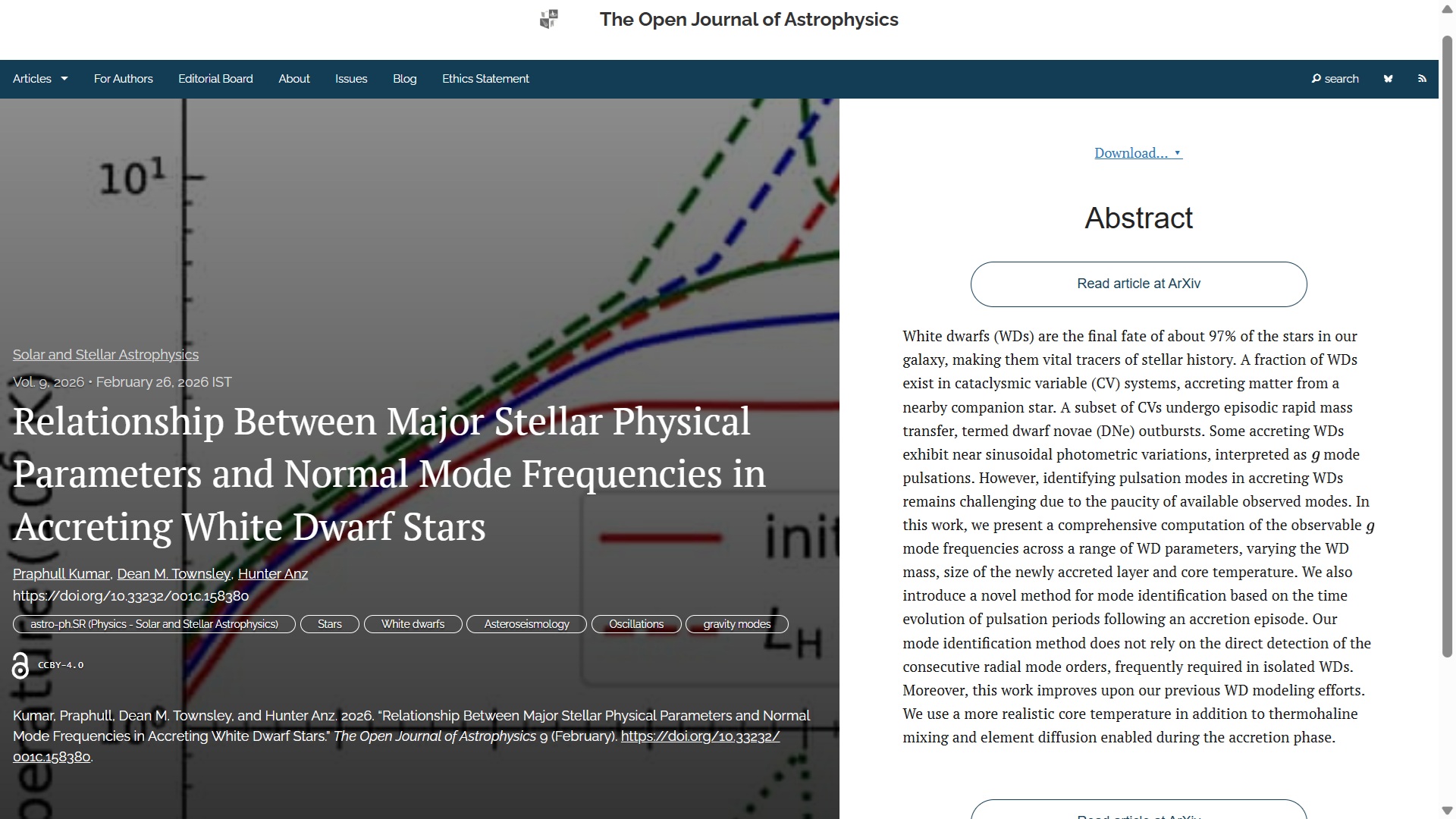
Number eight for this week is “Relationship Between Major Stellar Physical Parameters and Normal Mode Frequencies in Accreting White Dwarf Stars” by Praphull Kumar, Dean M. Townsley and Hunter Anz (U. Alabama, USA). This was published on Thursday 26th February in the category Solar and Stellar Astrophysics; the paper presents a new method for identifying pulsation modes in white dwarfs, improving upon previous models by using more realistic parameters and considering thermohaline mixing and element diffusion. The overlay is here:

The final version of this paper can be found on the arXiv here and the Mastodon announcement is here:

Open Journal of Astrophysics

New Publication at the Open Journal of Astrophysics: "Relationship Between Major Stellar Physical Parameters and Normal Mode Frequencies in Accreting White Dwarf Stars" by Praphull Kumar, Dean M. Townsley and Hunter Anz (U. Alabama, USA)

doi.org/10.33232/001c.158380

February 26, 2026, 7:37 am 1 boosts 0 favorites

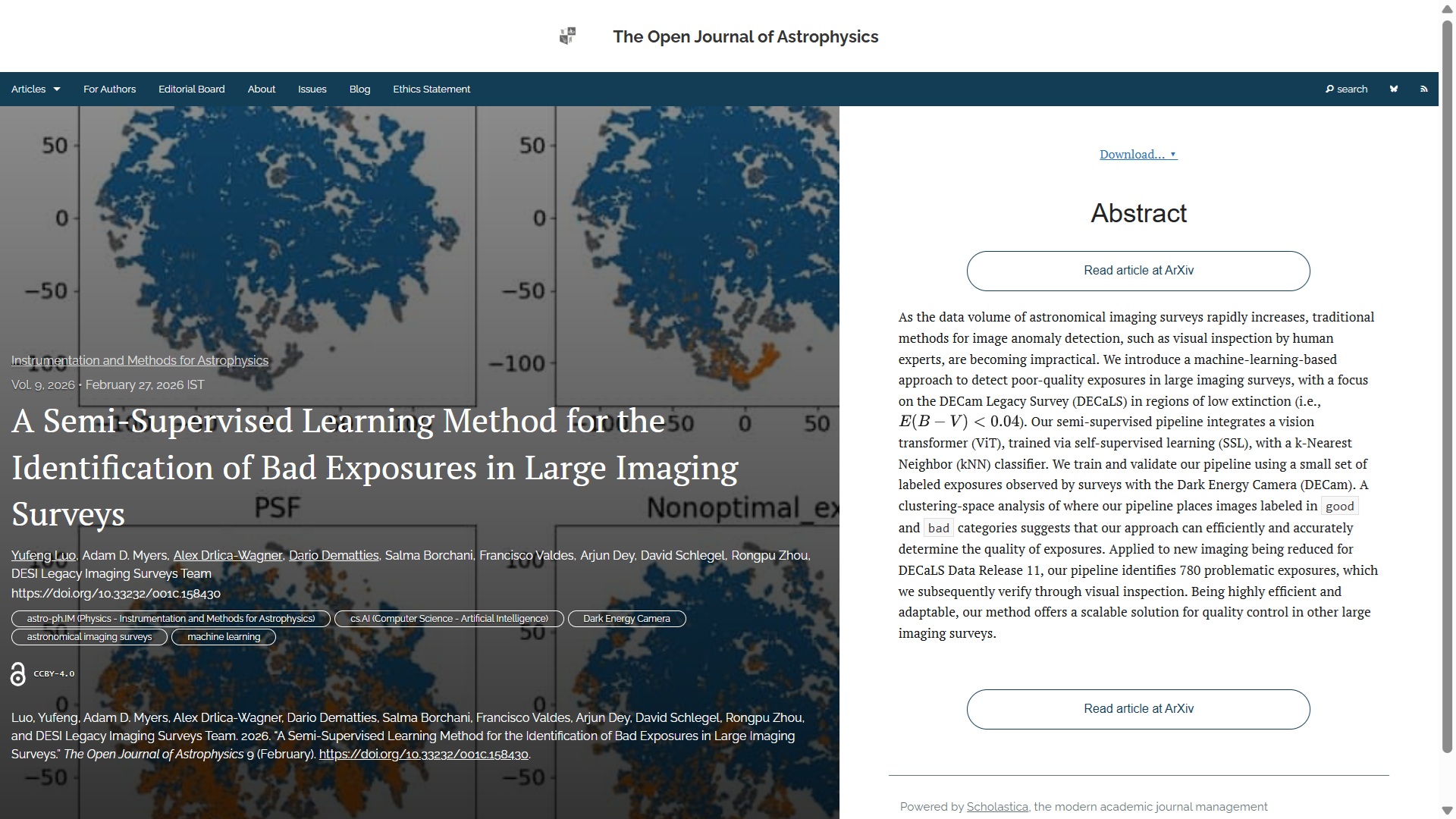
The ninth, and final, paper for this week is “A Semi-Supervised Learning Method for the Identification of Bad Exposures in Large Imaging Surveys” by Yufeng Luo (U. Wyoming, USA) and 8 others from the DESI Legacy Imaging Surveys Team. This was published on Friday 27th February, i.e yesterday, in the folder Instrumentation and Methods for Astrophysics. The paper describes a machine-learning approach for detecting poor-quality exposures in large astronomical imaging surveys, proving efficient and accurate in identifying problematic exposures.

The overlay is here:

The official version on arXiv can be found here and the Mastodon announcement follows:

Open Journal of Astrophysics

New Publication at the Open Journal of Astrophysics: "A Semi-Supervised Learning Method for the Identification of Bad Exposures in Large Imaging Surveys" by Yufeng Luo (U. Wyoming, USA) and 8 others from the DESI Legacy Imaging Surveys Team

doi.org/10.33232/001c.158430

February 27, 2026, 8:52 am 1 boosts 1 favorites

And that concludes this week’s update. We have now published 45 papers in two complete months of 2026, on which basis we can estimate about 270 papers in the year. For the record, in the first two months of 2025 we published 21 papers.

P.S. Thank you to the many people who responded to the latest call for editors. I’ve been sending out invitations and getting people onboard as quickly as I can, but I still have a number to get to so please bear with me!

Weekly Update from the Open Journal of Astrophysics – 07/02/2026

Posted in OJAp Papers, Open Access, The Universe and Stuff with tags , , , , , , , , , , , , , , , , , , , , , , , , , , , , , , , , , , , on February 7, 2026 by telescoper

It’s Saturday once more so time for another update of activity at the Open Journal of Astrophysics. Since the last update we have published a further six papers, bringing the number in Volume 9 (2026) to 24 and the total so far published by OJAp up to 472.

I will continue to include the posts made on our Mastodon account (on Fediscience) to encourage you to visit it. Mastodon is a really excellent service, and a more than adequate replacement for X/Twitter which nobody should be using; these announcement also show the DOI for each paper.

The first paper to report this week is “The Impact of Star Formation and Feedback Recipes on the Stellar Mass and Interstellar Medium of High-Redshift Galaxies” by Harley Katz (U. Chicago, USA), Martin P. Rey (U. Oxford, UK), Corentin Cadiou (Lund U., Sweden) Taysun Kimm (Yonsei U., Korea) and Oscar Agertz (Lund). This paper was published on Monday 2nd February 2026 in the folder Astrophysics of Galaxies. It introduces MEGATRON, a new model for galaxy formation simulations, highlighting that feedback energy controls star formation at high redshift and highlighting the importance of the interstellar medium.

The overlay is here:

You can find the officially accepted version on arXiv here and the announcement on Fediverse here:

Open Journal of Astrophysics

New Publication at the Open Journal of Astrophysics: "The Impact of Star Formation and Feedback Recipes on the Stellar Mass and Interstellar Medium of High-Redshift Galaxies" by Harley Katz (U. Chicago, USA), Martin P. Rey (U. Oxford, UK), Corentin Cadiou (Lund U., Sweden) Taysun Kimm (Yonsei U., Korea) and Oscar Agertz (Lund)

doi.org/10.33232/001c.156097

February 2, 2026, 11:02 am 1 boosts 1 favorites

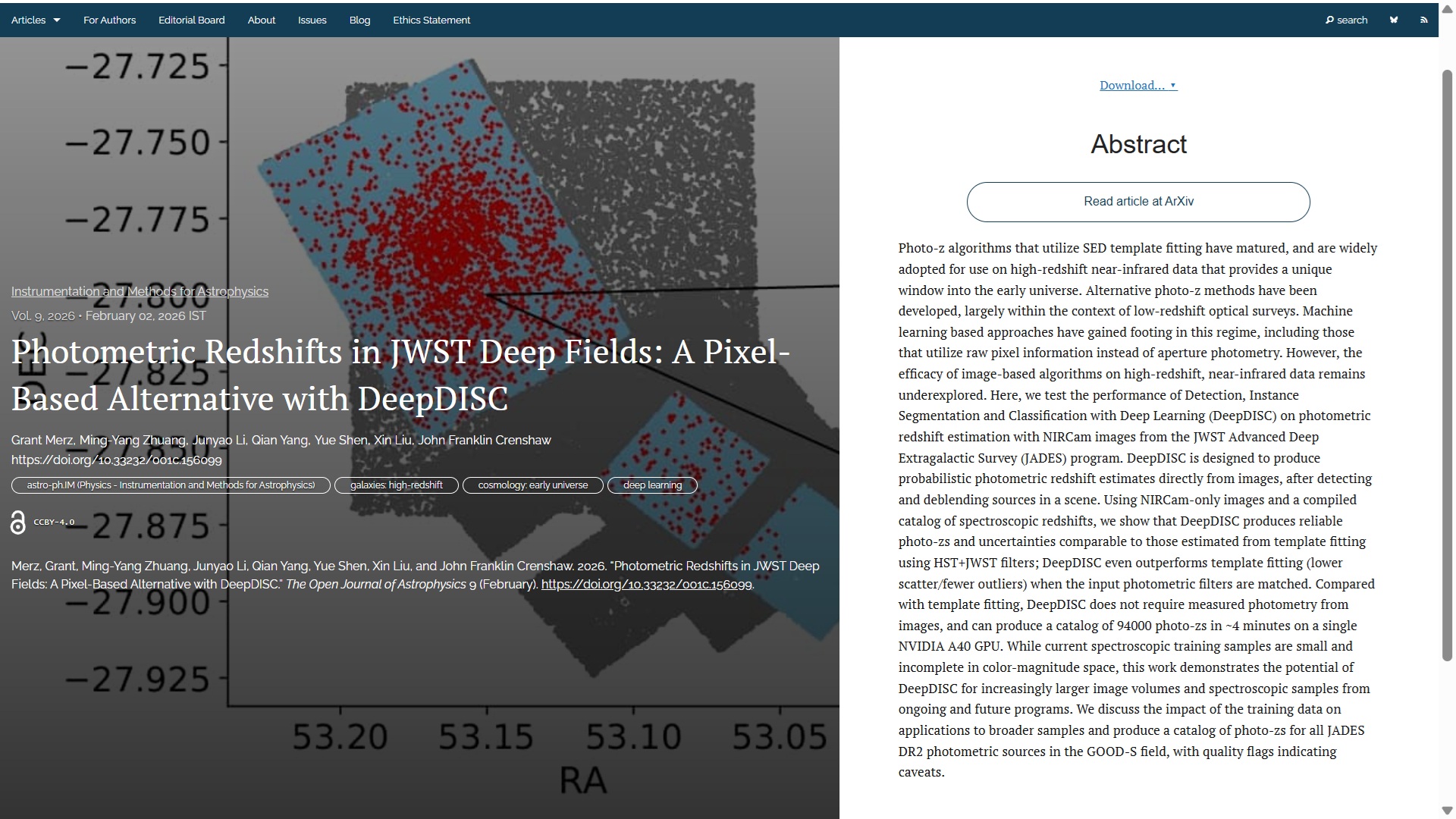
The second paper is “Photometric Redshifts in JWST Deep Fields: A Pixel-Based Alternative with DeepDISC” by Grant Merz (U. Illinois at Urbana-Champaign) and 6 others, all based in the USA. This paper was published on Monday February 2nd 2026 in the folder Instrumentation and Methods for Astrophysics. This paper explores the effectiveness of the DeepDISC machine learning algorithm in estimating photometric redshifts from near-infrared data, demonstrating its potential for larger image volumes and spectroscopic samples

The overlay for this one is here:

The official version of the paper can be found on arXiv here and the Fediverse announcement here:

Open Journal of Astrophysics

New Publication at the Open Journal of Astrophysics: "Photometric Redshifts in JWST Deep Fields: A Pixel-Based Alternative with DeepDISC" by Grant Merz (U. Illinois at Urbana-Champaign) and 6 others, all based in the USA

doi.org/10.33232/001c.156099

February 2, 2026, 11:23 am 1 boosts 0 favorites

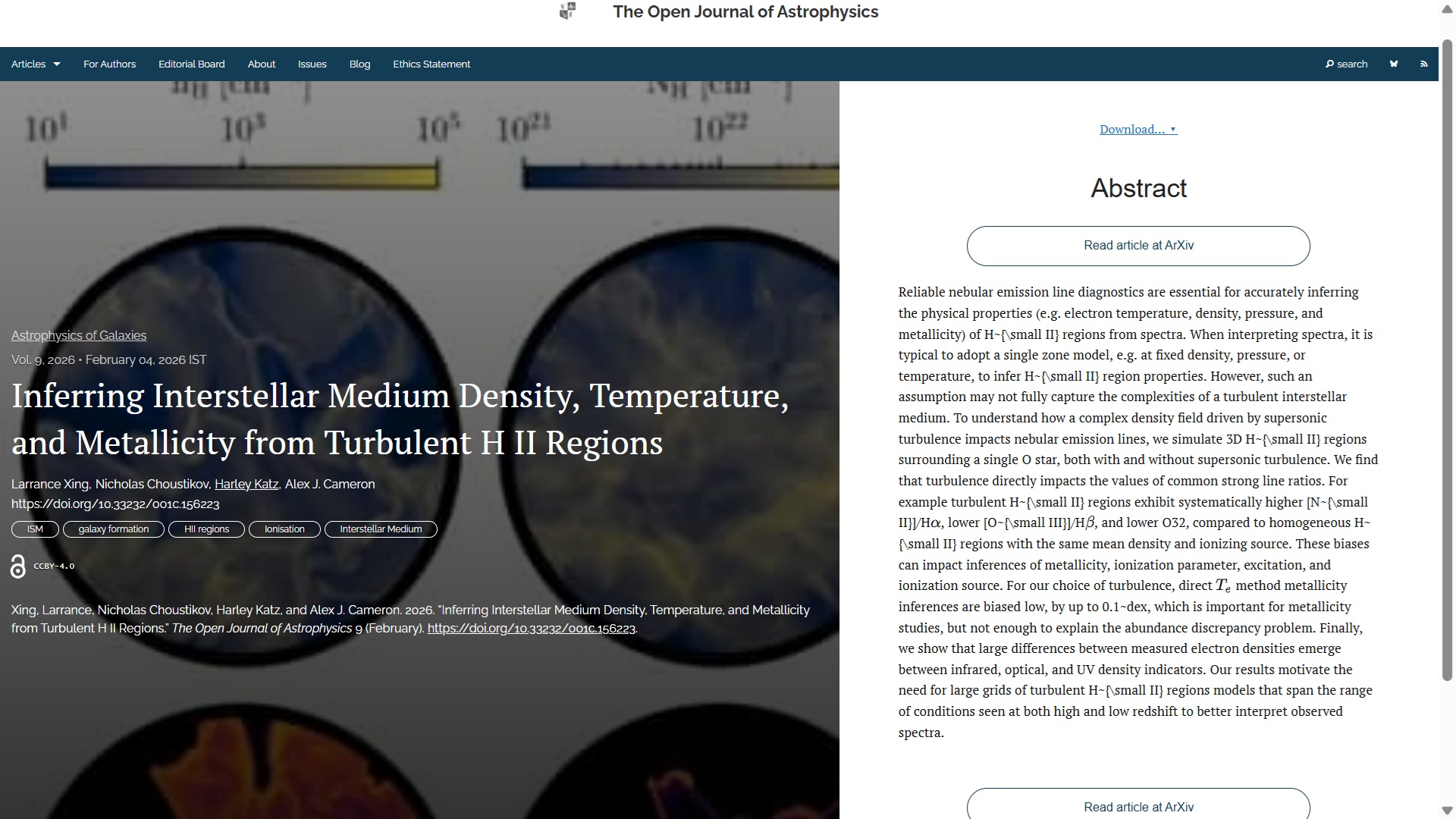
Next, published on Wednesday 4th February in the folder Astrophysics of Galaxies, is “Inferring Interstellar Medium Density, Temperature, and Metallicity from Turbulent H II Regions” by Larrance Xing (U. Chicago, USA), Nicholas Choustikov (U. Oxford, UK), Harley Katz (U. Chicago) and Alex J. Cameron (DAWN, Denmark). This paper argues that supersonic turbulenc affects the interpretation of H II region properties, potentially impacting inferred metallicity, ionization, and excitation from in nebular emission lines, motivating more extensive modelling.

The overlay is here:

The official version can be found on arXiv here and the Fediverse announcement is here:

Open Journal of Astrophysics

New Publication at the Open Journal of Astrophysics: "Inferring Interstellar Medium Density, Temperature, and Metallicity from Turbulent H II Regions" by Larrance Xing (U. Chicago, USA), Nicholas Choustikov (U. Oxford, UK), Harley Katz (U. Chicago) and Alex J. Cameron (DAWN, Denmark)

doi.org/10.33232/001c.156223

February 4, 2026, 8:20 am 1 boosts 0 favorites

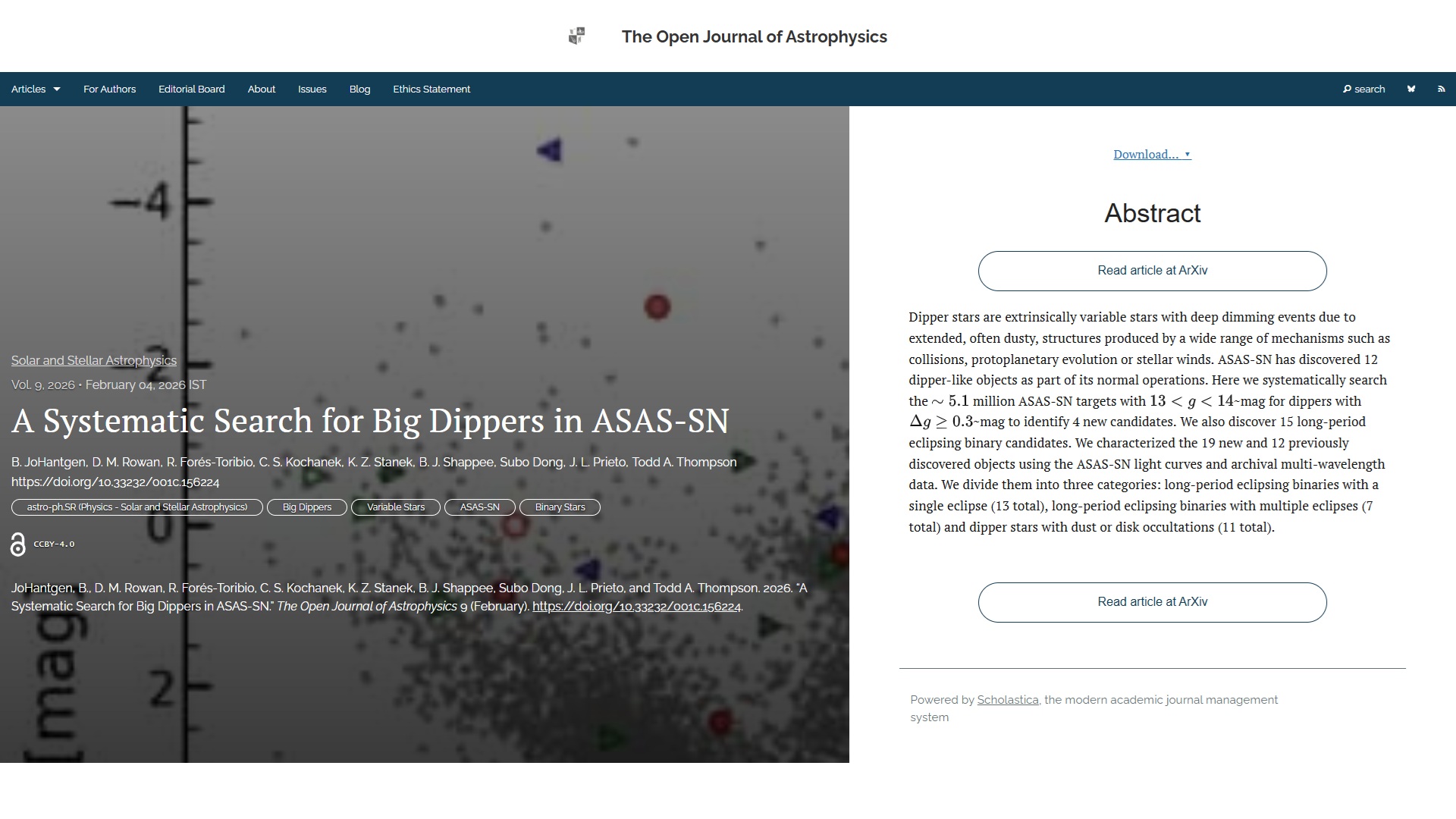
The fourth paper this week, also published on Wednesday 4th February, but in the folder Solar and Stellar Astrophysics, is “A Systematic Search for Big Dippers in ASAS-SN” by B. JoHantgen, D. M. Rowan, R. Forés-Toribio, C. S. Kochanek, & K. Z. Stanek (Ohio State University, USA), B. J. Shappee (U. Hawaii, USA), Subo Dong (Peking University), J. L. Prieto Universidad Diego Portales, Chile) and Todd A. Thompson (Ohio State). This study identifies 4 new dipper stars and 15 long-period eclipsing binary candidates using ASAS-SN light curves and multi-wavelength data, categorizing them based on their characteristics.

Here is the overlay:

The official version can be found on arXiv here and the Fediverse announcement is here:

Open Journal of Astrophysics

New Publication at the Open Journal of Astrophysics: "A Systematic Search for Big Dippers in ASAS-SN" by B. JoHantgen , D. M. Rowan, R. Forés-Toribio, C. S. Kochanek, & K. Z. Stanek (Ohio State University, USA), B. J. Shappee (U. Hawaii, USA), Subo Dong (Peking University), J. L. Prieto Universidad Diego Portales, Chile) and Todd A. Thompson (Ohio State)

doi.org/10.33232/001c.156224

February 4, 2026, 8:40 am 1 boosts 0 favorites

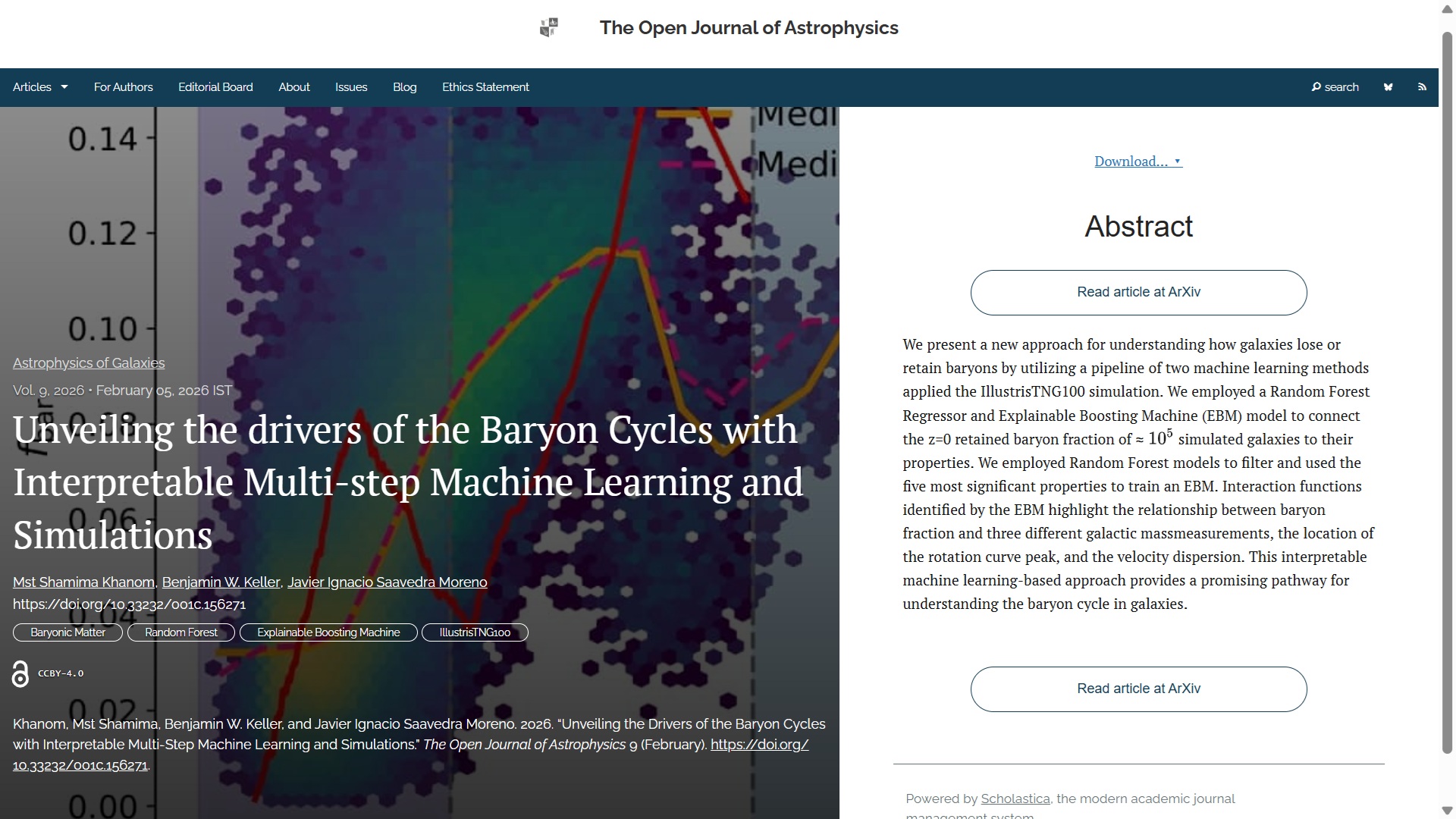
Fifth, and next to last this week we have “Unveiling the drivers of the Baryon Cycles with Interpretable Multi-step Machine Learning and Simulations” by Mst Shamima Khanom, Benjamin W. Keller and Javier Ignacio Saavedra Moreno (U. Memphis, USA). This paper was published on Thursday 5th February 2026 in the folder Astrophysics of Galaxies. This study uses machine learning methods to understand how galaxies lose or retain baryons, highlighting the relationship between baryon fraction and various galactic measurements.

The overlay is here:

The accepted version can be found on arXiv here, and the fediverse announcement is here:

Open Journal of Astrophysics

New Publication at the Open Journal of Astrophysics: "Unveiling the drivers of the Baryon Cycles with Interpretable Multi-step Machine Learning and Simulations" by Mst Shamima Khanom, Benjamin W. Keller and Javier Ignacio Saavedra Moreno (U. Memphis, USA)

doi.org/10.33232/001c.156271

February 5, 2026, 7:39 am 1 boosts 1 favorites

Finally for this week we have “The Bispectrum of Intrinsic Alignments: II. Precision Comparison Against Dark Matter Simulations” by Thomas Bakx (Utrecht U., Netherlands), Toshiki Kurita (MPA Garching, Germany), Alexander Eggemeier (U. Bonn, Germany), Nora Elisa Chisari (Utrecht) and Zvonimir Vlah (Ruđer Bošković Institute, Croatia). This paper was accepted in December, but publication got delayed by the Christmas effect so was published on February 6th 2026, in the folder Cosmology and Nongalactic Astrophysics. This study uses N-body simulations to accurately measure three-dimensional bispectra of halo intrinsic alignments and dark matter overdensities, providing a method to determine higher order shape bias parameters.

The overlay is here:

You can find the published version of the article here, and the Mastodon announcement is here:

Open Journal of Astrophysics

New Publication at the Open Journal of Astrophysics: "The Bispectrum of Intrinsic Alignments: II. Precision Comparison Against Dark Matter Simulations" by Thomas Bakx (Utrecht U., Netherlands), Toshiki Kurita (MPA Garching, Germany), Alexander Eggemeier (U. Bonn, Germany), Nora Elisa Chisari (Utrecht) and Zvonimir Vlah (Ruđer Bošković Institute, Croatia)

doi.org/10.33232/001c.156361

February 6, 2026, 7:43 am 1 boosts 0 favorites

And that concludes this week’s update. I will do another next Saturday.