Archive for the History Category

The Quickening of the Year Again

Posted in Biographical, History, Maynooth with tags , , , , , , , on February 3, 2025 by telescoper

Today would be the first day of teaching in Semester 2 at Maynooth University, were it not for the fact that it is a Bank Holiday in Ireland. The holiday marks Imbolc, an old Celtic festival occurring halfway between the winter solstice and vernal equinox in the Northern hemisphere. In the modern calendar the date is 1st February. In Ireland Imbolc is often referred to as a Lá Fhéile Bríde,  St Brigid’s Day, after St Brigid of Kildare, whose feast day is 1st February. In the old pagan calendar, this day is regarded as the first day of spring, as it is roughly the time when the first spring lambs are born, daffodils, etc, start to appear, and the days get noticeably longer. It corresponds to the Welsh Gŵyl Fair y Canhwyllau and is also sometimes called, rather beautifully, The Quickening of the Year. It’s a time for rebirth and renewal after the darkness of winter.

I noticed some scepticism on social media about 1st February being the first day of spring, but it makes sense to me. I feel the same way about May being the start of summer too. From living 7 years in Ireland, I’ve always found May/June the most summery months – as far as that means anything in Ireland!

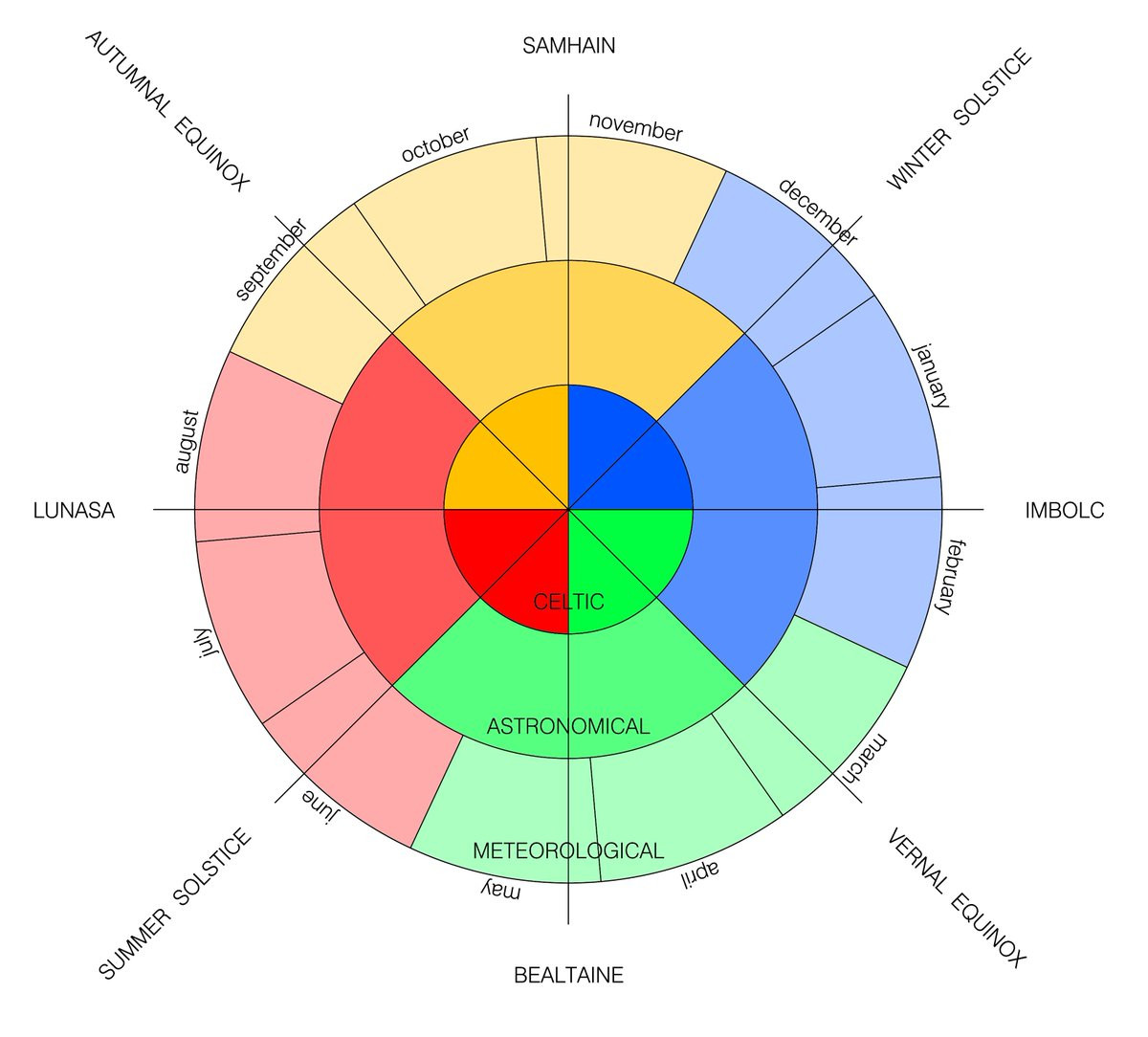
In the Northern hemisphere, in astronomical terms, the solar year is defined by the two solstices (summer, around June 21st, and winter, around December 21st) and the equinoxes (spring, around March 21st, and Autumn, around September 21st). These four events divide the year into four roughly equal parts of about 13 weeks each. If you divide each of these intervals in two you divide the year into eight pieces of six and a bit weeks each. The dates midway between the astronomical events mentioned above are the cross-quarter days, of which Imbolc is one. Here they are represented on a diagram:

The timings are rough because the dates of the equinoxes and solstices vary from year to year. Imbolc is often taken to be the 2nd of February (Groundhog Day) and Samhain is sometimes taken to be October 31st, Halloween but hopefully you get the point that although the Pagan festivals have been appropriated by the Christian church, they have much older origins.

Until 2023 only three of the four cross-quarter days were associated with public holidays in Ireland; there wasn’t a holiday for Imbolc. In 2022 however, the Government decided to create a new Bank Holiday that corrected this anomaly by introducing a new St Brigid’s Day holiday on the first Monday on or after 1st February (or on Friday if 1st February falls on that day), which also happens to be the first national holiday in Ireland to be named after a woman. The first such holiday was Monday, 6th February 2023 and the second was on Monday 5th February 2024. This is the third.

But I digress.

I am glad to have today’s holiday just before teaching starts. Having completed my examination marking duties promptly I was planning to use last week to get my teaching materials ready. Unfortunately I wasn’t at all well for most of the week – though I recovered by Friday – and am way behind schedule. Fortunately, I’ve taught one of the modules (Computational Physics) many times before so not much preparation is required although it is a bigger class than I’ve had on previous occasions which means extra work in due course grading the CA components. The other module, Particle Physics is new for me at Maynooth, though I have taught it elsewhere. This also has a bigger class than I was expecting for a final-year module and my first lecture on it is tomorrow. I’m going to have to spend most of today quickening the writing of the lecture notes and preparing assignments.

P.S. Not particularly relevantly, Particle Physics is an anagram of Happier Cyclists.

The Celestial Stranger – Thomas Traherne

Posted in History, Music, Poetry with tags , , on February 2, 2025 by telescoper

I promised yesterday that I would post the poem that gives its title to the song cycle, The Celestial Stranger, which was performed at the National Concert Hall on Friday night, so here it is as it appeared in the programme:

It’s very interesting to see such thoughts expressed in the mid-17th Century!

Thomas Traherne is an interesting poet in many ways and the associated story of his poetical manuscripts is strange and fascinating. The son of  a cobbler, Traherne was a devoutly religious man who lived most of his short life (1637-1674) in relative obscurity as a clergyman and theologian. He was a prolific writer of both prose and poetry, but very little of his work was published during his lifetime. A vast number of handwritten manuscripts survived his death, however, and many of these remained in the safekeeping of a local family in his native Herefordshire. However, in 1888 the estate of this family was wound up, sold, and the manuscripts became dispersed. Eventually, in 1897, one set of papers was  accidentally discovered in a bookstall. Traherne’s first volume of verse was published in 1903 and a second collection followed in 1908.

When these poems finally found their way into the literary world they were greeted with astonishment as well as deep appreciation and they were widely  influential: T.S. Eliot was a great admirer of Traherne, as was Dorothy L Sayers. There are also truly wonderful musical settings of some of Traherne’s poetry made by a young Gerald Finzi in his cantata Dies Natalis.

Over the years further manuscripts  have also come to light – literally, in one case, because in 1967 another lost Traherne manuscript was found, on fire, in a  rubbish dump and rescued in the nick of time! As late as 1997 more works by Traherne were discovered among 4,000 manuscripts in the Library of Lambeth Palace, the London residence of the Archbishop of Canterbury. The Lambeth manuscripts, from which the above poem is taken, are mostly prose writings, actually, but there are many poems in there too.

Traherne is sometimes described as the last metaphysical poet. However, it seems to me he might equally be described as the first romantic poet. The themes he tackles – love of nature and loss of childhood innocence – and his visionary, rhapsodic style have as much in common with William Blake and, especially, William Wordsworth as they do with better known metaphysical poets such as John Donne.

Google Garbage

Posted in History, mathematics with tags , on January 5, 2025 by telescoper

In the course of double-checking the time of perihelion for yesterday’s post I did a quick Google search. What came up first was this:

Google search results nowadays are prefaced by a short summary like this one, presumably generated by some sort of AI. This one – like many others I’ve seen recently – is just plain wrong. The time of perihelion was 13.28 Universal Time, not 09.00.

I am old enough to remember when Google Search first appeared in 1998. It was so much better than other search engines at that time, largely because of the PageRank algorithm; see this piece for a bit of the history and the reason it worked so well. Some years ago, however, Google Search underwent a transition from being a useful facility for web browsers to a piece of adtech useful only for marketing companies who pay to have their sites artificially boosted. Every time you do a search nowadays you have to scroll through a deluge of promoted pages that have very little to do with what you searched for. Google is now so corrupted as to be virtually useless. Adding garbled AI junk to the mixture is just making it worse. It’s not only frustrating but potentially dangerous. Information can be manipulated for purposes other than selling things; the systematic spread of misinformation by those in power has potentially catastrophic consequences.

Jimmy Carter in Newcastle (1977)

Posted in Biographical, History, R.I.P., Television with tags , , , on December 30, 2024 by telescoper

The news of the death at the age of 100 of former US President Jimmy Carter reminded me of a day way back when I was still at school. It was Friday, May 6th, 1977 and I was at the Royal Grammar School, Newcastle upon Tyne. I remember that morning it was announced at Assembly that Carter would be visiting the city and giving a speech outside the Civic Centre, which was less than 10 minutes’ walk from the School. I think some senior boys were allowed to go an see him, but as a mere third-former I went to a class and the occasion largely passed me by.

One thing I do remember is a classmate after Assembly saying “Thank God he didn’t visit Sunderland instead…” – Carter visited Newcastle on his way to Washington (the ancestral home of George Washington), which is nearer to Sunderland than Newcastle. I suppose the reason was that Newcastle has an airport, whereas Sunderland hasn’t.

The other thing I remember was the TV coverage on Look North when I got home, which showed the start of President Carter’s speech with his famous “Howay the Lads!”

R.I.P. Jimmy Carter (1924-2024)

Reaching Nelson

Posted in Cricket, History, OJAp Papers with tags , , , , , on December 9, 2024 by telescoper

This morning I published another paper at the Open Journal of Astrophysics and in the process I noticed that took us to a total 111 articles this year. I got to thinking about the significance of that number in cricket, where it goes by the name of Nelson

In cricket – at least in England – Nelson is supposed to be an unlucky number. The reason for this could well be that the number 111 looks like a set of stumps without the bails (see left). (For those of you not up with the lingo, the bails are two smaller bits of wood that sit on top of the stumps. ) The absence of the bails could mean that they have been dislodged, signifying that a batter is out. Also umpires remove the bails at close of play, so it could indicate that the match is over.

What’s less clear is the connection with Horatio, Lord Nelson (right). The version I was told at school was that Nelson had “one eye, one arm, and one Trafalgar”. Some also say “Destiny” instead of “Trafalgar”. Those are polite versions. Others say the third one refers to a part of the male anatomy. Bill Frindall used to say “one eye, one arm, and one et cetera“. Who knows which, if any, of these is right?

In any case this does give me the chance to point out that, contrary to popular myth, Nelson didn’t lose an eye anyway. In 1794, Nelson was in action at the Siege of Calvi during the Invasion of Corsica when a cannonball struck a nearby sandbag and sprayed him with sand and gravel. Nelson’s right eye was damaged by this, but he didn’t lose it although he had little effective vision through it thereafter.

Meanwhile, I just saw this notification on LinkedIn about yesterday’s post:

Newton’s Opticks and a Query about the Bending of Light

Posted in History, The Universe and Stuff with tags , , , , on December 5, 2024 by telescoper

The story of the famous 1919 expeditions to measure the bending of light by the Sun as a test of general relativity has featured many times on this blog (e.g. here). I ahve also written elsewhere about it, e.g. here. One way this is often presented is whether the measurements preferred the “Einstein” prediction or one consistent with “Newton”, there being a famous factor of two between the two.

In fact the earliest published calculation of the deflection of light by the Sun was not by Isaac Newton but by Johann Georg von Soldner (Uber die Ablenkung eines Lichstrals von seiner geradlinigen Bewegung, durch die Attraktion eines Weltk¨orpers, and welchem er nahe vorbei geht. Berliner Astronomisches Jahrbuch, 1801: 161-172). This calculation does use Newtonian theory, but as far as I know there is no record tof any calculation of this sort by Newton himself.

There is, however, something very tantalizing in Newton’s 1704 book Opticks, published almost 20 years after his Principia outlined the laws of mechanics and of universal gravitation. Opticks which (unlike the Principia) was written in English, ends with a series of rhetorical questions called “Queries” which present speculative ideas about light and its interactions with matter. The first of these reads:

Query 1. Do not Bodies act upon Light at a distance, and by their action bend its Rays; and is not this action (caeteris paribus) strongest at the least distance?

This looks very much like a speculation about the bending of light by gravitation. But if that’s what it is, he could have done exactly what Soldner did about a century later. Why then did he never publish the result and why was it never found among his unpublished papers?

I’ve spoken to several people about this and there are three main ideas. One is that Newton actual did the Soldner calculation, and that the manuscript was accidentally destroyed in a fire caused by his dog, Diamond. The other is that he just never got round to it, which seems unlikely because it’s not a difficult calculation and Newton lived over 20 years after the publication of the Opticks. The third possibility is that Query 1 wasn’t about gravity at all. If it had been, wouldn’t he have used the word and wouldn’t he have mentioned the inverse-square law specifically? Perhaps what he had in mind was some kind of refraction. This interpretation is consistent with other Queries where he talks about the “aetherial Medium” through which he supposed light to propagate being distorted by the presence of massive bodies and thus causing refraction. For example, from Query 21,

Is not this Medium much rarer within the dense Bodies of the Sun, Stars, Planets and Comets, than in the empty celestial Spaces between them?

I suppose we’ll never know what Newton had in mind. I am split between the first and third explanations above.

It’s worth mentioning that some of the other Queries are very prescient. Take Query 5, for example:

Do not Bodies and Light act mutually upon one another; that is to say, Bodies upon Light in emitting, reflecting, refracting and inflecting it, and Light upon Bodies for heating them, and putting their parts into a vibrating motion wherein heat consists?

Clever chap, Newton!

Teaching Transforms

Posted in Education, History, Maynooth, The Universe and Stuff with tags , , , , , on November 21, 2024 by telescoper

We’re about two-thirds of the way into the Autumn Semester here at Maynooth and, by a miracle, I’m just about on schedule with both the modules I’m teaching. It’s always difficult to work out how long things are going to need for explanation when you’re teaching them for the first time.

One of the modules I’m doing is Differential Equations and Transform Methods for Engineering Students. I’ve been on the bit following the “and” for a couple of weeks already. The first transform method covered was the Laplace transform, which I remember doing as a physics undergraduate but have used only rarely. Now I’m doing Fourier Series, as a prelude to Fourier transforms.

As I have observed periodically, the differential equations and transform methods are not at all disconnected, but are linked via the heat equation, the solution of which led Joseph Fourier to devise his series in Mémoire sur la propagation de la chaleur dans les corps solides (1807), a truly remarkable work for its time that inspired so many subsequent developments.

In the module I’m teaching, the applications are rather different from when I taught Fourier series to Physics students. Engineering students at Maynooth primarily study electronic engineering and robotics, so there’s a much greater emphasis on using integral transforms for signal processing. The mathematics is the same, of course, but some of the terminology is different from that used by physicists.

Anyway I was looking for nice demonstrations of Fourier series to help my class get to grips with them when I remembered this little video recommended to me some time ago by esteemed Professor George Ellis. It’s a nice illustration of the principles of Fourier series, by which any periodic function can be decomposed into a series of sine and cosine functions.

This reminds me of a point I’ve made a few times in popular talks about astronomy. It’s a common view that Kepler’s laws of planetary motion according to which which the planets move in elliptical motion around the Sun, is a completely different formulation from the previous Ptolemaic system which involved epicycles and deferents and which is generally held to have been much more complicated.

The video demonstrates however that epicycles and deferents can be viewed as the elements used in the construction of a Fourier series. Since elliptical orbits are periodic, it is perfectly valid to present them in the form of a Fourier series. Therefore, in a sense, there’s nothing so very wrong with epicycles. I admit, however, that a closed-form expression for such an orbit is considerably more compact and elegant than a Fourier representation, and also encapsulates a deeper level of physical understanding. What makes for a good physical theory is, in my view, largely a matter of economy: if two theories have equal predictive power, the one that takes less chalk to write it on a blackboard is the better one!

Anyway, soon I’ll be moving onto the complex Fourier series and thence to Fourier transforms which is familiar territory, but I have to end the module with the Z-transform, which I have never studied and never used. That should be fun!

Another Edgeworth Connection

Posted in History, The Universe and Stuff with tags , , , , , , , , , on November 3, 2024 by telescoper

A week or so ago I posted an item about the Edgeworth family that included a reference to Kenneth Edgeworth, an amateur astronomer of some note who first posited the existence of what is now known as the Kuiper belt. Here’s another interesting connection. Kenneth Edgeworth was born in 1880 in Daramona House in Street in County Westmeath. The owner of this house was Edgeworth’s uncle, another astronomer called William Edward Wilson who built an observatory next to Daramona House.

Here are pictures of (left) house and (right) the observatory, neither of look in particularly good condition!

After independence, many of the large houses owned by the rich Anglo-Irish families who had run Ireland until then fell into disrepair or were destroyed.

Anyway, on top of the two-storey observatory building there used to be a dome that housed a 24″ Grubb reflecting telescope. Here’s an old picture showing what it looked like in better times, around 1900:

The dome is no longer there, and neither is the telescope. The latter was donated to the University of London in 1925 eventually housed in the Observatory at Mill Hill, now run by University College London. Here is an excerpt from the history of the University of London Observatory:

W.E. Wilson established an observatory at Daramona, Street, County Westmeath, in 1871 and equipped it with a 12-inch equatorial reflector by Grubb. Wilson (born in 1851, elected FRS in 1896, an original member of the BAA, awarded an honorary DSc by the University of Dublin in 1901, High Sheriff of Co. Westmeath in 1894), observed the transit of Venus in 1882 and solar eclipses at Oran in 1870 and Spain in 1900, published many papers in Proc. R. Soc, Proc. R. Dublin Soc., Proc. R. Irish Acad., etc., and died in 1908) enlarged his observatory in 1881 and installed a 24-inch reflector by Grubb on the mounting previously used for the 12-inch reflector. Ten years later a new mounting was constructed. It is this mounting which was moved to Mill Hill in 1928. Dr. Wilson used his telescope to make some of the best photographs of his time of star clusters and nebulae, and he worked extensively on problems of solar physics and the solar constant. The telescope may be used in Newtonian and Cassegrain forms; the focal length of the mirror is 10 feet and the equivalent focal length at the Cassegrain focus is approximately 42 feet. The telescope was moved in 1928 from Ireland to University College, where minor modifications were made to the focussing arrangements and plate-holder, and an electric motor was added to rewind the driving clock automatically.

The Wilson telescope was retired from active service in 1974 and moved to the World Museum in Liverpool where, as far as I know, it remains on display to this day.

Edgeworth Connections

Posted in History, The Universe and Stuff with tags , , , , , on October 25, 2024 by telescoper

It’s a small world.

This year I am supervising an undergraduate project student who is looking at approximations to probability distribution functions. This project was inspired by a nice paper on the arXiv by Elena Sellentin, Andrew Jaffe and Alan Heavens about the use of the Edgeworth series which I blogged about here.

It turns out that the student who picked this project hails from a place very close to Edgeworthstown in County Longford. I’ve been through there on the train going to and from Sligo, but I never thought much about the possible connection, assuming the name was a coincidence. When I met my project student yesterday for our weekly discussion, however, he told me he had looked into it and the results are very interesting.

The Edgeworth series was invented by Francis Ysidro Edgeworth (1845-1926) who was a political economist and philosopher was born in Edgeworthstown. He was the grandson of the Richard Lovell Edgeworth (1744-1817) who had no fewer than 22 children (including the novelist Maria Edgeworth) and was a founder member of the Royal Irish Academy. In a manner not untypical of the Anglo-Irish landed gentry, the Edgeworths renamed the local town from Meathas Troim (anglicized form Mostrim), c.f. Parsonstown.

There is a directly astronomical connection with the Edgeworth family too. Kenneth Edgeworth (1880-1972) was another member of the Edgeworth dynasty, `one of ‘the archetypal gentleman literary and scientific families’ who had sufficient private income to be able to pursue a diverse range of interests. Kenneth Edgeworth was an independent theoretical astronomer, best known for proposing the existence of a disc of bodies beyond the orbit of Neptune in the 1930s. Observations later confirmed the existence of this structure, often called the Kuiper belt or, especially in Irish circles, the Edgeworth-Kuiper belt.

Here’s the front page of one of his astronomical publications:

Anyway, what’s the probability that a student would randomly pick a project involving a method invented a person born just a few miles away from his family home?

O(G)HAM

Posted in History, Irish Language with tags , , on October 3, 2024 by telescoper

Here’s a fascinating video about a project looking into Ogham, an early-mediaeval way of writing that dates back to about the 4th Century AD.

As the video reflects, there’s some controversy about whether the ‘g’ is pronounced but most Irish people I know would say “Oham” rather than “Ogam”. Anyway, this video reports on a research collaboration between the University of Glasgow and Maynooth University that aims to harness Digital Technologies to Transform Understanding of Ogham Writing, from the 4th Century to the 21st.