Archive for the OJAp Papers Category

New Publication at the Open Journal of Astrophysics

Posted in OJAp Papers, Open Access, The Universe and Stuff with tags , , , , , on June 29, 2024 by telescoper

It’s a rainy Saturday morning here in Barcelona, and here’s the last update from the Open Journal of Astrophysics before I depart these shores. In fact there is only one paper to report this week, being  the 52nd paper in Volume 7 (2024)  and the 167th altogether. It was published on June 24th 2024. With six months of the year now over, I predict we will have published about 52×12/6=104 papers by the end of the year.

The title is “Comparing Mass Mapping Reconstruction Methods with Minkowski Functionals” and it  is in the folder marked Cosmology and NonGalactic Astrophysics. The authors are: Nisha Grewal (U. Edinburgh, UK), Joe Zuntz (U. Edinburgh, UK) and Tilman Tröster (ETH Zurich, Switzerland);  the paper is about quantifying the accuracy, precision and efficiency of lensing reconstruction methods using topological characteristics known as Minkowski Fuctionals.

Here is the overlay of the paper containing the abstract:


You can click on the image of the overlay to make it larger should you wish to do so. You can also find the officially accepted version of the paper on the arXiv here.

P.S. Since I only had the one paper to publicize this week I took a few minutes to add the overlays to last week’s post, which I couldn’t do at the time because of computer problems.

Four New Publications at the Open Journal of Astrophysics

Posted in OJAp Papers, The Universe and Stuff on June 22, 2024 by telescoper

Ongoing computer issues mean that this week’s update of activity at the Open Journal of Astrophysics will have to be briefer and with fewer graphics than usual, for which I apologize. During the last week we published four new papers, taking the total so far in 2024 to 51 – so we have already passed last year’s total of 50 – and the total altogether to 166.

The four papers concerned are the following:

https://astro.theoj.org/article/120279-comparing-jet-shaped-point-symmetry-in-cluster-cooling-flows-and-supernovae

(in the folder High-Energy Astrophysical Phenomena, by Noam Soker, of Technion, Haifa, Israel; published on June 20th, arXiv version here)

https://astro.theoj.org/article/120086-repeating-partial-disruptions-and-two-body-relaxation

(in the folder High-Energy Astrophysical Phenomena, by Luca Broggi of the University of Milan, Italy, and six others; published on 21st June, arXiv version here)

https://astro.theoj.org/article/120316-effect-of-the-large-magellanic-cloud-on-the-kinematics-of-milky-way-satellites-and-virial-mass-estimate

(in the folder Astrophysics of Galaxies, by Andrey Kravtsov and Sophia Winney, of the University of Chicago, USA; published on 21st June, arXiv version here)

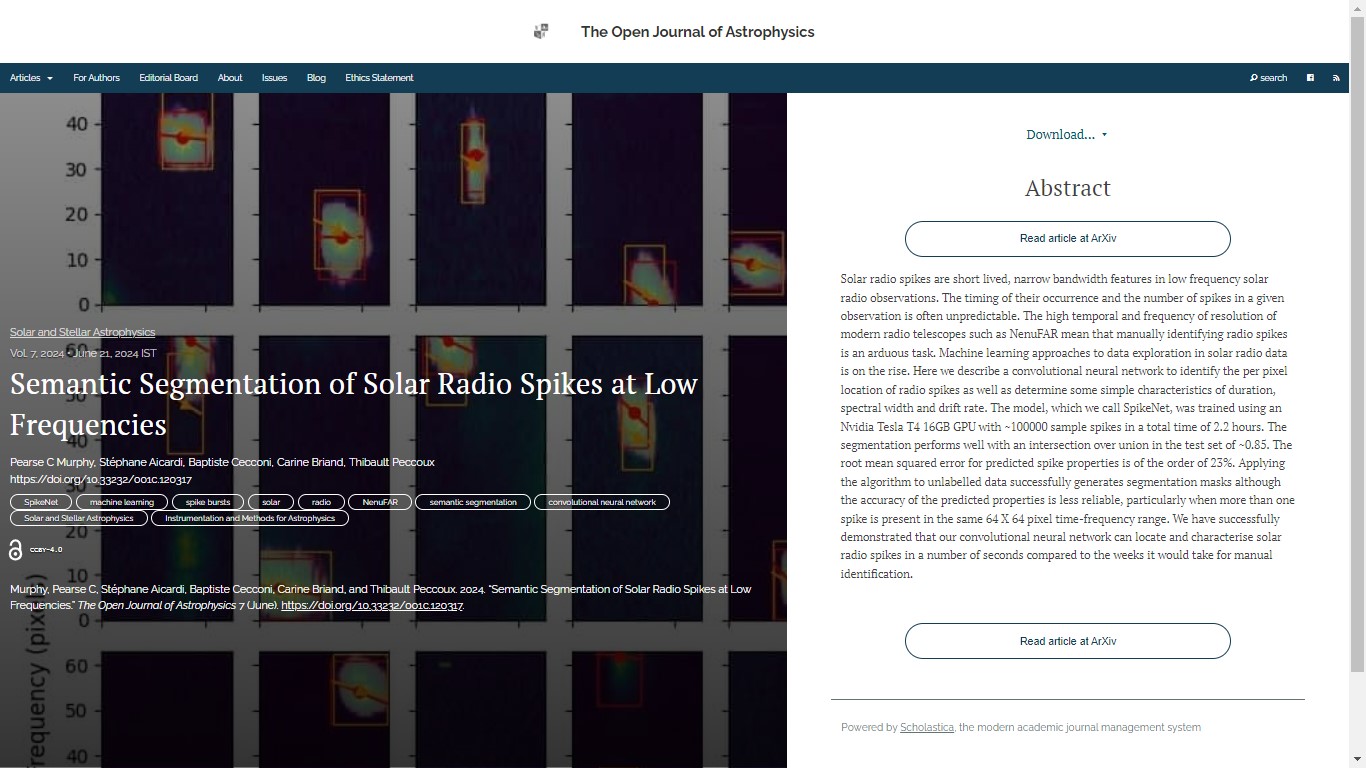
https://astro.theoj.org/article/120317-semantic-segmentation-of-solar-radio-spikes-at-low-frequencies

(in the folder Solar and Stellar Astrophysics, by Pearse C Murphy, and four others, based in Paris, France, arXiv version here)

Two New Publications at the Open Journal of Astrophysics

Posted in OJAp Papers, Open Access, The Universe and Stuff with tags , , , , , , , , , , , , , on June 15, 2024 by telescoper

It’s Saturday morning in Barcelona, and time to post another update relating to the  Open Journal of Astrophysics.  Since the last update we have published two more papers, taking  the count in Volume 7 (2024) up to 47 and the total published by OJAp up to 162. We actually accepted four papers last week, but so far only two final versions have appeared on the arXiv.

The first paper of the most recent pair – published on  Friday 14th June – is “Spectroscopic Confirmation of an Ultra-Massive Galaxy in a Protocluster at z 4.9″ . The author list has a strong University of California flavour: Stephanie M. Urbano Stawinski (UC Irvine), M. C. Cooper (UC Irvine), Ben Forrest (UC Davis) , Adam Muzzin (York University, Canada), Danilo Marchesini (Tufts University), Gillian Wilson (UC Merced), Percy Gomez (Keck Observatories, USA), Ian McConachie (UC Riverside), Z. Cemile Marsan (York University, Canada), Marianna Annuziatella (Centro de Astrobiología CSIC-INTA, Spain) and Wenjun Chang (UC Riverside).

This paper presents an investigation of a cluster system involving a massive galaxy using Keck spectroscopy with determination of its redshift and star formation properties. The results pose a challenge for theorists. The paper is in the folder marked Astrophysics of Galaxies.

Here is a screen grab of the overlay which includes the abstract:


You can click on the image of the overlay to make it larger should you wish to do so. You can find the officially accepted version of the paper on the arXiv here.

The second paper, also published on Friday 14th June and has the title “Boil-off of red supergiants: mass loss and type II-P supernovae” by Jim Fuller (Caltech) and  Daichi Tsuna (Caltech, USA and University of Tokyo, Japan). This one, which is in the folder marked Solar and Stellar Astrophysics, discusses A new model for stellar mass loss which predicts that low-mass red supergiants lose less mass than commonly assumed, while high-mass red supergiants lose more.

Here is a screen grab of the overlay which includes the abstract:


You can click on the image of the overlay to make it larger should you wish to do so. You can find the officially accepted version of the paper on the arXiv here.

That concludes this week’s update. Will we reach 50 for 20204 next week? Tune in next Saturday to find out!

Three New Publications at the Open Journal of Astrophysics

Posted in OJAp Papers, Open Access, The Universe and Stuff with tags , , , , , , , , , , , , , , , , , on June 8, 2024 by telescoper

Time for another roundup of business at the  Open Journal of Astrophysics. This time I have three papers to announce, which brings the total we have published so far this year (Vol. 7) to 45 and the total published by OJAp to 160. We’re still on track to publish around 100 papers this year or more, compared to last year’s 50.

First one up, published on 3rd June 2024, is “Log-Normal Waiting Time Widths Characterize Dynamics” by Jonathan Katz of Washington University (St Louis, Missouri, USA). This paper presents a discussion of the connection between waiting time distributions and dynamics for aperiodic astrophysical systems, with emphasis on log-normal distributions.  This paper is in the folder marked High-Energy Astrophysical Phenomena.

Here is a screen grab of the overlay, which includes the abstract:


You can read the paper directly on arXiv here.

The second paper to present is “An Empirical Model For Intrinsic Alignments: Insights From Cosmological Simulations” by Nicholas Van Alfen (Northeastern University, Boston, USA), Duncan Campbell (Carnegie Mellon University, Pittsburgh, USA), Jonathan Blazek (Northeastern University), C. Danielle Leonard (Newcastle University, UK), Francois Lanusse (Université Paris-Saclay, France), Andrew Hearin (Argonne National Laboratory, USA), Rachel Mandelbaum (Carnegie Mellon University) and The LSST Dark Energy Science Collaboration.  This paper presents an extension of the halo model (specifically the Halo Occupation Distribution, HOD) to include intrinsic alignment effects for the study of weak gravitational lensing. This paper is in the folder marked Cosmology and Nongalactic Astrophysics. It was published on Tuesday June 4th 2024.

The overlay looks like this:


You can read this paper directly on the arXiv here.

Last, but by no means least, comes  “Towards Cosmography of the Local Universe”  which proposes the multipoles of the distance-redshift relation as new cosmological observables that have a direct physical interpretation in terms of kinematical quantities of the underlying matter flow. This was also published on 4th June. The authors are Julian Adamek (IfA Zurich, Switzerland), Chris Clarkson (Queen Mary, London, UK), Ruth Durrer (Geneva, Switzerland), Asta Heinesen (U. Lyon, France & NBI Copenhagen, Denmark), Martin Kunz (Geneva), and Hayley J. Macpherson (Chicago, USA).

Here is a screengrab of the overlay:


To read the accepted version of this on the arXiv please go here. This paper is also in the folder marked Cosmology and Nongalactic Astrophysics.
That’s it for this week. I aim to post another update next weekend.


An analysis of the effects of sharing research data, code, and preprints on citations

Posted in OJAp Papers, Open Access with tags , , , , , on May 27, 2024 by telescoper

Whenever researchers ask me why I am an advocate of open science the response that first occurs to me is somewhat altruistic: sharing results and data is good for the whole community, as it enables the proper progress of research through independent scrutiny. There is however a selfish reason for open science, demonstrates rather well by a recent preprint on arXiv. The abstract is here:

Calls to make scientific research more open have gained traction with a range of societal stakeholders. Open Science practices include but are not limited to the early sharing of results via preprints and openly sharing outputs such as data and code to make research more reproducible and extensible. Existing evidence shows that adopting Open Science practices has effects in several domains. In this study, we investigate whether adopting one or more Open Science practices leads to significantly higher citations for an associated publication, which is one form of academic impact. We use a novel dataset known as Open Science Indicators, produced by PLOS and DataSeer, which includes all PLOS publications from 2018 to 2023 as well as a comparison group sampled from the PMC Open Access Subset. In total, we analyze circa 122’000 publications. We calculate publication and author-level citation indicators and use a broad set of control variables to isolate the effect of Open Science Indicators on received citations. We show that Open Science practices are adopted to different degrees across scientific disciplines. We find that the early release of a publication as a preprint correlates with a significant positive citation advantage of about 20.2% on average. We also find that sharing data in an online repository correlates with a smaller yet still positive citation advantage of 4.3% on average. However, we do not find a significant citation advantage for sharing code. Further research is needed on additional or alternative measures of impact beyond citations. Our results are likely to be of interest to researchers, as well as publishers, research funders, and policymakers.

Colavizza et al., arXiv:2404.16171

This analysis isn’t based on astrophysics, but I think the relatively high citation rates of papers in the Open Journal of Astrophysics are at least in part due to the fact that virtually all our papers are all available as preprints arXiv prior to publication. Citations aren’t everything, of course, but the positive effect of preprinting is an important factor in communicating the science you are doing.

Three New Publications at the Open Journal of Astrophysics

Posted in OJAp Papers, Open Access, The Universe and Stuff with tags , , , , , , , , on May 25, 2024 by telescoper

After a very busy and unusual week, it’s time to get back to normal with the usual  Saturday roundup of business at the  Open Journal of Astrophysics. If you want to know how many papers we have published so far this year (Vol. 7), the answer is 42. The total published by OJAp is now 157. We’re still on track to publish around 100 papers this year, possibly more, compared to last year’s 50.

All the members of this week’s trio are in the folder marked Cosmology and Nongalactic Astrophysics, and indeed all three relate in one way or another to the topic of weak gravitational lensing.  All three were published on Wednesday 22nd May 2024.

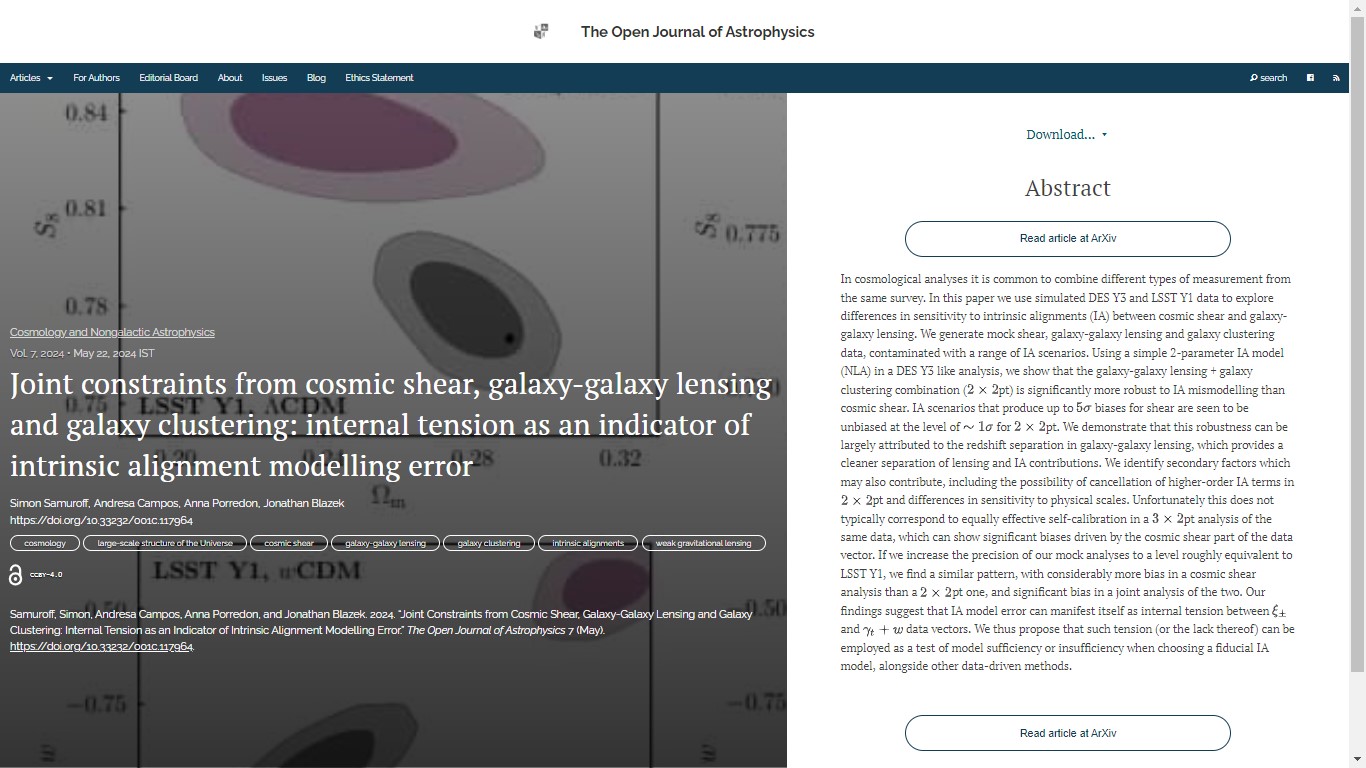
First one up is “Joint constraints from cosmic shear, galaxy-galaxy lensing and galaxy clustering: internal tension as an indicator of intrinsic alignment modelling error” which is by Simon Samuroff (Northeastern U., USA), Andresa Campos (Carnegie Mellon U., USA), Anna Porredon (Bochum, Germany) and Jonathan Blazek (Edinburgh, UK).   A combined statistical approach to the identification of errors arising in cosmic shear analysis due to intrinsic alignments.

Here is a screen grab of the overlay, which includes the abstract:

You can read the paper directly on arXiv here.

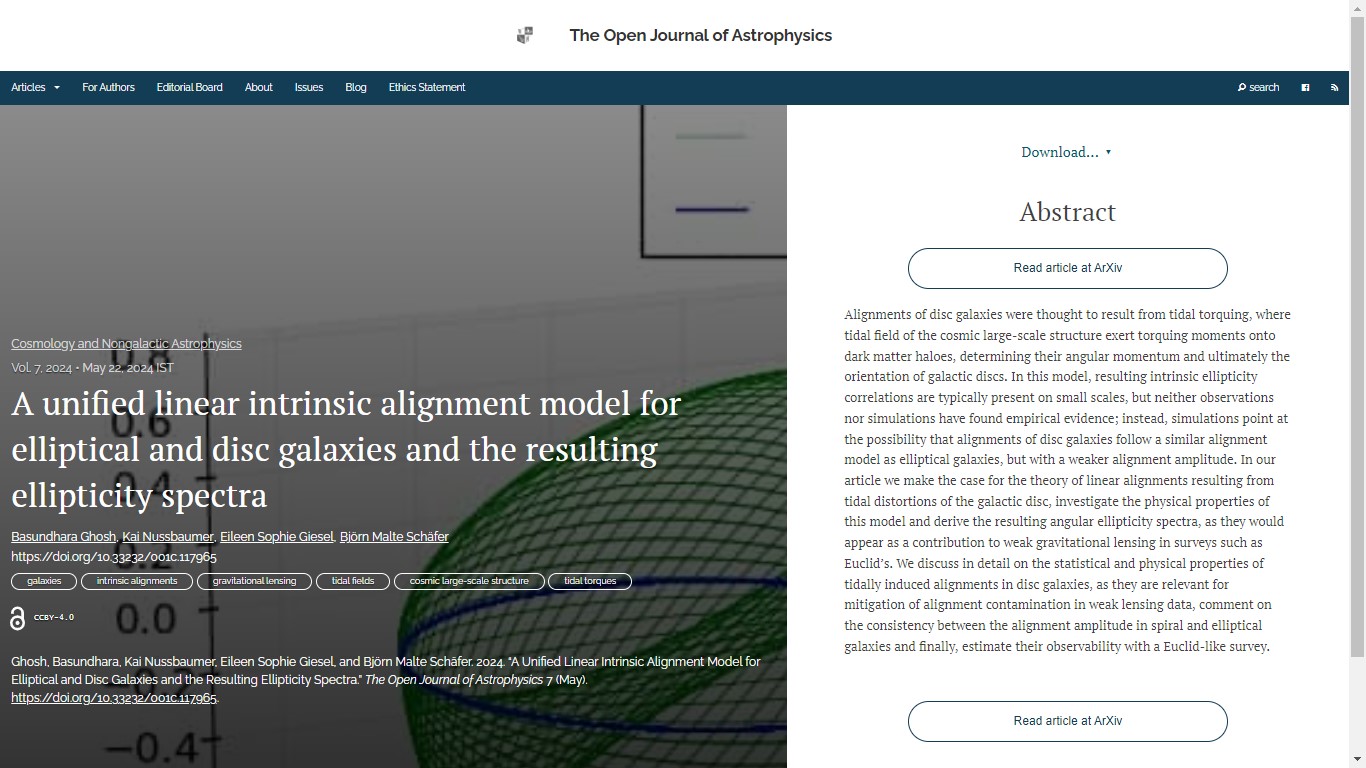
The second paper to present is “A unified linear intrinsic alignment model for elliptical and disc galaxies and the resulting ellipticity spectra” by Basundhara Ghosh (Bangalore, India), with Kai Nussbaumer, Eileen Sophie Giesel & Björn Malte Schäfer (Heidelberg, Germany). It presents a discussion of the physical origin of intrinsic alignments of both elliptical and disk galaxies and the implications for cosmological studies

The overlay looks like this:


You can read this paper directly on the arXiv here.

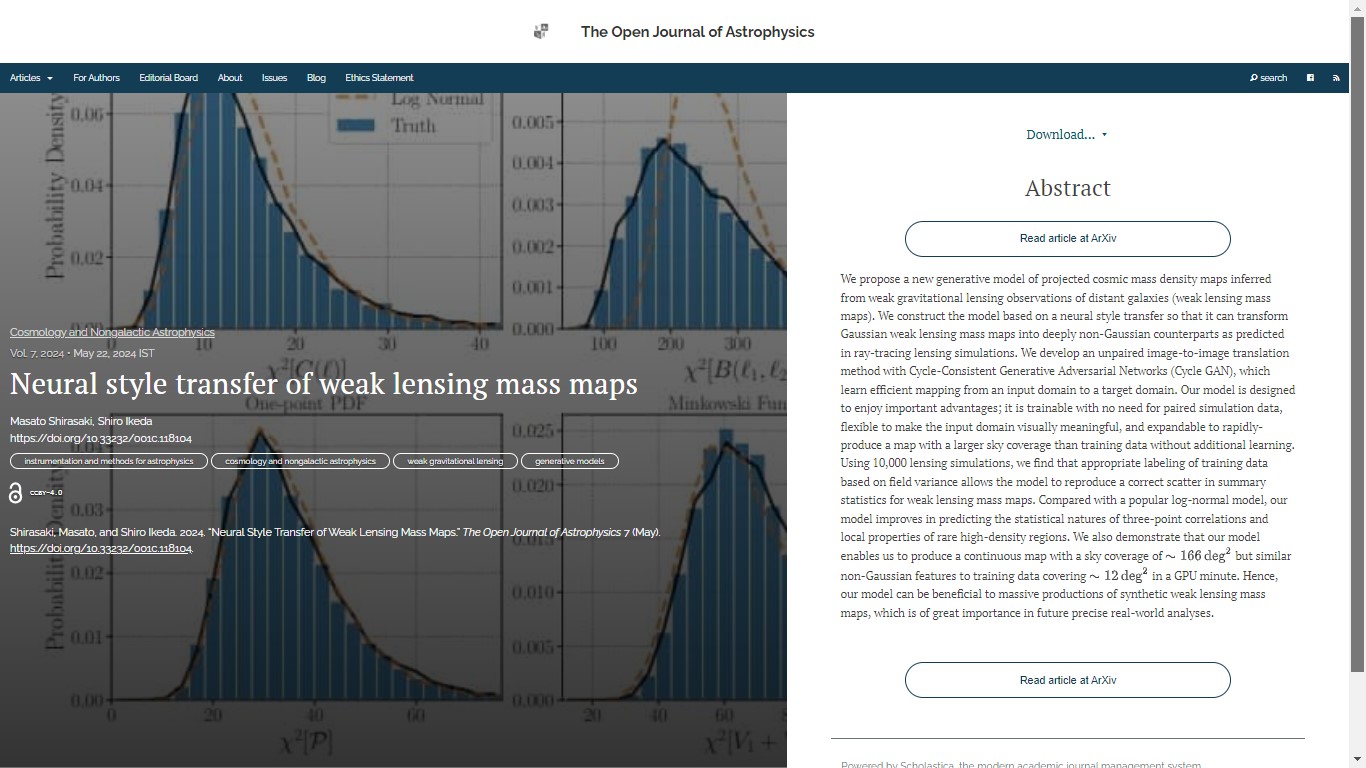
The last paper of this batch is entitled “Neural style transfer of weak lensing mass maps”  and proposes a generative model for the mass-production of weak-lensing maps. The authors are Masato Shirasaki and Shiro Ikeda (both of the University of Tokyo, Japan)

Here is a screengrab of the overlay:


To read the accepted version of this on the arXiv please go here.
That’s all for now. I will do another update next week.


Three New Publications at the Open Journal of Astrophysics

Posted in OJAp Papers, Open Access, The Universe and Stuff with tags , , , , , , , , , on May 18, 2024 by telescoper

It’s time once more for the usual  Saturday roundup of business at the  Open Journal of Astrophysics. The latest batch of publications consists of three papers, taking the count in Volume 7 (2024) up to 39 and the total published by OJAp up to 154. We’re still on track to publish around 100 papers this year, compared to last year’s 50.

All three of this week’s papers involve use of data from the European Space Agency’s Gaia mission, which is proving an immensely rich resource for astrophysics.

First one up is “Asymmetric Drift Map of the Milky Way Disk Populations between 8 -16 kpc with LAMOST and Gaia datasets” which is by  Xin Li (Nanchong, China), Peng Yang (Chengdu, China) , Hai-Feng Wang (Nanchong, China), Qing Li (Jiangmen, China), Yang-Ping Luo (Nanchong, China), Zhi-Quan Luo (Nanchong, China), Guan-Yu Wang (Nanchong, China). This is a study  of the asymmetric drift, the difference of the local circular speed and the mean rotational speed of the stellar population, for various stellar populations in the Milky Way. It is in the folder marked Astrophysics of Galaxies and was published on Tuesday 14th May 2024.

Here is a screen grab of the overlay, which includes the abstract:


You can read the paper directly on arXiv here.

The second paper to announce is “On the formation of a 33 solar-mass black hole in a low-metallicity binary” by Kareem El-Badry (Caltech, USA). It discusses theoretical models for the formation of a black hole in a particular binary system discovered in Gaia data.

This one is in the folder Solar and Stellar Astrophysics and was published on 16th May 2024. The overlay looks like this:


You can read this paper directly on the arXiv here.

The last paper of this batch, also in the in the folder Solar and Stellar Astrophysics, is entitled “Compact Binary Formation in Open Star Clusters II: Difficulty of Gaia NS formation in low-mass star clusters”  and it presents a discussion of the formation of binary neutron stars and black holes found in Gaia data based on their orbital properties. It was published on Friday May 17th 2024 (i.e. yesterday). The authors are Ataru Tanikawa (Fukui University, Japan), Long Wang (Sun-yat Sen University, China) and  Michiko S. Fujii (Tokyo University, Japan).

Here is a screengrab of the overlay:


To read the accepted version of this on the arXiv please go here.
That’s all for now. Another update next week!


Four New Publications at the Open Journal of Astrophysics

Posted in OJAp Papers, Open Access, The Universe and Stuff with tags , , , , , , , , , , , , on May 11, 2024 by telescoper

It is time yet again for an update of recent activity at the Open Journal of Astrophysics.
This week we have published four papers, which I now present to you. These four take the count in Volume 7 (2024) up to 36 and the total published by OJAp up to 151. I speculated last week that we would probably pass the 150 mark this week, and so we did. We’re still on target to publish around 100 papers this year.
In chronological order, the four papers published this week, with their overlays, are as follows. You can click on the images of the overlays to make them larger should you wish to do so.
First one up is “Ephemeris Matching Reveals False Positive Validated and Candidate Planets from the K2 Mission” by Drake A. Lehmann (U. Wisconsin-Madison, USA) and Andrew Vanderburg (MIT, USA). It presents a description and application of a technique for identifying false positives among candidate exoplanets. The paper was published on 7th May 2024, is in the folder marked Earth and Planetary Astrophysics, and can be found here.
Here is a screen grab of the overlay, which includes the abstract:

You can find the officially accepted version of the paper on the arXiv here.
The second paper to announce is “Accuracy requirements on intrinsic alignments for Stage-IV cosmic shear” which is by by Anya Paopiamsap, Natalia Porqueres & David Alonso (Oxford, UK) and Joachim Harnois-Deraps & C. Danielle Leonard (Newcastle, UK). This paper sets about quantifying the permissible level of disagreement between the true intrinsic galaxy alignments and the theoretical models thereof that can be allowed for future Stage-IV cosmic shear surveys. This one is in the folder marked Cosmology and Nongalactic Astrophysics. The paper was published on May 9th 2024 and you can see the overlay here:

The accepted version of this paper can be found on the arXiv here.
The next paper, is in the folder Instrumentation and Methods for Astrophysics and is entitled “Optimal Summary Statistics for X-ray Polarization”. The authors are Jeremy Heyl (Uni. British Columbia, Canada), Denis González-Caniulef (Uni. Toulouse, France) and Ilaria Caiazzo (Caltech, USA). This presents new statistical estimators for use in studies of X-ray polarization, with an analytic discussion of their efficiency. It can be found here and the accepted version can be read on arXiv here. Here is the overlay:

The last paper of this batch is called “B-modes from galaxy cluster alignments in future surveys” and is by Christos Georgiou, Thomas Bakx, Juliard van Donkersgoed and Nora Elisa Chisari, all from Utrecht University in The Netherlands. It presents a discussion of the possible detection of cosmic shear B-modes produced by intrinsic alignments in future galaxy surveys.
Here is the overlay:

You can find the full text for this one on the arXiv here. The primary classification for this one is Cosmology and Nongalactic Astrophysics.
And that ends this week’s update. More next week!

Two New Publications at the Open Journal of Astrophysics

Posted in OJAp Papers, The Universe and Stuff with tags , , , , , , on May 4, 2024 by telescoper

It’s Saturday morning in Barcelona, and time to post another update relating to the  Open Journal of Astrophysics.  Since the last update we have published two more papers, taking  the count in Volume 7 (2024) up to 32 and the total published by OJAp up to 147. There’s every chance we will reach 150 next week.

The first paper of the most recent pair – published on  Monday 29th April- is “Supernovae in 2023 (review): possible breakthroughs by late observations” by Noam Soker of Technion in Haifa, Israel. It presents  a discussion of observations of the aftermath of supernovae explosions, such as supernova remnants, and how these may shed light on the explosion mechanism. This one is in the folder marked High-Energy Astrophysical Phenomena.

Here is a screen grab of the overlay which includes the abstract:


You can click on the image of the overlay to make it larger should you wish to do so. You can find the officially accepted version of the paper on the arXiv here.

The second paper was published on Thursday 2nd May and has the title “ΛCDM is alive and well” The authors are: Alain Blanchard (Université de Toulouse, France), Jean-Yves Héloret (Université de Toulouse, France), Stéphane Ilíc (Université Paris-Saclay, France), Brahim Lamine (Université de Toulouse, France) and Isaac Tutusaus (Université de Genève, Switzerland). This one, which is in the folder marked Cosmology and NonGalactic Astrophysics, presents a review of  review of the alleged tensions between observations and the standard cosmological model.

I did a post recently relating to a Royal Society Meeting on this topic. The first version of this paper appeared on arXiv about two years ago but the final version is extensively modified.

Here is a screen grab of the overlay which includes the abstract:


You can click on the image of the overlay to make it larger should you wish to do so. You can find the officially accepted version of the paper on the arXiv here.

And that concludes this week’s update. More next week!

Three New Publications at the Open Journal of Astrophysics

Posted in OJAp Papers, Open Access, The Universe and Stuff with tags , , , , , , , , , , , , , on April 27, 2024 by telescoper

It’s time for the usual  Saturday roundup of business at the  Open Journal of Astrophysics. The latest batch of publications consists of three papers, taking the count in Volume 7 (2024) up to 30 and the total published by OJAp up to 145.

First one up is “Baryonic Imprints on DM Halos: the concentration-mass relation and its dependence on halo and galaxy properties” .  The authors, Mufan Shao and Dhayaa Anbajagane of the University of Chicago, USA, use  a non-linear model informed by simulations to study the imprint of galaxy formation physics on the concentration-mass relationship using various different choices of halo selection criteria. This one is in the folder marked Astrophysics of Galaxies and was published on 24th April 2024.

Here is a screen grab of the overlay, which includes the abstract:


You can read the paper directly on arXiv here.

The second paper to announce is “Variability in SSTc2d J163134.1-240100, a brown dwarf with quasi-spherical mass loss” which describes a search for variability in a brown dwarf star known to be losing mass and the implications of the lack thereof for the reason for the outflow therefrom. The authors are Aleks Scholz (St Andrews, UK),  Koraljka Muzic (Lisbon, Portugal), Victor Almendros-Abad (Palermo, Italy), Antonella Natta (DIAS, Ireland), Dary Ruiz-Rodriguez (NRAO, USA), Lucas Cieza (Uni. Diego Portales, Chile), Cristina Rodriguez-Lopez (IAA-CSIC, Granada, Spain)

This one is in the folder Solar and Stellar Astrophysics and was also published on 24th April 2024. The overlay looks like this:


You can read this paper directly on the arXiv here.

The last paper of this batch, also in the folder marked Astrophysics of Galaxies, is  entitled “MAGICS I. The First Few Orbits Encode the Fate of Seed Massive Black Hole Pairs”  and is a computational study of the process by which massive black holes are formed by merging smaller seed black holes. It was published on April 26th 2024 (i.e. yesterday). The authors are: Nianyi Chen, Diptajyoti Mukherjee and Tiziana Di Matteo (all Carnegie Mellon University); Yueying Ni (Harvard); Simeon Bird (University of California, Riverside); and Rupert Croft (Carnegie Mellon University). All authors are based in the USA.

Here is a screengrab of the overlay:


To read the accepted version of this on the arXiv please go here.
That’s all for now. More news in a week or so!