Archive for the OJAp Papers Category

Open Journal of Astrophysics Update

Posted in OJAp Papers, Open Access with tags , , , , , on April 4, 2024 by telescoper

I’ve just noticed that my post earlier in the week about changes to the publication system at the Open Journal of Astrophysics is dated April 1st. I can assure you it wasn’t meant as a joke! Anyway, the integration with Crossref is now complete and I’ve started clearing the backlog of papers waiting to be published. I would say normal service has been resumed, but the idea is to make the process faster and more reliable than before so it’s hopefully a return but to better-than-normal service.

I want first of all to thank the people at Maynooth University Library, Crossref, and Scholastica for helping us figure out the issue and solve it. We would no doubt have got there faster were it not for the intervention of the Easter break, but in any case it has only required a pause of publication for a couple of weeks.

I’ll resume the regular weekly updates at the weekend. However, one paper got snarled up when we ran into a problem. Although published on 20th March, it was never properly registered with Crossref. The only way I could think of to sort out the issue with this one was to start it again, which I did this morning, and it is now published though I kept the publication date as 20th March.

This paper, by Yingtian Chen and Oleg Gnedin of the University of Michigan, is the 21st paper to be published in Volume 7 and the 136th altogether. It is a study of kinematic, chemical and age data of globular clusters from Gaia yielding clues to how the Milky Way Galaxy assembled. You can read the article on arXiv directly here.

You will note the new format of DOI on the overlay. Nothing else has changed that’s visible to the reader.

Three New Publications at the Open Journal of Astrophysics

Posted in OJAp Papers, The Universe and Stuff with tags , , , , , , , , , , , , , , , , on March 19, 2024 by telescoper

Now that I’m safely back in Barcelona it’s a time for a roundup of the latest business at the  Open Journal of Astrophysics. The latest batch of publications consists of three papers, taking the count in Volume 7 (2024) up to 20 and the total published by OJAp up to 135.

This time the papers are all related, have many authors in common, and have the same first author, Philip F. Hopkins of Caltech. In fact the second and third papers in this batch were accepted well before the first one, but it seemed to make much more sense to publish them together so I held those two back a bit and published all three on 14th March.

The three papers published, with their overlays, are as follows. You can click on the images of the overlays to make them larger should you wish to do so. You can read these publications directly on arXiv if you wish; you will find them here, here and here.

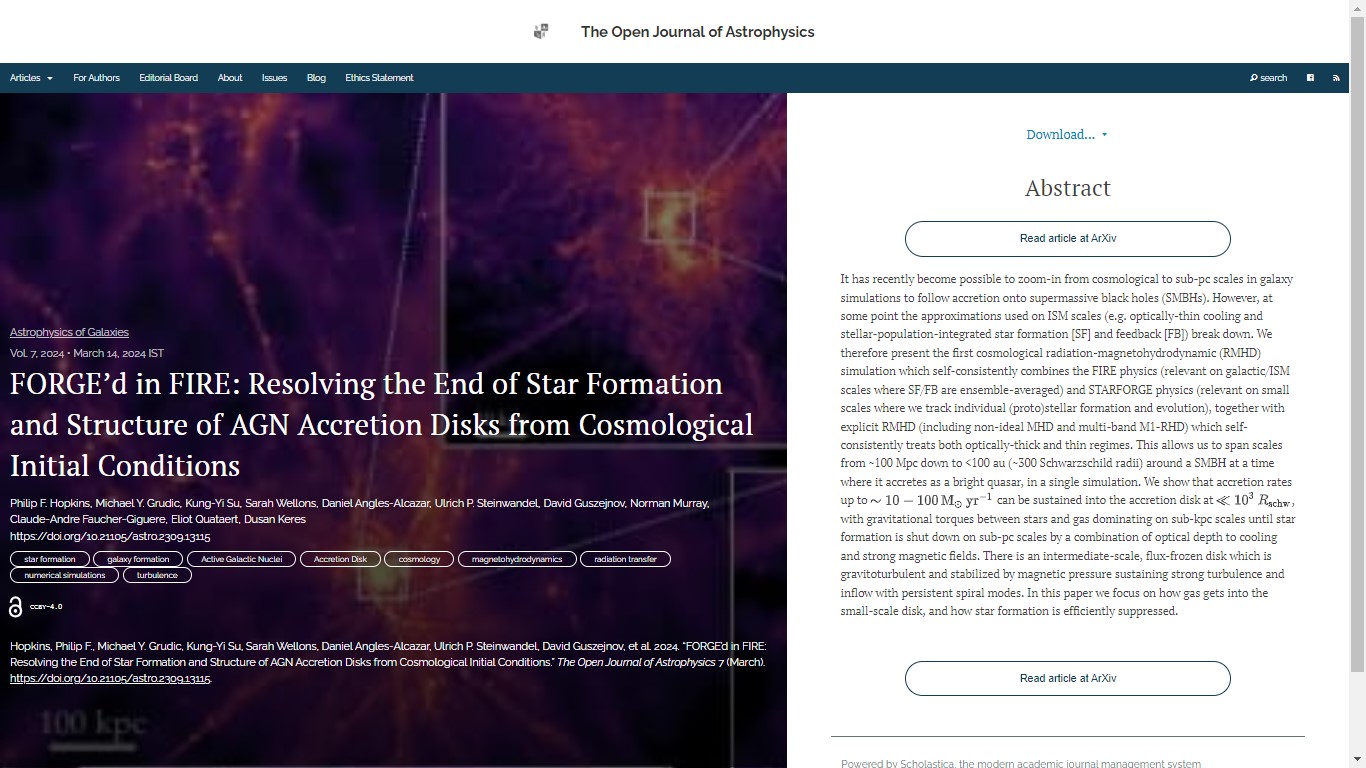
First one up is “FORGE’d in FIRE: Resolving the End of Star Formation and Structure of AGN Accretion Disks from Cosmological Initial Conditions” in which, using a full cosmological simulation, incorporating radiation and magnetohydrodynamics, the authors study the formation and structure of AGN accretion disks and their impact on star formation. This one is in the folder marked Astrophysics of Galaxies.

The authors (ten from the USA and one from Canada) are Philip F. Hopkins (Caltech), Michael Y. Grudic (Carnegie Observatories), Kung-Yi Su (Harvard), Sarah Wellons (Wesleyan University), Daniel Angles-Alcazar (University of Connecticut & Flatiron Institute), Ulrich P. Steinwandel (Flatiron Institute), David Guszejnov (University of Texas at Austin), Norman Murray (CITA, Toronto, Canada), Claude-Andre Faucher-Giguere (Northwestern University), Eliot Quataert (Princeton), and Dusan Keres (University of California, San Diego or UCSD for short).

Here is a screen grab of the overlay, which includes the abstract:


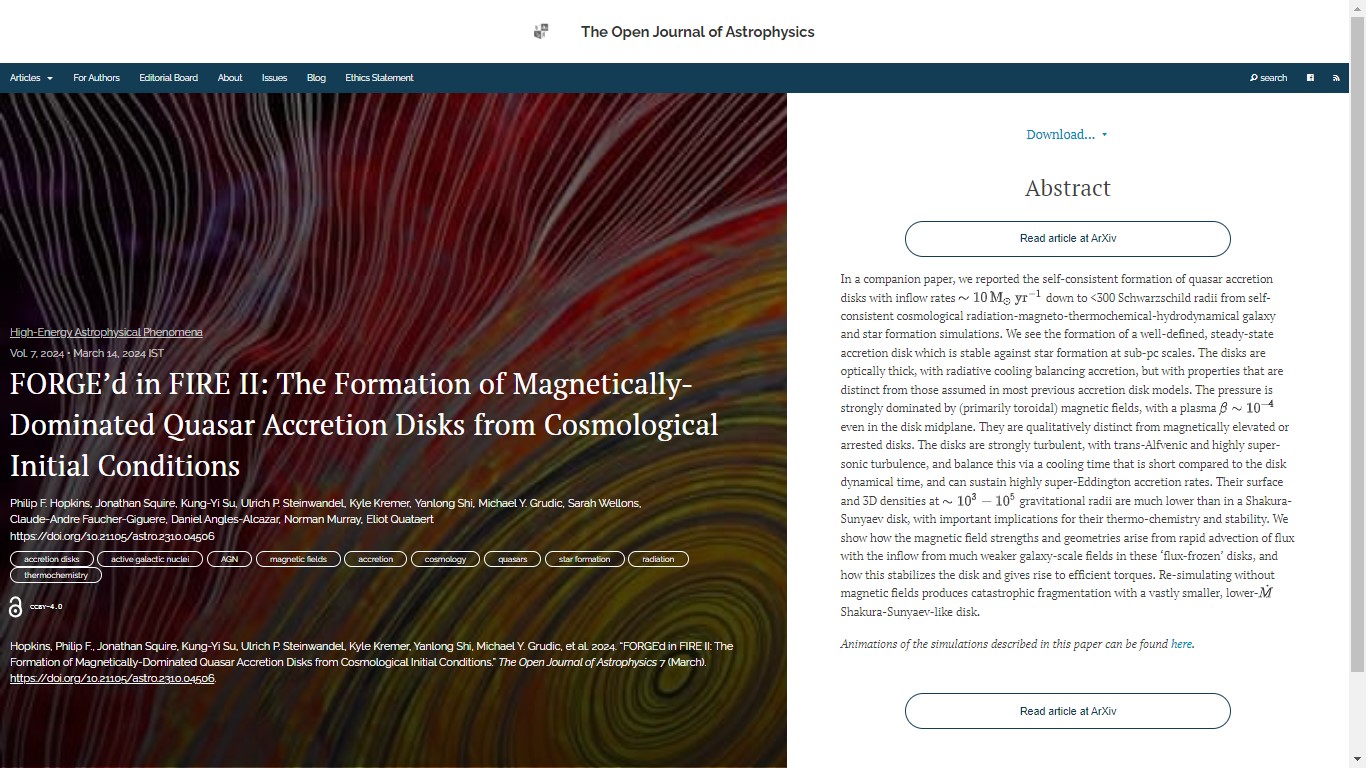
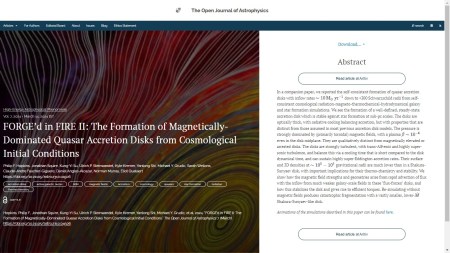
The second paper to announce is “FORGE’d in FIRE II: The Formation of Magnetically-Dominated Quasar Accretion Disks from Cosmological Initial Conditions” which is a study of the formation and properties of highly magnetized accretion disks using numerical simulations that include the effects of radiation, magnetic fields, thermochemistry, and star formation.

This one is in the folder High-Energy Astrophysical Phenomena. The authors (ten based in the USA, one fin Canada, and one in New Zealand) are Philip F. Hopkins, Jonathan Squire (University of Dunedin, New Zealand), Kung-Yi Su (Harvard), Ulrich P. Steinwandel (Flatiron Institute), Kyle Kremer (Caltech), Yanlong Shi (Caltech), Michael Y. Grudic (Carnegie Observatories), Sarah Wellons (Wesleyan University), Claude-Andre Faucher-Giguere (Northwestern University), Daniel Angles-Alcazar (University of Connecticut & Flatiron Institute), Norman Murray (CITA, Toronto), and Eliot Quataert (Princeton).
 

The last paper of this batch, also in the folder High-Energy Astrophysical Phenomena, is  entitled “An Analytic Model For Magnetically-Dominated Accretion Disks” and is closely related to the previous one; this particular paper presents an analytic similarity model for accretion disks that agrees remarkably well with the simulations in the previous one. Animations of the simulations referred to in both papers can be found here.

Here is the overlay:
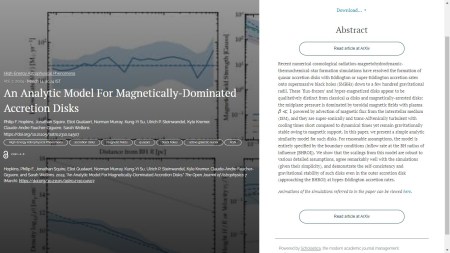
The authors of this one are Philip F. Hopkins, Jonathan Squire, Eliot Quataert, Norman Murray, Kung-Yi Su, Ulrich P. Steinwandel, Kyle Kremer, Claude-Andre Faucher-Giguere, and Sarah Wellons. You can find all their affiliations above.
That’s all for now. More news in a week or so!



New Publication at the Open Journal of Astrophysics

Posted in OJAp Papers, Open Access, The Universe and Stuff with tags , , , , , on March 12, 2024 by telescoper

It’s my last morning in Phoenix and since I was too busy at the weekend to post the usual update from the Open Journal of Astrophysics I will do so now, before I go to the Airport for my flight home.

Looking at the workflow I see that there is a considerable backlog of papers that have been accepted but are waiting for the authors to put the final version on arXiv.  As a result there is only one paper to report for last week, being the 17th paper in Volume 7 (2024)  and the 132nd altogether; it was published on March 6 2024. I expect more soon!

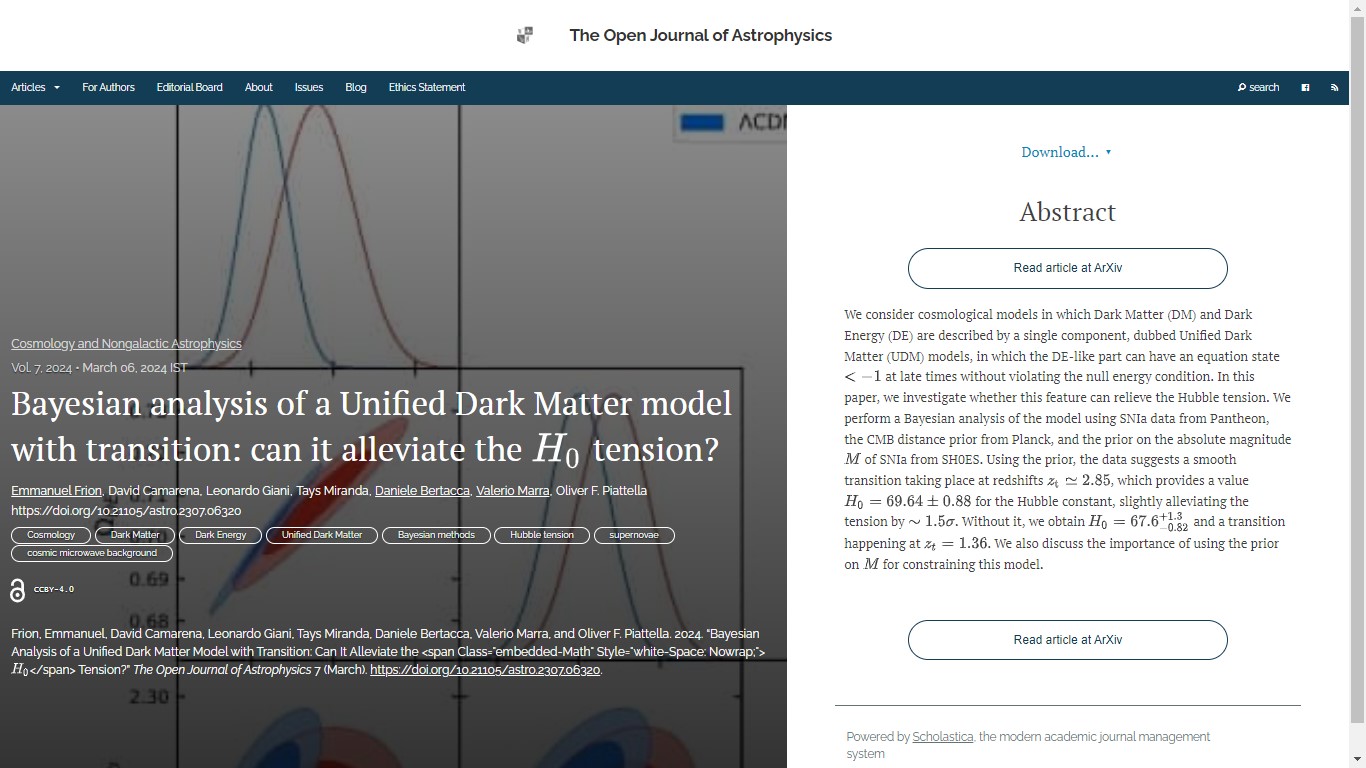
The title of the latest paper is “Bayesian analysis of a Unified Dark Matter model with transition: can it alleviate the H0tension?” and it  is in the folder marked Cosmology and NonGalactic Astrophysics.  The article presents an investigation using Bayesian techniques of a specific cosmological model, in which dark matter and dark energy are aspects of a single component, with particular emphasis on the Hubble tension.

The authors are seven in number: Emmanuel Frion (University of Helsinki, Finland, and Western University, Canada); David Camarena (University of New Mexico, USA); Leonardo Giani (University of Queensland, Australia); Tays Miranda (University of Helsinki and University of Jyväskylä, both in Finland); Daniele Bertacca (Università degli Studi di Padova, Italy); Valerio Marra (Universidade Federal do Espírito Santo, Brazil and Osservatorio Astronomico di Trieste, Italy);
and Oliver F. Piattella (Università degli Studi dell’Insubria, Como, Italy).

Here is the overlay of the paper containing the abstract:


You can click on the image of the overlay to make it larger should you wish to do so. You can also find the officially accepted version of the paper on the arXiv here.


New Publication at the Open Journal of Astrophysics

Posted in OJAp Papers, Open Access, The Universe and Stuff with tags , , , , , , , on March 2, 2024 by telescoper

It’s a rainy Saturday afternoon here in Sydney, and here’s the last update from the Open Journal of Astrophysics before I change time zones. In fact there is only one paper to report this week, being  the 16th paper in Volume 7 (2024)  and the 131st altogether. It was published on February 29th 2024.

The title is “Bound circumplanetary orbits under the influence of radiation pressure: Application to dust in directly imaged exoplanet systems” and it  is in the folder marked Earth and Planetary Astrophysics. It presents an investigation into the effect of radiation pressure on bound orbits, with applications to the behaviour of dust in exoplanet systems in general and to the Fomalhaut system in particular. The authors are Bradley Hansen of UCLA and Kevin Hayakawa of California State University (both in the USA).

Here is the overlay of the paper containing the abstract:

You can click on the image of the overlay to make it larger should you wish to do so. You can also find the officially accepted version of the paper on the arXiv here.

There are quite a few papers in the pipeline which I expect to be published during the next week or soon after.

Cosmology Talks: Intrinsic Alignments – A Guide for All Cosmologists

Posted in OJAp Papers, The Universe and Stuff, YouTube with tags , , , , , , , , , on February 24, 2024 by telescoper

I was just thinking this afternoon that I haven’t posted recently any of the Cosmology Talks curated by Shaun Hotchkiss, then I looked and found that I had the perfect excuse for doing so. This particular talk is actually about one of the two new OJAp papers I announced in my previous post, i.e. “The IA Guide: A Breakdown of Intrinsic Alignment Formalisms” and the authors are: Claire Lamman (Harvard, USA);  Eleni Tsaprazi (Stockholm, Sweden);  Jingjing Shi (Tokyo, Japan); Nikolina Niko Šarčević (Newcastle, UK); Susan Pyne (UCL, UK); Elisa Legnani (Barcelona, Spain); and Tassia Ferreira (Oxford, UK).

Here is Shaun’s description of the video:

Claire Lamman, Jingjing Shi, Niko Šarčević, Susan Pyne, Elisa Legnani and Tassia Ferreira tell us about the intrinsic alignments guide they wrote (along with Eleni Tsaprazi, who couldn’t make the video recording).

They wanted to write something that wasn’t quite a review, but also wasn’t quite a set of lecture notes. Instead they aimed for what might be best framed as a “cheat sheet” for intrinsic alignments. Everything you need to know about the topic, compressed into one article. However, there’s still a lot about the topic, so the compression is still 33 pages and 10 figures big.

To construct the guide they broke the topic of intrinsic alignments into sub-fields and then asked questions like “what are the key equations for this sub-field?”, “what are the different notations people use?”, “what might be confusing to a newcomer?” They then wrote the guide to answer those questions, even including subsections with quick definitions of each common term, and short lists of common alternative notations.

And here is the video!

Two New Publications at the Open Journal of Astrophysics

Posted in OJAp Papers, Open Access, The Universe and Stuff with tags , , , , , , , , , , on February 24, 2024 by telescoper

It’s Saturday morning in Sydney, and time to post another update relating to the  Open Journal of Astrophysics.  Since the last update we have published two more papers, taking  the count in Volume 7 (2024) up to 15 and the total published by OJAp up to 130. I should have posted these before leaving but it slipped my mind.

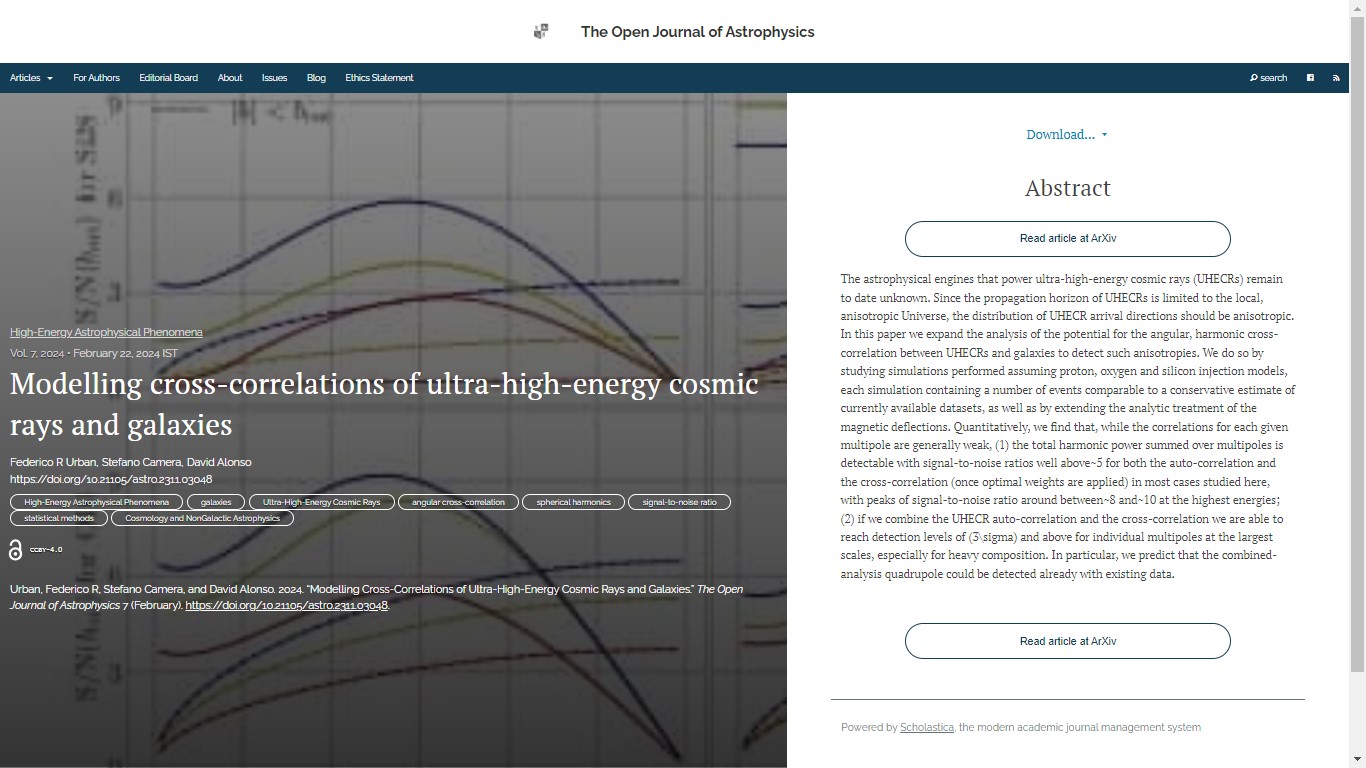
The first paper of the most recent pair – published on  Thursday 22nd February – is “Modelling cross-correlations of ultra-high-energy cosmic rays and galaxies” by Federico Urban (Prague, Czech Republic), Stefano Camera (Torino, Italy) and David Alonso (Oxford, UK). It presents a discussion of the possible statistical correlations between Ultra-High-Energy Cosmic-Ray (UHECR) directions in various models and structure in the galaxy distribution and whether or not this signal could be measurable.  This one is in the folder marked “High-Energy Astrophysical Phenomena“.

Here is a screen grab of the overlay which includes the abstract:

You can click on the image of the overlay to make it larger should you wish to do so. You can find the officially accepted version of the paper on the arXiv here.

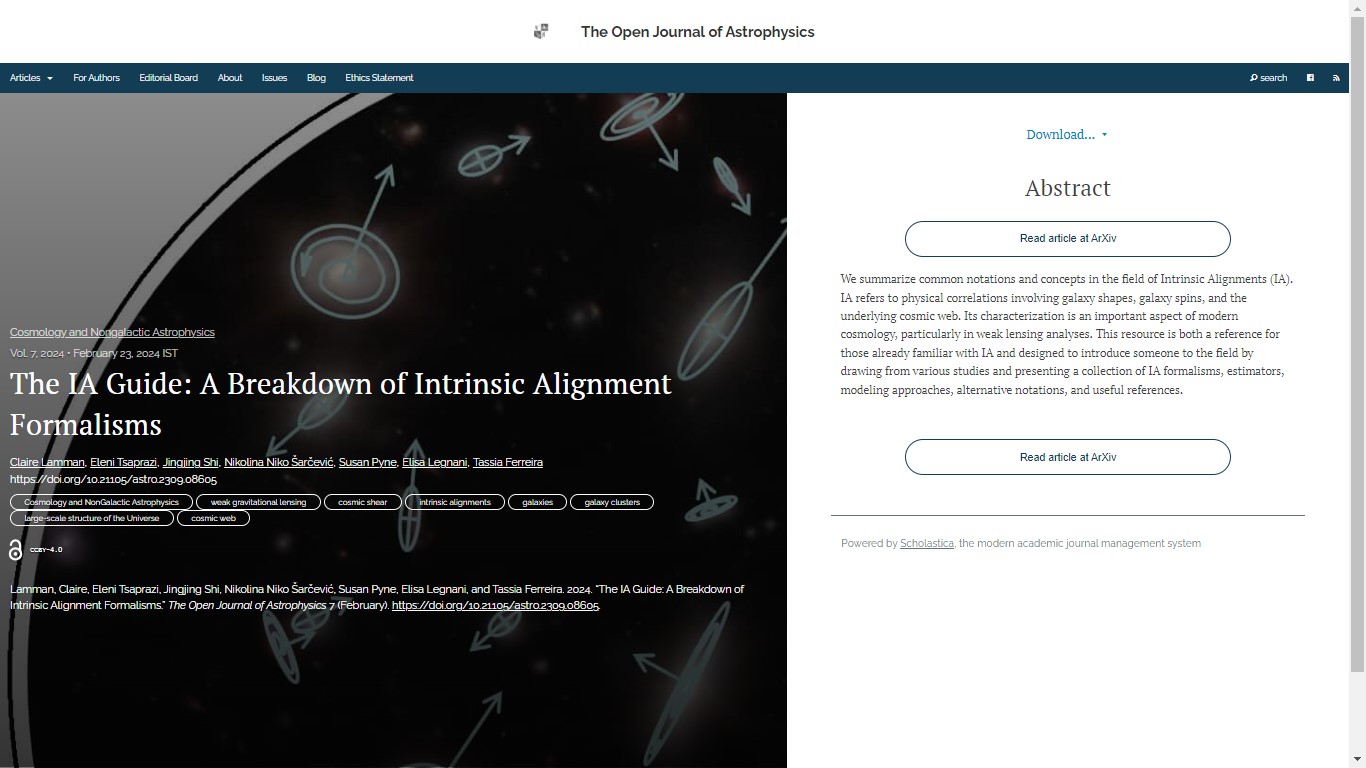
The second paper was published on Friday 23rd February and has the title “The IA Guide: A Breakdown of Intrinsic Alignment Formalisms” and the authors are: Claire Lamman (Harvard, USA);  Eleni Tsaprazi (Stockholm, Sweden);  Jingjing Shi (Tokyo, Japan); Nikolina Niko Šarčević (Newcastle, UK); Susan Pyne (UCL, UK); Elisa Legnani (Barcelona, Spain); and Tassia Ferreira (Oxford, UK). This one, which is in the folder marked Cosmology and NonGalactic Astrophysics, presents a review of Intrinsic Alignments, i.e. physical correlations involving galaxy shapes, galaxy spins, and larger scale structure, especially important for weak gravitational lensing

Here is a screen grab of the overlay which includes the abstract:


You can click on the image of the overlay to make it larger should you wish to do so. You can find the officially accepted version of the paper on the arXiv here.

That concludes this week’s update!

Talking Down Under

Posted in OJAp Papers, Open Access, The Universe and Stuff with tags , , , on February 19, 2024 by telescoper

This morning I gave a short talk at the “Astronomy Tea” at the Sydney Institute for Astronomy. No prizes for guessing what I talked about. The talk was followed by questions and then by a huge thunderstorm.

Here are the slides:

P.S. Today was the first day of teaching of the new academic year at the University of Sydney, so the campus was much busier today than it has been.

New Publication at the Open Journal of Astrophysics

Posted in OJAp Papers, Open Access, The Universe and Stuff with tags , , , , , , , on February 16, 2024 by telescoper

It’s Saturday morning here in Sydney, which means it is time for another weekly update from the Open Journal of Astrophysics. In fact there is only one paper to report this week, being  the 13th paper in Volume 7 (2024)  and the 128th altogether. It was published on February 15th 2024.

The title is “Jet – counter-jet asymmetry in the jittering jets explosion mechanism of supernovae” and it  This one is in the folder called High-Energy Astrophysical Phenomena. The paper presents a discussion of the production of jets in core-collapse supernovae and the resulting formation of neutron stars, and the implications for the morphology of the supernova remnant.

The sole author of the paper is Noam Soker of Technion, Haifa, in Israel.

Here is the overlay of the paper containing the abstract:


You can click on the image of the overlay to make it larger should you wish to do so. You can find the officially accepted version of the paper on the arXiv here.

New Publication at the Open Journal of Astrophysics

Posted in OJAp Papers, Open Access, The Universe and Stuff with tags , , , , , , on February 12, 2024 by telescoper

With all the excitement of my first weekend in Sydney I completely forgot to post an update from the Open Journal of Astrophysics. In fact there is only one paper to report from last week, being  the 12th paper in Volume 7 (2024)  and the 127th altogether. This one was published on 9th February 2024 and is the first published from Down Under.

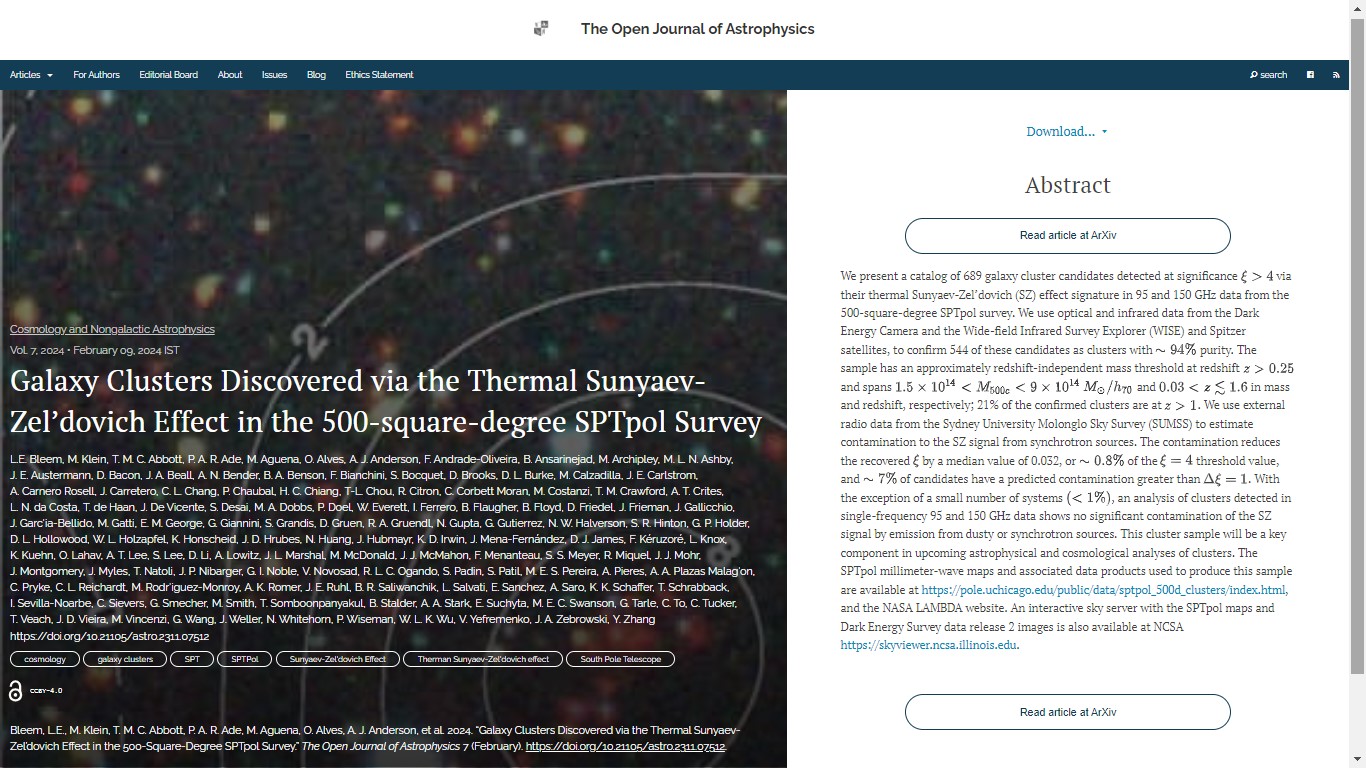
The title is “Galaxy Clusters Discovered via the Thermal Sunyaev-Zel’dovich Effect in the 500-square-degree SPTpol Survey” and it presents a catalogue of 689 galaxy clusters detected through the thermal Sunyaev-Zel’dovich using the dual-frequency polarization-sensitive camera SPTPol on the South Pole Telescope. This one is in the folder called Cosmology and NonGalactic Astrophysics.

This paper has lead author Lindsey Bleem  of the Argonne National Laboratory in the USA and has 127 other authors – too many to list individually here – but you can see them on the overlay below. I see quite a few names of people I know well!

Here is the overlay of the paper containing the abstract:


You can click on the image of the overlay to make it larger should you wish to do so. You can find the officially accepted version of the paper on the arXiv here.

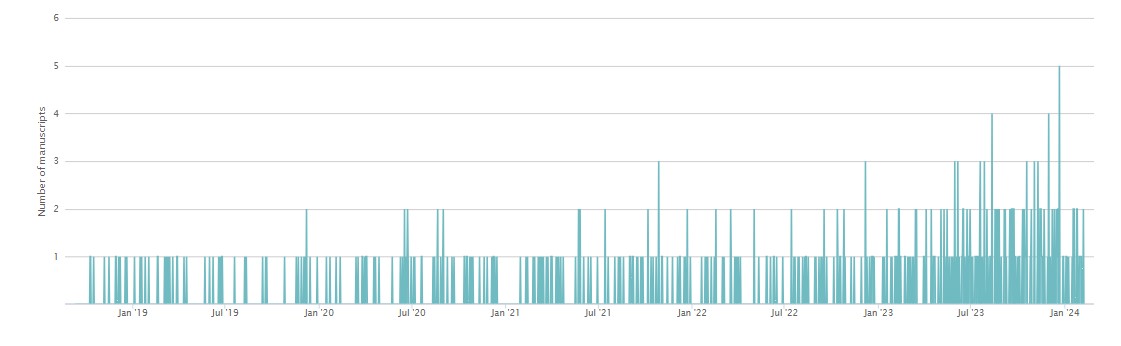
P.S. Incidentally, while I’m here I thought I’d share this little graphic I’ve generated (for other purposes) that shows how the rate of submissions to OJAp has increased over the last 5 years:

Two New Publications at the Open Journal of Astrophysics

Posted in OJAp Papers, Open Access, The Universe and Stuff with tags , , , , , , , on February 5, 2024 by telescoper

Now that I’m settled in Sydney it’s time to post another update relating to the  Open Journal of Astrophysics.  Since the last update we have published two more papers, taking  the count in Volume 7 (2024) up to 11 and the total published by OJAp up to 126. I should have posted these before leaving but it slipped my mind.

Both the current papers discussed here are in the folder marked Cosmology and NonGalactic Astrophysics, our most popular category.

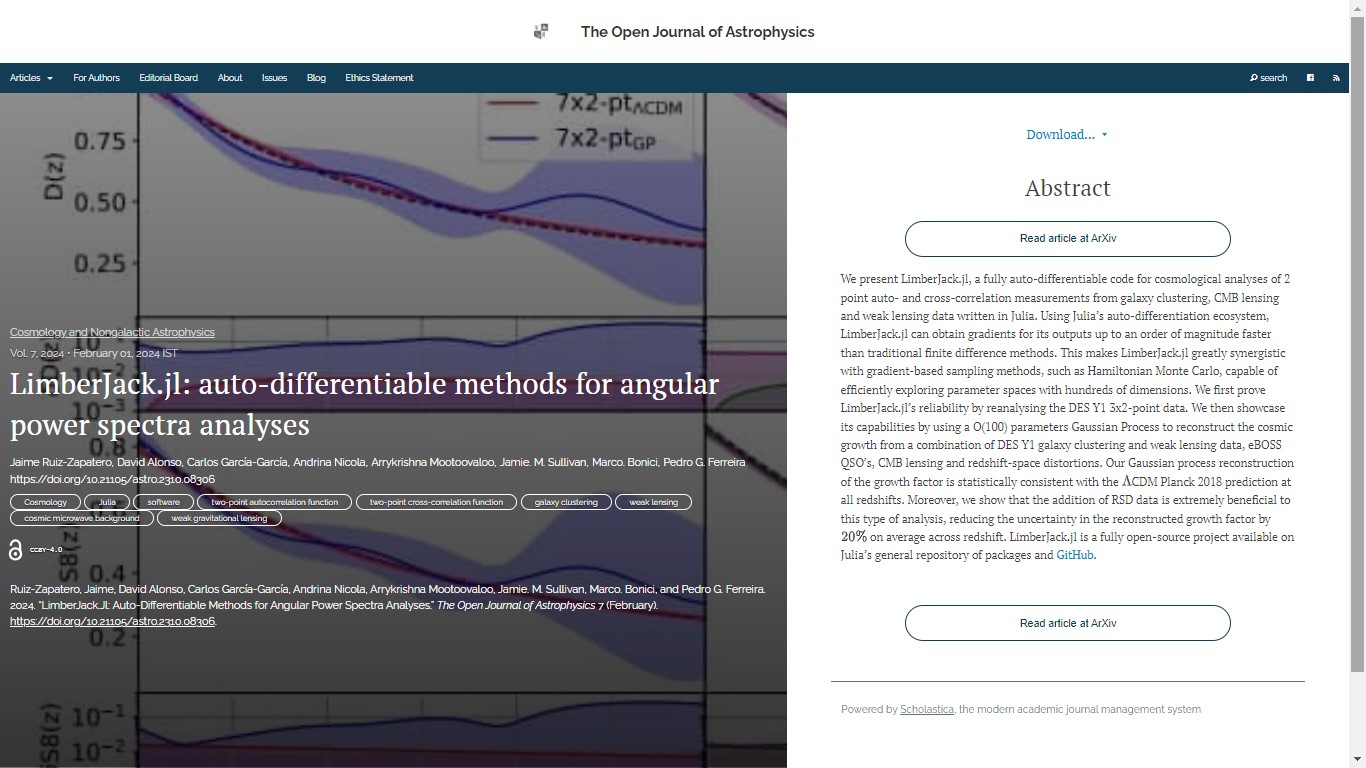
Anyway, the first paper of the most recent pair – published on February 1st – is “LimberJack.jl: auto-differentiable methods for angular power spectra analyses”, Jaime Ruiz-Zapatero (Oxford, UK), David Alonso (Oxford, UK), Carlos García-García (Oxford, UK) , Andrina Nicola (Bonn, Germany), Arrykrishna Mootoovaloo (Oxford, UK), Jamie Sullivan (Berkeley, USA), Marco Bonici (Milan, Italy), and Pedro Ferreira (Oxford, UK). This paper presents a fully auto-differentiable code for cosmological analyses of two-point auto- and cross-correlation measurements from galaxy clustering, CMB lensing and weak lensing data written in Julia.

Here is a screen grab of the overlay which includes the abstract:


You can click on the image of the overlay to make it larger should you wish to do so. You can find the officially accepted version of the paper on the arXiv here.

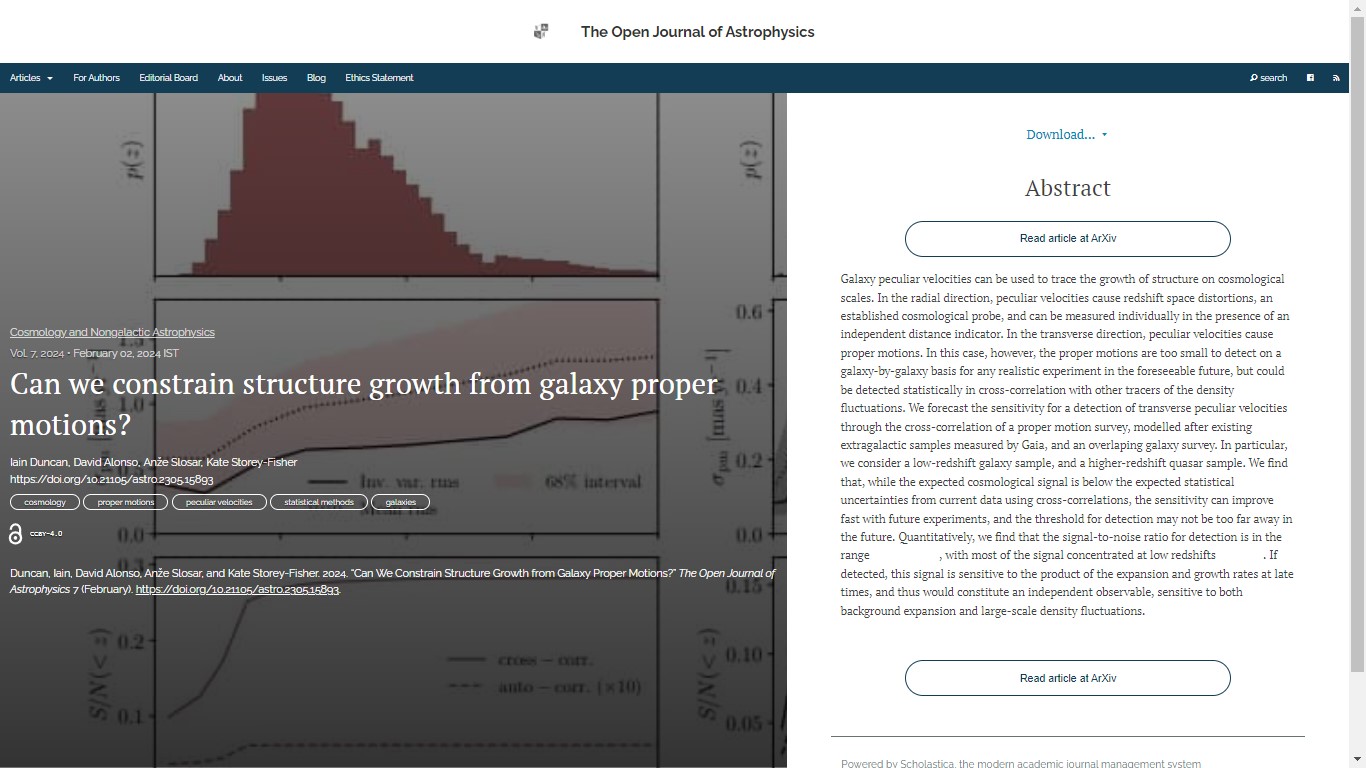
The second paper was published on Friday 2nd February and has the title “Can we constrain structure growth from galaxy proper motions?” which, as its title suggests, looks at the feasibility of using transverse peculiar velocities (i.e. proper motions) of galaxies for cosmological studies. The authors are Iain Duncan (Oxford, UK), David Alonso (Oxford, UK), Anže Slosar (Brookhaven National Laboratory, USA), and Kate Storey-Fisher (New York University, USA). To find out the answer to the question posed in its title you’ll have to read the paper!

Here is a screen grab of the overlay which includes the abstract:


You can click on the image of the overlay to make it larger should you wish to do so. You can find the officially accepted version of the paper on the arXiv here.

Because of the high rate of publications coming out, we’re moving to a system where we register papers in batches once a week rather than individually as they are published. This is just a temporary measure until we can automate this process more fully. Anyway, you can expect another update in a week or so.