Archive for the OJAp Papers Category

New Publication at the Open Journal of Astrophysics

Posted in OJAp Papers, Open Access, The Universe and Stuff with tags , , , on January 12, 2023 by telescoper

Time to announce another new paper at the Open Journal of Astrophysics. This one was published officially on 9th January 2023. The latest paper is the second paper in Volume 6 (2023) as well as the 67th in all. This one is in the Astrophysics of Galaxies folder.

The latest publication is entitled “Wide Binaries as a Modified Gravity test: prospects for detecting triple-system contamination” and the authors – Dhruv Manchanda, Will Sutherland Charalambos Pittordis – are all based at Queen Mary, University of London.

Here is a screen grab of the overlay which includes the  abstract:
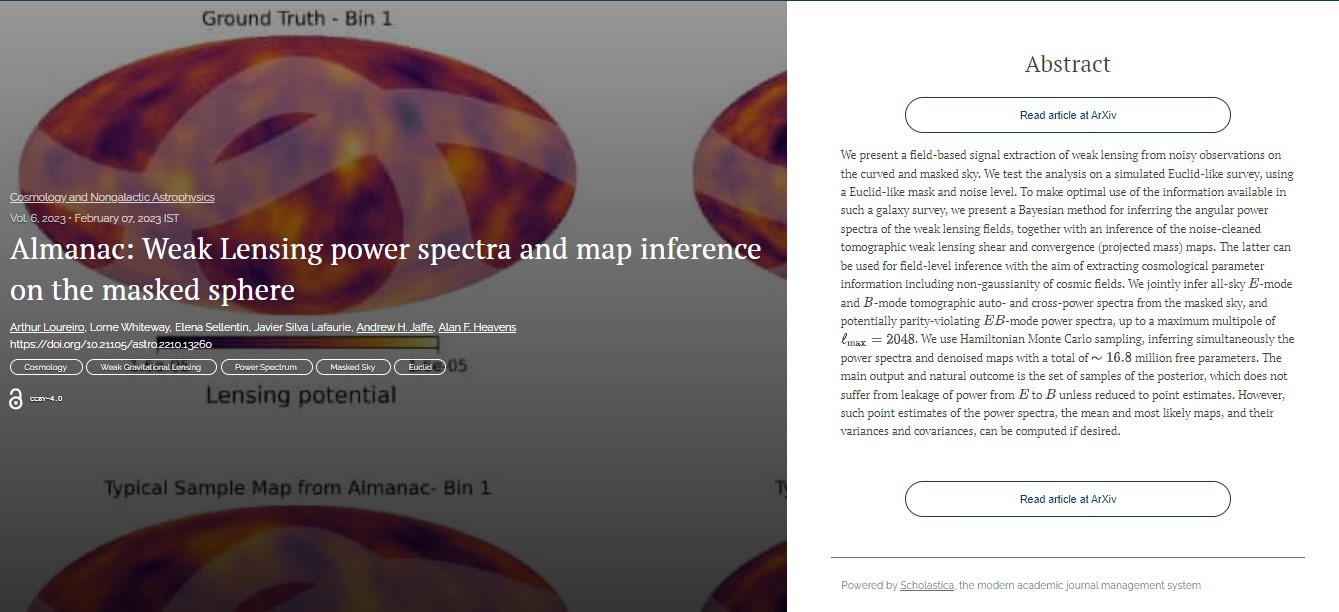


You can click on the image to make it larger should you wish to do so. You can find the officially accepted version of the paper on the arXiv here.
New Publication at the Open Journal of Astrophysics

Posted in OJAp Papers, Open Access, The Universe and Stuff with tags , , , , on January 7, 2023 by telescoper

Continuing the process of catching up with business at the Open Journal of Astrophysics, here is the first paper of 2023. This one was accepted before Christmas but the final version only appeared on arXiv after the holiday and was published officially on 4th January 2023.

The latest paper is the first paper in Volume 6 (2023) as well as the 66th in all. It’s yet another in the Cosmology and Non-Galactic Astrophysics folder.

The latest publication is entitled “It takes two to know one: Computing accurate one-point PDF covariances from effective two-point PDF models“. This is a British-French-German collaboration led by Cora Uhlemann of Newcastle University with co-authors  Oliver Friedrich, Aoife Boyle, Alex Gough, Alexandre Barthelemy, Francis Bernardeau, and Sandrine Codis.

This is such an interesting paper that we discussed it at our cosmology journal club at Maynooth University a while ago when it first appeared on arXiv and reading it again since then has suggested a nice project to me!

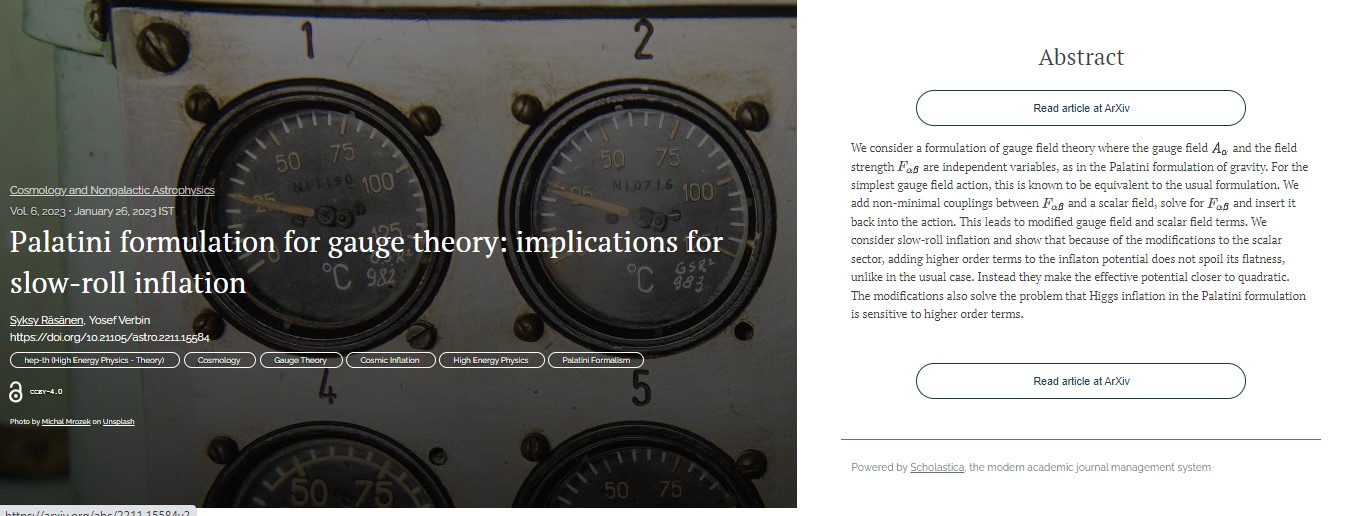
Anyway, here is a screen grab of the overlay which includes the  abstract:


You can click on the image to make it larger should you wish to do so. You can find the officially accepted version of the paper on the arXiv here.
New Publication at the Open Journal of Astrophysics

Posted in OJAp Papers, Open Access, The Universe and Stuff with tags , , on January 5, 2023 by telescoper

I’ve been catching up on publishing matters over the past day or so, including dealing with a bit of a backlog generated by the Christmas break. The Open Journal is run entirely by volunteers and we all need some time off at some point.

To start with I’m delighted to be able to announce the last paper of 2022 at the Open Journal of Astrophysics.  The latest paper is the 17th paper in Volume 5 (2022) as well as the 65th in all. It’s yet another in the Cosmology and Non-Galactic Astrophysics folder.

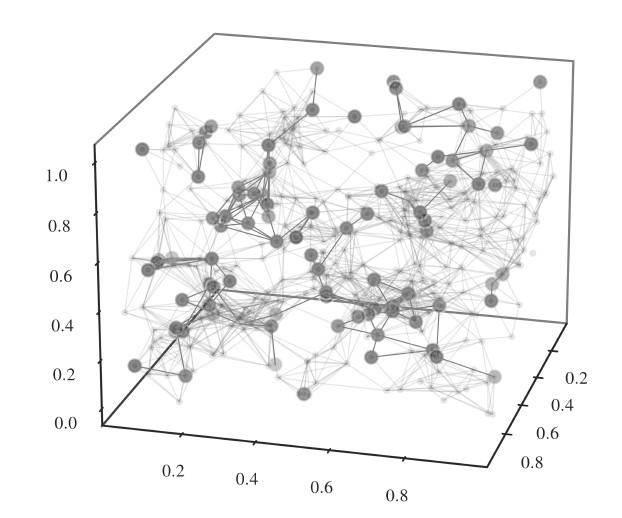
The latest publication is entitled “The Cosmic Graph: Optimal Information Extraction from Large-Scale Structure using Catalogues“. It is written by a distinguished collection of cosmologists from around the world (and Alan Heavens).

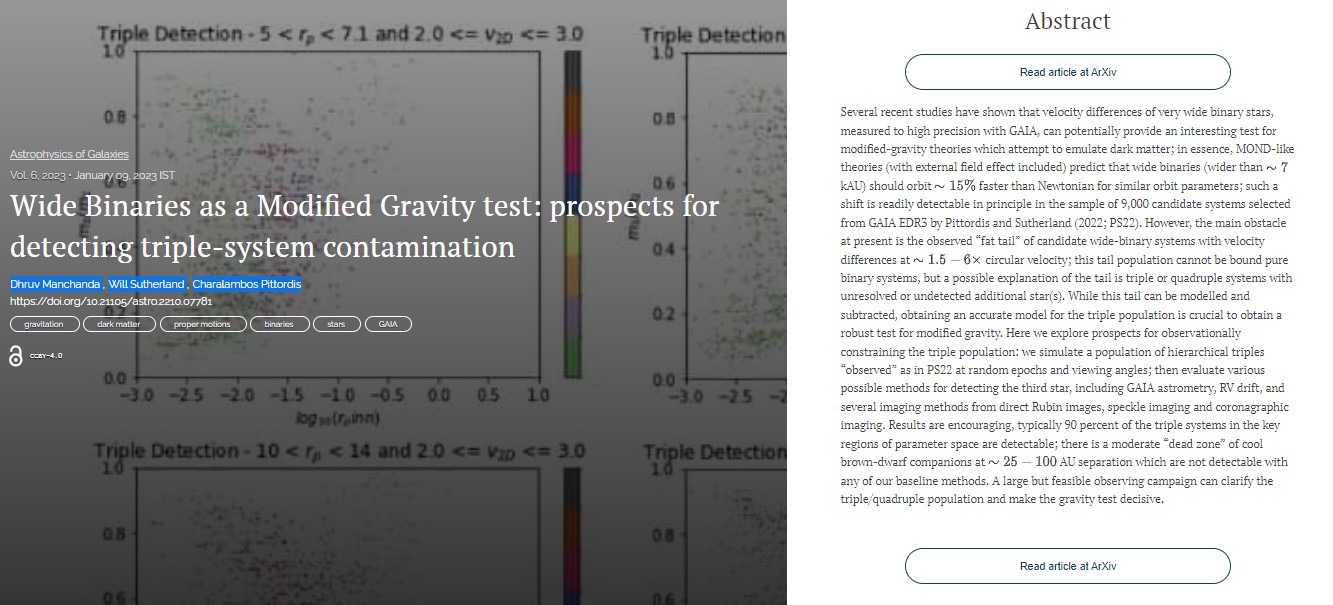
Anyway, here is a screen grab of the overlay which includes the  abstract:


You can click on the image to make it larger should you wish to do so. You can find the officially accepted version of the paper on the arXiv here.
Here is a bigger version of the image from the paper used on the overlay:


Code and a tutorial for the analysis and relevant software can be found here .

New Publication at the Open Journal of Astrophysics

Posted in OJAp Papers, Open Access, The Universe and Stuff with tags , , , , on November 10, 2022 by telescoper

I’m delighted to be able to announce the 10000th paper this year, and 1000000th publication overall, at the Open Journal of Astrophysics!

That is counting in binary, of course. In base ten the  new paper at the 16th paper in Volume 5 (2022) as well as the 64th in all.

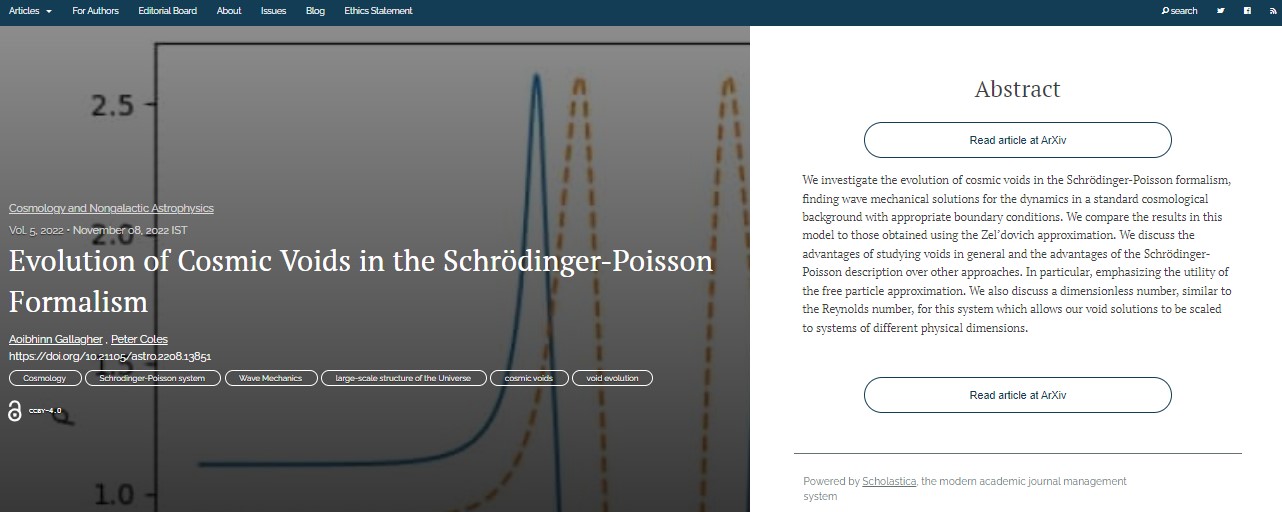
The latest publication is entitled “Evolution of Cosmic Voids in the Schrödinger-Poisson Formalism” and the authors are Aoibhinn Gallagher and Peter Coles (Who he? Ed) both of the Department of Theoretical Physics at Maynooth University. Obviously as author I played no role in the selection of referees or any other aspect of the editorial process.

Aoibhinn Gallagher – bonus marks for pronouncing both names correctly – is my first Maynooth PhD student and this is her first paper, of many I hope (and expect)! We’re already working on extensions of this approach to other aspects of large-scale structure. You can find some discussion of this general approach here.

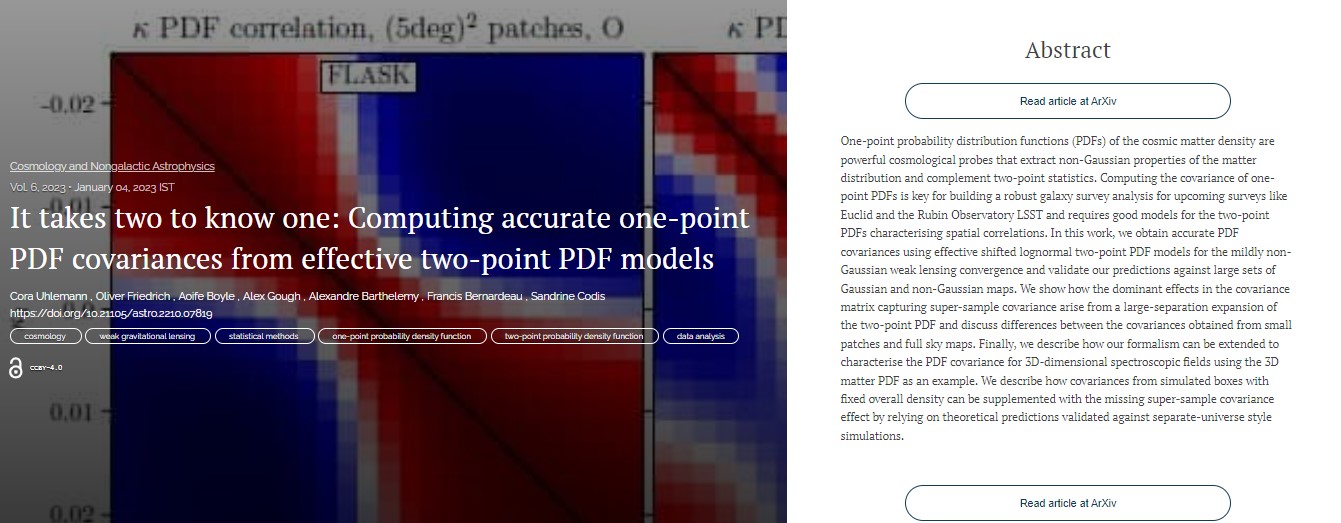
Anyway, here is a screen grab of the overlay which includes the  abstract:


You can click on the image to make it larger should you wish to do so. You can find the officially accepted version of the paper on the arXiv here.
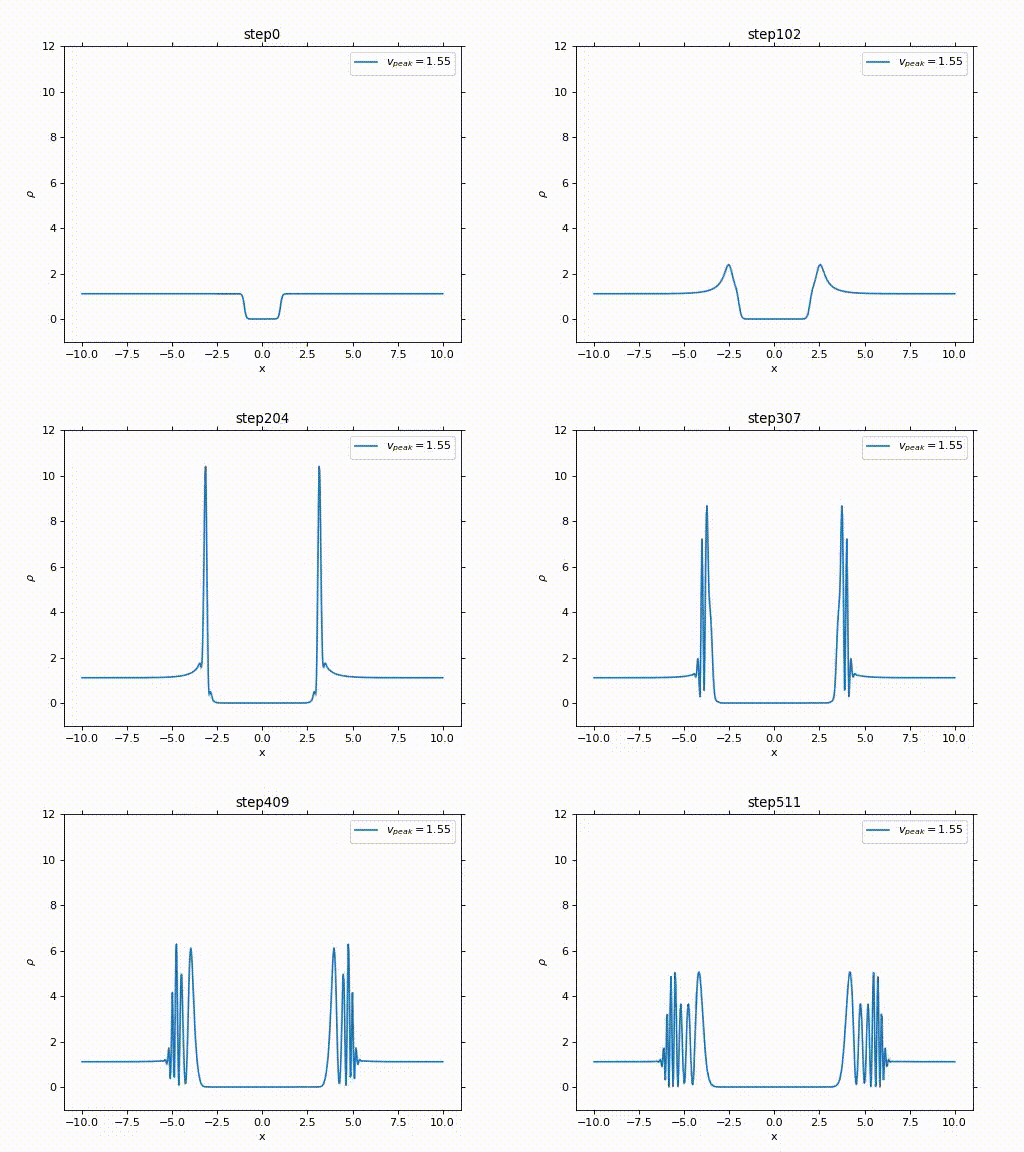
Here is a nice animated version of Figure 5 of the paper showing, for a 1D slice, the radial expansion of a spherically symmetric void (i.e. underdense region) using periodic boundary conditions:

The x-axis is in (scaled) comoving coordinates, i.e. expanding with the cosmological background, so that the global expansion is removed.  You can see that the void expands in these coordinates, so is expanding more quickly than the background, initially pushing matter into a dense ring around the rim of the empty void. That part of the evolution is just the same as for “normal” matter but in this case the wave-mechanical behaviour of the matter prevents it from being confined to a strongly-localized structure as well as affecting the subsequent expansion rate.

Of course in the real Universe, voids are not isolated like this but instead tend to push into each other, but we felt it was worth studying the single void case to understand the dynamics!

New Publication at the Open Journal of Astrophysics

Posted in OJAp Papers, Open Access, The Universe and Stuff with tags , , , , , on November 4, 2022 by telescoper

It’s time once again for me to announce new paper at the Open Journal of Astrophysics. The new paper, published last week, is the 15th paper in Volume 5 (2022) and the 63rd in all. The latest publication is entitled “Two-photon amplitude interferometry for precision astrometry” and the authors are Paul Stankus, Andrei Nomerotski and Anže Slosar of Brookhaven National Laboratory (USA) and Stephen Vintskevich (Moscow Institute of Physics & Technology, Russia).

The paper presents a new method for doing interferometry with quantum-mechanically entangled photons and is thus is in the folder marked Instrumentation and Methods for Astrophysics. I don’t know much about this area – and there are many whose baseline opinion is that interferometry is a bit of a fringe topic that is rather complex perhaps needs more visibility in the current phase of its development  (geddit?) – but the physics looks fascinating to me. Amplitude interferometry should be contrasted with the intensity interferometry method of Hanbury Brown and Twiss which I remember learning about as an undergraduate.

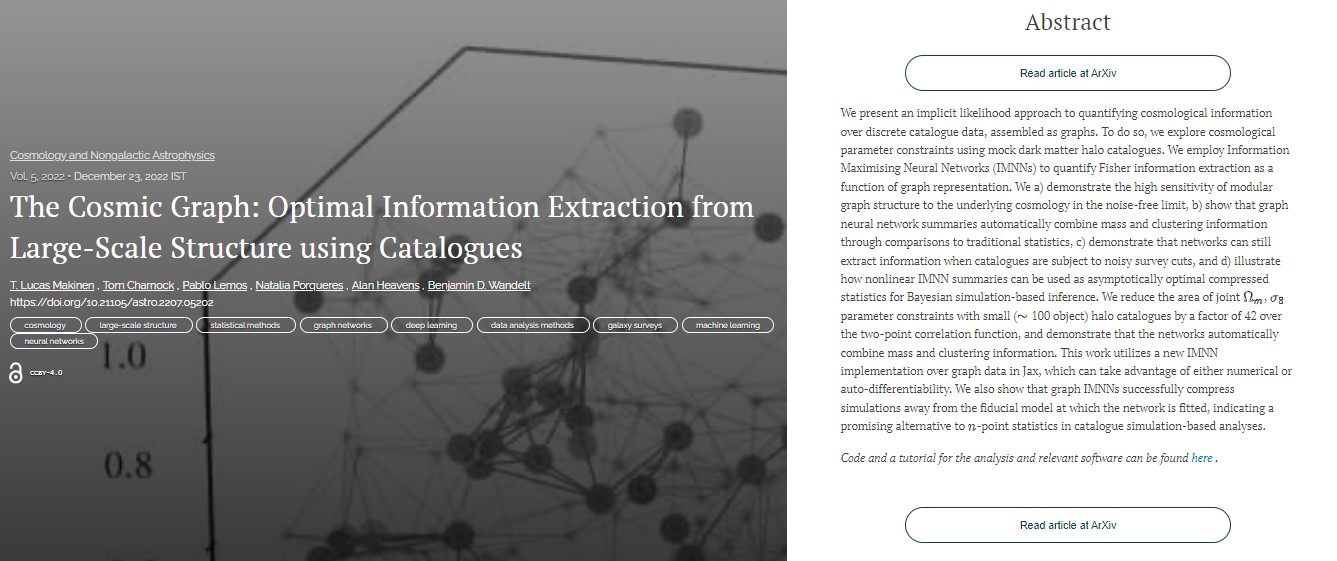
Anyway, here is a screen grab of the overlay which includes the  abstract:

You can click on the image to make it larger should you wish to do so. The full image used in the overlay is this:


You can find the officially accepted version of the paper on the arXiv here.
“New” Publication at the Open Journal of Astrophysics

Posted in OJAp Papers, Open Access, The Universe and Stuff with tags , , , , , on September 15, 2022 by telescoper

It’s time once again for me to announce the publication of another paper at the Open Journal of Astrophysics. The new paper, published last week, is the 14th paper in Volume 5 (2022) and the 62nd in all. The latest publication is entitled “Gravitational Stability of Vortices in Bose-Einstein Condensate Dark Matter”. This paper is another one for the folder marked Cosmology and Non-Galactic Astrophysics and the authors are Mark N Brook Now at the Institute for Cancer Research in London) and Peter Coles (Who he? Ed).

There is a bit of a story behind this one. The work on which this paper is based was done while both authors (Mark and I) were at the University of Nottingham. Mark was my PhD student at the time.  I left Nottingham for Cardiff in 2007 but Mark stayed behind to finish his thesis and write this paper, which appeared on the arXiv in 2009. The paper wasn’t accepted in its original form, Mark left the field after obtaining his PhD, and I was working on other things at Cardiff so the paper remained unpublished on the arXiv.

Last year, however, I was updating my publication list and noticed the old preprint so looked it up on NASA/ADS. Although not Earth-shattering, I found it had been acquiring a reasonable number of citations (16 according to ADS, including some this year) as an unpublished work largely because of increased interest in the field of condensate dark matter. I therefore approached the Editorial Board of the Open Journal of Astrophysics to ask their opinion about whether it would be appropriate to consider it for publication. They agreed and the paper was assigned to an Editor. Obviously I recused myself from the process.

Somewhat to my surprise, given that it’s basically an old paper, the referee comments were supportive. I’ve been very busy for the past year and communication with Mark was slow so it’s taken a while to revise and update the paper in line with the referee requests. We also took the opportunity to include a brief review of some papers that had come out since the original version of the paper appeared. Mark and I agreed a final text l and the paper was accepted last week. I uploaded the agreed version to arXiv and now the paper is now published. It was all a bit unconventional but there we are. It was interesting to be on the author side of the process for a change!

Anyway, here is a screen grab of the overlay which includes the  abstract:


You can click on the image to make it larger should you wish to do so. You can find the accepted version of the paper on the arXiv here.
New Publication at the Open Journal of Astrophysics

Posted in OJAp Papers, Open Access, The Universe and Stuff with tags , , , , , , on September 11, 2022 by telescoper

It’s time once again for me to announce another new paper at the Open Journal of Astrophysics. The new paper, published last week, is the 13th paper in Volume 5 (2022) and the 61st in all. The latest publication is entitled “Making (dark matter) waves: Untangling wave interference for multi-streaming dark matter” and the authors are Alex Gough and Cora Uhlemann (both of Newcastle University). The paper is another one for the folder marked Cosmology and Non-Galactic Astrophysics.

Here is a screen grab of the overlay which includes the  abstract:

You can click on the image to make it larger should you wish to do so. You can find the accepted version of the paper on the arXiv here.
This is a paper that’s close to one of my current research interests. I think it’s really excellent and I am very happy the authors chose to publish it in the Open Journal of Astrophysics.

As a bonus here is a groovy animated version of Figure 1 from the paper showing the development of a multi-stream region.

And if that weren’t enough here is a short talk about their work in the Cosmology From Home series by the first author Alex Gough.

New Publication at the Open Journal of Astrophysics

Posted in OJAp Papers, Open Access, The Universe and Stuff with tags , , , , , , , , , on August 24, 2022 by telescoper

It’s time once again for me to announce another new paper at the Open Journal of Astrophysics. The new paper, published yesterday, is the 12th paper in Volume 5 (2022) and the 60th in all. The latest publication is entitled “Minkowski Functionals in Joint Galaxy Clustering & Weak Lensing Analyses” and the authors are Nisha Grewal, Joe Zuntz and Tilman Tröster of the Institute for Astronomy in Edinburgh and Alexandra Amon of the Institute of Astronomy in Cambridge. The paper is in the folder marked Cosmology and Non-Galactic Astrophysics.

Incidentally, Dr Alexandra Amon is the winner of this year’s Caroline Herschel Lectureship in Astronomy, so congratulations to her for that too!

The new paper is about the application of topological characteristics known as Minkowski Functionals to cosmological data. This approach has been used in the past to study the pattern cosmic microwave background temperature fluctuations; see e.g. here for one of my forays into this way back in 2008. Now there are more high-quality datasets besides the CMB so there are more opportunities to use this elegant approach. Perhaps I should do a blog post about Minkowski Functionals? Somewhat to my surprise I can’t find anything on that topic in my back catalogue here In The Dark

Anyway, here is a screen grab of the overlay which includes the  abstract:


You can click on the image to make it larger should you wish to do so. You can find the accepted version of the paper on the arXiv here.
New Publication at the Open Journal of Astrophysics

Posted in OJAp Papers, Open Access, The Universe and Stuff with tags , , , , , , , on July 5, 2022 by telescoper

Time to announce another new publication in the Open Journal of Astrophysics! This one, published on Sunday, is the 8th paper in Volume 5 (2022) and the 56th in all.

The latest publication is entitled “Search for a distance-dependent Baryonic Tully-Fisher Relation at low redshifts” and is written by by Aditi Krishak (IISER-Bhopal, India) and Shantanu Desai (IIT Hyderabad, India).

This paper is in the Cosmology and Nongalactic Astrophysics folder.

Here is a screen grab of the overlay which includes the abstract:


You can click on the image to make it larger should you wish to do so. You can find the arXiv version of the paper here.

New Publication at the Open Journal of Astrophysics

Posted in OJAp Papers, Open Access, The Universe and Stuff with tags , , , on February 21, 2022 by telescoper

It’s time yet again to announce a new publication in the Open Journal of Astrophysics! This one is the 3rd paper in Volume 5 (2022) and the 51st in all. We actually published this on Friday, byt I’ve only just got around to announcing it here now.

The latest publication is entitled Differentiable Predictions for Large Scale Structure with SHAMNet and is written by Andrew Hearin, Nesar Ramachandra and Matthew R. Becker of the Argonne National Laboratory and Joseph DeRose of the Lawrence Berkeley Laboratory (both institutions being in the USA).

Here is a screen grab of the overlay which includes the abstract:

You can click on the image to make it larger should you wish to do so. You can find the arXiv version of the paper here. This paper is in our popular Cosmology and Non-galactic Astrophysics section.

P. S. Here’s a bit of feedback from the author of this paper about the referees:

They reviewed the paper in conscientious detail, and every comment was thoughtful. We feel that our paper has materially improved in clarity as a result of their critique.”