Archive for the OJAp Papers Category

Weekly Update from the Open Journal of Astrophysics – 14/06/2025

Posted in OJAp Papers, Open Access, The Universe and Stuff with tags , , , , , , , , , , , , on June 14, 2025 by telescoper

It’s Saturday so once again it’s time for the weekly update of papers published at the Open Journal of Astrophysics. Since the last update we have published two new papers, which brings the number in Volume 8 (2025) up to 71, and the total so far published by OJAp  is now up to 306.

The two papers published this week, with their overlays, are as follows. You can click on the images of the overlays to make them larger should you wish to do so.

The first paper to report is “Analysis of optical spectroscopy and photometry of the type I X-ray bursting system UW CrB2” by Mark Kennedy (University College Cork, Ireland) and 21 others based in Ireland, UK, USA, Finland, Netherlands and Australia. This one was published on Tuesday June 10th in the folder High-Energy Astrophysical Phenomena.  This describes optical photometry and spectroscopy of the low-mass X-ray binary UW Coronae Borealis taken over 2 years

The overlay is here:


You can read the final accepted version on arXiv here.

The second paper is “The Impact of Feedback-driven Outflows on Bar Formation” by Martin D. Weinberg (University of Massachusetts, Amherst, USA). This paper uses a generalization of the Hamiltonian Mean-Field model to of the disruption of bar formation in galaxies by stellar feedback. It was published on Friday 13th June 2025 in the folder marked Astrophysics of Galaxies.

The overlay is here:


You can find the officially-accepted version of the paper on arXiv here.

That’s all the papers for this week. I’ll post another update next weekend.


Weekly Update from the Open Journal of Astrophysics – 07/06/2025

Posted in OJAp Papers, Open Access, The Universe and Stuff with tags , , , , , , , , , , , on June 7, 2025 by telescoper

It’s Saturday so once again it’s time for the weekly update of papers published at the Open Journal of Astrophysics. Since the last update we have published two new papers, which brings the number in Volume 8 (2025) up to 69 and the total so far published by OJAp  is now up to 304.

The two papers published this week, with their overlays, are as follows. You can click on the images of the overlays to make them larger should you wish to do so.

The first paper to report is “Chemical Abundances in the Leiptr Stellar Stream: A Disrupted Ultra-faint Dwarf Galaxy?” by Kaia R. Atzberger (Ohio State University) and 13 others based in the USA, Germany, the UK, Sweden, Australia, Canada and Brazil. This one was published on 2nd June 2025 and is in the folder marked Astrophysics of Galaxies. It presents a spectroscopic study of stars in a stellar stream suggesting that the stream originated by the accretion of a dwarf galaxy by the Milky Way.

The overlay is here:


You can read the final accepted version on arXiv here.

The second paper is “Scaling Laws for Emulation of Stellar Spectra” by Tomasz Różański (Australian Nastional University) and Yuan-Sen Ting (Ohio State University, USA). This was published yesterday, i.e. on 6th June 2025, and is in the folder Instrumentation and Methods for Astrophysics. The paper discusses certain scaling models and their use to achieve optimal performance for neural network emulators in the inference of stellar parameters and element abundances from spectroscopic data.

The overlay is here:

You can find the officially-accepted version of the paper on arXiv here.

That’s the papers for this week. I’ll post another update next weekend.

As a postscript I have a small announcement about our social media. Owing to the imminent demise of Astrodon, we have moved the Mastodon profile of the Open Journal of Astrophysics to a new instance, Fediscience. You can find us here. The old profile currently redirects to the new one, but you might want to update your links as the old server will eventually go offline.

Weekly Update from the Open Journal of Astrophysics – 31/05/2025

Posted in OJAp Papers, Open Access, The Universe and Stuff with tags , , , , , , , , , , , , , , , on May 31, 2025 by telescoper

Once again it’s time for the weekly Saturday morning update of papers published at the Open Journal of Astrophysics. Since the last update we have published five new papers, which brings the number in Volume 8 (2025) up to 67; the total so far published by OJAp has passed the 300 mark and is now up to 302. If we keep up at the same rate for the rest of the year as we did for the first five months now completed, we will publish around 160 papers altogether in 2025.

In chronological order of publication, the five papers published this week, with their overlays, are as follows. You can click on the images of the overlays to make them larger should you wish to do so.

The first paper to report is “Which is the most eccentric binary known? Insights from the 2023/4 pericenter passages of Zeta Boötis and Eta Ophiuchi” by Idel Waisberg, Ygal Klein and Boaz Katz (Weizmann Institute of Science, Israel).  This is a report of interferometric observations of two very eccentric binary star systems, published on Tuesday 27th May 2025 in the folder Solar and Stellar Astrophysics. The overlay is here:

You can read the final accepted version on arXiv here.

The second paper to report is “On the full non-Gaussian Surprise statistic and the cosmological concordance between DESI, SDSS and Pantheon+” by Pedro Riba Mello & Miguel Quartin (Universidade Federal do Rio de Janeiro, Brazil), and Bjoern Malte Schaefer & Benedikt Schosser (Heidelberg, Germany). This paper is in the folder Cosmology and NonGalactic Astrophysics and was published on Tuesday 27th May 2025. The paper presents an application of the “Surprise Statistic”, based on the Kullback-Leibler divergence, as a measure of the difference between results inferred from different data sets.

The overlay is here:


You can find the officially-accepted version of the paper on arXiv here.

The third paper we published last week, and our 300th overall, is “Cosmic Ray Feedback in Massive Halos: Implications for the Distribution of Baryons” by Eliot Quataert (Princeton, USA) and Philip F. Hopkins (Caltech, USA).  This was published on Thursday 29th May in the folder Cosmology and NonGalactic Astrophysics. The paper discusses the effects of cosmic rays produced by massive black holes on the structure of the baryonic component of galaxies and how these might affect cosmological parameter estimation. The overlay is here:


You can read the officially accepted version of this paper on arXiv here.

The next one to report is “Mixing neutron star material into the jets in the common envelope jets supernova r-process scenario” by Noam Soker (Technion, Israel). This was published on Thursday 27th May in the folder High-Energy Astrophysical Phenomena; it presents a discussion of the chemical enrichment of an evolved star consequent upon its ingestion of a neutron star.

The overlay is here:

You can find the officially accepted version on arXiv here.

Last, but by no means least, for this week we have “Dark Energy Survey Year 6 Results: Synthetic-source Injection Across the Full Survey Using Balrog” by Dhayaa Anbajagane (Kavli Institute, Chicago) et al. (81 authors) on behalf of the Dark Energy Survey Collaboration. It was also  published on Thursday 27th May  2025, but in the folder Cosmology and NonGalactic Astrophysics. It is about testing the Dark Energy Survey analysis pipeline using synthetic sources.

The overlay is here:


You can find the officially accepted version on arXiv here.

That’s all the papers for this week. I’ll post another update next weekend.

The 300th Publication at the Open Journal of Astrophysics

Posted in OJAp Papers, Open Access, The Universe and Stuff with tags , , on May 29, 2025 by telescoper

It was on October 8th last year that we published the 200th paper at the Open Journal of Astrophysics. Today, on 29th May 2025, less than 8 months later, we have reached the 300 mark with this paper:

The authors are Eliot Quataert (Princeton, USA) and Philip F. Hopkins (Caltech, USA). We continue to have a large number of papers from authors based in the USA.

I published another two papers this morning and will include all the papers published this week (Including the 300th) in the usual weekly update on Saturday. Based on the 67 papers published so far this year and the activity in the OJAp worklow, I estimate we will publish at least 150 papers this year, which means we should reach the the 400 mark early next year.

Weekly Update from the Open Journal of Astrophysics – 24/05/205

Posted in OJAp Papers, Open Access, The Universe and Stuff with tags , , , , , , , , , , , , , , , , , on May 24, 2025 by telescoper

It’s  time once again for the regular Saturday update of papers published during the past week at the Open Journal of Astrophysics. Since the last update we have published three new papers, which brings the number in Volume 8 (2025) up to 62 and the total so far published by OJAp up to 297.

In chronological order of publication, the three papers published this week, with their overlays, are as follows. You can click on the images of the overlays to make them larger should you wish to do so.

The first paper to report is: “Jet-shaped filamentary ejecta in common envelope evolution” by Ron Schreier, Shlomi Hillel and Noam Soker (Technion, Haifa, Israel). This paper, which was published on Monday May 19th 2025 in the folder High-Energy Astrophysical Processes, presents three-dimensional hydrodynamical simulations of common envelope evolution of a neutron star inside the envelope of a rotating red supergiant with Rayleigh-Taylor instabilities forming filamentary ejecta.

The overlay is here:

You can find the officially accepted version on arXiv here.

Second one up is “Weighing The Options: The Unseen Companion in LAMOST J2354 is Likely a Massive White Dwarf” by M. A. Tucker, A. J. Wheeler & D. M. Rowan (Ohio State University, USA) and M. E. Huber (U. Hawaii, USA). This paper was published on Tuesday 20th May 2025 in the folder for Solar and Stellar Astrophysics. It discusses a spectroscopic study of the binary system LAMOST J235456.73+335625 (J2354) with a discussion of the implications for the nature of the dark component.

The overlay is here:


You can find the officially-accepted version of the paper on arXiv here.

The third and last paper of the week, published on Thursday May 22nd 2025, also in the folder Solar and Stellar Astrophysics, is “How to use Gaia parallaxes for stars with poor astrometric fits” by Kareem El-Badry (Caltech, USA).  This paper presents a method for extracting reasonable estimates of stellar parallaxes from Gaia data when the overall astrometric solution is unreliable due to errors and noise

Here is the overlay:

You can find the officially accepted version of this paper on arXiv here.

That’s all the papers for this week. Looking at the publishing workflow, I expect we will pass the 300 mark next week. We’ll see when I post the next update next Saturday.


A galaxy at redshift z=14.44?

Posted in OJAp Papers, The Universe and Stuff with tags , , , , , on May 19, 2025 by telescoper

This morning’s arXiv mailing presented me with a distraction from examination marking in the form of a paper by Naidu et al. with this abstract:

This paper has been submitted to the Open Journal of Astrophysics. In the relatively recent past, papers like this about record-breaking galaxies would normally be submitted to Nature so perhaps we’re at last starting to see a change of culture?

I usually feel a bit conflicted in situations when a paper has been submitted for editorial review there. In this case I am posting it here for two reasons: one is that I am not the Editor responsible for this paper; the other is that the arXiv submission specifically says

Submitted to the Open Journal of Astrophysics. Comments greatly appreciated and warmly welcomed!

In order to generate flagging it here to encourage people to comment, either through the box below or by contacting the authors.

For reference, here is the key plot showing the spectrum from which the redshift is determined. It is rather noisy, but the Lyman break seems reasonably convincing and there are some emission lines that appear to offer corroborative evidence:

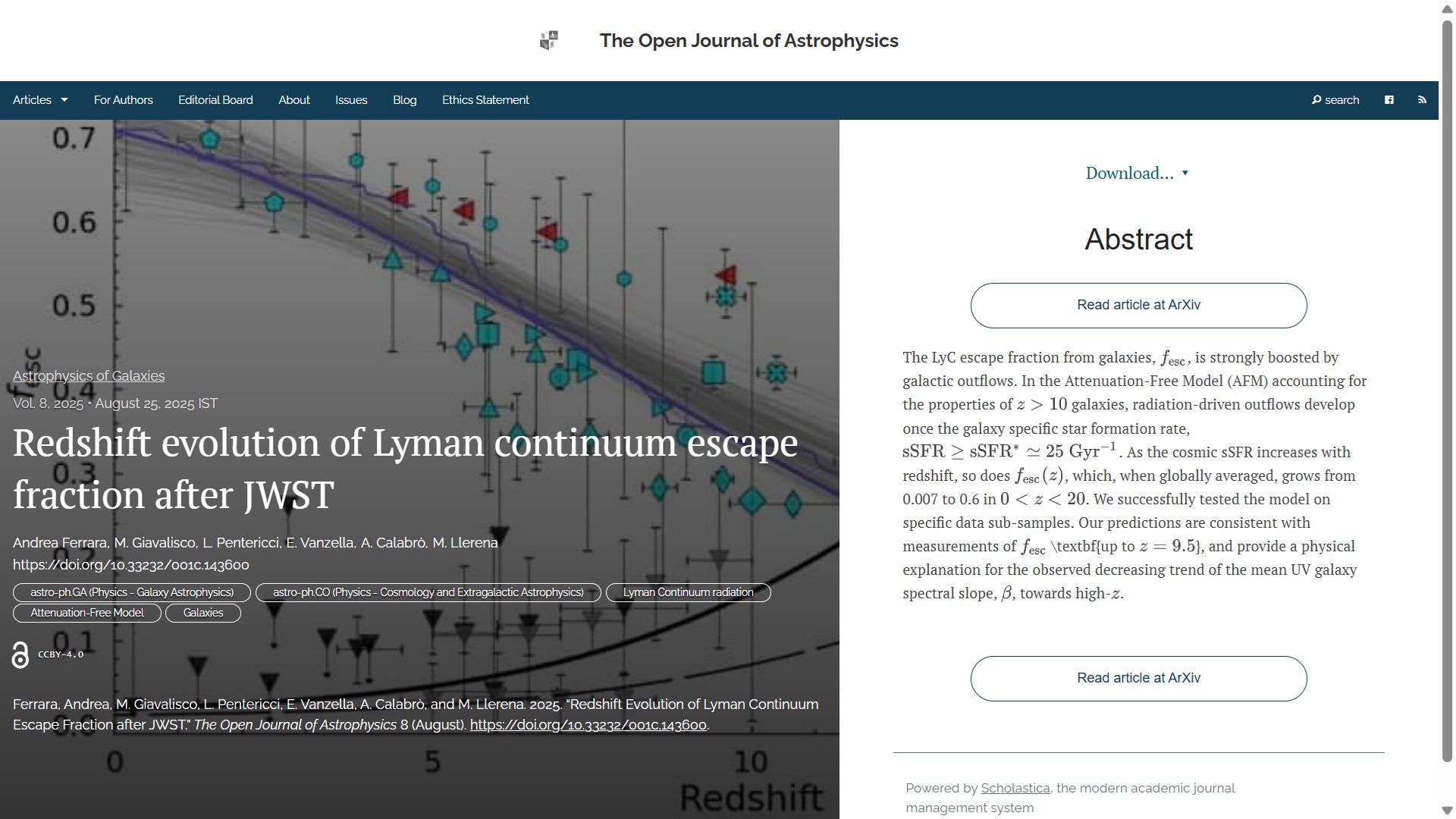
You might want to read this article (another OJAp paper) which contains this plot showing how galaxies at redshift z>10 challenge the standard model:

Please read the paper and comment if you wish!

Weekly Update from the Open Journal of Astrophysics – 17/05/2025

Posted in OJAp Papers, Open Access, The Universe and Stuff with tags , , , , , , , , , , , , on May 17, 2025 by telescoper

It’s a lovely Saturday morning in May, and it’s time for the weekly  update of papers published at the Open Journal of Astrophysics. Since the last update we have published four new papers, which brings the number in Volume 8 (2025) up to 59 and the total so far published by OJAp up to 294.

In chronological order of publication, the four papers published this week, with their overlays, are as follows. You can click on the images of the overlays to make them larger should you wish to do so.

The first paper to report is: “Multi-Phase Thermal Structure & The Origin of the Broad-Line Region, Torus, and Corona in Magnetically-Dominated Accretion Disks” by Philip F. Hopkins (Caltech, USA). This was published on Monday May 12th in the folder Astrophysics of Galaxies. It presents simple accretion disk model that predicts the properties of many features including the dusty torus, broad-line region, continuum emission and coronal gas.

The overlay is here:

You can find the officially accepted version on arXiv here.

Second one up is “Sparsity covariance: a source of uncertainty when estimating correlation functions with a discrete sample of observations in the sky” by Pierre Fleury (U. Montpellier, France). This one was published on Tuesday 13th May 2025 in the folder Cosmology and NonGalactic Astrophysics.  This paper presents a discussion of the uncertainty in cosmological observables caused by discrete sampling and a method to compute the covariances resulting from this.

The overlay is here:

You can find the officially-accepted version of the paper on arXiv here.

The third paper of the week, published on Wednesday May 14th 2025,  is “Dark Matter Particle Flux in a Dynamically Self-consistent Milky Way Model” by Lucijana Stanic, Mark Eberlein, Stanislav Linchakovskyy, Christopher Magnoli, Maryna Mesiura, Luca Morf, Prasenjit Saha (University of Zurich, Switzerland) and Eugene Vasiliev (University of Surrey, UK). This one presents a study of the behaviour of dark matter in an anisotropic model for the Milky Way halo with implications for particle detection rates. It is in the folder Astrophysics of Galaxies.

Here is the overlay:

You can find the officially accepted version of this paper on arXiv here.

The last paper published this week is “Too fast to be single: Tidal evolution and photometric identification of stellar and planetary companions” by Ilay Kamai and Hagai B. Perets (Technion, Haifa, Israel). This one was published on Friday 16th May 2025 in the folder Solar and Stellar Astrophysics. It presents an analysis of the rotation of stars observed in the Kepler field to identify non-single systems with high spin rates resulting from tidal effects.

Here is the overlay:

The official published version can be found on the arXiv here.

That’s all the papers for this week. I’ll post another update next week.

Weekly Update from the Open Journal of Astrophysics – 10/05/2025

Posted in OJAp Papers, Open Access, The Universe and Stuff with tags , , , , , , on May 10, 2025 by telescoper

It’s time for another update Saturday morning update of activity at the Open Journal of Astrophysics. After the record-breaking stats described in the last update , this week has been on the slow side with just one paper published. This brings the number in Volume 8 (2025) up to 55 and the total so far published by OJAp up to 290.

The paper to report is “Late-time growth weakly affects the significance of high-redshift massive galaxies” by Qianran Xia & Dragan Huterer (U. Michigan, USA) and Nhat-Minh Nguyen (U. Tokyo, Japan). This paper, which was published on Wednesday 7th May 2025,  is published in the folder Cosmology and NonGalactic Astrophysics. It presents an argument that changes in the growth rate of perturbations at low redshift do not have much effect on predictions of the abundance of lassive galaxies at high redshift.

The overlay is here:


You can find the officially accepted version on arXiv here.

That’s all for now. I’ll do another update next week.

Weekly Update from the Open Journal of Astrophysics – 03/05/2025

Posted in OJAp Papers, Open Access, The Universe and Stuff with tags , , , , , , , , , , , , , , , , , , , on May 3, 2025 by telescoper

Saturday morning once again, and time for another update of papers published at the Open Journal of Astrophysics. It’s been a recording-breaking week: since the last update we have published no fewer than ten papers, which brings the number in Volume 8 (2025) up to 54 and the total so far published by OJAp up to 289.

The first paper to report is “Subspace Approximations to the Focused Transport Equation of Energetic Particles, I. The Standard Form” by B. Kippenstein & A. Shalchi (U. Manitoba, Canada). This paper, which was published on Monday 28th April 2025, presents a hybrid analytical-numerical method to solve the Fokker-Planck equation for the transport of energetic particles. It is published in the folder Solar and Stellar Astrophysics.

The overlay is here:

You can find the officially accepted version on arXiv here.

Next is “The Importance of Subtleties in the Scaling of the ‘Terminal Momentum’ For Galaxy Formation Simulations” by Philip F. Hopkins (Caltech, USA). This presents a technical discussion of issues surrounding the proper modelling of supernova blast waves and their effects in numerical simulations of galaxy formation. It was published on Tuesday 29th April 2025 in the folder Astrophysics of Galaxies. The overlay is here:

The final version can be found on arXic here.

Next one up is “Local variations of the radial metallicity gradient in a simulated NIHAO-UHD Milky Way analogue and their implications for (extra-)galactic studies” by Sven Buder (ANU, Australia), Tobias Buck (U. Heidelberg, Germany), Qian-Hui Chen (ANU) and Kathryn Grasha (ANU). This one was also published on Tuesday 29th April 2025 in the folder Astrophysics of Galaxies. It describes a numerical study of the variation of chemical abundance with radial position in galaxies and the implications of this for galaxy formation. Here is the overlay:

and you can find the final accepted version on arXiv here.

The fourth paper this week is “Zooming In On The Multi-Phase Structure of Magnetically-Dominated Quasar Disks: Radiation From Torus to ISCO Across Accretion Rates” by Philip F. Hopkins (Caltech, USA) and 14 others based in the USA and Canada. This was also published on Tuesday 29th April 2025 in the folder Astrophysics of Galaxies. It presents very detailed numerical study of the structure of magnetized quasar accretion disks. The overlay is here:

You can find the official final version on arXiv here.

Next is “Tomographic halo model of the unWISE-Blue galaxies using cross-correlations with BOSS CMASS galaxies” by Alex Krolewski, Jensen Lawrence, and Will J. Percival (U. Waterloo, Canada). This one was also published on 29th April 2025, which was a busy day(!), but in the folder Cosmology and NonGalactic Astrophysics.  This paper describes using the halo model to create mock samples unWISE-Blue galaxies, applicable to other tomographic cross-correlations between photometric samples and narrowly-binned spectroscopic samples. The overlay is here:

The final version of this one can be found on the arXiv here.

Number six for this week is “StratLearn-z: Improved photo-estimation from spectroscopic data subject to selection effects” by Chiara Moretti (SISSA, Trieste, Italy), Maximilian Autenrieth (Imperial College, UK), Riccardo Serra (SISSA), Roberto Trotta (SISSA), David A. van Dyk (Imperial) and Andrei Mesinger (SNS Pisa, Italy). This was published on Thursday 1st May 2025 in the folder Cosmology and NonGalactic Astrophysics. This one is about estimating photometric redshifts using an approach that relies on splitting the source and target datasets into strata based on estimated propensity score. The overlay is here:


The official version can be found on arXiv here.

Next is “The Impact of Galaxy-halo Size Relations on Galaxy Clustering Signals” by Joshua B. Hill and Yao-Yuan Mao (U. Utah, USA). This one was also published on May 2nd 2025 and is in the folder Astrophysics of Galaxies. It discusses the challenge of identifying a specific galaxy halo property that controls galaxy sizes through constraints from galaxy clustering alone. The overlay is here:

You can find the official version of the paper on arXiv here.

The next paper is “Detection of Thermal Emission at Millimeter Wavelengths from Low-Earth Orbit Satellites” by Allen Foster (Princeton, USA) and an international cast of 90 others, which is too many to list individually. This one was also published on Thursday May 1st but is in the folder Instrumentation and Methods for Astrophysics.  The paper discusses the experimental detection of thermal emission from satellites and a discussion of the implications for astrophysical observations, especially time-domain astronomy. The overlay is here:

You can find the final version of the paper on arXiv here.

The penultimate paper of this week is “Pseudo-Cls for spin-s fields with component-wise weighting” by David Alonso (U. Oxford, UK). This one was published yesterday (Friday 2nd May 2025).  The paper presents an approach to power spectrum estimation appropriate for data with anisotropic noise properties or for which complicated masks are required.  It can be found in the folder Cosmology and NonGalactic Astrophysics. The overlay is here:


The final version of this paper is on arXiv here.

The last paper this week is “The past, present and future of observations of externally irradiated disks” by Planet formation environments collaboration: Megan Allen (U. Sheffield, UK) and 52 others. This paper was published on Friday 2nd May in the folder Solar and Stellar Astrophysics.  It presents a review of research on the effects of the ultraviolet radiation environment on protoplanetary disc evolution and planet formation. The overlay is here:

You can find the final version on arXiv here.

That’s all the papers for this week. I’ll just add that there were quite a few gremlins at Crossref this week, particularly yesterday. I usually do the publishing first thing in the morning but yesterday’s papers were held in a queue for most of the day pending registration. Usually it just takes a few minutes, but for these I had to wait several hours but we got there in the end. Although ten papers is more than we have ever published in a week, we still haven’t had a week in which we’ve published on every working day!

Anyway, that’s all for this week. I’ll post another update next Saturday.

Weekly Update from the Open Journal of Astrophysics – 26/04/2025

Posted in OJAp Papers, Open Access, The Universe and Stuff with tags , , , , , , , , , , , on April 26, 2025 by telescoper

It’s Satuday morning once again, and time for another update of papers published at the Open Journal of Astrophysics. Since the last update we have published two papers, which brings the number in Volume 8 (2025) up to 44 and the total so far published by OJAp up to 279.

The first paper to report is “Approximating non-Gaussian Bayesian partitions with normalising flows: statistics, inference and application to cosmology” by Tobias Röspel, Adrian Schlosser & Björn Malte Schäfer (Universität Heidelberg, Germany) which was published on April 23rd 2025 in the folder Cosmology and NonGalactic Astrophysics. It is an introduction to normalizing flows – a machine learning technique for transforming distributions – and its application to the extraction of cosmological parameters from supernova data.

The overlay is here:

You can find the officially accepted version on arXiv here.

The other paper this week is “Dwarf Galaxies in the TNG50 Field: connecting their Star-formation Rates with their Environments” by Joy Bhattacharyya & Annika H.G. Peter (Ohio State University, USA) and Alexie Leauthaud (UC Santa Cruz, USA).  This one was published on 24th April 2025 in the older Astrophysics of Galaxies and it studies dwarf galaxies with properties similar to the Large and Small Magellanic Clouds that form in different environments in the TNG50 simulation of the IllustrisTNG project.

The overlay is here:


and you can find the final accepted version on arXiv here.


That’s all for this week. I’ll have another update next Saturday.