Archive for the Open Access Category

The 200th Publication at the Open Journal of Astrophysics

Posted in OJAp Papers, Open Access, The Universe and Stuff with tags , , on October 8, 2024 by telescoper

It was on September 11th last year that we published the 100th paper at the Open Journal of Astrophysics. Today, on 8th October 2024, just over a year later we have reached the 200 mark with this paper:

In fact this looks like being a record-breaking week for OJAp as we have published four papers already and its only Tuesday. To be fair, most of these were accepted last week but were slow appearing on the arXiv – I think partly due to glitches on arXiv – but still it’s nice to be this active. I’ll do a regular post at the weekend with details of how many we published in total by then. I’m very confident that we will reach 100 for the calendar year.

Four New Publications at the Open Journal of Astrophysics

Posted in OJAp Papers, Open Access, The Universe and Stuff with tags , , , , , , , , , , , , on September 29, 2024 by telescoper

A day later than has been usual for such things, it’s now time for a quick update of activity at the Open Journal of Astrophysics. This week we have published another batch of four papers which takes the count in Volume 7 (2024) up to 81 and the total published altogether by OJAp up to 196. I think there may come a week in we publish papers on every day of that week, but it was not this week…

In chronological order, the four papers published this week, with their overlays, are as follows. You can click on the images of the overlays to make them larger should you wish to do so.

First one up is “Finding the unusual red giant remnants of cataclysmic variable mergers” by Nicholas Z. Rui and Jim Fuller of California Institute of Technology (Caltech), USA. It presents a discussion of the possible photometric, astroseismological, and surface abundance signatures of red giants formed by mergers of cataclysmic variable stars. It was published on 23rd September 2024 and is in the folder marked Solar and Stellar Astrophysics.

Here is a screen grab of the overlay, which includes the abstract:
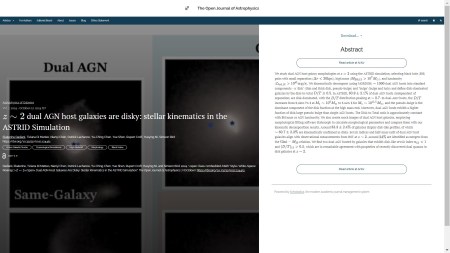


You can find the officially accepted version of the paper on the arXiv here.

The second paper to announce, also published on 23rd September 2024, is “Notes on the Practical Application of Nested Sampling: MultiNest, (Non)convergence, and Rectification” by Alexander Dittmann (U. Maryland, USA). A critical analysis of the MultiNest algorithm together with suggestions for approving its applicability. It is in the folder Instrumentation and Methods for Astrophysics.

You can see the overlay here:


The accepted version of this paper can be found on the arXiv here.

The third paper, published on 24th September 2024 in the folder marked High-Energy Astrophysical Phenomena, is called  “Merger Precursor: Year-long Transients Preceding Mergers of Low-mass Stripped Stars with Compact Objects” and is by Daichi Tsuna, Samantha Wu & Jim Fuller (Caltech), Yize Dong (UCLA) and Anthony Piro (Carnegie Observatories), all based in the USA.

Here is the overlay


The final version accepted on arXiv is here.

Last in this batch is “Spectroscopic Observations of the GALEX Nearby Young Star Survey Sample. I. Nearby Moving Group Candidates” by Navya Nagananda (Rochester, NY, USA), Laura Vican (UCLA), Ben Zuckerman (UCLA), David Rodriguez (STScI), Alexander Binks (Tübingen, Germany) & Joel Kastner (Rochester). It describes investigations of the spectra of the GALNYSS sample of over 2000 young stars and the assignment of these stars into moving groups. It is is in the folder marked Solar and Stellar Astrophysics, and was published on 25th September 2024 with this overlay:


You can find the official accepted version on the arXiv here.

That’s all for now. I will post another update in a week.

The Case Against Academic Publishers

Posted in Open Access with tags , , , , , on September 25, 2024 by telescoper

It seems appropriate to pass on news of a federal antitrust lawsuit being brought in the United States against six commercial academic publishers, including the “Big Four” (Elsevier, Springer Nature, Taylor & Francis and Wiley). The case is filed by lawyers Lieff Cabraser Heimann and Bernstein. The plaintiff is Lucina Uddin, Professor of Psychology at UCLA.

I suggest you read the full document linked to above for details, but in a nutshell the case alleges three anticompetitive practices:

  1. agreeing to “fix the price..at zero” for the labour of authors and peer reviewers;
  2. agreeing not to compete for manuscripts by forcing authors to submit to one journal at a time;
  3. agreeing to prohibit authors from sharing their work while under peer review, “a process that often takes over a year”

I’ve spoken to a few people who know a bit about US law on such matters and they all say that the plaintiff’s legal representatives have a good track record on antitrust litigation. Nevertheless, there is some doubt about whether the case is winnable but at the very least it will bring a lot of attention to the Academic Journal Racket, so is probably a good move even if it doesn’t succeed. If it does succeed, however, it might blow a hole in the entire commercial publishing industry, which would be an even better move…

As an interesting postscript (found here) is that, in 2002, the UK Office of Fair Trading reviewed complaints about anticompetitive practices in academic publishing; see here. It found market distortions but decided not to act because of the recent rise of Open Access. I quote

It is too early to assess what will be the impact of this … but there is a possibility that it will be a powerful restraint on exploiting positional advantage in the STM journals market.

Now that 22 years have passed, is it still too early?

P.S. Comments from legal experts would be especially welcome!

Four New Publications at the Open Journal of Astrophysics

Posted in OJAp Papers, Open Access, The Universe and Stuff with tags , , , , , , , , , , , , , , , , , , , on September 14, 2024 by telescoper

Once again, it’s time for a quick update of activity at the Open Journal of Astrophysics. This week we have published another batch of four papers which takes the count in Volume 7 (2024) up to 77 and the total published altogether by OJAp up to 192. Things are picking up again after the summer lull, and we’re moving towards a double century. If we keep up a steady average of four per week we’ll be at 200 per year.

In chronological order, the four papers published this week, with their overlays, are as follows. You can click on the images of the overlays to make them larger should you wish to do so.

First one up is “Quasi-two-dimensionality of three-dimensional, magnetically dominated, decaying turbulence” by Shreya Dwivedi, Chandranathan Anandavijayan, and Pallavi Bhat of TIFR, Bangalore, India. The paper presents an analysis of numerical simulations of MHD turbulence using Minkowski Functionals, with implications for local anisotropies revealed therein. It was published on 9th September 2024 and is in the folder marked High-Energy Astrophysical Phenomena.

Here is a screen grab of the overlay, which includes the abstract:


You can find the officially accepted version of the paper on the arXiv here.

The second paper to announce, also published on 9th September 2024, is “mochi_class: Modelling Optimisation to Compute Horndeski In class” by  Matteo Cataneo (Universität Bonn, Germany) and Emilio Bellini (SISSA, Trieste, Italy). This article presents a cosmological Einstein-Boltzmann solver adapted to work with Horndeski gravity, together with validation tests. It is in the folder Cosmology and NonGalactic Astrophysics.

You can see the overlay here:


The accepted version of this paper can be found on the arXiv here.

The third paper, published on 11th September 2024 in the folder marked High-Energy Astrophysical Phenomena, is by Jonathan Katz of Washington University, St Louis, USA. The title is “The Sources of Fast Radio Bursts” and it presents a discussion of the possible physical origin of Fast Radio Bursts, arguing that they fall into two distinct groups.


The final version accepted on arXiv is here.

Last in this batch, but by no means least, is “RMS asymmetry: a robust metric of galaxy shapes in images with varied depth and resolution” by Elizaveta Sazonova (U. Waterloo, Canada) with 15 other authors spread around the world (in Canada, USA, Australia, Italy, Chile, UK, Poland, Mexico, Germany, and Spain). This paper presents a method of quantifying distortion of galaxy images connected with mergers or other instabilities. It is in the folder marked Astrophysics of Galaxies and was published on September 12th 2024 with this overlay:


You can find the official accepted version on the arXiv here.

That’s all for now. I will post another update in a week.

An Anniversary of a Century

Posted in Open Access, The Universe and Stuff with tags on September 11, 2024 by telescoper

While I remember, here is a quick post to mark the fact that the 100th paper at the Open Journal of Astrophysics was published a year ago today (on 11th September 2023).

In the year that has passed since that milestone we have published a further 91 papers. I expect we will pass the 200 mark sometime next month. It’s an accelerating Universe!

The Big Four and Your Work

Posted in Open Access with tags , , , , on September 10, 2024 by telescoper

In Agatha Christie’s novel The Big Four (left) the great detective Hercule Poirot tries to identify the members of sinister group of unscrupulous individuals bent on world domination.

When it comes to the world of academic publishing, the members of the The Big Four are somewhat easier to identify, though no less unscrupulous. They are Elsevier, Spring-Nature, Taylor & Francis, and John Wiley & Sons who have cornered almost 50% of the lucrative market in scholarly books and journals and the eye-watering profits that go with that territory.

Recently, however, these companies have found a new way of boosting their profits still further. This involves selling their “content” to tech companies in order to train the generative AI algorithms known as Large Language Models. The latest to do this is Wiley, which has already cashed in to the tune of $44 million. Wiley has not given its authors the right to opt out of this deal nor will authors be remunerated. Others outside the Big Four are also cashing in. Oxford University Press, for example, which publishes Monthly Notices of the Royal Astronomical Society, has done similar deals.

This sort of arrangement provides yet another reason to avoid the commercial publishing sector. Do we become academic researchers in order to be mere “content creators” for Wiley and the rest?

Two New Publications at the Open Journal of Astrophysics

Posted in OJAp Papers, Open Access, The Universe and Stuff with tags , , , , , , , , , on September 7, 2024 by telescoper

It’s Saturday morning again so here’s another report on activity at the  Open Journal of Astrophysics.  Since the last update we have published two more papers, taking  the count in Volume 7 (2024) up to 73 and the total published by OJAp up to 188.  We’ve still got a few in the pipeline waiting for the final versions to appear on arXiv so I expect we’ll reach the 200 mark fairly soon.

The first paper of the most recent pair, published on September 4th 2024,  and in the folder marked Astrophysics of Galaxies, is “Massive Black Hole Seeds”  by John Regan of the Department of Theoretical Physics at Maynooth University and Marta Volonteri (Sorbonne Université, Paris, France). This article presents a discussion of the pathways to the formation of massive black holes, including both light and heavy initial seeds.

Here is a screen grab of the overlay which includes the abstract:


You can click on the image of the overlay to make it larger should you wish to do so. Those of you who are paying attention will see that there is a bit of a glitch on the left hand side where software has thrown a line break in between the two author names. I have no idea what caused this so I raised a ticket with Scholastica and no doubt it will soon be fixed.  (Update: it is now fixed, 12th September 2024). You can find the officially accepted version of this paper on the arXiv here.

The second paper has the title “The future of cosmological likelihood-based inference: accelerated high-dimensional parameter estimation and model comparison” and was published on 5th September 2024. The authors are Davide Piras (Université de Genève), Alicja Polanska (MSSL) , Alessio Spurio Mancini (Royal Holloway, London), Matthew A. Price(UCL) & Jason D. McEwen (UCL); the latter four are all based in the UK. This paper, which is in  the folder marked Cosmology and NonGalactic Astrophysics, describes an accelerated approach to Bayesian inference in higher-dimensional settings, as required for cosmology, based on recent developments in machine learning and its underlying technology.

Here is a screen grab of the overlay which includes the abstract:


You can click on the image of the overlay to make it larger should you wish to do so. You can find the officially accepted version of the paper on the arXiv here.

That concludes this week’s update. More  next week!

The Editorial Board of the Open Journal of Astrophysics

Posted in Open Access, The Universe and Stuff with tags , , on September 6, 2024 by telescoper

A couple of months ago, I issued a call for new Editors of the Open Journal of Astrophysics. That was very successful and we added a number of new Editors. The complete list (of 20 members) follows:

Peter Coles* (Department of Theoretical Physics, Maynooth University, Ireland). Cosmology, astrophysics, statistics and methodology.

Thierry Appourchaux (CNRS, Institut d’Astrophysique Spatiale, Orsay, France). Space instrumentation, astroseismology, helioseismology, statistics and methodology.

Emory (Ted) Bunn (Department of Physics, University of Richmond, USA). Relativity, cosmology.

Walter Dehnen (Astronomisches Rechen-Institut, University of Heidelberg, Germany). Stellar dynamics, galaxy dynamics, galaxies, bars, Milky-Way dynamics, Gaia, numerical methods, N-body techniques, smooth particle hydrodynamics (SPH).

Philipp Edelmann (Los Alamos National Laboratory, New Mexico, USA). Stellar astrophysics, hydrodynamics, high-performance computing, supernovae, internal waves, stellar evolution, numerical methods.

Pedro Ferreira (Department of Physics, University of Oxford, UK). Large-scale structure, general relativity, cosmic microwave background, early universe, cosmology.

Andrew Jaffe (Department of Physics, Imperial College, London, UK). Astrophysics, statistics and methodology, cosmology.

Harley Katz (Department of Astronomy and Astrophysics, University of Chicago, USA). Galaxy formation and evolution, numerical simulations

Lucyna Kedziora-Chudczer (School of Physics, University of New South Wales, Sydney, Australia). Active galactic nuclei, polarimetry, atmospheres of planets, exoplanets, solar system planets.

Julien Larena (Laboratoire Univers et Particules de Montpellier, Université de Montpellier, France). Cosmology, gravitation, lensing, large-scale structure, general relativity.

Manuela Magliocchetti (National Institute of Astrophysics, Rome, Italy). Cosmology, galaxies, active galactic nuclei (AGN).

Sean McGee (Department of Physics & Astronomy, University of Birmingham, UK). Galaxy formation, galaxy clusters, galaxy surveys.

Manolis Plionis (Department of Physics, Aristotle University of Thessaloniki, Greece). Observational cosmology, extragalactic astrophysics, large-scale structure, active galactic nuclei.

Alkistis Pourtsidou (Higgs Centre & Institute for Astronomy, Edinburgh, UK). Cosmology, large-scale structure of the Universe, radio astronomy, galaxy surveys.

Justin Read (School of Mathematics and Physics, University of Surrey, UK). Dark matter, cosmology, galaxy formation and evolution, dwarf galaxies, milky way, galactic dynamics, galactic archaeology, computational modeling.

Hanno Rein (Department of Physics and Environmental Sciences, University of Toronto at Scarborough, Canada). Numerical methods, in particular N-body codes and integration methods for planetary systems, planet formation, stochastic processes, planet migration, celestial mechanics, and Saturn’s rings.

Aleks Scholz (School of Physics & Astronomy, University of St Andrews, UK). Exoplanets, brown dwarfs, protoplanetary disks, stellar evolution, star formation.

Elena Sellentin (Sterrewacht Leiden, Leiden University, The Netherlands). Applied Mathematics, Cosmology, Statistics, Statistical Inference.

Elena Terlevich (Instituto Nacional de Astrofísica, Óptica y Electrónica, Puebla, Mexico). Stellar populations in galaxies, observational cosmology, violent star formation, element abundances, dynamics of stellar systems.

Bingbing Wang (Center for Space Plasma and Aeronomic Research, University of Alabama in Huntsville, USA.) Particle astrophysics, MHD turbulence, cosmic rays acceleration, cosmic ray propagation in the Galaxy and heliosphere.

Apologies to anyone who volunteered but has not yet received a reply from me. I’ve been a bit preoccupied these last weeks! The call is still open, though. Here are the areas of arXiv covered by the journal:

  1. astro-ph.GA – Astrophysics of Galaxies. Phenomena pertaining to galaxies or the Milky Way. Star clusters, HII regions and planetary nebulae, the interstellar medium, atomic and molecular clouds, dust. Stellar populations. Galactic structure, formation, dynamics. Galactic nuclei, bulges, disks, halo. Active Galactic Nuclei, supermassive black holes, quasars. Gravitational lens systems. The Milky Way and its contents
  2. astro-ph.CO – Cosmology and Nongalactic Astrophysics. Phenomenology of early universe, cosmic microwave background, cosmological parameters, primordial element abundances, extragalactic distance scale, large-scale structure of the universe. Groups, superclusters, voids, intergalactic medium. Particle astrophysics: dark energy, dark matter, baryogenesis, leptogenesis, inflationary models, reheating, monopoles, WIMPs, cosmic strings, primordial black holes, cosmological gravitational radiation
  3. astro-ph.EP – Earth and Planetary Astrophysics. Interplanetary medium, planetary physics, planetary astrobiology, extrasolar planets, comets, asteroids, meteorites. Structure and formation of the solar system
  4. astro-ph.HE – High Energy Astrophysical Phenomena. Cosmic ray production, acceleration, propagation, detection. Gamma ray astronomy and bursts, X-rays, charged particles, supernovae and other explosive phenomena, stellar remnants and accretion systems, jets, microquasars, neutron stars, pulsars, black holes
  5. astro-ph.IM – Instrumentation and Methods for Astrophysics. Detector and telescope design, experiment proposals. Laboratory Astrophysics. Methods for data analysis, statistical methods. Software, database design
  6. astro-ph.SR – Solar and Stellar Astrophysics. White dwarfs, brown dwarfs, cataclysmic variables. Star formation and protostellar systems, stellar astrobiology, binary and multiple systems of stars, stellar evolution and structure, coronas. Central stars of planetary nebulae. Helioseismology, solar neutrinos, production and detection of gravitational radiation from stellar systems.

We are looking for experienced scientists in any of these areas, and it would indeed be useful to have people who can cover a range of subjects (as some of our existing editors do), but there I think we’re still a bit short on High-Energy Astrophysics, Solar and Stellar Physics, and Galactic Astrophysics. I’d also like to see a better gender balance so applications from female scientists are particularly welcomed, as are astrophysicists from geographical areas not currently covered. The Open Journal of Astrophysics is intended to be a global enterprise!

Please follow the instructions here if you would like to volunteer!

Scopus should be banned

Posted in Maynooth, Open Access with tags , , , on September 5, 2024 by telescoper

I think it’s time to provide an update on the (lack of) progress getting The Open Journal of Astrophysics properly indexed in Scopus (which markets itself as a purveyor of “metrics you can trust”).

You might recall back in June that I reported that OJAp had been included in the index, but unfortunately the Scopus team messed up very badly by omitting about one-third of our papers and most of our citations. Here’s what they did:

In the column marked Documents 2020-23  you will see the number 67. In fact we published 99 articles between 2020 and 2023, not 67. This is easily established here. The number 67 relates to the period 2022-23 only. Accidentally or deliberately, Scopus has omitted a third of our papers from its database. But the error doesn’t end there. Papers published in OJAp between 2020 and 2023 have actually been cited 959 times, not 137. If you restrict the count to papers published in 2022-23 there are 526 citations. It’s no wonder that OJAp has such a low CiteScore, and consequently appears so far down the rankings, when the citation information is so woefully inaccurate. “Metrics you can trust?” My arse!

If you want accurate bibliometric information about the papers published in the two years that Scopus has chosen to ignore you can look here.

I sent this information to Scopus on 15th June, soon after noticing the error, but I then got shunted around. I eventually got a reply on 23rd August, acknowledging the mistake and including this:

I want to assure you that your request has been promptly forwarded to our technical team for the addition of the paper to our database. While we strive to resolve this as swiftly as possible, please be aware that this correction process may take up to four weeks to be completed. 

I think they’re using some definition of “promptly” with which I am unfamiliar. I’m not optimistic that they will actually correct it in four weeks, either, since it took 5 months to get the initial 67 papers indexed.

This all merely demonstrates the folly that so many institutions place so much trust in Scopus. Based on my interactions with them, I wouldn’t trust them with anything at all. Unfortunately the powers that be have decided that Scopus listing is such a reliable indicator of quality that any article not published in a Scopus journal is worthless. Knowing that it has a monopoly, Scopus has no incentive to put any effort into its own quality assurance. It can peddle any error-ridden tripe to its subscribers, most of them paying for the product with taxpayers’ money.

(I might add that if OJAp were a commercial journal, then the willful publication of demonstrably false information about it would be actionable as it is potentially damaging to business. )

Presumably at the instigation of senior management, IT services at Maynooth University are still banning access to this blog from campus. It would make far more sense for them to ban Scopus.

Two New Publications at the Open Journal of Astrophysics

Posted in OJAp Papers, Open Access, The Universe and Stuff with tags , , , , , , , , , , , , on August 31, 2024 by telescoper

I am back in circulation after my little break and, since it’s Saturday, I will resume blogging with another report on activity at the  Open Journal of Astrophysics.  Since the last update we have published two more papers, taking  the count in Volume 7 (2024) up to 71 and the total published by OJAp up to 186.  We’ve still got a few in the pipeline waiting for the final versions to appear on arXiv so I expect we’ll reach the 200 mark fairly soon.

The first paper of the most recent pair, published on August 26th 2024,  is “Impact of lensing of gravitational waves on the observed distribution of neutron star masses”  by Sofia Canevarolo, Loek van Vonderen and Nora Elisa Chisari, all of Utrecht University in the Netherlands. This article presents a discussion of the bias in neutron star mass determinations caused by gravitational lensing of the gravitational waves they produceThe paper is in the folder marked Cosmology and NonGalactic Astrophysics.

Here is a screen grab of the overlay which includes the abstract:


You can click on the image of the overlay to make it larger should you wish to do so. You can find the officially accepted version of the paper on the arXiv here.

The second paper has the title “FORGE’d in FIRE III: The IMF in Quasar Accretion Disks from STARFORGE” and was published (in the early hours of the morning) on 29th August 2024. The authors, all based in the USA, are Philip F. Hopkins (Caltech), Michael Y. Grudic (Carnegie Observatories), Kyle Kremer (Caltech), Stella S. R. Offner (UT Austin), David Guszejnov (UT Austin) and Anna L. Rosen (UCSD). This paper, which is in the folder marked Astrophysics of Galaxies, presents a numerical study of star formation and the initial mass function in quasar accretion disks. The previous two papers in this series have also been published in the OJAp: you can find them here and here; images and movies related to this project can be found here.

Here is a screen grab of the overlay which includes the abstract:


You can click on the image of the overlay to make it larger should you wish to do so. You can find the officially accepted version of the paper on the arXiv here.

That concludes this week’s update. We still have quite a few papers in the pipeline after the summer lull so I expect I’ll have a larger update for you next week!