Archive for the Open Access Category

New Publication at the Open Journal of Astrophysics

Posted in OJAp Papers, Open Access, The Universe and Stuff with tags , , , , , on March 12, 2024 by telescoper

It’s my last morning in Phoenix and since I was too busy at the weekend to post the usual update from the Open Journal of Astrophysics I will do so now, before I go to the Airport for my flight home.

Looking at the workflow I see that there is a considerable backlog of papers that have been accepted but are waiting for the authors to put the final version on arXiv.  As a result there is only one paper to report for last week, being the 17th paper in Volume 7 (2024)  and the 132nd altogether; it was published on March 6 2024. I expect more soon!

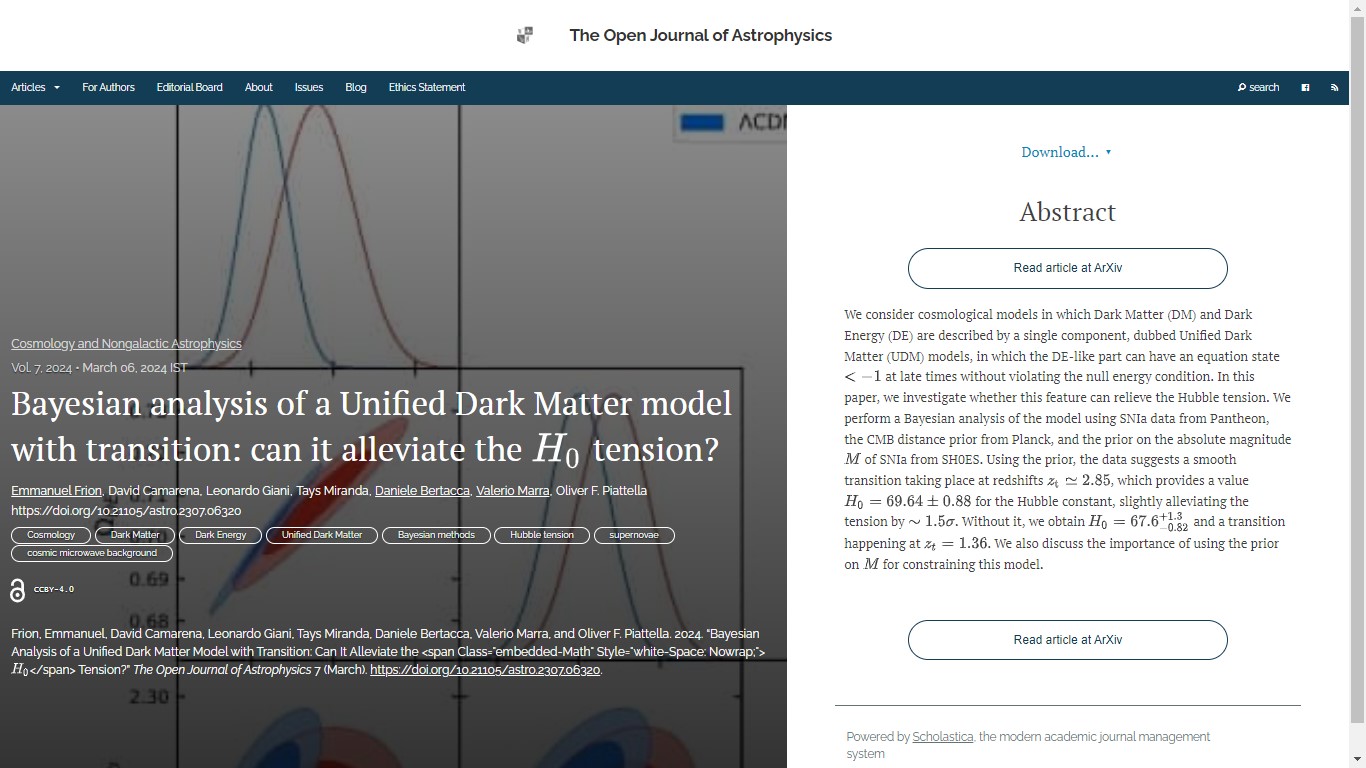
The title of the latest paper is “Bayesian analysis of a Unified Dark Matter model with transition: can it alleviate the H0tension?” and it  is in the folder marked Cosmology and NonGalactic Astrophysics.  The article presents an investigation using Bayesian techniques of a specific cosmological model, in which dark matter and dark energy are aspects of a single component, with particular emphasis on the Hubble tension.

The authors are seven in number: Emmanuel Frion (University of Helsinki, Finland, and Western University, Canada); David Camarena (University of New Mexico, USA); Leonardo Giani (University of Queensland, Australia); Tays Miranda (University of Helsinki and University of Jyväskylä, both in Finland); Daniele Bertacca (Università degli Studi di Padova, Italy); Valerio Marra (Universidade Federal do Espírito Santo, Brazil and Osservatorio Astronomico di Trieste, Italy);
and Oliver F. Piattella (Università degli Studi dell’Insubria, Como, Italy).

Here is the overlay of the paper containing the abstract:


You can click on the image of the overlay to make it larger should you wish to do so. You can also find the officially accepted version of the paper on the arXiv here.


Introducing alphaXiv

Posted in Open Access with tags , on March 9, 2024 by telescoper

I’ve been busy all day so just have time to mention an interesting new development to do with arXiv. There is a new site called alphaXiv, which is a forum for anyone to comment line-by-line on arXiv papers. It also allows you to “get responses directly from authors of the paper or from established research teams from Stanford and Harvard”, which seems to imply that authors can’t be from established research teams unless they are from Stanford or Harvard!

Anyway, you can try alphaXiv here.

I think this is a great idea in principle; it will be fascinating to see how it works out in practice. My main reservation stems from (i) it seems that there is no moderation of comments and (ii) anonymous comments are allowed; there is therefore a significant danger of abusive behaviour as is often the case on, e.g., Reddit.

I’d welcome reactions via the comments box below from anyone who has tried this already or who has thoughts about it generally!

Publishing Revenue and the Learned Societies

Posted in Open Access with tags , , , , , on March 8, 2024 by telescoper

A couple of days ago I posted a reaction to a shockingly dishonest article I saw in Physics World which has led me to resign my Fellowship of the Institute of Physics (IoP). I thought I would spend a bit of time now to raising some wider points (which I’ve raised before) about the extent that such organizations (including, in my field,  the Royal Astronomical Society and the Institute of Physics) rely for their financial security upon the revenues generated by publishing traditional journals and why this is not in the best interests of their disciplines.

Take IOP Publishing. This is a wholly-owned subsidiary of the Institute of Physics that has an annual turnover of around £60M generated from books and journals. This revenue is the largest contribution to the income that the IoP needs to run its numerous activities relating to the promotion of physics.  A similar situation pertains to the Royal Astronomical Society, although on a smaller scale, as it relies for much of its income from Monthly Notices of the Royal Astronomical Society, in which I have published quite a few papers in the past.

Not surprisingly, these and other learned societies are keen to protect their main source of cash and have lobbied very hard for the “Gold” Open Access some authorities are attempting to foist on the research community, rather than the far more sensible and sustainable approaches to Open Access employed, for example, by the Open Journal of Astrophysics.

There are two major reasons why I object to this approach, one practical and one ethical.

First, I consider it to be inevitable that the traditional journal industry will very soon be completely bypassed in favour of  other forms of publishing. The internet has changed the entire landscape of scientific publication. It’s now so cheap and so easy to disseminate knowledge that traditional journals are already virtually redundant, especially in my field of astrophysics where we have been using the arXiv for so long that many of us hardly ever look at journals.

The comfortable income stream that has been used by the IoP to “promote Physics”, as well as to furnish its  building in King’s Cross and office in Dublin, will dry up unless these organizations find a way of defending it. The “Gold” OA favoured by such organizations their attempt to stem the tide. I think this move into Gold `Open Access’, paid for by ruinously expensive Article Processing Charges paid by authors (or their organizations) is unsustainable because the research community will see through it and refuse to pay. I can already see signs of this happening.

The other problematic aspect of the approach of these learned societies is that I think it is fundamentally dishonest. University and other institutional libraries are provided with funds to provide access to published research, not to provide a backdoor subsidy for a range of extraneous activities that have nothing to do with that purpose. The learned societies do many good things – and some are indeed outstandingly good – but that does not give them the right to siphon off funds from their constituents by a sort of stealth levy.  Voluntary institutional affiliation, paid for by a fee, would be a much fairer way of funding these activities.

A couple of days ago I decided to cease paying the annual subscription to, and resign my Fellowship of, the Institute of Physics. I was reasonably comfortable spending some of my own money supporting physics, but don’t agree with  researchers having to fork out huge amounts of money in involuntary payment of APCs to the IOP. I will decide in the next few days whether or not to resign also from the Royal Astronomical Society for the same reason.

Some time ago I had occasion to visit the London offices of a well-known charitable organization which shall remain nameless. The property they occupied was glitzy, palatial, and obviously very expensive. I couldn’t help wondering how they could square the opulence of their headquarters with the quoted desire to spend as much as possible on their good works. Being old and cynical, I came to the conclusion that, although charities might start out with the noblest intentions, there is a grave danger that they simply become self-serving, viewing their own existence in itself as more important than what they do for others.

The commercial academic publishing industry has definitely gone that way. It arose because of the need to review, edit, collate, publish and disseminate the fruits of academic labour. Then the ease with which profits could be made led it astray. It now fulfills little or no useful purpose, but simply consumes financial resources that could be put to much better effect actually doing science. I think the scientific community knows this very well, and hopefully the parasite will die a natural death.

The question for learned societies is whether they can find a sustainable funding model that isn’t reliant upon effectively purloining funds from research budgets. If their revenue from publishing does fall, can they replace it? And, if not, in what form can they survive?

On “Purpose-Led Publishing”

Posted in Open Access with tags , , , , , , , , , , on March 6, 2024 by telescoper

I was flabbergasted by the cheek of an article that recently appeared in Physics World by Michael Brooks announcing that:

I can’t speak about the American Institute of Physics or the American Physical Society but in the context of the Institute of Physics – of which I am a Fellow and in whose house magazine the article appears – I draw your attention to the last sentence of the above excerpt which contains a commitment to “invest funds generated from publishing back into research” (my emphasis).

Really? The IOP invests in research? That’s news to me. How do I apply for a grant? Will they fund my next PhD student?

The IOP invests its funds in many things – many of them worthy – but it does not spend a significant part of the vast income it generates from its publishing house on research. The claim that it does is just dishonest. There’s point in mincing words.

This is an important distinction, particularly so that publishing in most IOP journals now requires the payment of a hefty Article Processing Charge (APC; Artificial Profit Charge would be more apt) which often has to be paid for out of research grants. Previously the revenue of IOP Publishing was appropriated from library budgets through subscriptions, so physicists were less aware of just how much the IOP was raking in. Now that researchers are having to find the funds themselves from research grants it has become more obvious that the IOP is actually a drain on research funds, not a source of them. The APC is a levy on research, designed to generate funds for other things. I think this model is indefensible. What gives the IOP the right to impose charges that far exceed the cost of disseminating scientific results in order to appropriate funds for its other activities?

Moreover, even if the IOP did fund research, what benefit would that be to a researcher in Spain, South Korea or Singapore or indeed anywhere outside the UK and Ireland?

The slogan for the initiative described in the article is “Purpose-led Publishing”. That reminds me of an old saying from systems theory: the Purpose Of a System Is What it Does (POSIWID). What the system does in this case is to raise funds for the IOP. That’s its purpose. Everything else is just marketing spiel.

The claim that IOP Publishing does not make a profit is disingenuous too. It does make a substantial profit. The only difference between it and the likes of Elsevier is where the profits go. A true not-for-profit publisher would charge only at the level to cover the costs of publication. The Purpose that should be leading Publishing in physics is the dissemination of scientific results, not the generation of revenue for sundry other things.

I have avoided publishing in IOP journals for many years because I think the approach of IOP Publishing is unethical. Now I have decided that I no longer wish to be associated with the IOP in any way. I have paid the subscription for 2024 but when that lapses I won’t renew it. Enough is enough.

New Publication at the Open Journal of Astrophysics

Posted in OJAp Papers, Open Access, The Universe and Stuff with tags , , , , , , , on March 2, 2024 by telescoper

It’s a rainy Saturday afternoon here in Sydney, and here’s the last update from the Open Journal of Astrophysics before I change time zones. In fact there is only one paper to report this week, being  the 16th paper in Volume 7 (2024)  and the 131st altogether. It was published on February 29th 2024.

The title is “Bound circumplanetary orbits under the influence of radiation pressure: Application to dust in directly imaged exoplanet systems” and it  is in the folder marked Earth and Planetary Astrophysics. It presents an investigation into the effect of radiation pressure on bound orbits, with applications to the behaviour of dust in exoplanet systems in general and to the Fomalhaut system in particular. The authors are Bradley Hansen of UCLA and Kevin Hayakawa of California State University (both in the USA).

Here is the overlay of the paper containing the abstract:

You can click on the image of the overlay to make it larger should you wish to do so. You can also find the officially accepted version of the paper on the arXiv here.

There are quite a few papers in the pipeline which I expect to be published during the next week or soon after.

Western Sydney

Posted in Biographical, Open Access with tags , , , , , , on February 26, 2024 by telescoper

Today I made a journey by train to Kingswood, a suburb of Sydney which is the location of one of the campuses of Western Sydney University (WSU). The journey of about 50 km takes about an hour on the stopping train (T1) from Sydney Central Station. I was intrigued that the final destination for the train I got was Emu Plains; I had visions of vast herds of Emus gathered there, but I had to get off the stop before the terminus so never saw them. There’s about a 20-minute walk to the campus from Kingswood Station. It was quite warm so I was grateful when one of my hosts offered me a lift back to Kingswood Station at the end of my visit.

The reason for my visit was set another seminar about Open Access Publishing in Astrophysics. Here are the slides:

Although I’ve given a talk based on more-or-less the same slides recently, it always comes out slightly different. There was a bigger audience than I expected in the room, supplemented by even more on Zoom. The topic of Open Access Publishing does seem to be pretty hot these days in Australia and there was quite a lively discussion. I have a feeling we might have a manuscript or two submitted from WSU before too long.

Kingswood is a far less affluent area than where I am staying in Ultimo, and WSU is an institution that’s very different from the University of Sydney itself, but it was good to see another side of the city, geographically as well as socially. Thank you to everyone who attended and, especially, to Luke Barnes for inviting me and for lunch and coffee!

On the train back into Sydney I noticed that trains going in the opposite direction where crammed full, with (mostly) teenage girls heading to Olympic Park for a Taylor Swift concert. My train, heading into Sydney was fairly empty by contrast and the journey back pleasant enough.

Two New Publications at the Open Journal of Astrophysics

Posted in OJAp Papers, Open Access, The Universe and Stuff with tags , , , , , , , , , , on February 24, 2024 by telescoper

It’s Saturday morning in Sydney, and time to post another update relating to the  Open Journal of Astrophysics.  Since the last update we have published two more papers, taking  the count in Volume 7 (2024) up to 15 and the total published by OJAp up to 130. I should have posted these before leaving but it slipped my mind.

The first paper of the most recent pair – published on  Thursday 22nd February – is “Modelling cross-correlations of ultra-high-energy cosmic rays and galaxies” by Federico Urban (Prague, Czech Republic), Stefano Camera (Torino, Italy) and David Alonso (Oxford, UK). It presents a discussion of the possible statistical correlations between Ultra-High-Energy Cosmic-Ray (UHECR) directions in various models and structure in the galaxy distribution and whether or not this signal could be measurable.  This one is in the folder marked “High-Energy Astrophysical Phenomena“.

Here is a screen grab of the overlay which includes the abstract:

You can click on the image of the overlay to make it larger should you wish to do so. You can find the officially accepted version of the paper on the arXiv here.

The second paper was published on Friday 23rd February and has the title “The IA Guide: A Breakdown of Intrinsic Alignment Formalisms” and the authors are: Claire Lamman (Harvard, USA);  Eleni Tsaprazi (Stockholm, Sweden);  Jingjing Shi (Tokyo, Japan); Nikolina Niko Šarčević (Newcastle, UK); Susan Pyne (UCL, UK); Elisa Legnani (Barcelona, Spain); and Tassia Ferreira (Oxford, UK). This one, which is in the folder marked Cosmology and NonGalactic Astrophysics, presents a review of Intrinsic Alignments, i.e. physical correlations involving galaxy shapes, galaxy spins, and larger scale structure, especially important for weak gravitational lensing

Here is a screen grab of the overlay which includes the abstract:


You can click on the image of the overlay to make it larger should you wish to do so. You can find the officially accepted version of the paper on the arXiv here.

That concludes this week’s update!

Open Access Talk at UNSW

Posted in Biographical, Open Access, The Universe and Stuff with tags , , , on February 21, 2024 by telescoper

After an exciting start to the day involving a fire alarm and consequent evacuation of my hotel, I today ventured into the suburbs of Sydney via the Light Rail system (i.e. the tram) to the University of New South Wales. The tram ride took about 20 minutes from Central and, incidentally, took me right past the Sydney Cricket Ground. Anyway, the UNSW campus at Kensington is very impressive:

After a few gremlins with the WIFI connection, the talk I gave was a longer version of the one I did at the University of Sydney on Monday. In discussions with the Astrophysics group at UNSW, I found they were particularly unhappy about the decision of Monthly Notices of the Royal Astronomical Society to charge a high level of APC (Article Processing Artificial Profit Charge) so is looking at alternative journals that aren’t so exploitative. A journal has no right to call itself “open access” if it excludes researchers on grounds of cost. The problem with the Open Journal of Astrophysics in this case is that they need their publications to be in “high impact journals” for research assessment purposes, and OJAp doesn’t have an “official” journal impact factor yet. The fascination of bureaucrats with the obviously flawed journal impact factor disturbs me greatly but I hope we will have one soon so we may be able to help them out before too long.

Anyway, here are the slides from today’s talk:

ArXiv Accessibility

Posted in Open Access with tags , , , , on February 19, 2024 by telescoper

Just over a year ago I did a post about the need to make arXiv more accessible, particularly for readers with some form of visual impairment. Although I missed it at the time, there was an announcement from arXiv in December 2023 that new papers (by which is meant submitted after 1st December 2023) will be available as HTML as well as PDF format. This has been in development for some time, actually, and HTML versions have been available from arXiv labs by changing the address of a paper from, for example, “https://arxiv.org/abs/2111.15014v3” to “https://ar5iv.org/abs/2111.15014v3“. The latter produces this HTML version of one of the papers we have published at the Open Journal of Astrophysics:

As you can see, it works pretty well for this example.

Naturally I tried out the new “beta” release of the HTML generator, which you can now find on the right-hand panel of the abstract page alongside the PDF download instead of fiddling around with the URL. Here is an example of one of our papers on which it works well:

Here it is on another of our OJAp papers which, as you can see, does not work:

You can see the reason for the failure, which is that the LaTex used to generate the paper contains a package the HTML generator does not know about. One of the difficulties for arXiv is that new packages are always being developed and it is hard to keep up. I’m told that on average arXiv achieves ~75% successful conversions (and 97% partial success), but the articles from January 2024 (which contain more new packages) convert with a success rate of only 62%. It’s far from perfect, but it will improve -especially if authors follow the advice on best practice produced by arXiv; I actually think authors have a responsibility to help arXiv as much as possible in this regard.

This all reminds me of past experiences I’ve had teaching theoretical physics to blind and partially-sighted students. Years ago this used to involve making Braille copies of notes, but there are now various bits of software to help such people manage LaTeX both for creating and reading documents. In particular there are programs that can read Latex documents (including formulae and equations) which means that if a lecturer can supply LaTeX source version of their notes, the student can hear them spoken out loud as well as make their own annotations/corrections. While HTML may well be better for some fields, I do wonder if physicists and other people in disciplines that make heavy use of mathematics might prefer to use the LaTeX source code which is already downloadable from arXiv?

Talking Down Under

Posted in OJAp Papers, Open Access, The Universe and Stuff with tags , , , on February 19, 2024 by telescoper

This morning I gave a short talk at the “Astronomy Tea” at the Sydney Institute for Astronomy. No prizes for guessing what I talked about. The talk was followed by questions and then by a huge thunderstorm.

Here are the slides:

P.S. Today was the first day of teaching of the new academic year at the University of Sydney, so the campus was much busier today than it has been.