Archive for the Open Access Category

Article Processing Charges for Monthly Notices of the Royal Astronomical Society

Posted in Open Access with tags , , , , , on January 19, 2024 by telescoper

As it was foretold, since January 1st 2024 the journal Monthly Notices of the Royal Astronomical Society (MNRAS) is now charging authors an Article Processing Charge (APC) at the (suitably astronomical) level of £2310 (approx €2700 at current rates) for each paper. There are exemptions in certain situations, such as if the author’s institution has signed up to a read-and-publish agreement via JISC (although that still involves a researcher’s institution paying unjustifiable amounts to the publisher).

The fundamental fact is that it just doesn’t cost £2310 to publish a paper online. That APC level is – for one paper – larger than the entire running costs of the Open Journal of Astrophysics for a year.

I did actually laugh out loud when I saw the spin the RAS tried to put on this decision:

The RAS is excited to be a key contributor to the open science movement, helping to drive discoverability and change.

Au contraire. Gold Open Access a serious hindrance to the open science movement, as it involves hugely inflated costs to the authors in attempt to protect revenue in the face of declining subscription income. This means that many potential authors just will not be able to pay. That’s not Open Access. Switching from a ‘fleece-the-libraries’ model to a ‘fleece-the-authors’ alternative can in no way be regarded as a progressive move.

It is true that some institutions will pay the APC on behalf of their authors, but that is hardly the point. If institutions have cash to pay for astronomy publications to be open access then they would do far more good to the research community by giving it to the arXiv rather than to the publishing industry. When authors themselves see how much they have to pay to publish their work, many will realize that it is simply not worth the money. I refuse to pay any APC on principle.

The question for the Royal Astronomical Society, and indeed the other learned societies that fund their activities in a similar way, is whether they can find a sustainable funding model that takes proper account of the digital publishing revolution. If their revenue from publishing does fall, can they replace it? And, if not, in what form can they survive? I’d like to think that future operating models for such organizations would involve serving their respective communities, rather than fleecing them. I’d advocate a institutional subscriptions as a fairer and more transparent alternative to syphoning funds from library budgets or research grants.

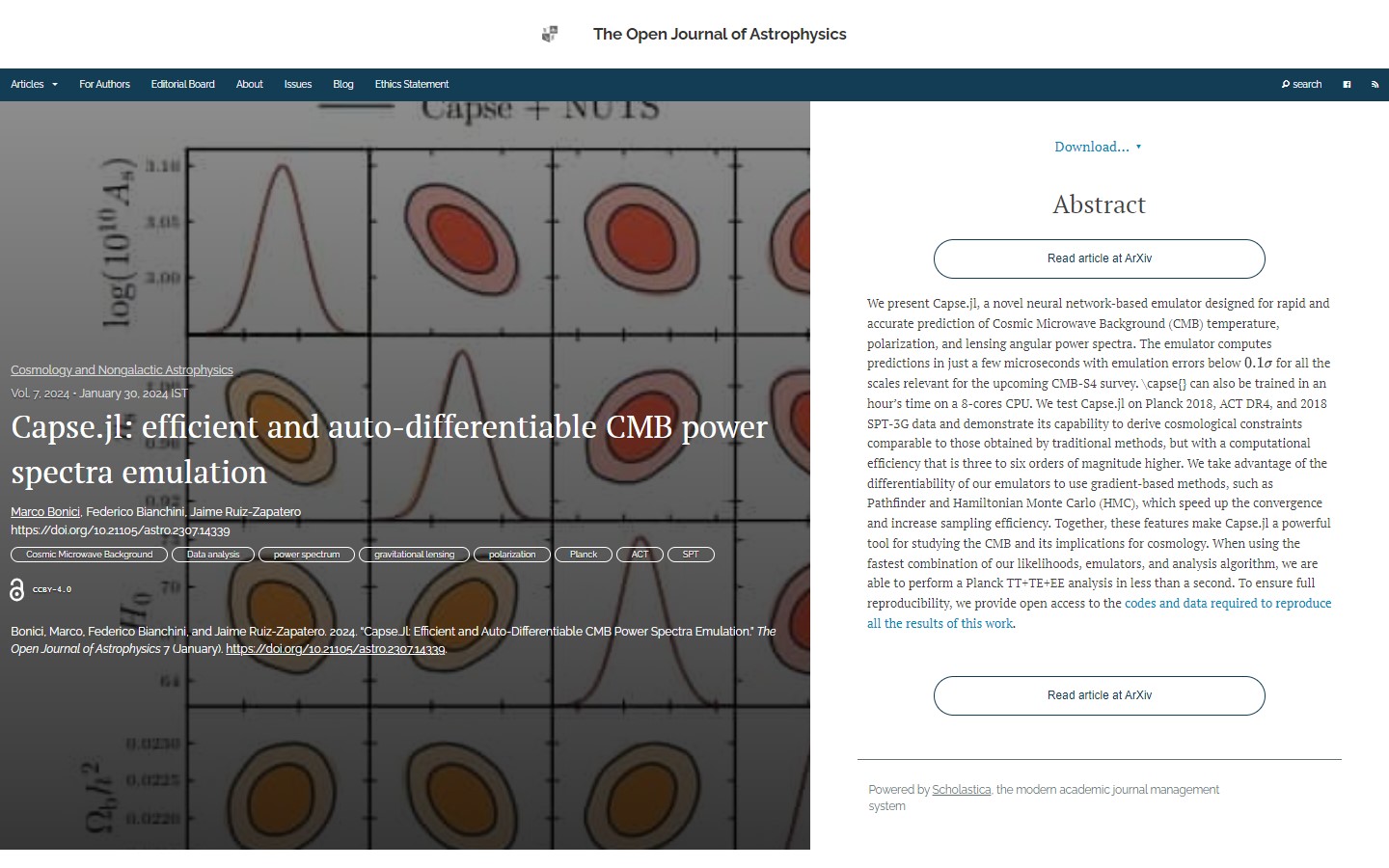
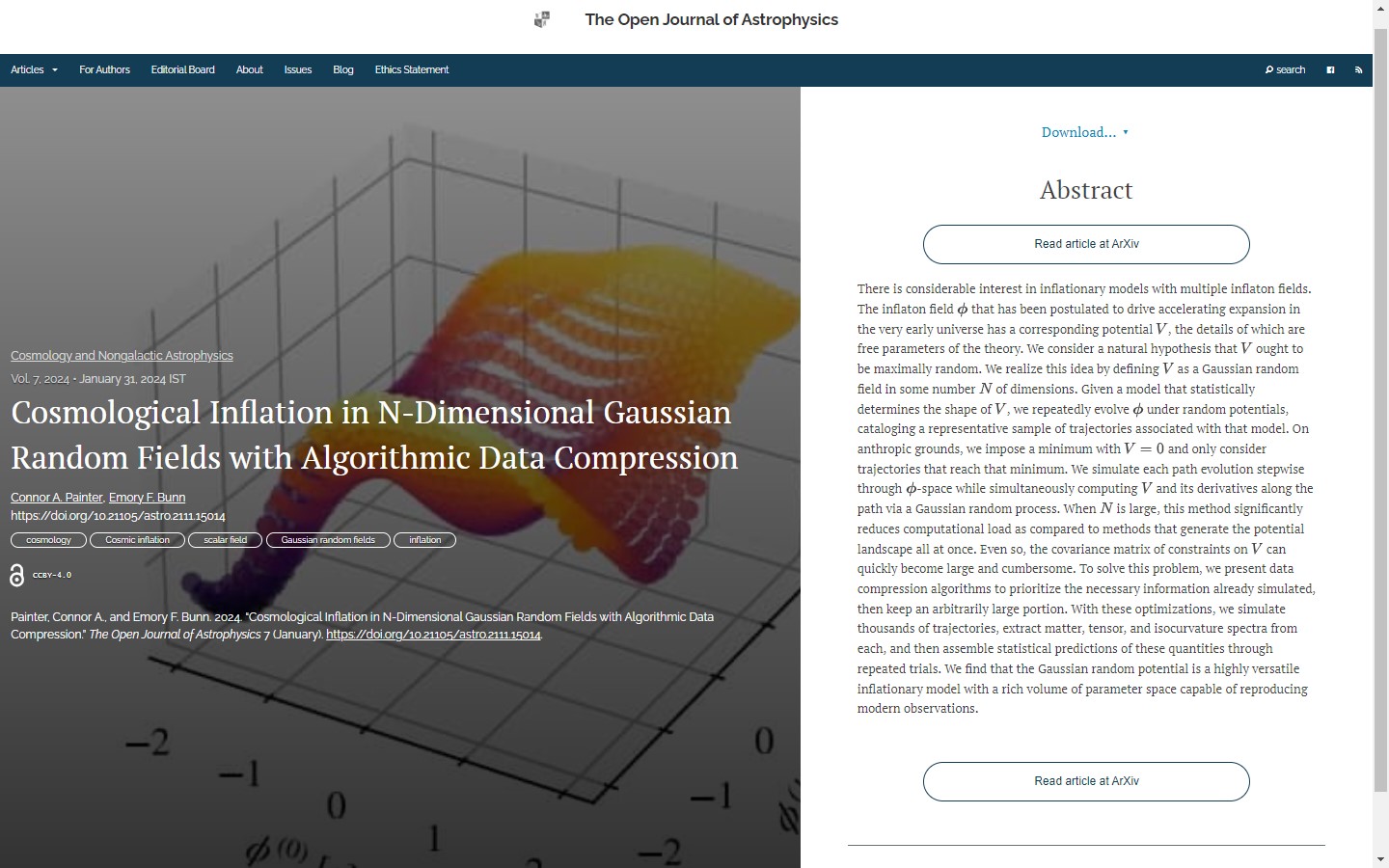
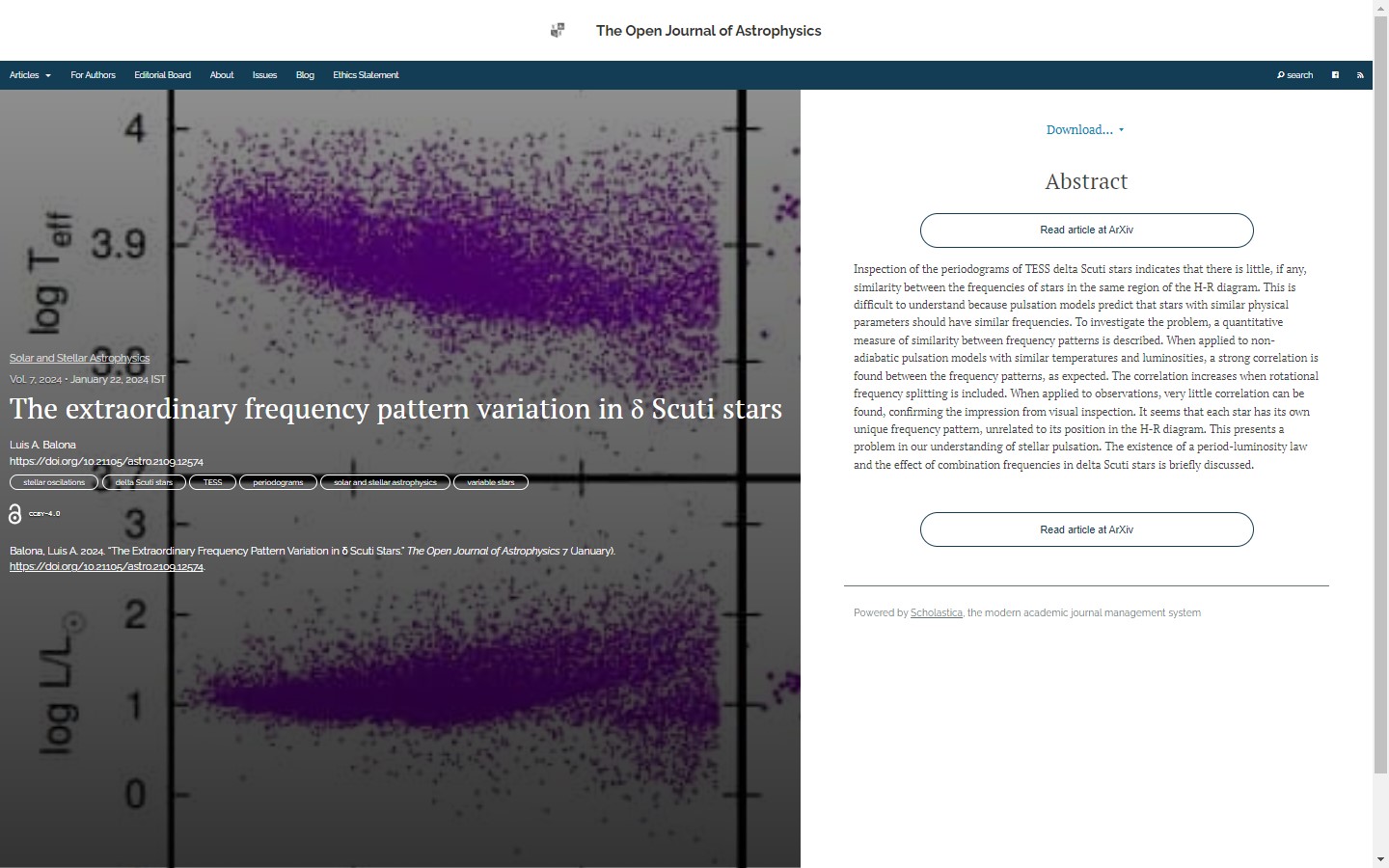
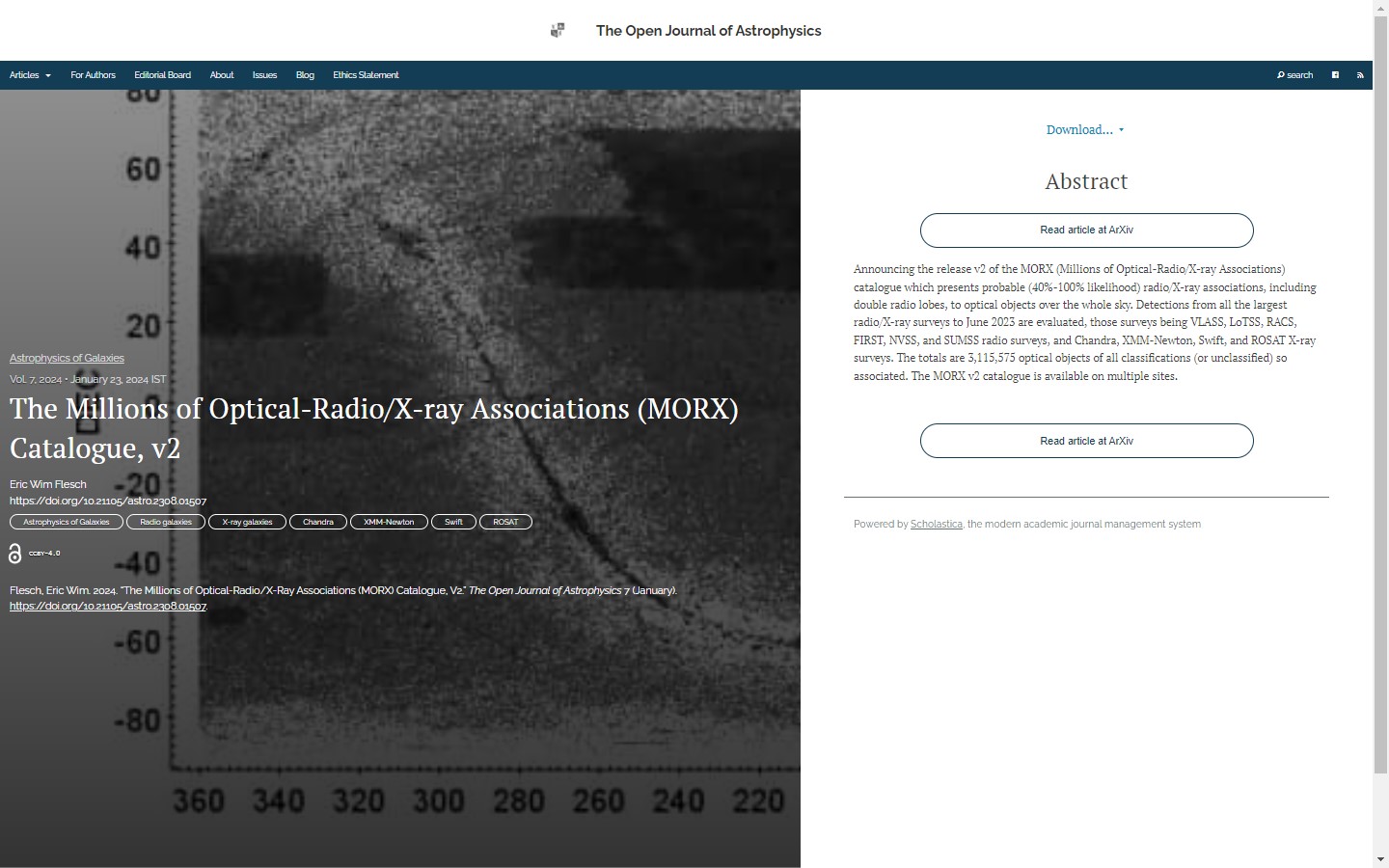
Meanwhile, the new regime at MNRAS (and possibly its acceptance on Scopus) have led to steadily increasing activity at the Open Journal of Astrophysics. This morning I announced three more papers. I will post about them on here tomorrow. Diamond Open Access is the way forward. It’s just a question of time before everyone realizes it.

IOAP Diamond Open Access Awards 2024

Posted in Open Access with tags , , , , , , , , , , on January 17, 2024 by telescoper

A week or so before Christmas I posted about a new organization called Irish Open Access Publishers whose mission statement is as follows:

Irish Open Access Publishers (IOAP) is a community of practice driven by Irish open access publishers for Irish open access publishers.  The IOAP promotes engagement with the Diamond Open Access publishing model (free to publish and free to read) as well as indexing on the Directory of Open Access Journals and the Directory of Open Access Books. The aim of this dynamic community of practice is to promote publishing activity that is free of pay walls and publication embargoes to further the dissemination of high quality scholarly output to all in society.

These aims are laudable and I support them wholeheartedly. I should also mention that the Open Journal of Astrophysics is listed in the Directory of Open Access Journals here, where you will find details of all the papers we have published so far. This index is all part of the service. We have also been accepted for inclusion in Scopus, in case that matters to you.

Anyway, I thought I would remind readers of this blog (both of them) about the fact that the IOAP is offering a new set of awards, for which nominations are now open:

(Unfortunately the links in the above image are not clickable, but you can the award details here…)

Nominations for the first three categories are by self-nomination only. I will of course, on behalf of Maynooth Academic Publishing, the Editorial Board, the authors, and everyone who has helped behind the scenes, be nominating the Open Journal of Astrophysics.

Nominations for the final category, Outstanding Contribution to the OA Field are described thus:

Category 4 welcomes third party as well as self nominations from academics, students, librarians, research managers, academic leaders, publishers and other stakeholders across further and higher education for an individual who has made an outstanding contribution to open access publishing in Ireland. Nominations from scholarly societies and other scholarly organisations are also welcome. Nominations for individuals based in Northern Ireland are also invited.

Self nominations are restricted to individuals based in Ireland including Northern Ireland. Third party nominations are invited from individuals based in Ireland including Northern Ireland as well as individuals based overseas. All third party nominations must be for individuals practising in the field of open access publishing in Ireland including Northern Ireland solely.

Notice that nominations are not restricted to individuals based in Ireland. So, wherever you are, if you can think of any individual based in Ireland who has done enough to merit being described as having made an “outstanding contribution”, perhaps not only for being a long-term advocate of Diamond Open Access but also for setting up and being Managing Editor of a successful Diamond Open Access journal in the field of astrophysics, then please feel free to nominate me them. I hope you get the message. If you want subtle, you’ve come to the wrong place!

The nomination form is here. The closing date for nominations is 1st February 2024.

Scopus Listing for the Open Journal of Astrophysics

Posted in Open Access with tags , , , on January 6, 2024 by telescoper

I have been asked a number of times about whether or not the Open Journal of Astrophysics will be listed on Scopus. For myself,  I couldn’t care less about getting listed by Scopus – which is a profit-making service run by publishing giant Elsevier as a gate-keeper for the academic publishing industry. I have, however, heard from many individuals around the world that their research managers and the like actually take it seriously, to the extent that a journal isn’t counted as a journal unless Scopus tells them that is the case.

I’m well aware that hanging the “Approved by Elsevier” tag on the Open Journal of Astrophysics would open us up to the accusation that we collaborating with the enemy. I fully understand that moral objection, but I had to weigh it up against the serious practical difficulties facing researchers who are being forced to pay for Gold Open Access as a result of the absence of OJAp from the Scopus approved list. In the end I decided to apply, but to continue to argue against the use of Scopus and related proprietary databases by research institutions as I consider them just as corrosive as league tables.

Last November, therefore, I decided to hold my nose and apply for Scopus listing; I blogged about this here. Just to clarify, although institutions and organizations pay to subscribe to Scopus, a journal doesn’t have to pay to be listed. The application process, though free, is nevertheless rather time-consuming and I was told to expect the process to take several months. I submitted the application on 21st November 2023.

I was quite surprised yesterday (5th January 2024) to receive an email from Scopus containing the following:

The Scopus Content Selection & Advisory Board (CSAB) has reviewed your application and approved it for coverage.

For your information, the reviewer comments are copied below:

+ The articles are consistently of high academic quality, consistent with the journal’s stated aims.
+ This title is a very welcome addition to the literature.

So there we are. The Open Journal of Astrophysics will indeed be listed on Scopus, though I’m told it might take a few weeks to appear as such. From now on, whenever anyone asks me about this I have a definite answer!

This has, however, reminded me to re-apply for listing by Clarivate. I did apply for this way back in March but the application was rejected on the grounds that we weren’t publishing enough papers (although we publish more papers than many of the journals currently listed by them). Since then our rate of publication has increased substantially, however, so I don’t think they can raise the same objection again.

It will be interesting to see if listing by Scopus makes any difference to the rate of submissions and the geographical distribution of the authors concerned. My guess is it probably will, but not immediately. We’ll just have to wait and see?

Here’s to a Diamond New Year…

Posted in Open Access with tags , , on January 1, 2024 by telescoper

I know it’s New Year’s Day but I am going to start 2024 the way I mean to continue it, i.e. by banging on about Diamond Open Access. In that vein I am delighted to share a link to a discussion document (by Pierre Mounier & Johan Rooryck) that echoes much of what I have been saying on the subject for quite a while (e.g. here). In my view the ratio of talk to action has been far too high in this context, and the good thing about this document is that it makes concrete practical proposals for a global infrastructure that could support the transition to Diamond Open Access worldwide:

The infrastructure will take the shape of a four-level federation, with  each level having its own responsibilities to achieve the shared goal of strengthening diamond open access as a leading scholarly communication model. These levels and their responsibilities are presented in this paper, initiating  a discussion with diamond OA communities and other stakeholders in the research landscape. We invite you to come forward and join this discussion.

You can read more here.

Here is a nice illustration:

A global system of federated diamond Open Access repositories would enable a truly innovative and equitable ecosystem for scholarly publication and realize the vision of research as a global public good, which is what it should be. I think Ireland is in a good position to play a leading role in this revolution, actually, as there is much going on in this respect (e.g. in the construction of a national peer review platform).

P.S. I think that a federated system of social media for public institutions is the way to go, too.

IOAP Diamond Open Access Awards 2024

Posted in Open Access with tags , , , , , , , , on December 18, 2023 by telescoper

Last week I found out about a new organization called Irish Open Access Publishers whose mission statement is as follows:

Irish Open Access Publishers (IOAP) is a community of practice driven by Irish open access publishers for Irish open access publishers.  The IOAP promotes engagement with the Diamond Open Access publishing model (free to publish and free to read) as well as indexing on the Directory of Open Access Journals and the Directory of Open Access Books. The aim of this dynamic community of practice is to promote publishing activity that is free of pay walls and publication embargoes to further the dissemination of high quality scholarly output to all in society.

These aims are laudable and I support them wholeheartedly. I should also mention that the Open Journal of Astrophysics is listed in the Directory of Open Access Journals here, where you will find details of all the papers we have published so far. This index is all part of the service.

The reason I found out about the existence of IOAP is that they are offering a new set of awards, for which nominations are now open:

(Unfortunately the links in the above image are not clickable, but you can the award details here…)

Nominations for the first three categories are by self-nomination only. I will of course, on behalf of Maynooth Academic Publishing, the Editorial Board, the authors, and everyone who has helped behind the scenes, be nominating the Open Journal of Astrophysics.

Nominations for the final category, Outstanding Contribution to the OA Field are described thus:

Category 4 welcomes third party as well as self nominations from academics, students, librarians, research managers, academic leaders, publishers and other stakeholders across further and higher education for an individual who has made an outstanding contribution to open access publishing in Ireland. Nominations from scholarly societies and other scholarly organisations are also welcome. Nominations for individuals based in Northern Ireland are also invited.

Self nominations are restricted to individuals based in Ireland including Northern Ireland. Third party nominations are invited from individuals based in Ireland including Northern Ireland as well as individuals based overseas. All third party nominations must be for individuals practising in the field of open access publishing in Ireland including Northern Ireland solely.

Notice that nominations are not restricted to individuals based in Ireland. So, wherever you are, if you can think of any individual based in Ireland who has done enough to merit being described as having made an “outstanding contribution”, perhaps not only for being a long-term advocate of Diamond Open Access but also for setting up and being Managing Editor of a successful Diamond Open Access journal in the field of astrophysics, then please feel free to nominate me them. I hope you get the message. If you want subtle, you’ve come to the wrong place!

The nomination form is here. The closing date for nominations is 1st February 2024.

Retractions and Resignations

Posted in Open Access with tags , , , , , , , , on December 16, 2023 by telescoper

I saw an article this week in Nature that revealed that more than 10,000 research papers have been retracted so far 2023. The actual number is probably much higher than that, as this is just the fraudulent papers that have been found out. Over 80% of the papers mentioned in the article were published by Hindawi, a known predatory publisher that specializes in Gold Open Access journals that charge Article Processing Charges. Hindawi is owned by Wiley but the brand has become so toxic that Wiley no longer wants to use the name. Presumably it still wants the profits.

(Another bit of news this week makes me think that Hindawi might be the academic publishing equivalent of Tesla…)

Here’s a figure showing how the number of retracted research articles has increased over time:

It has always seemed to me that the shift to “Gold” Open Access in which authors pay to have their work published would lead to a decrease in editorial standards. Since the publisher’s income comes from APCs, the more papers they publish the more money they get. This is another reason Diamond Open Access run on a not-for-profit basis with no fees for either authors or readers is a much better model.

At least some academics are taking a stand. Retraction Watch maintains a list of journals whose editors who have resigned – sometimes en masse from the same journal – in response to the imposition of dodgy practices by their publishers. Take the Journal of Geometric Mechanics, for example. The entire Editorial Board of this journal resigned because of pressure from above to increase “output” (i.e. profits) by lowering academic standards.

This is just a start, of course, but I don’t think it will take long for academic community to accept that the this publishing model is rotten to the core and embraces the only really viable and sustainable alternative.

Two New Publications at the Open Journal of Astrophysics

Posted in OJAp Papers, Open Access, The Universe and Stuff with tags , , , , , on December 14, 2023 by telescoper

As anticipated a couple of days ago, it’s now possible to announce another couple of new papers at the Open Journal of Astrophysics. These papers take us up to a total of 49  in Volume 6 (2023) and 114 in total since we started publishing.

It would be nice if we could make it to 50 in Volume 6 (2023), but I have already decided to close the publishing platform from 22nd December until 5th January (inclusive), so there there isn’t much time to get the single needed for our half-century.  While we will not be publishing new papers during this closure, the peer review platform will remain open for submission of new and revised manuscripts and the editorial processes will continue.

Whether or not we make 50 this year, it is worth remarking that 49 is already a significant figure, as it corresponds to the total number of papers we published in the previous three years: 15 (2020); 17 (2021); and 17 (2022). Things are definitely looking up!

Anyway, the first paper of the most recent pair – published on December 8th – is “The Million Quasars (Milliquas) Catalogue, v8”; its primary classification is Astrophysics of Galaxies and the author is Eric Wim Flesch from New Zealand. The Milliquas catalogue includes quasars from the literature to 30 June 2023, including quasars from the DESI-EDR and SDSS-DR18Q surveys.

Here is a screen grab of the overlay which includes the abstract:
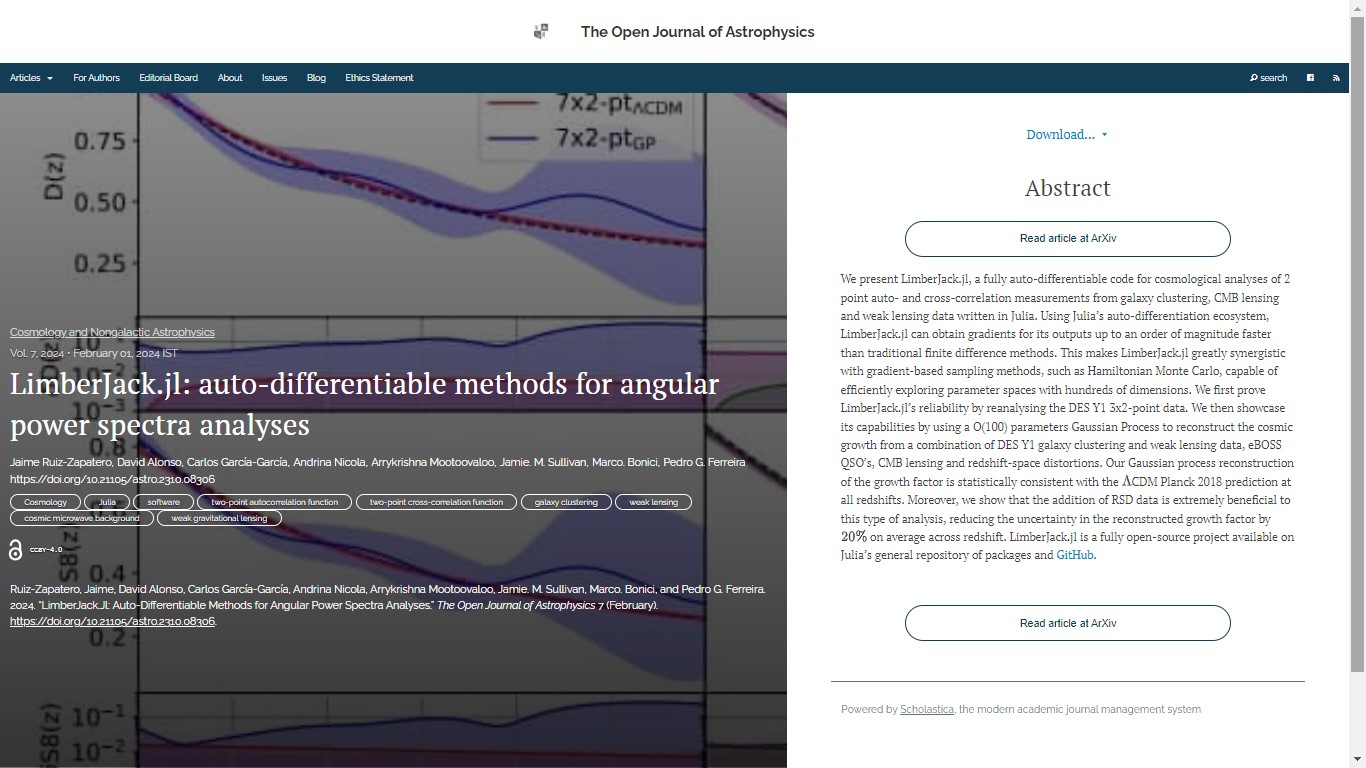
You can click on the image of the overlay to make it larger should you wish to do so. You can find the officially accepted version of the paper on the arXiv here.

The second paper was published on 11th December 2023 and is also in the folder marked Astrophysics of Galaxies.

The authors are all from various institutions in the USA:  Michael Grudić (Carnegie Observatories), Stella Offner (University of Texas at Austin); Dávid Guszejnov (Harvard);  Claude-André Faucher-Giguère (Northwestern University); and Philip F. Hopkins (Caltech).  The paper presents a comparison of full radiative magnetohydrodynamics simulations of the formation of star clusters with simple stochastic modelling showing the limitations of the latter.

Here is a screen grab of the overlay which includes the abstract:
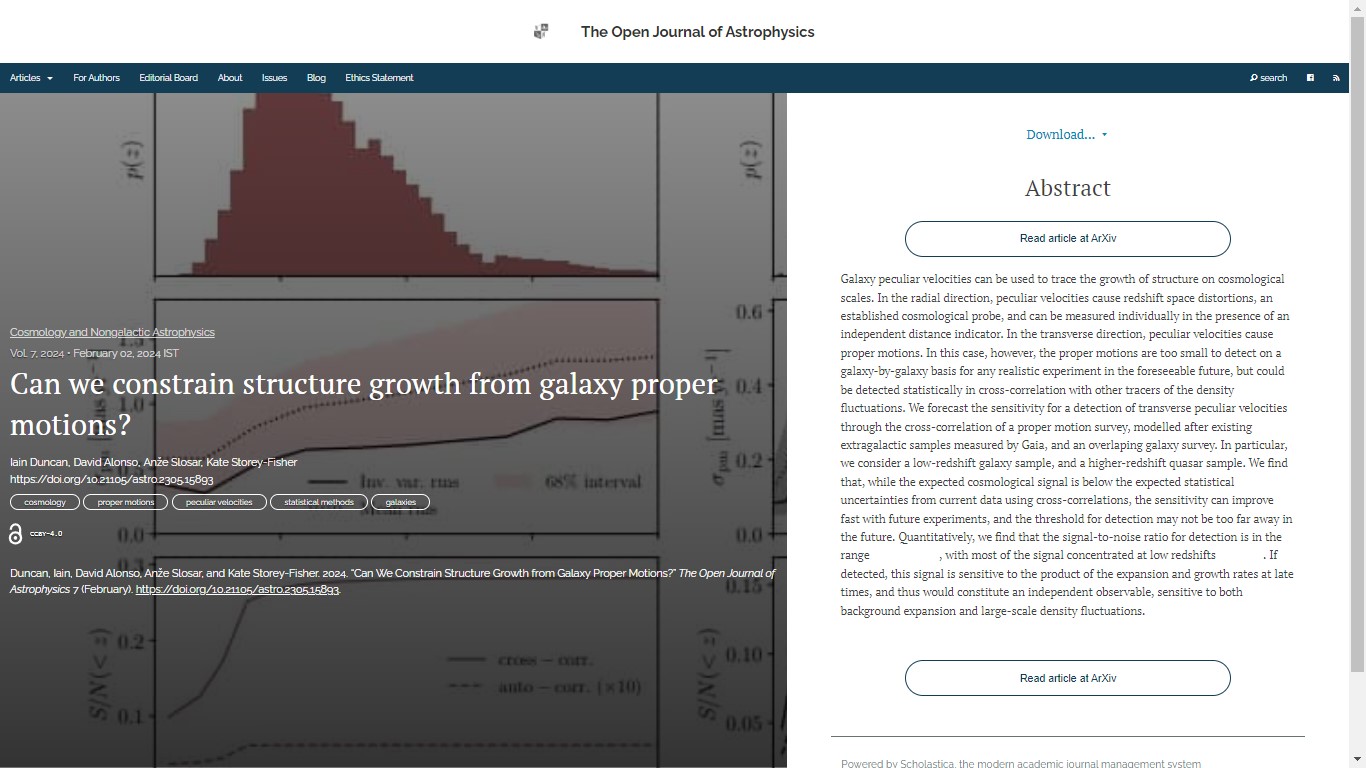


You can click on the image of the overlay to make it larger should you wish to do so. You can find the officially accepted version of the paper on the arXiv here.

New Publication at the Open Journal of Astrophysics

Posted in OJAp Papers, Open Access, The Universe and Stuff with tags , , , , on December 12, 2023 by telescoper

I was doing some work on the Open Journal of Astrophysics site and realized that there is a paper we published last week that I haven’t advertised on here yet, so I’m remedying that now.

The paper in question is the 47th so far in Volume 6 (2023)  and it’s the 112th altogether. This one was actually published on Tuesday December 5th. Two further papers are imminent; I’m just waiting for their metadata to be registered with Crossref.

The title of this one is “The SPHINX Public Data Release: Forward Modelling High-Redshift JWST Observations with Cosmological Radiation Hydrodynamics Simulations” and it represents  public data release of Sphinx20, a full box cosmological radiation-hydrodynamics simulation that provides a statistical sample of galaxies for comparison with those observed by JWST. It is in the folder marked Astrophysics of Galaxies.

There are 10 authors: Harley Katz (Oxford, UK); Joki Rosdahl (Lyon, France); Taysun Kimm (Seoul, Korea); Jeremy Blaizot (Lyon, France);  Nicholas Choustikov (Oxford, UK); Marion Farcy  and Thibault Garel (Geneva, Switzerland);  Martin G. Haehnelt (Cambridge, UK); Leo Michel-Dansac (Lyon, France); and Pierre Ocvirk (Strasbourg, France).

Here is the overlay of the paper containing the abstract:


You can click on the image of the overlay to make it larger should you wish to do so. You can find the officially accepted version of the paper on the arXiv here.

Bravo, Sorbonne University!

Posted in Education, Open Access with tags , , , on December 10, 2023 by telescoper

Here’s some good news for advocates of open research. Sorbonne University (Paris) has made an important announcement. I quote:

Sorbonne University has been deeply committed to the promotion and the development of  open science for many years. According to its commitment to open research information, it has decided to discontinue its subscription to the Web of Science publication database and Clarivate bibliometric tools in 2024. By resolutely abandoning the use of proprietary bibliometric products, it is opening the way for open, free and participative tools.

That’s the way to do it! Such a decision requires real intellectual leadership, so I’m not sure how many other universities will follow suit. Those paralyzed by managerialism probably won’t.

The Sorbonne statement goes on to explain:

This decision is in line with the University’s overall policy of openness, and it is now working to consolidate a sustainable, international alternative, in particular by using OpenAlex.

Both Web of Science and Clarivate are, of course, fronts for the academic publishing industry and are just as pointless, as they sell to subscribers a biased subset of information which is already in the public domain through services such as CrossRef.

While I’m congratulating Sorbonne for its leadership, I should do likewise (though in a different context) for Utrecht University, which refused to participate in this year’s Times Higher World Rankings. Among their reasons are

  • Rankings put too much stress on scoring and competition, while we want to focus on collaboration and open science.
  • The makers of the rankings use data and methods that are highly questionable, research shows. 

I hope more institutions join the fight back against the box-tickers in this regard too, although I’m not particularly hopeful here either.

New Publication at the Open Journal of Astrophysics

Posted in OJAp Papers, Open Access, The Universe and Stuff with tags , , , , , , on December 1, 2023 by telescoper

It’s Friday and I thought I’d take  the opportunity before the weekend to announce yet another new paper at the Open Journal of Astrophysics.

The latest paper is the 46th so far in Volume 6 (2023) – just four to go for a half-century – and it’s the 111th altogether. This one was actually published on Wednesday November 29th.

The title is “Optimization and Quality Assessment of Baryon Pasting for Intracluster Gas using the Borg Cube Simulation” and it presents an algorithm for adding baryons to gravity-only simulations via a “pasting” approach. It is in the folder marked Cosmology and Nongalactic Astrophysics.

There are 8 authors: F. Kéruzoré;  L. Bleem; M. Buehlmann;  J.D. Emberson; N. Frontiere; S. Habib; K. Heitmann; and P. Larsen;  all of them based at the Argonne National Laboratory, in Illinois (USA).

Here is the overlay of the paper containing the abstract:


You can click on the image of the overlay to make it larger should you wish to do so. You can find the officially accepted version of the paper on the arXiv here.