Well, Maynooth University may well be still (partially) closed as a result of the Covid-19 pandemic but the The Open Journal of Astrophysics is definitely fully open.
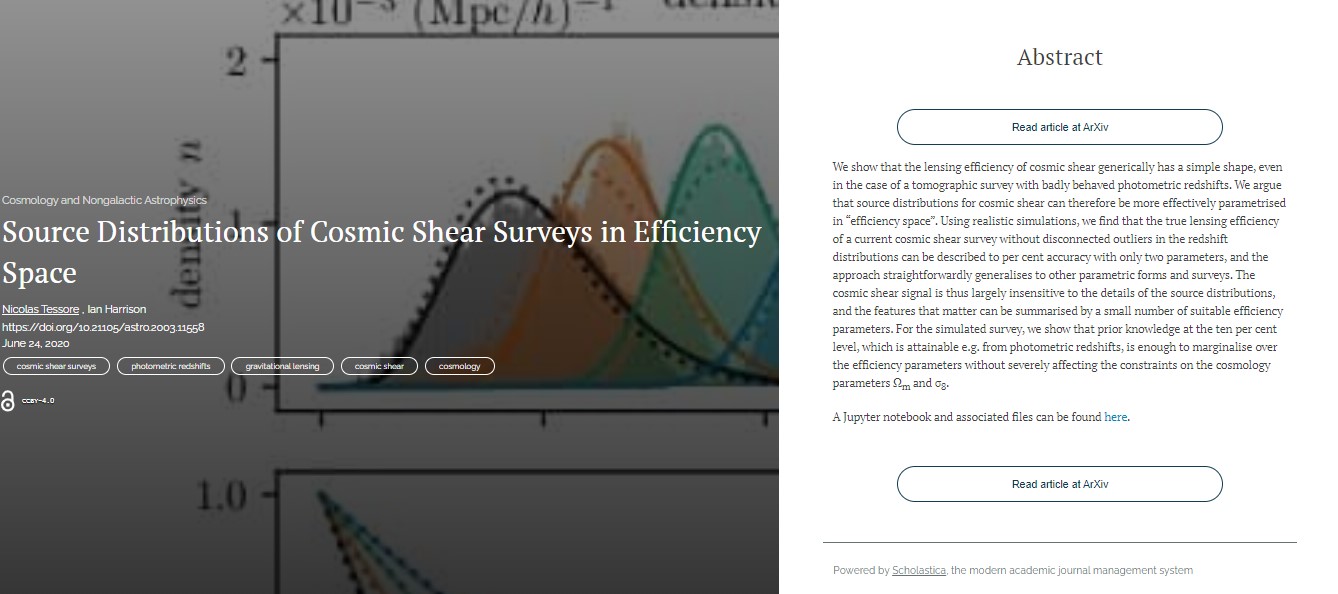
In fact we have just published another paper! This one is in the Astrophysics of Galaxies section and is entitled A Bayesian Approach to the Vertical Structure of the Disk of the Milky Way. The authors are Phillip S Dobbie and Stephen J Warren of Imperial College, London.
I’d like to take this opportunity to thank the Editorial team and various referees for their efforts in keeping the Open Journal of Astrophysics going in these difficult times.
The decision is in response to falling demand for the printed version which has made it no longer economically viable profitable to continue producing it. I choose the ‘profitable’ because the prime purpose of MNRAS is no longer the dissemination of scientific results but the generation of income to fund other activities of the Royal Astronomical Society. Despite the move to the much cheaper digital-only publishing mode, the annual cost of an institutional subscription to this journal is over $10,000. Most of that is goes as profit to Oxford University Press (the actual publisher) and to the Royal Astronomical Society.
Much of what the RAS does with this income is laudible of course, but I don’t think it is fair to inflate institutional subscription costs in order to fund it. University libraries are meant to provide access to research, not to act as cash cows to be milked by learned societies. The Royal Astronomical Society society isn’t the only learned society to use its journals this way, nor is it the most exploitative of those that do, but I believe the approach is indefensible.
My very first research paper was published in MNRAS way back in 1986 and I’ve published many others there over the years, so it’s with a certain amount of nostalgia that I look back on the old style journal. As. Fellow of the Royal Astronomical Society I used to get my own copy in the post at a discounted rate but had to stop and dispose of the old ones when I moved to Nottingham as they took up too much room.
My own belief is that it’s not only the print edition that has had its day but the whole idea of a traditional academic journal.
I’ll just take this opportunity to remind you that The Open Journal of Astrophysics publishes papers (online only) in all the areas of Astrophysics covered by MNRAS, and more, but is entirely free both for authors and readers.
Writing scientific papers and publishing them in academic journals is an essential part of the activity of a researcher. ‘Publish or perish’ is truer now than ever, and an extensive publication list is essential for anyone wanting to have a career in science.
But what are these papers actually for? What purpose do they serve?
I can think of two main purposes (which aren’t entirely mutually exclusive): one is to disseminate knowledge and ideas; the other is to confer status on the author(s) .
The academic journal began hundreds of years ago with the aim of achieving the former through distribution of articles in print form. Nowadays the distribution of research results is achieved much less expensively largely through online means. Nevertheless, journals still exist (largely, as I see it, to provide editorial input and organise peer review) .
Alongside this there is the practice of using articles as a measure of the ‘quality’ of an author. Papers in certain ‘prestigious’ ‘high impact’ journals are deemed important because they are indicators of status, like epaulettes on a uniform, and bibliometric data, especially citation counts, often seem to be more important than the articles themselves.
I thought it was just me getting cynical in my old age but a number of younger scientists I know have told me that the only reason they can see for writing papers is because you need to do it to get a job. There is no notion of disseminating knowledge just the need to establish priority and elevate oneself in the pecking order. In other words the original purpose of scientific publications has largely been lost.
I thought I’d test this by doing a (totally unscientific) poll here to see how my several readers think about this.
It was recently drawn to my attention that UK-based astronomers and astrophysicists now have to pay a charge of €100 per page (!) to publish in the journal Astronomy & Astrophysics (usually known as A&A for short). See their page charges information for details.
Contrary to popular belief, A&A only waives page charges for authors from countries who are sponsors of A&A, not all countries who are members of the European Southern Observatory (ESO) project. Although the United Kingdom is a member of ESO, it is not and never has been a sponsor of A&A: see the list of sponsoring countries and their representatives here .
Until recently, however, UK authors did have their page charges waived on what seems to have been an ex gratia basis. For some reason, that exception has now apparently been removed.
UPDATE 1: It should have occurred to me that that this also applies to authors from Ireland.
UPDATE 2: Apparently the liability for page charges is determined by the nationality of the first author. I had previously thought that if any of the authors belonged to a sponsoring country then charges would be waived.
Meanwhile, the Open Journal of Astrophysics publishes entirely for free and we are committed to continuing that way. You know what to do.
I’m delighted to be able to pass on the news released yesterday that the 2020 Gruber Prize for Cosmology has been awarded to Lars Hernquist (left) and Volker Springel (right) for their work on numerical simulations.
The citation reads:
The Gruber Foundation is pleased to present the 2020 Cosmology Prize to Lars Hernquist and Volker Springel for their transformative work on structure formation in the universe, and development of numerical algorithms and community codes further used by many other researchers to significantly advance the field. The contributions of Hernquist and Springel have led to profound insights spanning billions of years of cosmic evolution, including simulations of the growth of early density fluctuations through to present-day galaxies, the influence of galaxy mergers on star formation, and the close coevolution of supermassive black holes with their host galaxies.
I’ll just add that as well as being enormously influential in purely scientific terms both these scientists have contributed to the culture of open science through making codes (such as GADGET) freely available to the community.
Heartiest congratulations to Volker Springel and Lars Hernquist on their very well deserved award.
In fact we have just published another paper! This one is called Discrete Chi-square Method for Detecting Many Signals and the author is Lauri Jetsu of the University of Helsinki in Finland.
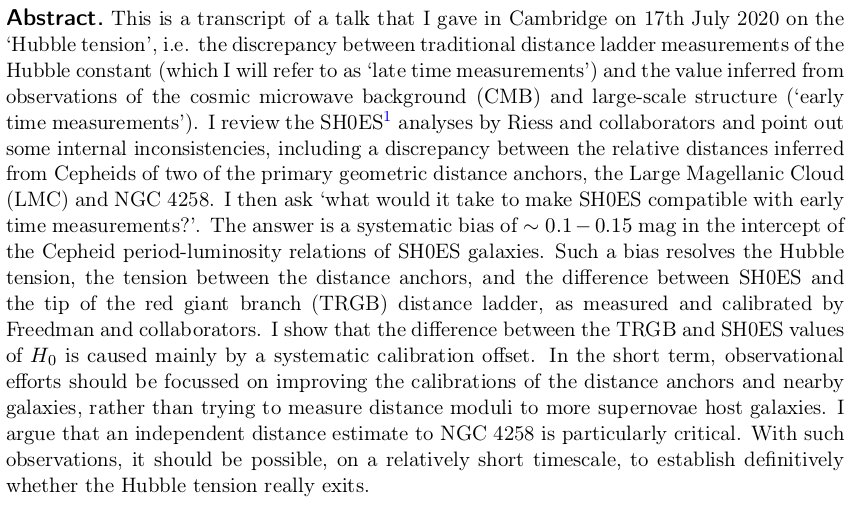
Here is a grab of the overlay as it appears on my phone:
I’d like to take this opportunity to thank the Editorial team and various referees for their efforts in keeping the Open Journal of Astrophysics going in these difficult times.
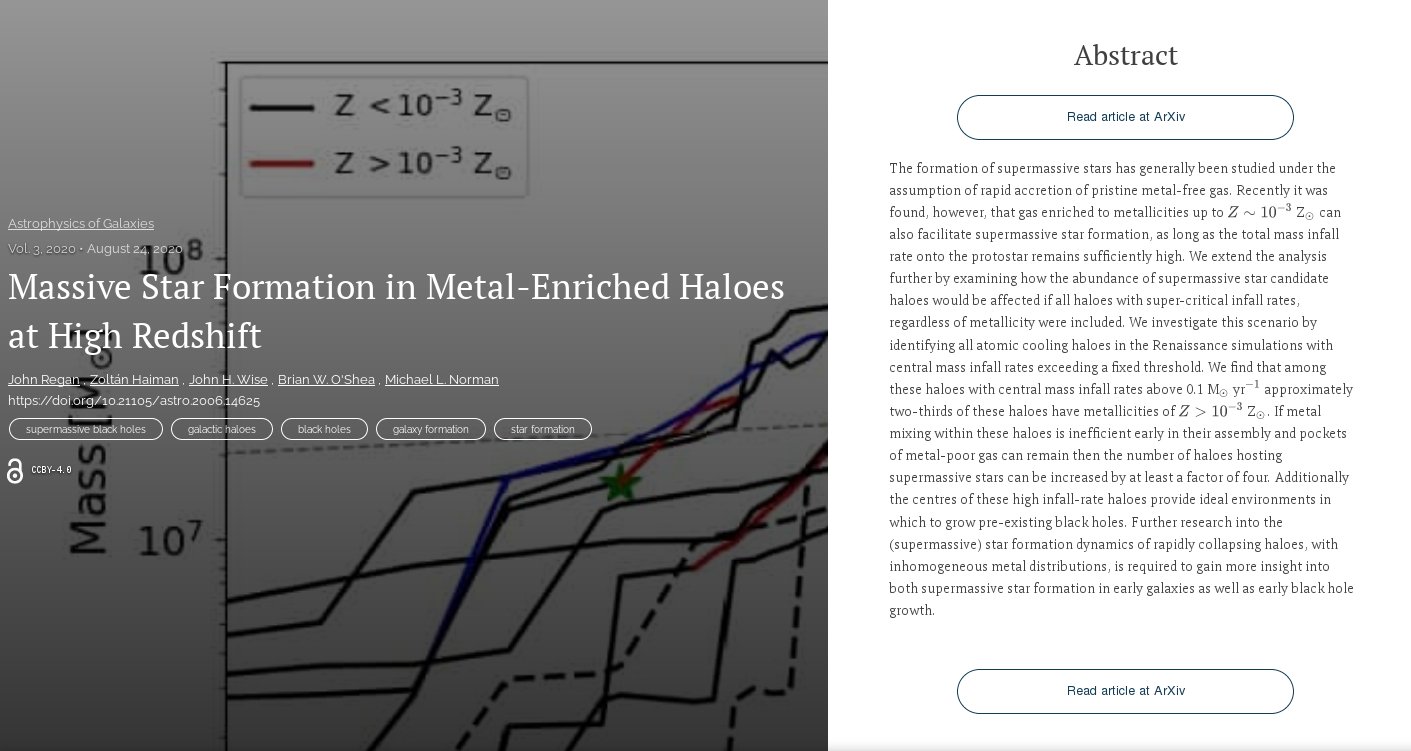
In fact we have just published another paper! This one is called Halo Spins from Primordial Inner Motions and the first author is Mark Neyrinck (based in Bilbao). The other authors are Miguel Aragon-Calvo (based in Mexico), Bridget Falck and Alex Szalay (based in the USA) and Jie Wang (China).
I’ve been a bit busy with Computational Physics lectures and labs today so I couldn’t make it to the launch event of a new online Open Access Journal by Maynooth Academic Publishing, who also publish the Open Journal of Astrophysics. The new publication is the Journal of Military History and Defence Studies and its website is here.
Here is the description of the journal:
The Journal of Military History and Defence Studies is a bi-annual peer-reviewed open access online journal that publishers original research and contributions in military history and defence studies. In addition to publishing work by established authors and scholars, the journal has the particular aim of making available to a wide audience the best work completed by postgraduate students studying within these fields at Maynooth University, the Irish Military College and other similar institutions. The journal also aims to publish special editions that make available original research presented at conferences, research seminars etc. As the title suggests, the journal focuses on military history and defence studies, taking a broad view of these subject areas to include the history of war and of militaries, and also of the impact of these on wider society, in addition to the study of war, strategy, security and military organisation today and into the future.
You will see from the website that, as well as catering for a different discipline, this one has a look and feel that is quite different from that of the Open Journal of Astrophysics , but the ultimate aim of both journals is the same, to make high quality research available free of charge to the largest possible audience.
I thought I would give an update with some bibliometric information about the 12 papers published by the Open Journal of Astrophysics in 2019. The NASA/ADS system has been struggling to tally the citations to a couple of our papers but this issue has now been resolved. According to this source the total number of citations for these papers is 532 (as of today). This number is dominated by one particular paper which has 443 citations according to NASA/ADS. Excluding this paper gives an average number of citations for the remaining 11 of 7.4.
I’ll take this opportunity to re-iterate some comments about the Journal Impact Factor. When asked about this my usual response is (a) to repeat the arguments why the impact factor is daft and (b) point out that we have to have been running continuously for at least two years to have an official impact factor anyway.
For those of you who can’t be bothered to look up the definition of an impact factor , for a given year it is basically the sum of the citations for all papers published in the journal over the previous two-year period divided by the total number of papers published in that journal over the same period. It’s therefore the average citations per paper published in a two-year window. The impact factor for 2019 would be defined using data from 2017 and 2018, etc.
The impact factor is prone to the same issue as the simple average I quoted above in that citation statistics are generally heavily skewed and the average can therefore be dragged upwards by a small number of papers with lots of citations (in our case just one).
I stress again we don’t have an Impact Factor as such for the Open Journal. However, for reference (but obviously not comparison) the latest actual impact factors (2018, i.e. based on 2016 and 2017 numbers) for some leading astronomy journals are: Monthly Notices of the Royal Astronomical Society 5.23; Astrophysical Journal 5.58; and Astronomy and Astrophysics 6.21.
My main point, though, is that with so much bibliometric information available at the article level there is no reason whatsoever to pay any attention to crudely aggregated statistics at the journal level. Judge the contents, not the packaging.
The views presented here are personal and not necessarily those of my employer (or anyone else for that matter).
Feel free to comment on any of the posts on this blog but comments may be moderated; anonymous comments and any considered by me to be vexatious and/or abusive and/or defamatory will not be accepted. I do not necessarily endorse, support, sanction, encourage, verify or agree with the opinions or statements of any information or other content in the comments on this site and do not in any way guarantee their accuracy or reliability.