Archive for the Open Access Category

Tuesday at #EAS2025

Posted in Open Access, The Universe and Stuff with tags , , , on June 24, 2025 by telescoper

Today was my first day at EAS 2025 on the nice campus of University College Cork. I managed to register before the first session and found my way around what is clearly a very well organised meeting. They have a very useful app to help attendees navigate both space and time.

I spent a large part of today at a session about the future of scientific publishing,  which was split in two, either side of the morning’s plenary. The first half started with a talk by Selina La Barbera, a representative of EDP Sciences, the publisher of the journal Astronomy and Astrophysics:

It also featured a talk by João Alves, Letters Editor of Astronomy and Astrophysics, and Uta Grothkopf, librarian of the European Southern Observatory. The last talk was full of insights and information. The Q&A was very lively. I was expecting that I might be the one to inject some controversy into the discussion, but I didn’t need to. Issues about the cost of APCs, etc, were raised by others before I got the chance.

Before the plenary, there was time for a group photograph of staff and students from Maynooth:

The Maynooth Contingent

The highlight of the plenary was seeing Licia Verde collect the Jocelyn Bell Burnell Medal on behalf of arXiv, together with Ralph Wijers. They both gave interesting presentations about arXiv too.

Licia, with the EAS Medal she received today.

Back in the special session about publishing, I participated in a panel discussion, which was very lively. On a Zoom  call last week in preparation for this, we were a bit worried that not many people would take part, but in the event the room was full and many people asked questions, including many about OJAp, and the discussion went on outside after the session was finished.  I think it was a very successful session.

Now that the session I was directly involved in is over, I can relax a bit and be free tomorrow to  attend more science sessions, including a couple about Euclid…

EAS 2025 in Cork

Posted in Biographical, Open Access with tags , , , , on June 22, 2025 by telescoper

Tomorrow I’ll be travelling to the fine city of Cork, where I shall be for most of next week, attending the 2025 Annual Meeting of the European Astronomical Society I was planing to travel today, but I have some things to attend to at home tomorrow morning so I won’t get to Cork until late afternoon.

The EAS Annual Meeting is a very large meeting with well over a thousand participants expected. It is held each year in a different European city but, according to tradition, never a capital. Last year it was in Padova (Italy) and the year before that in Kraków (Poland).

I usually enjoy smaller-scale meetings and workshops over these mega-conferences, but I’m looking forward to this one. There will be a strong Maynooth contingent there but I also hope to see some old friends from elsewhere, as well as catching up on some exciting science results.

Talking of science, I am on the Scientific Organizing Committee for this meeting. The programme is very large and diverse and there were a few headaches on the way, but nothing compared to the logistical challenges facing the local organizers; they will probably reach peak stress levels ahead of the opening of the meeting, but I’m sure everything will go well. The Irish National Astronomy Meeting (INAM) was actually held in Cork in 2023. Although a much smaller meeting than EAS, the experience of running that will probably have helped the organizers.

I’m not actually giving a talk at EAS but I will be participating in a panel discussion in a special session on The Future of Scientific Publishing: Strategies and Challenges for Astronomy on Tuesday 24th June. When I saw the initial announcement for this special session, I was was concerned that it would be entirely dominated by representatives of the journal Astronomy & Astrophysics and their publisher EDP Sciences. The first session (9.00 to 10.30) titled “SCIENCE PUBLISHING TODAY AND TOMORROW” is still like that, but the panel discussion in the second session (13.15 to 14.45) “SCIENCE PUBLISHING: A COMMUNITY’S VIEW” is a bit more balanced than that, with a representatives of NASA/ADS and the European Southern Observatory (among others). If I’m given an opportunity to get a word in, I’ll be arguing that traditional journals are unnecessary and obsolete.

Weekly Update from the Open Journal of Astrophysics – 20/06/2025

Posted in OJAp Papers, Open Access, The Universe and Stuff with tags , , , , , , , , , , , , , , , on June 20, 2025 by telescoper

Yesterday (Thursday 19th June 2025) was a national holiday in the USA, which means that no new papers were announced on arXiv today (Friday 20th June). I have therefore decided to bring forwarded the usual weekly update of papers published at the Open Journal of Astrophysics by a day. Since the last update we have published three new papers, which brings the number in Volume 8 (2025) up to 74, and the total so far published by OJAp  is now up to 309.

The three papers published this week, with their overlays, are as follows. All three were published on Tuesday, June 17th 2025. You can click on the images of the overlays to make them larger should you wish to do so.

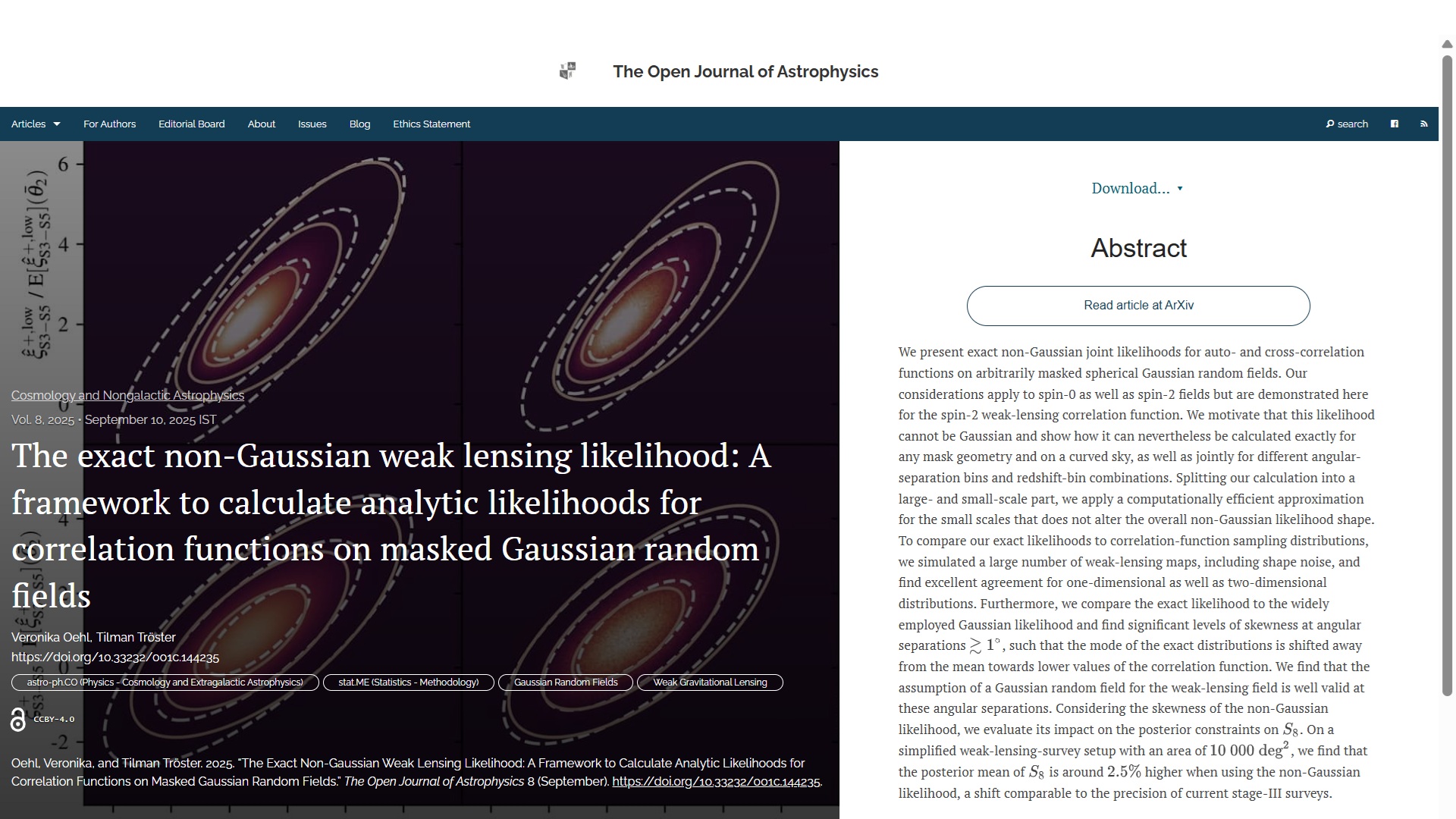
The first paper to report is “Illuminating the Physics of Dark Energy with the Discovery Simulations” by Gillian D. Beltz-Mohrmann (Argonne National Laboratory, USA) and 12 others based in the USA and Spain. This describes new high-resolution cosmological simulations providing a testbed for alternative cosmological probes that may offer additional constraining power beyond Baryon Accoustic Oscillations. It is filed in the folder marked Cosmology and NonGalactic Astrophysics.

The overlay is here:

You can read the final accepted version on arXiv here.

The second paper is in the folder marked Astrophysics of Galaxies. It is “LIGHTS. The extended point spread functions of the LIGHTS survey at the LBT” by Nafise Sedighi (Instituto de Astrofísica de Canarias, Spain) and 15 others based in Spain, USA, Iran, Italy and the UK. It describes the procedure used to construct the extended Point Spread Functions (PSFs) of the LIGHTS survey in images taken with the Large Binocular Cameras (LBCs) of the Large Binocular Telescope (LBT).

The overlay is here:


You can find the officially-accepted version of the paper on arXiv here.

Finally this week we have “Fast radio bursts as a probe of gravity on cosmological scales” by Dennis Neumann (Leiden University, Netherlands), Robert Reischke (Universität Bonn, Germany), Steffen Hagstotz (Ludwig-Maximilians Universität München, Germany) and Hendrik Hildebrandt (Ruhr University Bochum, Germany). This is about using dispersion measures derived from Fast Radio Bursts (FRBs) in combination with cosmic shear to investigate modified gravity theories, specifically Horndeski gravity. It is in the folder marked Cosmology and NonGalactic Astrophysics.

The overlay is here:

You can find the officially-accepted version on arXiv here.

That’s all the papers for this week. I’ll revert to the usual schedule for updates next week, and post the next one on Saturday 28th June.


Weekly Update from the Open Journal of Astrophysics – 14/06/2025

Posted in OJAp Papers, Open Access, The Universe and Stuff with tags , , , , , , , , , , , , on June 14, 2025 by telescoper

It’s Saturday so once again it’s time for the weekly update of papers published at the Open Journal of Astrophysics. Since the last update we have published two new papers, which brings the number in Volume 8 (2025) up to 71, and the total so far published by OJAp  is now up to 306.

The two papers published this week, with their overlays, are as follows. You can click on the images of the overlays to make them larger should you wish to do so.

The first paper to report is “Analysis of optical spectroscopy and photometry of the type I X-ray bursting system UW CrB2” by Mark Kennedy (University College Cork, Ireland) and 21 others based in Ireland, UK, USA, Finland, Netherlands and Australia. This one was published on Tuesday June 10th in the folder High-Energy Astrophysical Phenomena.  This describes optical photometry and spectroscopy of the low-mass X-ray binary UW Coronae Borealis taken over 2 years

The overlay is here:


You can read the final accepted version on arXiv here.

The second paper is “The Impact of Feedback-driven Outflows on Bar Formation” by Martin D. Weinberg (University of Massachusetts, Amherst, USA). This paper uses a generalization of the Hamiltonian Mean-Field model to of the disruption of bar formation in galaxies by stellar feedback. It was published on Friday 13th June 2025 in the folder marked Astrophysics of Galaxies.

The overlay is here:


You can find the officially-accepted version of the paper on arXiv here.

That’s all the papers for this week. I’ll post another update next weekend.


On Scholarly Communication

Posted in Open Access with tags , , , , on June 9, 2025 by telescoper

My marking duties being over, it’s time once more to take up the cudgels against the academic publishing racket, at least in a small way, by sharing an article from the European University Association called Reclaiming academic ownership of the scholarly communication system. I recommend you read the entire piece, which is an extended briefing note. It can be downloaded as a PDF here. One of the points it makes very strongly is how much the Open Access movement has been hijacked by commercial publishers.

I will share a couple of sections with you here. First, some background information about Open Access Publishing:

Now I’ll cut to the chase and share the key points from the end.

  1. Accelerate the reform of research assessment. Most of the issues in the current publishing system are rooted in how academic staff are evaluated. Research assessment reform is essential to break the cycle of dependence on high-impact commercial journals and related metrics. Universities should consider broadening the criteria used in academic evaluation, to ensure that recognition goes beyond research to include teaching, innovation, leadership, open science practices, and societal outreach. While institutional, regulatory, and cultural factors can either facilitate or hinder reforms, many universities are already taking the initiative and implementing changes (even in countries with centrally regulated academic career assessment processes).
  2. Strengthen institutional publishing services and infrastructures. A robust, sustainable and interoperable scholarly publishing ecosystem requires each university to properly curate their research contributions and outputs, through institutional or shared infrastructure and services (e.g. repositories, publishing platforms, and CRIS systems). Strengthening these institutional capacities may require reallocating resources and cooperation (see points 3 and 4). This should also apply to the various institutional departments (libraries, research management, etc.) and staff needed to support academics and researchers.
  3. Cooperate and coordinate with other universities, research performing and funding organisations, as well as researchers’ associations and learned societies. The challenges of scholarly publishing are systemic, and no single institution can tackle them alone. Universities should align their efforts with other academic organisations, funders and research institutions. Cooperation and coordination can be valuable for advocacy, policy development and implementation, as well as for shared or “horizontal” services and infrastructures. Cooperation can also take place within regional, national, European and global frameworks.
  4. Critically evaluate expenditure on commercial research publishing and information products and services. As new not-for-profit publishing alternatives emerge and consolidate, universities should regularly evaluate their expenditure on commercial products and services, including journal publication costs and research databases. By promoting cost transparency and cost efficiency, institutions can make informed decisions that support innovation and reinvest funds into institutional publishing services and infrastructure (see point 2). Where feasible, preference should be given to not-for-profit solutions, ultimately reducing costs and ensuring sustainability.
  5. Support and promote the use of rights retention by the university community. Rights retention should be used to regain academic ownership of scholarly communication. Universities should actively advocate for legislative reforms that allow researchers to retain their rights and freely share their research. They should also educate and inform their faculty and researchers of the importance of rights retention and provide legal support. Where legally feasible, institutions should implement and enforce rights retention policies to ensure that publicly funded research remains publicly accessible.
  6. Ensure researcher engagement. Any transition toward a more equitable and sustainable scholarly communication system must involve the academic community. Universities should raise awareness of the systemic issues in scholarly publishing and create spaces for dialogue, reflection, and co-design to discuss how to address them at institutional level. Engaging researchers early and consistently can help shift perceptions, foster a sense of shared responsibility and build support for longterm cultural change.

I endorse all of these, and have written about some of them before (e.g. here) but I would add to the first that universities should actively lobby their governments to change research assessment methods which in many cases are causing an immense waste of public money by outsourcing research assessment to entities, such as Scopus, who are mere fronts for the academic publishing industry.

Weekly Update from the Open Journal of Astrophysics – 07/06/2025

Posted in OJAp Papers, Open Access, The Universe and Stuff with tags , , , , , , , , , , , on June 7, 2025 by telescoper

It’s Saturday so once again it’s time for the weekly update of papers published at the Open Journal of Astrophysics. Since the last update we have published two new papers, which brings the number in Volume 8 (2025) up to 69 and the total so far published by OJAp  is now up to 304.

The two papers published this week, with their overlays, are as follows. You can click on the images of the overlays to make them larger should you wish to do so.

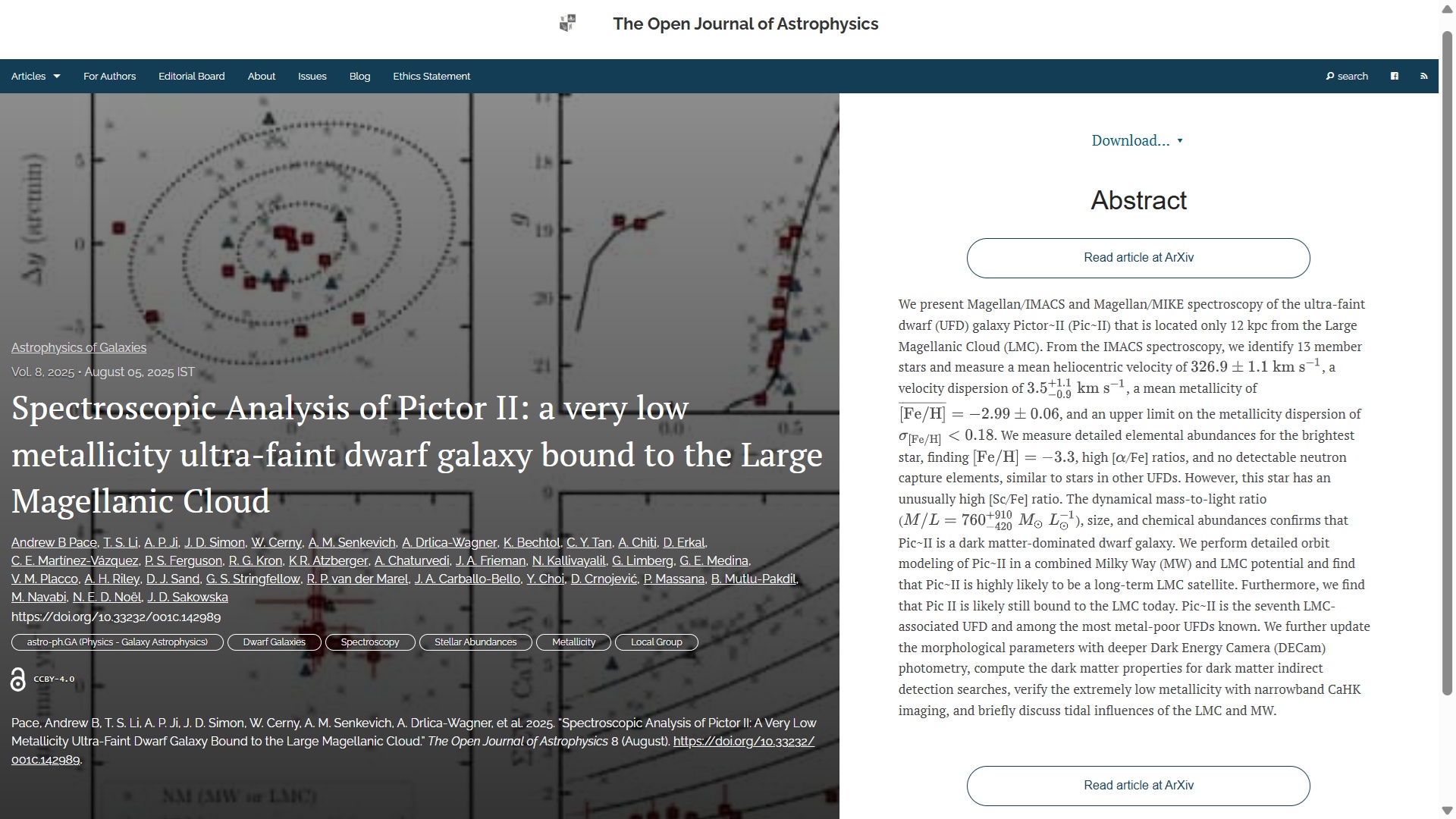
The first paper to report is “Chemical Abundances in the Leiptr Stellar Stream: A Disrupted Ultra-faint Dwarf Galaxy?” by Kaia R. Atzberger (Ohio State University) and 13 others based in the USA, Germany, the UK, Sweden, Australia, Canada and Brazil. This one was published on 2nd June 2025 and is in the folder marked Astrophysics of Galaxies. It presents a spectroscopic study of stars in a stellar stream suggesting that the stream originated by the accretion of a dwarf galaxy by the Milky Way.

The overlay is here:


You can read the final accepted version on arXiv here.

The second paper is “Scaling Laws for Emulation of Stellar Spectra” by Tomasz Różański (Australian Nastional University) and Yuan-Sen Ting (Ohio State University, USA). This was published yesterday, i.e. on 6th June 2025, and is in the folder Instrumentation and Methods for Astrophysics. The paper discusses certain scaling models and their use to achieve optimal performance for neural network emulators in the inference of stellar parameters and element abundances from spectroscopic data.

The overlay is here:

You can find the officially-accepted version of the paper on arXiv here.

That’s the papers for this week. I’ll post another update next weekend.

As a postscript I have a small announcement about our social media. Owing to the imminent demise of Astrodon, we have moved the Mastodon profile of the Open Journal of Astrophysics to a new instance, Fediscience. You can find us here. The old profile currently redirects to the new one, but you might want to update your links as the old server will eventually go offline.

Funding Diamond Open Access

Posted in Open Access with tags , , , , , on June 3, 2025 by telescoper

In case you weren’t aware, SciPost is a publishing infrastructure that provides Diamond Open Access to scientific papers. That means they are free to publish and free to read. They are funded by a consortium but are now struggling financially. They have recently circulated an open letter to the Community explaining their predicament and asking for help. I encourage you to read it and, if you can, to make a donation (or bully your institution to do so).

The open letter explains that SciPost is currently running at an average cost per paper of €500. That is much less than a typical APC for a mainstream journal but it is not a negligible cost. At the rate at which SciPost is publishing it amounts to about €1000 per day. SciPost currently attracts a significant level of sponsorship but it is not enough to support its current level of activity. Information on how to help SciPost can be found here. It is a worthy cause and deserves to be supported.

One area in which SciPost has not really taken of is Astronomy, where it has published very few papers. This may at be at least partly because of the Open Journal of Astrophysics (OJAp) which is also Diamond Open Access but runs in a very different and much cheaper way. A full breakdown of costs at OJAp is given here our annual running costs are about €5000 per year, which works out at less than €50 per paper (on average); that comprises a fixed component and a marginal cost of €10 per paper.

The main reasons for the large difference in running costs are: (i) SciPost maintains and runs its own platform; and (ii) it offers a copy-editing service. OJAp piggy-backs on arXiv (where most astrophysics research papers are found anyway) and expects authors to provide the final version of their own work. Neither organization pays referees or Editors. To enable it to run, SciPost employs about three staff full-time (2.9 FTE to be precise); OJAp has no employees and we keep our costs down by offering a ‘no-frills’ service. Instead of having a wide range of sponsors, we are entirely funded by Maynooth University. I am very grateful for that support, but we are run on a shoestring budget.

I have written before about what I think the future of Diamond Open Access could be like. I would like to see a range of Diamond Open Access journals offering a choice for authors and serving different sub-disciplines. Most universities nowadays have publishing operations so there could be network of federated journals, some based on arXiv and some based on other repositories and others with different models, such as SciPost. Perhaps institutions are worried about the expense but, as we have shown the actual cost, is far less than they are wasting on Article Processing Charges.

I don’t see other Diamond Open Access journals as competitors, but as allies with community-led ecosystem. I’d be more than happy to discuss how to start up such a journal on the OJAp model with anyone interested, and have already done so with some interested parties. As far as I’m concerned, the more the merrier! It is neither fair nor reasonable, however, that the expense of running a journal that serves the global astrophysics community should fall entirely on one small University in Ireland.

By all means support SciPost (and get your institutions to do likewise), but please also consider supporting OJAp. We are currently covering our costs but have no funds to make enhancements (such as a much-needed new LaTex template). If you can afford to make a donation to SciPost, then perhaps you can afford to make a donation to OJAp proportionate to our lower running costs? For example, if you give €10K to SciPost, could you give us €1K too? That amount would keep SciPost running for a day and OJAp for many months…

Weekly Update from the Open Journal of Astrophysics – 31/05/2025

Posted in OJAp Papers, Open Access, The Universe and Stuff with tags , , , , , , , , , , , , , , , on May 31, 2025 by telescoper

Once again it’s time for the weekly Saturday morning update of papers published at the Open Journal of Astrophysics. Since the last update we have published five new papers, which brings the number in Volume 8 (2025) up to 67; the total so far published by OJAp has passed the 300 mark and is now up to 302. If we keep up at the same rate for the rest of the year as we did for the first five months now completed, we will publish around 160 papers altogether in 2025.

In chronological order of publication, the five papers published this week, with their overlays, are as follows. You can click on the images of the overlays to make them larger should you wish to do so.

The first paper to report is “Which is the most eccentric binary known? Insights from the 2023/4 pericenter passages of Zeta Boötis and Eta Ophiuchi” by Idel Waisberg, Ygal Klein and Boaz Katz (Weizmann Institute of Science, Israel).  This is a report of interferometric observations of two very eccentric binary star systems, published on Tuesday 27th May 2025 in the folder Solar and Stellar Astrophysics. The overlay is here:
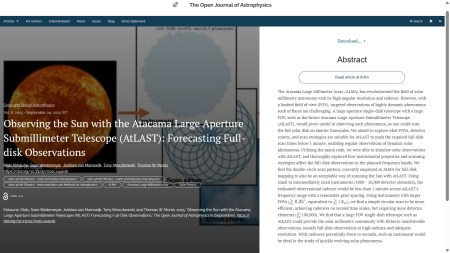
You can read the final accepted version on arXiv here.

The second paper to report is “On the full non-Gaussian Surprise statistic and the cosmological concordance between DESI, SDSS and Pantheon+” by Pedro Riba Mello & Miguel Quartin (Universidade Federal do Rio de Janeiro, Brazil), and Bjoern Malte Schaefer & Benedikt Schosser (Heidelberg, Germany). This paper is in the folder Cosmology and NonGalactic Astrophysics and was published on Tuesday 27th May 2025. The paper presents an application of the “Surprise Statistic”, based on the Kullback-Leibler divergence, as a measure of the difference between results inferred from different data sets.

The overlay is here:


You can find the officially-accepted version of the paper on arXiv here.

The third paper we published last week, and our 300th overall, is “Cosmic Ray Feedback in Massive Halos: Implications for the Distribution of Baryons” by Eliot Quataert (Princeton, USA) and Philip F. Hopkins (Caltech, USA).  This was published on Thursday 29th May in the folder Cosmology and NonGalactic Astrophysics. The paper discusses the effects of cosmic rays produced by massive black holes on the structure of the baryonic component of galaxies and how these might affect cosmological parameter estimation. The overlay is here:


You can read the officially accepted version of this paper on arXiv here.

The next one to report is “Mixing neutron star material into the jets in the common envelope jets supernova r-process scenario” by Noam Soker (Technion, Israel). This was published on Thursday 27th May in the folder High-Energy Astrophysical Phenomena; it presents a discussion of the chemical enrichment of an evolved star consequent upon its ingestion of a neutron star.

The overlay is here:

You can find the officially accepted version on arXiv here.

Last, but by no means least, for this week we have “Dark Energy Survey Year 6 Results: Synthetic-source Injection Across the Full Survey Using Balrog” by Dhayaa Anbajagane (Kavli Institute, Chicago) et al. (81 authors) on behalf of the Dark Energy Survey Collaboration. It was also  published on Thursday 27th May  2025, but in the folder Cosmology and NonGalactic Astrophysics. It is about testing the Dark Energy Survey analysis pipeline using synthetic sources.

The overlay is here:


You can find the officially accepted version on arXiv here.

That’s all the papers for this week. I’ll post another update next weekend.

The 300th Publication at the Open Journal of Astrophysics

Posted in OJAp Papers, Open Access, The Universe and Stuff with tags , , on May 29, 2025 by telescoper

It was on October 8th last year that we published the 200th paper at the Open Journal of Astrophysics. Today, on 29th May 2025, less than 8 months later, we have reached the 300 mark with this paper:

The authors are Eliot Quataert (Princeton, USA) and Philip F. Hopkins (Caltech, USA). We continue to have a large number of papers from authors based in the USA.

I published another two papers this morning and will include all the papers published this week (Including the 300th) in the usual weekly update on Saturday. Based on the 67 papers published so far this year and the activity in the OJAp worklow, I estimate we will publish at least 150 papers this year, which means we should reach the the 400 mark early next year.

Weekly Update from the Open Journal of Astrophysics – 24/05/205

Posted in OJAp Papers, Open Access, The Universe and Stuff with tags , , , , , , , , , , , , , , , , , on May 24, 2025 by telescoper

It’s  time once again for the regular Saturday update of papers published during the past week at the Open Journal of Astrophysics. Since the last update we have published three new papers, which brings the number in Volume 8 (2025) up to 62 and the total so far published by OJAp up to 297.

In chronological order of publication, the three papers published this week, with their overlays, are as follows. You can click on the images of the overlays to make them larger should you wish to do so.

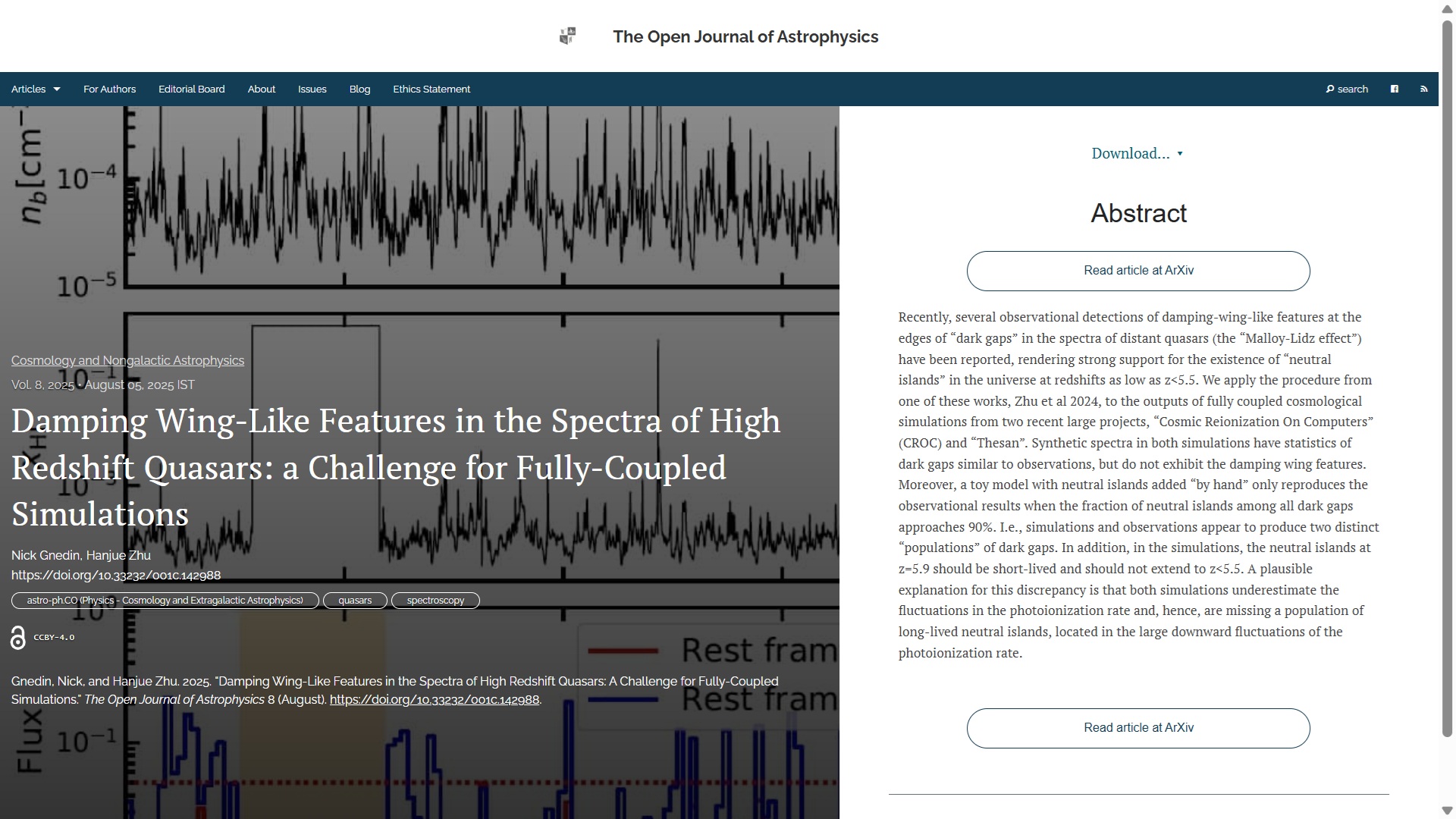
The first paper to report is: “Jet-shaped filamentary ejecta in common envelope evolution” by Ron Schreier, Shlomi Hillel and Noam Soker (Technion, Haifa, Israel). This paper, which was published on Monday May 19th 2025 in the folder High-Energy Astrophysical Processes, presents three-dimensional hydrodynamical simulations of common envelope evolution of a neutron star inside the envelope of a rotating red supergiant with Rayleigh-Taylor instabilities forming filamentary ejecta.

The overlay is here:

You can find the officially accepted version on arXiv here.

Second one up is “Weighing The Options: The Unseen Companion in LAMOST J2354 is Likely a Massive White Dwarf” by M. A. Tucker, A. J. Wheeler & D. M. Rowan (Ohio State University, USA) and M. E. Huber (U. Hawaii, USA). This paper was published on Tuesday 20th May 2025 in the folder for Solar and Stellar Astrophysics. It discusses a spectroscopic study of the binary system LAMOST J235456.73+335625 (J2354) with a discussion of the implications for the nature of the dark component.

The overlay is here:


You can find the officially-accepted version of the paper on arXiv here.

The third and last paper of the week, published on Thursday May 22nd 2025, also in the folder Solar and Stellar Astrophysics, is “How to use Gaia parallaxes for stars with poor astrometric fits” by Kareem El-Badry (Caltech, USA).  This paper presents a method for extracting reasonable estimates of stellar parallaxes from Gaia data when the overall astrometric solution is unreliable due to errors and noise

Here is the overlay:

You can find the officially accepted version of this paper on arXiv here.

That’s all the papers for this week. Looking at the publishing workflow, I expect we will pass the 300 mark next week. We’ll see when I post the next update next Saturday.