Archive for the The Universe and Stuff Category

Weekly Update from the Open Journal of Astrophysics – 09/08/2025

Posted in OJAp Papers, Open Access, The Universe and Stuff with tags , , , , , , , , , , , , , , , , , , , , , on August 9, 2025 by telescoper

It’s Saturday morning so, once again, it’s time for an update of papers published at the Open Journal of Astrophysics. Since the last update we have published four new papers, which brings the number in Volume 8 (2025) up to 114, and the total so far published by OJAp up to 349.

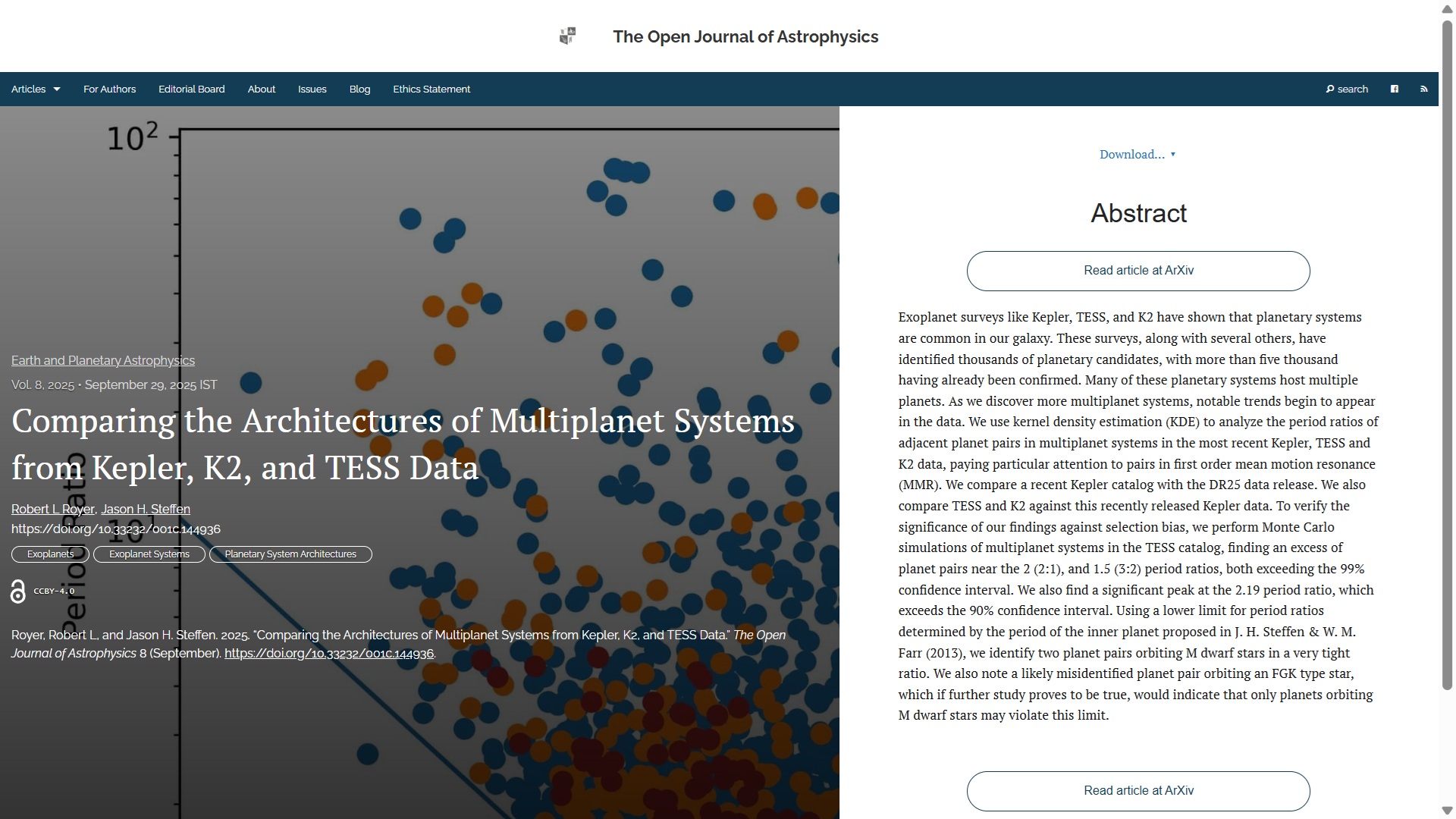
The papers published this week, with their overlays, are as follows. You can click on the images of the overlays to make them larger should you wish to do so.

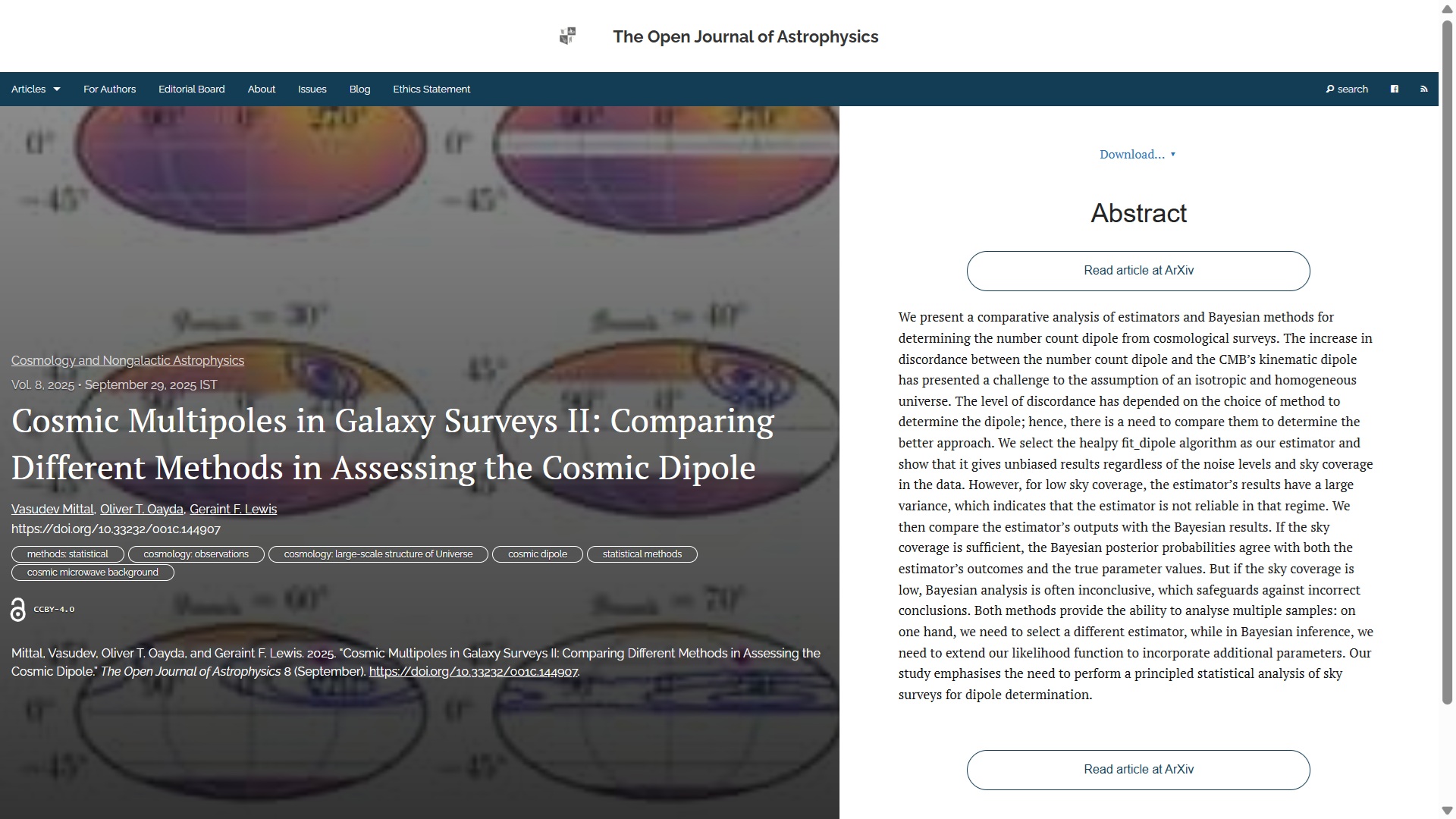
The first paper to report is “Caught in the Act of Quenching? – A Population of Post-Starburst Ultra-Diffuse Galaxies” by Loraine Sandoval Ascencio & M. C. Cooper (UC Irvine), Dennis Zaritsky, Richard Donnerstein & Donghyeon J. Khim (U. Arizona) and Devontae C. Baxter (UC San Diego). This paper was puvblished on Monday 4th August and is in the folder marked Astrophysics of Galaxies. It discusses a sample of Ultra-Diffuse Galaxies (UDGs) found to be post-starburst galaxies through spectroscopic analysis analysis of candidates selected from the Systematically Measuring Ultra-Diffuse Galaxies (SMUDGes) program.

The overlay is here:


The officially-accepted version can be found on arXiv here.

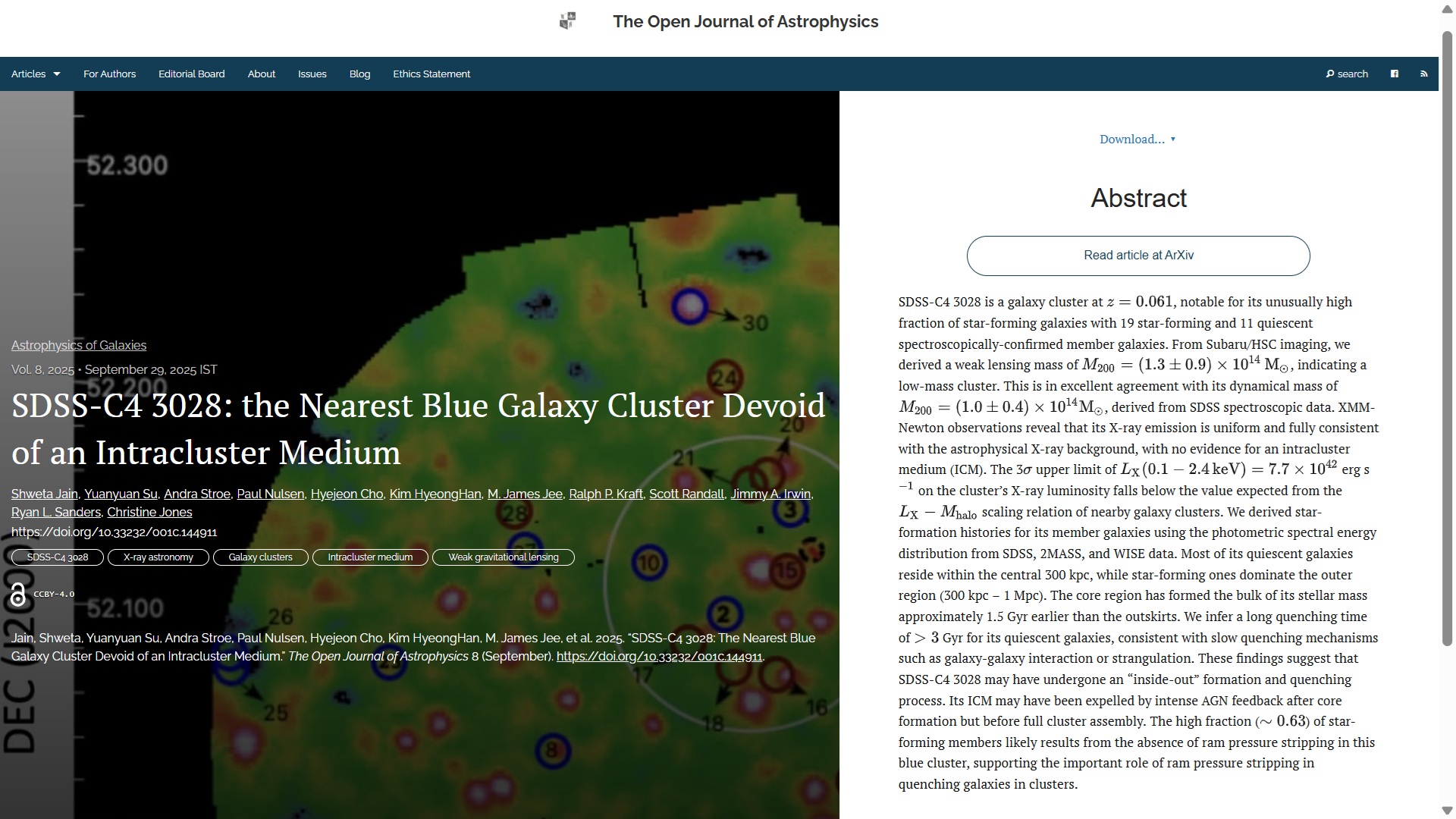
Next one up, published on Tuesday 5th August, in the folder Cosmology and Nongalactic Astrophysics, is “Damping Wing-Like Features in the Spectra of High Redshift Quasars: a Challenge for Fully-Coupled Simulations” by Nick Gnedin & Hanjue Zhu (University of Chicago, USA).  This paper presents a discussion of the difficulties that cosmological radiation transfer codes have in accounting for the existence of “neutral islands” in the universe at relatively low redshifts.

The overlay is here:


You can find the officially accepted version of the paper on arXiv here.

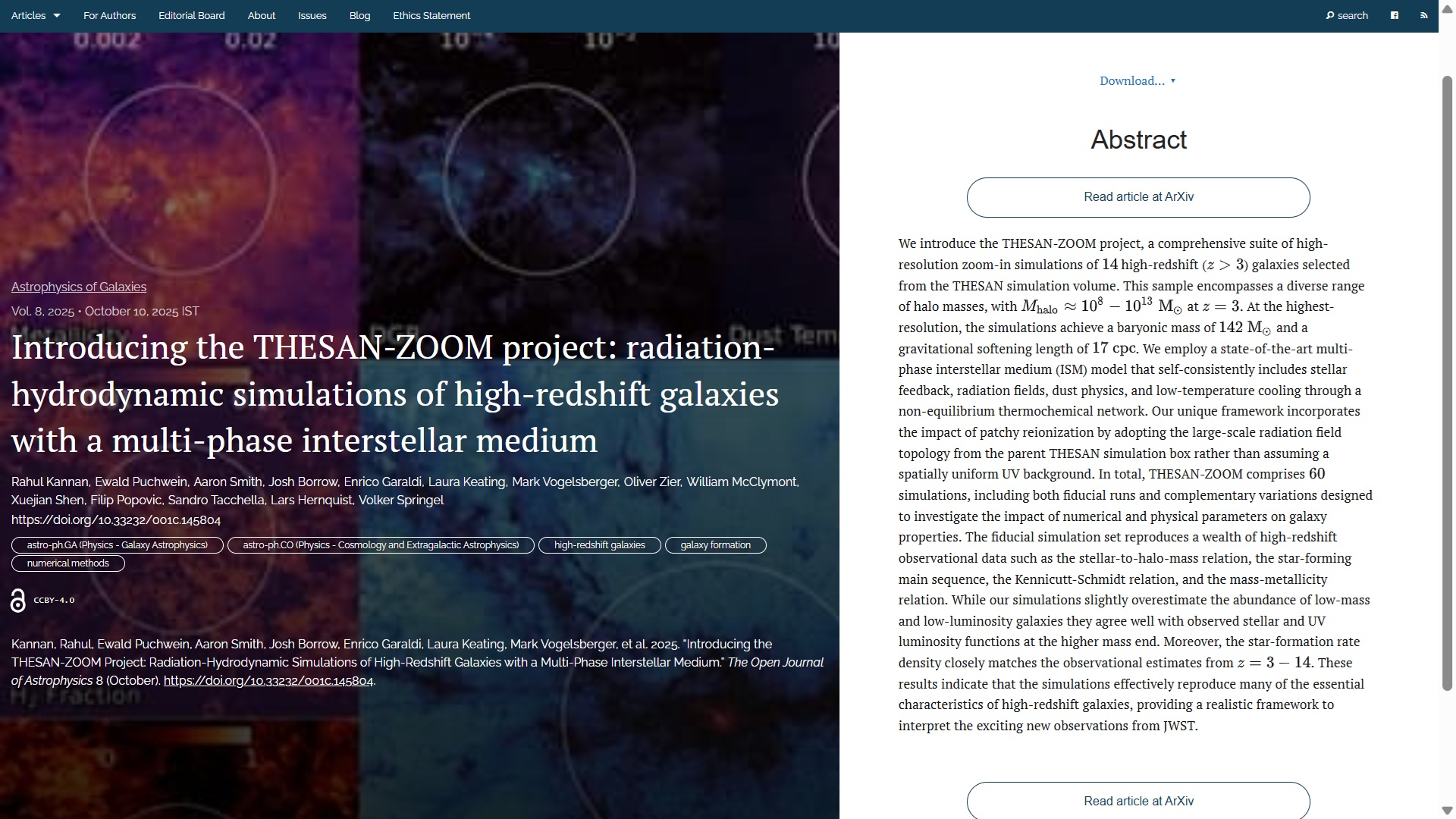
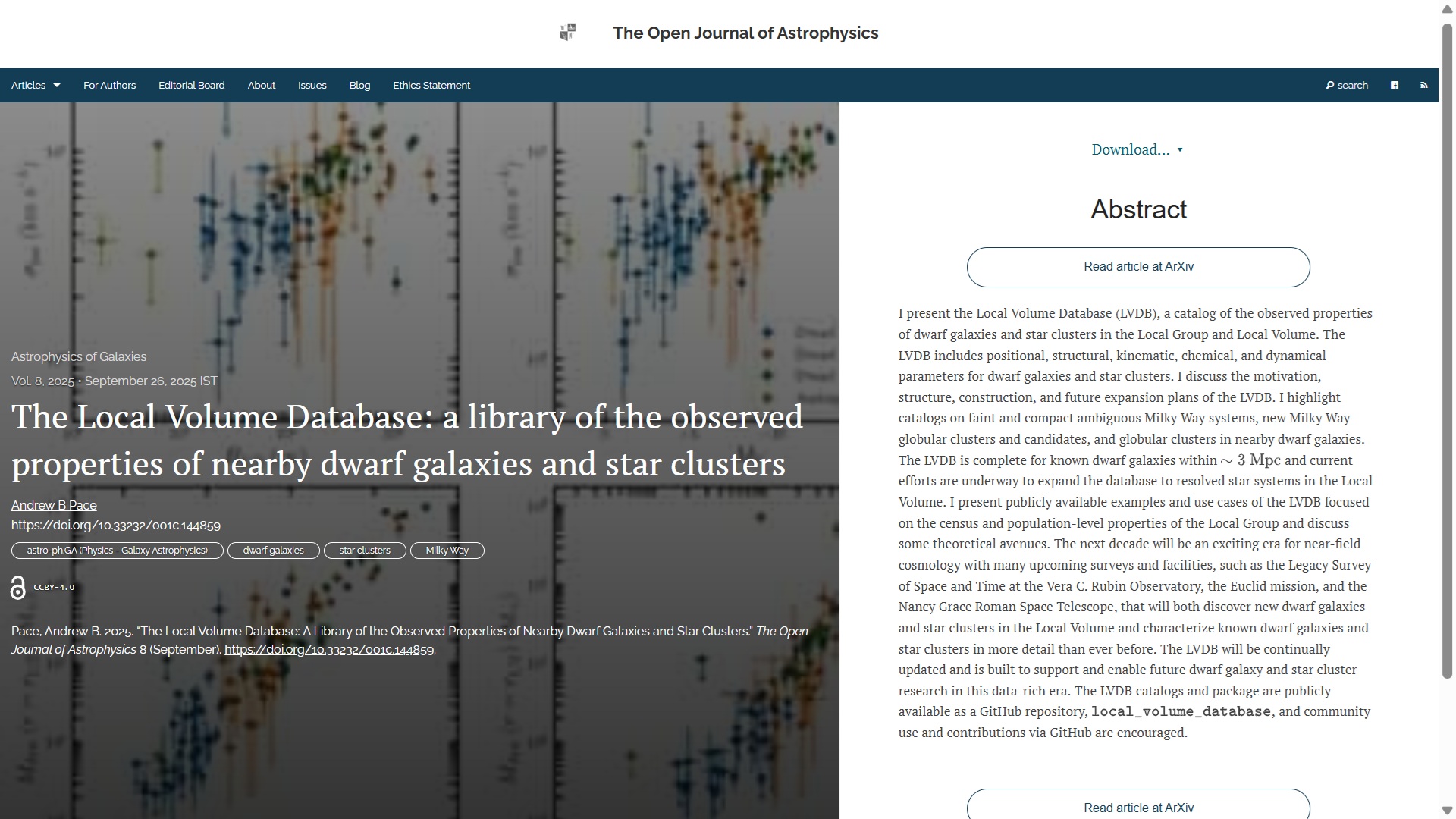
The third paper of the week is “Spectroscopic Analysis of Pictor II: a very low metallicity ultra-faint dwarf galaxy bound to the Large Magellanic Cloud” by Andrew Pace (U. Virginia, USA) and 32 others based in the USA, UK, Canada, Chile and Spain. This one was also published on Tuesday 5th August but in the folder Astrophysics of Galaxies. It describes Magellan/IMACS and Magellan/MIKE spectroscopy of the ultra-faint dwarf (UFD) galaxy Pictor II, which is located only 12 kpc from the Large Magellanic Cloud (LMC).

The overlay is here:


The final version is on arXiv here.

The fourth, and final, paper of the week, also published on Thursday 7th August, is “ASASSN-24fw: An 8-month long, 4.1 mag, optically achromatic and polarized dimming event” by Raquel Forés-Toribio (Ohio State University) and 22 others based in the USA, Austria, Chile and Australia. It is published in the folder Solar and Stellar Astrophysics, and it presents an observational study of an unusual dimming event likely to have been caused by eclipsing of a binary system by a dusty disk.

Here is the overlay:

You can find the officially-accepted version on arXiv here.

And that’s all the papers for this week. I’ll do another update next Saturday.

P.S. For those of you who missed the post I did earlier in the week, I have been looking at the accounts for the Open Journal of Astrophysics and can confirm that the cost to us per paper is less than $30 and will reduce with scale. We expect to publish around 180 papers in 2025 for which the total cost incurred by OJAp will be around $5000. Obviously if we increase by a factor, say, ten then that amount would become significant so we are taking steps to secure additional funding in the event that happens.

Weekly Update from the Open Journal of Astrophysics – 02/08/2025

Posted in OJAp Papers, Open Access, The Universe and Stuff with tags , , , , , , , , , , , , , , , , , , , , , , , , , , , , on August 2, 2025 by telescoper

It’s Saturday morning again, and it’s the start of a new month, so it’s time for an update of papers published at the Open Journal of Astrophysics. Since the last update we have published five new papers, which brings the number in Volume 8 (2025) up to 110, and the total so far published by OJAp up to 345. I expect we’ll the total number we published last year (120) sometime this month. I predict that by the end of this year we will have published around 180 papers in Volume 8 and around 400 altogether.

The papers published this week, with their overlays, are as follows. You can click on the images of the overlays to make them larger should you wish to do so.

The first paper to report is “The matter with(in) CPL” by Leonardo Giani (U. Queensland, Australia), Rodrigo Von Marttens (Universidade Federal da Bahia, Brazil) and Oliver Fabio Piattella (Universita degli Studi dell’Insubria, Italy). This was published on Monday 29th July 2025 in the folder Cosmology and Nongalactic Astrophysics. This article presents a new parameterization of the standard model and its implications for the interpretation of cosmological observations.

The overlay is here:


The officially-accepted version can be found on arXiv here.

The second paper of the week, published on Tuesday 30th July in the folder Instrumentation and Methods for Astrophysics, is “An automated method for finding the most distant quasars” by Lena Lenz, Daniel Mortlock, Boris Leistedt & Rhys Barnett (Imperial College London, UK) and Paul C. Hewett (U. Cambridge, UK)”.  This paper presents an automated, reproduceable and objective high-redshift quasar selection pipeline, tested on simulations and real data from the Sloan Digital Sky Survey (SDSS) and UKIRT Infrared Deep Sky Survey (UKIDSS). The overlay is here:


You can find the officially accepted version of the paper on arXiv here.

The third paper of the week is “Early Post Asymptotic Giant Branch Instability: Does it Affect White Dwarf Hydrogen Envelope Mass?” by James MacDonald (University of Delaware, USA). This one was published on Friday 1st Auguest (i.e. yesterday) in the folder Solar and Stellar Astrophysics. It is an investigation into whether Early Post AGB Instability (EPAGBI) can affect determinations of the total abundance of hydrogen in white dwarf stars.

The overlay is here:

The final version is on arXiv here.


The fourth paper of the week, also published on Friday 1st August, is “Light Echoes of Time-resolved Flares and Application to Kepler Data” by Austin King and Benjamin C. Bromley (University of Utah, USA).  This describes a new model for circumstellar disks that incorporates echoes produced by extended, time-resolved flares. It is published in the folder Solar and Stellar Astrophysics. Here is the overlay:

You can find the officially-accepted version on arXiv here.


The fifth and final article published this week, also published on Friday 1st August,  is “Wide Binaries from Gaia DR3 : testing GR vs MOND with realistic triple modelling” by Charalambos Pittordis, Will Sutherland and Paul Shepherd (Queen Mary, University of London, UK). This presents a test for modified gravity from a sample of wide-binary stars from Gaia DR3, finding that (unmodified) Newtonian gravity provides a better fit to the data. It is in the folder Astrophysics of Galaxies.

The overlay is here:


You can find the officially-accepted version on arXiv here.

And that’s all the papers for this week. I’ll do another update next Saturday.

Avi Loeb is a Fraud Now

Posted in The Universe and Stuff with tags , , , on July 30, 2025 by telescoper

I saw this video on YouTube about Harvard’s answer to Erich von Däniken and thought I should share it. The introduction to it reads:

Avi Loeb is a Harvard astronomer turned pseudoscience-peddling fraud. Since 2017 he’s been spewing horseshit about how everything is aliens when it definitely isn’t, just to sell a bunch of books to credulous laypeople. Predictably, when the scientific community politely pushes back on his bullshit, he throws a toddler tantrum. I wonder what will happen if someone exposes him in a not so polite manner? Let’s find out.

Here is the video

For supplementary reading I suggest: Ethan Siegel’s Forbes article; Desch and Jackson about Avi’s spherule manuscript: https://arxiv.org/pdf/2311.07699; and the following blog piece by Josh Hedgepeth

Read these carefully. There will be a test next week.

Weekly Update from the Open Journal of Astrophysics – 26/07/2025

Posted in OJAp Papers, Open Access, The Universe and Stuff with tags , , , , , , , , , , , , , , , , , , , , , on July 26, 2025 by telescoper

It’s Saturday morning again, so it’s time again for an update of papers published at the Open Journal of Astrophysics. Since the last update we have published seven new papers, which brings the number in Volume 8 (2025) up to 105, and the total so far published by OJAp up to 340. I expect we’ll pass the century for this year sometime next week. I had expected a bit of a slowdown in July, but that doesn’t seem to have happened. Anyway, with the century for the year having been achieved, the next target is 120 (the total number we published last year). At the current rate I expect us to reach that sometime in August.

The papers published this week, with their overlays, are as follows. You can click on the images of the overlays to make them larger should you wish to do so.

The first paper to report is “Non-equilibrium ionization in the multiphase circumgalactic medium – impact on quasar absorption-line analyses” by Suyash Kumar and Hsiao-Wen Chen (University of Chicago, USA). This was published on Tuesday 22nd July 2025 in the folder Astrophysics of Galaxies. It discusses time-dependent photoionization (TDP) models that self-consistently solve for the ionization state of rapidly cooling gas irradiated by the extragalactic ultraviolet background (UVB) and the application thereof to observed systems.

The overlay is here:

The officially-accepted version can be found on arXiv here.

The second paper of the week, also published on Tuesday 22nd July but in the folder Cosmology and Nongalactic Astrophysics, is “Do We Know How to Model Reionization?” by Nick Gnedin (University of Chicago, USA). This paper discusses the similarities and differences between the radiation fields produced by different numerical simulations of cosmic reionization. The overlay is here:

You can find the officially accepted version of the paper on arXiv here.

The third paper of the week is “The effects of projection on measuring the splashback feature” by Xiaoqing Sun (MIT), Stephanie O’Neil (U. Penn.), Xuejian Shen (MIT) and Mark Vogelsberger (MIT), all based in the USA. This paper describes an investigation whether projection effects could lead to any systematic bias in determining the position of the boundary between infalling and accreting matter around haloes. It was published on Wednesday 23rd July in the folder Astrophysics of Galaxies. The overlay is here:

The officially-accepted version can be found on arXiv here.

The fourth paper of the week, also published on Wednesday 22nd July in the folder Astrophysics of Galaxies, is “Host galaxy identification of LOFAR sources in the Euclid Deep Field North” by Laura Bisigello, Marika Giulietti, Isabella Prandoni, Marco Bondi, & Matteo Bonato (INAF, Bologna, Italy), Manuela Magliocchetti (INAF-IAPS Roma, Italy), Huub Rottgering (Leiden Observatory, Netherlands), Leah, K. Morabito (Durham University, UK) and Glenn, J. White (Open Universirty, UK). This presents a catalogue of optical and near-infrared counterparts to radio sources detected in the Euclid Deep Field North using observations from the LOw-Frequency ARray (LOFAR). The overlay is here:

The final, accepted version of the paper is on arXiv here.

Fifth one up is “Constraining the dispersion measure redshift relation with simulation-based inference” by Koustav Konar (Ruhr University Bochum), Robert Reischke (Universität Bonn), Steffen Hagstotz (Ludwig-Maximilians Universität München), Andrina Nicola (Bonn) and Hendrik Hildebrandt (Bochum); all authors based in Germany. This was published on Thursday 24th July in the folder Cosmology and NonGalactic Astrophysics. It discusses using simulations to develop the use of Dispersion Measures of Fast Radio Bursts as cosmological probes. The overlay is here:

You can find the officially accepted version on arXiv here.

The penultimate (sixth) article published this week is “Generating Dark Matter Subhalo Populations Using Normalizing Flows” by Jack Lonergan (University of Southern California), Andrew Benson (Carnegie Observatories) and Daniel Gilman (University of Chicago), all based in the USA. This paper describes a generative AI approach to subhalo populations, trained using the semi-analytical model Galacticus. This paper was published yesterday (i.e. on Friday 25th July) in the folder Astrophysics of Galaxies.

You can find the final version on arXiv here.

The last article published this week is “21 Balmer Jump Street: The Nebular Continuum at High Redshift and Implications for the Bright Galaxy Problem, UV Continuum Slopes, and Early Stellar Populations” by Harley Katz of the University of Chicago, and 13 others based in the USA, UK, Germany, Denmark and Austria. This discusses the implications of extreme nebular emission for the spectroscopic properties of galaxies, especially at high redshift. It was published on Friday 25th July in the folder Astrophysics of Galaxies.

The overlay is here:

You can find the officially-accepted version on arXiv here.

And that’s all the papers for this week. I’ll do another update next Saturday, when we’ll be into August.

Harvard Astronomer Latest!

Posted in The Universe and Stuff with tags , , , , on July 25, 2025 by telescoper

I couldn’t resist sharing the first abstract on today’s astro-ph announcement, one of the authors of which is Avi Loeb (the pseudonym of “Harvard Astronomer”). Here it is:

We examine the funding disparity in astronomical research priorities: the Habitable Worlds Observatory is planned to receive over $10 billion over the next two decades whereas extraterrestrial intelligence research receives nearly zero federal funding. This imbalance is in contrast to both scientific value and public interest, as 65% of Americans and 58.2% of surveyed astrobiologists believe extraterrestrial intelligence exists. Empirical psychological research demonstrates that humanity possesses greater resilience toward extraterrestrial contact than historically recognized. Contemporary studies reveal adaptive responses rather than mass panic, conflicting with the rationale for excluding extraterrestrial intelligence research from federal funding since 1993. The response to the recent interstellar object 3I/ATLAS exemplifies consequences of this underinvestment: despite discovery forecasts of a new interstellar object every few months for the coming decade, no funded missions exist to intercept or closely study these visitors from outside the Solar System. We propose establishing a comprehensive research program to explore both biosignatures and technosignatures on interstellar objects. This program would address profound public interest while advancing detection capabilities and enabling potentially transformative discoveries in the search for extraterrestrial life. The systematic exclusion of extraterrestrial intelligence research represents institutional bias rather than scientific limitation, requiring immediate reconsideration of funding priorities.

arXiv:2507.17790

You probably don’t need an AI summary (whether the A stands for “Artificial” or “Alien”), but it the gist of this new article is “Shut everything down and give me the money!”…

BBC Sounds Confusing

Posted in Music, The Universe and Stuff with tags , , , , on July 22, 2025 by telescoper

The BBC Proms having started on Sunday (20th July), I decided to listen to some of the concerts via BBC Sounds. One can’t get BBC Radio 3 on the radio here in the Republic, at least not this far from the border.

I was disappointed, then, to see that BBC Sounds is no longer available to listeners outside the UK. Apparently The BBC is making BBC Sounds exclusively available to UK license fee payers, meaning users outside the UK, including those in Ireland, will no longer be able to access the full service. This change came into effect yesterday (21st July).

So here I am, as I write this, on 22nd July, listening to this evening’s Promenade concert via BBC Sounds. No, I’m not doing anything illegal or unlawful. Neither did I last night, when I listened to Mahler’s Symphony No. 7. It’s just that the change has been implemented in a very peculiar and confusing way.

To start with, this is what I see a see on my screen right now:

I don’t think you get the top message if you listen in the UK, but then you might be listening on the radio anyway.

At the top it says use the BBC.com or the BBC App. For one thing I can’t find any sign of the “BBC App” on PlayStore on anywhere else. For another, BBC.com offers only Radio 4, BBC World Service and a random selection of podcasts. So neither of those options are any good for listening to Radio 3.

If you click to “Find out how to listen to other BBC stations” you get this page which “explains”:

Earlier this year, we launched a new audio service outside the UK on BBC.com and the BBC app. This includes access to BBC Radio 4 and BBC World Service English, thousands of hours of podcasts (including Global News Podcast, World of Secrets and Infinite Monkey Cage) – as well as some of the best of the BBC’s journalism and storytelling including news and history programming.  

As part of the announcement, we said we planned to close BBC Sounds to audiences living outside the UK later this year, making it available exclusively to people in the UK. Anyone who lives in the UK will still be able to use the BBC Sounds app when they go on holiday abroad. We can now confirm that BBC Sounds closed for listeners based outside the UK on 21 July 2025.

Leaving aside the mystery of the “BBC app”, this suggests that BBC Sounds is closed to listeners outside the UK. Except it isn’t.

The article goes on to explain:

Please use the links below for live listening access to the BBC’s other radio stations from across the UK, including BBC Radio 1, Radio 2 and Radio 3, 6Music, 1Xtra and Asian Network, Radio 4Xtra and 5Live, all the BBC’s stations from the UK nations and every local radio station in England.

The link to BBC Radio 3 is this:

https://www.bbc.co.uk/sounds/play/live/bbc_radio_three#noapp

In other words, it takes you back to BBC Sounds, which is where I am listening now! As far as I understand it, one can still listen to the live internet stream of BBC Radio on BBC Sounds, so it’s not closed to listeners outside the UK after all. What is closed (to us foreigners) is the back catalogue of past recordings. I only ever listen to live broadcasts, however, so after all that it’s business as usual for me.

I hope this clarifies the situation.

CP Violation in Baryons

Posted in The Universe and Stuff with tags , , , , , , , on July 21, 2025 by telescoper

I was (pleasantly) surprised to learn a few weeks ago that I shall be teaching particle physics again next academic year. That means that I’ll have to update to the notes to reflect the latest news from CERN. Researchers from the LHCb collaboration have published evidence for CP violation in baryons. The paper is published in Nature here.

For those of you not up with the lingo, CP is an operator that combines C (charge-conjugation, i.e. matter versus anti-matter) and P (parity, i.e. inversion of coordinates). Parity has been known since the 1950s to be violated in weak interactions, so the weak nuclear force distinguishes between states of odd and even parity. CP violation was first demonstrated in the 1960s CP in the decays of neutral kaons resulted in the Nobel Prize  in 1980 for its discoverers Cronin and Fitch. CP violation has subsequeuntly been seen in many other meson decays.

But the mesons (consisting of a quark and an antiquark) are only half of the family of particles made from quarks; the others are the baryons which are made of three quarks (c.f. James Joyce’s “Three quarks for Muster Mark” in Finnegans Wake). Antibaryons consist of three antiquarks, but such are not mentioned in Finnegans Wake.

The baryons concerned in the LHCb experiment contain an up quark, a down quark and a beauty quark and were produced in proton–proton collisions at the Large Hadron Collider in 2011–2018. These baryons and antibaryons can decay via multiple channels. In one, a baryon decays to a proton, a positive K-meson and a pair of pions – or, conversely, an antibaryon decays to an antiproton, a negative K-meson and a pair of pions. CP violation should create an asymmetry between these processes, and the researchers found evidence of this asymmetry in the numbers of particles detected at different energies from all the collisions.

A problem with calculating the magnitude of this effect for baryons is that there is a contribution from the strong force – see the curly line indicating a gluon in the lower panel on the left above – and that is much harder to compute than a pure weak force (represented by the wavy lines indicating W bosons. Yo will see that the tree and loop diagrams involve quark mixing, a process that allows quarks of different generations to couple via weak interactions; there is a buW vertex in the top panel and a tsW vertex in the bottom one. Given the uncertainties, it seems the results are consistent with the level of CP violation predicted in the Standard Model of particle physics.

The big question surrounding this result is whether it can account for the fact that our Universe – or at least our part of it -contains a preponderance of baryons over anti-baryons, so somehow the interactions going on during the Big Bang must have shown a preference for the former over the latter. This problem of baryogenesis is not explained in the Standard Model and, since these results are consistent with the Standard Model, the answer to that question is “no”…

Weekly Update from the Open Journal of Astrophysics – 19/07/2025

Posted in OJAp Papers, Open Access, The Universe and Stuff with tags , , , , , , , , , , , , , , , , , , , , , , , , , , on July 19, 2025 by telescoper

It’s Saturday morning again, so it’s time again for an update of papers published at the Open Journal of Astrophysics. Since the last update we have published six new papers, which brings the number in Volume 8 (2025) up to 98, and the total so far published by OJAp  up to 333. I expect we’ll pass the century for this year sometime next week.

The papers published this week, with their overlays, are as follows.  You can click on the images of the overlays to make them larger should you wish to do so.

The first paper to report is “Reconstructing Galaxy Cluster Mass Maps using Score-based Generative Modeling” by Alan Hsu (Harvard), Matthew Ho (CMU), Joyce Lin (U. Wisconsin-Madison), Carleen Markey (CMU), Michelle Ntampaka (STScI), Hy Trac (CMU) & Barnabás Póczos (CMU), all based in the USA. This paper was published on 14th July 2025 in the folder Cosmology and NonGalactic Astrophysics. It presents a diffusion-based generativbe AI model for reconstructing density profiles for galaxy clusters from observational data.

The overlay is here:

The officially-accepted version can be found on arXiv here.

The second and third papers are related. They were both published on 14th July in the folder Cosmology and NonGalactic Astrophysics.

The first of the pair is “J-PLUS: Tomographic analysis of galaxy angular density and redshift fluctuations in Data Release 3. Constraints on photo-z errors, linear bias, and peculiar velocities” by Carlos Hernández-Monteagudo (IAC, Tenerife, Spain) and 21 others. This presents an analysis of the Javalambre Photometric Local Universe Survey (J-PLUS) in redshift slices with a discussion of prospects for extracting cosmological information. The overlay is here:


You can find the final version of the manuscript on arXiv here.

The second of this pair is “The J-PLUS collaboration. Additive versus multiplicative systematics in surveys of the large scale structure of the Universe” by Carlos Hernández-Monteagudo (IAC) and 21 others (the same authors as the previous paper).  This paper presents an analysis of systematic effects in the Javalambre Photometric Local Universe Survey (J-PLUS), and a new model for handling such errors in this and other cosmological surveys. The overlay for this paper is here:

You can find the officially accepted version of this paper on arXiv here.

The fourth paper this week is “Why Machine Learning Models Systematically Underestimate Extreme Values” by Yuan-Sen Ting (Ohio State University). This one was published on July 16th in the folder marked Instrumentation and Methods for Astrophysics.  This paper presents a theoretical framework for understanding and addressing a bias that suppresses the dynamic range of variables in applications of machine learning to astronomical data analysis. Here is the overlay:

You can find the officially accepted version of this paper on arXiv here.

The penultimate article for this week is “Bridging Machine Learning and Cosmological Simulations: Using Neural Operators to emulate Chemical Evolution” by Pelle van de Bor, John Brennan & John A. Regan (Maynooth University) and Jonathan Mackey (Dublin Institute for Advanced Studies), all based in Ireland. This paper uses machine learning, in the form of neural operators, to emulate the Grackle method of solving non-equilibrium chemistry equations in cosmological hydrodynamic simulations and was published on 16th July also in the folder Instrumentation and Methods for Astrophysics. The overlay is here:

The final, accepted version of the paper is on arXiv here.

The last article published this week is “Astronomical Cardiology: A Search For Heartbeat Stars Using Gaia and TESS” by Jowen Callahan, D. M. Rowan, C. S. Kochanek and K. Z. Stanek (all of Ohio State University, USA). This paper presents a study of a sample of 112 new spectroscopic binaries called hearbeat stars (because their light curves resemble electrocardiagrams). It was published on 16th July 2025 in the folder marked Solar and Stellar Astrophysics. The overlay is here:

You can find the officially-accepted version on arXiv here.

And that’s all the papers for this week. I’ll do another update next Saturday.

Global Talent Ireland

Posted in Maynooth, The Universe and Stuff with tags , , on July 18, 2025 by telescoper

The Government of Ireland has just announced details of a scheme called Global Talent Ireland. Full details of the scheme can be found here but, in a nutshell, the scheme aims to attract exceptional mid-career and established researchers from across the globe to Ireland. Researchers funded through this programme are required to transfer their research activities from their current location to any Eligible Research Body in Ireland. Given its commitment to equality, diversity and inclusion, Research Ireland welcomes applications from women and those from historically underserved communities.

The programme budget includes the resources to build a research team (e.g., staff, consumables and travel) to carry out high-impact, world-class research, and additional start-up costs to support the researcher’s move to Ireland. These positions are available for any area of research supported by Research Ireland.

The programme comprises two streams: Rising Stars and Research Leaders. High level details are outlined in the table below: 

The timescale for this is very short (as the window lies in the vacations for people likely to be recruited). In the case of Maynooth, which I assume is an Eligible Research Body, there is a first-stage internal process for Expressions of Interest to be completed by 29th July (i.e. less than two weeks away). There is then a selection for submissions to be forwarded to the Government by August 28th 2025.

As the timescale is so short I would ask anyone interested in taking up such a position in the Department of Physics at Maynooth University to contact me as soon as possible, as both the Head of Department and Dean of the Faculty of Science and Engineering are away at the moment. Ireland’s recent decision to join CERN as well as membership of the European Southern Observatory and the European Space Agency might be good strategic grounds for an application.

Those interested in other areas of research would be advised to contact the relevant Departments as soon as possible. The selection process is bound to be very competitive, but you can’t win the prize if you don’t buy a ticket!

Classical Fluid Analogies for Schrödinger-Newton Systems

Posted in The Universe and Stuff with tags , , , , on July 16, 2025 by telescoper
Stock viscosity image: Photo by Fernando Serrano on Pexels.com

I thought I’d mention here a paper now on arXiv that I co-wrote with my PhD student Aoibhinn Gallagher. Here is the abstract:

The Schrödinger-Poisson formalism has found a number of applications in cosmology, particularly in describing the growth by gravitational instability of large-scale structure in a universe dominated by ultra-light scalar particles. Here we investigate the extent to which the behaviour of this and the more general case of a Schrödinger-Newton system, can be described in terms of classical fluid concepts such as viscosity and pressure. We also explore whether such systems can be described by a pseudo-Reynolds number as for classical viscous fluids. The conclusion we reach is that this is indeed possible, but with important restrictions to ensure physical consistency.

arXiv:2507.08583

It is based on work that his in her now-completed PhD thesis, along with another paper mentioned here. I have been interested for many years in the Schrödinger-Newton system (or, more specifically, the Schrödinger-Poisson system in the case where self-gravitational forces are involved). In its simplest form this involves a wave-mechanical representation, in the form of an effective Schrödinger equation, of potential flow described classically by an Euler equation. More recently we got interested in the extent to which such an approach could be used to model viscous fluids represented by a Navier-Stokes equation rather than an Euler equation. That was largely because the effective Planck constant that arises in this representation has the same dimensions as kinematic viscosity (but there’s more to it than that).

In the paper we explored a limited aspect of this, by looking at situations where there is no vorticity (so still a potential flow) but there is viscosity. There aren’t many examples of fluid flow in which there is viscosity but no vorticity, and most of those that do exist are about one-dimensional flow along channels or pipes with boundary conditions that don’t really apply to astrophysics, but one example we did look at in detail was the dissipiation of longitudinal waves in such a fluid.

One upshot of this work is that one can indeed describe some aspects of quantum-mechnical fluids such as ultra-light scalar matter in terms of classical fluid properties, such as viscosity, but you have to be careful. For more information, read the paper!