Archive for the The Universe and Stuff Category

Authentic Tidings of Invisible Things

Posted in Poetry, The Universe and Stuff with tags , , , , on January 5, 2013 by telescoper

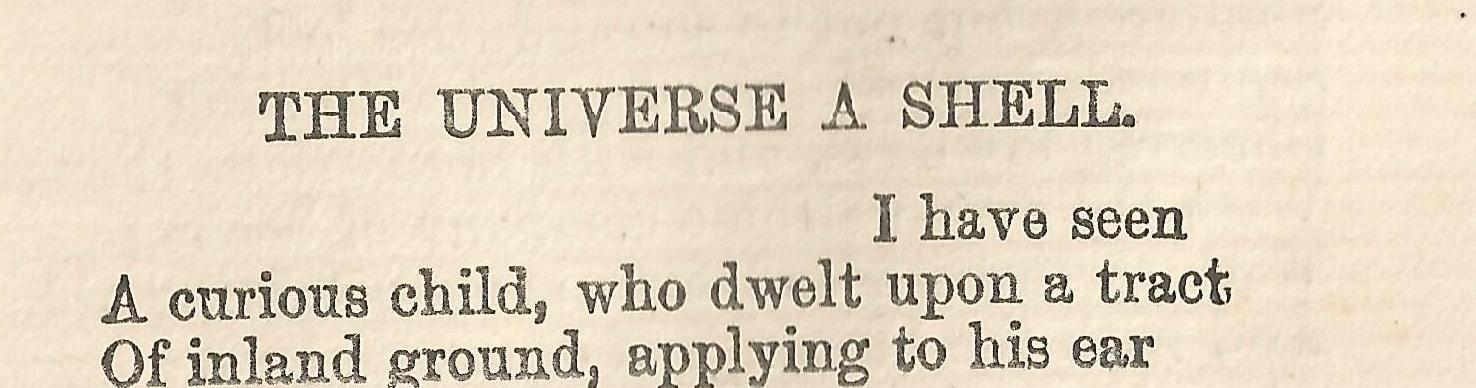
One of my very first blog posts (from way back in 2008) was inspired by an old book of poems by William Wordsworth that I’ve had since I was a child. I was reading it again this evening and came across this short excerpt, near the end of the book, from The Excursion, and entitled for the purposes of the book The Universe a Shell. It struck me as having a message for anyone who works on the science of things either too big or too small to be sensed directly on a human scale, so I thought I’d post it.

I decided to scan it in rather than copy it from elsewhere on the net, as I really love the look of that old faded  typeface on the yellowing paper, even if it is a bit wonky because it went over two pages. I’ve been fond of Wordsworth for as long as I can remember and, like a few other things, that’s something I’ll never feel the need to apologize for…

Shell-a

Shell-b

Science Propaganda

Posted in Science Politics, The Universe and Stuff with tags , , on January 2, 2013 by telescoper

I thought I’d do a quick rehash of an old post which is vaguely relevant to the still simmering controversy generated by the Cox-Ince editorial I blogged about before Christmas.

The legitimate interface between science and society has many levels to it. One aspect is the simple need to explain what science tells us about the world in order that people can play an informed part in our increasingly technological society. Another is that there needs to be encouragement for (especially young) people to study science seriously and to make it their career in order to maintain the supply of scientists for the future. And then there is the issue of the wider cultural implications of science, its impact on other belief-systems (such as religions) other forms of endeavour (such as art and literature) and even for government.

I think virtually all scientists would agree with the need for engagement in at least the first two of these. In fact, I’m sure most scientists would love to have the chance to explain their work to a lay audience, but not all subjects are as accessible or inspirational as, say, astronomy. Unfortunately also, not all scientists are very good at this sort of thing. Some might even be counter-productive if inflicted on the public in this way. So it seems relatively natural that some people have had more success at this activity than others, and have thus become identified as “science communicators”. Although some scientists are a bit snobby about those who write popular books and give popular talks, most of us agree that this kind of work is vital for both science and society.

Vital, yes, but there are dangers. The number of scientists involved in this sort of work is probably more limited than it should be owing to the laziness of the popular media, who generally can’t be bothered to look outside London and the South-East for friendly scientists. The broadsheet newspapers employ very few qualified specialists among their staff even on the science pages so it’s a battle to get meaningful scientific content into print in the mass media. Much that does appear is slavishly regurgitated from one of the press agencies who are kept well fed by the public relations experts employed by research laboratories and other science institutes.

These factors mean that what comes out in the media can be a distorted representation of the real scientific process. Heads of research groups and laboratories are engaged in the increasingly difficult business of securing enough money to continue their work in these uncertain financial times. Producing lots of glossy press releases seems to be one way of raising the profile and gaining the attention of funding bodies. Most scientists do this with care, but sometimes the results are ludicrously exaggerated or simply wrong. Some of the claims circulating around the time the Large Hadron Collider was switched on definitely fell into one or more of those categories. I realise that there’s a difficult balance to be struck between simplicity and accuracy, and that errors can result from over-enthusiasm rather than anything more sinister, but even so we should tread carefully if we want the public to engage with what science really is.

The Cox-Ince editorial is refreshingly clear about the limitations of science:

Science is a framework with only one absolute: all opinions, theories and “laws” are open to revision in the face of evidence. It should not be seen or presented, therefore, as a body of inviolate knowledge against which policy should be judged; the effect of this would be to replace one priesthood with another. Rather, science is a process, a series of structures that allow us, in as unbiased a way as possible, to test our assertions against Nature.

However, there is still far too much science reporting that portrays as facts  ideas and theories which have little or no evidence to support them. This isn’t science communication, it’s science propaganda and I think too many scientists go along with it. There’s a difficult balance to be struck, between engaging the public with inspirational but superficial TV programmes and explaining the intellectual struggles that science really involves.  Give the public the latter without any of the former and they’ll surely switch off!

Most worryingly is the perceived need to demonstrate black-and-white certainty over issues which are considerably more complicated than that. This is another situation where science popularisation becomes science propaganda. I’m not sure whether the public actually wants its scientists to make pronouncements as if they were infallible oracles, but the media definitely do. Scientists sometimes become cast in the role of priests, which is dangerous, especially when a result is later shown to be false. Then the public don’t just lose faith with one particular scientist, but with the whole of science.

Science is not about certainty. What it is a method for dealing rationally with uncertainty. It is a pragmatic system primarily intended for making testable inferences about the world using measurable, quantitative data. Scientists look their most arrogant and dogmatic when they try to push science beyond the (relatively limited) boundaries of its applicability and to ride roughshod over alternative ways of dealing with wider issues including, yes, religion.

I don’t have any religious beliefs that anyone other than me would recognize as such. I am also a scientist. But I don’t see any reason why being a scientist or not being a scientist should have any implications for my (lack of) religious faith. God (whatever that means) is, by construction, orthogonal to science. I’m not at all opposed to scientists talking about their religion or their atheism in the public domain. I don’t see why their opinions are of any more interest than anyone else’s in these matters, but I’m quite happy to hear them voiced.

This brings us to the question, often raised by hardline atheists, as to whether more scientists  should follow Richard Dawkins’ lead and be champions of atheism in the public domain. As a matter of fact, I agree with some of Dawkins’ agenda, such as his argument for the separation of church and state, although I don’t feel his heavy-handed use of the vitriol in The God Delusion achieved anything particularly positive (except for his bank balance, perhaps). But I don’t think it’s right to assume that all scientists should follow his example. Their beliefs are their business. I don’t think we will be much better off if we simply replace one set of priests with another. In this respect I wholeheartedly agree with Peter Higgs who has recently described Dawkins as “embarrassing”.

So there you have my plea for both public and scientists to accept that science will never have all the answers. There will always be “aspects of human experience that, even in an age of astonishing scientific advance, remain beyond the reach of scientific explanation”.

Can I have the Templeton Prize now please?
A Little Bit of Gravitational Lensing

Posted in The Universe and Stuff with tags , , , , , on December 30, 2012 by telescoper

I thought I’d take a short break from doing absolutely nothing to post a quick little item about gravitational lensing. It’s been in my mind to say something about this since I mentioned it in one of the lectures I gave just before Christmas, but I’ve been too busy (actually too disorganized) to do it until now. It’s all based on a paper posted to the arXiv in December which was led by Jo Woodward (née Short) who did her PhD with me in Cardiff and is now in a postdoctoral research position in Durham (which is in the Midlands). The following pictures were take from her paper.

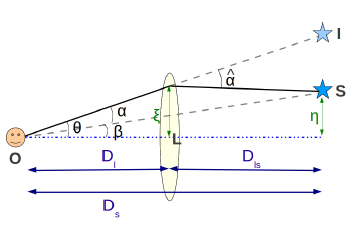
This figure shows the geometry of a gravitational lens system: light from the source S is deflected by the gravitational potential of the lens L so that an image I appears at a position on the sky which is different from the actual position when viewed by the observer O:

lensing_1
There’s a critical radius (which depends on the mass and density profile of the lens) at which this can lead to the formation of multiple images of the source. Even if multiple images are not resolved, lensing results in an increase in the apparent brightness of the source.

A great deal of cosmological information can be gleaned statistically from lensing  with even limited knowledge of the properties of the source and lens populations and with incomplete information about e.g. the actual angular deflection produced by the lens or the lens mass. To illustrate this, just consider the expression for the differential optical depth to lensing (related to the probability that a source at redshift z_s is lensed by an object at redshift z_l
lensing_2

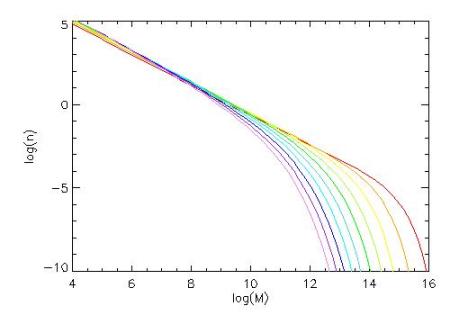
The first two terms are cosmological, accounting geometrical and expansion effects. Roughly speaking, the larger the volume out to a given redshift the higher the probability is that a given source will be lensed. The third term involves the mass function of lens systems. In the framework of the standard cosmological model this can be computed using Press-Schechter theory or one of the variations thereof. According to current understanding, cosmological structures (i.e. galaxies and clusters of galaxies) form hierarchically so this mass function changes with redshift, with fewer high mass objects present at high redshift than at low redshift, as represented in this picture, in which masses are given in units of solar masses, the colour-coding representing different redshifts:
lensing_3

The last term represents the lensing cross-section of an object with a given mass. This depends on the internal structure of the lens – an object in which the mass is highly concentrated produces  lensing effects radically different from one that isn’t. Two simple models for the mass distribution are the singular isothermal sphere (SIS) and the Navarro-Frenk-White profile (NFW). The latter is thought (by some) to represent the distribution of cold dark matter in haloes around galaxies and clusters which is more diffuse than that of the baryonic material because it can’t dissipate energy which it needs to do to fall into the centre of the object. The real potential of a galaxy in its central regions could be more like the SIS profile would predict, however, because baryons outweigh dark matter there.

Now time for a bit of historical reminiscence. In 1997 I published a book with George Ellis in which we analysed the evidence available at the time relating to the density of matter in the Universe. It was a little bit controversial at the time, but it turns out we were correct in concluding that the density of matter was well below the level favoured by most theorists i.e. only about 20-30% of the critical density. However we did not find any compelling evidence at that time for a cosmological constant (or, if you prefer, dark energy). Indeed one of the strongest upper limits on the cosmological constant came from gravitational lensing measurements, or rather the dearth of them.

The reason for this negative conclusion was that, for a fixed value of the Hubble constant,  in the presence of a cosmological constant the volume out to a given redshift is much larger than if there is no cosmological constant. That means the above integral predicts a high probability for lensing. Surveys however failed to turn up large numbers of strongly-lensed objects, hence the inference that the universe could not be dominated by a cosmological constant. This is, of course, assuming that the other terms in the integral are well understood and that the reason significant numbers of lensed systems weren’t found wasn’t just they are tricky to identify…

Meanwhile, huge advances were made in other aspects of observational cosmology that established a standard cosmological model in which the cosmological constant makes up almost 75% of the energy budget of the Universe.

Now, 15 years later on, enter the Herschel Space Observatory, which turns out to be superb at identifying gravitational lenses.  I posted about this here, in fact. Working in the far-infrared makes it impossible to resolve multiple images with Herschel – even with a 3.5m mirror in space, λ/D isn’t great for wavelengths of 500 microns! However, the vast majority of sources found during the Herschel ATLAS survey with large fluxes at this wavelengths can be identified as lenses simply because their brightness tells us they’ve probably been magnified by a lens. Candidates can then be followed up with other telescopes on the ground.  A quick look during the Science Demonstration Phase of Herschel produced the first crop of firmly identified gravitational lens systems published in Science by Negrello et al..  When the full data set has been analysed there should be hundreds of such systems, which will revolutionize this field.

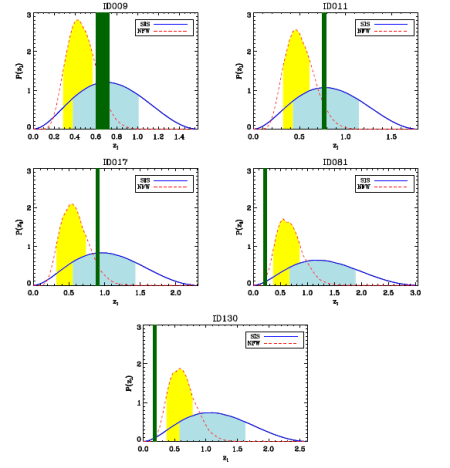
To see the potential (no pun intended) of this kind of measurement, take a look at these five systems from the SDP set:

lensing_4

These systems have measured (or estimated) source and lens redshifts. What is plotted is the conditional probability of a lens at some particular lens redshift, given the source redshift and the fact that strong lensing has occurred. Curves are given for SIS and NFW lens profiles and everything else is calculated according to the standard cosmological model. The green bars represent the measured lens redshifts.  It’s early days, so there are only five systems, but you can already see that they are pointing towards low lens redshifts, favouring NFW over SIS;  the yellow and light blue shading represents regions in which 68% of the likelihood lies.  These data don’t strongly prefer one model over the other, but with hundreds more, and extra information about at least some of the lens systems (such as detailed determinations of the lens mass from deflections etc) we should be able  to form more definite conclusions.

Unfortunately the proposal I submitted to STFC to develop a more detailed theoretical model and statistical analysis pipeline (Bayesian, of course) wasn’t funded. C’est la vie. That probably just means that someone smarter and quicker than me will do the necessary…

The Planck Rumour Mill

Posted in The Universe and Stuff with tags , , , , on December 28, 2012 by telescoper

I gather the internet is crawling with people searching for rumours about the Planck mission. It would obviously be entirely inappropriate for me to direct my readers to any website where they might obtain access to confidential information about this experiment, the results from which are embargoed until well into the New Year. So naturally that’s what I’m going to do. Well, blog traffic doesn’t generate itself does it?

As a Telescoper exclusive I am able to offer you a sneak preview of the top secret Planck data well in advance of official release. If you want to see what Planck scientists have been looking since Planck was launched in 2009, just click here.

WMAP: The Last Judgement

Posted in The Universe and Stuff with tags , , , , , , on December 21, 2012 by telescoper

It seems the the Wilkinson Microwave Anisotropy Probe, or rather the estimable team of people working on it, have produced yet another set of maps and key results. I believe this will be the final release from WMAP. The paper is on the arXiv here and it represents a synthesis of no less than nine years of measurements of the cosmic microwave background radiation:

Here’s the abstract:

We present the final nine-year maps and basic results from the WMAP mission. We provide new nine-year full sky temperature maps that were processed to reduce the asymmetry of the effective beams. Temperature and polarization sky maps are examined to separate CMB anisotropy from foreground emission, and both types of signals are analyzed in detail. The WMAP mission has resulted in a highly constrained LCDM cosmological model with precise and accurate parameters in agreement with a host of other cosmological measurements. When WMAP data are combined with finer scale CMB, baryon acoustic oscillation, and Hubble constant measurements, we find that Big Bang nucleosynthesis is well supported and there is no compelling evidence for a non-standard number of neutrino species (3.26+/-0.35). The model fit also implies that the age of the universe is 13.772+/-0.059 Gyr, and the fit Hubble constant is H0 = 69.32+/-0.80 km/s/Mpc. Inflation is also supported: the fluctuations are adiabatic, with Gaussian random phases; the detection of a deviation of the scalar spectral index from unity reported earlier by WMAP now has high statistical significance (n_s = 0.9608+/-0.0080); and the universe is close to flat/Euclidean, Omega_k = -0.0027 (+0.0039/-0.0038). Overall, the WMAP mission has resulted in a reduction of the cosmological parameter volume by a factor of 68,000 for the standard six-parameter LCDM model, based on CMB data alone. For a model including tensors, the allowed seven-parameter volume has been reduced by a factor 117,000. Other cosmological observations are in accord with the CMB predictions, and the combined data reduces the cosmological parameter volume even further. With no significant anomalies and an adequate goodness-of-fit, the inflationary flat LCDM model and its precise and accurate parameters rooted in WMAP data stands as the standard model of cosmology.

The main reason for posting this is to acknowledge the remarkable impact WMAP has had on the field of cosmology. The standard model does indeed account for most available cosmological data extremely well. I’m not entirely sure about the “no significant anomalies” bit in the last sentence, in fact, but I won’t argue with it as it depends entirely upon what you mean by significant. It’s not exactly proven that the fluctuations have “random phases” either. We’ll just have to see whether data from Planck, due to be released next year, will reveal evidence of any physics beyond the standard framework WMAP did so much to establish.

Das Letzte Gericht

Posted in Art, Astrohype, The Universe and Stuff with tags , , , on December 20, 2012 by telescoper

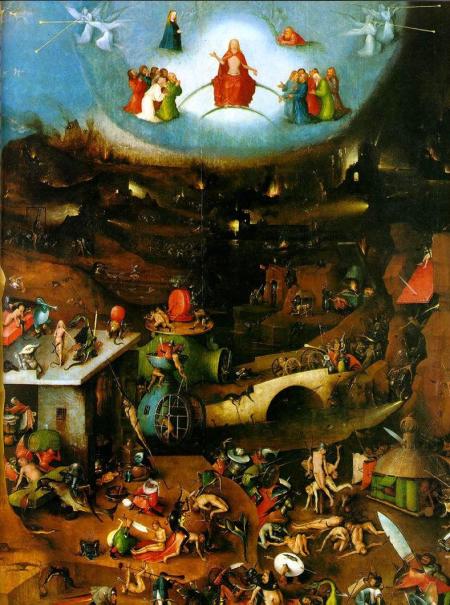
Apparently the world is due to end tomorrow, so I’ve saved quite a lot of money by not having done my Christmas shopping yet. Anyway, the forthcoming Apocalypse reminded me of the painting that I often use to introduce cosmology talks. I usually use this piece of Hieronymus Bosch Das letzte Gericht (The Last Judgement) to illustrate my feelings about the standard cosmological model:

das_letzte_gericht

The top part represents the concordance cosmology. It clearly features an eminent cosmologist surrounded by postdoctoral researchers. Everything appears to be in heavenly harmony, surrounded by a radiant glow of self-satisfaction. The trumpets represent various forms of exaggerated press coverage.

But if you step back from it, and get the whole thing in a proper perspective, you realise that there’s an awful lot going on underneath that’s not so pleasant or easy to interptet. I don’t know what’s going down below there, although the unfortunate figures slaving away in miserable conditions and suffering unimaginable torments, are obviously supposed to represent graduate students. The large knife visible in the bottom right corner clearly symbolises budget cuts looming in the next Comprehensive Spending Review.

The main point is that the concordance model is based on rather strange foundations: nobody understands what the dark matter and dark energy are, for example. Even more fundamentally, the whole thing is based on a shotgun marriage between general relativity and quantum field theory which is doomed to fail somewhere along the line.

Far from being a final theory of the Universe I think we should treat our standard model as a working hypothesis and actively look for departures from it. I’m not at all against the model. As models go, it’s very successful. It’s a good one, but it’s still just a model.

My Last Cardiff Lecture

Posted in Biographical, Education, The Universe and Stuff with tags , , on December 7, 2012 by telescoper

Hey ho.

This morning, as usual for a Friday, the alarm went off at 6am and I started the slow process of getting my brain in gear for a two-hour 9am lecture. As usual, by the start of the lecture I was still trying to wake up, but I at least managed to get through the performance  making only  finite number of errors.

The topic for day was Fourier series, and especially how to use them to solve interesting partial differential equations. The one I chose to illustrate the general method of separation of variables was the heat conduction equation, appropriately enough because Joseph Fourier, the man himself, developed the idea of using   trigonometric functions to represent other functions in order to solve that equation; he presented the method in his book Théorie analytique de la chaleur way back in 1822.

During the lecture I also had to distribute another bunch of questionnaires to the students to allow them to give constructive feedback vent their spleen at my incompetence and lack of organization. We already had one set of questionnaires halfway through the term, so I’m not sure why we need another one. Perhaps the students gave the wrong answers to the questions last time, so this is like a resit?

When it was all over, and I returned to my office to recover,  I suddenly realised that it was my last Cardiff lecture ever. (There is in fact another week remaining before the Christmas break, but I’m away next week and a colleague will fill in for me. ) In fact, it might have been my last undergraduate lecture ever, as I’m not sure how much time I’ll get for actual teaching when I move to my new job in the New Year. I think I’ll miss it, actually, but I’m not sure the students will!

Still, at least I get to set my alarm to a more sensible time from now on.

SPT and the CMB

Posted in The Universe and Stuff with tags , , , , , , , , , on November 30, 2012 by telescoper

I’ve been remiss in not yet passing on news  from the South Pole Telescope, which has recently produced a number of breakthrough scientific results, including:  improved cosmological constraints from the SPT-SZ cluster survey (preprint here); a new catalogue of 224 SZ-selected cluster candidates from the first 720 square-degrees of the survey (preprint here); the first measurement of galaxy bias from the gravitational lensing of the CMB (preprint here); the first CMB-based constraint on the evolution of the ionized fraction during the epoch of reionization (preprint here); the most-significant detection of non-Gaussianity induced from the gravitational lensing of the CMB (preprint here); and the most precise measurement of the CMB damping tail and improved constraints on models of Inflation (preprint here).

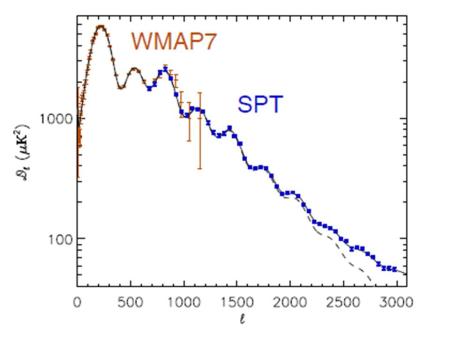
Here’s the graph that drew my eye (from this paper). It shows the (angular) power spectrum of the cosmic microwave for very high (angular) frequency spherical harmonics; the resolution of SPT allows it to probe finer details of the spectrum that WMAP (also shown, at lower l).

Slide1

This is an amazing graph, especially for oldies like me who remember being so impressed by the emergence of the first “acoustic peak” at around l=200 way back in the days of Boomerang and Maxima and gobsmacked by WMAP’s revelation of the second and third. Now there are at least six acoustic peaks, although of progressively lower amplitude. The attenuation of the CMB fluctuations at high frequencies is the result of diffusion damping – similar to the way high-frequency sound waves are attenuated when they pass through a diffusive medium (e.g. a gas).  The phenomenon in this case is usually called Silk Damping, as it was first worked out back in the 1960s by Joe Damping Silk.

Anyway, there’ll be a lot more CMB news early (?) next year from Planck which will demonstrate yet again that cosmic microwave background physics has certainly come a long way from pigeon shit

Simulations and False Assumptions

Posted in The Universe and Stuff with tags , , , , on November 29, 2012 by telescoper

Just time for an afternoon quickie!

I saw this abstract by Smith et al. on the arXiv today:

Future large-scale structure surveys of the Universe will aim to constrain the cosmological model and the true nature of dark energy with unprecedented accuracy. In order for these surveys to achieve their designed goals, they will require predictions for the nonlinear matter power spectrum to sub-percent accuracy. Through the use of a large ensemble of cosmological N-body simulations, we demonstrate that if we do not understand the uncertainties associated with simulating structure formation, i.e. knowledge of the `true’ simulation parameters, and simply seek to marginalize over them, then the constraining power of such future surveys can be significantly reduced. However, for the parameters {n_s, h, Om_b, Om_m}, this effect can be largely mitigated by adding the information from a CMB experiment, like Planck. In contrast, for the amplitude of fluctuations sigma8 and the time-evolving equation of state of dark energy {w_0, w_a}, the mitigation is mild. On marginalizing over the simulation parameters, we find that the dark-energy figure of merit can be degraded by ~2. This is likely an optimistic assessment, since we do not take into account other important simulation parameters. A caveat is our assumption that the Hessian of the likelihood function does not vary significantly when moving from our adopted to the ‘true’ simulation parameter set. This paper therefore provides strong motivation for rigorous convergence testing of N-body codes to meet the future challenges of precision cosmology.

This paper asks an important question which I could paraphrase as “Do we trust N-body simulations too much?”.  The use of numerical codes in cosmology is widespread and there’s no question that they have driven the subject forward in many ways, not least because they can generate “mock” galaxy catalogues in order to help plan survey strategies. However, I’ve always worried that there is a tendency to trust these calculations too much. On the one hand there’s the question of small-scale resolution and on the other there’s the finite size of the computational volume. And there are other complications in between too. In other words, simulations are approximate. To some extent our ability to extract information from surveys will therefore be limited by the inaccuracy of our calculation of  the theoretical predictions.

Anyway,  the paper gives us quite a few things to think about and I think it might provoke a bit of discussion, which is why I mentioned it here – i.e. to encourage folk to read and give their opinions.

The use of the word “simulation” always makes me smile. Being a crossword nut I spend far too much time looking in dictionaries but one often finds quite amusing things there. This is how the Oxford English Dictionary defines SIMULATION:

1.

a. The action or practice of simulating, with intent to deceive; false pretence, deceitful profession.

b. Tendency to assume a form resembling that of something else; unconscious imitation.

2. A false assumption or display, a surface resemblance or imitation, of something.

3. The technique of imitating the behaviour of some situation or process (whether economic, military, mechanical, etc.) by means of a suitably analogous situation or apparatus, esp. for the purpose of study or personnel training.

So it’s only the third entry that gives the intended meaning. This is worth bearing in mind if you prefer old-fashioned analytical theory!

In football, of course, you can even get sent off for simulation…

Three Astronomy Jobs at Sussex – The Deadline Approaches!

Posted in The Universe and Stuff with tags , , , on November 29, 2012 by telescoper

I’m taking the liberty of repeating this advertisement in case anybody out there missed it. Here is an announcement of three (new, permanent) jobs in Astronomy at the University of Sussex. You can also find an advertisment in the November AAS Jobs Register. In fact this is it. The deadline is 30th November, i.e. tomorrow, so if you want to apply then you had better get your skates on!

Full details of the positions are in the above links, but the gist is that applications are invited for 3 permanent, full-time faculty positions within the Astronomy Centre.

The 8 existing faculty have research interests that span the observation, modelling/simulation and theory of extragalactic astronomy and cosmology.  We are seeking talented and ambitious colleagues whose research interests complement and extend our current activity.

I’ll be interested to see how many people apply as a result of seeing this here announcement, so if you do fill in an application form  be sure to answer the question “Where did you see this post advertised” with “In the Dark”!