I’m indebted to Alan Heavens (currently of Edinburgh University, shortly to move to Imperial College) for drawing my attention to outstanding young jazz pianist and composer Dan Tepfer. I’ve been listening to quite a lot of Dan’s music, over the past few days and I think he’s brilliant. What’s even more interesting about him from the point of view of this blog is his background: he is a former Astrophysics student (at the University of Edinburgh). He changed direction away from academic studies in order to focus on his music, relocated to New York and has subsequently received rave reviews for his performances both live and on various albums. He tours extensively in the USA and worldwide; next time he’s in the UK I’m definitely going to check out one of his live gigs. Do visit his website; as a taster here’s his highly original (and pretty long) live version of the John Coltrane classic Giant Steps..
Follow @telescoperArchive for the The Universe and Stuff Category
Giant Steps, from Astrophysics to Jazz
Posted in Jazz, The Universe and Stuff with tags Astrophysics, Dan Tepfer, Giant Steps, Jazz, University of Edinburgh on January 21, 2012 by telescoperThe Unknown Citizen
Posted in Poetry, The Universe and Stuff with tags BBC Stargazing Live, Citizen Science, Planethunters, Poetry, W.H. Auden, Zooniverse on January 20, 2012 by telescoperI thought of this poem when I was moaning the other day about the widespread use of the term “Citizen Science” to describe, e.g., the admirable activities of the Zooniverse. One aspect of their work, planethunters, employs enthusiastic amateurs volunteers from the general public to search for signs of exoplanets, for example, with a notable success during the recent series BBC Stargazing Live.
The problem I have with using the term “Citizen Science” is that it logically excludes those of us who happen to be professional scientists; we are citizens too! At least I hope we are…
Not that I’m pedantic or anything.
I like the word amateur which is derived from the latin verb amare (“to love”) and hence properly means someone who does a task out of love, rather than for money. I’d agree, though, that this has acquired negative connotations of amateurishness (i.e. “unprofessional”) so is probably unsuitable for modern use. But what other word would be better? I just had a look at my thesaurus and it suggests, e.g. “votary”, “layperson” and even “groupie” although I don’t think the latter will catch on!
Anyway, as you will see, none of this has really got anything to do with the poem, which I’m just posting because the word “Citizen” made me remember it. Apologies for the small font size, but I wanted to ensure that the line breaks didn’t get messed up.
(To JS/07/M/378 This Marble Monument Is Erected by the State)
He was found by the Bureau of Statistics to be
One against whom there was no official complaint,
And all the reports on his conduct agree
That, in the modern sense of an old-fashioned word, he was a saint,
For in everything he did he served the Greater Community.
Except for the War till the day he retired
He worked in a factory and never got fired,
But satisfied his employers, Fudge Motors Inc.
Yet he wasn’t a scab or odd in his views,
For his Union reports that he paid his dues,
(Our report on his Union shows it was sound)
And our Social Psychology workers found
That he was popular with his mates and liked a drink.
The Press are convinced that he bought a paper every day
And that his reactions to advertisements were normal in every way.
Policies taken out in his name prove that he was fully insured,
And his Health-card shows he was once in hospital but left it cured.
Both Producers Research and High-Grade Living declare
He was fully sensible to the advantages of the Installment Plan
And had everything necessary to the Modern Man,
A phonograph, a radio, a car and a frigidaire.
Our researchers into Public Opinion are content
That he held the proper opinions for the time of year;
When there was peace, he was for peace; when there was war, he went.
He was married and added five children to the population,
Which our Eugenist says was the right number for a parent of his generation.
And our teachers report that he never interfered with their education.
Was he free? Was he happy? The question is absurd:
Had anything been wrong, we should certainly have heard.
by W.H. Auden (1907-1973)
Follow @telescoperStargazing (virtually) Live
Posted in Television, The Universe and Stuff with tags Andrew Pontzen, BBC, Cosmology, galaxy formation, Oxford English Dictionary, simulation, Stargazing Live on January 18, 2012 by telescoperI hope you’ve all been tuning in to the BBC’s astronomy jamboree Stargazing Live. There have been two episodes so far, with one last one to follow tonight, plus a huge range of activities across the country (including Wales) giving members of the public the chance to look at the sky through telescopes. The programmes and other activities have been getting an excellent response, especially from the younger generation, which is excellent news for the future of astronomy.
Working in a School of Physics & Astronomy makes one realise just how much public interest there is in astronomy, not just among schoolkids but in the numerous amateur astronomical societies, the members of which actually know the night sky better than many professionals! Most of us astronomers and astrophysicists are regularly asked to give public lectures and Cardiff in particular runs a host of other outreach activities related to our astronomy research. Our colleagues in mainstream physics subjects such as condensed matter physics don’t get the same level of direct public interest – I don’t think there are any amateur semiconductor physics clubs in the UK! – but many students attracted into universities by astronomy do turn to other branches of physics when they get here, because something else catches their imagination.
But important though that role is, let’s not forget that astronomy isn’t just about outreach. It’s actually real science, making real discoveries about the way our universe works. It’s worth doing in its own right as well as being good for other branches of physics.
Anyway, being a theoretical astrophysicist I usually feel a bit left out of these stargazing actitivies because I don’t really know one end of a telescope from the other. The other day I jokingly asked whether Stargazing Live was ever going to include a theory component…
Last night’s episode actually did, in the form of a discussion of a numerical simulation of galaxy formation between the presenters and young Dr Andrew Pontzen from Oxford University. He even made a little video about the simulation, sort of virtual reality rendition of the formation of the Milky Way, as shown on the telly:
Apparently, making this required 300,000 CPU hours on 300 processors and it is based on 16 Terabytes of raw data. Phew!
It’s a very impressive simulation, but the use of the word simulation in this context always makes me smile. Being a crossword nut I spend far too much time looking in dictionaries but one often finds quite amusing things there. This is how the Oxford English Dictionary defines SIMULATION:
1.
a. The action or practice of simulating, with intent to deceive; false pretence, deceitful profession.
b. Tendency to assume a form resembling that of something else; unconscious imitation.
2. A false assumption or display, a surface resemblance or imitation, of something.
3. The technique of imitating the behaviour of some situation or process (whether economic, military, mechanical, etc.) by means of a suitably analogous situation or apparatus, esp. for the purpose of study or personnel training.
It’s only the third entry that gives the intended meaning. This is worth bearing in mind if you prefer old-fashioned analytical theory!
In football, of course, you can get sent off for simulation…
Follow @telescoperThe Eagle Nebula (as seen by Herschel)
Posted in Poetry, The Universe and Stuff with tags astronomy, Eagle Nebula, Herschel Space Observatory, Tennyson on January 17, 2012 by telescoperIt’s been a while since I posted anything from the Herschel Space Observatory, but here’s a stunning image I just saw on the BBC website which will more than rectify that omission. This is the Eagle Nebula, a much-studied object in terms of the optical light it emits, but this is a remarkable picture taken in the far-infrared part of the spectrum.

For more details, see here.
There’s much more to astronomy than looking at pretty pictures, but the opportunity to stare at things like this is definitely one of the perks of the job. It makes me think of Tennyson’s Poem, The Eagle…
He clasps the crag with crooked hands;
Close to the sun in lonely lands,
Ring’d with the azure world, he stands.
The wrinkled sea beneath him crawls;
He watches from his mountain walls,
And like a thunderbolt he falls.
Hungry Philosophers
Posted in The Universe and Stuff with tags philosophy, Physics, Richard Feynman on January 17, 2012 by telescoperAstronomy in Darkness
Posted in The Universe and Stuff with tags astronomy, Cosmic Web., Cosmology, Dark Energy, dark matter, RAS Club, Royal Astronomical Society, Steve Rawlings, Tom Kitching on January 14, 2012 by telescoperYesterday, being the second Friday of the month, was the day for the Ordinary Meeting of the Royal Astronomical Society (followed by dinner at the Athenaeum for members of the RAS Club). Living and working in Cardiff it’s difficult for me to get the specialist RAS Meetings earlier in the day, but if I get myself sufficiently organized I can usually get to Burlington House in time for the 4pm start of the Ordinary Meeting, which is open to the public.
The distressing news we learnt on Thursday about the events of Wednesday night cast a shadow over the proceedings. Given that I was going to dinner afterwards, for which a jacket and tie are obligatory, I went through my collection of (rarely worn) ties, and decided that a black one would be appropriate. When I arrived at Burlington House I was just in time to hear a warm tribute paid by a clearly upset Professor Roger Davies, President of the RAS and Oxford colleague of the late Steve Rawlings. There then followed a minute’s silence in his memory.
The principal reaction to this news amongst the astronomers present was one of disbelief and/or incomprehension. Some friends and colleagues of Steve clearly knew much more about what had happened than has so far appeared in the press, but I don’t think it’s appropriate for me to make these public at this stage. We will know the facts soon enough. A colleague also pointed out to me that Steve had spent most of his recent working life as a central figure in the project to build the Square Kilometre Array, which will be the world’s largest radio telescope. He has died just a matter of days before the announcement will be made of where the SKA will actually be built. It’s sobering to think that one can spend so many years working on a project, only for something wholly unforeseen to prevent one seeing it through to completion.
Anyway, the meeting included an interesting talk by Tom Kitching of the University of Edinburgh who talked about recent results from the Canada-France-Hawaii Telescope Lensing Survey (CHFTLenS). The same project was the subject of a press release because the results were presented earlier in the week at the American Astronomical Society meeting in Austin, Texas. I haven’t got time to go into the technicalities of this study – which exploits the phenomenon of weak gravitational lensing to reconstruct the distribution of unseen (dark) matter in the Universe through its gravitational effect on light from background sources – but Tom Kitching actually contributed a guest post to this blog some time ago which will give you some background.
In the talk he presented one of the first dark matter maps obtained from this survey, in which the bright colours represent regions of high dark matter density

Getting maps like this is no easy process, so this is mightily impressive work, but what struck me is that it doesn’t look very filamentary. In other words, the dark matter appears to reside predominantly in isolated blobs with not much hint of the complicated network of filaments we call the Cosmic Web. That’s a very subjective judgement, of course, and it will be necessary to study the properties of maps like this in considerable detail in order to see whether they really match the predictions of cosmological theory.
After the meeting, and a glass of wine in Burlington House, I toddled off to the Athenaeum for an extremely nice dinner. It being the Parish meeting of the RAS Club, afterwards we went through a number of items of Club business, including the election of four new members.
Life goes on, as does astronomy, even in darkness.
Follow @telescoperJust a closer walk with thee
Posted in Music, Television, The Universe and Stuff with tags Just a closer walk with thee, New Orleans, Steve Rawlings, Treme on January 12, 2012 by telescoperI saw this clip a few days ago, and had it in mind to post it at an appropriate time. Unfortunately when I got home today I learned some news that makes today seem all too appropriate. A distinguished and respected colleague, Prof. Steve Rawlings, of Oxford University was found dead last night. This is shocking and desperately sad news. I have no idea what happened but apparently the Oxfordshire police have arrested a 49-year old man on suspicion of murder. No doubt more information will emerge in due course.
The connection between this sombre piece of news and the clip I intended to post should become obvious when I tell you that it depicts a funeral. Indeed the music featured, the hymn or spiritual Just a Closer Walk with Thee, was the main music chosen for the service when my father died, just over four years ago. It’s a lovely old traditional tune that often plays a central role in New Orleans style funerals, as shown here, and is a melody that, for me, has a deep associattion with loss and bereavement.
The clip is taken from the US TV series Treme. I haven’t seen Treme -if it has been shown on UK TV I missed it – but it’s set in New Orleans in the aftermath of the near destruction of the city by Hurricane Katrina in 2005. Not knowing anything about the TV series I only watched the clip because of the music, but I was mightily impressed by the way the scene was photographed and how careful the producers had been in getting the details just right, because a funeral in New Orleans is unlike any other.
The sashes, parasols, and exaggerated, swaying slow march seen in the film are in some sense almost comical, but they are also at the same time solemn and immensely dignified. Defiant, even. I don’t think it’s just because I am a jazz fan that I find this video so moving. Perhaps it’s really because, faced with the awesome finality of death, every action we take in life is comical anyway, just as every word is ultimately banal. However, if a farce is what it’s going to be, let’s just make sure it’s done the way we like it – especially at the end.
One of the commenters on Youtube put it thus:
it aint my time yet .but when it is thats the way i wanna go home
Amen to that. I don’t think Steve Rawlings was a jazz fan, but this is the best way I can think of to pay my respects.
Follow @telescoperAway to Swansea
Posted in The Universe and Stuff with tags Cardiff University, Cosmology, Particle Physics, Physics, Swansea University on January 11, 2012 by telescoperJust time for a quick post this evening, primarily to make a note of an enjoyable event that took place this afternoon. I long since gave up keeping a proper journal so the old blog will have to play that role.
Today a small group of cosmologists from the School of Physics & Astronomy at Cardiff University made the short trip to Swansea to meet with members of the Physics department there. The idea of the meeting was to explore the possibilites of future research collaboration. For historical reasons there is a pretty strong separation in Wales between research in Particle Physics and Astronomy/Astrophysics; Swansea does the former and Cardiff does the latter. However, cosmology is an area in which there are possible overlaps between some of the – primarily theoretical – research going on at Swansea into, e.g., Quantum Gravity and what we do in Cardiff, e.g. inflationary cosmology.
Anyway we decided to get together for an afternoon of talks by members of both departments to see if anything emerged as potential research topics. In fact, a couple of interesting ideas were discussed and although the main focus of research differs substantially in the two institutions we’re definitely going to get together again to follow up these ideas.
Although I’ve been in Cardiff since 2007, I’d never visited Swansea University before which, considering that it’s only an hour away by train, is admittedly a bit pathetic. In fact I think it’s quite weird the two departments don’t collaborate more in other areas too. I’m certainly very keen to see more joint activities than we have now, so hopefully this is a move in that direction.
Anyway, I’d like to thank Graham Shore at Swansea for hosting us this afternoon and I very much look forward to the planned return leg which will be held in Cardiff in a couple of months.
Follow @telescoperIn a Physicist’s Mailbag…
Posted in Biographical, The Universe and Stuff with tags mail, Particle Physics, Physics on January 10, 2012 by telescoperAmong the delights (?) of being a scientist are those priceless pieces of unsolicited mail from members of the public. When I went to collect my mail this morning I found a prime example waiting in my pigeonhole. I knew what it was going to be like before I even opened it because the envelope was addressed (rather inaccurately) using an old-fashioned typewriter. Only a certain kind of person uses a typewriter these days.

I particularly enjoyed the “Emeritus Prof. ” bit. And Cardiff isn’t in “Engand”, by the way. Or even “England”.
Inside were six pieces of paper – all of different sizes – on which fascinating things had been typed and later highlighted with red and black pens in order to enhance both their scientific and artistic impact.
I’m in the middle of a load of project vivas today so haven’t had time to scan this masterpiece neatly, but it’s such a wonderful piece of correspondence that I couldn’t resist taking a few pictures of various elements for the edification of my vast readership. I think if you click on the images you might be able to read them more clearly but, if you do, I will not accept liability for the consequences.
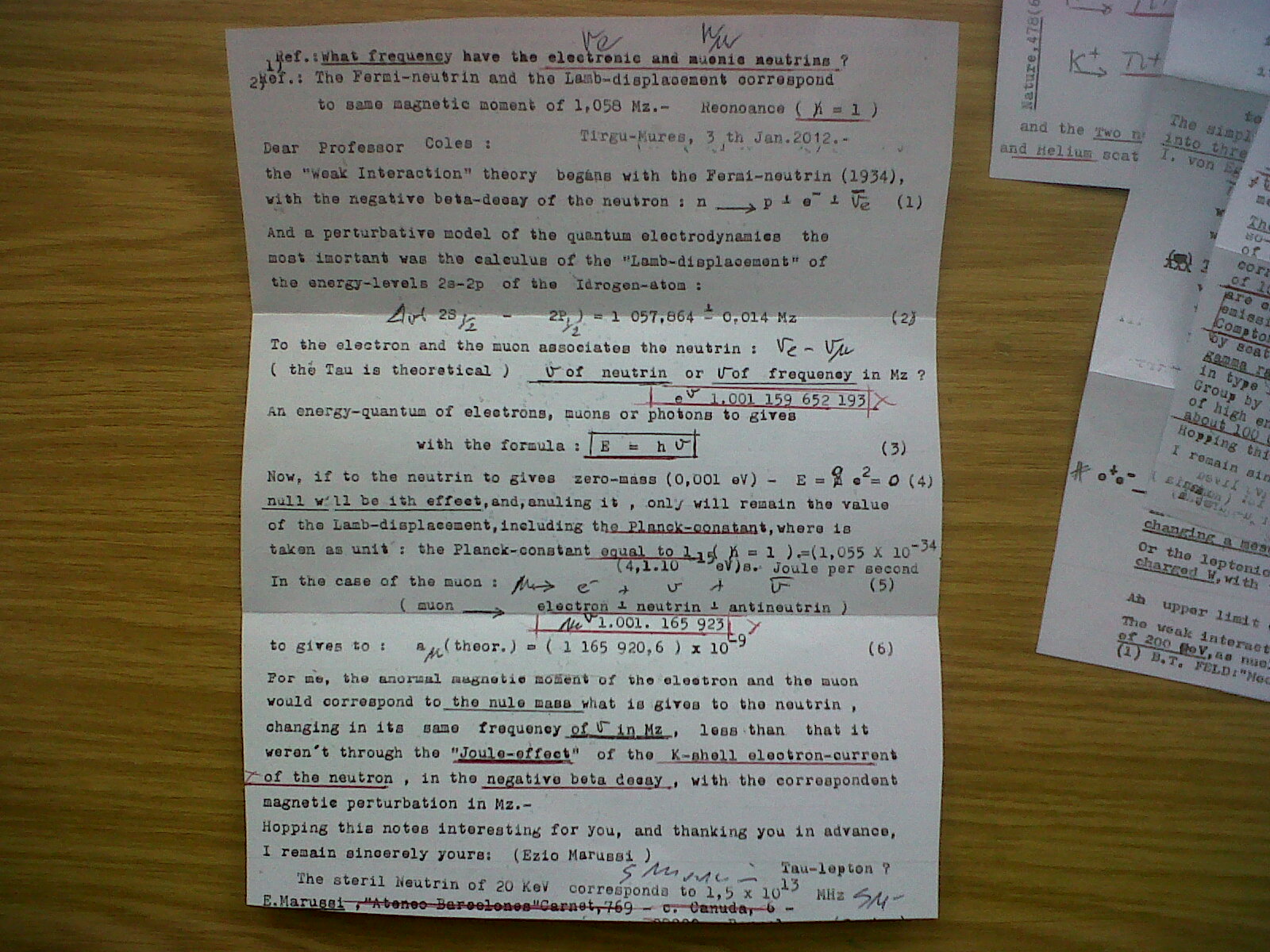
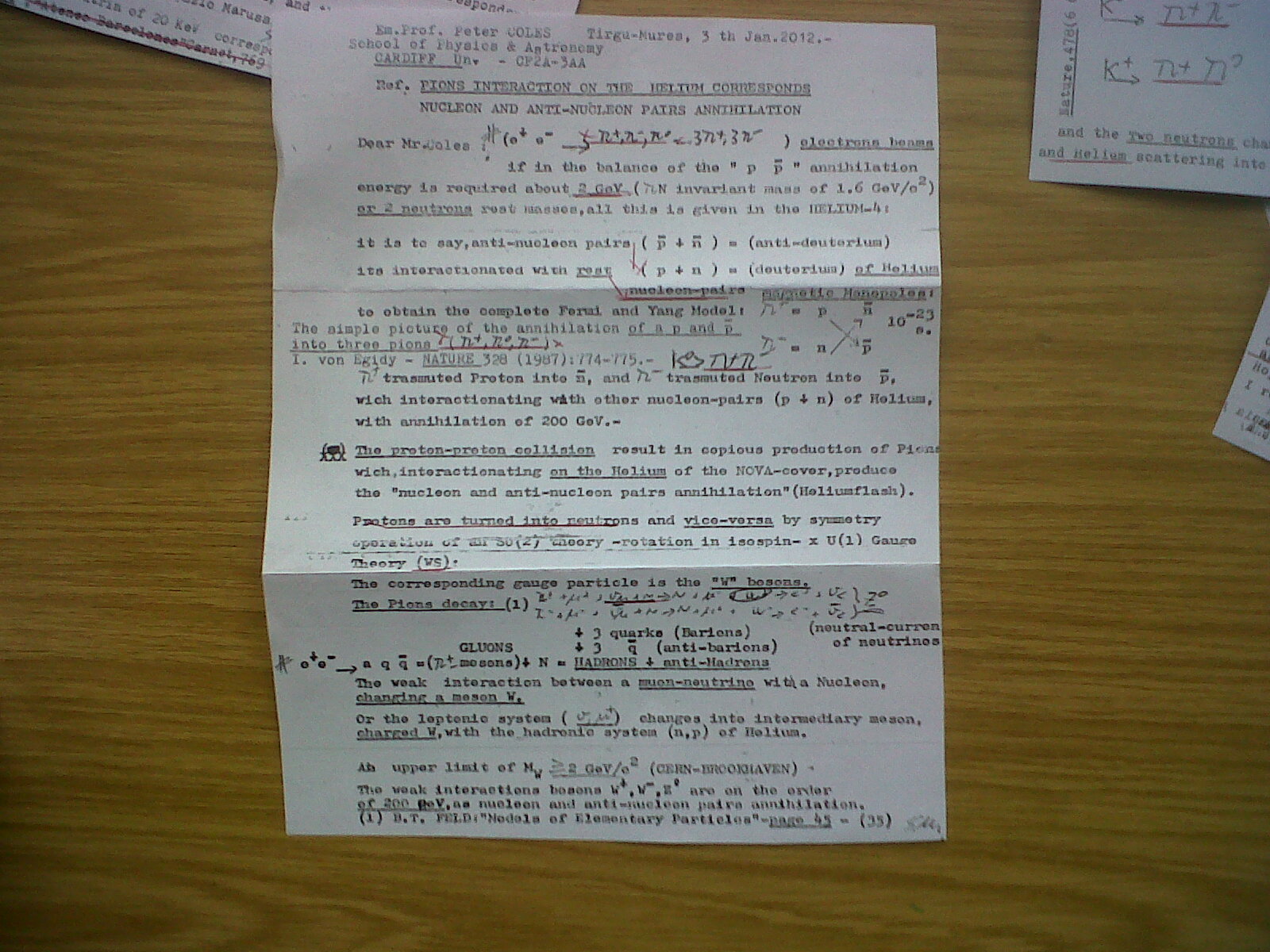

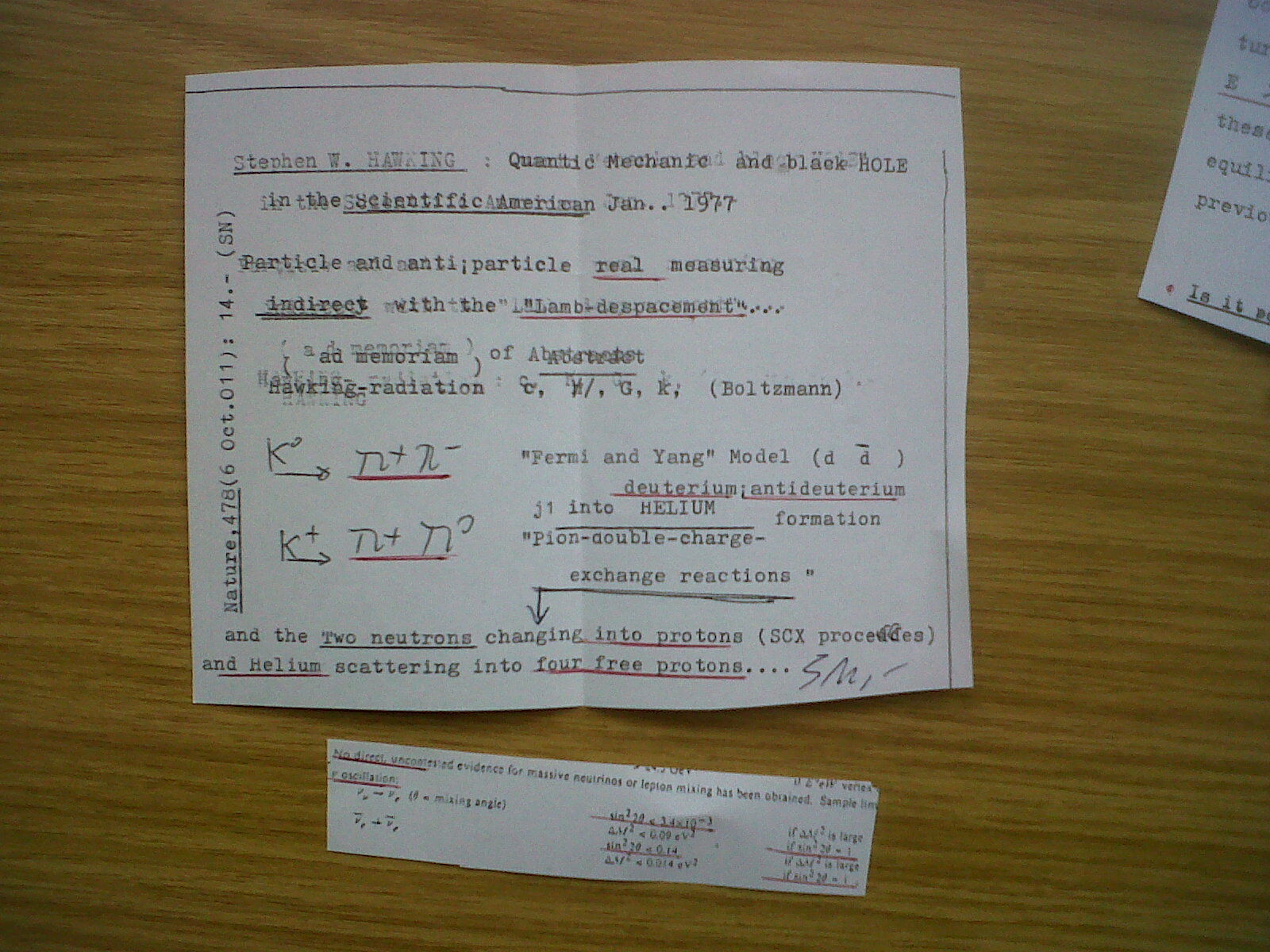
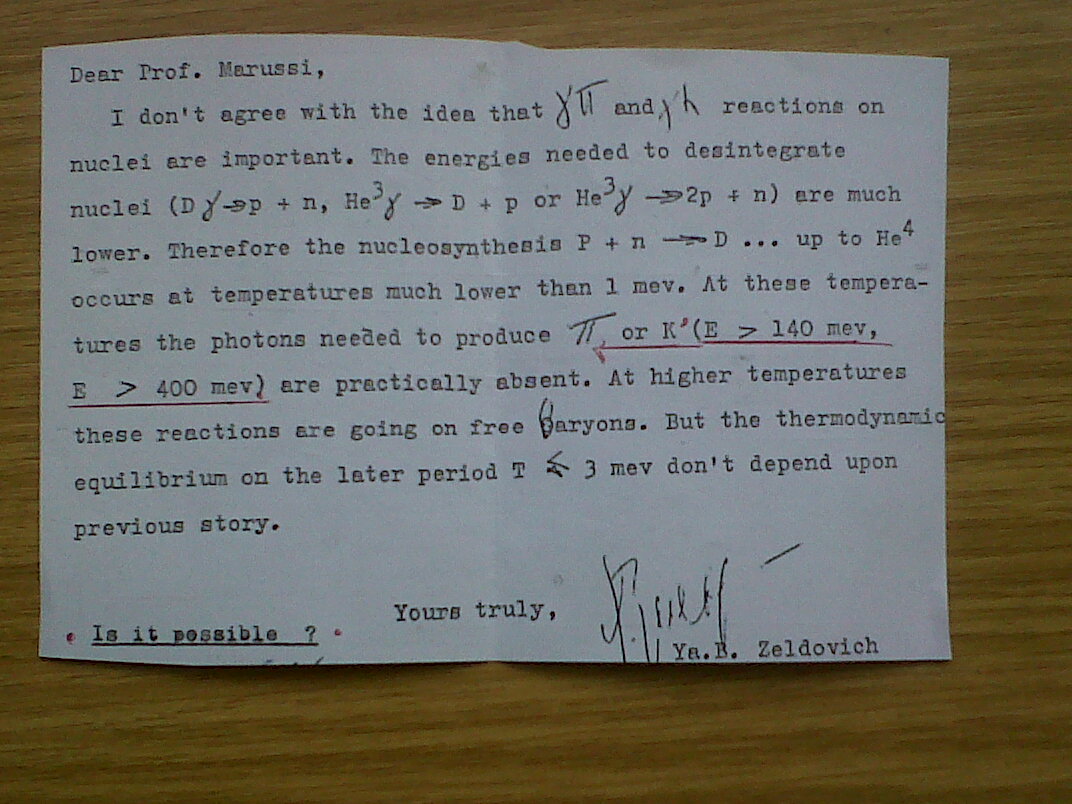
Unfortunately I’m not sure whether I have them in the right order, as the logic that connects them together escapes me.
I have a large collection of similar missives but, despite some obvious deficiencie, such as a lack of drawings, this letter is one of the best and will now take pride of place in the bottom drawer of my filing cabinet. Perhaps one day I’ll write a book about them…
Follow @telescoperHawking at 70
Posted in Books, Talks and Reviews, The Universe and Stuff with tags Einstein, Hawking and the Mind of God, Newton, Physics, Stephen Hawking on January 8, 2012 by telescoperToday is the 70th Birthday of renowned British theoretical physicist Stephen Hawking. His immense contributions to physics, including but not restricted to cosmology, are remarkable in their own right, but made even more emarkable that has done so much after having been stricken by such a debilitating disease when he was only in his twenties. Hawking’s is undoubtedly a brilliant and inspirational mind, but his courage and physical endurance in the face of difficulties that others might have found unbearable provide inspiration far behond physics. I’d therefore like to add a genuine Many Happy Returns to Professor Stephen Hawking, and I hope he’s enjoying the celebratory conference and other events that have been laid on to mark this special occasion.
I have in the past gone on record, both on television and in print, as being not entirely positive about the “cult” that surrounds Stephen Hawking. I think a number of my colleagues find things I have said disrespectful and/or churlish. I do, however, stand by everything I’ve said. I do have enormous respect for Hawking the physicist, as well as deep admiration for his tenacity and fortitude, and have never said otherwise. I don’t, however, agree that Hawking is in the same category of revolutionary thinkers as Newton or Einstein, which is how he is often portrayed.
In fact a poll of 100 theoretical physicists in 1999 came to exactly the same conclusion. The top ten in that list were:
- Albert Einstein
- Isaac Newton
- James Clerk Maxwell
- Niels Bohr
- Werner Heisenberg
- Galileo Galilei
- Richard Feynman
- Paul Dirac
- Erwin Schrödinger
- Ernest Rutherford
The idea of a league table like this is of course a bit silly, but it does at least give some insight into the way physicists regard prominent figures in their subject. Hawking came way down the list, in fact, in 300th (equal) place. I don’t think it is disrespectful to Hawking to point this out. I’m not saying he isn’t a brilliant physicist. I’m just saying that there are a great many other brilliant physicists that no one outside physics has ever heard of.
It is interesting to speculate what would have happened if the list had been restricted to living physicists. I’d guess Hawking would be in the top ten, but I’m not at all sure where…
And before I get accused of jealousy about Stephen Hawking’s fame, let me make it absolutely clear that if Hawking is like a top Premiership footballer (which I think is an appropriate analogy), then I am definitely like someone kicking a ball around for a pub team on a Sunday morning (with a hangover). This gulf does not make me envious; it just makes me admire his ability all the more, just as trying to play football makes one realise exactly how good the top players really are.
Anyway, I had better wind this up because that sporting metaphor has just reminded me that there are some FA Cup ties on the TV this afternoon. I’ll therefore switch to a slightly different kind of hawking, i.e. trying to peddle a few copies of my book Hawking and the Mind of God, which was published in 2000. Excuse the blatant self-promotion, but these are hard times!
Here is the jacket blurb:
Stephen Hawking has achieved a unique position in contemporary culture, combining eminence in the rarefied world of theoretical physics with the popular fame usually reserved for film stars and rock musicians. Yet Hawking’s technical work is so challenging, both in its conceptual scope and in its mathematical detail, that proper understanding of its significance lies beyond the grasp of all but a few specialists. How, then, did Hawking-the-scientist become Hawking-the-icon? Hawking’s theories often take him into the intellectual territory that has traditionally been the province of religion rather than science. He acknowledges this explicitly in the closing sentence of his bestseller, “A Brief History of Time”, where he says that his ultimate aim is the “know the Mind of God”. “Hawking and the Mind of God” examines the pseudo-religious connotations of some of the key themes in Hawking’s work, and how these shed light not only on the Hawking cult itself, but also on the wider issue of how scientists represent themselves in the media.
And you can take a peek at the inside here:


 In the Dark