Archive for the The Universe and Stuff Category

Talking Planck

Posted in The Universe and Stuff with tags , , on April 3, 2009 by telescoper

Since the Planck mission is due to be launched very soon, I thought it would be nice to put this lecture by George Efstathiou here in order to give some background. It’s from a page of science talks about Planck.

George is the Professor of Astrophysics (1909) at the University of Cambridge. The 1909 isn’t when he was born, but when the Chair he holds was set up. I have a hundred-year-old Chair in my house too.
He is also the Director of the impressive Kavli Institute for Cosmology.
He’s a leading member of the Planck science team and is coordinating the UK effort that will be applied to analysing the data. He’s an FRS, citation millionaire, and general all-round clever clogs. He would cut an even more impressive figure were it not for the fact that he supports Arsenal.

Clover Story

Posted in Science Politics, The Universe and Stuff with tags , , on April 2, 2009 by telescoper

Just a quick note for those interested in the story of Clover, Physics World have run a news item on their website.

You may also like to read the article by Alan Heavens over on the e-astronomer.

Note added on Monday 6th April: the Nature slant on the story is now published online, complete with quote from yours truly…

Another update (9th April). Welsh Newspaper The Western Mail has now run a story on the clover cancellation and there was a short item on the BBC Radio Wales News this evening.

Another update (14th April). A statement from Walter Gear, Principal Investigator of the Clover project, about the current status of Clover has been placed on the Cardiff University School of Physics & Astronomy web pages.

Update: 22nd April 2009. Here is the text of a piece I wrote for today’s Research Fortnight:

An undeserved end

Science projects don’t get much purer than CLOVER, an experiment designed to search for evidence of the existence of primordial gravitational waves by making ultra-sensitive measurements of the polarisation of the cosmic microwave background.

From its vantage point in the Atacama Desert in Chile, CLOVER was intended to probe the state of the universe when it was less than a billionth of a billionth of a second old, to test our understanding of the Big Bang theory. Unfortunately, the Science and Technology Facilities Council says it is cancelling funding for the experiment.

Gravitational waves have been studied theoretically and are known to be intimately related to the structure of space-time itself, the understanding of which is arguably the fundamental goal of modern science. The first discovery of the presence of gravitational waves will lead to the emergence of a brand new area of physics. In anticipation of this new science, the CLOVER team—entirely British, with members in the universities of Cardiff, Cambridge, Oxford and Manchester—has established a technical capability in the UK that is second to none. Cancellation will prevent the team from making direct experimental observations of the universe that would not only have been of immense scientific importance, but could also have had deep cultural significance.

So if CLOVER is so good, why is it being cancelled?

The answer lies in an unfortunate combination of circumstances. CLOVER was initially funded in 2004, with
£4.8 million from the Particle Physics and Astronomy Research Council, one of the forerunners of the STFC. This budget was not sufficient to complete the experiment, for two main reasons. First, the original grant did not include the costs of setting up a site, which was originally to be provided by overseas collaborators in Antarctica. When this option fell through, the cost of the alternative site in Chile (approximately £0.8m) had
to be found. Second, there were delays due to technical challenges, such as the need to develop some of the world’s most sensitive far-infrared superconducting cameras. So, the CLOVER team was unable to complete the project within the original budget, and went back to the STFC to request extra money. This brought a third factor into play.

Since 2007, the research councils, including the STFC, have changed their method of funding university-based research. In the new full-economic-costs regime, costs are substantially higher than at the time of the original award. These elements combined to leave the CLOVER team with a shortfall of about £2.6m, bringing the overall cost to completion to about £7.5m, although the increase in resources required would be only around 20 per cent if calculated on the pre-FEC basis of the initial funding.

Unfortunately, despite receiving strong support from the scientific community and being rated extremely highly in recent prioritisation exercises, the STFC Council has decided that it does not have the funds and has abruptly cancelled the CLOVER experiment.

The background to this decision is one of dire financial circumstances within the research council. Created in 2007, the STFC was set up with insufficient funding to continue all the programmes that it inherited from its predecessors. The deficit (of around £80m) has led to swingeing cuts in research grants over the past year. The pound has also fallen dramatically against the euro, increasing the cost of subscriptions to the European Space Agency, Cern and the European Southern
Observatory. The balance sheet of the STFC is now in total disarray. CLOVER is the first casualty in what may become a large-scale cull of fundamental science projects.

The STFC’s decision on CLOVER means that an important instrument will be lost, and the millions already spent on it wasted. The technology will be difficult to replace. The many gifted scientists who have been working on CLOVER will have to leave the UK to continue in the field, and are unlikely to return. Their fate is unlikely to tempt younger people into a career in science either.

In cancelling CLOVER, the council has effectively closed the door on UK involvement in cosmic microwave background science in general, an area that has already led to two Nobel prizes for physics. The decision also provides worrying evidence that the STFC seems to be turning away from fundamental science towards technology- driven projects. For example the lunar probe Moonlite has recently won funding for initial development studies without ever passing through the rigorous peer review required of CLOVER. If this really is the way the STFC is going, then we may be witnessing the beginning of the end for British astronomy.

The Waste Land

Posted in Poetry, Science Politics, The Universe and Stuff with tags , , , , on April 1, 2009 by telescoper

APRIL is the cruellest month, sending
Clover into the dead land, ditching
The great for the dire, erring
Dead heads caused spring pain.
Keith Mason fucked it up, smothering
Good science with tons of shit, ending
Our little dream; we’re the losers.

After The Waste Land, Part I: The Burial of the Dead, by T.S. Eliot.

Clover and Out

Posted in Science Politics, The Universe and Stuff with tags , , , , , , , , , on March 31, 2009 by telescoper

One of the most exciting challenges facing the current generation of cosmologists is to locate in the pattern of fluctuations in the cosmic microwave background evidence for the primordial gravitational waves predicted by models of the Universe that involve inflation.

Looking only at the temperature variation across the sky, it is not possible to distinguish between tensor  (gravitational wave) and scalar (density wave) contributions  (both of which are predicted to be excited during the inflationary epoch).  However, scattering of photons off electrons is expected to leave the radiation slightly polarized (at the level of a few percent). This gives us additional information in the form of the  polarization angle at each point on the sky and this extra clue should, in principle, enable us to disentangle the tensor and scalar components.

The polarization signal can be decomposed into two basic types depending on whether the pattern has  odd or even parity, as shown in the nice diagram (from a paper by James Bartlett)

The top row shows the E-mode (which look the same when reflected in a mirror and can be produced by either scalar or tensor modes) and the bottom shows the B-mode (which have a definite handedness that changes when mirror-reflected and which can’t be generated by scalar modes because they can’t have odd parity).

The B-mode is therefore (in principle)  a clean diagnostic of the presence of gravitational waves in the early Universe. Unfortunately, however, the B-mode is predicted to be very small, about 100 times smaller than the E-mode, and foreground contamination is likely to be a very serious issue for any experiment trying to detect it.

An experiment called Clover (involving the Universities of  Cardiff, Oxford, Cambridge and Manchester) was designed to detect the primordial B-mode signal from its vantage point in Chile. You can read more about the way it works at the dedicated webpages here at Cardiff and at Oxford. I won’t describe it in more detail here, for reasons which will become obvious.

The chance to get involved in a high-profile cosmological experiment was one of the reasons I moved to Cardiff a couple of years ago, and I was looking forward to seeing the data arriving for analysis. Although I’m primarily a theorist, I have some experience in advanced statistical methods that might have been useful in analysing the output.  It would have been fun blogging about it too.

Unfortunately, however, none of that is ever going to happen. Because of its budget crisis, and despite the fact that it has spent a large amount (£4.5M) on it already,  STFC has just decided to withdraw the funding needed to complete it (£2.5M)  and cancel the Clover experiment.

Clover wasn’t the only B-mode experiment in the game. Its rivals include QUIET and SPIDER, both based in the States. It wasn’t clear that Clover would have won the race, but now that we know  it’s a non-runner  we can be sure it won’t.

**** Energy

Posted in Poetry, The Universe and Stuff with tags , , , , , on March 30, 2009 by telescoper

The phrase expletive deleted was made popular at the time of Watergate after the release of the expurgated tapes made by Richard Nixon in the Oval Office when he was President of the United States of America. These showed that, as well as been a complete crook, he was practically unable to speak a single sentence without including a swear word.

Nowadays the word expletive is generally taken to mean an oath or exclamation, particularly if it is obscene, but that’s not quite what it really means. Derived from the latin verb explere (“to fill out”) from which the past participle is expletus, the meaning of the word in the context of English grammar is  “something added to a phrase or sentence that isn’t strictly needed for the grammatical sense”.  An expletive is added either to fill a syntactical role or, in a poem, simply to make a line fit some metrical rule.

Examples of the former can be found in constructions like “It takes two to Tango” or “There is lots of crime in Nottingham”; neither  “it” nor “there” should really be needed but English likes to have something before the verb.

The second kind of use is illustrated wonderfully by Alexander Pope in his Essay on Criticism, which is a kind of guide to what to avoid in writing poetry. It’s a tour de force for its perceptiveness and humour. The following excerpt is pricelessly apt

These equal syllables alone require,
Tho’ oft the open vowels tire;
While expletives their feeble aid do join;
And ten low words oft creep in one dull line

Here the expletive is “do”,  and it is cleverly incorporated in the line talking about expletives, adding  the syllable needed to fit with a strict pentameter. Apparently, poets often used this construction before Pope attacked it but it quickly fell from favour afterwards.

His other prosodic targets are the “open vowels” which means initial vowels that produce an ugly glottal sound, such as in “oft” (especially ugly when following “Tho”). The last line is brilliant too, showing how using only monosyllabic “low” words makes for a line that plods along tediously just like it says.

It’s amazing how much Pope managed to fit into this poem, given the restrictions imposed by the closed couplet structure he adopted. Each idea is compressed into a unit of twenty syllables, two lines of ten syllables with a rhyme at the end of each. This is such an impressive exercise in word-play that it reminds me a lot of the skill showed by the best cryptic crossword setters. Needless to say I’m no more successful at writing poetry than I am at setting crossword clues.

After my talk in Dublin last Friday, somebody in the audience asked me what I thought about Dark Energy. There’s some discussion in the comments after my post on that too.

The Dark Energy is an ingredient added to the standard model of cosmology to reconcile  observations of a flat Universe with a matter density that seems too low to account for it.

Other than that it makes the  cosmological metric work out satisfactorily (geddit?), we don’t understand what Dark Energy means and would rather it wasn’t there.  Most people think the resulting model is inelegant or even ugly.

In other words, it’s an expletive…

Dublin Back

Posted in Art, Books, Talks and Reviews, Crosswords, The Universe and Stuff with tags , , , , on March 28, 2009 by telescoper

I’m just back from a flying visit to Dublin, where I gave a talk yesterday at a meeting of the Astronomical Science Group of Ireland (ASGI), an organization which promotes scientific collaborations between individuals and institutions on both sides of the border between Northern Ireland and the Republic of Eire. The venue for the twice-yearly meetings moves around both countries, but this time it was held in the splendid environment of Trinity College, Dublin.

It turned out to be an easy trip from Cardiff to Dublin and my first opportunity to try out Cardiff’s fine little airport. A small airline called Air Arann operates the route to Dublin from there, and it all went to schedule despite the plane having to struggle against a 70 mph head wind across the Irish sea. For our small propeller-driven plane, that made a signficant difference to the flying time.

Arriving in Dublin on Thursday I had time to have a nice dinner before settling in to my hotel in the Temple Bar region of the city. There’s a huge concentration of bars and nightclubs there and it’s a traditional area for Stag and Hen Parties. There was plenty of evidence of drunken debauchery going on into the early hours of the morning, which remind me of the way the Irish rugby fans carried on last weekend in Cardiff.

Anyway, the meeting itself was interesting with a wide range of talks most of which were given by PhD students. I enjoy meetings where the younger scientists are encouraged to speak; too many conferences involve the same people giving the same talk time after time. Solar Physics was particularly  well represented, and I learned quite a bit about about things that are far from my own province. 

There isn’t much actual cosmology done in Ireland (North or South) so my brief as invited speaker was to give an overview of the current state of the field for astronomers who are not  experts in cosmological matters. I therefore gave a summary of the concordance model which I’ve blogged about before and then made some comments about things that might point to a more complete theory of the Universe. I also mentioned some of the anomalies in the cosmic microwave background that I’ve also blogged about on here.

I usually use this piece of Hieronymus Bosch The Last Judgement to illustrate my feelings about the concordance model:

das_letzte_gericht


The top part represents the concordance cosmology. It clearly features an eminent cosmologist surrounded by postdoctoral researchers. Everything appears to be in heavenly harmony, surrounded by a radiant glow of self-satisfaction. The trumpets represent various forms of exaggerated press coverage.

But if you step back from it, and get the whole thing in a proper perspective, you realise that there’s an awful lot going on underneath that’s not so pleasant or easy to interptet. I don’t know what’s going down below there although the unfortunate figures slaving away in miserable conditions and suffering unimaginable torments are obviously supposed to represent graduate students.

The main point is that the concordance model is based on rather strange foundations: nobody understands what the dark matter and dark energy are, for example. Even more fundamentally, the whole thing is based on a shotgun marriage between general relativity and quantum field theory which is doomed to fail somewhere along the line.

Far from being a final theory of the Universe I think we should treat our standard model as a working hypothesis and actively look for departures from it. I’m not at all against the model. As models go, it’s very successful. It’s a good one, but it’s still just a model.

That reminds me of the school report I got after my first year at the Royal Grammar School. The summary at the bottom described me as a “model student”. I was so thrilled I went and looked up the word model in a dictionary and found it said “a small imitation of the real thing.”

Anyway, the talk went down pretty well (I think) and after a quick glass of Guinness (which definitely went down well) I was back to Dublin airport and home to Cardiff soon after that: Cardiff airport to my house was less than twenty minutes. I greatly enjoyed my short visit and was delighted to be asked to do a couple of seminars back there in the near future.

I was in a  good mood when I got home, which got even better when I found out that I won the latest Crossword competition in the Times Literary Supplement. And the prize isn’t even a dictionary. It’s cash!

Social Physics and Astronomy

Posted in The Universe and Stuff with tags , , , , , on March 23, 2009 by telescoper

When I give popular talks about Cosmology,  I sometimes look for appropriate analogies or metaphors in television programmes about forensic science, such as CSI: Crime Scene Investigation which I used to watch quite regularly (to the disdain of many of my colleagues and friends). Cosmology is methodologically similar to forensic science because it is generally necessary in both these fields to proceed by observation and inference, rather than experiment and deduction: cosmologists have only one Universe;  forensic scientists have only one scene of the crime. They can collect trace evidence, look for fingerprints, establish or falsify alibis, and so on. But they can’t do what a laboratory physicist or chemist would typically try to do: perform a series of similar experimental crimes under slightly different physical conditions. What we have to do in cosmology is the same as what detectives do when pursuing an investigation: make inferences and deductions within the framework of a hypothesis that we continually subject to empirical test. This process carries on until reasonable doubt is exhausted, if that ever happens.

Of course there is much more pressure on detectives to prove guilt than there is on cosmologists to establish the truth about our Cosmos. That’s just as well, because there is still a very great deal we do not know about how the Universe works.I have a feeling that I’ve stretched this analogy to breaking point but at least it provides some kind of excuse for writing about an interesting historical connection between astronomy and forensic science by way of the social sciences.

The gentleman shown in the picture on the left is Lambert Adolphe Jacques Quételet, a Belgian astronomer who lived from 1796 to 1874. His principal research interest was in the field of celestial mechanics. He was also an expert in statistics. In Quételet’s  time it was by no means unusual for astronomers to well-versed in statistics, but he  was exceptionally distinguished in that field. Indeed, Quételet has been called “the father of modern statistics”. and, amongst other things he was responsible for organizing the first ever international conference on statistics in Paris in 1853.


His fame as a statistician owed less to its applications to astronomy, however, than the fact that in 1835 he had written a very influential book which, in English, was titled A Treatise on Man but whose somewhat more verbose original French title included the phrase physique sociale (“social physics”).

Apparently the philosopher Auguste Comte was annoyed that Quételet appropriated the phrase “social physics” because he did not approve of the quantitative statistical-based  approach that it had come to represent. For that reason Comte  ditched the term from his own work and invented the subject of  sociology…

Quételet had been struck not only by the regular motions performed by the planets across the sky, but also by the existence of strong patterns in social phenomena, such as suicides and crime. If statistics was essential for understanding the former, should it not be deployed in the study of the latter? Quételet’s first book was an attempt to apply statistical methods to the development of man’s physical and intellectual faculties. His follow-up book Anthropometry, or the Measurement of Different Faculties in Man (1871) carried these ideas further, at the expense of a much clumsier title.

This foray into “social physics” was controversial at the time, for good reason. It also made Quételet extremely famous in his lifetime and his influence became widespread. For example, Francis Galton wrote about the deep impact Quételet had on a certain British lady:

Her statistics were more than a study, they were indeed her religion. For her Quételet was the hero as scientist, and the presentation copy of his “Social Physics” is annotated on every page. Florence Nightingale believed – and in all the actions of her life acted on that belief – that the administrator could only be successful if he were guided by statistical knowledge. The legislator – to say nothing of the politician – too often failed for want of this knowledge. Nay, she went further; she held that the universe – including human communities – was evolving in accordance with a divine plan; that it was man’s business to endeavour to understand this plan and guide his actions in sympathy with it. But to understand God’s thoughts, she held we must study statistics, for these are the measure of His purpose. Thus the study of statistics was for her a religious duty.

The name of the lady in question was Florence Nightingale. Not many people know that she was an adept statistician who was an early advocate of the use of pie charts to represent data graphically; she apparently found them useful when dealing with dim-witted army officers and dimmer-witted politicians.

The type of thinking described in the quote  also spawned a number of highly unsavoury developments in pseudoscience, such as the eugenics movement (in which Galton himself was involved), and some of the vile activities related to it that were carried out in Nazi Germany. But an idea is not responsible for the people who believe in it, and Quételet’s work did lead to many good things, such as the beginnings of forensic science.

A young medical student by the name of Louis-Adolphe Bertillon was excited by the whole idea of “social physics”, to the extent that he found himself imprisoned for his dangerous ideas during the revolution of 1848, along with one of his Professors, Achile Guillard, who later invented the subject of demography, the study of racial groups and regional populations. When they were both released, Bertillon became a close confidante of Guillard and eventually married his daughter Zoé. Their second son, Adolphe Bertillon, turned out to be a prodigy.

Young Adolphe was so inspired by Quételet’s work, which had no doubt been introduced to him by his father, that he hit upon a novel way to solve crimes. He would create a database of measured physical characteristics of convicted criminals. He chose 11 basic measurements, including length and width of head, right ear, forearm, middle and ring fingers, left foot, height, length of trunk, and so on. On their own none of these individual characteristics could be probative, but it ought to be possible to use a large number of different measurements to establish identity with a very high probability. Indeed, after two years’ study, Bertillon reckoned that the chances of two individuals having all 11 measurements in common were about four million to one. He further improved the system by adding photographs, in portrait and from the side, and a note of any special marks, like scars or moles.

Bertillonage, as this system became known, was rather cumbersome but proved highly successful in a number of high-profile criminal cases in Paris. By 1892, Bertillon was exceedingly famous but nowadays the word bertillonage only appears in places like the Observer’s Azed crossword.

The main reason why Bertillon’s fame subsided and his system fell into disuse was the development of an alternative and much simpler method of criminal identification: fingerprints. The first systematic use of fingerprints on a large scale was implemented in India in 1858 in an attempt to stamp out electoral fraud.

The name of the British civil servant who had the idea of using fingerprinting in this way was William Herschel, although I don’t think he was related to the astronomer of the same name.

That would be too much of a coincidence.

Factoid-based Learning

Posted in Books, Talks and Reviews, The Universe and Stuff with tags , on March 16, 2009 by telescoper

There’s a post over on cosmic variance that asks the question What is Scientific Literacy? Some of the comments reminded me of a book review I did for Nature a while ago, so I thought I’d put it on here.

My point is that teaching science isn’t about teaching facts, it’s about trying to develop critical thinking and problem-solving skills.
At least that’s what it should be, if only the dumbers-down would stop meddling.

BOOK REVIEWED Heavenly Errors: Misconceptions about the Real Nature of the Universe

by Neil F. Comins

Columbia University Press: 2001. 288 pp. $27.95, £18.95

Astronomy is a curious subject to teach. Even the most unpromising fledgling scientist has probably, at some stage, looked at the night sky and wondered about the meaning of it all. Students usually therefore enter the classroom with some preconceived notions about astronomical matters. These notions are often naïve, sometimes inaccurate, and occasionally downright bogus. The teaching of astronomy does not, therefore, begin with a blank piece of paper, as it does with other topics in physical science, but with the correction of misconceptions that may be deeply held.

In Heavenly Errors, Neil F. Comins illustrates the ambivalent consequences of astronomy’s peculiar allure with a series of commonly held misconceptions, misunderstandings and errors of logic. It is a promising idea for a book, particularly when the author has enlisted the willing help of thousands of undergraduate students to compile a list of frequently held wrong ideas about the Solar System and beyond. It is interesting to read of the origins of these misconceptions: Hollywood movies, astrology, the Internet and bad reporting of science all share some of the blame. But it’s even more interesting to look at the different kinds of misconception and what they tell us about the chasm that often lies between scientific thinking and the ‘common-sense’ reasoning they represent.

Ask why the weather is colder in the winter and you may well get the reply that, because its orbit is elliptical, the Earth is further from the Sun during winter than it is during summer and therefore receives less of the Sun’s power at that time of year. This explanation fails to explain why the Southern Hemisphere experiences summer at the same time as the Northern Hemisphere experiences winter, that is, at the same stage of the Earth’s orbit around the Sun. Talking through the logic of this example with students not only corrects the misconception, but also illustrates the scientific method by examining other necessary consequences of a given explanation before settling on the correct one. In this case, it is to do with the varying length of day and angle of the Sun in the sky.

Many of the examples presented by Comins are simple errors of fact. For example, “Polaris is the brightest star in the night sky”, comes in at number 8 in the top 50 Cosmic Clangers (it is Sirius). Many others do not justify being called misconceptions at all. Time travel, which Comins takes to be self-evidently impossible, is not, as he claims, excluded by the general theory of relativity. On the other hand, he states that black holes are definitely not black because they give off Hawking radiation — this despite the fact that Hawking radiation has not yet been observed in an astronomical object.

And what is a misconception anyway? Contrary to popular belief, planetary orbits are not circular, and yet circles provide a useful approximate description for many purposes. We are told that they are actually elliptical, but this is itself an approximation that ignores perturbations from other bodies and relativistic effects. Most scientific explanations are misconceptions if you view them like this.

Much of the early part of Heavenly Errors is excellent, particularly its explanations of the basic astronomical properties of the Sun, planets and comets. But further on, the book goes badly off the rails. Through its conflation of fact and theory, and its blurring of the distinction between truth and approximation, it turns into a misguided crusade that encourages the rote learning of factoids as a means to “acquire a sound scientific foundation for understanding nature”. I think this does more harm than good. T. H. Huxley, who knew a thing or two about science, put it best: “irrationally held truths may be more harmful than reasoned errors.”

Late Arrivals at the Physics Ball

Posted in The Universe and Stuff, Uncategorized with tags , , on March 13, 2009 by telescoper

Today is the day we have to endure Comic Relief, an event which happens mercifully only once a year. The idea is to raise money for charity by doing something funny. If only.

I’ve also recently been persuaded to part with £30 to buy a ticket for the annual Physics Ball, organized by Chaos (Cardiff University Physics student-staff society). In the light of this I thought I’d add yet another item of debatable comic value to Comic Relief. My old friend Bryn Jones and I have been taking a leaf out of the I’m Sorry I Haven’t a Clue book of appalling puns.

Without further ado, therefore, it gives us great pleasure to announce the late arrivals at the Physics Ball:

Mr. and Mrs. Sirquashens and their son Maxwell
Mr and Mrs Rowave and their son Mike
Mr and Mrs Ofmotion and their daughter Constance
Mr and Mrs Destate and their son Solly
And from Ireland, Mr and Mrs O’genesis and their son Barry who has brought his two pet newts (Ron and Reno).
Mr and Mrs Yabatick and their daughter Ada.
Mr and Mrs Dardtemperatureandpressure and their son, Stan.
Mr and Mrs Hertz and their son Terry.
Mr and Mrs Avolt and their energetic daughter Meg
Mr and Mrs Persymmetry and their daughter Sue
Mr and Mrs Mentum and their daughter Mo.
Mr and Mrs Sticity and their daughter Ella.
Mr and Mrs Ryovrelativity and their son, Theo, who has a successful career in the military, yes it’s General Theo Ryovrelativity. He’s brought a couple of friends too: Chris Toffle-Cymbals and Joe Desick. Oh, and have you met Rick Tensor?

Here’s Mr and Mrs Zeinstein-Condensate with their son Bo.
Mr and Mrs Gular-velocity and their daughter Anne.
And now we have Mr. and Mrs. Ihilation and their destructive daughter Ann.
Here are Mr. and Mrs. Barr and their highly pressured daughter Millie.

Mr. and Mrs. Farparticull with their son Al.
Mr. and Mrs. Diantflucks and their bright son Ray.
And the coach party has arrived from Ireland with Mr. and Mrs. O’Moshun and their important son Newt Onslow.
Mr. and Mrs. O’Lissforss and their daughter rotating daughter Kerry.
From the Institute of Electrical Engineers we have Mr. and Mrs. Arrsirkitt and their pulsating daughter Elsie.
We now have Mr. and Mrs. Rectcurrant and their son Dai.
Mr and Mrs Hair-Theorem and their son Noah.
Mr and Mrs Mix and their daughter Dinah
Mr and Mrs Clotron and their son Si
Mr and Mrs Yaolis and, doing her best to circulate, their daughter Cora
Mr and Mrs Daze-Lore and their Daughter Farrah
From the Ruritanian principality of Energee we have Prince Ippilocon-Servashun of Energee.
Mr. and Mrs. Jeenslaw and their far-from-energetic son Ray Lee.
Mr. and Mrs. Minnusflucks and their bright son Lou.
Mr. and Mrs. Litonian and their dynamic son Hammy.
Mr. and Mrs. Shuoffheet-Capassitees and their son Ray.
And more arrivals from Ireland: Mr. O’Savar-Law and his attractive wife Bea.
Mr. and Mrs. O’Watt and their powerful daughter Meg.
Mr. and Mrs. O’Particull and their petite daughter Nan
Mr and Mrs Ear-accelerator and their daughter Lynne

And although I don’t think they were invited here are Mr and Mrs Osoficklenonsense and their son Phil along with Mr and Mrs Logicaldistraction and their son Theo.

And a definitely unwelcome are Mr and Mrs Thropic-principle and their daughter Anne

Sorry you can’t come in wearing those jeans. You might not like it, but we do have a Jeans criterion.

Mr and Mrs Ittifluctuation and their son Dennis
Mr and Mrs Punovexponent and their rather chaotic daughter, Leah
Mr and Mrs Stransition and their daughter Fay
Mr and Mrs Trope with their children Polly and Barry.
And we now welcome Mr. and Mrs. Way-Veckwashunn and their canny daughter Inga; that’s the shrewd Inga Way-Veckwashunn.
Mr. and Mrs. Broywavelength and their daughter Deb.
Please welcome Mr. and Mrs. Noldsnumber and their turbulent son Ray.

And now it’s Cabaret time!

First we’ve got sensational pop in the form of singer Larry Tee, followed by a quick burst of Pump up the Volume, folllowed by Norwegian artist Lars Kattering, then chillout with the smooth background sounds of The Three Degrees and ending up with a number of fading stars performing Back to Black.

For those of you wanting something more traditional, we’ve got folk music by The Spinors.

Mr. and Mrs. Helmholtz-Instability and their unstable son Kelvin.
Mr. and Mrs. Tensor and their son Richie
From Wales, Mr and Mrs Menshanalanalissis and their son Dai
Mr and Mrs Eyelength and their daughter Deb Eyelength
Mr and Mrs Notanotherloadofbolloxaboutstringtheory and their son Gordon Bennett Notanotherloadofbolloxaboutstringtheory
Mr and Mrs Dingo-Flyte and their son Ben
From Norway, Mr and Mrs Tableorbit and their son Lars
Mr and Mrs Sonscattering and their son Tom.
Mr. Skelleration and his rapidly moving wife Constance.
Mr. and Mrs. Vennspeed and their son Alf.
And the Welsh electrician, Dai Electric.
From Germany we have Herr Diffraction and his wife Frau Enhofer Diffraction.
Mr. and Mrs. Offslaw and their electrical engineer son Kirk.
Mrs and Mrs Ginvariance and their daughter Gay
Mr and Mrs Terry-Matrix and their daughter Una
And here is Solly, the only member of the Ton family who could make it, but then he always comes on his own
Mr and Mrs On and their daughter Kay and son Barry
Mr and Mrs Roscopic-quantity and their son Mac.
Mr. and Mrs. Moment and their bipolar son Dai Paul.
Mr. and Mrs. Covraydiashonn and their glowing daughter Cherry Ann.
Mr. and Mrs. Arisation and their son Paul.
Mr. and Mrs. Onsprinkippiah and their very important son Newt.
Mr. and Mrs. Cannsoyldropp-Experryment and their very practical daughter Millie.
Mr. and Mrs. Sonnmorlie-Experryment, and here comes their son Michael with no positive result.
Mr. Menterryparticalls and his fundamentally important wife Ellie.
Mr. and Mrs. Swelldeemon and their problematic son Max.
Mr. and Mrs. Defect and their slightly spolit daughter Crystal.
Mr. Formmotion and his constant wife Una.
And here are the Tonn children with their father Newt, and their father’s unmarried sister Prue – that’s Auntie Prue Tonn.
The coach party has arrived from Wales, with Mr. and Mrs. Nammicks and their fast-moving son Dai.
Mr. and Mrs. Vergance-Theorem and their son Dai.
Mr. and Mrs. Oolie-Ekwayshonn and their son Bernie.
From America, Mr and Mrs Chure and their spaced-out son Cosmic Tex Chure
Mr and Mrs Wurld and their son Brian
Mr and Mrs Theory and their Daughter Emma
and here are the Structive-interference family, with brother and sister Des and Connie
Mr and Mrs Medes-Principle with their son Archie
Mr and Mrs Fishalsatellites and their son Artie
In a bit of a whirl here’s Mr and Mrs Currants and their son Eddy

From Germany, Mr and Mrs Duranium and their son Heinrich
Mr and Mrs Photon and their son Virgil
Mr and Mrs Velocity and their typical son Aramis
Mr and Mrs Gadrowsnumber and their daughter Ava
Mr and Mrs Experryment and their son Jules
Mr and Mrs Psimeson and their son Jay
Mr and Mrs Dington-Limit and their son Ed.
Mr. and Mrs. Eslaw and their son Charles.

From the Institution of Electrical Engineers we have Mr. and Mrs. Acksialcabell and their shielded son Carl.
We are pleased to receive Mr. Tennar and his wife Ann.
And from the Science and Technology Facilities Council we have their chief accountants, Mrs. Nanshall-Dissastar and Mr. Jettery-Kayoss: that’s Fi Nanshall-Dissastar and Bud Jettery-Kayoss.

Mr. Motiff-Forss and his magnetic wife Elektra.
Here from the left come Mr. and Mrs. Saslaw and their charged son Guy, and in the opposite direction their son Len.
Mr. and Mrs. Annicall-Annerjee and their son Mike.
Mr. and Mrs. Tamass and their son Rhys.
Mr. and Mrs. Statickpotenshall and their daughter Elektra.
Mr. Jenner-Ait-Annerjee-Levell and his wife Dee.
Mr. and Mrs. Mental-Constance and their humorous, light-hearted son Dai. That’s fun Dai Mental-Constance

Feel free to add more via the comments if you get the idea! The more excruciating the better…

The First Digit Phenomenon

Posted in Bad Statistics, The Universe and Stuff with tags , , on March 11, 2009 by telescoper

I thought it would be fun to put up this quirky example of how sometimes things that really ought to be random turn out not to be. It’s also an excuse to mention a strange connection between astronomy and statistics.

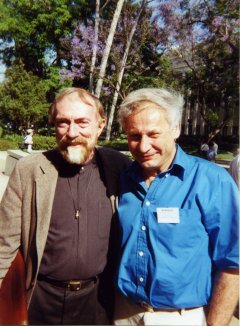
The astronomer Simon Newcomb (right) was born in 1835 in Nova Scotia picture2(Canada). He had no real formal education at all, but since there wasn’t much else to do in Nova Scotia, he taught himself mathematics and astronomy and became very adept at performing astronomical calculations with great diligence. He began work in a lowly position at the US Nautical Almanac Office in 1857, and by 1877 he was director. He became was professor of Mathematics and Astronomy and Johns Hopkins University from 1884 until 1893 and was made the first ever president of the American Astronomical Society in 1899; he died in 1909.

Newcomb was performing lengthy numerical calculations in an era long before the invention of the pocket calculator or desktop computer. In those days many such calculations, including virtually anything involving multiplication, had to be done using logarithms. The logarithm (to the base ten) of a number x is defined to be the number a such that x=10a. To multiply two numbers whose logarithms are a and b respectively involves simply adding the logarithms: 10a times 10b=10(a+b), which helps a lot because adding is a lot easier than multiplying if you have no calculator. The initial logarithms are simply looked up in a table; to find the answer you use different tables to find the “inverse” logarithm.

Newcomb was a heavy user of his book of mathematical tables for this type of calculation, and it became very grubby and worn. But he also noticed that the first pages of the logarithms seemed to have been used much more than the others. This puzzled him greatly. Logarithm tables are presented in order of the first digit of the number required: the first pages therefore contain logarithms for numbers beginning with the digit 1. Newcomb used the tables for a vast range of different calculations of different things. He expected the first digits of numbers that he had to look up to just be as likely to be anything. Shouldn’t they be randomly distributed? Shouldn’t all the pages be equally used?

Once raised, this puzzle faded away until it was re-discovered in 1938 and acquired the name of Benford’s law, or the first digit phenomenon. In virtually any list you can think of – street addresses, city populations, lengths of rivers, and so on – there are more entries beginning with the digit “1” than any other digit.

To give another example, although I admit this one is much harder to explain, in the American Physical Society’s list of fundamental constants, or at least the last version I happened to look at, no less than 40% begin with the digit 1. If you’ve been writing physics examination papers recently like I have, you will notice a similar behaviour. Out of the 16 physical constants listed in the rubric of a physics examination paper lying on my desk right now, 6 begin with the digit 1.

So what is going on?

There is a (relatively) simple answer, and a more complicated one. I’ll take the simple one first.

Consider street numbers in an address book as an example. Suppose Any street will be numbered from 1 to N. It doesn’t really matter what N is as long as it is finite (and nobody has ever built an infinitely long street). Now think about the first digits of the addresses. There are 9 possibilities, because we never start an address with 0. On the face of it, we might expect a fraction 1/9 (approximately 11%) of the addresses will start with 1. Suppose N is 200. What fraction actually starts with 1? The answer is more than 50%. Everything from 100 upwards, plus 1, and 11 to 19. Very few start with 9: only 9 itself, and 90-99 inclusive. If N is 300 then there are still more beginning with 1 than any other digit, and there are no more that start with 9. One only gets close to an equal fraction of each starting number if the value of N is an exact power of 10, e.g. 1000.

Now you can see why pulling numbers out of an address book leads to a distribution of first digits that is not at all uniform. As long as the numbers are being drawn from a collection of streets each of whom has a finite upper limit, then the result is bound to be biased towards low starting digits. Only if every street contained an exact power of ten addresses would the result be uniform. Every other possibility favours 1 at the start.

The more complicated version involves a scaling argument and is a more suitable explanation for the appearance of this phenomenon in measured physical quantities. Lengths, heights and weights of things are usually measured with respect to some reference quantity. In the absence of any other information, one might imagine that the distribution of whatever is being measured possesses some sort of invariance or symmetry with respect to the scale being chosen. In this case the prior distribution p(x) can be taken to have the so-called Jeffreys form, which is uniform in the logarithm, i.e. p(x) is proportional to 1/x. There obviously must be a cut-off at some point as this can’t be allowed to go on forever as it doesn’t converge for large x, but this doesn’t really matter for the sake of this argument. We can suppose anyway that there are many powers of ten involved before this upper limit is reached.

In this case the probability that the first digit is D is just given by the ratio of two terms: In the numerator we have the integral between D and D+1 of p(x) (that’s a measure of how much of the distribution represents numbers starting with the digit D) and on the denominator we have the integral between 1 and 10 of p(x) (the overall measure). The result, if we take p(x) to be proportional to 1/x, is just log (1+1/D).

picture1

The shape of this distribution is shown in the Figure. Note that about 30% of the first digits are expected to be 1. Of course I have made a number of simplifying assumptions that are unlikely to be exactly true, and the case of the physical constants is complicated by the fact that some are measured and some are defined, but I think this captures the essential reason for the curious behaviour of first digits.

If nothing else, it provides a valuable lesson that you should be careful in what variables you assume are uniformly distributed!