Archive for the The Universe and Stuff Category

Science and Stamp Collecting

Posted in Books, Talks and Reviews, The Universe and Stuff with tags , , on November 18, 2008 by telescoper

Musing over the comments posted on my (slightly ironic) blog item about exoplanetary ennui, I remembered a piece I wrote for the Times Literary Supplement last summer so I dusted it off, chopped it up, and updated it for presentation here because it expands a bit on the earlier contribution.

If the Sun were the size of a golf ball, then the Earth would be a speck of dust a few metres from it and the nearest star would be hundreds of kilometres away. And this is what it is like in the relatively crowded environment of the Milky Way. The unimaginable scale of our Universe means that astronomy has never really become an experimental science, but has largely remained an observational one, having more in common with, say, archaeology than chemistry or other laboratory-based disciplines. Consequently, even though it is perhaps the oldest science, it is also in some respects the least mature. The absence of the traditional interplay between theory and experiment, the inability to perform repeated experiments under slightly different conditions, and the sheer difficulty of measuring anything at all have stunted its development compared to younger fields. For this reason, one often finds in astronomy certain tendencies that other subjects have largely grown out of, such as an unhealthy mania for classification and nomenclature.

Taxonomy has its place within the scientific method: modern chemistry owes much to Dmitri Mendeleev‘s periodic table; botany could not have progressed without Linnaeus; and the theory of evolution was founded on Charles Darwin‘s painstaking studies on the Galapagos Islands. But arranging things in groups and giving them names does not in itself constitute scientific progress, no matter how systematically it is done. The great experimental physicist Ernest (Lord) Rutherford dismissed this kind of activity as not science but “stamp collecting”.

This brings us to the grand debate that took place in Prague in the summer of 2006 under the auspices of the International Astronomical Union. One of the problems before the IAU’s 26th General Assembly was what to do about the fact that recent investigations have revealed the presence of a number of objects orbiting the Sun that are ostensibly at least as worthy of the name “planet” as Pluto, which in our current textbooks is the ninth one out. Obviously, which objects should be called planets depends on how you define what a planet is. The solar system contains objects of all shapes and sizes, from tiny asteroids to immense gas giants such as Jupiter and Saturn. Where should one draw the line? The original proposal was to increase the number of planets to twelve by admitting some lowly new members to the club, but in the end the IAU decided to demote Pluto to the status of a “dwarf” planet thus restricting the number of true planets to eight. This was a controversial decision, at least in the United States, because the vital vote was taken on the last day of the meeting when most of the US delegates had to take flights home. Pluto was discovered by an American, Clyde Tombaugh, in 1930, so the decision deprived the nation of its only planet-discoverer.

The “no” decision hinged on the adoption of three criteria: that the object be round, i.e. have a shape determined by internal gravitational forces; that it should have cleared its own orbit of debris; and that it should be orbiting our own star, the Sun. None of these has any special scientific value; the resulting decision was therefore pretty arbitrary. Moreover, deep-space observations have led to the discovery of literally hundreds of planetlike objects orbiting other stars. These exoplanets offer much greater prospects for scientific progress into the general theory of planet formation than the few objects that happen to have formed in our particular vicinity, so why are they excluded from the definition? In any case, what have we learned scientifically from the new nomenclature? Pluto is still the same object that it was before August 2006, and astronomers still don’t understand what one can infer from its own particular properties about the general process of planet formation.

So is Pluto a planet?

Who cares? In this case there really is nothing in a name. When I was asked this question on the telephone by a reporter I gave precisely that answer and he was shocked. I’m sure he thought that all that astronomers do is look at things and give them names. There are some that do that, of course, but most of us prefer doing proper science.

In the field of exoplanet research we are seeing real signs of maturity, although current studies are still firmly rooted in the “discovery” and “classificatuion” stage. Witness last weeks press interest in the first directly imaged exoplanets. I am well aware of the immense potential that those pictures have for stimulating interest in science, but there is still a long way to go before this field reaches its prime. That probably makes it an excellent area for young scientists to work in. But ultimately this youthful exuberance should give way to something a bit more serious, which is to go beyond what these discoveries are in themselves and ask what deeper questions they might answer.

One can see many other parallels in the history of astronomy, such as the discovery of quasars in the late 1950s. The first few of these must have generated a huge amount of excitement because they were not at all understood. Within a few years hundreds had been detected by radio observations but their nature remained unknown. The subsequent identification of redshifted hydrogen emission lines in the spectra of these objects led to them eventually being identified as very distant extragalactic sources of immense intrinsic power. By the 1980s quasars were identified as a particular type of active galaxy and placed within a general classification scheme that also involved blazars, Seyfert galaxies, and so on. Nowadays we have samples of tens of thousands of quasar spectra and the interest evolves around how the activity in their nucleus relates to the process of galaxy formation in an expanding Universe and how we can use these objects to map out the large-scale distribution of matter. To an outsider these tasks may seem less glamorous that the early days of quasar research, but that’s what science is like.

At the extreme end of the distance scale of astronomical investigation lies my own field of cosmology, the scientific study of the Universe as a whole. The scale of the solar system is challenging enough, but the cosmos is really big. Until recently, cosmology was so lacking in reliable observational input that it was thought of as a flaky offshoot of astronomy, more a branch of metaphysics than a proper scientific discipline, a paradise for theoreticians whose wildest speculations stood no chance of ever being tested with real measurements. Over the past twenty years or so, however, staggering advances in astronomical instrumentation have allowed astronomers to probe the darkest depths of space, capturing light that has travelled for almost 14 billion years on its way towards us. Theories are now so tightly constrained by these observations that there is very little room for manoeuvre. From this interplay between conjecture and refutation has emerged a cosmological framework that accounts, at least in a broad-brush sense, for how the Universe is constructed and how it is evolving.

There are some important gaps, including some puzzling anomalies, and the precise nature of many of its constituents is yet to be understood, but the establishment of the “concordance model” is a sign that cosmology really has come of age.

When you’ve seen one planet….

Posted in The Universe and Stuff with tags on November 14, 2008 by telescoper

Rumours have been circulating for several days and now we have confirmation. The most exciting news in the history of the Universe! Planets exist

Well, actually, we knew that. We live on one. And anyway, the International Astronomical Union recently stipulated that planets could only be things orbiting the Sun.  Don’t ask me why. So the new things have to be called exoplanets. And over 300 hundred of these were known before today anyway.  A rose by any other name would smell as sweet, so we won’t worry about the taxonomy. But what’s the big deal?

2008111311What is different about the most recent observations, reported in today’s issue of Science, is that they involve direct detection (i.e. imaging) of exoplanets, not indirect inferences made by studying stellar wobbles. An example is shown here: the three red dots are the exoplanetary objects orbiting around the star HR 8799.

 Quite interesting.

But is every new detection of an exoplanet going to be hyped like this from now until doomsday? Or until the public gets thoroughly bored?  Might it not be better to wait until there’s a sufficiently large and unbiased sample that exoplaneticists can quit their stamp collecting and start doing some real science?

At least in cosmology nobody ever exaggerates the importance of their discoveries.

*cough*

A Lop-sided Universe?

Posted in Bad Statistics, Cosmic Anomalies, The Universe and Stuff with tags , on November 9, 2008 by telescoper

Over on cosmic variance, I found an old post concerning the issue of whether there might be large-scale anomalies in the cosmic microwave background sky. I blogged about this some time ago, under the title of Is there an Elephant in the Room?, so it’s interesting to see a different take on it. Interest in this issue has been highlighted by a recent paper by Groeneboom & Eriksen that claims to have detected asymmetry in the distribution of fluctuations in the data from the Wilkinson Microwave Anisotropy Probe (WMAP) inconsistent with the predictions of the standard cosmological model. If this feature is truly of primordial origin then it is an extremely important discovery as it will (probably) require the introduction of new physics into our understanding of cosmology, and that will be exciting.

It is the job of theorists to invent new theories, and it is not at all a problem that these bits of evidence have generated a number of speculative ideas. Who knows? One of them may be right. I think it is the job of theoreticians to think as radically as possible about things like this. On the other hand, it is the observational evidence that counts in the end and we should be very conservative in how we treat that. This is what bothers me about this particular issue.

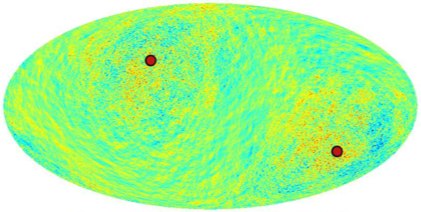
elongatedThe picture on the left shows a processed version of the WMAP fluctuation pattern designed to reveal the asymmetry, with the apparent preferred direction shown in red. This map shows the variation of the across the whole sky, and the claimed result is that the fluctuations are a bit larger around the red dots (which are 180 degrees apart) than in the regions at right angles to them.

It’s a slight effect, but everything in the picture is a slight effect as the CMB is extremely smooth to start with, the fluctuations in temperature being only about one part in a hundred thousand. The statistical analysis looks to me to be reasonably solid, so lets suppose that the claim is correct.scan

The picture on the right (courtesy of NASA/WMAP Science Team) shows the scan strategy followed by the WMAP satellite on the same projection of the sky. The experiment maps the whole sky by spinning its detectors in such a way that they point at all possible positions. The axis of this spin is chosen in a particular way so that it is aligned with the ecliptic poles (out of the plane of the solar system). It is in the nature of this procedure that it visits some places more than others (those at the ecliptic poles are scanned more often than those at the equator), hence the variation in signal-to-noise shown in the map. You can see that effect graphically in the picture: the regions near the North and South ecliptic poles have better signal to noise than the others.

The axis found by Groeneboom & Eriksen is not perfectly aligned with the ecliptic plane but it is pretty close. It seems a reasonable (if conservative) interpretation of this that the detected CMB anomaly could be due to an unknown systematic that has something to do either with the solar system (such as an unknown source of radiation, like cold dust) or the way the satellite scans. The WMAP team have worked immensely hard to isolate any such systematics so if this is such an effect then it must be very subtle to have escaped their powerful scrutiny. They’re all clever people and it’s a fabulous experiment, but that doesn’t mean that it is impossible that they have missed something.

Many of the comments that have been posted on cosmic variance relating to this question the statistical nature of the result. Of course we have only one sky available, so given the “randomness” of the fluctuations it is possible that freakish configurations occur by chance. This misses the essentially probabilistic nature of all science which I tried to describe in my book on probability From Cosmos to Chaos. We are always limited by noise and incompleteness but that doesn’t invalidate the scientific method. In cosmology these problems are writ large because of the nature of the subject, but there is no qualitative difference in the interplay between science and theory in cosmology compared with other sciences. It’s just less easy to get the evidence.

So the issue here, which is addressed only partially by Groeneboom % Eriksen, is whether a lop-sided universe is more probable than an isotropic one given the WMAP measurements. They use a properly consistent Bayesian argument to tackle this issue and form a reasonably strong conclusion that the answer is yes. As far as it goes, I think this is (probably) reasonable.

However, now imagine I don’t believe in anistropic cosmologies but instead have an idea that this is caused by an unknown systematic relating in some way to the ecliptic plane. Following the usual Bayesian logic I think it is clear that, although both can account for the data, my hypothesis must be even more probable than a lop-sided universe. There is no reason why a primordial effect should align so closely with the ecliptic plane, so there is one unexplained coincidence in the lop-sided-universe model, whereas my model neatly accounts for that fact without any freedom to adjust free parameters. Ockham’s razor is on my side.

So what can we do about this? The answer might be not very much. It is true that, soon, the Planck Surveyor will be launched and it will map the CMB sky againat higher resolution and sensitivity. On the other hand, it will not solve the problem that we only have one sky. The fact that it is a different experiment may yield clues to any residual systematics in the WMAP results, but if it has a similar scan strategy to WMAP, even Planck might not provide definitive answers.

I think this one may run and run!

Parallel Lives

Posted in Music, The Universe and Stuff with tags , on November 6, 2008 by telescoper

I’ve just finished reading The Life of Charles Ives by Stuart Feder, which I bought some time ago with my Cambridge University Press author discount and I’ve had on my shelves without getting around to read it until this week. It’s a very interesting and informative biography of one of the strangest but most fascinating composers in the history of classical music.

Charles Ives was by any standards a daring musical innovator. Some of his compositions involve atonal structures and some involve different parts of the orchestra playing in different time signatures. He also wrote strange and wonderful piano pieces, including some which involved re-tuning the piano to obtain scales involving quarter-tones. Among this maelstrom of modern ideas he also liked to add quotations from folk songs and old hymns which gives his work a paradoxically nostalgic tinge.

His pieces are often extremely diffficult to play (so I’m told) and sometimes not that easy to listen to, but while he’s often perplexing he can also be exhilarating and very moving. Other composers might play off two musical ideas against each other, but Ives would smash them together and to hell with the dissonance. I think the wholeheartedness of his eccentricity is wonderful, but I know that some people think he was just a nut.. You’ll have to make your own mind up on that.

My favourite quote of his can be found scrawled on a hand-written score which he sent to his copyist:

Please don’t try to make things nice! All the wrong notes are right. Just copy as I have – I want it that way.”

But the point of adding this post to my blog was that in the course of reading the biography, it struck me that there is a strange parallel between the life of this controversial and not-too-well known composer and that of Albert Einstein who is certainly better known, especially to people reading what purports to be a physics blog.

For one thing their lifespans coincide pretty closely. Charles Ives was born in 1874 and died in 1954; Albert Einstein lived from 1879 to 1955. Of course the one was born in America and the latter in Germany. One inhabited the world of music and the other science; Ives, in fact, made his living in the insurance business and only composed in his spare time while Einstein spent most of his career in academia, after a brief period working in a patent office. Not everything Ives wrote was published professionally and he also rewrote things extensively, so it is difficult to establish exact dates for things especially for a non-expert like me. In any case I don’t want to push things too far and try to argue that some spooky zeitgeist acted at a distance to summon the ideas from each of them in his own sphere. I just think it is curious to observe how similar their world lines were, at least in some respects.

We all know that Einstein’s “year of miracles” was 1905, during which he published classic papers on special relativity, brownian motion and the photoelectric effect. What was arguably Ives’ greatest composition, The Unanswered Question, was completed in 1906 (although it was revised later). This piece is subtitled “A Cosmic Landscape” and it’s a sort of meditation on the philosophical problem of existence: the muted strings (which are often positioned offstage in concert performances) symbolize silence while the solo trumpet evokes the individual struggling to find meaning within the void. Here’s a fine performance of this work recorded at La Scala in Milan, in which the strings are onstage while the trumpet is in the audience. I love the way that at the end nobody seems to know if they have finished!

The Unanswered Question is probably Ives’ greatest masterpiece, but it wasn’t the only work he composed in 1906. A companion piece called Central Park in the Dark also dates from that year and they are sometimes performed together as a kind of diptych which offers interesting contrasts. While the former is static and rather abstract, the latter is dynamic and programmatic (in that it includes realistic evocations of night-time sounds).

Einstein’s next great triumph was his General Theory of Relativity in 1915, an extension of the special theory to include gravity and accelerated motion, which which came only after years of hard work learning the required difficult mathematics. Ives too was hard at work for the next decade which resulted in other high points, although they didn’t make him a household name like Einstein. The Fourth Symphony is an extraordinary work which even the best orchestras find extremely difficult to perform. Even better in my view is Three Places in New England (completed in 1914) , which contains my own favourite bit of Ives. The last movement, The Housatonic at Stockbridge is very typical of his unique approach, with a beautifully paraphrased hymn tune floating over the top of complex meandering string figures until the piece ends in a tumultuous crescendo.

After this period, both Einstein and Ives carried on working in their respective domains, and even with similar preoccupations. Einstein was in search of a unified field theory that could unite gravity with the other forces of nature, although the approach led him away from the mainstream of conventional physics research and his later years he became an increasingly marginal figure.

By about 1920 Ives had written five full symphonies (four numbered ones and one called the Holidays Symphony) but his ambition beyond these was perhaps just as grandiose as Einstein’s: to create a so-called “Universe Symphony” which he described (in typically bewildering fashion) as

A striving to present – to contemplate in tones rather than in music as such, that is – not exactly within the general term or meaning as it is so understood – to paint the creation, the mysterious beginnings of all things, known through God to man, to trace with tonal imprints the vastness, the spiritual eternities, from the great unknown to the great unknown.”

I guess such an ambitious project – to create an entirely new language of “tones” that could give expression to timeless eternity, a kind of musical theory of everything – was doomed to failure. Although Ives was an experienced symphonic composer he couldn’t find a way to realise his vision. Only fragments of the Universe Symphony remain (although various attempts have been made by others to complete it).

In fact, the end of Ives’ creative career was much more sudden and final than Einstein who, although he never again reached the heights he had scaled in 1915 – who could? – remained a productive and respected scientist until his death. Ives had a somewhat melancholic disposition and from time to time suffered from depression. By 1918 he already felt that his creative flame was faltering, but by 1926 the spark was extinguished completely. His wife, appropriately named Harmony, remembered the precise day when this happened at their townhouse in New York:

He came downstairs one day with tears in his eyes, and said he couldn’t seem to compose anymore – nothing went well, nothing sounded right.”

Although Charles Ives lived almost another thirty years he never composed another piece of music after that day in 1926. I find that unbearably sad, but at least a lot of his work is available and now fairly widely played. Alongside the pieces I have mentioned, there are literally hundreds of songs, some of which are exceptionally beautiful, and dozens of smaller works including piano and violin sonatas.

Although they both lived in the same part of America for many years, I don’t think Charles Ives and Albert Einstein ever met. I wonder what they would have made of each other if they had?

If you believe in the multiverse, of course, then there is a part of it in which they do meet. Einstein was an enthusiastic violinist so there will even be a parallel world in which Einstein is playing the Ives’ Violin Sonata on Youtube.

Theories of Everything

Posted in The Universe and Stuff with tags , on October 18, 2008 by telescoper

A string theorist arrives home one evening. When he goes into his house, his wife tells him that she’s hired a private detective who has been following him for the past week and she now knows he’s having an affair with another woman.

“But darling…” says the string theorist. “I can explain everything.”

Nobel Sur-prize

Posted in The Universe and Stuff with tags , , on October 7, 2008 by telescoper

I was waiting for the letter from Stockholm, but it didn’t come. Maybe next year…

Anyway, this year’s Nobel Prize for Physics has been awarded to Yoichiro Nambu (half the prize) and the other half is split between
Makoto Kobayashi and Toshihide Maskawa. All three are extremely distinguished physicists and their contributions certainly deserve to be rewarded. But, in the case of Kobayashi and Maskawa, the Nobel Foundation has made a startling omission that I really can’t understand at all and which even threatens to undermine the prestige of the prize itself.

The work for which these two were given half the Nobel Prize this year relates to the broken symmetry displayed by weak interactions between quarks. We now know that there are three generations of quarks, each containing quarks of two different flavours. The first generation contains the up (u) and the down (d), the second the strange (s) and the charmed (c), and the third has the bottom (b) and the top (t). OK, so the names are daft, but physicists have never been good at names.

The world of quarks is different to penetrate becauses quarks interact via the strong force which binds them close together into hadrons which are either baryons (three quarks) or mesons (a quark and an anti-quark).

But there are other kinds of particles too, the leptons. These are also arranged in three generations but each of these families contains a charged particle and a neutrino. The first generation is an electron and a neutrino, the second a muon and its neutrino, and the third has the tau and another neutrino. One might think that the three quark generations and the three lepton generations might have some deep equivalence between them, but leptons aren’t quarks so can’t interact at all by the strong interaction. Quarks and leptons can both interact via the weak interaction (the force responsible for radioactive beta-decay).

Weak interactions between leptons conserve generation, so the total number of particles of electron type is never changed (ignoring neutrino oscillations, which have only relatively recently been discovered). It seemed natural to assume that weak interactions between quarks should do the same thing, forbidding processes that hop between generations. Unfortunately, however, this is not the case. There are weak interactions that appear to convert u and/or d quarks into c and/or s quarks, but these seem to be relatively feeble compared to interactions within a generation, which seem to happen with about the same strength for quarks as they do for leptons. This all suggests that there is some sort of symmetry lurking somewhere in there, but it’s not quite what one might have anticipated.

The explanation of this was proposed by Nicola Cabibbo who, using a model in which there are only two quark generations, developed the idea that states of pure quark flavour (“u” or “d”, say) are not really what the weak interaction “sees”. In other words, the quark flavour states are not proper eigenstates of the weak interaction. All that is needed is to imagine that the required eigenstates are a linear combination of the flavour states and, Bob’s your uncle, quark generation needn’t be conserved. This phenomenon is called Quark Mixing. What makes it simple for only two generations is that it can be described entirely by one number: the Cabibbo angle, which measures how much the quark flavour basis is misaligned with the weak interaction basis. The angle is small so the symmetry is only slightly broken.

Kobayashi and Maskawa generalized the work of Cabibbo to the case of three quark generations. That’s actually quite a substantial task as the description of mixing in this case requires not just a single number but a 3×3 matrix each of whose entries is complex. This matrix is universally called the Cabibbo-Kobayashi-Maskawa (CKM) matrix and it now crops up all over the standard model of particle physics.

And there’s the rub. Why on Earth was Cabibbo not awarded a share of this year’s prize? I was shocked and saddened to find out that he’d been passed over despite the fact that his work so obviously led the way. I can think of no reason why he was omitted. It’s outrageous. I even feel sorry for Kobayashi and Maskawa, because there is certain to be such an outcry about this gaffe that it may detract from their success.

But really

Wakeham Review

Posted in Science Politics, The Universe and Stuff with tags , , on October 1, 2008 by telescoper

Today is the day of publication of the Wakeham Review of the state of Physics in the United Kingdom. This report was commissioned by the Secretary of State for Innovation, Universities and Skills (DIUS) against the backdrop of the funding crisis that threatened to engulf the
Science and Technology Facilities Council (STFC) in December 2007 and which has led to drastic cuts in research grant funding in particle physics and astronomy throughout the country.

I started blogging a bit too late to join in the chorus of anger surrounding the handling of this crisis by STFC and especially by the behaviour of its Chief Executive, Keith Mason. An investigation of this by a parliamentary Select Committee stated that

Substantial and urgent changes are now needed in the way in which the Council is run in order to restore confidence and to give it the leadership it desperately needs and has so far failed properly to receive”

If anyone was ever given a clear message that he should resign, this was it. But Keith Mason remains Chief Executive of STFC.

I hoped, therefore, to find some comment about this state of affairs in the Wakeham Review. I haven’t had time to read all of it, but most of it seems bland and rather self-congratulatory. It does, however, describe the strengths of astronomy and space science research in the UK, which is one of the areas placed in jeopardy by STFC’s cack-handed management and woeful lack of political nous. On the other hand, the UK has less impressive impact in other areas. Condensed matter physics was the research area in which most University-based physicists in the UK worked in 2001but their impact, at least in bibliometric terms, was and is unspectacular compared with other countries. Perhaps this is the reason why the number of condensed matter physicists submitted to the Research Assessment Exercise in 2008 has declined, while astronomy and astrophysics have increased.

The Wakeham review does not come to any clear conclusions on why some areas of physics are more popular than others, citing as possibilities laboratory costs and difficulties of attracting people into cross-disciplinary areas like biophysics or nanoscience. Since I’m not a member I don’t have to mince words like the panel did. I think some fields are popular because they are more interesting. And if people wanted to do chemistry or biology they wouldn’t have become physicists in the first place.

There are two paragraphs specifically about STFC, and they make very specific proposals although falling short of asking the current leadership to step down:

6. There is a need to ensure that there is coherence of planning of physics facilities and the allocation of physics research grants, so that research needs are closely aligned with facility provision. For that reason it is not desirable to separate former PPARC-like physics from the funding of its facilities. For this reason the Panel recommends that the current division of physics funding between Research Councils remains. Whilst recognising recent difficulties, the Panel believes that it is important that facilities provided for particle physics and astronomy researchers be directly tensioned with the budget for the research that will utilise those facilities. The current structure provides this tension in part of its remit. However, the panel believes that adding to this tension a further dimension of national facilities and a government Science and Innovation Campuses is just too much.

This is true but I think it’s only a small part of the problem.

The Panel recommends that:
a) the STFC be required at each CSR to bid for and allocate specific funds to former PPARC facilities and grant funding together.This would avoid the undesired tensioning of these grants and facilities support against national facilities and the project for the development of science and innovation campuses.

Good! But will this happen?

b) the existing structure should be allowed time to develop, given it was founded on the basis of extensive positive consultation. However, at an appropriate point following the review of STFC management currently being conducted by Dr David Grant, DIUS should commission a review to examine STFC operations.

*Sigh* Another review. Great.

The next one is a bit stronger:


7. The STFC’s governance structure must be representative of the community it serves in order to gain stakeholders’ confidence going forward.

“..stakeholders’ confidence going forward”? Ugh! Who wrote that bollocks?

The Panel believes that significant damage has been done to the UK’s international reputation in some areas of the discipline of physics following the furore that was generated by the manner, timescale of changes and announcement of recent STFC funding decisions.

You can say that again.

The Panel were very concerned at the make-up of the STFC Council, both in terms of the over representation of the executive and the lack of representation of the community it serves in comparison with other Research Councils. It is understood that this structure was deliberately adopted to deal with the distinct features of STFC that arose because of its multiple missions. However, this has not best served the scientific community in some branches of science whose input was at one level below the Council. This is in sharp distinction to the practice of other Research Councils.


The Panel recommends to DIUS that the membership of STFC’s Council be broadened to include more of the stakeholders in the science activity at the highest level, and to redress the balance between executive presence and non-executive oversight.

Somebody must have deleted the sentence about having to get a new Chief Executive.

I’m sure there’ll be a lot more on physics blogs when there’s been time to digest the whole report, and if I think I’ve missed anything at a first reading I may post some more myself.

Cosmology Explained

Posted in Biographical, The Universe and Stuff with tags , , on September 29, 2008 by telescoper

I’ve always avoided describing myself as an astronomer, because most people seem to think that involves star signs and horoscopes. Anyone can tell I’m not an astrologer anyway, because I’m not rich. Astrophysicist sounds more impressive, but perhaps a bit too scary. That’s why I settled on “Cosmologist”. Grandiose, but at the same time somehow cuddly.

I had an inkling that this choice was going to be a mistake at the start of my first ever visit to the United States, which was to attend a conference in memory of the great physicist Yacov Borisovich Zel’dovich, who died in 1989. The meeting was held in Lawrence, Kansas, home of the University of Kansas, in May 1990. This event was notable for many reasons, including the fact that the effective ban on Russian physicists visiting the USA had been lifted after the arrival of glasnost to the Soviet Union. Many prominent scientists from there were going to be attending. I had also been invited to give a talk, the only connection with Zel’dovich that I could figure out was that the very first paper I wrote was cited in the very last paper to be written by the great man.

I think I flew in to Detroit from London and had to clear customs there in order to transfer to an internal flight to Kansas. On arriving at the customs area in the airport, the guy at the desk peered at my passport and asked me what was the purpose of my visit. I said “I’m attending a Conference”. He eyed me suspiciously and asked me my line of work. “Cosmologist,” I proudly announced. He frowned and asked me to open my bags. He looked in my suitcase, and his frown deepened. He looked at me accusingly and said “Where are your samples?”

I thought about pointing out that there was indeed a sample of the Universe in my bag but that it was way too small to be regarded as representative. Fortunately, I thought better of it. Eventually I realised he thought cosmologist was something to do with cosmetics, and was expecting me to be carrying little bottles of shampoo or make-up to a sales conference or something like that. I explained that I was a scientist, and showed him the poster for the conference I was going to attend. He seemed satisfied. As I gathered up my possessions thinking the formalities were over, he carried on looking through my passport. As I moved off he suddenly spoke again. “Is this your first visit to the States, son?”. My passport had no other entry stamps to the USA in it. “Yes,” I said. He was incredulous. “And you’re going to Kansas?”

This little confrontation turned out to be a forerunner of a more dramatic incident involving the same lexicographical confusion. One evening during the Zel’dovich meeting there was a reception held by the University of Kansas, to which the conference participants, local celebrities (including the famous writer William Burroughs, who lived nearby) and various (small) TV companies were invited. Clearly this meeting was big news for Lawrence. It was all organized by the University of Kansas and there was a charming lady called Eunice largely running the show. I got talking to her near the end of the party. As we chatted, the proceedings were clearly winding down and she suggested we go into Kansas to go dancing. I’ve always been up for a boogie, Lawrence didn’t seem to be offering much in the way of nightlife, and my attempts to talk to William Burroughs were repelled by the bevy of handsome young men who formed his entourage, so off we went in her car.

It takes over an hour to drive into Kansas City from Lawrence but we got there safely enough. We went to several fun places and had a good time until well after midnight. We were about to drive back when Eunice suddenly remembered there was another nightclub she had heard of that had just opened. However, she didn’t really know where it was and we spent quite a while looking for it. We ended up on the State Line, a freeway that separates Kansas City Kansas from Kansas City Missouri, the main downtown area of Kansas City actually being for some reason in the state of Missouri. After only a few moments on the freeway a police car appeared behind us with its lights blazing and siren screeching, and ushered us off the road into a kind of parking lot.

Eunice stopped the car and we waited while a young cop got out of his car and approached us. I was surprised to see he was on his own. I always thought the police always went around in pairs, like low comedians. He asked for Eunice’s driver’s license, which she gave him. He then asked for mine. I don’t drive and don’t have a driver’s license, and explained this to the policeman. He found it difficult to comprehend. I then realised I hadn’t brought my passport along, so I had no ID at all.

I forgot to mention that Eunice was black and that her car had Alabama license plates.

I don’t know what particular thing caused this young cop to panic, but he dashed back to his car and got onto his radio to call for backup. Soon, another squad car arrived, drove part way into the entrance of the parking lot and stopped there, presumably so as to block any attempted escape. The doors of the second car opened and two policemen got out, kneeled down and and aimed pump-action shotguns at us as they hid behind the car doors which partly shielded them from view and presumably from gunfire. The rookie who had stopped us did the same thing from his car, but he only had a handgun.

“Put your hands on your heads. Get out of the car. Slowly. No sudden movements.” This was just like the movies.

We did as we were told. Eventually we both ended up with our hands on the roof of Eunice’s car being frisked by a large cop sporting an impressive walrus moustache. He reminded me of one of the Village People, although his uniform was not made of leather. I thought it unwise to point out the resemblance to him. Declaring us “clean”, he signalled to the other policemen to put their guns away. They had been covering him as he searched us.

I suddenly realised how terrified I was. It’s not nice having guns pointed at you.

Mr Walrus had found a packet of French cigarettes (Gauloises) in my coat pocket. I clearly looked scared so he handed them to me and suggested I have a smoke. I lit up, and offered him one (which he declined). Meanwhile the first cop was running the details of Eunice’s car through the vehicle check system, clearly thinking it must have been stolen. As he did this, the moustachioed policeman, who was by now very relaxed about the situation, started a conversation which I’ll never forget.

Policeman: “You’re not from around these parts, are you?” (Honestly, that’s exactly what he said.)

Me: “No, I’m from England.”

Policeman: “I see. What are you doing in Kansas?”

Me: “I’m attending a conference, in Lawrence..”

Policeman: “Oh yes? What kind of Conference?”

Me: “It’s about cosmology”

At this point, Mr Walrus nodded and walked slowly to the first car where the much younger cop was still fiddling with the computer.

“Son,” he said, “there’s no need to call for backup when all you got to deal with is a limey hairdresser.”

Is there an Elephant in the Room?

Posted in Cosmic Anomalies, The Universe and Stuff with tags , on September 26, 2008 by telescoper

A couple of weeks ago I was in Cambridge giving a talk at a nice cosmology meeting housed in the splendid Centre for Mathematical Sciences. How the other half lives. The building is not only palatial, it is also very well designed for informal interactions and discussions. When I was a student at Cambridge this building didn’t exist and the Department of Applied Mathematics and Theoretical Physics was housed in rather ramshackle but characterful buildings in Silver Street, right in the city centre. I don’t know what department is there now.

I gave a talk with the title “Fishing for Elephants in the CMB”. I always think it’s a good idea not to give too much away in the title, although perhaps in this case I went a bit too far. Quite apart from the mixed metaphor, it doesn’t really give any clue at all as to what I was talking about. Mind you, I’m not sure at the end of the talk the audience was any the wiser either.

The idea for the title came from the phrase “There’s an Elephant in the Room”, a curious expression that even has its own wikipedia entry, as well as being the title of the picture shown here made by the artist Banksy. It refers to something that is large and obvious, but is being ignored for some reason, usually because it is considered impolite to draw attention to it. My talk of course wasn’t about real elephants but the possibility that there may be a metaphorical one in the field of cosmology, something that is consciously ignored by most of the community.

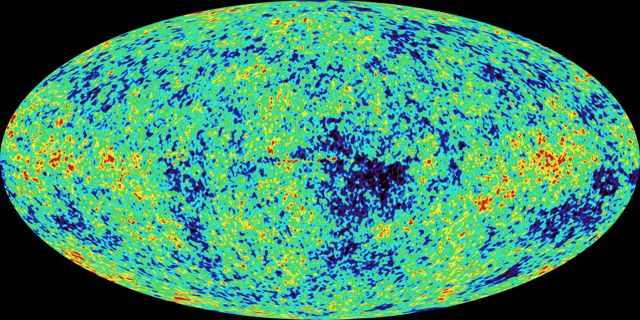
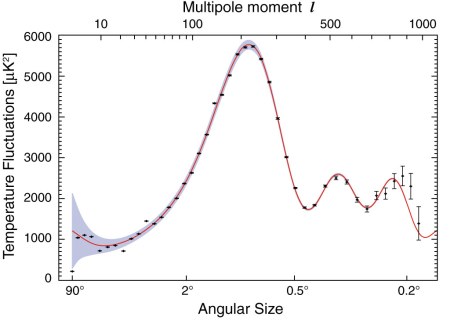
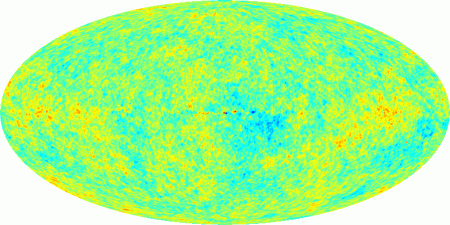
In yesterday’s post, I referred to the importance of the cosmic microwave background in establishing the so-called “concordance model” of cosmology. But as well as providing compelling evidence in support of this theory, the CMB has also thrown up a few bits of evidence that are quite difficult to reconcile with the standard description of the Universe.

Perhaps the most famous of these anomalies is the so-called “Axis of Evil“, which is an unexplained alignment of features in the pattern of temperature fluctuations observed across the sky by the Wilkinson Microwave Anisotropy Probe (WMAP) satellite. In the concordance picture, the fluctuations are basically random so there shouldn’t be coherent alignments like this.

But the Axle of Elvis isn’t the only curiosity in the cosmology shop. There is also a significant asymmetry between North and South on the sky (with respect to the ecliptic plane) when the two celestial hemispheres should be statistically indistinguishable if the standard model is correct.

There also exists a peculiar cold spot. Of course a fluctuating temperature pattern must contain places colder than average and places hotter than average. However, the standard model assumes these are drawn from a Gaussian (or “normal“) distribution, in which large fluctuations are extremely rare. The cold spot we see in the WMAP is colder than the coldest cold spot expected if the standard model is right, with odds of greater than 1000:1 against.

And there’s more. Statistical measures of the fluctuation pattern, such as the correlation function, pixel variance and quadupole moment, all give results for the real sky that are discordant with theory, although admittedly some are more significant than others. There are others too but I have no time to go into them, except to say that they may be related to the ones I’ve already mentioned, or at least share a common cause.

So what’s going on? The most conservative view is that there is nothing in the data that can’t be explained by the standard model and what we are seeing is a consequence of over-interpreting one or two chance coincidences. In the words of Fred Menger

If tortured sufficiently, data will confess to anything.

There may indeed be some truth to this, but serious attempts have been made to assess the statistical significance of the various results and my personal reaction is that, while coincidences do happen, it is unwise to dismiss 1000:1 results as mere flukes. On the other hand, these assessments are difficult and the significance may have been miscalculated.

More likely is the presence of some slight unidentified systematic artefact in the data. Not being an experimentalist it’s unfair to cast doubts on the brilliant work of the WMAP team, but one should keep an open mind about this possibility.

But as a theorist I have to admit that the most exciting possibility is that, lurking out there somewhere, are clues to a radical departure from orthodox theory. Many suggestions have been made, and no doubt most of them will be shown to be wrong. But the most dramatic thing that can happen in science is when the only game in town is “none of the above” and we are forced to think outside the box altogether.

I’m certainly not going to argue that we need to ditch the standard model or that cosmologists should all become obsessed with these tantalising conundrums. But in focussing exclusively on questions related to the standard model and its parameters, we may be throwing away a great deal of potentially exciting information. Every now and again, it’s worth checking your waste basket in case there’s something in it that you really shouldn’t have binned.

I realise that there are probably too many mixed metaphors in this piece. They’re a habit of mine and when you get to my age it’s difficult to change. After all, you can’t teach an old leopard to change its spots in midstream.


Mesmeric Universes

Posted in The Universe and Stuff with tags , , on September 25, 2008 by telescoper

It’s probably going to be difficult to describe what these images really are without going into enormous amounts of technical detail, but I think they are fun so I thought I’d put the pictures up with only a brief description. The remind me a little bit of the sort of hypnotic swirl sometimes used to put people under, although there’s a bit more to them than that.

According to our the standard “Big Bang” model, our Universe satisfies the Cosmological Principle which is that it is both homogeneous and isotropic, i.e. that it is the same in every location and looks the same in all directions. Of course we know our Universe isn’t exactly like that because it contains lumps of stuff called galaxies that correspond to variations in its density, but if look at sufficiently large scales it begins to look smooth. Sand is lumpy if you look close at it, but if you look at it from a long way away it looks smooth. The universe is supposed to be similarly smooth if you take a coarse-grained view.

The primary reason for incorporating the Cosmological Principle into models of the Universe is to make the mathematics simple. Einstein’s General Theory of Relativity is such a difficult theory that there are very few situations where the equations can actually be solved. One case where exact solution is relatively easy to achieve is that of homogeneous and isotropic space, which is such a symmetric state of affairs that much of the complexity of the Einstein equations disappears. Cosmological models based on this solution are generally called the Friedman models, after Alexander Friedman who first derived the solutions in the 1920s.

Despite their simplicity, the Friedman models turned out to be surprisingly accurate at describing our actual Universe which we now know to be very close to homogeneous and isotropic. Evidence for this comes from the Cosmic Microwave Background (CMB) which is astonishingly smooth across the sky. Variations in the sky temperature of the CMB are about one part in a hundred thousand of the mean temperature, which is smoother than the surface of a billiard ball.

However, it remains possible that our Universe may be slightly asymmetric and it is interesting to know what the CMB would look like if this were the case. Unfortunately there is no general cosmological solution available, so we have to tread slowly. One approach is to look at Universes which are homogeneous (the same in every place) but not isotropic (they look different in different directions). This might be describe the situation if the Universe were expanding more quickly in one direction that the others, or if it were rotating.

Actually the theory of homogeneous anisotropic universe models is quite well established and there is a full classification of all the possibilities, into the nine so-called Bianchi types. This is mathematically very complicated, so I won’t give details. However, my PhD student Rockhee has been calculating what the CMB pattern would look like in these models and the results are very pretty so I’ve included a few examples here. The little animated gifs show what the sky looks like as the Universe evolves in such cases. In all cases it starts as a pure quadrupole, i.e. a 90 degree variation across the sky. You might have to click on the image to see the animation.

The first one is Bianchi Type V. This is an example of a model in which the space is curved, so that as time goes on the initial quadrupole is focussed by gravitational effects into a smaller and smaller region of the sky. The preferred direction in this (and the other models) is picked to be in the centre of the image and the projection shows the whole sky. Hot spots are blue and cold spots are red, which is the way a physicist should plot temperature.

The next example is Bianchi Type VII_0 which is a flat Universe with rotation. What happens is that the initial quadrupole in this case gets twisted by the rotating space-time into a sort of spiral pattern. Late on in the evolution of such a Universe, an observer would see an interesting swirly structure in the cosmic microwave background.

The final example is my favourite, Bianchi Type VII_h. This one is a sort of combination of the two above examples. It has both rotation and curvature, so there is a swirly pattern which also gets focussed into a small bit of the sky. An observer living in such a Universe would see a prominent spot on the sky lying in the direction of the axis, which in this case is chosen to be in the centre of the diagram.

We’ve also been working out what the sky would look like in polarized light for these, but that’s even more complicated. If you’re really interested, I’ll post a link to the paper when it’s done…