Archive for the The Universe and Stuff Category

Power isn’t Everything

Posted in The Universe and Stuff with tags , , , , , , , on January 6, 2009 by telescoper

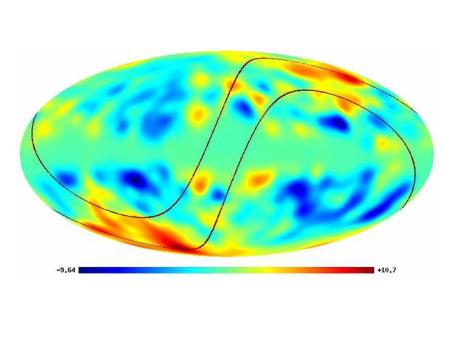
WMapThe picture above shows the latest available all-sky map of fluctuations in the temperature of the cosmic microwave background across the sky as revealed by the Wilkinson Microwave Anisotropy Probe, known to its friends as WMAP.

I’ve spent many long hours fiddling with the data coming from the WMAP experiment, partly because I’ve never quite got over the fact that such wonderful data actually exists. When I started my doctorate in 1985 the whole field of CMB analysis was so much pie in the sky, as no experiments had yet been performed with the sensitivity to reveal the structures we now see. This is because they are very faint and easily buried in noise. The fluctuations in temperature from pixel to pixel across the sky are of order one part in a hundred thousand of the mean temperature (i.e. about 30 microKelvin on a background temperature of about 3 Kelvin). That’s smoother than the surface of a billiard ball. That’s why it took such a long time to make the map shown above, and why it is such a triumphant piece of science.

I blogged a few days ago about the idea that the structure we see in this map was produced by sound waves reverberating around the early Universe. The techniques cosmologists use to analyse this sound are similar to those used in branches of acoustics except that we only see things in projection on the celestial sphere which requires a bit of special consideration.

One of the things that sticks in my brain from my undergraduate years is being told that if a physicist doesn’t know what they are doing they should start by making a Fourier transform. This breaks down the phenomenon being studied into a set of independent plane waves with different wavelengths corresponding to the different tones present in a complicated sound.

It’s often very good advice to do such a decomposition for one-dimensional time series or fluctuation fields in three-dimensional Cartesian space, even you do know what you’re doing, but it doesn’t work with a sphere because plane waves don’t fit properly on a curved surface. Fortunately, however, there is a tried-and-tested alternative involving spherical harmonics rather than plane waves.

Spherical harmonics are quite complicated beasts mathematically but they have pretty similar properties to Fourier harmonics in many respects. In particular they are represented as complex numbers having real and imaginary parts or, equivalently, an amplitude and a phase (usually called an argument by mathematicians). The latter representation is the most useful one for CMB fluctuations because the simplest versions of inflation predict that the phases of each of the spherical harmonic modes should be randomly distributed. What this really means is that there is no information content in their distribution so that the harmonic modes are in a state of maximum statistical disorder or entropy. This property also guarantees that the distribution of fluctuations over the sky should have a Gaussian distribution.

If you accept that the fluctuations are Gaussian then only the amplitudes of the spherical harmonic coefficients are useful. Indeed, their statistical properties can be specified entirely by the variance of these amplitudes as a function of mode frequency. This pre-eminently important function is called the power-spectrum of the fluctuations, and it is shown here for the WMAP data:

080999_powerspectrumm

Although the units on the axes are a bit strange it doesn”t require too much imagination to interpret this in terms of a sound spectrum. There is a characteristic tone (at the position of the peak) plus a couple of overtones. However these features are not sharp so the overall sound is not at all musical.

If the Gaussian assumption is correct then the power-spectrum contains all the useful statistical information to be gleaned from the CMB sky, which is why so much emphasis has been placed on extracting it accurately from the data.

Conversely, though, the power spectrum is completely insenstive to any information in the distribution of spherical harmonic phases. If something beyond the standard model made the Universe non-Gaussian it would affect the phases of the harmonic modes in a way that would make them non-random.

So far, so good. It sounds like it should be a straightforward job to work out whether the WMAP phases are random or not. Unfortunately, though, this task is heavily complicated by the presence of noise and systematics which can be quite easily cleaned from the spectrum but not from more sophisticated descriptors. All we can say so far is that the data seem to be consistent with a Gaussian distribution.

However, I thought I’d end with a bit of fun and show you how important phase information could actually be, if only we could find a good way of exploiting it. Let’s start with a map of the Earth, with the colour representing height of the surface above mean sea level:

sw_world

You can see the major mountain ranges (Andes, Himalayas) quite clearly as red in this picture and note how high Antarctica is…that’s one of the reasons so much astronomy is done there.

Now, using the same colour scale we have the WMAP data again (in Galactic coordinates).

sw_ilc

The virture of this map is that it shows how smooth the microwave sky is compared to the surface of the Earth. Note also that you can see a bit of crud in the plane of the Milky Way that serves as a reminder of the difficulty of cleaning the foregrounds out.

Clearly these two maps have completely different power spectra. The Earth is dominated by large features made from long-wavelength modes whereas the CMB sky has relatively more small-scale fuzz.

Now I’m going to play with these maps in the following rather peculiar way. First, I make a spherical harmonic transform of each of them. This gives me two sets of complex numbers, one for the Earth and one for WMAP. Following the usual fashion, I think of these as two sets of amplitudes and two sets of phases. Note that the spherical harmonic transformation preserves all the information in the sky maps, it’s just a different representation.

Now what I do is swap the amplitudes and phases for the two maps. First, I take the amplitudes of WMAP and put them with the phases for the Earth. That gives me the spherical harmonic representation of a new data set which I can reveal by doing an inverse spherical transform:

sw_worldphases

This map has exactly the same amplitudes for each mode as the WMAP data and therefore possesses an identical power spectrum to that shown above. Clearly, though, this particular CMB sky is not compatible with the standard cosmological model! Notice that all the strongly localised features such as coastlines appear by virtue of information contained in the phases but absent from the power-spectrum.

To understand this think how sharp features appear in a Fourier transform. A sharp spike at a specific location actually produces a broad spectrum of Fourier modes with different frequencies. These modes have to add in coherently at the location of the spike and cancel out everywhere else, so their phases are strongly correlated. A sea of white noise also has a flat power spectrum but has random phases. The key difference between these two configurations is not revealed by their spectra but by their phases.

Fortunately there is nothing quite as wacky as a picture of the Earth in the real data, but it makes the point that there are more things in Heaven and Earth than can be described in terms of the power spectrum!

Finally, perhaps in your mind’s eye you might consider what it might look lie to do the reverse experiment: recombine the phases of WMAP with the amplitudes of the Earth.

sw_ilcphases

If the WMAP data are actually Gaussian, then this map is a sort of random-phase realisation of the Earth’s power spectrum. Alternatively you can see that it is the result of running a kind of weird low-pass filter over the WMAP fluctuations. The only striking things it reveals are (i) a big blue hole associated with foreground contamination, (ii) a suspicious excess of red in the galactic plane owing to the same problem, and (iiI) a strong North-South asymmetry arising from the presence of Antarctica.

There’s no great scientific result here, just a proof that spherical harmonics can be fun.

PS. These pictures were made by a former PhD student of mine, Patrick Dineen, who has since quit astronomy to work in high finance. I hope he is weathering the global financial storm!

Who put the Bang in Big Bang?

Posted in The Universe and Stuff with tags , , , , , on December 29, 2008 by telescoper

Back from the frozen North, having had a very nice time over Christmas, I thought it was time to reactivate my blog and to redress the rather shameful lack of science on what is supposed to be a science blog. Rather than writing a brand new post, though, I’m going to cheat like a TV Chef by sticking up something that I did earlier. I’ve  had the following piece floating around on my laptop for a while so I thought I’d rehash it and post it on here. It is based on an article that was published in a heavily revised and shortened form in New Scientist in 2007, where it attracted some splenetic responses despite there not being anything particular controversial in it! It’s not particularly topical, but there you go. The television is full of repeats these days too.

Around twenty-five years ago a young physicist came up with what seemed at first to be an absurd idea: that, for a brief moment in the very distant past, just after the Big Bang, something weird happened to gravity that made it push rather than pull.  During this time the Universe went through an ultra-short episode of ultra-fast expansion. The physicist in question, Alan Guth, couldn’t prove that this “inflation” had happened nor could he suggest a compelling physical reason why it should, but the idea seemed nevertheless to solve several major problems in cosmology.

Twenty five years later on, Guth is a professor at MIT and inflation is now well established as an essential component of the standard model of cosmology. But should it be? After all, we still don’t know what caused it and there is little direct evidence that it actually took place. Data from probes of the cosmic microwave background seem to be consistent with the idea that inflation happened, but how confident can we be that it is really a part of the Universe’s history?

According to the Big Bang theory, the Universe was born in a dense fireball which has been expanding and cooling for about 14 billion years. The basic elements of this theory have been in place for over eighty years, but it is only in the last decade or so that a detailed model has been constructed which fits most of the available observations with reasonable precision. The problem is that the Big Bang model is seriously incomplete. The fact that we do not understand the nature of the dark matter and dark energy that appears to fill the Universe is a serious shortcoming. Even worse, we have no way at all of describing the very beginning of the Universe, which appears in the equations used by cosmologists as a “singularity”- a point of infinite density that defies any sensible theoretical calculation. We have no way to define a priori the initial conditions that determine the subsequent evolution of the Big Bang, so we have to try to infer from observations, rather than deduce by theory, the parameters that govern it.

The establishment of the new standard model (known in the trade as the “concordance” cosmology) is now allowing astrophysicists to turn back the clock in order to understand the very early stages of the Universe’s history and hopefully to understand the answer to the ultimate question of what happened at the Big Bang itself and thus answer the question “How did the Universe Begin?”

Paradoxically, it is observations on the largest scales accessible to technology that provide the best clues about the earliest stages of cosmic evolution. In effect, the Universe acts like a microscope: primordial structures smaller than atoms are blown up to astronomical scales by the expansion of the Universe. This also allows particle physicists to use cosmological observations to probe structures too small to be resolved in laboratory experiments.

Our ability to reconstruct the history of our Universe, or at least to attempt this feat, depends on the fact that light travels with a finite speed. The further away we see a light source, the further back in time its light was emitted. We can now observe light from stars in distant galaxies emitted when the Universe was less than one-sixth of its current size. In fact we can see even further back than this using microwave radiation rather than optical light. Our Universe is bathed in a faint glow of microwaves produced when it was about one-thousandth of its current size and had a temperature of thousands of degrees, rather than the chilly three degrees above absolute zero that characterizes the present-day Universe. The existence of this cosmic background radiation is one of the key pieces of evidence in favour of the Big Bang model; it was first detected in 1964 by Arno Penzias and Robert Wilson who subsequently won the Nobel Prize for their discovery.

The process by which the standard cosmological model was assembled has been a gradual one, but it culminated with recent results from the Wilkinson Microwave Anisotropy Probe (WMAP). For several years this satellite has been mapping the properties of the cosmic microwave background and how it varies across the sky. Small variations in the temperature of the sky result from sound waves excited in the hot plasma of the primordial fireball. These have characteristic properties that allow us to probe the early Universe in much the same way that solar astronomers use observations of the surface of the Sun to understand its inner structure,  a technique known as helioseismology. The detection of the primaeval sound waves is one of the triumphs of modern cosmology, not least because their amplitude tells us precisely how loud the Big Bang really was.

The pattern of fluctuations in the cosmic radiation also allows us to probe one of the exciting predictions of Einstein’s general theory of relativity: that space should be curved by the presence of matter or energy. Measurements from WMAP reveal that our Universe is very special: it has very little curvature, and so has a very finely balanced energy budget: the positive energy of the expansion almost exactly cancels the negative energy relating of gravitational attraction. The Universe is (very nearly) flat.

The observed geometry of the Universe provides a strong piece of evidence that there is an mysterious and overwhelming preponderance of dark stuff in our Universe. We can’t see this dark matter and dark energy directly, but we know it must be there because we know the overall budget is balanced. If only economics were as simple as physics.

Computer Simulation of the Cosmic Web

The concordance cosmology has been constructed not only from observations of the cosmic microwave background, but also using hints supplied by observations of distant supernovae and by the so-called “cosmic web” – the pattern seen in the large-scale distribution of galaxies which appears to match the properties calculated from computer simulations like the one shown above, courtesy of Volker Springel. The picture that has emerged to account for these disparate clues is consistent with the idea that the Universe is dominated by a blend of dark energy and dark matter, and in which the early stages of cosmic evolution involved an episode of accelerated expansion called inflation.

A quarter of a century ago, our understanding of the state of the Universe was much less precise than today’s concordance cosmology. In those days it was a domain in which theoretical speculation dominated over measurement and observation. Available technology simply wasn’t up to the task of performing large-scale galaxy surveys or detecting slight ripples in the cosmic microwave background. The lack of stringent experimental constraints made cosmology a theorists’ paradise in which many imaginative and esoteric ideas blossomed. Not all of these survived to be included in the concordance model, but inflation proved to be one of the hardiest (and indeed most beautiful) flowers in the cosmological garden.

Although some of the concepts involved had been formulated in the 1970s by Alexei Starobinsky, it was Alan Guth who in 1981 produced the paper in which the inflationary Universe picture first crystallized. At this time cosmologists didn’t know that the Universe was as flat as we now think it to be, but it was still a puzzle to understand why it was even anywhere near flat. There was no particular reason why the Universe should not be extremely curved. After all, the great theoretical breakthrough of Einstein’s general theory of relativity was the realization that space could be curved. Wasn’t it a bit strange that after all the effort needed to establish the connection between energy and curvature, our Universe decided to be flat? Of all the possible initial conditions for the Universe, isn’t this very improbable? As well as being nearly flat, our Universe is also astonishingly smooth. Although it contains galaxies that cluster into immense chains over a hundred million light years long, on scales of billions of light years it is almost featureless. This also seems surprising. Why is the celestial tablecloth so immaculately ironed?

Guth grappled with these questions and realized that they could be resolved rather elegantly if only the force of gravity could be persuaded to change its sign for a very short time just after the Big Bang. If gravity could push rather than pull, then the expansion of the Universe could speed up rather than slow down. Then the Universe could inflate by an enormous factor (1060 or more) in next to no time and, even if it were initially curved and wrinkled, all memory of this messy starting configuration would be lost. Our present-day Universe would be very flat and very smooth no matter how it had started out.

But how could this bizarre period of anti-gravity be realized? Guth hit upon a simple physical mechanism by which inflation might just work in practice. It relied on the fact that in the extreme conditions pertaining just after the Big Bang, matter does not behave according to the classical laws describing gases and liquids but instead must be described by quantum field theory. The simplest type of quantum field is called a scalar field; such objects are associated with particles that have no spin. Modern particle theory involves many scalar fields which are not observed in low-energy interactions, but which may well dominate affairs at the extreme energies of the primordial fireball.

Classical fluids can undergo what is called a phase transition if they are heated or cooled. Water for example, exists in the form of steam at high temperature but it condenses into a liquid as it cools. A similar thing happens with scalar fields: their configuration is expected to change as the Universe expands and cools. Phase transitions do not happen instantaneously, however, and sometimes the substance involved gets trapped in an uncomfortable state in between where it was and where it wants to be. Guth realized that if a scalar field got stuck in such a “false” state, energy – in a form known as vacuum energy – could become available to drive the Universe into accelerated expansion.We don’t know which scalar field of the many that may exist theoretically is responsible for generating inflation, but whatever it is, it is now dubbed the inflaton.

This mechanism is an echo of a much earlier idea introduced to the world of cosmology by Albert Einstein in 1916. He didn’t use the term vacuum energy; he called it a cosmological constant. He also didn’t imagine that it arose from quantum fields but considered it to be a modification of the law of gravity. Nevertheless, Einstein’s cosmological constant idea was incorporated by Willem de Sitter into a theoretical model of an accelerating Universe. This is essentially the same mathematics that is used in modern inflationary cosmology.  The connection between scalar fields and the cosmological constant may also eventually explain why our Universe seems to be accelerating now, but that would require a scalar field with a much lower effective energy scale than that required to drive inflation. Perhaps dark energy is some kind of shadow of the inflaton

Guth wasn’t the sole creator of inflation. Andy Albrecht and Paul Steinhardt, Andrei Linde, Alexei Starobinsky, and many others, produced different and, in some cases, more compelling variations on the basic theme. It was almost as if it was an idea whose time had come. Suddenly inflation was an indispensable part of cosmological theory. Literally hundreds of versions of it appeared in the leading scientific journals: old inflation, new inflation, chaotic inflation, extended inflation, and so on. Out of this activity came the realization that a phase transition as such wasn’t really necessary, all that mattered was that the field should find itself in a configuration where the vacuum energy dominated. It was also realized that other theories not involving scalar fields could behave as if they did. Modified gravity theories or theories with extra space-time dimensions provide ways of mimicking scalar fields with rather different physics. And if inflation could work with one scalar field, why not have inflation with two or more? The only problem was that there wasn’t a shred of evidence that inflation had actually happened.

This episode provides a fascinating glimpse into the historical and sociological development of cosmology in the eighties and nineties. Inflation is undoubtedly a beautiful idea. But the problems it solves were theoretical problems, not observational ones. For example, the apparent fine-tuning of the flatness of the Universe can be traced back to the absence of a theory of initial conditions for the Universe. Inflation turns an initially curved universe into a flat one, but the fact that the Universe appears to be flat doesn’t prove that inflation happened. There are initial conditions that lead to present-day flatness even without the intervention of an inflationary epoch. One might argue that these are special and therefore “improbable”, and consequently that it is more probable that inflation happened than that it didn’t. But on the other hand, without a proper theory of the initial conditions, how can we say which are more probable? Based on this kind of argument alone, we would probably never really know whether we live in an inflationary Universe or not.

But there is another thread in the story of inflation that makes it much more compelling as a scientific theory because it makes direct contact with observations. Although it was not the original motivation for the idea, Guth and others realized very early on that if a scalar field were responsible for inflation then it should be governed by the usual rules governing quantum fields. One of the things that quantum physics tells us is that nothing evolves entirely smoothly. Heisenberg’s famous Uncertainty Principle imposes a degree of unpredictability of the behaviour of the inflaton. The most important ramification of this is that although inflation smooths away any primordial wrinkles in the fabric of space-time, in the process it lays down others of its own. The inflationary wrinkles are really ripples, and are caused by wave-like fluctuations in the density of matter travelling through the Universe like sound waves travelling through air. Without these fluctuations the cosmos would be smooth and featureless, containing no variations in density or pressure and therefore no sound waves. Even if it began in a fireball, such a Universe would be silent. Inflation puts the Bang in Big Bang.

The acoustic oscillations generated by inflation have a broad spectrum (they comprise oscillations with a wide range of wavelengths), they are of small amplitude (about one hundred thousandth of the background); they are spatially random and have Gaussian statistics (like waves on the surface of the sea; this is the most disordered state); they are adiabatic (matter and radiation fluctuate together) and they are formed coherently.  This last point is perhaps the most important. Because inflation happens so rapidly all of the acoustic “modes” are excited at the same time. Hitting a metal pipe with a hammer generates a wide range of sound frequencies, but all the different modes of the start their oscillations at the same time. The result is not just random noise but something moderately tuneful. The Big Bang wasn’t exactly melodic, but there is a discernible relic of the coherent nature of the sound waves in the pattern of cosmic microwave temperature fluctuations seen by WMAP. The acoustic peaks seen in the WMAP angular spectrum  provide compelling evidence that whatever generated the pattern did so coherently.
 

There are very few alternative theories on the table that are capable of reproducing the WMAP results. Some interesting possibilities have emerged recently from string theory. Since this theory requires more space-time dimensions than the four we are used to, something has to be done with the extra ones we don’t observe. They could be wrapped up so small we can’t perceive them. Or, as is assumed in braneworld cosmologies our four-dimensional universe exists as a subspace (called a “brane”) embedded within a larger dimensional space; we don’t see the extra dimensions because we are confined on the subspace. These ideas may one day lead to a viable alternative to inflationary orthodoxy. But it is early days and not all the calculations needed to establish this theory have yet been done. In any case, not every cosmologist feels the urge to make cosmology consistent with string theory, which has even less evidence in favour of it than inflation. Some of the wilder outpourings of string-inspired cosmology seem to me to be the physics equivalent of nausea-induced vomiting.

So did inflation really happen? Does WMAP prove it? Will we ever know?

It is difficult to talk sensibly about scientific proof of phenomena that are so far removed from everyday experience. At what level can we prove anything in astronomy, even on the relatively small scale of the Solar System? We all accept that the Earth goes around the Sun, but do we really even know for sure that the Universe is expanding? I would say that the latter hypothesis has survived so many tests and is consistent with so many other aspects of cosmology that it has become, for pragmatic reasons, an indispensable part our world view. I would hesitate, though, to say that it was proven beyond all reasonable doubt. The same goes for inflation. It is a beautiful idea that fits snugly within the standard cosmological and binds many parts of it together. But that doesn’t necessarily make it true. Many theories are beautiful, but that is not sufficient to prove them right. When generating theoretical ideas scientists should be fearlessly radical, but when it comes to interpreting evidence we should all be unflinchingly conservative. WMAP has also provided a tantalizing glimpse into the future of cosmology, and yet more stringent tests of the standard framework that currently underpins it. Primordial fluctuations produce not only a pattern of temperature variations over the sky, but also a corresponding pattern of polarization. This is fiendishly difficult to measure, partly because it is such a weak signal (only a few percent of the temperature signal) and partly because the primordial microwaves are heavily polluted by polarized radiation from our own Galaxy. Although WMAP achieved the detection of this polarization, the published map is heavily corrupted by foregrounds.

Future generations of experiments, such as the Planck Surveyor (due for launch in 2009), will have to grapple with the thorny issue of foreground subtraction if substantial progress is to be made. But there is a crucial target that justifies these endeavours. Inflation does not just produce acoustic waves, it also generates different modes of fluctuation, called gravitational waves, that involve twisting deformations of space-time. Inflationary models connect the properties of acoustic and gravitational fluctuations so if the latter can be detected the implications for the theory are profound. Gravitational waves produce very particular form of polarization pattern (called the B-mode) which can’t be generated by acoustic waves so this seems a promising way to test inflation. Unfortunately the B-mode signal is very weak and the experience of WMAP suggests it might be swamped by foregrounds. But it is definitely worth a go, because it would add considerably to the evidence in favour of inflation as an element of physical reality

Besides providing strong evidence for the concordance cosmology, the WMAP satellite has also furnished some tantalizing evidence that there may be something missing. Not all the properties of the microwave sky seem consistent with the model. For example, the temperature pattern should be structureless, mirroring the random Gaussian fluctuations of the primordial density perturbations. In reality the data contains tentative evidence of strange alignments, such as the so-called “Axis of Evil” discovered by Kate Land and Joao Magueijo. These anomalies could be systematic errors in the data, or perhaps residual problems with the foreground that have to be subtracted, but they could also indicate the presence of things that can’t be described within the standard model. Cosmology is now a mature and (perhaps) respectable science: the coming together of theory and observation in the standard concordance model is a great advance in our understanding of the Universe and how it works. But it should be remembered that there are still many gaps in our knowledge. We don’t know the form of the dark matter. We don’t have any real understanding of dark energy.  We don’t know for sure if inflation happened and we are certainly a long way from being able to identify the inflaton. In a way we are as confused as we ever were about how the Universe began. But now, perhaps, we are confused on a higher level and for better reasons…

Silver Linings

Posted in Science Politics, The Universe and Stuff with tags on December 19, 2008 by telescoper

They say that bad news sells newspapers, so I shouldn’t be surprised with the large number of hits my previous post and the one before that about the Research Assessment Exercise has generated.

However, I heard some news today which has at least provided a bit of a silver lining and put me in a better mood for the Christmas break. My recent application for a grant to the Science and Technology Facilities Council to fund research over the next three years into departures from the concordance cosmological model has actually been selected.

Owing to a budgetary crisis, STFC grants rounds have been very competitive in recent years so I’m quite relieved to have been successful in the present dire financial context. Obviously, somebody out there seems to like what I do. Being a theorist I’m also quite cheap, which probably helped. Or maybe it was just an administrative error…

Anyway, thanks to this grant I will be able to employ a postdoctoral research assistant and spend a bit more of my time on research. It also helps fund a bit of infrastructure within the department. Overall it amounts to about £350K which sounds a lot, but is actually quite small by the standards of particle physics and astronomy grants. STFC isn’t actually Tesco but every little helps.

All I have to do now is convince a potential postdoc to come and work with me in the 35th 22nd best Physics department in the country. What could be simpler?

Misplaced Confidence

Posted in Bad Statistics, The Universe and Stuff with tags , , , on December 10, 2008 by telescoper

From time to time I’ve been posting items about the improper use of statistics. My colleague Ant Whitworth just showed me an astronomical example drawn from his own field of star formation and found in a recent paper by Matthew Bate from the University of Exeter.

The paper is a lengthy and complicated one involving the use of extensive numerical calculations to figure out the effect of radiative feedback on the process of star formation. The theoretical side of this subject is fiendishly difficult, to the extent that it is difficult to make any progress with pencil-and-paper techinques, and Matthew is one of the leading experts in the use of computational methods to tackle problems in this area.

One of the main issues Matthew was investigating was whether radiative feedback had any effect on the initial mass function of the stars in his calculations. The key results are shown in the picture below (Figure 8 from the paper) in terms of cumulative distributions of the star masses in various different situations.

untitled

The question that arises from such data is whether these empirical distributions differ significantly from each other or whether they are consistent with the variations that would naturally arise in different samples drawn from the same distribution. The most interesting ones are the two distributions to the right of the plot that appear to lie almost on top of each other.

Because the samples are very small (only 13 and 15 objects respectively) one can’t reasonably test for goodness-of-fit using the standard chi-squared test because of discreteness effects and because not much is known about the error distribution. To do the statistics, therefore, Matthew uses a popular non-parametric method called the Kolmogorov-Smirnov test which uses the maximum deviation D between the two distributions as a figure of merit to decide whether they match. If D is very large then it is not probable that it can have arisen from the same distribution. If it is smaller then it might have. As for what happens if it is very small then you’ll have to wait a bit.

This is an example of a standard (frequentist) hypothesis test in which the null hypothesis is that the empirical distributions are calculated from independent samples drawn from the same underlying form. The probability of a value of D arising as large as the measured one can be calculated assuming the null is true and is then the significance level of the test. If there’s only a 1% chance of it being as large as the measured value then the significance level is 1%.

So far, so good.

But then, in describing the results of the K-S test the paper states

A Kolmogorov-Smirnov (K-S) test on the …. distributions gives a 99.97% probability that the two IMFs were drawn from the same underlying distribution (i.e. they are statistically indistinguishable).

Agh! No it doesn’t! What it gives is a probability of 99.97% that the chance deviation between the two distributions is expected to be larger than that actually measured. In other words, the two distributions are surprisingly close to each other. But the significance level merely specifies the probability that you would reject the null-hypothesis if it were correct. It says nothing at all about the probability that the null hypothesis is correct. To make that sort of statement you would need to specify an alternative distribution, calculate the distribution of D based on it, and hence determine the statistical power of the test. Without specifying an alternative hypothesis all you can say is that you have failed to reject the null hypothesis.

Or better still, if you have an alternative hypothesis you can forget about power and significance and instead work out the relative probability of the two hypotheses using a proper Bayesian approach.

You might also reasonably ask why might D be so very small? If you find an improbably low value of chi-squared then it usually means either that somebody has cheated or that the data are not independent (which is assumed for the basis of the test). Qualitatively the same thing happens with a KS test.

In fact these two distributions can’t be thought of as independent samples anyway as they are computed from the same initial conditions but with various knobs turned on or off to include different physics. They are not “samples” drawn from the same population but slightly different versions of the same sample. The probability emerging from the KS machinery is therefore meaningless anyway in this context.

So a correct statement of the result would be that the deviation between the two computed distributions is much smaller than one would expect to arise from two independent samples of the same size drawn from the same population.

That’s a much less dramatic statement than is contained in the paper, but has the advantage of not being bollocks.

Operation Skyphoto

Posted in The Universe and Stuff with tags , on December 9, 2008 by telescoper

Katherine Blundell from Oxford just contacted me with a request that I post the following message. I’m more than happy to oblige.

Dear All,

There is a one-off opportunity to buy vintage prints of the original photographic plates of the Palomar All-Sky Survey. Although no longer useful for science (they fell into disuse two decades ago because of modern data digitization) they make rather handsome objets d’art when suitably mounted and framed.

These prints are for sale to raise money for Alexander Thatte’s treatment for leukemia – Alexander is the 5-year old son of two of our colleagues.

The mounted/framed photographs could make very nice Christmas presents. For a small additional payment we can deliver them to you already tastefully gift-wrapped.

A very limited number of photographs have kindly been signed by Jocelyn Bell Burnell – please email us if you wish to request one of these.

Please see http://www.physics.ox.ac.uk/skyphoto for an order form and further details. Please feel free to forward this email to anyone whom you think might be interested in purchasing a piece of astronomical history, and helping a child in need.

Best wishes,

Katherine & the Astro Grads

I can’t think of a better Christmas gift for an astronomer.

Go on. You know you want to.

If you leave it too late to buy your presents you might end up buying something really naff. Like a paperweight.

Look, I’ve even made it easier for you. Just click the link here.

So now there’s no excuse. Do it. Buy one. Now.

Physics Noir

Posted in The Universe and Stuff with tags , , on December 2, 2008 by telescoper

Last week, while I was indisposed with the ‘flu and faced with the imminent danger of having to watch daytime TV, I suddenly remembered that I had bought a boxed set of classic Film Noir on DVD and had only watched one or two of the films. I took the opportunity to watch the whole lot, and very enjoyable it was too. I’ve always been a big fan of this type of film, starting with the glorious Maltese Falcon (which has featured in a previous post of mine) and the classic Double Indemnity. There are probably hundreds of films belonging to this genre and, if the selection I watched last week is anything to go by then they are decidedly variable in quality. Among them, though, was one I had never seen before – Out of the Past – which I think is a masterpiece, containing all the quintessential elements of film noir and many unique features of its own.

It’s difficult to define exactly what turns a film noir, but there are some common characteristics. First the male lead protagonist is far from the dashing romantic character portrayed in mainstream Hollywood fare. Often a troubled and dysfunctional character, cynical and hard-bitten, distrustful and alienated, the classic noir anti-hero is often a private investigator or in any case a loner who lives in a moral vacuum. To counterpoint this, the female lead is usually a femme fatale, glamorous but duplicitous, sexy and dangerous, manipulative and assertive. There are definitely shades of Macbeth in that the female lead is usually a more compelling and impressive personality than the supposed hero. The inversion of stereotypical roles also serves to hold a “dark mirror” up to society, an effect which other elements of these films also strive to achieve.

The plots usually deal with the seedy side of human life: crime, betrayal, jealousy and revenge, much of it sexually motivated. Narrative strategies involve repeated use of flashbacks, first-person voiceovers, dream-like sequences, and unresolved episodes that emphasize the overall lack of moral direction. The photography is dominated by high contrast lights surrounding the protagonists with dark, threatening shadows while odd angles and unbalanced framing produce unstable, disorienting images. The chiaroscuro lighting makes even mundane encounters seem charged with danger or erotic suspense.

di6

This is a still from Double Indemnity which shows a number of trademark features. The shadows cast by venetian blinds on the wall, the cigarette being smoked by Barbara Stanwyck and the curious construction of the mise en scene are all very characteristic of the style. What is even more wonderful about this particular shot however is the way the shadow of Fred McMurray’s character enters the scene before he does. The Barbara Stanwyck character is just about to shoot him with a pearl-handled revolver so this image suggests that he is already on his way to the underworld.

Noir settings are almost exclusively urban: the resulting iconography consists of images of dark night-time cities with rain-soaked streets reflecting dazzling neon lights that intrude into the picture and fracture the composition. Interiors are almost always cramped and claustrophobic: dingy hotel rooms, night clubs or even the backs of taxi cabs. The dark outside world presses in on the characters and is full of danger. Soundtracks often include jazz in the bebop style from the late 1940s or early 1950s, with its jagged melodic lines and stuttering rythms, emphasizing the psychological instability displayed by the characters and settings.

The protagonists are trapped, perhaps just by mischance, in an alienating lonely world, usually a night-time city, where they are constantly in danger for their lives. The chaotic, random violence of this world gives rise to feelings of persecution and paranoia and a sense that life is absurd, meaningless, without order or purpose, and governed by contingency rather than design.

Much has been written about the origins of Film Noir, but it does seem clear to me that, although it is essentially an American style, it owes many of its roots to European existentialism, a point further reinforced by the fact that many great movie directors of the noir period (including the great Billy Wilder, who directed Double Indemnity) were in fact European emigres.

Anyway, I digress. What I wanted to say really was that during the course of watching all these wonderful films from a bygone age it struck me how much the language and iconography of modern cosmology shares this existentialist heritage. Our new standard cosmological model is full of references to the “dark” sector (dark matter and dark energy) which dominates the energy budget of the Universe, but which not just invisible but also unfathomable. The cosmos is lit by garish starlight from small islands of luminosity embedded in this sea of darkness. Long chains of bright galaxies stretch across space like rows of streetlights whose glare fractures and disturbs the celestial dark. We cling to a precarious existence on a tiny rock that is surrounded by danger. Even the stuff from which our atoms are made is completely overshadowed by alien matter. The universe is oblivious to us and we are irrelevant to it.

But it’s not only the surface imagery of cosmology that resembles that of a noir movie. The exisentialist trend runs deep. Cosmology seems to be abandoning the idea that there is a design behind it all. The idea that there is a single explanatory principle “a theory of everything” that accounts for why our Universe is the way it is and why life is possible within it, is losing ground to the idea that there is a multiverse in which all possible laws of nature are realised; we just live in a place where life happens to be possible. I’m not at all convinced that it is a good route for science to follow, but many cosmologists seem to be accepting this kind of thing as the best we will ever do to explain the Universe.

But if the idea of a world without meaning fills you with existential angst, then don’t worry about it. At least there are plenty of good films to watch.

Gamma Plus

Posted in The Universe and Stuff with tags , on November 26, 2008 by telescoper

I’m a bit slow to blog about this but better late than never. The topic is the satellite formerly known as GLAST (which was an acronym: Gamma-ray Large Area Space Telescope) and which is now called Fermi (which isn’t an acronym, but a late and great physicist). I’ve got nothing against the change of name but I rather enjoyed seeing GLAST in titles of papers and conference talks, particularly in combination with the complementary ground-based facility HESS (another acronym: High Energy Stereoscopic System, situated in Namibia). “Astronomy with Hess and Glast” always sounded to me it should be like Astronomy with Sturm und Drang, or something like that. Astronomy with Hess and Fermi just doesn’t sound as exciting.

Anyway, Fermi was launched in June 2008 and by August had completed a quick scan of the whole sky in gamma rays with energies from 20 MeV up to 300 GeV. The main result of this quick look is that the telescope seems to work and that most of things you would expect are actually there in the gamma-ray sky, as you can see in this picture (courtesy of NASA/Fermi):

fermi0827081

As expected, the Galactic Plane shows up quite brightly in gamma rays because of the collisions between dust particles and high-energy cosmic rays. There are also a couple of supernova remnants nearby and one nearby active galaxy 3C454.3 outside our galaxy. It’s too early to say how many other sources Fermi will identify but it’s certainly a very promising start.

Actually things are looking up elsewhere in the high-energy astrophysics world too, as reported on cosmic variance recently, with a number of tantalising indications of immense potential interest discussed there. One of the exciting possibilities is that gamma ray observations might offer the chance to detect the annihilation of dark matter particles through collisions in our own Galaxy. Such collisions could chuck out gamma rays energies relating to the (unknown) mass of the dark matter particles.

For myself, I wonder if there might be any hint that the low-level fuzz in the Fermi map might give us about the apparent lopsidedness and other anomalies in the Cosmic Microwave background?

elongated

Hmm. Watch this space

PS. I hope my remarks about the name won’t set Enrico Fermi spinning in his grave. Or perhaps only half-spinning. (Geddit?)

Popularisation or Propaganda?

Posted in Science Politics, The Universe and Stuff with tags , , , on November 25, 2008 by telescoper

I was just reading a piece by Jim Al-Khalili in today’s Guardian online science section. Jim is Professor of Physics and of Public Engagement in Science at the University of Surrey. His piece seems to have been inspired by the new appointment of Marcus du Sautoy to a similar position at Oxford University recently vacated by Richard Dawkins. His message is essentially that scientists should not only be more active in popularising science but also do more to “defend our rational, secular society against the rising tide of irrationalism”.

The legitimate interface between science and society has many levels to it. One aspect is the simple need to explain what science tells us about the world in order that people can play an informed part in our increasingly technological society. Another is that there needs to be encouragement for (especially young) people to study science seriously and to make it their career in order to maintain the supply of scientists for the future. And then there is the issue of the wider cultural implications of science, its impact on other belief-systems (such as religions) other forms of endeavour (such as art and literature) and even for government.

I think virtually all scientists would agree with the need for engagement in at least the first two of these. In fact, I’m sure most scientists would love to have the chance to explain their work to a lay audience, but not all subjects are as accessible or inspirational as, say, astronomy. Unfortunately also, not all scientists are very good at this sort of thing. Some might even be counterproductive if inflicted on the public in this way. So it seems relatively natural that some people have had more success than others, and have thus become identified as “science communicators”. Although some scientists are a bit snobby about those who write popular books and give popular talks, most of us agree that this kind of work is vital.

Vital, yes, but there are dangers. The number of scientists involved in this sort of work is probably more limited than it should be owing to the laziness of the popular media, who generally can’t be bothered to look outside London and the South-East for friendly scientists. The broadsheet newspapers employ very few qualified specialists among their staff even on the science pages so it’s a battle to get meaningful scientific content into print in the mass media. Much that does appear is slavishly regurgitated from one of the press agencies who are kept well fed by the public relations experts employed by research laboratories and other science institutes.

These factors mean that what comes out in the media can be a distorted representation of the real scientific process. Head of research groups and laboratories are engaged in the increasingly difficult business of securing enough money to continue their work in these uncertain financial times. Producing lots of glossy press releases seems to be one way of raising the profile and gaining the attention of funding bodies. Most scientists do this with care, but sometimes the results are ludicrously exaggerated or simply wrong. Some of the claims circulating around the time the Large Hadron Collider was switched on definitely fell into one or more of those categories. I realise that there’s a difficult balance to be struck between simplicity and accuracy, and that errors can result from overenthusiasm rather than anything more sinister, but even so we should tread carefully if we want the public to engage with what science really is.

Most worryingly is the perceived need to demonstrate black-and-white certainty over issues which are considerably more complicated than that. This is another situation where science popularisation becomes science propaganda. I’m not sure whether the public actually wants its scientists to make pronouncements as if they were infallible oracles, but the media definitely do. Scientists sometimes become cast in the role of priests, which is dangerous, especially when a result is later shown to be false. Then the public don’t just lose faith with one particular scientist, but with the whole of science.

Science is not about certainty. What it is a method for dealing rationally with uncertainty. It is a pragmatic system primarily intended for making testable inferences about the world using measurable, quantitative data. Scientists look their most arrogant and dogmatic when they try to push science beyond the (relatively limited) boundaries of its applicability and to ride roughshod over alternative ways of dealing with wider issues including, yes, religion.

I don’t have any religious beliefs that anyone other than me would recognize as such. I am also a scientist. But I don’t see any reason why being a scientist or not being a scientist should have any implications for my (lack of) religious faith. God (whatever that means) is, by construction, orthogonal to science. I’m not at all opposed to scientists talking about their religion or their atheism in the public domain, but I don’t see why their opinions are of any more interest than anyone else’s in these matters.

This brings us to the third of Jim’s suggestions: that more scientists should follow Richard Dawkins’ lead and be champions of atheism in the public domain. As a matter of fact, I agree with some of Dawkins’ agenda, such as his argument for the separation of church and state, although I don’t feel his heavy-handed use of the vitriol in The God Delusion achieved anything particularly positive (except for his bank balance, perhaps). But I don’t think it’s right to assume that all scientists should follow his example. Their beliefs are their business. I don’t think we will be much better off if we simply replace one set of priests with another.

So there you have my plea for scientists to accept that science will never have all the answers. There will always be “aspects of human experience that, even in an age of astonishing scientific advance, remain beyond the reach of scientific explanation”.

Can I have the Templeton Prize now please?

What about magnetic fields?

Posted in The Universe and Stuff with tags , , on November 20, 2008 by telescoper

If you’re stuck for a question to ask at the end of an astronomy seminar and don’t want to reveal the fact that you were asleep for most of it, there are some general questions that you can nearly always ask regardless of the topic of the talk without appearing foolish. A few years ago, “how would the presence of dust affect your conclusions?” was quite a good one, but the danger these days is that with the development of far-infrared and submillimetre instrumentation and the proliferation of people using it, this could actually have been the topic of the talk you just dozed through. However, no technological advances have threatened the viability of another old stalwart: “What about magnetic fields?”.

These thoughts came into my mind when I was listening to an excellent talk by Richard Ellis at the Royal Astronomical Society last Friday about the current state of play in the (very complicated) field of galaxy formation. I hasten to add that nobody there was sleeping. Well, not many.

In theory, galaxies condense out of the Big Bang as lumps of dark matter. Seeded by primordial density fluctuations and amplified by the action of gravity these are supposed to grow in a hierarchical, bottom-up fashion with little blobs forming first and then merging into larger objects. The physics of this process is relatively simple (at least if the dark matter is cold) as it involves only gravity.

But, by definition, the dark matter can’t be seen. At least not directly, though its presence can be inferred indirectly by dynamical measurements and gravitational lensing. What astronomers generally see is starlight, although it often arrives at the telescope in an unfamiliar part of the spectrum owing to the redshifting effect of the expansion of the Universe. The stars in galaxies sit inside the blobs of dark matter, which are usually called “haloes” although blobs is a better name. In art the whole purpose of a halo is that you can see it.

How stars form is a very complicated question to answer even when you’re asking about nearby stellar nurseries like the Orion Nebula. The basic idea is that a gas cloud cools and contracts, radiating away energy until it gets sufficiently hot that nuclear burning switches on and pressure is generated that can oppose further collapse. The early stages of this processs, though, involve very many imponderables. Star formation doesn’t just involve gravity but lots of other processes, including additional volumes of Landau & Lifshitz, such as hydrodynamics, radiative transfer and, yes, magnetic fields. Naively, despite the complicated physics, it might still be imagined that stars form in the little blobs of dark matter first and then gradually get incorporated in larger objects.

Unfortunately, as Richard Ellis pointed out, this naive picture doesn’t seem to work. Deep surveys of galaxies suggest that the most massive galaxies formed their stars quite early in the Big Bang and have been relatively quiescent since then, while smaller objects contain younger stars. In other words, pretty much the opposite of what one might have thought. This phenomenon (known appropriately in the time of the Credit Crunch as “downsizing”) suggests that something inhibits star formation early on in all but the largest of the largest haloes. It could be that powerful feedback from activity in the nuclear regions associated with a central black hole might do this, or it could be something a little less exotic such as stellar winds. Or it could be that the whole scheme is wrong in a more fundamental way. I personally wouldn’t go so far as to throw out the whole framework, as it has scored many successes, but it is definitely an open question what is going on.

Then I was reminded by a posting on the arxiv about an interesting paper that appeared in Nature last month by Art Wolfe and collaborators which revealed the presence of an enormously strong magnetic field in a galaxy at the relatively high redshift of 0.692. Actually it’s about 84 microGauss. OK, so this is just one object but the magnetic field in it is remarkably strong. It could be a freak occurence resulting from some kind of shock or bubble, but it does seem to fit in a pattern in which young galaxies generally seem to have much higher magnetic fields than previously expected. Obviously we need to know how many more such magnetic monsters are lurking out there.

So why are these results so surprising? Didn’t we already know galaxies have magnetic fields in them?

Well, yes we did. The Milky Way has a magnetic field with a strength of about 10 microGauss, much lower than that discovered by Wolfe et al. But the point is that if we understand them properly, galactic magnetic fields are supposed to be have been much lower in the past than they are now. The standard theoretical picture is that a (tiny) initial seed field is amplified by a kind of dynamo operating by virtue of the strong differential rotation in disk galaxies. This makes the field grow exponentially with time so that only a few rotations of the galaxy are needed to make a large field out of a small one. Eventually this dynamo probably quenches when the field has an energy density comparable to the gas in the galaxy (which is roughly the situation we find in our own Galaxy).

Hopefully you now see the problem. If the field is being wound up quickly then younger galaxies (those whose light comes to us from a long way away) should have much smaller magnetic fields than nearby ones. But they don’t seem to behave in this way. A few years ago, I wrote a paper about a model in which the galactic fields weren’t produced by a dynamo but were primordial in origin and large from the start. I might dust it off and look it again…

The mystery of the origin of galactic magnetic fields remains unsolved largely because, although we know magnetism exists, it is notoriously difficult to understand its behaviour when it is coupled to all the other messy things we have to deal with in astrophysics. It’s a kind of polar opposite of dark matter, which we don’t know (for sure) exists but which only acts through gravity so its behaviour is easier to model. This is the main reason why cosmological theorists prefer to think about dark matter rather than magnetic fields. I’d hazard a guess that this is one problem that won’t be resolved soon either. Things are complicated enough already!

It is also worth considering the possibility that magnetic fields might play a role in moderating the processes by which gas turns into stars within protogalaxies. At the very least, a magnetic field generates stresses that influence the onset of collapse. Although it is by no means obvious that they provide the required missing link between dark matter haloes and stars, we now have less excuse for continuing to ignore them.

On First Looking into Chapman’s Homer

Posted in Poetry, The Universe and Stuff with tags , , on November 19, 2008 by telescoper

As a present to those who appear disgruntled by my comments about exoplanets here and there, this is from John Keats:


Much have I travell’d in the realms of gold,
    And many goodly states and kingdoms seen;
    Round many western islands have I been
Which bards in fealty to Apollo hold.
Oft of one wide expanse had I been told
    That deep-brow’d Homer ruled as his demesne;
    Yet did I never breathe its pure serene
Till I heard Chapman speak out loud and bold:
Then felt I like some watcher of the skies
    When a new planet swims into his ken;
Or like stout Cortez when with eagle eyes
    He star’d at the Pacific–and all his men
Look’d at each other with a wild surmise–
    Silent, upon a peak in Darien.
 

This famous sonnet was written in October 1816 and is considered the highlight of Keats’s first volume of poetry. It was originally a gift for his friend, Charles Cowden Clarke. The two men had spent an evening reading George Chapman’s superb 17th century translation of the Iliad and Odyssey.

Please note lines 9 and 10. I’m sure they capture the excitement of discovery although Keats probably wasn’t using the correct IAU nomenclature. I’m not sure about the bit about being “silent” either.