Archive for the The Universe and Stuff Category

LISA adopted by ESA

Posted in Science Politics, The Universe and Stuff with tags , , , , on January 25, 2024 by telescoper

I have some good news for gravitational-wave physicists to pass on. The European Space Agency (ESA) has formally “adopted” the Laser Interferometric Space Experiment (LISA) – a gravitational wave experiment in space. This follows the detection of gravitational waves using the ground-based experiment Advanced LIGO and the success of a space-based technology demonstrator mission called Lisa Pathfinder. LISA was actually selected as a potential mission in 2017 – see here – but “adoption” means that the mission concept and technology required are now both sufficiently advanced that it can proceed in 2025, once contractors are found to actually build it.

LISA consists of a flotilla of three spacecraft in orbit around the Sun forming the arms of an interferometer with baselines of the order of 2.5 million kilometres, much longer than the ~1km arms of Advanced LIGO. These larger dimensions make LISA much more sensitive to long-period signals. Each of the LISA spacecraft contains two telescopes, two lasers and two test masses, arranged in two optical assemblies pointed at the other two spacecraft. This forms Michelson-like interferometers, each centred on one of the spacecraft, with the platinum-gold test masses defining the ends of the arms.

Here’s an artist’s impression of LISA:

This is excellent news for the gravitational waves community, especially since LISA was threatened with the chop when NASA pulled out in 2011. Space experiments are huge projects – and LISA is more complicated than most – so it will take some time before it actually happens. The first I heard of the LISA concept was back in the mid-1990s and at the moment LISA is pencilled in for launch in 2035, so it will be forty years in the development.

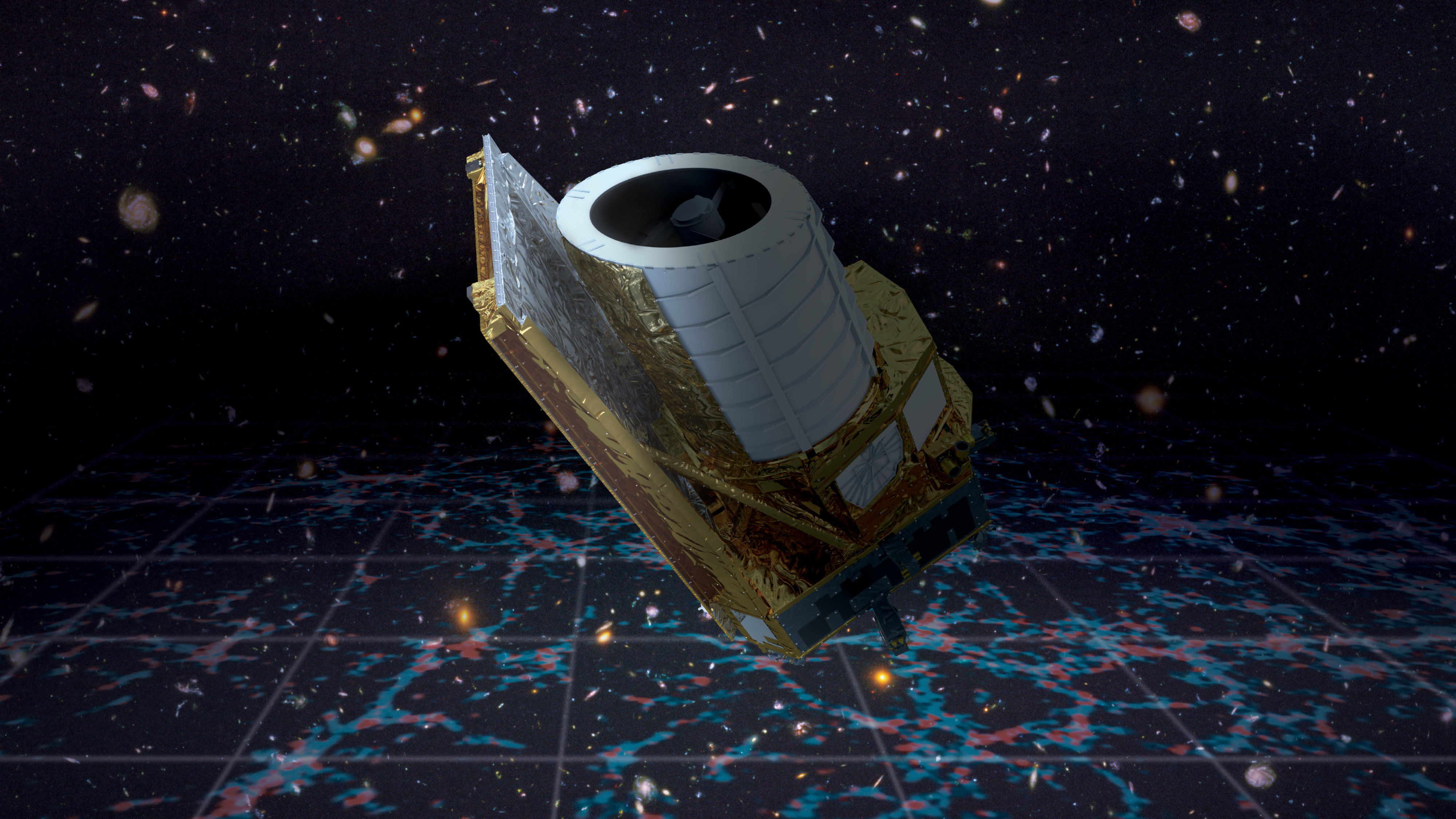
Ireland is a full member of ESA so let’s hope the Irish Government finds a way of funding participation in the LISA mission. Although Ireland joined ESA nearly fifty years ago, and is paying  into the mandatory science programme which includes LISA (and, for example, Euclid), there is no funding programme in Ireland dedicated to the scientific exploitation of ESA projects. Let’s hope the Irish scientists involved in LISA – including those at Maynooth – are able to play a full part in this exciting project.

R.I.P. Arno Penzias (1933-2024)

Posted in History, R.I.P., The Universe and Stuff with tags , , , on January 24, 2024 by telescoper

Yesterday I heard the sad news of the death, at the age of 90, of American physicist and radio astronomer Arno Penzias.

I’ve used the above image hundreds of times in popular talks. It shows Robert W. Wilson (left) and Arno A. Penzias (right) standing in front of the famous horn antenna that (accidentally) discovered what we now know to be the cosmic microwave background, radiation left over after the Big Bang.

Penzias and Wilson made their historic measurements in 1964, published their results in 1965, and received the Nobel Prize for Physics in 1978. At the time of this experiment, the scientists were working at Bell Telephone Laboratories at Holmdel, New Jersey, on Project Echo. The antenna was built to receive radio signals bounced off a passive satellite in a low Earth orbit to check the feasibility of satellite radio communication. They found excess noise in their receiver, which was eventually identified as a relic of a time when the Universe was extremely hot. Coincidentally, the theory of this yet undiscovered radiation was being worked on by Bob Dicke and his group in Princeton at about the same time (and also in New Jersey). Discussions ensued, and the discovery paper by Penzias & Wilson appeared in the Astrophysical Journal in 1965 beside a paper by Dicke et al. giving the theoretical interpretation.

The discovery of the cosmic microwave background was probably the most important result in observational cosmology after that of the Hubble expansion and it paved the way for the establishment and further development of the Big Bang theory. One of the two discoverers of the CMB has now left us, leaving a priceless legacy.

Rest in peace, Arno Allan Penzias (1933-2024)

Spring School on Topological Aspects of Low-dimensional Quantum Physics at Maynooth!

Posted in Maynooth, The Universe and Stuff with tags , , on January 23, 2024 by telescoper

I’ve been asked by colleagues not in Barcelona to use the medium of this blog to advertise the fact that Maynooth University is hosting an exciting spring school for Early Career Researchers this April:

Registration is now open!

For further information and to register see here. Please forward to anyone who might be interested!

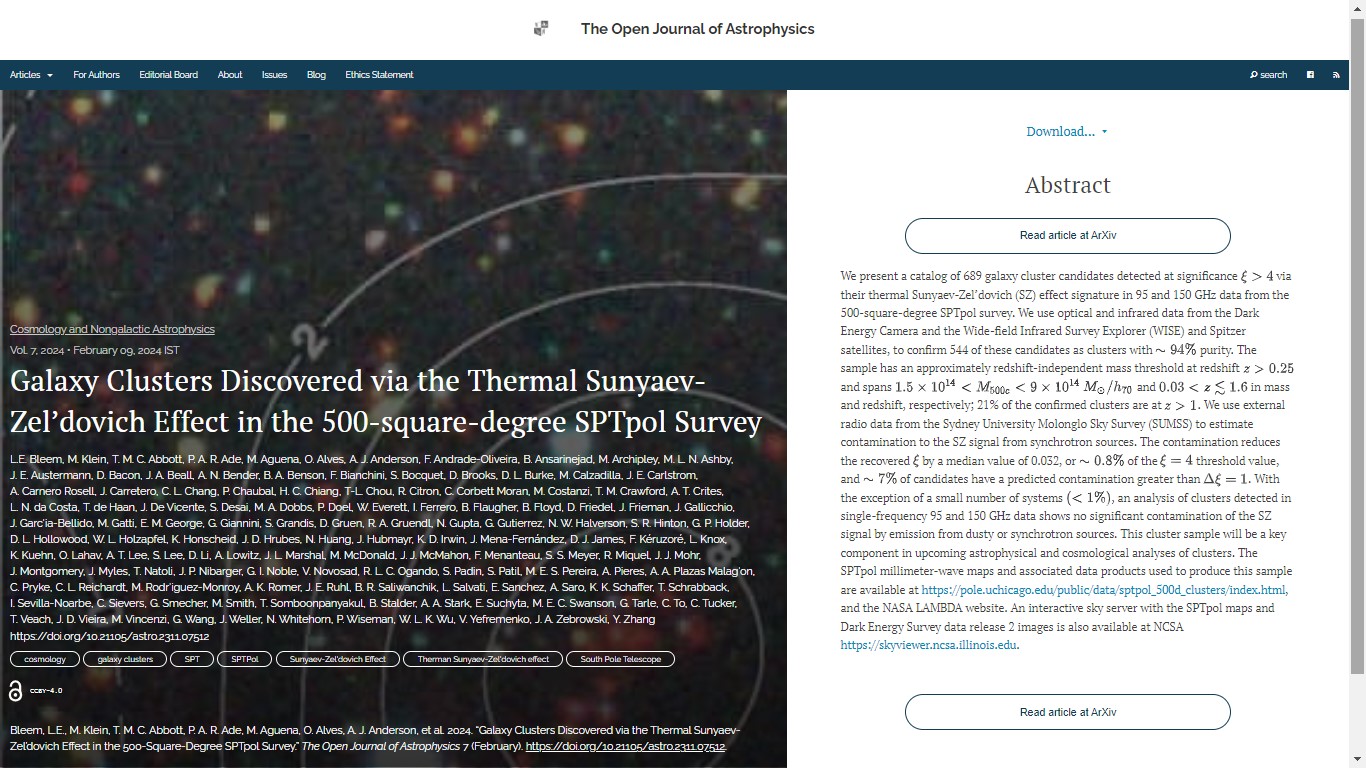
Three New Publications at the Open Journal of Astrophysics

Posted in OJAp Papers, Open Access, The Universe and Stuff with tags , , , , , , , , , , , , , , , , , on January 20, 2024 by telescoper

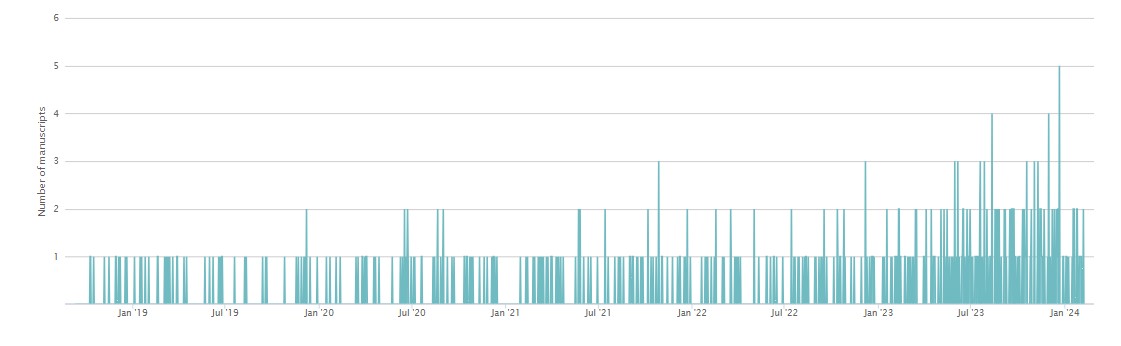
As promised yesterday, it’s time for a roundup of the week’s business at the  Open Journal of Astrophysics. This past week we have published three papers, taking  the count in Volume 7 (2024) up to 4 and the total published by OJAp up to 119. There are quite a few more ready to go as people return from the Christmas break.

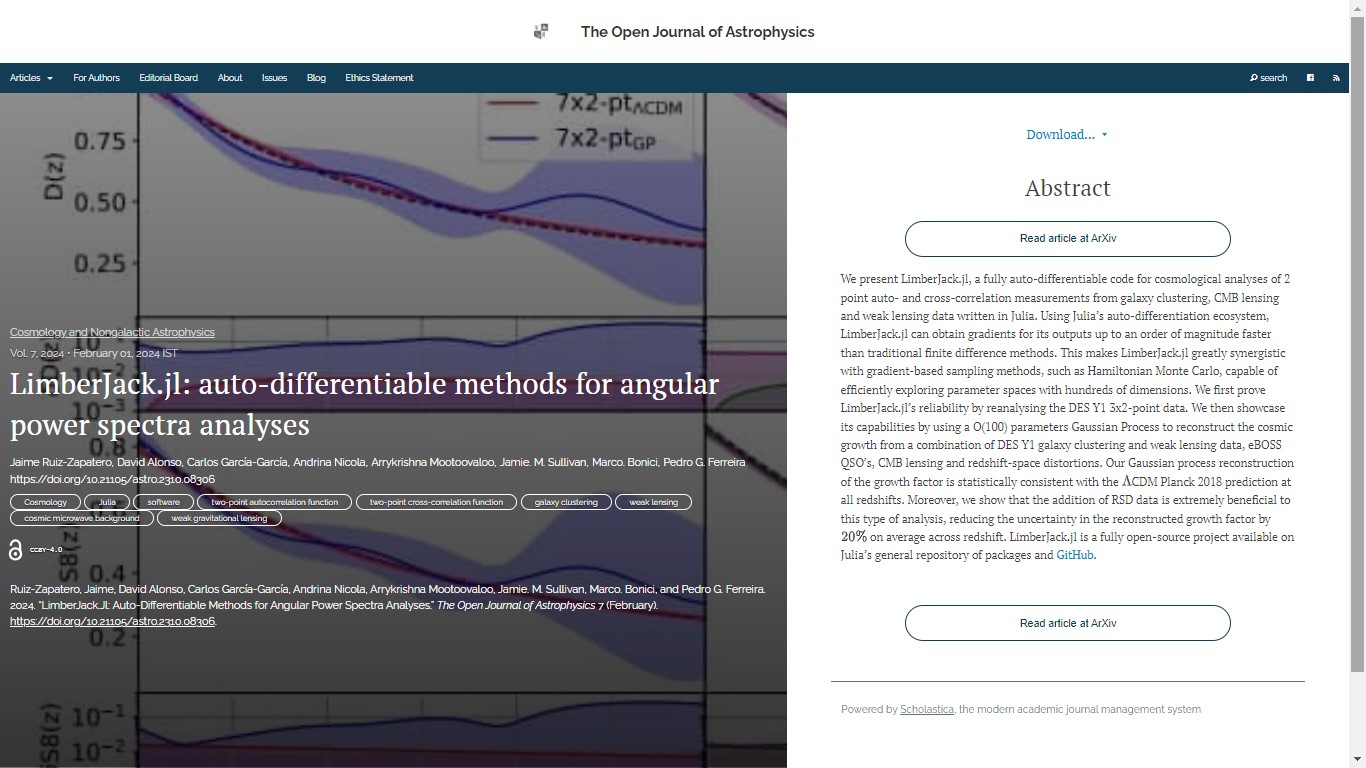
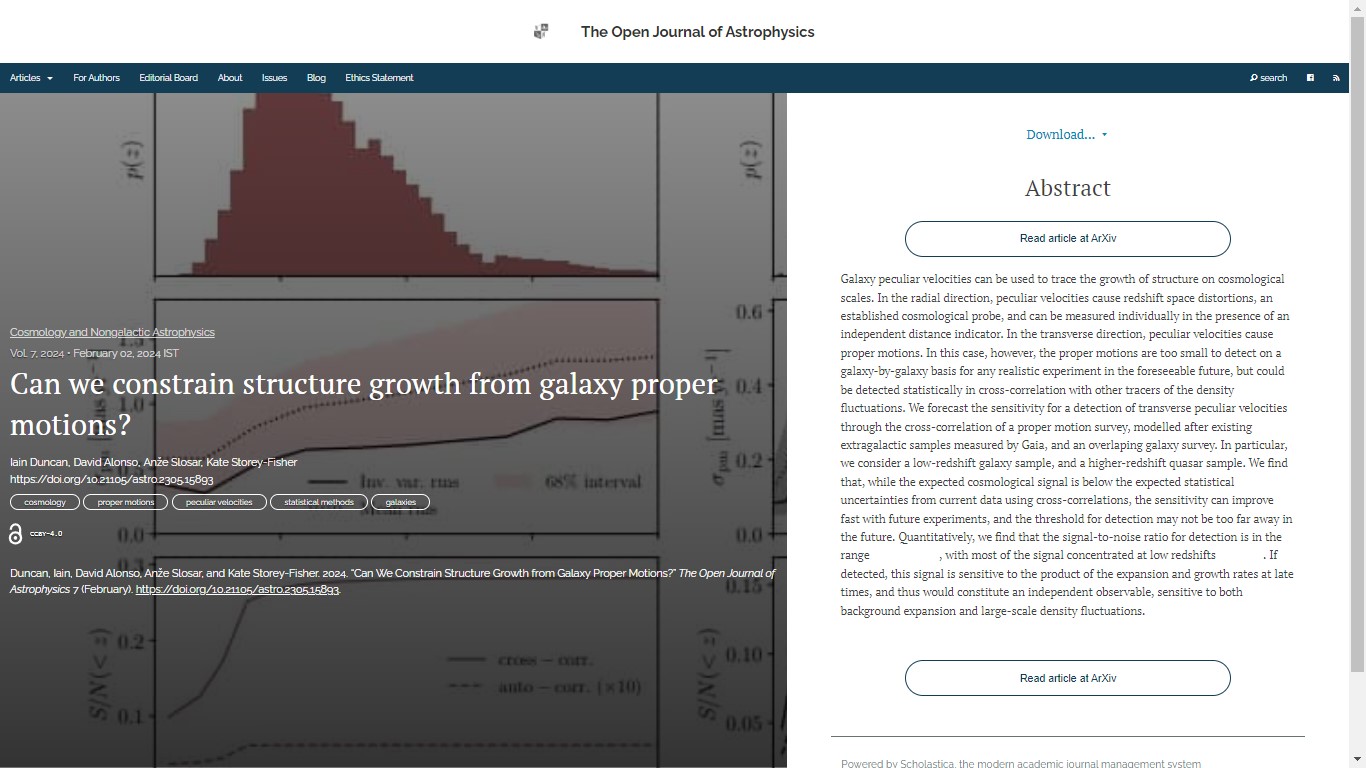
In chronological order, the three papers published this week, with their overlays, are as follows. You can click on the images of the overlays to make them larger should you wish to do so.

First one up is “Prospects for studying the mass and gas in protoclusters with future CMB observations” by  Anna Gardner and Eric Baxter (Hawaii, USA), Srinivasan Raghunathan (NCSA, USA), Weiguang Cui (Edinburgh, UK), and Daniel Ceverino (Madrid, Spain). This paper, published on 17th January 2024, uses realistic hydrodynamical simulations to probe the ability of CMB Stage 4-like (CMB-S4) experiments to detect and characterize protoclusters via gravitational lensing and the Sunyaev-Zel’dovich effect. This paper is in the category of Cosmology and Nongalactic Astrophysics.

Here is a screen grab of the overlay, which includes the abstract:


You can find the officially accepted version of the paper on the arXiv here.

The second paper to announce is “SDSS J125417.98+274004.6: An X-ray Detected Minor Merger Dual AGN” and is by Marko Mićić, Brenna Wells, Olivia Holmes, and Jimmy Irwin (all of the University of Alabama, USA).  This presents the discovery of a dual AGN in a merger between the galaxy SDSS J125417.98+274004.6 and dwarf satellite, studied using X-ray observations from the Chandra satellite. The paper was also published on 18th January 2024 in the category Astrophysics of Galaxies . You can see the overlay here:


The accepted version of this paper can be found on the arXiv here.

The last paper of this batch is  entitled “Population III star formation: multiple gas phases prevent the use of an equation of state at high densities” and the authors are:  Lewis Prole (Maynooth, Ireland), Paul Clark (Cardiff, UK), Felix Priestley (Cardiff, UK), Simon Glover (Heidelberg, Germany) and John Regan (Maynooth, Ireland). This paper, which presents a comparison of results obtained using chemical networks and a simpler equation-of-state approach for primordial star formation (showing the limitations of the latter) was published on 19th January 2024 and also in the folder marked Astrophysics of Galaxies.

Here is the overlay:


You can find the full text for this one on the arXiv here.

And that concludes the update. There’ll be more next week!


DIRAC Research Image Competition Winners

Posted in Art, Biographical, The Universe and Stuff with tags , , , , on January 18, 2024 by telescoper

You may recall that last year I posted about the results of the annual Dirac Research Image competition for which I was one of the judges. For those of you who weren’t aware, DIRAC is a high-performance computing facility designed to serve the research community supported in the UK by the Science and Technology Facilities Council (STFC). I was honoured to be invited back to judge the competition this year.

As before, entries to the Research Image Competition were divided into two Themes: Theme 1 (Particle and Nuclear Physics) and Theme 2 (Astronomy, Cosmology and Solar & Planetary Science) and scores were allocated by the judges based on visual impact and scientific interest. Once again, the standard was very high, but there were clear winners in each category. Here they are:

LUCA REALI, MAX BOLEININGER, DANIEL MASON, SERGEI DUDAREV (UKAEA)

DATA INTENSIVE CAMBRIDGE

Molecular dynamics simulations of high-dose radiation damage in tungsten to understand the evolution of the material under fusion reactor conditions. Blue spheres are vacancies (missing-atom defects), orange spheres are interstitials (extra-atom defects). Lines are dislocations (linear crystallographic defect).

Softwares: LAMMPS for simulations, Ovito for the rendering.

JOSH BORROW, FLAMINGO TEAM

MEMORY INTENSIVE DURHAM

The most massive galaxy cluster in the flagship, 2.8 Gpc, FLAMINGO volume, with each side of the image spanning 40 megaparsecs. Each colour represents a different gas density contour, highlighting the extremely complex spatial and velocity structure of the gas within the cluster. At the center, the gas serendipitously aligns to produce a love heart.

The image was created with DiRAC supported software SWIFT and swiftsimio.

For more details about these images and the other entries see here. The 2024 Dirac Calendar features a selection of the entries.

Congratulations to the winners and indeed all the entrants!

The Big Ring Circus

Posted in Astrohype, Bad Statistics, The Universe and Stuff with tags , , , , on January 15, 2024 by telescoper

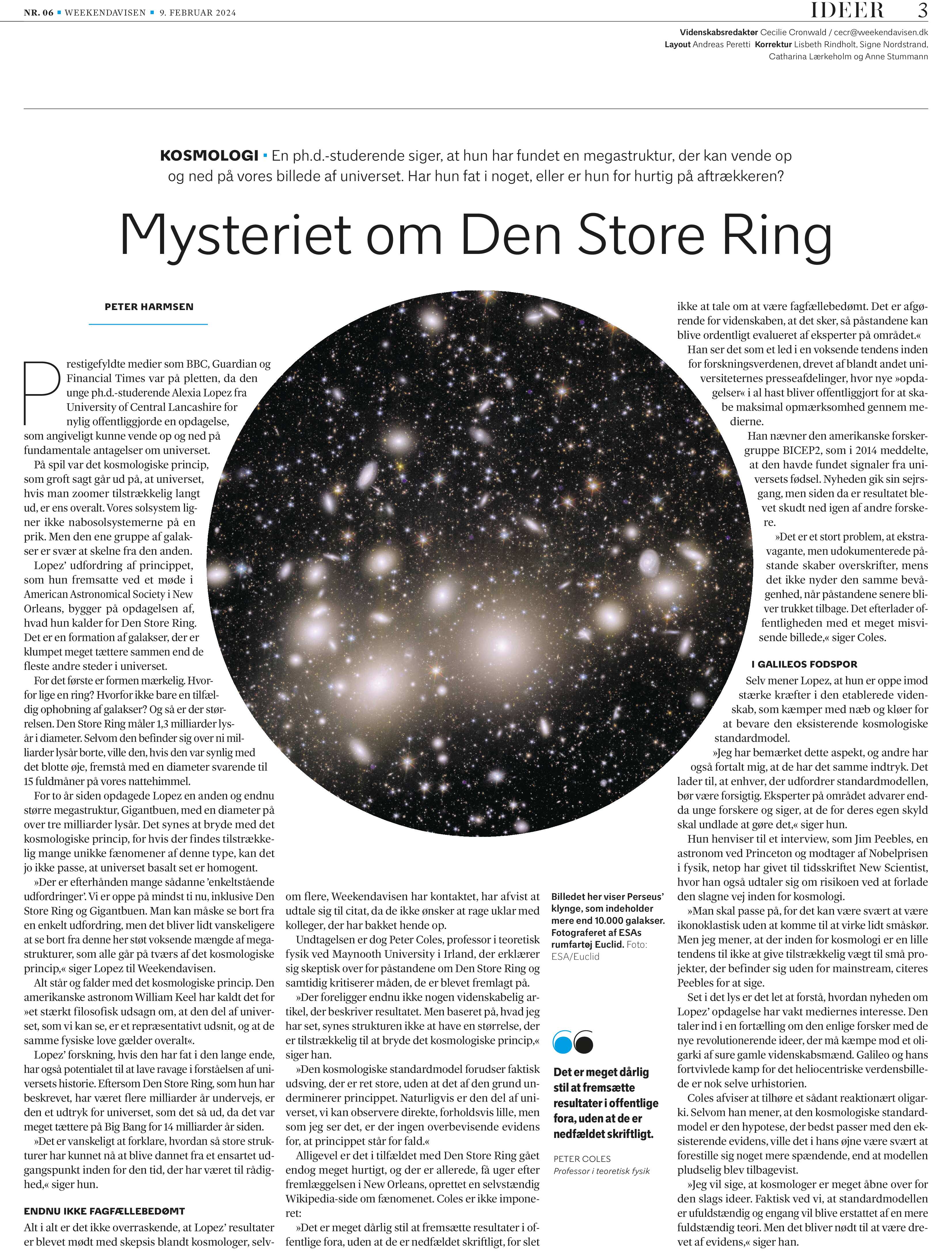
At the annual AAS Meeting in New Orleans last week there was an announcement of a result that made headlines in the media (see, e.g., here and here). There is also a press release from the University of Central Lancashire.

Here is a video of the press conference:

I was busy last week so didn’t have time to read the details so refrained from commenting on this issue at the time of the announcement. Now that I am back in circulation, I have time to read the details, but unfortunately was unable to find even a preprint describing this “discovery”. The press conference doesn’t contain much detail either so it’s impossible to say anything much about the significance of the result, which is claimed (without explanation) to be 5.2σ (after “doing some statistics”). I see the “Big Ring” now has its own wikipedia page, the only references on which are to press reports, not peer-reviewed scientific papers or even preprints.

So is this structure “so big it challenges our understanding of the universe”?

Based on the available information it is impossible to say. The large-scale structure of the Universe comprises a complex network of walls and filaments known as the cosmic web which I have written about numerous times on this blog. This structure is so vast and complicated that it is very easy to find strange shapes in it but very hard to determine whether or not they indicate anything other than an over-active imagination.

To assess the significance of the Big Ring or other structures in a proper scientific fashion, one has to calculate how probable that structure is given a model. We have a standard model that can be used for this purpose, but to simulate very structures is not straightforward because it requires a lot of computing power even to simulate just the mass distribution. In this case one also has to understand how to embed Magnesium absorption too, something which may turn out to trace the mass in a very biased way. Moreover, one has to simulate the observational selection process too, so one is doing a fair comparison between observations and predictions.

I have seen no evidence that this has been done in this case. When it is, I’ll comment on the details. I’m not optimistic however, as the description given in the media accounts contains numerous falsehoods. For example, quoting the lead author:

The Cosmological Principle assumes that the part of the universe we can see is viewed as a ‘fair sample’ of what we expect the rest of the universe to be like. We expect matter to be evenly distributed everywhere in space when we view the universe on a large scale, so there should be no noticeable irregularities above a certain size.

https://www.uclan.ac.uk/news/big-ring-in-the-sky

This just isn’t correct. The standard cosmology has fluctuations on all scales. Although the fluctuation amplitude decreases with scale, there is no scale at which the Universe is completely smooth. See the discussion, for example, here. We can see correlations on very large angular scales in the cosmic microwave background which would be absent if the Universe were completely smooth on those scales. The observed structure is about 400 Mpc in size, which does not seem to be to be particularly impressive.

I suspect that the 5.2σ figure mentioned above comes from some sort of comparison between the observed structure and a completely uniform background, in which case it is meaningless.

My main comment on this episode is that I think it’s very poor practice to go hunting headlines when there isn’t even a preprint describing the results. That’s not the sort of thing PhD supervisors should be allowing their PhD students to do. As I have mentioned before on this blog, there is an increasing tendency for university press offices to see themselves entirely as marketing agencies instead of informing and/or educating the public. Press releases about scientific research nowadays rarely make any attempt at accuracy – they are just designed to get the institution concerned into the headlines. In other words, research is just a marketing tool.

In the long run, this kind of media circus, driven by hype rather than science, does nobody any good.

P.S. I was going to joke that ring-like structures can be easily explained by circular reasoning, but decided not to.

New Publication at the Open Journal of Astrophysics

Posted in OJAp Papers, The Universe and Stuff with tags , , , on January 11, 2024 by telescoper

Well, it’s 2024 and time to start a new volume – the seventh – of the Open Journal of Astrophysics with the very first paper of the new year. The paper in question is the 1st paper in Volume 7 (2024)  and the 116th altogether. This one was published on 8th January 2024.

The title is “A new timestep criterion for N-body simulations” and it presents a new method for estimating characteristic dynamical timescales in N-body simulations, based on derivatives up to fourth order, which can be used to adjust timesteps used in numerical computations. The paper is in the folder marked Earth and Planetary Astrophysics as the paper discusses applications to orbital dynamics in planetary systems, but the method is of much wider applicability.

The authors are Dang Pham & Hanno Rein  (University of Toronto, Canada) and David S. Spiegel (Google, USA).

Here is the overlay of the paper containing the abstract:


You can click on the image of the overlay to make it larger should you wish to do so. You can find the officially accepted version of the paper on the arXiv here.

New Dark Energy Survey Supernovae Results

Posted in The Universe and Stuff with tags , , , , , , , on January 10, 2024 by telescoper

Some important cosmological results have just been announced by the Dark Energy Survey Collaboration. I haven’t had time to go through them in detail but I thought it was worth doing a quick post here to draw attention to them. The results concern a sample of Type Ia supernovae (SN Ia) discovered during the full five years of the Dark Energy Survey (DES) Supernova Program, which contains about 1500 new Type Ia Supernovae that can be used for cosmological analysis. The paper is available on the arXiv here; the abstract is:

The key numerical result of interest is the equation-of-state parameter for dark energy, designated by w, which occurs in the (assumed) relationship between pressure p and effective mass density ρ  of the form p=wρc2. A cosmological constant – which for many cosmologists is the default assumption for the form of dark energy – has w=-1 as I explained here. This parameter is one of the things Euclid is going to try to measure, using different methods. Interestingly, the DES results are offset a bit from the value of -1, but with quite a large uncertainty.

While the results for the equation-of-state parameter are somewhat equivocal, one thing that is clear is that the new SNIa measurements do confirm the existence of dark energy, in that the data can only be described by models with accelerating expansion, as dramatically demonstrated in this Figure:

I think this figure – or versions of it – will very rapidly appear in public talks on cosmology, including my own!

The Time of Perihelion

Posted in The Universe and Stuff with tags , , , on January 3, 2024 by telescoper

Earth’s elliptical orbit viewed at an angle (which makes it look more eccentric than it is – in reality is very nearly circular).

I haven’t received a Royal Astronomical Society diary this year, which I’m sad about as it has been a bit of a tradition, as well as being a useful source of astronomical information. According to other sources,  however, today (Wednesday 3rd January 2024) at approximately 00.39 GMT the Earth reached the point on its orbit  closest to the Sun, i.e. its perihelion. At this time the distance from the Sun’s centre to Earth’s centre was  147,100,632 km. This year, aphelion (the furthest distance from the Sun) is at 06.06 GMT on July 6th 2023 at which point the centre of the Earth will be 152,099,968 km from the centre of the Sun. You can find a list of times and dates of perihelion and aphelion for future years here.

At perihelion the speed of the Earth in its orbit around the Sun is greater than at aphelion (about 30.287 km/s versus 29.291 km/s). This difference, caused by the Earth’s orbital eccentricity, contributes to the difference between mean time and solar time which, among other things, influences the time of sunrise and sunset at the winter solstice that happened a couple of weeks or so ago.

It surprises me how many people think that the existence of the seasons has something to do with the variation of the Earth’s distance from the Sun as it moves in its orbit in that the closer to the Sun we get the warmer the weather will be. The fact that perihelion occurs in the depth of winter should convince anyone living in the Northern hemisphere that this just can’t be the case, as should the fact that it’s summer in the Southern hemisphere while it is winter in the North.

The real reason for the existence of seasons is the tilt of the Earth’s axis of rotation. I used to do a little demonstration with a torch (flashlight to American readers) to illustrate this when I taught first-year astrophysics. If you shine a torch horizontally at a piece of card it will illuminate a patch of the card. Keep the torch at the same distance but tilt the card and you will see the illuminated patch increase in size. The torch is radiating the same amount of energy but in the second case that energy is spread over a larger area than in the first. This means that the energy per unit area incident on the card is decreases when the card is tilted. It is that which is responsible for winter being colder than summer. In the summer the sun is higher in the sky (on average) than in winter. From this argument you can infer that the winter solstice not the perihelion, is the relevant astronomical indicator of winter.

That is not to say that the shape of the Earth’s orbit has no effect on temperatures. It may, for example, contribute to the summer in the Southern hemisphere being hotter than in the North, although it is not the only effect. The Earth’s surface possesses a significant North-South asymmetry: there is a much larger fraction of ocean in the Southern hemisphere, for example, which could be responsible for moderating any differences in temperature due to insolation. The climate is a non-linear system that involves circulating air and ocean currents that respond in complicated ways and on different timescales not just to insolation but to many other parameters, including atmospheric composition (especially the amount of water vapour).

The dates when Earth reaches the extreme points on its orbit (apsides) are not fixed because of the variations in its orbital eccentricity so, in the short-term, the dates can vary up to 2 days from one year to another. The perihelion distance varies slightly from year to year too; it’s slightly larger this year than last year, for example.

There is however a long-term trend for perihelion to occur later in the year. For example, in 1246, the December Solstice (winter solstice for the Northern Hemisphere) was on the same day as the Earth’s perihelion. Since then, the perihelion and aphelion dates have drifted by an average of one day every 58 years and this trend will continue. This means that by the year 6430 the timing of the perihelion and the March Equinox will coincide, although I hope to have retired by then…

New Publication at the Open Journal of Astrophysics

Posted in OJAp Papers, The Universe and Stuff with tags , , , , , on December 31, 2023 by telescoper

It’s New Year’s Eve and I just remembered that there was a paper at the Open Journal of Astrophysics site that we published before Christmas but that I haven’t yet announced on here, so for the sake of completeness here it is. It takes us to 50 papers published in 2023.

The paper in question is the 50th and final paper  in Volume 6 (2023)  and it’s the 115th altogether. This one was actually published on Friday 22nd December 2023 but owing to the vacations we had to wait a bit to get the metadata registered.

The title of this one is “What are the parities of photon-ring images near a black hole?” and is a discussion of the Fermat potential (also known as the arrival-time surface) in the context of gravitational lensing by strong gravitational fields and the implication for image parities thereby produced. This one is actually listed in General Relativity and Quantum Cosmology (gr-qc, on arXiv) but is cross-listed as Cosmology and Non-galactic Astrophysics so is eligible for publication here in the appropriate folder.

The authors are Ashish Kumar Meena (Ben Gurion University of the Negev, Israel) and Prasenjit Saha (University of Zurich, Switzerland).

Here is the overlay of the paper containing the abstract:


You can click on the image of the overlay to make it larger should you wish to do so. You can find the officially accepted version of the paper on the arXiv here.

And that concludes Volume 6 of the Open Journal of Astrophysics. Roll on Volume 7.