Archive for the The Universe and Stuff Category

The 2023 OJAp Annual!

Posted in OJAp Papers, The Universe and Stuff with tags , on December 29, 2023 by telescoper

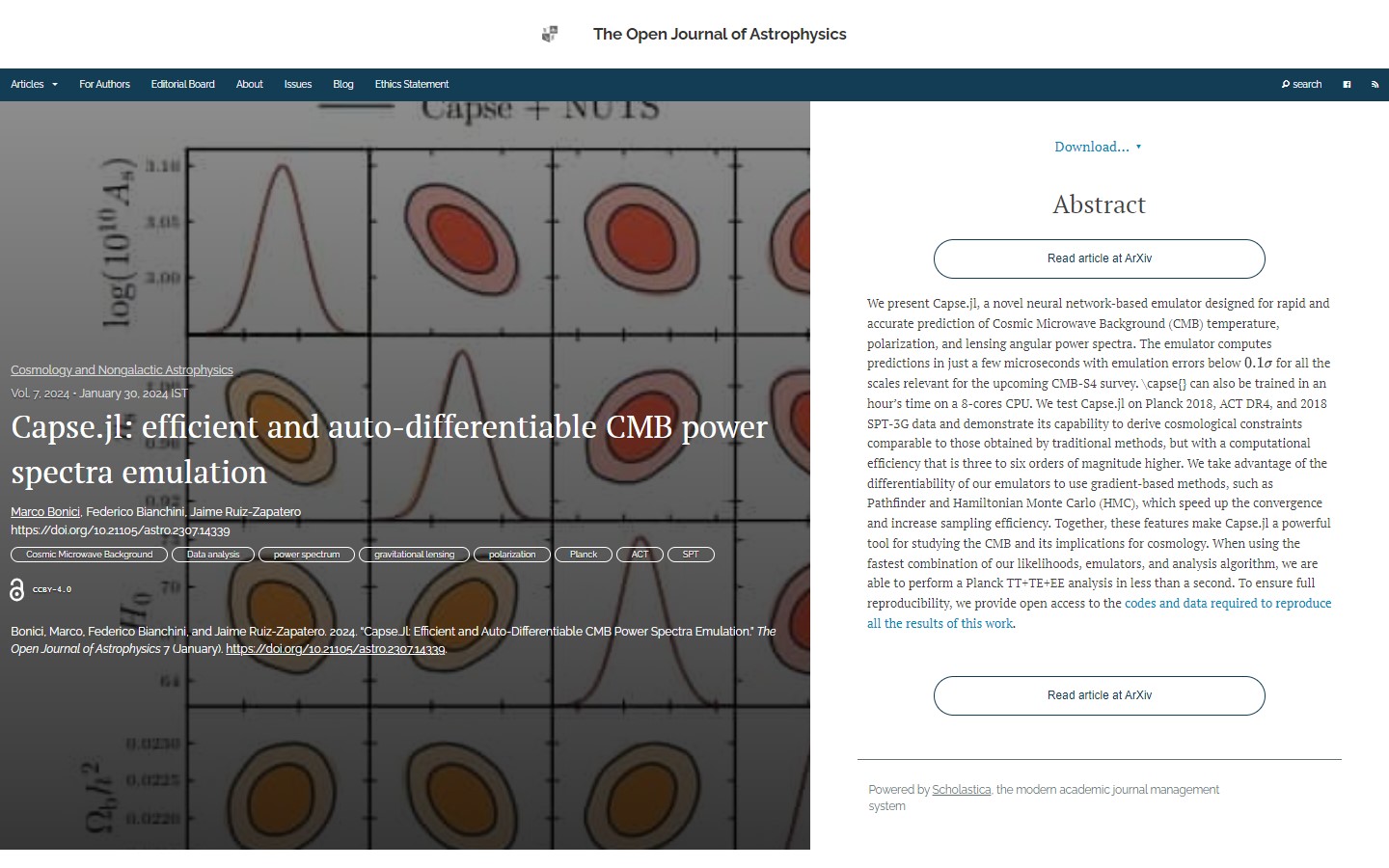
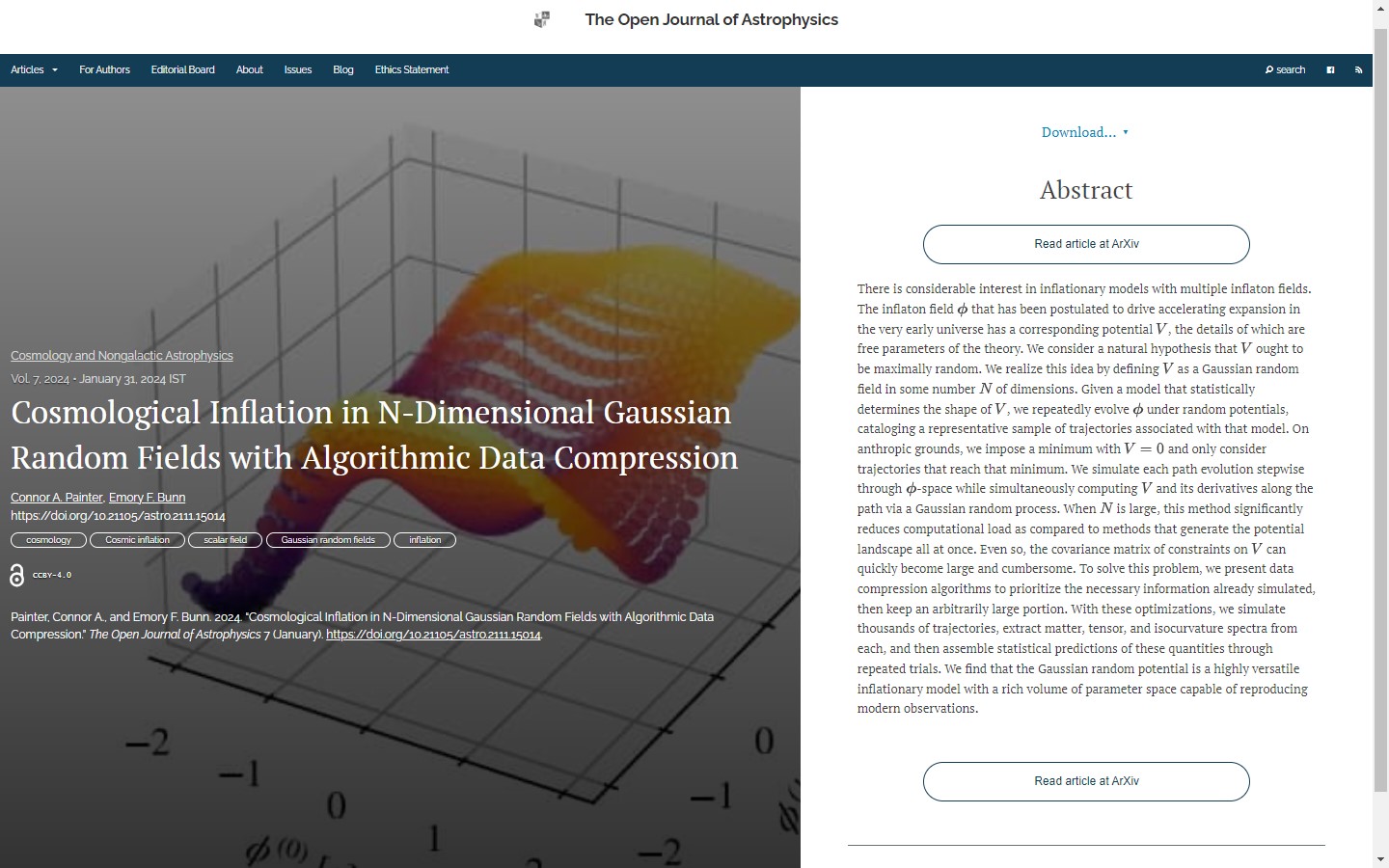
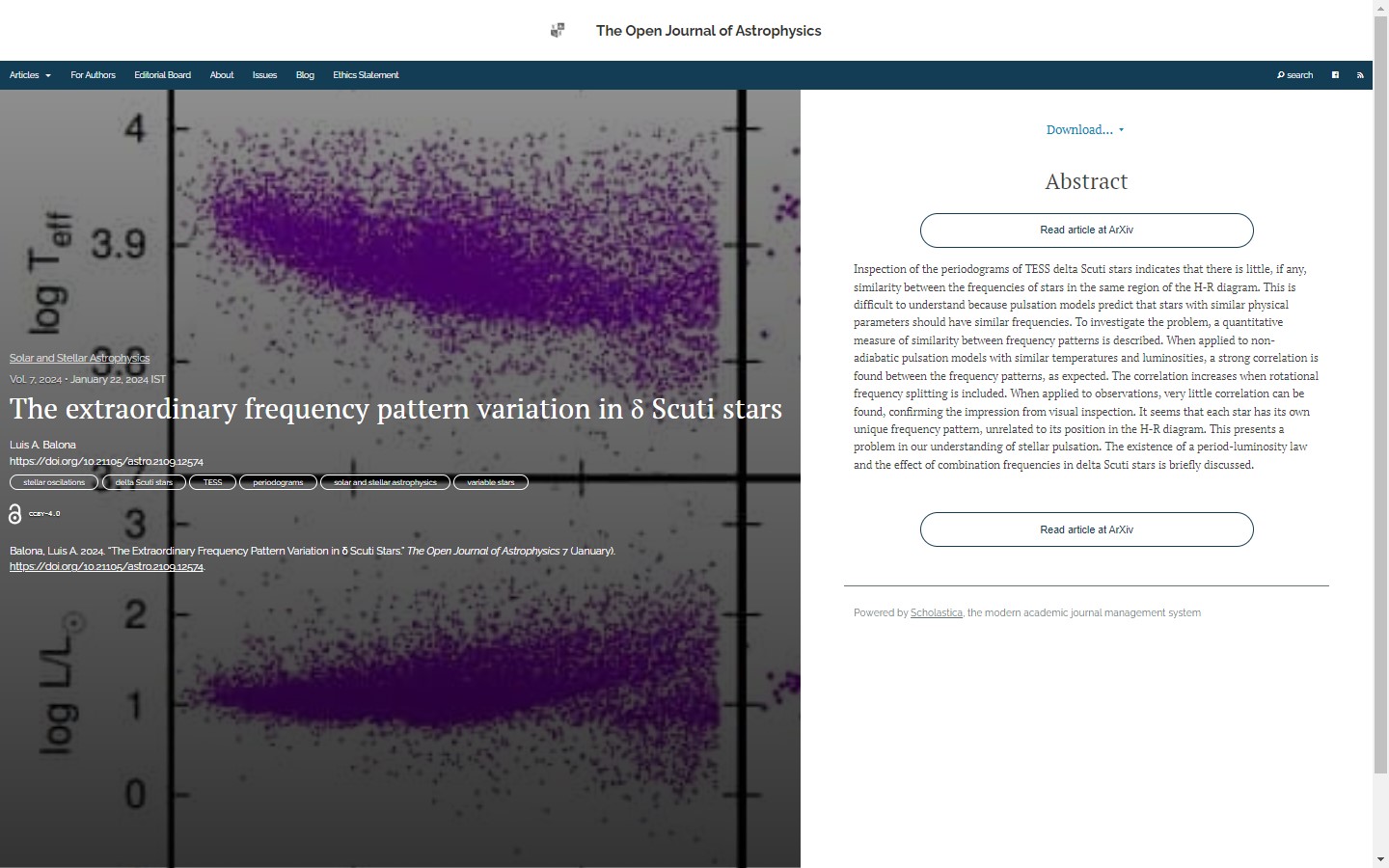
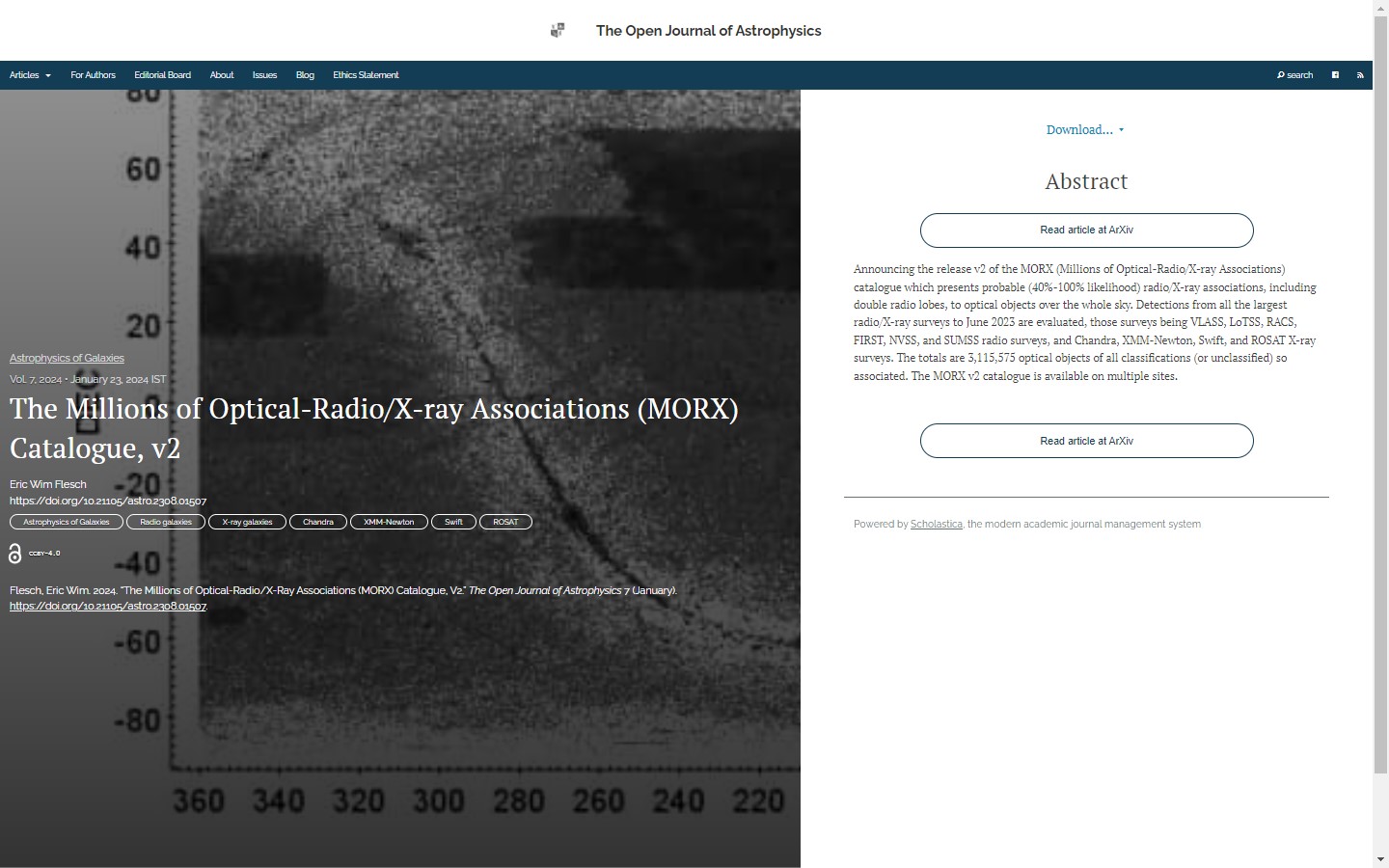
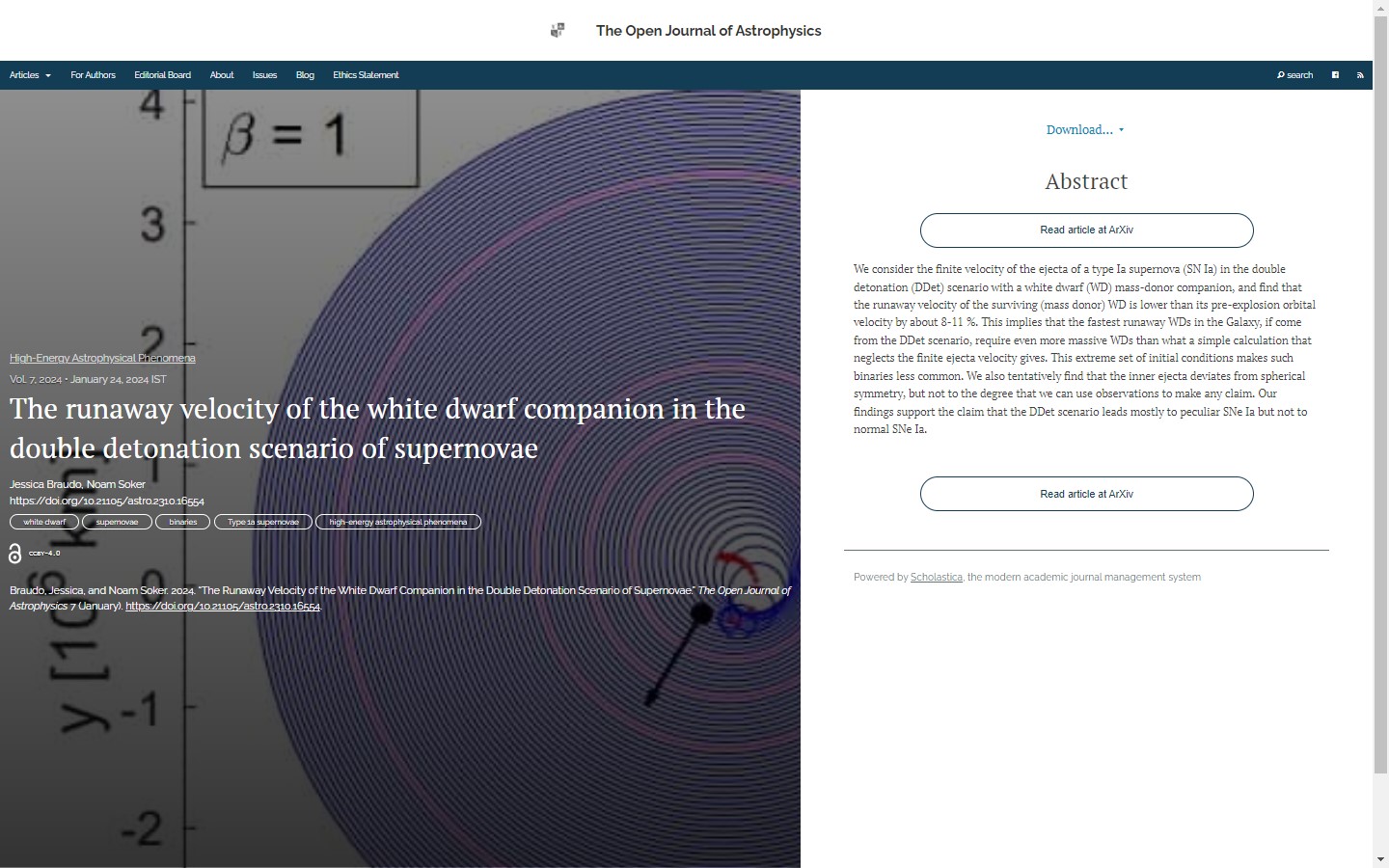
I was leafing through my copy of the 2023 Private Eye Annual and thought it would be fun to do a sort of annual for the Open Journal of Astrophysics, so here you are: all 50 of the papers in Volume 6 (2023) in glorious technicolour.

I could have linked each image to the relevant paper, but I’m way to lazy to do that!

In case you are interested here is the breakdown into different sections:

You can see that over half the papers we published are in Cosmology and Nongalactic Astrophysics, and just three arXiv categories account for 90% of the publications. I hope we can increase our diversity in 2024!

Newton’s Third Law Illustrated

Posted in The Universe and Stuff with tags , on December 23, 2023 by telescoper
"To every Action Man...

R.I.P. Alexei Starobinsky (1948-2023)

Posted in Covid-19, R.I.P., The Universe and Stuff with tags , , , on December 22, 2023 by telescoper
Alexei Starobinsky, pictured in 2013.

I’m very sorry, especially just before Christmas, to pass on the news of the death of Russian physicist and cosmologist Alexei Starobinsky who died yesterday (21st December 2023) of complications resulting from Covid-19. I heard this morning, but have been travelling all day and only just found time to write something in appreciation.

Starobinsky was one of the many academic descendants of the great Zeldovich; he did particularly important work on the physics of the early Universe in which field his ideas prefigured the theory that came to be known as cosmic inflation. Although Starobinsky’s seminal (1979) work on this topic was not well known outside the Soviet Union at the time Alan Guth wrote his paper on inflation (1981), it did later gained wider appreciation, and led to numerous awards, including the Gruber Prize in 2013 and the Kavli Prize in 2014 (together with Guth and Andrei Linde). 

I do have one rather fond personal memory of Starobinsky, from when we were coincidentally both visiting IUCAA in Pune at the same time back in the Nineties. We ended up going on a shopping trip together during which he revealed himself to be hopeless at the kind of light-hearted haggling that was the norm in the places we visited. He ended up paying way over the odds for everything he bought. He didn’t seem to mind though, and apparently found it all quite amusing. I only met him a few times and didn’t get to know him well at all, but he struck me as a very nice man as well as a fine physicist of the old-school Russian type.

Rest in peace, Alexei Alexandrovich Starobinsky (1948-2023).

The Winter Solstice 2023

Posted in The Universe and Stuff with tags , , , on December 21, 2023 by telescoper
Sunlight at dawn on the Winter Solstice at Newgrange

Just a quick note to point out that the Winter Solstice in the Northern hemisphere happens tomorrow, Friday 22nd December 2023, at 4.27 am CET (3.27 UT). I am posting this in advance as although I am will be getting up quite early to catch a flight, it won’t be that early…

People often think that the Winter Solstice is defined to be the “shortest day” or the “longest night” of the year. The Solstice is actually defined in astronomical terms much more precisely than that. It happens when the axial tilt of the Earth away from the Sun is greatest, so that the Sun appears in the sky with its lowest maximum elevation. The timing of this event can be calculated with great precision.

In Barcelona, sunrise today (21st December) is at 8.13 am and sunset at 5.24 pm, while tomorrow the sunrise is at 8.14 am and sunset at 5.25 pm. The Solstice therefore occurs before sunrise tomorrow morning and the interval between sunrise and sunset tomorrow will be very close to that today; the interval between sunrise and sunset on 20th December (yesterday) was four whole seconds longer than on 22nd (today); the shortest day is therefore today rather than tomorrow. Moreover, the Solstice marks neither the latest sunrise nor the earliest sunset: sunrise will carry on getting later until the new year, the length of the day nevertheless increasing because sunset occurs even later. For a full explanation of this, see last year’s Winter Solstice post.

Yet more high-z galaxies from JWST…

Posted in The Universe and Stuff with tags , , , , , , , on December 19, 2023 by telescoper

I noticed a paper on arXiv yesterday, by Robertson et al., with the abstract:

You can click on this to make it larger if you find it difficult to read.

This is the latest in a number of studies by the JWST Advanced Deep Extragalactic Survey (JADES), which is aiming to detect galaxies that formed in the very early Universe; for a previous example see here. The latest batch can be seen in this figure:

There is an important caveat here, which is that these are photometric redshifts, based on the overall shape of the spectrum of the galaxy rather than on spectral lines which give a more accurate result. Follow-up spectroscopy is needed to firmly identify the redshift of the sources. Past experience suggests that some of these candidates may not actually be at as high a redshift as is claimed. If confirmed, however, the existence of large galaxies at redshifts of order 15 will put greater pressure on models of galaxy formation. A recent OJAp publication has shown that galaxies at redshift 10 are consistent with current theoretical ideas, but much larger will increase the tension on theorists. I can imagine quite a few people around the world replotting their graphs right now!

Two New Publications at the Open Journal of Astrophysics

Posted in OJAp Papers, Open Access, The Universe and Stuff with tags , , , , , on December 14, 2023 by telescoper

As anticipated a couple of days ago, it’s now possible to announce another couple of new papers at the Open Journal of Astrophysics. These papers take us up to a total of 49  in Volume 6 (2023) and 114 in total since we started publishing.

It would be nice if we could make it to 50 in Volume 6 (2023), but I have already decided to close the publishing platform from 22nd December until 5th January (inclusive), so there there isn’t much time to get the single needed for our half-century.  While we will not be publishing new papers during this closure, the peer review platform will remain open for submission of new and revised manuscripts and the editorial processes will continue.

Whether or not we make 50 this year, it is worth remarking that 49 is already a significant figure, as it corresponds to the total number of papers we published in the previous three years: 15 (2020); 17 (2021); and 17 (2022). Things are definitely looking up!

Anyway, the first paper of the most recent pair – published on December 8th – is “The Million Quasars (Milliquas) Catalogue, v8”; its primary classification is Astrophysics of Galaxies and the author is Eric Wim Flesch from New Zealand. The Milliquas catalogue includes quasars from the literature to 30 June 2023, including quasars from the DESI-EDR and SDSS-DR18Q surveys.

Here is a screen grab of the overlay which includes the abstract:
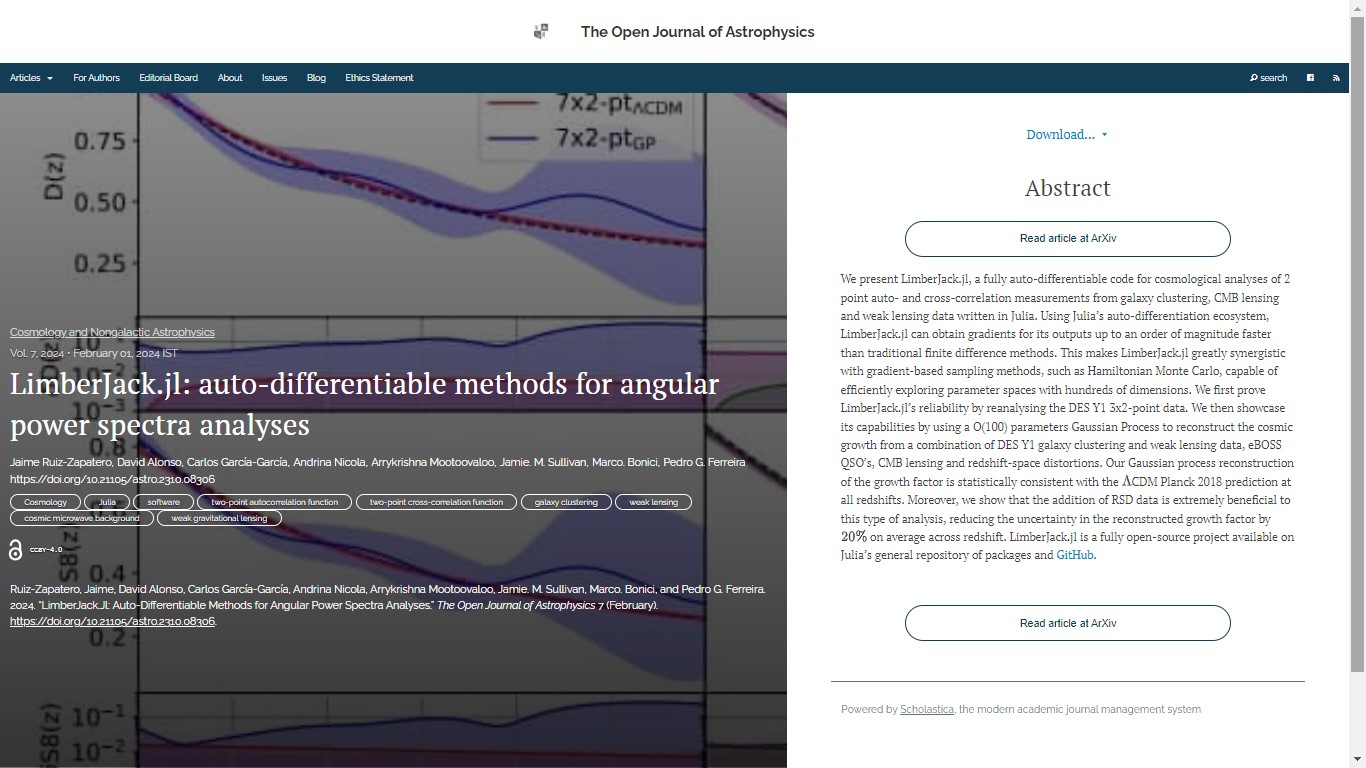
You can click on the image of the overlay to make it larger should you wish to do so. You can find the officially accepted version of the paper on the arXiv here.

The second paper was published on 11th December 2023 and is also in the folder marked Astrophysics of Galaxies.

The authors are all from various institutions in the USA:  Michael Grudić (Carnegie Observatories), Stella Offner (University of Texas at Austin); Dávid Guszejnov (Harvard);  Claude-André Faucher-Giguère (Northwestern University); and Philip F. Hopkins (Caltech).  The paper presents a comparison of full radiative magnetohydrodynamics simulations of the formation of star clusters with simple stochastic modelling showing the limitations of the latter.

Here is a screen grab of the overlay which includes the abstract:
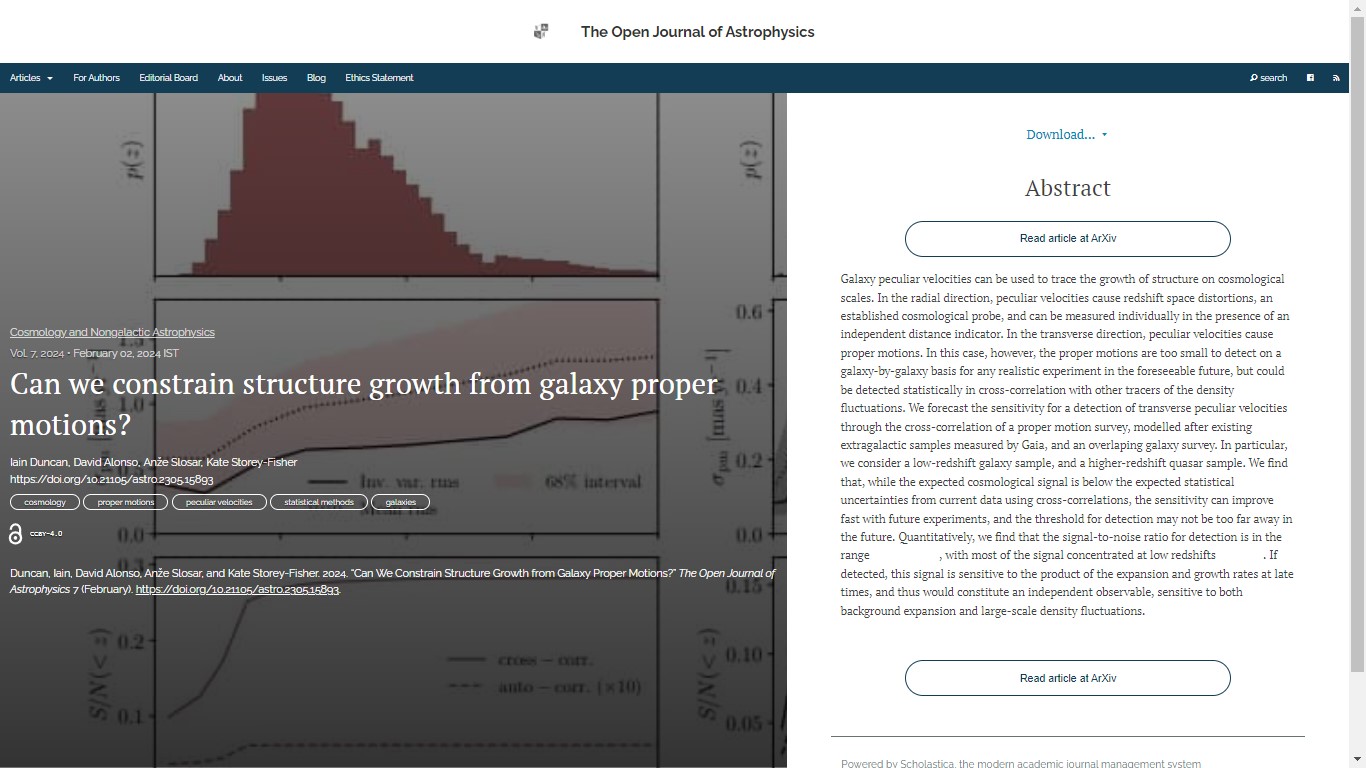


You can click on the image of the overlay to make it larger should you wish to do so. You can find the officially accepted version of the paper on the arXiv here.

New Publication at the Open Journal of Astrophysics

Posted in OJAp Papers, Open Access, The Universe and Stuff with tags , , , , on December 12, 2023 by telescoper

I was doing some work on the Open Journal of Astrophysics site and realized that there is a paper we published last week that I haven’t advertised on here yet, so I’m remedying that now.

The paper in question is the 47th so far in Volume 6 (2023)  and it’s the 112th altogether. This one was actually published on Tuesday December 5th. Two further papers are imminent; I’m just waiting for their metadata to be registered with Crossref.

The title of this one is “The SPHINX Public Data Release: Forward Modelling High-Redshift JWST Observations with Cosmological Radiation Hydrodynamics Simulations” and it represents  public data release of Sphinx20, a full box cosmological radiation-hydrodynamics simulation that provides a statistical sample of galaxies for comparison with those observed by JWST. It is in the folder marked Astrophysics of Galaxies.

There are 10 authors: Harley Katz (Oxford, UK); Joki Rosdahl (Lyon, France); Taysun Kimm (Seoul, Korea); Jeremy Blaizot (Lyon, France);  Nicholas Choustikov (Oxford, UK); Marion Farcy  and Thibault Garel (Geneva, Switzerland);  Martin G. Haehnelt (Cambridge, UK); Leo Michel-Dansac (Lyon, France); and Pierre Ocvirk (Strasbourg, France).

Here is the overlay of the paper containing the abstract:


You can click on the image of the overlay to make it larger should you wish to do so. You can find the officially accepted version of the paper on the arXiv here.

The Return of Halley’s Comet…

Posted in Art, Literature, The Universe and Stuff with tags , , , on December 11, 2023 by telescoper

I was reminded at the weekend that Halley’s Comet has just passed its aphelion (furthest distance from the Sun) and is now falling back into the Solar System towards its next perihelion (closest distance to the Sun) in 2061, by which time I will almost certainly be retired.

Halley’s Comet last visited us in 1986 when I was 23 and living in Brighton. It will next appear in 2061, when I shall be 98 and lucky to be living at all.

This reminded me of a rather poignant cartoon I found a while ago on Facebook. I don’t know the name of the artist. If anyone does please let me know.

The comet’s orbital period of 75 years or so is brief by astronomical standards, as is the duration of a human life. As Quintus Horatius Flaccus (Horace to you and me) put it in one of his Odes (Book I, Ode 4, line 15):

Vitae summa brevis spem nos vetat incohare longam

Do Black Holes have Singularities?

Posted in mathematics, The Universe and Stuff with tags , , , on December 7, 2023 by telescoper

A paper appeared on arXiv this week that has ruffled a few feathers. It’s by Roy Kerr (yes, him) and it has the abstract:

There is no proof that black holes contain singularities when they are generated by real physical bodies. Roger Penrose claimed sixty years ago that trapped surfaces inevitably lead to light rays of finite affine length (FALL’s). Penrose and Stephen Hawking then asserted that these must end in actual singularities. When they could not prove this they decreed it to be self evident. It is shown that there are counterexamples through every point in the Kerr metric. These are asymptotic to at least one event horizon and do not end in singularities.

arXiv:2312.00841

I don’t think this paper is as controversial as some people seem to find it. I think most of us have doubts that singularities – specifically curvature singularities – are physically real rather than manifestations of gaps in our understanding. On the other hand, this paper focusses on an interesting technical question and provides a concrete counterexample. The point is that the famous Penrose-Hawking singularity theorems don’t actually prove the existence of singularities; they prove geodesic incompleteness, i.e. that there are geodesics that can only be extended for a finite time as measured by an observer travelling along one. Geodesic incompleteness does imply the existence of some sort of boundary, often termed a trapped surface, but not necessarily that anything physical diverges there at that boundary. Though a singularity will result in geodesic incompleteness, the assertion that geodesic incompleteness necessarily implies the existence of a singularity is really just a conjecture.

For more details, read the paper. It’s technical, of course, but well written and actually not all difficult to understand.

Euclid in the Media

Posted in Euclid, The Universe and Stuff with tags , , , , , on December 3, 2023 by telescoper

Yesterday came across the above “infographic” – as I’m told such things are called – showing the media traffic generated by last month’s Early Release Observations from the ESA Euclid mission. Some quite interesting facts emerge from it. The new observations were released n 7th November, hence the big spike in the left hand panel on that date.

I see that about 31% of the activity was on Twitter, which I am no longer on, with a slightly smaller amount on Facebook. Overall, social media account for about 60% of the “reach”, with mainstream media (including print, online, and TV/Radio) languishing far behind. Blogs (presumably including this one) account for a mere 1%.

The breakdown by country is interesting too; the table shows only EAS member states. The UK is way out in front, no doubt because BBC News ran a major item on the day of the release. France, Germany, Italy and Spain all have major scientific involvements in Euclid and correspondingly active public engagement activities.

I was pleasantly surprised at the significant amount of interest in Ireland, given that some bigger countries with far greater scientific involvement in Euclid (e.g. Denmark and The Netherlands) generated so little. As the only member of the Euclid Consortium in Ireland I could try to pretend that this was all down to me, but I rather think it’s more likely to be a result of the fact that many Irish people read the UK media so some of the Irish traffic could be spillover from the big UK spike. Still, I think one can interpret this as meaning that the Public in the Republic have an appetite for news about space, something that we have certainly noticed when organizing events in Maynooth.

I thought I’d mention another nice thing. Here is one of the PR images produced by ESA about the early release observations. The point about Euclid is that to achieve its science goals it has to have extremely good optical quality across a very wide field of view. The systems are currently being tested and fine-tuned to see how good their performance actually is, but so far it’s looking good.

The main thing that caught my eye, however, is the collection of little flags along the bottom. How nice it is to see Ireland’s among them!