Archive for the The Universe and Stuff Category

Weekly Update from the Open Journal of Astrophysics – 25/10/2025

Posted in OJAp Papers, Open Access, The Universe and Stuff with tags , , , , , , , , , , , , , , , , , , , , on October 25, 2025 by telescoper

It may be a Bank Holiday weekend here in Ireland, but it’s still time for the usual Saturday update of the week’s new papers at the Open Journal of Astrophysics (although a bit later in the day than usual). Since the last update we have published another five papers, which brings the number in Volume 8 (2025) up to 161, and the total so far published by OJAp up to 396.

This week’s update  is rather unusual because there are four papers in a series (or, more precisely, mathematically speaking, a sequence) all published on the same day (Wednesday October 22nd 2025), in the same folder (Cosmology and NonGalactic Astrophysics), with the same first author (Dhayaa Anbajagane of the University of Chicago), with long author lists and many co-authors in common. These papers all relate to the DECADE cosmic shear project. Instead of doing them one by one, therefore, I’ve decided to put all four overlays together and provide links to all the papers afterwards. As I’m trying to encourage people to follow our feed on the Fediverse via Mastodon (where I announce papers as they are published, including the all-important DOI),  I’ll include links to each announcement there too.

  1. The DECADE cosmic shear project I: A new weak lensing shape catalog of 107 million galaxies“, accepted version on arXiv here.
  2. The DECADE cosmic shear project II: photometric redshift calibration of the source galaxy sample“, accepted version on arXiv here.
  3. The DECADE cosmic shear project III: validation of analysis pipeline using spatially inhomogeneous data“, accepted version on arXiv here.
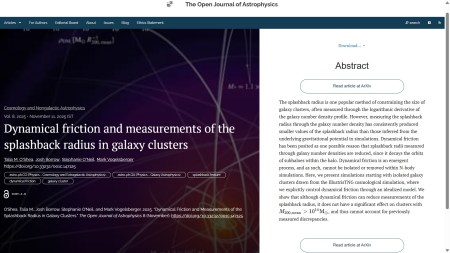
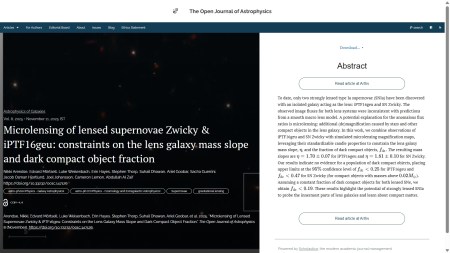
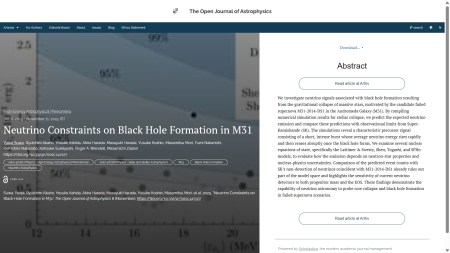
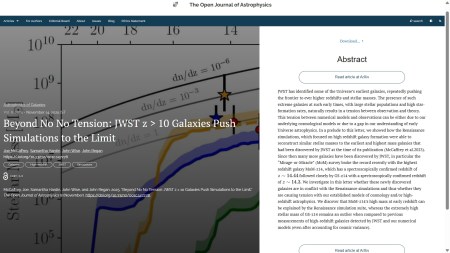
  4. The DECADE cosmic shear project IV: cosmological constraints from 107 million galaxies across 5,400 deg2 of the sky“, accepted version on arXiv here.

The fediverse announcements follow:

Open Journal of Astrophysics

New Publication at the Open Journal of Astrophysics: "The DECADE cosmic shear project I: A new weak lensing shape catalog of 107 million galaxies" by Dhayaa Anbajagane (University of Chicago, USA) et al. (54 authors)

doi.org/10.33232/001c.146158

October 22, 2025, 12:42 pm 2 boosts 0 favorites

Open Journal of Astrophysics

New Publication at the Open Journal of Astrophysics: "The DECADE cosmic shear project II: photometric redshift calibration of the source galaxy sample" by Dhayaa Anbajagane (University of Chicago, USA) et al. (53 authors)

doi.org/10.33232/001c.146159

October 22, 2025, 1:07 pm 2 boosts 0 favorites

Open Journal of Astrophysics

New Publication at the Open Journal of Astrophysics: "The DECADE cosmic shear project III: validation of analysis pipeline using spatially inhomogeneous data" by Dhayaa Anbajagane (University of Chicago, USA) et al. (53 authors)

doi.org/10.33232/001c.146160

October 22, 2025, 1:57 pm 1 boosts 0 favorites

Open Journal of Astrophysics

New Publication at the Open Journal of Astrophysics: "The DECADE cosmic shear project IV: cosmological constraints from 107 million galaxies across 5,400 deg^2 of the sky" by Dhayaa Anbajagane (University of Chicago, USA) et al. (75 authors)

doi.org/10.33232/001c.146161

October 22, 2025, 2:47 pm 1 boosts 0 favorites


The fifth and final paper for this week is “Clustering of DESI galaxies split by thermal Sunyaev-Zeldovich effect” by Michael Rashkovetskyi of the Harvard-Smithsonian Center for Astrophysics, or CfA for short, and 48 others. This one was published on Wednesday 23rd October in the folder Cosmology and NonGalactic Astrophysics. This paper explores how the clustering properties of galaxies mapped by the Dark energy Spectroscopic Instrument (DESI) relate to the local thermal Sunyaev-Zeldovich emission mapped by the Atacama Cosmology Telescope (ACT). The overlay is here:

The officially accepted version can be found on arXiv here, and the fediverse announcement is here:

Open Journal of Astrophysics

New Publication at the Open Journal of Astrophysics: "Clustering of DESI galaxies split by thermal Sunyaev-Zeldovich effect" by Michael Rashkovetskyi (Cfa Harvard-Smithsonian, USA) et al. (49 authors)

doi.org/10.33232/001c.146033

October 23, 2025, 8:28 am 1 boosts 0 favorites


That concludes the papers for this week. With one week to go and our total at 396, I still think we might reach the 400 total by the end of October.

Ireland in CERN!

Posted in Science Politics, The Universe and Stuff with tags , , , , , , , , on October 22, 2025 by telescoper
Photo by Pietro Battistoni on Pexels.com

I saw the news today that the Republic of Ireland is now officially an associate member state of the Conseil Européen pour la Recherche Nucléaire, better known as CERN. This has been in the pipeline for a while: I blogged about it here, for example. But today’s the day that Ireland formally joined.

I think this is a very good move for Irish physics, and indeed for Ireland generally. I will, however, repeat a worry that I have expressed previously. There is an important point about CERN membership, however, which I hope is not sidelined. The case for joining CERN made at political levels was largely about the return in terms of the potential in contracts to technology companies based in Ireland from instrumentation and other infrastructure investments. This was also the case for Ireland’s membership of the European Southern Observatory (ESO), which Ireland joined 7 years ago. The same thing is true for involvement in the European Space Agency, which Ireland joined in 1975. These benefits are of course real and valuable and it is entirely right that arguments should involve them.

Looking at CERN membership from a purely scientific point of view, however, the return to Ireland will be negligible unless there is a funding to support scientific exploitation of the facility. That would include funding for academic staff time, and for postgraduate and postdoctoral researchers to build up an active community as well as, e.g., computing facilities. This need not be expensive even relative to the modest cost of associate membership (approximately  €1.9M). I would estimate a figure of around half that would be needed to support CERN-based science. I am given to understand that some funds have been made available as part of the joining arrangements, but I don’t know the details.

As I have mentioned before, Ireland’s membership of ESO provides a cautionary tale. The Irish astronomical community was very happy about the decision to join ESO, but that decision was not accompanied by significant funding to exploit the telescopes. Few astronomers have therefore been able to benefit from ESO membership. While there are other benefits of course, the return to science has been extremely limited. The phrase “to spoil a ship for a ha’porth of tar” springs to mind.

Although Ireland joined ESA almost fifty years ago, the same issue applies there. ESA member countries pay into a mandatory science programme which includes, for example, Euclid. However, the Irish Government did not put any resources on the table to allow full participation in the Euclid Consortium. There is Irish involvement in other ESA projects (such as JWST) but this is somewhat piecemeal. There is no funding programme in Ireland dedicated to the scientific exploitation of ESA projects.

Under current arrangements the best bet in Ireland for funding for ESA, ESO or CERN exploitation is via the European Research Council, but to get a grant from that one has to compete with much better developed communities in those areas.

The recent merger of Science Foundation Ireland and the Irish Research Council to form a single entity called Research Ireland could provide an opportunity to correct this shortfall in funding for science exploitation. The reorganization won’t do anything on its own, however: the overall level of public sector research funding will have to increase dramatically from its current level, well below the OECD average. The recent Budget in Ireland for 2026 does include an allocation of €426 million for research under the National Development Plan, but how much of this will find its way into basic research generally and CERN science in particular?

On Cosmography (and going Mainstream)

Posted in Maynooth, The Universe and Stuff with tags , , , , on October 19, 2025 by telescoper

On Friday I attended a colloquium in the Physics Department at Maynooth University by Asta Heinesen of the Niels Bohr Institute in Copenhagen. The talk had the title of Cosmography of the local Universe, as shown on the first slide:

Asta talked about a very interesting programme of work that takes a different approach from most of modern cosmology in that it avoids making the prior assumption of global homogeneity and isotropy embodied by the Friedmann–Lemaître–Robertson–Walker metric. In particular, instead of assuming the isotropic expansion of the Universe, it tries to determine its properties directly using only such measurements as luminosity distances and redshifts. This method is not entirely model-independent because it does assume Lorentz invariance and the conditions required for the Etherington Reciprocity Theorem to hold, but it does not assume any particular form of the metric, so can be applied on scales where the distribution of matter is inhomogeneous and isotropic, e.g. in our local neighbourhood.

To apply this “metric-free” idea one has to construct as general as possible description of the kinematic properties of the underlying matter flow, allowing the global expansion to be anisotropic, and for there to be both rotation and shear. Obviously one would need a large number of measurements to extract anything like a full description of the matter flow, so generally one is restricted to deriving the low-order multipoles (monopole. dipole and quadrupole) as well as the observer’s velocity with respect to the large-scale matter flow.

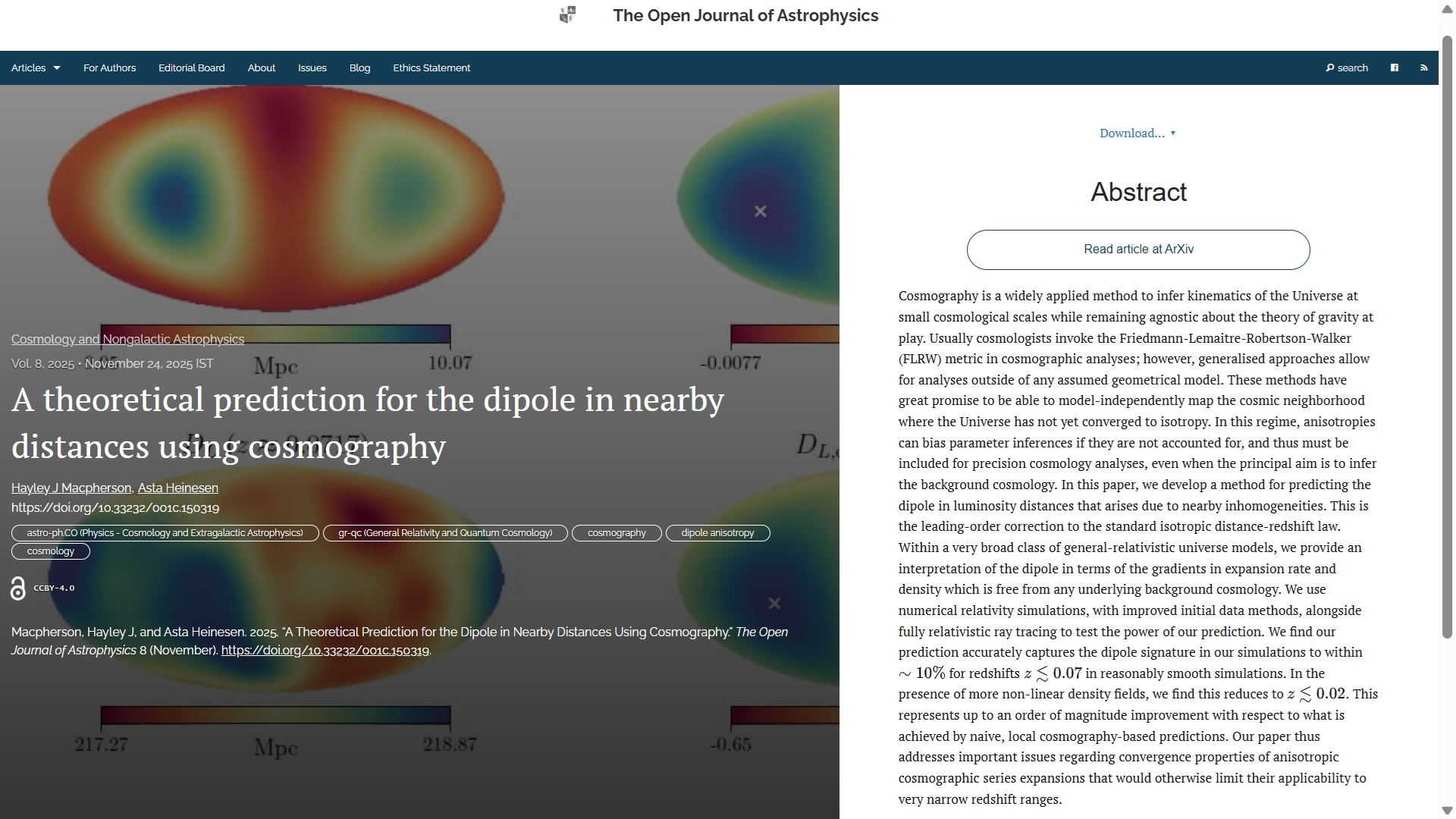
I found Asta Heinesen’s seminar very stimulating in itself, but it was also nice to see that one of the papers on which it was based is published in the Open Journal of Astrophysics:

When I checked it, I found it was published on my birthday! Here is the overlay:

I announced it on this blog here.

I freely admit that I feel quite proud to have played a small part in helping to get such interesting work published. I’m seeing more and more papers referenced like this, actually. I was reminded of the recent announcement of this year’s list of MacArthur Fellows. among them Kareem El-Badry who has published quite a few papers with the Open Journal of Astrophysics. His biography on the MacArthur Foundation page includes this:

He has published articles in Monthly Notices of the Royal Astronomical SocietyThe Astrophysical Journal, and The Open Journal of Astrophysics, among other leading scientific journals.

I’m pleased to see us listed with the established names. I mention this just in case there are still people out there who think it might damage their career if they publish with a non-mainstream journal. We are mainstream now…

Weekly Update from the Open Journal of Astrophysics – 18/10/2025

Posted in OJAp Papers, Open Access, The Universe and Stuff with tags , , , , , , , , , , , , , , , , , , , , on October 18, 2025 by telescoper

It’s time once again for the usual Saturday update of the week’s new papers at the Open Journal of Astrophysics. Since the last update we have published four  more papers, which brings the number in Volume 8 (2025) up to 156, and the total so far published by OJAp up to 391.

I’d like to encourage people to follow our feed on the Fediverse via Mastodon (where I announce papers as they are published, including the all-important DOI) so this week I’ll include links to each announcement there.

The first paper to report is “Shot noise in clustering power spectra” by Nicolas Tessore (University College London, UK) and Alex Hall (University of Edinburgh, UK). This was published in the folder Cosmology and NonGalactic Astrophysics on Tuesday October 14th 2025. This presents a discussion of the effects of ‘shot noise’, an additive contribution due to degenerate pairs of points, in angular galaxy clustering power spectra. Here is a screen grab of the overlay:

You can find the officially accepted version of the paper here. The Mastodon announcement is here:

Open Journal of Astrophysics

New Publication at the Open Journal of Astrophysics: "Shot noise in clustering power spectra" by Nicolas Tessore (University College London, UK) and Alex Hall (University of Edinburgh, UK)

doi.org/10.33232/001c.145919

October 14, 2025, 7:07 am 2 boosts 0 favorites

Next one up is “The Giant Arc – Filament or Figment?” by Till Sawala and Meri Teeriaho (University of Helsinki, Finland). This paper discusses the abundance of large arc-like structures formed in the standard cosmological model, with reference to the “Giant Arc” identified in MgII absorption systems. It was published on Wednesday October 15th in the folder Cosmology and NonGalactic Astrophysics. The overlay is here:

The officially accepted version of this paper can be found on the arXiv here and the Mastodon announcement is here:

Open Journal of Astrophysics

New Publication at the Open Journal of Astrophysics: "The Giant Arc – Filament or Figment?" by Till Sawala and Meri Teeriaho (University of Helsinki, Finland)

doi.org/10.33232/001c.145931

October 15, 2025, 6:33 am 2 boosts 3 favorites


The third paper this week,  published on Monday 6th October, is “Detecting wide binaries using machine learning algorithms” by Amoy Ashesh, Harsimran Kaur and Sandeep Aashish (Indian Institute of Technology, Patna, India). This was published on Friday 17th October (yesterday) in the folder Astrophysics of Galaxies. It presents a method for detecting wide binary systems in Gaia data using machine learning algorithms.
The overlay is here:


You can find the officially accepted version of this paper on arXiv here. The announcement on Mastodon is here:

Open Journal of Astrophysics

New Publication at the Open Journal of Astrophysics: "Detecting wide binaries using machine learning algorithms" by Amoy Ashesh, Harsimran Kaur and Sandeep Aashish (Indian Institute of Technology, Patna, India)

doi.org/10.33232/001c.146027

October 17, 2025, 6:55 am 0 boosts 0 favorites

The last one this week is “Learned harmonic mean estimation of the Bayesian evidence with normalizing flows” by Alicja Polanska & Matthew A. Price (University College London, UK), Davide Piras (Université de Genève, CH), Alessio Spurio Mancini (Royal Holloway, London, UK) and Jason D. McEwen (University College London). This one was also published on Friday 17th October, but in the folder Instrumentation and Methods for Astrophysics; it presents a new method for estimating Bayesian evidence for use in model comparison, illustrated with a cosmological example.

The corresponding overlay is here:


You can find the officially accepted version on arXiv here. The Mastodon announcement is here:

Open Journal of Astrophysics

New Publication at the Open Journal of Astrophysics: "Learned harmonic mean estimation of the Bayesian evidence with normalizing flows" by Alicja Polanska & Matthew A. Price (University College London, UK), Davide Piras (Université de Genève, CH), Alessio Spurio Mancini (Royal Holloway, London, UK) and Jason D. McEwen (University College London)

doi.org/10.33232/001c.146026

October 17, 2025, 7:06 am 0 boosts 0 favorites

That concludes the papers for this week. With two weeks to go I think we might reach the 400 total by the end of October.

Calling all Irish weather and climate enthusiasts! 

Posted in The Universe and Stuff with tags , , , , on October 16, 2025 by telescoper

Just a quick post to share an opportunity to get involved in a bit of Citizen Science. The inestimable Zooniverse has teamed up with Met Éireann, the Irish National Meteorological Service, in a project called Irish Weather Rescue. Your mission, should you choose to accept it, is to help digitize historical weather records that currently only exist on paper. Currently only a few percent of the available records have been digitised.

The project aims to provide access to valuable data that will improve our understanding of how rainfall patterns have changed over longer timescales and provide context for the changes we see in our current climate and possible future climate. Met Éireann’s archive contains an extensive collection of historical weather observations that include meteorological registers, rainfall registers, climatological reports, weather diaries, monthly weather bulletins and maps. These handwritten paper records are at risk of being lost due to the vulnerability of the original paper documents. By creating a digital copy of these records and extracting the data contained in them we can use the data to monitor climate variability and change, support effective climate risk management and improve climate model projections.

To read more about the project and/or volunteer, see here.

Weekly Update from the Open Journal of Astrophysics – 11/10/2025

Posted in OJAp Papers, Open Access, The Universe and Stuff with tags , , , , , , , , , , , , , , , , , , , , , on October 11, 2025 by telescoper

It’s time once again for the usual Saturday update of the week’s new papers at the Open Journal of Astrophysics. Since the last update we have published six  more papers, which brings the number in Volume 8 (2025) up to 152, and the total so far published by OJAp up to 387. Not only have we passed the 150 mark for the year, but this week saw another record for the Journal, in that it was the first week in which we published at least one paper on every day.

Anyway, here are this week’s papers:

The first paper is “Mapping the Nearest Ancient Sloshing Cold Front in the Sky with XMM-Newton” by Sheng-Chieh Lin (University of Kentucky) and 10 others based in the USA, Spain and Germany. This article, published on Monday 6th October 2025, in the section High-Energy Astrophysical Phenomena discusses cold fronts in the Virgo Cluster, their importance in shaping the thermal dynamics of the intracluster medium beyond the cluster core, and their implications for cluster cosmology.

The overlay is here:


The officially accepted version of this paper can be found on the arXiv here.

The second paper this week, also published on Monday 6th October, is “Testing gravitational physics by combining DESI DR1 and weak lensing datasets using the E_G estimator” by S.J. Rauhut (Swinburne University of Technology, Australia) and an international cast of 63 others. This one is in the folder Cosmology and NonGalactic Astrophysics, and it presents a comparison of  Baryon Acoustic Oscillation (BAO) measurements from BOSS, DESI with weak lensing from KiDS, DES and HSC showing that the results are altogether consistent with the standard cosmological model.

The overlay is here:

You can find the officially accepted version of this paper on arXiv here.

Next one up is “Analysis of Galaxies at the Extremes: Failed Galaxy Progenitors in the MAGNETICUM Simulations” by Jonah S. Gannon (Swinburne University, Australia), Lucas C. Kimmig (Ludwig-Maximilians-Universität, Germany; LMU), Duncan A. Forbes (Swinburne), Jean P. Brodie (Swinburne), Lucas M. Valenzuela (LMU), Rhea-Silvia Remus (LMU), Joel L. Pfeffer (Swinburne) and Klaus Dolag (LMU). This paper, published on Tuesday 7th October 2025, in the folder Astrophysics of Galaxies, discusses the business of identifying the possible high-redshift progenitors of low-redshift ultra-diffuse galaxies in cosmological simulations.

The corresponding overlay is here:

You can find the officially accepted version on arXiv here.

The fourth paper this week, published on Wednesday 8th October 2025 in the folder Astrophysics of Galaxies,  is
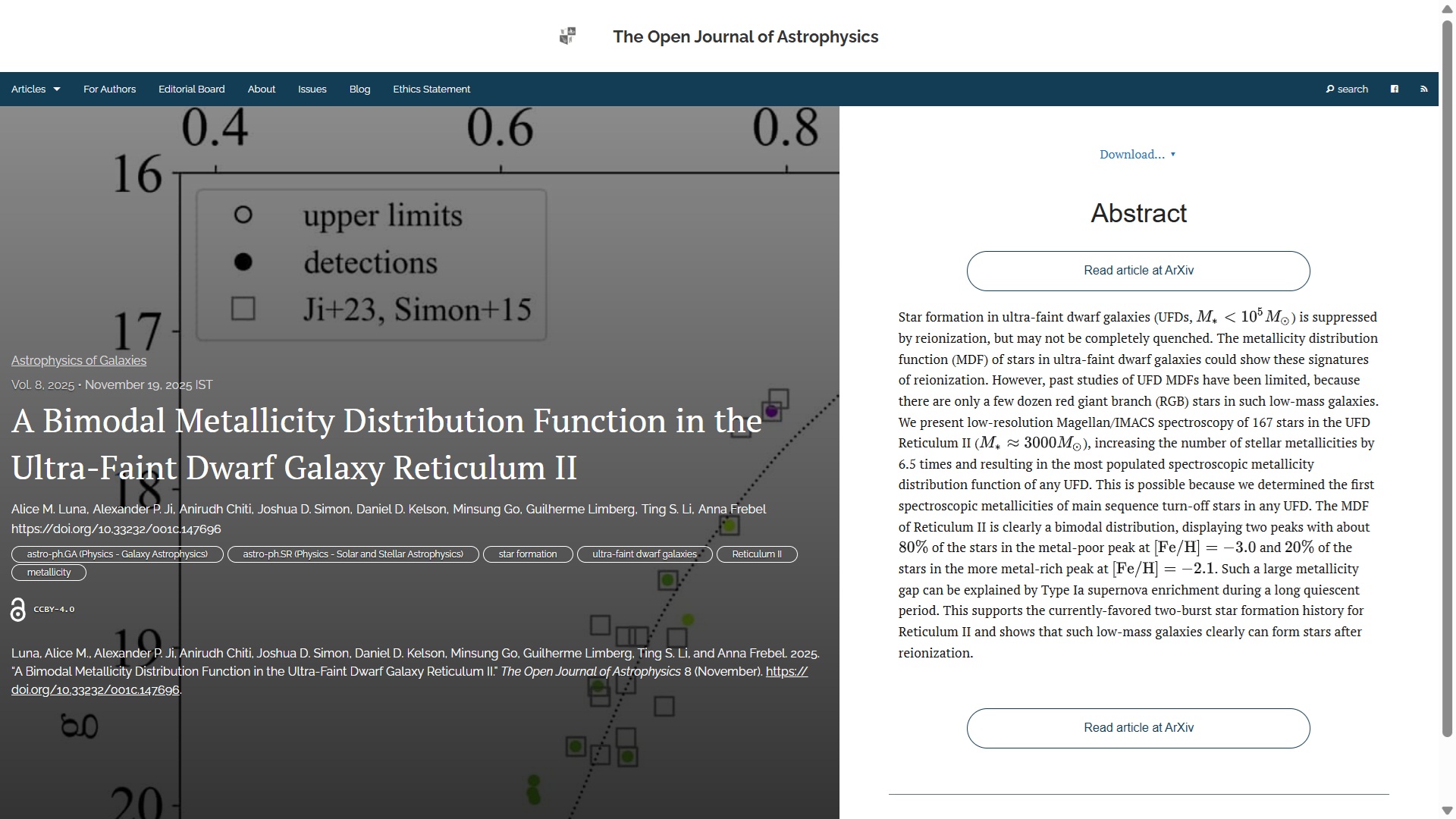
What Sets the Metallicity of Ultra-Faint Dwarfs?” by Vance Wheeler, Andrey Kravtsov, Anirudh Chiti & Harley Katz (U. Chicago) and Vadim A. Semenov (CfA Harvard), all based in the USA.

The overlay is here:

You can find the officially-accepted version on arXiv here.

Next, and fifth, we have our 150th publication of 2025, “Synthesizer: a Software Package for Synthetic Astronomical Observables” by Christopher C. Lovell (Cambridge, UK), William J. Roper, Aswin P. Vijayan & Stephen M. Wilkins (Sussex, UK), Sophie Newman (Portsmouth, UK) and Louise Seeyave (Sussex). This paper presents a suite of software tools for creating synthetic astrophysical observables for use in mock galaxy catalogues. It was published on Thursday 9th October 2025 in the folder Instrumentation and Methods for Astrophysics.

The overlay is here:

You can find the officially accepted version on arXiv here.

And finally for this week we have “Introducing the THESAN-ZOOM project: radiation-hydrodynamic simulations of high-redshift galaxies with a multi-phase interstellar medium” by Rahul Kannan (York University, Canada) and 13 others based in the USA, Germany, Japan, Italy and the UK. This one was published on Friday 10th October (i.e. yesterday) in the folder Astrophysics of Galaxies. It describes a comprehensive suite of high-resolution zoom-in simulations of high-redshift galaxies, encompassing a diverse range of halo masses, selected from the THESAN simulation volume.

The corresponding overlay is here:

You can find the officially accepted version of this one on arXiv here.

That concludes the papers for this week. I will, however, add a short postscript. This week saw the announcement of this year’s list of MacArthur Fellows. among them Kareem El-Badry who has published quite a few papers with the Open Journal of Astrophysics. His biography on the MacArthur Foundation page includes this:

He has published articles in Monthly Notices of the Royal Astronomical SocietyThe Astrophysical Journal, and The Open Journal of Astrophysics, among other leading scientific journals.

I’m pleased to see us listed with the established names. I mention this just in case there are still people out there who think it might damage their career if they publish with a non-mainstream journal. I guess we are mainstream now…

Caveman Physics

Posted in The Universe and Stuff with tags , , on October 9, 2025 by telescoper

A colleague sent me this, so I thought I’d share it:

Of course we can’t be sure whether there’s a singularity or not because of the presence of a horizon…

Everyone wants something better than ΛCDM

Posted in The Universe and Stuff with tags , , , , on October 8, 2025 by telescoper

There’s a nice short review article on arXiv today by Mike Turner. I wasn’t going to share it because it hasn’t got any pictures in it, but changed my mind.

Here is the abstract

The current cosmological paradigm, ΛCDM, is characterized (b) its expansive description of the history of the Universe, its deep connections to particle physics and the large amounts of data that support it. Nonetheless, ΛCDM’s critics argue that it has been falsified or must be discarded for various reasons. Critics and boosters alike do agree on one thing: it is the not the final cosmological theory and they are anxious to see it replaced by something better! I review the status of ΛCDM, provide my views of the path forward, and discuss the role that the “Hubble tension” might play.

arXiv:2510.05483

To make up for the lack of pictures in the article, here’s the first image that came up when I did a search for “ΛCDM”:

Nobel Prize for Physics Speculation

Posted in Biographical, Science Politics, The Universe and Stuff with tags , on October 6, 2025 by telescoper

Just to mention that tomorrow (Tuesday, October 7th 2025) will see the announcement of this year’s Nobel Prize for Physics. I must remember to make sure my mobile phone is fully charged so I can be easily reached, although I am likely to be lecturing when the announcement is made.

The announcement of the Nobel Prize for Physics on Tuesday is preceded today (Monday 6th) by the announcement of the Prize for Applications of Physics to Physiology or Medicine, and followed on Wednesday by the Prize for Applications of Physics to Chemistry. You can find links to all the announcements here.

I do, of course, already have a Nobel Prize Medal of my own already, dating from 2006, when I was lucky enough to attend the prize-giving ceremony and banquet.

I was, however, a guest of the Nobel Foundation rather than a prizewinner, so my medal is made of chocolate rather than gold. I think after 19 years the chocolate is now inedible, but it serves as a souvenir of a very nice weekend in Stockholm! Sadly one of the Laureates whose award we were celebrating passed away recently.

Regular readers of this blog may recall that I called it correctly in 2022 when Alain Aspect, John F. Clauser and Anton Zeilinger won the Nobel Prize for Physics that year. I had, however, predicted them every year for many years until they won, and they won’t win it again.

I drew a blank in 2023 when attosecond light pulses were the topic and was completely wrongfooted last when the 2024 Nobel Prize for Physics was awarded to John J. Hopfield and Geoffrey E. Hinton “for foundational discoveries and inventions that enable machine learning with artificial neural networks”. I didn’t see that one coming at all.

I really have no idea who will win it this year, but I’ll suggest that there’s still an outside chance for Michael Berry and Yakir Aharonov for their work on the geometric phase, although if they were going to win they probably would have done so by now.

To find out who the lucky winners you’ll have to wait for the announcement, around about 10.45 (UK/Irish time) on Tuesday morning. I’ll update this post when the wavefunction has collapsed.

Feel free to make your predictions through the comments box below!

Update: I’m not often right but I was wrong again: the 2025 Nobel Prize for Physics goes to John Clarke, Michel H. Devoret and John M. Martinis “for the discovery of macroscopic quantum mechanical tunnelling and energy quantisation in an electric circuit”…

https://www.nobelprize.org/prizes/physics/2025/press-release/

Introducing Science Explorer (SciX)

Posted in The Universe and Stuff with tags , , , , on October 5, 2025 by telescoper

I received an email about this over a week ago from Alberto Accomazzi (Director and Principal Investigator of the NASA Astrophysics Data System) and was going to post about it then but I was quite busy and it slipped my mind. I met Alberto at ENAM earlier this summer and he told me then this was in the pipeline so I should have remembered. Anyway, better late than never…

The email was to announce the formal launch of Science Explorer (SciX for short) on Monday 29th September 2025. SciX is meant to build on the excellence of ADS and expanding its coverage to accelerate astro-related research even further.

Here’s a screenshot of the home page set up in such a way as to take you, if you click on it, by a miracle of the internet, and at no extra charge, to the actual home page:

Feel free to go and check it out!

Here is some text from the email I mentioned:

So, what is the Science Explorer platform, or SciX? Think of it as your one-stop platform for exploring research across Earth, environmental and space sciences, including planetary science, heliophysics, geology, geophysics, atmospheric sciences and oceanography. From tracking solar storms, to uncovering the secrets of distant planets, to understanding the changing dynamics of our own Earth, SciX is designed to be your research co-pilot. You can find out more at scixplorer.org.

The people behind SciX would also love to know how NASA/ADS has supported your work so far and how SciX’s additional features will benefit the community. Your testimonial can be brief, in written or video form, and can be submitted via this form, or by email if easier. It is important to show your support in view of the challenges facing NASA these days. I think we tend to take services such as NASA/ADS for granted, but we’d all find our work much harder without them, so do please send a message of support.

P.S. You can find SciX on social media with the handle @SciXCommunity. Please give them a follow!