Archive for the The Universe and Stuff Category

Astrophysics & Cosmology Masterclass at Maynooth

Posted in Education, Maynooth, The Universe and Stuff with tags , , on February 23, 2021 by telescoper

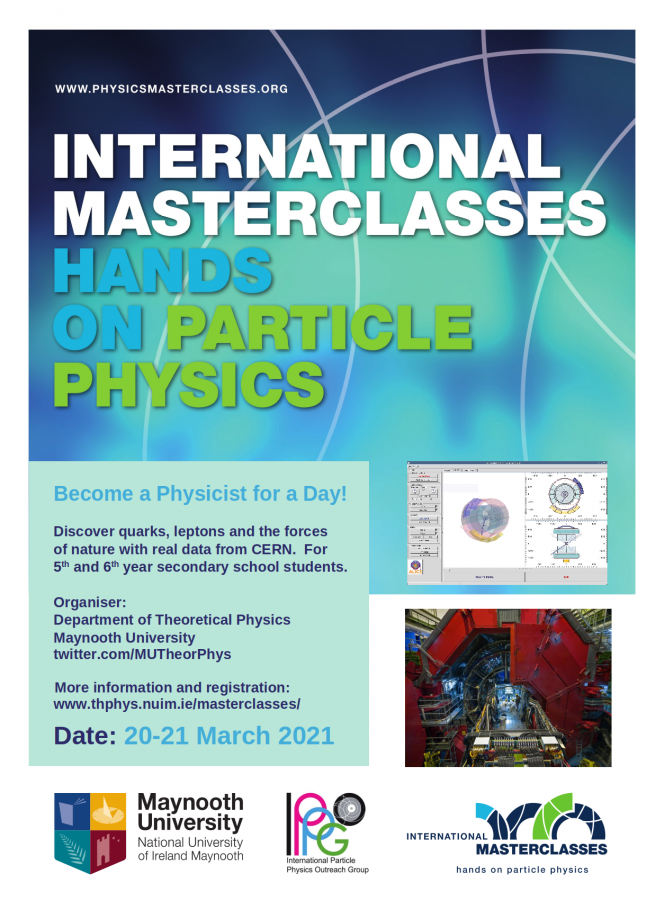
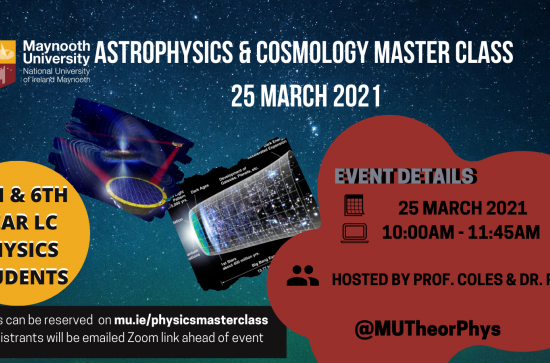
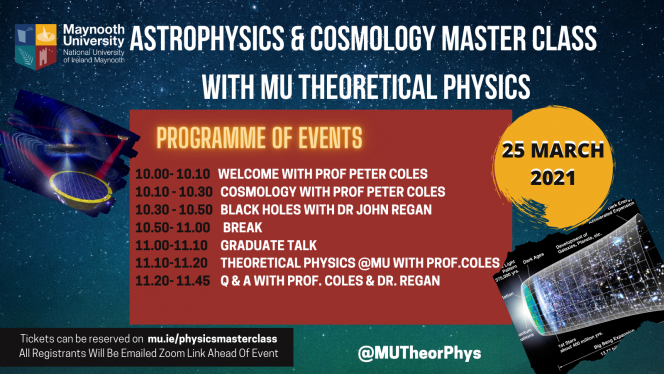
Regular readers of the blog – both of them – may remember that we planned to present a Masterclass in Astrophysics & Cosmology on January 14th 2021 but this had to be postponed due to Covid-19 restrictions. After today’s announcements by the Government of  a phased return to school starting on March 1st we have now decided to proceed with a new date of March 25th 2021.

This will be a half-day virtual event via Zoom. It’s meant for school students in their 5th or 6th year of the Irish system, who should be returning to classrooms on March 15th, but there might be a few of them or their teachers who see this blog so I thought I’d share the news here. You can find more information, including instructions on how to book a place, here.

Here is the updated official poster and the programme:

I’ll be talking about cosmology early on, while John Regan will talk about black holes. After the coffee break one of our PhD students will talk about why they wanted to study astrophysics. Then I’ll say something about our degree programmes for those students who might be interested in studying astrophysics and/or cosmology as part of a science course. We’ll finish with questions either about the science or the study!

What is Quantum Technology? – A Public Lecture by Prof. Sir Peter Knight

Posted in Maynooth, The Universe and Stuff with tags , , , , on February 23, 2021 by telescoper

On Thursday March 11th (at 7pm) the Maynooth University Faculty of Science and Engineering will present its first ever Dean’s Lecture. This is a public event, consisting of a talk followed by a Q&A session.

The topic of the talk is quantum technology and it is presented by Prof. Sir Peter Knight who is Senior Research Investigator at Imperial College London. He retired in 2010 as Deputy Rector (Research) at Imperial. He was knighted in 2005 for his work in optical physics. Knight was the 2004 President of the Optical Society of America and 2011-2013 President of the Institute of Physics. He is Editor of Contemporary Physics, Chair of the UK National Quantum Technology Programme Strategy Advisory Board, chairs the Quantum Metrology Institute at the National Physical Laboratory, was until 2010 chair of the UK Defence Scientific Advisory Council and remains a UK Government science advisor. His research centres on quantum optics and quantum technology. He has won the Thomas Young Medal and the Glazebrook Medal of the Institute of Physics, the Ives Medal and the Walther Medal and Prize of the OSA, the Royal Medal of the Royal Society and the Faraday Prize of the IET.

Here is a description of the talk:

We already live in a quantum-enabled world with devices powered by quantum mechanics affecting our everyday world (lasers, telecoms semiconductor chips, and much more). But we are now poised to exploit a hitherto largely unexplored technology capability enabled by some of the stranger aspects of quantum physics: quantum coherence and entanglement. These new capabilities include novel sensing, timing, imaging, and of course computing. I will describe these new quantum coherence capabilities and plans to develop the next generation of quantum technologies. Quantum Information Science is advancing our understanding of the physical world in remarkable ways. But it is also driving novel and disruptive technologies. I will describe plans for ensuring the advanced quantum science and demonstrator platforms in imaging, sensing, communications, and computing developed over the past five years or so will drive the formation of the quantum technology sector and embed quantum technology in a broad range of industries.

The event is free but you will need to register here.

R.I.P. Roger Griffin (1935-2021)

Posted in Film, History, The Universe and Stuff with tags , , , on February 19, 2021 by telescoper

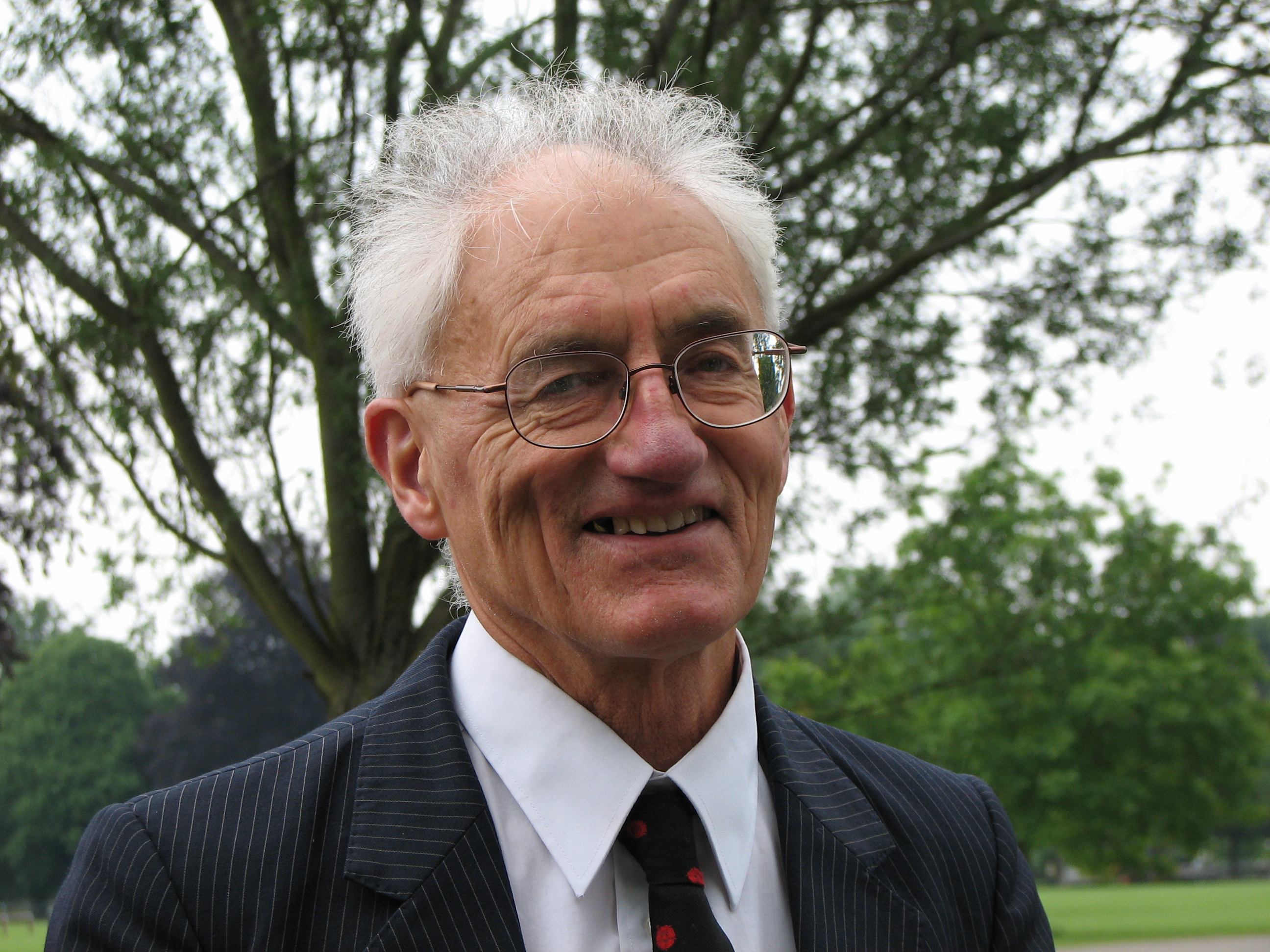
Roger Griffin (picture credit: St John’s College, Cambridge)

Earlier today I heard the sad news of the death at the age of 85 of astronomer Roger Griffin. He passed away on 12th February 2021.

Roger Griffin worked at Cambridge for over six decades, except for one year when he had a post-doctorate position at the Mount Wilson and Palomar Observatories, of the Carnegie Institution of Washington. He was the Assistant Director of Research in Astronomy at the University of Cambridge for nine years before he was promoted to a Readership of Observational Astronomy and later a Professorship. He appeared in the film Starmen alongside Donald Lyndon-Bell, Wal Sargent and Neville “Nick” Woolf.

Roger Griffin worked on astronomical spectroscopy and his main scientific claim to fame was that he invented a method of measuring radial velocities of stars in binary systems described in this classic paper published in 1967:

Over the subsequent years he published many radial velocity curves thus obtained in a long series of papers in the Observatory Magazine and the same method was subsequently used for measuring orbits of black holes and detecting extrasolar planets.

Despite the Cambridge connection I never met Roger Griffin personally but people who did talk about him with great affection and he will be greatly missed.

Rest in peace, Roger Griffin (1935-2021)

Cosmology Talks: Alvaro Pozo on Potential Evidence for Wave Dark Matter

Posted in The Universe and Stuff with tags , , , , , , , , , on February 19, 2021 by telescoper

It’s time I shared another one of those interesting cosmology talks on the Youtube channel curated by Shaun Hotchkiss. This channel features technical talks rather than popular expositions so it won’t be everyone’s cup of tea but for those seriously interested in cosmology at a research level they should prove interesting. This is quite a recent one, from about a week ago.

In the talk, Alvaro Pozo tells us about a recent paper where he an collaborators detect the transition between a core (flat density profile) and halo (power law density profile) in dwarf galaxies. The full core + halo profile matches very closely what is expected in simulations of wave dark matter (sometimes called “fuzzy” dark matter), by which is meant dark matter consisting of a particle so light that its de Broglie wavelength is long enough to be astrophysically relevant. That is, there is a very flat core, which then drops off suddenly and then flattens off to a decaying power-law profile. The core matches the soliton expected in wave dark matter and the halo matches an outer NFW profile expected outside the soliton. They also detect evidence for tidal stripping of the matter in the galaxies. The galaxies closer to the centre of the Milky Way have their transition point between core and halo happen at smaller densities (despite the core density itself not being systematically smaller). The transition also appears to happen closer to the centre of the galaxy, which matches simulations. Of course the core+halo pattern they have clearly observed might be due to something else, but the match between wave dark matter simulations and observations is impressive. An important  caveat is that the mass for the dark matter that they use is very small and in significant tension with Lyman Alpha constraints for wave-like dark matter. This might indicate that the source of this universal core+halo pattern they’re observing comes from something else, or it might indicate that the wave dark matter is more complicated than represented in the simplest models.

P. S. The papers that accompany this talk can be found here.

P.P.S. If you’re interested in wave dark matter there is a nice recent review article by Lam Hui here.

New Publication at the Open Journal of Astrophysics

Posted in OJAp Papers, Open Access, The Universe and Stuff with tags , , , , , on February 18, 2021 by telescoper

Time to announce another publication in the Open Journal of Astrophysics. This one was published yesterday, actually, but I didn’t get time to post about it until just now. It is the second paper in Volume 4 (2021).

The latest publication is entitled Characterizing the Sample Selection for Supernova Cosmology and is written by Alex G. Kim on behalf of the LSST Dark Energy Science Collaboration.  It’s nice to be getting papers from large collaborations like this!

Here is a screen grab of the overlay which includes the abstract:

You can click on the image to make it larger should you wish to do so. You can find the arXiv version of the paper here. This is one for the Cosmology and Nongalactic Astrophysics folder.

Birth of a Galaxy – Max Ernst

Posted in Art, The Universe and Stuff with tags , , on February 17, 2021 by telescoper

by Max Ernst (1891-1976), painted in 1969, 92 x 73 cm, oil on canvas.

Zel’dovich Pancake Day!

Posted in The Universe and Stuff with tags , , , on February 16, 2021 by telescoper

Today it’s Shrove Tuesday but unfortunately I forgot to buy shroves yesterday so will have to make do with pancakes instead, but not the usual kind. I’ve blogged before about the Zel’dovich Approximation (published in Zeldovich, Ya.B. 1970, A&A, 5, 84) but there’s no harm in describing this classic again. Here’s the first page of the original paper:

zeld

In a nutshell, this daringly simple approximation considers the evolution of particles in an expanding Universe from an early near-uniform state into the non-linear regime as a sort of ballistic, or kinematic, process. Imagine the matter particles are initial placed on a uniform grid, where they are labelled by Lagrangian coordinates vec{q}. Their (Eulerian) positions at some later time t are taken to be

vec{r}(vec(q),t) = a(t) vec{x}(vec{q},t) = a(t) left[ vec{q} + b(t) vec{s}(vec{q},t) right].

Here the vec{x} coordinates are comoving, i.e. scaled with the expansion of the Universe using the scale factor a(t). The displacement vec{s}(vec{q},t) between initial and final positions in comoving coordinates is taken to have the form

vec{s}(vec{q},t)= vec{nabla} Phi_0 (vec{q})

where Phi_0 is a kind of velocity potential (which is also in linear Newtonian theory proportional to the gravitational potential).If we’ve got the theory right then the gravitational potential field defined over the initial positions is a Gaussian random field. The function b(t) is the growing mode of density perturbations in the linear theory of gravitational instability.

This all means that the particles just get a small initial kick from the uniform Lagrangian grid and their subsequent motion carries on in the same direction. The approximation predicts the formation of caustics in the final density field when particles from two or more different initial locations arrive at the same final location, a condition known as shell-crossing. The caustics are identified with the main elements we find in large-scale structure. Because the initial collapse is usually along one direction the dominant structures are known as pancakes (or, as Zel’dovich himself might have called them, blini…).

Here’s a picture of a simulation showing these structures from the classic paper of Davis, Efstathiou, Frenk & White (1985):

Despite its simplicity this approximation is known to perform extremely well at reproducing the morphology of the cosmic web, although it breaks down after shell-crossing has occurred. In reality, bound structures are formed whereas the Zel’dovich approximation simply predicts that particles sail straight through the caustic which consequently evaporates.

Do you believe there is intelligent life out there?

Posted in Astrohype, The Universe and Stuff with tags , , on February 15, 2021 by telescoper

Following on from yesterday’s post and inspired by this tweet

I thought I’d try a quick poll on what people think about the existent of intelligent life “out there”. In my experience, and in contrast to the tweet, most astronomers are actually quite open-minded about the possibility of extraterrestrial intelligence. My own view is that while it is entirely possible that there is intelligent life elsewhere in the Universe, scientific belief* should be based on evidence and we simply don’t have any evidence to support the idea. I would therefore say that I don’t “believe” but am agnostic. Sometimes “I don’t know” is the only rational answer.

You might ask me as a cosmologist whether I believe in the Big Bang theory. My answer would be “yes” because I think the evidence supports this description of the Universe. If evidence came along to change my opinion I might believe in it less or not at all. I might also change my mind if a different model came along that fits the observations better.

*In a Bayesian sense I would interpret “refusing to believe” as meaning setting a prior probability of zero, so that no amount of evidence would produce a non-zero posterior probability.

Anyway, setting aside the issue of whether there is even any evidence of intelligent life on Earth here is a poll:

How not to behave in a Zoom discussion…

Posted in The Universe and Stuff with tags , , , on February 14, 2021 by telescoper

A couple of days ago, on February 12th, there was a ‘Golden webinar in Astrophysics’ one of a series that seeks to bring forefront research in astronomy, astrophysics, and cosmology to the public in the English and Spanish languages. The speaker this time was Avi Loeb and the full title of his talk was  Extraterrestrial Life: Are We the Sharpest Cookies in the Jar? A video of the entire event can be viewed here.

Avi Loeb is a very distinguished theoretical physicist, with broad interests in the fields of astrophysics and cosmology who has done excellent rather mainstream work on the formation and evolution of black holes, the first generation of stars in the universe and the epoch of reionization, as well as high-redshift gamma-ray bursts. He has also produced a large number of much more speculative articles in areas such as extra-terrestrial life (including SETI) some of which, in my opinion, is rather flaky. Loeb was a long-serving Chair of the Department of Astronomy at Harvard University and is the current Director of the Institute for Theory and Computation there.

The following is a short excerpt from the panel discussion following his talk. I was surprised to Avi Loeb adopt such a dismissive and confrontational attitude towards Jill Tarter (who has worked in the field of SETI for over 40 years). I’m also surprised that there was no intervention by the moderator of the discussion.

Many members of the astrophysics community have worked very hard to ensure that conference talks, seminars and panel discussions (whether in person or virtual) are conducted in a collegiate and cooperative manner. I don’t think Loeb is setting a good example in this clip, especially for someone who is an experienced former Department Chair. We all have strong feelings about certain things, but there’s no need to adopt such an aggressive tone. No wonder so many people find academia a toxic environment.

Faraday Rotation in the Milky Way

Posted in Biographical, The Universe and Stuff with tags , , , , , , on February 13, 2021 by telescoper

Yesterday I came across a very interesting paper on the arXiv by Sebastian Hutschenreuter et al. entitled The Galactic Faraday rotation sky 2020 which contains this stunning map of Faraday Rotation across the sky (presented in Galactic coordinates, so the plane of the Milky Way appears across the middle of the map):

The abstract of the paper is here:

If you’ll pardon a short trip down memory lane, this reminds me of a little paper I did back in 2005 with a former PhD student of mine, Patrick Dineen (which is cited in the  Hutschenreuter et al. paper).

What we had back in 2005 was a collection of  Faraday Rotation measurements of extragalactic radio sources dotted around the sky. Their distribution is fairly uniform but I hasten to add that it was not a controlled sample so it would be not possible to take the sources as representative of anything for statistical purposes and there weren’t so many of them: we had three samples, with 540, 644 and 744 sources respectively.

Faraday rotation occurs because left and right-handed polarizations of electromagnetic radiation travel at different speeds along a magnetic field line. The effect of this is for the polarization vector to be rotated as light waves travel and the net rotation angle (which can be either positive or negative) is related to the line integral of the component of the magnetic field along the line of sight travelled by the waves. The picture below shows the distribution of sources, plotted in Galactic coordinates and coded black for negative and white for positive.

rotation

Some radio galaxies have enormously large Faraday rotation measures because light reaches us through regions of the source that have strong magnetic fields. However, for most sources in our sample the rotation measures are smaller and are thought to be determined largely by the propagation of light not through the emitting galaxy, near the start of its journey towards us, but through our own Galaxy, the Milky Way, which is near the end of its path.

If this is true then the distribution of rotation measures across the sky should contain information about the magnetic field distribution inside our own Galaxy. Looking at the above picture doesn’t give much of a hint of what this structure might be, however.

What Patrick and I decided to do was to try to make a map of the rotation measure distribution across the sky based only on the information given at the positions where we had radio sources. This is like looking at the sky through a mask full of little holes at the source positions. Using a nifty (but actually rather simple) trick of decomposing into spherical harmonics and transforming to a new set of functions that are orthogonal on the masked sky we obtained maps of the Faraday sky for the different samples. Here is one:

uni_16_rmjoint

(The technical details are in the paper, if you’re interested.) You probably think it looks a bit ropey but, as far as I’m concerned, this turned out surprisingly well!

The most obvious features are a big blue blob to the left and a big red blob to the right, both in the Galactic plane. What you’re seeing in those regions is almost certainly the local spur (sometimes called the Orion Spur; see below), which is a small piece of spiral arm in which the local Galactic magnetic field is confined. The blobs show the field coming towards the observer on one side and receding on the other. The structure seen is relatively local, i.e. within a kiloparsec or so of the observer.

I was very pleased to see this come out so clearly from an apparently unpromising data set, although we had to confine ourselves to large-scale features because of instabilities in the reconstruction of high-frequency components.

Now, 15 years later we have the beautiful map produced by Hutschenreuter et al.


You’ll see the vastly bigger data set (almost a hundred times as many sources) and way more sophisticated analysis technique has produced much higher resolution and consequently more detail, especially near the Galactic plane, but we did at least do a fairly good job at capturing the large-scale distribution: the blue on the left and red on the right is clearly present in the new map.

There’s something very heartening about seeing scientific progress in action! This also illustrates how much astrophysics has changed over the last 15 years: from hundreds of data points to more than 50,000 and from two authors to 30!