Archive for the The Universe and Stuff Category

Wolfram Alpha and the Principle of Astrogeometry

Posted in The Universe and Stuff on July 4, 2019 by telescoper

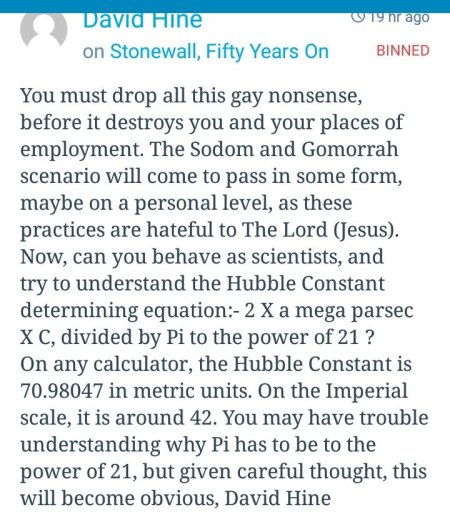
Regular readers of this blog (both of them) may remember the basically tedious and offensive but occasionally (accidentally) hilarious troll who keeps attempting to post comments like this:

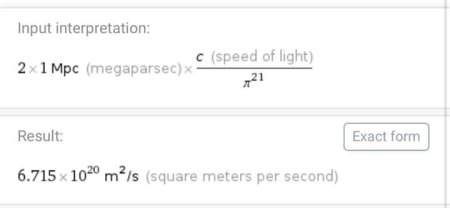
I thought you might like to see the result of feeding the expression found in the above rant into Wolfram Alpha:

This is exactly the expression described above but produces nothing like the claimed value of the Hubble constant, and it’s in the wrong units too.

Update for the benefit of the extremely hard of thinking (especially Mr Hine):

π21 ≈ 2.75 × 10¹⁰ (dimensionless).

One parsec = 3.086 ×10¹⁶ m so one Megaparsec is 3.086 ×10²² m. Hence 2 × `a Mpc’ × c ≈ 2 × 3.086 ×1022 m × 3 × 108 m s-1 ≈ 1.83 × 1031 m2 s-1.

Thus the full expression is obtained by dividing this by the value for π21 obtained above giving a value approximately 6.7× 1020 m2 s-1 as demonstrated by Wolfram Alpha.

The correct value for the Hubble constant is about 2.2 × 10⁻¹⁸ s−1.


UPDATE: It’s interesting how the Megaparsec appears in the numerator in Mr Hine’s expression, but magically transfers to the denominator as far as the units are concerned:

ANOTHER UPDATE:

I think I may have cracked it. I believe Mr Hine’s calculation involves using light-years instead of Mpc or SI (for some reason) the calculation is in which case the calculation becomes:

π21 ≈ 2.75 × 10¹⁰ (dimensionless) as before

One parsec = 3.26 light years so one Megaparsec is 3.26 ×10⁶ million light years. Hence 2 × `a Mpc’ × c ≈ 2 × 3.26 ×106 m × 3 × 105 m s-1, using c in km/s.

When divided by the value of π21 this gives a number around 71 (I couldn’t be bothered with the extra decimal places).

However, although it is a number around 71 the units are then km/s times light years, not the correct units which are km/s divided by Megapersecs. The fact that the number comes out close to 70 is just a numerical artefact of Mr Hine’s basic misunderstanding of units and dimensions. In other words, it’s gibberish. I know you’ll all be shocked by this revelation, but it’s true.

New Publication at the Open Journal of Astrophysics!

Posted in OJAp Papers, Open Access, The Universe and Stuff with tags , , , , , , on June 26, 2019 by telescoper

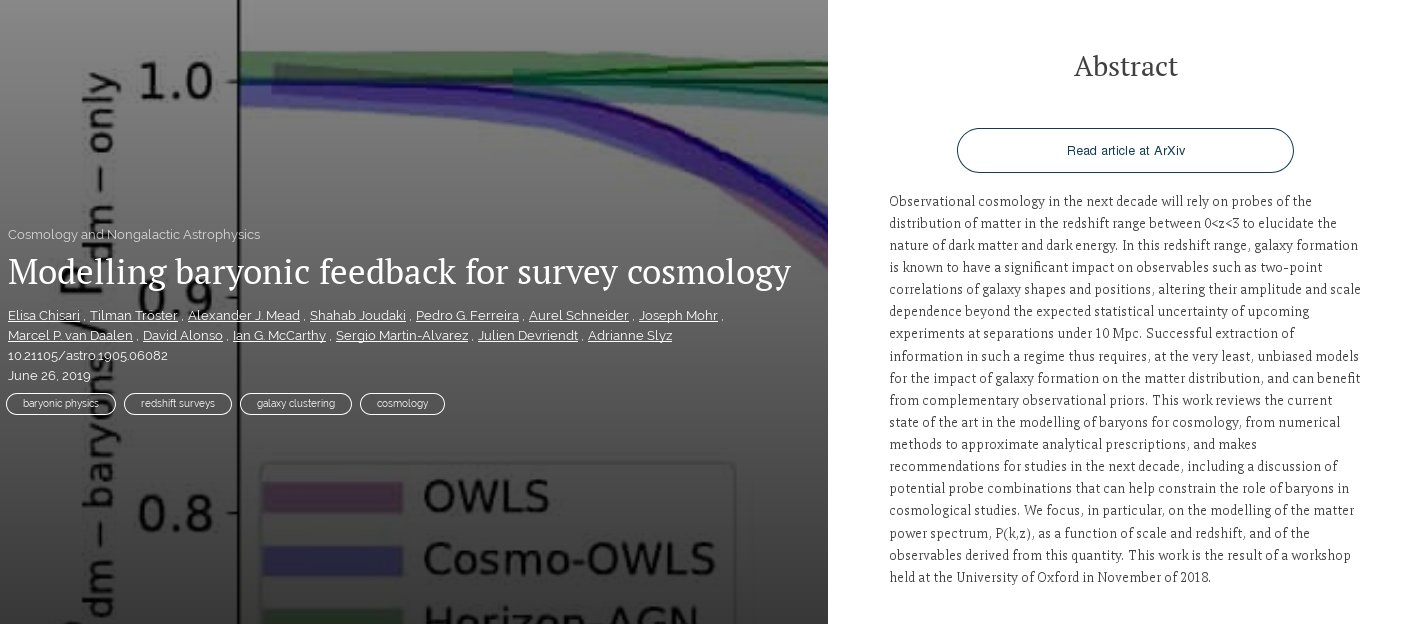
In a blog I posted just a couple of day ago I mentioned that there were a number of papers about to be published by the Open Journal of Astrophysics and, to show that I wasn’t making that up, the first of the latest batch has just appeared. Here is how it looks on the site!

There are thirteen authors altogether (from Oxford, Liverpool, Edinburgh, Leiden, British Columbia, Zurich and Munich); the lead other is Elisa

You can find the accepted version on the arXiv here. This version was accepted after modifications requested by the referee and editor.

This is another one for the `Cosmology and Nongalactic Astrophysics’ folder. We would be happy to get more submissions from other areas of astrophysics. Hint! Hint!

A few people have asked why the Open Journal of Astrophysics is not yet listed in the Directory of Open Access Journals. The answer to that is simple: to qualify for listing a journal must publish a minimum of five papers in a calendar year. Since OJA underwent a failure long hiatus after publishing its first batch of papers we haven’t yet qualified. However, this new one means that we have now published five papers so have reached the qualifying level.  I’ll put in the application as soon as I can, but will probably wait a little because we have a bunch of other papers coming out very soon to add to that number.

P.S. Please note that we now have an Open Journal of Astrophysics Facebook page where you can follow updates from the Journal should you wish..

More Vain Human Fake (Cosmology) Science

Posted in The Universe and Stuff with tags , on June 24, 2019 by telescoper

I haven’t mucked out my spam folder for a while and when I did so just now I found that a long-term irritant of mine, a certain Mr David Hine, had attempted to post another comment:

I have to admit that I’m not well up on the biblical references so I looked them up. Isaiah Chapter 40 Verse 22

He sits enthroned above the circle of the earth, and its people are like grasshoppers. He stretches out the heavens like a canopy, and spreads them out like a tent to live in.

I don’t see any mention of the Hubble constant, nor indeed any statement that the stretching of the heavens follows a linear relation (Hubble’s Law).

As for Psalm 2, in the New International Version, Verse 1 reads:

Why do the nations conspire
    and the peoples plot in vain?

I have only just now realized that the second part of this verse refers to the construction of graphs. Personally, I never plot in vain. I normally use python.

UPDATE: I have now received further information of the derivation of the Hubble constant straight from the horse’s arse mouth:


Unfortunately I am so lacking in mental equipment I can’t really understand this equation. It’s not even an equation actually because it doesn’t equate anything with anything.

Anyway, let’s look at the expression given in the above comment. A Megaparsec has the units of length. The speed of light has units of length/time, so  whatever the formula calculates has units of length2 time-1, which is dimensionally incorrect for the Hubble constant, which has units of time-1.

Moreover, if I put values for c, π, 21 and 2 into the equation I don’t even get anything like 70.98047:

π21 ≈ 2.75 × 10¹⁰ (dimensionless).

2 × `a Mpc’ × c ≈ 2 × 3.086 ×1022 m × 3 × 108 m s-1 ≈ 1.83 × 1031 m2 s-1.

Thus the full expression has a value approximately 6.66 × 1020 m2 s-1.

The correct value for the Hubble constant is about 2.2 × 10⁻¹⁸ s−1.

Completely wrong value and completely wrong dimensions. The first three figures of the answer may be significant however.

Here’s some reasoned criticism:


I’ve checked the above calculation and don’t see any mistakes. Perhaps I forgot to take away the number I first thought of…


Atmospheric Muons as an Imaging Tool

Posted in The Universe and Stuff with tags , , on June 19, 2019 by telescoper

The other day I came across an interesting paper with the above title on the arXiv. The abstract reads:

Imaging methods based on the absorption or scattering of atmospheric muons, collectively named under the neologism “muography”, exploit the abundant natural flux of muons produced from cosmic-ray interactions in the atmosphere. Recent years have seen a steep rise in the development of muography methods in a variety of innovative multidisciplinary approaches to study the interior of natural or man-made structures, establishing synergies between usually disconnected academic disciplines such as particle physics, geology, and archaeology. Muography also bears promise of immediate societal impact through geotechnical investigations, nuclear waste surveys, homeland security, and natural hazard monitoring. Our aim is to provide an introduction to this vibrant research area, starting from the physical principles at the basis of the methods and reviewing several recent developments in the application of muography methods to specific use cases, without any pretence of exhaustiveness. We then describe the main detector technologies and imaging methods, including their combination with conventional techniques from other disciplines, where appropriate. Finally, we discuss critically some outstanding issues that affect a broad variety of applications, and the current state of the art in addressing them.

This isn’t a new field, but it’s new to me and this paper provides a very nice introduction to it. I’ve taken the liberty of reproducing Figure 3 here to show one application of `muography’..


Euclid Updates

Posted in Euclid, The Universe and Stuff with tags , , , , on June 17, 2019 by telescoper

Following the Euclid Consortium Meeting in Helsinki a couple of weeks ago, here are a couple of updates.

First, here is the conference photograph so you can play Spot The Telescoper:

(The picture was taken from the roof of the Finlandia Hall, by the way, which accounts for the strange viewpoint.

The other update is that the European Space Agency has released a Press Release releasing information about the location on the sky of the planned Euclid Deep Fields. Here they are (marked in yellow):

These deep fields amount to only about 40 square degrees, a small fraction of the total sky coverage of Euclid (~15,000 square degrees), but the Euclid telescope will point at them multiple times in order to detect very faint distant galaxies at enormous look-back times to study galaxy evolution. It is expected that these fields will produce several hundred thousand galaxy images per square degree…

Selecting these fields was a difficult task because one has to avoid bright sources in both optical and infrared (such as stars and zodiacal emission) so as not to mess with Euclid’s very sensitive camera. Roberto Scaramella gave a talk at the Helsinki Meeting showing how hard it is to find fields that satisfy all the constraints. The problem is that there are just too many stars and other bits of rubbish in the sky getting in the way of the interesting stuff!


For much more detail see here.


A Ring of Controversy Around a Black Hole Photo

Posted in The Universe and Stuff on June 15, 2019 by telescoper

This is a long post but well worth reading if you want to know what we really know about the black hole in M87..

Matt Strassler's avatarOf Particular Significance

It’s been a couple of months since the `photo’ (a false-color image created to show the intensity of radio waves, not visible light) of the black hole at the center of the galaxy M87, taken by the Event Horizon Telescope (EHT) collaboration, was made public. Before it was shown, I wrote an introductory post explaining what the ‘photo’ is and isn’t. There I cautioned readers that I thought it might be difficult to interpret the image, and controversies about it might erupt.EHTDiscoveryM87

So far, the claim that the image shows the vicinity of M87’s black hole (which I’ll call `M87bh’ for short) has not been challenged, and I’m not expecting it to be. But what and where exactly is the material that is emitting the radio waves and thus creating the glow in the image? And what exactly determines the size of the dark region at…

View original post 6,013 more words

Dark Energy – Lectures by Varun Sahni

Posted in The Universe and Stuff with tags , , on June 9, 2019 by telescoper

I thought I’d share this lecture course about Dark Energy here. It was delivered by Varun Sahni at an international school on cosmology earlier this year. The material is quite technical in places but I’m sure these lectures will prove a very helpful introduction to, for example, new PhD students in this area. Varun has been a very good friend and colleague of mine for many years, and he is an excellent lecturer!

Here are the three lectures:

Equality, Diversity and Euclid

Posted in Euclid, The Universe and Stuff with tags , , on June 7, 2019 by telescoper

So here I am, back in my hotel, after the second pleasant wine and food reception of the week – this time hosted by the University of Helsinki. I have to leave early tomorrow morning to get back to Maynooth so I’m not among those going for dinner afterwards.

It’s been a very satisfying meeting, in terms of scientific content, organization and even the weather which has been warm and sunny throughout.

That said I feel obliged to mention one less than satisfactory episode which happened this afternoon. Euclid is a very large consortium working on a complex mission. That requires certain management structures to be put in place, including how to deal with the many scientific publications that will hopefully result from the Euclid mission to be as fair as possible to everyone working on the various projects as well as ensuring the scientific quality of resulting papers.

This afternoon a very distinguished senior member of the Euclid Consortium presented an overview of the publication policy on behalf of the Editorial Board which included this slide:

Not knowing all the names I didn’t think twice about the various panels until at the end of the talk a member of the audience pointed out that none of the individuals named are female.

I wasn’t alone in being surprised that such a situation had arisen, especially since Euclid has a Diversity Committee. But what made matters worse was the apparently dismissive response of the speaker, which caused a sharp intake of breath around the auditorium, and left many with the impression that the Consortium needs to look at whether unconscious or other bias might have been involved in the selection of these members. The impression given may have been inadvertent but appearances matter, and I know I’m not the only person who was troubled by what went on this afternoon. I sincerely hope the Diversity Committee looks into this issue as soon as possible.

UPDATE: 21st June 2019. I understand that this issue has been looked into in depth by the Euclid Consortium and active measures are being taken to improve the gender balance in future, which is a very positive outcome.

5th June 23.15 GMT

Posted in Literature, The Universe and Stuff with tags , , , on June 6, 2019 by telescoper


Blessent mon cœur
D’une langueur
Monotone.


(This excerpt from a poem by Paul Verlaine formed a coded message broadcast to the French resistance by Radio Londres, 5th June 1944 at 23.15 GMT informing them that the Allied invasion of France was imminent. Preceded by extensive airborne operations, the landings on the beaches of Normandy began on the morning of 6th June 1944.)


The Congress of Helsinki

Posted in Biographical, The Universe and Stuff with tags , , on June 5, 2019 by telescoper

After yesterday’s murky and rainy start, it’s lovely weather this morning in Helsinki as I get ready to leave my hotel for the conference venue. It took me a while yesterday to find the way in, but I succeeded in the end to find a promising opportunity through the rear entrance.

After close of play yesterday the conference participants adjourned to the City Hall (which is about a 30 minute walk from Finlandia Hall) for a reception hosted by the civic authorities which was nice.

There was time afterwards to have a drink in a bar overlooking the harbour too. Drinks are rather expensive here – as are most things, apparently – but Helsinki is definitely a very livable city, nice to walk around but also with very good public transport.

I’ve been here a couple of times before, though not recently. The last time I was here was just for a couple of days, on a Scandinavian funding panel, which was very hard work, so didn’t get the chance to see the City at all so it’s nice to be able to wander around a bit.

It’s light until very late and gets light again very early at this time of year in Helsinki, which gave me a bit of trouble sleeping the first night I was here but I slept well last night and managed not to wake up until 6am (local time).

Oh, and it was my birthday yesterday too.