Back to Teaching

Posted in Biographical, Education, Maynooth, The Universe and Stuff with tags , , , on February 4, 2025 by telescoper

After yesterday’s holiday it was back to teaching full-time this morning with the first lecture of my module on Particle Physics. I just about managed to get everything ready in time for the teaching session at 1pm which, because it was an introductory lecture with lots of pictures, I decided to do via powerpoint rather than my usual chalk-and-talk. That didn’t get off to a very good start because the podium PC in my room had decided to do a Windows update just before I started and I had to wait for that to finish before I could show my slides. I suppose that happened because this was the first day of teaching after a lengthy break so nobody had used the room recently.

Most of the lecture was devoted to introducing natural units, which I intend to use throughout the module, like I have on previous occasions I have taught this sort of material for reasons I explained here. The last time I taught particle physics was some 15 years ago, so I had to update some things, especially the picture of the components of the standard model to include the Higgs. After extensive research (by which I mean looking at wikipedia) I found the above; the Higgs is on the right. Unfortunately the particle masses – which reveal themselves if you click on the image above – are not given in natural units, but have pesky factors of c-squared in them. You can’t have everything.

The bit I’m looking forward to most is doing the Dirac Equation which, years ago when I was at Sussex, was once the subject of a cake:

That particular cake was a lemon drizzle cake which unfortunately is not one of the flavours represented in the standard model.

Who will stand up for LGBTQ+ Diversity?

Posted in Biographical, Euclid, LGBTQ+, Politics with tags , , , on February 3, 2025 by telescoper
Progress Pride flag

The only thing that has surprised me about Donald Trump’s assault on Diversity, Equity and Inclusion is the speed with which he has imposed his bigotry on individuals and federal institutions. The first step came within hours of the Felon-in-Chief assuming office with an Executive Order intended to dismantle crucial protections for transgender people and deny the validity of gender identity itself. The new order withdraws a range of executive orders issued by Joe Biden, including those allowing transgender people to serve in the military, advancing the health and well-being of lesbian, gay, bisexual, and transgender (LGBT) youth, and interpreting federal sex discrimination protections in domains like education, housing, and immigration to prohibit discrimination based on sexual orientation or gender identity. And this is just the start, and I don’t think it will be confined to the USA for very long.

The attack on LGBTQ+ rights is part of a wider assault on the Diversity, Equity and Inclusion policies intended to create a level playing field for women and minorities. The intention is to turn the Federal government into a system of oppression operated by people of Trump’s hate-filled mindset that diversity is a threat to white male privilege and must be crushed. He and his crony Elon Musk got where they are not by merit but through inherited wealth. It’s no surprise that they wish to deny others the chance to succeed.

I have addressed the question “why should we care about diversity?” many times on this blog in many contexts, though usually in science and usually in reference to LGBTQ+ rights. The obvious answer _ think – is based on notions of fairness: we should do everything we can to ensure that people have equal opportunity to advance their career in whatever direction appeals to them. But I’m painfully aware that there are some people for whom arguments based on fairness simply don’t wash. Trumpists, for example. For them there’s another argument that should work better. As scientists whose goal is – or should be – the advancement of knowledge, the message is that we should strive as hard as possible to recruit the brightest and most creative brains into our subject. That means ensuring that the pool from which we recruit is as large and as diverse as possible. In large and complex research collaborations, such as the Euclid Consortium (of which I am a member), the range of ideas and perspectives is a real asset when it comes to solving problems. The problem is that this argument doesn’t work either as they are driven purely by mean-spirited ideology and the desire to fill the institutions of state with those of a similar ilk.

The effects of the latest reactionary steps are already starting to show in the area of astronomy. The Diversity and LGBT+ channels on the Vera Rubin-LSST Slack (which is a Federal project, funded by the National Science Foundation and the Department of Energy) have already been deleted. A similar fate has befallen the Space Telescope Science Institute (funded by NASA). It seems to me unlikely that NASA itself will survive long as Musk will have his eyes on dismantling it and using its resources for his own vanity projects.

Over the past year I have given a few talks about my own career in research as an LGBTQ+ person; see for example here. In giving these talks I tried to strike a relatively positive tone, showing how LGBTQ+ rights have improved over the 40 years or so I’ve been involved in cosmological research since I started my graduate studies in 1985. I have, however, ended with a warning that the forces of reaction were gathering, and all the progress we have made could easily be put into reverse. That is exactly what is happening now in the USA.

The question in my mind is who will stand up for diversity? I can quote examples from my own life that prove that some individual institutions have never really taken LGBTQ+ bullying and discrimination seriously. Others may be genuinely supportive, but perhaps that is wishful thinking. It is notable how enthusiastically some US organizations have preemptivly cooperated with Trump’s edicts, even when paused through legal challenge. I grew up in the 1980s when the climate was filled with homophobic hate. It is naive to imagination that all that hate simply disappeared. We will find out very soon whether our self-styled “allies” have only ever been fair weather friends who will happily abandon us when we become politically inconvenient.

The Quickening of the Year Again

Posted in Biographical, History, Maynooth with tags , , , , , , , on February 3, 2025 by telescoper

Today would be the first day of teaching in Semester 2 at Maynooth University, were it not for the fact that it is a Bank Holiday in Ireland. The holiday marks Imbolc, an old Celtic festival occurring halfway between the winter solstice and vernal equinox in the Northern hemisphere. In the modern calendar the date is 1st February. In Ireland Imbolc is often referred to as a Lá Fhéile Bríde,  St Brigid’s Day, after St Brigid of Kildare, whose feast day is 1st February. In the old pagan calendar, this day is regarded as the first day of spring, as it is roughly the time when the first spring lambs are born, daffodils, etc, start to appear, and the days get noticeably longer. It corresponds to the Welsh Gŵyl Fair y Canhwyllau and is also sometimes called, rather beautifully, The Quickening of the Year. It’s a time for rebirth and renewal after the darkness of winter.

I noticed some scepticism on social media about 1st February being the first day of spring, but it makes sense to me. I feel the same way about May being the start of summer too. From living 7 years in Ireland, I’ve always found May/June the most summery months – as far as that means anything in Ireland!

In the Northern hemisphere, in astronomical terms, the solar year is defined by the two solstices (summer, around June 21st, and winter, around December 21st) and the equinoxes (spring, around March 21st, and Autumn, around September 21st). These four events divide the year into four roughly equal parts of about 13 weeks each. If you divide each of these intervals in two you divide the year into eight pieces of six and a bit weeks each. The dates midway between the astronomical events mentioned above are the cross-quarter days, of which Imbolc is one. Here they are represented on a diagram:

The timings are rough because the dates of the equinoxes and solstices vary from year to year. Imbolc is often taken to be the 2nd of February (Groundhog Day) and Samhain is sometimes taken to be October 31st, Halloween but hopefully you get the point that although the Pagan festivals have been appropriated by the Christian church, they have much older origins.

Until 2023 only three of the four cross-quarter days were associated with public holidays in Ireland; there wasn’t a holiday for Imbolc. In 2022 however, the Government decided to create a new Bank Holiday that corrected this anomaly by introducing a new St Brigid’s Day holiday on the first Monday on or after 1st February (or on Friday if 1st February falls on that day), which also happens to be the first national holiday in Ireland to be named after a woman. The first such holiday was Monday, 6th February 2023 and the second was on Monday 5th February 2024. This is the third.

But I digress.

I am glad to have today’s holiday just before teaching starts. Having completed my examination marking duties promptly I was planning to use last week to get my teaching materials ready. Unfortunately I wasn’t at all well for most of the week – though I recovered by Friday – and am way behind schedule. Fortunately, I’ve taught one of the modules (Computational Physics) many times before so not much preparation is required although it is a bigger class than I’ve had on previous occasions which means extra work in due course grading the CA components. The other module, Particle Physics is new for me at Maynooth, though I have taught it elsewhere. This also has a bigger class than I was expecting for a final-year module and my first lecture on it is tomorrow. I’m going to have to spend most of today quickening the writing of the lecture notes and preparing assignments.

P.S. Not particularly relevantly, Particle Physics is an anagram of Happier Cyclists.

The Celestial Stranger – Thomas Traherne

Posted in History, Music, Poetry with tags , , on February 2, 2025 by telescoper

I promised yesterday that I would post the poem that gives its title to the song cycle, The Celestial Stranger, which was performed at the National Concert Hall on Friday night, so here it is as it appeared in the programme:

It’s very interesting to see such thoughts expressed in the mid-17th Century!

Thomas Traherne is an interesting poet in many ways and the associated story of his poetical manuscripts is strange and fascinating. The son of  a cobbler, Traherne was a devoutly religious man who lived most of his short life (1637-1674) in relative obscurity as a clergyman and theologian. He was a prolific writer of both prose and poetry, but very little of his work was published during his lifetime. A vast number of handwritten manuscripts survived his death, however, and many of these remained in the safekeeping of a local family in his native Herefordshire. However, in 1888 the estate of this family was wound up, sold, and the manuscripts became dispersed. Eventually, in 1897, one set of papers was  accidentally discovered in a bookstall. Traherne’s first volume of verse was published in 1903 and a second collection followed in 1908.

When these poems finally found their way into the literary world they were greeted with astonishment as well as deep appreciation and they were widely  influential: T.S. Eliot was a great admirer of Traherne, as was Dorothy L Sayers. There are also truly wonderful musical settings of some of Traherne’s poetry made by a young Gerald Finzi in his cantata Dies Natalis.

Over the years further manuscripts  have also come to light – literally, in one case, because in 1967 another lost Traherne manuscript was found, on fire, in a  rubbish dump and rescued in the nick of time! As late as 1997 more works by Traherne were discovered among 4,000 manuscripts in the Library of Lambeth Palace, the London residence of the Archbishop of Canterbury. The Lambeth manuscripts, from which the above poem is taken, are mostly prose writings, actually, but there are many poems in there too.

Traherne is sometimes described as the last metaphysical poet. However, it seems to me he might equally be described as the first romantic poet. The themes he tackles – love of nature and loss of childhood innocence – and his visionary, rhapsodic style have as much in common with William Blake and, especially, William Wordsworth as they do with better known metaphysical poets such as John Donne.

Debussy, McNeff & Rachmaninov at the NCH

Posted in Uncategorized with tags , , , , , , , , on February 1, 2025 by telescoper

Last night was my first trip of the year to the National Concert Hall in Dublin. I had planned to go on 17th January but by the time I got around to buying a ticket it was sold out. Fortunately, it was broadcast live on the radio and is still available on the RTÉ Player. I had a ticket for last Friday’s concert but bottled out of going because of transport worries about Storm Éowyn. That concert went ahead, apparently, but wasn’t broadcast so I missed it. Last night was third time lucky, and I’m very glad I got there!

The conductor of the National Symphony Orchestra for last night’s performance was Columbian-born Lina González-Granados in what I believe to have been her first appearance with the NSO. I certainly hope she comes back as she was very good indeed. I think the members of the orchestra enjoyed themselves as much as the audience!

As you can see from the programme, the concert opened with a very familiar piece, Prélude à l’après-midi d’un faune by Claude Debussy, which was performed with all the shimmering sensuality it demands. Some very lush playing by the strings on this one, and lovely work by the woodwinds made it sound very fresh although I’ve heard it many times.

After that tenor Gavan Ring joined the orchestra to perform the Irish Premiere of The Celestial Stranger, a song cycle composed by Belfast born composer Stephen McNeff. This consists of settings of five poems, two by Thomas Traherne (including the one that gives its name to the collection, a remarkable work that I will post in its entirety later on). The next poem is by Walt Whitman and is titled As The Time Draws Nigh in the programme, but is not the well-known Whitman poem of that title but seems to have been adapted from various texts, including Years of the Modern. After that is a famous poem by Dylan Thomas, The hand that signed the paper and the cycle concludes with an adaptation of Farewell to Thee, written by Liliʻuokalani (former monarch of Hawaii). It’s a varied collection but there is a narrative behind the choice: a visitor from outerspace (the Celestial Stranger) arrives on Earth and reacts joyfully to begin with. As time goes on, however, he finds out more about war and and death and finally takes his leave.

The music is as varied as the choice of verse. I felt some influence of Britten in the first piece, but the rest is very different. Gavan Ring was in fine voice and the orchestra responded very well to the very different demands of this work compared to the first.

After the interval it was time for the main course of the evening, Rachmaninov’s Second Symphony. It’s a remarkable work because it’s not only a “proper” symphony in its construction and development but also the best part of an hour of one glorious melody after another. It’s a gorgeous work altogether, but the third movement (Adagio) is especially beautiful. I love the way Rachmaninov starts this movement one of his big romantic tunes, but then hides it while passages develop through a solo  clarinet and strings. You know the tune is coming back though, and when it does the emotional impact brought the audience to a collective swoon. This is romantic music in all senses of the word, just the ticket for a cole January evening. It was a very fine performance, not least because you could see how much both conductor and orchestra were enjoying themselves. Hats off to Lina González-Granados who had just the right balance of control and expressiveness. She look quite exhauasted at the end, actually. She had worked hard to earn her standing ovation.

Weekly Update from the Open Journal of Astrophysics – 01/02/2025

Posted in OJAp Papers, Open Access, The Universe and Stuff with tags , , , , , , , , , , , , , , , , , , on February 1, 2025 by telescoper

It’s Saturday morning, so once again it’s time for an update of papers published at the Open Journal of Astrophysics. There were no papers to report last week but since the last update we have published four new papers, which brings the number in Volume 8 (2025) up to 11 and the total so far published by OJAp up to 246.

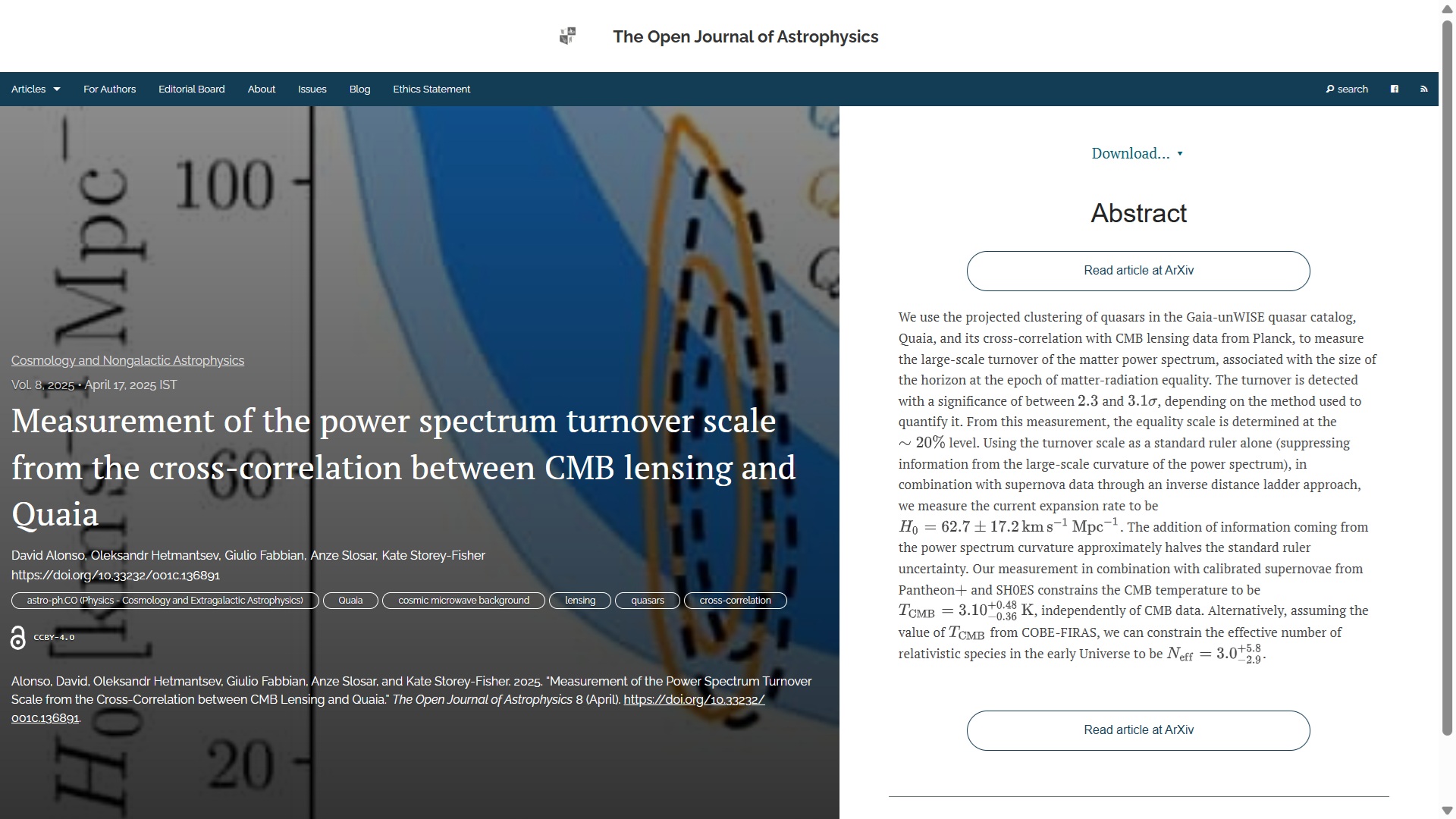
In chronological order of publication, the four papers published this week, with their overlays, are as follows. You can click on the images of the overlays to make them larger should you wish to do so.

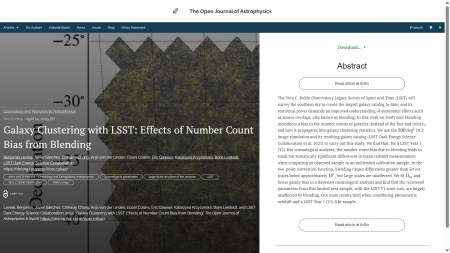
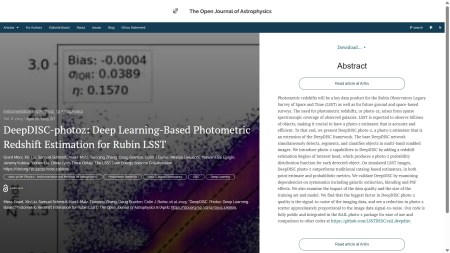
First one up is  “A halo model approach for mock catalogs of time-variable strong gravitational lenses” by Katsuya T. Abe & Masamune Oguri (Chiba U, Japan), Simon Birrer & Narayan Khadka (Stony Brook, USA), Philip J. Marshall (Stanford, USA), Cameron Lemon (Stockholm U., Sweden), Anupreeta More (IUCAA, India), and the LSST Dark Energy Science Collaboration. It was published on 27th January 2025 in the folder marked Cosmology and NonGalactic Astrophysics. The paper discusses how to generate mock catalogs of strongly lensed QSOs and Supernovae on galaxy-, group-, and cluster-scales based on a halo model that incorporates dark matter halos, galaxies, and subhalos.


You can find the officially accepted version of this paper on arXiv here.

This paper, also published on Monday 27th January 2025, but in the folder Astrophysics of Galaxies, is “The Soltan argument at redshift 6: UV-luminous quasars contribute less than 10% to early black hole mass growth” by Knud Jahnke (MPI Heidelberg, Germany). This paper presents an argument that almost all growth of supermassive black hole mass at z>6 does not take place in UV-luminous quasars.

Here is a screen grab of the overlay, which includes the abstract:You can find the officially accepted version of the paper on the arXiv here.

The third paper to announce, published on 29th January 2025 in the folder Cosmology and NonGalactic Astrophysics, is “A Heavy Seed Black Hole Mass Function at High Redshift – Prospects for LISA” by Joe McCaffrey & John Regan (Maynooth U., Ireland), Britton Smith (Edinburgh U., UK), John Wise (Georgia Institute of Technology, USA), Brian O’Shea (Michigan State U., USA) and Michael Norman (University of California, San Diego). This is a numerical study of the growth rates of massive black holes in the early Universe and implications for their detection via gravitational wave emission.

You can see the overlay here:


The accepted version of this paper can be found on the arXiv here.

The last paper of this batch is “Forecasting the Detection of Lyman-alpha Forest Weak Lensing from the Dark Energy Spectroscopic Instrument and Other Future Surveys” by Patrick Shaw & Rupert A. C. Croft (Carnegie Mellon U., USA) and R. Benton Metcalf (U. Bologna, Italy). This paper, published on January 30th 2025, is about extending the applicationof  Lyman-α forest weak gravitational lensing to lower angular source densities than has previously been done, with forecasts for future spectral surveys. It is in the folder marked Cosmology and NonGalactic Astrophysics.

The overlay is here


You can find the accepted version on arXiv here.

Incidentally, we currently have 121 papers under review, including 81 under a revise and resubmit request.

That’s all for this week. I’ll do another update next Saturday.

Blue Sky Research in Ireland

Posted in Maynooth, Science Politics, The Universe and Stuff with tags , , , , on January 31, 2025 by telescoper

There’s a new piece in the Irish Times (sponsored by the recently formed Research Ireland, but probably behind a paywall) that makes promising noises about “Blue Skies” research. No jokes about the Irish weather, please. I quote:

The merger of Science Foundation Ireland (SFI) and the Irish Research Council (IRC) to form Research Ireland on August 1st, 2024, has opened up new possibilities and opportunities for the Irish research community. The new organisation now oversees competitive research funding across all disciplines, ranging from the arts, humanities and social sciences through to science, technology, engineering and maths, as well as across the full spectrum spanning curiosity-driven to applied research.

“SFI was enterprise and Stem-focused,” explains Research Ireland deputy chief executive Dr Ciarán Seoighe. “The IRC was not set up on a statutory basis so that meant that the arts, humanities and social sciences [AHSS] were not in the statutory research funding system. That put us behind other countries. We weren’t getting the full benefit of research in those areas. By creating Research Ireland we are able to support the full spectrum.”

He also points out that SFI wasn’t able to fund blue-skies, fundamental research, but Research Ireland can. “We need that research to create the new ideas and innovations that become applied research in years to come. By creating Research Ireland, we now have the ability to tap into and unlock the full potential of research in Ireland.”

The last bit is encouraging – or at least less discouraging – for those of us who work in fundamental science than the previous regime. The thing that struck me immediately when arriving in Ireland from the UK that funding for basic or fundamental research – especially in the sciences – is extremely poor. That is still the case now. This situation is largely the result of a high-level report published in 2012. This identified 14 priority areas of research that are most likely to give demonstrable economic and societal return, and where Ireland should focus the majority of competitive funding. Four criteria were used in selecting the 14 priority areas for future, competitively-awarded investment for economic objectives:

  1. the area is associated with a large global market or markets in which Irish-based enterprises already compete or can realistically compete;
  2. publicly performed R&D in Ireland is required to exploit the area and will complement private sector research and innovation in Ireland;
  3. Ireland has built or is building (objectively measured) strengths in research disciplines relevant to the area; and,
  4. the area represents an appropriate approach to a recognized national challenge and/or a global challenge to which Ireland should respond.

The `vast majority’ of SFI’s funding was directed towards the 14 areas so defined, leaving virtually nothing for anything else, an outcome which has dire implications for `blue skies’ research.

I think this is a deeply misguided short-term policy, which has had and will continue to have strongly negative effects on science in Ireland in the medium to long term, especially because Ireland spends so little of its GDP on research in the first place. There’s simply no point in trying to persuade world-leading researchers to come to Ireland if insufficient funds are available to enable them to establish here; the politicians’ welcoming platitudes will never be enough. This makes appointment of world-class researchers to Irish universities extremely difficult so, given that is what we are trying to do in Maynooth now, the change of tone is welcome.

The problem is that the creation of Research Ireland has not involved any more money that was previous allocated to the SFI and IRC separately. Unless there is a budget uplift – which in my view would be a good use for at least part of the huge windfall tax from Apple – any increase in basic research will have to be offset by cuts elsewhere.

It seems appropriate re-iterate part of my response to a previous funding crisis in the UK, about using taxpayer’s money to fund research in universities:

… “commercially useful” research should not be funded by the taxpayer through research grants. If it’s going to pay off in the short term it should be funded by private investors, venture capitalists of some sort or perhaps through some form of National Investment Bank. When the public purse is so heavily constrained, it should only be asked to fund those things that can’t in practice be funded any other way. That means long-term, speculative, curiosity driven research.

This is pretty much the opposite of what Irish government thinks. It wants to concentrate public funds in projects that can demonstrate immediate commercial potential. Taxpayer’s money used in this way ends up in the pockets of entrepreneurs if the research succeeds and, if it doesn’t, the grant has not fulfilled its stated objectives and the funding has therefore, by its own standards, been wasted.

My proposal, therefore, would be to phase out research grants for groups that want to concentrate on commercially motivated research and replace them with research loans. If the claims they make to secure the advance are justified, they should have no problem repaying the funds from the profits they make from patent income or other forms of exploitation. If not, then they will have to pay back the loan from their own funds (as well as being exposed as bullshit merchants). In the current economic situation the loans could be made at very low interest rates and still save a huge amount of the current research budget. I suggest these loans should be repayable in 3-5 years, so in the long term this scheme would be self-financing. I think a large fraction of research in, e.g., the applied sciences and engineering should be funded in this way. I think it is wrong to nationalise the risk only to privatise the profits.

The money saved by replacing grants to commercially driven research groups with loans could be re-invested in those areas where public investment is really needed, such as purely curiosity-driven science. Here grants are needed because the motivation for the research is different. Much of it does, in fact, lead to commercial spin-offs, and when that happens it is a very good thing, but these are likely to appear only in the very long term. But just because this research does not have an immediate commercial benefit does not mean that it has no benefit. For one thing, it is subjects such as Astronomy and Particle Physics that inspire young people to get interested in science in the first place.

Professorial Position in Observational Astrophysics or Cosmology at Maynooth University!

Posted in Maynooth, The Universe and Stuff with tags , , , , on January 30, 2025 by telescoper

You may recall that back in November 2021 we received word that Maynooth University had been awarded one of ten new senior professorial positions under the Strategic Academic Leadership Initiative (SALI). I blogged about this scheme here. The position we were awarded is a Chair (Full Professorship) in Observational Astrophysics or Cosmology.

We haven’t been able to make an appointment so far, despite trying! One of the reasons was undoubtedly that the two previous Departments of Theoretical Physics and Experimental Physics were in the throes of a merger and it was by no means certain at that time what the outcome of that process would look like in terms of the structure of the new Department. However, we now have a single Department of Physics so that at least is much clearer. So we’re trying again now.

The job announcement can be found here. It will appear on other sites shortly. Update: it is now on the Times Higher Jobs page here. The deadline is 31st March. I hope readers of this blog will help spread the news of this opportunity through their own networks.

The key rationale for these SALI positions is clear from the statement from Simon Harris, the (then) Minister responsible for Third Level education in Ireland:

“Championing equality and diversity is one of the key goals of my department. The Senior Academic Leadership Initiative (SALI) is an important initiative aimed at advancing gender equality and the representation of women at the highest levels in our higher education institutions.

We have a particular problem with gender balance among the staff in Physics in Maynooth, especially on the theoretical side, where all the permanent staff are male, and the lack of role models has a clear effect on our ability to encourage more female students to study with us.

The wider strategic case for this Chair revolves around broader developments in the area of astrophysics and cosmology at Maynooth. Currently there are two groups active in research in these areas, one in the former Department of Experimental Physics (which is largely focussed on astronomical instrumentation) and the other, in the former Department of Theoretical Physics, which is theoretical and computational. We want to promote closer collaboration between these research strands. The idea with the new position is that the holder will nucleate and lead a research programme in the area between these existing groups as well as getting involved in outreach and public engagement.

It is intended that the position to appeal not only to people undertaking observational programmes using ground-based facilities (e.g. those provided by ESO, which Ireland recently joined), or those exploiting data from space-based experiments, such as Euclid, as well as people working on multi-messenger astrophysics, gravitational waves, and so on.

Exciting as this position is in itself, it is part of wider developments and we are expecting to advertise further job opportunities in physics and astronomy very soon! I’d be happy to be contacted by any eligible person wishing to discuss this position (or indeed the general situation in Maynooth) on an informal basis:

← Back

Thank you for your response. ✨

P. S. For those of you reading this from outside Ireland the job includes a proper public service pension, a defined benefit scheme way better than the UK’s USS.

Cut – Sylvia Plath

Posted in Poetry with tags , , , on January 29, 2025 by telescoper
What a thrill -
My thumb instead of an onion.
The top quite gone
Except for a sort of hinge

Of skin,
A flap like a hat,
Dead white.
Then that red plush.

Little pilgrim,
The Indian's axed your scalp.
Your turkey wattle
Carpet rolls

Straight from the heart.
I step on it,
Clutching my bottle
Of pink fizz. A celebration, this is.
Out of a gap
A million soldiers run,
Redcoats, every one.

Whose side are they on?
O my
Homunculus, I am ill.
I have taken a pill to kill

The thin
Papery feeling.
Saboteur,
Kamikaze man -

The stain on your
Gauze Ku Klux Klan
Babushka
Darkens and tarnishes and when
The balled
Pulp of your heart
Confronts its small
Mill of silence

How you jump -
Trepanned veteran,
Dirty girl,
Thumb stump.

by Sylvia Plath (1932-1963)

Cardiff University in Crisis

Posted in Cardiff, Education with tags , , on January 28, 2025 by telescoper

I saw in the news today that Cardiff University has announced a series of mergers, closures and widepsread job cuts in order to deal with a financial deficit. If I understand the announcement correctly, the intention is to terminate the equivalent of 400 full-time academic posts, which is over 10% of the academic staff complement. No doubt there will also be job losses among the important professional services and support staff. There is plenty of doubt, however, as to whether they will extend to members of the Senior Management Team who made today’s announcement and who should really be the ones held to account.

Cardiff is by no means the only UK university being decimated in this way. It is just the latest in a long list. The crisis in UK higher education has been brewing since Brexit, and the subsequent reduction in overseas students needed to balance the books in the absence of significant ncreases in tuition fees for UK students. A burst of inflation post-Covid and, more recently, increased National Insurance contributions have taken many institutions to the brink of solvency. That’s the official line. You can add, unofficially, poor decision-making at senior management level, in many cases pursuing expensive and over-ambitious vanity projects that have ultimately proved unaffordable but impossible to cancel.

One has to remember that when university managers make decisions on closing down units, it’s not often on the basis that those units are losing money. For a start, universities operate according to complicated and arbitrary financial models small adjustments to which can easily move a department from black to red or vice versa. Moreover, over half the income of a university is not spent on the front-line activities of teaching and research: a huge slice is absorbed by the central administration to fund “strategic” investments (i.e. risky projects) and of course to pay vast salaries to the VC, PVCs and other assorted cronies. Departments therefore tend to be judged not on whether they can cover their own costs but whether they return a surplus to The Centre.

(Incidentally, while the UK Higher Education sector is in turmoil, there is no sign of vice-chancellor pay packages being cut. Quite the opposite, in fact.)

I’d be the first to admit that running a large university is a difficult job. Even in the lower levels of management as Head of School at Sussex, I agonized over many decisions. During that time I came to the conclusion that being a successful manager of something is very stressful if you actually care about it. This is why so many of the people who prosper in senior university management circles are not people who care at all about what makes a university what it is. They just see everything as a sterile combination of metrics and spreadsheets and boxes to be ticked. This, not the funding shortfall per se, is why universities are experiencing an “existential crisis”.

Anyway, among the specific proposals at Cardiff are the closures of courses and whole Departments in Ancient History, Modern Languages, Music, Nursing and Religion & Theology. Job cuts (or, as the announcement puts it, “reductions in staff FTE”) will affect (among others) the Schools of Biosciences, Chemistry, Computer Sciences, Engineering, Mathematics, and Medicine. The list of Schools to face job losses look to me to be mainly those who had relied strongly on overseas students as a source of revenue, a source which must have dried up.

Another proposal (one of four mergers of Schools) involves the creation of a new School of Natural Sciences formed by merging Chemistry, Earth Sciences and “Physics”. The latter should be “Physics & Astronomy“, not “Physics”. I hope that carelessness is not typical of the forthcoming process. Physics & Astronomy is not earmarked for losses of academic jobs, but the merger is almost certainly intended to allow cuts in support staff. As per the above paragraph, Chemistry staff will be cut, so the new School of Natural Sciences will not be off to a happy start.

I worked at Cardiff University for many years, and am in regular touch with a number of friends and former colleagues still there, so this news is very distressing. All I can do is offer a message of solidarity and encourage everyone who is not in a Union to join immediately! I have a terrible feeling that today’s announcement is only the start.