Absence – Edwin Morgan

Posted in Poetry with tags , , on January 22, 2025 by telescoper
My shadow --
I woke to a wind swirling the curtains light and dark
and the birds twittering on the roofs, I lay cold
in the early light in my room high over London.
What fear was it that made the wind sound like a fire
so that I got up and looked out half-asleep
at the calm rows of street-lights fading far below?
Without fire
Only the wind blew.
But in the dream I woke from, you
came running through the traffic, tugging me, clinging
to my elbow, your eyes spoke
what I could not grasp --
Nothing, if you were here!

The wind of the early quiet
merges slowly now with a thousand rolling wheels.
The lights are out, the air is loud.
It is an ordinary January day.
My shadow, do you hear the streets?
Are you at my heels? Are you here?
And I throw back the sheets.

by Edwin Morgan (1920-2010)

R.I.P. Sverre Aarseth (1934-2024)

Posted in R.I.P., The Universe and Stuff with tags , , , on January 21, 2025 by telescoper
Picture Credit: Institute of Astronomy, Cambridge

I am very late passing this sad news on, but I only just heard of the death (on 28th December 2024, at the age of 90) of Sverre Aarseth, who spent almost all of his research career at the Institute of Astronomy in Cambridge. Sverre was a pioneer in the use of N-body numerical techniques for solving gravitational problems and whose work had enormous impact across many aspects of astrophysics and cosmology, not least because he made his codes available as “open source”. I suspect many of us have used an “Aarseth code” at some point in our careers! I only met him a few times, but he struck me as a friendly and self-effacing man. He was certainly never someone who tried to hog the limelight but he was held in a very high regard across the research community.

You can find fuller tributes here and here.

Rest in peace, Sverre Aarseth (20 July 1934 – 28 December 2024)

Page Charges at A&A

Posted in Euclid, Open Access with tags , , , , , on January 20, 2025 by telescoper

The journal Astronomy & Astrophysics (A&A for short) announced last week that it was increasing page charges on longer papers. The table of new charges to be implemented is here:

A&A is published on behalf of the European Southern Observatory by EDP Sciences (Édition Diffusion Presse Sciences) which began life as a joint venture of four French learned societies in science, mathematics, and medicine. The company was acquired in 2019 by  China Science Publishing & Media (which has headquarters in Beijing). Judging by its social media activity, EDP Sciences sees A&A as a flagship journal; for a list of other journals it runs see here. I gave some background on A&A here.

A&A publishes papers through a curious hybrid model called “S2O” (Subscribe to Open; not to be confused with “420”). This is not fully Open Access because it requires libraries to pay a subscription to access the journal. For this reason it is not compatible with some institutional open access policies. Unlike some journals, however, A&A does allow authors to place their papers on arXiv without restriction, so they can be read there for free. Previously A&A required authors (or their institutes) to pay “Page Charges” – essentially an Article Processing Charge (APC) – if they were not from a “member country”; this policy was introduced in 2020. Authors from a member country will now have to pay APCs to publish (if their paper exceeds the page limit) but their institutional libraries still have to pay a subscription if they are to access the paper. In other words, A&A is double-dipping.

According to A&A,

… the average length of papers has also been increasing. Too often, papers are longer than necessary, leading to increased workload for authors, referees, and editors, and hindering the reader’s ability to efficiently grasp their content. As well as needing logistical consideration, the challenges related to the journal’s growth have financial implications that must be addressed to ensure long-term sustainability.

I agree that many papers are far too long. As a journal Editor myself I know that it is much harder to find people willing to review very long papers, a fact that some authors seem reluctant to recognize. On the other hand I very much doubt that any of the funds generated by page charges will be given to the refeees who do the most important – indeed I would argue the only important – work of a journal.

If the desired effect is to reduce the number of long papers this policy may work, though I suspect authors who are incurably prolix will respond by splitting their work into several shorter papers to avoid the page charges and thereby generating even more work for the journal. I suspect however that the desired effect is really to increase revenue; so often in the context of academic publishing “sustainability” really means “profitability”. I would also bet that these charges will increase further in future.

The changing charges at A&A have widespread implications, including for the Euclid Consortium, most of whose scientific papers are published there. I’m sure the Euclid Consortium Editorial Board will discuss this development. I’m not a member of the ECEB so it would be inappropriate to comment further on publication policy so I’ll leave the discussion to them. I would say, however, that the publication process at A&A is rather slow. The main post-launch Euclid Overview paper by Mellier et al., for example, was accepted for publication in August 2024 but has still not appeared. It is, however, available on arXiv, which is all that really matters. That paper, incidentally, is over 90 pages long. According to the table above that would cost about €12,000 in page charges. It was submitted in May 2024 and accepted quite quickly but is planned to appear in a special issue Euclid on Sky the publication of which is being delayed by other papers still going through the editorial process.

(Incidentally, Mellier et al. has already acquired 157 citations despite not yet being officially published, which illustrates how little difference “official” publication is actually worth.)

Speak Low

Posted in Jazz with tags , , , , , , on January 19, 2025 by telescoper

It’s been a while since I shared any music on this blog, so here’s a favourite track of mine from the late Fifties. The tune, Speak Low, which was written in 1943 by Kurt Weill and rapidly became a jazz standard. The following is an instrumental version but it’s worth mentioning that the lyrics were written by Ogden Nash, a man much more known for humorous verse than for beautiful love songs.

Anyway, this version is from a great album called Sonny’s Crib recorded in 1957 by a band led by pianist Sonny Clark and released on the Blue Note label in 1958. Clark was an excellent piano player but he’s not as well known nowadays as he should be, largely because he died very young (in 1963, at the age of just 31, from a heart attack caused by a heroin overdose). I bought the album on vinyl when I was still at school, perhaps 45 years ago, and I still have it. This particular track has also featured in many “best of” collections.

Alongside Sonny Clark (piano), the sextet contains John Coltrane, no less, on tenor sax who, just a couple of weeks before, had recorded the album Blue Train as leader, also for Blue Note. Coltrane does plays a prominent role in this track and indeed in the whole session. There’s also fine Curtis Fuller (trombone) and Donald Byrd (trumpet), Art Taylor (drums) and Paul Chambers (bass). Credit must ago to Rudy van Gelder for producing that very distinctive Blue Note sound that does justice to the great musicians that recorded for the label.

Weekly Update from the Open Journal of Astrophysics – 18/01/2025

Posted in OJAp Papers, Open Access, The Universe and Stuff with tags , , , , , , , , , , on January 18, 2025 by telescoper

It’s Saturday morning so once again it’s time for an updated of papers published at the Open Journal of Astrophysics. Since the last update we have published three new papers which brings the number in Volume 8 (2025) up to 7 and the total so far published by OJAp up to 242.

In chronological order of publication, the three papers published this week, with their overlays, are as follows. You can click on the images of the overlays to make them larger should you wish to do so.

First one up is “Potential-density pairs for Galaxy discs with exponential or sech^2 vertical profile” by Walter Dehnen and Shera Jafaritabar (Heidelberg, Germany). This paper was published on Tuesday 14th January 2025 in the folder marked Astrophysics of Galaxies. It presents a new set of analytic models for the structure of disc galaxies. The overlay, which includes the abstract, is here:

You can find the officially accepted version of this paper on arXiv here.

The second paper, which was published on Thursday 17th January 2025 also in the folder Astrophysics of Galaxies, is “Quantifying Bursty Star Formation in Dwarf Galaxies” by Yuan-Sen Ting (Ohio State University) and Alexander Ji (U. Chicago). This paper describes an application of Gaussian mixture models to distinguish between discontinuous and continuous star formation histories in dwarf galaxies.

Here is a screen grab of the overlay, which includes the abstract:You can find the officially accepted version of the paper on the arXiv here.

The third paper to announce, also published on 17th January 2025 but in the folder Cosmology and NonGalactic Astrophysics, is “Fast Projected Bispectra: the filter-square approach” by Lea Harscouet, Jessica A. Cowel, Julia Ereza & David Alonso (Oxford U., UK), Hugo Camacho (Brookhaven National Laboratory, USA), Andrina Nicola (Bonn, Germany) and Anže Slosar (Brookhaven). This paper presents Presenting the filtered-squared bispectrum (FSB), a fast and robust estimator of the projected bispectrum for use on cosmological data sets.

You can see the overlay here:

The accepted version of this paper can be found on the arXiv here.

That’s all for this week. I’ll do another update next Saturday.

Maynooth University Library Cat Update

Posted in Maynooth with tags , on January 17, 2025 by telescoper

This afternoon, for the first time in a while, I encountered Maynooth University Library Cat at his customary position. Unfortunately he didn’t seem favourably disposed and when I tried to take his picture he turned his back on me. Luckily I was with a colleague who was strategically positioned to take the snap above.

The Dangers of AI in Science Education

Posted in Education with tags , , , , on January 17, 2025 by telescoper

I’m taking the liberty of reblogging this post from an experienced university teacher of chemistry and physics outlining some of the dangers posed by the encroachment of Artificial Intelligence into science education. It’s quite a long piece, but well worth reading in its entirety

Bluesky Embed Test

Posted in Art, Biographical, Uncategorized with tags , , , on January 16, 2025 by telescoper

It’s been a very busy day today so I just have time to test out the new “Bluesky embed” feature on WordPress. That means I can share a selection of my very best shitposts directly here. Try this one:

It seems to work on some browsers but not others. How is it for you?

Farewell to Gaia

Posted in The Universe and Stuff with tags , , , , on January 15, 2025 by telescoper
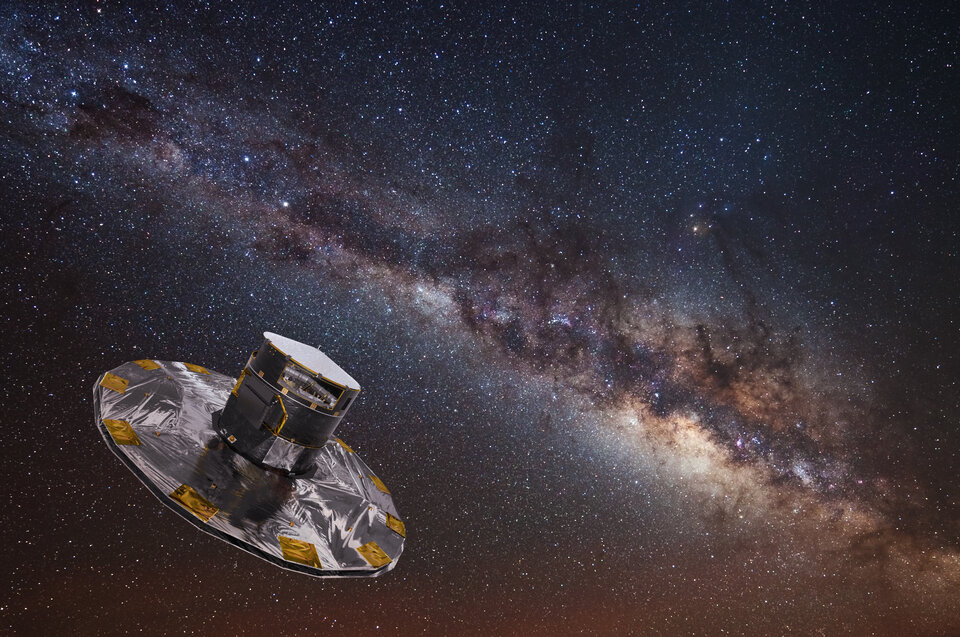
Artist impression of ESA’s Gaia satellite observing the Milky Way. The background image of the sky is compiled from data from more than 1.8 billion stars. Spacecraft: ESA/ATG medialab; Milky Way: ESA/Gaia/DPAC. Acknowledgement: A. Moitinho

Today (15th January 2025) marks the end of an era. The European Space Agency’s Gaia spacecraft stops taking data today as it is running out of the gas propellant needed to keep it scanning the sky. The spacecraft was launched on 19 December 2013 so has been operating for just over 11 years.

For those of you not in the know, Gaia is a global space astrometry mission, whose mission was to make the largest, most precise three-dimensional map of our Galaxy by surveying more than a billion stars. Gaia was to monitor each of its target stars about 70 times over a five-year period. Alongside this core mission, it has also discovered hundreds of thousands of new celestial objects, such as extra-solar planets and brown dwarfs, and observed hundreds of thousands of asteroids within our own Solar System.

Gaia is creating an extraordinarily precise three-dimensional map of more than a thousand million stars throughout our Galaxy (The Milky Way) and beyond, mapping their motion, luminosity, temperature and chemical composition as well as any changes in such properties. This huge stellar census will provide the data needed to tackle an enormous range of important problems related to the origin, structure and evolutionary history of our Galaxy. Gaia does this by repeatedly measuring the positions of all objects down to an apparent magnitude of 20. A billion stars is about 1% of the entire stellar population of the Milky Way.

For the brighter objects, i.e. those brighter than magnitude 15, Gaia  measures their positions to an accuracy of 24 microarcseconds, comparable to measuring the diameter of a human hair at a distance of 1000 km. Distances of relatively nearby stars are measured to an accuracy of 0.001%. Even stars near the Galactic Centre, some 30,000 light-years away, have their distances measured to within an accuracy of 20%.

The huge quantity of high-precision data Gaia has produced constitutes a tremendously influential resource for astronomical research. The fourth data release from Gaia, DR4, is in the pipeline for completion soon but the final data release (DR5) will take some years to appear, so this is by no means the last we will hear from Gaia, but the end of observations does close a significant chapter. Its legacy will be immense.

Marking Progress

Posted in Biographical, Education, mathematics, Maynooth with tags , on January 14, 2025 by telescoper

I’ve been at home marking examinations almost all day and have decided to knock off until tomorrow when hopefully I can finish the job. I say almost all day because I took a break this afternoon to back to campus to collect some papers that I didn’t get yesterday because they were from students sitting the examination for various reasons in alternative venues on campus rather than the main examination room.

What I do with examination scripts is mark one question at a time rather than one script at a time. What I mean by that is that I go through every script marking all the attempts at Question 1, then I start again and do all the Questions 2, etc. I find that this is much quicker and more efficient than marking all the questions in each script then moving onto the next script. The reason for this is that I can upload into my mind the model answer for Question 1 so that it stays there while I mark dozens of attempts at it so I don’t have to keep referring to the marking scheme. Other advantages are that it’s easier to be consistent in giving partial credit when you’re doing the same question over and over again, and that also you spot what the common mistakes are more easily.

It’s a fairly monotonous job and I find my concentration starts to wander if I try to do too many in one go. Fortunately the exam papers are organized in batches (separated by elastic bands as in the photograph) so I usuallly take a break – as a sort of self-reward- after each batch to break things up. Each batch usually takes a couple of hours or so, so the breaks often end up as times to have lunch and tea. In terms of the timing it’s rather like a game of cricket, actually.

Today I corrected Question 1 in two batches before lunch, then another between lunch and tea. At that point I took a walk into town to do a few errands and then collected the remaining scripts from campus, which I have now just finished correcting. Some people will accuse me of being lazy, taking breaks like this, but I think it’s more efficient to do it this way. Trying to mark examinations for hours on end inevitably leads to more errors, so in the long run it takes longer to complete the job. Slow and steady does it.

I remember using a similar approach when I wrote my thesis many years ago. That’s a much bigger job, of course, but I found what worked for me was to plan out each chapter in terms of sections of roughly equal length, write each in turn and take a break when I’d finished it. Writing a thesis of around 200 pages may seem a daunting task, but if you split it into 1000-word chunks spread over three months or so it’s quite manageable – and you can plan to take time out for relaxtion along the way to avoid getting too burned out by the process.

Anyway, I’ve now finished all the attempts at Question 1 in this examination, including those in the extra scripts I picked up today. Question 1 consists of a set of short problems and is altogether worth 50% of the examination mark, so I’m actually abouty halfway through the marking. There three questions left, each longer than the pieces of Question 1 and worth 25% of the overall mark. Students are supposed to answer two. I’ll start on Question 2 in the morning and hopefully by this time tomorrow evening I will have marked all three, and that will be that. Until the next one…