The pockets of our greatcoats full of barley… No kitchens on the run, no striking camp… We moved quick and sudden in our own country. The priest lay behind ditches with the tramp. A people hardly marching… on the hike… We found new tactics happening each day: We’d cut through reins and rider with the pike And stampede cattle into infantry, Then retreat through hedges where cavalry must be thrown. Until… on Vinegar Hill… the final conclave. Terraced thousands died, shaking scythes at cannon. The hillside blushed, soaked in our broken wave. They buried us without shroud or coffin And in August… the barley grew up out of our grave.
This poem is about the Battle of Vinegar Hill which took place outside Enniscorthy in County Wexford on 21st June 1798. It was part of the Rebellion of the United Irishmen. The term “croppy” refers to the short cropped hair worn by the rebels, most of whom went into battle carrying only pikes against the artillery and muskets of the crown forces. The battle was a heavy defeat for the United Irishmen over a thousand of whom were killed in what Heaney calls the “final conclave” where the last hopes for the rebellion to succeed were finally crushed. The poem’s final line depicts the barley in the pockets of dead rebels growing through the soil used to bury them, suggesting that the dream of independence would live on.
I was reminded just now that 30 years ago today, on 25th August 1994, this review article by myself and George Ellis was published in Nature (volume 370, pp. 609–615).
Sorry for the somewhat scrappy scanned copy. The article is still behind a paywall. No open access for the open Universe!
Can this really have been 30 years ago?
Anyway, that was the day I officially became labelled a “crank”, by some, although others thought we were pushing at an open door. We were arguing against the then-standard cosmological model (based on the Einstein – de Sitter model), but the weight of evidence was already starting to shift. Although we didn’t predict the arrival of dark energy, the arguments we presented about the density of matter did turn out to be correct. A lot has changed since 1994, but we continue to live in a Universe with a density of matter much lower than the critical density and our best estimate of what that density is was spot on.
Looking back on this, I think valuable lessons would be learned if someone had the time and energy to go through precisely why so many papers at that time were consistent with a higher-density Universe that we have now settled on. Confirmation bias undoubtedly played a role, and who is to say that it isn’t relevant to this day?
The Government of Ireland has announced the Members of the Board of the newly-formed agency Taighde Éireann – Research Ireland. The names are:
Dr Eoin O’Sullivan
Anne Vaughan
Professor Niamh Moloney
Professor Valeria Nicolosi
Dr. Godfrey Gaston
Professor Rebecca Braun
Patricia Quane
Lorraine Allen
Leonard Hobbs
You can find biographies, together with one of the Chair, Michael Horgan, here. Looking through the list I see just one practising scientist, Valeria Nicolosi, who is an industrial chemist specialising in nanoscience. Among the other biographies you will find expertise in technology, entrepreneurship, and generic businessy things. but very little to do with actual research. And there’s nobody at all on the Board to champion fundamental science or any other curiosity-driven research. It appears that the misguided short-termism of Science Foundation Ireland is to be continued into the new organization.
Like many scientists working in Ireland, I was optimistic that the merger of the IRC with SFI would provide an opportunity to rebalance Ireland’s research ecosystem to have less emphasis on applied research. I hope I’m proved wrong, but it looks like that opportunity is to be squandered.
I was interested to see a new advertisement for “student accommodation” in Maynooth containing the picture on the left. It’s a new development called The Duke, which was formerly a bar and nightclub called The Duke and Coachman and, before that, The Leinster Arms. It is a prime location on Main Street, and had been empty for a while, so it is good to see it being put to use.
I was walking past the place this afternoon so took a picture of it (right). As you can see, the reality is quite different from the advertisement. I think someone has been doing a bit of photoshopping! In fact the development is nowhere near finished; the area behind it is a construction site. That’s why the advertisement has no photographs of the interior.
I didn’t post this because of the photograph, however. The point is the price. A double room will cost €1500 per month (after you’ve paid a €800 letting fee). That seems very pricey for student accommodation! For comparison, a single en suite room in campus accommodation at Maynooth costs €650 per month.
Apparently there will be 90 rooms in this development. While accommodation is much needed, 90 rooms represent a drop in the ocean when there are over 15,000 students at Maynooth University, and the University Management wants that number to keep increasing so it can afford to pay for the legions of new managers it has appointed. Where will they live?
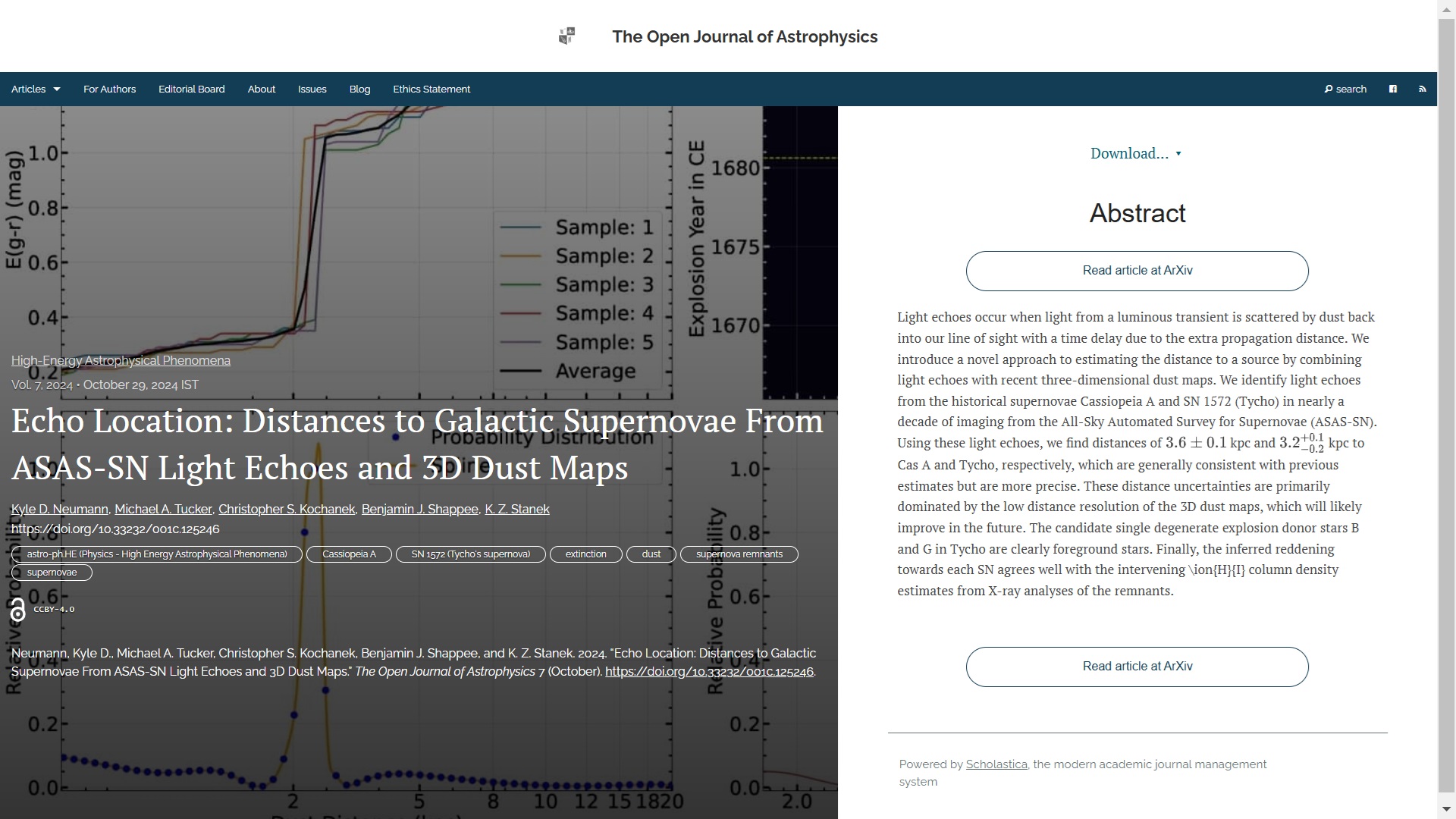
It’s Saturday morning so it’s time for the usual weekly update of publications at the Open Journal of Astrophysics. Once again this week’s report will be short because there is only one paper to report this week, being the 69th paper in Volume 7 (2024) and the 184th altogether. It was published on Wednesday 21st August 2024.
This week has been a bit strange, actually. We have actually accepted four papers that I was expecting to publish this week but only one has been published because the authors of the others have not yet put the final versions on arXiv. I suppose this is due to ongoing holidays and they’ll appear in due course. The other thing that happened was that when I published the paper below I discovered that the Crossref system was down for a scheduled upgrade that took a whole day to complete. Although I published the paper on 21st August I couldn’t register the metadata, etc, until 22nd August. Just as well I didn’t have more to do really!
Here is the overlay of the paper containing the abstract:
You can click on the image of the overlay to make it larger should you wish to do so. You can also find the officially accepted version of the paper on the arXiv here.
Today’s the day that over 60,000 school students across Ireland are receiving their Leaving Certificate Results. As always there will be joy for some, and disappointment for others. The headline news relating to these results is that a majority (68%) of grades have been scaled up to that the distribution matches last year’s outcomes. This has meant an uplift of marks by about 7.5% on average, with the biggest changes happening at the lower levels of grade.
This artificial boost is a consequence of the generous adjustments made during the pandemic and apparent wish by the Education Minister, Norma Foley, to ensure that this year’s students are treated “fairly” compared to last year’s. Of course this argument could be made for continuing to inflate grades next year too, and the year after that. Perhaps the Minister’s plan seems to be to keep the grades high until after the next General Election, after which it will be someone else’s job to treat students “unfairly”. Anyway, you might say that marks have been scaled to maintain a Norma Distribution…
One can’t blame the students, of course, but one of the effects of this scaling is that students will be coming into third-level education with grades that imply a greater level of achievement than they actually have reached. This is a particular problem with a subject like physics where we really need students to be comfortable with certain aspects of mathematics before they start their course. It has been clear that even students with very good grades at Higher level have considerable gaps in their knowledge. This looks set to continue, and we will just have to deal with it. This issue was compounded for a while because Leaving Certificate grades were produced so late that first-year students had to start university a week late, giving less time for the remedial teaching that many of them needed. At least this year we won’t have that problem, so can plan some activities early on in the new Semester.
Anyway, out of interest – probably mine rather than yours – I delved into the statistics of Leaving Certificate results going back six years for Mathematics (at Higher A and Ordinary B) level, Physics and Applied Mathematics which I fished out of the general numbers given here.
Here are the results in a table, with the columns denoting the grade (1=high) and the numbers are percentages:
You can seen that the percentage of students getting H1 in Mathematics has increased a bit to 12.6% after falling considerably from 18.1% in 2022 to 11.2% last year (2023); note the huge increase in H1 from 2020 to 2021 (8.6% to 15.1%). Another thing worth noting is that both Physics and Applied Mathematics have declined significantly in popularity since 2019 from 7210.
Now that the results are out there will be a busy time until next Wednesday (28th) when the CAO first round offers go out. That is when those students wanting to go to university find out if they made the grades and university departments find out how many new students (if any) they will have to teach in September.
P.S. When I was a little kid we used to call a “Certificate” a “Stiff Ticket”. I just thought you would like to know that.
Although I studied French for five years at school I never learned the correct way to end an item of private correspondence in that language. It’s quite a subtle business in English whether to use “Yours Sincerely”, “Yours Faithfully”, or “Best Regards”, or some other alternative. Anyway, I stumbled across an old example of a French letter the other day which reveals what the French do write at the end …
A businessman is on a luxury yacht, celebrating his recent acquittal in a high-profile fraud trial, when the yacht sinks in mysterious circumstances off the coast of Sicily. The businessman is one of six people on board who are missing, presumed dead. Just last week, the businessman’s co-defendant in the aforementioned fraud trial died in a mysterious road accident while out running in Cambridgeshire.
Using Bayesian methods, calculate the probability of these two events being a coincidence. Show your working. To the police.
Jimmy Giuffre (1921-2008) was an immensely gifted saxophonist and clarinet player who was also an accomplished arranger and composer who worked for many big bands. His most famous piece as an arranger was Four Brothers which he wrote for Woody Herman’s fantastic saxophone section of Stan Getz, Zoot Sims, Serge Chaloff and Herb Steward. My first encounter with Giuffre as an instrumentalist was in the opening track of the 1958 film Jazz on a Summer’s Day playing a tune called The Train and the River which has been a favourite of mine for many years. Back then he had a quite accessible style that blended jazz with folk elements, but he later developed a freer and more “modern” approach, including the use of electronic instruments and elements of jazz/rock fusion. I recently read a biographical article about him and – for obvious reasons – was intrigued that in 1985 he made an album called Quasar so I thought I’d share the title track here. Giuffre is on soprano sax on this one.
The views presented here are personal and not necessarily those of my employer (or anyone else for that matter).
Feel free to comment on any of the posts on this blog but comments may be moderated; anonymous comments and any considered by me to be vexatious and/or abusive and/or defamatory will not be accepted. I do not necessarily endorse, support, sanction, encourage, verify or agree with the opinions or statements of any information or other content in the comments on this site and do not in any way guarantee their accuracy or reliability.