It’s Saturday once again, so time for another update of activity at the Open Journal of Astrophysics. Since the last update we have published a further five papers, bringing the number in Volume 9 (2026) to 104 and the total so far published by OJAp up to 552. It took us until late July to pass 100 last year.
I will continue to include the posts made on our Mastodon account (on Fediscience) to encourage you to visit it. Mastodon is a really excellent service, and a more than adequate replacement for X/Twitter (which nobody should be using); these announcements also show the DOI for each paper.
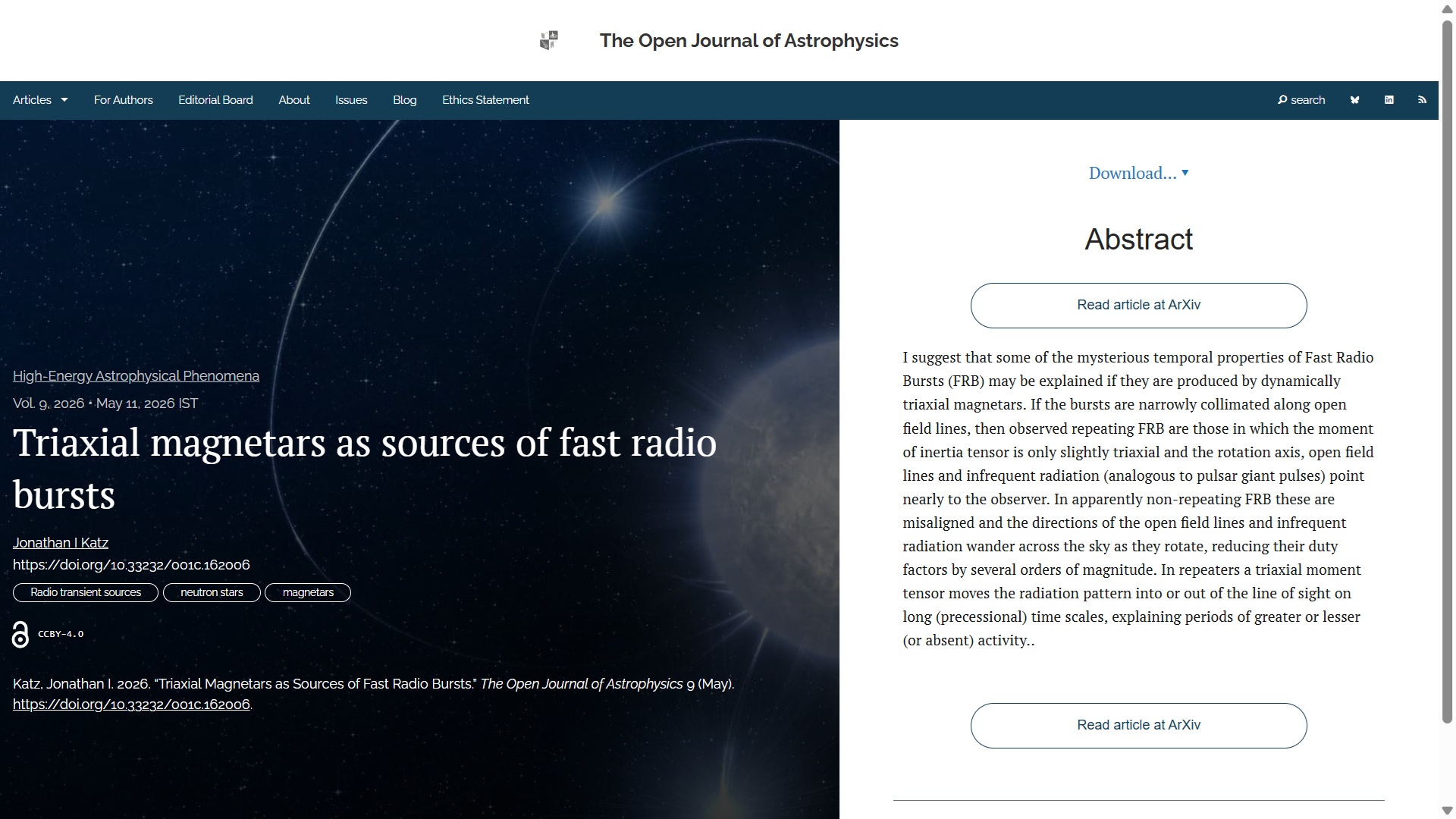
The first paper to report this week, published on Monday 11th May in the folder High-Energy Astrophysical Phenomena is “Triaxial magnetars as sources of fast radio bursts” by Jonathan I Katz (Washington University, USA). This paper suggests that the mysterious properties of Fast Radio Bursts (FRB) could be explained by triaxial magnetars, with their activity levels influenced by precessional time scales.
The overlay for this paper is here
You can find the officially accepted version on arXiv here and the announcement on Fediverse here:

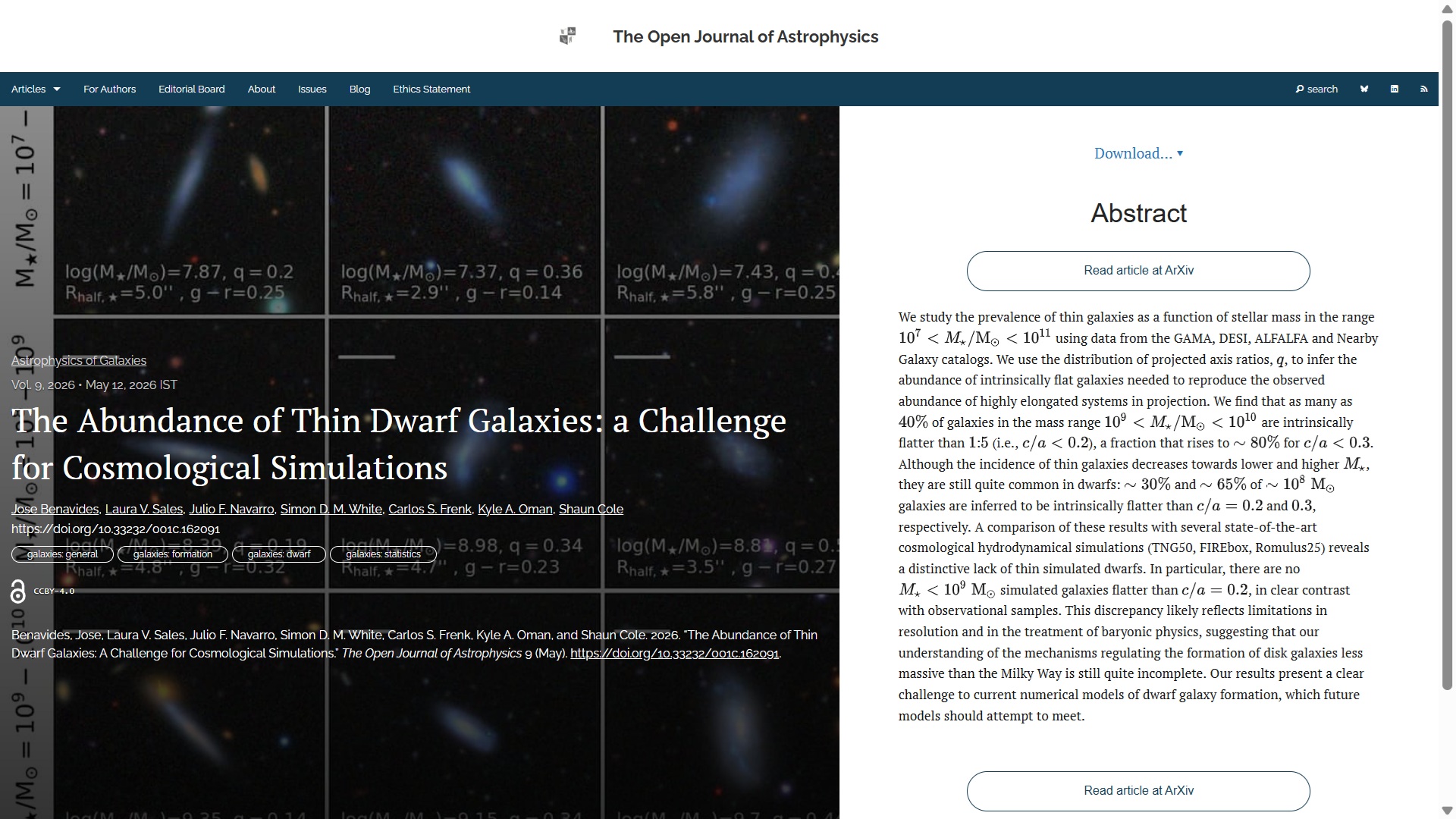
The second paper for this week, published on Tuesday 12th May in the folder Astrophysics of Galaxies, is “The Abundance of Thin Dwarf Galaxies: a Challenge for Cosmological Simulations” by Jose Benavides & Laura V. Sales (UC Riverside, USA), Julio F. Navarro (U. Victoria, Canada), Simon D. M. White (MPA Garching, Germany), and Carlos S. Frenk, Kyle A. Oman & Shaun Cole (U. Durham, UK). Depending on mass up to 40% of galaxies are intrinsically flat, a fraction that numerical models of galaxy formation struggle to reproduce suggesting the models are incomplete.
The overlay for this one is here:
The official version of the paper can be found on arXiv here and the Fediverse announcement here:
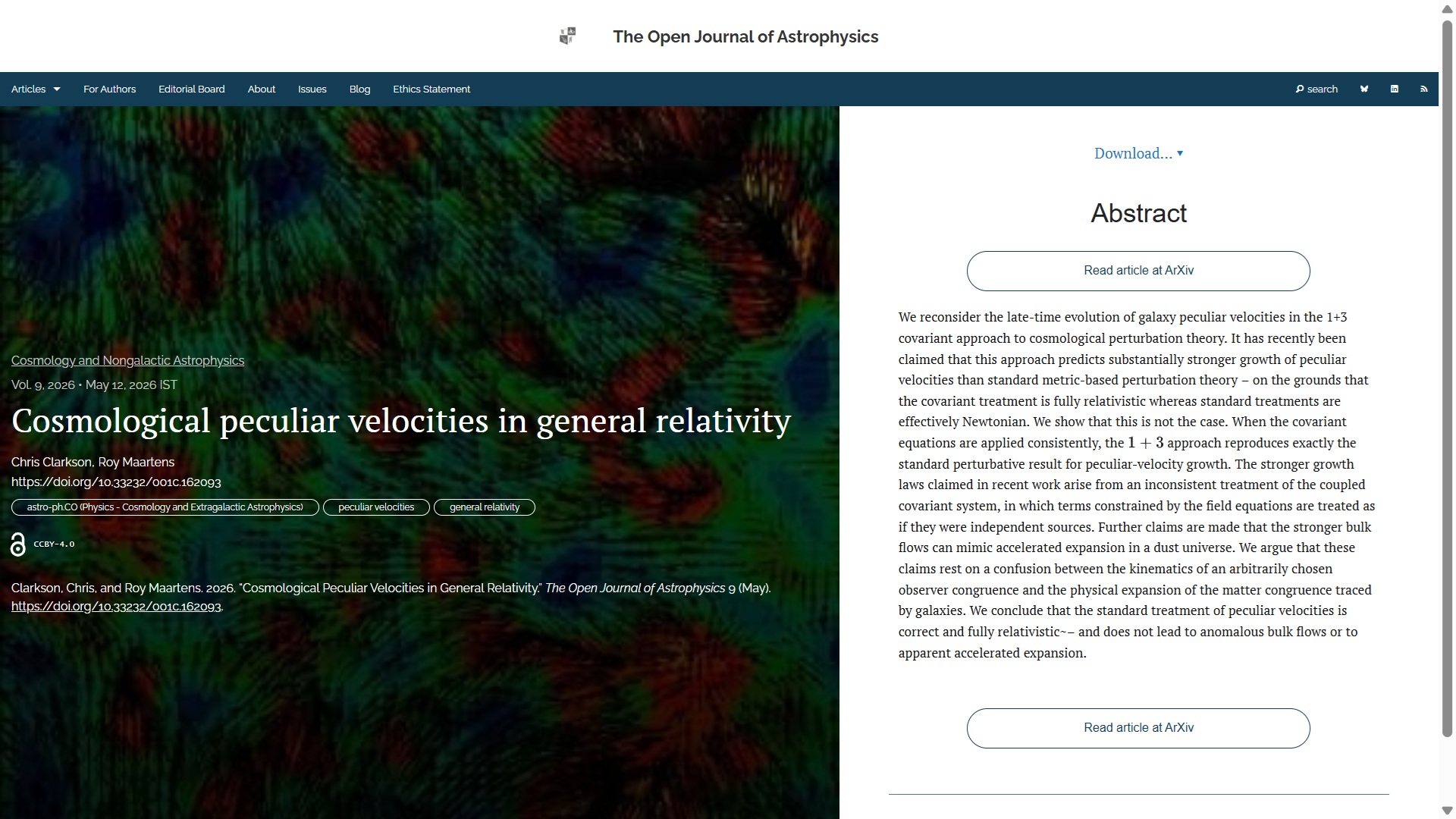
Next one up, the third paper of the week, also published on Tuesday 12th May but in the folder Cosmology and Nongalactic Astrophysics is “Cosmological peculiar velocities in general relativity” by Chris Clarkson (Queen Mary, University of London, UK) and Roy Maartens (U. Western Cape, South Africa). This paper refutes claims that the 1+3 covariant approach to cosmological perturbation theory predicts stronger growth of galaxy peculiar velocities, arguing that standard treatments are correct and fully relativistic.
The overlay for this one is here:
The final, accepted version can be found on arXiv here and the Mastodon announcement is here:
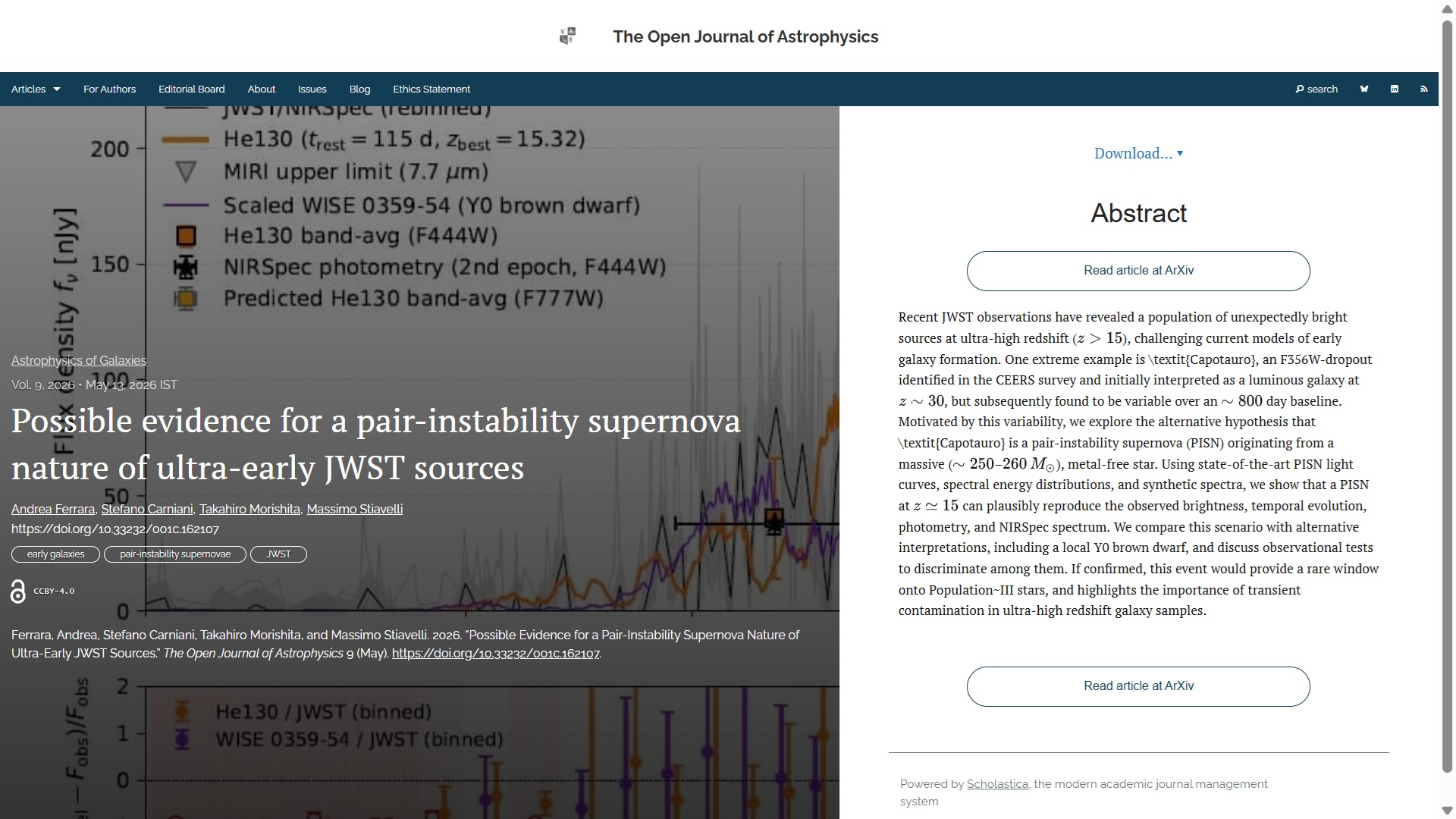
The fourth paper this week, published on Wednesday May 13th “Possible evidence for a pair-instability supernova nature of ultra-early JWST sources” by Andrea Ferrara & Stefano Carniani (Scuola Normale Superiore, Pisa, Italy), Takahiro Morishita (California Institute of Technology, USA), and Massimo Stiavelli (Space Telescope Science Institute, USA). Published in the section Astrophysics of Galaxies. This paper argues that recent observations challenge early galaxy formation models, suggesting that the bright source, Capotauro, could be a supernova from a massive, metal-free star, not a luminous galaxy as initially thought.
The overlay is here:
The officially accepted version can be found on arXiv here and here is the Mastodon announcement:
The fifth and final article of this week was also published on Wednesday 13th May but in the folder Cosmology and Nongalactic Astrophysics. The title is “Evolving and interacting dark energy: photometric and spectroscopic synergy with DES Y3 and DESI DR2” and it is by Maria Tsedrik and Benjamin Bose (University of Edinburgh, UK). The study investigates the Dark Scattering interacting dark energy scenario, using data from various sources. Results show no evidence of dark-sector interaction and a preference for the Chevallier-Polarski-Linder parametrisation.
The overlay is here:
You can find the authorized version of this paper on arXiv here and the Fediverse announcement is here:
And that concludes this week’s update. I’ll do another next Saturday.


