Archive for Astrophysics

Introducing Science Explorer (SciX)

Posted in The Universe and Stuff with tags , , , , on October 5, 2025 by telescoper

I received an email about this over a week ago from Alberto Accomazzi (Director and Principal Investigator of the NASA Astrophysics Data System) and was going to post about it then but I was quite busy and it slipped my mind. I met Alberto at ENAM earlier this summer and he told me then this was in the pipeline so I should have remembered. Anyway, better late than never…

The email was to announce the formal launch of Science Explorer (SciX for short) on Monday 29th September 2025. SciX is meant to build on the excellence of ADS and expanding its coverage to accelerate astro-related research even further.

Here’s a screenshot of the home page set up in such a way as to take you, if you click on it, by a miracle of the internet, and at no extra charge, to the actual home page:

Feel free to go and check it out!

Here is some text from the email I mentioned:

So, what is the Science Explorer platform, or SciX? Think of it as your one-stop platform for exploring research across Earth, environmental and space sciences, including planetary science, heliophysics, geology, geophysics, atmospheric sciences and oceanography. From tracking solar storms, to uncovering the secrets of distant planets, to understanding the changing dynamics of our own Earth, SciX is designed to be your research co-pilot. You can find out more at scixplorer.org.

The people behind SciX would also love to know how NASA/ADS has supported your work so far and how SciX’s additional features will benefit the community. Your testimonial can be brief, in written or video form, and can be submitted via this form, or by email if easier. It is important to show your support in view of the challenges facing NASA these days. I think we tend to take services such as NASA/ADS for granted, but we’d all find our work much harder without them, so do please send a message of support.

P.S. You can find SciX on social media with the handle @SciXCommunity. Please give them a follow!

Weekly Update from the Open Journal of Astrophysics – 09/08/2025

Posted in OJAp Papers, Open Access, The Universe and Stuff with tags , , , , , , , , , , , , , , , , , , , , , on August 9, 2025 by telescoper

It’s Saturday morning so, once again, it’s time for an update of papers published at the Open Journal of Astrophysics. Since the last update we have published four new papers, which brings the number in Volume 8 (2025) up to 114, and the total so far published by OJAp up to 349.

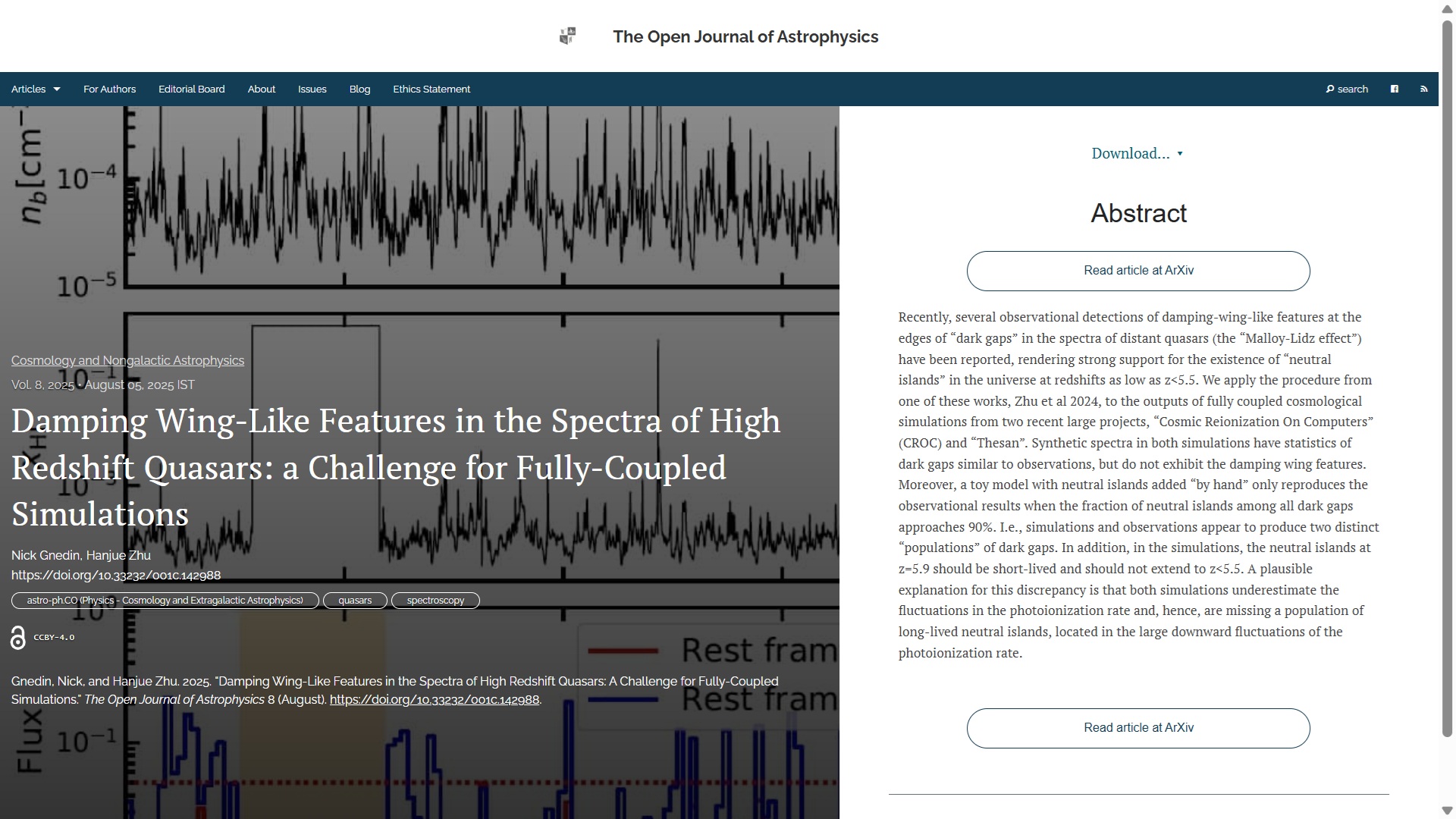
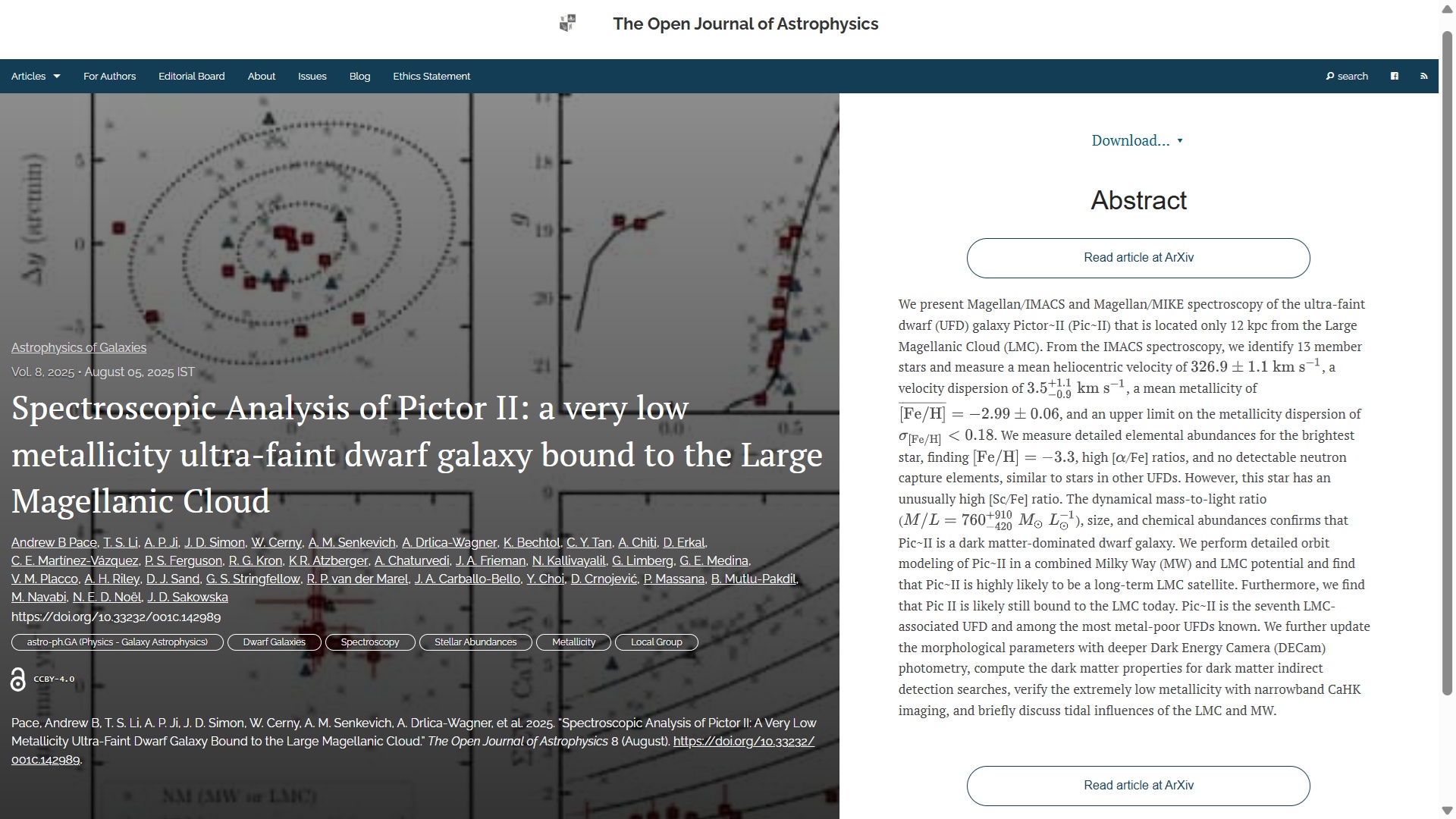
The papers published this week, with their overlays, are as follows. You can click on the images of the overlays to make them larger should you wish to do so.

The first paper to report is “Caught in the Act of Quenching? – A Population of Post-Starburst Ultra-Diffuse Galaxies” by Loraine Sandoval Ascencio & M. C. Cooper (UC Irvine), Dennis Zaritsky, Richard Donnerstein & Donghyeon J. Khim (U. Arizona) and Devontae C. Baxter (UC San Diego). This paper was puvblished on Monday 4th August and is in the folder marked Astrophysics of Galaxies. It discusses a sample of Ultra-Diffuse Galaxies (UDGs) found to be post-starburst galaxies through spectroscopic analysis analysis of candidates selected from the Systematically Measuring Ultra-Diffuse Galaxies (SMUDGes) program.

The overlay is here:


The officially-accepted version can be found on arXiv here.

Next one up, published on Tuesday 5th August, in the folder Cosmology and Nongalactic Astrophysics, is “Damping Wing-Like Features in the Spectra of High Redshift Quasars: a Challenge for Fully-Coupled Simulations” by Nick Gnedin & Hanjue Zhu (University of Chicago, USA).  This paper presents a discussion of the difficulties that cosmological radiation transfer codes have in accounting for the existence of “neutral islands” in the universe at relatively low redshifts.

The overlay is here:


You can find the officially accepted version of the paper on arXiv here.

The third paper of the week is “Spectroscopic Analysis of Pictor II: a very low metallicity ultra-faint dwarf galaxy bound to the Large Magellanic Cloud” by Andrew Pace (U. Virginia, USA) and 32 others based in the USA, UK, Canada, Chile and Spain. This one was also published on Tuesday 5th August but in the folder Astrophysics of Galaxies. It describes Magellan/IMACS and Magellan/MIKE spectroscopy of the ultra-faint dwarf (UFD) galaxy Pictor II, which is located only 12 kpc from the Large Magellanic Cloud (LMC).

The overlay is here:


The final version is on arXiv here.

The fourth, and final, paper of the week, also published on Thursday 7th August, is “ASASSN-24fw: An 8-month long, 4.1 mag, optically achromatic and polarized dimming event” by Raquel Forés-Toribio (Ohio State University) and 22 others based in the USA, Austria, Chile and Australia. It is published in the folder Solar and Stellar Astrophysics, and it presents an observational study of an unusual dimming event likely to have been caused by eclipsing of a binary system by a dusty disk.

Here is the overlay:

You can find the officially-accepted version on arXiv here.

And that’s all the papers for this week. I’ll do another update next Saturday.

P.S. For those of you who missed the post I did earlier in the week, I have been looking at the accounts for the Open Journal of Astrophysics and can confirm that the cost to us per paper is less than $30 and will reduce with scale. We expect to publish around 180 papers in 2025 for which the total cost incurred by OJAp will be around $5000. Obviously if we increase by a factor, say, ten then that amount would become significant so we are taking steps to secure additional funding in the event that happens.

Weekly Update from the Open Journal of Astrophysics – 14/06/2025

Posted in OJAp Papers, Open Access, The Universe and Stuff with tags , , , , , , , , , , , , on June 14, 2025 by telescoper

It’s Saturday so once again it’s time for the weekly update of papers published at the Open Journal of Astrophysics. Since the last update we have published two new papers, which brings the number in Volume 8 (2025) up to 71, and the total so far published by OJAp  is now up to 306.

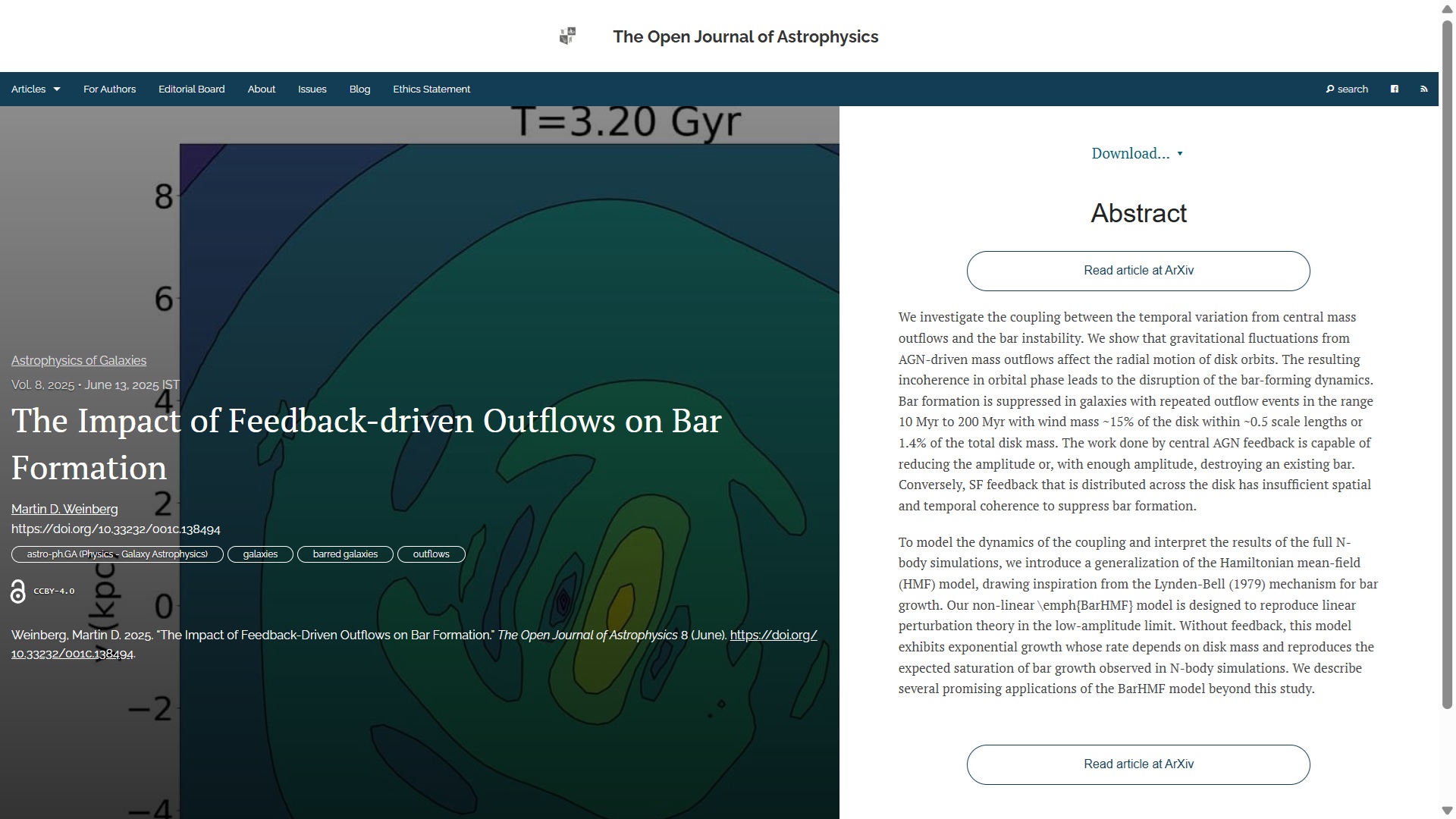
The two papers published this week, with their overlays, are as follows. You can click on the images of the overlays to make them larger should you wish to do so.

The first paper to report is “Analysis of optical spectroscopy and photometry of the type I X-ray bursting system UW CrB2” by Mark Kennedy (University College Cork, Ireland) and 21 others based in Ireland, UK, USA, Finland, Netherlands and Australia. This one was published on Tuesday June 10th in the folder High-Energy Astrophysical Phenomena.  This describes optical photometry and spectroscopy of the low-mass X-ray binary UW Coronae Borealis taken over 2 years

The overlay is here:


You can read the final accepted version on arXiv here.

The second paper is “The Impact of Feedback-driven Outflows on Bar Formation” by Martin D. Weinberg (University of Massachusetts, Amherst, USA). This paper uses a generalization of the Hamiltonian Mean-Field model to of the disruption of bar formation in galaxies by stellar feedback. It was published on Friday 13th June 2025 in the folder marked Astrophysics of Galaxies.

The overlay is here:


You can find the officially-accepted version of the paper on arXiv here.

That’s all the papers for this week. I’ll post another update next weekend.


R.I.P. Jerry Ostriker (1937-2025)

Posted in R.I.P., The Universe and Stuff with tags , , , , , , on April 9, 2025 by telescoper

Once again I find myself using this blog to pass on sad news. This time it is of the death of renowned astrophysicist Jerry Ostriker (pictured left in 2012), who passed away on Monday 6th April 2025 just a week before his 88th birthday.

Jeremiah Paul Ostriker (to give his full name) was an extremely energetic, versatile and influential theorist who worked on a wide range of problems in diverse areas of astrophysics and produced a number of classic papers. Close to my own specialism I would quote two in particular: one written with Jim Peebles in 1973 about the stability of galactic disks; and the other with Martin Rees in 1977 about the role of gas cooling and fragmentation in determining the size of galaxies and clusters. He also did much to establish the use of hydrodynamic simulations in cosmology and was an early adopter of the current standard cosmological model, including a cosmological constant. He worked on many other things too, including pulsars and galactic nuclei.

I only met Jerry Ostriker a few times, mainly at conferences – where he was never shy to contribute to discussions after talks – but also once back in the 1990s when I was a visitor Princeton (where he was Professor). I didn’t have much time to talk to him then as he always seemed to be on the go, so I never really got to know him personally. After spending most of his career in Princeton, including a spell as Provost, in 2001 Ostriker moved to Cambridge for a short stint as Plumian Professor, before returning to Princeton.

There is a very nice obituary of Jerry Ostriker by Dennis Overbye in the New York Times.

Rest in peace, Jerry Ostriker

Last Chance to apply for the Professorial Position in Observational Astrophysics or Cosmology at Maynooth University!

Posted in Maynooth, The Universe and Stuff with tags , , , , on March 31, 2025 by telescoper

A couple of months ago I announced here a vacancy for a Professor of Observational Astrophysics or Cosmology at Maynooth. The position is on the AAS Jobs Register here. The deadline is 31st March 2025 which is today so if you were thinking of applying then this is your last chance! Applications close at 23.30 Irish Time; the clocks went forward yesterday so it’s actually 00.30 tomorrow CEST so you still have time. The application portal is here.

The strategic case for this Chair revolves around broader developments in the area of astrophysics and cosmology at Maynooth. Currently there are two groups active in research in these areas, one in the former Department of Experimental Physics (which is largely focussed on astronomical instrumentation) and the other, in the former Department of Theoretical Physics, which is theoretical and computational. We want to promote closer collaboration between these research strands. The idea with the new position is that the holder will nucleate and lead a research programme in the area between these existing groups as well as getting involved in outreach and public engagement.

It is intended that the position to appeal not only to people undertaking observational programmes using ground-based facilities (e.g. those provided by ESO, which Ireland recently joined), or those exploiting data from space-based experiments, such as Euclid, as well as people working on multi-messenger astrophysics, gravitational waves, and so on.

P. S. For those of you reading this from outside Ireland the job is tenured and includes a defined benefit pension way better than the equivalent UK system.

Professorial Position in Observational Astrophysics or Cosmology at Maynooth University!

Posted in Maynooth, The Universe and Stuff with tags , , , , on February 12, 2025 by telescoper

It’s been a couple of weeks since I announced a job opportunity in the form of Professorial position in Observational Astrophysics or Cosmology at Maynooth University. After a short bureaucratic delay the announcement has just appeared on the AAS Jobs Register here, which gives me an excuse to post about the poistion again. The deadline is 31st March 2025. I hope readers of this blog will help spread the news of this opportunity through their own networks.

The strategic case for this Chair revolves around broader developments in the area of astrophysics and cosmology at Maynooth. Currently there are two groups active in research in these areas, one in the former Department of Experimental Physics (which is largely focussed on astronomical instrumentation) and the other, in the former Department of Theoretical Physics, which is theoretical and computational. We want to promote closer collaboration between these research strands. The idea with the new position is that the holder will nucleate and lead a research programme in the area between these existing groups as well as getting involved in outreach and public engagement.

It is intended that the position to appeal not only to people undertaking observational programmes using ground-based facilities (e.g. those provided by ESO, which Ireland recently joined), or those exploiting data from space-based experiments, such as Euclid, as well as people working on multi-messenger astrophysics, gravitational waves, and so on.

P. S. For those of you reading this from outside Ireland the job includes a proper public service pension, a defined benefit scheme way better than the UK’s USS.

Professorial Position in Observational Astrophysics or Cosmology at Maynooth University!

Posted in Maynooth, The Universe and Stuff with tags , , , , on January 30, 2025 by telescoper

You may recall that back in November 2021 we received word that Maynooth University had been awarded one of ten new senior professorial positions under the Strategic Academic Leadership Initiative (SALI). I blogged about this scheme here. The position we were awarded is a Chair (Full Professorship) in Observational Astrophysics or Cosmology.

We haven’t been able to make an appointment so far, despite trying! One of the reasons was undoubtedly that the two previous Departments of Theoretical Physics and Experimental Physics were in the throes of a merger and it was by no means certain at that time what the outcome of that process would look like in terms of the structure of the new Department. However, we now have a single Department of Physics so that at least is much clearer. So we’re trying again now.

The job announcement can be found here. It will appear on other sites shortly. Update: it is now on the Times Higher Jobs page here. The deadline is 31st March. I hope readers of this blog will help spread the news of this opportunity through their own networks.

The key rationale for these SALI positions is clear from the statement from Simon Harris, the (then) Minister responsible for Third Level education in Ireland:

“Championing equality and diversity is one of the key goals of my department. The Senior Academic Leadership Initiative (SALI) is an important initiative aimed at advancing gender equality and the representation of women at the highest levels in our higher education institutions.

We have a particular problem with gender balance among the staff in Physics in Maynooth, especially on the theoretical side, where all the permanent staff are male, and the lack of role models has a clear effect on our ability to encourage more female students to study with us.

The wider strategic case for this Chair revolves around broader developments in the area of astrophysics and cosmology at Maynooth. Currently there are two groups active in research in these areas, one in the former Department of Experimental Physics (which is largely focussed on astronomical instrumentation) and the other, in the former Department of Theoretical Physics, which is theoretical and computational. We want to promote closer collaboration between these research strands. The idea with the new position is that the holder will nucleate and lead a research programme in the area between these existing groups as well as getting involved in outreach and public engagement.

It is intended that the position to appeal not only to people undertaking observational programmes using ground-based facilities (e.g. those provided by ESO, which Ireland recently joined), or those exploiting data from space-based experiments, such as Euclid, as well as people working on multi-messenger astrophysics, gravitational waves, and so on.

Exciting as this position is in itself, it is part of wider developments and we are expecting to advertise further job opportunities in physics and astronomy very soon! I’d be happy to be contacted by any eligible person wishing to discuss this position (or indeed the general situation in Maynooth) on an informal basis:

Go back

Your message has been sent

Warning
Warning
Warning
Warning.

P. S. For those of you reading this from outside Ireland the job includes a proper public service pension, a defined benefit scheme way better than the UK’s USS.

Open Access Encounters: The Good, The Bad and the Ugly

Posted in Open Access with tags , , , on August 7, 2024 by telescoper

As it was foretold on Saturday, this afternoon I gave a talk at the 32nd General Assembly of the International Astronomical Union currently taking place in Cape Town, or rather at a side event thereof called Open Access Encounters: The Good, The Bad and the Ugly. I actually gave the last talk in the session, which may or may not mean that I was representing The Ugly

About 50 people attended online plus an unknown number in person, so it was quite a decent size of audiance.

I’m not sure if Slideshare is still working on WordPress, but if not here is a PDF of the slides.

Call for Editors at the Open Journal of Astrophysics

Posted in Open Access, Uncategorized with tags , , , , , , , , , , , , , on July 7, 2024 by telescoper

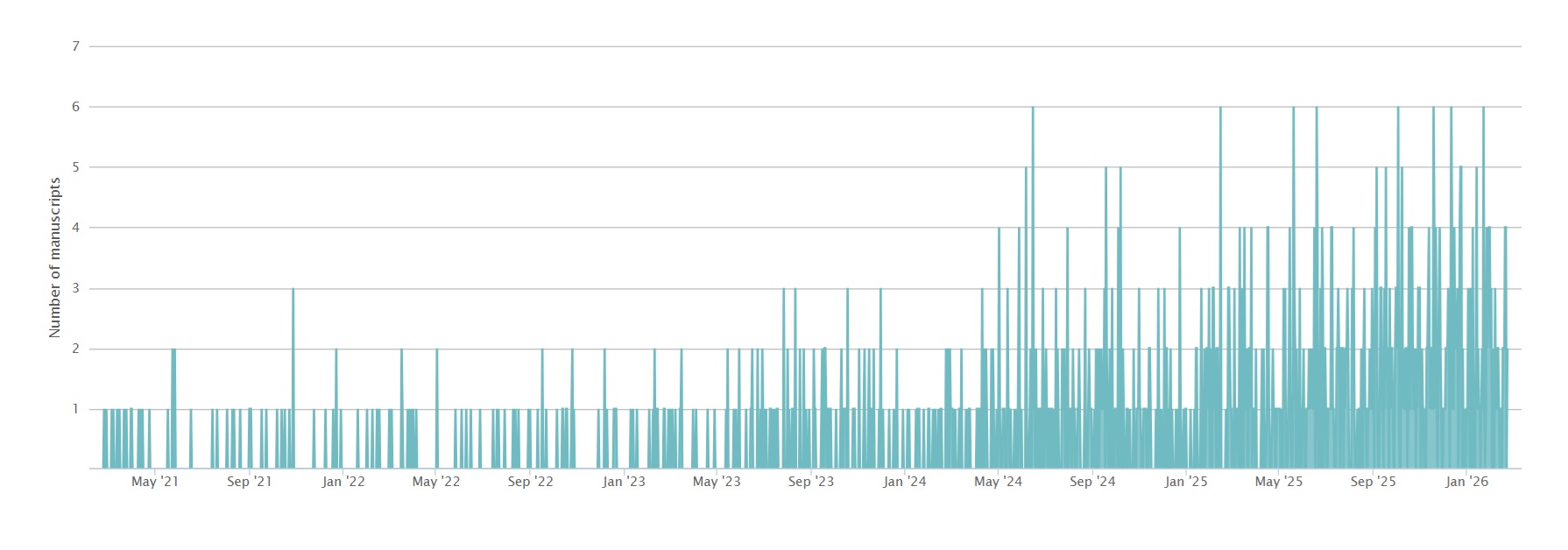
Just over halfway into 2024 the number of papers submitted to the Open Journal of Astrophysics continues to rise, as demonstrated by this nice graphic which shows the submission stats for the last five years:

The increasing number of articles is of course very welcome indeed, but it is increasing the load on our Editorial Board and that includes me! We’re therefore looking for volunteers to join the team, in any area of astrophysics. As a reminder, here are the areas we cover, corresponding to the sections of astro-ph on the arXiv:

  1. astro-ph.GA – Astrophysics of Galaxies. Phenomena pertaining to galaxies or the Milky Way. Star clusters, HII regions and planetary nebulae, the interstellar medium, atomic and molecular clouds, dust. Stellar populations. Galactic structure, formation, dynamics. Galactic nuclei, bulges, disks, halo. Active Galactic Nuclei, supermassive black holes, quasars. Gravitational lens systems. The Milky Way and its contents
  2. astro-ph.CO – Cosmology and Nongalactic Astrophysics. Phenomenology of early universe, cosmic microwave background, cosmological parameters, primordial element abundances, extragalactic distance scale, large-scale structure of the universe. Groups, superclusters, voids, intergalactic medium. Particle astrophysics: dark energy, dark matter, baryogenesis, leptogenesis, inflationary models, reheating, monopoles, WIMPs, cosmic strings, primordial black holes, cosmological gravitational radiation
  3. astro-ph.EP – Earth and Planetary Astrophysics. Interplanetary medium, planetary physics, planetary astrobiology, extrasolar planets, comets, asteroids, meteorites. Structure and formation of the solar system
  4. astro-ph.HE – High Energy Astrophysical Phenomena. Cosmic ray production, acceleration, propagation, detection. Gamma ray astronomy and bursts, X-rays, charged particles, supernovae and other explosive phenomena, stellar remnants and accretion systems, jets, microquasars, neutron stars, pulsars, black holes
  5. astro-ph.IM – Instrumentation and Methods for Astrophysics. Detector and telescope design, experiment proposals. Laboratory Astrophysics. Methods for data analysis, statistical methods. Software, database design
  6. astro-ph.SR – Solar and Stellar Astrophysics. White dwarfs, brown dwarfs, cataclysmic variables. Star formation and protostellar systems, stellar astrobiology, binary and multiple systems of stars, stellar evolution and structure, coronas. Central stars of planetary nebulae. Helioseismology, solar neutrinos, production and detection of gravitational radiation from stellar systems.

We are looking for experienced scientists in any of these areas, and it would indeed be useful to have people who can cover a range of subjects (as some of our existing editors do), but there are two specific topics that have seen a big increase recently: (a) galaxy formation simulations (especially involving hydrodynamics) covered by astro-ph.CO; and (b) galactic dynamics, covered by astro-ph.GA. The latter increase is driven Gaia data, an immensely rich source for discovery science.

Since we don’t charge authors or readers we can not offer payment to Editors but it is nevertheless a way of providing a service to the community.

Please get in touch either through the Open Journal website here, or through a message Mastodon here, BlueSky here, or Facebook here. You could even send a message through this form:

Go back

Your message has been sent

Warning
Warning
Warning
Warning.

Is machine learning good or bad for the natural sciences?

Posted in The Universe and Stuff with tags , , , , , , , on May 30, 2024 by telescoper

Before I head off on a trip to various parts of not-Barcelona, I thought I’d share a somewhat provocative paper by David Hogg and Soledad Villar. In my capacity as journal editor over the past few years I’ve noticed that there has been a phenomenal increase in astrophysics papers discussing applications of various forms of Machine Leaning (ML). This paper looks into issues around the use of ML not just in astrophysics but elsewhere in the natural sciences.

The abstract reads:

Machine learning (ML) methods are having a huge impact across all of the sciences. However, ML has a strong ontology – in which only the data exist – and a strong epistemology – in which a model is considered good if it performs well on held-out training data. These philosophies are in strong conflict with both standard practices and key philosophies in the natural sciences. Here, we identify some locations for ML in the natural sciences at which the ontology and epistemology are valuable. For example, when an expressive machine learning model is used in a causal inference to represent the effects of confounders, such as foregrounds, backgrounds, or instrument calibration parameters, the model capacity and loose philosophy of ML can make the results more trustworthy. We also show that there are contexts in which the introduction of ML introduces strong, unwanted statistical biases. For one, when ML models are used to emulate physical (or first-principles) simulations, they introduce strong confirmation biases. For another, when expressive regressions are used to label datasets, those labels cannot be used in downstream joint or ensemble analyses without taking on uncontrolled biases. The question in the title is being asked of all of the natural sciences; that is, we are calling on the scientific communities to take a step back and consider the role and value of ML in their fields; the (partial) answers we give here come from the particular perspective of physics

arXiv:2405.18095

P.S. The answer to the question posed in the title is probably “yes”.