Archive for black holes

Do Black Holes have Singularities?

Posted in mathematics, The Universe and Stuff with tags , , , on December 7, 2023 by telescoper

A paper appeared on arXiv this week that has ruffled a few feathers. It’s by Roy Kerr (yes, him) and it has the abstract:

There is no proof that black holes contain singularities when they are generated by real physical bodies. Roger Penrose claimed sixty years ago that trapped surfaces inevitably lead to light rays of finite affine length (FALL’s). Penrose and Stephen Hawking then asserted that these must end in actual singularities. When they could not prove this they decreed it to be self evident. It is shown that there are counterexamples through every point in the Kerr metric. These are asymptotic to at least one event horizon and do not end in singularities.

arXiv:2312.00841

I don’t think this paper is as controversial as some people seem to find it. I think most of us have doubts that singularities – specifically curvature singularities – are physically real rather than manifestations of gaps in our understanding. On the other hand, this paper focusses on an interesting technical question and provides a concrete counterexample. The point is that the famous Penrose-Hawking singularity theorems don’t actually prove the existence of singularities; they prove geodesic incompleteness, i.e. that there are geodesics that can only be extended for a finite time as measured by an observer travelling along one. Geodesic incompleteness does imply the existence of some sort of boundary, often termed a trapped surface, but not necessarily that anything physical diverges there at that boundary. Though a singularity will result in geodesic incompleteness, the assertion that geodesic incompleteness necessarily implies the existence of a singularity is really just a conjecture.

For more details, read the paper. It’s technical, of course, but well written and actually not all difficult to understand.
Four New Publications at the Open Journal of Astrophysics

Posted in OJAp Papers, Open Access, The Universe and Stuff with tags , , , , , , , , , , , , , , , , on July 29, 2023 by telescoper

The rate of publication at the Open Journal of Astrophysics has now reached the point at which I think I’ll have to limit myself to weekly updates here rather than announcing every paper as it appears. We still announce individual papers on social media of course, meaning Mastodon, Facebook and the platform formerly known as Twitter…

This week we have published four papers which I now present to you here. These four take the count in Volume 6 (2023) up to 31 and the total published by OJAp up to 96. I speculated earlier this year that we might reach 100 before the end of 2023, now it looks certain we will reach the century mark as early as August! It is gratifying to see the range of papers published increasing, with all four of these in different categories.

In chronological order, the four papers published this week, with their overlays, are as follows. You can click on the images of the overlays to make them larger should you wish to do so.

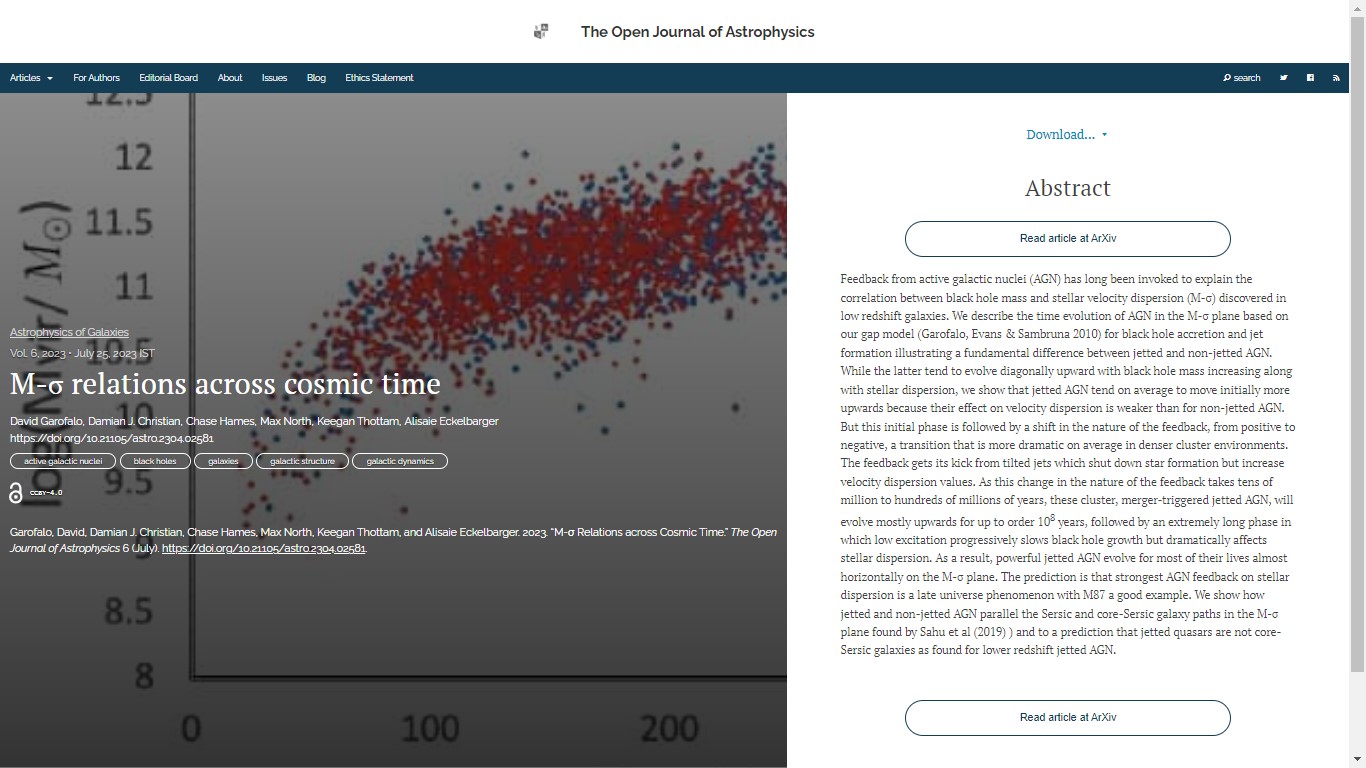
First one up is “M-σ relations across cosmic time” by David Garofalo (1), Damian J. Christian (2), Chase Hames (1), Max North (3), Keegan Thottam (1) & Alisaie Eckelbarger (1). The author affiliations are: (1) Department of Physics, Kennesaw State University, USA; (2) Department of Physics and Astronomy, California State University, Northridge, USA; (3) Department of Information Systems, Kennesaw State University, USA. This is a discussion of the relationship between black hole mass and stellar velocity dispersion discovered in low redshift galaxies and its evolution with cosmic time. The paper was published on 25th July, is in the folder marked Astrophysics of Galaxies and can be found here.

Here is a screen grab of the overlay, which includes the abstract:

You can find the officially accepted version of the paper on the arXiv here.

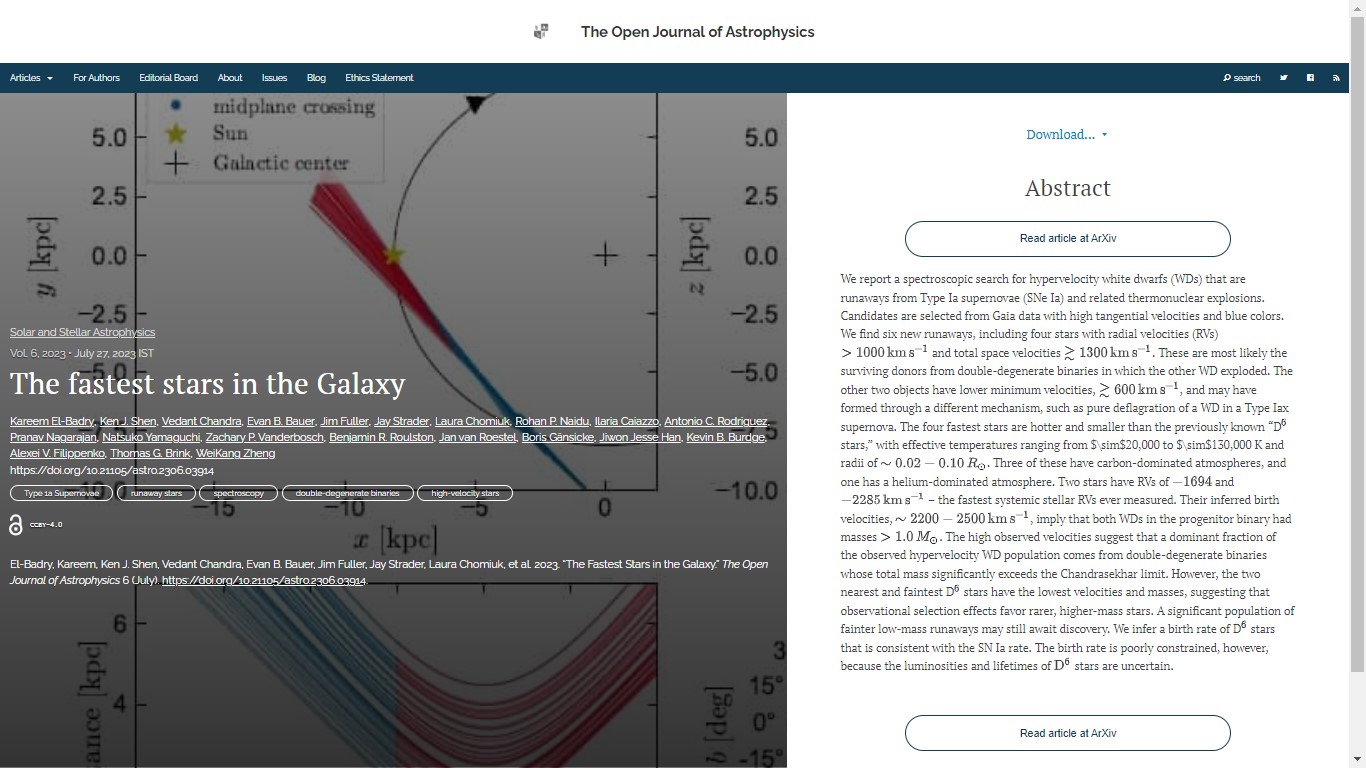
The second paper to announce is “The fastest stars in the Galaxy” by Kareem El-Badry et al. (21 authors. This one is the fourth item in the folder marked Solar and Stellar Astrophysics and it reports the spectroscopic discovery of 6 new “runaway” stars, probably the surviving members of binary star systems in which one star exploded in a Type 1a supernova. The paper was published on 27th July 2023 and you can see the overlay here:

The accepted version of this paper can be found on the arXiv here.

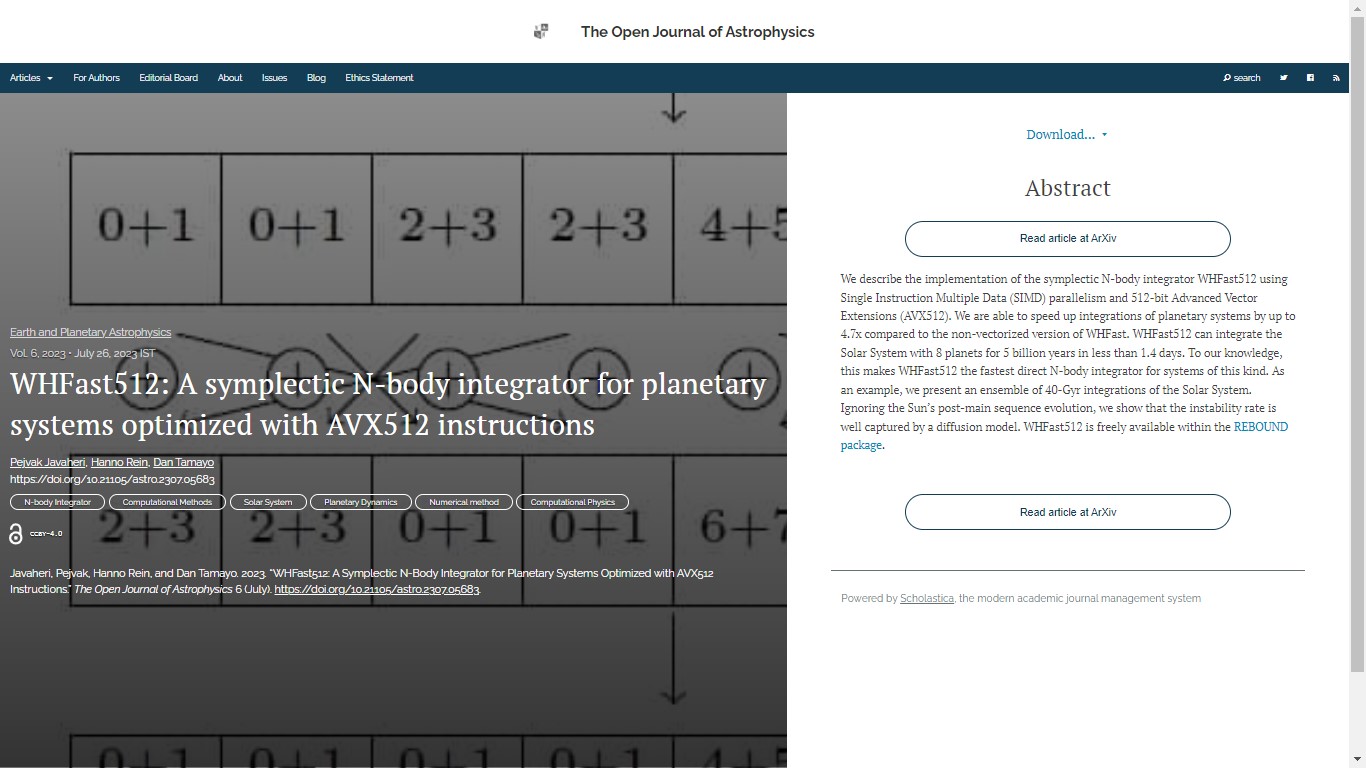
The next paper is in the Earth and Planetary Astrophysics folder. It is in fact only the second paper we have published in that area. It is entitled “WHFast512: A symplectic N-body integrator for planetary systems optimized with AVX512 instructions” by Pejvak Javaheri & Hanno Rein (University of Toronto, Canada) and Daniel Tamayo (Harvey Mudd College, USA). This paper presents a fast direct N-body integrator for gravitational systems, and demonstrates it using a 40 Gyr integration of the Solar System.

Here is the overlay:


You can find the full text for this one on the arXiv here.

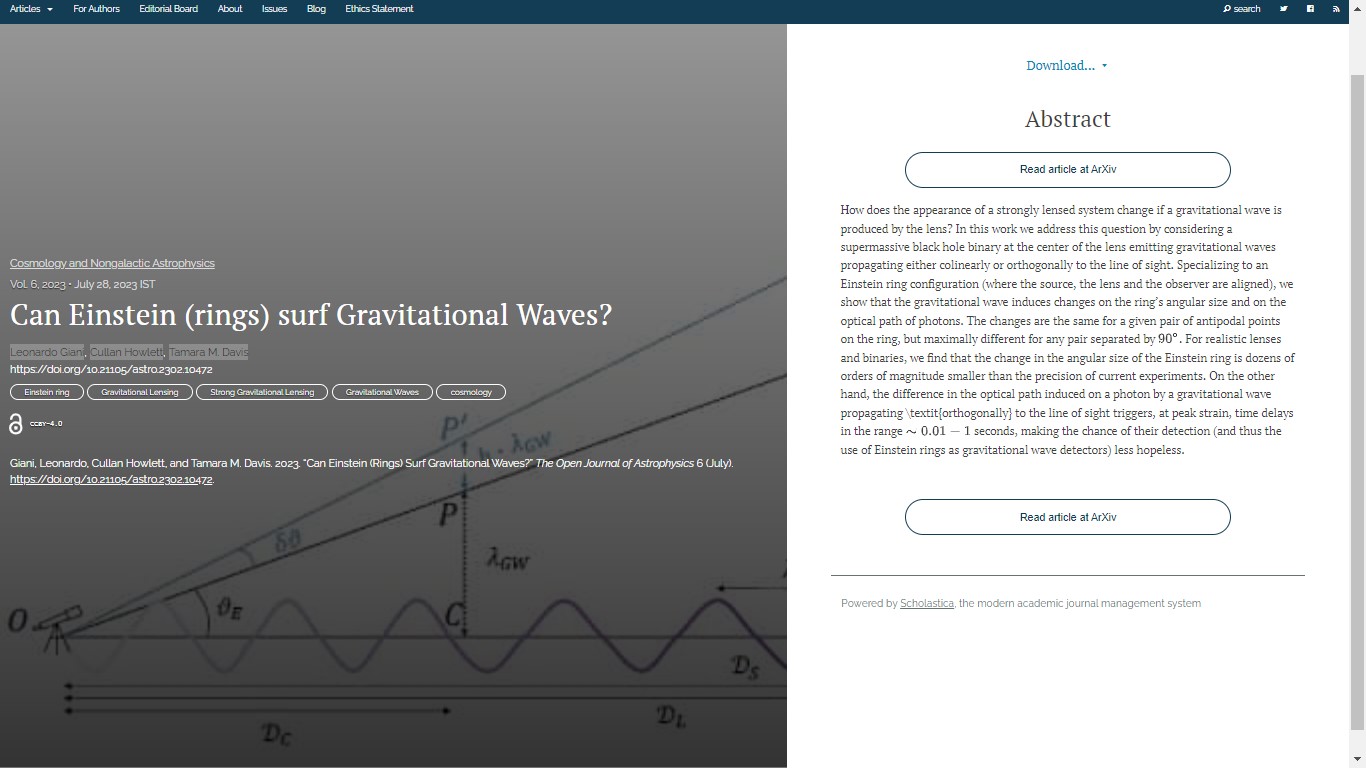
Last but by no means least, published yesterday (29th July), we have a paper that asks the question “Can Einstein (rings) surf Gravitational Waves?” by Leonardo Giani, Cullan Howlett and Tamara M. Davis of the University of Queensland, Australia. The primary classification for this one is Cosmology and Nongalactic Astrophysics and it discusses the possible effect(s) of gravitational waves on gravitational lensing observations.


You can click on the image of the overlay to make it larger should you wish to do so. You can find the officially accepted version of the paper on the arXiv here.

New Publication at the Open Journal of Astrophysics

Posted in OJAp Papers, Open Access, The Universe and Stuff with tags , , , , , , on July 22, 2023 by telescoper

Time to announce yet another new paper at the Open Journal of Astrophysics. This one was published yesterday, on 21st July 2023.

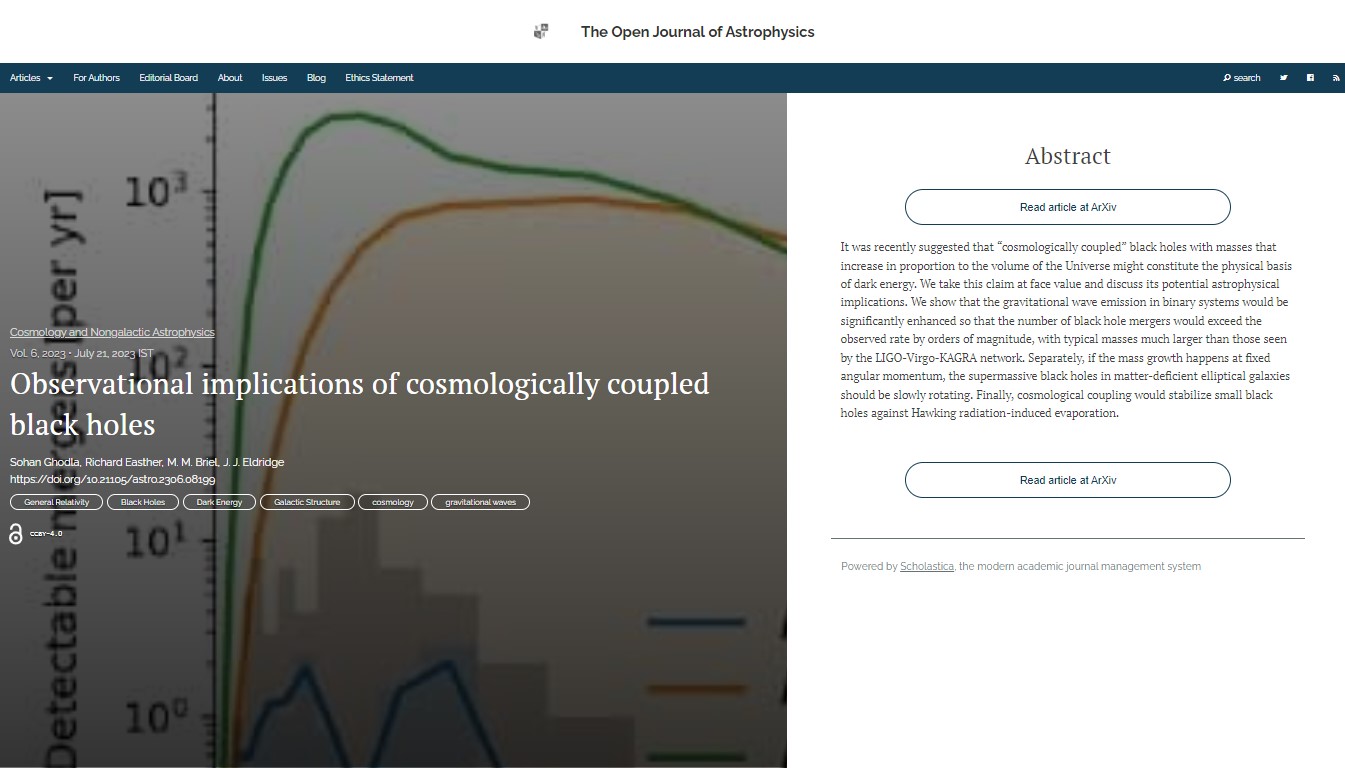
The latest paper is the 27th  so far in Volume 6 (2023) and the 92nd in all. The authors are Sohan Ghodla, Richard Easther, M.M. Briel and J.J. Eldridge, all of the University of Auckland in New Zealand.

The primary classification for this paper is Cosmology and Nongalactic Astrophysics and its title is “Observational implications of cosmologically coupled black holes”.  The paper elucidates some of the consequences of a suggestion that the interaction between black holes and the global properties of space-time underlying explanation for dark energy. The key result is that the existence of cosmologically-coupled black holes implies a much larger rate of black-hole merger events than is observed.

The papers to which this is a response are mentioned here. For reference ,these earlier works were published in The Astrophysical Journal and The Astrophysical Journal Letters. There is also a detailed twitter thread about this paper by Richard Easter, posted when it was submitted as a preprint to the arXiv last month:


Anyway, here is a screen grab of the overlay of the published version which includes the  abstract:


You can click on the image of the overlay to make it larger should you wish to do so. You can find the officially accepted version of the paper on the arXiv here.

New Publication at the Open Journal of Astrophysics

Posted in OJAp Papers, The Universe and Stuff with tags , , , , on April 28, 2023 by telescoper

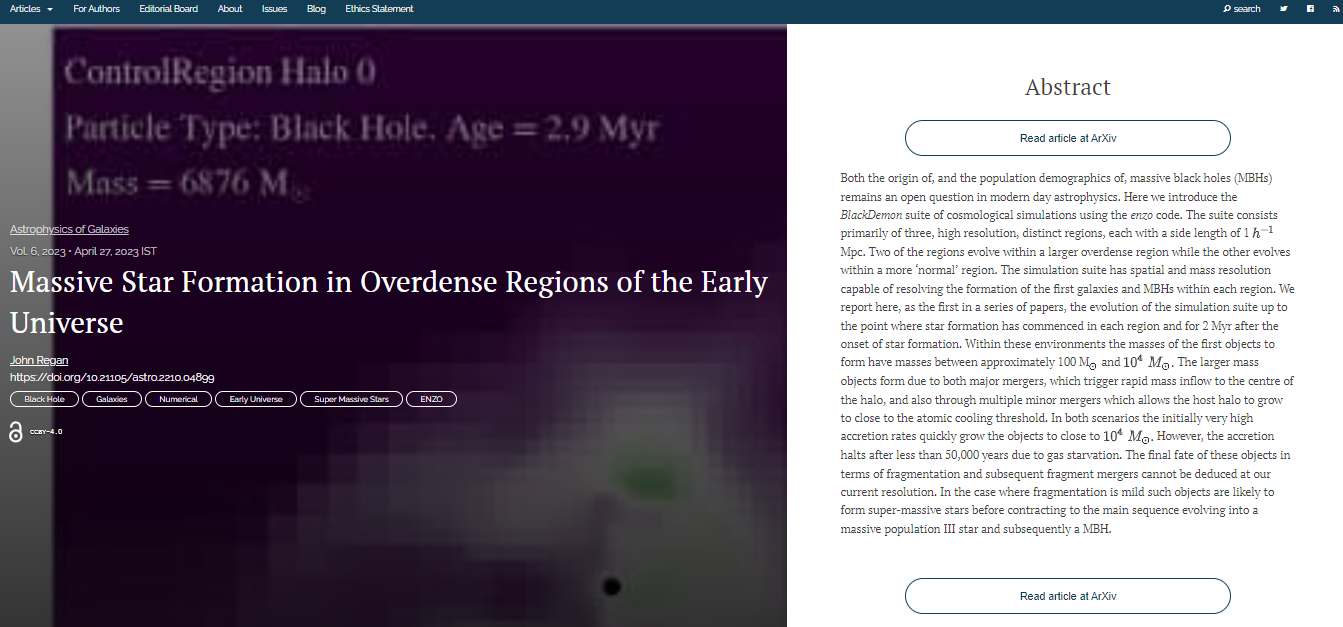
Time for the announcement of yet another new paper at the Open Journal of Astrophysics. The latest paper is the 14th paper so far in Volume 6 (2023) and the 79th in all. This one is in the folder marked Astrophysics of Galaxies and its title is “Massive Star Formation in Overdense Regions of the Early Universe”. The early Universe aspect does of course imply considerable overlap with cosmology.

The (sole) author is our very own John Regan of the Department of Theoretical Physics at Maynooth University.

Here is a screen grab of the overlay which includes the  abstract:

Here’s a bigger version of the image I chose for the overlay:


You can click on the image of the overlay to make it larger should you wish to do so. You can find the officially accepted version of the paper on the arXiv here.

Can Black Holes really create Dark Energy?

Posted in Astrohype, The Universe and Stuff with tags , , , , on February 25, 2023 by telescoper
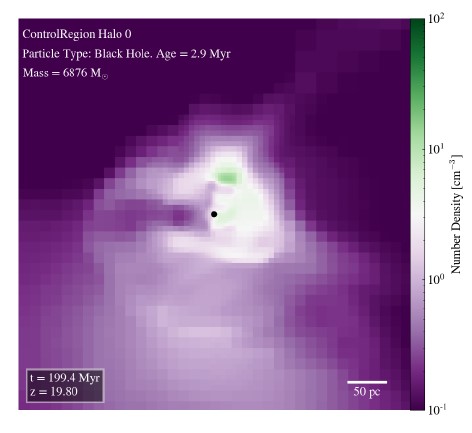
Gratuitous Black Hole Graphic

A couple of papers were published recently that attracted quite a lot of media interest so I thought I’d mention the work here.

The researchers detail the theory in two papers, published in The Astrophysical Journal and The Astrophysical Journal Letterswith both laying out different aspects of the cosmological connection and providing the first “astrophysical explanation of dark energy”. The lead author of both papers is Duncan Farrah of the University of Hawaii. Both are available on the arXiv, where all papers worth reading in astrophysics can be found.

The first paper, available on the arXiv here, entitled Preferential Growth Channel for Supermassive Black Holes in Elliptical Galaxies at z<2, and makes the argument that observations imply that supermassive black holes grow preferentially in elliptical galaxies:

The assembly of stellar and supermassive black hole (SMBH) mass in elliptical galaxies since z∼1 can help to diagnose the origins of locally-observed correlations between SMBH mass and stellar mass. We therefore construct three samples of elliptical galaxies, one at z∼0 and two at 0.7≲z≲2.5, and quantify their relative positions in the MBH−M∗ plane. Using a Bayesian analysis framework, we find evidence for translational offsets in both stellar mass and SMBH mass between the local sample and both higher redshift samples. The offsets in stellar mass are small, and consistent with measurement bias, but the offsets in SMBH mass are much larger, reaching a factor of seven between z∼1 and z∼0. The magnitude of the SMBH offset may also depend on redshift, reaching a factor of ∼20 at z∼2. The result is robust against variation in the high and low redshift samples and changes in the analysis approach. The magnitude and redshift evolution of the offset are challenging to explain in terms of selection and measurement biases. We conclude that either there is a physical mechanism that preferentially grows SMBHs in elliptical galaxies at z≲2, or that selection and measurement biases are both underestimated, and depend on redshift.

arXiv: 2212.06854

Note the important caveats at the end. I gather from people who work on this topic that it’s a rather controversial claim.

The second paper, entitled Observational evidence for cosmological coupling of black holes and its implications for an astrophysical source of dark energy and available on the arXiv here, discusses a mechanism by which it is claimed that the formation of black holes actually creates dark energy:

Observations have found black holes spanning ten orders of magnitude in mass across most of cosmic history. The Kerr black hole solution is however provisional as its behavior at infinity is incompatible with an expanding universe. Black hole models with realistic behavior at infinity predict that the gravitating mass of a black hole can increase with the expansion of the universe independently of accretion or mergers, in a manner that depends on the black hole’s interior solution. We test this prediction by considering the growth of supermassive black holes in elliptical galaxies over 0<z≲2.5. We find evidence for cosmologically coupled mass growth among these black holes, with zero cosmological coupling excluded at 99.98% confidence. The redshift dependence of the mass growth implies that, at z≲7, black holes contribute an effectively constant cosmological energy density to Friedmann’s equations. The continuity equation then requires that black holes contribute cosmologically as vacuum energy. We further show that black hole production from the cosmic star formation history gives the value of ΩΛ measured by Planck while being consistent with constraints from massive compact halo objects. We thus propose that stellar remnant black holes are the astrophysical origin of dark energy, explaining the onset of accelerating expansion at z∼0.7.

arXiv:2302.07878


The first I saw of these papers was in a shockingly poor write-up in the Guardian which is so garbled that I dismissed the story out of hand. I recently saw it taken up in Physics World though so maybe there is something in it. Having scanned it quickly it doesn’t look trivially wrong as I had feared it would be.

I haven’t had much time to read papers over the last few weeks but I’ve decided to present the second paper – the more theoretical one – next time I do our cosmology journal club at Maynooth, which means I’ll have to read it! I’ll add my summary after I’ve done the Journal club on Monday afternoon.

In the meantime I was wondering what the general reaction in the cosmological community is to these papers, especially the second one. If anyone has strong views please feel free to put them in the comments box!

UPDATE: There is a counter-argument on the arXiv today.

PhD Opportunity in Theoretical Astrophysics at Maynooth!

Posted in Maynooth, The Universe and Stuff with tags , , , on January 18, 2023 by telescoper

Posting this again because the deadline (31st January) is coming up fast….

The Department of Theoretical Physics at Maynooth University invites applications for a PhD in Theoretical Astrophysics starting in September 2023. The successful applicant will work in the group led by Dr. John Regan on a project examining the formation processes of massive black holes in the early Universe. Massive black holes populate the centres of all massive galaxies and are now also observed in both the centres and in off-centre locations in less massive dwarf galaxies.

For more details and instructions on how to apply, see here.

PhD Opportunity in Theoretical Astrophysics at Maynooth!

Posted in Maynooth, The Universe and Stuff with tags , , , on December 8, 2022 by telescoper

The Department of Theoretical Physics at Maynooth University invites applications for a PhD in Theoretical Astrophysics starting in September 2023. The successful applicant will work in the group led by Dr. John Regan on a project examining the formation processes of massive black holes in the early Universe. Massive black holes populate the centres of all massive galaxies and are now also observed in both the centres and in off-centre locations in less massive dwarf galaxies.

For more details and instructions on how to apply, see here.

Job Opportunity in Computational Astrophysics at Maynooth!

Posted in Maynooth, The Universe and Stuff with tags , , on December 2, 2022 by telescoper

Just a quick post to advertise the fact that the Department of Theoretical Physics at Maynooth University is inviting applications for a Postdoctoral Fellowship Position in Computational and Theoretical Astrophysics. The successful applicant will join the Research Group led by Dr John Regan and is expected to develop their own independent research program within the confines of a research project investigating the formation, growth, and demographics of Black Holes in the early Universe. The group, currently consisting of four PhD students and one additional postdoctoral researcher, is currently engaged in numerous research topics with the goal of understanding early black hole formation. In line with this we are currently implementing an ambitious research project using the EnzoE exascale class code to run large volume, high resolution simulations focused on the first billion years of black hole formation. The successful candidate will be expected to contribute significantly to this research effort but are free to pursue their own research lines under this remit.

For more information, including deadlines and the applications procedure, please see the AAS Jobs register advertisement here.

New Publication at the Open Journal of Astrophysics

Posted in OJAp Papers, Open Access, The Universe and Stuff with tags , , , , , , , , , , , , on December 24, 2020 by telescoper

Just time before Christmas to announce another paper in the Open Journal of Astrophysics. This one was actually published a few days ago but because of holiday delays it took some time to get the metadata and DOI registered so I held off announcing it until that was done.

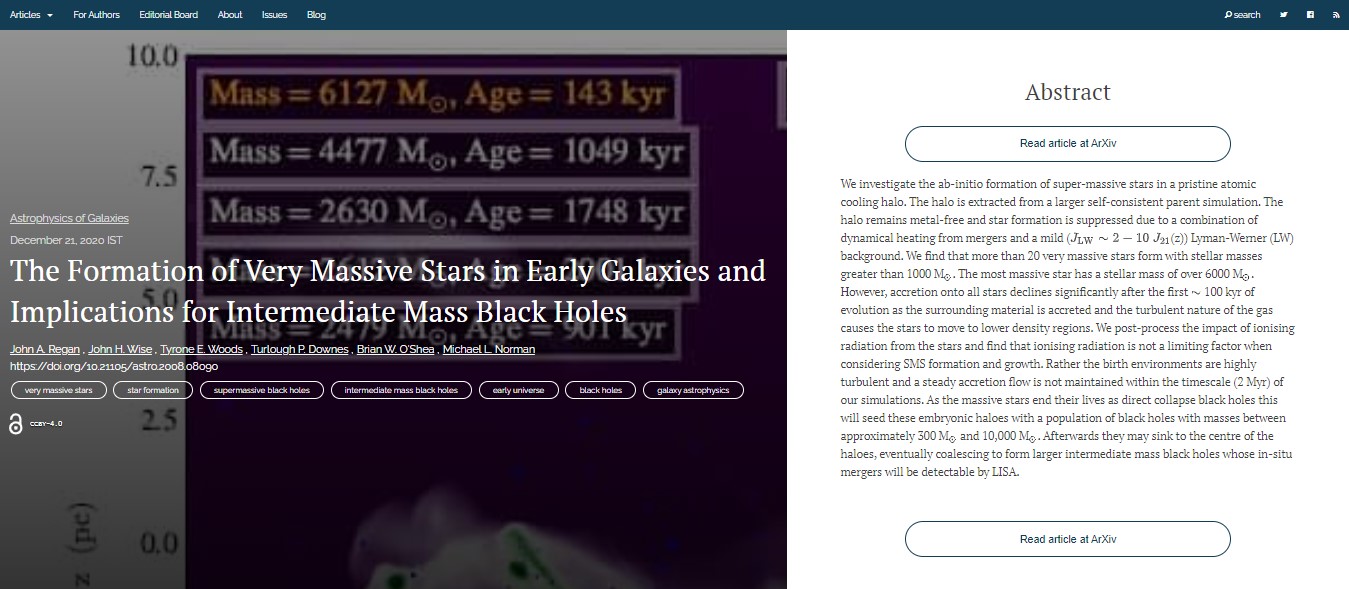
The latest publication is by my colleague* John Regan (of the Department of Theoretical Physics at Maynooth), John Wise (Georgia Tech), Tyrone Woods (NRC Canada), Turlough Downes (DCU), Brian O’Shea (Michigan State) and Michael Norman (UCSD). It is entitled The Formation of Very Massive Stars in Early Galaxies and Implications for Intermediate Mass Black Holes and appears in the Astrophysics of Galaxies section of the arXiv.

Here is a screen grab of the overlay:

You can click on the image to make it larger should you wish to do so. You can find the arXiv version of the paper here.

I think that will be that for for 2020 at the Open Journal of Astrophysics. We have published 15 papers this year, up 25% on last year. Growth is obviously modest, but there’s obviously a lot of inertia in the academic community. After the end of this year we will have two full consecutive years of publishing.

I’d like to take this opportunity to thank all our authors, readers, referees, and editors for supporting the Open Journal of Astrophysics and wish you all the very best for 2021!

*Obviously, owing to the institutional conflict I recused myself from the editorial process on this paper.

New Publication at the Open Journal of Astrophysics!

Posted in Maynooth, OJAp Papers, Open Access, The Universe and Stuff with tags , , , , , , on August 24, 2020 by telescoper

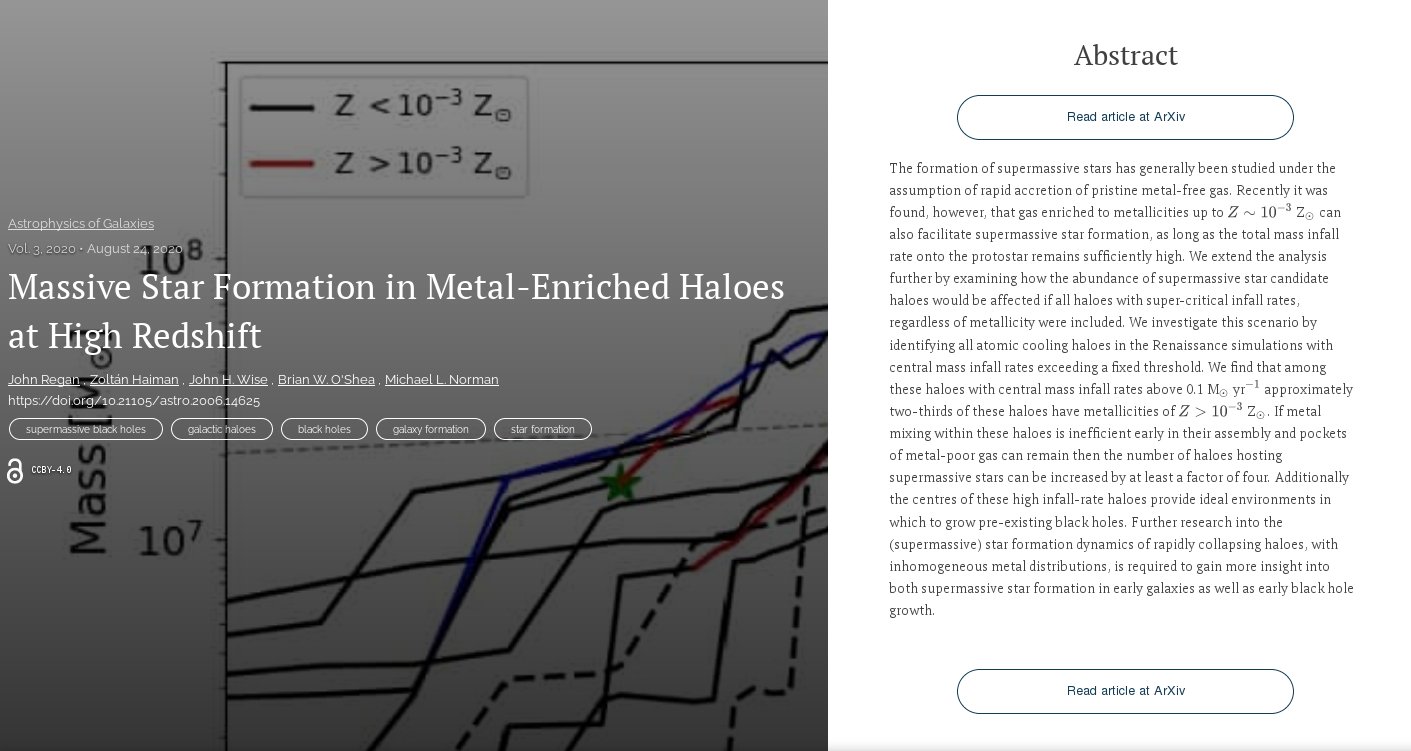
So another new paper has been published in the Open Journal of Astrophysics! This one is in the folder marked Astrophysics of Galaxies and is entitled Massive Star Formation in Metal-Enriched Haloes at High Redshift. I should explain that “Metal” here is the astrophysicist’s definition which basically means anything heavier than hydrogen or helium: chemists may look away now.

The authors of this paper are John Regan (of the Department of Theoretical Physics at Maynooth University), Zoltán Haiman (Columbia), John Wise (Georgia Tech), Brian O’Shea (Michigan State) and Michael Norman (UCSD). And before anyone asks, no I don’t force members of staff in my Department to submit papers to the Open Journal of Astrophysics and yes I did stand aside from the Editorial process because of the institutional conflict.

Here is a screen grab of the overlay:

You can click on the image to make it larger should you wish to do so.

You can find the arXiv version of the paper here.