Archive for Cosmology

New Publication at the Open Journal of Astrophysics

Posted in Open Access, The Universe and Stuff with tags , , , , , , , on July 22, 2022 by telescoper

It seems we’re on a bit of a roll at the Open Journal of Astrophysics as we have yet another new paper for me to announce. I think with the end of teaching quite a few authors are finding time to make their revised versions (which I should also be doing, come to think of it….)

Anyway the new paper, published yesterday, is the 11th paper in Volume 5 (2022) and the 59th in all. The latest publication is entitled “Bayesian error propagation for neural-net based parameter inference” and is written by Daniela Grandón of the University of Chile and Elena Sellentin of Leiden University.

It being mainly about the application of parameter inference to cosmology, this is another paper in the Instrumentation and Methods for Astrophysics folder.

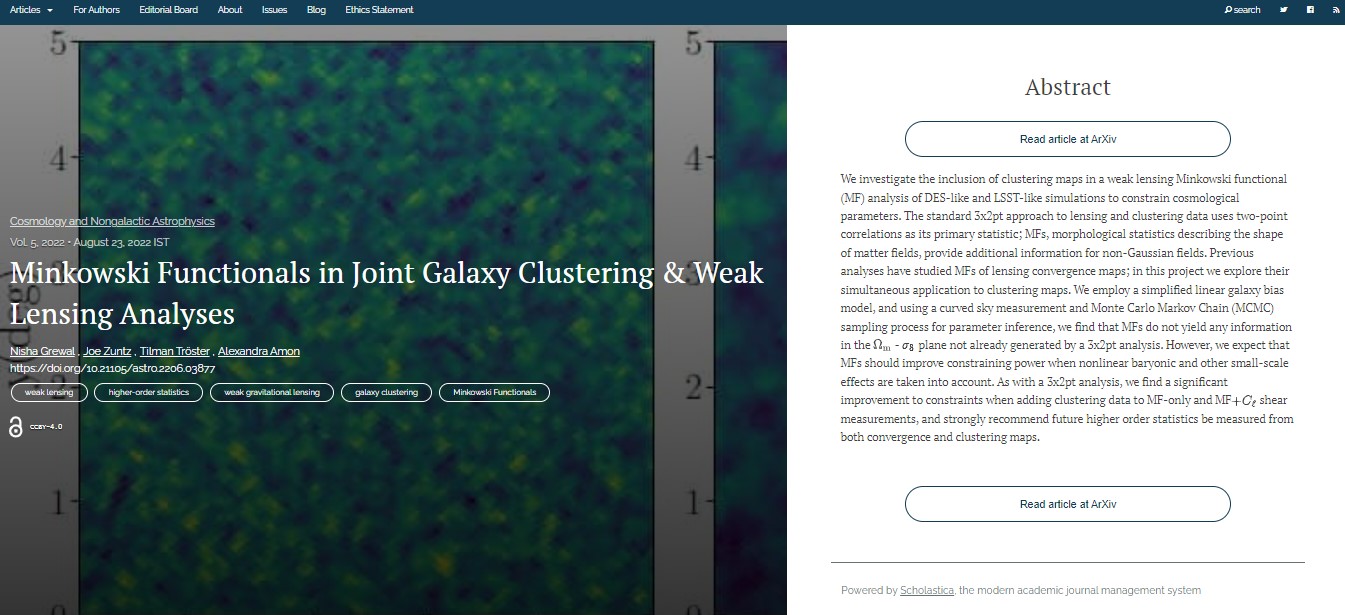
Here is a screen grab of the overlay which includes the  abstract:


You can click on the image to make it larger should you wish to do so. You can find the arXiv version of the paper here.

The First Deep Field from JWST

Posted in Astronomy Lookalikes, The Universe and Stuff with tags , , , , , on July 12, 2022 by telescoper

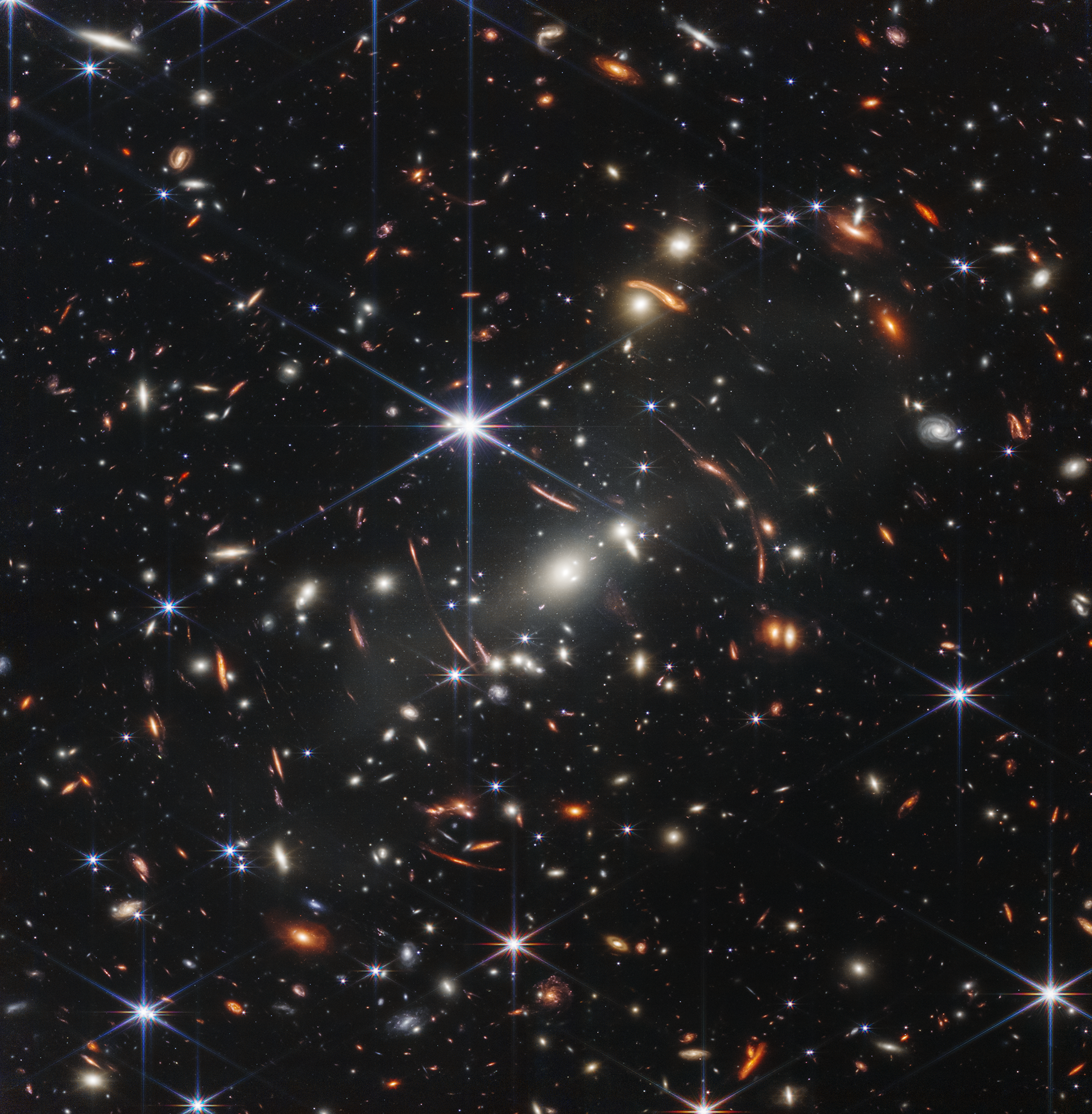
I have to say that I didn’t stay up to watch the live stream of last night’s preview of this afternoon’s release of the first images from the James Webb Space Telescope. It started very late and I got sick of listening to the dreary music on the feed so went to bed. Nevertheless here is the first picture:

Credits: NASA, ESA, CSA, and STScI

This is a deep field image taken using JWST’s NIRCAM (Near-Infrared Camera). Note that the artifacts you see around some objects are diffraction spikes which occur around bright sources; their six-fold symmetry reflects the hexagonal structure built into the JWST’s mirror assembly. Sources sufficiently bright and compact enough to cause these spikes in deep field images are foreground stars: the extended, fainter objects are all much more distant galaxies.

The description from the NASA page is:

NASA’s James Webb Space Telescope has produced the deepest and sharpest infrared image of the distant universe to date. Known as Webb’s First Deep Field, this image of galaxy cluster SMACS 0723 is overflowing with detail.

Thousands of galaxies – including the faintest objects ever observed in the infrared – have appeared in Webb’s view for the first time. This slice of the vast universe is approximately the size of a grain of sand held at arm’s length by someone on the ground.

This deep field, taken by Webb’s Near-Infrared Camera (NIRCam), is a composite made from images at different wavelengths, totaling 12.5 hours – achieving depths at infrared wavelengths beyond the Hubble Space Telescope’s deepest fields, which took weeks. 

The image shows the galaxy cluster SMACS 0723 as it appeared 4.6 billion years ago. The combined mass of this galaxy cluster acts as a gravitational lens, magnifying much more distant galaxies behind it. Webb’s NIRCam has brought those distant galaxies into sharp focus – they have tiny, faint structures that have never been seen before, including star clusters and diffuse features. Researchers will soon begin to learn more about the galaxies’ masses, ages, histories, and compositions, as Webb seeks the earliest galaxies in the universe

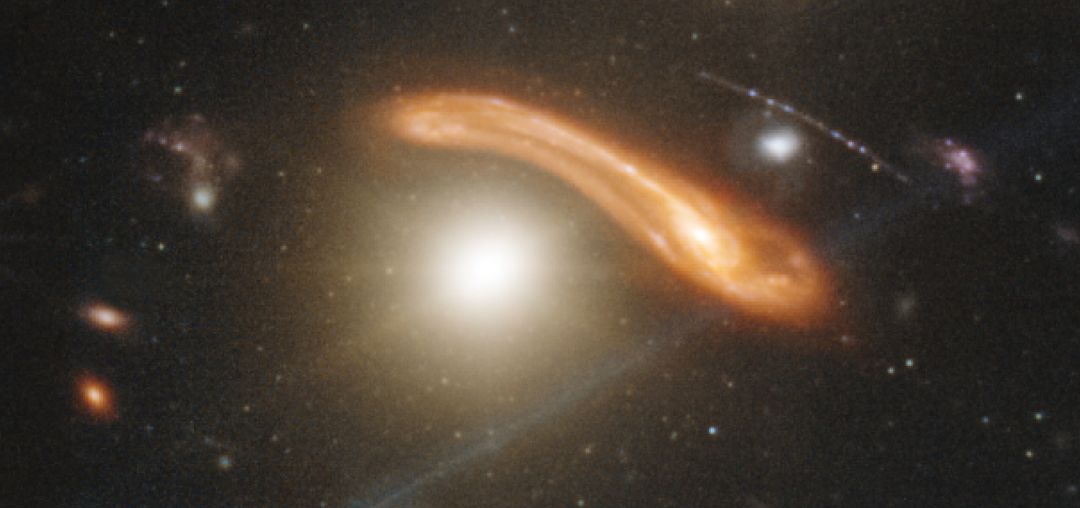
Here is a close-up of one of the distorted galaxy images and othe features produced by gravitational lensing:

We’re having a special viewing in Maynooth this afternoon of the press conference which will unveil more new images from JWST – nice telescope, shame about the name. I may add comments on here if anything particularly exciting turns up. You can watch it here:

Let’s hope this one starts on time!

The Consequences of Decoupling

Posted in Politics, The Universe and Stuff with tags , , , on July 11, 2022 by telescoper

I was struck by the similarity between the UK’s export performance post-Brexit (left) and the behaviour of radiative perturbations in the post-recombination Universe (right). It seems that, in different ways, they are both consequences of some form of decoupling

Cosmological Constraints on Alternative Gravity Theories

Posted in The Universe and Stuff with tags , , , , , , , on July 11, 2022 by telescoper

The standard model of cosmology is based on Einstein’s theory of general relativity. In order to account for cosmological observations this has required the introduction of dark matter – which also helps explain the properties of individual galaxies – and dark energy. The result model, which I would describe as a working hypothesis, is rather successful but it is reasonable to question whether either or both of the dark components can be avoided by adopting an alternative theory of gravity instead of Einstein’s.

There is an interesting paper by Kris Pardo and David Spergel on arXiv that argues that none of the modifications of Einstein’s theory currently on the market is able to eliminate the need for dark matter. Here is the abstract of this paper:

It’s a more sophisticated version of an argument that has been going around at least in qualitative form for some time. The gist of it is that the distinctive pattern of fluctuations in the cosmic microwave background, observed by e.g. the Planck experiment, arise from coupling between baryons and photons in the early Universe. Similar features can be observed in the distribution of galaxies – where they are called Baryon Acoustic Oscilations (BAO) at a more recent cosmic epoch, but they are are much weaker. This is easily explicable if there is a dark matter component that dominates gravitational instability at late times but does not couple to photons via electromagnetic interactions. This is summed up in the following graphic (which I think I stole from a talk by John Peacock) based on data from about 20 years ago:

If there were no dark matter the coherent features seen in the power spectrum of the galaxy distribution would be much stronger; with dark matter dominating they are masked by the general growth of the collisionless component so their relative amplitude decreases.

The graphic shows how increasing the dark matter component from 0.1 to 0.3, while keeping the baryon component fixed, suppresses the wiggles corresponding to BAOs. The data suggest a dark matter contribution at the upper end of that range, consistent with the standard cosmology.

Of course if there are were no baryons at all there wouldn’t be fluctuations in either the CMB polarization or the galaxy distribution so both spectra would be smooth as shown in the graphic, but in that case there wouldn’t be anyone around to write about them as people are made of baryons.

This general conclusion is confirmed by the Pardo & Spergel paper, though it must be said that the argument doesn’t mean that modified gravity is impossible. It’s just that it seems nobody has yet thought of a specific model that satisfies all the constraints. That may change.

Phase Correlations and Cosmic Structure

Posted in Biographical, The Universe and Stuff with tags , , , on July 9, 2022 by telescoper

I’m indebted to a friend for tipping me off about a nice paper that appeared recently on the arXiv by Franco et al. with the title First measurement of projected phase correlations and large-scale structure constraints. The abstract is here:

Phase correlations are an efficient way to extract astrophysical information that is largely independent from the power spectrum. We develop an estimator for the line correlation function (LCF) of projected fields, given by the correlation between the harmonic-space phases at three equidistant points on a great circle. We make a first, 6.5σ measurement of phase correlations on data from the 2MPZ survey. Finally, we show that the LCF can significantly improve constraints on parameters describing the galaxy-halo connection that are typically degenerate using only two-point data.


I’ve worked on phase correlations myself (with a range of collaborators) – you can see a few of the papers here. Indeed I think it is fair to say I was one of the first people to explore ways of quantifying phase information in cosmology. Although I haven’t done anything on this recently (by which I mean in the last decade or so), other people have been developing very promising looking approaches (including the Line Correlation Function (LCF) explored in the above paper. In my view there is a lot of potential in this approach and as we await even more cosmological data and hopefully more people will look at this in future. In my opinion we still haven’t found the optimal way to exploit phase information statistically so there’s a lot of work to be done in this field.

Anyway, I thought I’d try to explain what phase correlations are and why they are important.

One of the challenges we cosmologists face is how to quantify the patterns we see in, for example, galaxy redshift surveys. In the relatively recent past the small size of the available data sets meant that only relatively crude descriptors could be used; anything sophisticated would be rendered useless by noise. For that reason, statistical analysis of galaxy clustering tended to be limited to the measurement of autocorrelation functions, usually constructed in Fourier space in the form of power spectra; you can find a nice review here.

Because it is so robust and contains a great deal of important information, the power spectrum has become ubiquitous in cosmology. But I think it’s important to realize its limitations.

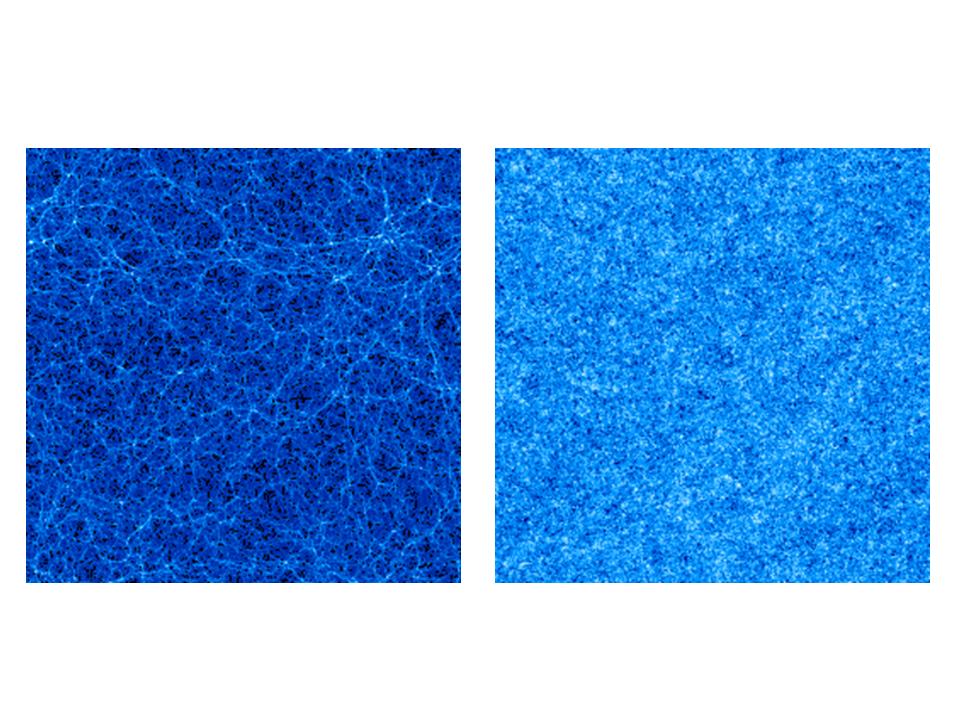
Take a look at these two N-body computer simulations of large-scale structure:

The one on the left is a proper simulation of the “cosmic web” which is at least qualitatively realistic, in that in contains filaments, clusters and voids pretty much like what is observed in galaxy surveys.

To make the picture on the right I first  took the Fourier transform of the original  simulation. This approach follows the best advice I ever got from my thesis supervisor: “if you can’t think of anything else to do, try Fourier-transforming everything.”

Anyway each Fourier mode is complex and can therefore be characterized by an amplitude and a phase (the modulus and argument of the complex quantity). What I did next was to randomly reshuffle all the phases while leaving the amplitudes alone. I then performed the inverse Fourier transform to construct the image shown on the right.

What this procedure does is to produce a new image which has exactly the same power spectrum as the first. You might be surprised by how little the pattern on the right resembles that on the left, given that they share this property; the distribution on the right is much fuzzier. In fact, the sharply delineated features  are produced by mode-mode correlations and are therefore not well described by the power spectrum, which involves only the amplitude of each separate mode.

If you’re confused by this, consider the Fourier transforms of (a) white noise and (b) a Dirac delta-function. Both produce flat power-spectra, but they look very different in real space because in (b) all the Fourier modes are correlated in such away that they are in phase at the one location where the pattern is not zero; everywhere else they interfere destructively. In (a) the phases are distributed randomly.

The moral of this is that there is much more to the pattern of galaxy clustering than meets the power spectrum…

New Publication at the Open Journal of Astrophysics

Posted in OJAp Papers, Open Access, The Universe and Stuff with tags , , , , , , , on July 5, 2022 by telescoper

Time to announce another new publication in the Open Journal of Astrophysics! This one, published on Sunday, is the 8th paper in Volume 5 (2022) and the 56th in all.

The latest publication is entitled “Search for a distance-dependent Baryonic Tully-Fisher Relation at low redshifts” and is written by by Aditi Krishak (IISER-Bhopal, India) and Shantanu Desai (IIT Hyderabad, India).

This paper is in the Cosmology and Nongalactic Astrophysics folder.

Here is a screen grab of the overlay which includes the abstract:


You can click on the image to make it larger should you wish to do so. You can find the arXiv version of the paper here.

R.I.P. Jim Bardeen (1939-2022)

Posted in Biographical, The Universe and Stuff with tags , , , , , on July 4, 2022 by telescoper

I was saddened this morning to hear news of the death at the age of 83 of Jim Bardeen who passed away on June 20th 2022. Jim – the son of John Bardeen, who won two Nobel physics prizes – did important work in theoretical cosmology and general relativity. In my own field of cosmology he is probably best known for his work on perturbation theory where he clarified many longstanding issues about gauge-dependence and as the first author of the famous and heavily cited “BBKS” (Bardeen, Bond, Kaiser & Szalay) paper, published in 1986:

BBKS

I received this as a very hefty preprint when I started my graduate studies back in 1985 and it scared the hell out of me. I still have the photocopy of the published version I made when it came out (in the days when PhD meant Doctor of Photocopying). You can find the paper on the NASA/ADS system here.

I met Jim Bardeen only once, at an Aspen Summer Workshop back in the 90s. He was a very shy and modest man but very kindly and polite. I remember a couple of times out hiking with him, when a discussion about physics was going on he would keep quiet until he had figured out what he thought and when he did choose to speak it was usually brief and invariably very incisive. He didn’t write all that many papers either, but those he did publish were invariably excellent.

Rest in peace, James Maxwell Bardeen (1939-2022)

Final Reminder – Professorial Position in Observational Astrophysics or Cosmology at Maynooth!

Posted in Maynooth, The Universe and Stuff with tags , , , , on July 1, 2022 by telescoper

With just a few days to go to the deadline (3rd July), I thought I would take the opportunity to remind readers that Maynooth University has a Chair (i.e. Full Professor) position in Astrophysics or Cosmology under the Strategic Academic Leadership Initiative (SALI). I blogged about this scheme here and announced this Chair position originally here.

You can find the full announcement of the competition for all the SALI positions here; you can apply for the position at Maynooth here. The position is now also advertised on the AAS Jobs Register here.

As I said, the deadline for applications is 3rd July 2022, and the provisional start date is January 2023 (although this is flexible). As well as a good salary (starting at €124,683 at current rates, rising by annual increments to €157,611) the position comes with membership of the Irish public service pension scheme, a defined benefit scheme (comparable to the older version of the UK’s USS which has now been scrapped).

The key rationale for these SALI positions is clear from the statement from Simon Harris, the Minister responsible for Third Level education in Ireland:

“Championing equality and diversity is one of the key goals of my department. The Senior Academic Leadership Initiative (SALI) is an important initiative aimed at advancing gender equality and the representation of women at the highest levels in our higher education institutions.

We have a particular problem with gender balance among the staff in Physics in Maynooth, especially in Theoretical Physics where all the permanent staff are male, and the lack of role models has a clear effect on our ability to encourage more female students to study with us.

The wider strategic case for this Chair revolves around broader developments in the area of astrophysics and cosmology at Maynooth. Currently there are two groups active in research in these areas, one in the Department of Experimental Physics (which is largely focussed on astronomical instrumentation) and the other, in the Department of Theoretical Physics, which is theoretical and computational. We want to promote closer collaboration between these research strands. The idea with the new position is that the holder will nucleate and lead a new research programme in the area between these existing groups as well as getting involved in outreach and public engagement.

It is intended that the position to appeal not only to people undertaking observational programmes using ground-based facilities (e.g. those provided by ESO, which Ireland recently joined), or those exploiting data from space-based experiments, as well as people working on multi-messenger astrophysics, gravitational waves, and so on.

Exciting as this position is in itself, it is part of wider developments and we are expecting to advertise further job opportunities in physics and astronomy very soon! I’d be happy to be contacted by any eligible person wishing to discuss this position (or indeed the general situation in Maynooth) on an informal basis.

Professorial Position in Observational Astrophysics or Cosmology at Maynooth!

Posted in Maynooth, The Universe and Stuff with tags , , , , on May 30, 2022 by telescoper

With about a month to go to the deadline, I thought I would take the opportunity to remind readers that Maynooth University has a Chair (i.e. Full Professor) position in Astrophysics or Cosmology under the Strategic Academic Leadership Initiative (SALI). I blogged about this scheme here and announced this Chair position originally here.

You can find the full announcement of the competition for all the SALI positions here; you can apply for the position at Maynooth here. The position is now also advertised on the AAS Jobs Register here.

The deadline for applications is in July 2022, and the provisional start date is January 2023 (although this is flexible). As well as a good salary (starting at €124,683 at current rates, rising by annual increments to €157,611) the position comes with membership of the Irish public service pension scheme, a defined benefit scheme (comparable to the older version of the UK’s USS which has now been scrapped).

The key rationale for these SALI positions is clear from the statement from Simon Harris, the Minister responsible for Third Level education in Ireland:

“Championing equality and diversity is one of the key goals of my department. The Senior Academic Leadership Initiative (SALI) is an important initiative aimed at advancing gender equality and the representation of women at the highest levels in our higher education institutions.

We have a particular problem with gender balance among the staff in Physics in Maynooth, especially in Theoretical Physics where all the permanent staff are male, and the lack of role models has a clear effect on our ability to encourage more female students to study with us.

The wider strategic case for this Chair revolves around broader developments in the area of astrophysics and cosmology at Maynooth. Currently there are two groups active in research in these areas, one in the Department of Experimental Physics (which is largely focussed on astronomical instrumentation) and the other, in the Department of Theoretical Physics, which is theoretical and computational. We want to promote closer collaboration between these research strands. The idea with the new position is that the holder will nucleate and lead a new research programme in the area between these existing groups as well as getting involved in outreach and public engagement.

It is intended that the position to appeal not only to people undertaking observational programmes using ground-based facilities (e.g. those provided by ESO, which Ireland recently joined), or those exploiting data from space-based experiments, as well as people working on multi-messenger astrophysics, gravitational waves, and so on.

Exciting as this position is in itself, it is part of wider developments and we are expecting to advertise further job opportunities in physics and astronomy very soon! I’d be happy to be contacted by any eligible person wishing to discuss this position (or indeed the general situation in Maynooth) on an informal basis.

Two New Publications at the Open Journal of Astrophysics

Posted in Open Access, The Universe and Stuff with tags , , , , , , on May 29, 2022 by telescoper

Last week was rather busy. Amongst other things I managed to complete the publication process for two more papers in the Open Journal of Astrophysics (one on Tuesday and one on Thursday) although there was a small delay in registering the metadata so I didn’t fully announce them until yesterday. I’ve only just managed to find time today to advertise them here. These two are the sixth and seventh papers in Volume 5 (2022) and the 54th and 55th in all respectively. Both the new papers are in the folder marked Cosmology and Nongalactic Astrophysics.

The first of these two new publications is entitled “The Impact of Quadratic Biases on Cosmic Shear” and is written by Tom Kitching and Anurag Deshpande of the Mullard Space Science Laboratory in Surrey (UK).

Here is a screen grab of the overlay which includes the abstract:

You can click on the image to make it larger should you wish to do so. You can find the arXiv version of this paper directly here.

The second new publication is entitled “Cosmo-Paleontology: Statistics of Fossil Groups in a Gravity-Only Simulation” and is written by Aurora Coissairt, Michael Buehlmann, Eve Kovacs, Xin Liu, Salman Habib and Katrin Heitmann all from the Argonne National Laboratory which is just outside Chicago in the USA.

Here is the overlay of that paper which includes the abstract:

Once again You can click on the image to make it larger should you wish to do so. You can find the arXiv version of the paper here.

We have quite a few more papers in the pipeline so expect to be announcing more quite soon, probably early next month.