I was reminded just now that 30 years ago today, on 25th August 1994, this review article by myself and George Ellis was published in Nature (volume 370, pp. 609–615).
Sorry for the somewhat scrappy scanned copy. The article is still behind a paywall. No open access for the open Universe!
Can this really have been 30 years ago?
Anyway, that was the day I officially became labelled a “crank”, by some, although others thought we were pushing at an open door. We were arguing against the then-standard cosmological model (based on the Einstein – de Sitter model), but the weight of evidence was already starting to shift. Although we didn’t predict the arrival of dark energy, the arguments we presented about the density of matter did turn out to be correct. A lot has changed since 1994, but we continue to live in a Universe with a density of matter much lower than the critical density and our best estimate of what that density is was spot on.
Looking back on this, I think valuable lessons would be learned if someone had the time and energy to go through precisely why so many papers at that time were consistent with a higher-density Universe that we have now settled on. Confirmation bias undoubtedly played a role, and who is to say that it isn’t relevant to this day?
A few months ago I posted an item about the release new results from the Dark Energy Spectroscopic Instrument (DESI). That was then followed by a presentation explaining the details which you can find here to find out more about the techniques involved. At the time the new DESI results garnered a lot of media attention much of it about claims that the measurements provided evidence for “New Physics”, such as evolving dark energy. Note that the DESI results themselves did not imply this. Only when combined with supernova measurements did this suggestion arise.
Now there’s a new preprint out by George Efstathiou of Cambridge. The abstract is here:
Recent results from the Dark Energy Spectroscopic Instrument (DESI) collaboration have been interpreted as evidence for evolving dark energy. However, this interpretation is strongly dependent on which Type Ia supernova (SN) sample is combined with DESI measurements of baryon acoustic oscillations (BAO) and observations of the cosmic microwave background (CMB) radiation. The strength of the evidence for evolving dark energy ranges from ~3.9 sigma for the Dark Energy 5 year (DES5Y) SN sample to ~ 2.5 sigma for the Pantheon+ sample. Here I compare SN common to both the DES5Y and Pantheon+ compilations finding evidence for an offset of ~0.04 mag. between low and high redshifts. Correcting for this offset brings the DES5Y sample into very good agreement with the Planck LCDM cosmology. Given that most of the parameter range favoured by the uncorrected DES5Y sample is discrepant with many other cosmological datasets, I conclude that the evidence for evolving dark energy is most likely a result of systematics in the DES5Y sample.
Here are a couple of figures from the paper illustrating the difference in parameter constraints using the uncorrected (left) and corrected (right) Dark Energy (Survey) 5 year Supernova sample.
The y-axis shows a parameter wa, which is zero in the standard model with non-evolving dark energy; the non-zero value implied by the left hand panel using the uncorrected data.
Just as with the Hubble Tension I blogged about yesterday, the evidence for a fundamental revision of our standard model may be nothing of the sort but some kind of systematic error. I think we can expect a response from the Dark Energy Survey (DES) team. Grab your popcorn.
Here’s another video in the Cosmology Talks series curated by Shaun Hotchkiss. This one very timely after yesterday’s announcement. Here is the description on the YouTube page:
The Dark Energy Spectroscopic Instrument (DESI) has produced cosmological constraints! And it is living up to its name. Two researchers from DESI, Seshadri Nadathur and Andreu Font-Ribera, tell us about DESI’s measurements of the Baryon Acoustic Oscillations (BAO) released today. These results use one full year of DESI data and are the first cosmological constraints from the telescope that have been released. Mostly, it is what you might expect: tighter constraints. However, in the realm of the equation of state of dark energy, they find, even with BAO alone, that there is a hint of evidence for evolving dark energy. When they combine their data with CMB and Supernovae, who both also find small hints of evolving dark energy on their own, the evidence for dark energy not being a cosmological constant jumps as high as 3.9σ with one combination of the datasets. It seems there still is “concordance cosmology”, it’s just not ΛCDM for these datasets. The fact that all three probes are tentatively favouring this is intriguing, as it makes it unlikely to be due to systematic errors in one measurement pipeline.
My own take is that the results are very interesting but I think we need to know a lot more about possible systematics before jumping to conclusions about time-varying dark energy. Am I getting conservative in my old age? These results from DESI do of course further underline the motivation for Euclid (another Stage IV survey), which may have an even better capability to identify departures from the standard model.
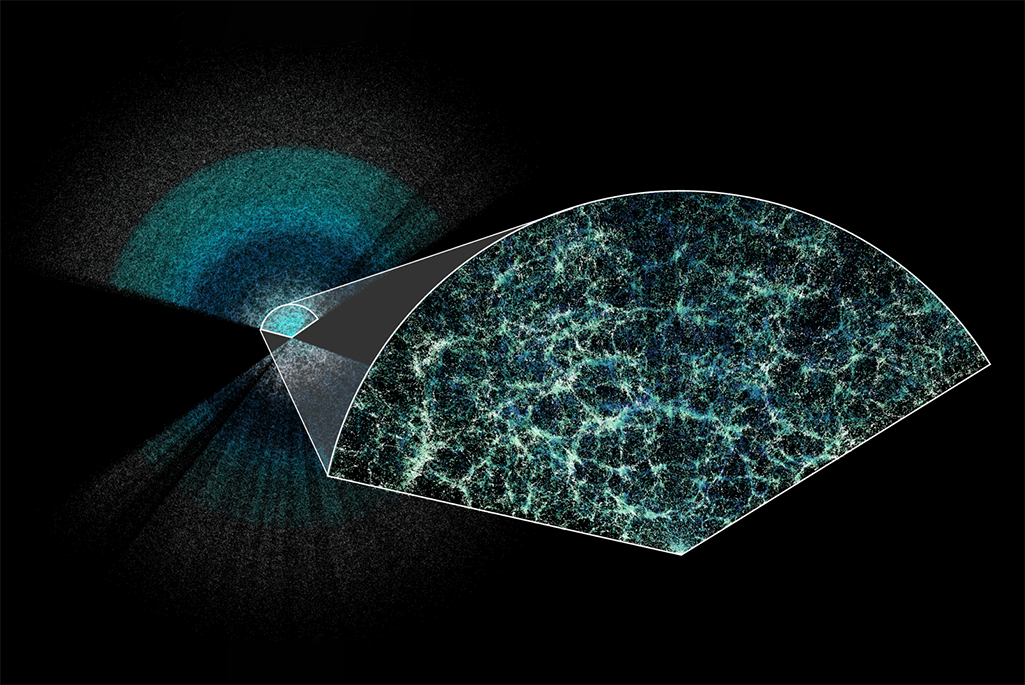
P.S. Here’s a nice graphic showing the cosmic web showing revealed by the DESI survey:
It’s my last morning in Phoenix and since I was too busy at the weekend to post the usual update from the Open Journal of Astrophysics I will do so now, before I go to the Airport for my flight home.
Looking at the workflow I see that there is a considerable backlog of papers that have been accepted but are waiting for the authors to put the final version on arXiv. As a result there is only one paper to report for last week, being the 17th paper in Volume 7 (2024) and the 132nd altogether; it was published on March 6 2024. I expect more soon!
The authors are seven in number: Emmanuel Frion (University of Helsinki, Finland, and Western University, Canada); David Camarena (University of New Mexico, USA); Leonardo Giani (University of Queensland, Australia); Tays Miranda (University of Helsinki and University of Jyväskylä, both in Finland); Daniele Bertacca (Università degli Studi di Padova, Italy); Valerio Marra (Universidade Federal do Espírito Santo, Brazil and Osservatorio Astronomico di Trieste, Italy);
and Oliver F. Piattella (Università degli Studi dell’Insubria, Como, Italy).
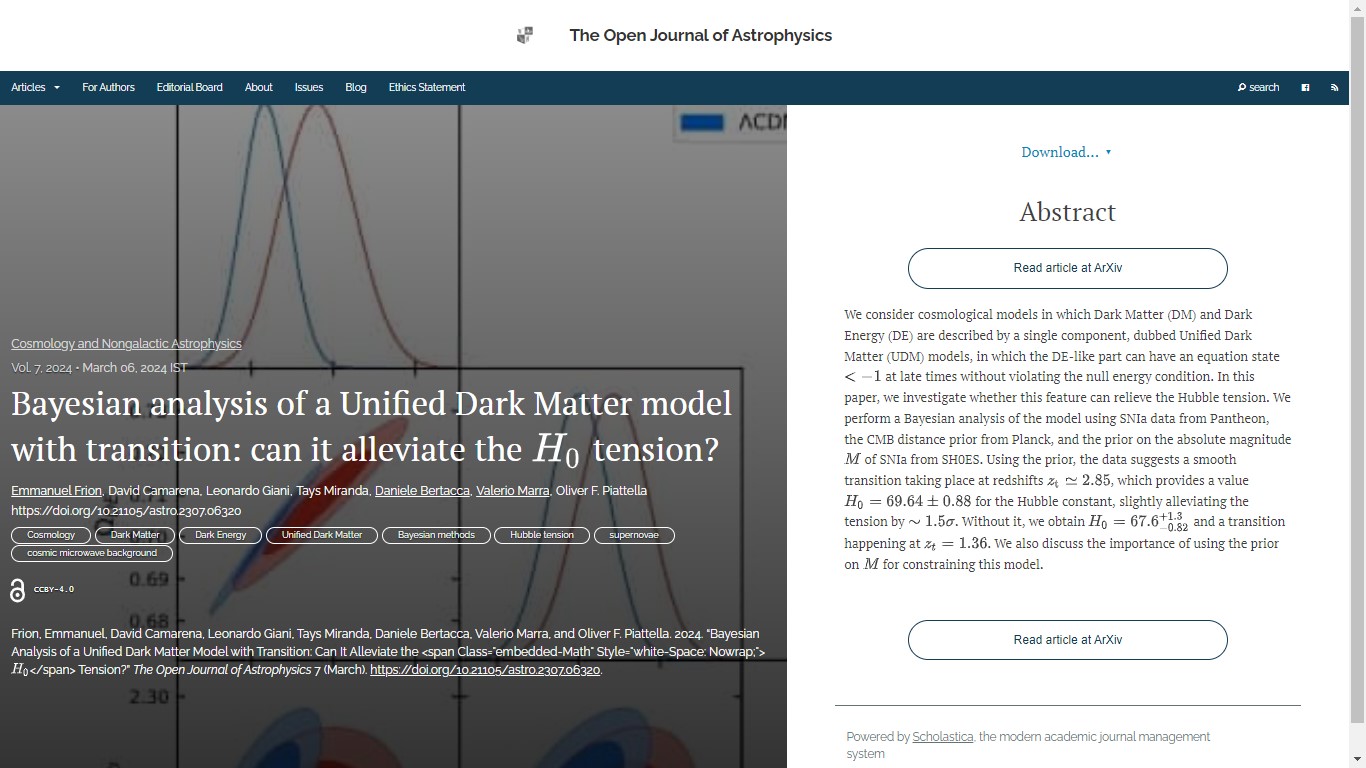
Here is the overlay of the paper containing the abstract:
You can click on the image of the overlay to make it larger should you wish to do so. You can also find the officially accepted version of the paper on the arXiv here.
I just saw a press release about new results from the Dark Energy Survey relating to measurements of baryon acoustic oscillations. These are basically the residue of the oscillations seen in the power spectrum of the cosmic microwave background (CMB) temperature distribution imprinted on the galaxy distribution. They are somewhat less obvious that the primordial temperature fluctuations because the growth of structure produces a much larger background but they are measurable (and indeed are one of the things Euclid will measure).
Anyway, there is a very nice detailed description in the press release and you can find the preprint of the work in full on arXiv here, so I’ll just show the key figure:
The effective redshift of this measurement is about 0.85; in the CMB the redshift is about 1000. You can see that there is a characteristic scale but it is slightly offset from that predicted using the standard ΛCDM model based on the Planck determination of cosmological parameters. One has to be careful in interpreting this diagram because it is determined using autocorrelation functions; the errors on different bins are therefore correlated, not statistically independent. They are also, as you can see, quite large. Nonetheless, it’s a tantalizing result…
Some important cosmological results have just been announced by the Dark Energy Survey Collaboration. I haven’t had time to go through them in detail but I thought it was worth doing a quick post here to draw attention to them. The results concern a sample of Type Ia supernovae (SN Ia) discovered during the full five years of the Dark Energy Survey (DES) Supernova Program, which contains about 1500 new Type Ia Supernovae that can be used for cosmological analysis. The paper is available on the arXiv here; the abstract is:
The key numerical result of interest is the equation-of-state parameter for dark energy, designated by w, which occurs in the (assumed) relationship between pressure p and effective mass density ρ of the form p=wρc2. A cosmological constant – which for many cosmologists is the default assumption for the form of dark energy – has w=-1 as I explained here. This parameter is one of the things Euclid is going to try to measure, using different methods. Interestingly, the DES results are offset a bit from the value of -1, but with quite a large uncertainty.
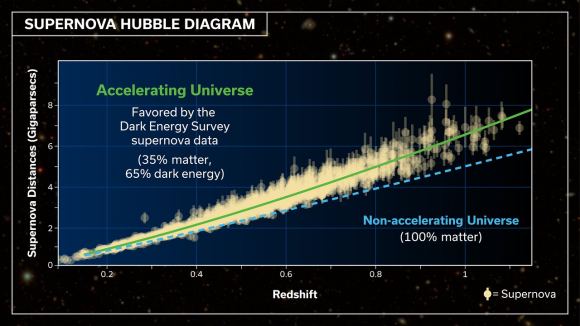
While the results for the equation-of-state parameter are somewhat equivocal, one thing that is clear is that the new SNIa measurements do confirm the existence of dark energy, in that the data can only be described by models with accelerating expansion, as dramatically demonstrated in this Figure:
I think this figure – or versions of it – will very rapidly appear in public talks on cosmology, including my own!
So today’s the day. The first science-quality observations from Euclid have now been released to the public. The official press release is here, and the press conference showcasing the new observations can be viewed here:
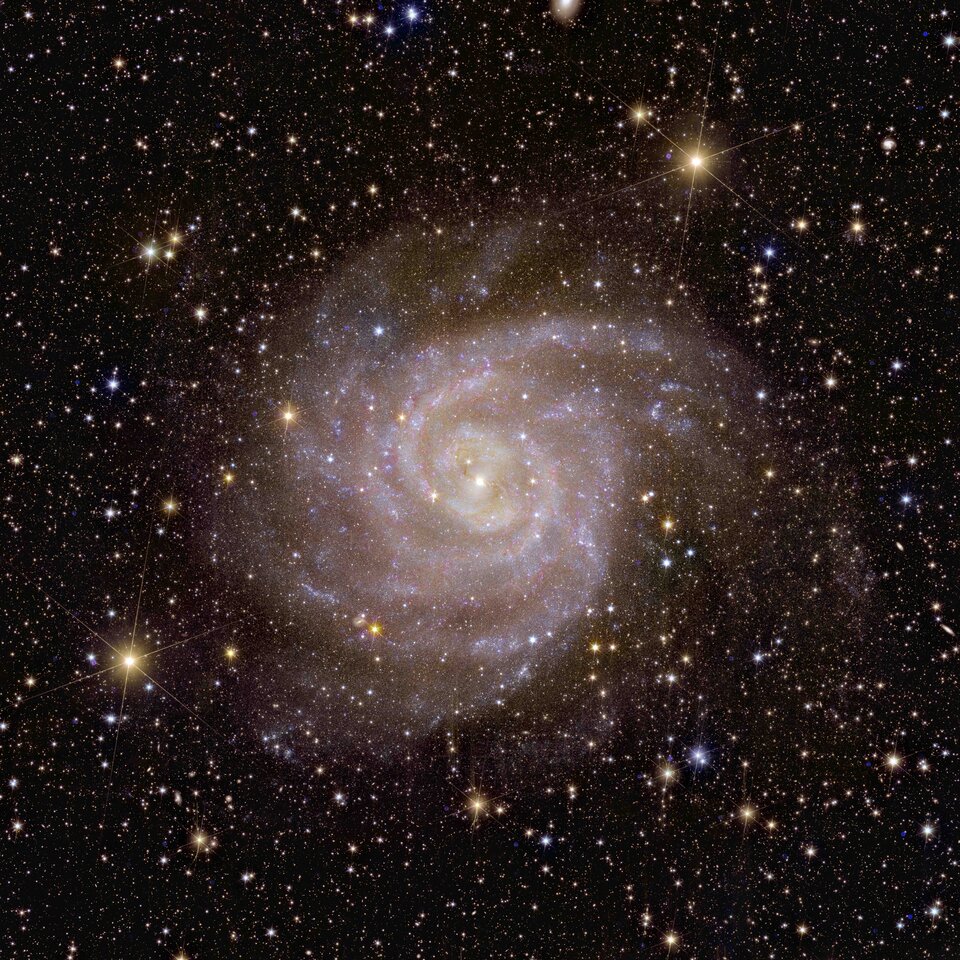
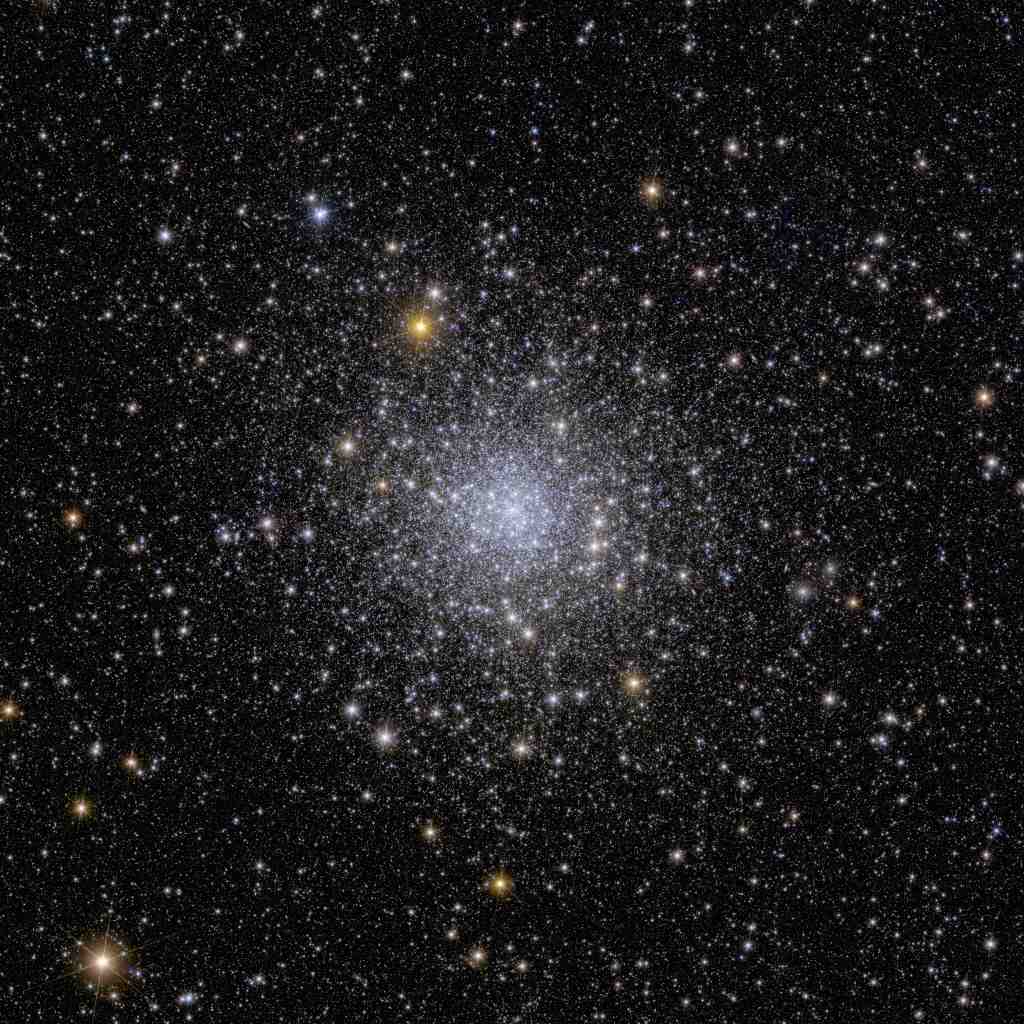
The images themselves can be found in this repository. In summary they are (in no particular order):
IC 342NGC 6822Horsehead NebulaNGC 6397Perseus Cluster
And here they are – you can click on them to make them bigger:
A few points of my own.
First, it is important to realise that these observations are not part of the full Euclid survey, which will start in early 2024, but were produced during the process of verification the capabilities of the telescope and detectors. They are all very short exposures, taking up less than a day to make all the images, but they demonstrate that Euclid is performing very well indeed!
Euclid is designed to achieve very sharp optical quality across a very wide field of view, so its strength is that it will produce beautiful images like these not only of a handful of objects but for billions. We need to map very large numbers of galaxies to perform the careful analysis needed to extract information about dark matter and dark energy, which is the main goal of the mission.
While these images are, in a sense, by-products of the Euclid mission, not specifically related to the main aims of the mission, they are interesting in their own right and there are proper scientific papers related to each of the five sets of observations released today. We expect many more non-cosmological spinoffs like these as the mission goes on.
There were some problems during the commissioning of the instruments carried by Euclid, the most serious of which was an issue with the Fine Guidance Sensor used to control the pointing of the telescope. This has been fixed by a software update and everything is now functioning well, as today’s new results confirm!
Here’s a little video update to accompany the news that, as of yesterday (28th July), the European Space Agency’s Euclid spacecraft has reached its orbit around L2, the second Lagrange Point of the Earth-Sun system:
More news is on the way. Commissioning of the instruments is now complete and the telescope is in focus. On Monday 31st July, ESA will release the first actual images from the Euclid telescope!
With the launch of the Euclid spacecraft due next month, and the last Euclid Consortium meeting before the launch coming up in just over a week, I thought I’d share another one of the nice little taster videos prepared by the European Space Agency:
The Euclid Mission has long been “sold” as a mission to probe the nature of Dark Energy in much the same way that the Large Hardon Collider was often portrayed as an experiment designed to find the Higgs boson. But as this video makes clear, testing theories of dark energy is just one of the tasks Euclid will undertake, and it may well be the case that in years to come the mission is remembered for something other than dark energy. On the other hand, big science like this needs big money, and making the specific case for a single big ticket item is an easier way to persuade funding agencies to cough up the dosh than for a general “let’s do a lot of things we’re sure we’ll fin something” approach. These thoughts triggered a memory of an old post of mine about Alfred Hitchcock so, with apologies for repeating something I have blogged about before, here’s an updated version.
Unpick the plot of any thriller or suspense movie and the chances are that somewhere within it you will find lurking at least one MacGuffin. This might be a tangible thing, such the eponymous sculpture of a Falcon in the archetypal noir classic The Maltese Falcon or it may be rather nebulous, like the “top secret plans” in Hitchcock’s The Thirty Nine Steps. Its true character may be never fully revealed, such as in the case of the glowing contents of the briefcase in Pulp Fiction, which is a classic example of the “undisclosed object” type of MacGuffin, or it may be scarily obvious, like a doomsday machine or some other “Big Dumb Object” you might find in a science fiction thriller. It may even not be a real thing at all. It could be an event or an idea or even something that doesn’t exist in any real sense at all, such the fictitious decoy character George Kaplan in North by Northwest. In fact North by North West is an example of a movie with more than one MacGuffin. Its convoluted plot involves espionage and the smuggling of what is only cursorily described as “government secrets”. These are the main MacGuffin; George Kaplan is a sort of sub-MacGuffin. But although this is behind the whole story, it is the emerging romance, accidental betrayal and frantic rescue involving the lead characters played by Cary Grant and Eve Marie Saint that really engages the characters and the audience as the film gathers pace. The MacGuffin is a trigger, but it soon fades into the background as other factors take over.
Whatever it is real or is not, the MacGuffin is the thing responsible for kick-starting the plot. It makes the characters embark upon the course of action they take as the tale begins to unfold. This plot device was particularly beloved by Alfred Hitchcock (who was responsible for introducing the word to the film industry). Hitchcock was however always at pains to ensure that the MacGuffin never played as an important a role in the mind of the audience as it did for the protagonists. As the plot twists and turns – as it usually does in such films – and its own momentum carries the story forward, the importance of the MacGuffin tends to fade, and by the end we have usually often forgotten all about it. Hitchcock’s movies rarely bother to explain their MacGuffin(s) in much detail and they often confuse the issue even further by mixing genuine MacGuffins with mere red herrings.
Here is the man himself explaining the concept at the beginning of this clip. (The rest of the interview is also enjoyable, convering such diverse topics as laxatives, ravens and nudity..)
There’s nothing particular new about the idea of a MacGuffin. I suppose the ultimate example is the Holy Grail in the tales of King Arthur and the Knights of the Round Table and, much more recently, the Da Vinci Code. The original Grail itself is basically a peg on which to hang a series of otherwise disconnected stories. It is barely mentioned once each individual story has started and, of course, is never found.
Physicists are fond of describing things as “The Holy Grail” of their subject, such as the Higgs Boson or gravitational waves. This always seemed to me to be an unfortunate description, as the Grail quest consumed a huge amount of resources in a predictably fruitless hunt for something whose significance could be seen to be dubious at the outset. The MacGuffin Effect nevertheless continues to reveal itself in science, although in different forms to those found in Hollywood.
The Large Hadron Collider (LHC), switched on to the accompaniment of great fanfares a few years ago, provides a nice example of how the MacGuffin actually works pretty much backwards in the world of Big Science. To the public, the LHC was built to detect the Higgs Boson, a hypothetical beastie introduced to account for the masses of other particles. If it exists the high-energy collisions engineered by LHC should (and did) reveal its presence. The Higgs Boson is thus the LHC’s own MacGuffin. Or at least it would be if it were really the reason why LHC has been built. In fact there are dozens of experiments at CERN and many of them have very different motivations from the quest for the Higgs, such as evidence for supersymmetry.
Particle physicists are not daft, however, and they realized that the public and, perhaps more importantly, government funding agencies need to have a really big hook to hang such a big bag of money on. Hence the emergence of the Higgs as a sort of master MacGuffin, concocted specifically for public consumption, which is much more effective politically than the plethora of mini-MacGuffins which, to be honest, would be a fairer description of the real state of affairs.
While particle physicists might pretend to be doing cosmology, we astrophysicists have to contend with MacGuffins of our own. One of the most important discoveries we have made about the Universe in the last decade is that its expansion seems to be accelerating. Since gravity usually tugs on things and makes them slow down, the only explanation that we’ve thought of for this perverse situation is that there is something out there in empty space that pushes rather than pulls. This has various possible names, but Dark Energy is probably the most popular, adding an appropriately noirish edge to this particular MacGuffin. It has even taken over in prominence from its much older relative, Dark Matter, although that one is still very much around.
We have very little idea what Dark Energy is, where it comes from, or how it relates to other forms of energy with which we are more familiar, so observational astronomers have jumped in with various grandiose strategies to find out more about it. This has spawned a booming industry in surveys of the distant Universe, all aimed ostensibly at unravelling the mystery of the Dark Energy. It seems that to get any funding at all for cosmology these days you have to sprinkle the phrase “Dark Energy” liberally throughout your grant applications.
The old-fashioned “observational” way of doing astronomy – by looking at things hard enough and long enough until something exciting appears (which it does with surprising regularity) – has been replaced by a more “experimental” approach, more like that of the LHC. We can no longer do deep surveys of galaxies to find out what’s out there. We have to do it “to constrain models of Dark Energy”. This is just one example of the (not entirely positive) influence that particle physics has had on astronomy in recent times.
Whatever the motivation for doing these projects now, they will undoubtedly lead to many new discoveries, so I’m not for one minute arguing that the case for, e.g, the Euclid mission is misguided. I’m just saying that in my opinion there will never be a real solution of the Dark Energy problem until it is understood much better at a conceptual level, and that will probably mean major revisions of our theories of both gravity and matter. I venture to speculate that in twenty years or so people will look back on the obsession with Dark Energy with some amusement, as our theoretical language will have moved on sufficiently to make it seem irrelevant. That’s how it goes with MacGuffins. In the end, even the Maltese Falcon turned out to be a fake, but what an adventure it was along the way!
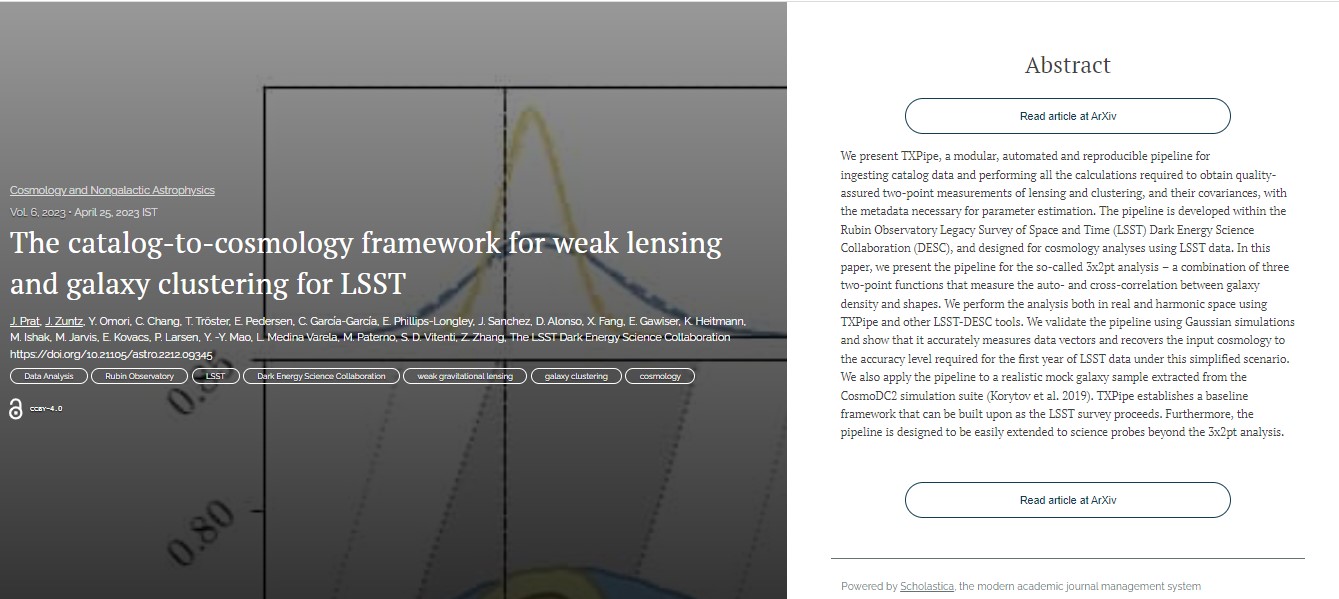
It’s time once more to announce a new paper at the Open Journal of Astrophysics. The latest paper is the 13th paper so far in Volume 6 (2023) and the 78th in all. This one is another for the folder marked Cosmology and NonGalactic Astrophysics and its title is “The catalog-to-cosmology framework for weak lensing and galaxy clustering for LSST”.
The lead author is Judit Prat of the University of Chicago (Illinois, USA) and there are 21 co-authors from elsewhere in the USA and in the UK. The paper is written on behalf of the LSST Dark Energy Science Collaboration (LSST DESC), which is the international science collaboration that will make high accuracy measurements of fundamental cosmological parameters using data from the Rubin Observatory Legacy Survey of Space and Time (LSST). The OJAp has published a number of papers involving LSST DESC, and I’m very happy that such an important consortium has chosen to publish with us.
Here is a screen grab of the overlay which includes the abstract:
You can click on the image of the overlay to make it larger should you wish to do so. You can find the officially accepted version of the paper on the arXiv here.
The views presented here are personal and not necessarily those of my employer (or anyone else for that matter).
Feel free to comment on any of the posts on this blog but comments may be moderated; anonymous comments and any considered by me to be vexatious and/or abusive and/or defamatory will not be accepted. I do not necessarily endorse, support, sanction, encourage, verify or agree with the opinions or statements of any information or other content in the comments on this site and do not in any way guarantee their accuracy or reliability.