Archive for Diamond Open Access

Weekly Update from the Open Journal of Astrophysics – 09/08/2025

Posted in OJAp Papers, Open Access, The Universe and Stuff with tags , , , , , , , , , , , , , , , , , , , , , on August 9, 2025 by telescoper

It’s Saturday morning so, once again, it’s time for an update of papers published at the Open Journal of Astrophysics. Since the last update we have published four new papers, which brings the number in Volume 8 (2025) up to 114, and the total so far published by OJAp up to 349.

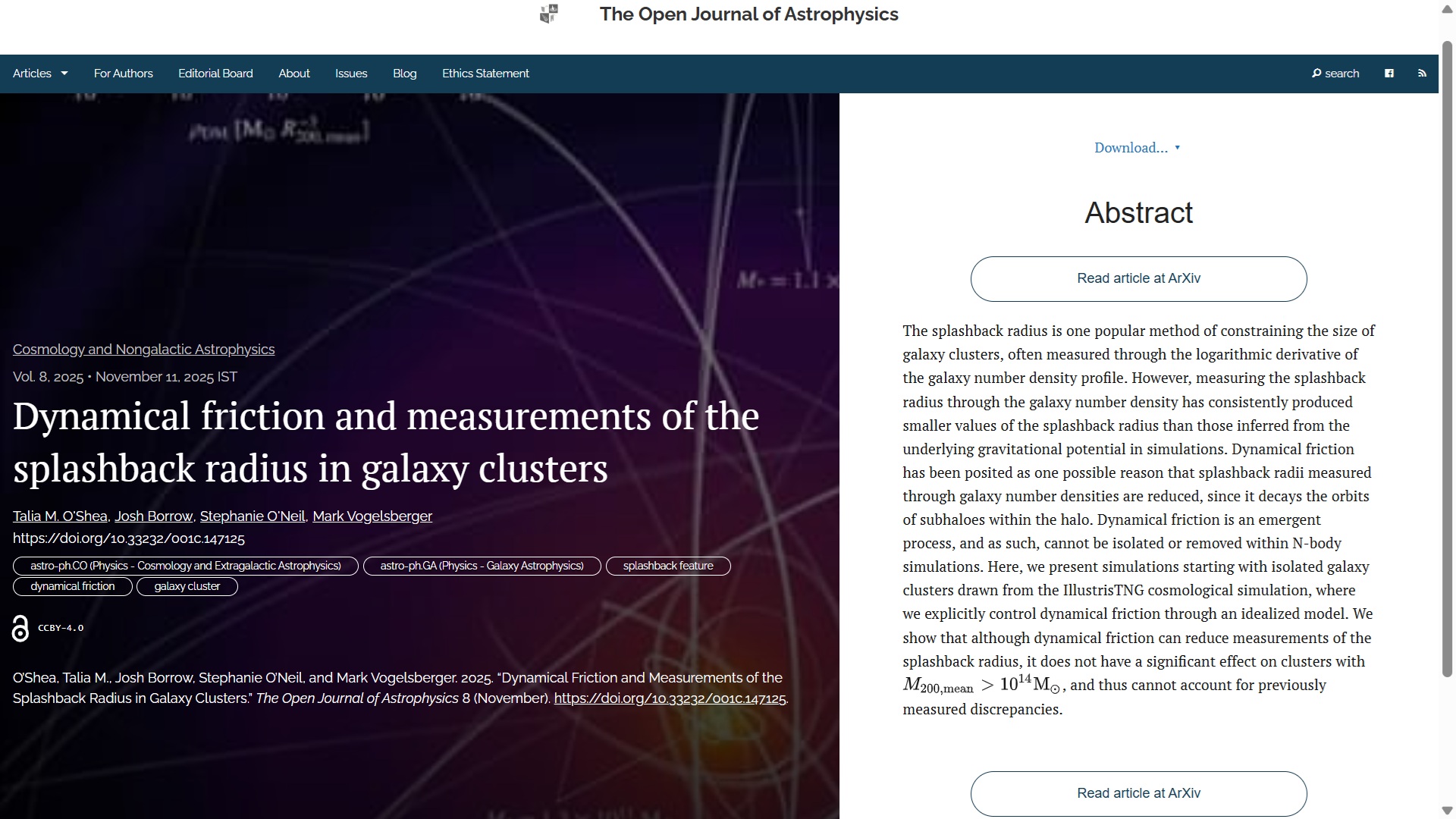
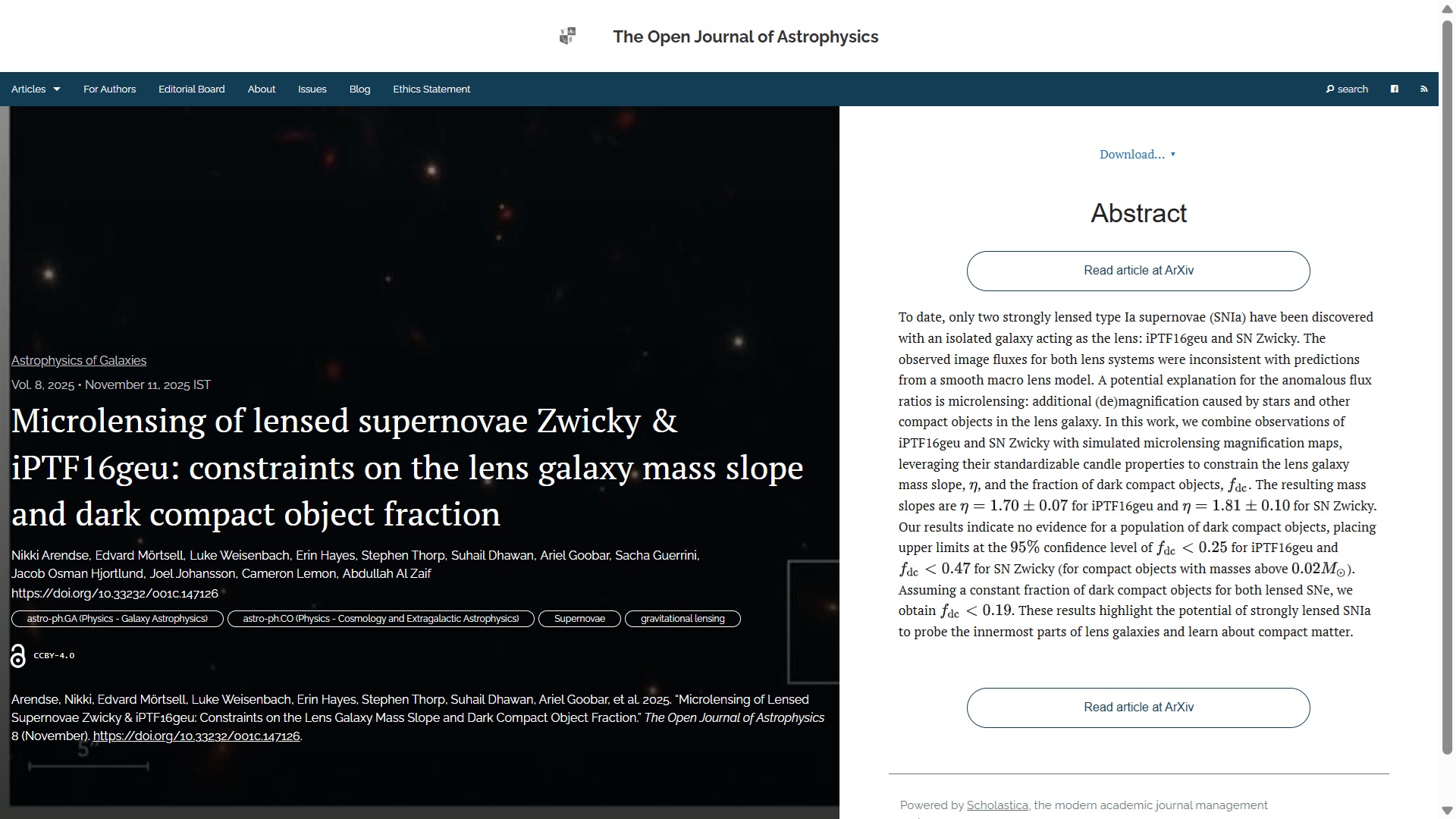
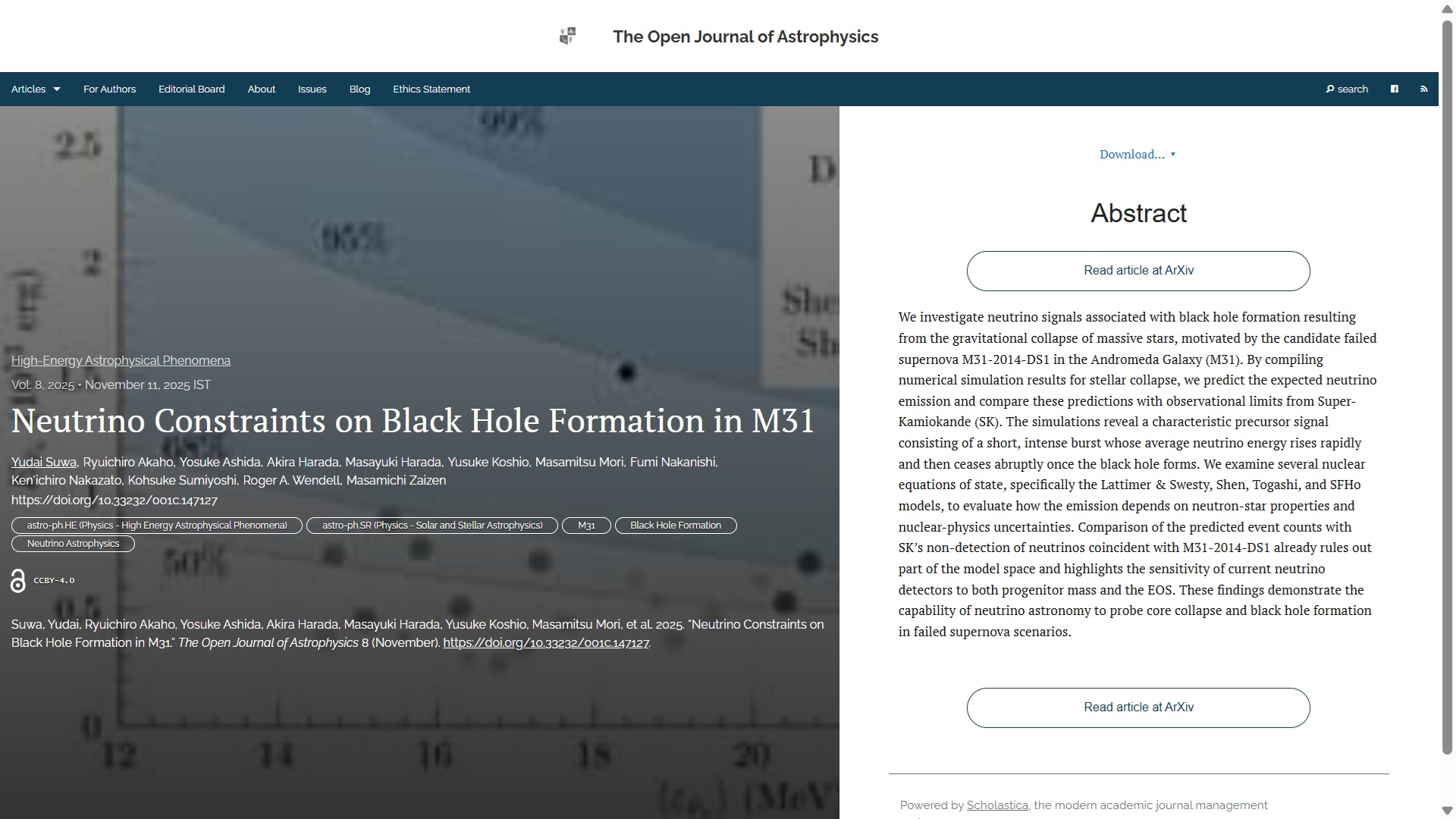
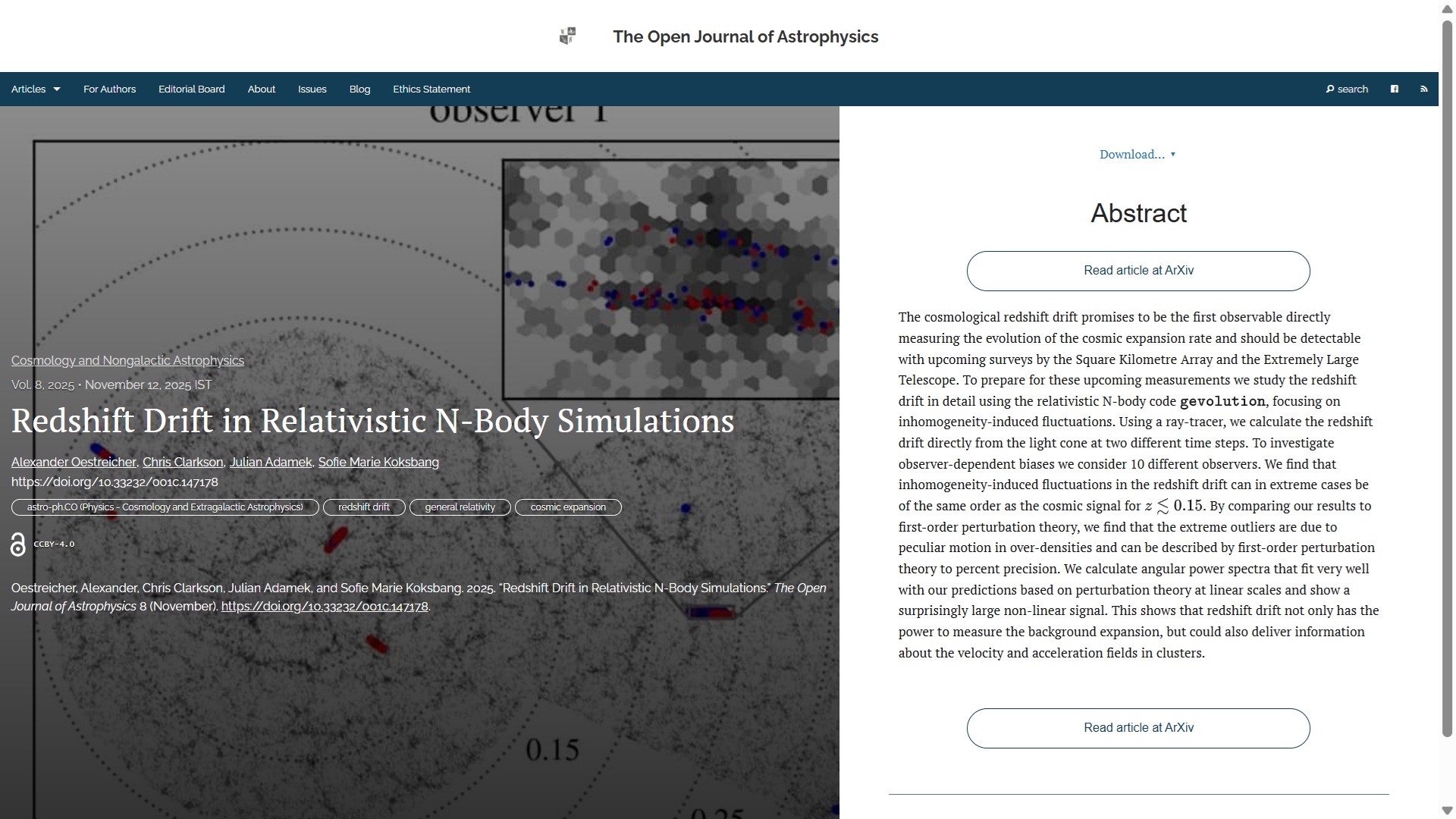
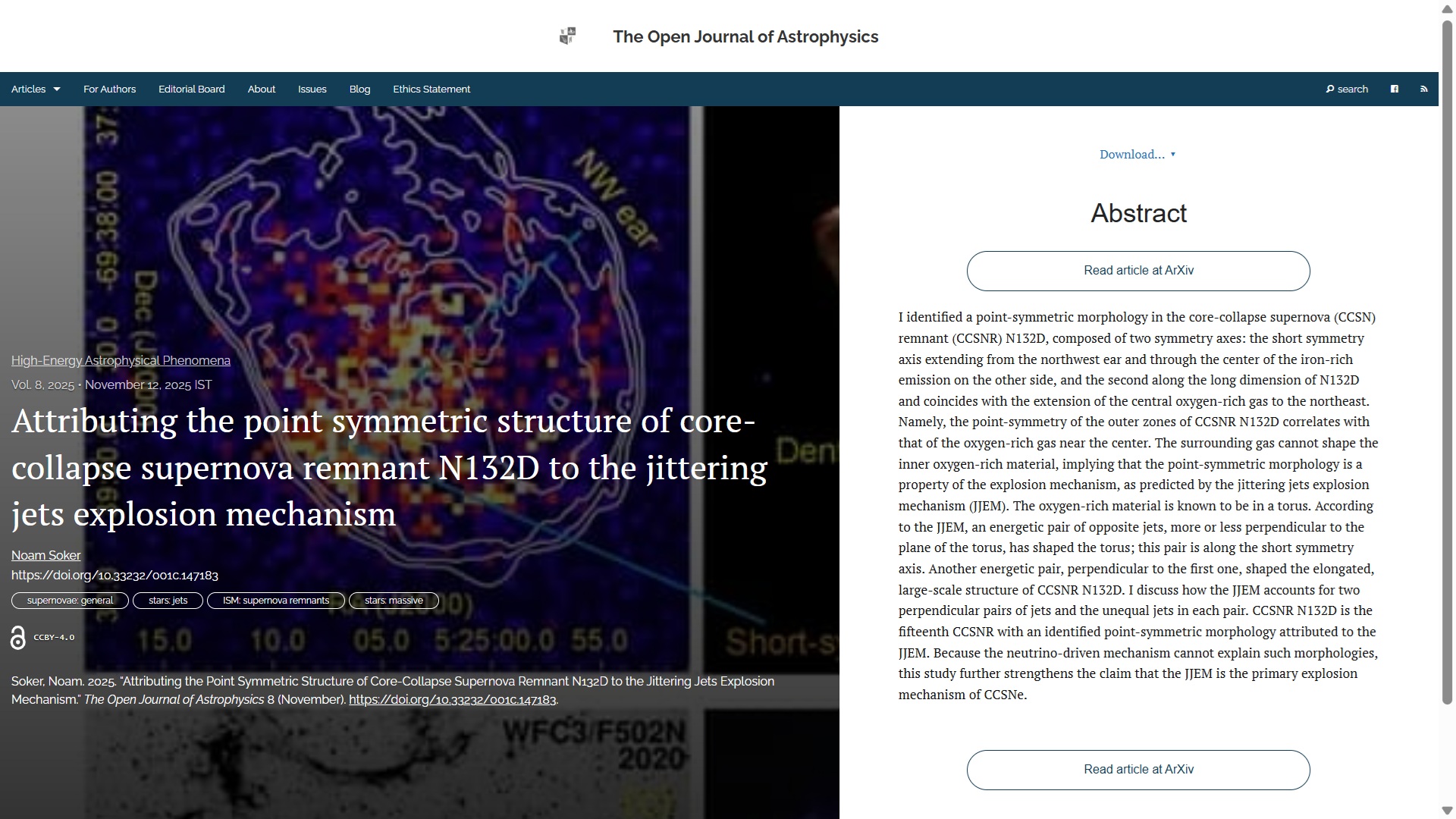
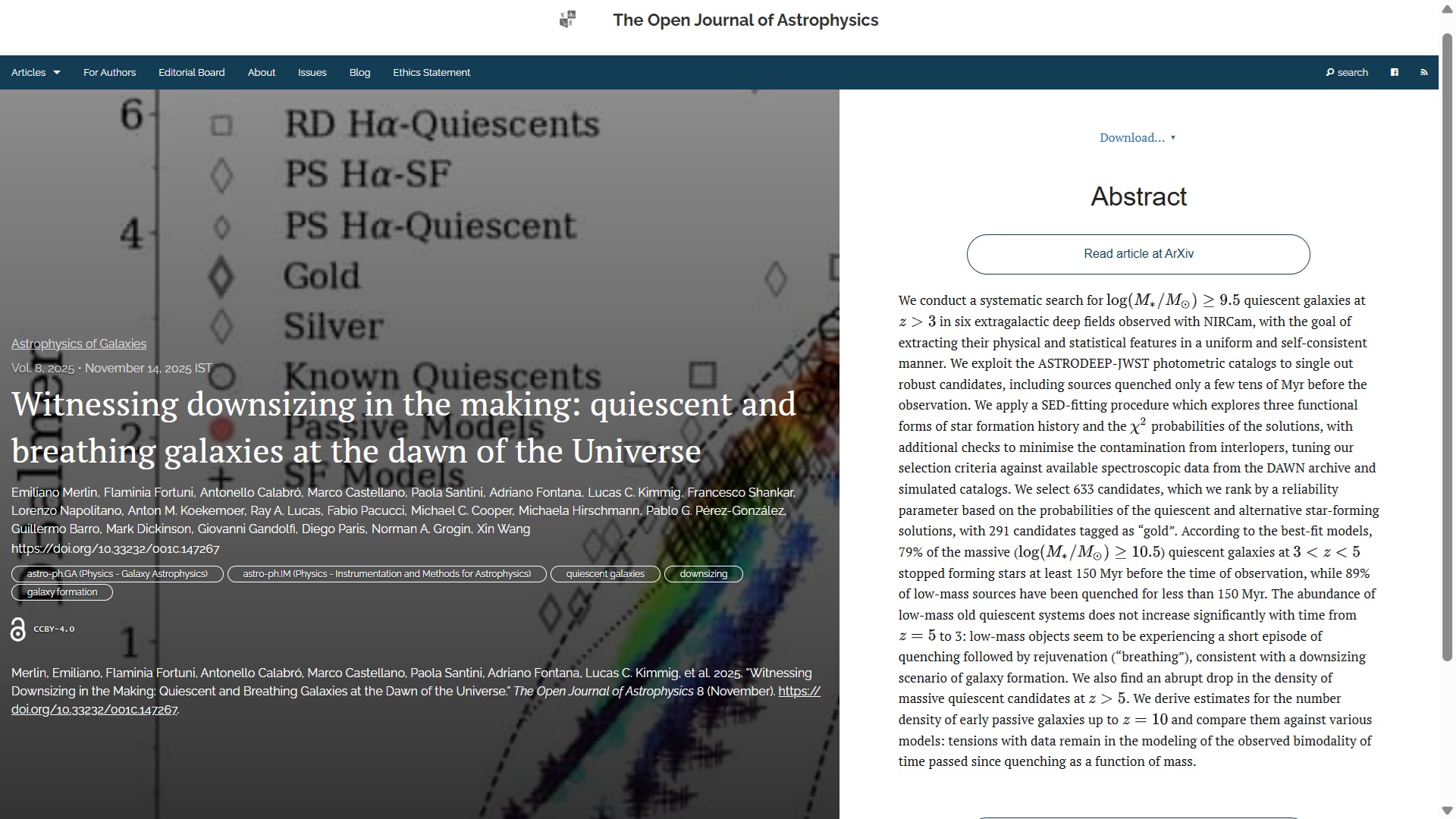
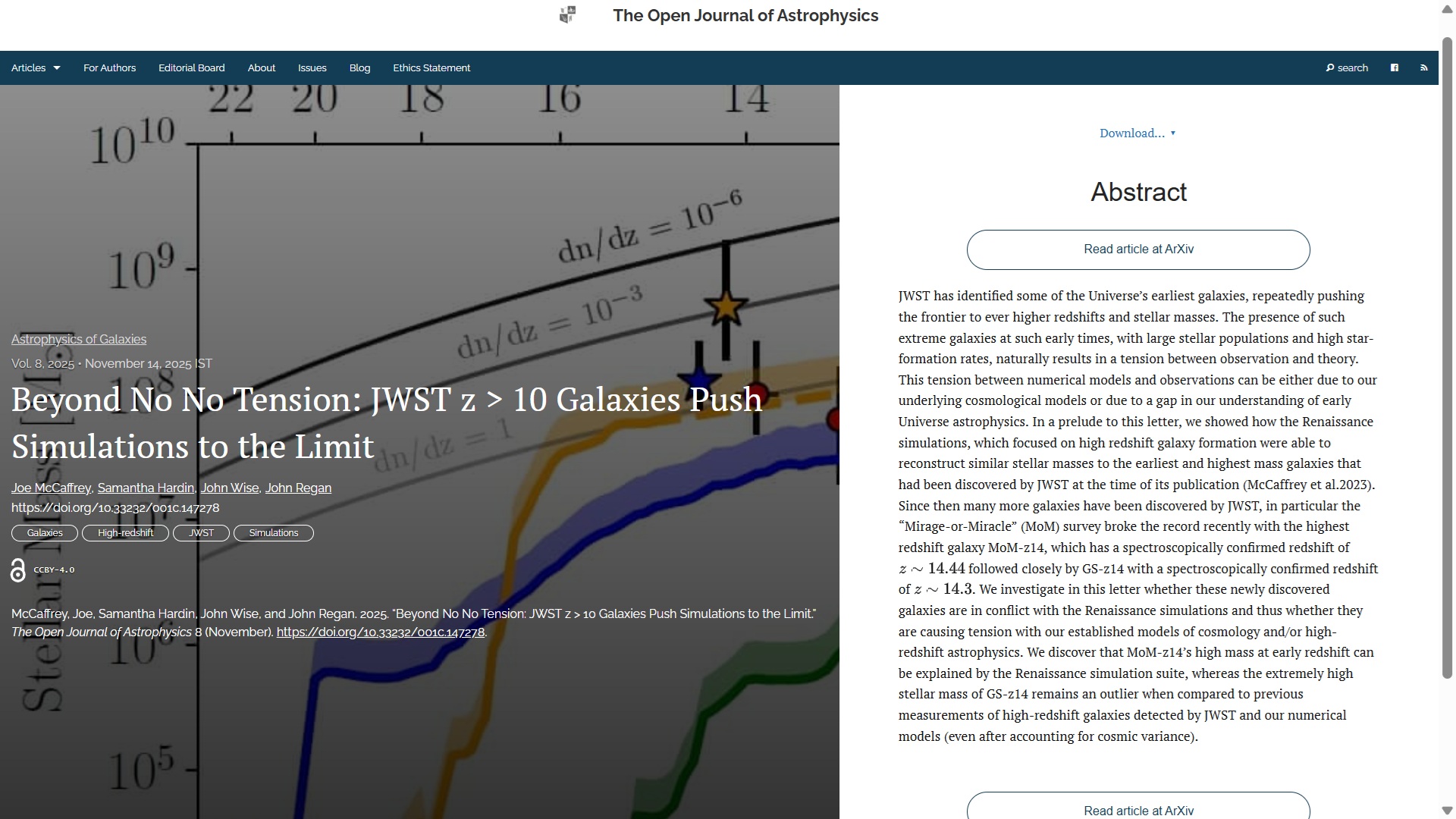
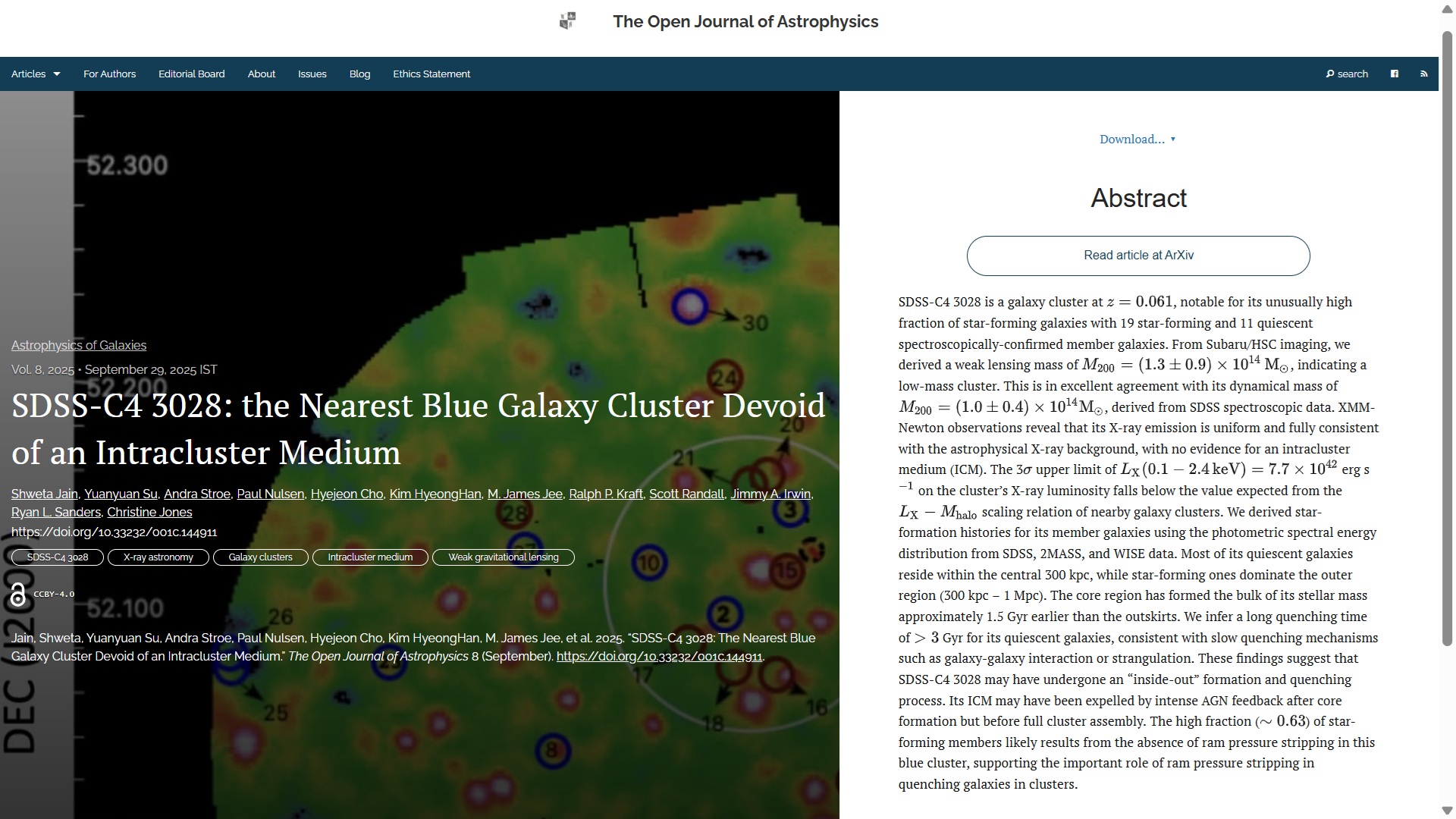
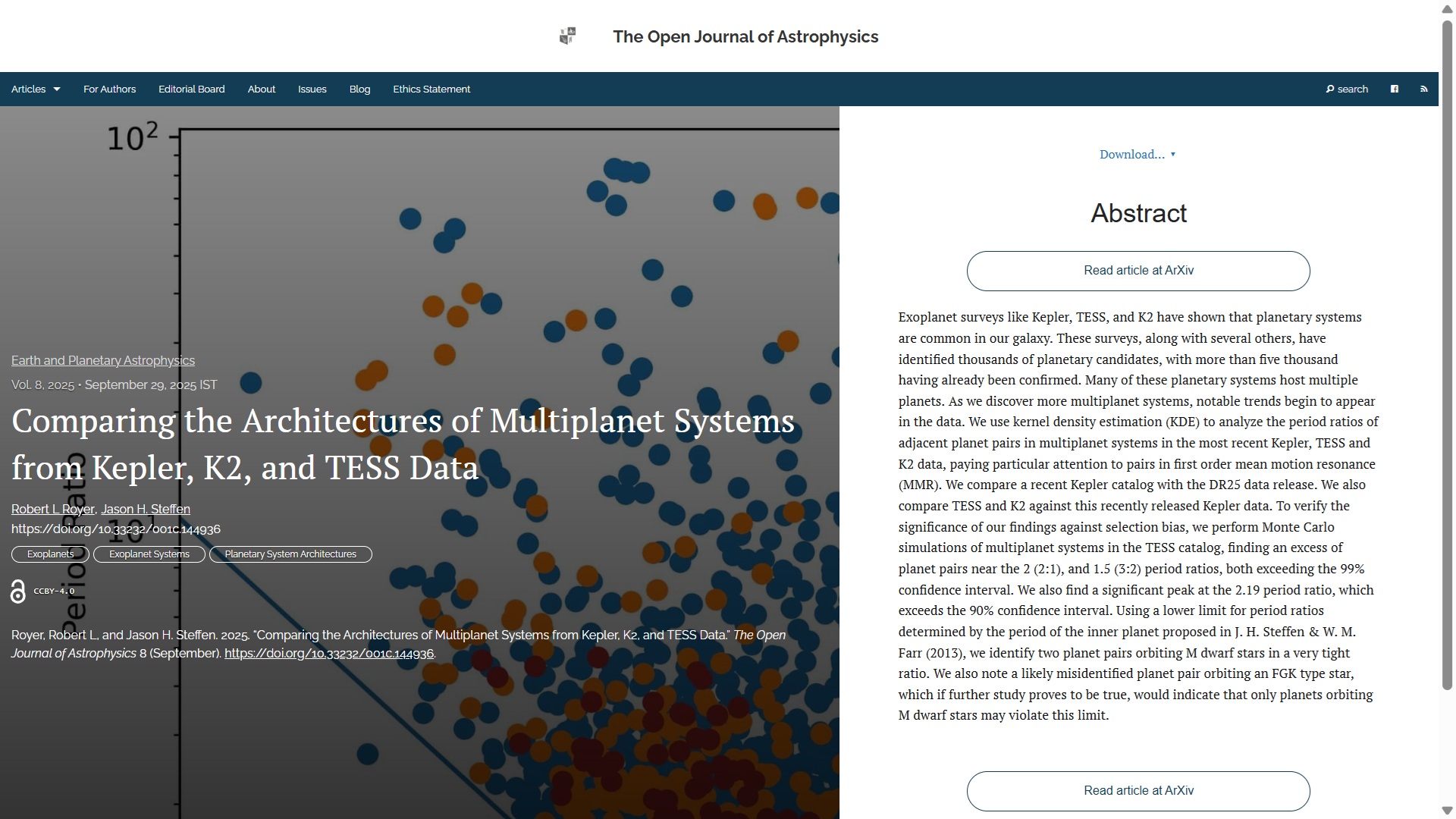
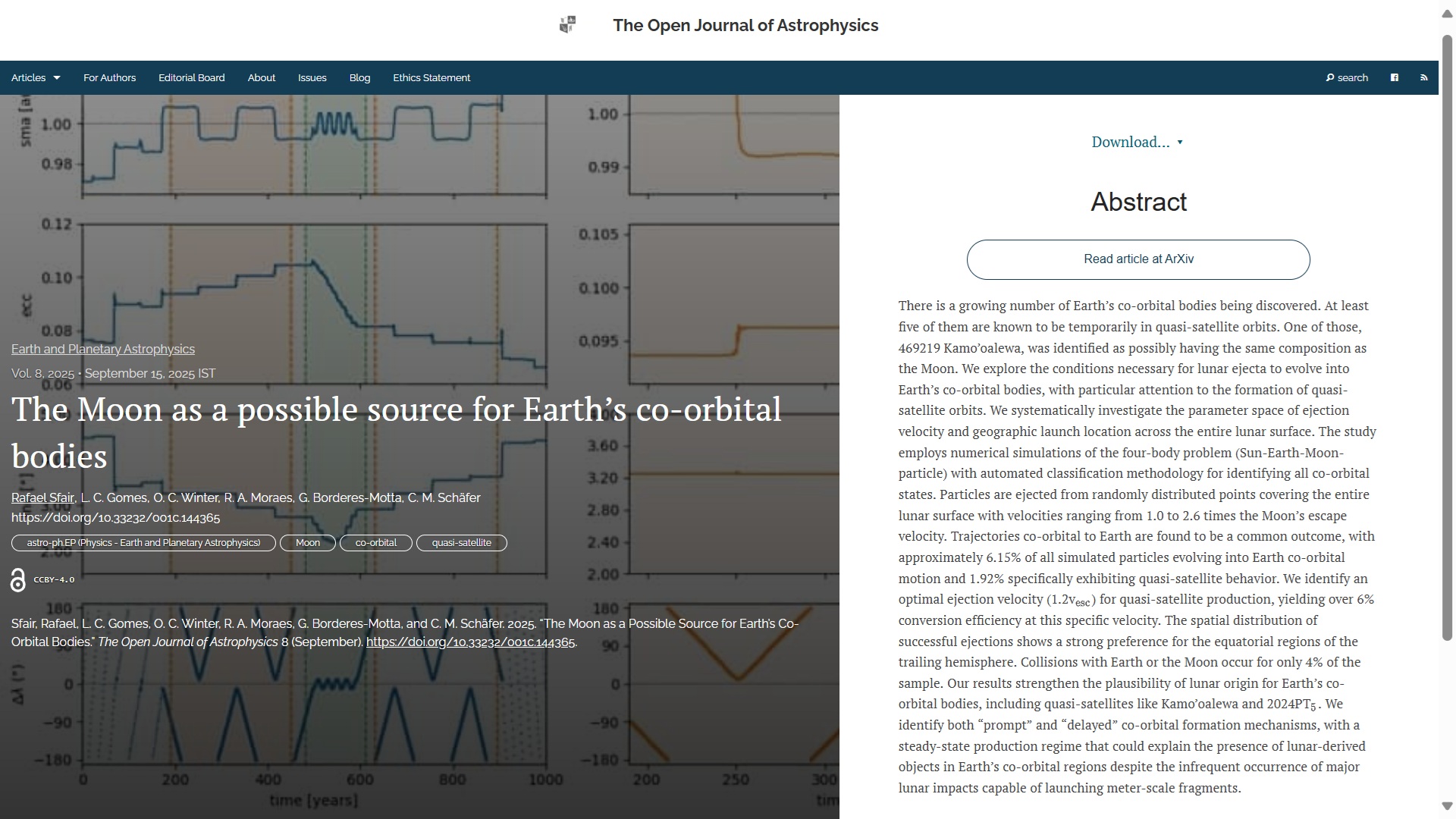
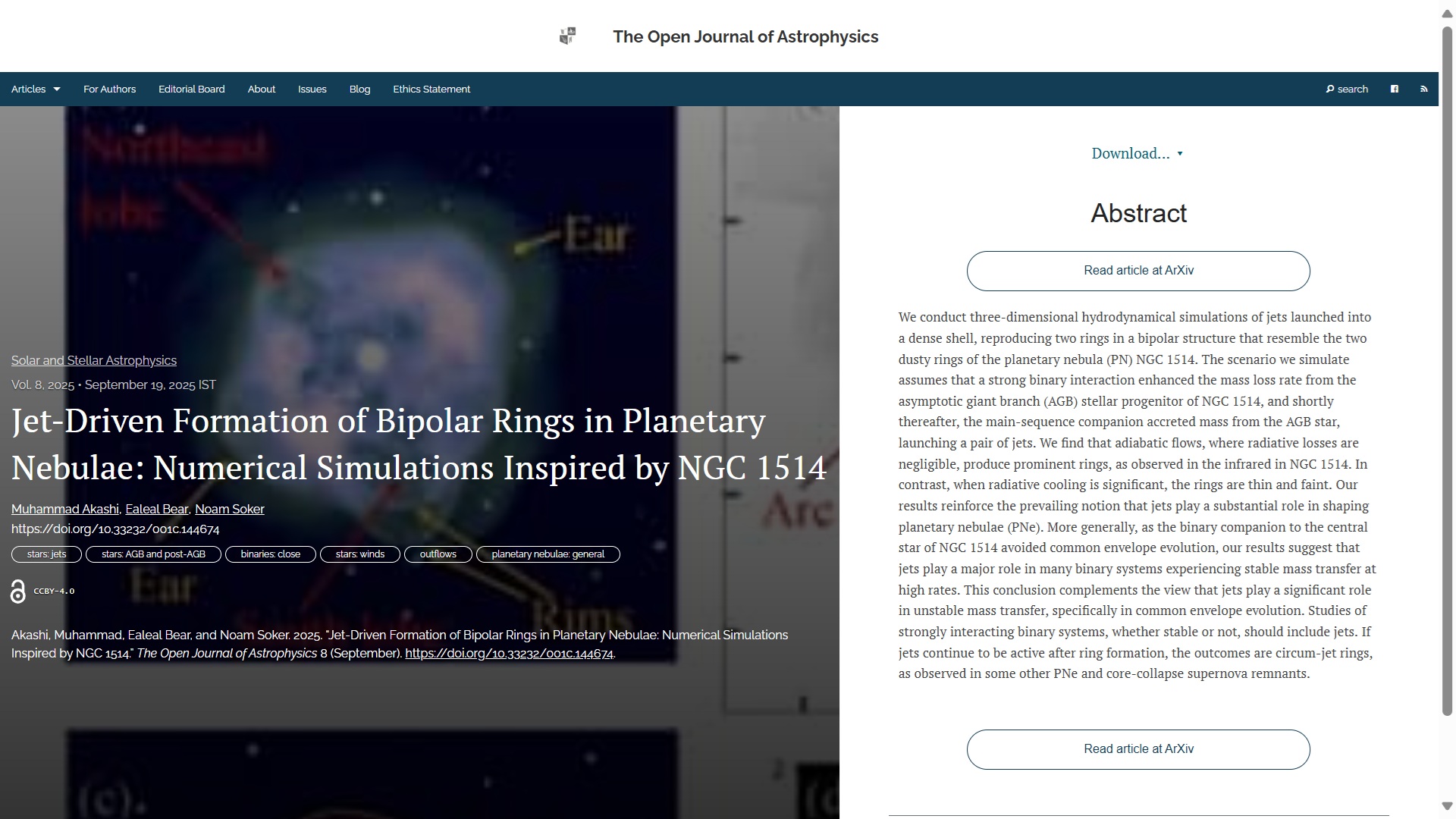
The papers published this week, with their overlays, are as follows. You can click on the images of the overlays to make them larger should you wish to do so.

The first paper to report is “Caught in the Act of Quenching? – A Population of Post-Starburst Ultra-Diffuse Galaxies” by Loraine Sandoval Ascencio & M. C. Cooper (UC Irvine), Dennis Zaritsky, Richard Donnerstein & Donghyeon J. Khim (U. Arizona) and Devontae C. Baxter (UC San Diego). This paper was puvblished on Monday 4th August and is in the folder marked Astrophysics of Galaxies. It discusses a sample of Ultra-Diffuse Galaxies (UDGs) found to be post-starburst galaxies through spectroscopic analysis analysis of candidates selected from the Systematically Measuring Ultra-Diffuse Galaxies (SMUDGes) program.

The overlay is here:


The officially-accepted version can be found on arXiv here.

Next one up, published on Tuesday 5th August, in the folder Cosmology and Nongalactic Astrophysics, is “Damping Wing-Like Features in the Spectra of High Redshift Quasars: a Challenge for Fully-Coupled Simulations” by Nick Gnedin & Hanjue Zhu (University of Chicago, USA).  This paper presents a discussion of the difficulties that cosmological radiation transfer codes have in accounting for the existence of “neutral islands” in the universe at relatively low redshifts.

The overlay is here:


You can find the officially accepted version of the paper on arXiv here.

The third paper of the week is “Spectroscopic Analysis of Pictor II: a very low metallicity ultra-faint dwarf galaxy bound to the Large Magellanic Cloud” by Andrew Pace (U. Virginia, USA) and 32 others based in the USA, UK, Canada, Chile and Spain. This one was also published on Tuesday 5th August but in the folder Astrophysics of Galaxies. It describes Magellan/IMACS and Magellan/MIKE spectroscopy of the ultra-faint dwarf (UFD) galaxy Pictor II, which is located only 12 kpc from the Large Magellanic Cloud (LMC).

The overlay is here:


The final version is on arXiv here.

The fourth, and final, paper of the week, also published on Thursday 7th August, is “ASASSN-24fw: An 8-month long, 4.1 mag, optically achromatic and polarized dimming event” by Raquel Forés-Toribio (Ohio State University) and 22 others based in the USA, Austria, Chile and Australia. It is published in the folder Solar and Stellar Astrophysics, and it presents an observational study of an unusual dimming event likely to have been caused by eclipsing of a binary system by a dusty disk.

Here is the overlay:

You can find the officially-accepted version on arXiv here.

And that’s all the papers for this week. I’ll do another update next Saturday.

P.S. For those of you who missed the post I did earlier in the week, I have been looking at the accounts for the Open Journal of Astrophysics and can confirm that the cost to us per paper is less than $30 and will reduce with scale. We expect to publish around 180 papers in 2025 for which the total cost incurred by OJAp will be around $5000. Obviously if we increase by a factor, say, ten then that amount would become significant so we are taking steps to secure additional funding in the event that happens.

Weekly Update from the Open Journal of Astrophysics – 02/08/2025

Posted in OJAp Papers, Open Access, The Universe and Stuff with tags , , , , , , , , , , , , , , , , , , , , , , , , , , , , on August 2, 2025 by telescoper

It’s Saturday morning again, and it’s the start of a new month, so it’s time for an update of papers published at the Open Journal of Astrophysics. Since the last update we have published five new papers, which brings the number in Volume 8 (2025) up to 110, and the total so far published by OJAp up to 345. I expect we’ll the total number we published last year (120) sometime this month. I predict that by the end of this year we will have published around 180 papers in Volume 8 and around 400 altogether.

The papers published this week, with their overlays, are as follows. You can click on the images of the overlays to make them larger should you wish to do so.

The first paper to report is “The matter with(in) CPL” by Leonardo Giani (U. Queensland, Australia), Rodrigo Von Marttens (Universidade Federal da Bahia, Brazil) and Oliver Fabio Piattella (Universita degli Studi dell’Insubria, Italy). This was published on Monday 29th July 2025 in the folder Cosmology and Nongalactic Astrophysics. This article presents a new parameterization of the standard model and its implications for the interpretation of cosmological observations.

The overlay is here:


The officially-accepted version can be found on arXiv here.

The second paper of the week, published on Tuesday 30th July in the folder Instrumentation and Methods for Astrophysics, is “An automated method for finding the most distant quasars” by Lena Lenz, Daniel Mortlock, Boris Leistedt & Rhys Barnett (Imperial College London, UK) and Paul C. Hewett (U. Cambridge, UK)”.  This paper presents an automated, reproduceable and objective high-redshift quasar selection pipeline, tested on simulations and real data from the Sloan Digital Sky Survey (SDSS) and UKIRT Infrared Deep Sky Survey (UKIDSS). The overlay is here:


You can find the officially accepted version of the paper on arXiv here.

The third paper of the week is “Early Post Asymptotic Giant Branch Instability: Does it Affect White Dwarf Hydrogen Envelope Mass?” by James MacDonald (University of Delaware, USA). This one was published on Friday 1st Auguest (i.e. yesterday) in the folder Solar and Stellar Astrophysics. It is an investigation into whether Early Post AGB Instability (EPAGBI) can affect determinations of the total abundance of hydrogen in white dwarf stars.

The overlay is here:

The final version is on arXiv here.


The fourth paper of the week, also published on Friday 1st August, is “Light Echoes of Time-resolved Flares and Application to Kepler Data” by Austin King and Benjamin C. Bromley (University of Utah, USA).  This describes a new model for circumstellar disks that incorporates echoes produced by extended, time-resolved flares. It is published in the folder Solar and Stellar Astrophysics. Here is the overlay:

You can find the officially-accepted version on arXiv here.


The fifth and final article published this week, also published on Friday 1st August,  is “Wide Binaries from Gaia DR3 : testing GR vs MOND with realistic triple modelling” by Charalambos Pittordis, Will Sutherland and Paul Shepherd (Queen Mary, University of London, UK). This presents a test for modified gravity from a sample of wide-binary stars from Gaia DR3, finding that (unmodified) Newtonian gravity provides a better fit to the data. It is in the folder Astrophysics of Galaxies.

The overlay is here:


You can find the officially-accepted version on arXiv here.

And that’s all the papers for this week. I’ll do another update next Saturday.

Weekly Update from the Open Journal of Astrophysics – 26/07/2025

Posted in OJAp Papers, Open Access, The Universe and Stuff with tags , , , , , , , , , , , , , , , , , , , , , on July 26, 2025 by telescoper

It’s Saturday morning again, so it’s time again for an update of papers published at the Open Journal of Astrophysics. Since the last update we have published seven new papers, which brings the number in Volume 8 (2025) up to 105, and the total so far published by OJAp up to 340. I expect we’ll pass the century for this year sometime next week. I had expected a bit of a slowdown in July, but that doesn’t seem to have happened. Anyway, with the century for the year having been achieved, the next target is 120 (the total number we published last year). At the current rate I expect us to reach that sometime in August.

The papers published this week, with their overlays, are as follows. You can click on the images of the overlays to make them larger should you wish to do so.

The first paper to report is “Non-equilibrium ionization in the multiphase circumgalactic medium – impact on quasar absorption-line analyses” by Suyash Kumar and Hsiao-Wen Chen (University of Chicago, USA). This was published on Tuesday 22nd July 2025 in the folder Astrophysics of Galaxies. It discusses time-dependent photoionization (TDP) models that self-consistently solve for the ionization state of rapidly cooling gas irradiated by the extragalactic ultraviolet background (UVB) and the application thereof to observed systems.

The overlay is here:

The officially-accepted version can be found on arXiv here.

The second paper of the week, also published on Tuesday 22nd July but in the folder Cosmology and Nongalactic Astrophysics, is “Do We Know How to Model Reionization?” by Nick Gnedin (University of Chicago, USA). This paper discusses the similarities and differences between the radiation fields produced by different numerical simulations of cosmic reionization. The overlay is here:

You can find the officially accepted version of the paper on arXiv here.

The third paper of the week is “The effects of projection on measuring the splashback feature” by Xiaoqing Sun (MIT), Stephanie O’Neil (U. Penn.), Xuejian Shen (MIT) and Mark Vogelsberger (MIT), all based in the USA. This paper describes an investigation whether projection effects could lead to any systematic bias in determining the position of the boundary between infalling and accreting matter around haloes. It was published on Wednesday 23rd July in the folder Astrophysics of Galaxies. The overlay is here:

The officially-accepted version can be found on arXiv here.

The fourth paper of the week, also published on Wednesday 22nd July in the folder Astrophysics of Galaxies, is “Host galaxy identification of LOFAR sources in the Euclid Deep Field North” by Laura Bisigello, Marika Giulietti, Isabella Prandoni, Marco Bondi, & Matteo Bonato (INAF, Bologna, Italy), Manuela Magliocchetti (INAF-IAPS Roma, Italy), Huub Rottgering (Leiden Observatory, Netherlands), Leah, K. Morabito (Durham University, UK) and Glenn, J. White (Open Universirty, UK). This presents a catalogue of optical and near-infrared counterparts to radio sources detected in the Euclid Deep Field North using observations from the LOw-Frequency ARray (LOFAR). The overlay is here:

The final, accepted version of the paper is on arXiv here.

Fifth one up is “Constraining the dispersion measure redshift relation with simulation-based inference” by Koustav Konar (Ruhr University Bochum), Robert Reischke (Universität Bonn), Steffen Hagstotz (Ludwig-Maximilians Universität München), Andrina Nicola (Bonn) and Hendrik Hildebrandt (Bochum); all authors based in Germany. This was published on Thursday 24th July in the folder Cosmology and NonGalactic Astrophysics. It discusses using simulations to develop the use of Dispersion Measures of Fast Radio Bursts as cosmological probes. The overlay is here:

You can find the officially accepted version on arXiv here.

The penultimate (sixth) article published this week is “Generating Dark Matter Subhalo Populations Using Normalizing Flows” by Jack Lonergan (University of Southern California), Andrew Benson (Carnegie Observatories) and Daniel Gilman (University of Chicago), all based in the USA. This paper describes a generative AI approach to subhalo populations, trained using the semi-analytical model Galacticus. This paper was published yesterday (i.e. on Friday 25th July) in the folder Astrophysics of Galaxies.

You can find the final version on arXiv here.

The last article published this week is “21 Balmer Jump Street: The Nebular Continuum at High Redshift and Implications for the Bright Galaxy Problem, UV Continuum Slopes, and Early Stellar Populations” by Harley Katz of the University of Chicago, and 13 others based in the USA, UK, Germany, Denmark and Austria. This discusses the implications of extreme nebular emission for the spectroscopic properties of galaxies, especially at high redshift. It was published on Friday 25th July in the folder Astrophysics of Galaxies.

The overlay is here:

You can find the officially-accepted version on arXiv here.

And that’s all the papers for this week. I’ll do another update next Saturday, when we’ll be into August.

Weekly Update from the Open Journal of Astrophysics – 19/07/2025

Posted in OJAp Papers, Open Access, The Universe and Stuff with tags , , , , , , , , , , , , , , , , , , , , , , , , , , on July 19, 2025 by telescoper

It’s Saturday morning again, so it’s time again for an update of papers published at the Open Journal of Astrophysics. Since the last update we have published six new papers, which brings the number in Volume 8 (2025) up to 98, and the total so far published by OJAp  up to 333. I expect we’ll pass the century for this year sometime next week.

The papers published this week, with their overlays, are as follows.  You can click on the images of the overlays to make them larger should you wish to do so.

The first paper to report is “Reconstructing Galaxy Cluster Mass Maps using Score-based Generative Modeling” by Alan Hsu (Harvard), Matthew Ho (CMU), Joyce Lin (U. Wisconsin-Madison), Carleen Markey (CMU), Michelle Ntampaka (STScI), Hy Trac (CMU) & Barnabás Póczos (CMU), all based in the USA. This paper was published on 14th July 2025 in the folder Cosmology and NonGalactic Astrophysics. It presents a diffusion-based generativbe AI model for reconstructing density profiles for galaxy clusters from observational data.

The overlay is here:

The officially-accepted version can be found on arXiv here.

The second and third papers are related. They were both published on 14th July in the folder Cosmology and NonGalactic Astrophysics.

The first of the pair is “J-PLUS: Tomographic analysis of galaxy angular density and redshift fluctuations in Data Release 3. Constraints on photo-z errors, linear bias, and peculiar velocities” by Carlos Hernández-Monteagudo (IAC, Tenerife, Spain) and 21 others. This presents an analysis of the Javalambre Photometric Local Universe Survey (J-PLUS) in redshift slices with a discussion of prospects for extracting cosmological information. The overlay is here:


You can find the final version of the manuscript on arXiv here.

The second of this pair is “The J-PLUS collaboration. Additive versus multiplicative systematics in surveys of the large scale structure of the Universe” by Carlos Hernández-Monteagudo (IAC) and 21 others (the same authors as the previous paper).  This paper presents an analysis of systematic effects in the Javalambre Photometric Local Universe Survey (J-PLUS), and a new model for handling such errors in this and other cosmological surveys. The overlay for this paper is here:

You can find the officially accepted version of this paper on arXiv here.

The fourth paper this week is “Why Machine Learning Models Systematically Underestimate Extreme Values” by Yuan-Sen Ting (Ohio State University). This one was published on July 16th in the folder marked Instrumentation and Methods for Astrophysics.  This paper presents a theoretical framework for understanding and addressing a bias that suppresses the dynamic range of variables in applications of machine learning to astronomical data analysis. Here is the overlay:

You can find the officially accepted version of this paper on arXiv here.

The penultimate article for this week is “Bridging Machine Learning and Cosmological Simulations: Using Neural Operators to emulate Chemical Evolution” by Pelle van de Bor, John Brennan & John A. Regan (Maynooth University) and Jonathan Mackey (Dublin Institute for Advanced Studies), all based in Ireland. This paper uses machine learning, in the form of neural operators, to emulate the Grackle method of solving non-equilibrium chemistry equations in cosmological hydrodynamic simulations and was published on 16th July also in the folder Instrumentation and Methods for Astrophysics. The overlay is here:

The final, accepted version of the paper is on arXiv here.

The last article published this week is “Astronomical Cardiology: A Search For Heartbeat Stars Using Gaia and TESS” by Jowen Callahan, D. M. Rowan, C. S. Kochanek and K. Z. Stanek (all of Ohio State University, USA). This paper presents a study of a sample of 112 new spectroscopic binaries called hearbeat stars (because their light curves resemble electrocardiagrams). It was published on 16th July 2025 in the folder marked Solar and Stellar Astrophysics. The overlay is here:

You can find the officially-accepted version on arXiv here.

And that’s all the papers for this week. I’ll do another update next Saturday.

Weekly Update from the Open Journal of Astrophysics – 12/07/2025

Posted in OJAp Papers, Open Access, The Universe and Stuff with tags , , , , , , , , , , , , , , , , , , , , , , , , , on July 12, 2025 by telescoper

It’s Saturday morning again, so it’s time again for an update of papers published at the Open Journal of Astrophysics. Since the last update we have published seven new papers, which brings the number in Volume 8 (2025) up to 92, and the total so far published by OJAp  up to 327.

This was a slightly strange week, starting with the fact that there were no new arXiv announcements on Monday 7th July because of the 4th July holiday in the USA on Friday so no papers were published that day. We were not able to publish any papers on Wednesday 9th July either because Crossref was offline for 24 hours that day while its data was migrated into the cloud. Our publishing process requires a live connection with Crossref to deposit metadata upon publication so we can’t publish while that service is down. Fortunately the update seems to have gone well and normal services resumed the following day. That partially accounts for the fact that four of this week’s papers were published on 10th July.
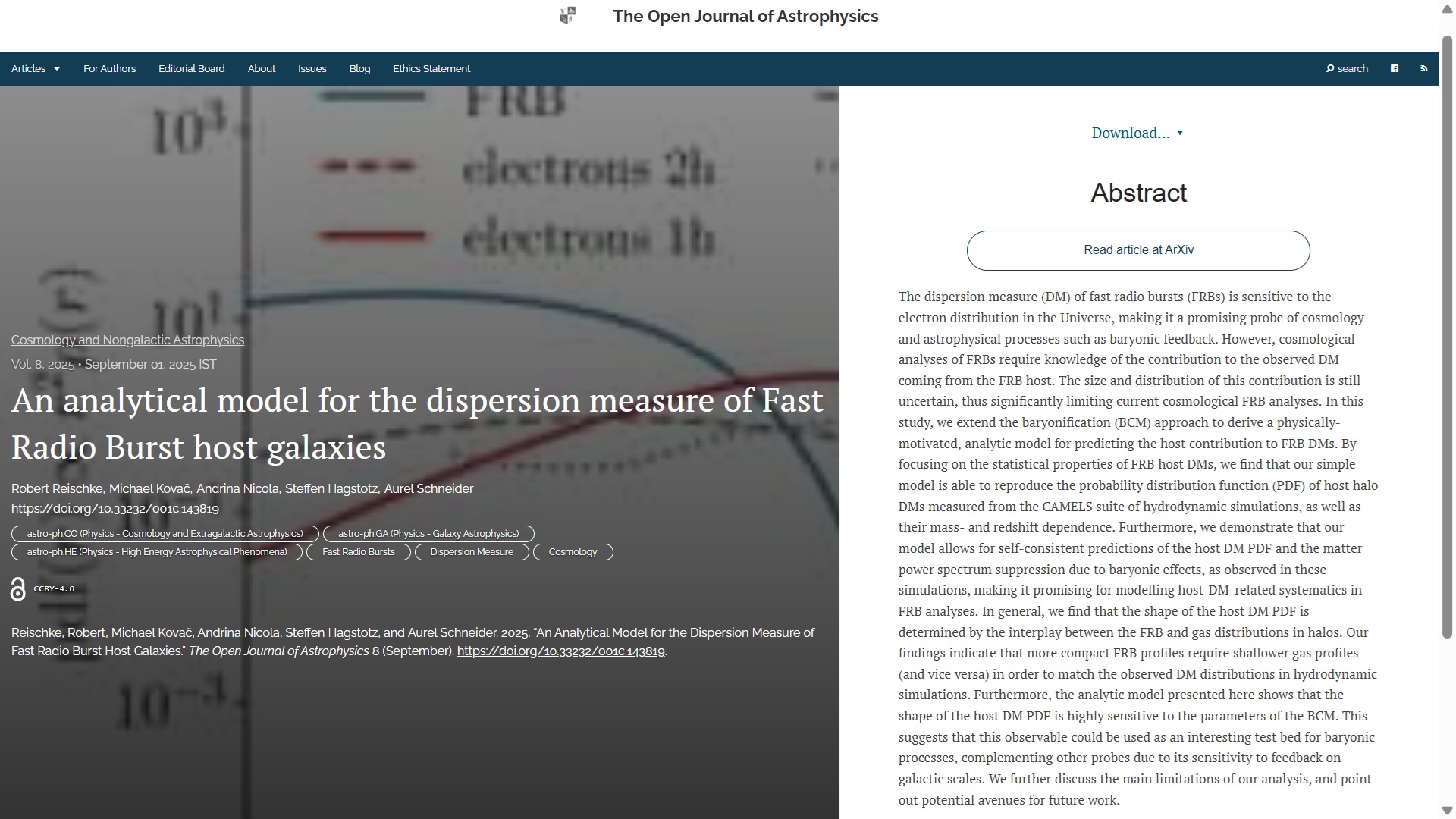
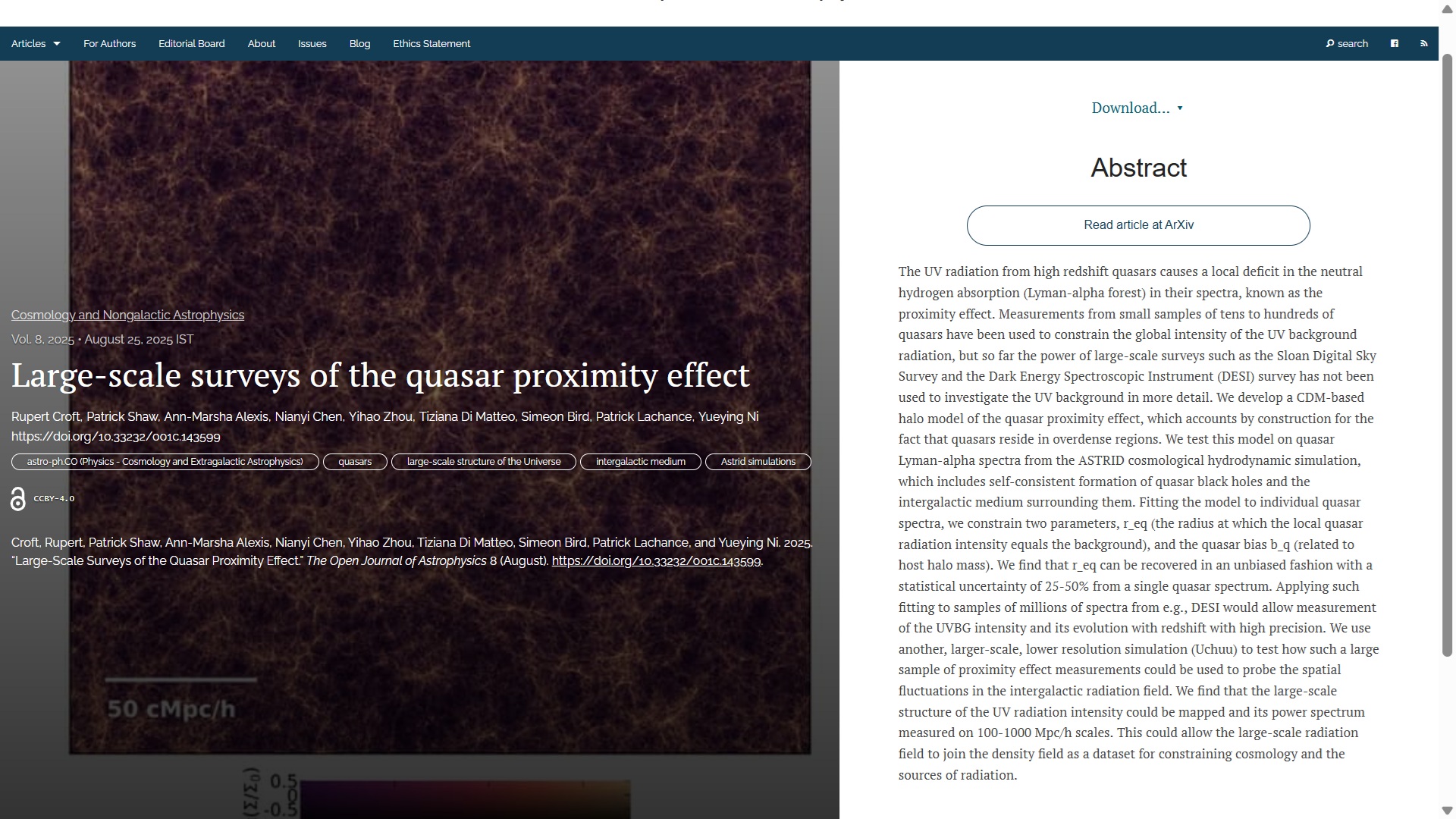
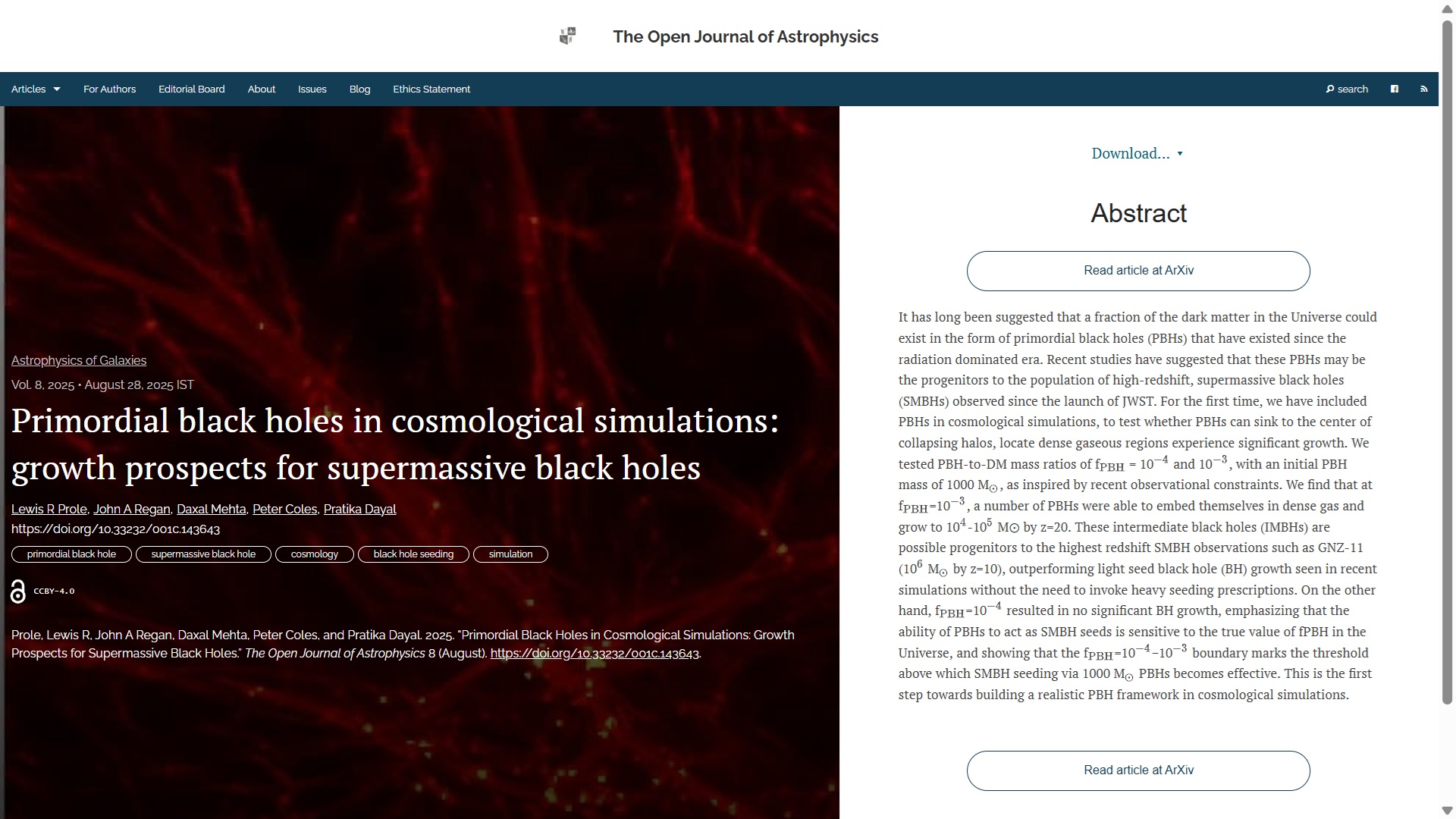
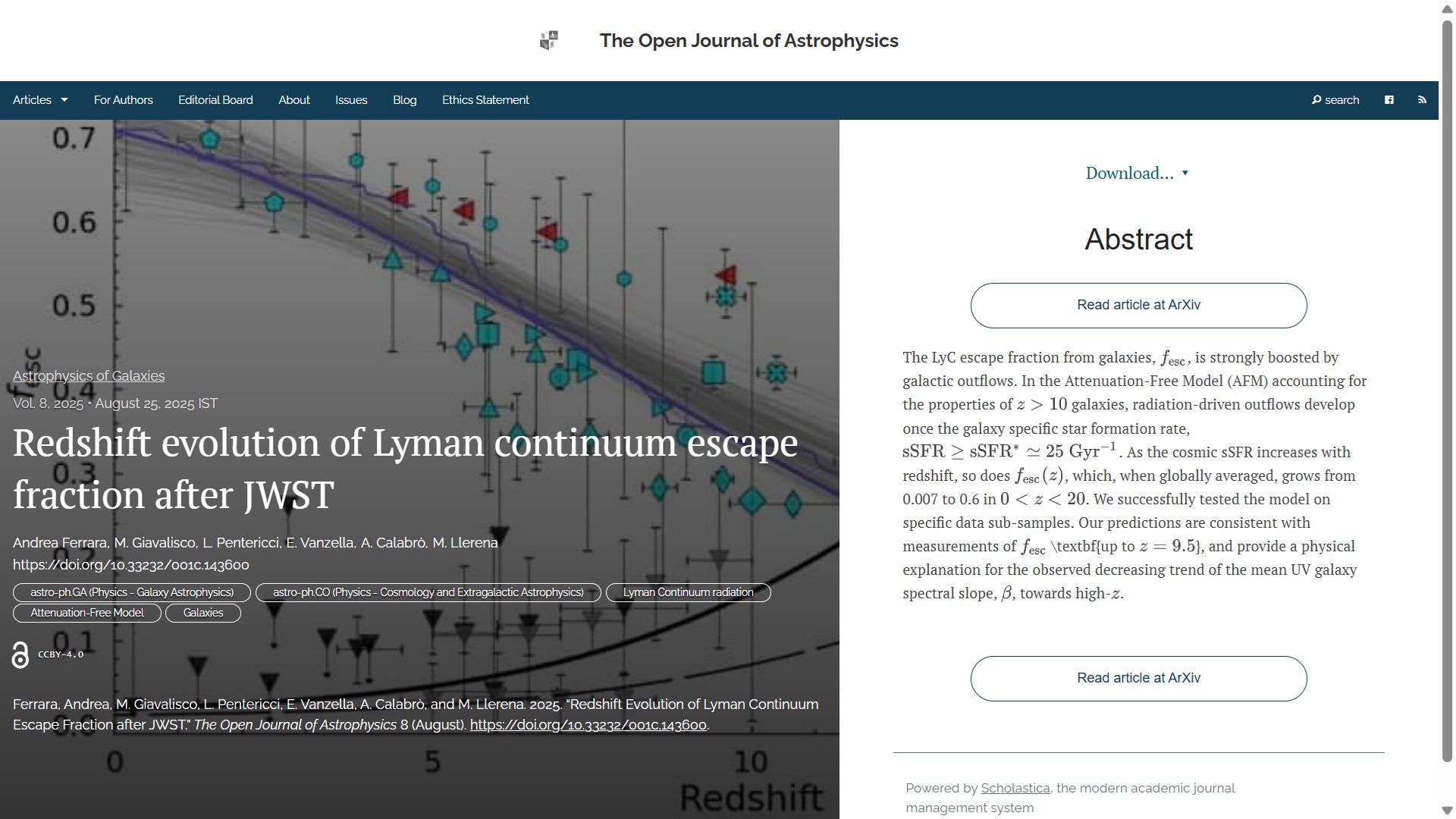
Anyway, The papers published this week, with their overlays, are as follows.  You can click on the images of the overlays to make them larger should you wish to do so.
The first paper to report is “The Jackknife method as a new approach to validate strong lens mass models” by Shun Nishida & Masamune Oguri (Chiba University, Japan) , Yoshinobu Fudamoto (Steward Observatory, USA) and Ayari Kitamura (Tohoku University, Japan). This article, which is in the folder marked Cosmology and NonGalactic Astrophysics,  describes and application of the Jackknife statistical resampling techique to gravitational lensing by removing lensed images and recalcualting the mass modelIt was published on Tuesday 8th July 2025. The overlay is here:


The officially-accepted version can be found on arXiv here.

The second paper is “Low redshift post-starburst galaxies host abundant HI reservoirs” by Sara Ellison (U. Victoria, Canada) and 10 others based in China, UK, Spain, USA and Canada.  This one was also published oon Tuesday 8th July but in the folder Astrophysics of Galaxies. This paper uses 21cm observations of a sample of post-starburst galaxies, to show  that they contain large reservoirs of neutral hydrogen. Here is the overlay:

You can find the final version of the manuscript on arXiv here.

Next one up, one of four published on Thursday 10th July, is “Predicting the number density of heavy seed massive black holes due to an intense Lyman-Werner field” by Hannah O’Brennan (Maynooth University, Ireland) and 7 others based in Ireland, USA and Italy. This paper presents an exploration of the scenario for black hole formation driven by Lyman-Werner photons (i.e. ultraviolet radiation in the range 11.2 to 13.6 eV). It is in the folder marked Cosmology and NonGalactic Astrophysics, and the overlay is here:


You can read the final accepted version on arXiv here.

The fourth paper this week, and the second published on 10th July, is “Chemical Abundances in the Metal-Poor Globular Cluster ESO 280-SC06: A Formerly Massive, Tidally Disrupted Globular Cluster” by Sam A. Usman (U. Chicago, USA) and 8 others based in the USA, Canada and Australia. This paper, which is in the folder Astrophysics of Galaxies, presents a detailed spectroscopic study of the chemical abundances in a Milky Way globular cluster ESO 280-SC06. The overlay is here:

The officially accepted version of the paper can be read here.

Next one up, also published on 10th July and also in the folder marked Astrophysics of Galaxies is “Predictions for the Detectability of Milky Way Satellite Galaxies and Outer-Halo Star Clusters with the Vera C. Rubin Observatory” by Kabelo Tsiane (U. Michigan) and 9 others on behalf of the LSST Dark Energy Science Collaboration.

The overlay is here:


You can find the officially-accepted version of the paper on arXiv here.

The penultimate paper for this week, and the last of the batch published on 10th July,  is “Systematically Measuring Ultra-Diffuse Galaxies. VIII. Misfits, Miscasts, and Miscreants” by Dennis Zaritsky, Richard Donnerstein, and Donghyeon J. Khim (Steward Observatory, U. Arizona, USA). This paper presents a morphological study of weird and wonderful galaxies as part of an effort to Systematically Measure Ultra-Diffuse Galaxies (the SMUDGes survey). It is in the folder marked Astrophysics of Galaxies. The overlay is here:


You can find the officially-accepted version of the paper on arXiv here.

The last article published this week is “Differential virial analysis: a new technique to determine the dynamical state of molecular clouds” by Mark R. Krumholz (ANU, Australia), Charles J. Lada (Harvard, USA) & Jan Forbrich (U. Herts, UK). This paper presents simple analytic models of supported and collapsing molecular clouds, tested using full 3D simulations and applied to observed clouds in Andromeda. It is in the folder marked Astrophysics of Galaxies and was published yesterday, i.e on Friday 11th July 2025. Here is the overlay


You can find the officially-accepted version on arXiv here.

And that’s all the papers for this week. I will, however, take this opportunity to mention that a while ago I was interviewed about the Open Journal of Astrophysics by Colin Stuart on behalf of the Foundational Questions Institute; the write-up of the interview can be found here.

Weekly Update from the Open Journal of Astrophysics: 05/07/2025

Posted in OJAp Papers, Open Access, The Universe and Stuff with tags , , , , , , , , , , , , , , , , , on July 5, 2025 by telescoper

It’s Saturday so, once again, it’s time for the weekly update of papers published at the Open Journal of Astrophysics. Since the last update we have published three new papers, which brings the number in Volume 8 (2025) up to 85, and the total so far published by OJAp  up to 320.

The three papers published this week, with their overlays, are as follows. You can click on the images of the overlays to make them larger should you wish to do so.

The first paper to report is “Stellar reddening map from DESI imaging and spectroscopy” by Rongpu Zhou (Lawrence Berkeley National Laboratory, USA) and an international case of 56 others too numerous to mention individually. This paper was published on 1st July 2025 in the folder marked Astrophysics of Galaxies. It describes maps of stellar reddening by Galactic dust inferred from observations obtained using the Dark Energy Spectroscopic Instrument, and a comparison with previous such maps. The overlay is here:

You can find the final, accepted, version on arXiv here.

Next one up is “On inertial forces (indirect terms) in problems with a central body” by Aurélien Crida (Université Côte d’Azur, France) and 17 others – again too numerous to be listed individually – based in France, Italy, Germany, Mexico and the USA. This paper discusses the indirect terms that arise the Newtonian dynamics of multi-body systems dominated by a central massive body, upon which other bodies exert a gravitational pull, when the massive body is treated as the origin of the coordinate system. This one, also published on July 1st 2025, is in the folder marked Earth and Planetary Astrophysics.

The overlay is here:

You can find the officially accepted version on arXiv here.

The last paper of this batch is “Stellar ejection velocities from the binary supernova scenario: A comparison across population synthesis codes” by Tom Wagg (U. Washington, USA), David D. Hendriks (U. Surrey, UK), Mathieu Renzo (U. Arizona, USA) and Katelyn Breivik (Carnegie Mellon U., USA). It was published on July 2nd 2025 in the folder Solar and Stellar Astrophysics and it presents comparison of the ejection velocities of stars ejected from binary systems by supernova explosions predicted in three different population synthesis codes.

The overlay is here:

You can read the final accepted version on arXiv here.

That’s all the papers for this week. I’ll post another update next weekend.

Weekly Update from the Open Journal of Astrophysics – 14/06/2025

Posted in OJAp Papers, Open Access, The Universe and Stuff with tags , , , , , , , , , , , , on June 14, 2025 by telescoper

It’s Saturday so once again it’s time for the weekly update of papers published at the Open Journal of Astrophysics. Since the last update we have published two new papers, which brings the number in Volume 8 (2025) up to 71, and the total so far published by OJAp  is now up to 306.

The two papers published this week, with their overlays, are as follows. You can click on the images of the overlays to make them larger should you wish to do so.

The first paper to report is “Analysis of optical spectroscopy and photometry of the type I X-ray bursting system UW CrB2” by Mark Kennedy (University College Cork, Ireland) and 21 others based in Ireland, UK, USA, Finland, Netherlands and Australia. This one was published on Tuesday June 10th in the folder High-Energy Astrophysical Phenomena.  This describes optical photometry and spectroscopy of the low-mass X-ray binary UW Coronae Borealis taken over 2 years

The overlay is here:


You can read the final accepted version on arXiv here.

The second paper is “The Impact of Feedback-driven Outflows on Bar Formation” by Martin D. Weinberg (University of Massachusetts, Amherst, USA). This paper uses a generalization of the Hamiltonian Mean-Field model to of the disruption of bar formation in galaxies by stellar feedback. It was published on Friday 13th June 2025 in the folder marked Astrophysics of Galaxies.

The overlay is here:


You can find the officially-accepted version of the paper on arXiv here.

That’s all the papers for this week. I’ll post another update next weekend.


Funding Diamond Open Access

Posted in Open Access with tags , , , , , on June 3, 2025 by telescoper

In case you weren’t aware, SciPost is a publishing infrastructure that provides Diamond Open Access to scientific papers. That means they are free to publish and free to read. They are funded by a consortium but are now struggling financially. They have recently circulated an open letter to the Community explaining their predicament and asking for help. I encourage you to read it and, if you can, to make a donation (or bully your institution to do so).

The open letter explains that SciPost is currently running at an average cost per paper of €500. That is much less than a typical APC for a mainstream journal but it is not a negligible cost. At the rate at which SciPost is publishing it amounts to about €1000 per day. SciPost currently attracts a significant level of sponsorship but it is not enough to support its current level of activity. Information on how to help SciPost can be found here. It is a worthy cause and deserves to be supported.

One area in which SciPost has not really taken of is Astronomy, where it has published very few papers. This may at be at least partly because of the Open Journal of Astrophysics (OJAp) which is also Diamond Open Access but runs in a very different and much cheaper way. A full breakdown of costs at OJAp is given here our annual running costs are about €5000 per year, which works out at less than €50 per paper (on average); that comprises a fixed component and a marginal cost of €10 per paper.

The main reasons for the large difference in running costs are: (i) SciPost maintains and runs its own platform; and (ii) it offers a copy-editing service. OJAp piggy-backs on arXiv (where most astrophysics research papers are found anyway) and expects authors to provide the final version of their own work. Neither organization pays referees or Editors. To enable it to run, SciPost employs about three staff full-time (2.9 FTE to be precise); OJAp has no employees and we keep our costs down by offering a ‘no-frills’ service. Instead of having a wide range of sponsors, we are entirely funded by Maynooth University. I am very grateful for that support, but we are run on a shoestring budget.

I have written before about what I think the future of Diamond Open Access could be like. I would like to see a range of Diamond Open Access journals offering a choice for authors and serving different sub-disciplines. Most universities nowadays have publishing operations so there could be network of federated journals, some based on arXiv and some based on other repositories and others with different models, such as SciPost. Perhaps institutions are worried about the expense but, as we have shown the actual cost, is far less than they are wasting on Article Processing Charges.

I don’t see other Diamond Open Access journals as competitors, but as allies with community-led ecosystem. I’d be more than happy to discuss how to start up such a journal on the OJAp model with anyone interested, and have already done so with some interested parties. As far as I’m concerned, the more the merrier! It is neither fair nor reasonable, however, that the expense of running a journal that serves the global astrophysics community should fall entirely on one small University in Ireland.

By all means support SciPost (and get your institutions to do likewise), but please also consider supporting OJAp. We are currently covering our costs but have no funds to make enhancements (such as a much-needed new LaTex template). If you can afford to make a donation to SciPost, then perhaps you can afford to make a donation to OJAp proportionate to our lower running costs? For example, if you give €10K to SciPost, could you give us €1K too? That amount would keep SciPost running for a day and OJAp for many months…

Weekly Update from the Open Journal of Astrophysics – 31/05/2025

Posted in OJAp Papers, Open Access, The Universe and Stuff with tags , , , , , , , , , , , , , , , on May 31, 2025 by telescoper

Once again it’s time for the weekly Saturday morning update of papers published at the Open Journal of Astrophysics. Since the last update we have published five new papers, which brings the number in Volume 8 (2025) up to 67; the total so far published by OJAp has passed the 300 mark and is now up to 302. If we keep up at the same rate for the rest of the year as we did for the first five months now completed, we will publish around 160 papers altogether in 2025.

In chronological order of publication, the five papers published this week, with their overlays, are as follows. You can click on the images of the overlays to make them larger should you wish to do so.

The first paper to report is “Which is the most eccentric binary known? Insights from the 2023/4 pericenter passages of Zeta Boötis and Eta Ophiuchi” by Idel Waisberg, Ygal Klein and Boaz Katz (Weizmann Institute of Science, Israel).  This is a report of interferometric observations of two very eccentric binary star systems, published on Tuesday 27th May 2025 in the folder Solar and Stellar Astrophysics. The overlay is here:

You can read the final accepted version on arXiv here.

The second paper to report is “On the full non-Gaussian Surprise statistic and the cosmological concordance between DESI, SDSS and Pantheon+” by Pedro Riba Mello & Miguel Quartin (Universidade Federal do Rio de Janeiro, Brazil), and Bjoern Malte Schaefer & Benedikt Schosser (Heidelberg, Germany). This paper is in the folder Cosmology and NonGalactic Astrophysics and was published on Tuesday 27th May 2025. The paper presents an application of the “Surprise Statistic”, based on the Kullback-Leibler divergence, as a measure of the difference between results inferred from different data sets.

The overlay is here:


You can find the officially-accepted version of the paper on arXiv here.

The third paper we published last week, and our 300th overall, is “Cosmic Ray Feedback in Massive Halos: Implications for the Distribution of Baryons” by Eliot Quataert (Princeton, USA) and Philip F. Hopkins (Caltech, USA).  This was published on Thursday 29th May in the folder Cosmology and NonGalactic Astrophysics. The paper discusses the effects of cosmic rays produced by massive black holes on the structure of the baryonic component of galaxies and how these might affect cosmological parameter estimation. The overlay is here:


You can read the officially accepted version of this paper on arXiv here.

The next one to report is “Mixing neutron star material into the jets in the common envelope jets supernova r-process scenario” by Noam Soker (Technion, Israel). This was published on Thursday 27th May in the folder High-Energy Astrophysical Phenomena; it presents a discussion of the chemical enrichment of an evolved star consequent upon its ingestion of a neutron star.

The overlay is here:

You can find the officially accepted version on arXiv here.

Last, but by no means least, for this week we have “Dark Energy Survey Year 6 Results: Synthetic-source Injection Across the Full Survey Using Balrog” by Dhayaa Anbajagane (Kavli Institute, Chicago) et al. (81 authors) on behalf of the Dark Energy Survey Collaboration. It was also  published on Thursday 27th May  2025, but in the folder Cosmology and NonGalactic Astrophysics. It is about testing the Dark Energy Survey analysis pipeline using synthetic sources.

The overlay is here:


You can find the officially accepted version on arXiv here.

That’s all the papers for this week. I’ll post another update next weekend.

Weekly Update from the Open Journal of Astrophysics – 24/05/205

Posted in OJAp Papers, Open Access, The Universe and Stuff with tags , , , , , , , , , , , , , , , , , on May 24, 2025 by telescoper

It’s  time once again for the regular Saturday update of papers published during the past week at the Open Journal of Astrophysics. Since the last update we have published three new papers, which brings the number in Volume 8 (2025) up to 62 and the total so far published by OJAp up to 297.

In chronological order of publication, the three papers published this week, with their overlays, are as follows. You can click on the images of the overlays to make them larger should you wish to do so.

The first paper to report is: “Jet-shaped filamentary ejecta in common envelope evolution” by Ron Schreier, Shlomi Hillel and Noam Soker (Technion, Haifa, Israel). This paper, which was published on Monday May 19th 2025 in the folder High-Energy Astrophysical Processes, presents three-dimensional hydrodynamical simulations of common envelope evolution of a neutron star inside the envelope of a rotating red supergiant with Rayleigh-Taylor instabilities forming filamentary ejecta.

The overlay is here:

You can find the officially accepted version on arXiv here.

Second one up is “Weighing The Options: The Unseen Companion in LAMOST J2354 is Likely a Massive White Dwarf” by M. A. Tucker, A. J. Wheeler & D. M. Rowan (Ohio State University, USA) and M. E. Huber (U. Hawaii, USA). This paper was published on Tuesday 20th May 2025 in the folder for Solar and Stellar Astrophysics. It discusses a spectroscopic study of the binary system LAMOST J235456.73+335625 (J2354) with a discussion of the implications for the nature of the dark component.

The overlay is here:


You can find the officially-accepted version of the paper on arXiv here.

The third and last paper of the week, published on Thursday May 22nd 2025, also in the folder Solar and Stellar Astrophysics, is “How to use Gaia parallaxes for stars with poor astrometric fits” by Kareem El-Badry (Caltech, USA).  This paper presents a method for extracting reasonable estimates of stellar parallaxes from Gaia data when the overall astrometric solution is unreliable due to errors and noise

Here is the overlay:

You can find the officially accepted version of this paper on arXiv here.

That’s all the papers for this week. Looking at the publishing workflow, I expect we will pass the 300 mark next week. We’ll see when I post the next update next Saturday.