Archive for Euclid

Euclid Update

Posted in Euclid, The Universe and Stuff with tags , , , , on August 27, 2023 by telescoper

Time for a quick update on the European Space Agency’s Euclid mission. For full details about what follows you can see here. Everything I mention here is already in the public domain, so I am not disclosing any secrets!

The last update I posted mentioned that Euclid had moved into what is called the Performance Verification phase of its mission. That has now been put on hold in order to troubleshoot an intermittent problem with the Fine Guidance Sensor (FGS) which helps to maintain correct pointing of the telescope. This issue can probably be fixed by software updates, but these will have to be tested, hence the pause. This is rather irksome, but the instrument teams are confident they can find a solution soon.

Anyway, while we’re waiting, here is a video from Launch Pad Astronomy explaining about the mission. It was actually released about six days ago but I didn’t have time to post it until now. About 15 minutes long, it’s a big longer than previous official Euclid videos I’ve posted, but I think it’s very informative:

Oh, I almost forgot to mention that I’ll be talking a little bit about Euclid among other things at this event on 6th September.

Euclid Update

Posted in Euclid with tags , , , , , on August 15, 2023 by telescoper
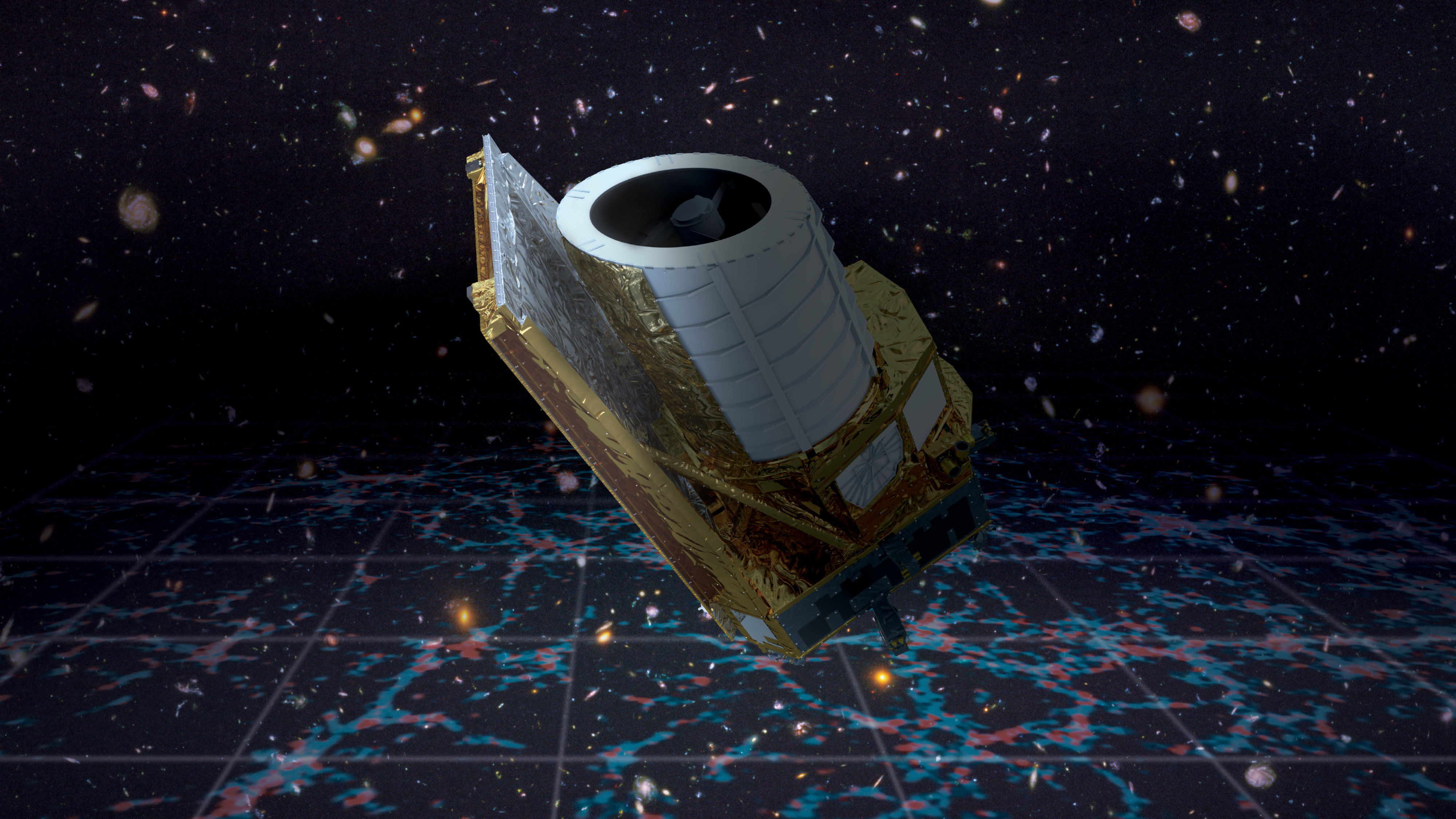
ESA/Euclid/Euclid Consortium/NASA. Background galaxies: NASA, ESA, and S. Beckwith (STScI) and the HUDF Team.

Since I’ve been working today on stuff related to ESA’s Euclid mission, I thought I would post a brief update on the mission status before I go home. The official channel to which I refer you for full updates is here.

A message was sent out on Saturday to member of the Euclid Consortium indicating that the commissioning phase of the Euclid satellite was essentially completed, although with some issues still to be fixed. In particular, as has previously been reported, there is an issue with stray light in the VIS instrument, which will have to be coped with. To prevent stray sunlight getting onto VIS detectors, Euclid will be configured to operate at a range of specific angles with respect to the Sun. This means that the survey strategy will have to be adapted in order to be as optimal as possible with this new constraint.

The next phase after the commissioning phase is called performance verification, for which control switches over to the science ground segment. The operations team will then operate the spacecraft in the same way as required for the full survey in order to assess the performance of the instruments and obtain calibration data ahead of the start of the full survey.

The Challenges of Large Collaborations in STEM

Posted in Biographical, Harassment Bullying etc, Mental Health with tags , , , , , on August 12, 2023 by telescoper

There’s a new paper on the arXiv by Kamiel Janssens and Michiko Ueda that addresses some of the challenges that arise for people working in large STEM collaborations. Although the sample they use is drawn from gravitational-wave collaborations I think many of the patterns that emerge will also apply elsewhere, e.g. in the Euclid Consortium.

Here is the abstract:

Large-scale international scientific collaborations are increasingly common in the field of STEM (Science, Technology, Engineering, and Mathematics). However, little is known about the well-being of the members participating in these `big science’ collaborations, which can present unique challenges due to the scale of their work. We conducted a survey among members of three large, international collaborations in the field of gravitational-wave astrophysics in the summer of 2021. Our objective was to investigate how career stage, job insecurity and minority status are associated with reported levels of depressive symptoms as well as the desire to leave academia. We found that early-career scientists and certain minoritized groups reported significantly higher levels of depressive symptoms compared to senior members or those who do not consider themselves as a member of minoritized groups. Furthermore, relatively young members, staff scientists/engineers, and those experiencing high levels of job insecurity and lack of recognition were more likely to frequently consider leaving academia. Our findings suggest that improving recognition for personal contributions to collaborative work and providing clearer job perspectives could be two key factors in enhancing the well-being of young scientists and reducing the potential outflow from academia.

arXiv:2308.05107

I would like to add a personal note. When I was an early-career researcher in cosmology I was for the most part given a free hand to work on whatever I wanted to do. My first papers were either sole author or with one or two others, being people I’d met and wanted to collaborate with. Nowadays many opportunities – indeed, most – for postdocs are associated with very large teams into which one just has to fit. The work is also highly directed with little choice of what to do, and it is harder to individuals to shine even if the team is well managed, and not all senior scientists in such collaborations have good leadership skills. Theoretical astrophysics is challenging enough but sometimes the really difficult thing is the behaviour of other people!

I’m not saying that this way of working is necessarily bad, just that it is very different from what I experienced. It does not therefore surprise me to hear that many, especially younger, people struggle in the current environment and why it is important for large collaborations to do the best they can to help. I think part of that involves us oldies recognizing that things are very different now from what they were like back in our day.

How Euclid will map the Universe

Posted in Euclid, The Universe and Stuff with tags , , on August 10, 2023 by telescoper

Time for another nice little video explainer about Euclid. This one is largely about the role of large computer simulations (particularly the Flagship simulation) in preparing for (and in future in analyzing) the Euclid survey.

The full blurb accompanying the video is appended here:

ESA’s Euclid mission will create a 3D-map of the Universe that scientists will use to measure the properties of dark energy and dark matter and uncover the nature of these mysterious components. The map will contain a vast amount of data, it will cover more than a third of the sky and its third dimension will represent time spanning 10 billion years of cosmic history.

But dealing with the huge and detailed set of novel data that Euclid observations will produce is not an easy task. To prepare for this, scientists in the Euclid Consortium have developed one of the most accurate and comprehensive computer simulations of the large-scale structure of the Universe ever produced. They named this the Euclid Flagship simulation.

Running on large banks of advanced processors, computer simulations provide a unique laboratory to model the formation and evolution of large-scale structures in the Universe, such as galaxies, galaxy clusters, and the filamentary cosmic web they form. These state-of-the-art computational techniques allow astrophysicists to trace the motion and behavior of an extremely large number of dark-matter particles over cosmological volumes under the influence of their own gravitational pull. They replicate how and where galaxies form and grow, and are used to predict their distribution across the celestial sphere.

Explore the Euclid Flagship simulation in this video and get a sneak preview of the structure of the dark Universe, as we currently model it. New insights will be brought to you by the Euclid mission in the coming years.

Euclid has arrived…

Posted in Euclid, The Universe and Stuff with tags , , , on July 29, 2023 by telescoper

Here’s a little video update to accompany the news that, as of yesterday (28th July), the European Space Agency’s Euclid spacecraft has reached its orbit around L2, the second Lagrange Point of the Earth-Sun system:

More news is on the way. Commissioning of the instruments is now complete and the telescope is in focus. On Monday 31st July, ESA will release the first actual images from the Euclid telescope!

Stay tuned here.

Euclid Update

Posted in Euclid, The Universe and Stuff with tags , , on July 10, 2023 by telescoper

The Euclid spacecraft launched over a week ago so so here’s a short video explaining its trajectory and what it will do over the next weeks and months.

Countdown to the Euclid Launch

Posted in Euclid, The Universe and Stuff with tags , , , on July 1, 2023 by telescoper

Today’s the day! Weather permitting, of course, all eyes will be on Cape Canaveral for the launch of the Euclid satellite later this afternoon (as reckoned in Ireland). You can watch the launch on YouTube via the following stream (but it won’t start until 15.30 Irish Time; 16.30 CEST):

The Key Events to look for in local time are:

16:12 Euclid launch on SpaceX Falcon 9
16:53 Separation of Euclid from Falcon 9
16:57 Earliest expected time to establish communication with Euclid

After that, the mission is handed over to the ESA Space Operations Centre in Darmstadt, Germany as it sets out for the Sun-Earth Lagrange point L2. Approximately four weeks after launch, Euclid will enter in orbit around this point, which is located at 1.5 million km from Earth, in the opposite direction from the Sun. Once in orbit, mission operators will start verifying all the functions of the telescope. During this, residual water is outgassed, after which Euclid’s instruments will be turned on. Between one and three months after launch, Euclid will go through several calibrations and scientific performance tests and get ready for science. The telescope begins its early phase of the survey of the Universe three months after launch. There will be a preliminary release of a small amount of data in December 2024, but the first full data release – DR1 – will take about two years.

UPDATE: All critical stages of the launch passed satisfactorily, and contact has been established with the ground control. Euclid is now on its way to L2. Bon Voyage, Euclid!

Pushing Euclid

Posted in Biographical, Euclid, Science Politics, The Universe and Stuff with tags , , , on June 30, 2023 by telescoper

I’ve spent a sizeable chunk of the last two days answering press enquiries concerning the Euclid mission, due to be launch about 24 hours from now. Here is a picture of Euclid in the Falcon 9 fairing, getting ready to be moved to the launch facility. It’s all getting very real!

After talking with their researcher yesterday, this morning I did a short interview on Morning Ireland, which is on RTÉ Radio 1. It was shorter than I imagined because the previous item – about the ongoing ructions at RTÉ over various financial scandals – understandably overran quite a bit. The presenter, Rachel English, was very nice though and I think it went fairly well. I did another short interview on Newstalk Radio on a programme called Hard Shoulder, which took place at 5.48pm. I also spoke to a journalist from the Sunday Times Irish Edition, who I think will run a story on Sunday.

Anyway, the purpose of this media stuff is not to try to grab headlines – my involvement in Euclid is very small, really – but to generate some interest in the hope that Ireland takes a more active role in future space missions. I don’t know whether it will work, but I hope it does, and I feel obliged to try although it has made for a very busy day indeed!

First Impression seeing the Euclid Telescope

Posted in Euclid, The Universe and Stuff with tags , , , on June 28, 2023 by telescoper

With just three days to go before the scheduled launch of the Euclid spacecraft on Saturday 1st July 2023, at 1612 Irish Time (GMT+1), the Education and Public Outreach (EPO) team have been continuing to ramp up its social media activity and the second YouTube video has now “dropped” (as you young people say).

This was filmed at Thales Alenia Space in Cannes, France, as members of the Euclid consortium from around the world gathered in anticipation to see the fully-assembled Euclid telescope for the first time as it underwent final tests before its journey to the launch site in Florida.

Euclid’s “Red Book”

Posted in Euclid, The Universe and Stuff with tags , , on June 27, 2023 by telescoper

With the scheduled launch of ESA’s Euclid mission coming up this weekend, it is perhaps topical to share the document written almost 12 years ago that outlines the design concepts and describes the detailed scientific case. It’s a compendious piece, running to well over 100 pages but, as with virtually everything in astrophysics, the full Euclid Definition Study Report can be found on arXiv.

Here is the abstract:

Euclid is a space-based survey mission from the European Space Agency designed to understand the origin of the Universe’s accelerating expansion. It will use cosmological probes to investigate the nature of dark energy, dark matter and gravity by tracking their observational signatures on the geometry of the universe and on the cosmic history of structure formation. The mission is optimised for two independent primary cosmological probes: Weak gravitational Lensing (WL) and Baryonic Acoustic Oscillations (BAO). The Euclid payload consists of a 1.2 m Korsch telescope designed to provide a large field of view. It carries two instruments with a common field-of-view of ~0.54 deg2: the visual imager (VIS) and the near infrared instrument (NISP) which contains a slitless spectrometer and a three bands photometer. The Euclid wide survey will cover 15,000 deg2 of the extragalactic sky and is complemented by two 20 deg2 deep fields. For WL, Euclid measures the shapes of 30-40 resolved galaxies per arcmin2 in one broad visible R+I+Z band (550-920 nm). The photometric redshifts for these galaxies reach a precision of dz/(1+z) < 0.05. They are derived from three additional Euclid NIR bands (Y, J, H in the range 0.92-2.0 micron), complemented by ground based photometry in visible bands derived from public data or through engaged collaborations. The BAO are determined from a spectroscopic survey with a redshift accuracy dz/(1+z) =0.001. The slitless spectrometer, with spectral resolution ~250, predominantly detects Ha emission line galaxies. Euclid is a Medium Class mission of the ESA Cosmic Vision 2015-2025 programme, with a foreseen launch date in 2019. This report (also known as the Euclid Red Book) describes the outcome of the Phase A study.

arXiv:1110.3193

Euclid was formally adopted as an ESA M Class mission in June 2012. I’ve added the emphasis to the penultimate sentence to draw your attention to the fact that the launch of Euclid is about four years late.