Archive for High-Energy Astrophysical Phenomena

Weekly Update from the Open Journal of Astrophysics – 14/06/2025

Posted in OJAp Papers, Open Access, The Universe and Stuff with tags , , , , , , , , , , , , on June 14, 2025 by telescoper

It’s Saturday so once again it’s time for the weekly update of papers published at the Open Journal of Astrophysics. Since the last update we have published two new papers, which brings the number in Volume 8 (2025) up to 71, and the total so far published by OJAp  is now up to 306.

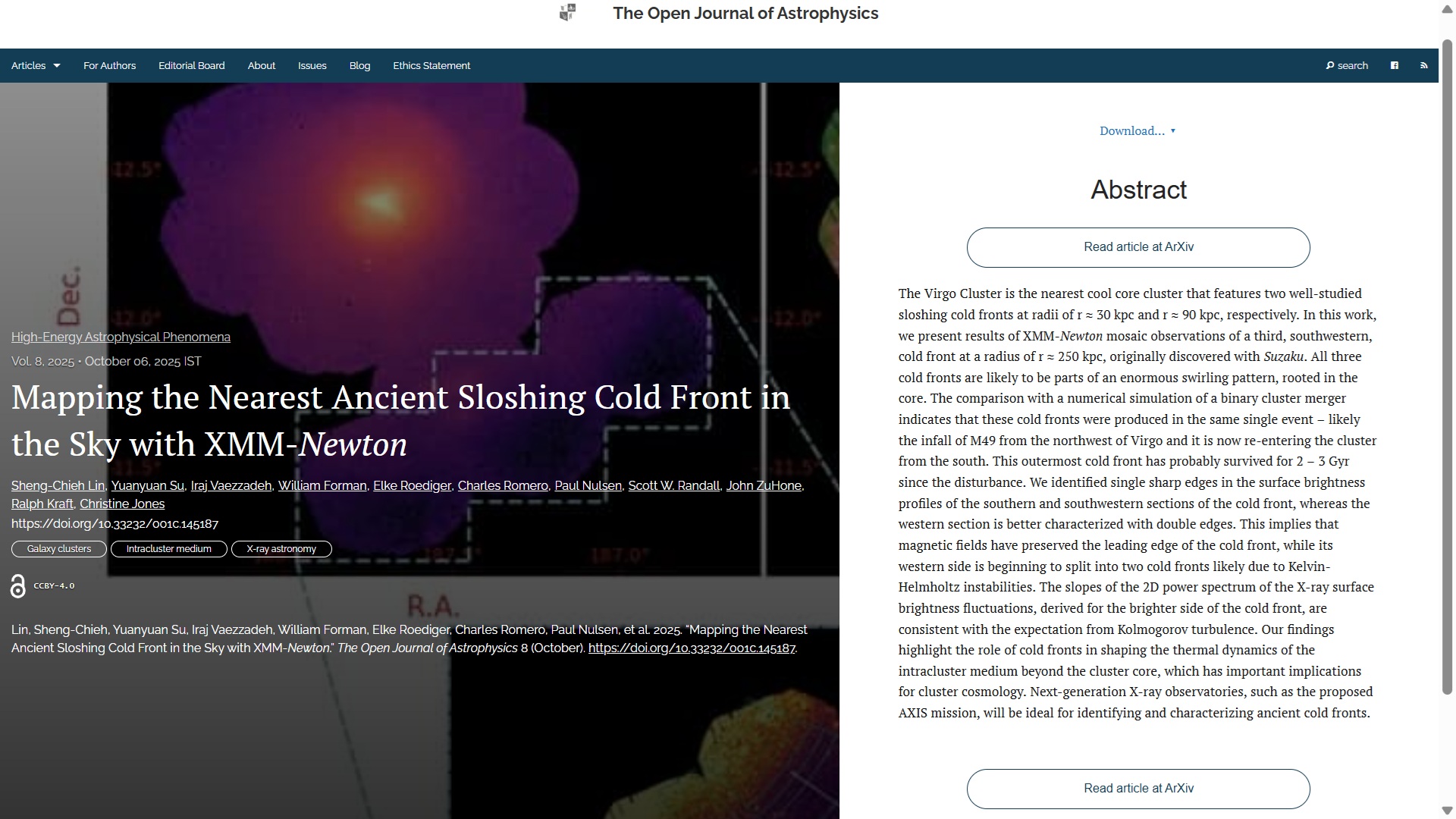
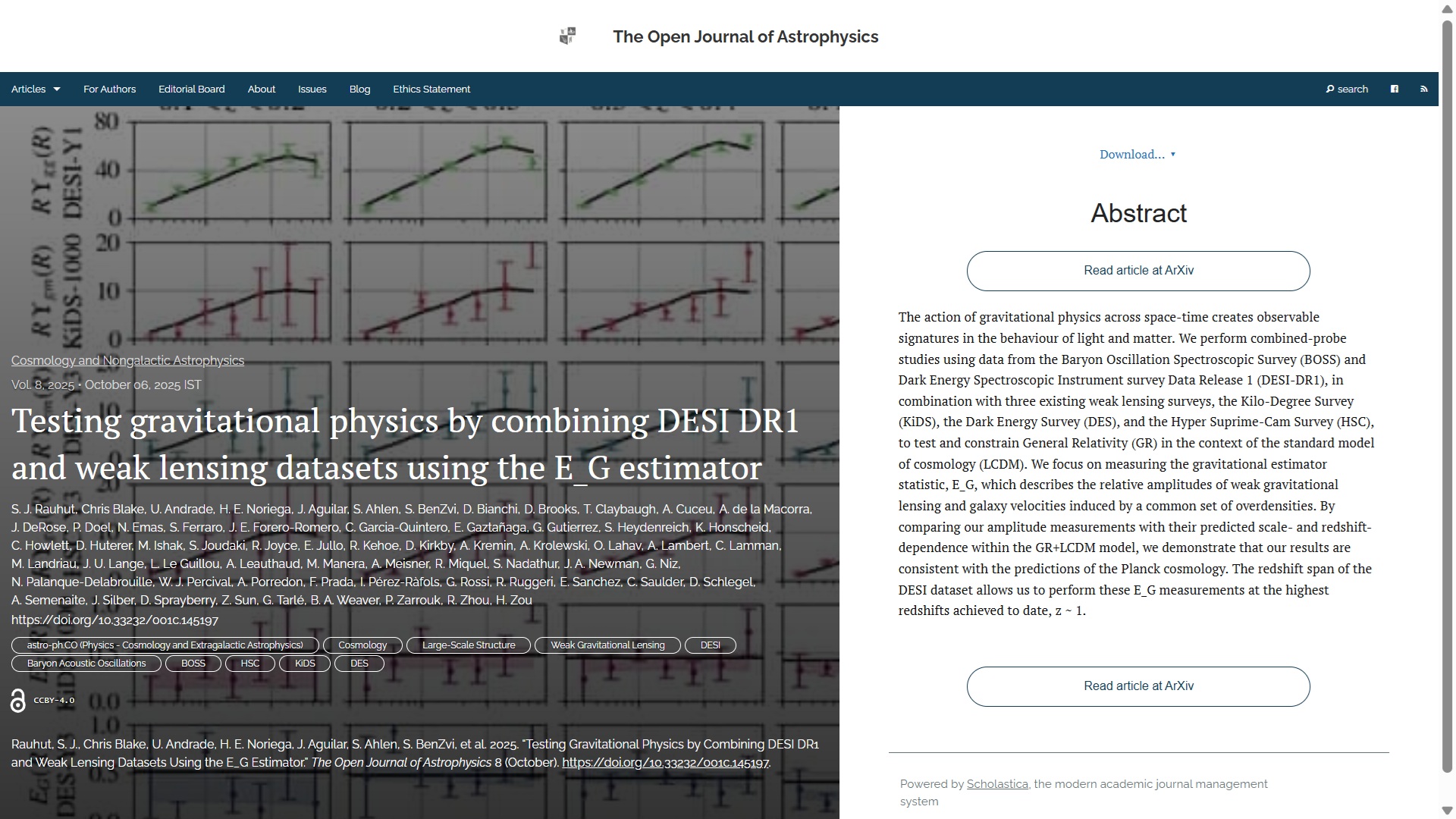
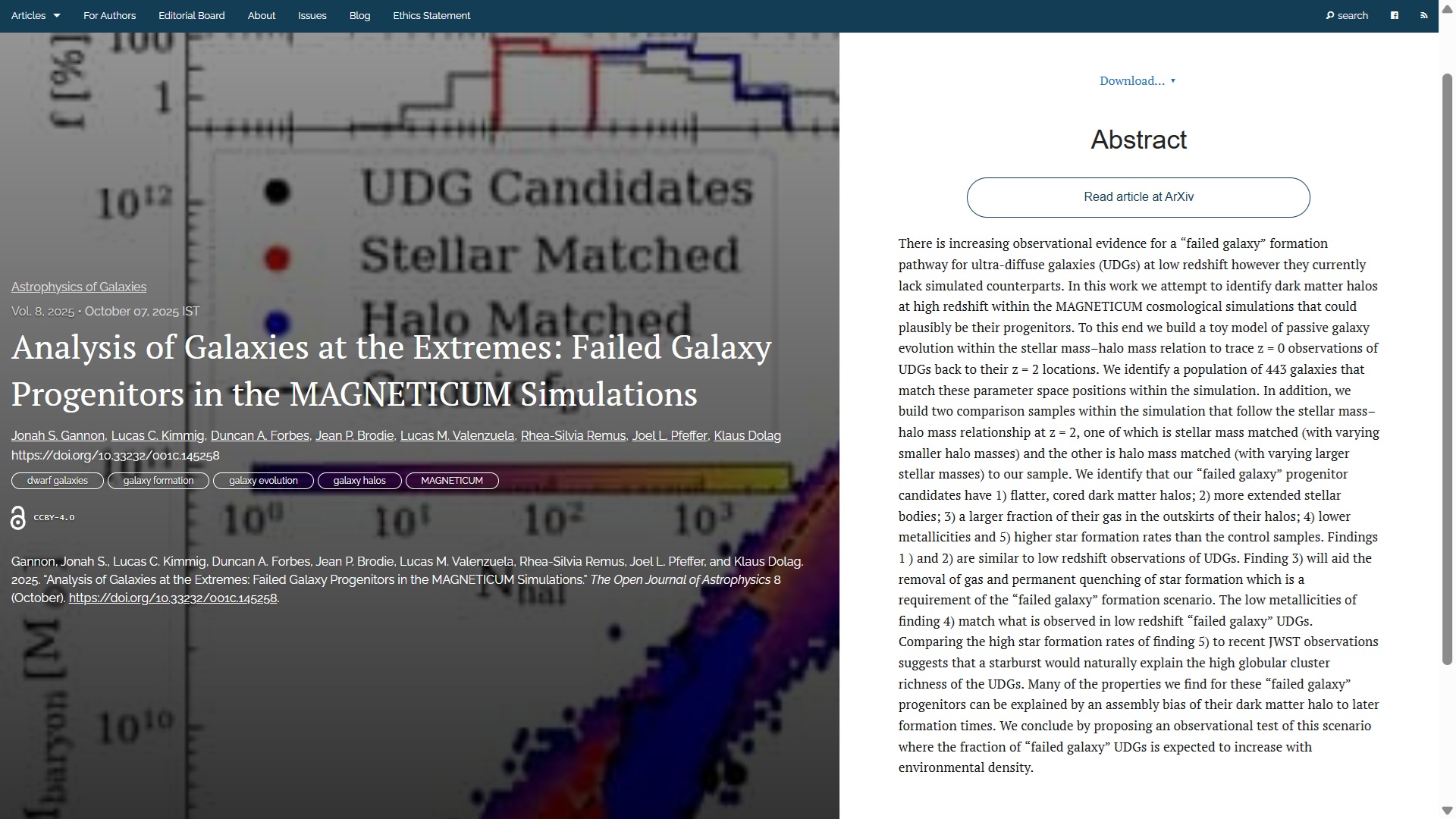
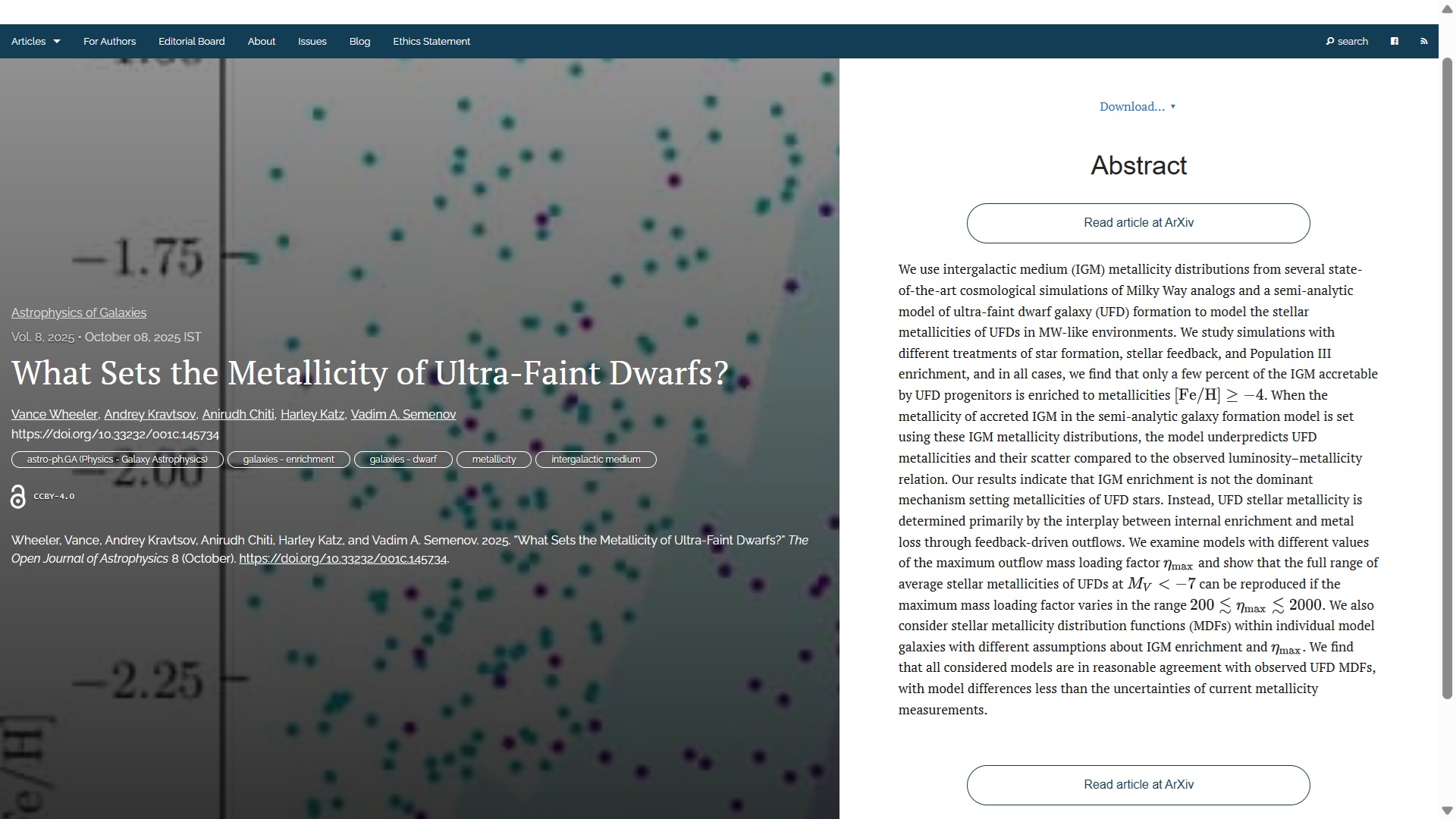
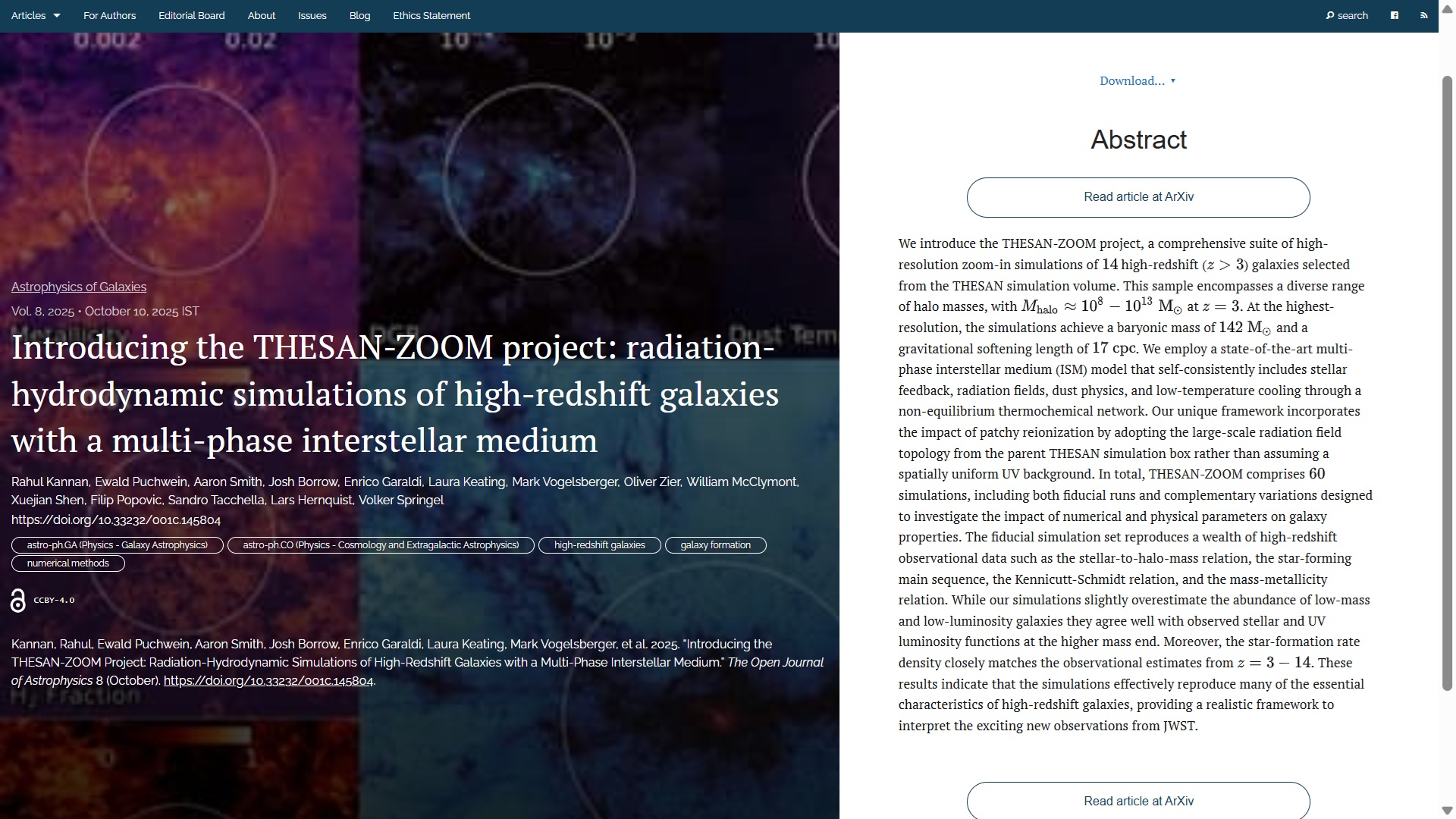
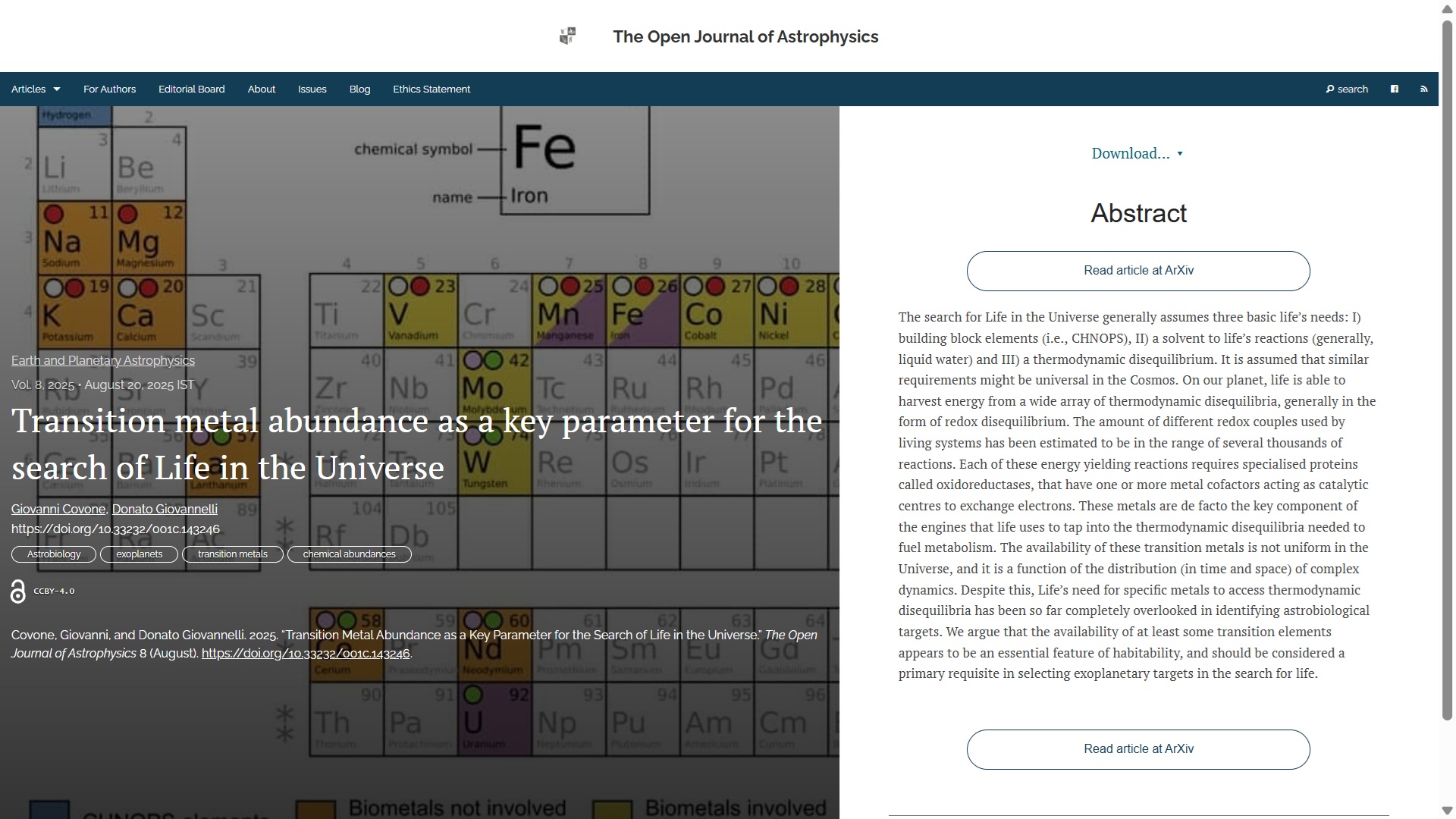
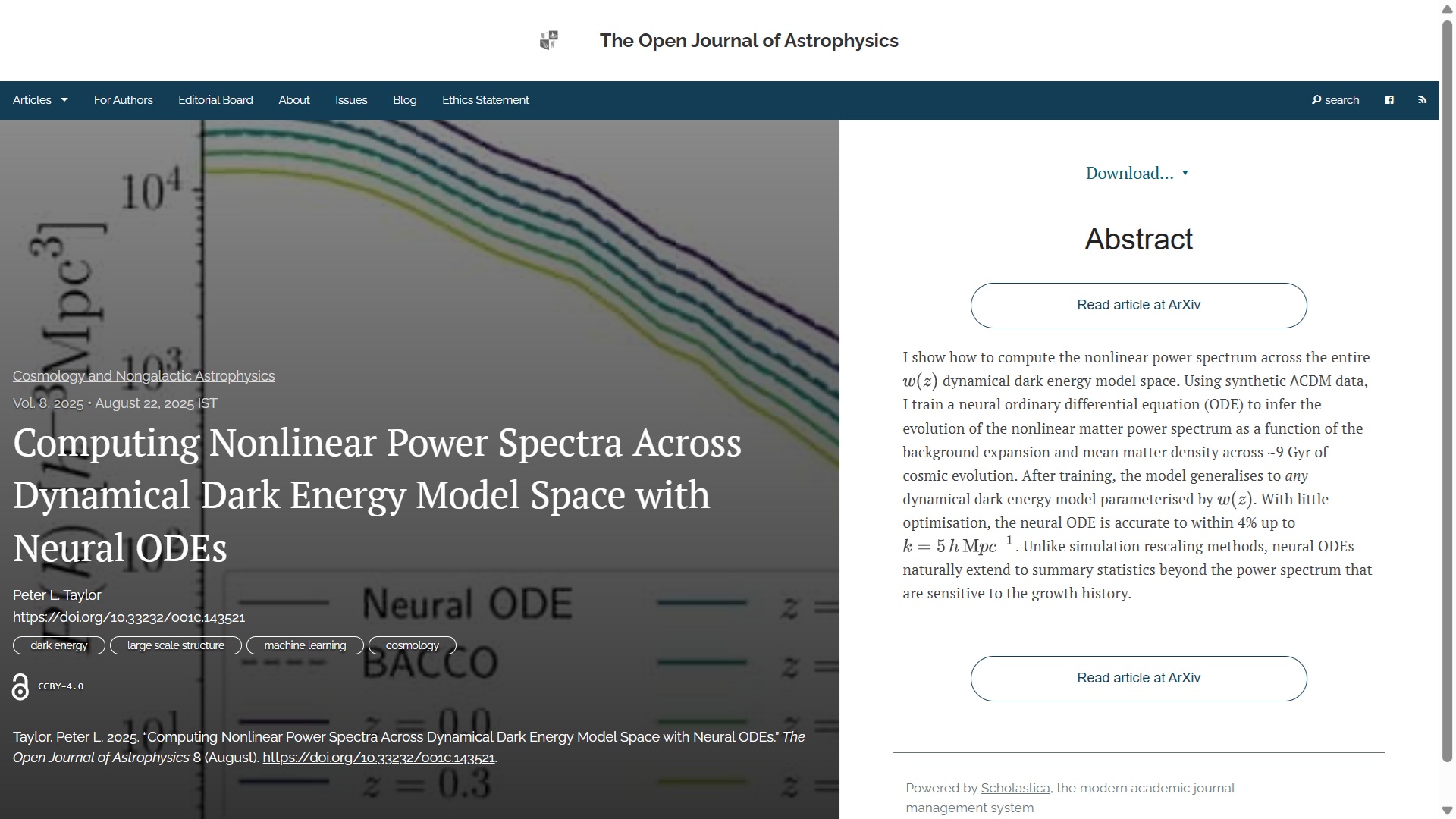
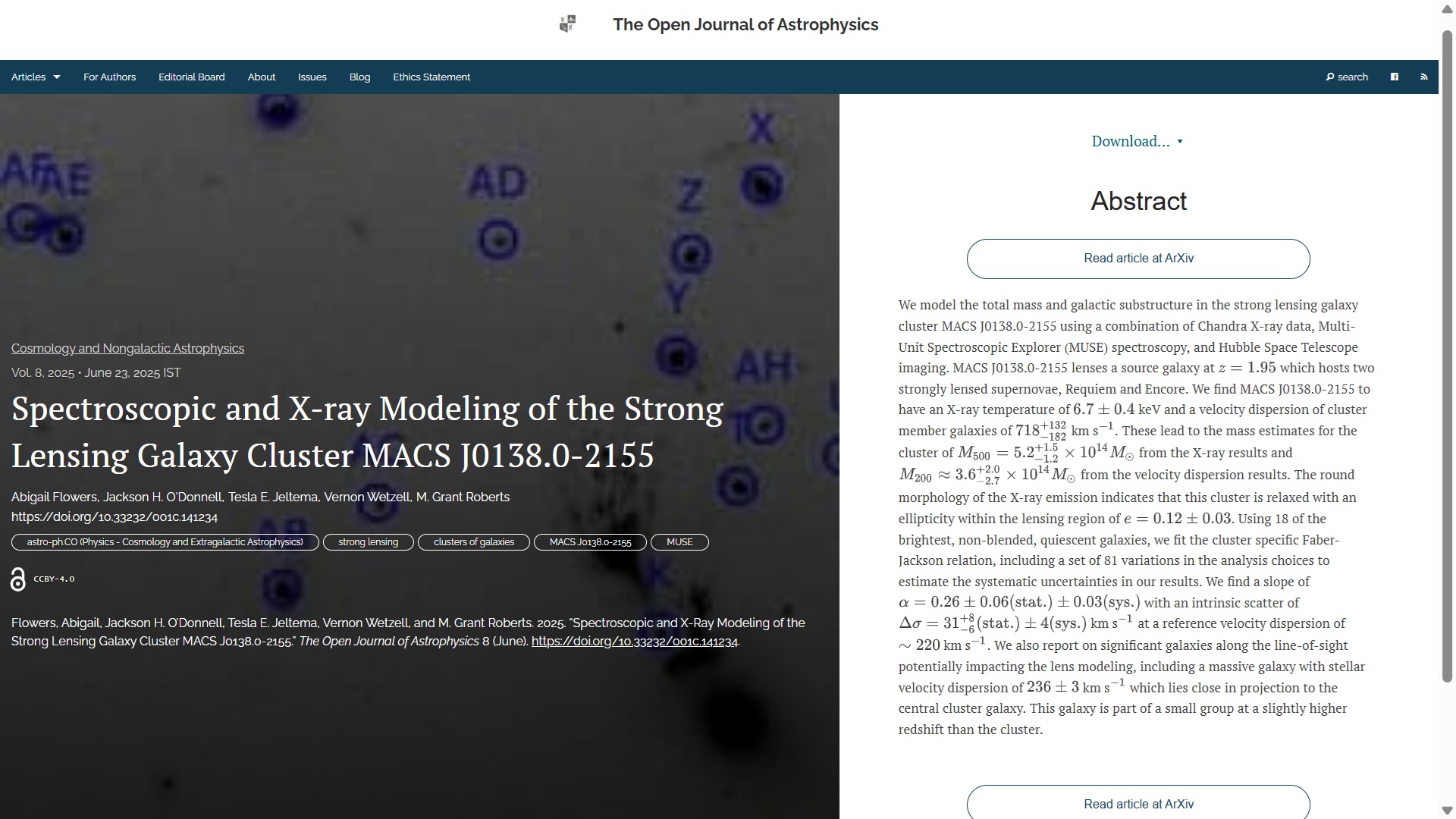
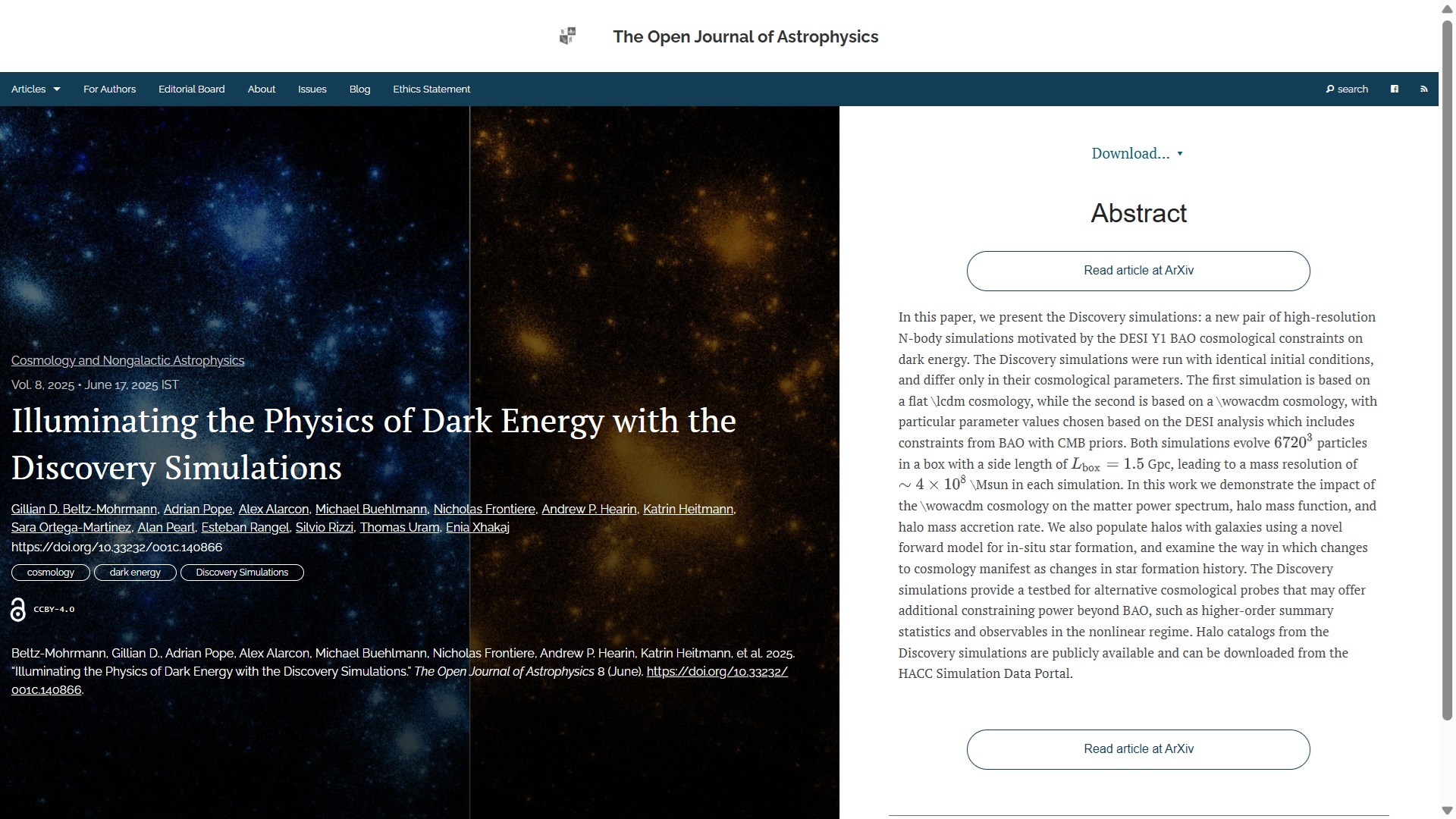
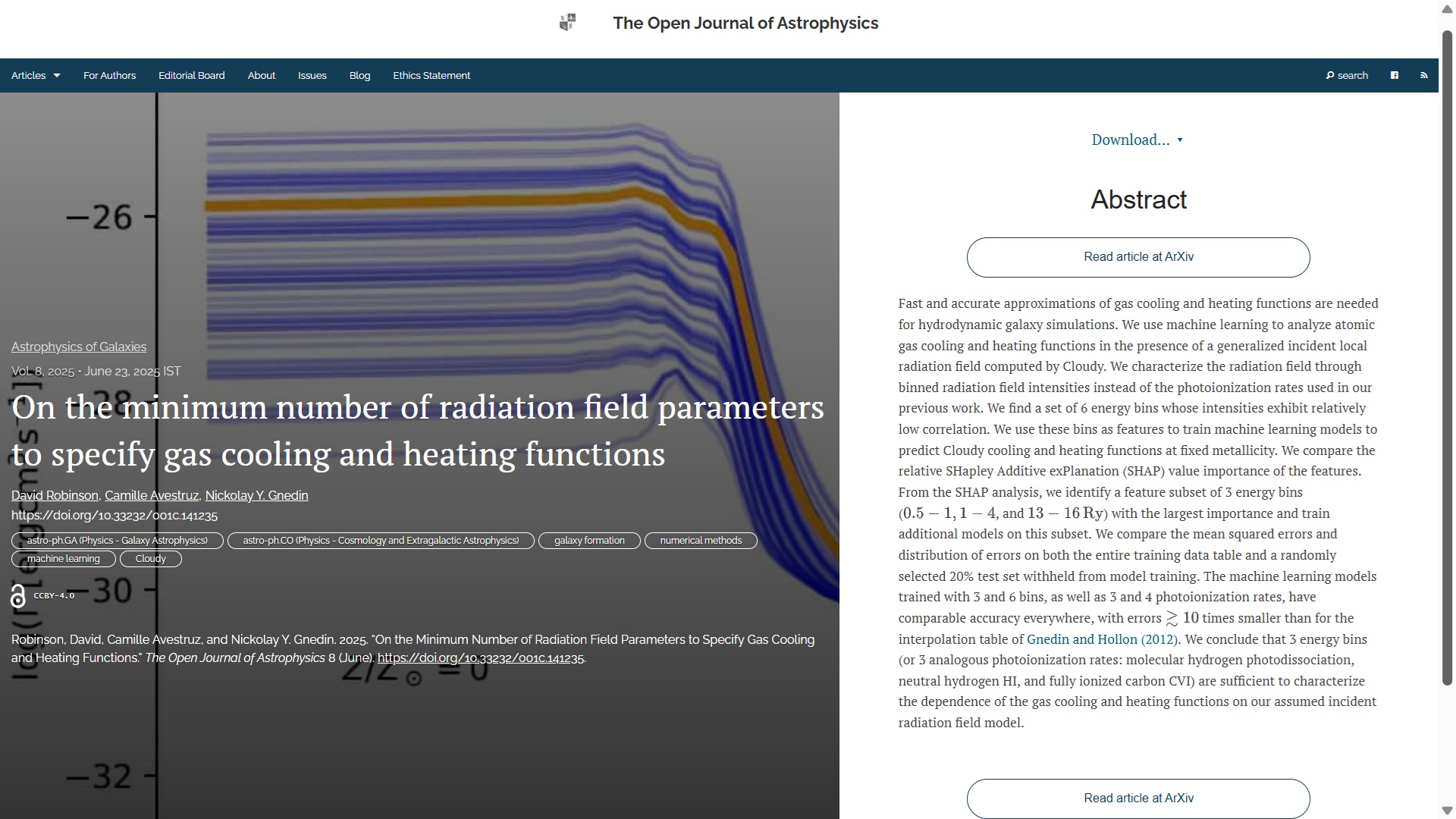
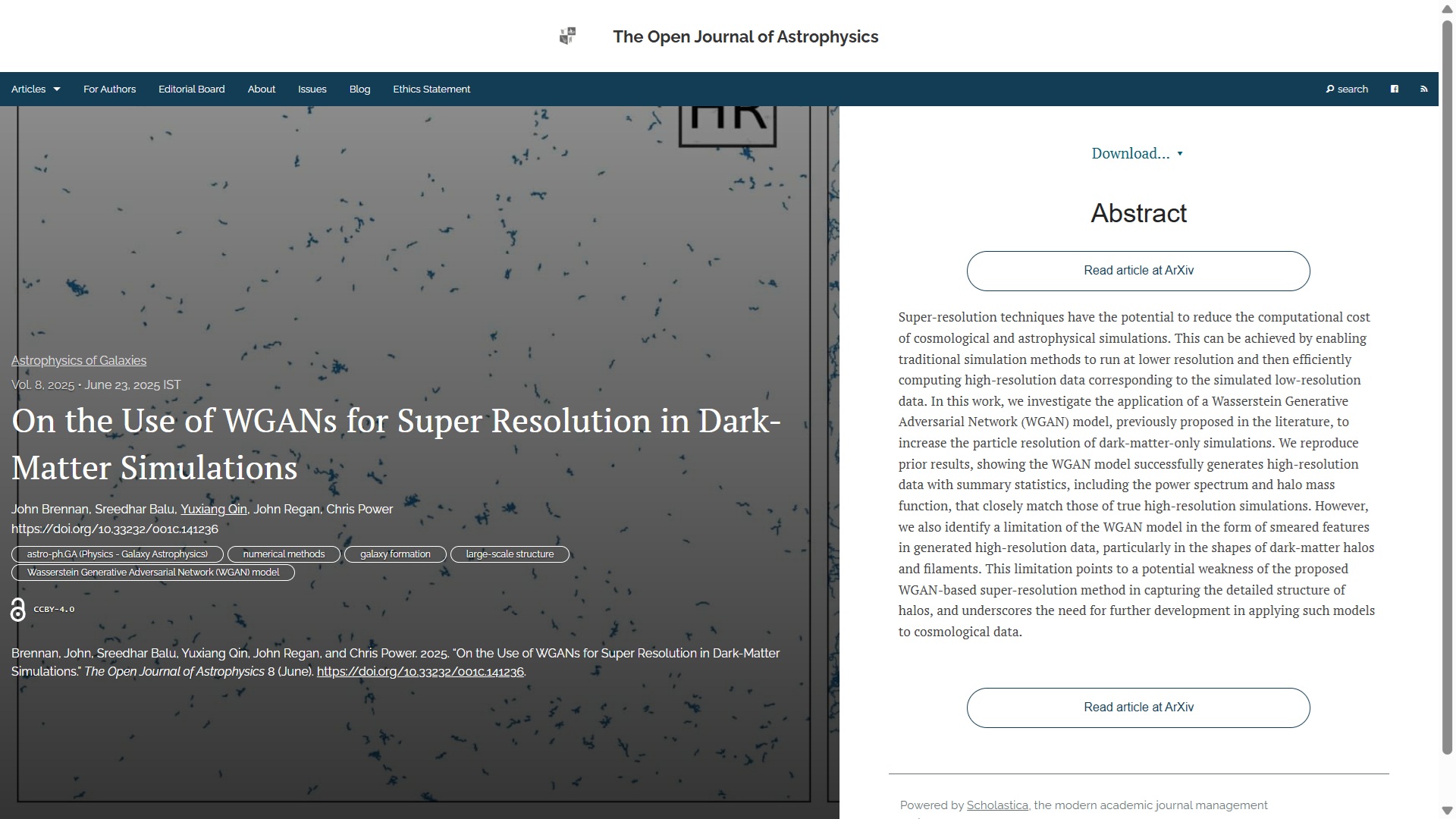
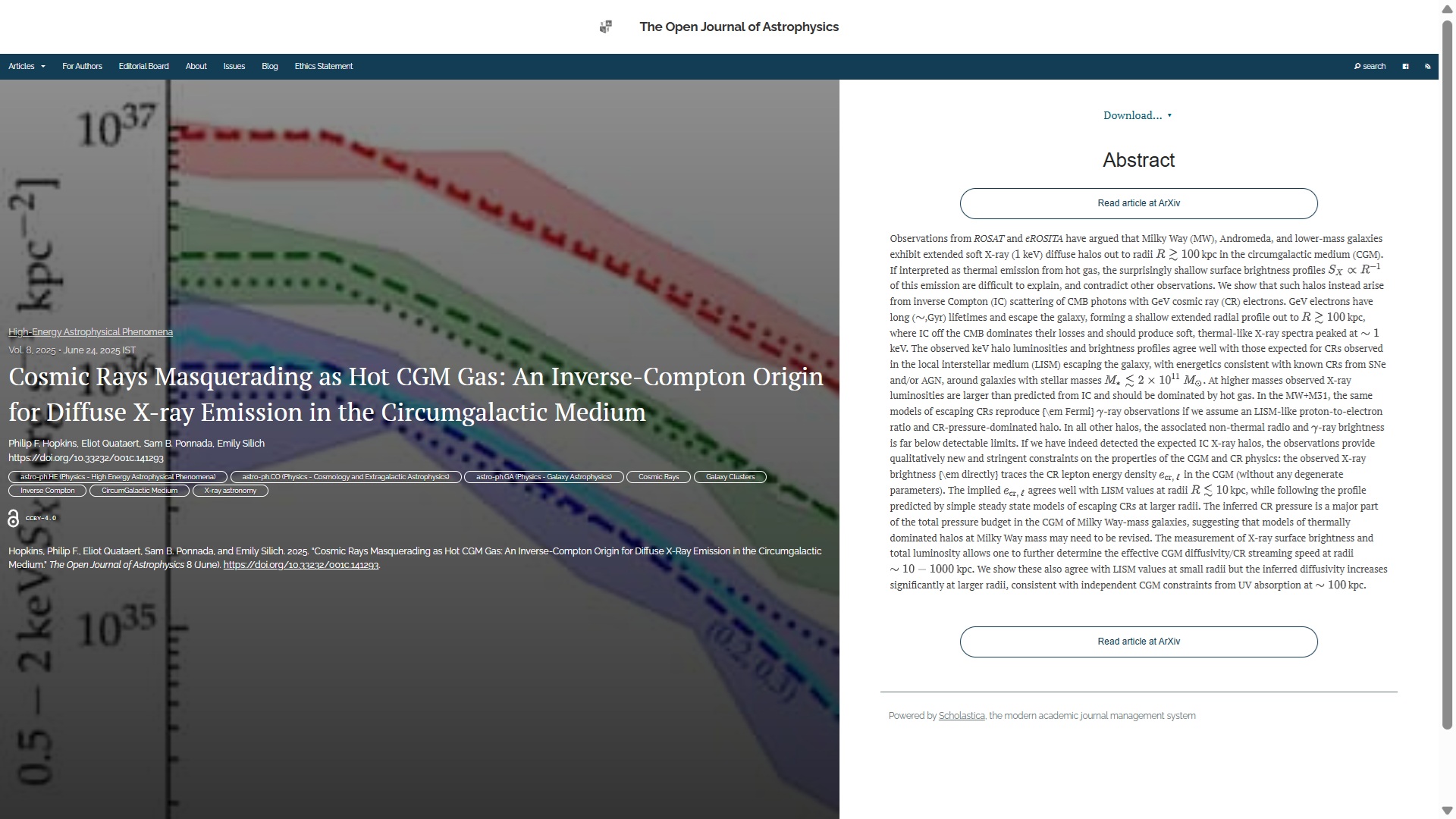
The two papers published this week, with their overlays, are as follows. You can click on the images of the overlays to make them larger should you wish to do so.

The first paper to report is “Analysis of optical spectroscopy and photometry of the type I X-ray bursting system UW CrB2” by Mark Kennedy (University College Cork, Ireland) and 21 others based in Ireland, UK, USA, Finland, Netherlands and Australia. This one was published on Tuesday June 10th in the folder High-Energy Astrophysical Phenomena.  This describes optical photometry and spectroscopy of the low-mass X-ray binary UW Coronae Borealis taken over 2 years

The overlay is here:


You can read the final accepted version on arXiv here.

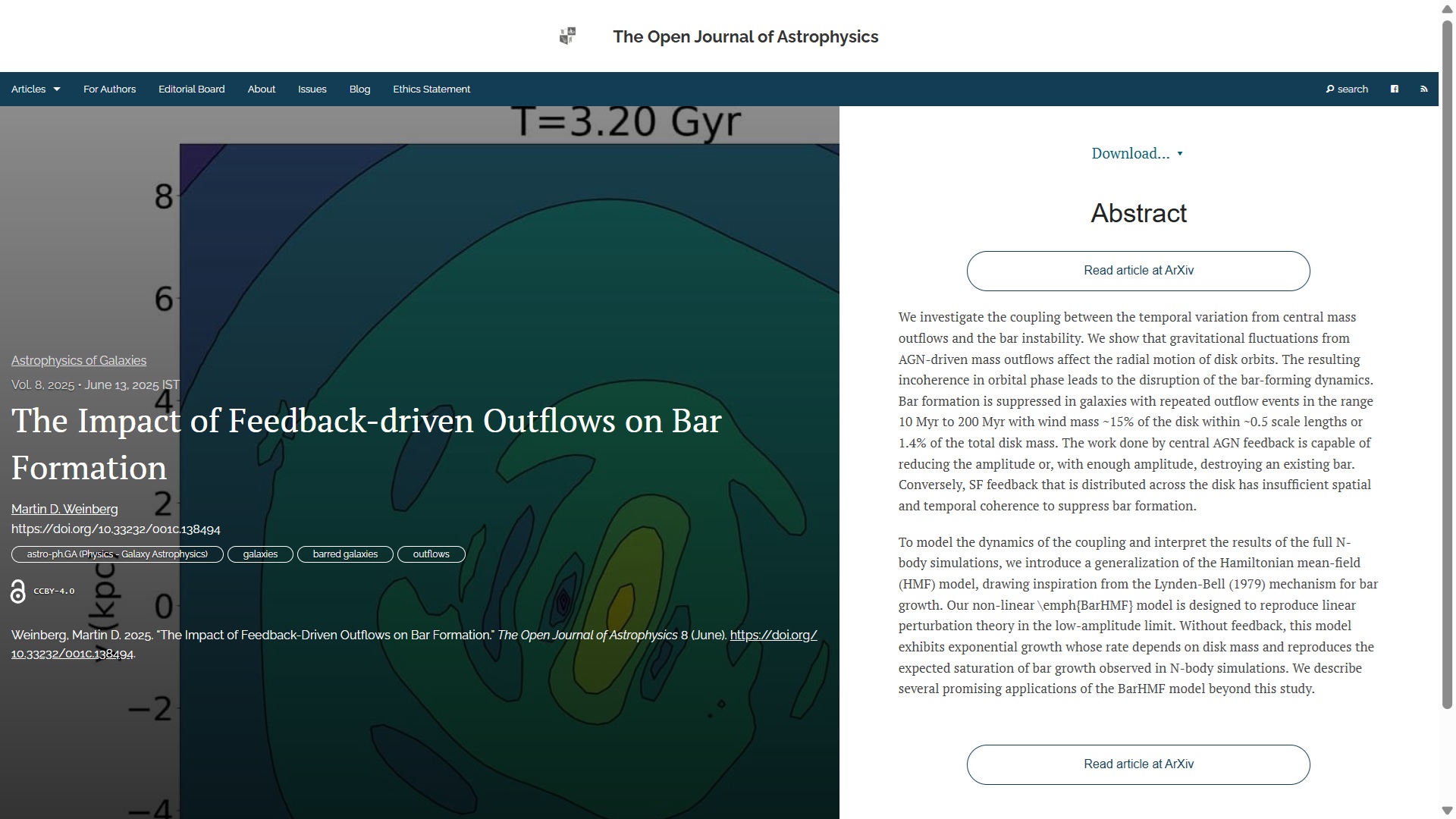
The second paper is “The Impact of Feedback-driven Outflows on Bar Formation” by Martin D. Weinberg (University of Massachusetts, Amherst, USA). This paper uses a generalization of the Hamiltonian Mean-Field model to of the disruption of bar formation in galaxies by stellar feedback. It was published on Friday 13th June 2025 in the folder marked Astrophysics of Galaxies.

The overlay is here:


You can find the officially-accepted version of the paper on arXiv here.

That’s all the papers for this week. I’ll post another update next weekend.


Weekly Update from the Open Journal of Astrophysics – 31/05/2025

Posted in OJAp Papers, Open Access, The Universe and Stuff with tags , , , , , , , , , , , , , , , on May 31, 2025 by telescoper

Once again it’s time for the weekly Saturday morning update of papers published at the Open Journal of Astrophysics. Since the last update we have published five new papers, which brings the number in Volume 8 (2025) up to 67; the total so far published by OJAp has passed the 300 mark and is now up to 302. If we keep up at the same rate for the rest of the year as we did for the first five months now completed, we will publish around 160 papers altogether in 2025.

In chronological order of publication, the five papers published this week, with their overlays, are as follows. You can click on the images of the overlays to make them larger should you wish to do so.

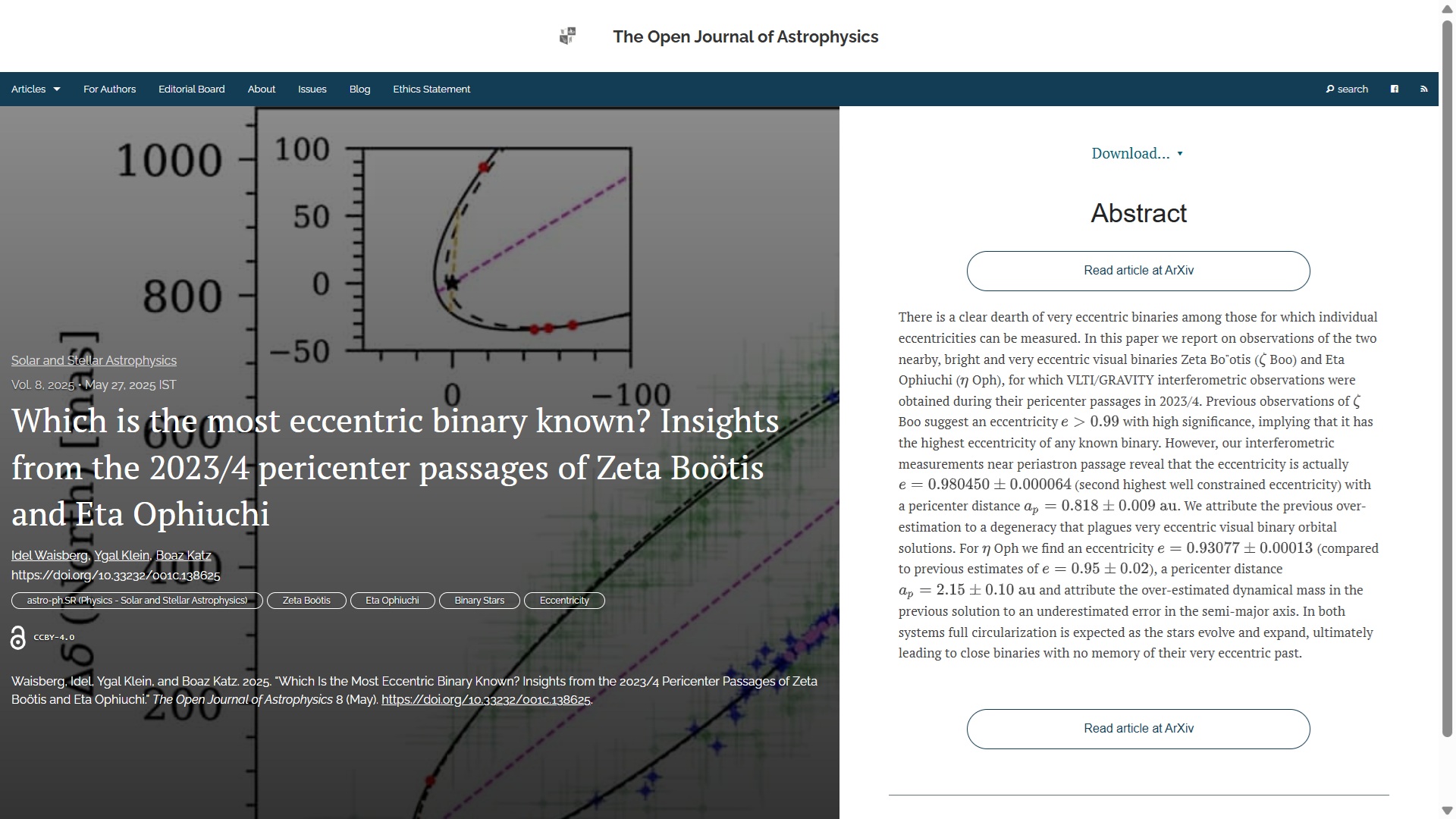
The first paper to report is “Which is the most eccentric binary known? Insights from the 2023/4 pericenter passages of Zeta Boötis and Eta Ophiuchi” by Idel Waisberg, Ygal Klein and Boaz Katz (Weizmann Institute of Science, Israel).  This is a report of interferometric observations of two very eccentric binary star systems, published on Tuesday 27th May 2025 in the folder Solar and Stellar Astrophysics. The overlay is here:

You can read the final accepted version on arXiv here.

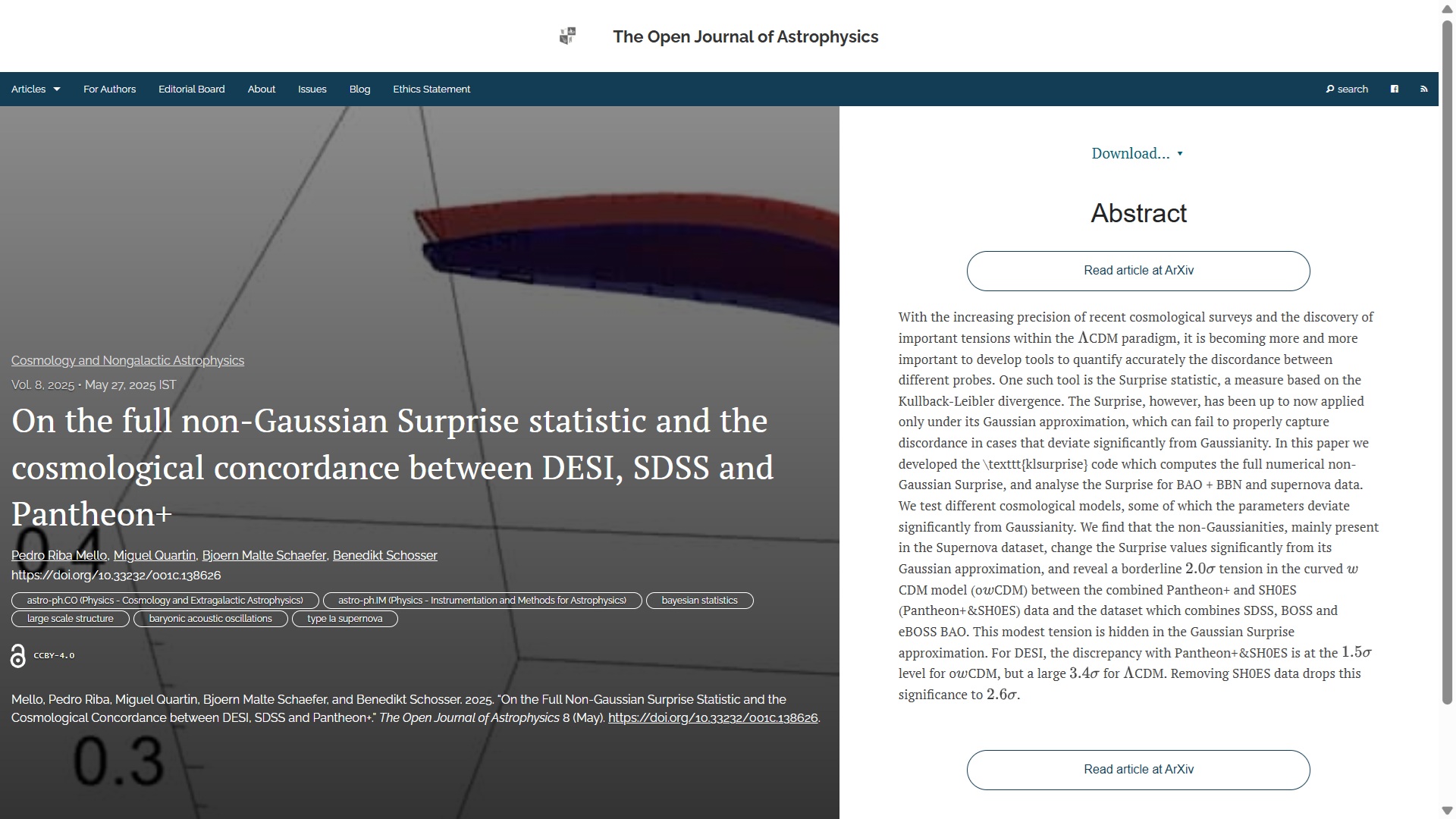
The second paper to report is “On the full non-Gaussian Surprise statistic and the cosmological concordance between DESI, SDSS and Pantheon+” by Pedro Riba Mello & Miguel Quartin (Universidade Federal do Rio de Janeiro, Brazil), and Bjoern Malte Schaefer & Benedikt Schosser (Heidelberg, Germany). This paper is in the folder Cosmology and NonGalactic Astrophysics and was published on Tuesday 27th May 2025. The paper presents an application of the “Surprise Statistic”, based on the Kullback-Leibler divergence, as a measure of the difference between results inferred from different data sets.

The overlay is here:


You can find the officially-accepted version of the paper on arXiv here.

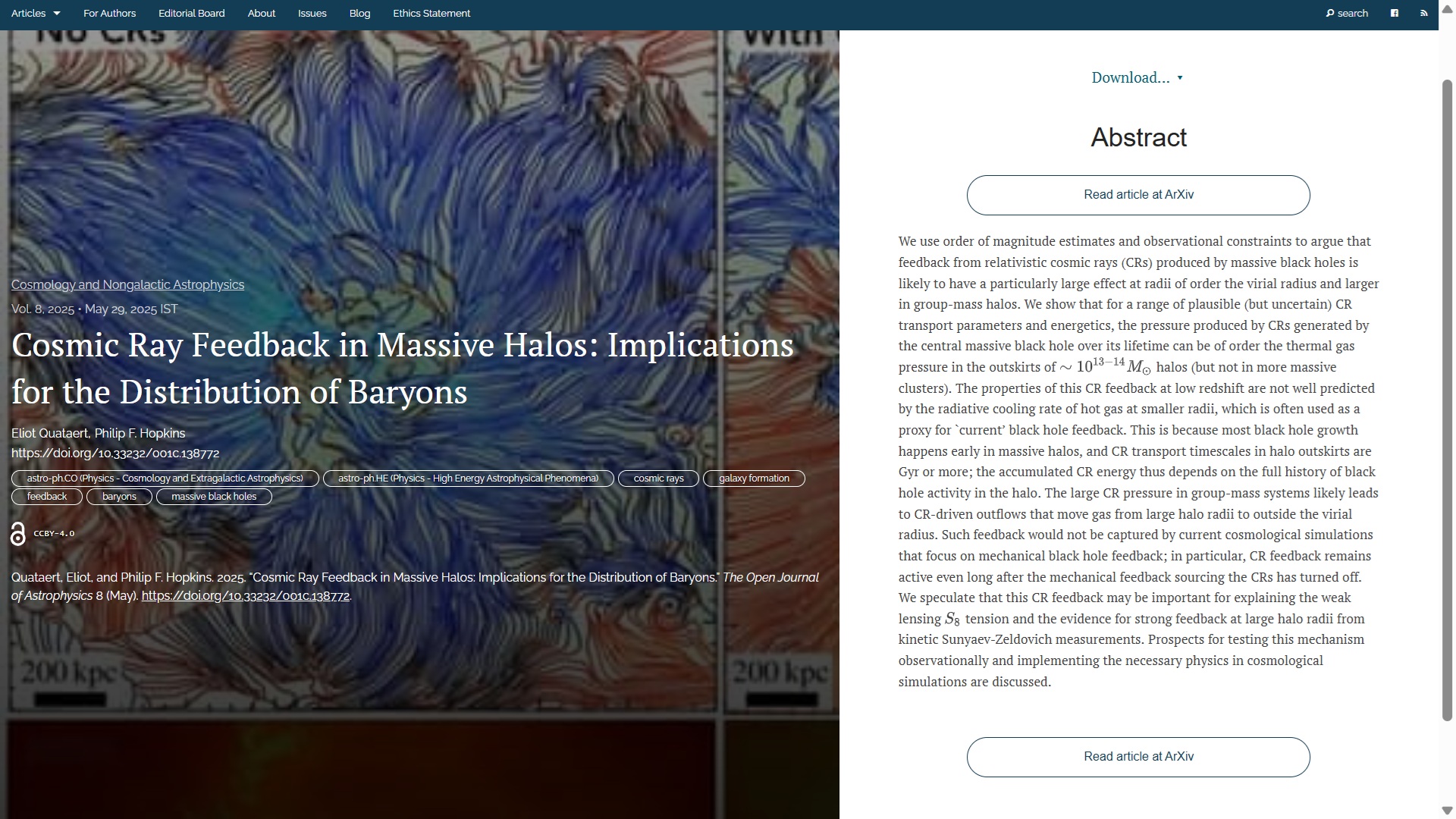
The third paper we published last week, and our 300th overall, is “Cosmic Ray Feedback in Massive Halos: Implications for the Distribution of Baryons” by Eliot Quataert (Princeton, USA) and Philip F. Hopkins (Caltech, USA).  This was published on Thursday 29th May in the folder Cosmology and NonGalactic Astrophysics. The paper discusses the effects of cosmic rays produced by massive black holes on the structure of the baryonic component of galaxies and how these might affect cosmological parameter estimation. The overlay is here:


You can read the officially accepted version of this paper on arXiv here.

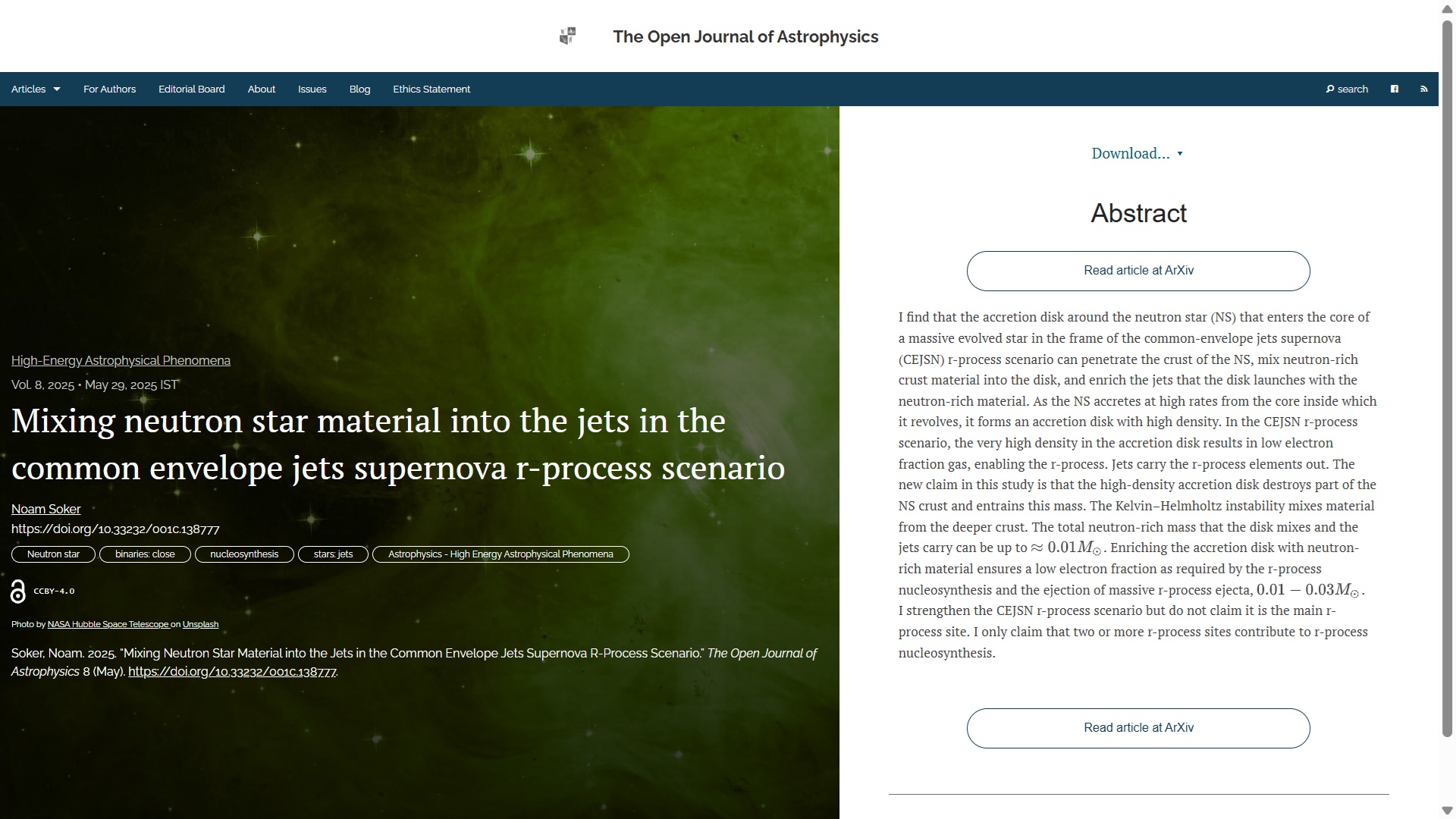
The next one to report is “Mixing neutron star material into the jets in the common envelope jets supernova r-process scenario” by Noam Soker (Technion, Israel). This was published on Thursday 27th May in the folder High-Energy Astrophysical Phenomena; it presents a discussion of the chemical enrichment of an evolved star consequent upon its ingestion of a neutron star.

The overlay is here:

You can find the officially accepted version on arXiv here.

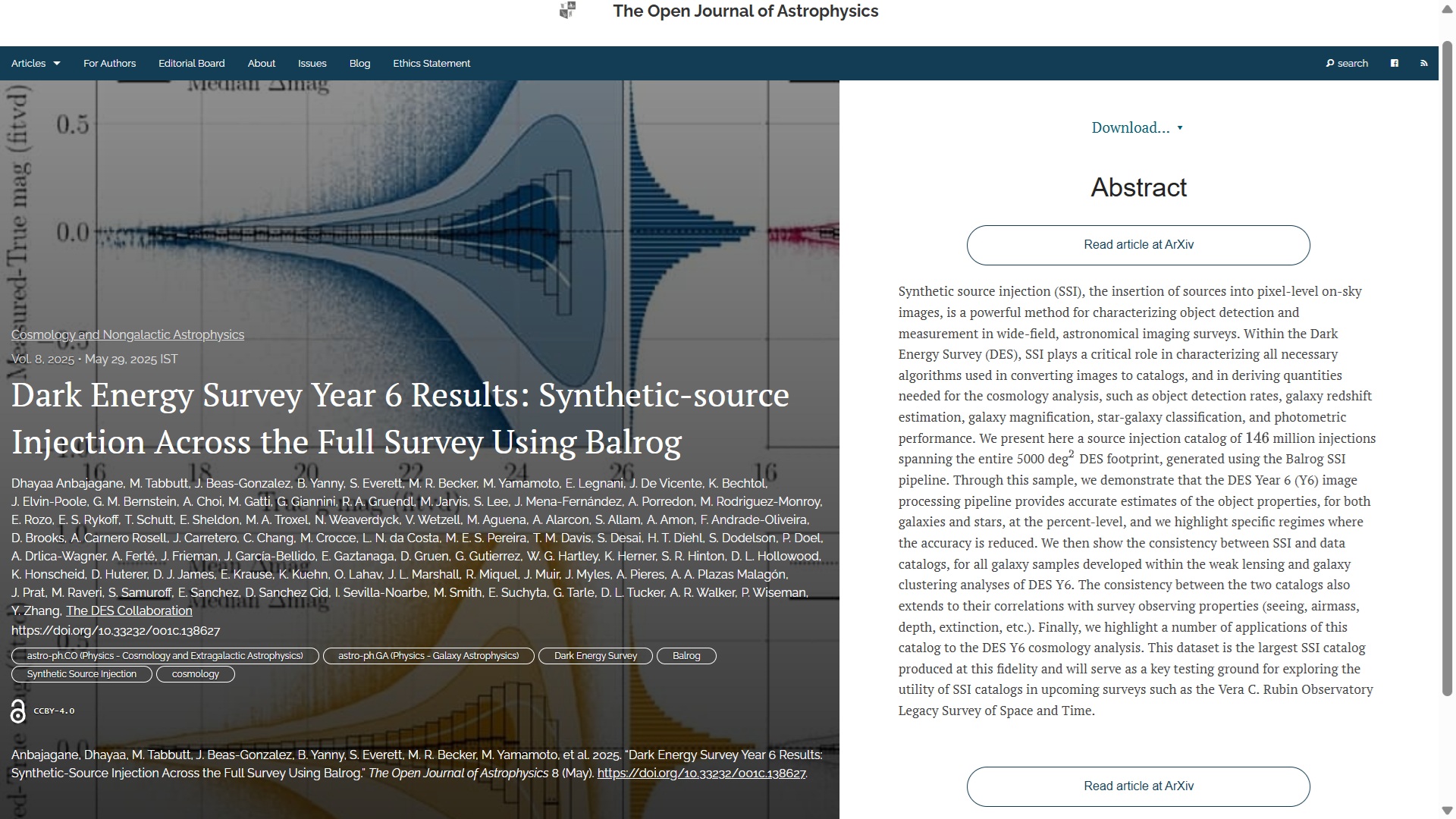
Last, but by no means least, for this week we have “Dark Energy Survey Year 6 Results: Synthetic-source Injection Across the Full Survey Using Balrog” by Dhayaa Anbajagane (Kavli Institute, Chicago) et al. (81 authors) on behalf of the Dark Energy Survey Collaboration. It was also  published on Thursday 27th May  2025, but in the folder Cosmology and NonGalactic Astrophysics. It is about testing the Dark Energy Survey analysis pipeline using synthetic sources.

The overlay is here:


You can find the officially accepted version on arXiv here.

That’s all the papers for this week. I’ll post another update next weekend.

Weekly Update from the Open Journal of Astrophysics – 24/05/205

Posted in OJAp Papers, Open Access, The Universe and Stuff with tags , , , , , , , , , , , , , , , , , on May 24, 2025 by telescoper

It’s  time once again for the regular Saturday update of papers published during the past week at the Open Journal of Astrophysics. Since the last update we have published three new papers, which brings the number in Volume 8 (2025) up to 62 and the total so far published by OJAp up to 297.

In chronological order of publication, the three papers published this week, with their overlays, are as follows. You can click on the images of the overlays to make them larger should you wish to do so.

The first paper to report is: “Jet-shaped filamentary ejecta in common envelope evolution” by Ron Schreier, Shlomi Hillel and Noam Soker (Technion, Haifa, Israel). This paper, which was published on Monday May 19th 2025 in the folder High-Energy Astrophysical Processes, presents three-dimensional hydrodynamical simulations of common envelope evolution of a neutron star inside the envelope of a rotating red supergiant with Rayleigh-Taylor instabilities forming filamentary ejecta.

The overlay is here:

You can find the officially accepted version on arXiv here.

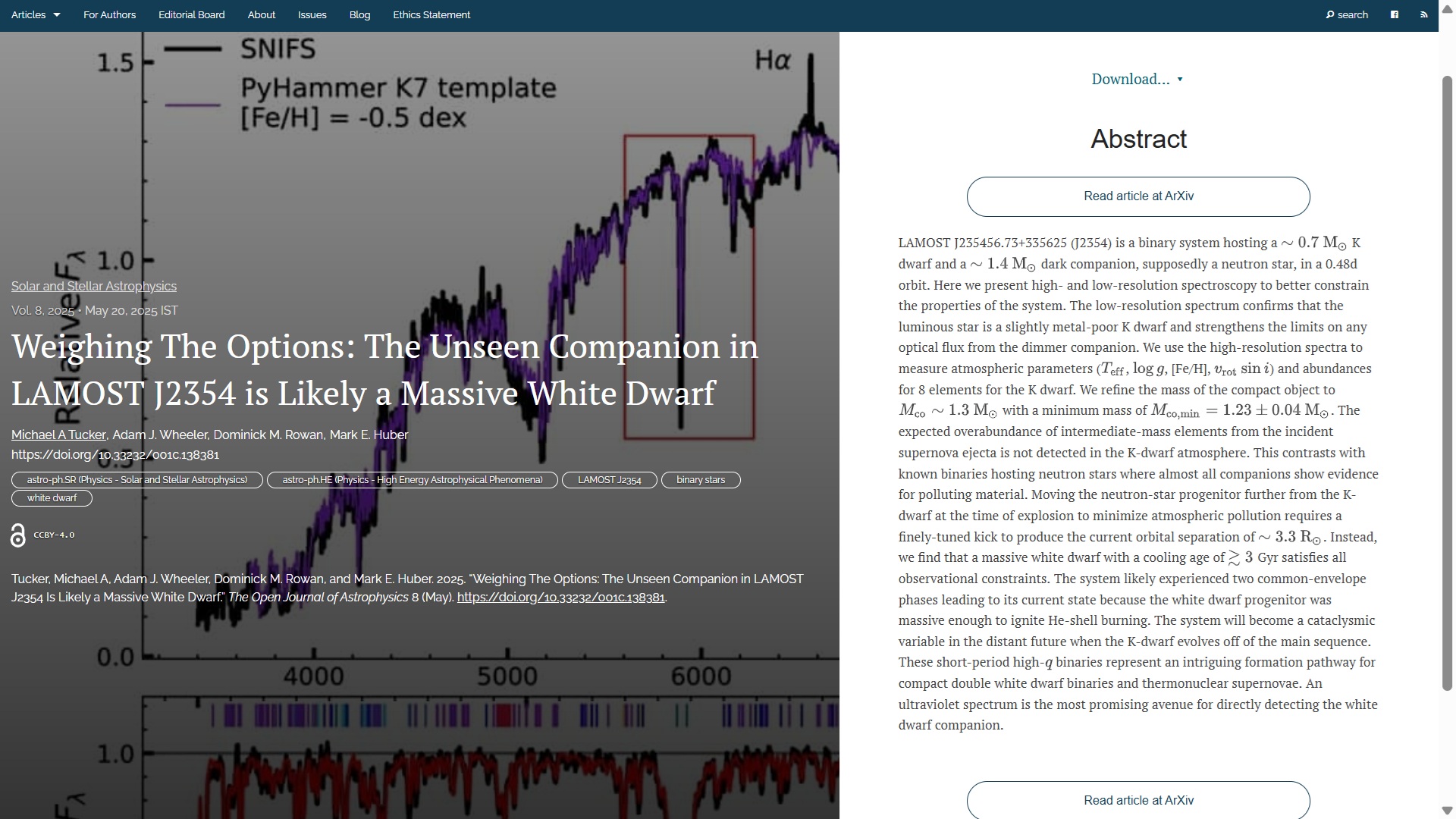
Second one up is “Weighing The Options: The Unseen Companion in LAMOST J2354 is Likely a Massive White Dwarf” by M. A. Tucker, A. J. Wheeler & D. M. Rowan (Ohio State University, USA) and M. E. Huber (U. Hawaii, USA). This paper was published on Tuesday 20th May 2025 in the folder for Solar and Stellar Astrophysics. It discusses a spectroscopic study of the binary system LAMOST J235456.73+335625 (J2354) with a discussion of the implications for the nature of the dark component.

The overlay is here:


You can find the officially-accepted version of the paper on arXiv here.

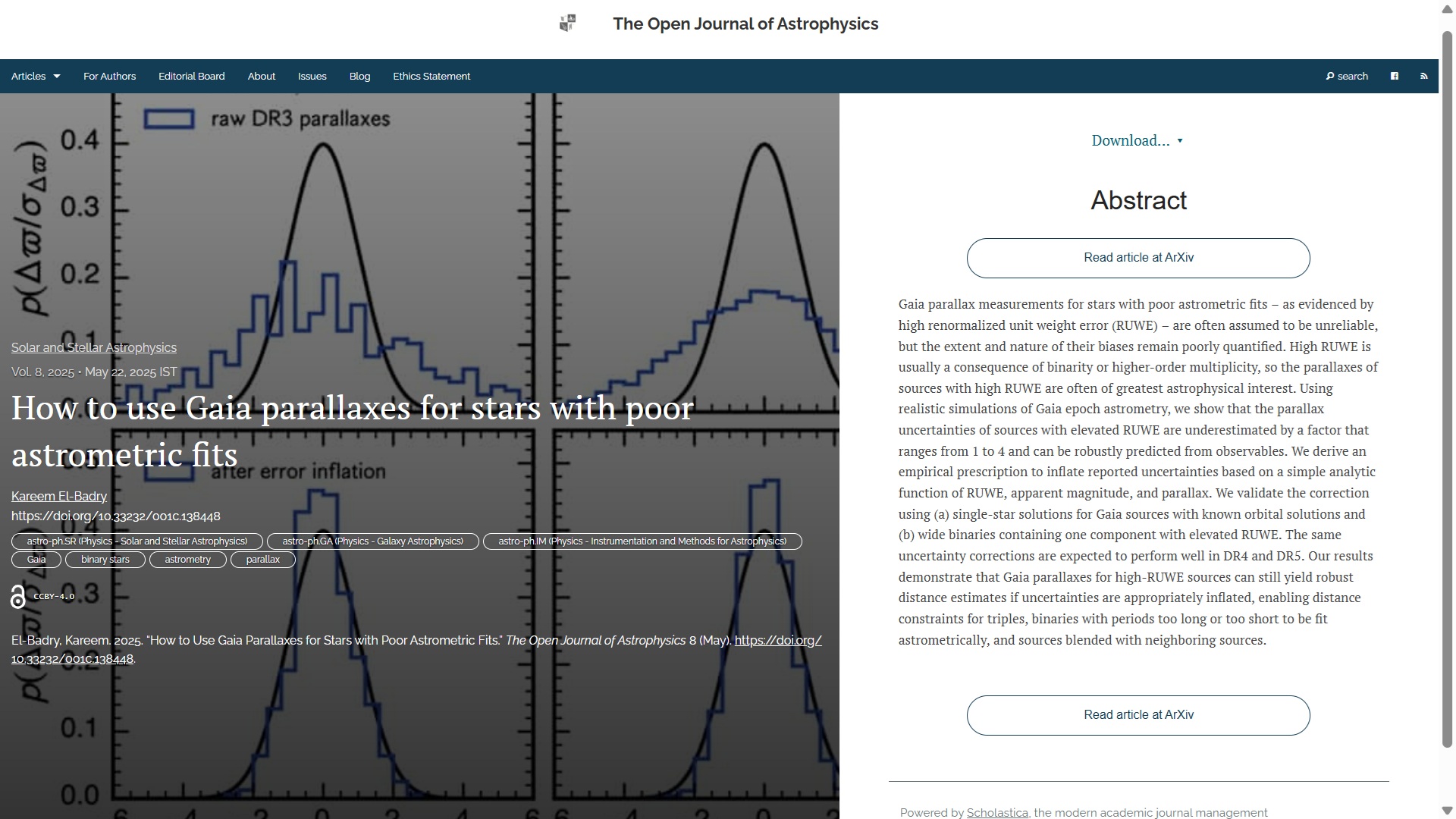
The third and last paper of the week, published on Thursday May 22nd 2025, also in the folder Solar and Stellar Astrophysics, is “How to use Gaia parallaxes for stars with poor astrometric fits” by Kareem El-Badry (Caltech, USA).  This paper presents a method for extracting reasonable estimates of stellar parallaxes from Gaia data when the overall astrometric solution is unreliable due to errors and noise

Here is the overlay:

You can find the officially accepted version of this paper on arXiv here.

That’s all the papers for this week. Looking at the publishing workflow, I expect we will pass the 300 mark next week. We’ll see when I post the next update next Saturday.


Weekly Update from the Open Journal of Astrophysics – 19/04/2025

Posted in OJAp Papers, Open Access, The Universe and Stuff with tags , , , , , , , , , , , , , , , , , , , on April 19, 2025 by telescoper

It may be the Easter holiday weekend, but it’s still time for the weekly Saturday morning update of papers published at the Open Journal of Astrophysics. Since the last update we have published five new papers, which brings the number in Volume 8 (2025) up to 42 and the total so far published by OJAp up to 277.

In chronological order of publication, the five papers published this week, with their overlays, are as follows. You can click on the images of the overlays to make them larger should you wish to do so.

The first paper to report is “Galaxy Clustering with LSST: Effects of Number Count Bias from Blending” by Benjamin Levine (Stony Brook, NY), Javier Sánchez (STScI, MD), Chihway Chang (Chicago, IL) Anja von der Linden (Stony Brook), Eboni Collins (Dillard, LA), Eric Gawiser (Rutgers, NJ), Katarzyna Krzyżańska (Cornell, NY), Boris Leistedt (Imperial College, UK) on behalf of the LSST Dark Energy Science Collaboration.

This presents a simulation-based study of the effect of source overlaps (blending) on galaxy counts expected for the Vera C. Rubin Legacy Survey of Space and Time (LSST). The paper is in the folder Cosmology and NonGalactic Astrophysics and was published on Monday 14th April 2025. The overlay is here:


You can find the officially-accepted version of the paper on arXiv here.

The second paper to announce, published onTuesday 15th April 2025,  “Rapid, strongly magnetized accretion in the zero-net-vertical-flux shearing box” by Jonathan Squire (Otago, New Zealand), Eliot Quataert (Princeton, USA) & Philip F. Hopkins (Caltech, USA). This  paper presents a numerical study of turbulence in a flux shearing box, with discussion of the implications of the results for global accretion disk models and simulations thereof. It was published in the folder High-Energy Astrophysical Phenomena and the overlay is here:


You can read the officially accepted version of this paper on arXiv here.

The third paper of the week, published on Wednesday April 16th 2025,   is “DeepDISC-photoz: Deep Learning-Based Photometric Redshift Estimation for Rubin LSST” by Grant Merz (University of Illinois at Urbana-Champaign, USA) and 13 others (all based in the USA) on behalf of the LSST Dark Energy Science Collaboration. This paper describes adding photometric redshift estimation to the DeepDISC framework for classification objects in co-added images for use with the Vera C. Rubin LSST survey. It can be found in the folder Instrumentation and Methods for Astrophysics.

Here is the overlay:


You can find the officially accepted version of this paper on arXiv here.

The next one to report is “Multidimensional Nova Simulations with an Extended Buffer and Lower Initial Mixing Temperatures” by Alexander Smith Clark and Michael Zingale (Stony Brook University, NY, USA). This paper presents new computer models of classical novae with improved ability to follow nucleosynthesis in the thermonuclear outburst and better treatment of convective transport. This one was also published on Wednesday 16th April 2025 but in the folder Solar and Stellar Astrophysics.

Here is the overlay:


The official published version can be found on the arXiv here.

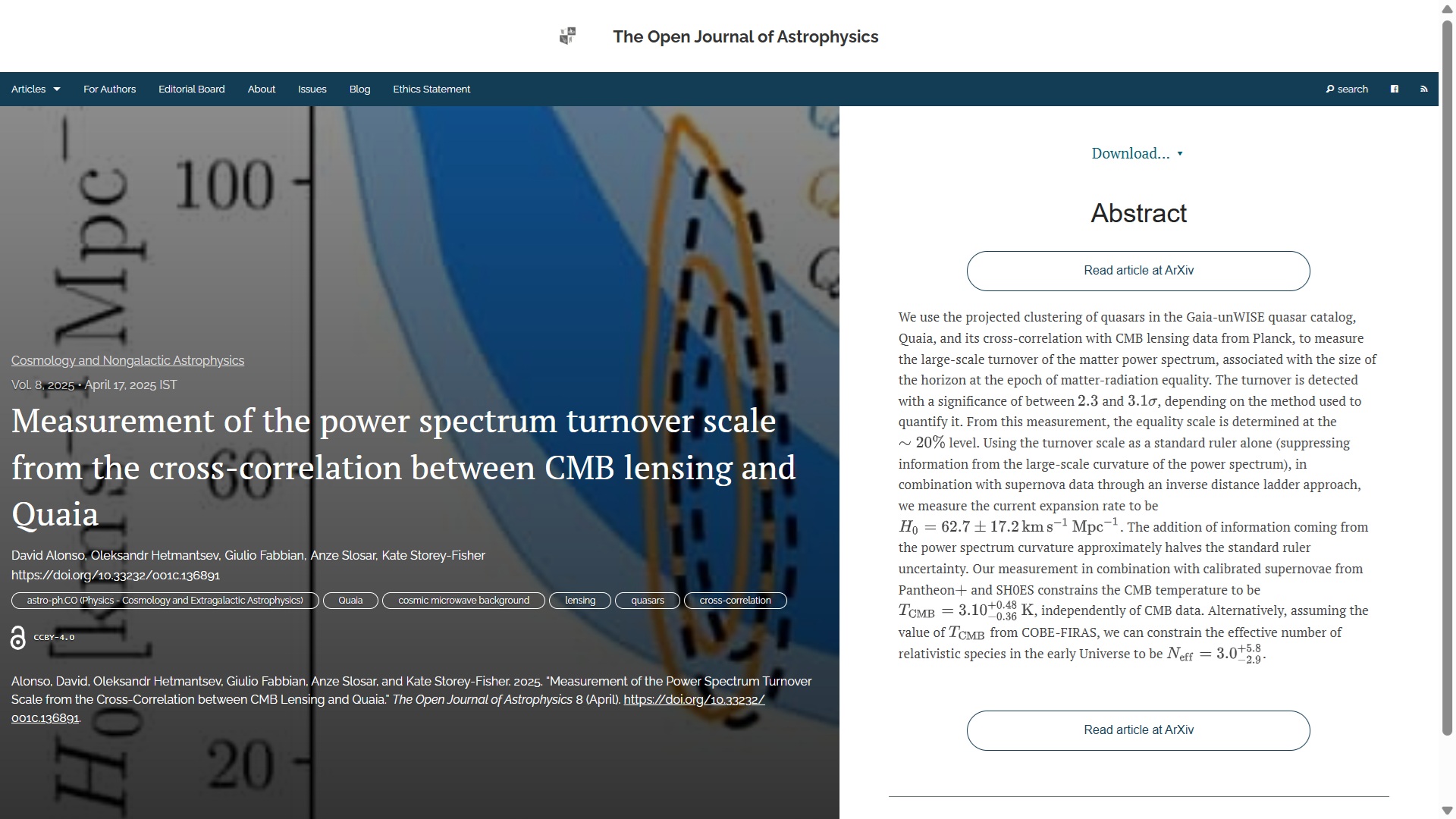
The last paper of the five published this week is “Measurement of the power spectrum turnover scale from the cross-correlation between CMB lensing and Quaia” by David Alonso (Oxford, UK), Oleksandr Hetmantsev (Kyiv, Ukraine), Giulio Fabbian (Cambridge, UK), Anze Slosar (Brookhaven National Laboratory, USA) and Kate Storey-Fisher (Stanford, USA). This is a discussion of using the spatial correlations of quasars and their cross-correlations with cosmic microwave background lensing data to measure a feature corresponding to the matter-radiation equality scale with consequences for cosmological parameter estimation. It was published on Thursday 17th April 2025 in the folder Cosmology and NonGalactic Astrophysics.

The overlay is here:

You can find the officially accepted version on arXiv here.

That’s all the papers for this week. I’ll just add a couple of things.

One is that, although there have been weeks before in which we have published five or more papers, we still haven’t managed to have a week on which we’ve published a paper on every weekday. This week we had two on Wednesday 16th but didn’t have any yesterday (Friday).

The second is that tt has been a while since I last posted a breakdown of the running costs here at the Open Journal of Astrophysics. Today I received an email from Scholastica, our service provider, reminding me our costs will go up shortly (from 22nd April). In the interest of transparency I am passing this information on here.

The new prices will be as follows:

  • Peer Review System annual cost will be $425/year (was $350/year) plus $10 per submission (no change)
  • OA Publishing Platform annual cost will be $1,499/year (was $1,399/year)

Last year we published 120 papers with about 250 submissions. We’re a bit ahead of that this year, so I estimate that our next year’s costs will be a bit less than $5000. That’s still less than the typical APC for a single paper at many journals.

I hope this clarifies the situation.

Weekly Update from the Open Journal of Astrophysics – 12/04/2025

Posted in OJAp Papers, Open Access, The Universe and Stuff with tags , , , , , , , , , , , , , , , , on April 12, 2025 by telescoper

Time for the weekly Saturday morning update of papers published at the Open Journal of Astrophysics. Since the last update we have published four new papers, which brings the number in Volume 8 (2025) up to 37 and the total so far published by OJAp up to 272.

In chronological order of publication, the four papers published this week, with their overlays, are as follows. You can click on the images of the overlays to make them larger should you wish to do so.

The first paper to report is “Searching for new physics using high precision absorption spectroscopy; continuum placement uncertainties and the fine structure constant in strong gravity” by Chung-Chi Lee (Big Questions Institute (BQI), Sydney, Australia), John K. Webb (Cambridge, UK), Darren Dougan (BQI), Vladimir A. Dzuba & Victor V. Flambaum (UNSW, Australia) and Dinko Milaković (Trieste, Italy).

This presents a discussion of the problem of continuum placement in high-resolution spectroscopy, which impacts significantly on fine structure constant measurements, and a method for mitigating its effects. The paper is in the folder Solar and Stellar Astrophysics and was published on Tuesday 8th April 2025. The overlay is here:

You can find the officially-accepted version of the paper on arXiv here.

The second paper to announce, also published on 8th April 2025,  is “Deciphering Spatially Resolved Lyman-Alpha Profiles in Reionization Analogs: The Sunburst Arc at Cosmic Noon” by Erik Solhaug (Chicago, USA), Hsiao-Wen Chen (Chicago), Mandy C. Chen (Chicago),  Fakhri Zahedy (University of North Texas),  Max Gronke (MPA Garching, Germany),  Magdalena J. Hamel-Bravo (Swinburne, Australia), Matthew B. Bayliss (U. Cincinatti), Michael D. Gladders  (Chicago), Sebastián López (Universidad de Chile), Nicolás Tejos (Universidad Católica de Valparaíso, Chile).

This paper, which presents a study of the Lyman-alpha emission properties of a gravitationally-lensed galaxy at redshift z=2.37, appears in the folder Astrophysics of Galaxies. It was published


You can read the officially accepted version of this paper on arXiv here.

The third paper of the week  is “On the progenitor of the type Ia supernova remnant 0509-67.5” by Noam Soker (Technion, Haifa, Israel). This one was published on Wednesday 9th April 2025 in the folder High-Energy Astrophysical Phenomena. The author discusses possible ideas for the origin of a supernova that exploded inside a planetary nebula.

Here is the overlay:


You can find the officially accepted version of this paper on arXiv here.

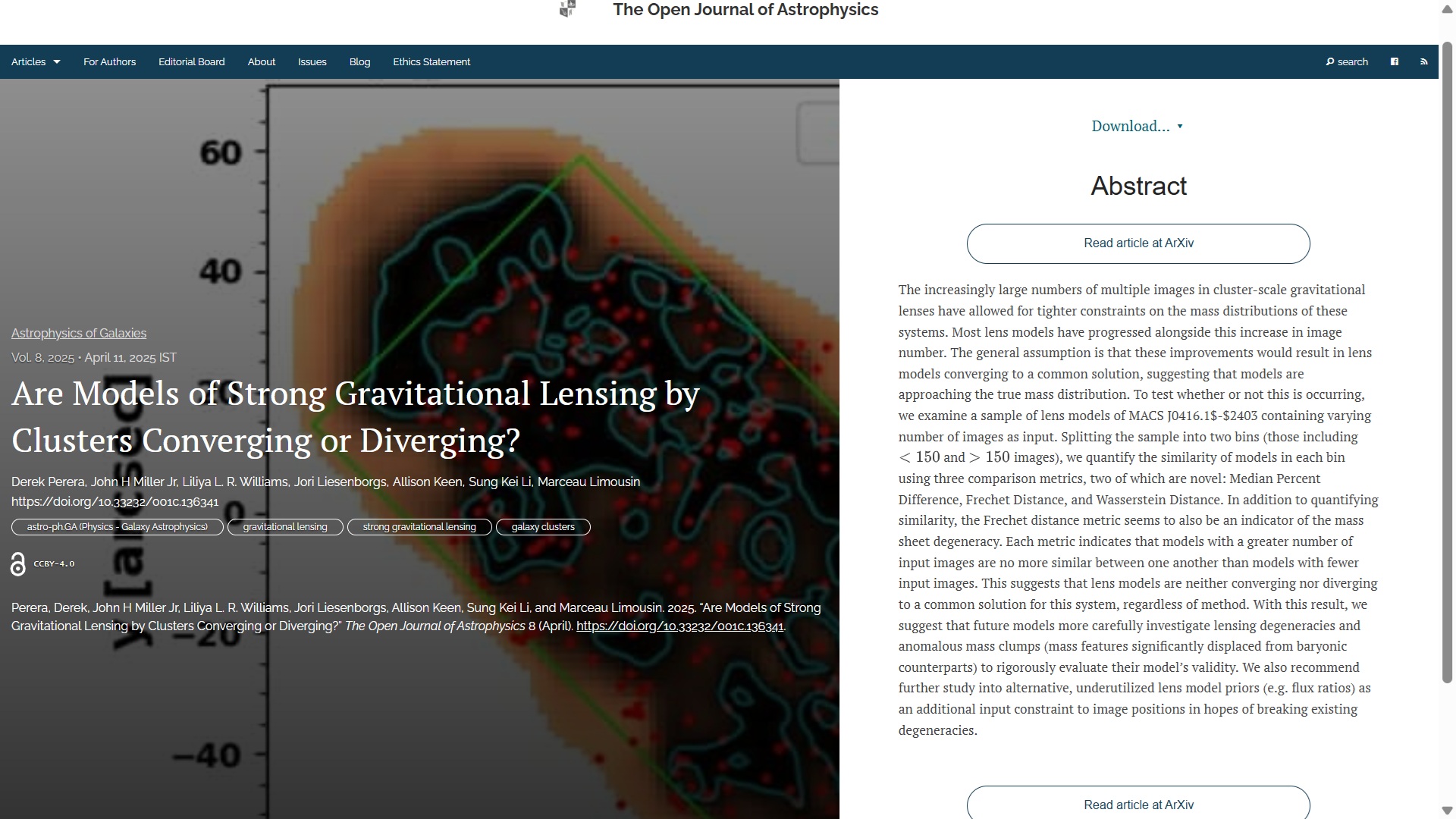
Last (but certainly) not least for this week, published on April 11th 2025, we have “Are Models of Strong Gravitational Lensing by Clusters Converging or Diverging?” by Derek Perera (U. Minnesota), John H Miller Jr & Liliya L. R. Williams (U. Minnesota, USA), Jori Liesenborgs (Hasselt U., Belgium), Allison Keen (U. Minnesota), Sung Kei Li (Hong Kong University), Marceau Limousin (Aix Marseille Univ., France).  This papers study various models of a strong gravitational lensing system, the results suggesting that lens models are neither converging to nor diverging from a common solution for this system, regardless of method.

Here is the overlay:


The official published version can be found on the arXiv here.


That’s all the papers for this week. By way of a postscript I’ll just mention that the gremlins that have affected submissions to Crossref (which we rely on for registering the article metadata) have now been resolved and normal services have been restored.

Weekly Update at the Open Journal of Astrophysics – 08/03/2025

Posted in OJAp Papers, Open Access, The Universe and Stuff with tags , , , , , , , , , , , , , , , , , , , , on March 8, 2025 by telescoper

Time for the weekly Saturday morning update of papers published at the Open Journal of Astrophysics. Since the last update we have published four new papers, which brings the number in Volume 8 (2025) up to 25 and the total so far published by OJAp up to 260.

In chronological order of publication, the four papers published this week, with their overlays, are as follows. You can click on the images of the overlays to make them larger should you wish to do so.

The first paper to report is “Partition function approach to non-Gaussian likelihoods: information theory and state variables for Bayesian inference” by Rebecca Maria Kuntz, Heinrich von Campe, Tobias Röspel, Maximilian Philipp Herzog, and Björn Malte Schäfer, all from the University of Heidelberg (Germany). It was published on Wednesday March 5th 2025 in the folder Cosmology and NonGalactic Astrophysics and it discusses the relationship between information theory and thermodynamics with applications to Bayesian inference in the context of cosmological data sets.


You can read the officially accepted version of this paper on arXiv here.

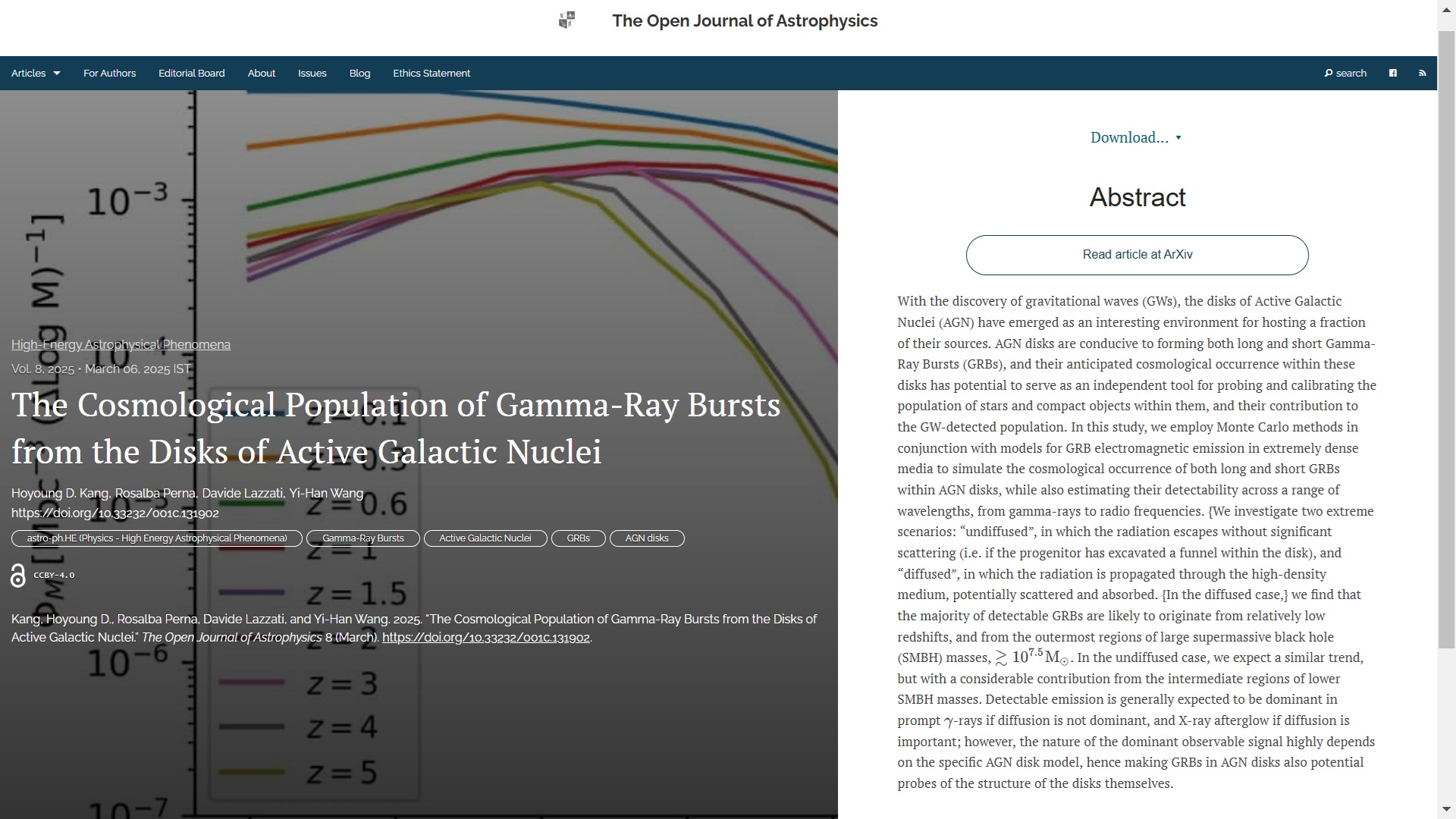
The second paper of the week  is “The Cosmological Population of Gamma-Ray Bursts from the Disks of Active Galactic Nuclei” by Hoyoung D. Kang & Rosalba Perna (Stony Brook), Davide Lazzati (Oregon State), and Yi-Han Wang (U. Nevada), all based in the USA. It was published on Thursday 6th March 2025 in the folder High-Energy Astrophysical Phenomena. The authors use models for GRB electromagnetic emission to simulate the cosmological occurrence and observational detectability of both long and short GRBs within AGN disks

You can find the officially accepted version of this paper on arXiv here.

The next two papers were published on Friday 7th March 2025.

The distribution of misalignment angles in multipolar planetary nebulae” by Ido Avitan and Noam Soker (Technion, Haifa, Israel) analyzes the statistics of measured misalignment angles in multipolar planetary nebulae implies a random three-dimensional angle distribution limited to <60 degrees. It is in the folder Solar and Stellar Astrophysics.

Here is the overlay:


The official published version can be found on the arXiv here.

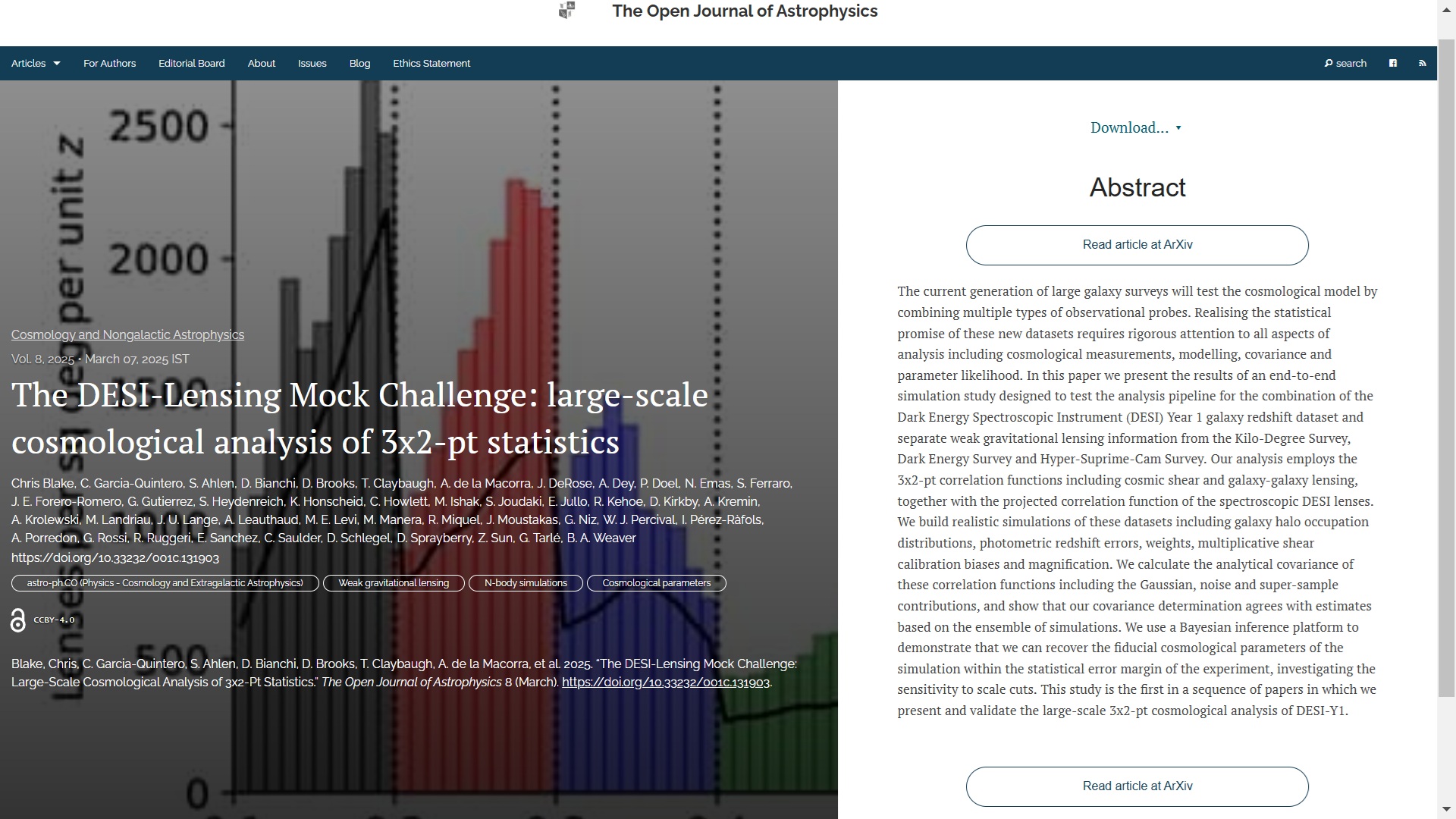
The last paper to report this week is “The DESI-Lensing Mock Challenge: large-scale cosmological analysis of 3×2-pt statistics” by Chris Blake (Swinburne, Australia) and 43 others; this is a large international collaboration and I apologize for not being able to list all the authors here!

This one is in the folder marked Cosmology and NonGalactic Astrophysics; it presents an end-to-end simulation study designed to test the analysis pipeline for the Dark Energy Spectroscopic Instrument (DESI) Year 1 galaxy redshift dataset combined with weak gravitational lensing from other surveys.

The overlay is here:


You can find the “final” version on arXiv here.

That’s all for this week. It’s good to see such an interesting variety of topics. I’ll do another update next Saturday

Five New Publications at the Open Journal of Astrophysics

Posted in OJAp Papers, Open Access, The Universe and Stuff with tags , , , , , , , , , , , , , on December 21, 2024 by telescoper

Time for the usual Saturday summary of papers at the Open Journal of Astrophysics. We have published five more papers since the last update a week ago. The count in Volume 7 (2024) is now up to 119 and the total altogether to 234. As I mentioned in a post last week this means we have published more papers this year (2024) than in all previous years put together.

In chronological order, the five papers published this week, with their overlays, are as follows. You can click on the images of the overlays to make them larger should you wish to do so.

First one up, published on Wednesday 18th December 2024 is “The picasso gas model: Painting intracluster gas on gravity-only simulations” byby Florian Kéruzoré, L. E. Bleem, N. Frontiere, N. Krishnan, M. Buehlmann, J. D. Emberson, S. Habib, and P. Larsen all of the Argonne National Laboratory, USA.  The paper, which is in the folder marked Cosmology and NonGalactic Astrophysics describes a method using machine learning based on an analytical gas model to predict properties of the intracluster medium.

Here is a screen grab of the overlay, which includes the abstract:


You can find the officially accepted version of the paper on the arXiv here.

The second paper to announce, and the first of four published on Wednesday 19th December 2024, “maria: A novel simulator for forecasting (sub-)mm observations” by J. van Marrewijk (ESO, Garching, Germany) and 10 others based in Germany, USA, Norway, France and Italy. This paper describes a multi-purpose telescope simulator that optimizes scanning strategies and instrument designs, produces synthetic time-ordered data, time streams, and maps from hydrodynamical simulations, thereby enabling comparison between theory and observations. This one is in the folder marked Instrumentation and Methods for Astrophysics.

You can see the overlay here:

The accepted version of this paper can be found on the arXiv here.

The third paper  is “Detached Circumstellar Matter as an Explanation for Slowly-Rising Interacting Type Ibc Supernovae” by Yuki Takei (Kyoto U., Japan) & Daichi Tsuna (Caltech, USA). This one was also published on 19th December and is in the folder marked High-Energy Astrophysical Phenomena. The overlay is here:


The officially accepted version can be found on arXiv here.

The fourth paper, also published on 19th December 2024, is called “On the dark matter content of ultra-diffuse galaxies” and was written by Andrey Kravtsov (U. Chicago, USA).  The article discusses the implications of measured velocity dispersions of ultra-diffuse galaxies for models of galaxy formation and is in the folder marked Astrophysics of Galaxies.

The overlay is here


You can find the officially accepted version of this paper here.

The fifth paper in this batch is “Estimating Exoplanet Mass using Machine Learning on Incomplete Datasets” by Florian Lalande (Okinawa Institute of Science and Technology), Elizabeth Tasker (Institute of Space and Astronautical Science, Kanagawa) and Kenji Doya (Okinawa); all based in Japan. This one was published on 10th October 2024 in the folder marked Earth and Planetary Astrophysics. It compares different methods for inferring exoplanet masses in catalogues with missing data


You can find the official accepted version on the arXiv here.

Finally for this week we have “A new non-parametric method to infer galaxy cluster masses from weak lensing” by Tobias Mistele (Case Western Reserve University, USA) and Amel Durakovic (Czech Academy of Sciences, Czechia). This one was also published on 19th December and is in the folder Cosmology and NonGalactic Astrophysics.  The overlay is here


You can find the officially-accepted version on arXiv here.

That’s in for this week. I will do another update next Saturday only if we have any new papers on Monday. I will be taking a break over Christmas and also preparing Volume 8 (2025) for the new year, so publishing will be suspended from 24th December until 2nd January (inclusive). If you want your paper to be published in 2024 the final version must be on arXiv by Monday 23rd December at the latest, otherwise it will be held over until 2025.


Three New Publications at the Open Journal of Astrophysics

Posted in OJAp Papers, Open Access, The Universe and Stuff with tags , , , , , , , , , , , on November 2, 2024 by telescoper

It’s Saturday, so it’s time once again for another summary of business at the  Open Journal of Astrophysics. This week I have three papers to announce, which brings the total we have published so far this year (Vol. 7) to 98 and the total published by OJAp to 213.

First one up, published on Tuesday 29th October 2024, is “Cosmology with shear ratios: a joint study of weak lensing and spectroscopic redshift datasets” by Ni Emas & Chris Blake (Swinburne U., Australia), Rossana Ruggeri (Queensland U, Australia) and Anna Porredon (Ruhr University, Bochum, Germany). This paper is in the folder marked Cosmology and NonGalactic Astrophysics. The paper investigates the use of shear ratios as a cosmological diagnostic, with applications to lensing surveys

Here is a screen grab of the overlay, which includes the abstract:

You can read the paper directly on arXiv here.

The second paper to present, also published on Tuesday 29th October 2024, is “Echo Location: Distances to Galactic Supernovae From ASAS-SN Light Echoes and 3D Dust Maps” by Kyle D. Neumann (Penn State), Michael A. Tucker & Christopher S. Kochanek (Ohio State), Benjamin J. Shappee (U. Hawaii), and K. Z. Stanek (Ohio State), all based in the USA. This paper is in the folder marked High-Energy Astrophysical Phenomena and it presents a new approach to estimating the distance to a source by combining light echoes with recent three-dimensional dust maps with application to supernova distances.

The overlay looks like this:


You can read this paper directly on the arXiv here.

Last, but by no means least, comes  “A deconstruction of methods to derive one-point lensing statistics” by Viviane Alfradique (Universidade Federal do Rio De Janeiro, Brazil), Tiago Castro (INAF Trieste, Italy), Valerio Marra (Trieste), Miguel Quartin (Rio de Janeiro), Carlo Giocoli (INAF Bologna, Italy), and Pierluigi Monaco (Trieste).  Published in the folder marked Cosmology and NonGalactic Astrophysics, it describes a comparative study of different methods of approximating the one-point probability density function (PDF) for use in the statistical analysis of gravitational lensing.

Here is a screengrab of the overlay:


To read the accepted version of this on the arXiv please go here.

That’s it for this week. I hope to post another update next weekend, by when we might well have reached a century for this year!

Four New Publications at the Open Journal of Astrophysics

Posted in OJAp Papers, Open Access, The Universe and Stuff with tags , , , , , , , , , , , , on September 29, 2024 by telescoper

A day later than has been usual for such things, it’s now time for a quick update of activity at the Open Journal of Astrophysics. This week we have published another batch of four papers which takes the count in Volume 7 (2024) up to 81 and the total published altogether by OJAp up to 196. I think there may come a week in we publish papers on every day of that week, but it was not this week…

In chronological order, the four papers published this week, with their overlays, are as follows. You can click on the images of the overlays to make them larger should you wish to do so.

First one up is “Finding the unusual red giant remnants of cataclysmic variable mergers” by Nicholas Z. Rui and Jim Fuller of California Institute of Technology (Caltech), USA. It presents a discussion of the possible photometric, astroseismological, and surface abundance signatures of red giants formed by mergers of cataclysmic variable stars. It was published on 23rd September 2024 and is in the folder marked Solar and Stellar Astrophysics.

Here is a screen grab of the overlay, which includes the abstract:


You can find the officially accepted version of the paper on the arXiv here.

The second paper to announce, also published on 23rd September 2024, is “Notes on the Practical Application of Nested Sampling: MultiNest, (Non)convergence, and Rectification” by Alexander Dittmann (U. Maryland, USA). A critical analysis of the MultiNest algorithm together with suggestions for approving its applicability. It is in the folder Instrumentation and Methods for Astrophysics.

You can see the overlay here:


The accepted version of this paper can be found on the arXiv here.

The third paper, published on 24th September 2024 in the folder marked High-Energy Astrophysical Phenomena, is called  “Merger Precursor: Year-long Transients Preceding Mergers of Low-mass Stripped Stars with Compact Objects” and is by Daichi Tsuna, Samantha Wu & Jim Fuller (Caltech), Yize Dong (UCLA) and Anthony Piro (Carnegie Observatories), all based in the USA.

Here is the overlay


The final version accepted on arXiv is here.

Last in this batch is “Spectroscopic Observations of the GALEX Nearby Young Star Survey Sample. I. Nearby Moving Group Candidates” by Navya Nagananda (Rochester, NY, USA), Laura Vican (UCLA), Ben Zuckerman (UCLA), David Rodriguez (STScI), Alexander Binks (Tübingen, Germany) & Joel Kastner (Rochester). It describes investigations of the spectra of the GALNYSS sample of over 2000 young stars and the assignment of these stars into moving groups. It is is in the folder marked Solar and Stellar Astrophysics, and was published on 25th September 2024 with this overlay:


You can find the official accepted version on the arXiv here.

That’s all for now. I will post another update in a week.

Four New Publications at the Open Journal of Astrophysics

Posted in OJAp Papers, Open Access, The Universe and Stuff with tags , , , , , , , , , , , , , , , , , , , on September 14, 2024 by telescoper

Once again, it’s time for a quick update of activity at the Open Journal of Astrophysics. This week we have published another batch of four papers which takes the count in Volume 7 (2024) up to 77 and the total published altogether by OJAp up to 192. Things are picking up again after the summer lull, and we’re moving towards a double century. If we keep up a steady average of four per week we’ll be at 200 per year.

In chronological order, the four papers published this week, with their overlays, are as follows. You can click on the images of the overlays to make them larger should you wish to do so.

First one up is “Quasi-two-dimensionality of three-dimensional, magnetically dominated, decaying turbulence” by Shreya Dwivedi, Chandranathan Anandavijayan, and Pallavi Bhat of TIFR, Bangalore, India. The paper presents an analysis of numerical simulations of MHD turbulence using Minkowski Functionals, with implications for local anisotropies revealed therein. It was published on 9th September 2024 and is in the folder marked High-Energy Astrophysical Phenomena.

Here is a screen grab of the overlay, which includes the abstract:


You can find the officially accepted version of the paper on the arXiv here.

The second paper to announce, also published on 9th September 2024, is “mochi_class: Modelling Optimisation to Compute Horndeski In class” by  Matteo Cataneo (Universität Bonn, Germany) and Emilio Bellini (SISSA, Trieste, Italy). This article presents a cosmological Einstein-Boltzmann solver adapted to work with Horndeski gravity, together with validation tests. It is in the folder Cosmology and NonGalactic Astrophysics.

You can see the overlay here:


The accepted version of this paper can be found on the arXiv here.

The third paper, published on 11th September 2024 in the folder marked High-Energy Astrophysical Phenomena, is by Jonathan Katz of Washington University, St Louis, USA. The title is “The Sources of Fast Radio Bursts” and it presents a discussion of the possible physical origin of Fast Radio Bursts, arguing that they fall into two distinct groups.


The final version accepted on arXiv is here.

Last in this batch, but by no means least, is “RMS asymmetry: a robust metric of galaxy shapes in images with varied depth and resolution” by Elizaveta Sazonova (U. Waterloo, Canada) with 15 other authors spread around the world (in Canada, USA, Australia, Italy, Chile, UK, Poland, Mexico, Germany, and Spain). This paper presents a method of quantifying distortion of galaxy images connected with mergers or other instabilities. It is in the folder marked Astrophysics of Galaxies and was published on September 12th 2024 with this overlay:


You can find the official accepted version on the arXiv here.

That’s all for now. I will post another update in a week.