Archive for M31

Weekly Update from the Open Journal of Astrophysics – 17/01/2026

Posted in OJAp Papers, Open Access, The Universe and Stuff with tags , , , , , , , , , , , , , , , , , , , , , , , , , , , , on January 17, 2026 by telescoper

It’s Saturday once more so time for another update of activity at the Open Journal of Astrophysics. Since the last update we have published seven papers, bringing the number in Volume 9 (2026) to 11 and the total so far published by OJAp up to 459. This week has been quite busy; for only the second time in recorded history we published at least one paper each working day.

I will continue to include the announcements made on our Mastodon account (on Fediscience) to encourage you to visit it. Mastodon is a really excellent service, and a more than adequate replacement for X/Twitter which nobody should be using.

The first three papers this week were all published on Monday January 12th in the folder Astrophysics of Galaxies.

The first paper to report this week is “Rotational Kinematics in the Globular Cluster System of M31: Insights from Bayesian Inference” by Yuan (Cher) Li & Brendon J. Brewer (U. Auckland, New Zealand), Geraint F. Lewis (U. Sydney, Australia) and Dougal Mackey (independent researcher, Australia). This study uses Bayesian modelling to explore the kinematics of globular clusters in the Andromeda Galaxy, revealing distinct rotation patterns that suggest different subgroups were added at separate times.

The overlay is here:
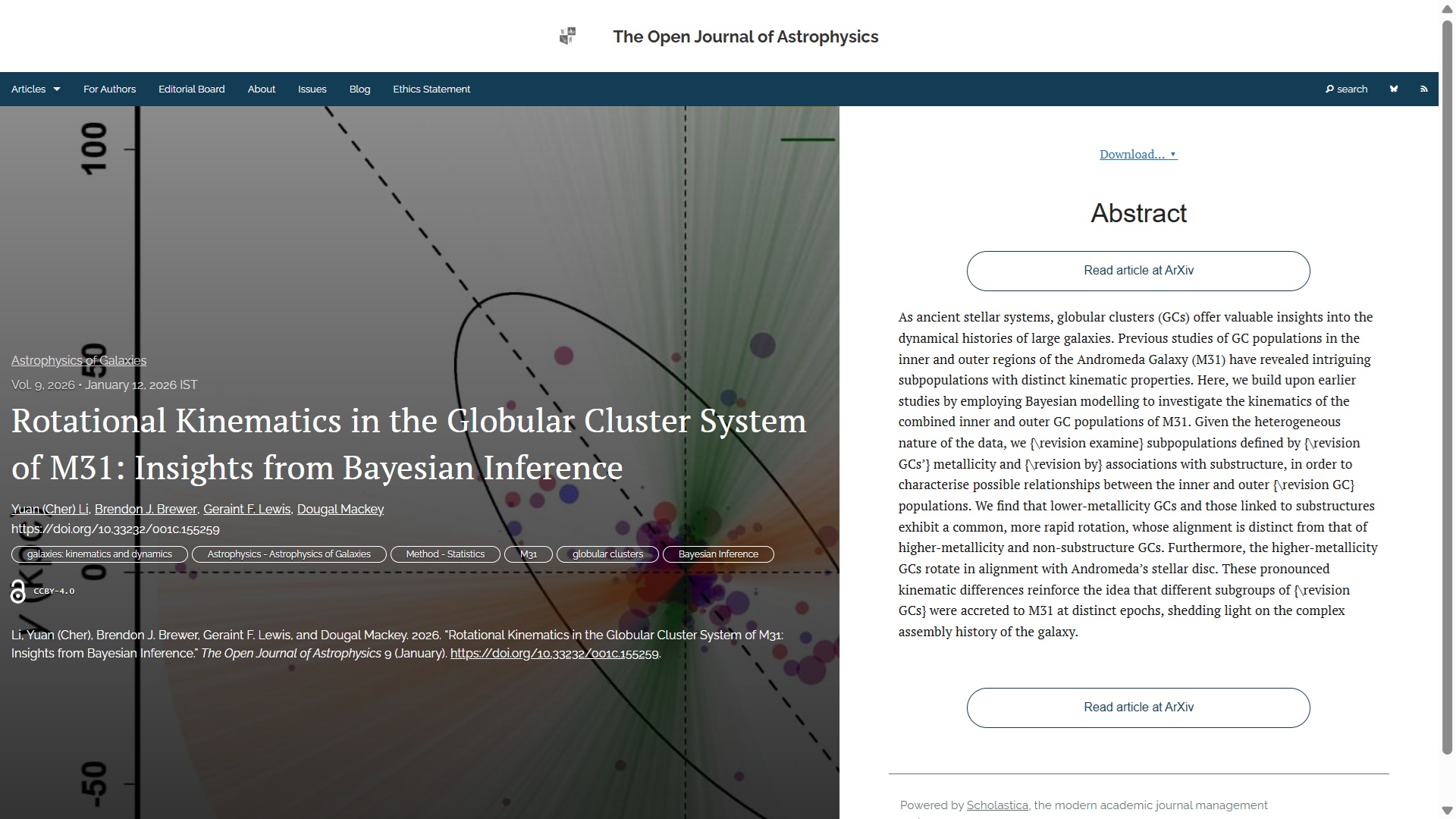
You can find the officially accepted version on arXiv here and the announcement on Fediverse here:

Open Journal of Astrophysics

New Publication at the Open Journal of Astrophysics: "Rotational Kinematics in the Globular Cluster System of M31: Insights from Bayesian Inference" by Yuan (Cher) Li & Brendon J. Brewer (U. Auckland, New Zealand), Geraint F. Lewis (U. Sydney, Australia) and Dougal Mackey

doi.org/10.33232/001c.155259

January 12, 2026, 9:55 am 1 boosts 1 favorites

The second paper is “DESI Data Release 1: Stellar Catalogue” by Sergey Koposov (U. Edinburgh, UK) and an international cast of 67 other authors. This paper introduces and describes the stellar Value-Added Catalogue (VAC) based on DESI Data Release 1, providing measurements for over 4 million stars, including radial velocity, abundance, and stellar parameters.

The overlay for this one is here:
The official version of the paper can be found on arXiv here and the Fediverse announcement here:

Open Journal of Astrophysics

New Publication at the Open Journal of Astrophysics: "DESI Data Release 1: Stellar Catalogue" by Sergey Koposov (U. Edinburgh, UK) and an international cast of 67 other authors.

doi.org/10.33232/001c.155260

January 12, 2026, 10:11 am 2 boosts 1 favorites

Next we have “On the origins of oxygen: ALMA and JWST characterise the multi-phase, metal-enriched, star-bursting medium within a ‘normal’ z>11 galaxy” by Joris Witstok (Cosmic Dawn Centre, Copenhagen, Denmark) and 37 others in locations dotted around the world. This paper presents new ALMA observations of the JADES-GS-z11-0 galaxy confirm the presence of the [O III] 88 µm line, suggesting it consists of two low-mass components undergoing star formation and enriched in metals.

The overlay is here:
The official version can be found on arXiv here and the Fediverse announcement is here:

Open Journal of Astrophysics

New Publication at the Open Journal of Astrophysics: "On the origins of oxygen: ALMA and JWST characterise the multi-phase, metal-enriched, star-bursting medium within a ‘normal’ z>11 galaxy" by Joris Witstok (Cosmic Dawn Centre, Copenhagen, Denmark) and 37 others dotted around the world

doi.org/10.33232/001c.155261

January 12, 2026, 10:30 am 1 boosts 2 favorites

The fourth paper this week is also in the folder Astrophysics of Galaxies. but was published on Tuesday 13th January. It is entitled “Accelerated calibration of semi-analytic galaxy formation models” by Andrew Robertson and Andrew Benson (Carnegie Observatories, USA). This paper presents a faster calibration framework for galaxy formation models, using fewer simulations for each evaluation. However, the model shows discrepancies suggesting the model needs to be made more flexible.

The overlay is here:
You can find the officially accepted version on arXiv here and the Mastodon announcement here:

Open Journal of Astrophysics

New Publication at the Open Journal of Astrophysics: "Accelerated calibration of semi-analytic galaxy formation models" by Andrew Robertson and Andrew Benson (Carnegie Observatories, USA)

doi.org/10.33232/001c.155306

January 13, 2026, 9:41 am 1 boosts 1 favorites

Next one up, published on Wednesday 14th January in the folder Cosmology and Nongalactic Astrophysics, is “Constraints from CMB lensing tomography with projected bispectra” by Lea Harscouet & David Alonso (U. Oxford), UK), Andrina Nicola (U. Manchester, UK) and Anže Slosar (Brookhaven National Laboratory, USA). This study presents angular power spectra and bispectra of DESI luminous red galaxies, finding that the galaxy bispectrum can constrain the amplitude of matter fluctuations and the non-relativistic matter fraction. The overlay is here:
You can find the officially accepted paper on arXiv here and the Mastodon announcement here:

Open Journal of Astrophysics

New Publication at the Open Journal of Astrophysics: "Constraints from CMB lensing tomography with projected bispectra" by Lea Harscouet & David Alonso (U. Oxford, UK), Andrina Nicola (U. Manchester, UK) and Anže Slosar (Brookhaven National Laboratory, USA)

doi.org/10.33232/001c.155341

January 14, 2026, 2:00 pm 2 boosts 0 favorites

The sixth paper this week is “Universal numerical convergence criteria for subhalo tidal evolution” by Barry T. Chiang & Frank C. van den Bosch (Yale U., USA) and Hsi-Yu Schive (National Taiwan University, Taiwan). This was published on Thursday 15th January in the folder Cosmology and Nongalactic Astrophysics; it presents an analysis of a simulation suite that addresses the ‘overmerging’ problem in cosmological simulations of dark matter subhalos, showing that up to 50% of halos in state-of-the art simulations are unresolved. The overlay is here:
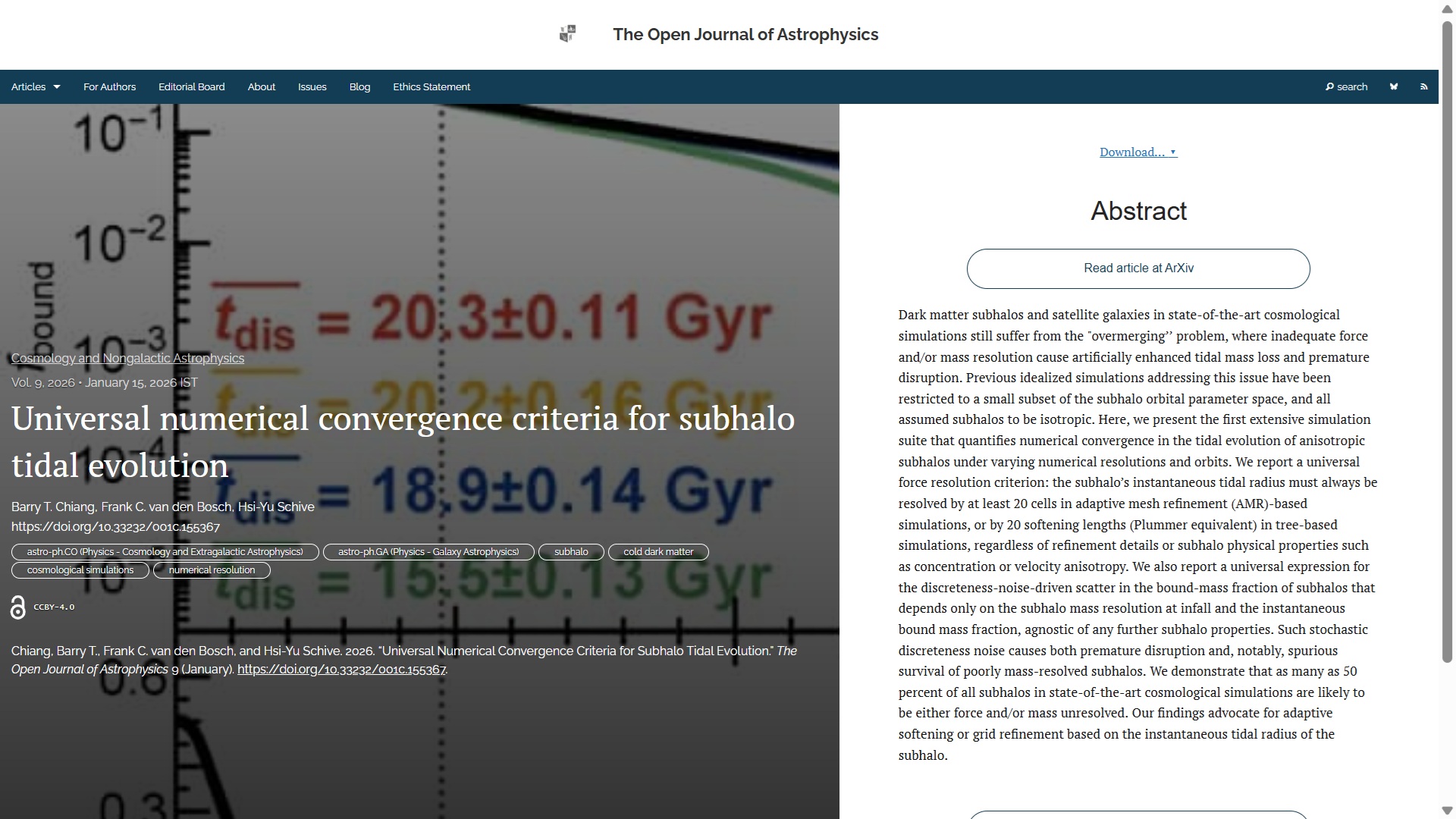
The final accepted version of this paper can be found on arXiv here. The Mastodon announcement follows:

Open Journal of Astrophysics

New Publication at the Open Journal of Astrophysics: "Universal numerical convergence criteria for subhalo tidal evolution" by Barry T. Chiang & Frank C. van den Bosch (Yale U., USA) and Hsi-Yu Schive (National Taiwan University, Taiwan)

doi.org/10.33232/001c.155367

January 15, 2026, 9:11 am 1 boosts 0 favorites

Finally for this week we have “Detectability of dark matter subhalo impacts in Milky Way stellar streams” by Junyang Lu , Tongyan Lin & Mukul Sholapurkar (UCSD, USA) and Ana Bonaca (Carnegie Observatories, USA). This was published on Friday 16th January (i.e. yesterday) in the folder Astrophysics of Galaxies. The study develops a method to estimate the minimum detectable dark matter subhalo mass in stellar streams, ranking them by sensitivity and identifying promising lines for further research.

The overlay is here:
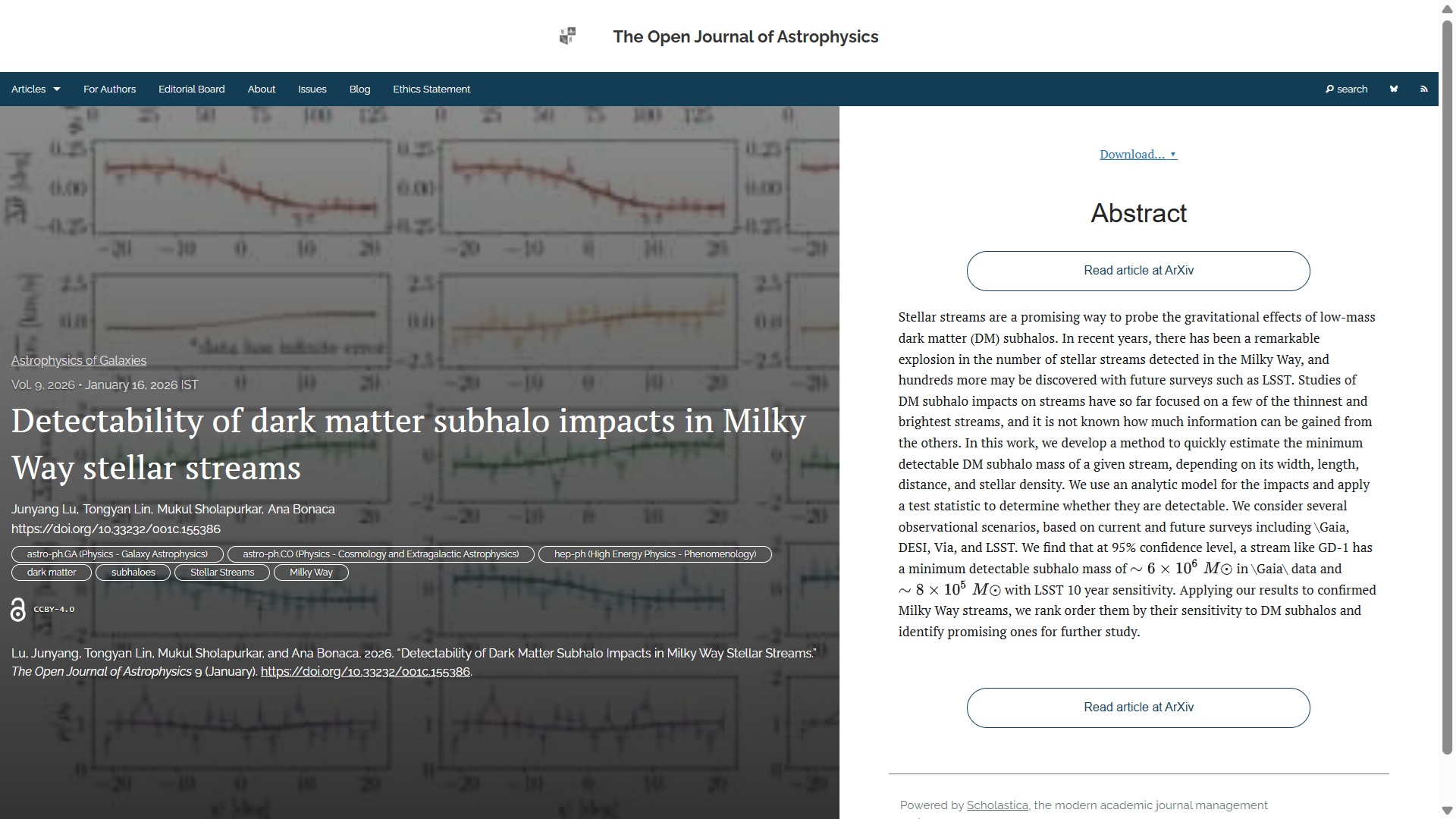
The officially accepted version can be found on arXiv here and the Fediverse announcement here:

Open Journal of Astrophysics

New Publication at the Open Journal of Astrophysics: "Detectability of dark matter subhalo impacts in Milky Way stellar streams" by Junyang Lu , Tongyan Lin & Mukul Sholapurkar (UCSD, USA) and Ana Bonaca (Carnegie Observatories, USA)

doi.org/10.33232/001c.155386

January 16, 2026, 9:32 am 0 boosts 0 favorites

That concludes the update for this week. I will do another next Saturday.
Weekly Update from the Open Journal of Astrophysics – 15/11/2025

Posted in OJAp Papers, Open Access, The Universe and Stuff with tags , , , , , , , , , , , , , , , , , , , , , , , , , , , , , on November 15, 2025 by telescoper

It’s Saturday again, so it’s time for the usual update of the week’s new papers at the Open Journal of Astrophysics. It has been quite a busy week. Since the last update we have published another seven papers, which brings the number in Volume 8 (2025) up to 175, and the total so far published by OJAp up to 410.

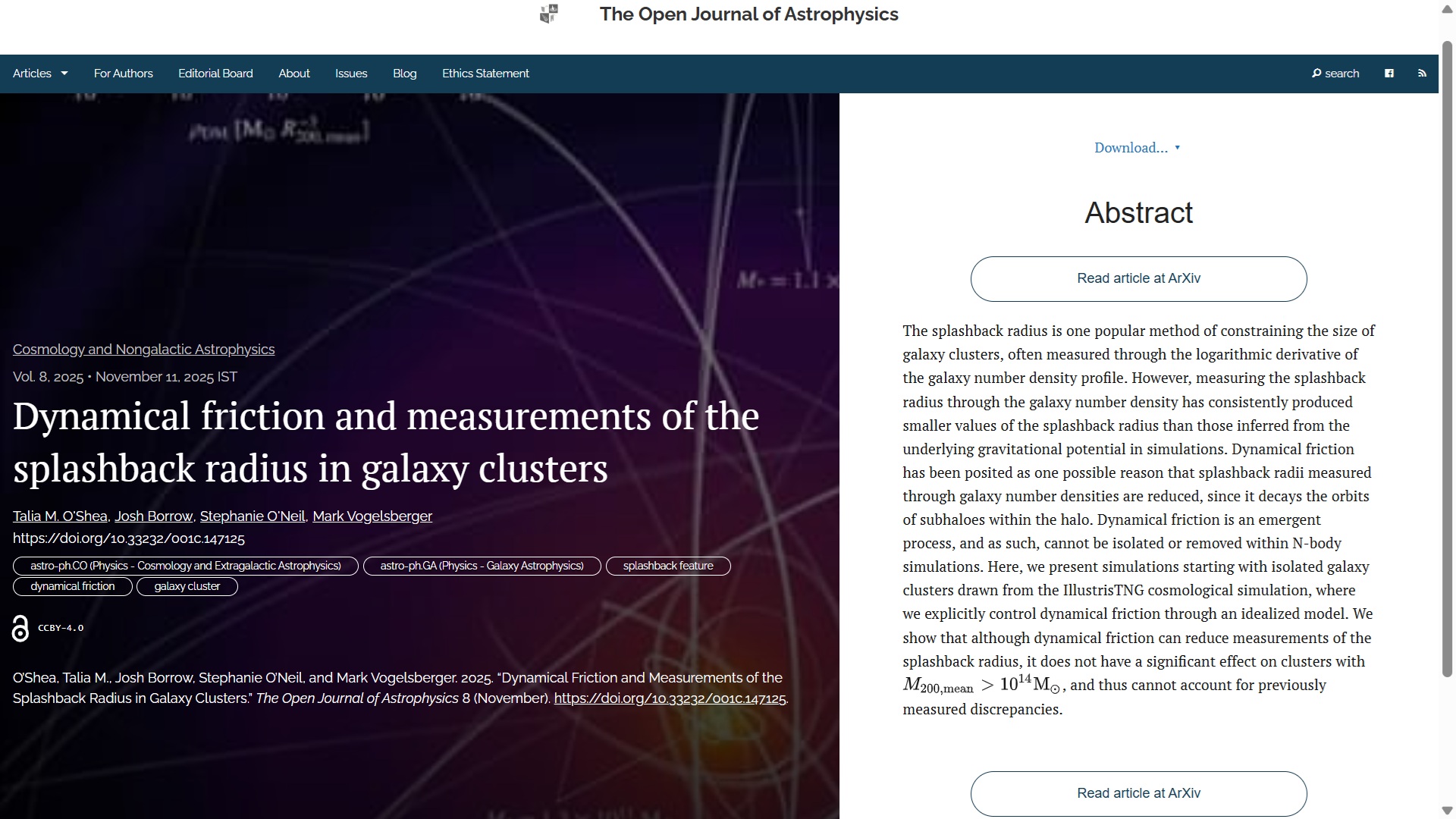
First on the menu for this week is “Dynamical friction and measurements of the splashback radius in galaxy clusters” by Talia M. O’Shea (U. Wisconsin-Madison, USA), Josh Borrow & Stephanie O’Neil (U. Pennsylvania, USA) and Mark Vogelsberger (MIT, USA). Published on Tuesday 11th November in the folder Cosmology and NonGalactic Astrophysics, this one presents a study suggesting that dynamical friction does not play a major role in reducing the radius of the splashback feature in real data compared to numerical simulations.

The overlay is here:

You can find the officially accepted version on arXiv here.

The Fediverse announcement is here:

Open Journal of Astrophysics

New Publication at the Open Journal of Astrophysics: "Dynamical friction and measurements of the splashback radius in galaxy clusters" by Talia M. O'Shea (U. Wisconsin-Madison, USA), Josh Borrow & Stephanie O'Neil (U. Pennsylvania, USA) and Mark Vogelsberger (MIT, USA)

doi.org/10.33232/001c.147125

November 11, 2025, 8:36 am 3 boosts 1 favorites


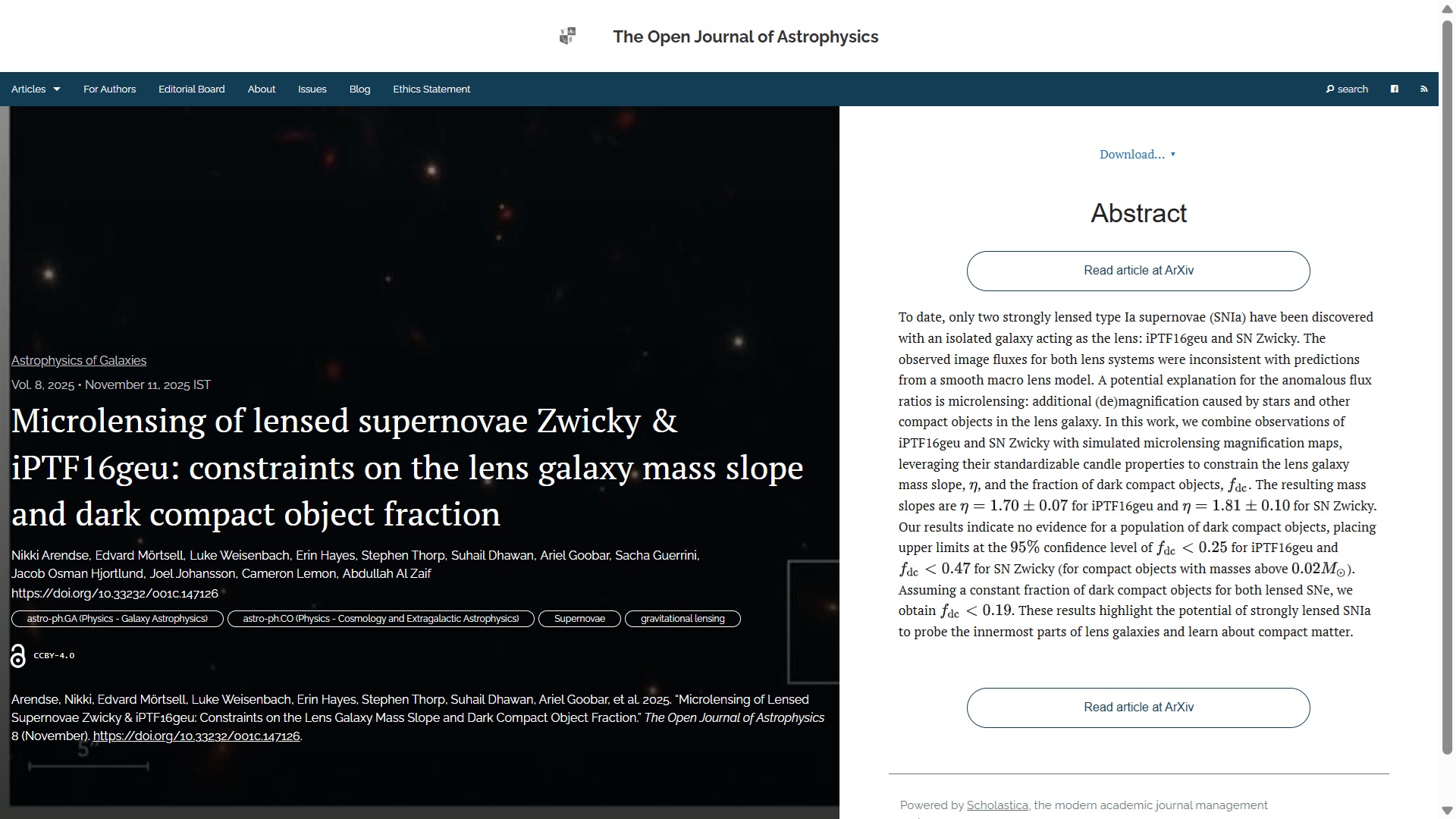
The second paper of the week is “Microlensing of lensed supernovae Zwicky & iPTF16geu: constraints on the lens galaxy mass slope and dark compact object fraction” by Nikki Arendse (Stockholm University, Sweden) and and international cast of 11 others based in Sweden, UK and France. This one was published on 11th November 2025 in the folder Astrophysics of Galaxies. It is about combining observations of two supernovae, iPTF16geu and SN Zwicky, with microlensing magnification maps to probe the properties of the lens galaxy.

The overlay is here:


You can find the official version of this one on arXiv here. The federated announcement on Mastodon is here:

Open Journal of Astrophysics

New Publication at the Open Journal of Astrophysics: "Microlensing of lensed supernovae Zwicky & iPTF16geu: constraints on the lens galaxy mass slope and dark compact object fraction" by Nikki Arendse (Stockholm University, Sweden) and 11 others based in Sweden, UK and France

doi.org/10.33232/001c.147126

November 11, 2025, 8:53 am 1 boosts 1 favorites


Next one up is “Neutrino Constraints on Black Hole Formation in M31” by Yudai Sawa (U. Tokyo, Japan) and 11 others all based in Japan. This was published on Tuesday 11th November in the folder High-Energy Astrophysical Phenomena. It presents a calculation of the neutrino emission expected from the collapse of massive stars and its use in constraining black hole formation using neutrino detectors.


The overlay is here:

You can find the official accepted version on arXiv here. The fediverse announcement is here:

Open Journal of Astrophysics

New Publication at the Open Journal of Astrophysics: "Neutrino Constraints on Black Hole Formation in M31" by Yudai Sawa (U. Tokyo, Japan) and 11 others all based in Japan

doi.org/10.33232/001c.147127

November 11, 2025, 9:04 am 0 boosts 1 favorites

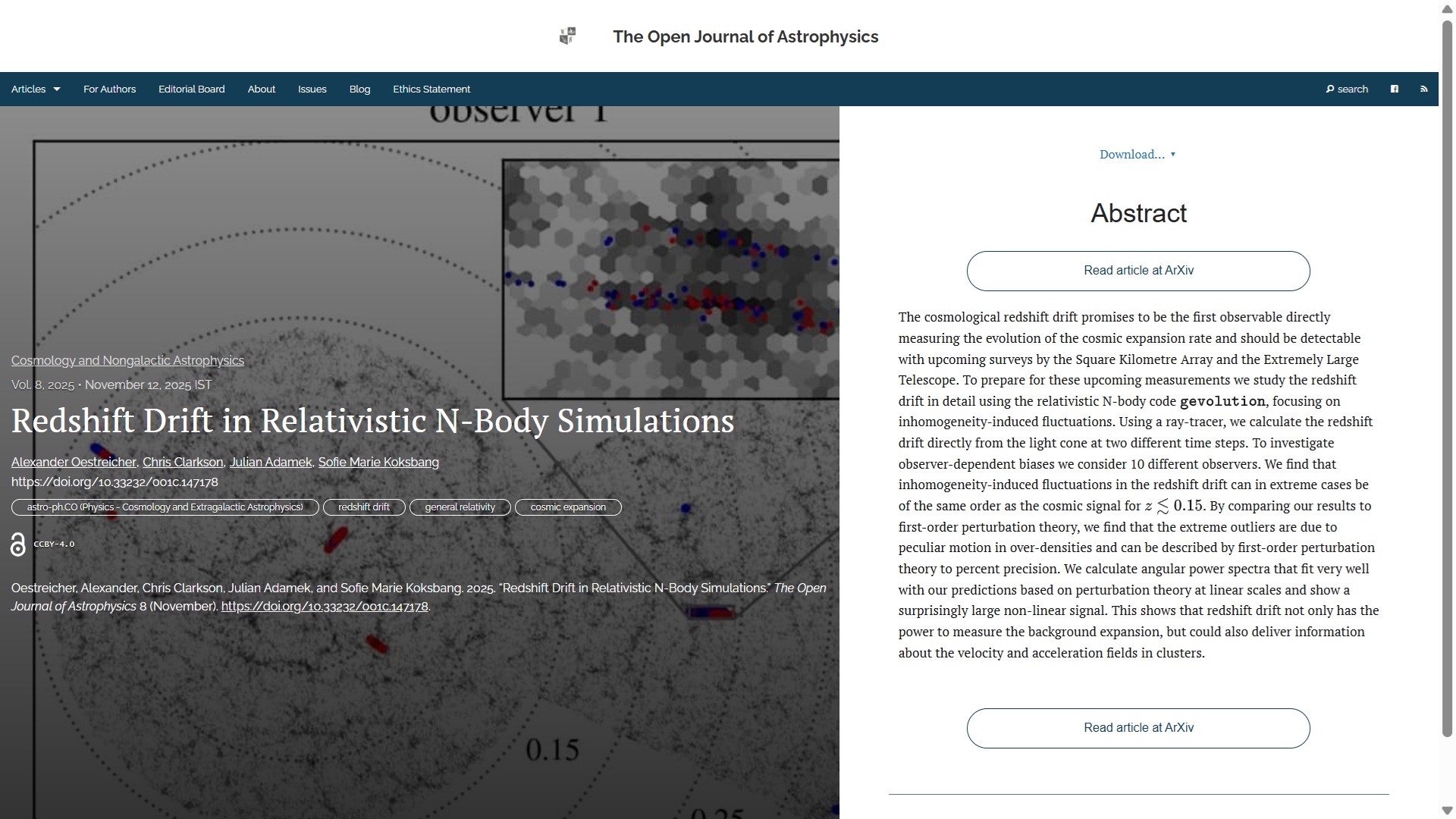
The fourth paper this week is “Redshift Drift in Relativistic N-Body Simulations” by Alexander Oestreicher (U. Southern Denmark, DK), Chris Clarkson (QMUL, UK), Julian Adamek (U. Zürich, CH) and Sofie Marie Koksbang (U. Southern Denmark, DK). This one was published on Wednesday 12th November in the folder marked Cosmology and NonGalactic Astrophysics. It presents numerical calculations of the cosmological redshift drift effect for comparison with future surveys.

The overlay is here:


You can find the official published version on arXiv here. The Fediverse announcement follows:

Open Journal of Astrophysics

New Publication at the Open Journal of Astrophysics: "Redshift Drift in Relativistic N-Body Simulations" by Alexander Oestreicher (U. Southern Denmark, DK), Chris Clarkson (QMUL, UK), Julian Adamek (U. Zürich, CH) and Sofie Marie Koksbang (U. Southern Denmark, DK)

doi.org/10.33232/001c.147178

November 12, 2025, 8:35 am 1 boosts 0 favorites


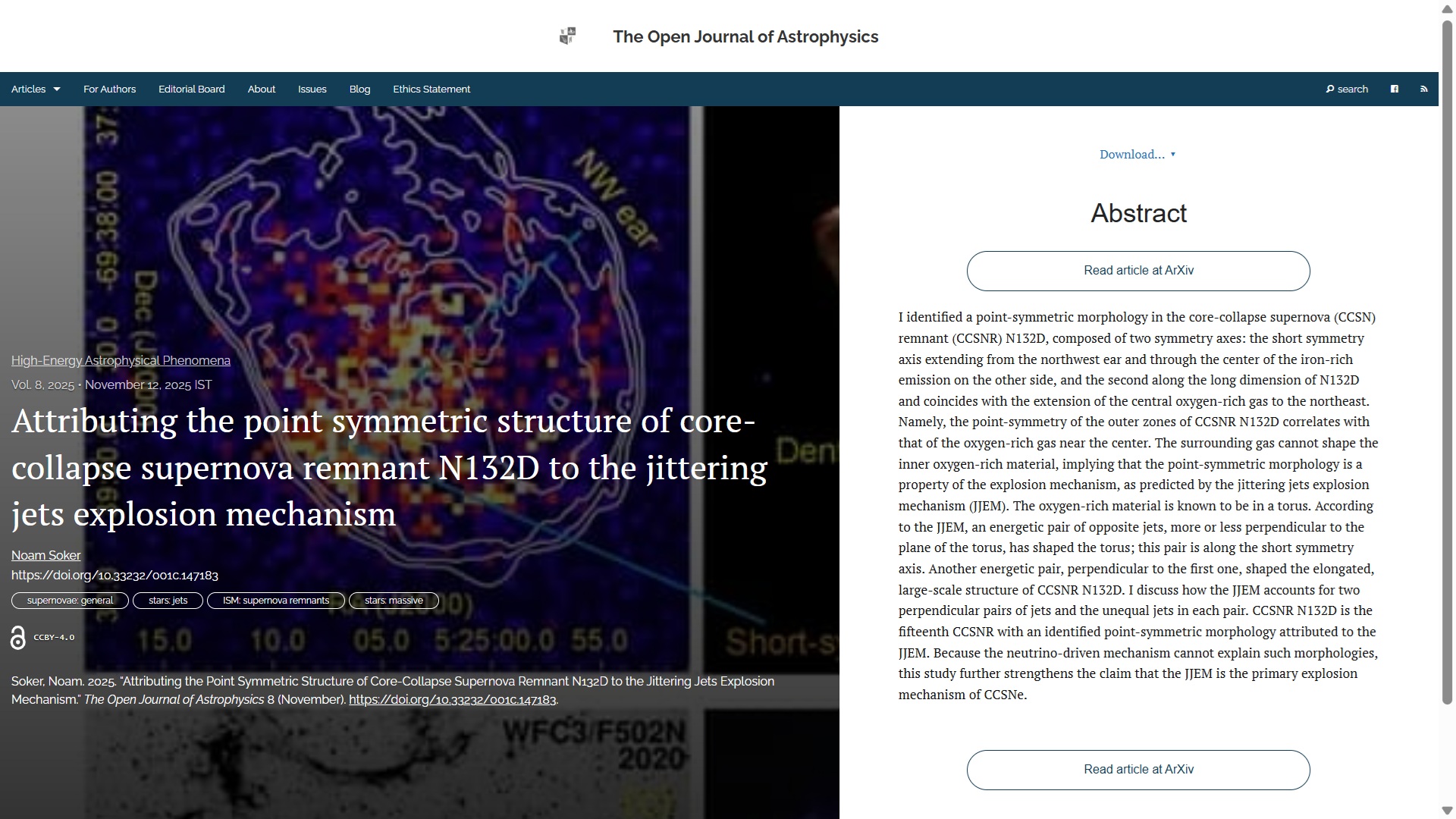
The fifth paper for this week is “Attributing the point symmetric structure of core-collapse supernova remnant N132D to the jittering jets explosion mechanism” by Noam Soker (Technion, Haifa, Israel). This one, published on Wednesday November 12th in the folder High-Energy Astrophysical Phenomena, presents a discussion of the morphology of a supernova remnant and possible explanation for it in terms of the explosion mechanism.

The overlay is here:


The officially accepted version can be found on arXiv here. The Fediverse announcement is here:

Open Journal of Astrophysics

New Publication at the Open Journal of Astrophysics: "Attributing the point symmetric structure of core-collapse supernova remnant N132D to the jittering jets explosion mechanism" by Noam Soker (Technion, Haifa, Israel)

doi.org/10.33232/001c.147183

November 12, 2025, 8:46 am 1 boosts 0 favorites

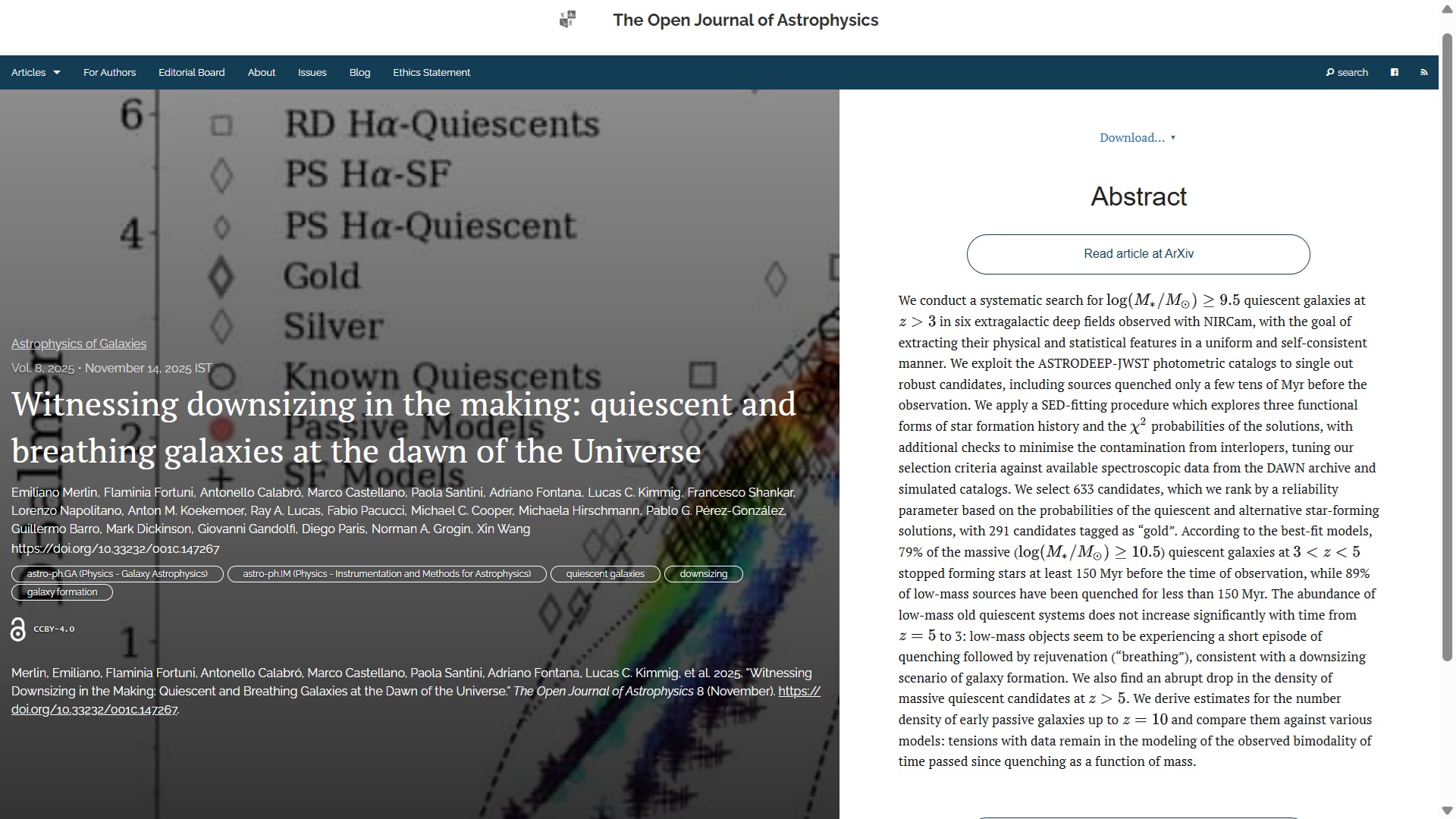
The sixth paper to report this week is “Witnessing downsizing in the making: quiescent and breathing galaxies at the dawn of the Universe” by Emiliano Merlin (Osservatorio Astronomico di Roma, Italy) and an international cast of 20 others based in Italy, Germany, UK, USA, Switzerland, Spain and China. This one was published on Friday November 14th in the folder Astrophysics of Galaxies.

You can find the officially-accepted version on arXiv here. The fediverse announcement is here:

Open Journal of Astrophysics

New Publication at the Open Journal of Astrophysics: "Witnessing downsizing in the making: quiescent and breathing galaxies at the dawn of the Universe" by Emiliano Merlin (Osservatorio Astronomico di Roma, Italy) and 20 others based in Italy, Germany, UK, USA, Switzerland, Spain and China

doi.org/10.33232/001c.147267

November 14, 2025, 8:38 am 1 boosts 1 favorites

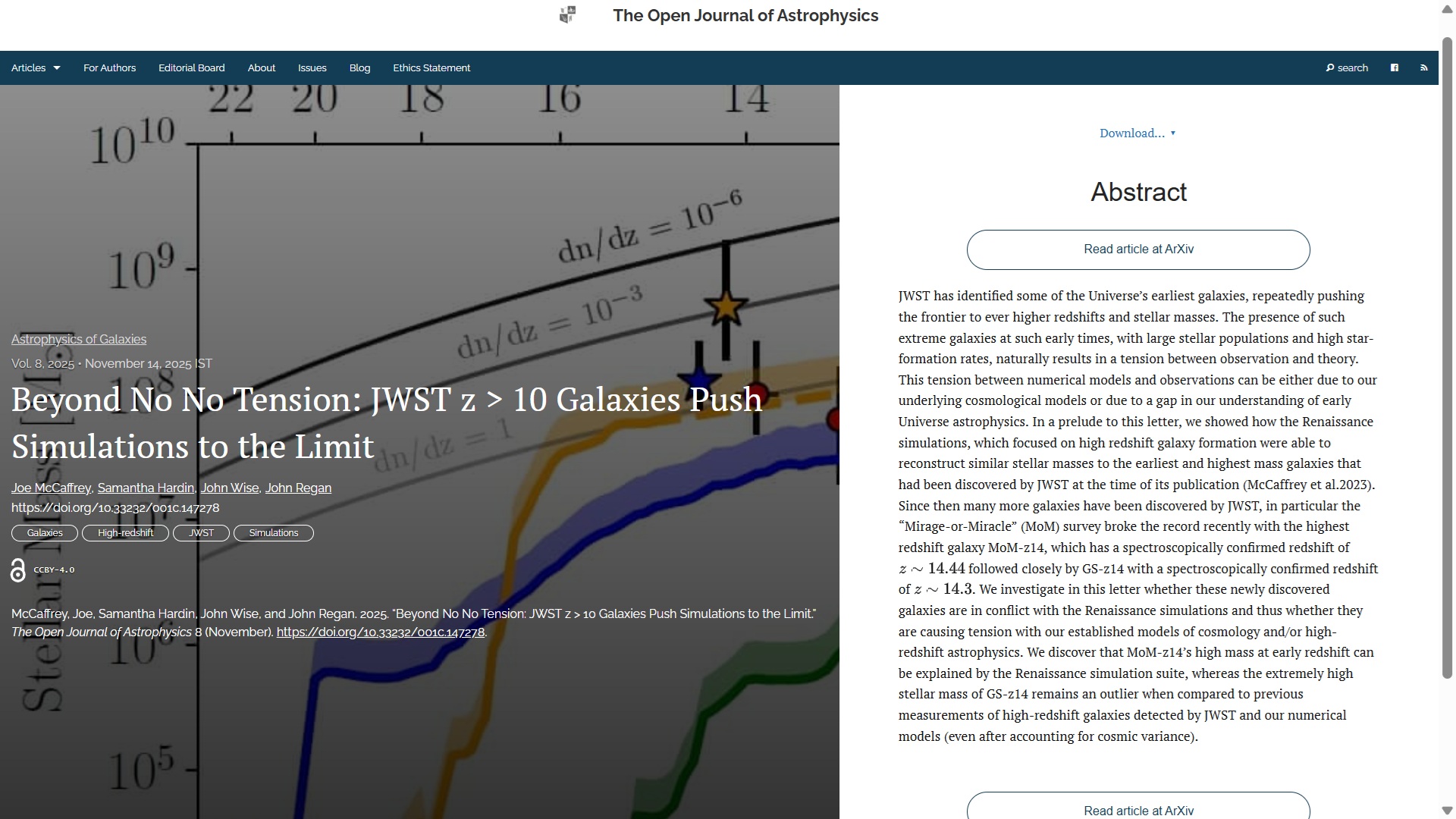
And finally (for this week) we have “Beyond No No Tension: JWST z > 10 Galaxies Push Simulations to the Limit” by Joe McCaffrey (NUI Maynooth, Ireland), Samantha Hardin & John Wise (Georgia Institute of Technology, USA) and John Regan (Maynooth). This one was also published on Friday 14th November, in the folder marked Astrophysics of Galaxies. It asks the question whether newly-discovered high redshift galaxies are consistent with simulations of galaxy formation. The overlay is here:

You can find the officially acceopted version on arXiv here. The fediverse announcement is here:

Open Journal of Astrophysics

New Publication at the Open Journal of Astrophysics: "Beyond No No Tension: JWST z > 10 Galaxies Push Simulations to the Limit" by Joe McCaffrey (NUI Maynooth, Ireland), Samantha Hardin & John Wise (Georgia Institute of Technology, USA) and John Regan (Maynooth)

doi.org/10.33232/001c.147278

November 14, 2025, 9:02 am 2 boosts 0 favorites

And that concludes the update for this week. There will be another next Saturday.

Astronomy Photograph of the Year 2020

Posted in Art, The Universe and Stuff with tags , , , , on September 24, 2020 by telescoper

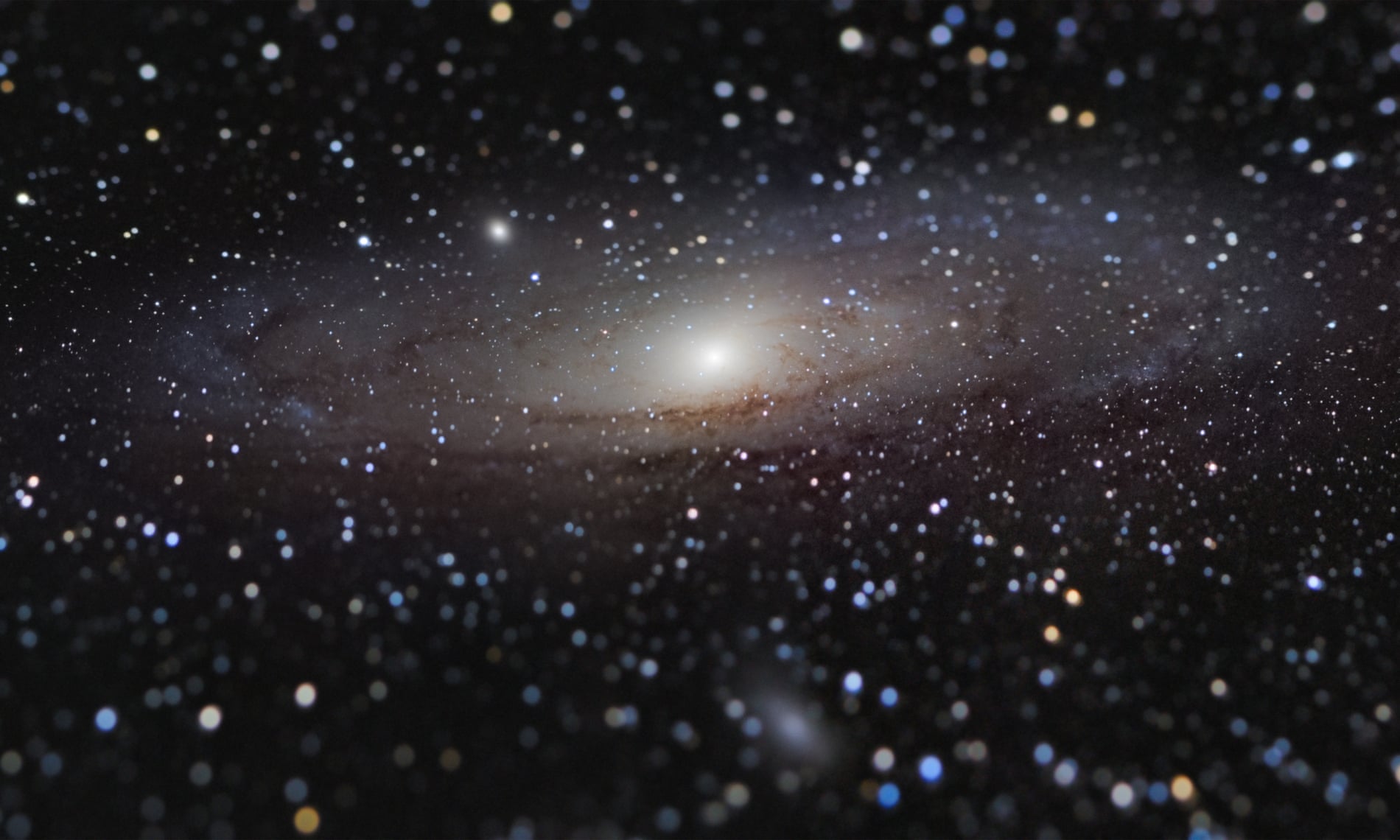
Very busy today so I only have time to share a this stunning picture, the overall winner of the 2020 Astronomy Photographer of the Year, Andromeda Galaxy at Arm’s Length? by Nicolas Lefaudeux (France).


Photo credit: Nicolas Lefaudeux/2020 astronomy photographer of the year

Watch “Why the Universe is quite disappointing, really – Episode 4” on YouTube

Posted in The Universe and Stuff, YouTube with tags , , , , on May 19, 2020 by telescoper

Episode 4, in which I show that spiral galaxies are very grubby – they contain huge amounts of dust. And not only galaxies – astronomical dust is everywhere we look. The Universe may be big, but it sure is dirty..

Andromeda in High Resolution

Posted in The Universe and Stuff with tags , , , , , , on January 20, 2015 by telescoper

This afternoon I gave three hours of lectures on the trot, so I’m now feeling more than a little knackered. Before I head home for an early night, though, I thought I’d share this amazing video produced by the Panchromatic Hubble Andromeda Survey (or PHAT, for short), which is a Hubble Space Telescope (HST) Multi-cycle program to map roughly a third of the star-forming disk of the Andromeda Nebula (M31), using 6 filters covering from the ultraviolet through the near infrared. With HST’s resolution and sensitivity, the disk of M31 is resolved into more than 100 million stars. The combination of scale and detail is simply jaw-dropping. Hat’s off to the PHAT team!

Herschel Views Andromeda (via The Herschel Space Observatory)

Posted in The Universe and Stuff with tags , , , , on January 6, 2011 by telescoper

An amazing composite image of M31 in Andromeda using both infra-red and X-rays was recently obtained using Herschel and XMM space observatories. It featured in the BBC Stargazing Live programme earlier this week and I’m told that, typically for astronomy, the inspiration behind it was … beer.

Herschel Views Andromeda We've been sitting on this image since just before Christmas so that it could be unveiled during the BBC Stargazing Live show last night, but I've been aching to get this onto the blog ever since I saw it. This is a Herschel image of our nearest neighbour galaxy, the Andromeda galaxy, also known as M31, along with comparison images at other wavelengths. [/captio … Read More

via The Herschel Space Observatory


Share/Bookmark