Archive for Milky Way

Weekly Update from the Open Journal of Astrophysics – 12/07/2025

Posted in OJAp Papers, Open Access, The Universe and Stuff with tags , , , , , , , , , , , , , , , , , , , , , , , , , on July 12, 2025 by telescoper

It’s Saturday morning again, so it’s time again for an update of papers published at the Open Journal of Astrophysics. Since the last update we have published seven new papers, which brings the number in Volume 8 (2025) up to 92, and the total so far published by OJAp  up to 327.

This was a slightly strange week, starting with the fact that there were no new arXiv announcements on Monday 7th July because of the 4th July holiday in the USA on Friday so no papers were published that day. We were not able to publish any papers on Wednesday 9th July either because Crossref was offline for 24 hours that day while its data was migrated into the cloud. Our publishing process requires a live connection with Crossref to deposit metadata upon publication so we can’t publish while that service is down. Fortunately the update seems to have gone well and normal services resumed the following day. That partially accounts for the fact that four of this week’s papers were published on 10th July.

Anyway, The papers published this week, with their overlays, are as follows.  You can click on the images of the overlays to make them larger should you wish to do so.

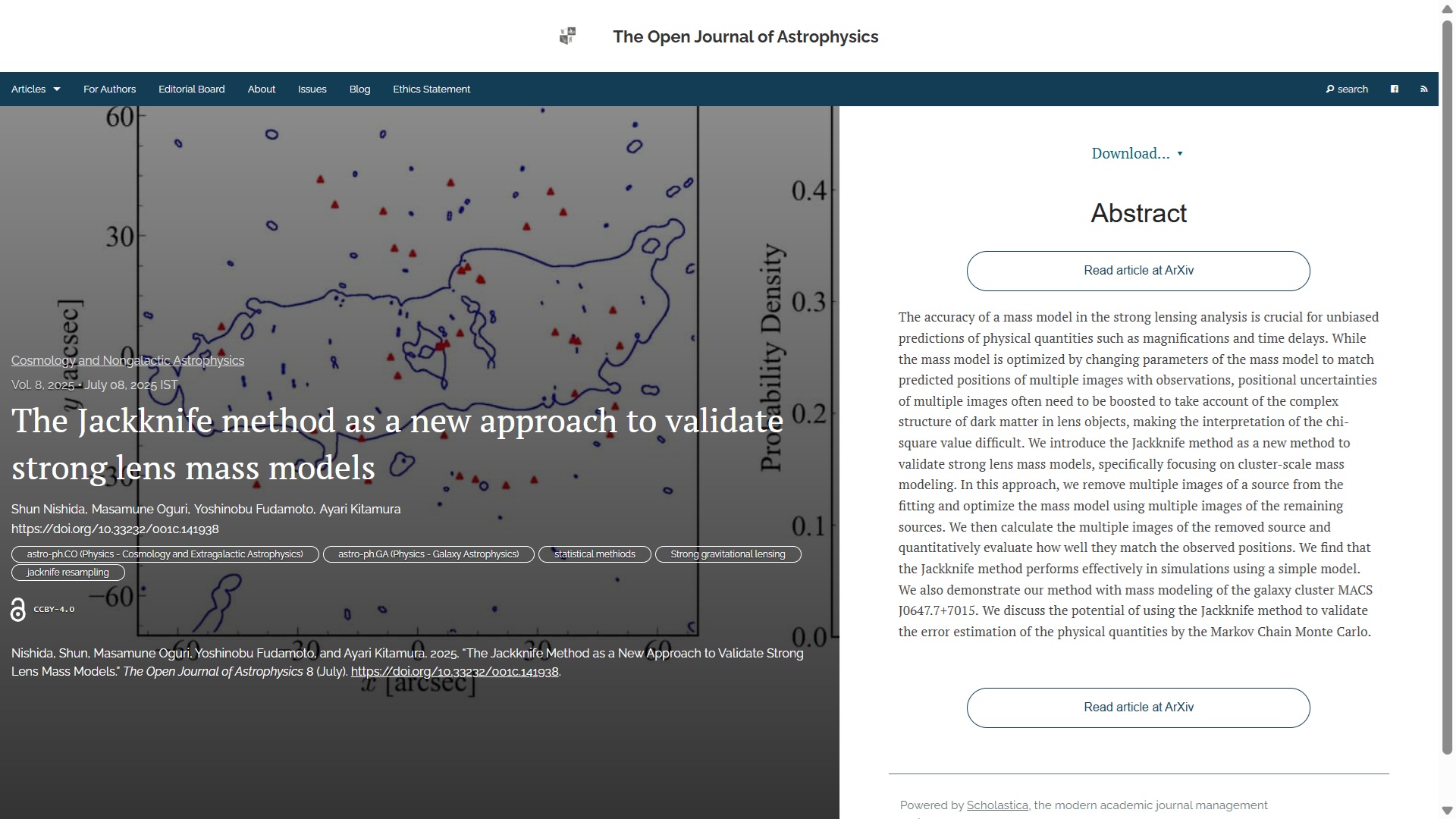
The first paper to report is “The Jackknife method as a new approach to validate strong lens mass models” by Shun Nishida & Masamune Oguri (Chiba University, Japan) , Yoshinobu Fudamoto (Steward Observatory, USA) and Ayari Kitamura (Tohoku University, Japan). This article, which is in the folder marked Cosmology and NonGalactic Astrophysics,  describes and application of the Jackknife statistical resampling techique to gravitational lensing by removing lensed images and recalcualting the mass modelIt was published on Tuesday 8th July 2025. The overlay is here:


The officially-accepted version can be found on arXiv here.

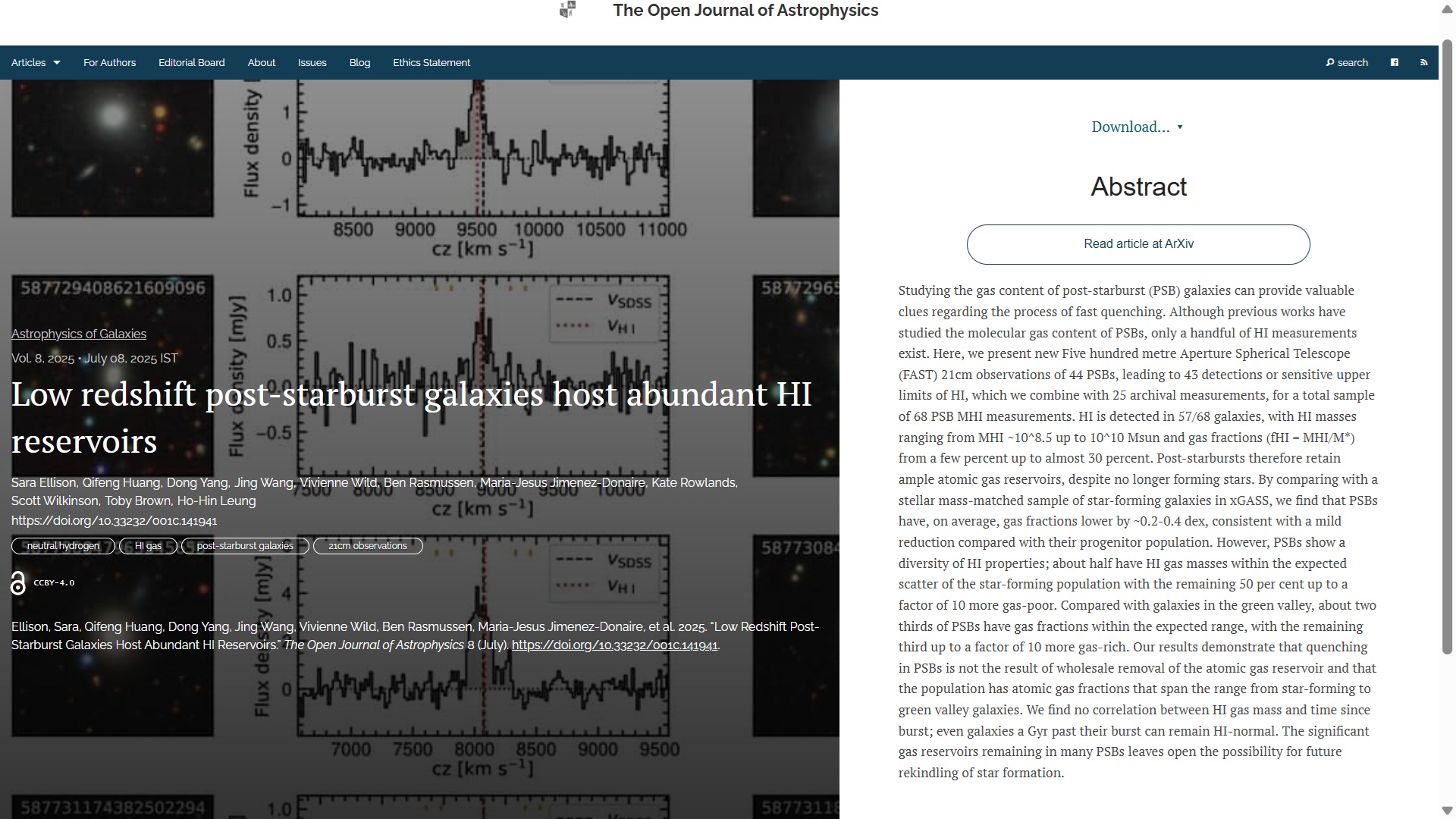
The second paper is “Low redshift post-starburst galaxies host abundant HI reservoirs” by Sara Ellison (U. Victoria, Canada) and 10 others based in China, UK, Spain, USA and Canada.  This one was also published oon Tuesday 8th July but in the folder Astrophysics of Galaxies. This paper uses 21cm observations of a sample of post-starburst galaxies, to show  that they contain large reservoirs of neutral hydrogen. Here is the overlay:

You can find the final version of the manuscript on arXiv here.

Next one up, one of four published on Thursday 10th July, is “Predicting the number density of heavy seed massive black holes due to an intense Lyman-Werner field” by Hannah O’Brennan (Maynooth University, Ireland) and 7 others based in Ireland, USA and Italy. This paper presents an exploration of the scenario for black hole formation driven by Lyman-Werner photons (i.e. ultraviolet radiation in the range 11.2 to 13.6 eV). It is in the folder marked Cosmology and NonGalactic Astrophysics, and the overlay is here:


You can read the final accepted version on arXiv here.

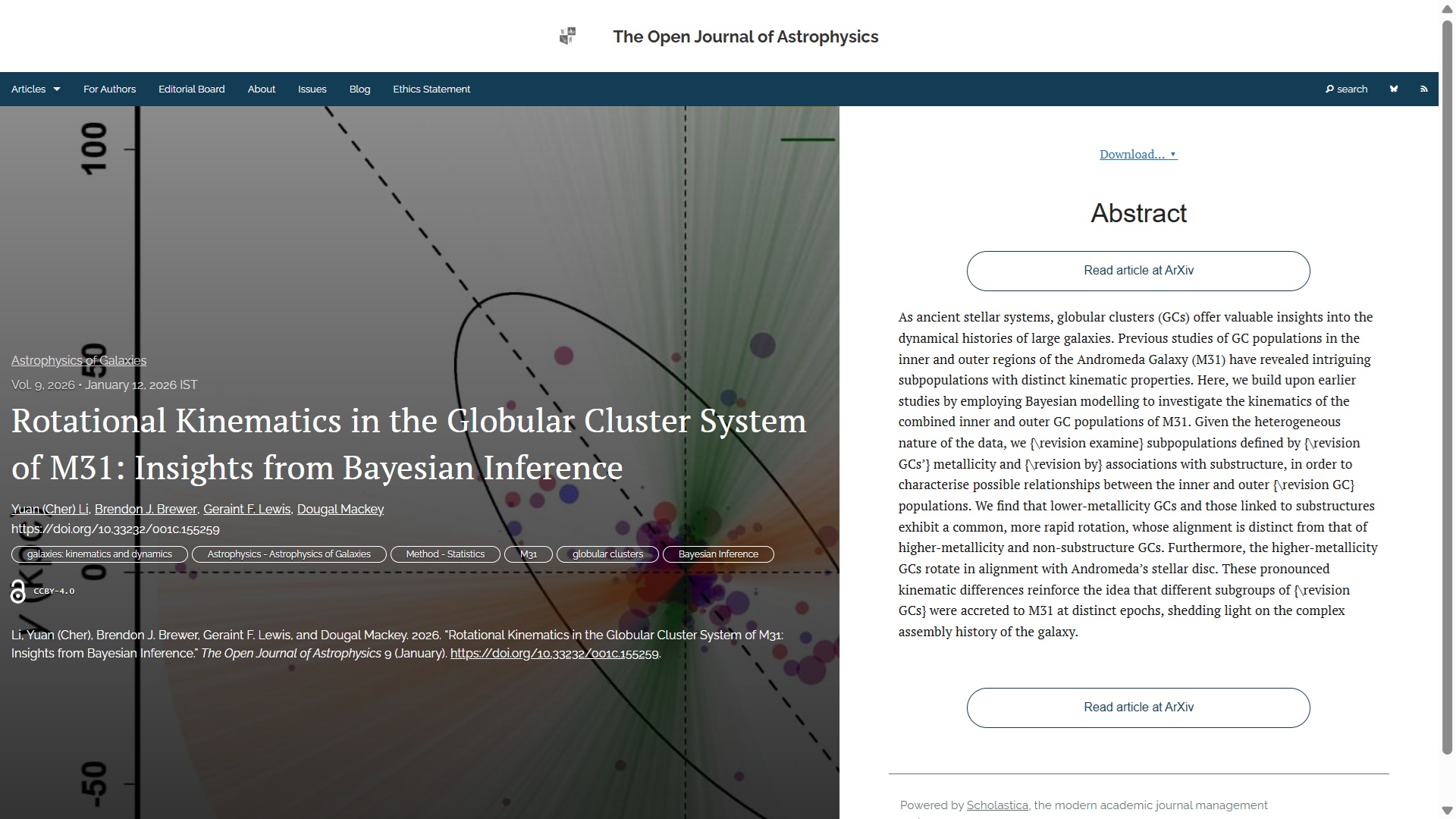
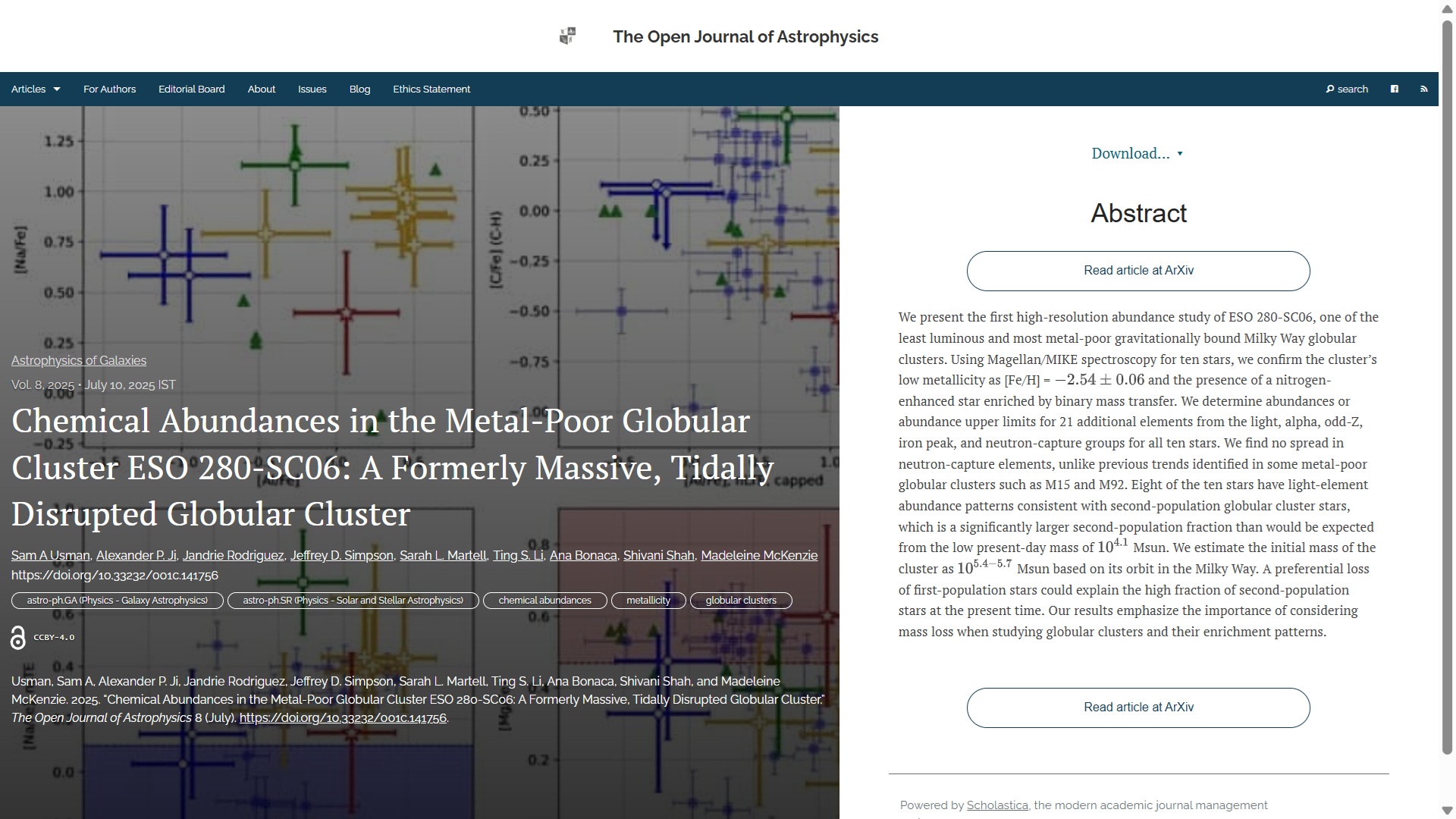
The fourth paper this week, and the second published on 10th July, is “Chemical Abundances in the Metal-Poor Globular Cluster ESO 280-SC06: A Formerly Massive, Tidally Disrupted Globular Cluster” by Sam A. Usman (U. Chicago, USA) and 8 others based in the USA, Canada and Australia. This paper, which is in the folder Astrophysics of Galaxies, presents a detailed spectroscopic study of the chemical abundances in a Milky Way globular cluster ESO 280-SC06. The overlay is here:

The officially accepted version of the paper can be read here.

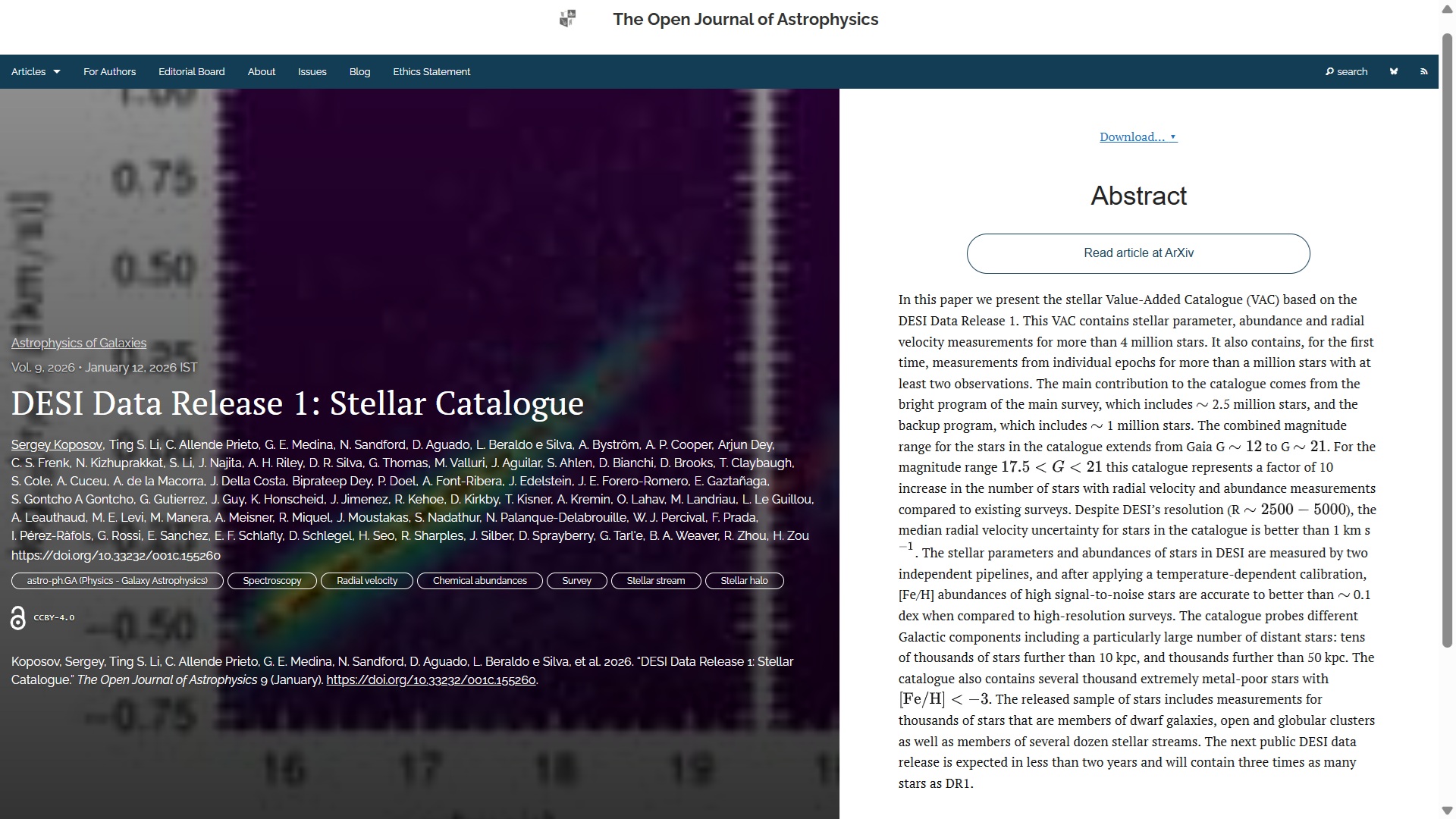
Next one up, also published on 10th July and also in the folder marked Astrophysics of Galaxies is “Predictions for the Detectability of Milky Way Satellite Galaxies and Outer-Halo Star Clusters with the Vera C. Rubin Observatory” by Kabelo Tsiane (U. Michigan) and 9 others on behalf of the LSST Dark Energy Science Collaboration.

The overlay is here:


You can find the officially-accepted version of the paper on arXiv here.

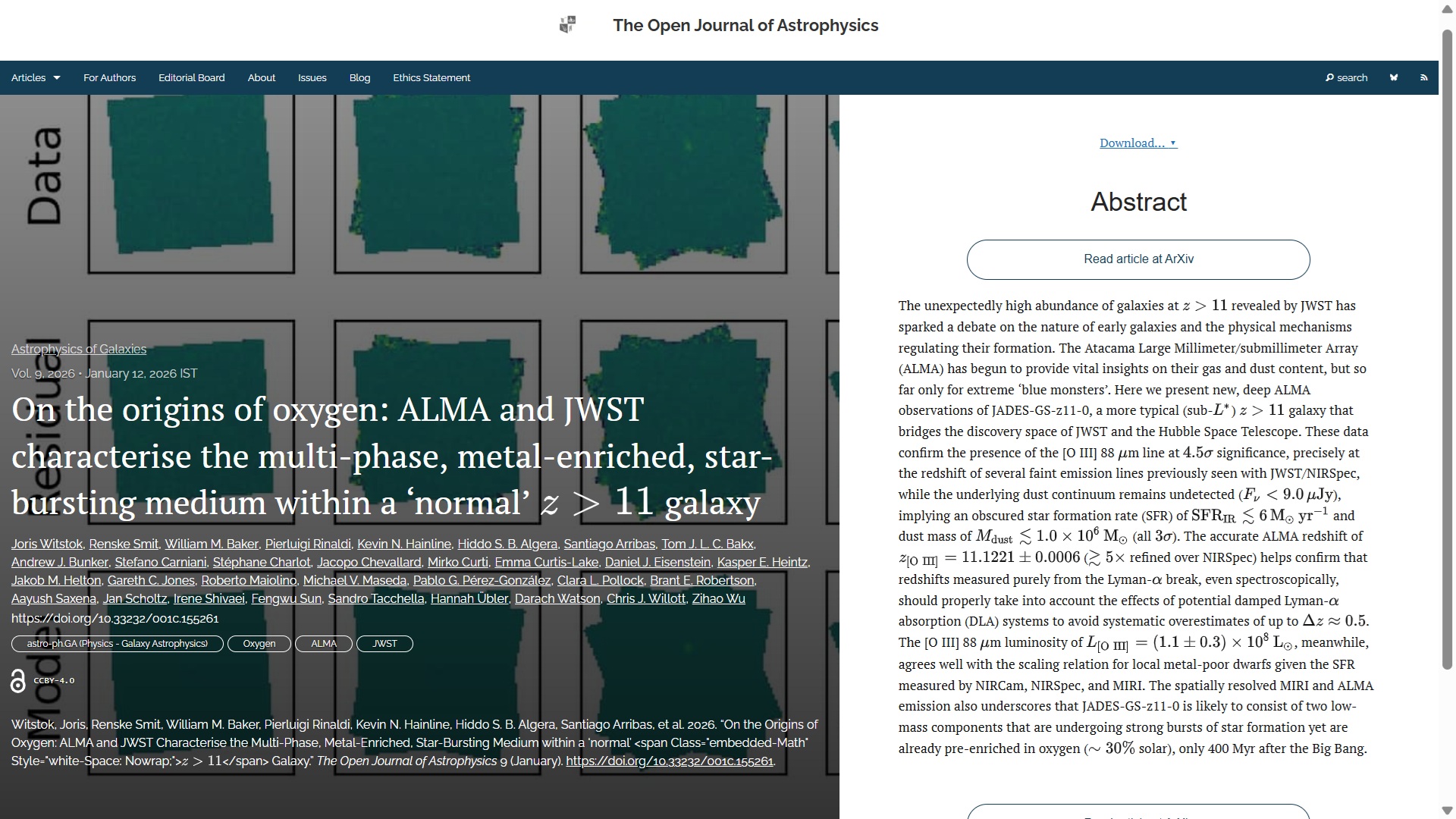
The penultimate paper for this week, and the last of the batch published on 10th July,  is “Systematically Measuring Ultra-Diffuse Galaxies. VIII. Misfits, Miscasts, and Miscreants” by Dennis Zaritsky, Richard Donnerstein, and Donghyeon J. Khim (Steward Observatory, U. Arizona, USA). This paper presents a morphological study of weird and wonderful galaxies as part of an effort to Systematically Measure Ultra-Diffuse Galaxies (the SMUDGes survey). It is in the folder marked Astrophysics of Galaxies. The overlay is here:


You can find the officially-accepted version of the paper on arXiv here.

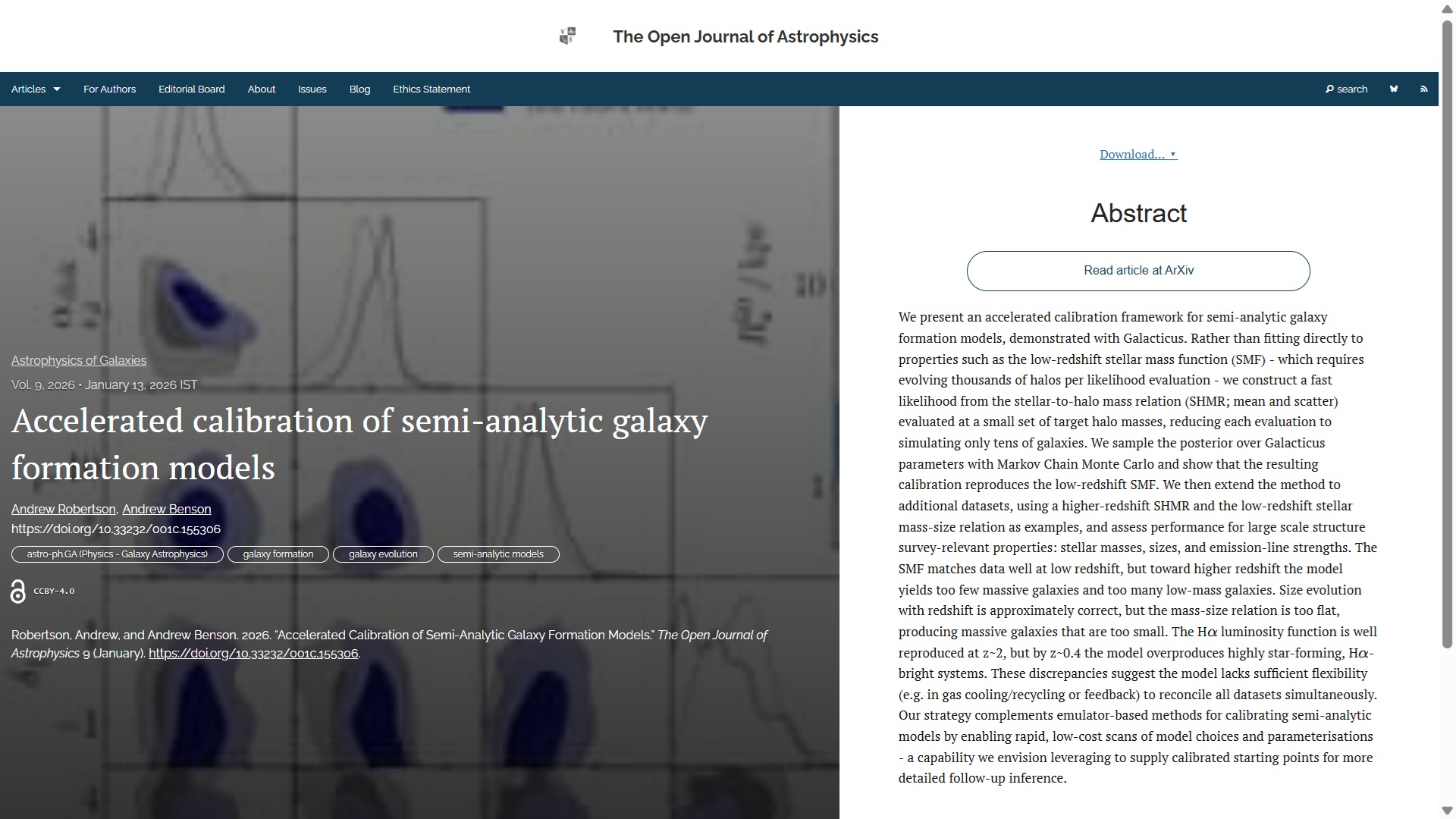
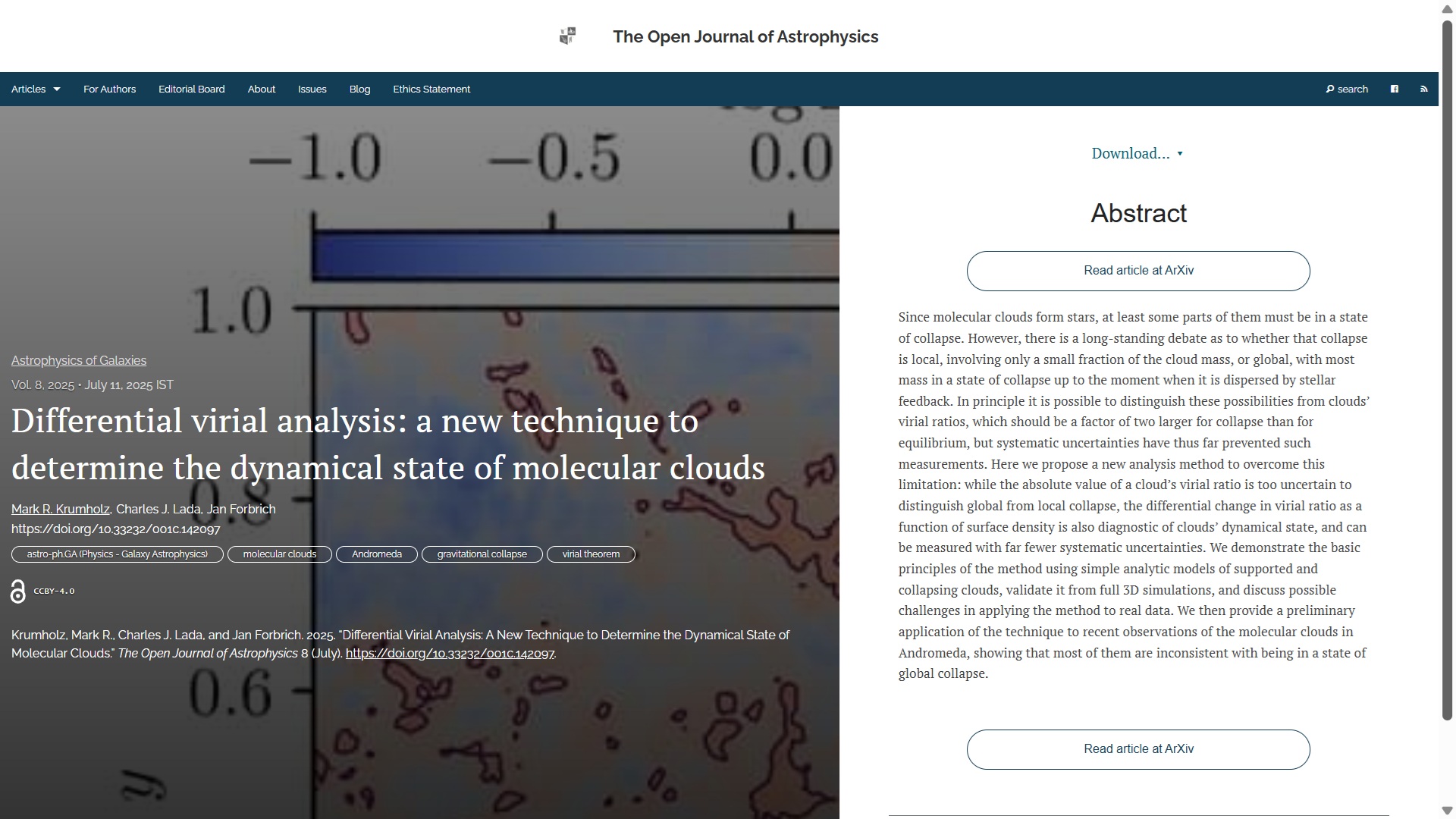
The last article published this week is “Differential virial analysis: a new technique to determine the dynamical state of molecular clouds” by Mark R. Krumholz (ANU, Australia), Charles J. Lada (Harvard, USA) & Jan Forbrich (U. Herts, UK). This paper presents simple analytic models of supported and collapsing molecular clouds, tested using full 3D simulations and applied to observed clouds in Andromeda. It is in the folder marked Astrophysics of Galaxies and was published yesterday, i.e on Friday 11th July 2025. Here is the overlay


You can find the officially-accepted version on arXiv here.

And that’s all the papers for this week. I will, however, take this opportunity to mention that a while ago I was interviewed about the Open Journal of Astrophysics by Colin Stuart on behalf of the Foundational Questions Institute; the write-up of the interview can be found here.

Weekly Update from the Open Journal of Astrophysics – 07/06/2025

Posted in OJAp Papers, Open Access, The Universe and Stuff with tags , , , , , , , , , , , on June 7, 2025 by telescoper

It’s Saturday so once again it’s time for the weekly update of papers published at the Open Journal of Astrophysics. Since the last update we have published two new papers, which brings the number in Volume 8 (2025) up to 69 and the total so far published by OJAp  is now up to 304.

The two papers published this week, with their overlays, are as follows. You can click on the images of the overlays to make them larger should you wish to do so.

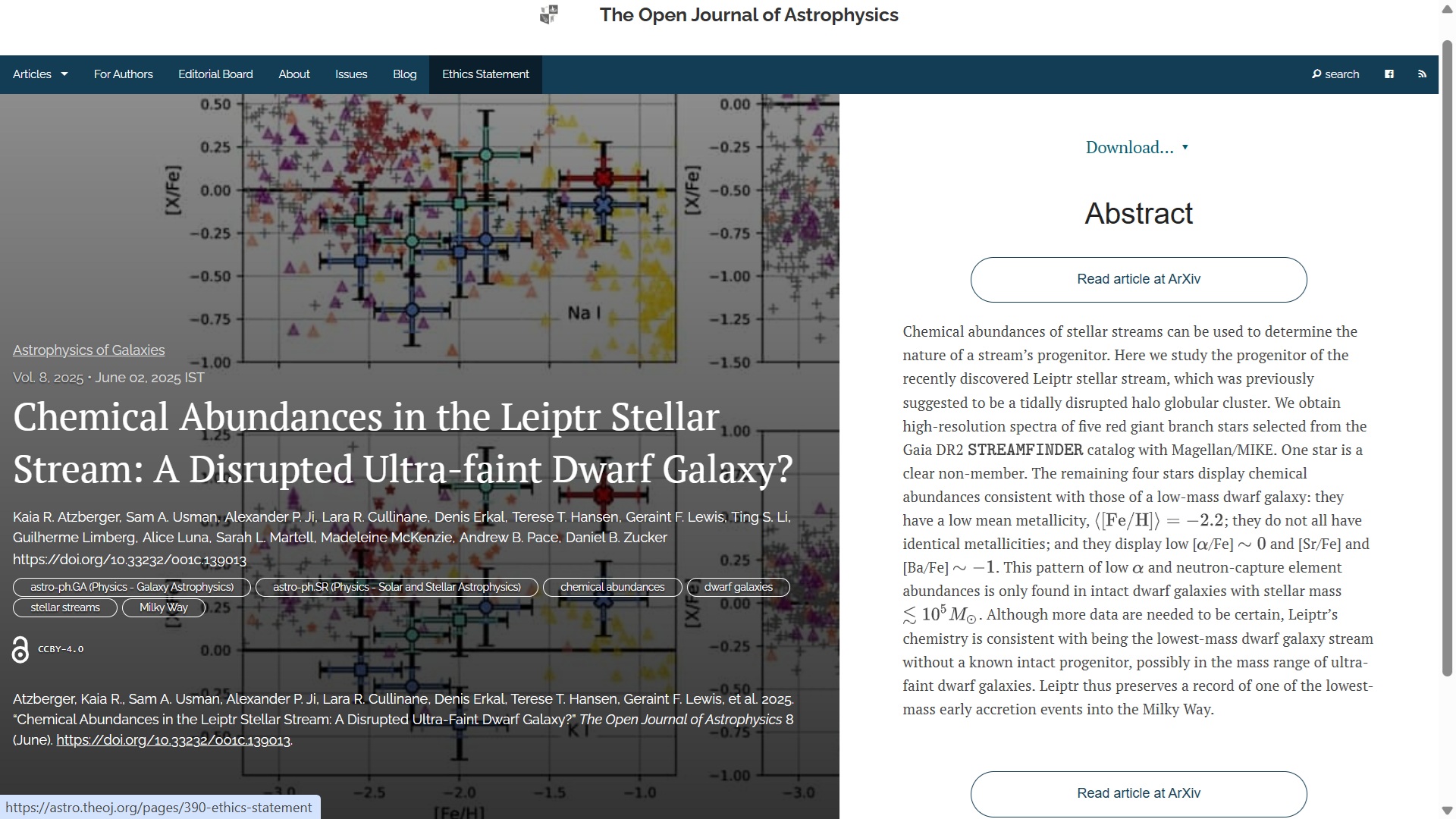
The first paper to report is “Chemical Abundances in the Leiptr Stellar Stream: A Disrupted Ultra-faint Dwarf Galaxy?” by Kaia R. Atzberger (Ohio State University) and 13 others based in the USA, Germany, the UK, Sweden, Australia, Canada and Brazil. This one was published on 2nd June 2025 and is in the folder marked Astrophysics of Galaxies. It presents a spectroscopic study of stars in a stellar stream suggesting that the stream originated by the accretion of a dwarf galaxy by the Milky Way.

The overlay is here:


You can read the final accepted version on arXiv here.

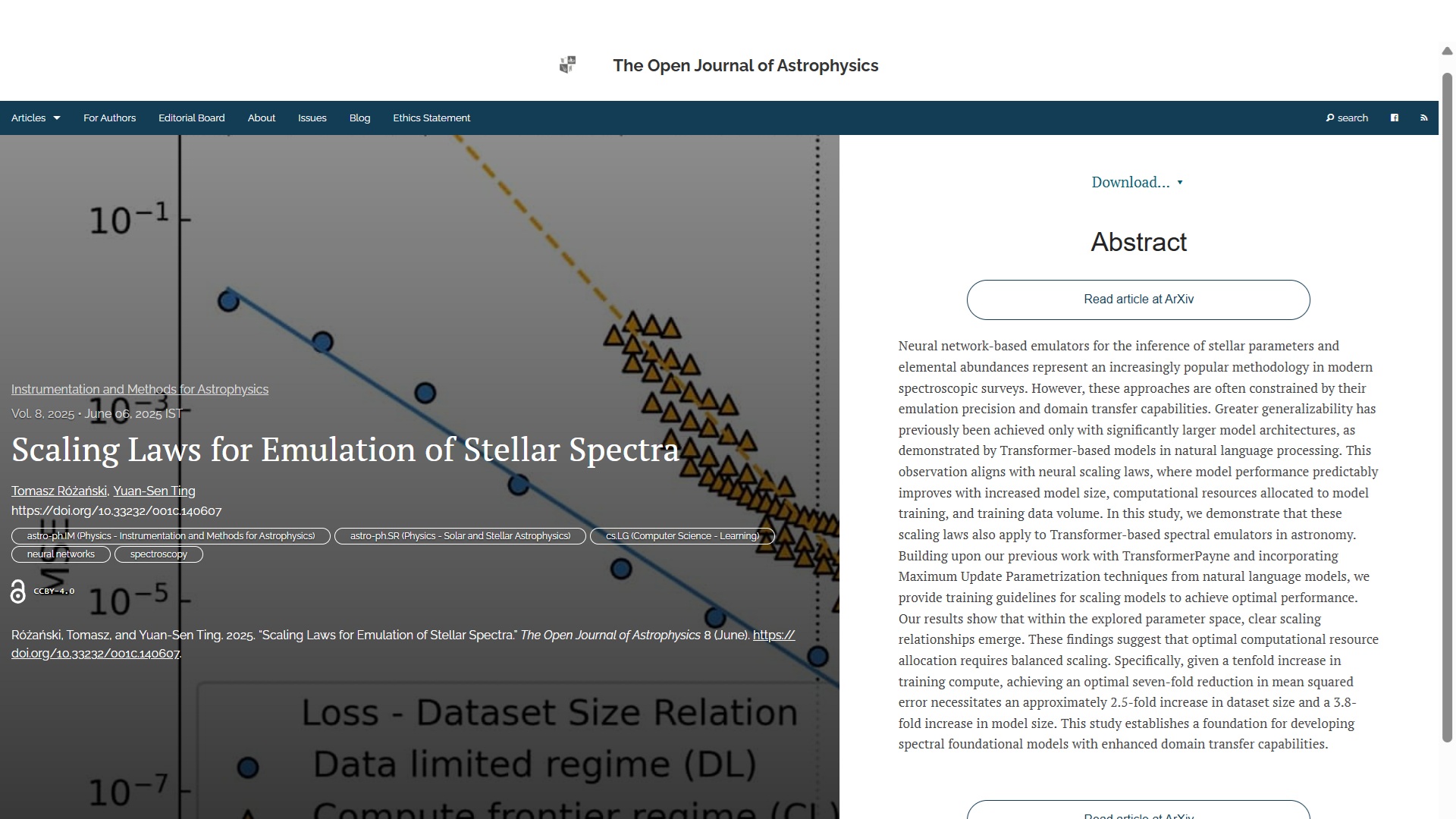
The second paper is “Scaling Laws for Emulation of Stellar Spectra” by Tomasz Różański (Australian Nastional University) and Yuan-Sen Ting (Ohio State University, USA). This was published yesterday, i.e. on 6th June 2025, and is in the folder Instrumentation and Methods for Astrophysics. The paper discusses certain scaling models and their use to achieve optimal performance for neural network emulators in the inference of stellar parameters and element abundances from spectroscopic data.

The overlay is here:

You can find the officially-accepted version of the paper on arXiv here.

That’s the papers for this week. I’ll post another update next weekend.

As a postscript I have a small announcement about our social media. Owing to the imminent demise of Astrodon, we have moved the Mastodon profile of the Open Journal of Astrophysics to a new instance, Fediscience. You can find us here. The old profile currently redirects to the new one, but you might want to update your links as the old server will eventually go offline.

Farewell to Gaia

Posted in The Universe and Stuff with tags , , , , on January 15, 2025 by telescoper
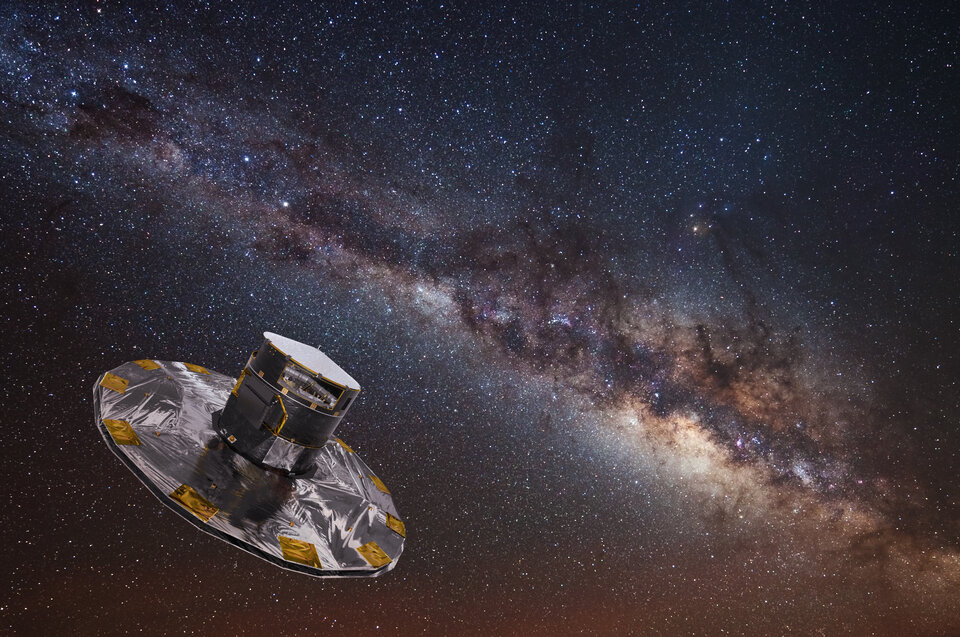
Artist impression of ESA’s Gaia satellite observing the Milky Way. The background image of the sky is compiled from data from more than 1.8 billion stars. Spacecraft: ESA/ATG medialab; Milky Way: ESA/Gaia/DPAC. Acknowledgement: A. Moitinho

Today (15th January 2025) marks the end of an era. The European Space Agency’s Gaia spacecraft stops taking data today as it is running out of the gas propellant needed to keep it scanning the sky. The spacecraft was launched on 19 December 2013 so has been operating for just over 11 years.

For those of you not in the know, Gaia is a global space astrometry mission, whose mission was to make the largest, most precise three-dimensional map of our Galaxy by surveying more than a billion stars. Gaia was to monitor each of its target stars about 70 times over a five-year period. Alongside this core mission, it has also discovered hundreds of thousands of new celestial objects, such as extra-solar planets and brown dwarfs, and observed hundreds of thousands of asteroids within our own Solar System.

Gaia is creating an extraordinarily precise three-dimensional map of more than a thousand million stars throughout our Galaxy (The Milky Way) and beyond, mapping their motion, luminosity, temperature and chemical composition as well as any changes in such properties. This huge stellar census will provide the data needed to tackle an enormous range of important problems related to the origin, structure and evolutionary history of our Galaxy. Gaia does this by repeatedly measuring the positions of all objects down to an apparent magnitude of 20. A billion stars is about 1% of the entire stellar population of the Milky Way.

For the brighter objects, i.e. those brighter than magnitude 15, Gaia  measures their positions to an accuracy of 24 microarcseconds, comparable to measuring the diameter of a human hair at a distance of 1000 km. Distances of relatively nearby stars are measured to an accuracy of 0.001%. Even stars near the Galactic Centre, some 30,000 light-years away, have their distances measured to within an accuracy of 20%.

The huge quantity of high-precision data Gaia has produced constitutes a tremendously influential resource for astronomical research. The fourth data release from Gaia, DR4, is in the pipeline for completion soon but the final data release (DR5) will take some years to appear, so this is by no means the last we will hear from Gaia, but the end of observations does close a significant chapter. Its legacy will be immense.

Three New Publications at the Open Journal of Astrophysics

Posted in OJAp Papers, Open Access, The Universe and Stuff with tags , , , , , , , , , on May 18, 2024 by telescoper

It’s time once more for the usual  Saturday roundup of business at the  Open Journal of Astrophysics. The latest batch of publications consists of three papers, taking the count in Volume 7 (2024) up to 39 and the total published by OJAp up to 154. We’re still on track to publish around 100 papers this year, compared to last year’s 50.

All three of this week’s papers involve use of data from the European Space Agency’s Gaia mission, which is proving an immensely rich resource for astrophysics.

First one up is “Asymmetric Drift Map of the Milky Way Disk Populations between 8 -16 kpc with LAMOST and Gaia datasets” which is by  Xin Li (Nanchong, China), Peng Yang (Chengdu, China) , Hai-Feng Wang (Nanchong, China), Qing Li (Jiangmen, China), Yang-Ping Luo (Nanchong, China), Zhi-Quan Luo (Nanchong, China), Guan-Yu Wang (Nanchong, China). This is a study  of the asymmetric drift, the difference of the local circular speed and the mean rotational speed of the stellar population, for various stellar populations in the Milky Way. It is in the folder marked Astrophysics of Galaxies and was published on Tuesday 14th May 2024.

Here is a screen grab of the overlay, which includes the abstract:


You can read the paper directly on arXiv here.

The second paper to announce is “On the formation of a 33 solar-mass black hole in a low-metallicity binary” by Kareem El-Badry (Caltech, USA). It discusses theoretical models for the formation of a black hole in a particular binary system discovered in Gaia data.

This one is in the folder Solar and Stellar Astrophysics and was published on 16th May 2024. The overlay looks like this:


You can read this paper directly on the arXiv here.

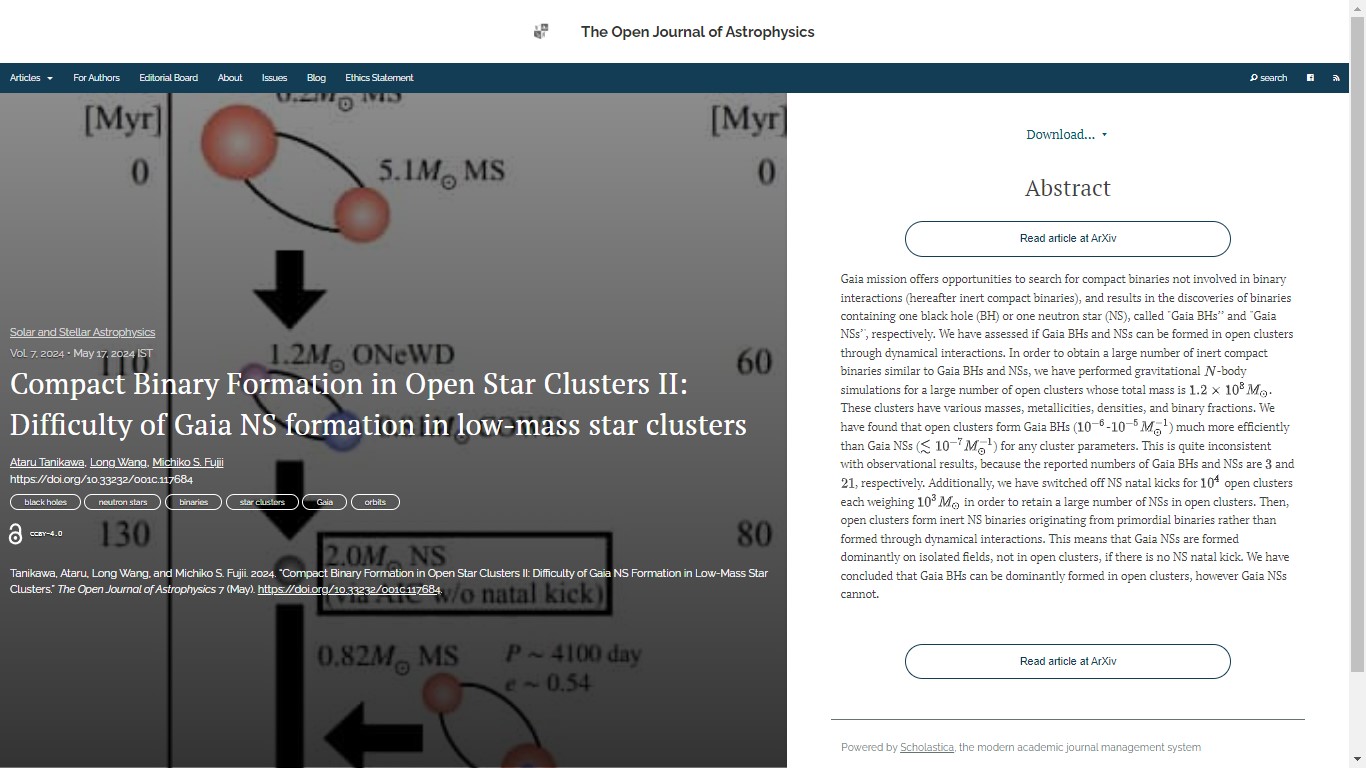
The last paper of this batch, also in the in the folder Solar and Stellar Astrophysics, is entitled “Compact Binary Formation in Open Star Clusters II: Difficulty of Gaia NS formation in low-mass star clusters”  and it presents a discussion of the formation of binary neutron stars and black holes found in Gaia data based on their orbital properties. It was published on Friday May 17th 2024 (i.e. yesterday). The authors are Ataru Tanikawa (Fukui University, Japan), Long Wang (Sun-yat Sen University, China) and  Michiko S. Fujii (Tokyo University, Japan).

Here is a screengrab of the overlay:


To read the accepted version of this on the arXiv please go here.
That’s all for now. Another update next week!


The Decline of the Milky Way’s Rotation

Posted in The Universe and Stuff with tags , , , , on September 28, 2023 by telescoper

I just noticed an interesting item on the ESA website about results described in a paper by Jiao et al. (on the arXiv here) relating to the rotation of the Milky Way as determined by Gaia’s Data Release 3.

The key result in the paper is summarized in this diagram:

A galaxy rotation curve like this is a diagnostic of the radial distribution of mass. If all the mass were concentrated at the centre, the galaxy would behave like the Solar System (in which most of the mass is contained within the Sun). In such a Keplerian profile the rotation speed falls off with distance, just as the outer planets move more slowly in their orbits than the inner ones. According to modern cosmology, however, there is dark matter not concentrated in the centre, in which case the rotation curve does not decline with distance and may even rise. According to theory, at large distances, the rotation curve of a spiral galaxy should be roughly flat.

The new results seem to contract this notion. The Figure shows a rotation curve that declines for distances about 15 kpc from the Galactic Centre; for reference the Sun orbits at a radius of about 10 kpc.

One of the problems in constructing a rotation curve of our own Galaxy is that we are inside it so it isn’t possible to make measurements across the entire system like we can with other galaxies. Using the Gaia measurements and a plausible model, however, the authors find much less dark matter than anticipated.

With a bit of extrapolation using a model, this measurement leeds to a reduction in the estimated total mass of the Milky Way. The value usually bandied about is around 1012 Solar Masses, while the new measurements imply a much lower mass of about 2 × 10¹¹ Solar Masses.

A factor of five reduction is quite a dramatic change and I’m sure this result will be challenged by those of an orthodox persuasion while also providing encouragement to dark matter sceptics. We’ll just have to wait and see how this pans out.

Gaia’s Third Data Release!

Posted in The Universe and Stuff with tags , , on June 13, 2022 by telescoper

It seems like only yesterday that I blogged about the second release of data from the European Space Agency’s Gaia mission but today sees the release of the third data set, known to its friends as DR3. This completes the set after some initial data were released early as EDR3 back in 2020.

Gaia on the Launchpad at Kourou, French Guyana, on 13th December 2013

In case you weren’t aware, Gaia, launched way back in 2013, is an ambitious space mission to chart a three-dimensional map of our Galaxy, the Milky Way, in the process revealing the composition, formation and evolution of the Galaxy. Gaia will provide unprecedented positional and radial velocity measurements with the accuracy needed to produce a stereoscopic and kinematic census of about one billion stars in our Galaxy and throughout the Local Group. This amounts to about 1 per cent of the Galactic stellar population.

Gaia is likely to operate until round about November 2024, so there’s a lot of data yet to come.

You can find a complete list of what is in DR3 here and if you want to go straight into the papers based on this dataset, go here. There is a nice promotional video here:

Our own Galactic Black Hole

Posted in The Universe and Stuff with tags , , , , on May 12, 2022 by telescoper

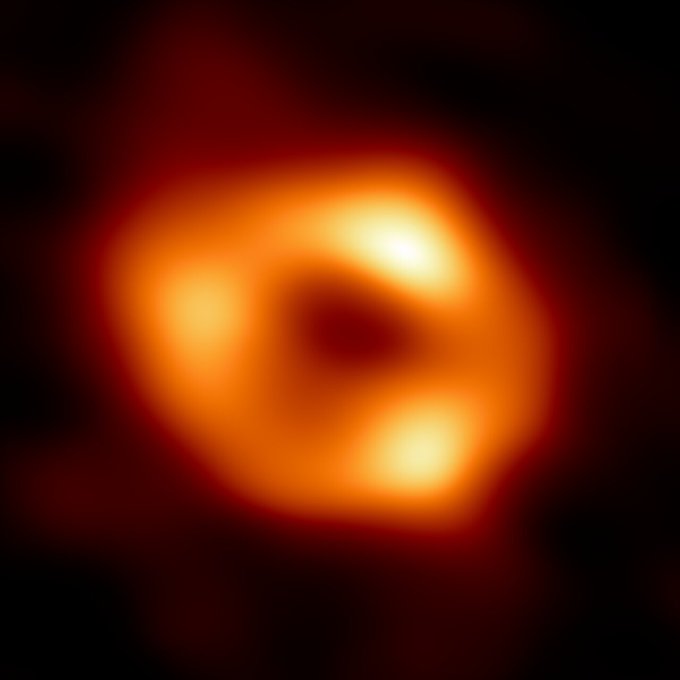
As I mentioned a while ago the Event Horizon Telescope team held a press conference this afternoon and to nobody’s surprise they used it announce an image of the (shadow of the event horizon around the) black hole at the centre of the Milky Way.

Here it is:

You can read the full press release here.

You may recall a great deal of excitement about three years ago concerning the imaging of the “shadow” of the event horizon of the black hole in the centre of the galaxy M87. The question I was asked most frequently back then is that there’s a much closer black hole in the centre of our own Galaxy, the Milky Way, so why wasn’t that imaged first?

It it true is that the black hole in the centre of M87 is ~103 times further away from us than the black hole in the centre of the Milky Way – known to its friends as Sagittarius A* or SgrA* for short – but is also ~103 times more massive, so its Schwarzschild radius is ~103 times larger. In terms of angular resolution, therefore, the observational challenge of imaging the event horizon is similar in the two cases. However, in the the case of the Milky Way’s black hole the timescales involved are much shorter than in M87 and there is a greater level of obscuration along the line of sight. That’s why it took longer to produce the image.

It’s a very difficult observation of course and I’m not sure of the significance of the “lumps” you can see, but the dark region in the centre is what the image is really about and that seems to be exactly the predicted size. The resolution is about 20 microarcseconds. Congratulations to the Event Horizon Telescope team!

If you’re interested in learning more about how this image was made I recommend this short video:

Astronomical Heads Up

Posted in The Universe and Stuff with tags , , , , on May 3, 2022 by telescoper

You may recall a great deal of excitement about three years ago concerning the imaging of the “shadow” of the event horizon of the black hole in the centre of the galaxy M87. There was so much interest in this measurement that you could hardly move without seeing this picture somewhere or other:

The question I was asked most frequently back then is that there’s a much closer black hole in the centre of our own Galaxy, the Milky Way, so why wasn’t that imaged first? The answer is that the black hole in the centre of M87 is about 1000 times further away from us than the black hole in the centre of the Milky Way – known to its friends as Sagittarius A* or SgrA* for short – but is also about 1000 times more massive, so its Schwarzschild radius is 1000 times larger. In terms of angular resolution, therfore, the observational challenge of imaging the event horizon is similar in the two cases.

I mention this because the Event Horizon Telescope team who made the above image are holding a press conference next week at ESO on “groundbreaking Milky Way results from the Event Horizon Telescope Collaboration”.

I wonder what these “groundbreaking results” might be?

The Complex Heart of the Milky Way

Posted in Art, The Universe and Stuff with tags , , , on January 26, 2022 by telescoper

I couldn’t resist sharing this amazing radio image of the Galactic Centre made using the South African MeerKAT radio telescope:

Radio frequency electromagnetic radiation is able to penetrate the dust that permeates this region so can reveal what optical light can not. In particular you can see the very active region around the black hole at the centre of the Milky Way, bubbles caused by exploding stars and – most interesting of all – a number of magnetized filamentary structures.

It’s an extraordinarily beautiful picture made from a mosaic of 20 separate observations. In fact I like it so much I’ve cross-filed it in my “Art” folder. Those of us who work in astronomy or astrophysics are wont to say that there’s much more to it than pretty pictures, but when one like this comes along we’re all sure to geek out over it!

For more information about this image at the science behind it, see here.

New Publication at the Open Journal of Astrophysics

Posted in OJAp Papers, Open Access, The Universe and Stuff with tags , , , , , on June 7, 2021 by telescoper

Time to announce another publication in the Open Journal of Astrophysics. This one was actually published on Friday actually, but I didn’t get time to post about it until just now. It is the fourth paper in Volume 4 (2021) and the 35th paper in all.

The latest publication is entitled The local vertical density distribution of ultracool dwarfs M7 to L2.5 and their luminosity function and the ultracool authors are Steve Warren (Imperial College), Saad Ahmed (Open University) and Richard Laithwaite (Imperial College).

Here is a screen grab of the overlay which includes the abstract:

You can click on the image to make it larger should you wish to do so. You can find the arXiv version of the paper here. This one is in the Astrophysics of Galaxies section but it also has overlap with Solar and Stellar Astrophysics.

Over the last few months I have noticed that it has taken a bit longer to get referee reports on papers and also for authors to complete their revisions. I think that’s probably a consequence of the pandemic and people being generally overworked. We do have a number of papers at various stages of the pipeline, so although we’re a bit behind where we were last year in terms of papers published I think may well catch up in the next month or two.

I’ll end with a reminder to prospective authors that the OJA  now has the facility to include supplementary files (e.g. code or data sets) along with the papers we publish. If any existing authors (i.e. of papers we have already published) would like us to add supplementary files retrospectively then please contact us with a request!