Archive for Open Access Publishing

On Scholarly Communication

Posted in Open Access with tags , , , , on June 9, 2025 by telescoper

My marking duties being over, it’s time once more to take up the cudgels against the academic publishing racket, at least in a small way, by sharing an article from the European University Association called Reclaiming academic ownership of the scholarly communication system. I recommend you read the entire piece, which is an extended briefing note. It can be downloaded as a PDF here. One of the points it makes very strongly is how much the Open Access movement has been hijacked by commercial publishers.

I will share a couple of sections with you here. First, some background information about Open Access Publishing:

Now I’ll cut to the chase and share the key points from the end.

  1. Accelerate the reform of research assessment. Most of the issues in the current publishing system are rooted in how academic staff are evaluated. Research assessment reform is essential to break the cycle of dependence on high-impact commercial journals and related metrics. Universities should consider broadening the criteria used in academic evaluation, to ensure that recognition goes beyond research to include teaching, innovation, leadership, open science practices, and societal outreach. While institutional, regulatory, and cultural factors can either facilitate or hinder reforms, many universities are already taking the initiative and implementing changes (even in countries with centrally regulated academic career assessment processes).
  2. Strengthen institutional publishing services and infrastructures. A robust, sustainable and interoperable scholarly publishing ecosystem requires each university to properly curate their research contributions and outputs, through institutional or shared infrastructure and services (e.g. repositories, publishing platforms, and CRIS systems). Strengthening these institutional capacities may require reallocating resources and cooperation (see points 3 and 4). This should also apply to the various institutional departments (libraries, research management, etc.) and staff needed to support academics and researchers.
  3. Cooperate and coordinate with other universities, research performing and funding organisations, as well as researchers’ associations and learned societies. The challenges of scholarly publishing are systemic, and no single institution can tackle them alone. Universities should align their efforts with other academic organisations, funders and research institutions. Cooperation and coordination can be valuable for advocacy, policy development and implementation, as well as for shared or “horizontal” services and infrastructures. Cooperation can also take place within regional, national, European and global frameworks.
  4. Critically evaluate expenditure on commercial research publishing and information products and services. As new not-for-profit publishing alternatives emerge and consolidate, universities should regularly evaluate their expenditure on commercial products and services, including journal publication costs and research databases. By promoting cost transparency and cost efficiency, institutions can make informed decisions that support innovation and reinvest funds into institutional publishing services and infrastructure (see point 2). Where feasible, preference should be given to not-for-profit solutions, ultimately reducing costs and ensuring sustainability.
  5. Support and promote the use of rights retention by the university community. Rights retention should be used to regain academic ownership of scholarly communication. Universities should actively advocate for legislative reforms that allow researchers to retain their rights and freely share their research. They should also educate and inform their faculty and researchers of the importance of rights retention and provide legal support. Where legally feasible, institutions should implement and enforce rights retention policies to ensure that publicly funded research remains publicly accessible.
  6. Ensure researcher engagement. Any transition toward a more equitable and sustainable scholarly communication system must involve the academic community. Universities should raise awareness of the systemic issues in scholarly publishing and create spaces for dialogue, reflection, and co-design to discuss how to address them at institutional level. Engaging researchers early and consistently can help shift perceptions, foster a sense of shared responsibility and build support for longterm cultural change.

I endorse all of these, and have written about some of them before (e.g. here) but I would add to the first that universities should actively lobby their governments to change research assessment methods which in many cases are causing an immense waste of public money by outsourcing research assessment to entities, such as Scopus, who are mere fronts for the academic publishing industry.

Weekly Update from the Open Journal of Astrophysics – 03/05/2025

Posted in OJAp Papers, Open Access, The Universe and Stuff with tags , , , , , , , , , , , , , , , , , , , on May 3, 2025 by telescoper

Saturday morning once again, and time for another update of papers published at the Open Journal of Astrophysics. It’s been a recording-breaking week: since the last update we have published no fewer than ten papers, which brings the number in Volume 8 (2025) up to 54 and the total so far published by OJAp up to 289.

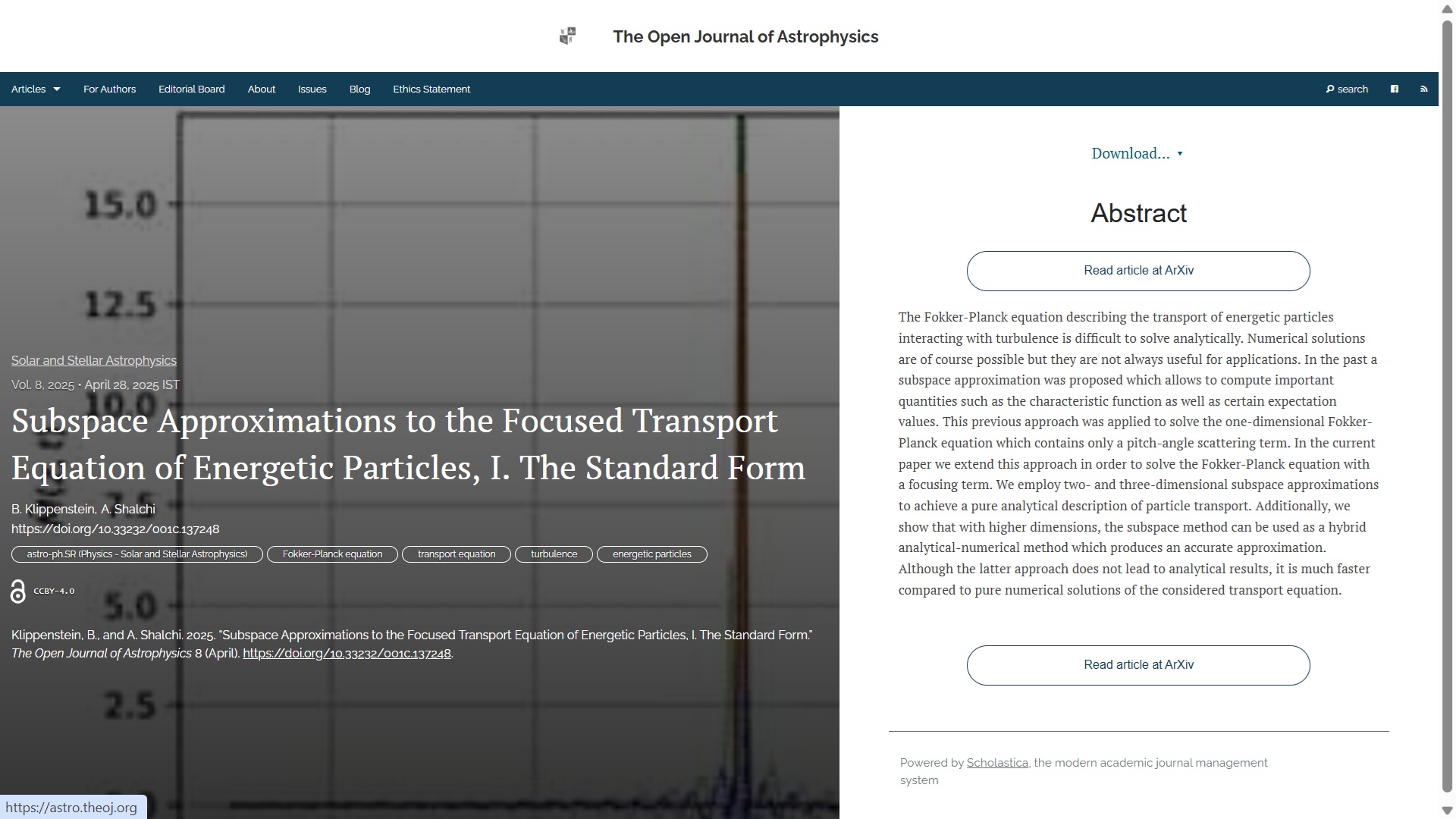
The first paper to report is “Subspace Approximations to the Focused Transport Equation of Energetic Particles, I. The Standard Form” by B. Kippenstein & A. Shalchi (U. Manitoba, Canada). This paper, which was published on Monday 28th April 2025, presents a hybrid analytical-numerical method to solve the Fokker-Planck equation for the transport of energetic particles. It is published in the folder Solar and Stellar Astrophysics.

The overlay is here:

You can find the officially accepted version on arXiv here.

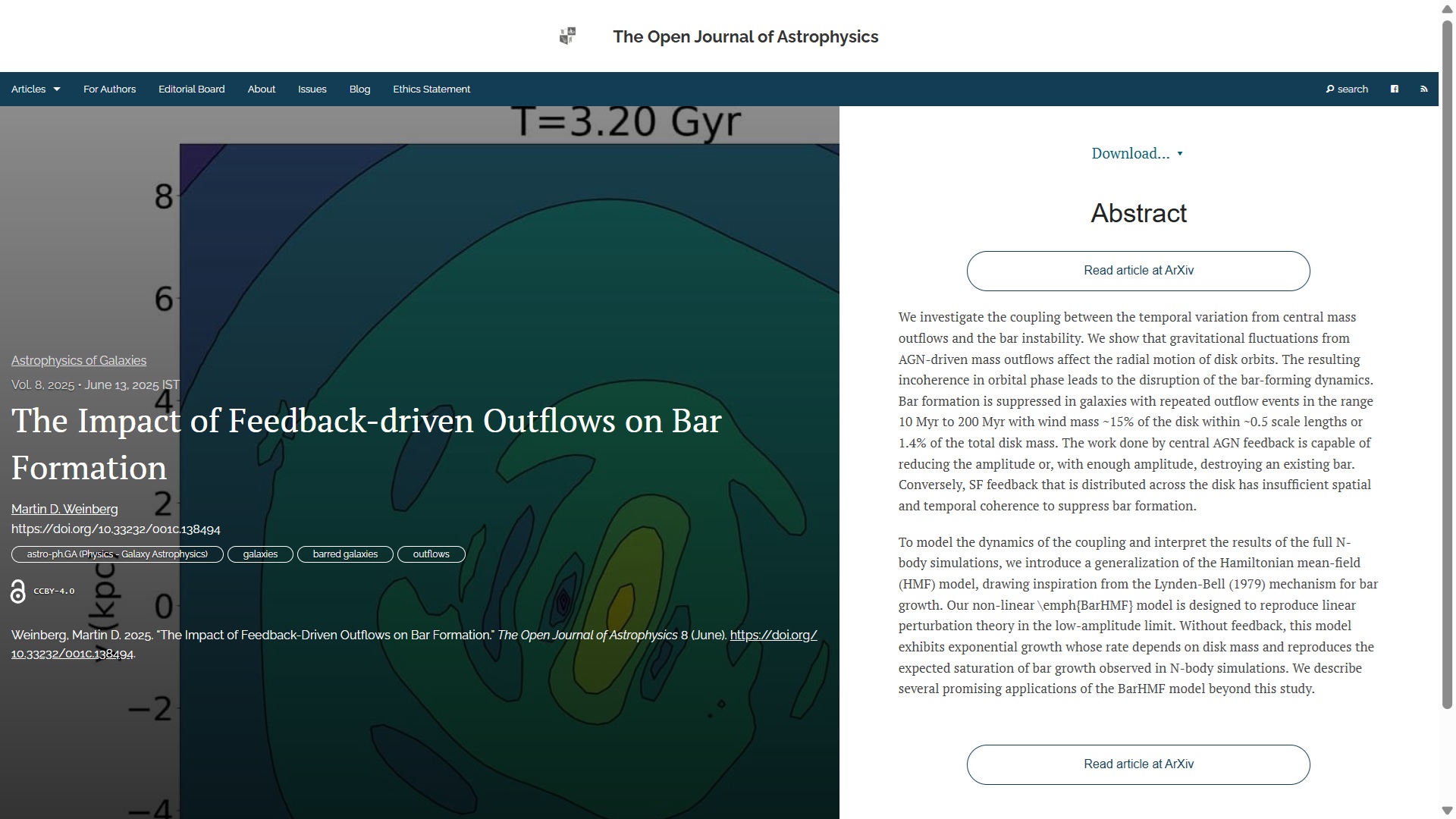
Next is “The Importance of Subtleties in the Scaling of the ‘Terminal Momentum’ For Galaxy Formation Simulations” by Philip F. Hopkins (Caltech, USA). This presents a technical discussion of issues surrounding the proper modelling of supernova blast waves and their effects in numerical simulations of galaxy formation. It was published on Tuesday 29th April 2025 in the folder Astrophysics of Galaxies. The overlay is here:

The final version can be found on arXic here.

Next one up is “Local variations of the radial metallicity gradient in a simulated NIHAO-UHD Milky Way analogue and their implications for (extra-)galactic studies” by Sven Buder (ANU, Australia), Tobias Buck (U. Heidelberg, Germany), Qian-Hui Chen (ANU) and Kathryn Grasha (ANU). This one was also published on Tuesday 29th April 2025 in the folder Astrophysics of Galaxies. It describes a numerical study of the variation of chemical abundance with radial position in galaxies and the implications of this for galaxy formation. Here is the overlay:
and you can find the final accepted version on arXiv here.

The fourth paper this week is “Zooming In On The Multi-Phase Structure of Magnetically-Dominated Quasar Disks: Radiation From Torus to ISCO Across Accretion Rates” by Philip F. Hopkins (Caltech, USA) and 14 others based in the USA and Canada. This was also published on Tuesday 29th April 2025 in the folder Astrophysics of Galaxies. It presents very detailed numerical study of the structure of magnetized quasar accretion disks. The overlay is here:

You can find the official final version on arXiv here.

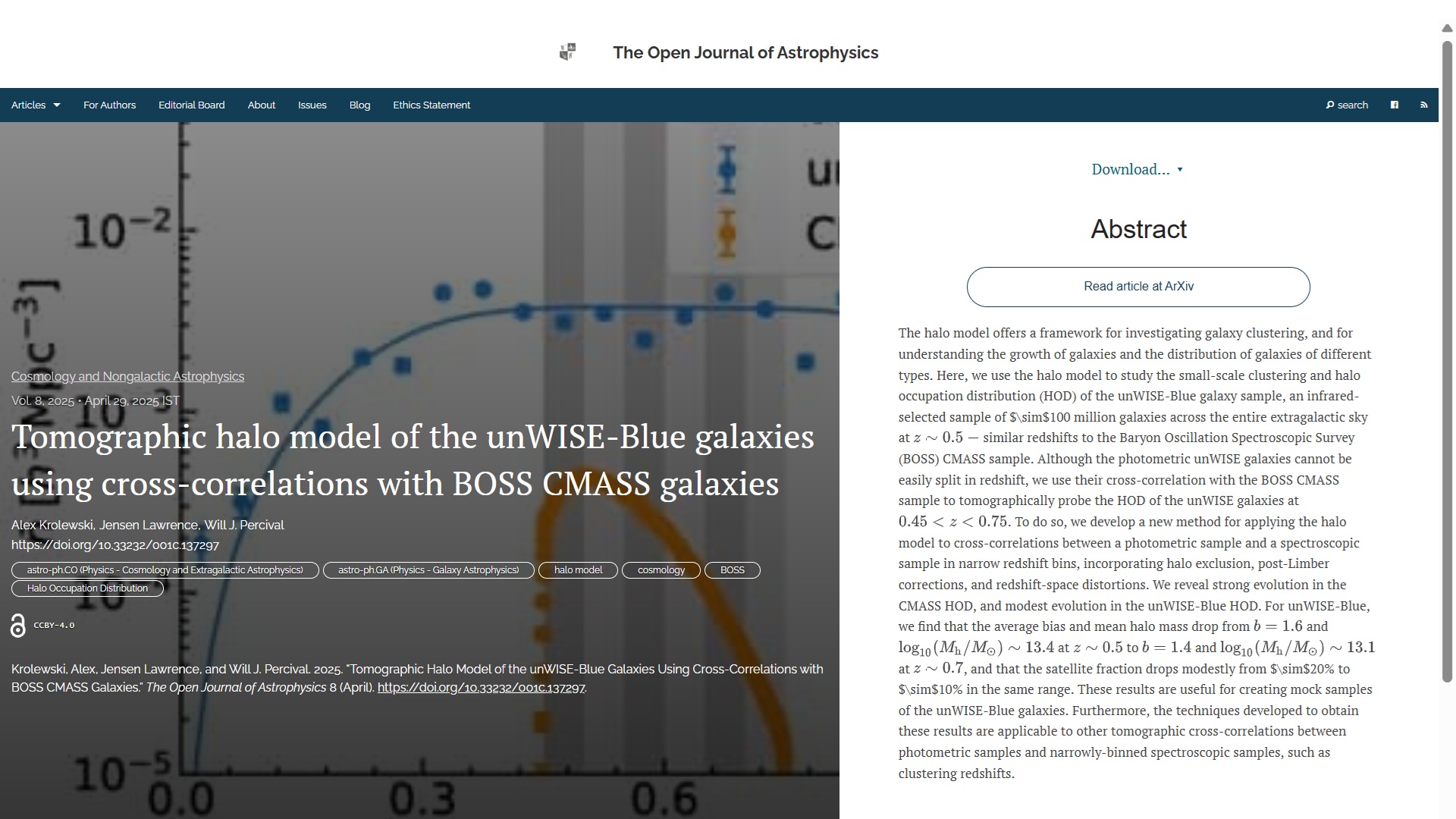
Next is “Tomographic halo model of the unWISE-Blue galaxies using cross-correlations with BOSS CMASS galaxies” by Alex Krolewski, Jensen Lawrence, and Will J. Percival (U. Waterloo, Canada). This one was also published on 29th April 2025, which was a busy day(!), but in the folder Cosmology and NonGalactic Astrophysics.  This paper describes using the halo model to create mock samples unWISE-Blue galaxies, applicable to other tomographic cross-correlations between photometric samples and narrowly-binned spectroscopic samples. The overlay is here:

The final version of this one can be found on the arXiv here.

Number six for this week is “StratLearn-z: Improved photo-estimation from spectroscopic data subject to selection effects” by Chiara Moretti (SISSA, Trieste, Italy), Maximilian Autenrieth (Imperial College, UK), Riccardo Serra (SISSA), Roberto Trotta (SISSA), David A. van Dyk (Imperial) and Andrei Mesinger (SNS Pisa, Italy). This was published on Thursday 1st May 2025 in the folder Cosmology and NonGalactic Astrophysics. This one is about estimating photometric redshifts using an approach that relies on splitting the source and target datasets into strata based on estimated propensity score. The overlay is here:


The official version can be found on arXiv here.

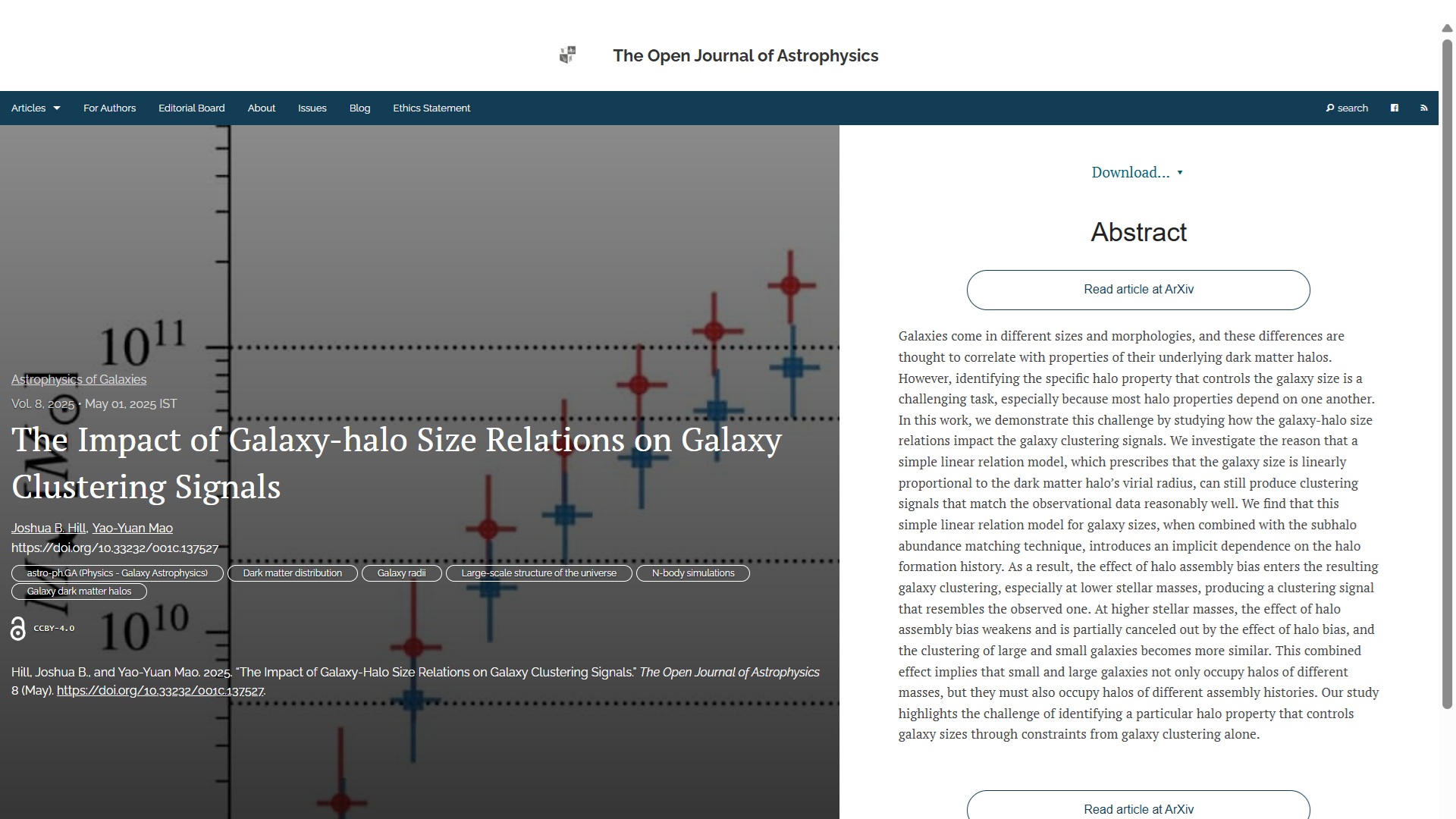
Next is “The Impact of Galaxy-halo Size Relations on Galaxy Clustering Signals” by Joshua B. Hill and Yao-Yuan Mao (U. Utah, USA). This one was also published on May 2nd 2025 and is in the folder Astrophysics of Galaxies. It discusses the challenge of identifying a specific galaxy halo property that controls galaxy sizes through constraints from galaxy clustering alone. The overlay is here:

You can find the official version of the paper on arXiv here.

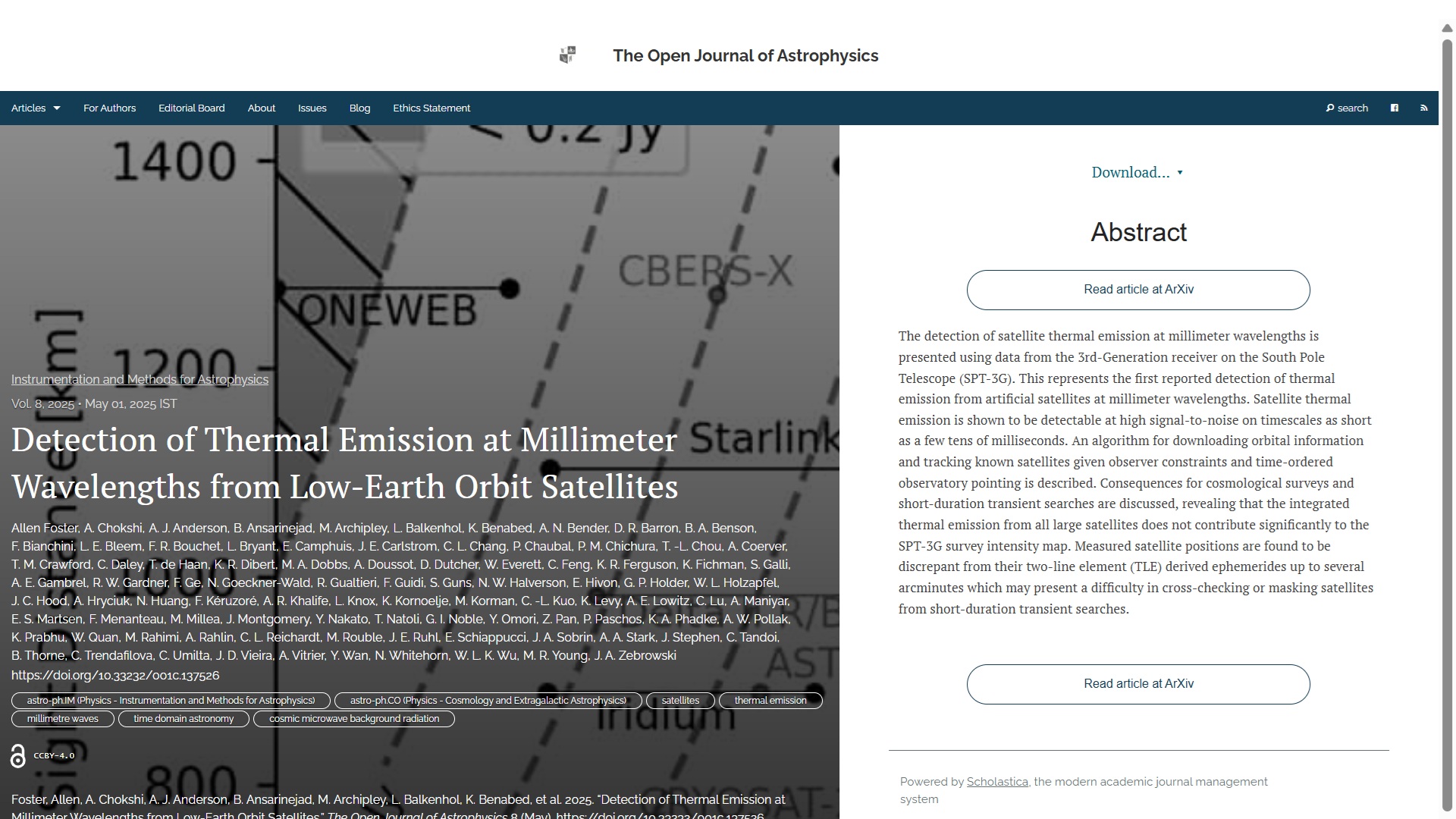
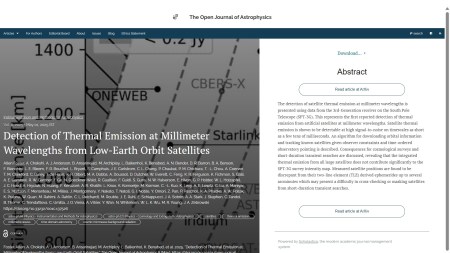
The next paper is “Detection of Thermal Emission at Millimeter Wavelengths from Low-Earth Orbit Satellites” by Allen Foster (Princeton, USA) and an international cast of 90 others, which is too many to list individually. This one was also published on Thursday May 1st but is in the folder Instrumentation and Methods for Astrophysics.  The paper discusses the experimental detection of thermal emission from satellites and a discussion of the implications for astrophysical observations, especially time-domain astronomy. The overlay is here:
You can find the final version of the paper on arXiv here.

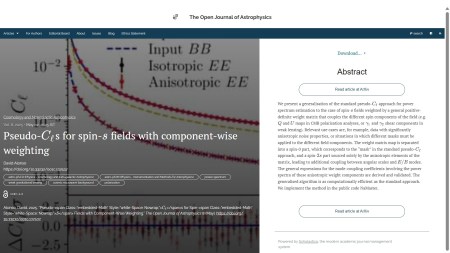
The penultimate paper of this week is “Pseudo-Cls for spin-s fields with component-wise weighting” by David Alonso (U. Oxford, UK). This one was published yesterday (Friday 2nd May 2025).  The paper presents an approach to power spectrum estimation appropriate for data with anisotropic noise properties or for which complicated masks are required.  It can be found in the folder Cosmology and NonGalactic Astrophysics. The overlay is here:
 

The final version of this paper is on arXiv here.

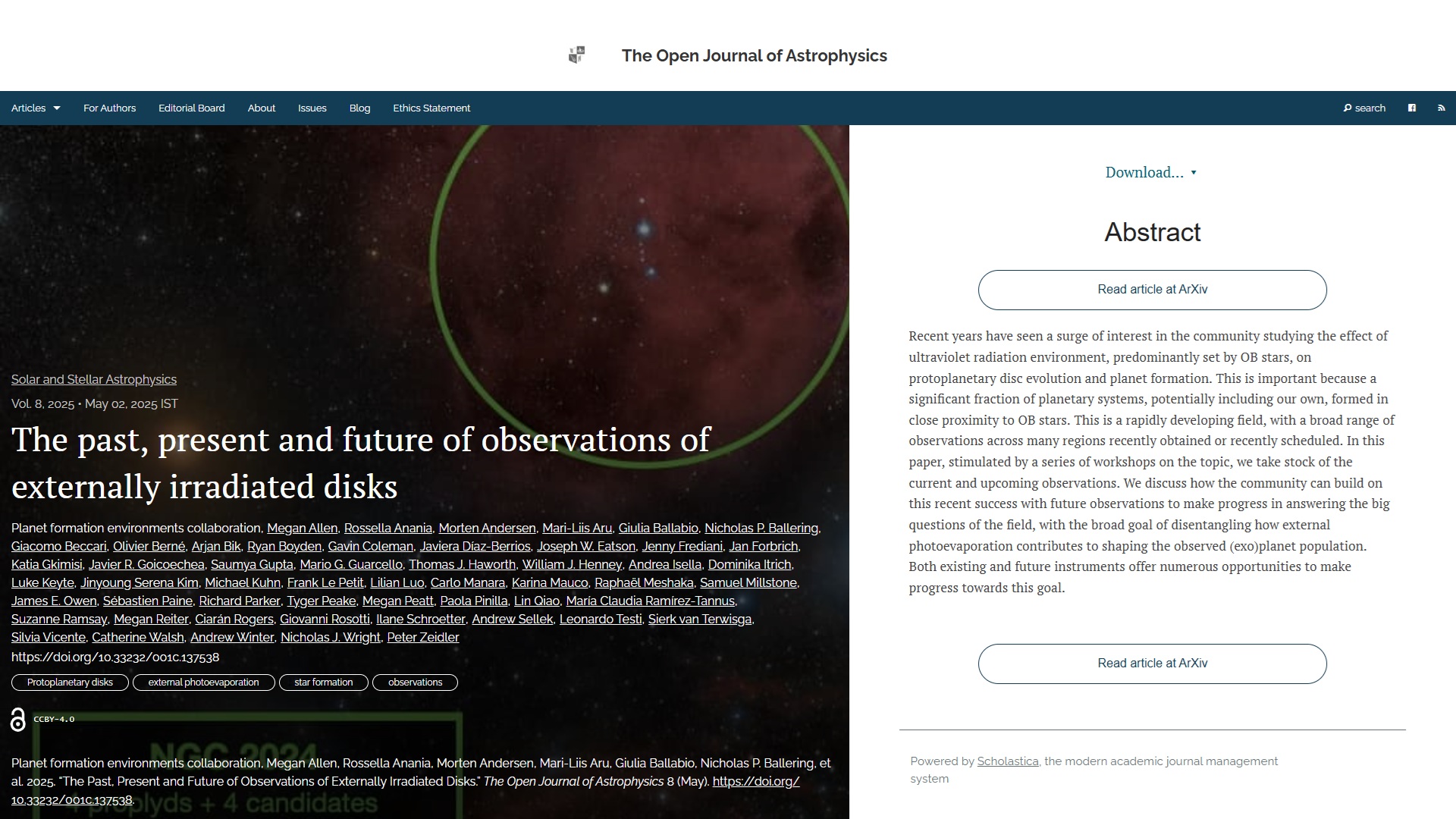
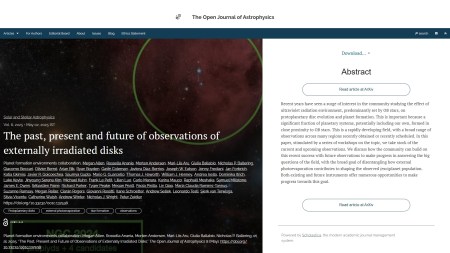
The last paper this week is “The past, present and future of observations of externally irradiated disks” by Planet formation environments collaboration: Megan Allen (U. Sheffield, UK) and 52 others. This paper was published on Friday 2nd May in the folder Solar and Stellar Astrophysics.  It presents a review of research on the effects of the ultraviolet radiation environment on protoplanetary disc evolution and planet formation. The overlay is here:
You can find the final version on arXiv here.

That’s all the papers for this week. I’ll just add that there were quite a few gremlins at Crossref this week, particularly yesterday. I usually do the publishing first thing in the morning but yesterday’s papers were held in a queue for most of the day pending registration. Usually it just takes a few minutes, but for these I had to wait several hours but we got there in the end. Although ten papers is more than we have ever published in a week, we still haven’t had a week in which we’ve published on every working day!

Anyway, that’s all for this week. I’ll post another update next Saturday.

Weekly Update at the Open Journal of Astrophysics – 22/03/2025

Posted in OJAp Papers, Open Access, The Universe and Stuff with tags , , , , , , , , , , , , on March 22, 2025 by telescoper

It’s Satuday morning once again, and time for another update of papers published at the Open Journal of Astrophysics. Since the last update we have published two papers, which brings the number in Volume 8 (2025) up to 29 and the total so far published by OJAp up to 264.

The papers we have published this week are connected by the theme of black holes and their role in galaxy formation, which is a very hot topic nowadays!

The first paper to report is “Hawking Radiation from non-evaporating primordial black holes cannot enable the formation of direct collapse black holes” by Jonathan Regan, Marios Kalomenopoulos and Kelly Kosmo O’Neil of the University of Nevada, USA. This paper, which is based on an undergraduate thesis, is a study of the irradiating effects of primordial black holes and a discussion of whether these might influence the subsequent formation of supermassive black holes. It is in the section marked Astrophysics of Galaxies, and was published on Tuesday  18th March.

The overlay is here:

and you can find the final accepted version on arXiv here.

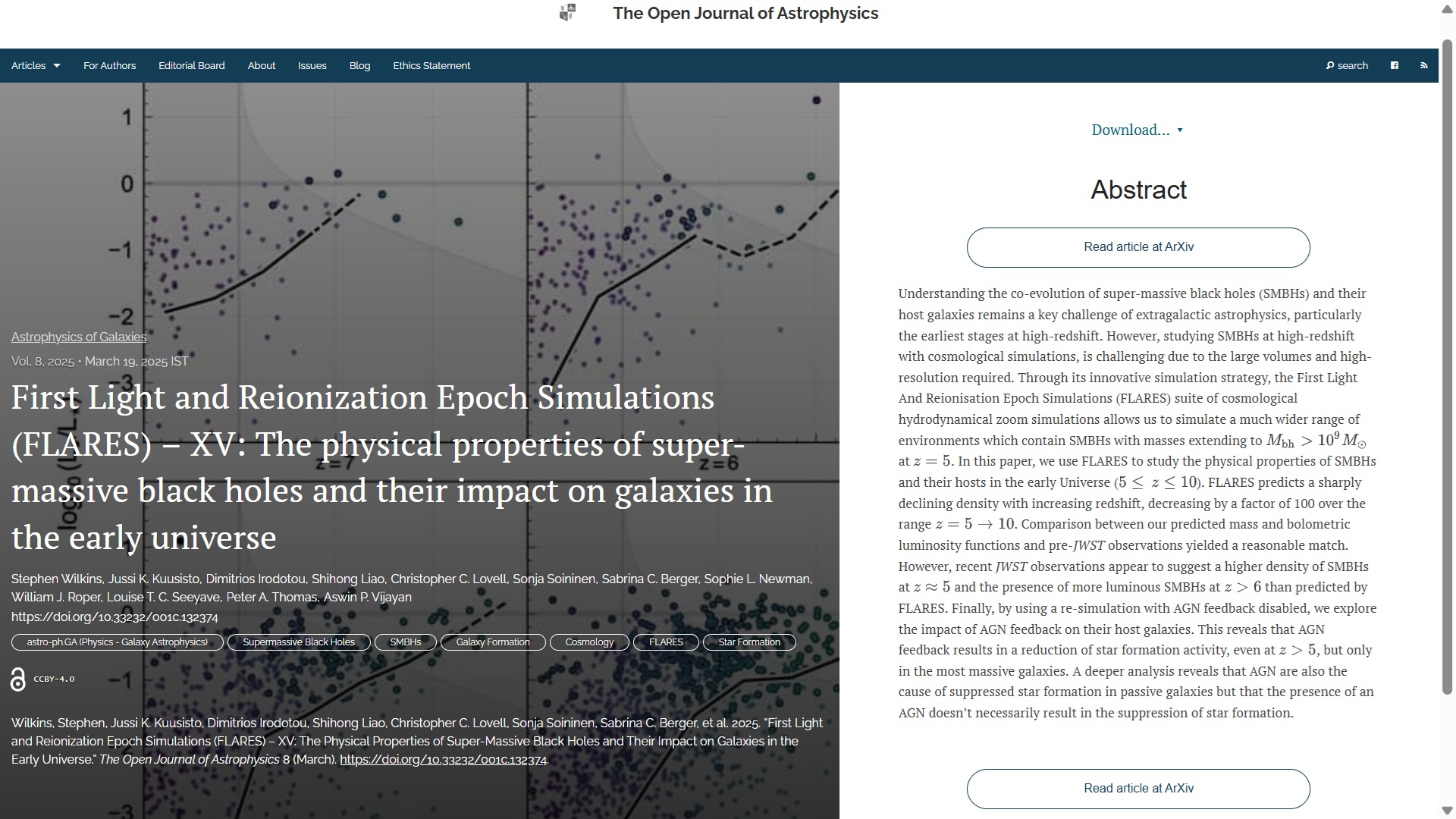
The second paper, which was published on Wednesday 19th March and is also in the folder Astrophysics of Galaxies, is “First Light and Reionization Epoch Simulations (FLARES) – XV: The physical properties of super-massive black holes and their impact on galaxies in the early universe” by Stephen Wilkins & Jussi K. Kuusisto (U. Sussex, UK), Dimitrios Irodotou (Institute of Cancer Research, UK), Shihong Liao (Beijing, China) Christopher C. Lovell (Portsmouth, UK), Sonja Soininen (Insitute of Cancer Research), Sabrina C. Berger (Melbourne, Australia), Sophie L. Newman (Portsmouth, UK), William J. Roper (Sussex), Louise T. C. Seeyave (Sussex), Peter A. Thomas (Sussex) and Aswin P. Vijayan Sussex). This paper uses cosmological hydrodynamical zoom simulations to study the formation of supermassive black holes and their impact on star formation in the early Universe.

Here is the overlay, which you can click on to make larger if you wish:


You can read the officially accepted version of this paper on arXiv here.

That’s all for this week. It’s been a bit frustrating for me as Managing Ediutor, because we have built up a backlog of several papers that were accepted for publication some time ago, but are still waiting for the authors to place the final version on arXiv. I hope these won’t take too long to appear, not least because I would like to clear my workflow on the Scholastica platform!

Weekly Update at the Open Journal of Astrophysics – 15/03/2025

Posted in OJAp Papers, Open Access, The Universe and Stuff with tags , , , , , , , , , , , , , on March 15, 2025 by telescoper

The Ideas of March are come, so it’s time for another update of papers published at the Open Journal of Astrophysics. Since the last update we have published two papers, which brings the number in Volume 8 (2025) up to 27 and the total so far published by OJAp up to 262.

The first paper to report is “Dark Energy Survey Year 6 Results: Point-Spread Function Modeling” by Theo Schutt and 59 others distributed around the world, on behalf of the DES Collaboration. It was published on Wednesday March 12th 2025 in the folder Cosmology and NonGalactic Astrophysics. It discusses the improvements made in modelling the Point Spread Function (PSF) for weak lensing measurements in the latest Dark Energy Survey (6-year) data and prospects for the future.

Here is the overlay, which you can click on to make larger if you wish:


You can read the officially accepted version of this paper on arXiv here.

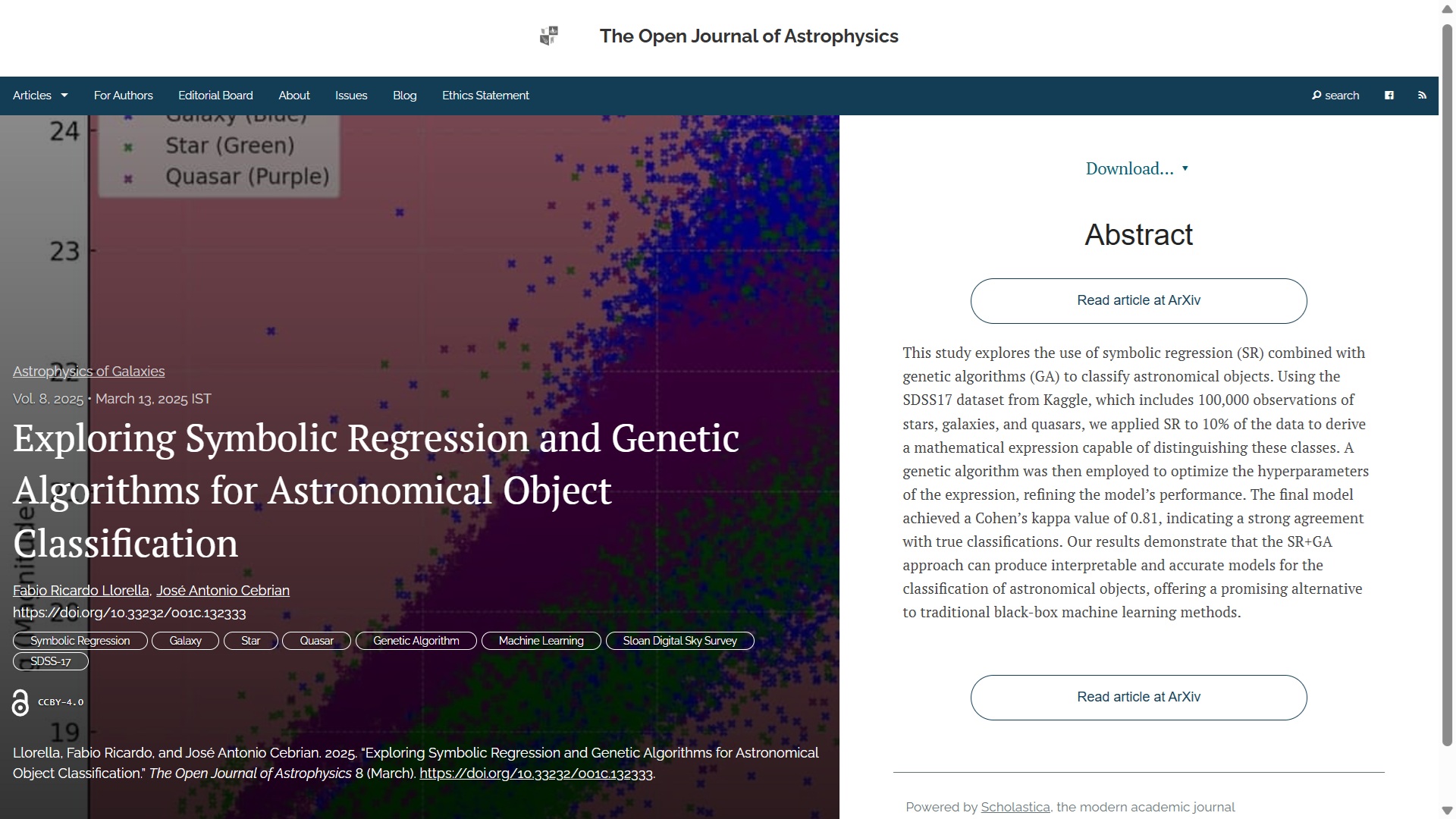
The other paper published this week is “Exploring Symbolic Regression and Genetic Algorithms for Astronomical Object Classification” by Fabio Ricardo Llorella (Universidad Internacional de la Rioja, Spain) & José Antonio Cebrian (Universidad Laboral de Córdoba, Spain), which came out on Thursday 13th March. This one is in the folder marked Astrophysics of Galaxies and it discusses the classification of astronomical objects in the Sloan Digital Sky Survey SDSS-17 dataset using a combination of Symbolic Regressiion and Genetic Algorithms.

The overlay can be seen here:

You can find the “final” version on arXiv here.

That’s it for this week. I’ll have more papers to report next Saturday.

Weekly Update from the Open Journal of Astrophysics – 01/02/2025

Posted in OJAp Papers, Open Access, The Universe and Stuff with tags , , , , , , , , , , , , , , , , , , on February 1, 2025 by telescoper

It’s Saturday morning, so once again it’s time for an update of papers published at the Open Journal of Astrophysics. There were no papers to report last week but since the last update we have published four new papers, which brings the number in Volume 8 (2025) up to 11 and the total so far published by OJAp up to 246.

In chronological order of publication, the four papers published this week, with their overlays, are as follows. You can click on the images of the overlays to make them larger should you wish to do so.

First one up is  “A halo model approach for mock catalogs of time-variable strong gravitational lenses” by Katsuya T. Abe & Masamune Oguri (Chiba U, Japan), Simon Birrer & Narayan Khadka (Stony Brook, USA), Philip J. Marshall (Stanford, USA), Cameron Lemon (Stockholm U., Sweden), Anupreeta More (IUCAA, India), and the LSST Dark Energy Science Collaboration. It was published on 27th January 2025 in the folder marked Cosmology and NonGalactic Astrophysics. The paper discusses how to generate mock catalogs of strongly lensed QSOs and Supernovae on galaxy-, group-, and cluster-scales based on a halo model that incorporates dark matter halos, galaxies, and subhalos.


You can find the officially accepted version of this paper on arXiv here.

This paper, also published on Monday 27th January 2025, but in the folder Astrophysics of Galaxies, is “The Soltan argument at redshift 6: UV-luminous quasars contribute less than 10% to early black hole mass growth” by Knud Jahnke (MPI Heidelberg, Germany). This paper presents an argument that almost all growth of supermassive black hole mass at z>6 does not take place in UV-luminous quasars.

Here is a screen grab of the overlay, which includes the abstract:You can find the officially accepted version of the paper on the arXiv here.

The third paper to announce, published on 29th January 2025 in the folder Cosmology and NonGalactic Astrophysics, is “A Heavy Seed Black Hole Mass Function at High Redshift – Prospects for LISA” by Joe McCaffrey & John Regan (Maynooth U., Ireland), Britton Smith (Edinburgh U., UK), John Wise (Georgia Institute of Technology, USA), Brian O’Shea (Michigan State U., USA) and Michael Norman (University of California, San Diego). This is a numerical study of the growth rates of massive black holes in the early Universe and implications for their detection via gravitational wave emission.

You can see the overlay here:


The accepted version of this paper can be found on the arXiv here.

The last paper of this batch is “Forecasting the Detection of Lyman-alpha Forest Weak Lensing from the Dark Energy Spectroscopic Instrument and Other Future Surveys” by Patrick Shaw & Rupert A. C. Croft (Carnegie Mellon U., USA) and R. Benton Metcalf (U. Bologna, Italy). This paper, published on January 30th 2025, is about extending the applicationof  Lyman-α forest weak gravitational lensing to lower angular source densities than has previously been done, with forecasts for future spectral surveys. It is in the folder marked Cosmology and NonGalactic Astrophysics.

The overlay is here


You can find the accepted version on arXiv here.

Incidentally, we currently have 121 papers under review, including 81 under a revise and resubmit request.

That’s all for this week. I’ll do another update next Saturday.
Page Charges at A&A

Posted in Euclid, Open Access with tags , , , , , on January 20, 2025 by telescoper

The journal Astronomy & Astrophysics (A&A for short) announced last week that it was increasing page charges on longer papers. The table of new charges to be implemented is here:

A&A is published on behalf of the European Southern Observatory by EDP Sciences (Édition Diffusion Presse Sciences) which began life as a joint venture of four French learned societies in science, mathematics, and medicine. The company was acquired in 2019 by  China Science Publishing & Media (which has headquarters in Beijing). Judging by its social media activity, EDP Sciences sees A&A as a flagship journal; for a list of other journals it runs see here. I gave some background on A&A here.

A&A publishes papers through a curious hybrid model called “S2O” (Subscribe to Open; not to be confused with “420”). This is not fully Open Access because it requires libraries to pay a subscription to access the journal. For this reason it is not compatible with some institutional open access policies. Unlike some journals, however, A&A does allow authors to place their papers on arXiv without restriction, so they can be read there for free. Previously A&A required authors (or their institutes) to pay “Page Charges” – essentially an Article Processing Charge (APC) – if they were not from a “member country”; this policy was introduced in 2020. Authors from a member country will now have to pay APCs to publish (if their paper exceeds the page limit) but their institutional libraries still have to pay a subscription if they are to access the paper. In other words, A&A is double-dipping.

According to A&A,

… the average length of papers has also been increasing. Too often, papers are longer than necessary, leading to increased workload for authors, referees, and editors, and hindering the reader’s ability to efficiently grasp their content. As well as needing logistical consideration, the challenges related to the journal’s growth have financial implications that must be addressed to ensure long-term sustainability.

I agree that many papers are far too long. As a journal Editor myself I know that it is much harder to find people willing to review very long papers, a fact that some authors seem reluctant to recognize. On the other hand I very much doubt that any of the funds generated by page charges will be given to the refeees who do the most important – indeed I would argue the only important – work of a journal.

If the desired effect is to reduce the number of long papers this policy may work, though I suspect authors who are incurably prolix will respond by splitting their work into several shorter papers to avoid the page charges and thereby generating even more work for the journal. I suspect however that the desired effect is really to increase revenue; so often in the context of academic publishing “sustainability” really means “profitability”. I would also bet that these charges will increase further in future.

The changing charges at A&A have widespread implications, including for the Euclid Consortium, most of whose scientific papers are published there. I’m sure the Euclid Consortium Editorial Board will discuss this development. I’m not a member of the ECEB so it would be inappropriate to comment further on publication policy so I’ll leave the discussion to them. I would say, however, that the publication process at A&A is rather slow. The main post-launch Euclid Overview paper by Mellier et al., for example, was accepted for publication in August 2024 but has still not appeared. It is, however, available on arXiv, which is all that really matters. That paper, incidentally, is over 90 pages long. According to the table above that would cost about €12,000 in page charges. It was submitted in May 2024 and accepted quite quickly but is planned to appear in a special issue Euclid on Sky the publication of which is being delayed by other papers still going through the editorial process.

(Incidentally, Mellier et al. has already acquired 157 citations despite not yet being officially published, which illustrates how little difference “official” publication is actually worth.)

The trouble with arXiv

Posted in Biographical, Open Access with tags , , , , on October 17, 2024 by telescoper

We’re now publishing papers at a steady rate at the Open Journal of Astrophysics. This is probably not obvious to outsiders, but our platform actually consists of two different sites, one handling submissions and the other dealing with publishing those papers accepted. Although we have a large (and still expanding) team of volunteer Editors to deal with the former, as Managing Editor I am the only person with the keys to the publishing side of things. This part of the process has been simplified enormously after the automation introduced earlier this year but it still takes some time to do, as I have to check the overlay and metadata before pressing the button to deposit everything with Crossref and make the overlay live. I also announce each paper on social media. This usually takes around 15 minutes per paper, give or take.

Now that I’ve returned to full teaching duties at Maynooth University, I’ve developed a routine to deal with this activity. During workdays I usually wake around 7am, make some coffee, and then check the day’s arXiv mailing to see if any of our accepted papers have been announced. If any have, I do the honours while I have my coffee, and then proceed to shower and breakfast (including Coffee no. 2); if none have, I go straight to shower and breakfast. I’ve been following this routine for quite a while now.

In the last couple of weeks, however, I have noticed quite often when I try to look up newly-announced papers on arXiv that the connection times out with a message saying ‘rate exceeded’. If that happens I just wait a while and try again. It’s not a very serious issue but it does slow down the process.

Well, today I found out the reason via a message on Mastodon. The loading errors at arXiv are caused by people doing many simultaneous downloads in attempts to scrape all the content from arXiv as soon as it is announced. This is almost certainly to provide material for Large Language Models, such as ChatGPT, which are essentially Automated Plagiarism Engines. I propose the acronym APE for the kind of person who engages in this sort of activity.

This is a very tedious development and I hope arXiv can find a way of putting a stop to it without inconveniencing its authentic users. I suggest that the people managing arXiv identify the culprits and send the boys round.

Another Day, Another Predator…

Posted in Open Access with tags , , , on May 9, 2024 by telescoper

It’s been a while since I reported on a couple of encounters with predatory publishers so I thought I’d do another post in the same vein. Just this morning I received an email:

The email is in Polish, followed by the above translation into English. Out of curiosity I had a look at the website for UK Zhende Publishing. Imagine my lack of surprise when I found out it was down! The company is however registered at Companies House. Mr Zihan Li – who is resident in China -owns 75% of the business.

The Open Journal of Astrophysics is not for sale under any circumstances, not that I own it anyway. I did toy with the idea of selling them some other journal I don’t own, but I’m too busy to play such games. I did, however, find the time to reply giving my “thoughts/comments” as requested, though it would be inappropriate to repeat them here.

The last time I received such an approach ( a few months ago) the suggested price was $70,000. I see it has now gone up to $100,000. I don’t know how Mr Zihan arrived at a valuation of $100K but it got me thinking. We have so far published 149 articles at OJAp. Taking the APC for MNRAS of £2500 (approximately $3000) as typical then we have saved the community about $447,000 in unnecessary publication charges.

Who Publishes A&A?

Posted in Euclid, Open Access with tags , , , , , , , on May 8, 2024 by telescoper

The journal Astronomy & Astrophysics, generally known as A&A, which featured in yesterday’s post, is and has been for some time the journal of choice for many astrophysics researchers, especially those based in Europe. It is the journal in which the bulk of publications from Euclid will be published, including a batch due to come out in a couple of weeks.

The journal, which has existed since 1969, is published on behalf of the European Southern Observatory by EDP Sciences (Édition Diffusion Presse Sciences) which began life as a joint venture of four French learned societies in science, mathematics, and medicine. The company was acquired in 2019 by  China Science Publishing & Media (which has headquarters in Beijing). Judging by its social media activity, EDP Sciences sees A&A as a flagship journal; for a list of other journals it runs see here.

A&A publishes papers through a curious hybrid model called “S2O” (Subscribe to Open; not to be confused with “420”). This is not fully Open Access because it requires libraries to pay a subscription to access the journal, but unlike some journals A&A does allow authors to place their papers on arXiv without restriction, so they can be read there for free. On the other hand, A&A also requires authors to pay “Page Charges” – essentially an Article Processing Charge (APC) – if they are not from a “member country”. Authors from a member country do not have to pay APCs to publish but their institutional libraries still have to pay a subscription if they are to access the paper.

You might ask why you should publish in A&A if you can put your papers on arXiv. The answer given on the website is:

Preprint servers such as arXiv play a vital role in bringing research into the astronomy and astrophysics communities as quickly as possible. However, content uploaded to this service has not undergone rigorous peer review and the editorial oversight offered by a professional publisher such as EDP Sciences. In addition, preprints don’t offer the content selection and curation processes that make a scholarly journal a reliable and trusted addition to library collections.

In summary, publishing your article in A&A increases the value and impact of your work by making your article more trustworthy, easier to find, read, and cite, whilst ensuring that the version of record is preserved in perpetuity.

In other words, A&A does nothing that the Open Journal of Astrophysics doesn’t do for free…

Incidentally, I am struck by the frequent assertion that publishers preserve or curate content. Actually they don’t. Libraries do that. If a publisher such as EDP Science decides a journal is no longer commercially viable it will simply ditch it. Fortunately nowadays institutions maintain their own repositories of published papers as insurance against this.

Here is some more information about how S20 works, taken from the A&A website:

A&A is a community journal sponsored by a board of member countries. While subscriptions fund the publishing costs of the journal, the editorial costs are funded both by the contributions from member countries, and the page charges for authors of non-member countries. This division of costs between authors and readers makes it possible to offer low subscription prices, while at the same time removing barriers to publishing for authors from A&A sponsoring countries, and allowing authors from non-sponsoring countries to publish for a modest charge.

If the S2O model is successful, editorial costs will continue to be funded by A&A member contributions and page charges, while subscriptions will be used to cover the open access publication of the journal. Authors from sponsoring countries can therefore publish in open access free of charge, while authors from other countries remain liable for page charges to fund the editorial process of their article (note: page charges are paid to A&A directly and not to the publisher).

This arrangement is being kept under annual review so whether it will persist is open to question.