Archive for Physics

Quantum & Answers

Posted in Maynooth, The Universe and Stuff with tags , , , on November 13, 2025 by telescoper

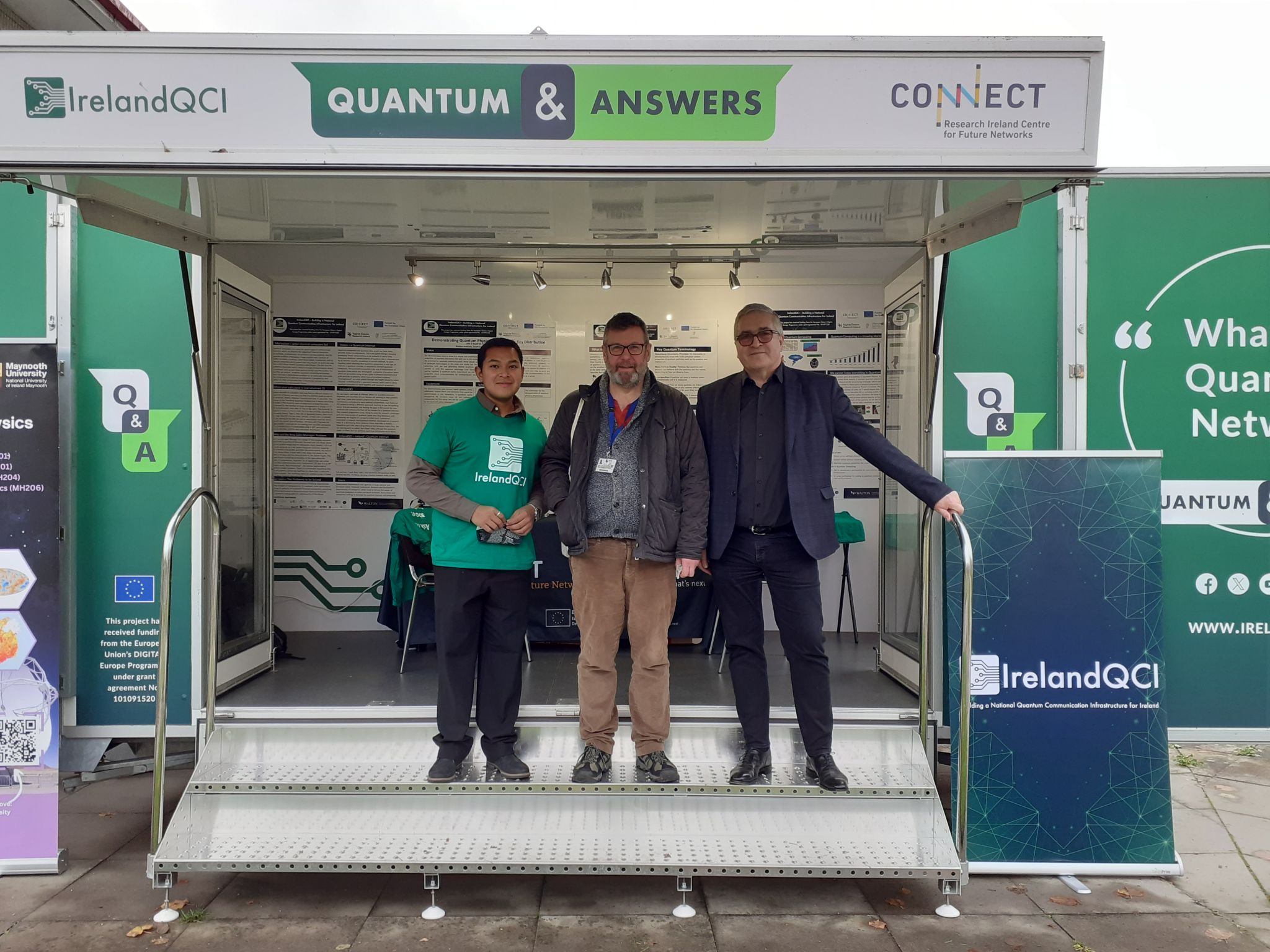
Returning to my office in the Science Building at Maynooth University I saw a new feature, which I initially thought was a mobile coffee shop, but which turned out to be the Quantum & Answers trailer, a mobile engagement unit, developed by IrelandQCI, and designed to bring quantum technologies to life for the general public in Ireland.

In case you weren’t aware, IrelandQCI, the ‘Building a National Quantum Communication Infrastructure for Ireland’ project incorporates integrating innovative and secure quantum devices and systems into conventional communication infrastructures. This will be done by enhancing the ESB Telecoms’ optical fibre network with an additional layer of security, all based on quantum physics, in particular quantum key distribution (QKD).

You can read more about this initiative here.

It’s on Maynooth University campus for the rest of the day so if you’re around please feel free to visit and talk about quantum encryption and the like.

Update: I popped in to get out of the rain…

Caveman Physics

Posted in The Universe and Stuff with tags , , on October 9, 2025 by telescoper

A colleague sent me this, so I thought I’d share it:

Of course we can’t be sure whether there’s a singularity or not because of the presence of a horizon…

The Week Ahead

Posted in Education, Maynooth with tags , , , , , on August 17, 2025 by telescoper

Another weekend is almost over so, after spending most of this afternoon in the garden, I’ve retreated indoors to look at my calendar for the forthcoming week. I find a plethora of Examination Board meetings, one (tomorrow) for our Masters students who did their presentations on Friday and two for undergraduates who took repeat examinations in August (one for Mathematical Physics and one for Engineering, as I happen to have been teaching Engineering Mathematics this year). The two undergraduate boards are both on Thursday. All three of these should be relatively brief, but you never know…

There is another meeting tomorrow, Monday, about organizing our computational physics teaching for the new academic year. The merger of theoretical and experimental physics has given us the chance to coordinate the different computational modules offered by the two previous departments, but we need to make sure the teaching rooms are big enough and the computers have the correct software, etc. Fortunately I’m not actually teaching Computational Physics again until Semester 2 but we have to get it sorted in time for other modules happening in Semester 1.

In between Monday and Thursday I have two whole days with no meetings and no grading to do. I might be able to get on with some research, or at least with writing up some research I’ve already done.

Friday is a big day for the Irish higher education system, in that it’s the day students get their Leaving Certificate results. This year the grade inflation introduced during the pandemic is supposed to begin to unwind, but none of us outside the examination system knows how this will be achieved or what the results will be. If I had to bet I’d say that the CAO points needed for most courses at Maynooth will go down substantially, partly because of the deflation mentioned previously but also because The Management has decided that the University has to recruit more and more students and will drop entry standards as low as it needs to in order to meet its targets.

I don’t know how many students we will end up with for Academic Year 2025/6 but I do know that I will have retired before most of them complete their course. I used to find it a bit scary thinking about retirement, but not any more.

Generative AI in Physics?

Posted in Artificial Intelligence, Education, mathematics, Maynooth with tags , , , , , , , , , on August 11, 2025 by telescoper

As a new academic year approaches we are thinking about updating our rules for the use of Generative AI by physics students. The use of GenAI for writing essays, etc, has been a preoccupation for many academic teachers. Of course in Physics we ask our students to write reports and dissertations, but my interest in what we should do about the more mathematical and/or computational types of work. A few years ago I looked at how well ChatGPT could do our coursework assignments, especially Computational Physics, and it was hopeless. Now it’s much better, though still by no means flawless, and now there are also many other variants on the table.

The basic issue here relates to something that I have mentioned many times on this blog, which is the fact that modern universities place too much emphasis on assessment and not enough on genuine learning. Students may use GenAI to pass assessments, but if they do so they don’t learn as much as they would had they done the working out for themselves. In the jargon, the assessments are meant to be formative rather than purely summative.

There is a school of thought that has the opinion that formative assessments should not gain credit at all in the era of GenAI since “cheating” is likely to be widespread. The only secure method of assessment is through invigilated written examinations. Students will be up in arms if we cancel all the continuous assessment (CA), but a system based on 100% written examinations is one with which those of us of a certain age are very familiar.

Currently, most of our modules in theoretical physics in Maynooth involve 20% coursework and 80% unseen written examination. That is enough credit to ensure most students actually do the assignments, but the real purpose is that the students learn how to solve the sort of problems that might come up in the examination. A student who gets ChatGPT to do their coursework for them might get 20%, but they won’t know enough to pass the examination. More importantly they won’t have learnt anything. The learning is in the doing. It is the same for mathematical work as it is in a writing task; the student is supposed to think about the subject not just produce an essay.

Another set of issues arises with computational and numerical work. I’m currently teaching Computational Physics, so am particularly interested in what rules we might adopt for that subject. A default position favoured by some is that students should not use GenAI at all. I think that would be silly. Graduates will definitely be using CoPilot or equivalent if they write code in the world outside university so we should teach them how to use it properly and effectively.

In particular, such methods usually produce a plausible answer, but how can a student be sure it is correct? It seems to me that we should place an emphasis on what steps a student has taken to check an answer, which of course they should do whether they used GenAI or did it themselves. If it’s a piece of code to do a numerical integration of a differential equation, for example, the student should test it using known analytic solutions to check it gets them right. If it’s the answer to a mathematical problem, one can check whether it does indeed solve the original equation (with the appropriate boundary conditions).

Anyway, my reason for writing this piece is to see if anyone out there reading this blog has any advice to share, or even a link to their own Department’s policy on the use of GenAI in physics for me to copy adapt for use in Maynooth! My backup plan is to ask ChatGPT to generate an appropriate policy…

The 2025 Leaving Certificate Physics papers

Posted in Education, Maynooth with tags , , , on June 18, 2025 by telescoper

As I have already mentioned on this blog, examinations for the 2025 school Leaving Certificate are under way. One of the interesting things about the Irish system is that the examination papers are put up online immediately after the examinations so it’s very easy to share the content. I have already posted the two Mathematics papers for 2025. This year’s Physics examinations (at Ordinary and Higher level) took place this morning, so I thought I’d share the papers here. In particular, readers in the UK might be interested to compare the standard of these papers with that of current A-levels in Physics.

One thing I should mention is that Leaving Certificate Physics is not a prerequisite for entry into any of our Physics programmes at Maynooth University. Some do have it, but many don’t. We teach the first-year material from scratch for all students. Anyway, here are this years papers, Ordinary and Higher respectively. As usual comments are welcome, through the box below:

I think the Ordinary level paper could have done with better proof-reading. As well as Jim’s comment below, there is

Explain how your calculations can be used to verify the principle of conversation of
momentum.

The Leaving

Posted in Biographical, Education, mathematics, Maynooth with tags , , , , , on June 4, 2025 by telescoper

Today is not only a significant date for me (in more ways than one), but it’s important for many young people in Ireland because the Junior Certificate and Leaving Certificate examinations both start today, so the first thing I need to do is wish everyone starting their examinations the very best of luck!

Among other things, the results of the leaving certificate examinations are important for September’s university admissions. This year the grade inflation that occurred during the pandemic years will be reduced, though it is not yet clear how. Whatever happens is likely to have a big impact on student recruitment to third-level institutions.

In the system operating in England and Wales the standard qualification for entry is the GCE A-level. Most students take A-levels in three subjects, which gives them a relatively narrow focus although the range of subjects to choose from is rather large. In Ireland the standard qualification is the Leaving Certificate, which comprises a minimum of six subjects, with many students taking more than this. This gives students a broader range of knowledge at the sacrifice (perhaps) of a certain amount of depth; it has been decreed for entry into this system that an Irish Leaving Certificate subject counts as about 2/3 of an A-level subject for admissions purposes, so Irish students do the equivalent of at least four A-levels, and many do more than this. It’s also worth noting that all students have to take Mathematics at Leaving Certificate level.

One can choose to do Leaving Certificate subjects at Ordinary or Higher level and there’s quite a big difference between the two, especially in Mathematics (of which more below).

Overall I prefer the Leaving Certificate over the UK system of A-levels, as the former gives the students a broader range of subjects than the latter (as does the International Baccalaureate). I would have liked to have been allowed to take at least one arts subject past O-level, for example.

For University admissions points are awarded for each paper according to the marks obtained and then aggregated into a total CAO points, CAO being the Central Applications Office, the equivalent of the UK’s UCAS. This means, for example, that our main Science pathway at Maynooth allows students to study Physics without having done it at Leaving Certificate level. This obviously means that the first year has to be taught at a fairly elementary level, but it has the enormous benefit of allowing us to recruit students whose schools do not offer Physics.

There is however a big problem with Mathematics. It was decided some years ago that students would get 25 extra CAO points if they got a mark of at least 40% in Higher Mathematics. This has led to more students taking the subject, which is good, but there are signs that this may have led to a decline in standards. If, for example, the marking is such that a fixed proportion of students get the top grade but more weaker students take the examination, that means that standards fall at the top end. For more discussion, see here.

Anyway, our Theoretical Physics & Mathematics course requires a good result in Higher Mathematics for entry. Will changes to the marking of Higher Mathematics this year make it harder for students to make the grade? We’ll just have to wait and see.

Moreover, since the pandemic struck, students have been able to choose to answer questions from a limited range of sections on the mathematics examination papers. That means that students can get very high grades despite knowing nothing about a big chunk of the syllabus. That matters most for subjects that require students to have certain skills and knowledge for entry into University, such as Physics. I taught part of our first year Mathematical Physics course in Maynooth for about 5 years. It was noticeable how the fraction that were comfortable with basic differentiation and integration was falling. Will this trend accelerate? Again, we’ll just have to wait and see…

Physics & Theoretical Physics Undergraduate Final Examinations from 1985

Posted in Biographical, Education with tags , , on May 22, 2025 by telescoper

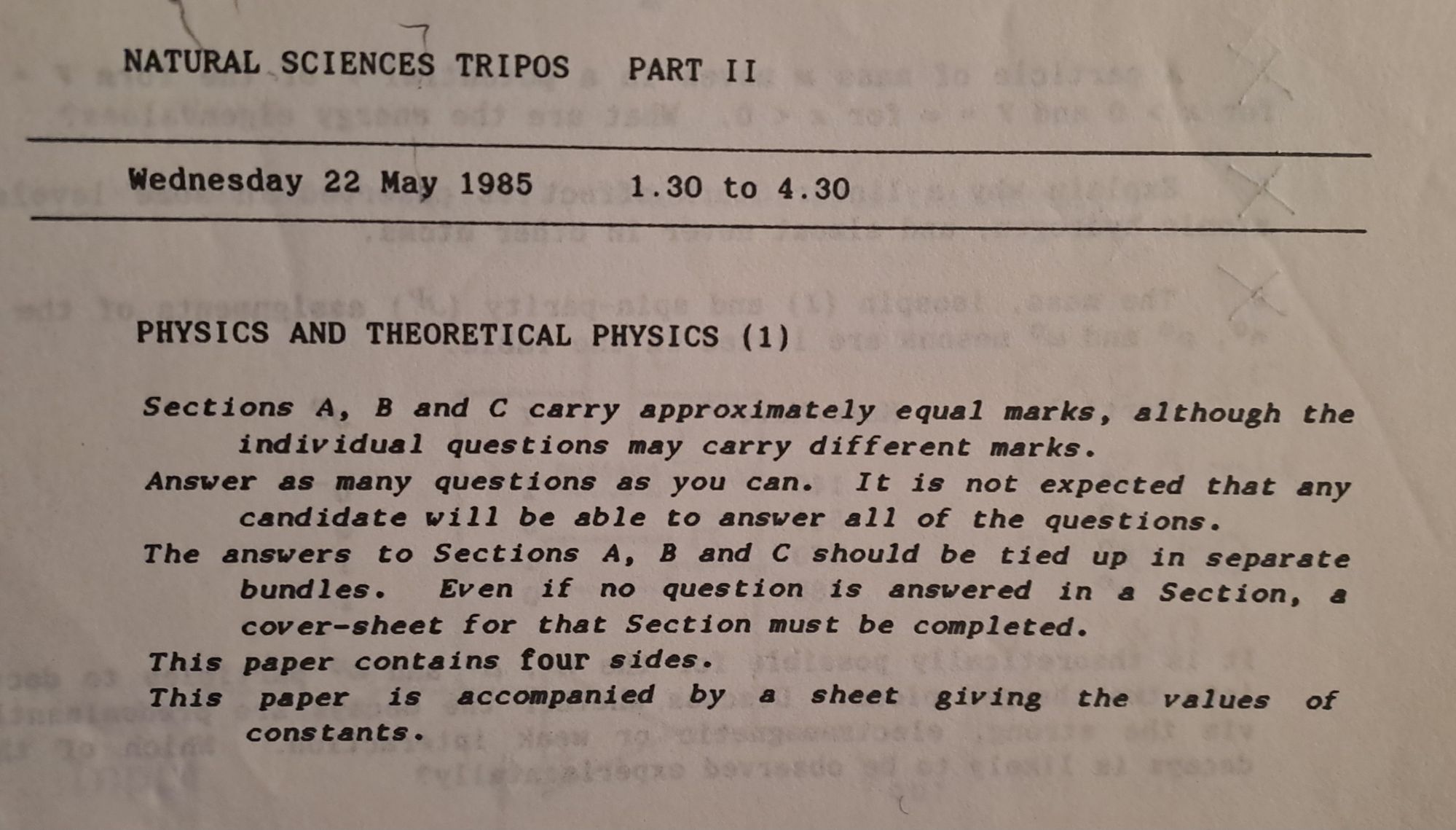
It is May 22nd 2025, so it’s 40 years to the day since started my final examinations in Physics and Theoretical Physics in the Natural Sciences Tripos at Cambridge University. These examinations concluded what was called Part II, the third and last year of a course which started out with four subjects (Part IA), then three (Part IB) I did double-physics and mathematics for IB.

The first paper of Part II was actually Paper Zero, an essay paper which I have already posted here. The five other papers are below; all six (including Paper Zero) were of three hours’ duration. You will see that Paper 4 is a very big one, because it contains questions pertaining to many options but each student did only a few. Unlike most of the theoretical physics students in my year I offered a theoretical project in lieu of part of Paper V, which means I was spared another three-hour paper. My project, incidentally, was on the computer simulation of a laser. My “prepared essay” was also on lasers Kilohertz and picoseconds in laser physics.

Looking at the papers I find a few things are different from what we do nowadays.

One is that Paper I was a general paper, with questions about random bits of physics. Most university physics courses these days do not have such papers (although I know of at least one that does…).

Another is that the course was not really modular. Each paper covered several different topics: Paper 2 for example covers Solid State Physics, Statistical and Thermal Physics and Electromagnetism; Paper 3 is Quantum Physics, Nuclear Physics and Particle Physics. In most modern university courses each of these would have a separate examination.

Other than that, some of the content (e.g. electromagnetism) is close to what you would find nowadays but in some areas (particle physics, for example) the 1985 paper is extremely dated.

As for the level difficulty, I can’t really comment. Take a look a the papers and decide for yourself!

(There is supposed to be a PDF preview, but it seems not to work on many web browsers, so You may hev to download the paper to view it.)

Comments are welcome through the box below.

The Universe Keeper

Posted in Maynooth, The Universe and Stuff with tags , , , , , , on February 28, 2025 by telescoper

Interested in learning a little bit about the ideas behind string theory? Here’s a short video that tries to explain the basics in a thought-provoking way. It features three main characters: The Universe Keeper Renata, inspired by Russian-American physicist Renata Kallosh, the quizzical Wolfie, inspired by the Austrian Nobel laureate Wolfgang Pauli, and the inquisitive Albie, inspired by Albert Einstein.

See what you make of it…

(One of the creators of this video is my PhD student Kay Lehnert, who has just given a departmental seminar in which he mentioned the video.)

The Dangers of AI in Science Education

Posted in Education with tags , , , , on January 17, 2025 by telescoper

I’m taking the liberty of reblogging this post from an experienced university teacher of chemistry and physics outlining some of the dangers posed by the encroachment of Artificial Intelligence into science education. It’s quite a long piece, but well worth reading in its entirety

Cosmology Talks: Recent DESI Power Spectrum Results

Posted in The Universe and Stuff with tags , , , , , on December 12, 2024 by telescoper

Some weeks ago I posted an item about recent results that have emerged from the DESI (Dark Energy Spectroscopic Instrument) Collaboration. I have been a bit busy since then but I just saw that there is one of those Cosmology Talks about these results which I thought I would pass on. The contributors are Arnaud de Mattia, Hector Gil-Marín and Pauline Zarrouk and they are talking about the analsysis they have done using the “full shape” of the galaxy power spectrum. It’s quite a long video, but very illuminating.