Here’s another video in the Cosmology Talks series curated by Shaun Hotchkiss. This one very timely after yesterday’s announcement. Here is the description on the YouTube page:
The Dark Energy Spectroscopic Instrument (DESI) has produced cosmological constraints! And it is living up to its name. Two researchers from DESI, Seshadri Nadathur and Andreu Font-Ribera, tell us about DESI’s measurements of the Baryon Acoustic Oscillations (BAO) released today. These results use one full year of DESI data and are the first cosmological constraints from the telescope that have been released. Mostly, it is what you might expect: tighter constraints. However, in the realm of the equation of state of dark energy, they find, even with BAO alone, that there is a hint of evidence for evolving dark energy. When they combine their data with CMB and Supernovae, who both also find small hints of evolving dark energy on their own, the evidence for dark energy not being a cosmological constant jumps as high as 3.9σ with one combination of the datasets. It seems there still is “concordance cosmology”, it’s just not ΛCDM for these datasets. The fact that all three probes are tentatively favouring this is intriguing, as it makes it unlikely to be due to systematic errors in one measurement pipeline.
My own take is that the results are very interesting but I think we need to know a lot more about possible systematics before jumping to conclusions about time-varying dark energy. Am I getting conservative in my old age? These results from DESI do of course further underline the motivation for Euclid (another Stage IV survey), which may have an even better capability to identify departures from the standard model.
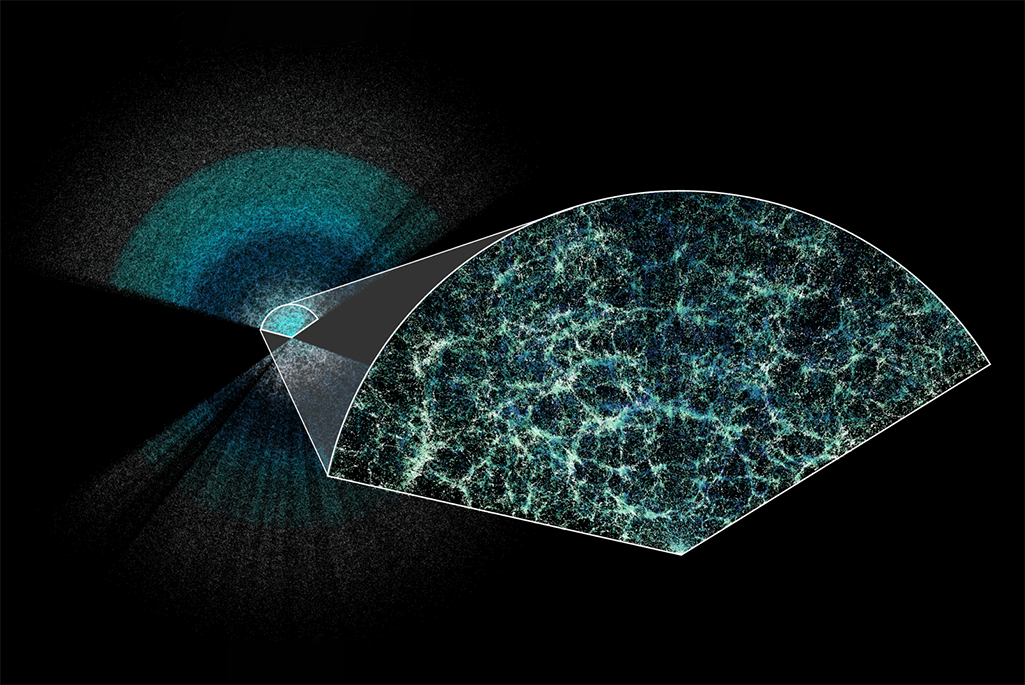
P.S. Here’s a nice graphic showing the cosmic web showing revealed by the DESI survey:
Here’s an interestingly different talk in the series of Cosmology Talks curated by Shaun Hotchkiss. The speaker, Sylvia Wenmackers, is a philosopher of science. According to the blurb on Youtube:
Her focus is probability and she has worked on a few theories that aim to extend and modify the standard axioms of probability in order to tackle paradoxes related to infinite spaces. In particular there is a paradox of the “infinite fair lottery” where within standard probability it seems impossible to write down a “fair” probability function on the integers. If you give the integers any non-zero probability, the total probability of all integers is unbounded, so the function is not normalisable. If you give the integers zero probability, the total probability of all integers is also zero. No other option seems viable for a fair distribution. This paradox arises in a number of places within cosmology, especially in the context of eternal inflation and a possible multiverse of big bangs bubbling off. If every bubble is to be treated fairly, and there will ultimately be an unbounded number of them, how do we assign probability? The proposed solutions involve hyper-real numbers, such as infinitesimals and infinities with different relative sizes, (reflecting how quickly things converge or diverge respectively). The multiverse has other problems, and other areas of cosmology where this issue arises also have their own problems (e.g. the initial conditions of inflation); however this could very well be part of the way towards fixing the cosmological multiverse.
The paper referred to in the presentation can be found here. There is a lot to digest in this thought-provoking talk, from the starting point on Kolmogorov’s axioms to the application to the multiverse, but this video gives me an excuse to repeat my thoughts on infinities in cosmology.
Most of us – whether scientists or not – have an uncomfortable time coping with the concept of infinity. Physicists have had a particularly difficult relationship with the notion of boundlessness, as various kinds of pesky infinities keep cropping up in calculations. In most cases this this symptomatic of deficiencies in the theoretical foundations of the subject. Think of the ‘ultraviolet catastrophe‘ of classical statistical mechanics, in which the electromagnetic radiation produced by a black body at a finite temperature is calculated to be infinitely intense at infinitely short wavelengths; this signalled the failure of classical statistical mechanics and ushered in the era of quantum mechanics about a hundred years ago. Quantum field theories have other forms of pathological behaviour, with mathematical components of the theory tending to run out of control to infinity unless they are healed using the technique of renormalization. The general theory of relativity predicts that singularities in which physical properties become infinite occur in the centre of black holes and in the Big Bang that kicked our Universe into existence. But even these are regarded as indications that we are missing a piece of the puzzle, rather than implying that somehow infinity is a part of nature itself.
The exception to this rule is the field of cosmology. Somehow it seems natural at least to consider the possibility that our cosmos might be infinite, either in extent or duration, or both, or perhaps even be a multiverse comprising an infinite collection of sub-universes. If the Universe is defined as everything that exists, why should it necessarily be finite? Why should there be some underlying principle that restricts it to a size our human brains can cope with?
On the other hand, there are cosmologists who won’t allow infinity into their view of the Universe. A prominent example is George Ellis, a strong critic of the multiverse idea in particular, who frequently quotes David Hilbert
The final result then is: nowhere is the infinite realized; it is neither present in nature nor admissible as a foundation in our rational thinking—a remarkable harmony between being and thought
But to every Hilbert there’s an equal and opposite Leibniz
I am so in favor of the actual infinite that instead of admitting that Nature abhors it, as is commonly said, I hold that Nature makes frequent use of it everywhere, in order to show more effectively the perfections of its Author.
You see that it’s an argument with quite a long pedigree!
Many years ago I attended a lecture by Alex Vilenkin, entitled The Principle of Mediocrity. This was a talk based on some ideas from his book Many Worlds in One: The Search for Other Universes, in which he discusses some of the consequences of the so-called eternal inflation scenario, which leads to a variation of the multiverse idea in which the universe comprises an infinite collection of causally-disconnected “bubbles” with different laws of low-energy physics applying in each. Indeed, in Vilenkin’s vision, all possible configurations of all possible things are realised somewhere in this ensemble of mini-universes.
One of the features of this scenario is that it brings the anthropic principle into play as a potential “explanation” for the apparent fine-tuning of our Universe that enables life to be sustained within it. We can only live in a domain wherein the laws of physics are compatible with life so it should be no surprise that’s what we find. There is an infinity of dead universes, but we don’t live there.
I’m not going to go on about the anthropic principle here, although it’s a subject that’s quite fun to write or, better still, give a talk about, especially if you enjoy winding people up! What I did want to say mention, though, is that Vilenkin correctly pointed out that three ingredients are needed to make this work:
An infinite ensemble of realizations
A discretizer
A randomizer
Item 2 involves some sort of principle that ensures that the number of possible states of the system we’re talking about is not infinite. A very simple example from quantum physics might be the two spin states of an electron, up (↑) or down(↓). No “in-between” states are allowed, according to our tried-and-tested theories of quantum physics, so the state space is discrete. In the more general context required for cosmology, the states are the allowed “laws of physics” ( i.e. possible false vacuum configurations). The space of possible states is very much larger here, of course, and the theory that makes it discrete much less secure. In string theory, the number of false vacua is estimated at 10500. That’s certainly a very big number, but it’s not infinite so will do the job needed.
Item 3 requires a process that realizes every possible configuration across the ensemble in a “random” fashion. The word “random” is a bit problematic for me because I don’t really know what it’s supposed to mean. It’s a word that far too many scientists are content to hide behind, in my opinion. In this context, however, “random” really means that the assigning of states to elements in the ensemble must be ergodic, meaning that it must visit the entire state space with some probability. This is the kind of process that’s needed if an infinite collection of monkeys is indeed to type the (large but finite) complete works of shakespeare. It’s not enough that there be an infinite number and that the works of shakespeare be finite. The process of typing must also be ergodic.
Now it’s by no means obvious that monkeys would type ergodically. If, for example, they always hit two adjoining keys at the same time then the process would not be ergodic. Likewise it is by no means clear to me that the process of realizing the ensemble is ergodic. In fact I’m not even sure that there’s any process at all that “realizes” the string landscape. There’s a long and dangerous road from the (hypothetical) ensembles that exist even in standard quantum field theory to an actually existing “random” collection of observed things…
More generally, the mere fact that a mathematical solution of an equation can be derived does not mean that that equation describes anything that actually exists in nature. In this respect I agree with Alfred North Whitehead:
There is no more common error than to assume that, because prolonged and accurate mathematical calculations have been made, the application of the result to some fact of nature is absolutely certain.
It’s a quote I think some string theorists might benefit from reading!
Items 1, 2 and 3 are all needed to ensure that each particular configuration of the system is actually realized in nature. If we had an infinite number of realizations but with either infinite number of possible configurations or a non-ergodic selection mechanism then there’s no guarantee each possibility would actually happen. The success of this explanation consequently rests on quite stringent assumptions.
I’m a sceptic about this whole scheme for many reasons. First, I’m uncomfortable with infinity – that’s what you get for working with George Ellis, I guess. Second, and more importantly, I don’t understand string theory and am in any case unsure of the ontological status of the string landscape. Finally, although a large number of prominent cosmologists have waved their hands with commendable vigour, I have never seen anything even approaching a rigorous proof that eternal inflation does lead to realized infinity of false vacua. If such a thing exists, I’d really like to hear about it!
I can’t speak about the American Institute of Physics or the American Physical Society but in the context of the Institute of Physics – of which I am a Fellow and in whose house magazine the article appears – I draw your attention to the last sentence of the above excerpt which contains a commitment to “invest funds generated from publishing back into research” (my emphasis).
Really? The IOP invests in research? That’s news to me. How do I apply for a grant? Will they fund my next PhD student?
The IOP invests its funds in many things – many of them worthy – but it does not spend a significant part of the vast income it generates from its publishing house on research. The claim that it does is just dishonest. There’s point in mincing words.
This is an important distinction, particularly so that publishing in most IOP journals now requires the payment of a hefty Article Processing Charge (APC; Artificial Profit Charge would be more apt) which often has to be paid for out of research grants. Previously the revenue of IOP Publishing was appropriated from library budgets through subscriptions, so physicists were less aware of just how much the IOP was raking in. Now that researchers are having to find the funds themselves from research grants it has become more obvious that the IOP is actually a drain on research funds, not a source of them. The APC is a levy on research, designed to generate funds for other things. I think this model is indefensible. What gives the IOP the right to impose charges that far exceed the cost of disseminating scientific results in order to appropriate funds for its other activities?
Moreover, even if the IOP did fund research, what benefit would that be to a researcher in Spain, South Korea or Singapore or indeed anywhere outside the UK and Ireland?
The slogan for the initiative described in the article is “Purpose-led Publishing”. That reminds me of an old saying from systems theory: the Purpose Of a System Is What it Does (POSIWID). What the system does in this case is to raise funds for the IOP. That’s its purpose. Everything else is just marketing spiel.
The claim that IOP Publishing does not make a profit is disingenuous too. It does make a substantial profit. The only difference between it and the likes of Elsevier is where the profits go. A true not-for-profit publisher would charge only at the level to cover the costs of publication. The Purpose that should be leading Publishing in physics is the dissemination of scientific results, not the generation of revenue for sundry other things.
I have avoided publishing in IOP journals for many years because I think the approach of IOP Publishing is unethical. Now I have decided that I no longer wish to be associated with the IOP in any way. I have paid the subscription for 2024 but when that lapses I won’t renew it. Enough is enough.
At the annual AAS Meeting in New Orleans last week there was an announcement of a result that made headlines in the media (see, e.g., here and here). There is also a press release from the University of Central Lancashire.
Here is a video of the press conference:
I was busy last week so didn’t have time to read the details so refrained from commenting on this issue at the time of the announcement. Now that I am back in circulation, I have time to read the details, but unfortunately was unable to find even a preprint describing this “discovery”. The press conference doesn’t contain much detail either so it’s impossible to say anything much about the significance of the result, which is claimed (without explanation) to be 5.2σ (after “doing some statistics”). I see the “Big Ring” now has its own wikipedia page, the only references on which are to press reports, not peer-reviewed scientific papers or even preprints.
So is this structure “so big it challenges our understanding of the universe”?
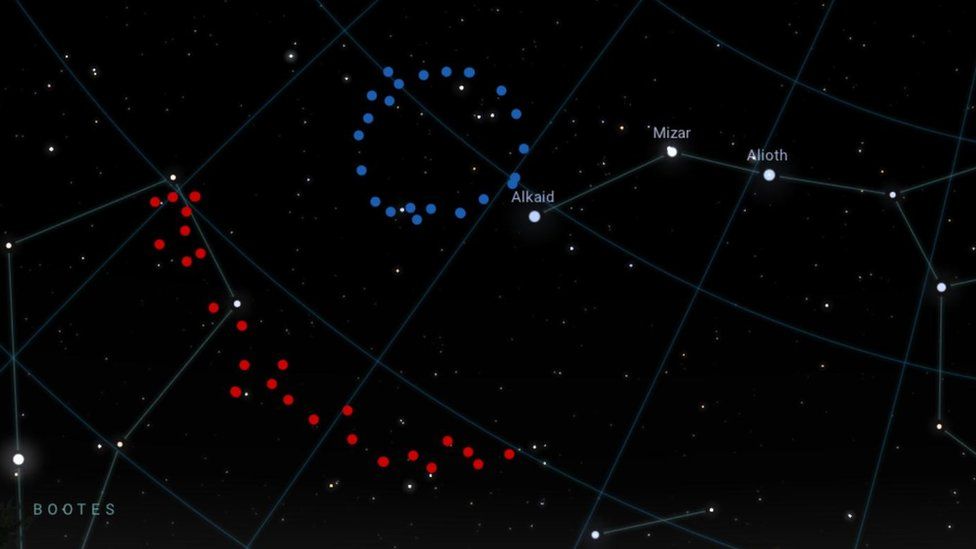
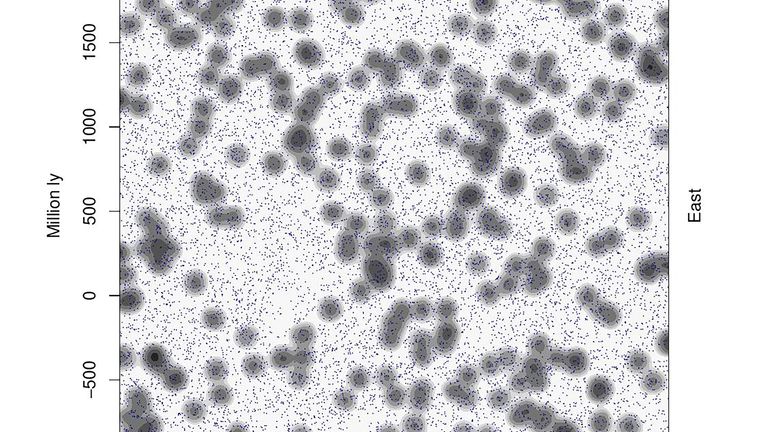
The Big Ring (blue) and another large structure (red)Spot the Ring in the actual data
Based on the available information it is impossible to say. The large-scale structure of the Universe comprises a complex network of walls and filaments known as the cosmic web which I have written about numerous times on this blog. This structure is so vast and complicated that it is very easy to find strange shapes in it but very hard to determine whether or not they indicate anything other than an over-active imagination.
To assess the significance of the Big Ring or other structures in a proper scientific fashion, one has to calculate how probable that structure is given a model. We have a standard model that can be used for this purpose, but to simulate very structures is not straightforward because it requires a lot of computing power even to simulate just the mass distribution. In this case one also has to understand how to embed Magnesium absorption too, something which may turn out to trace the mass in a very biased way. Moreover, one has to simulate the observational selection process too, so one is doing a fair comparison between observations and predictions.
I have seen no evidence that this has been done in this case. When it is, I’ll comment on the details. I’m not optimistic however, as the description given in the media accounts contains numerous falsehoods. For example, quoting the lead author:
The Cosmological Principle assumes that the part of the universe we can see is viewed as a ‘fair sample’ of what we expect the rest of the universe to be like. We expect matter to be evenly distributed everywhere in space when we view the universe on a large scale, so there should be no noticeable irregularities above a certain size.
This just isn’t correct. The standard cosmology has fluctuations on all scales. Although the fluctuation amplitude decreases with scale, there is no scale at which the Universe is completely smooth. See the discussion, for example, here. We can see correlations on very large angular scales in the cosmic microwave background which would be absent if the Universe were completely smooth on those scales. The observed structure is about 400 Mpc in size, which does not seem to be to be particularly impressive.
I suspect that the 5.2σ figure mentioned above comes from some sort of comparison between the observed structure and a completely uniform background, in which case it is meaningless.
My main comment on this episode is that I think it’s very poor practice to go hunting headlines when there isn’t even a preprint describing the results. That’s not the sort of thing PhD supervisors should be allowing their PhD students to do. As I have mentioned before on this blog, there is an increasing tendency for university press offices to see themselves entirely as marketing agencies instead of informing and/or educating the public. Press releases about scientific research nowadays rarely make any attempt at accuracy – they are just designed to get the institution concerned into the headlines. In other words, research is just a marketing tool.
In the long run, this kind of media circus, driven by hype rather than science, does nobody any good.
P.S. I was going to joke that ring-like structures can be easily explained by circular reasoning, but decided not to.
Some important cosmological results have just been announced by the Dark Energy Survey Collaboration. I haven’t had time to go through them in detail but I thought it was worth doing a quick post here to draw attention to them. The results concern a sample of Type Ia supernovae (SN Ia) discovered during the full five years of the Dark Energy Survey (DES) Supernova Program, which contains about 1500 new Type Ia Supernovae that can be used for cosmological analysis. The paper is available on the arXiv here; the abstract is:
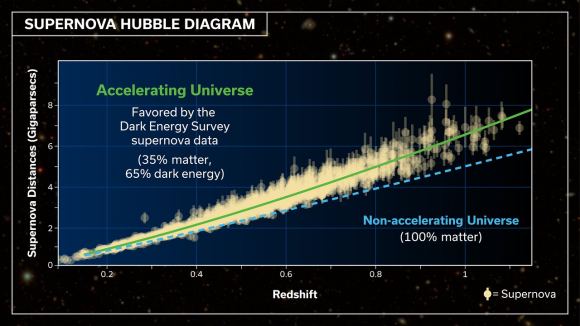
The key numerical result of interest is the equation-of-state parameter for dark energy, designated by w, which occurs in the (assumed) relationship between pressure p and effective mass density ρ of the form p=wρc2. A cosmological constant – which for many cosmologists is the default assumption for the form of dark energy – has w=-1 as I explained here. This parameter is one of the things Euclid is going to try to measure, using different methods. Interestingly, the DES results are offset a bit from the value of -1, but with quite a large uncertainty.
While the results for the equation-of-state parameter are somewhat equivocal, one thing that is clear is that the new SNIa measurements do confirm the existence of dark energy, in that the data can only be described by models with accelerating expansion, as dramatically demonstrated in this Figure:
I think this figure – or versions of it – will very rapidly appear in public talks on cosmology, including my own!
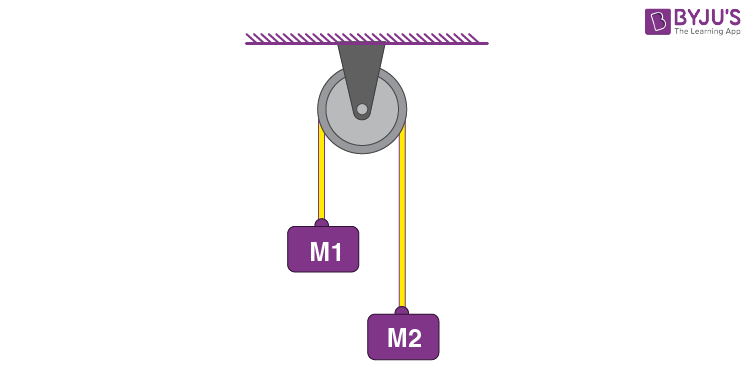
In the foyer of the Physics Department at the University of Barcelona you will find, as well as a fine refracting telescope, an example of the Atwood Machine. For some years before my current sabbatical I have been teaching Newtonian Mechanics to first-year students in Maynooth and used this as a simple worked example. I have to admit I’ve never seen an actual Atwood machine before, and what I’ve done in lectures is the simplified form on the right rather than the actual machine on the left.
Atwood Machine
The illustration on the right depicts the essential elements, but you can can see that the actual machine has a ruler which, together with a timing device, can be used to determine the acceleration of the suspended mass and how that varies with the other mass. You can work this out quite easily in the simplest case of a frictionless pulley by letting the tension in the string (which is light and inextensible) be T (say) and then eliminating it from the equations of motion for the two masses. I leave the rest as an exercise for the reader. A more interesting problem, for the advanced student, is when you have to take into account the rotational motion of the pulley wheel…
When I was a lad, during the 1970s, the term Spanish Practices was used pejoratively in a union-bashing sense to describe restrictive practices in the workplace. Until recently I thought it was a modern invention that relied on a stereotypical view of Spanish people as being lazy. In fact it seems the term dates back to Tudor times and is religious in origin, referring to Roman Catholic rites, in contrast to the simpler Protestant forms of worship. Anyway, none of that is what this post is about. I just used the title as clickbait.
I’ve been here in Barcelona, and working in the University of Barcelona, for four weeks now and I thought I’d share a few observations about differences in practice here and in the Ireland (and the UK).
The other night I went out for dinner with colleagues from the Department. The restaurant was much closer to the University than to my flat so instead of going home first I stayed in my office and walked straight there. My route out of the building takes me past a number of teaching rooms. During this warm weather, most of the rooms have the doors open so it’s easy to have a quick look at what’s going on inside. On my way out at about 7.30pm I was surprised to see a number of classes still going on, and they weren’t sparsely attended either.
In Maynooth the latest regular lectures finish at 6pm. Even during the 5pm to 6pm lectures, many students have to leave before the end to catch the one and only bus back to their place of residence. Here the public transport system is so good that isn’t really an issue even for those who don’t live near the campus. As far as I know lectures start at 9am, so students potentially have a very long day. They work hard.
I have to say that I wouldn’t like to have teach late in the evening. I used to do that on Fridays at Queen Mary for the MSc course and didn’t enjoy it. I don’t mind doing 9am lectures, though, but I don’t think students agree – partly because of the difficulty of getting to campus at that time.
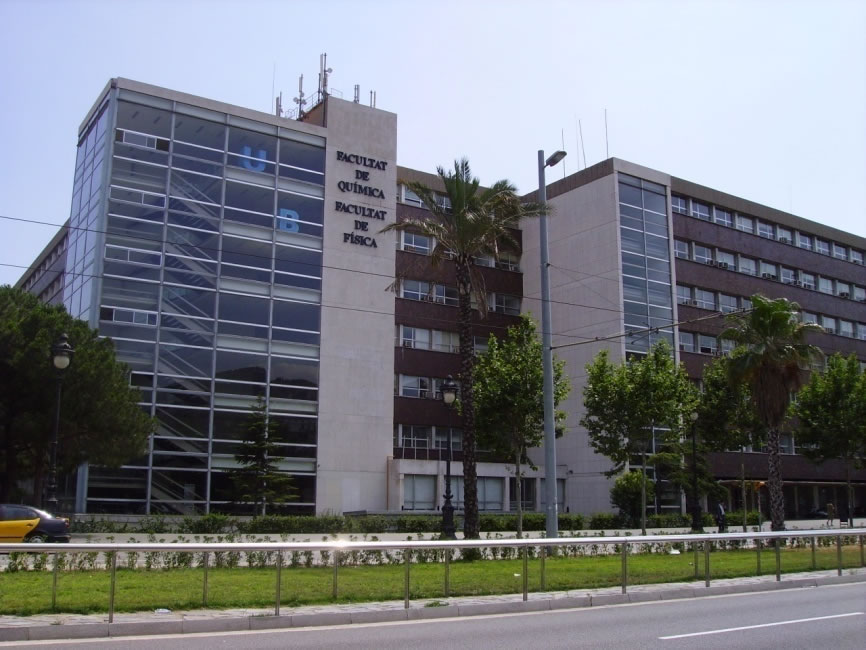
In the Faculty of Physics, all the lecture halls, classrooms and laboratories are in one building rather than spread around the campus like they are in Maynooth (and many places in the UK). Fortunately, the building has been designed with students in mind and there is plenty of space for students to use socially or for private study between teaching sessions.
In this picture you can see the inner courtyard of the building occupied by the Faculties of Chemistry and Physics. It’s a big open space, with teaching rooms, etc, on either side. In the far right-hand corner there is a café/bar where one can buy lunch, a coffee, or even a beer, to be consumed either inside or in the seating area in the courtyard. Many students seem to prefer bring their own lunch and eat it in this space., although the food available is pretty good and cheap compared to back home.
As well as being able to eat and drink here, there is plenty of room for students simply to hang out or to study, either alone or in groups. If they don’t feel like that they can use the tram, bus or Metro to go home, and come back later if they have a long gap between classes. None of this is possible at Maynooth.
This particular kind of open space would not work so well in Ireland or the UK because of the weather, though you can probably see in the picture that there had been a bit of rain before I took the photograph, but I hope I’ve made the point that having social spaces makes a huge amount of difference to the student experience, not least because it feels that the University has thought about them. In the neoliberal system that dominates in the UK and Ireland, students are simply a commodity, a source of revenue, to be crammed into every available space and processed as cheaply as possible. In Maynooth students have been, and are being, forced to pay an extra levy for a notional student centre that will probably never be built.
The contrast is very disheartening.
Getting back to educational matters, another thing I’ve noticed walking past classrooms is that it’s not unusual to see a student standing at the blackboard in front of the class going through a problem. I’ve seen that a number of times with quite large classes. Sometimes we ask students to do that sort of thing in tutorials, but I’ve never done so in a full lecture. I think our students would be shocked if we asked, but it’s clearly not unexpected here. That’s a Spanish Practice I’d be quite happy to try.
I spent quite a lot of this morning trying to get my internet connections to work and trying to sort out an office key, not with 100% success. I am currently in the office of a member of staff who happens to be away today instead of the office I was allocated, and my email address here is not yet activated – probably because I did something wrong in the registration process. I’m hopeful that these minor issues will be resolved tomorrow. Even Eduroam acted up for a while before finally letting me connect. Such is life.
Anyway, my first impression on arriving in the building was of a huge difference in scale in Physics activity here at the University of Barcelona (UB) as compared to Maynooth (and indeed the UK Physics departments I have worked in). That’s not just the size of the building, which the Faculty of Physics shares with the Faculty of Chemistry. Physics and Chemistry also share a building in Maynooth, in fact, so the sharing was not in itself a surprise. The Science Building in Maynooth is very small, however, and it was a bit of a shock seeing how much space there is here compared with Maynooth, and also finding out how easy it is to get lost among the 7 floors. The sense of space is very refreshing, actually, as cramped accommodation is a constant reminder of financial and other constraints.
That’s not the only difference, though. There is enough activity in Physics in the University of Barcelona for it to be an entire Faculty. The UB Faculty of Physics contains Departments, covering the following areas: Electronic & Biomedical Engineering; Quantum Physics & Astrophysics; Condensed Matter Physics, and Applied Physics. It is also home to ICCUB, an interdisciplinary research institute that sits outside the Department structure and some of whose staff are paid from external agencies rather than the University itself.
In Maynooth there is a Faculty of Science and Engineering that covers all disciplines represented in the list above, and more besides. It would amuse my colleagues back in Ireland to see that Electronic Engineering is considered a small subset of Physics in Barcelona, whereas in Maynooth it is a free-standing department which is larger than Physics.
P.S. I just thought I’d mention another difference: that it is very warm here (26° C) so I may need to stop for a beer on the way home…
No sooner is yesterday’s departmental Examination Board done and dusted (after just two and a half hours) when attention switches to school examinations. The Junior Certificate and Leaving Certificate examinations both start today, so the first thing I need to do is wish everyone taking examinations the very best of luck!
Among other things, the results of the leaving certificate examinations are important for next year’s University admissions. As we gradually dispense with the restrictions imposed during the pandemic, it seems this year we just might have the results before the start of teaching at the end of September. That will make a nice change!
In the system operating in England and Wales the standard qualification for entry is the GCE A-level. Most students take A-levels in three subjects, which gives them a relatively narrow focus although the range of subjects to choose from is rather large. In Ireland the standard qualification is the Leaving Certificate, which comprises a minimum of six subjects, giving students a broader range of knowledge at the sacrifice (perhaps) of a certain amount of depth; it has been decreed for entry into this system that an Irish Leaving Certificate subject counts as about 2/3 of an A-level subject for admissions purposes, so Irish students do the equivalent of at least four A-levels, and many do more than this. It’s also worth noting that all students have to take Mathematics at Leaving Certificate level.
Overall I prefer the Leaving Certificate over the UK system of A-levels, as the former gives the students a broader range of subjects than the latter (as does the International Baccalaureate). I would have liked to have been allowed to take at least one arts subject past O-level, for example.
For University admissions points are awarded for each paper according to the marks obtained and then aggregated into a total CAO points, CAO being the Central Applications Office, the equivalent of the UK’s UCAS. This means, for example, that our main Science pathway at Maynooth allows students to study Physics without having done it at Leaving Certificate level. This obviously means that the first year has to be taught at a fairly elementary level, but it has the enormous benefit of allowing us to recruit students whose schools do not offer Physics.
As much as I like the Leaving Certificate, I have concerns about using a simple CAO points count for determining entry into third-level courses. My main concern about is with Mathematics. Since the pandemic struck, students have been able to choose to questions from just six out of ten sections. That means that students can get very high grades despite knowing nothing about 40% of the syllabus. That matters most for subjects that require students to have certain skills and knowledge for entry into University, such as Physics.
I’ve been teaching the first year Mathematical Physics course in Maynooth for about 5 years. At the start of the module I put up a questionnaire asking the students about various mathematical concepts and asking them how comfortable they feel with them. It’s been noticeable how the fraction that are comfortable with basic differentiation and integration has been falling. That’s not a reflection on the ability of the students, just on the way they have been taught. As well as making adjustments during the pandemic for online teaching, etc, I have changed various things about the teaching, in particular adjusting the way I have introduced calculus into the module. Another problem is that we have been forced to start teaching first-years a week late because of delays to the CAO process caused by the pandemic.
I’ll be on sabbatical next academic year so I won’t be teaching the first-years (or anyone else) in September. It’s time to hand these challenges on to someone else!
It’s the day before the start of a new Semester in Maynooth. Last week we finished all due processes relating to the First Semester examinations and the provisional results will be uploaded to “The System” next week. They’re provisional at this stage because they’re not set in stone until the final meeting of the Examination Board. Obviously I can’t discuss the results here. I could comment here about how clunky the whole process is, including multiple downloads of spreadsheets and subsequent uploads somewhere else, but I won’t bother. Nobody seems to be interesting in fixing it. Perhaps by the time I retire “The System” will have been replaced by something that doesn’t waste an enormous amount of staff time. But I doubt it.
It’s a curiosity of the teaching allocation in the Department of Theoretical Physics that I do first-year and second-year modules (MP110 Mechanics and Special Relativity and MP201 Vector Calculus & Fourier Series) in Semester 1 while in Semester 2 it’s the third and fourth year students who have to put up with my ramblings.
The menu for this term involves MP354 Computational Physics 1, which entails just one hour of lectures per week but two two-hour lab sessions. Each student attends one of these sessions, so they get 3 contact hours per week but I have to look after both sessions. Our computer lab has a small cluster of Linux machines and, this term, a brand new display screen which I am looking forward to playing with. I’m also looking forward to seeing how the infamous ChatGPT copes with the Python coding exercises I give the students to do in class: I’ve only tried one so far, without much success. This is the first module I taught at Maynooth, back in 2018, so this will be the 6th time I’ve done it.
My other class is MP465 Advanced Electromagnetism, which I’m doing for the 3rd time now. This is a standard chalk-and-talk kind of module covering a well-established syllabus, and involving two lectures per week plus a tutorial. At least I’m teaching in a classroom rather than online like when I first did this module!
In 2020/21 (during the Pandemic restrictions) I did five modules as well as being Head of Department. At this time two academic staff departures left us severely short-staffed and struggling to deliver our programmes. My workload then was unmanageable and I asked to step down. I changed my mind when were eventually allowed to recruit two lecturers and saw out my three-year term to the end. I had better not repeat here what I think of the deliberate management decisions that left us reeling and had such negative effects on staff morale and on the education of students in the Department. I just hope the damage is not irreparable.
Although I am doing the same number of modules as last term, the number of contact hours I have to do is higher (8 versus 5) because of the labs and the fact that we don’t have tutors for 4th-year modules so lecturers have to do the tutorials themselves. Four modules a year is a much heavier teaching load than a Full Professor at a UK university would be expected to carry, but it seems normal in Ireland where the funding for sciences is far less than adequate. The impact on research productivity is obvious and is systemic. There are excellent physicists in Maynooth but they are given little time or other resources. It’s a big waste of potential. That’s another “System” that needs changing, but I see little appetite for change of the required sort at institutional level. It’s all about recruiting more and more students to be taught with fewer and fewer resources.
The impact of this on staff careers is severe: teaching loads are so heavy that it’s very difficult to reach the level of research productivity required for promotion. For myself, though, the next career step will be retirement so I don’t have to worry about promotion. Fortunately too, I enjoy teaching, so I’ll just get on with it. So I’ll stop writing and get on with preparing my first week of lectures and lab sessions!
The views presented here are personal and not necessarily those of my employer (or anyone else for that matter).
Feel free to comment on any of the posts on this blog but comments may be moderated; anonymous comments and any considered by me to be vexatious and/or abusive and/or defamatory will not be accepted. I do not necessarily endorse, support, sanction, encourage, verify or agree with the opinions or statements of any information or other content in the comments on this site and do not in any way guarantee their accuracy or reliability.






 In the Dark