Archive for star formation

Three New Publications at the Open Journal of Astrophysics

Posted in OJAp Papers, The Universe and Stuff with tags , , , , , , , , , , , , , , , , on March 19, 2024 by telescoper

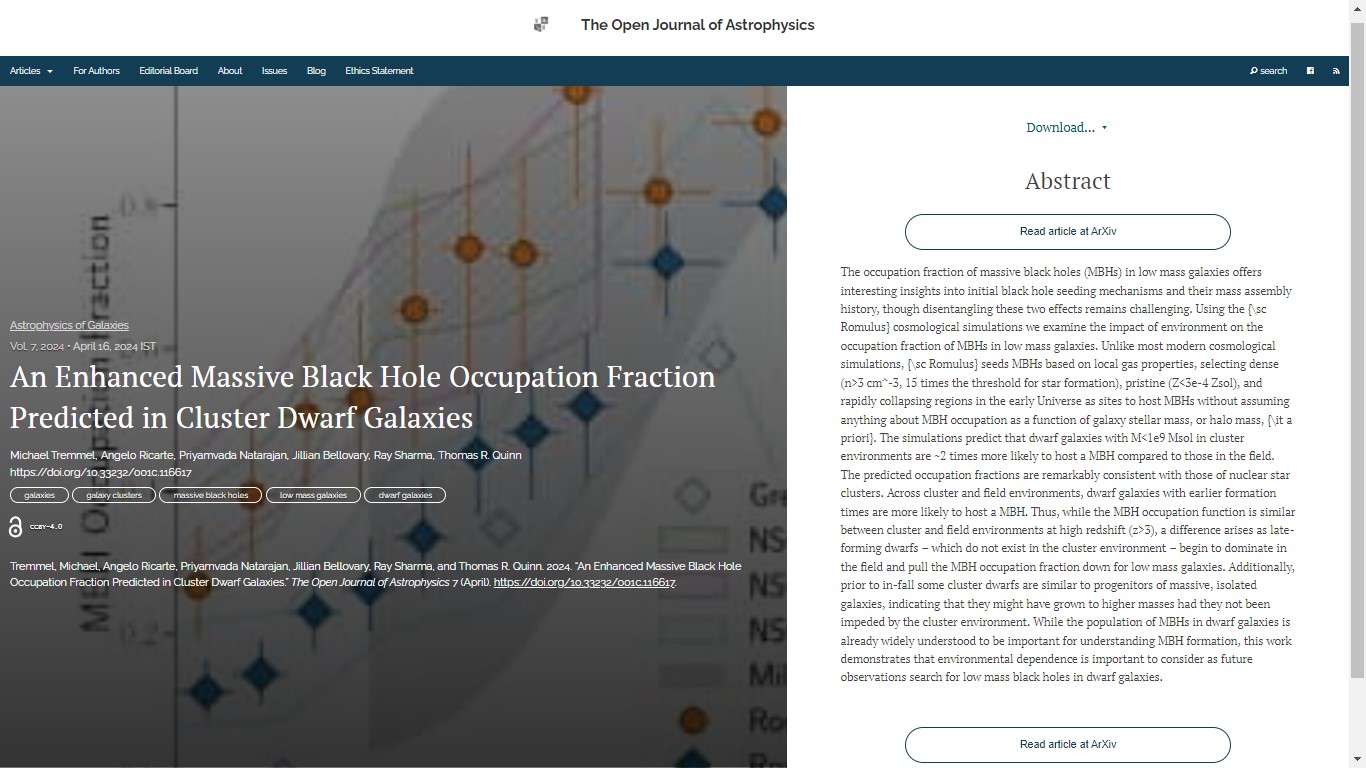
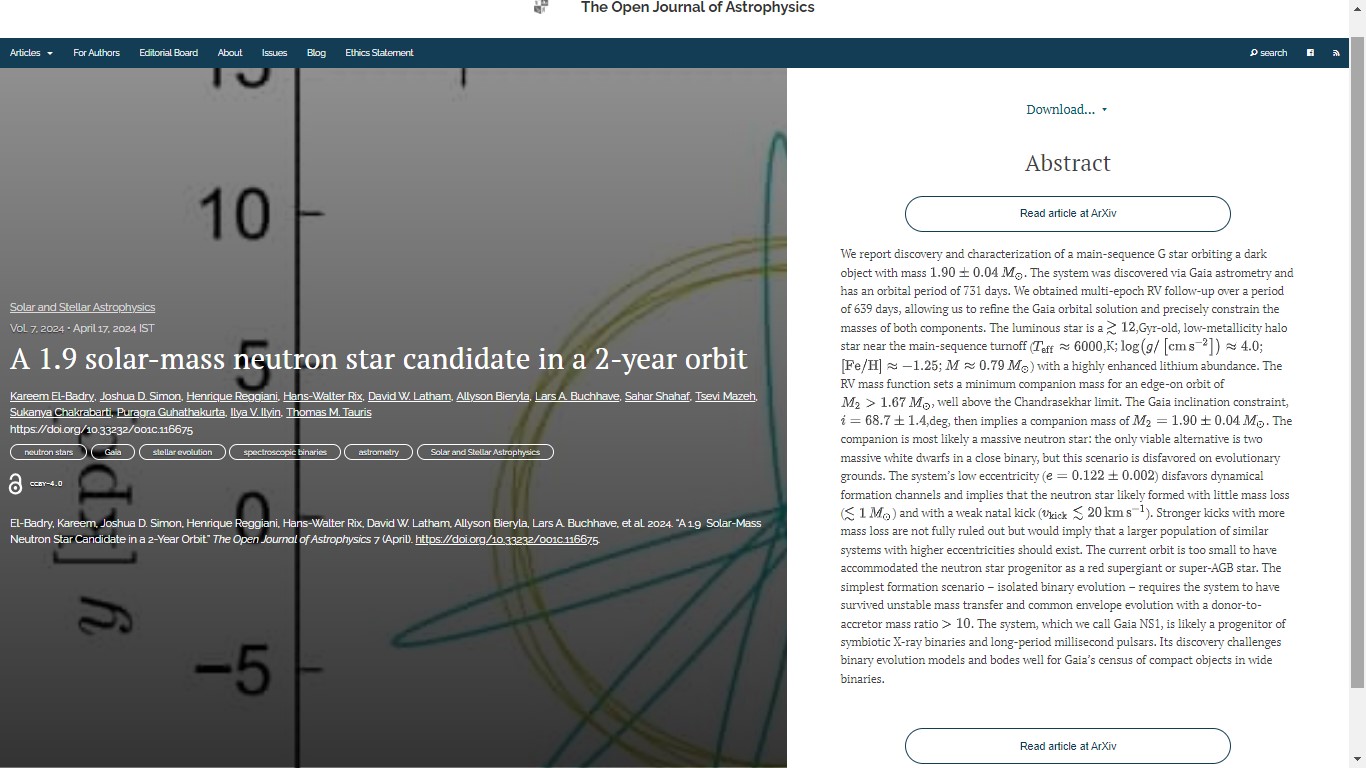
Now that I’m safely back in Barcelona it’s a time for a roundup of the latest business at the  Open Journal of Astrophysics. The latest batch of publications consists of three papers, taking the count in Volume 7 (2024) up to 20 and the total published by OJAp up to 135.

This time the papers are all related, have many authors in common, and have the same first author, Philip F. Hopkins of Caltech. In fact the second and third papers in this batch were accepted well before the first one, but it seemed to make much more sense to publish them together so I held those two back a bit and published all three on 14th March.

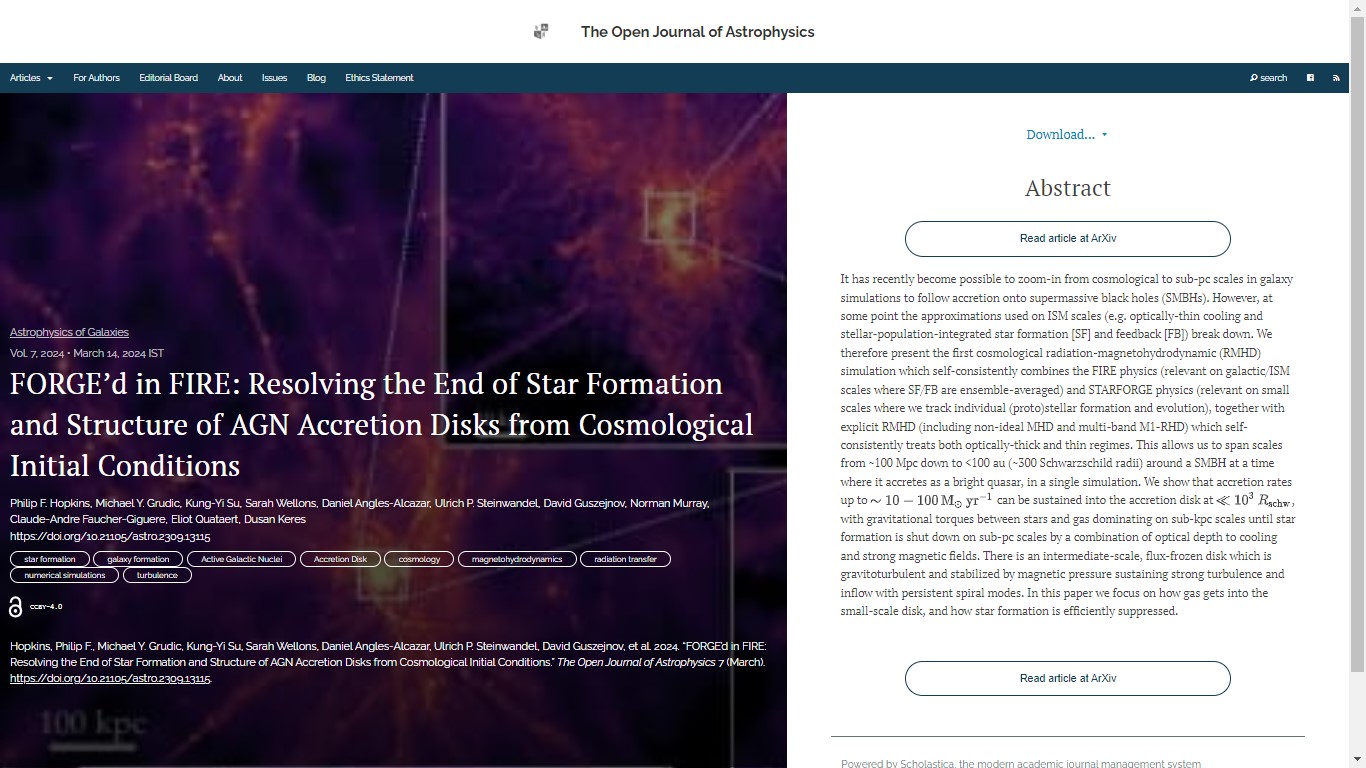
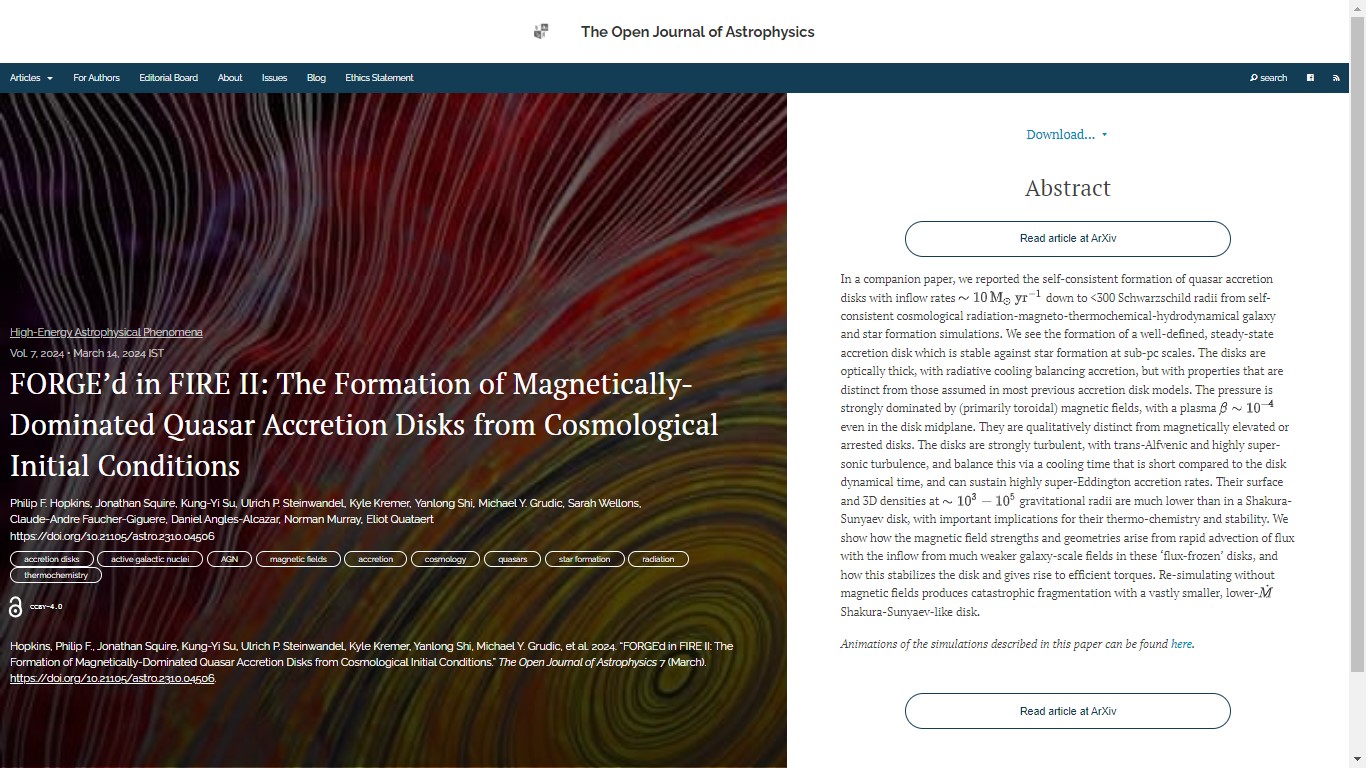
The three papers published, with their overlays, are as follows. You can click on the images of the overlays to make them larger should you wish to do so. You can read these publications directly on arXiv if you wish; you will find them here, here and here.

First one up is “FORGE’d in FIRE: Resolving the End of Star Formation and Structure of AGN Accretion Disks from Cosmological Initial Conditions” in which, using a full cosmological simulation, incorporating radiation and magnetohydrodynamics, the authors study the formation and structure of AGN accretion disks and their impact on star formation. This one is in the folder marked Astrophysics of Galaxies.

The authors (ten from the USA and one from Canada) are Philip F. Hopkins (Caltech), Michael Y. Grudic (Carnegie Observatories), Kung-Yi Su (Harvard), Sarah Wellons (Wesleyan University), Daniel Angles-Alcazar (University of Connecticut & Flatiron Institute), Ulrich P. Steinwandel (Flatiron Institute), David Guszejnov (University of Texas at Austin), Norman Murray (CITA, Toronto, Canada), Claude-Andre Faucher-Giguere (Northwestern University), Eliot Quataert (Princeton), and Dusan Keres (University of California, San Diego or UCSD for short).

Here is a screen grab of the overlay, which includes the abstract:


The second paper to announce is “FORGE’d in FIRE II: The Formation of Magnetically-Dominated Quasar Accretion Disks from Cosmological Initial Conditions” which is a study of the formation and properties of highly magnetized accretion disks using numerical simulations that include the effects of radiation, magnetic fields, thermochemistry, and star formation.

This one is in the folder High-Energy Astrophysical Phenomena. The authors (ten based in the USA, one fin Canada, and one in New Zealand) are Philip F. Hopkins, Jonathan Squire (University of Dunedin, New Zealand), Kung-Yi Su (Harvard), Ulrich P. Steinwandel (Flatiron Institute), Kyle Kremer (Caltech), Yanlong Shi (Caltech), Michael Y. Grudic (Carnegie Observatories), Sarah Wellons (Wesleyan University), Claude-Andre Faucher-Giguere (Northwestern University), Daniel Angles-Alcazar (University of Connecticut & Flatiron Institute), Norman Murray (CITA, Toronto), and Eliot Quataert (Princeton).


The last paper of this batch, also in the folder High-Energy Astrophysical Phenomena, is  entitled “An Analytic Model For Magnetically-Dominated Accretion Disks” and is closely related to the previous one; this particular paper presents an analytic similarity model for accretion disks that agrees remarkably well with the simulations in the previous one. Animations of the simulations referred to in both papers can be found here.

Here is the overlay:

The authors of this one are Philip F. Hopkins, Jonathan Squire, Eliot Quataert, Norman Murray, Kung-Yi Su, Ulrich P. Steinwandel, Kyle Kremer, Claude-Andre Faucher-Giguere, and Sarah Wellons. You can find all their affiliations above.
That’s all for now. More news in a week or so!


Three New Publications at the Open Journal of Astrophysics

Posted in OJAp Papers, Open Access, The Universe and Stuff with tags , , , , , , , , , , , , , , , , , on January 20, 2024 by telescoper

As promised yesterday, it’s time for a roundup of the week’s business at the  Open Journal of Astrophysics. This past week we have published three papers, taking  the count in Volume 7 (2024) up to 4 and the total published by OJAp up to 119. There are quite a few more ready to go as people return from the Christmas break.

In chronological order, the three papers published this week, with their overlays, are as follows. You can click on the images of the overlays to make them larger should you wish to do so.

First one up is “Prospects for studying the mass and gas in protoclusters with future CMB observations” by  Anna Gardner and Eric Baxter (Hawaii, USA), Srinivasan Raghunathan (NCSA, USA), Weiguang Cui (Edinburgh, UK), and Daniel Ceverino (Madrid, Spain). This paper, published on 17th January 2024, uses realistic hydrodynamical simulations to probe the ability of CMB Stage 4-like (CMB-S4) experiments to detect and characterize protoclusters via gravitational lensing and the Sunyaev-Zel’dovich effect. This paper is in the category of Cosmology and Nongalactic Astrophysics.

Here is a screen grab of the overlay, which includes the abstract:


You can find the officially accepted version of the paper on the arXiv here.

The second paper to announce is “SDSS J125417.98+274004.6: An X-ray Detected Minor Merger Dual AGN” and is by Marko Mićić, Brenna Wells, Olivia Holmes, and Jimmy Irwin (all of the University of Alabama, USA).  This presents the discovery of a dual AGN in a merger between the galaxy SDSS J125417.98+274004.6 and dwarf satellite, studied using X-ray observations from the Chandra satellite. The paper was also published on 18th January 2024 in the category Astrophysics of Galaxies . You can see the overlay here:


The accepted version of this paper can be found on the arXiv here.

The last paper of this batch is  entitled “Population III star formation: multiple gas phases prevent the use of an equation of state at high densities” and the authors are:  Lewis Prole (Maynooth, Ireland), Paul Clark (Cardiff, UK), Felix Priestley (Cardiff, UK), Simon Glover (Heidelberg, Germany) and John Regan (Maynooth, Ireland). This paper, which presents a comparison of results obtained using chemical networks and a simpler equation-of-state approach for primordial star formation (showing the limitations of the latter) was published on 19th January 2024 and also in the folder marked Astrophysics of Galaxies.

Here is the overlay:


You can find the full text for this one on the arXiv here.

And that concludes the update. There’ll be more next week!


Catching up on Cosmic Dawn

Posted in The Universe and Stuff with tags , , , , , on June 25, 2021 by telescoper

Trying to catch up on cosmological news after a busy week I came across a number of pieces in the media about “Cosmic Dawn” (e.g. here in The Grauniad). I’ve never actually met Cosmic Dawn but she seems like an interesting lady.

But seriously folks, Cosmic Dawn refers to the epoch during which the first stars formed in the expanding Universe lighting up the Universe after a few hundred million years of post-recombination darkness.

According to the Guardian article mentioned above the new results being discussed are published in Monthly Notices of the Royal Astronomical Society but they’re actually not. Yet. Nevertheless the paper (by Laporte et al.) is available on the arXiv which is where people will actually read it…

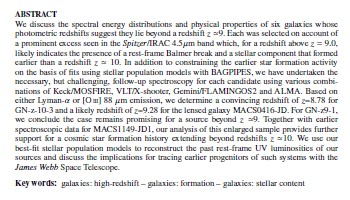
Anyway, here is the abstract:

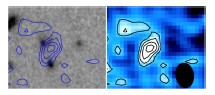
Here is a composite of HST and ALMA images for one of the objects discussed in the paper (MACS0416-JD):

I know it looks a bit blobby but it’s not easy to resolve things at such huge distances! Also, it’s quite small because it’s far away. In any case the spectroscopy is really the important thing, not the images, as that is what determines the redshift. The Universe has expanded by a factor 10 since light set out towards us from an object at redshift 9. I’m old enough to remember when “high redshift” meant z~0.1!

At the end of my talk on Wednesday Floyd Stecker asked me about what the James Webb Space Telescope (due for launch later this year) would do for cosmology and I replied that it would probably do a lot more for galaxy formation and evolution than cosmology per se. I think this is a good illustration of what I meant. Because of its infrared capability JWST will allow astronomers to push back even further and learn even more about how the first stars formed, but it won’t tell us much directly about dark matter and dark energy.

New Publication at the Open Journal of Astrophysics!

Posted in Maynooth, OJAp Papers, Open Access, The Universe and Stuff with tags , , , , , , on August 24, 2020 by telescoper

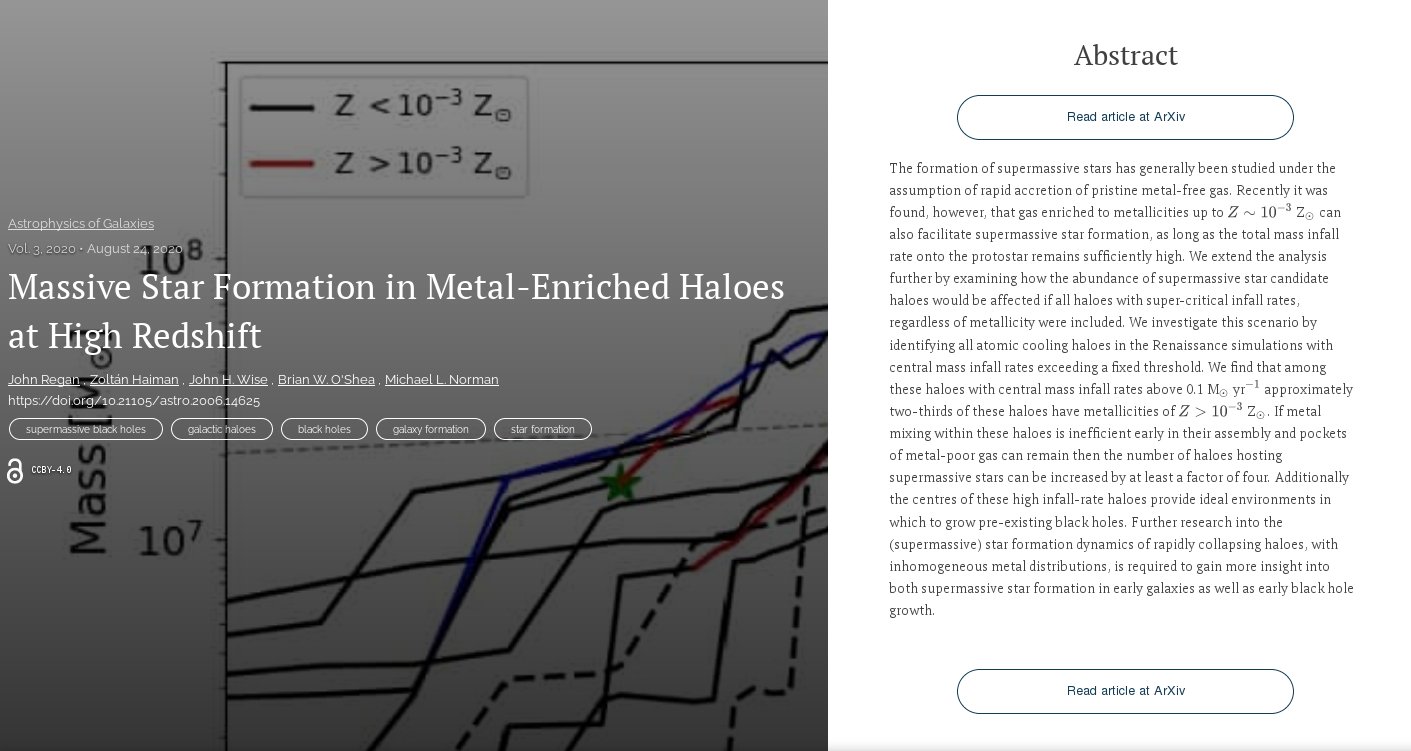
So another new paper has been published in the Open Journal of Astrophysics! This one is in the folder marked Astrophysics of Galaxies and is entitled Massive Star Formation in Metal-Enriched Haloes at High Redshift. I should explain that “Metal” here is the astrophysicist’s definition which basically means anything heavier than hydrogen or helium: chemists may look away now.

The authors of this paper are John Regan (of the Department of Theoretical Physics at Maynooth University), Zoltán Haiman (Columbia), John Wise (Georgia Tech), Brian O’Shea (Michigan State) and Michael Norman (UCSD). And before anyone asks, no I don’t force members of staff in my Department to submit papers to the Open Journal of Astrophysics and yes I did stand aside from the Editorial process because of the institutional conflict.

Here is a screen grab of the overlay:

You can click on the image to make it larger should you wish to do so.

You can find the arXiv version of the paper here.

Orion Nebula (Herschel, after Turner)

Posted in Art, The Universe and Stuff with tags , , , on September 6, 2013 by telescoper

I stumbled across this wonderful image (and associated description) yesterday and thought I’d share it. It’s a region of the Orion Nebula (which is located in the  Midlands region of Orion’s “sword”, i.e. the long thing hanging down below his belt).  It’s a turbulent region of dust and gas in which stars are forming. This image was taken in the far-infrared part of the spectrum by the Herschel Space Observatory, which is now defunct but much data remains to be analysed. Because the image was taken at wavelengths much longer than optical light, the colours are obviously “false”. I don’t work on star formation so I tend to see images like this just as beautiful things to be enjoyed for themselves rather than as a subject for scientific research. In fact, I have no difficulty at all in describing this picture as a work of art, slightly reminiscent of the cloudscapes and seascapes of  J.M.W Turner in that it is, at the same time, both a representation of a natural phenomenon and  an abstract creation that transcends it. You can click on the image to make it larger…

Orion_A

UPDATE: I see that someone else has thought of the parallel with Turner!

The Ant Whitworth Caption Competition

Posted in Uncategorized with tags , , , on June 26, 2012 by telescoper

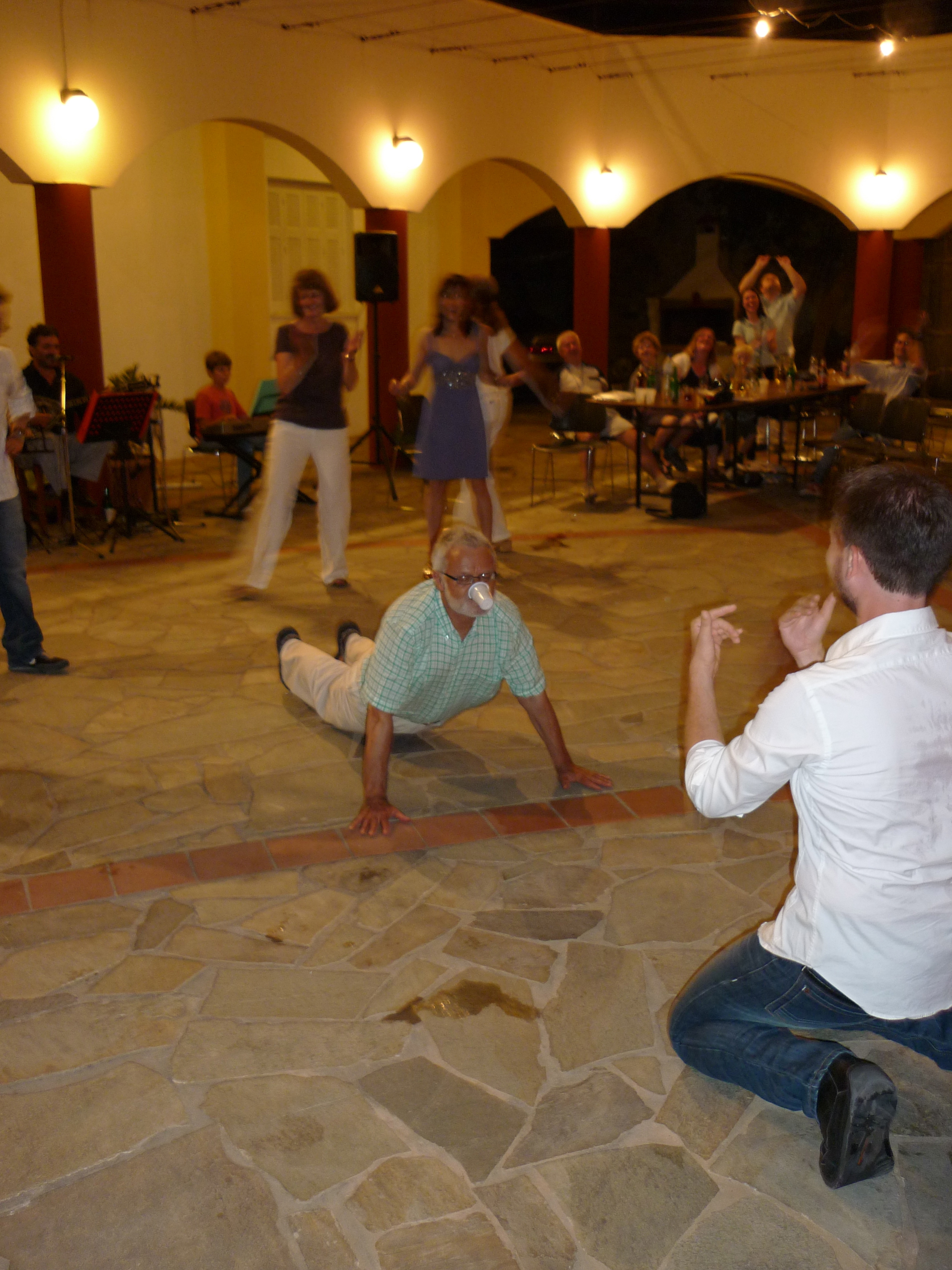
Last week a number of colleagues joined friends from around the world at a star formation conference in Crete to celebrate the scientific career of our esteemed Professor Anthony Whitworth who recently celebrated his nth birthday (n→∞). I wasn’t there myself, but an anonymous informant (Derek Ward-Thompson) gave me this photograph of said Professor, apparently taken at the conference dinner:

Don’t ask me what’s going on, but I think this picture is ripe fodder for a caption competition!

Please let me have your suggestions through the comments box…

Astronomy Jobs at Cardiff!

Posted in The Universe and Stuff with tags , , , , , on June 1, 2012 by telescoper

Just a quick post to advertise a couple of job opportunities in the School of Physics & Astronomy at Cardiff University. For further details you can look at the official website, but here is an outline:

Two Faculty Positions in Astrophysics

Observational and theoretical studies of star-formation and/or extrasolar planetary systems.

The School of Physics and Astronomy at Cardiff University has immediate vacancies for two permanent faculty appointments in Astrophysics.  We are seeking experts in observational and theoretical studies of star-formation and/or extra-solar planetary systems to conduct world-class research and research-led teaching at undergraduate and postgraduate level.  The appointments will be at any level from Lecturer to Professor depending on the experience of the candidate; we expect at least one of the appointments to be at a junior level.

Physics and Astronomy at Cardiff University has undergone substantial expansion in the past few years and has very strong research groups in gravitational-wave physics, astronomical instrumentation, extragalactic astronomy and cosmology, star-formation and condensed matter physics.  There are presently 18 academic staff involved in astrophysics and relativity, with 15 post-doctoral researchers and 22 PhD students.

The appointment will be made at a level commensurate with experience.

The advertisement is also available on the AAS Jobs Register, or will be when they get their act together and put it online. The AAS website is just one of a number that have been recently improved, with the result that they’re much less efficient than they were before.

Anyway, I’m just passing on the advertisement so please don’t send me your CVs! If you’d like to apply please do so using the official Cardiff University jobs page, which also has a lot of general information about the City and the University.

P.S. There have been quite a few job vacancies in astronomy around the UK recently – Edinburgh, Surrey, Liverpool, Exeter etc. I wonder why that is, and where the money is coming from?

Starchild

Posted in The Universe and Stuff with tags , , , on May 10, 2010 by telescoper

It’s been a busy day today,  so I’ve decided to be lazy and plunder the online stack of juicy Herschel images for a pretty picture to show. This one has done the rounds in the popular media recently, which is not surprising given how strange it looks.

Image Credits: ESA / PACS & SPIRE Consortium, Dr. Annie Zavagno, LAM, HOBYS Key Programme Consortia

This image shows a Galactic bubble (technically an HII emission region) called RCW 120 that contains an embryonic star that looks set to turn into one of the brightest stars in the Galaxy. It lies about 4300 light-years away. The star is not visible at these infrared avelengths but its radiation pressure pushes on the surrounding dust and gas. In the approximately 2.5 million years the star has existed, it has raised the density of matter in the bubble wall by so much that the material trapped there can now collapse to form new stars.

The bright knot to the right of the base of the bubble is an unexpectedly large, embryonic star, triggered into formation by the power of the central star. Herschel’s observations have shown that it already contains between 8-10 times the mass of our Sun. The star can only get bigger because it is surrounded by a cloud containing an additional 2000 solar masses.

Not all of that will fall onto the star, because even the largest stars in the Galaxy do not exceed 150 solar masses. But the question of what stops the matter falling onto the star is an astrophysical puzzle. According to theory, stars should stop forming at about 8 solar masses. At that mass they should become so hot that they shine powerfully at ultraviolet wavelengths exerting so much radiation pressure that it should push the surrounding matter away, much as the central star did to form this bubble in the first place. But this mass limit is must be exceeded sometimes, otherwise there would be no giant stars in the Galaxy. So astronomers would like to know how some stars can seem to defy physics and grow so large. Is this newly discovered stellar embryo destined to grow into a stellar monster? At the moment, nobody knows but further analysis of this Herschel image could give us invaluable clues.

It also reminds me a little bit of the Starchild from 2001: A Space Odyssey…

Protostars in the Rosette Nebula

Posted in The Universe and Stuff with tags , , , , , on April 13, 2010 by telescoper

Every now and again I remember that I should  pretend that this is an astronomy blog. A new press release from the European Space Agency just reminded me again, by unveiling a wonderful new Herschel image of part of the Rosette Nebula:

This isn’t really one for the cosmologists as it concerns a star-forming region in our own Galaxy. Herschel collects the infrared light given out by cool dust; this image is a three-colour composite made of wavelengths at 70 microns (blue), 160 microns (green) and 250 microns (red). It was made with observations from Herschel’s Photoconductor Array Camera and Spectrometer (PACS) and the Spectral and Photometric Imaging Receiver (SPIRE). The bright smudges are dusty cocoons containing massive protostars. The small spots near the centre of the image are lower mass protostars.

This is a wonderful demonstration of how Herschel is able to see massive objects – probably about ten times the mass of the Sun – previously hidden from view within the nebular dust. Studies such as this will help astronomers understand much better the processes by which stars form in regions such as this.

PS. If you want to know why this is called the Rosette Nebula, you need to see what the whole thing looks like in optical light:

The Cosmic Web

Posted in The Universe and Stuff with tags , , , , , on November 23, 2009 by telescoper

When I was writing my recent  (typically verbose) post about chaos  on a rainy saturday afternoon, I cut out a bit about astronomy because I thought it was too long even by my standards of prolixity. However, walking home this evening I realised I could actually use it in a new post inspired by a nice email I got after my Herschel lecture in Bath. More of that in a minute, but first the couple of paras I edited from the chaos item…

Astronomy provides a nice example that illustrates how easy it is to make things too complicated to solve. Suppose we have two massive bodies orbiting in otherwise empty space. They could be the Earth and Moon, for example, or a binary star system. Each of the bodies exerts a gravitational force on the other that causes it to move. Newton himself showed that the orbit followed by each of the bodies is an ellipse, and that both bodies orbit around their common centre of mass. The Earth is much more massive than the Moon, so the centre of mass of the Earth-Moon system is rather close to the centre of the Earth. Although the Moon appears to do all the moving, the Earth orbits too. If the two bodies have equal masses, they each orbit the mid-point of the line connecting them, like two dancers doing a waltz.

Now let us add one more body to the dance. It doesn’t seem like too drastic a complication to do this, but the result is a mathematical disaster. In fact there is no known mathematical solution for the gravitational three-body problem, apart from a few special cases where some simplifying symmetry helps us out. The same applies to the N-body problem for any N bigger than 2. We cannot solve the equations for systems of gravitating particles except by using numerical techniques and very big computers. We can do this very well these days, however, because computer power is cheap.

Computational cosmologists can “solve” the N-body problem for billions of particles, by starting with an input list of positions and velocities of all the particles. From this list the forces on each of them due to all the other particles can be calculated. Each particle is then moved a little according to Newton’s laws, thus advancing the system by one time-step. Then the forces are all calculated again and the system inches forward in time. At the end of the calculation, the solution obtained is simply a list of the positions and velocities of each of the particles. If you would like to know what would have happened with a slightly different set of initial conditions you need to run the entire calculation again. There is no elegant formula that can be applied for any input: each laborious calculation is specific to its initial conditions.

Now back to the Herschel lecture I gave, called The Cosmic Web, the name given to the frothy texture of the large-scale structure of the Universe revealed by galaxy surveys such as the 2dFGRS:

One of the points I tried to get across in the lecture was that we can explain the pattern – quite accurately – in the framework of the Big Bang cosmology by a process known as gravitational instability. Small initial irregularities in the density of the Universe tend to get amplified as time goes on. Regions just a bit denser than average tend to pull in material from their surroundings faster, getting denser and denser until they collapse in on themselves, thus forming bound objects.

This  Jeans instability  is the dominant mechanism behind star formation in molecular clouds, and it leads to the rapid collapse of blobby extended structures  to tightly bound clumps. On larger scales relevant to cosmological structure formation we have to take account of the fact that the universe is expanding. This means that gravity has to fight against the expansion in order to form structures, which slows it down. In the case of a static gas cloud the instability grows exponentially with time, whereas in an expanding background it is a slow power-law.

This actually helps us in cosmology because the process of structure formation is not so fast that it destroys all memory of the initial conditions, which is what happens when stars form. When we look at the large-scale structure of the galaxy distribution we are therefore seeing something which contains a memory of where it came from. I’ve blogged before about what started the whole thing off here.

Here’s a (very low-budget) animation of the formation of structure in the expanding universe as computed by an N-body code. The only subtlety in this is that it is in comoving coordinates, which expand with the universe: the box should really be getting bigger but is continually rescaled with the expansion to keep it the same size on the screen.

You can see that filaments form in profusion but these merge and disrupt in such a way that the characteristic size of the pattern evolves with time. This is called hierarchical clustering.

One of the questions I got by email after the talk was basically that if the same gravitational instability produced stars and large-scale structure, why wasn’t the whole universe just made of enormous star-like structures rather than all these strange filaments and things?

Part of the explanation is that the filaments are relatively transient things. The dominant picture is one in which the filaments and clusters
become incorporated in larger-scale structures but really dense concentrations, such as the spiral galaxies, which do
indeed look a bit like big solar systems, are relatively slow to form.

When a non-expanding cloud of gas collapses to form a star there is also some transient filamentary structure  but the processes involved go so rapidly that it is all swept away quickly. Out there in the expanding universe we can still see the cobwebs.