Archive for The Open Journal of Astrophysics

New Publication at the Open Journal of Astrophysics

Posted in OJAp Papers, Open Access, The Universe and Stuff with tags , , , , , on June 29, 2024 by telescoper

It’s a rainy Saturday morning here in Barcelona, and here’s the last update from the Open Journal of Astrophysics before I depart these shores. In fact there is only one paper to report this week, being  the 52nd paper in Volume 7 (2024)  and the 167th altogether. It was published on June 24th 2024. With six months of the year now over, I predict we will have published about 52×12/6=104 papers by the end of the year.

The title is “Comparing Mass Mapping Reconstruction Methods with Minkowski Functionals” and it  is in the folder marked Cosmology and NonGalactic Astrophysics. The authors are: Nisha Grewal (U. Edinburgh, UK), Joe Zuntz (U. Edinburgh, UK) and Tilman Tröster (ETH Zurich, Switzerland);  the paper is about quantifying the accuracy, precision and efficiency of lensing reconstruction methods using topological characteristics known as Minkowski Fuctionals.

Here is the overlay of the paper containing the abstract:


You can click on the image of the overlay to make it larger should you wish to do so. You can also find the officially accepted version of the paper on the arXiv here.

P.S. Since I only had the one paper to publicize this week I took a few minutes to add the overlays to last week’s post, which I couldn’t do at the time because of computer problems.

Recent Citations in Astrophysics

Posted in Open Access with tags , , , , , , , on June 27, 2024 by telescoper

When I was on the train yesterday I thought I’d pass the time by looking up some numbers to answer a question someone asked me after my seminar in Valencia. I thought the results were Quite Interesting so I thought I would share them here. Just for fun I worked out the average number of citations so far for all papers published in 2023 in the “leading” astrophysics journals:

JournalMean citations per paperMedian citations per paper
ApJ6.23
MNRAS6.94
A&A7.74
OJAp8.45
Source: NASA/ADS

I suspect these numbers don’t turn out the way most people would have imagined! I don’t think you should infer too much from these figures because the window for citations is very narrow, but they do demonstrate that there’s no evidence that papers in the Open Journal of Astrophysics attract any less attention than those in more mainstream journals.

Two New Publications at the Open Journal of Astrophysics

Posted in OJAp Papers, Open Access, The Universe and Stuff with tags , , , , , , , , , , , , , on June 15, 2024 by telescoper

It’s Saturday morning in Barcelona, and time to post another update relating to the  Open Journal of Astrophysics.  Since the last update we have published two more papers, taking  the count in Volume 7 (2024) up to 47 and the total published by OJAp up to 162. We actually accepted four papers last week, but so far only two final versions have appeared on the arXiv.

The first paper of the most recent pair – published on  Friday 14th June – is “Spectroscopic Confirmation of an Ultra-Massive Galaxy in a Protocluster at z 4.9″ . The author list has a strong University of California flavour: Stephanie M. Urbano Stawinski (UC Irvine), M. C. Cooper (UC Irvine), Ben Forrest (UC Davis) , Adam Muzzin (York University, Canada), Danilo Marchesini (Tufts University), Gillian Wilson (UC Merced), Percy Gomez (Keck Observatories, USA), Ian McConachie (UC Riverside), Z. Cemile Marsan (York University, Canada), Marianna Annuziatella (Centro de Astrobiología CSIC-INTA, Spain) and Wenjun Chang (UC Riverside).

This paper presents an investigation of a cluster system involving a massive galaxy using Keck spectroscopy with determination of its redshift and star formation properties. The results pose a challenge for theorists. The paper is in the folder marked Astrophysics of Galaxies.

Here is a screen grab of the overlay which includes the abstract:


You can click on the image of the overlay to make it larger should you wish to do so. You can find the officially accepted version of the paper on the arXiv here.

The second paper, also published on Friday 14th June and has the title “Boil-off of red supergiants: mass loss and type II-P supernovae” by Jim Fuller (Caltech) and  Daichi Tsuna (Caltech, USA and University of Tokyo, Japan). This one, which is in the folder marked Solar and Stellar Astrophysics, discusses A new model for stellar mass loss which predicts that low-mass red supergiants lose less mass than commonly assumed, while high-mass red supergiants lose more.

Here is a screen grab of the overlay which includes the abstract:


You can click on the image of the overlay to make it larger should you wish to do so. You can find the officially accepted version of the paper on the arXiv here.

That concludes this week’s update. Will we reach 50 for 20204 next week? Tune in next Saturday to find out!

Three New Publications at the Open Journal of Astrophysics

Posted in OJAp Papers, Open Access, The Universe and Stuff with tags , , , , , , , , , , , , , , , , , on June 8, 2024 by telescoper

Time for another roundup of business at the  Open Journal of Astrophysics. This time I have three papers to announce, which brings the total we have published so far this year (Vol. 7) to 45 and the total published by OJAp to 160. We’re still on track to publish around 100 papers this year or more, compared to last year’s 50.

First one up, published on 3rd June 2024, is “Log-Normal Waiting Time Widths Characterize Dynamics” by Jonathan Katz of Washington University (St Louis, Missouri, USA). This paper presents a discussion of the connection between waiting time distributions and dynamics for aperiodic astrophysical systems, with emphasis on log-normal distributions.  This paper is in the folder marked High-Energy Astrophysical Phenomena.

Here is a screen grab of the overlay, which includes the abstract:


You can read the paper directly on arXiv here.

The second paper to present is “An Empirical Model For Intrinsic Alignments: Insights From Cosmological Simulations” by Nicholas Van Alfen (Northeastern University, Boston, USA), Duncan Campbell (Carnegie Mellon University, Pittsburgh, USA), Jonathan Blazek (Northeastern University), C. Danielle Leonard (Newcastle University, UK), Francois Lanusse (Université Paris-Saclay, France), Andrew Hearin (Argonne National Laboratory, USA), Rachel Mandelbaum (Carnegie Mellon University) and The LSST Dark Energy Science Collaboration.  This paper presents an extension of the halo model (specifically the Halo Occupation Distribution, HOD) to include intrinsic alignment effects for the study of weak gravitational lensing. This paper is in the folder marked Cosmology and Nongalactic Astrophysics. It was published on Tuesday June 4th 2024.

The overlay looks like this:


You can read this paper directly on the arXiv here.

Last, but by no means least, comes  “Towards Cosmography of the Local Universe”  which proposes the multipoles of the distance-redshift relation as new cosmological observables that have a direct physical interpretation in terms of kinematical quantities of the underlying matter flow. This was also published on 4th June. The authors are Julian Adamek (IfA Zurich, Switzerland), Chris Clarkson (Queen Mary, London, UK), Ruth Durrer (Geneva, Switzerland), Asta Heinesen (U. Lyon, France & NBI Copenhagen, Denmark), Martin Kunz (Geneva), and Hayley J. Macpherson (Chicago, USA).

Here is a screengrab of the overlay:


To read the accepted version of this on the arXiv please go here. This paper is also in the folder marked Cosmology and Nongalactic Astrophysics.
That’s it for this week. I aim to post another update next weekend.


Publishing Stats for Astrophysics Journals

Posted in Open Access, The Universe and Stuff with tags , , , , , on May 6, 2024 by telescoper

Somebody asked me about this recently so this afternoon while I was paying rapt attention to a Zoom call I was attending I did some quick sums and produced the table below. The request that was made was to give details of total numbers of papers published in the big astronomy and astrophysics journals last year. This is easy relatively easy to do using the excellent NASA/ADS search tool.

Name of JournalNumber of PapersNumber of CitationsAverage citations per paper
MNRAS413125,5406.18
A&A235415,9016.75
ApJ285915,7715.52
ApJL72610,22814.09
ApJS3382,6117.72
OJAp503717.42
Citations to papers published in 2023 (Data from NASA/ADS)

In case you weren’t aware of the standard abbreviations, MNRAS is Monthly Notices of the Royal Astronomical Society and A&A is Astronomy and Astrophysics; ApJ is the Astrophysical Journal, ApJL is the Astrophysical Journal Letters and ApJS is the Astrophysical Journal Supplement Series. The Open Journal of Astrophysics is OJAp.

Anyway, you can see that the big journals published many more papers last year than OJAp but in terms of citations per paper OJAp is doing well. We have a lot of ground to make up if we’re going to be a significant player in the game in terms of sheer quantity of publications, but since we don’t make a profit from APCs we have no reason to lower standards to achieve that.

If you’re interested, the average citations per paper so far this year (i.e. as of 6th May 2024) are: MNRAS (1.84); A&A (1.66); ApJ (2.29); ApJL (2.05), ApJS (2.09) and OJAp (2.90).

Three New Publications at the Open Journal of Astrophysics

Posted in OJAp Papers, Open Access, The Universe and Stuff with tags , , , , , , , , , , , , , on April 27, 2024 by telescoper

It’s time for the usual  Saturday roundup of business at the  Open Journal of Astrophysics. The latest batch of publications consists of three papers, taking the count in Volume 7 (2024) up to 30 and the total published by OJAp up to 145.

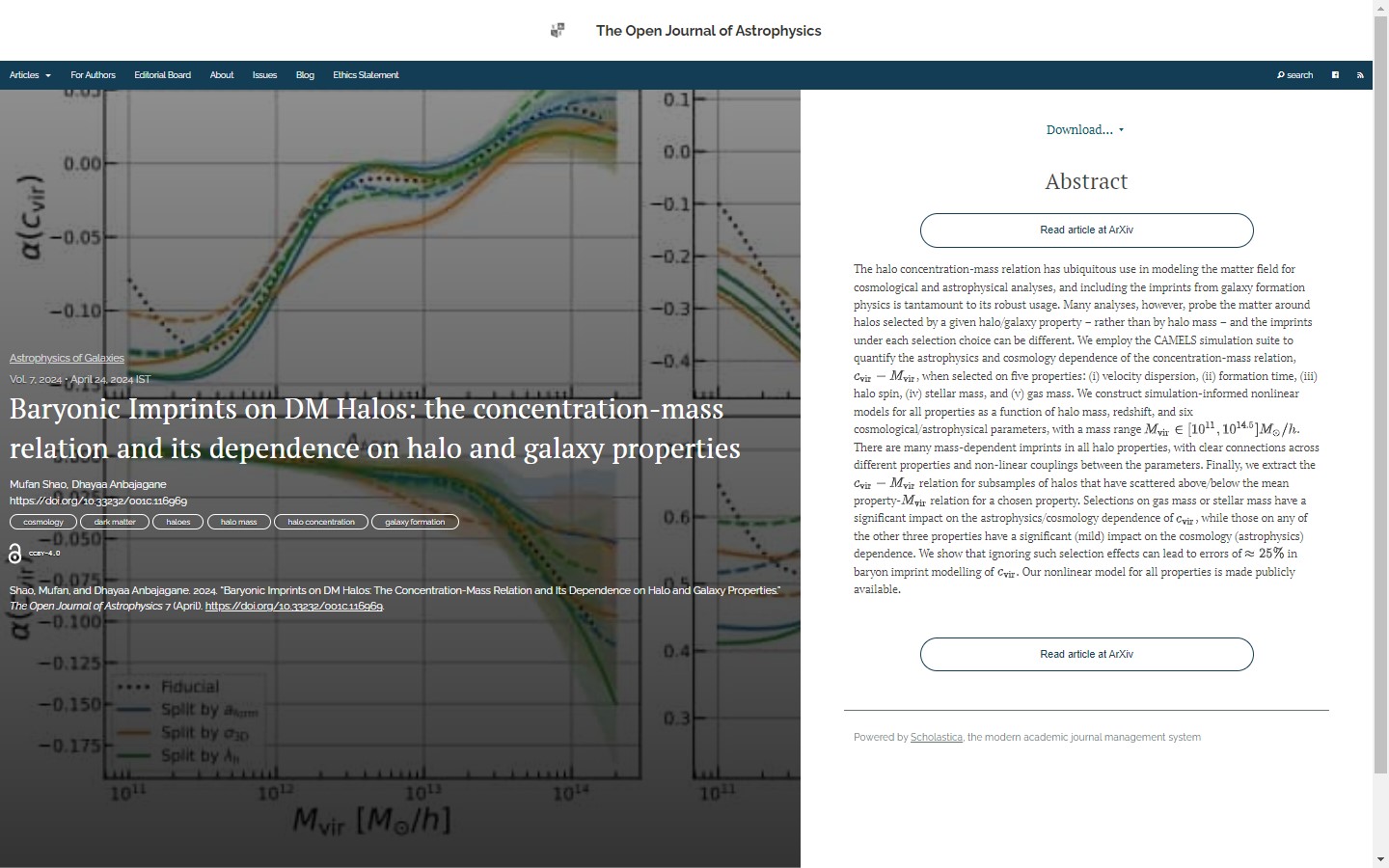
First one up is “Baryonic Imprints on DM Halos: the concentration-mass relation and its dependence on halo and galaxy properties” .  The authors, Mufan Shao and Dhayaa Anbajagane of the University of Chicago, USA, use  a non-linear model informed by simulations to study the imprint of galaxy formation physics on the concentration-mass relationship using various different choices of halo selection criteria. This one is in the folder marked Astrophysics of Galaxies and was published on 24th April 2024.

Here is a screen grab of the overlay, which includes the abstract:


You can read the paper directly on arXiv here.

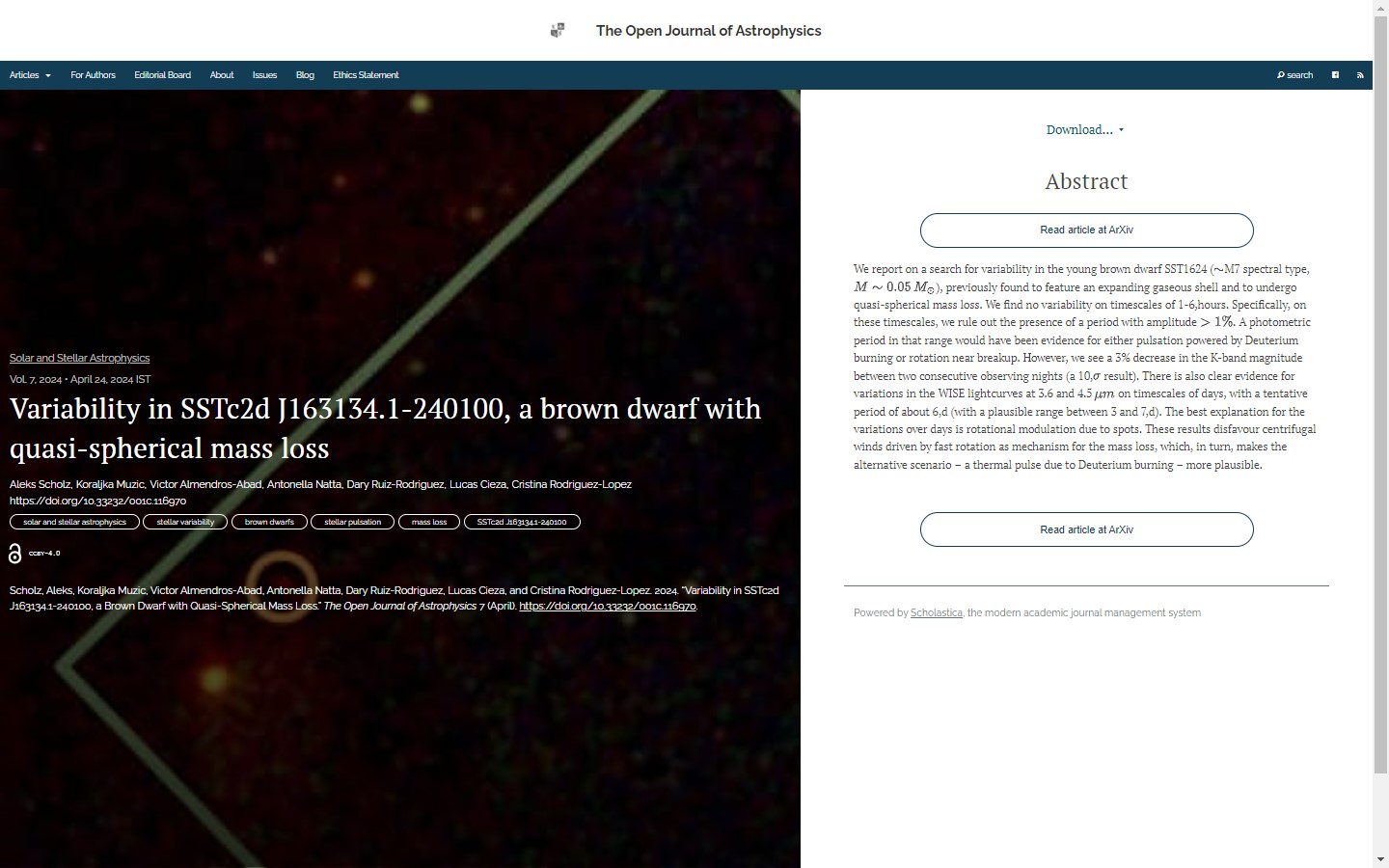
The second paper to announce is “Variability in SSTc2d J163134.1-240100, a brown dwarf with quasi-spherical mass loss” which describes a search for variability in a brown dwarf star known to be losing mass and the implications of the lack thereof for the reason for the outflow therefrom. The authors are Aleks Scholz (St Andrews, UK),  Koraljka Muzic (Lisbon, Portugal), Victor Almendros-Abad (Palermo, Italy), Antonella Natta (DIAS, Ireland), Dary Ruiz-Rodriguez (NRAO, USA), Lucas Cieza (Uni. Diego Portales, Chile), Cristina Rodriguez-Lopez (IAA-CSIC, Granada, Spain)

This one is in the folder Solar and Stellar Astrophysics and was also published on 24th April 2024. The overlay looks like this:


You can read this paper directly on the arXiv here.

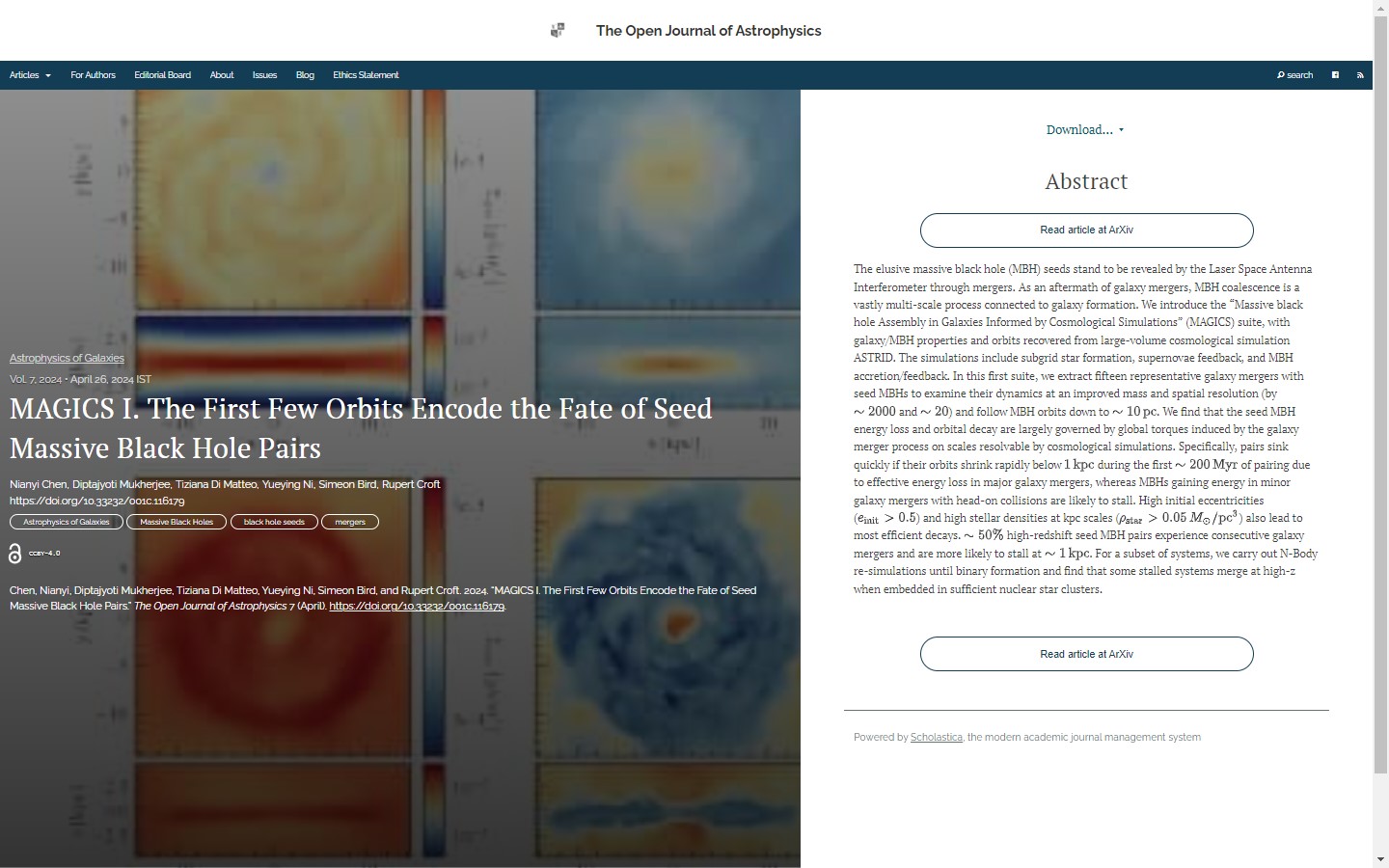
The last paper of this batch, also in the folder marked Astrophysics of Galaxies, is  entitled “MAGICS I. The First Few Orbits Encode the Fate of Seed Massive Black Hole Pairs”  and is a computational study of the process by which massive black holes are formed by merging smaller seed black holes. It was published on April 26th 2024 (i.e. yesterday). The authors are: Nianyi Chen, Diptajyoti Mukherjee and Tiziana Di Matteo (all Carnegie Mellon University); Yueying Ni (Harvard); Simeon Bird (University of California, Riverside); and Rupert Croft (Carnegie Mellon University). All authors are based in the USA.

Here is a screengrab of the overlay:


To read the accepted version of this on the arXiv please go here.
That’s all for now. More news in a week or so!


Two New Publications at the Open Journal of Astrophysics

Posted in OJAp Papers, Open Access, The Universe and Stuff with tags , , , , , , , , , , on April 20, 2024 by telescoper

It’s Saturday, and it’s time to post another update relating to the  Open Journal of Astrophysics.  Since the last update we have published two more papers, taking  the count in Volume 7 (2024) up to 27 and the total published by OJAp up to 142.

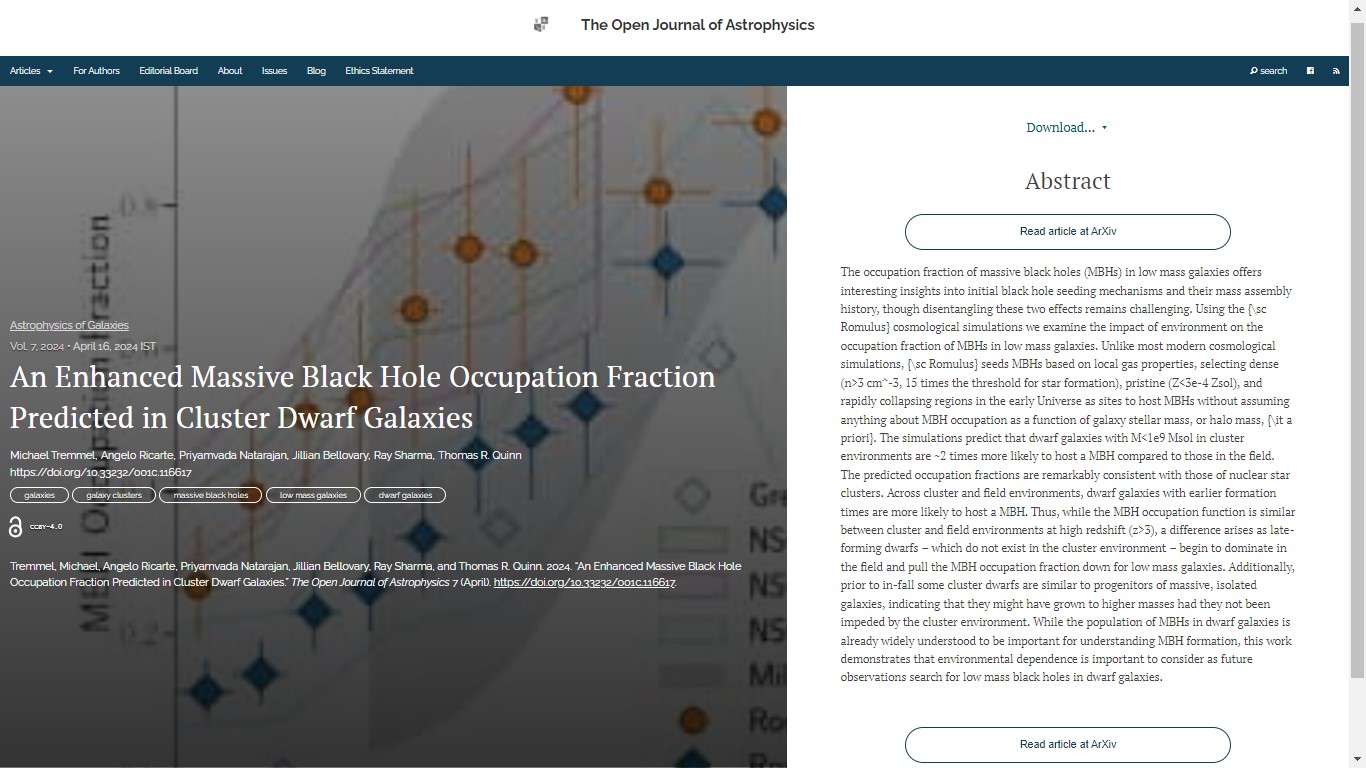
The first paper of the most recent pair – published on  Tuesday April 16th – is “An Enhanced Massive Black Hole Occupation Fraction Predicted in Cluster Dwarf Galaxies” by Michael Tremmel (UCC, Ireland), Angelo Ricarte (Harvard, USA), Priyamvada Natarajan (Yale, USA), Jillian Bellovar (American Museum of Natural History, New York, USA), Ray Sharma (Rutgers, USA), Thomas R. Quinn (University of Washington, USA). It presents a  study, based on the Romulus cosmological simulations, of the impact of environment on the occupation fraction of massive black holes in low mass galaxies. This one is in the folder marked “Astrophysics of Galaxies“.

Here is a screen grab of the overlay which includes the abstract:


You can click on the image of the overlay to make it larger should you wish to do so. You can find the officially accepted version of the paper on the arXiv here.

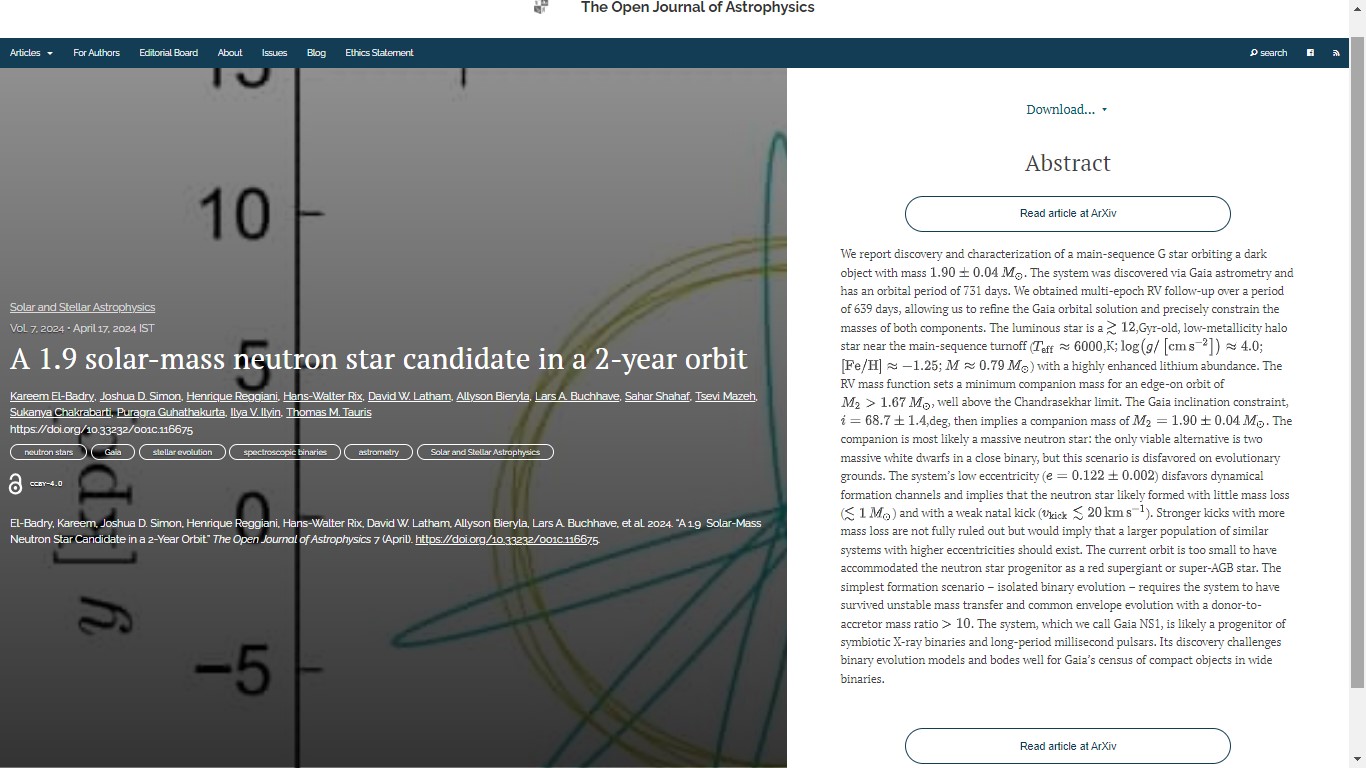
The second paper was published on Wednesday 17th April and has the title “A 1.9 solar-mass neutron star candidate in a 2-year orbit” and the authors are: Kareem El-Badry (Caltech, USA), Joshua D. Simon (Carnegie Observatories, USA), Henrique Reggiani (Gemini Observatory, Chile), Hans-Walter Rix (Heidelberg, Germany),  David W. Latham (Harvard, USA),  Allyson Bieryla (Harvard, USA),  Lars A. Buchhave (Technical University of Denmark, Denmark),  Sahar Shahaf (Weizmann Institute of Science, Israel),  Tsevi Mazeh (Tel Aviv University, Israel), Sukanya Chakrabarti (University of Alabama, USA), Puragra Guhathakurta (University of California Santa Cruz, USA), Ilya V. Ilyin (Potsdam, Germany), and Thomas M. Tauris (Aalborg University, Denmark)

This one, which is in the folder marked Solar and Stellar Astrophysics, presents a discussion of the discovery of a 1.9 solar mass neutron star candidate using Gaia astrometric data, together with the implications of its orbital parameters for the formation mechanism.

Here is a screen grab of the overlay which includes the abstract:


You can click on the image of the overlay to make it larger should you wish to do so. You can find the officially accepted version of the paper on the arXiv here.

That concludes this week’s update!

Five New Publications at the Open Journal of Astrophysics

Posted in OJAp Papers, Open Access, The Universe and Stuff with tags , , , , , , , , , on April 6, 2024 by telescoper

As promised a couple of days ago, I am taking the opportunity today to announce the batch of papers at the Open Journal of Astrophysics that were paused slightly while we updated our system. This batch includes five papers, which I now present to you here. These five take the count in Volume 7 (2024) up to 25 and the total published by OJAp up to 140. We’re publishing roughly two papers a week these days so we expect publish about 100 this year.

In chronological order, the five papers, with their overlays, are as follows. You can click on the images of the overlays to make them larger should you wish to do so.

This paper, by Yingtian Chen and Oleg Gnedin of the University of Michigan, is the 21st paper to be published in Volume 7 and the 136th altogether. It is a study of kinematic, chemical and age data of globular clusters from Gaia yielding clues to how the Milky Way Galaxy assembled. Here’s a screenshot of the overlay which includes the abstract. Note the new-style DOI at the bottom left.

You can read the article on arXiv directly here. This paper has a publication date of 20th March 2024, and is in the folder marked Astrophysics of Galaxies.

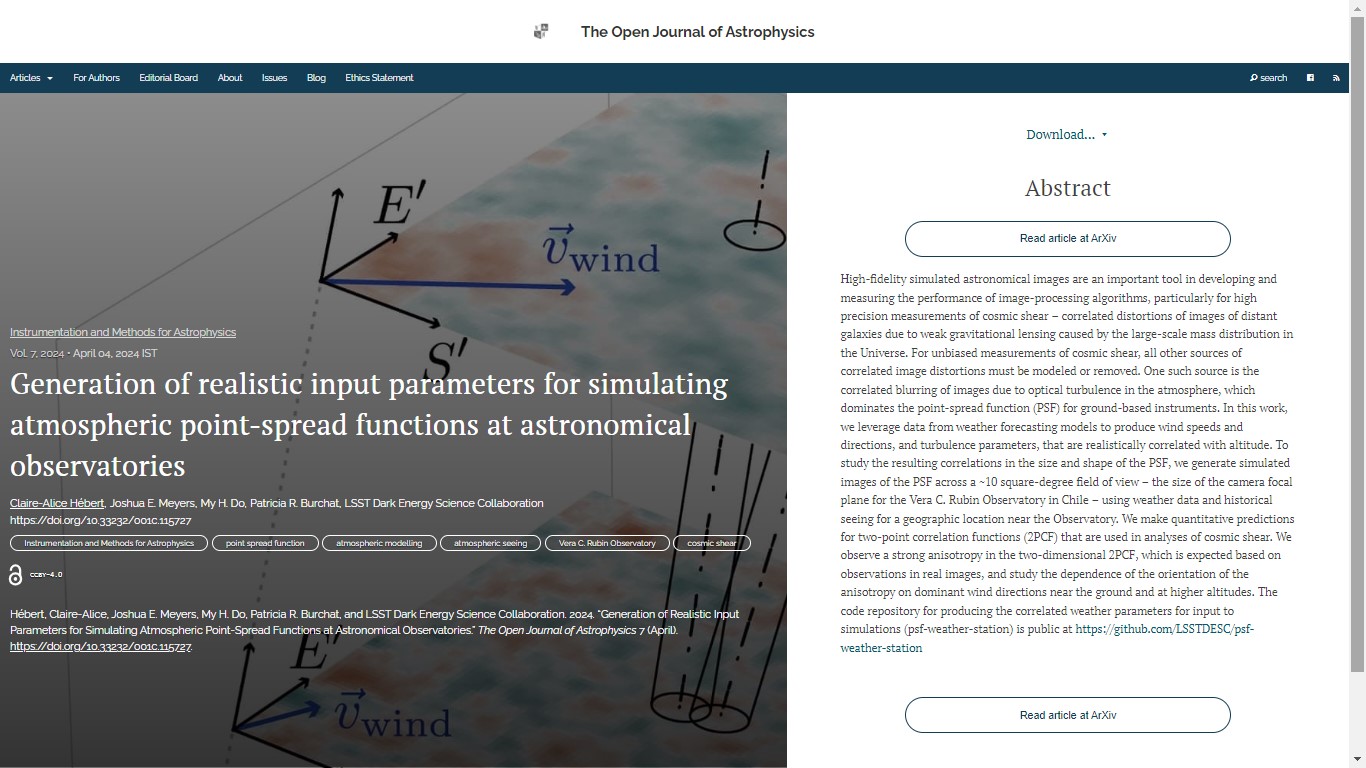
The second paper is “Generation of realistic input parameters for simulating atmospheric point-spread functions at astronomical observatories” by Claire-Alice Hébert (Stanford), Joshua E. Meyers (Stanford), My H. Do (Cal. State U, Pomona), Patricia R. Burchat (Stanford) and the LSST Dark Energy Science Collaboration. It explores the use of atmospheric modelling to generate realistic estimates of the point-spread function for observational work, especially for the Vera C. Rubin Observatory. This one is in the folder marked Instrumentation and Methods for Astrophysics and was published on 4th April 2024. Here is a screen grab of the overlay which includes the abstract:
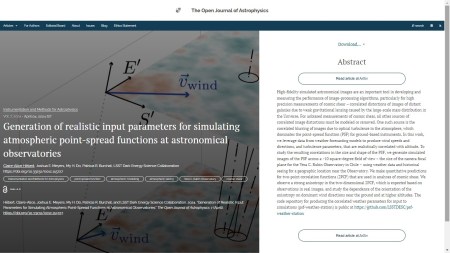
 

You can find the officially accepted version of the paper on the arXiv here.

The third paper to announce is “Cosmic Dragons: A Two-Component Mixture Model of COSMOS Galaxies” by William K. Black and August E. Evrard of the University of Michigan (Ann Arbor, USA). This paper was also published on 4th April 2024,  is in the folder Astrophysics of Galaxies and you can see the overlay here:
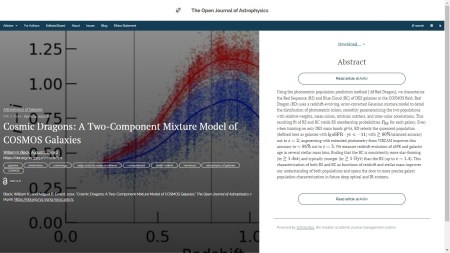
 

The accepted version of this paper can be found on the arXiv here.

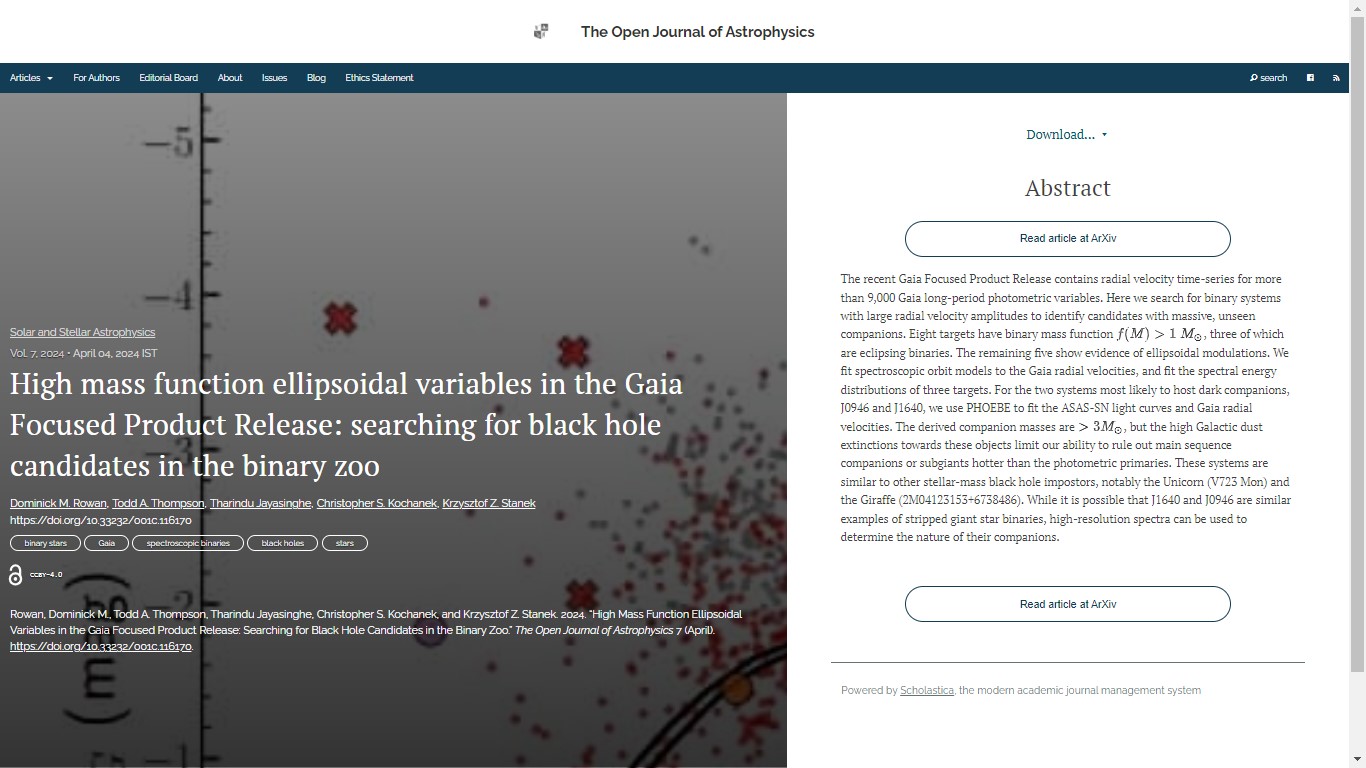
The next paper is “High mass function ellipsoidal variables in the Gaia Focused Product Release: searching for black hole candidates in the binary zoo” by Dominick M. Rowan, Todd A. Thompson,
Tharindu Jayasinghe, Christopher S. Kochanek and Krzysztof Z. Stanek of Ohio State University (USA). This paper, in the Solar and Stellar Astrophysics collection, describes a search for massive unseen stellar companions variable star systems found in Gaia data. This one was also published on 4th April 2024.

Here is the overlay:
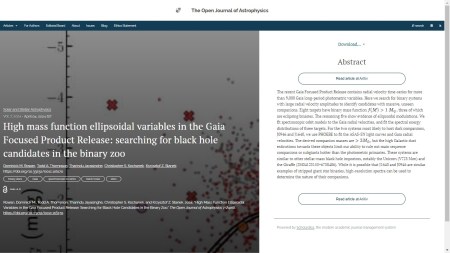


You can find the full text for this one on the arXiv here.

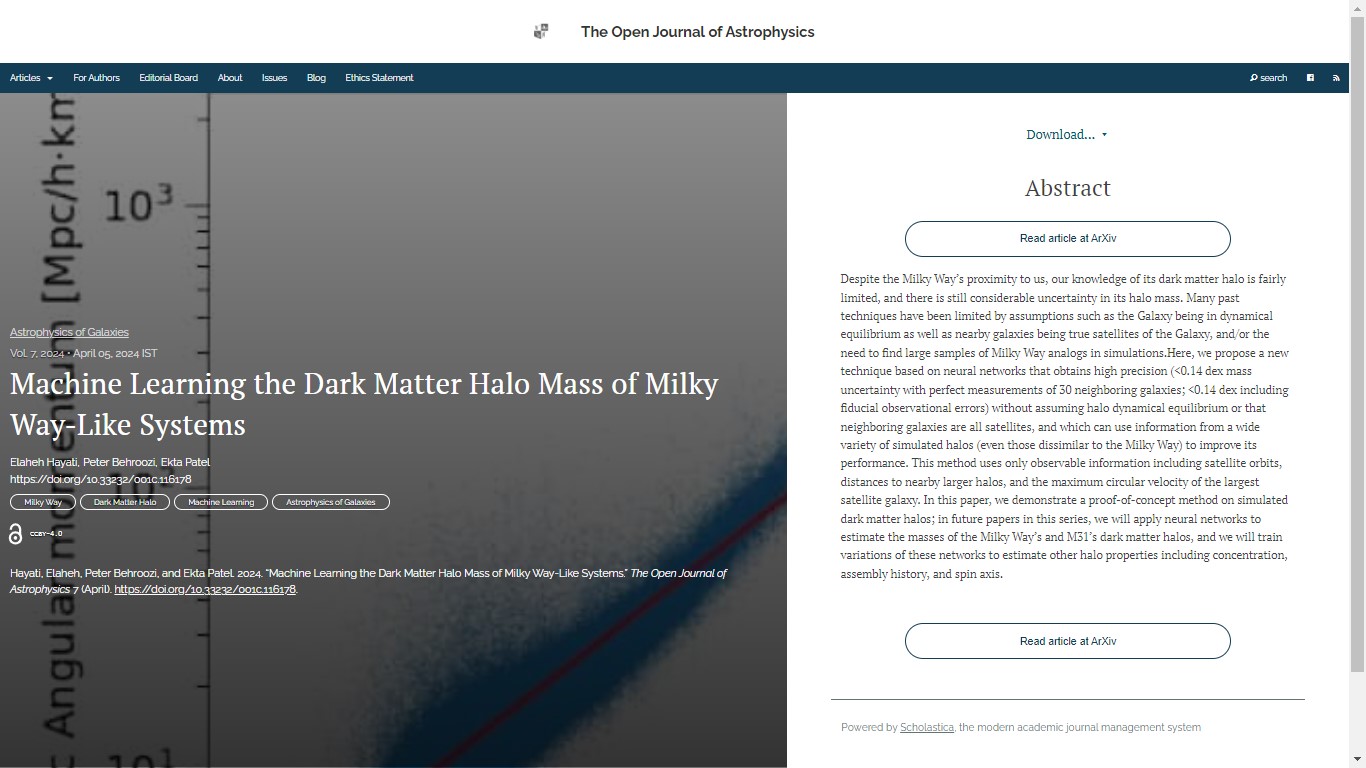
Last in this batch, but by no means least, published yesterday (5th April 2024), we have a paper “Machine Learning the Dark Matter Halo Mass of Milky Way-Like Systems” by Elaheh Hayati & Peter Behroozi (University of Arizona, USA) and Ekta Patel (University of Utah, USA).  The primary classification for this one is once again Astrophysics of Galaxies and it presents a method for estimating the mass of a galaxy halo using neural networks that does not assume, for example,  dynamical equilibrium:
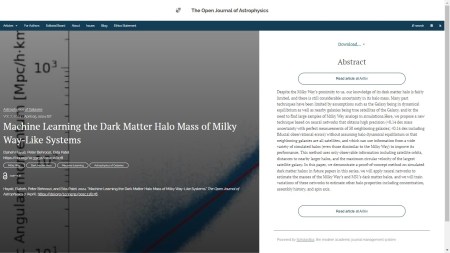
 

You can click on the image of the overlay to make it larger should you wish to do so. You can find the officially accepted version of the paper on the arXiv here.

As you can see this is quite a diverse collection of papers. Given the increase in submissions in the area of galactic astrophysics we are very happy to welcome another expert in that area to our Editorial Board, in the form of Professor Walter Dehnen of the University of Heidelberg.

Changes at the Open Journal of Astrophysics

Posted in Maynooth, Open Access with tags , , , , , , , on April 1, 2024 by telescoper

Regular readers of this blog – both of them – will have noticed that I haven’t posted any new publications from the Open Journal of Astrophysics for a couple of weeks. The reason for this is that we are switching to a new system of publishing that automatically integrates the Scholastica platform with Crossref, the system that (among many other things) keeps track of citations to published articles.

Up to now, I have had to prepare manually an XML file containing the metadata for each paper for upload, then send it to a colleague to register with Crossref. There are two problems with this. One is that transcribing the information from each overlay is prone to errors (made by me), especially if there is a long author list. The other problem is that it is rather slow and inefficient, which wasn’t such a problem when we were only publishing a few papers, but now that we are handling much more it is taking up too much time.

The obvious solution is to cut out the middle man (i.e. me) and register everything with Crossref directly from our platform. That will ensure that what goes to Crossref will be exactly the same as on our website and it will go there much faster. Another advantage is that if there is an error on the platform, such as a spelling mistake in an author name, correcting it there will automatically update the metadata on Crossref. You have no idea how much time and frustration this will save. Up to now we have to raise a ticket with Crossref for their staff to make the change, which can take a while to complete.

Scholastica offers a way to do this integration, but it doesn’t work with our existing Digital Object Identifiers (DOIs), which have the format 10.21105/astro.1234.56789, because it doesn’t allow us to include the “astro” which we need it to do because we share the prefix (10.21105) with another journal, the Journal of Open Source Software and we need to keep the two separate; they use 10.21105/joss at the start of their DOIs. After much to-ing and fro-ing we were unable to persuade Scholastica to change their policy, so to use their integration we have been forced to change prefix. Fortunately, Maynooth University (which runs Maynooth Academic Publishing, the official publisher of OJAp) is registered to mint its own DOIs so we can switch to a new prefix (10.33232) and avoid potential problems with the old one.

This change seems straightforward but it requires Crossref to switch the “ownership” of the journal and give us permission to add new papers with the same journal title “The Open Journal of Astrophysics” from what is effect a new publisher. This is a straightforward process, but has been a bit slower than expected because of the Easter break. I expect it to be completed in a week or so, at the latest.

It is important to stress that this change only affects the DOIs and registration of new papers. Existing papers are not affected at all: they continue with the old DOIs. The DOI is meant to be a persistent identifier so this is as it should be. The name of our website domain (astro.theoj.org) remains unchanged too. In other words, nothing visible to authors will change except for the format of the DOIs and the fact we go from acceptance to publication even faster.

If al this seems rather boring, that’s because it is. But please bear with us while we complete this change. It’s definitely going to be worth it in the long run, for me if nobody else!

New Publication at the Open Journal of Astrophysics

Posted in OJAp Papers, Open Access, The Universe and Stuff with tags , , , , , , , on March 2, 2024 by telescoper

It’s a rainy Saturday afternoon here in Sydney, and here’s the last update from the Open Journal of Astrophysics before I change time zones. In fact there is only one paper to report this week, being  the 16th paper in Volume 7 (2024)  and the 131st altogether. It was published on February 29th 2024.

The title is “Bound circumplanetary orbits under the influence of radiation pressure: Application to dust in directly imaged exoplanet systems” and it  is in the folder marked Earth and Planetary Astrophysics. It presents an investigation into the effect of radiation pressure on bound orbits, with applications to the behaviour of dust in exoplanet systems in general and to the Fomalhaut system in particular. The authors are Bradley Hansen of UCLA and Kevin Hayakawa of California State University (both in the USA).

Here is the overlay of the paper containing the abstract:

You can click on the image of the overlay to make it larger should you wish to do so. You can also find the officially accepted version of the paper on the arXiv here.

There are quite a few papers in the pipeline which I expect to be published during the next week or soon after.