Archive for The Open Journal of Astrophysics

New Publication at the Open Journal of Astrophysics

Posted in OJAp Papers, Open Access, The Universe and Stuff with tags , , , , , , , on February 16, 2024 by telescoper

It’s Saturday morning here in Sydney, which means it is time for another weekly update from the Open Journal of Astrophysics. In fact there is only one paper to report this week, being  the 13th paper in Volume 7 (2024)  and the 128th altogether. It was published on February 15th 2024.

The title is “Jet – counter-jet asymmetry in the jittering jets explosion mechanism of supernovae” and it  This one is in the folder called High-Energy Astrophysical Phenomena. The paper presents a discussion of the production of jets in core-collapse supernovae and the resulting formation of neutron stars, and the implications for the morphology of the supernova remnant.

The sole author of the paper is Noam Soker of Technion, Haifa, in Israel.

Here is the overlay of the paper containing the abstract:


You can click on the image of the overlay to make it larger should you wish to do so. You can find the officially accepted version of the paper on the arXiv here.

New Publication at the Open Journal of Astrophysics

Posted in OJAp Papers, Open Access, The Universe and Stuff with tags , , , , , , on February 12, 2024 by telescoper

With all the excitement of my first weekend in Sydney I completely forgot to post an update from the Open Journal of Astrophysics. In fact there is only one paper to report from last week, being  the 12th paper in Volume 7 (2024)  and the 127th altogether. This one was published on 9th February 2024 and is the first published from Down Under.

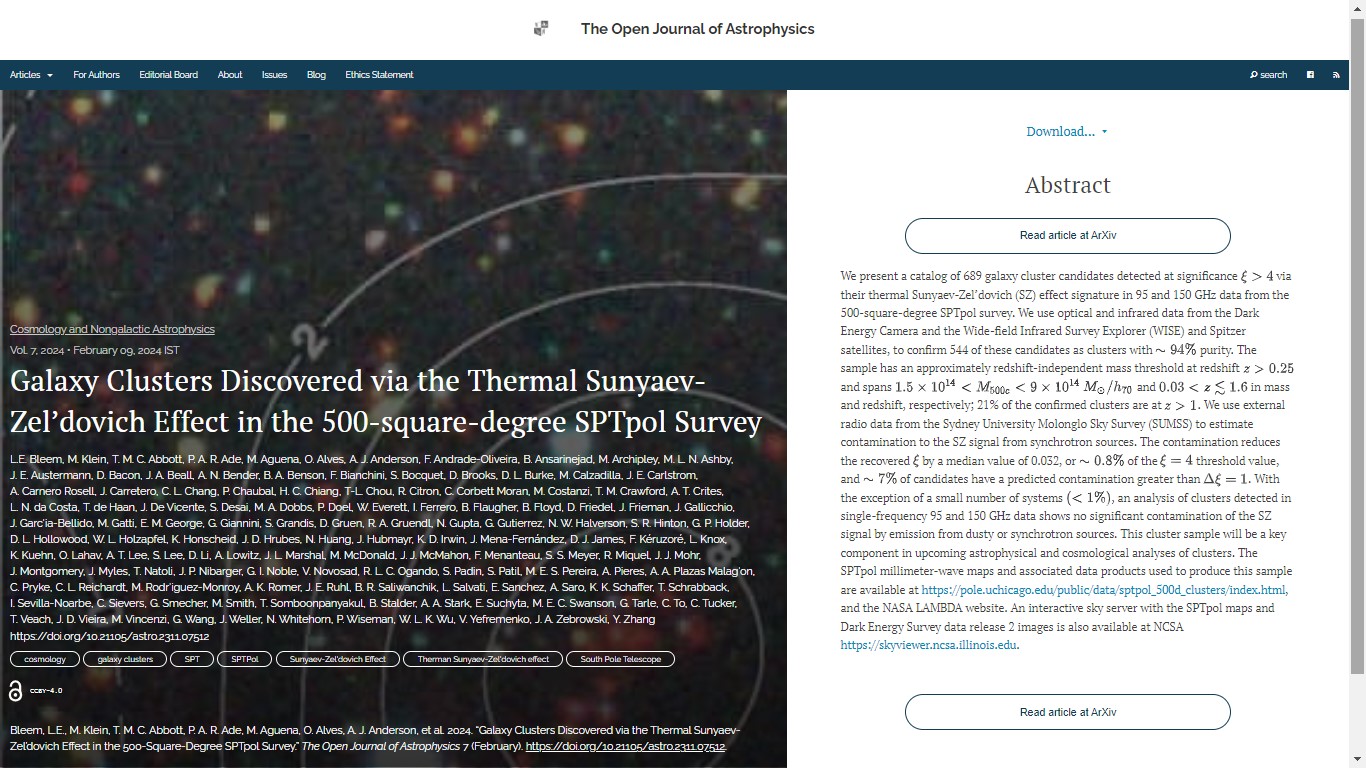
The title is “Galaxy Clusters Discovered via the Thermal Sunyaev-Zel’dovich Effect in the 500-square-degree SPTpol Survey” and it presents a catalogue of 689 galaxy clusters detected through the thermal Sunyaev-Zel’dovich using the dual-frequency polarization-sensitive camera SPTPol on the South Pole Telescope. This one is in the folder called Cosmology and NonGalactic Astrophysics.

This paper has lead author Lindsey Bleem  of the Argonne National Laboratory in the USA and has 127 other authors – too many to list individually here – but you can see them on the overlay below. I see quite a few names of people I know well!

Here is the overlay of the paper containing the abstract:


You can click on the image of the overlay to make it larger should you wish to do so. You can find the officially accepted version of the paper on the arXiv here.

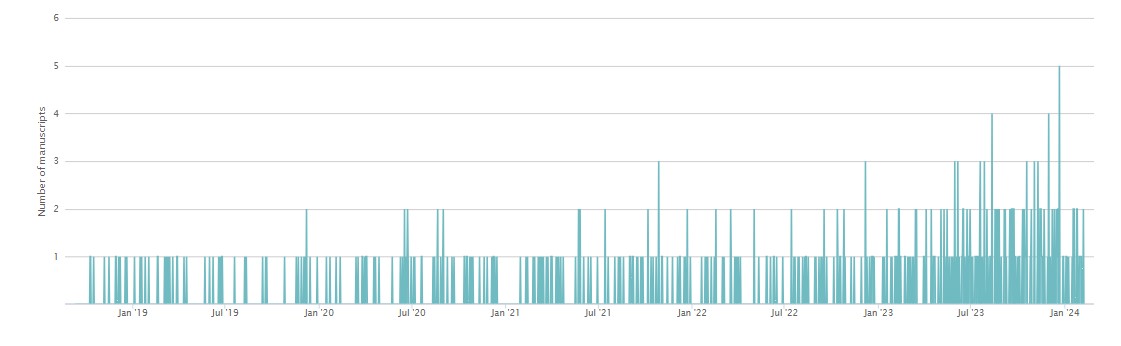
P.S. Incidentally, while I’m here I thought I’d share this little graphic I’ve generated (for other purposes) that shows how the rate of submissions to OJAp has increased over the last 5 years:

Two New Publications at the Open Journal of Astrophysics

Posted in OJAp Papers, Open Access, The Universe and Stuff with tags , , , , , , , on February 5, 2024 by telescoper

Now that I’m settled in Sydney it’s time to post another update relating to the  Open Journal of Astrophysics.  Since the last update we have published two more papers, taking  the count in Volume 7 (2024) up to 11 and the total published by OJAp up to 126. I should have posted these before leaving but it slipped my mind.

Both the current papers discussed here are in the folder marked Cosmology and NonGalactic Astrophysics, our most popular category.

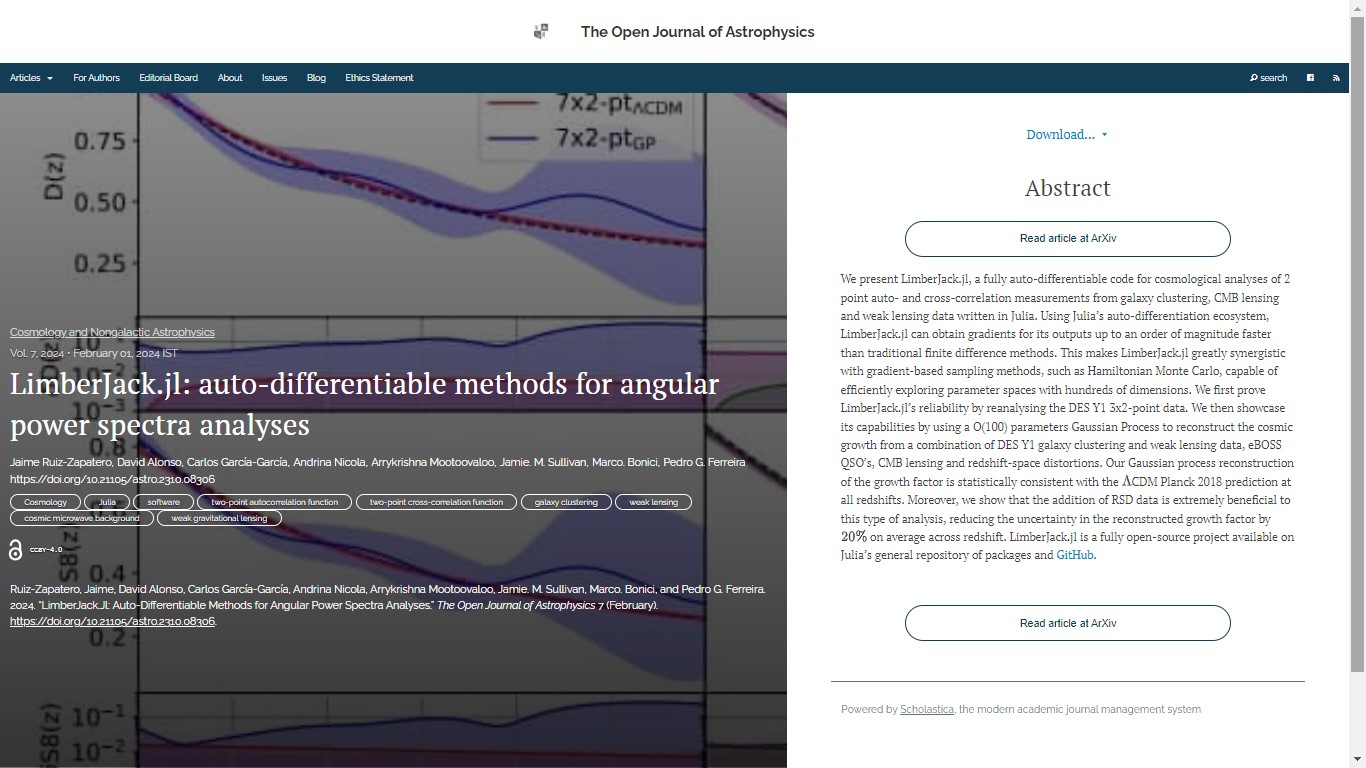
Anyway, the first paper of the most recent pair – published on February 1st – is “LimberJack.jl: auto-differentiable methods for angular power spectra analyses”, Jaime Ruiz-Zapatero (Oxford, UK), David Alonso (Oxford, UK), Carlos García-García (Oxford, UK) , Andrina Nicola (Bonn, Germany), Arrykrishna Mootoovaloo (Oxford, UK), Jamie Sullivan (Berkeley, USA), Marco Bonici (Milan, Italy), and Pedro Ferreira (Oxford, UK). This paper presents a fully auto-differentiable code for cosmological analyses of two-point auto- and cross-correlation measurements from galaxy clustering, CMB lensing and weak lensing data written in Julia.

Here is a screen grab of the overlay which includes the abstract:


You can click on the image of the overlay to make it larger should you wish to do so. You can find the officially accepted version of the paper on the arXiv here.

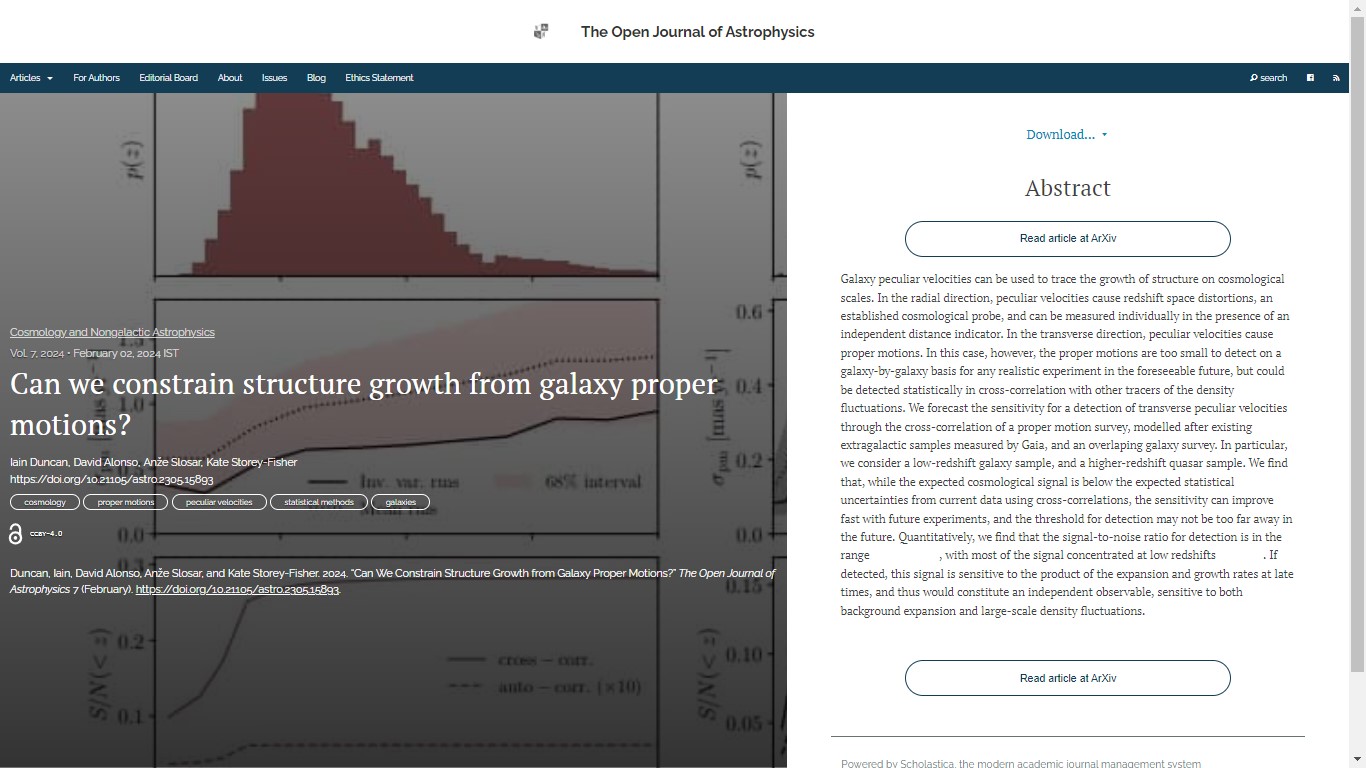
The second paper was published on Friday 2nd February and has the title “Can we constrain structure growth from galaxy proper motions?” which, as its title suggests, looks at the feasibility of using transverse peculiar velocities (i.e. proper motions) of galaxies for cosmological studies. The authors are Iain Duncan (Oxford, UK), David Alonso (Oxford, UK), Anže Slosar (Brookhaven National Laboratory, USA), and Kate Storey-Fisher (New York University, USA). To find out the answer to the question posed in its title you’ll have to read the paper!

Here is a screen grab of the overlay which includes the abstract:


You can click on the image of the overlay to make it larger should you wish to do so. You can find the officially accepted version of the paper on the arXiv here.

Because of the high rate of publications coming out, we’re moving to a system where we register papers in batches once a week rather than individually as they are published. This is just a temporary measure until we can automate this process more fully. Anyway, you can expect another update in a week or so.

Two New Publications at the Open Journal of Astrophysics

Posted in OJAp Papers, Open Access, The Universe and Stuff with tags , , , , , , , , , , , on February 1, 2024 by telescoper

As the first month of 2024 is now over, I thought I’d post an update relating to the  Open Journal of Astrophysics.  Since the last update we have published two papers, taking  the count in Volume 7 (2024) up to 9 (the total for January) and the total published by OJAp up to 124. We will have others soon, but I will be travelling for the first few days of February so the next update will be in a week or so.

Using our sophisticated forecasting algorithm, based on the first month of 2024 as input, I predict that we will publish around 9×12=108 papers in 2024, more than double last year’s total of 50.

Both the current papers discussed here are in the folder marked Cosmology and NonGalactic Astrophysics, our most popular category.

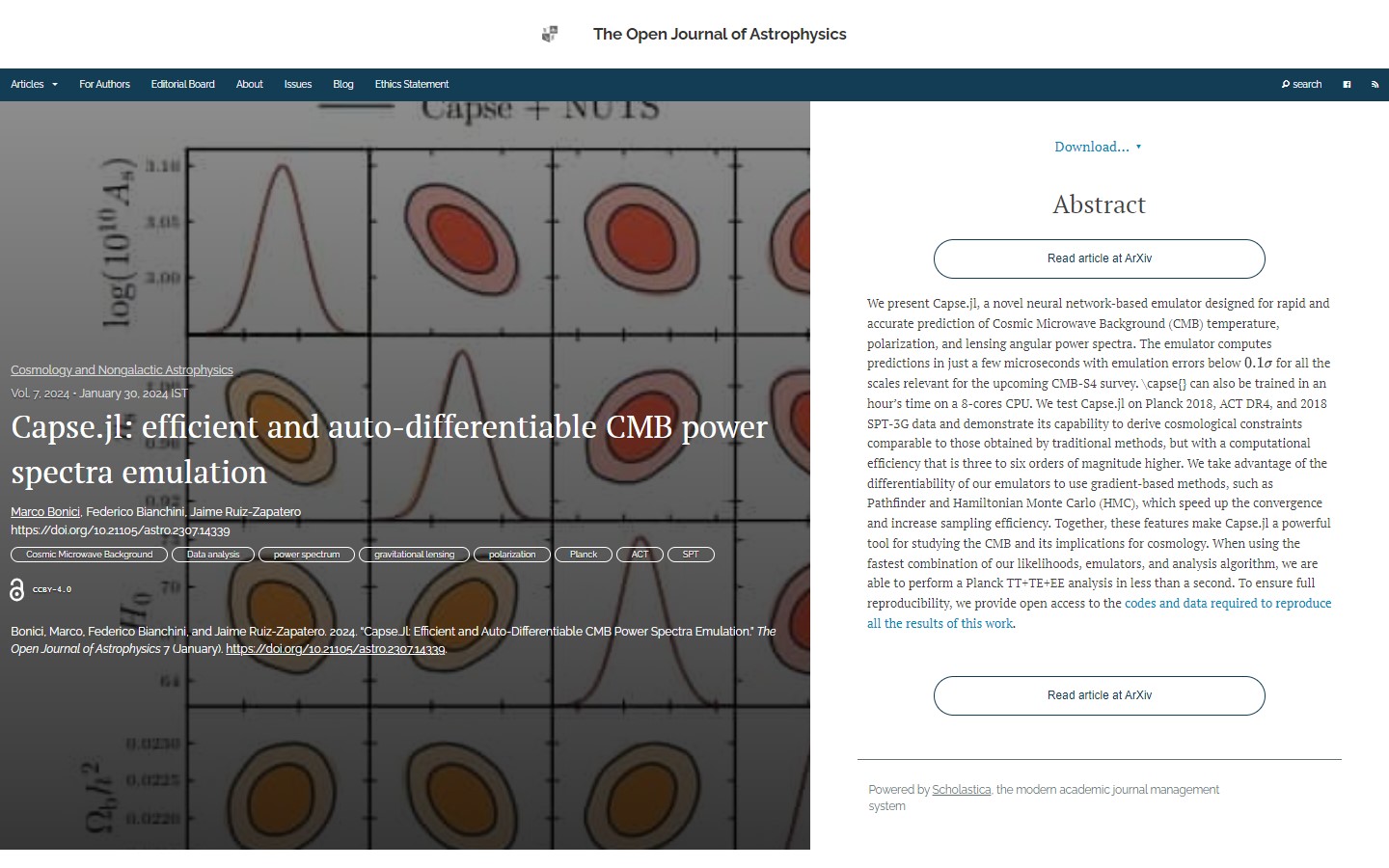
Anyway, the first paper of the most recent pair – published on January 30th – is “Capse.jl: efficient and auto-differentiable CMB power spectra emulation”, by Marco Bonici (INAF Milano, Italy & Waterloo, Canada), Federico Bianchini (Stanford, USA) and Jaime Ruiz-Zapatero (Oxford, UK). This paper presents an emulator for rapid and accurate prediction of Cosmic Microwave Background (CMB) temperature, polarization, and lensing angular power spectra, that works much faster than traditional methods. The code is written in Julia, in which language we are seeing an increasing number of submissions to OJAp.

Here is a screen grab of the overlay which includes the abstract:


You can click on the image of the overlay to make it larger should you wish to do so. You can find the officially accepted version of the paper on the arXiv here.

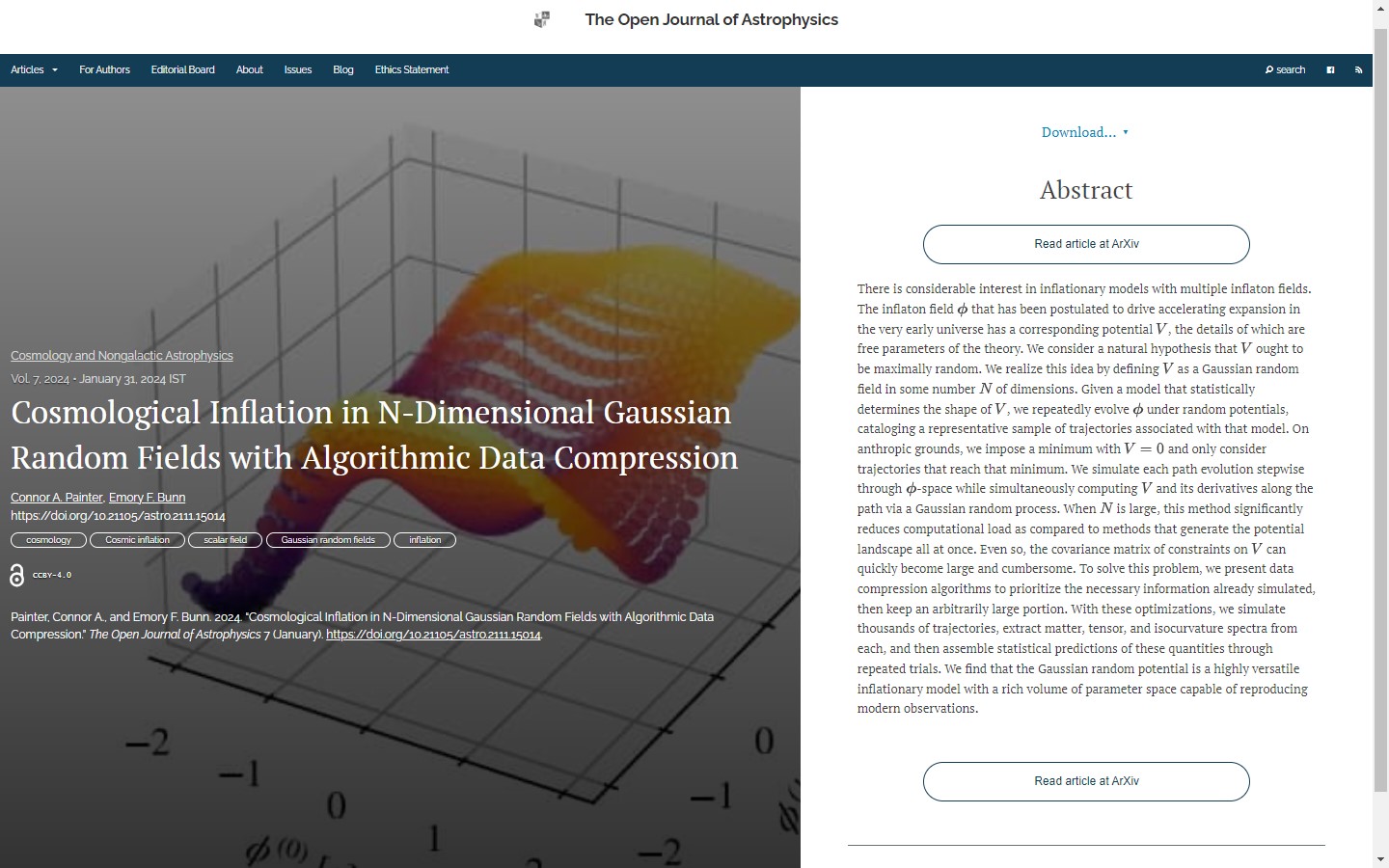
The second paper was published yesterday (31st January 2024) and has the title “Cosmological Inflation in N-Dimensional Gaussian Random Fields with Algorithmic Data Compression” which is a  study of inflationary models with Gaussian random potentials for multiple scalar fields, tracking the evolutionary trajectories numerically. The authors are Connor Painter and Emory Bunn, both the Physics Department at the University of Richmond, Virginia (USA). Ted Bunn (as he is usually known) is a longstanding member of the Editorial Board of the Open Journal of Astrophysics (and was thereby excluded from any involvement in the editorial process for this paper).

Here is a screen grab of the overlay which includes the abstract:


You can click on the image of the overlay to make it larger should you wish to do so. You can find the officially accepted version of the paper on the arXiv here.

Here Endeth the Update.

Replacing Academic Journals

Posted in Open Access with tags , , on January 21, 2024 by telescoper

I just saw an interesting paper published by the Royal Society last year with the abstract:

Replacing traditional journals with a more modern solution is not a new idea. Here, we propose ways to overcome the social dilemma underlying the decades of inaction. Any solution needs to not only resolve the current problems but also be capable of preventing takeover by corporations: it needs to replace traditional journals with a decentralized, resilient, evolvable network that is interconnected by open standards and open-source norms under the governance of the scholarly community. It needs to replace the monopolies connected to journals with a genuine, functioning and well-regulated market. In this new market, substitutable service providers compete and innovate according to the conditions of the scholarly community, avoiding sustained vendor lock-in. Therefore, a standards body needs to form under the governance of the scholarly community to allow the development of open scholarly infrastructures servicing the entire research workflow. We propose a redirection of money from legacy publishers to the new network by funding bodies broadening their minimal infrastructure requirements at recipient institutions to include modern infrastructure components replacing and complementing journal functionalities. Such updated eligibility criteria by funding agencies would help realign the financial incentives for recipient institutions with public and scholarly interest.

https://royalsocietypublishing.org/doi/10.1098/rsos.230206

The article is well worth reading in full. It says things that I have said on this blog (e.g. here) but rather more eloquently than I managed. I’ll just make a couple of comments.

First, in the first paragraph of the first section it says:

Replacing traditional journals with a more modern solution is not a new idea […], but the lack of progress since the first calls and ideas more than 20 years ago has convinced an increasing number of experts that the time for small tweaks is long gone and a disruptive break is now overdue.

I agree, of course, and I think one of the problems is the perennial problem of academia: there’s a huge excess of talking over doing. With the Open Journal of Astrophysics I’m proud to be one of the doers. Incidentally, a senior member of the Royal Astronomical Society recently told me that they were finding OApJ “disruptive”. That is, of course, the point. We need a lot more disruption.

Another issue I’ve written about before is whether there is any future in academic journals as such at all. The concept dates from the 17th Century – when it was extremely valuable and useful – but is now very outdated. As I wrote here more than a decade ago:

I’d say that, at least in my discipline, traditional journals are simply no longer necessary for communicating scientific research. I find all the  papers I need to do my research on the arXiv and most of my colleagues do the same. We simply don’t need old-fashioned journals anymore.  Yet we keep paying for them. It’s time for those of us who believe that  we should spend as much of our funding as we can on research instead of throwing it away on expensive and outdated methods of publication to put an end to this absurd system. We academics need to get the academic publishing industry off our backs.

https://telescoper.blog/2015/11/05/enough-of-the-academic-publishing-racket/

The revolution has been a slower process than I expected, but I do sense that the worm is at last turning.

Three New Publications at the Open Journal of Astrophysics

Posted in OJAp Papers, Open Access, The Universe and Stuff with tags , , , , , , , , , , , , , , , , , on January 20, 2024 by telescoper

As promised yesterday, it’s time for a roundup of the week’s business at the  Open Journal of Astrophysics. This past week we have published three papers, taking  the count in Volume 7 (2024) up to 4 and the total published by OJAp up to 119. There are quite a few more ready to go as people return from the Christmas break.

In chronological order, the three papers published this week, with their overlays, are as follows. You can click on the images of the overlays to make them larger should you wish to do so.

First one up is “Prospects for studying the mass and gas in protoclusters with future CMB observations” by  Anna Gardner and Eric Baxter (Hawaii, USA), Srinivasan Raghunathan (NCSA, USA), Weiguang Cui (Edinburgh, UK), and Daniel Ceverino (Madrid, Spain). This paper, published on 17th January 2024, uses realistic hydrodynamical simulations to probe the ability of CMB Stage 4-like (CMB-S4) experiments to detect and characterize protoclusters via gravitational lensing and the Sunyaev-Zel’dovich effect. This paper is in the category of Cosmology and Nongalactic Astrophysics.

Here is a screen grab of the overlay, which includes the abstract:


You can find the officially accepted version of the paper on the arXiv here.

The second paper to announce is “SDSS J125417.98+274004.6: An X-ray Detected Minor Merger Dual AGN” and is by Marko Mićić, Brenna Wells, Olivia Holmes, and Jimmy Irwin (all of the University of Alabama, USA).  This presents the discovery of a dual AGN in a merger between the galaxy SDSS J125417.98+274004.6 and dwarf satellite, studied using X-ray observations from the Chandra satellite. The paper was also published on 18th January 2024 in the category Astrophysics of Galaxies . You can see the overlay here:


The accepted version of this paper can be found on the arXiv here.

The last paper of this batch is  entitled “Population III star formation: multiple gas phases prevent the use of an equation of state at high densities” and the authors are:  Lewis Prole (Maynooth, Ireland), Paul Clark (Cardiff, UK), Felix Priestley (Cardiff, UK), Simon Glover (Heidelberg, Germany) and John Regan (Maynooth, Ireland). This paper, which presents a comparison of results obtained using chemical networks and a simpler equation-of-state approach for primordial star formation (showing the limitations of the latter) was published on 19th January 2024 and also in the folder marked Astrophysics of Galaxies.

Here is the overlay:


You can find the full text for this one on the arXiv here.

And that concludes the update. There’ll be more next week!


Scopus Listing for the Open Journal of Astrophysics

Posted in Open Access with tags , , , on January 6, 2024 by telescoper

I have been asked a number of times about whether or not the Open Journal of Astrophysics will be listed on Scopus. For myself,  I couldn’t care less about getting listed by Scopus – which is a profit-making service run by publishing giant Elsevier as a gate-keeper for the academic publishing industry. I have, however, heard from many individuals around the world that their research managers and the like actually take it seriously, to the extent that a journal isn’t counted as a journal unless Scopus tells them that is the case.

I’m well aware that hanging the “Approved by Elsevier” tag on the Open Journal of Astrophysics would open us up to the accusation that we collaborating with the enemy. I fully understand that moral objection, but I had to weigh it up against the serious practical difficulties facing researchers who are being forced to pay for Gold Open Access as a result of the absence of OJAp from the Scopus approved list. In the end I decided to apply, but to continue to argue against the use of Scopus and related proprietary databases by research institutions as I consider them just as corrosive as league tables.

Last November, therefore, I decided to hold my nose and apply for Scopus listing; I blogged about this here. Just to clarify, although institutions and organizations pay to subscribe to Scopus, a journal doesn’t have to pay to be listed. The application process, though free, is nevertheless rather time-consuming and I was told to expect the process to take several months. I submitted the application on 21st November 2023.

I was quite surprised yesterday (5th January 2024) to receive an email from Scopus containing the following:

The Scopus Content Selection & Advisory Board (CSAB) has reviewed your application and approved it for coverage.

For your information, the reviewer comments are copied below:

+ The articles are consistently of high academic quality, consistent with the journal’s stated aims.
+ This title is a very welcome addition to the literature.

So there we are. The Open Journal of Astrophysics will indeed be listed on Scopus, though I’m told it might take a few weeks to appear as such. From now on, whenever anyone asks me about this I have a definite answer!

This has, however, reminded me to re-apply for listing by Clarivate. I did apply for this way back in March but the application was rejected on the grounds that we weren’t publishing enough papers (although we publish more papers than many of the journals currently listed by them). Since then our rate of publication has increased substantially, however, so I don’t think they can raise the same objection again.

It will be interesting to see if listing by Scopus makes any difference to the rate of submissions and the geographical distribution of the authors concerned. My guess is it probably will, but not immediately. We’ll just have to wait and see?

New Publication at the Open Journal of Astrophysics

Posted in OJAp Papers, The Universe and Stuff with tags , , , , , on December 31, 2023 by telescoper

It’s New Year’s Eve and I just remembered that there was a paper at the Open Journal of Astrophysics site that we published before Christmas but that I haven’t yet announced on here, so for the sake of completeness here it is. It takes us to 50 papers published in 2023.

The paper in question is the 50th and final paper  in Volume 6 (2023)  and it’s the 115th altogether. This one was actually published on Friday 22nd December 2023 but owing to the vacations we had to wait a bit to get the metadata registered.

The title of this one is “What are the parities of photon-ring images near a black hole?” and is a discussion of the Fermat potential (also known as the arrival-time surface) in the context of gravitational lensing by strong gravitational fields and the implication for image parities thereby produced. This one is actually listed in General Relativity and Quantum Cosmology (gr-qc, on arXiv) but is cross-listed as Cosmology and Non-galactic Astrophysics so is eligible for publication here in the appropriate folder.

The authors are Ashish Kumar Meena (Ben Gurion University of the Negev, Israel) and Prasenjit Saha (University of Zurich, Switzerland).

Here is the overlay of the paper containing the abstract:


You can click on the image of the overlay to make it larger should you wish to do so. You can find the officially accepted version of the paper on the arXiv here.

And that concludes Volume 6 of the Open Journal of Astrophysics. Roll on Volume 7.


The 2023 OJAp Annual!

Posted in OJAp Papers, The Universe and Stuff with tags , on December 29, 2023 by telescoper

I was leafing through my copy of the 2023 Private Eye Annual and thought it would be fun to do a sort of annual for the Open Journal of Astrophysics, so here you are: all 50 of the papers in Volume 6 (2023) in glorious technicolour.

I could have linked each image to the relevant paper, but I’m way to lazy to do that!

In case you are interested here is the breakdown into different sections:

You can see that over half the papers we published are in Cosmology and Nongalactic Astrophysics, and just three arXiv categories account for 90% of the publications. I hope we can increase our diversity in 2024!

New Publication at the Open Journal of Astrophysics

Posted in OJAp Papers, Open Access, The Universe and Stuff with tags , , , , on December 12, 2023 by telescoper

I was doing some work on the Open Journal of Astrophysics site and realized that there is a paper we published last week that I haven’t advertised on here yet, so I’m remedying that now.

The paper in question is the 47th so far in Volume 6 (2023)  and it’s the 112th altogether. This one was actually published on Tuesday December 5th. Two further papers are imminent; I’m just waiting for their metadata to be registered with Crossref.

The title of this one is “The SPHINX Public Data Release: Forward Modelling High-Redshift JWST Observations with Cosmological Radiation Hydrodynamics Simulations” and it represents  public data release of Sphinx20, a full box cosmological radiation-hydrodynamics simulation that provides a statistical sample of galaxies for comparison with those observed by JWST. It is in the folder marked Astrophysics of Galaxies.

There are 10 authors: Harley Katz (Oxford, UK); Joki Rosdahl (Lyon, France); Taysun Kimm (Seoul, Korea); Jeremy Blaizot (Lyon, France);  Nicholas Choustikov (Oxford, UK); Marion Farcy  and Thibault Garel (Geneva, Switzerland);  Martin G. Haehnelt (Cambridge, UK); Leo Michel-Dansac (Lyon, France); and Pierre Ocvirk (Strasbourg, France).

Here is the overlay of the paper containing the abstract:


You can click on the image of the overlay to make it larger should you wish to do so. You can find the officially accepted version of the paper on the arXiv here.