Archive for The Open Journal of Astrophysics

Weekly Update from the Open Journal of Astrophysics – 13/09/2025

Posted in OJAp Papers, Open Access, The Universe and Stuff with tags , , , , , , , , , , , , , , , , , , , , , , , , , , , on September 13, 2025 by telescoper

It’s Saturday again, so it’s time for another summary of the week’s new papers at the Open Journal of Astrophysics. Since the last update we have published seven new papers, which brings the number in Volume 8 (2025) up to 134, and the total so far published by OJAp up to 369. We seem to be emerging for the slight late-summer hiatus we have experienced over the last few weeks.

Anyway, the first paper to report this week is “Observing the Sun with the Atacama Large Aperture Submillimeter Telescope (AtLAST): Forecasting Full-disk Observations” by Mats Kirkaune & Sven Wedemeyer (U. Oslo, Norway), Joshiwa van Marrewijk (Leiden U., Netherlands), Tony Mroczkowski (ESO, Garching, Germany) and Thomas W. Morris (Yale, USA). This paper discusses possible strategies and parameters for full-disk observations of the Sun using the proposed Atacama Large Aperture Submillimeter Telescope (AtLAST). It was published on Tuesday 9th September 2025 in the folder Solar and Stellar Astrophysics.

The overlay is here:


You can make this larger by clicking on it.  The officially accepted version of this paper can be found on the arXiv here.

The second paper this week, published on Wednesday 10th September in the folder Cosmology and NonGalactic Astrophysics, is “The exact non-Gaussian weak lensing likelihood: A framework to calculate analytic likelihoods for correlation functions on masked Gaussian random fields” by Veronika Oehl and Tilman Tröster (ETH Zurich, Switzerland).  This paper shows how to calculate likelihoods for the correlation functions of spin-2 Gaussian random fields defined on the sphere in the presence of a mask with applications to weak gravitational lensing.

The overlay is here:

and you can find the final accepted version on arXiv here.

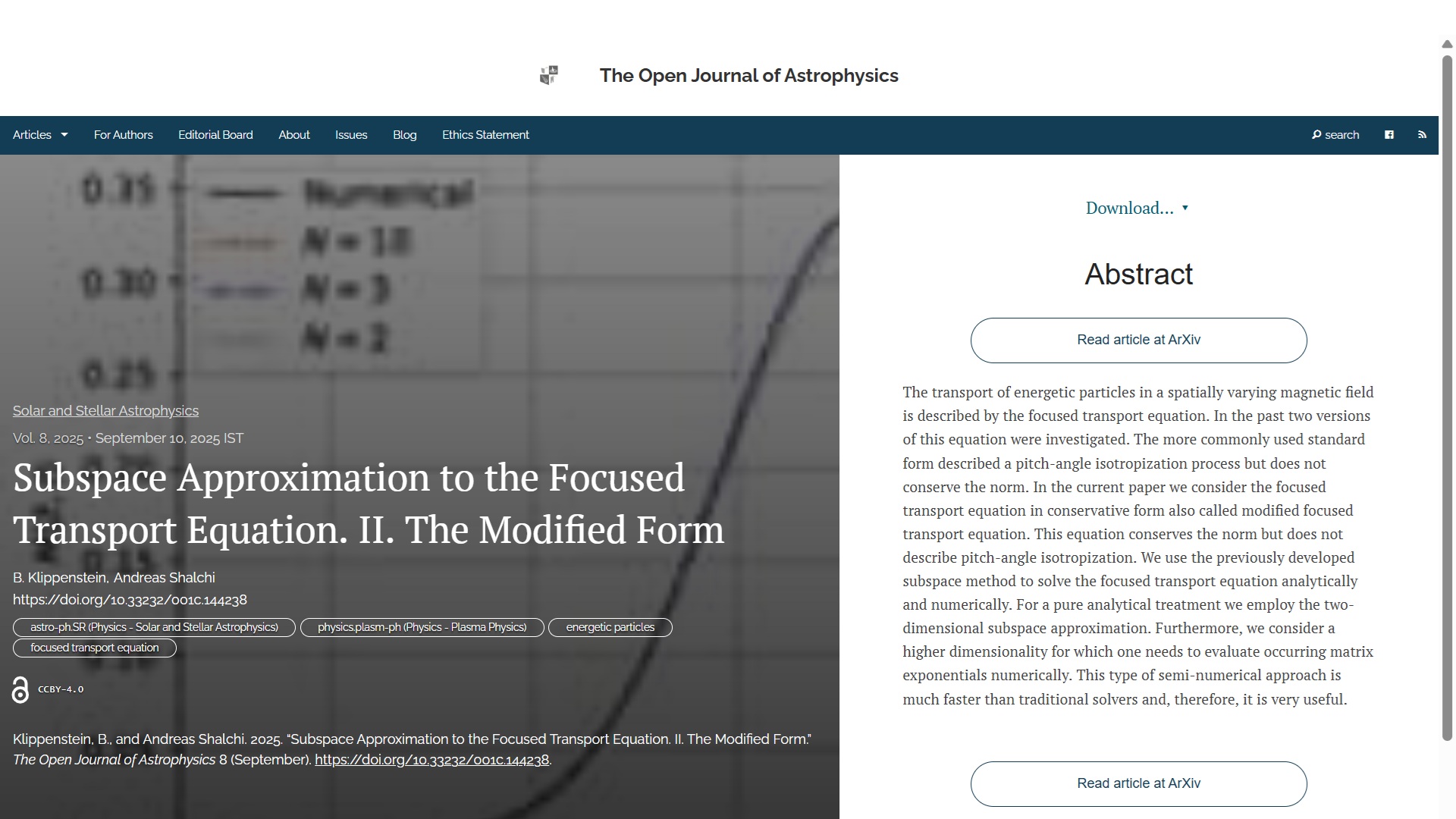
Next one up, the third paper this week, is  “Subspace Approximation to the Focused Transport Equation. II. The Modified Form” by B. Klippenstein and Andreas Shalchi (U. Manitoba, Canada). This was also published on 10th September 2025 in the folder Solar and Stellar Astrophysics. It is about solving the focused transport equation analytically and numerically using the subspace method in two or more dimensions.

You can find the final accepted version on arXiv here.

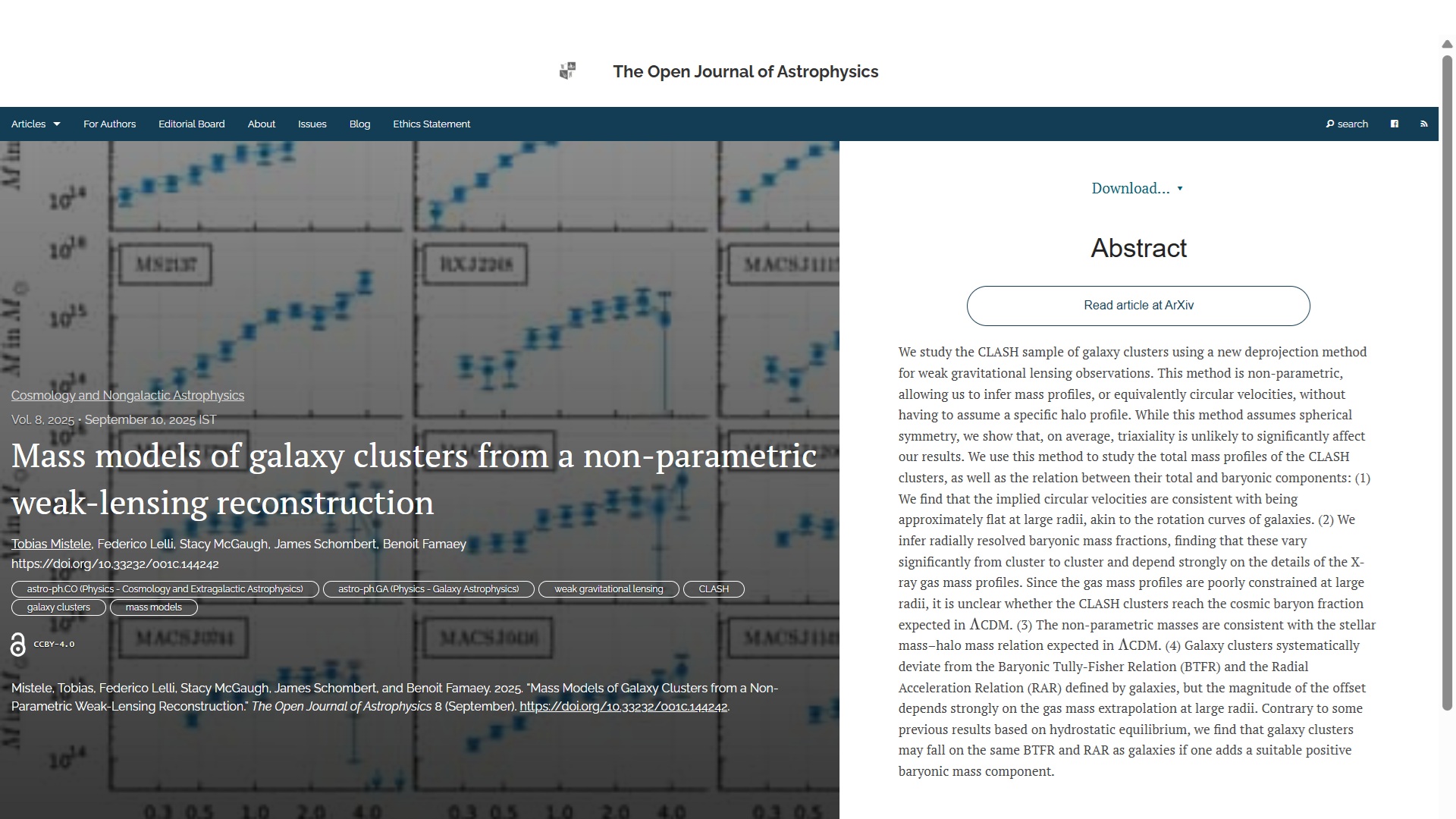
The fourth paper of this week was also published on Wednesday 10th September. It is “Mass models of galaxy clusters from a non-parametric weak-lensing reconstruction” by Tobias Mistele (Case Western Reserve U., USA), Federico Lelli (INAF, Firenze, Italy), Stacy McGaugh (Case Western), James Schombert (U. Oregon, USA) and Benoit Famaey (Université de Strasbourg, France).  Published in the folder Cosmology and NonGalactic Astrophysics, it presents new, non-parametric deprojection method for weak gravitational lensing applied to a sample of galaxy clusters. The overlay is here:

You can find the officially accepted version on arXiv here.

The fifth paper of the week is “A Swift Fix II: Physical Parameters of Type I Superluminous Supernovae” by Jason T. Hinkle & Benjamin J. Shappee (U. Hawaii, USA) and Michael A. Tucke (Ohio State, USA). This one was published on Thursday 11th September 2025 in the folder High-Energy Astrophysical Phenomena. The paper uses recalibrated Swift photometry to recompute peak luminosities and other properties of a sample of superluminous Type I supernovae. The overlay is here:

You can find the official accepted version on arXiv here.

Paper No. 6 for this week is “Detailed Microwave Continuum Spectra from Bright Protoplanetary Disks in Taurus” by Caleb Painter (Harvard, USA) and 11 others, too numerous to mention by name, based in the USA, Germany, Mexico and Taiwan.  This one was published in the folder marked Solar and Stellar Astrophysics on September 11th 2025. It presents new observations sampling the microwave (4-360 GHz) continuum spectra from eight young stellar systems in the Taurus region. The overlay is here:


The final version can be found on arXiv here.

The last paper for this update is “On Soft Clustering For Correlation Estimators” by Edward Berman (Northeastern University, USA) and 13 others based in the USA, France, Denmark and Finland and Cosmos-Web:The JWST Cosmic Origins Survey. This was published on Friday 12th September 2025 in the folder Instrumentation and Methods for Astrophysics. It presents an algorithm for estimating correlations that clusters objects in a probabilistic fashion, enabling the uncertainty caused by clustering to be quantified simply through model inference. The overlay is here:

You can find the final version on arXiv here.

And that’s all the papers for this week. I’ve noticed a significant recent increase in the number of papers in Solar and Stellar Astrophysics, which means we’re broadening our impact across the community. Which is nice.

P.S. I found out last week that, according to NASA/ADS, papers in OJAp have now accumulated over 5000 citations.

Weekly Update from the Open Journal of Astrophysics – 06/09/2025

Posted in OJAp Papers, Open Access, The Universe and Stuff with tags , , , , , , , , , , , on September 6, 2025 by telescoper

It’s Saturday again, so it’s time for a summary of the week’s new papers at the Open Journal of Astrophysics. Since the last update we have published two new papers, which brings the number in Volume 8 (2025) up to 127, and the total so far published by OJAp up to 362. It’s been another relatively slow week, not least because of the Labor (sic) Day holiday in the USA on Monday which, among other things, meant there was no arXiv update on Tuesday.

Anyway, the first paper to report this week is “An analytical model for the dispersion measure of Fast Radio Burst host galaxies” by Robert Reischke, Michael Kovač & Andrina Nicola (U. Bonn, Germany), Steffen Hagstotz (Ludwig-Maximilians Universität München) and Aurel Schneider (U. Zurich, Switzlerland). This is a theoretical study of the dispersion measures (DMs) intrinsic to host galaxies of Fast Radio Burst (FRB) sources to enable separation of that from the line-of-sight DM. This one was published on Monday 1st September 2025 in the folder Cosmology and NonGalactic Astrophysics.

The overlay is here:


You can make this larger by clicking on it.  The officially accepted version of this paper can be found on the arXiv here.

The second paper this week, published on Wednesday 3rd Sepember in the folder Solar and Stellar Astrophysics, is “Complex spectral variability and hints of a luminous companion in the Be star + black hole binary candidate ALS 8814” by Kareem El-Badry (Caltech, USA), Matthias Fabry (Villanova U., USA), Hugues Sana (KU Leuven, Belgium), Tomer Shenar (Tel Aviv U., Israel) and Rhys Seeburger (MPA Heidelberg, Germany).

The overlay for this one is here:


You can find the officially accepted version on arXiv here.

And that’s all the papers for this week. It’s still a bit slow as we emerge from the summer vacations, we have a lot of papers in the pipeline that I expect to emerge pretty soon.

Weekly Update from the Open Journal of Astrophysics – 30/08/2025

Posted in OJAp Papers, Open Access, The Universe and Stuff with tags , , , , , , , , , , , , , , , on August 30, 2025 by telescoper

Once again it’s time for a summary of the week’s new papers at the Open Journal of Astrophysics. Since the last update we have published three new papers, which brings the number in Volume 8 (2025) up to 125, and the total so far published by OJAp up to 360.

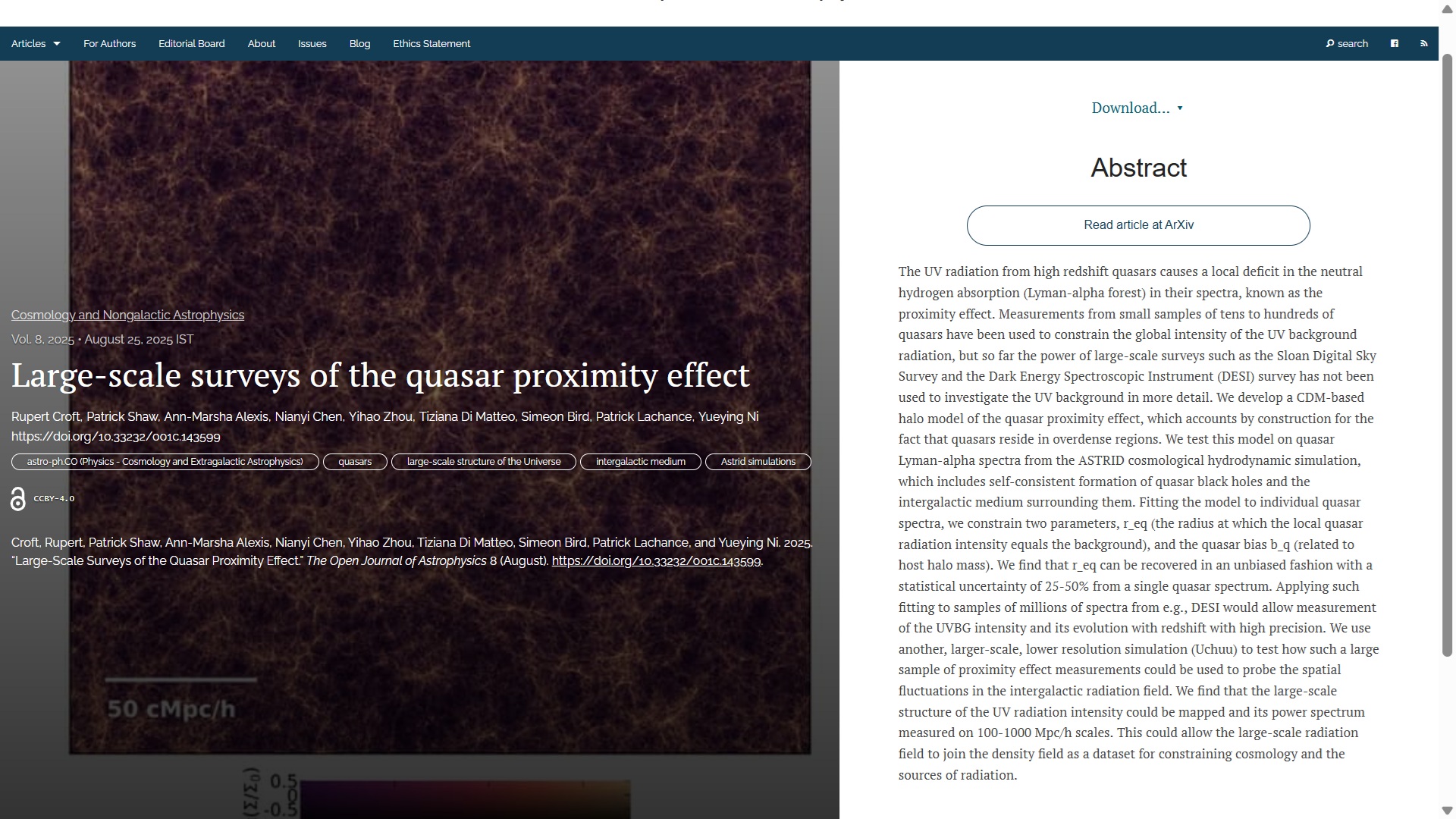
The first paper to report this week is “Large-scale surveys of the quasar proximity effect” by Rupert Croft, Patrick Shaw & Ann-Marsha Alexis (Carnegie Mellon University; CMU), Nianyi Chen (Princeton), Yihao Zhou & Tiziana Di Matteo (CMU), Simeon Bird (UC Riverside), Patrick Lachance (CMU), and Yueying Ni (Harvard). This paper was published on Monday 25th August in the folder Cosmology and NonGalactic Astrophysics. It presents a CDM-based halo model of the quasar proximity effect, tested on quasar Lyman-alpha spectra from the ASTRID cosmological simulation, including self-consistent formation of quasar black holes and the intergalactic medium.

The overlay is here:


You can make this larger by clicking on it, as you can with all the overlays below. The officially accepted version of this paper can be found on the arXiv here.

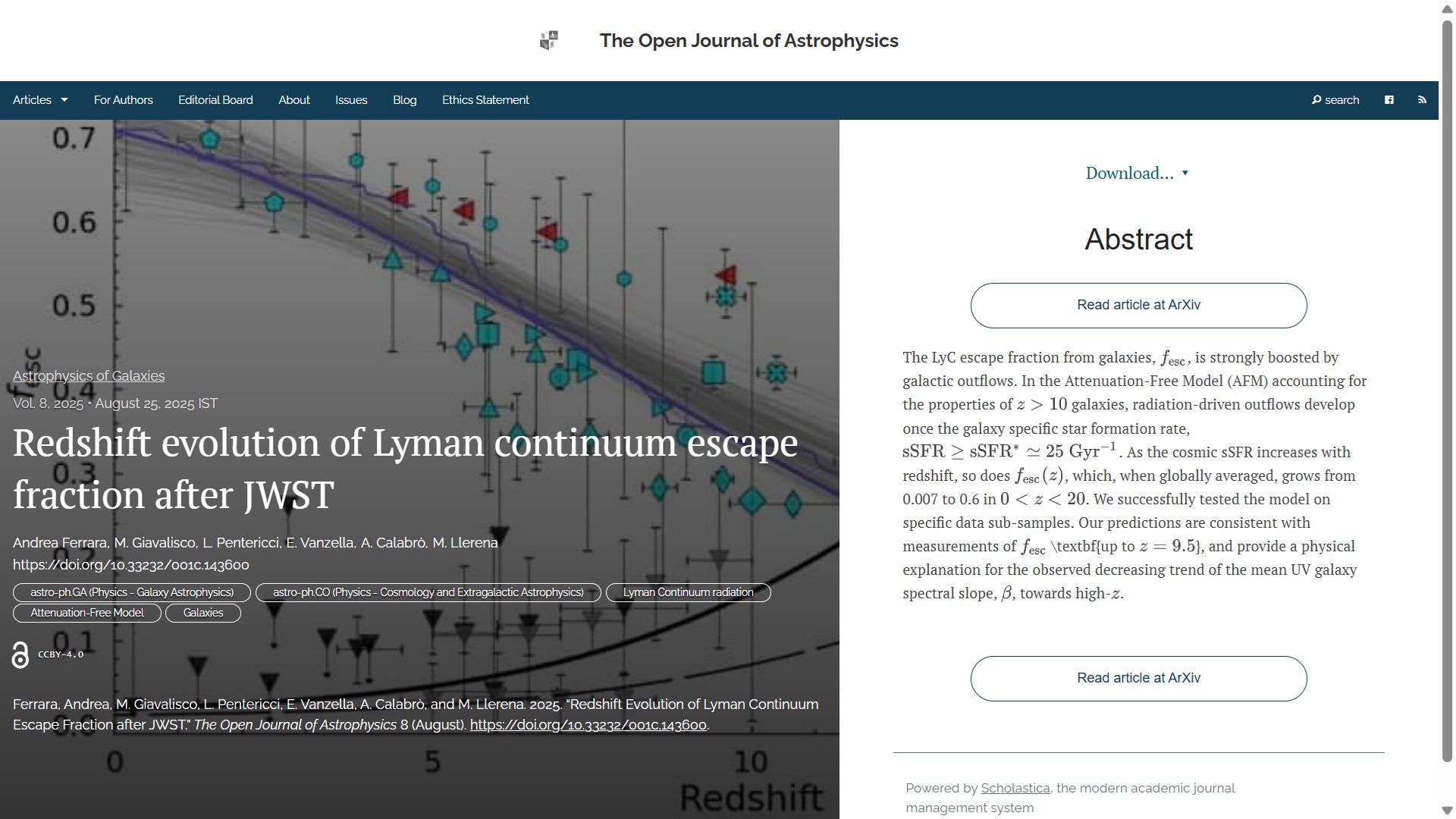
The second paper this week, also published on Monday 25th August, but in the folder Astrophysics of Galaxies, is “Redshift evolution of Lyman continuum escape fraction after JWST” by Andrea Ferrara (Pisa), M. Giavalisco (UMass Amherst), L. Pentericci (Rome), E. Vanzella (Bologna), A. Calabrò (Rome) and M. Llerena (Rome). This paper is about the Attenuation-Free Model (AFM) for galaxies, in which radiation-driven outflows develop once the galaxy specific star formation rate exceeds a certain level, which is tested on data with positive results. The overlay is here:

You can find the officially accepted version on arXiv here.

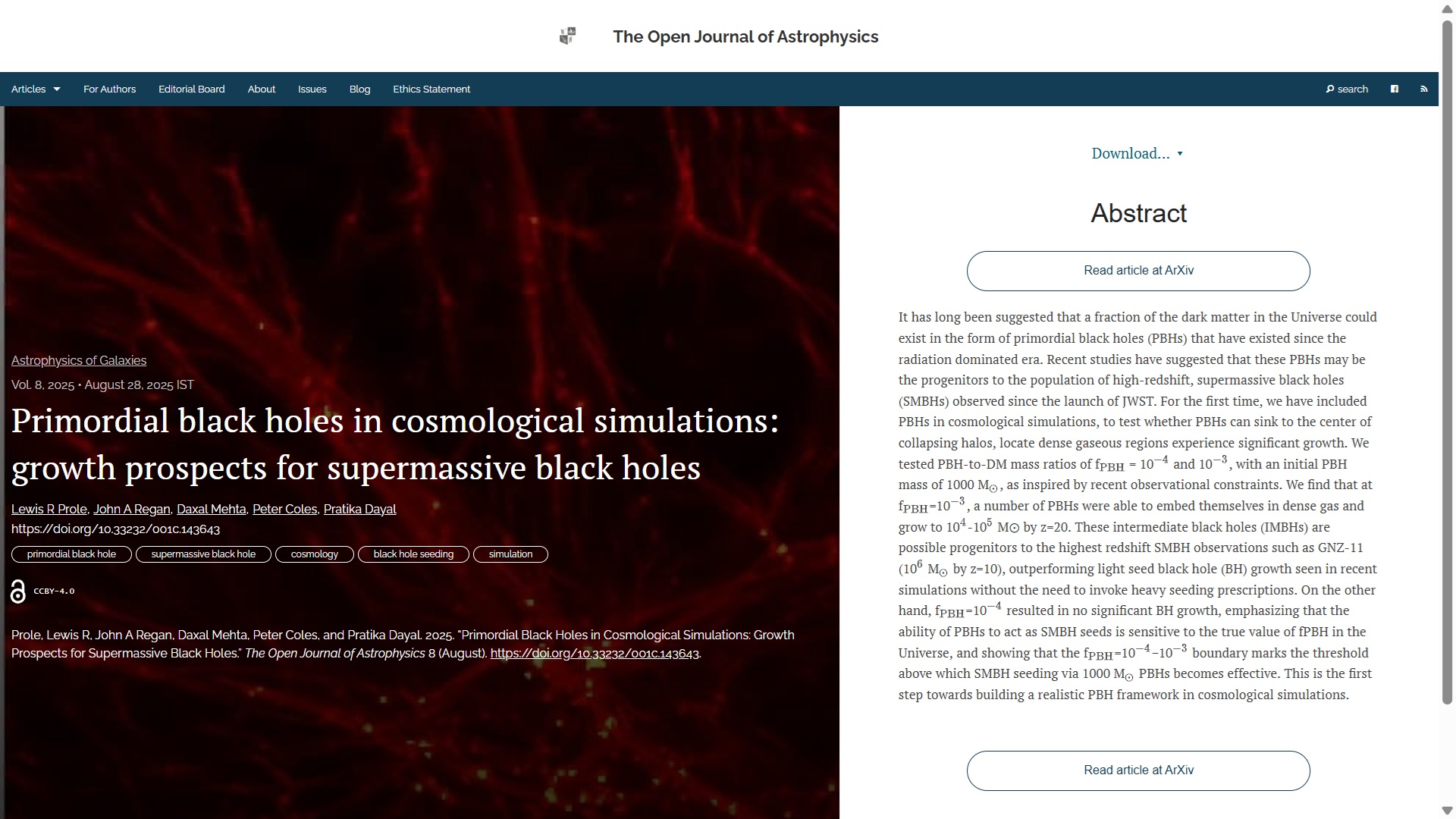
The third and final paper this week is “Primordial black holes in cosmological simulations: growth prospects for supermassive black holes” by Lewis R Prole, John A Regan, Daxal Mehta & Peter Coles (National University of Ireland, Maynooth) and Pratika Dayal (Groningen, NL). This one was published in Astrophysics of Galaxies folder on Thursday 28th August 2025. You can read more about this paper here: basically it studies the growth of primordial black holes in the early Universe using numerical simulations, with implications for the subsequent formation of massive black holes.

The overlay is here:

You can find the officially accepted version of this one on arXiv here.

And that’s all the papers for this week. It’s still a bit slow as we emerge from the summer vacations, but I expect things will start to pick up from now on.

Our Million-Dollar Journal!

Posted in Open Access with tags , , , , on August 25, 2025 by telescoper

The Article Processing Charge (APC) for publishing a paper in Monthly Notices of the Royal Astronomical Society (MNRAS) is now £2356. Converting that to dollars at current rates gives about $3150 per paper.

As of today, 25th August 2025, the Open Journal of Astrophysics has published 359 articles.

Using the dollar cost of an MNRAS APC as a benchmark – many journals charge more – this means that we have now saved the global astrophysics community about $1.1M (for an outlay of around $10K).

Yes, we are still a small journal but the size of that figure should help you understand how much money is being wasted globally on publishing fees that could instead be spent on actual research.

It’s good to see that more and more researchers are seeing the light and switching to Diamond Open Access. Today we published the 124th article in Volume 8 (2025) of the Open Journal of Astrophysics. This means that we have so far in 2025 published more papers than we published in the whole of 2024. At the end of August we will be about two-thirds of the way through the year so I expect we will publish more than 180 articles this year.

I’d like to take this opportunity to thank everyone involved in running this journal: the Editors, staff at Maynooth University Library who help us, the host of volunteer referees, and of course our authors. I’m confident that, together, we can change the publishing landscape in astrophysics, and put the power (and money) back in the hands of researchers instead of greedy publishers.

This is a slightly-edited version of a post I made last week for the Open Journal of Astrophysics blog.

Weekly Update from the Open Journal of Astrophysics – 23/08/2025

Posted in OJAp Papers, Open Access, The Universe and Stuff with tags , , , , , , , , , , , , , , , , , , , , , , , , , on August 23, 2025 by telescoper

So it’s Saturday again, so it’s time for the usual update of papers published at the Open Journal of Astrophysics which I do every Saturday. Since the last update we have published six new papers, which brings the number in Volume 8 (2025) up to 122, and the total so far published by OJAp up to 357. As I mentioned here we have overtaken the total of 120 published in Volume 7 (2024) and are on track for in excess of 180 publications in 2025.

The first paper to report this week is “Mass-feeding of jet-launching white dwarfs in grazing and common envelope evolution” by Noam Soker (Technion, Haifa, Israel). This was published on Tuesday 19th August in the folder Solar and Stellar Astrophysics. It proposes a theoretical suggestion about the production of jets in common-envelope evolution with massive stars.

The overlay is here:

You can make this larger by clicking on it, as you can with all the overlays below. The officially accepted version of this paper can be found on the arXiv here.

The second paper this week, published on Wednesday 20th August in the folder Earth and Planetary Astrophysics, is “Transition metal abundance as a key parameter for the search of Life in the Universe” by Giovanni Covone and Donato Giovannelli (University of Naples, Italy). This paper presents an argument that the availability of transition elements is an essential feature of habitability, and should be considered as such in selecting exoplanetary targets in the search for life.

The overlay is here:

You can find the officially accepted version of the paper on arXiv here.

The third paper this week, also published on 20th August 2025 in the folder Earth and Planetary Astrophysics, is “Discrete element simulations of self-gravitating rubble pile collisions: the effects of non-uniform particle size and rotation” by Job Guidos, Lucas Kolanz and Davide Lazzati (Oregon State University, USA).  This presents a new computer code for simulating the growth of granular masses through collisions of smaller particles and discusses results generated by it.

The overlay for this one is here:

You can find the officially accepted version on arXiv here.

The next paper, the fourth this week, is “Seeing the Outer Edge of the Infant Type Ia Supernova 2024epr in the Optical and Near Infrared” by W.B. Hoogendam (University of Hawaii, USA) and 32 others – too numerous to list by name – based in various institutes in the USA, Australia, UK, Denmark, Taiwan and China. This paper was also published on Wednesday 20th August 2025, but in the folder High-Energy Astrophysical Phenomena.  The article reports on the results of optical-to-near-infrared photometry and spectroscopy of the Type Ia supernova (SN Ia) 2024epr and a discusses how these challenge models for this sort of supernova.

The overlay is here:

You can find the officially accepted version on arXiv here.

The fifth paper this week is “Computing Nonlinear Power Spectra Across Dynamical Dark Energy Model Space with Neural ODEs” by Peter L. Taylor of Ohio State University (USA).  This one shows how to compute the evolution of cosmological power spectra into the non-linear regime via neural differential equations. It was published on Friday 22nd August 2025 in the folder Cosmology and NonGalactic Astrophysics. The overlay is here:

You can find the officially accepted version on arXiv here.

And finally for this week we have “Symbiotic star candidates in Gaia Data Release 3” by Samantha E. Ball & Benjamin C Bromley (University of Utah, USA) and Scott J. Kenyon (Smithsonian Observatory, USA). This paper was published on Friday 22nd August in the folder Solar and Stellar Astrophysics. It describes a new search for symbiotic star candidates in Gaia Data Release 3 (GDR3), based on astrometric, photometric, and spectroscopic information. The overlay is here:

You can find the officially accepted version of this one on arXiv here.

And that’s all the papers for this week. I suppose there will come a time when we publish a paper on every day of the week and each week’s summary will contain a paper in each of the astro-ph categories on arXiv, but we haven’t done that yet. This week we published on every day but Monday 18th August, and have papers in four of the six categories.

Il Sorpasso

Posted in Film, Open Access with tags , , , on August 21, 2025 by telescoper

Just a quick note to say that yesterday we published the 120th article in Volume 8 (2025) of the Open Journal of Astrophysics. This means that we have so far in 2025 published as many papers we published in the whole of 2024. At the end of August we will be about 2/3 of the way through the year so I expect we will publish more than 180 articles this year. It may be more than that because we have a group of articles in the pipeline that will be published simultaneously in a special issue, which may be completed this year. We might in this case reach 200 altogther for 2025, but if not the special issue will appear in 2026.

The relevance of all this to the 1962 Italian comedy film Il Sorpasso is entirely negligible, except that I like the movie.

I hope this clarifies the situation

Weekly Update from the Open Journal of Astrophysics – 16/08/2025

Posted in OJAp Papers, Open Access, The Universe and Stuff with tags , , , , , , , , , , , , on August 16, 2025 by telescoper

It’s time once again for the usual update of papers published at the Open Journal of Astrophysics which I do every Saturday. Since the last update we have published two new papers, which brings the number in Volume 8 (2025) up to 116, and the total so far published by OJAp up to 351. The summer lull we always expected is now upon us, so this will be a shorter post than we have had of late.

The first paper to report this week is “The reflex instability: exponential growth of a large-scale mode in astrophysical discs” by Aurélien Crida (Université Côte d’Azur, France), Clément Baruteau (Université de Toulouse, France), Jean-François Gonzalez (Universite Claude Bernard Lyon 1, France), Frédéric Masset (Universidad Nacional Autonoma de México) and Paul Segretain, Philippine Griveaud, Héloïse Méheut & Elena Lega (Université Côte d’Azur).  This paper was published on Tuesday August 12th 2025 in the folder marked “Earth and Planetary Astrophysics“. It discusses a exponentially-growing instability in gas discs around stars caused by the motion of the central star in response to the disc.

The overlay – which you can make larger by clicking on it – is here:

You can find the officially accepted version on arXiv here.

The other paper this week, published in the folder Cosmology and Nongalactic Astrophysics, is “The galaxy-IGM connection in THESAN: the physics connecting the IGM Lyman-alpha opacity and galaxy density in the reionization epoch” by Enrico Garaldi (University of Tokyo, Japan), Verena Bellscheidt (Technical University of Munich, Germany), Aaron Smith (York University, Canada) and Rahul Kannan (University of Texas at Dallas, USA).  It presents a study of the relation between the Lyman-alpha effective optical depth of quasar sightlines and the distribution of galaxiesas as a probe of ionized regions around sources of photons. It was published on Wednesday August 13th 2025.

The overlay is here:


You can find the officially accepted version of the paper on arXiv here.

That concludes the papers for this week. I’ll do another update next weekend, though I expect things will remain relatively quiet until September.

Weekly Update from the Open Journal of Astrophysics – 09/08/2025

Posted in OJAp Papers, Open Access, The Universe and Stuff with tags , , , , , , , , , , , , , , , , , , , , , on August 9, 2025 by telescoper

It’s Saturday morning so, once again, it’s time for an update of papers published at the Open Journal of Astrophysics. Since the last update we have published four new papers, which brings the number in Volume 8 (2025) up to 114, and the total so far published by OJAp up to 349.

The papers published this week, with their overlays, are as follows. You can click on the images of the overlays to make them larger should you wish to do so.

The first paper to report is “Caught in the Act of Quenching? – A Population of Post-Starburst Ultra-Diffuse Galaxies” by Loraine Sandoval Ascencio & M. C. Cooper (UC Irvine), Dennis Zaritsky, Richard Donnerstein & Donghyeon J. Khim (U. Arizona) and Devontae C. Baxter (UC San Diego). This paper was puvblished on Monday 4th August and is in the folder marked Astrophysics of Galaxies. It discusses a sample of Ultra-Diffuse Galaxies (UDGs) found to be post-starburst galaxies through spectroscopic analysis analysis of candidates selected from the Systematically Measuring Ultra-Diffuse Galaxies (SMUDGes) program.

The overlay is here:


The officially-accepted version can be found on arXiv here.

Next one up, published on Tuesday 5th August, in the folder Cosmology and Nongalactic Astrophysics, is “Damping Wing-Like Features in the Spectra of High Redshift Quasars: a Challenge for Fully-Coupled Simulations” by Nick Gnedin & Hanjue Zhu (University of Chicago, USA).  This paper presents a discussion of the difficulties that cosmological radiation transfer codes have in accounting for the existence of “neutral islands” in the universe at relatively low redshifts.

The overlay is here:


You can find the officially accepted version of the paper on arXiv here.

The third paper of the week is “Spectroscopic Analysis of Pictor II: a very low metallicity ultra-faint dwarf galaxy bound to the Large Magellanic Cloud” by Andrew Pace (U. Virginia, USA) and 32 others based in the USA, UK, Canada, Chile and Spain. This one was also published on Tuesday 5th August but in the folder Astrophysics of Galaxies. It describes Magellan/IMACS and Magellan/MIKE spectroscopy of the ultra-faint dwarf (UFD) galaxy Pictor II, which is located only 12 kpc from the Large Magellanic Cloud (LMC).
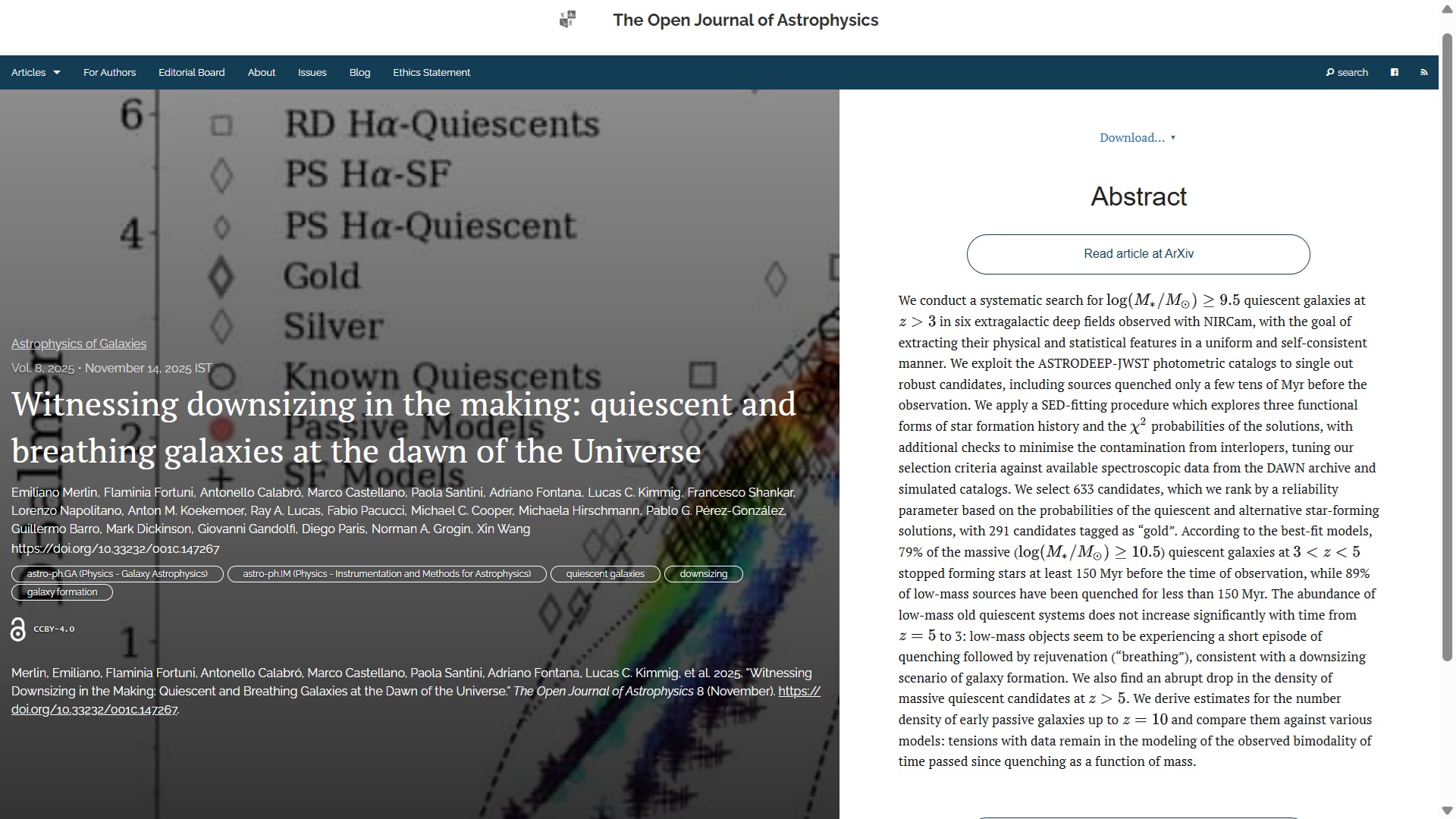
The overlay is here:


The final version is on arXiv here.

The fourth, and final, paper of the week, also published on Thursday 7th August, is “ASASSN-24fw: An 8-month long, 4.1 mag, optically achromatic and polarized dimming event” by Raquel Forés-Toribio (Ohio State University) and 22 others based in the USA, Austria, Chile and Australia. It is published in the folder Solar and Stellar Astrophysics, and it presents an observational study of an unusual dimming event likely to have been caused by eclipsing of a binary system by a dusty disk.

Here is the overlay:

You can find the officially-accepted version on arXiv here.

And that’s all the papers for this week. I’ll do another update next Saturday.
P.S. For those of you who missed the post I did earlier in the week, I have been looking at the accounts for the Open Journal of Astrophysics and can confirm that the cost to us per paper is less than $30 and will reduce with scale. We expect to publish around 180 papers in 2025 for which the total cost incurred by OJAp will be around $5000. Obviously if we increase by a factor, say, ten then that amount would become significant so we are taking steps to secure additional funding in the event that happens.

Weekly Update from the Open Journal of Astrophysics – 02/08/2025

Posted in OJAp Papers, Open Access, The Universe and Stuff with tags , , , , , , , , , , , , , , , , , , , , , , , , , , , , on August 2, 2025 by telescoper

It’s Saturday morning again, and it’s the start of a new month, so it’s time for an update of papers published at the Open Journal of Astrophysics. Since the last update we have published five new papers, which brings the number in Volume 8 (2025) up to 110, and the total so far published by OJAp up to 345. I expect we’ll the total number we published last year (120) sometime this month. I predict that by the end of this year we will have published around 180 papers in Volume 8 and around 400 altogether.

The papers published this week, with their overlays, are as follows. You can click on the images of the overlays to make them larger should you wish to do so.

The first paper to report is “The matter with(in) CPL” by Leonardo Giani (U. Queensland, Australia), Rodrigo Von Marttens (Universidade Federal da Bahia, Brazil) and Oliver Fabio Piattella (Universita degli Studi dell’Insubria, Italy). This was published on Monday 29th July 2025 in the folder Cosmology and Nongalactic Astrophysics. This article presents a new parameterization of the standard model and its implications for the interpretation of cosmological observations.

The overlay is here:


The officially-accepted version can be found on arXiv here.

The second paper of the week, published on Tuesday 30th July in the folder Instrumentation and Methods for Astrophysics, is “An automated method for finding the most distant quasars” by Lena Lenz, Daniel Mortlock, Boris Leistedt & Rhys Barnett (Imperial College London, UK) and Paul C. Hewett (U. Cambridge, UK)”.  This paper presents an automated, reproduceable and objective high-redshift quasar selection pipeline, tested on simulations and real data from the Sloan Digital Sky Survey (SDSS) and UKIRT Infrared Deep Sky Survey (UKIDSS). The overlay is here:


You can find the officially accepted version of the paper on arXiv here.

The third paper of the week is “Early Post Asymptotic Giant Branch Instability: Does it Affect White Dwarf Hydrogen Envelope Mass?” by James MacDonald (University of Delaware, USA). This one was published on Friday 1st Auguest (i.e. yesterday) in the folder Solar and Stellar Astrophysics. It is an investigation into whether Early Post AGB Instability (EPAGBI) can affect determinations of the total abundance of hydrogen in white dwarf stars.

The overlay is here:

The final version is on arXiv here.


The fourth paper of the week, also published on Friday 1st August, is “Light Echoes of Time-resolved Flares and Application to Kepler Data” by Austin King and Benjamin C. Bromley (University of Utah, USA).  This describes a new model for circumstellar disks that incorporates echoes produced by extended, time-resolved flares. It is published in the folder Solar and Stellar Astrophysics. Here is the overlay:

You can find the officially-accepted version on arXiv here.


The fifth and final article published this week, also published on Friday 1st August,  is “Wide Binaries from Gaia DR3 : testing GR vs MOND with realistic triple modelling” by Charalambos Pittordis, Will Sutherland and Paul Shepherd (Queen Mary, University of London, UK). This presents a test for modified gravity from a sample of wide-binary stars from Gaia DR3, finding that (unmodified) Newtonian gravity provides a better fit to the data. It is in the folder Astrophysics of Galaxies.

The overlay is here:


You can find the officially-accepted version on arXiv here.

And that’s all the papers for this week. I’ll do another update next Saturday.
Weekly Update from the Open Journal of Astrophysics – 26/07/2025

Posted in OJAp Papers, Open Access, The Universe and Stuff with tags , , , , , , , , , , , , , , , , , , , , , on July 26, 2025 by telescoper

It’s Saturday morning again, so it’s time again for an update of papers published at the Open Journal of Astrophysics. Since the last update we have published seven new papers, which brings the number in Volume 8 (2025) up to 105, and the total so far published by OJAp up to 340. I expect we’ll pass the century for this year sometime next week. I had expected a bit of a slowdown in July, but that doesn’t seem to have happened. Anyway, with the century for the year having been achieved, the next target is 120 (the total number we published last year). At the current rate I expect us to reach that sometime in August.

The papers published this week, with their overlays, are as follows. You can click on the images of the overlays to make them larger should you wish to do so.

The first paper to report is “Non-equilibrium ionization in the multiphase circumgalactic medium – impact on quasar absorption-line analyses” by Suyash Kumar and Hsiao-Wen Chen (University of Chicago, USA). This was published on Tuesday 22nd July 2025 in the folder Astrophysics of Galaxies. It discusses time-dependent photoionization (TDP) models that self-consistently solve for the ionization state of rapidly cooling gas irradiated by the extragalactic ultraviolet background (UVB) and the application thereof to observed systems.

The overlay is here:

The officially-accepted version can be found on arXiv here.

The second paper of the week, also published on Tuesday 22nd July but in the folder Cosmology and Nongalactic Astrophysics, is “Do We Know How to Model Reionization?” by Nick Gnedin (University of Chicago, USA). This paper discusses the similarities and differences between the radiation fields produced by different numerical simulations of cosmic reionization. The overlay is here:

You can find the officially accepted version of the paper on arXiv here.

The third paper of the week is “The effects of projection on measuring the splashback feature” by Xiaoqing Sun (MIT), Stephanie O’Neil (U. Penn.), Xuejian Shen (MIT) and Mark Vogelsberger (MIT), all based in the USA. This paper describes an investigation whether projection effects could lead to any systematic bias in determining the position of the boundary between infalling and accreting matter around haloes. It was published on Wednesday 23rd July in the folder Astrophysics of Galaxies. The overlay is here:

The officially-accepted version can be found on arXiv here.

The fourth paper of the week, also published on Wednesday 22nd July in the folder Astrophysics of Galaxies, is “Host galaxy identification of LOFAR sources in the Euclid Deep Field North” by Laura Bisigello, Marika Giulietti, Isabella Prandoni, Marco Bondi, & Matteo Bonato (INAF, Bologna, Italy), Manuela Magliocchetti (INAF-IAPS Roma, Italy), Huub Rottgering (Leiden Observatory, Netherlands), Leah, K. Morabito (Durham University, UK) and Glenn, J. White (Open Universirty, UK). This presents a catalogue of optical and near-infrared counterparts to radio sources detected in the Euclid Deep Field North using observations from the LOw-Frequency ARray (LOFAR). The overlay is here:

The final, accepted version of the paper is on arXiv here.

Fifth one up is “Constraining the dispersion measure redshift relation with simulation-based inference” by Koustav Konar (Ruhr University Bochum), Robert Reischke (Universität Bonn), Steffen Hagstotz (Ludwig-Maximilians Universität München), Andrina Nicola (Bonn) and Hendrik Hildebrandt (Bochum); all authors based in Germany. This was published on Thursday 24th July in the folder Cosmology and NonGalactic Astrophysics. It discusses using simulations to develop the use of Dispersion Measures of Fast Radio Bursts as cosmological probes. The overlay is here:

You can find the officially accepted version on arXiv here.

The penultimate (sixth) article published this week is “Generating Dark Matter Subhalo Populations Using Normalizing Flows” by Jack Lonergan (University of Southern California), Andrew Benson (Carnegie Observatories) and Daniel Gilman (University of Chicago), all based in the USA. This paper describes a generative AI approach to subhalo populations, trained using the semi-analytical model Galacticus. This paper was published yesterday (i.e. on Friday 25th July) in the folder Astrophysics of Galaxies.

You can find the final version on arXiv here.

The last article published this week is “21 Balmer Jump Street: The Nebular Continuum at High Redshift and Implications for the Bright Galaxy Problem, UV Continuum Slopes, and Early Stellar Populations” by Harley Katz of the University of Chicago, and 13 others based in the USA, UK, Germany, Denmark and Austria. This discusses the implications of extreme nebular emission for the spectroscopic properties of galaxies, especially at high redshift. It was published on Friday 25th July in the folder Astrophysics of Galaxies.

The overlay is here:

You can find the officially-accepted version on arXiv here.

And that’s all the papers for this week. I’ll do another update next Saturday, when we’ll be into August.