Oysters and Bones

Posted in Biographical, Education, History, Irish Language, Literature with tags , , , on October 20, 2026 by telescoper

A post on Bluesky got me thinking about the origin of the word “oyster”, which I shall bore you with shortly, but the post asks an interesting question about the well-known phrase “The World’s Mine Oyster”. This comes from Shakespeare’s The Merry Wives of Windsor and is spoken to Falstaff by Pistol, a swaggering soldier, in the line:

Why, then the world’s mine oyster, Which I with sword will open.

The meaning it has there is that Pistol thinks he can get whatever he wants by force of arms. In more modern usage, however, it is taken to mean that the speaker has everything on a plate. In modern usage it sometimes appears as “the world is your oyster” which means something like “take your pick”. At some point, it is claimed in the 20th Century, this meaning of this phrase changed. There’s a podcast about this here. How, where and why this happened I don’t know, and I don’t know who does. My usual source for information about things like this is the wonderful Brewer’s Dictionary of Phrase and Fable which has the phrase but sheds no light on its change of meaning. If you can shed light on this, please feel free to comment below through the box below.

Anyway, having had oysters in Ireland a few times – with Guinness, obviously- but not knowing the word in the Irish language, I looked it up: it is oisre. Interestingly close, I thought. So then I looked at the etymology of the English word oyster. This first appeared in Middle English via the Latin ostrea (and probably Norman French). The Latin word is derived from the Classical Greek ὄστρεον (ostreon), which is the origin of many words connected with bone, e.g. osteopath and ossuary. This is presumably because it was thought oyster shells were made of bone or at least bony in appearance.

Just for a laugh, here’s a mediaeval representation of an oyster from a Bestiary:

Incidentally, the Romans used ostrea for mussels as well as oysters. This reminds me of my first year at the Royal Grammar School in Newcastle when we had a history teacher whose name escapes me but whose initials – from and old school report I still have – were `BM’ and who possessed a strong Scottish accent. In the first year we learnt a little bit about the Roman invasion of Britain. BM explained that one of the reasons the Romans came to Britain was that they were looking for “perils”. Although confused, I wrote that down unquestioningly in my exercise book. After the lesson was over I asked a classmate about it and he told me the teacher had meant “pearls”. These were very prized in Rome, and there was a rumour circulating there that they were abundant in Britain. But not in oysters. Freshwater mussels were the source of the perils pearls. I guess the Romans used the same word anyway.

Meanwhile, back at the oysters, I find that the Old English (Anglo-Saxon) word is ostre. This might itself have been borrowed from the Latin, but we know that the ancient Britons were eating oysters long before the Romans arrived. In fact, there are shell middens dating back to the mesolithic period. It seemed to me quite possible, therefore, that the word oyster may predate Classical Latin, and even Greek. The similarity of the Gaelic and Anglo-Saxon words may be because they are both linked to Latin, but look at the word for oyster in other languages, German: Auster, Danish østers, Polish: ostryga, etc. Like words for many things with which Europeans have been familiar with for a very long time indeed, could this one have a proto-Indo-European root? I recently read a fascinating book about this and was captivated by the idea of some of our ancient ancestors, thousands of years ago, eating oysters and using a very similar word to describe them.

It seems it does, but the common ancestor is a word not meaning “oyster” directly but “bone”. The Sanskrit word for “bone” is अस्थि (ásthi), which convinces me of its Indo-European origins. It was perhaps the Greeks, or their ancestors, who first adapted this word to refer to an oyster as a “bony thing”.
(Another) Call for Editors at the Open Journal of Astrophysics!

Posted in Open Access with tags , on October 19, 2026 by telescoper

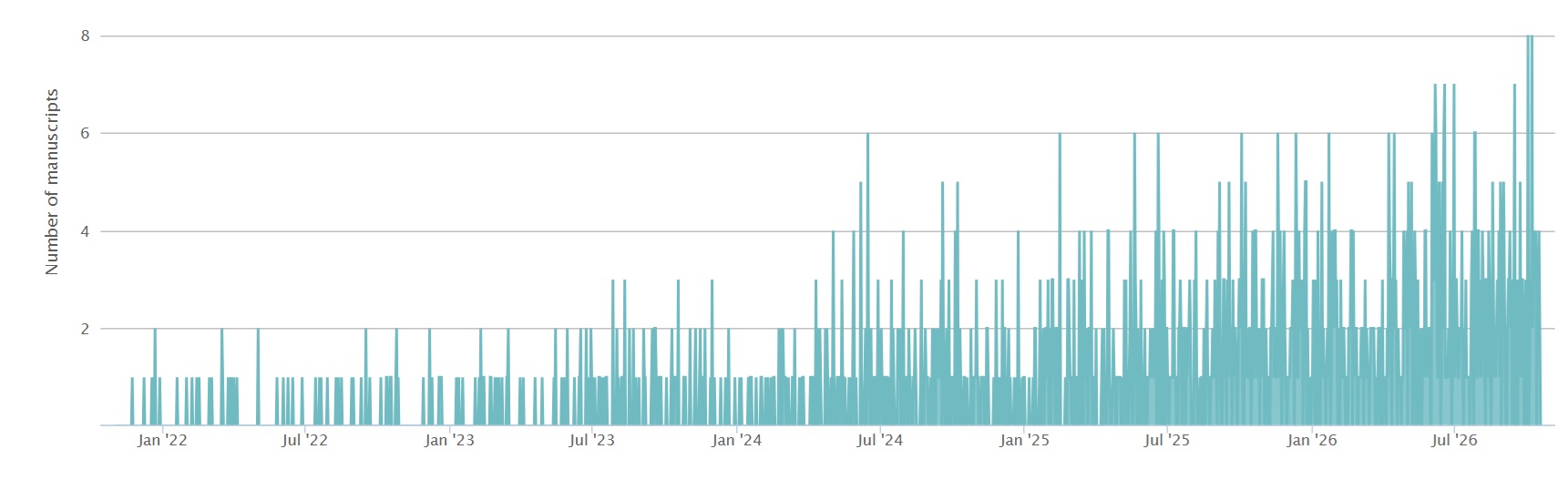
The number of papers being submitted to the Open Journal of Astrophysics continues to rise, as demonstrated by the following graphic which shows the stats for new submissions for the last five years:

It’s very clear that the thicket is getting thicker and thicker as times goes on! The increasing number of articles is of course very welcome indeed, but it is increasing the load on our Editorial Board and that includes me! I think it’s time once again to look for more volunteers to join the team, in any area of astrophysics. As a reminder, here are the areas we cover, corresponding to the sections of astro-ph on the arXiv:

  1. astro-ph.GA – Astrophysics of Galaxies. Phenomena pertaining to galaxies or the Milky Way. Star clusters, HII regions and planetary nebulae, the interstellar medium, atomic and molecular clouds, dust. Stellar populations. Galactic structure, formation, dynamics. Galactic nuclei, bulges, disks, halo. Active Galactic Nuclei, supermassive black holes, quasars. Gravitational lens systems. The Milky Way and its contents
  2. astro-ph.CO – Cosmology and Nongalactic Astrophysics. Phenomenology of early universe, cosmic microwave background, cosmological parameters, primordial element abundances, extragalactic distance scale, large-scale structure of the universe. Groups, superclusters, voids, intergalactic medium. Particle astrophysics: dark energy, dark matter, baryogenesis, leptogenesis, inflationary models, reheating, monopoles, WIMPs, cosmic strings, primordial black holes, cosmological gravitational radiation
  3. astro-ph.EP – Earth and Planetary Astrophysics. Interplanetary medium, planetary physics, planetary astrobiology, extrasolar planets, comets, asteroids, meteorites. Structure and formation of the solar system
  4. astro-ph.HE – High Energy Astrophysical Phenomena. Cosmic ray production, acceleration, propagation, detection. Gamma ray astronomy and bursts, X-rays, charged particles, supernovae and other explosive phenomena, stellar remnants and accretion systems, jets, microquasars, neutron stars, pulsars, black holes
  5. astro-ph.IM – Instrumentation and Methods for Astrophysics. Detector and telescope design, experiment proposals. Laboratory Astrophysics. Methods for data analysis, statistical methods. Software, database design
  6. astro-ph.SR. – Solar and Stellar Astrophysics. White dwarfs, brown dwarfs, cataclysmic variables. Star formation and protostellar systems, stellar astrobiology, binary and multiple systems of stars, stellar evolution and structure, coronas. Central stars of planetary nebulae. Helioseismology, solar neutrinos, production and detection of gravitational radiation from stellar systems.

We are looking for experienced scientists in any of these areas, and it would be useful to have people who can cover a range of subjects (as some of our existing editors do). As I mentioned here, our most popular area is 1 (Astrophysics of Galaxies) but 2 (Cosmology and NonGalactic Astrophysics) is running it a close second. While I would welcome offers from people with expertise in either of those fields, Editors in any of the other areas listed above would be welcome additions. Since we don’t charge authors or readers we can not offer payment to Editors but it is nevertheless a way of providing a service to the community.

If you’re interested, please get in touch either through the Open Journal website here, or through a message Mastodon here, BlueSky here, or LinkedIn here.

Peter Coles
Editor-in-Chief
Open Journal of Astrophysics

This is a version of a piece I posted yesterday on the OJAp blog.

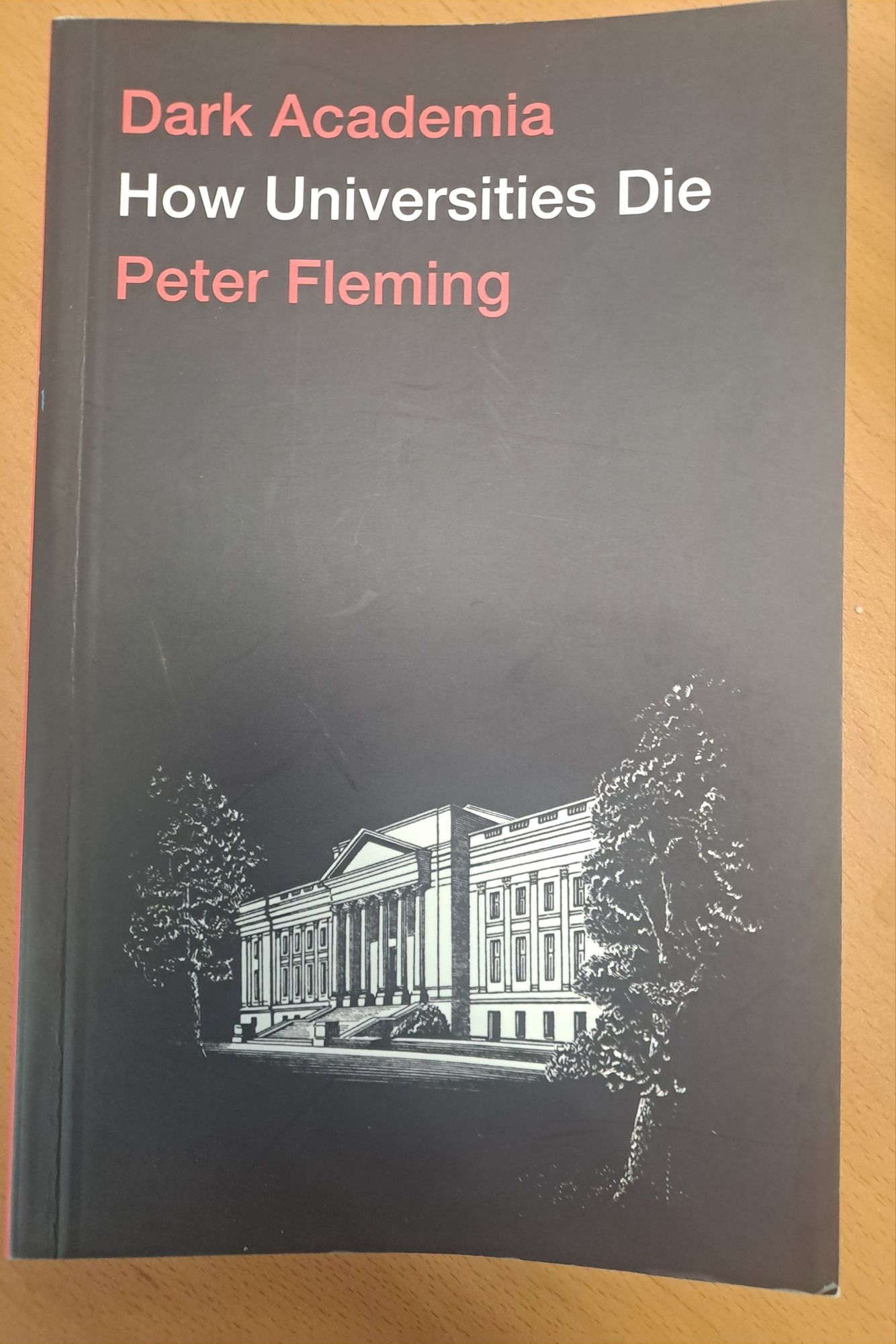
Dark Academia – How Universities Die, by Peter Fleming

Posted in Covid-19, Education, Literature with tags , , , , on October 18, 2026 by telescoper

I ordered this book from our local bookshop a while ago but have only just found time to finish reading it. It’s an analysis of the decline of the neoliberal model of the university accompanied by the rise of commercialisation, managerialism and authoritarian models of governance. At 165 pages, not counting the notes and references, it’s a concise and compelling polemic, full of controlled anger and sprinkled with sardonic wit.

The problem I have in reviewing it is that almost every page contains something that rings so true that I’d want to include a quote. There wouldn’t be any point in doing that as I’d end up quoting almost the entire book, so I decided just to include one excerpt, part of a paragraph in the introduction:

Impersonal and unforgiving management hierarchies have supplanted academic judgement, collegiality and professional common sense. in many institutions, senior executives have no PhDs and have been trained in business or the military instead. Mindless performance targets dominate teaching and research to the point of caricature, designed by functionaries who’ve never taught a class or written a research article in their lives. Unfortunately, these hierarchies have become notoriously bossy. Coercion rather than volition compels much academic labour today, even tasks that scholars would have otherwise done willingly because it’s central to their vocation. This surfeit of duress, most of which is unnecessary and counterproductive, is a defining feature of the corporate university.

The book charts the rise of this fanatical managerialism, the consequent fall of academic institutions as places of education, scholarship and research, and their replacement by soulless teaching factories. I’ve been an academic for almost forty years and I’ve seen this process unfold in real time. As I approach retirement, I deeply regret that I didn’t do more to stop it.

Dark Academia was written around the time of the Covid-19 pandemic and published in 2021 so it does not cover the dreadful collapse of higher education in the UK since then. The author does make some presciently pessimistic comments, but the reality has turned out to be far worse than he imagined.

My own experience of the pandemic here in Maynooth illustrates what went on to a greater or lesser extent throughout the university system, namely that it was seen by Management as an opporunity to strengthen its grip. Staff workloads went through the roof as under-resourced departments struggled to deliver adequate teaching. Seeing that we were on our knees, the powers that be decided it was an ideal opportunity to kick us in the teeth. Witholding replacement positions for two lecturers who left at this time, showed a callous disregard for staff morale and student education alike. Needless to say, the person responsible was promoted.

Since the end of the pandemic, the Management of Maynooth University has been led frog-marched down the path towards Dark Academia. The past few years have been a jamboree for senior administrators, with the creation of umpteen new Vice-Presidents on high salaries and extensive perks, such €500,000 on a luxury chauffeur service and €1M. This profligate expenditure on management bloat has been accompanied by austerity everywhere else, especially for teaching and research. This new configuration of the University is clearly unsustainable. The only question is whether anything can be salvaged from the wreckage when it crashes.

The term The University used to have a collective meaning, referring to all staff and students, not just the leadership, but now it simply means The University Management. For example, it was rumbled last year that Maynooth University had paid €47,000 tax on the President’s behalf. The President eventually paid the bill and an anonymous spokesperson said “The University now considers this matter resolved”. I know I’m not the only person working at Maynooth who doesn’t consider it “resolved”: for one thing, I’d like to know who made the decision to pay the President’s tax bill in the first place; and for another I’d like to know who issued the statement that it was “resolved”. I mention this episode because it exemplifies a phrase used by Peter Fleming at the end of his book. Academics used to be able to say that that they worked “in” a university. Not any more we don’t. We work “under” a university.

I’m not very optimistic that academia can change for the better – I think it’s too far gone – but this book at least identifies most of what is wrong. Perhaps, if enough of us read it, we can start trying to reverse the decline.

Strikes Suspended

Posted in Maynooth, Politics with tags , , , on October 17, 2026 by telescoper

Following Wednesday’s successful one-day stoppage, there were meetings of union members yesterday (Friday) to set up roster’s and make other preparations for similar industrial action on Wednesday 21st October. On Friday evening, however, a message was sent round indicating that next week’s strike action had been suspended on the grounds that a process had been agreed to construct a process for formal pay talks. That announcement made it onto the news last night.

It is of course a good thing that the Government that has decided to move, but it is important to realize that this is not a victory. Nothing has been agreed, and the mandate achieved via balloting is still in place, so the industrial action is suspended rather than cancelled. Unions that were previously working to rule will continue to do so.

Given the antics of the Government over the last few weeks, there isn’t much trust or goodwill going around so they will have to work to restore what they have damaged. There’s more than a suspicion that the Government might just be trying to kick this issue into the long grass (again). Let’s hope that’s not the case, and the negotiators can quickly come up with a deal that is acceptable to union members. If they can’t, we’ll go back to industrial action. One thing the strikes definitely did achieve was to encourage more employees to join a union and build common cause with those who were already members.

We should have been at this point more than six months ago, and I doubt the reason it didn’t was simply sloth (although there’s a lot of that about in Government circles these days). It’s more likely that the Minister for Public Expenditure was posing as a strong man to further his own political ambitions. The Taoiseach himself intervened to set up the process now in place. I don’t know what persuaded him to get involved. The strikes on Wednesday were solid, for one thing, but I suspect of greater importance was the high-level of public support for the strikers. Jack Chambers seemed to be trying to deploy the usual divide-and-conquer approach favoured by his ilk by setting the public against the strikers, but that didn’t work, and without a Plan B he was floundering.

It is uncertain what will happen in the longer term, but next Wednesday’s lectures will go ahead.

Weekly Update from the Open Journal of Astrophysics 17/10/2026

Posted in OJAp Papers, Open Access, The Universe and Stuff with tags , , , , , , , , , , , , , , , , , , on October 17, 2026 by telescoper

It’s Saturday again, so it’s time for another update of activity at the Open Journal of Astrophysics. Since the last update we have published a further eight papers, bringing the number in Volume 9 (2026) to 245 and the total so far published by OJAp up to 693. There was no arXiv update on Monday 12th October owing to a US holiday, and I was on strike on Wednesday 14th October, so there were no papers published on either 13th or 14th October.

I continue to include the posts made on our Mastodon account (on Fediscience); these announcements also contain a clickable form of the DOI for each paper. Our Mastodon account has regular updates and other announcements from OJAp too, including posts from the OJAp blog.

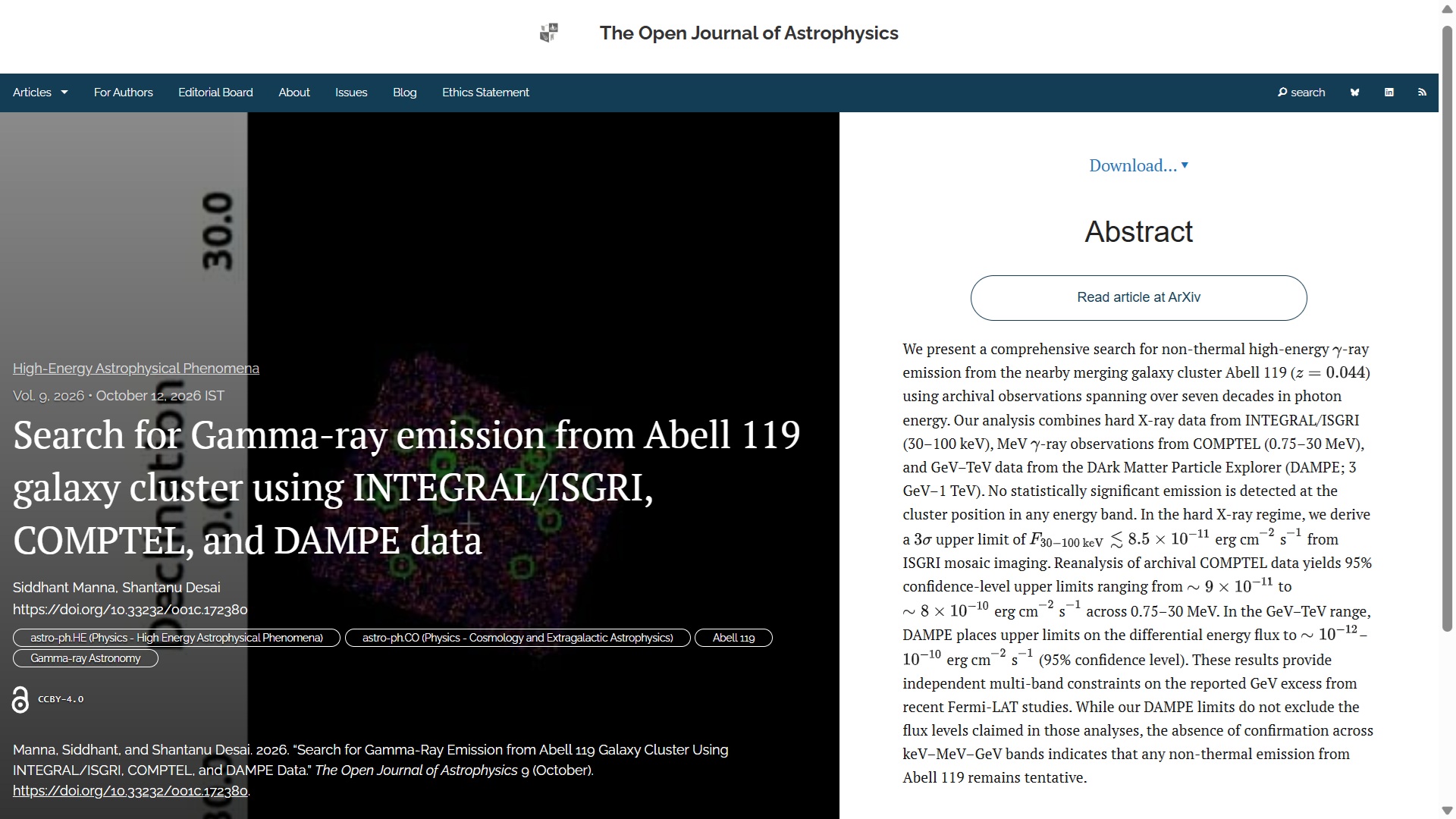
The first new paper this week was published on Monday 12th October in the folder High-Energy Astrophysical Phenomena. The title is “Search for Gamma-ray emission from Abell 119 galaxy cluster using INTEGRAL/ISGRI, COMPTEL, and DAMPE data” by Siddhant Manna & Shantanu Desai (IIT Hyderabad Kandi, India. The study conducted a thorough search for non-thermal high-energy gamma-ray emission from the Abell 119 galaxy cluster using archival observations, but found no significant emission.

The overlay for this one is here:

You can find the officially accepted version on arXiv here and the announcement on Fediverse here:

Open Journal of Astrophysics

New Publication at the Open Journal of Astrophysics: "Search for Gamma-ray emission from Abell 119 galaxy cluster using INTEGRAL/ISGRI, COMPTEL, and DAMPE data" by Siddhant Manna & Shantanu Desai (IIT Hyderabad Kandi, India)

doi.org/10.33232/001c.172380

October 12, 2026, 7:16 am 1 boosts 1 favorites

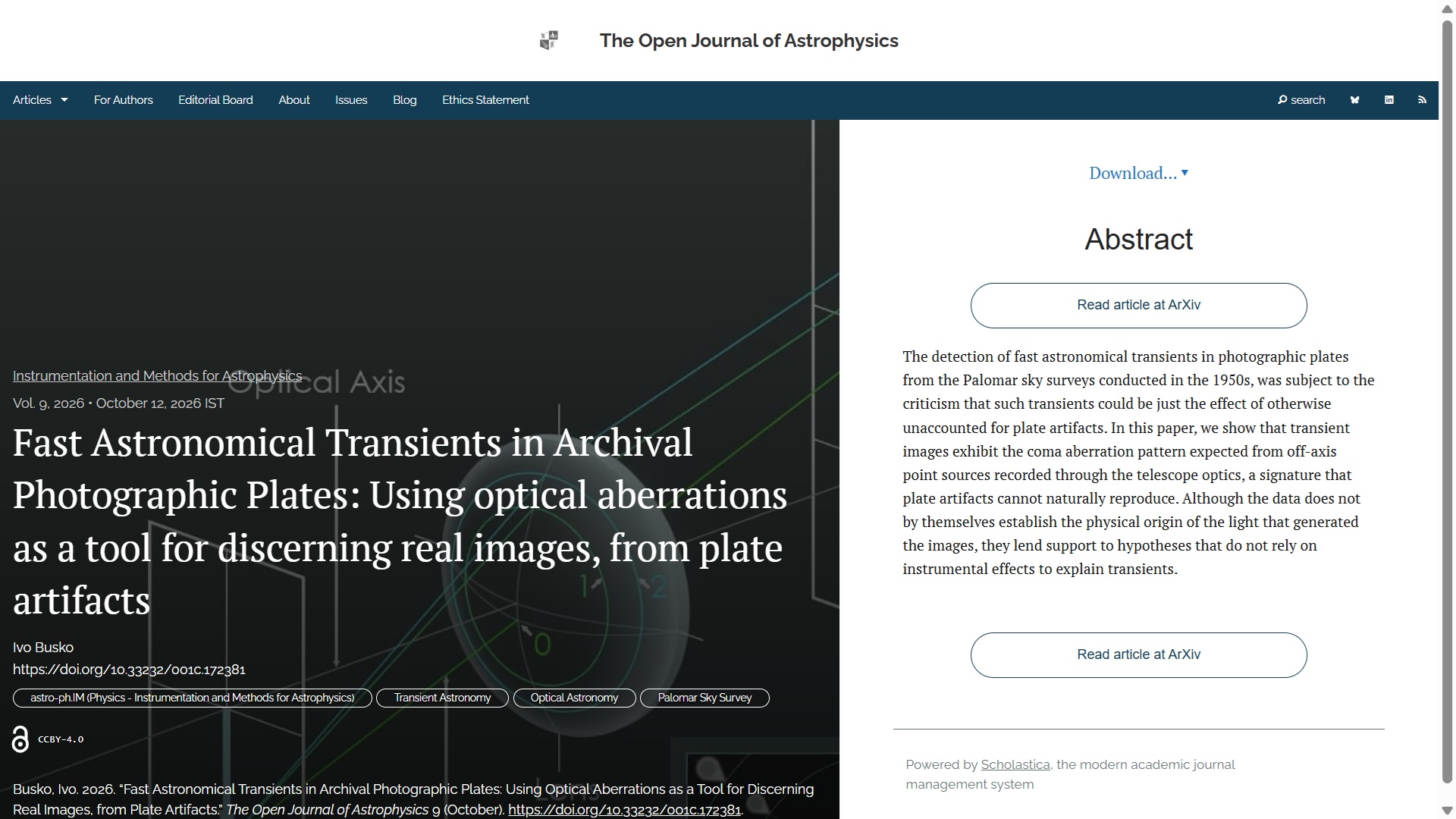
The second paper for this week, also published on Monday 12th October, is “Fast Astronomical Transients in Archival Photographic Plates: Using optical aberrations as a tool for discerning real images, from plate artifacts” by Ivo Busko (Independent Researcher). This study supports the idea that fast astronomical transients detected in 1950s Palomar sky surveys are not just plate artifacts, but potentially genuine off-axis point sources. It is in the folder Instrumentation and Methods for Astrophysics.

The overlay looks like this:

The official version of the paper can be found on arXiv here and the Fediverse announcement here:

Open Journal of Astrophysics

New Publication at the Open Journal of Astrophysics: "Fast Astronomical Transients in Archival Photographic Plates: Using optical aberrations as a tool for discerning real images, from plate artifacts" by Ivo Busko (Independent Researcher)

doi.org/10.33232/001c.172381

October 12, 2026, 7:29 am 1 boosts 0 favorites

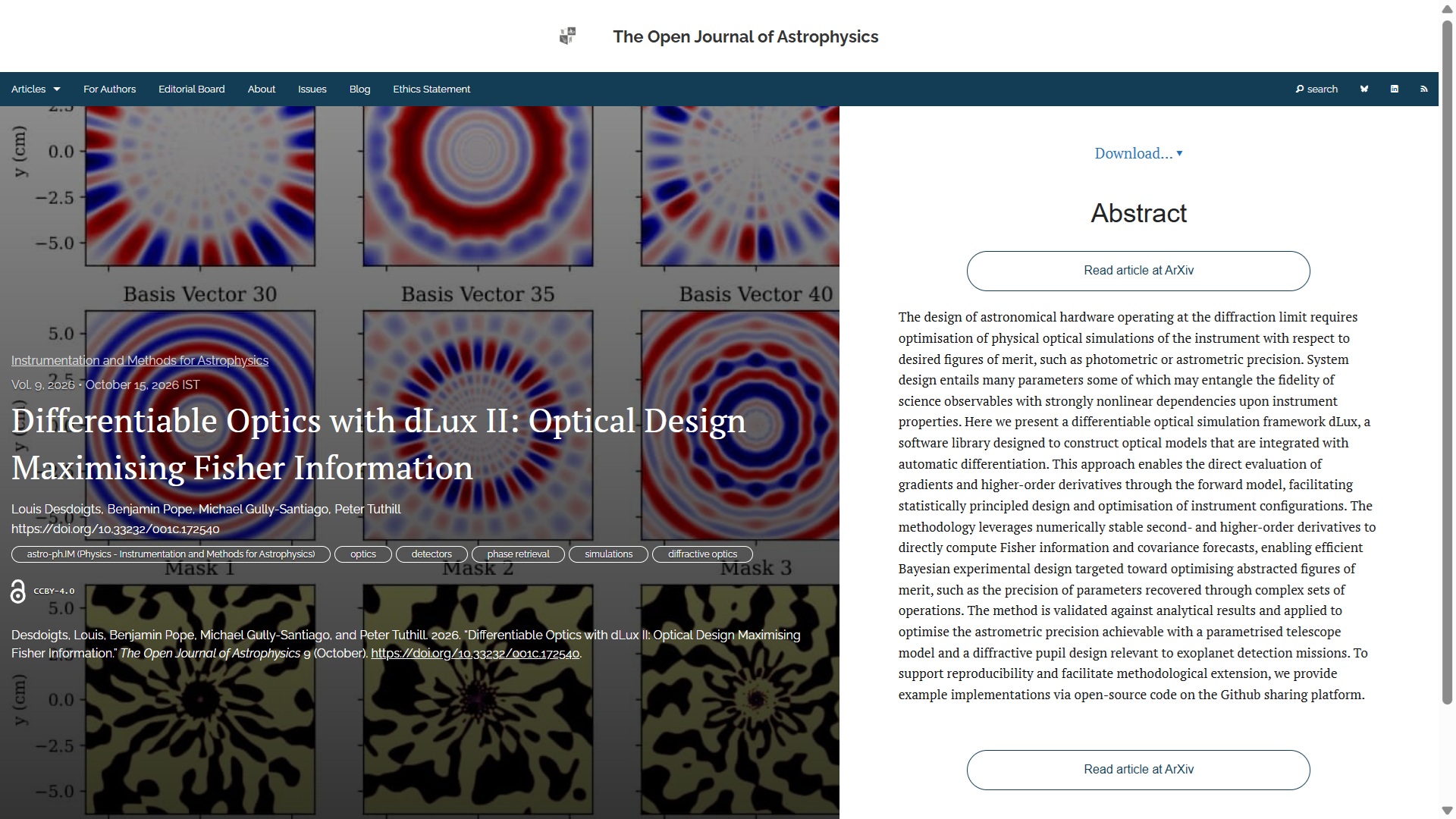
The third paper of the week, published on Thursday 15th October in the folder Instrumentation and Methods for Astrophysics, is “Differentiable Optics with dLux II: Optical Design Maximising Fisher Information” by Louis Desdoigts (Leiden Obs., NL), Benjamin Pope (Macquarie U., AU), Michael Gully-Santiago (U. Texas Austin, USA) & Peter Tuthill (U. Sydney, Australia).

The overlay for this is here:

The accepted version of this one can be found on the arXiv here and the Mastodon announcement here:

Open Journal of Astrophysics

New Publication at the Open Journal of Astrophysics "Differentiable Optics with dLux II: Optical Design Maximising Fisher Information" by Louis Desdoigts (Leiden Obs., NL), Benjamin Pope (Macquarie U., AU), Michael Gully-Santiago (U. Texas Austin, USA) & Peter Tuthill (U. Sydney, AU)

doi.org/10.33232/001c.172540

October 15, 2026, 6:43 am 2 boosts 2 favorites

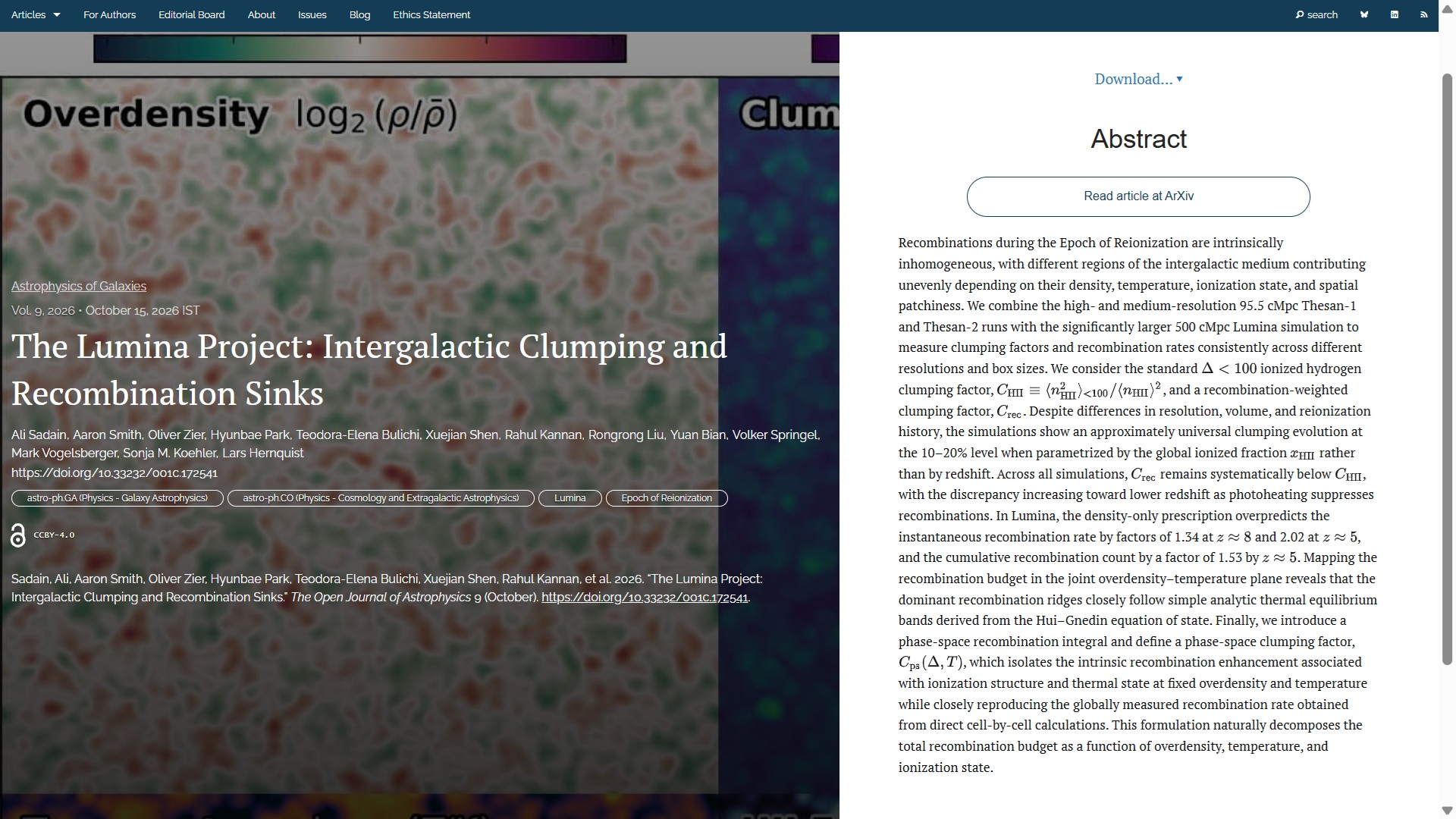
The fourth new article of the week, also published on Thursday 15th October, in the folder Astrophysics of Galaxies is “The Lumina Project: Intergalactic Clumping and Recombination Sinks” by Ali Sadain (U. Texas Dallas, USA) and 12 others based in the USA, S. Korea and Germany. The study uses simulations to examine the uneven recombination rates during the Epoch of Reionization, finding a universal clumping evolution and discrepancies in recombination rates due to photoheating.

The overlay is here:

The official version of the paper can be found on arXiv here and the Fediverse announcement here:

Open Journal of Astrophysics

New Publication at the Open Journal of Astrophysics: "The Lumina Project: Intergalactic Clumping and Recombination Sinks" by Ali Sadain (U. Texas Dallas, USA) and 12 others based in the USA, S. Korea and Germany.

doi.org/10.33232/001c.172541

October 15, 2026, 7:04 am 2 boosts 1 favorites

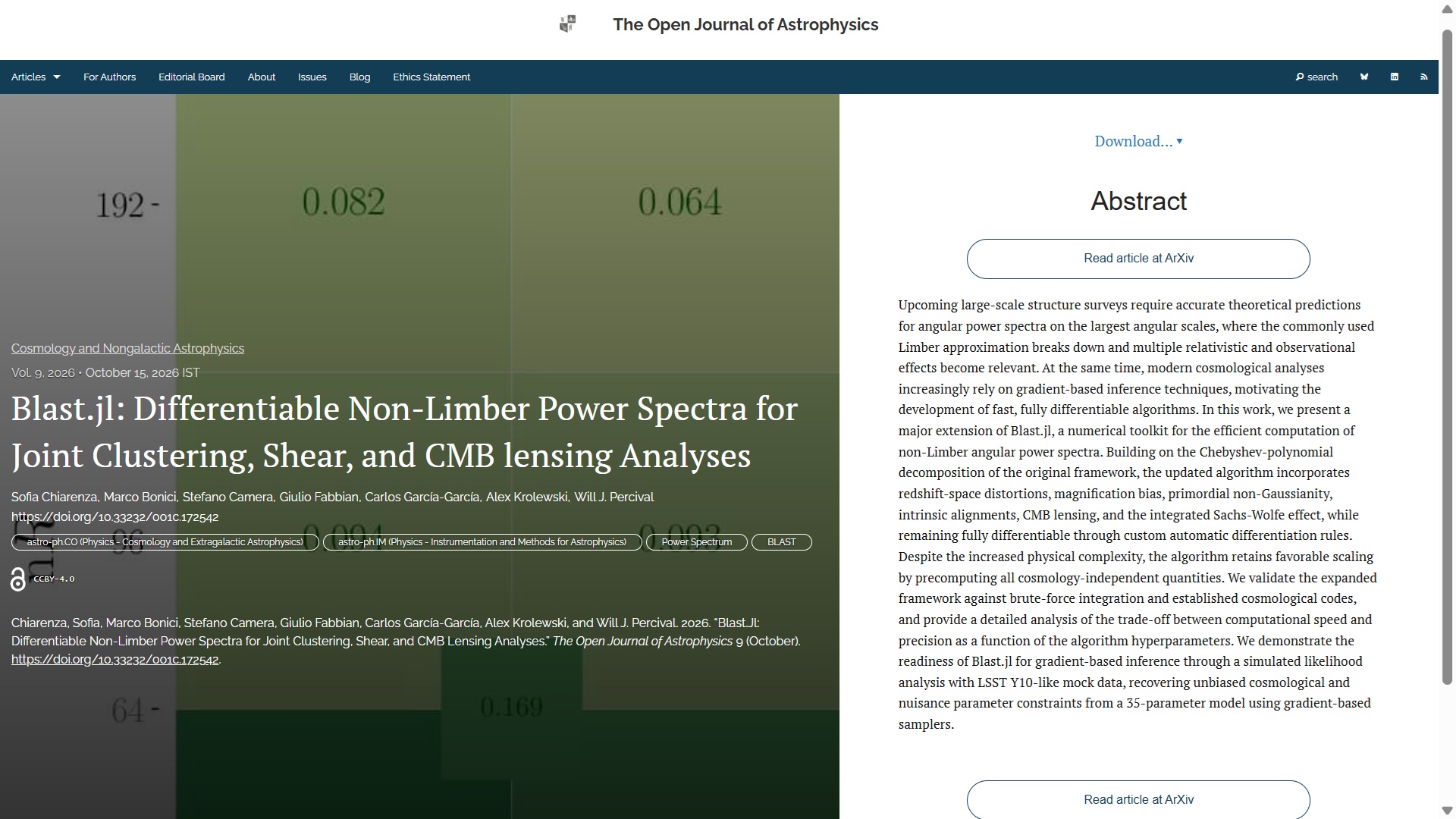
Paper Number Five for the week is “Blast.jl: Differentiable Non-Limber Power Spectra for Joint Clustering, Shear, and CMB lensing Analyses” by Sofia Chiarenza (U. Waterloo, Canada) and 6 others based in Canada, Italy, France and USA. This study, which is in the folder Cosmology and Nongalactic Astrophysics, presents an enhanced version of Blast.jl, a toolkit for computing non-Limber angular power spectra, incorporating various cosmological effects. Despite increased complexity, it maintains efficiency and supports gradient-based inference. It was also published on Thursday 15th October.

The overlay is here:

The officially-accepted version of the paper can be found on arXiv here and the Fediverse announcement here:

Open Journal of Astrophysics

New Publication at the Open Journal of Astrophysics: "Blast.jl: Differentiable Non-Limber Power Spectra for Joint Clustering, Shear, and CMB lensing Analyses" by Sofia Chiarenza (U. Waterloo, Canada) and 6 others based in Canada, Italy, France and USA.

doi.org/10.33232/001c.172542

October 15, 2026, 7:20 am 0 boosts 1 favorites

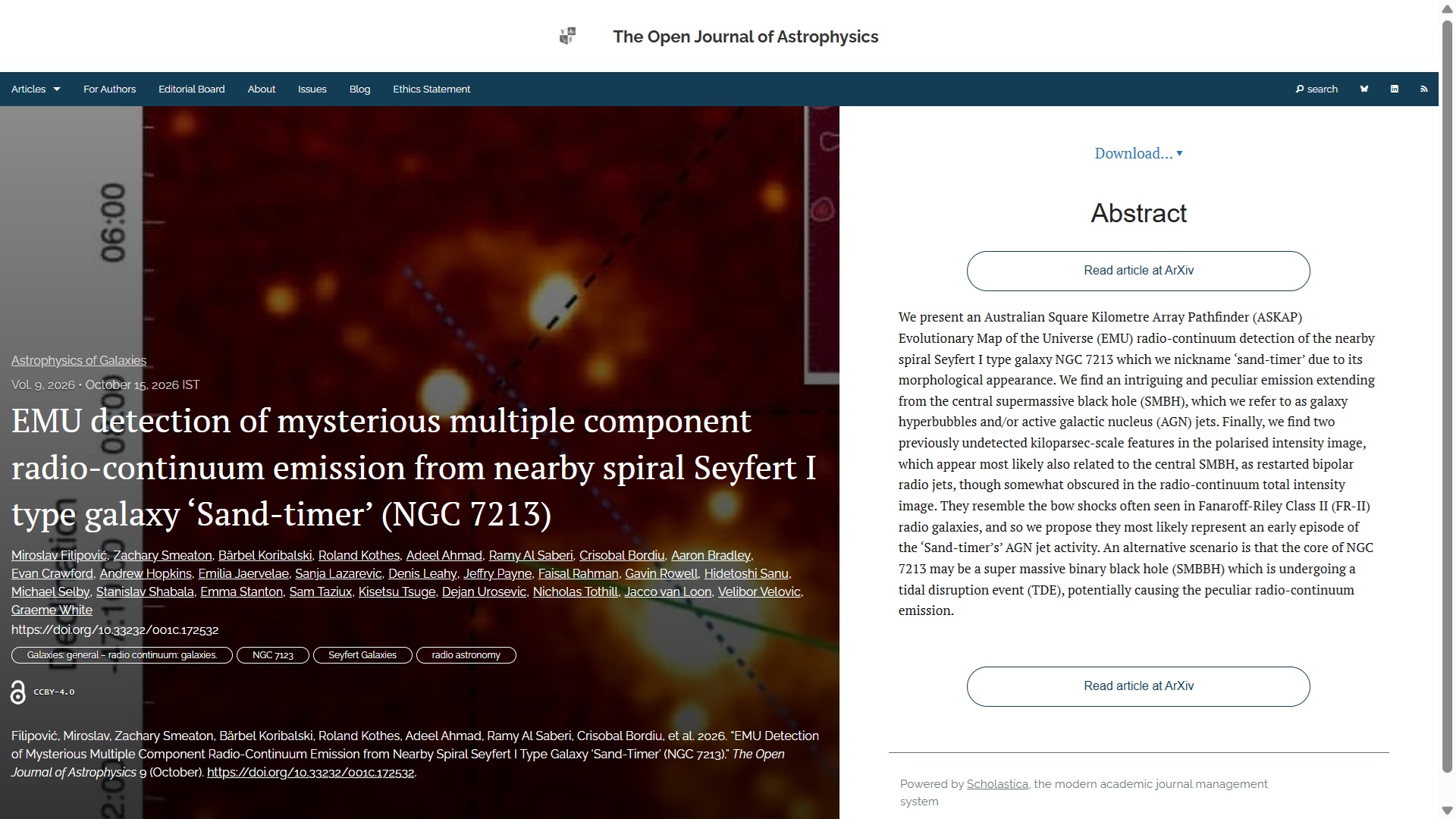
Sixth one up is “EMU detection of mysterious multiple component radio-continuum emission from nearby spiral Seyfert I type galaxy ‘Sand-timer’ (NGC 7213)” by Miroslav Filipović (Western Sydney U., Australia) and an international cast of 26 others. The observations presented in this paper reveal peculiar emissions and previously undetected features in the ‘Sand-timer’ galaxy NGC 7213, possibly due to black hole activity or a tidal disruption event.

The overlay is here:

The officially-accepted version of this paper is on arXiv here and the Mastodon announcement on the fediverse here:

Open Journal of Astrophysics

New Publication at the Open Journal of Astrophysics: "Blast.jl: Differentiable Non-Limber Power Spectra for Joint Clustering, Shear, and CMB lensing Analyses" by Sofia Chiarenza (U. Waterloo, Canada) and 6 others based in Canada, Italy, France and USA.

doi.org/10.33232/001c.172542

October 15, 2026, 7:20 am 0 boosts 1 favorites

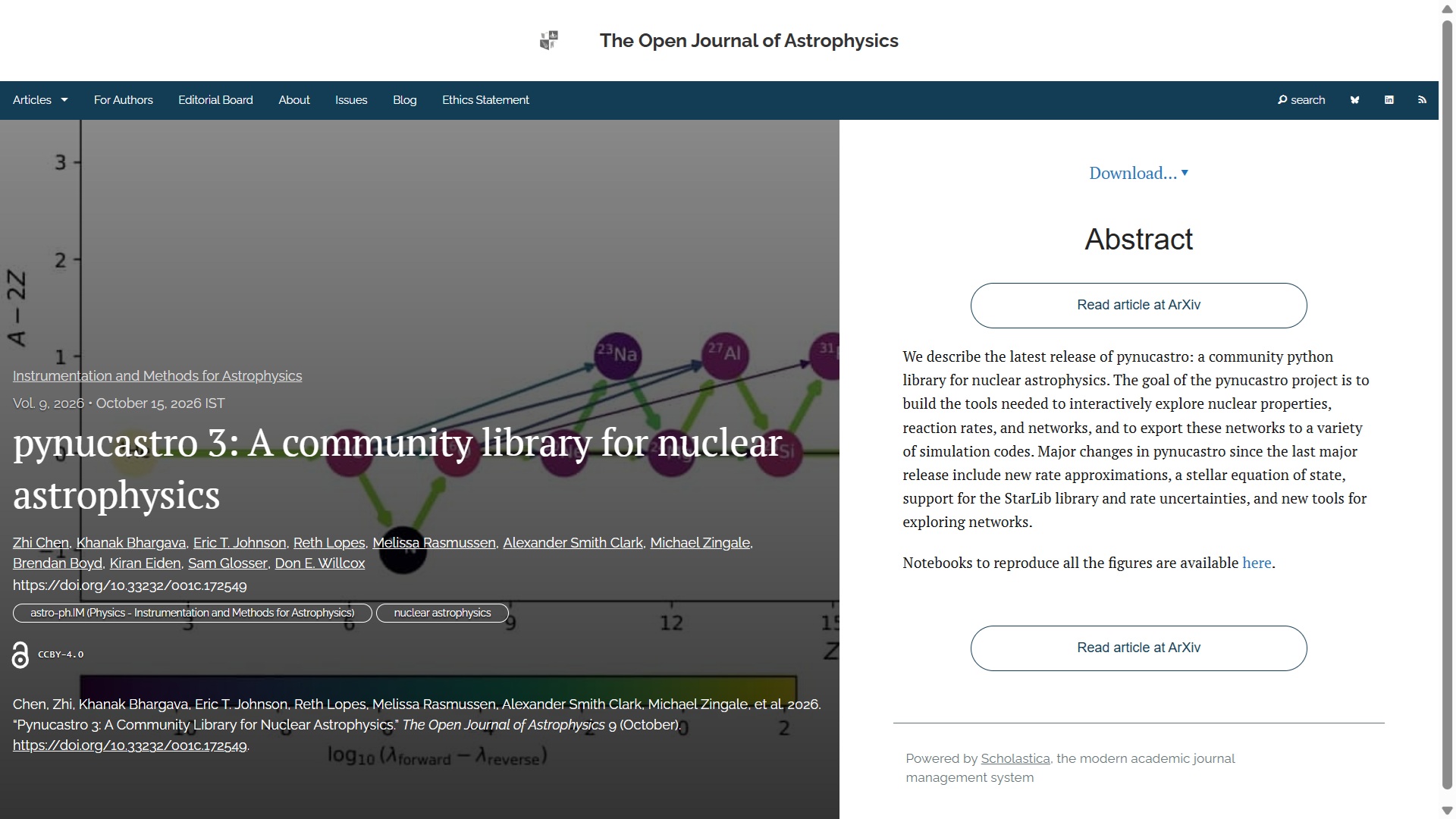
The seventh paper of the week is “pynucastro 3: A community library for nuclear astrophysics” by Zhi Chen (Stony Brook U., USA) and 10 others, all based in the USA. This was published on Friday 16th October, i.e. yesterday, in the folder Instrumentation and Methods for Astrophysics. This article announces the latest release of pynucastro, a python library for nuclear astrophysics, includes new rate approximations, a stellar equation of state, StarLib support, and network exploration tools.

The overlay is here:

The officially accepted version is on arXiv here and the Mastodon announcement here:

Open Journal of Astrophysics

New Publication at the Open Journal of Astrophysics: "pynucastro 3: A community library for nuclear astrophysics" by Zhi Chen (Stony Brook U., USA) and 10 others, all based in the USA.

doi.org/10.33232/001c.172549

October 15, 2026, 11:45 am 3 boosts 4 favorites

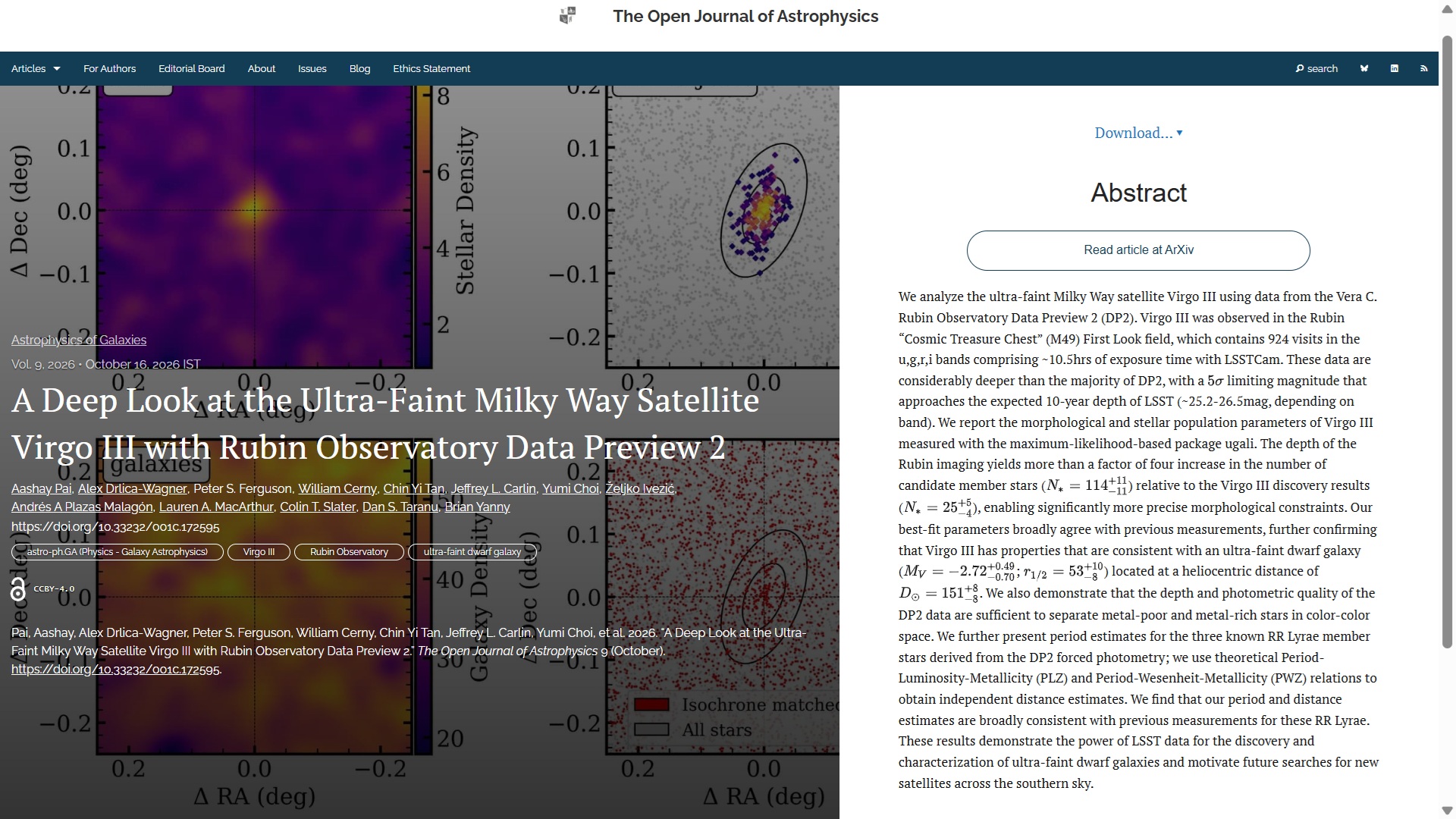
The eighth, and last, of the new papers for this week is “A Deep Look at the Ultra-Faint Milky Way Satellite Virgo III with Rubin Observatory Data Preview 2” by Aashay Pai (U. Chicago, USA) and 12 others based in the USA. This study uses data from the Vera C. Rubin Observatory to analyze the ultra-faint Milky Way satellite, Virgo III, confirming Virgo III’s properties as an ultra-faint dwarf galaxy.

The overlay is here:

The final version of this paper is on the arXiv here and the Mastodon announcement here:

Open Journal of Astrophysics

New Publication at the Open Journal of Astrophysics: "A Deep Look at the Ultra-Faint Milky Way Satellite Virgo III with Rubin Observatory Data Preview 2" by Aashay Pai (U. Chicago, USA) and 12 others based in the USA.

doi.org/10.33232/001c.172595

October 16, 2026, 7:04 am 1 boosts 1 favorites

That concludes this week’s update. I anticipate that we’ll pass the 250 mark for 2026 next week, which means we’re well on target to publish over 300 papers and reach the 750 mark by the end of the year. I’ll do another update next weekend.

It’s Hamilton Day!

Posted in Euclid, History, mathematics with tags , , , , , on October 16, 2026 by telescoper
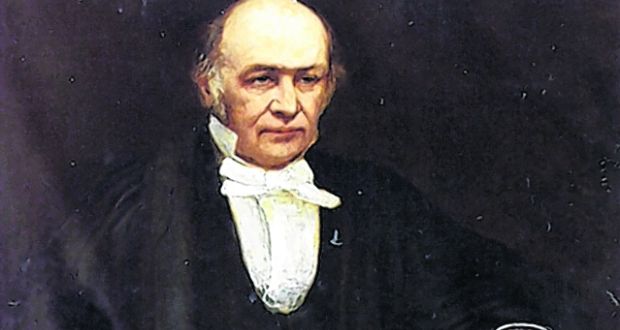
Sir William Rowan Hamilton (1805-1865)

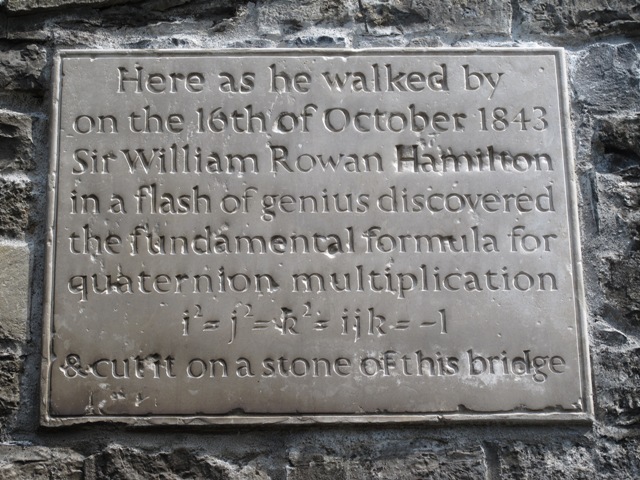
Today, October 16th, is Hamilton day! It was on this day 183 years ago, in 1843, that  William Rowan Hamilton first wrote down the fundamental result of quaternions. Apparently he was walking from his residence at Dunsink Observatory into Dublin when he had a sudden flash of inspiration, and wrote the result down on the spot, now marked by a plaque:


Picture Credit: Brian Dolan

This event is commemorated by an annual Hamilton Walk. Broombridge railway station (Droichead Broome), near the bridge (Broom Bridge), where Hamilton had his Eureka moment, is not far from Maynooth University the main commuter line from Maynooth into Dublin. This is ironic because Quaternion algebra does not commute. (Geddit?)

You may be interested that quaternions form the core mathematical framework used in the Euclid satellite’s telemetry system to represent and control its attitude (pointing direction and orientation). I also make extensive use of quaternions in preparing my tax return.

Although it is quite easy to reach Broombridge from Maynooth, I have never managed to attend the walk nor any of the other celebratory events because I’ve either been away or teaching. Perhaps one of these years, after I’ve retired, I’ll be able join the walk or attend one of the various ectures.

P.S. Maynooth University is also home to the Hamilton Institute which promotes and facilitates research links between mathematics and other fields.

The Sopranist

Posted in LGBTQ+, Opera with tags , , , , , on October 15, 2026 by telescoper

A while ago I was listening to a radio broadcast of a recording from last year’s Wexford Festival Opera. The Opera in question was Handel’s Deidamia. In fact you can see a video of the whole performance here. Like most baroque operas, the plot of Deidamia is rather complex but it is drawn directly from familiar Greek legend, and features Achilles and Ulysses. The former spends much of the opera dressed in women’s clothing because his father Peleus doesn’t want him dragged off to fight in the Trojan War and has hidden him on the island of Skyros among the daughters of his friend Lycomedes. Eventually Ulysses lands on Skyros to try to persuade Achilles to lead his army, but the disguise is so good that he fails to identify him. He does however develop a bit of a crush on the hot young girl Pyrrha, who is actually Achilles in drag…

I won’t give any more spoilers because the Opera Deidamia is not really the point of this post, which is that the part of Pyrrha is written for a soprano. It’s not unusual in Handel’s operas for a male part to be sung by a woman – as indeed this part was when it was first performed in London in January 1741 or a castrato. The practice of castrating boys to prevent their voices breaking has long been discontinued, thankfully, so I assumed that the voice I had been listening to was that of a female singer. Then, in the interval, I learnt that this part was actually sung by a man, Bruno de Sá. Here he is in a short clip from that production.

Bruno de Sá is a sopranist, a man whose modal voice is in the soprano register, i.e. he sings that high without using falsetto. I’ve seen and heard quite a few operas in my time but I didn’t realise that there was such a thing as a sopranist. You live and learn!

I did a bit of searching on the interwebs and found the following clip which shows another sopranist, Samuel Mariño, having fun in a duet with an oboist at a concert in Versailles:

Samuel Mariño is from Venezuela. He is gay and was bullied at school when he was young for that, and for the fact that his voice didn’t break when he reached adolescence. He sought medical advice to see if he could have surgery to lower his voice, but the doctor instead suggested he embark on a career as an opera singer. And that’s what he did. Don’t be fooled by the fun he is having in that clip; he’s not some sort of novely act, he’s a very serious vocal artist.

I find his story very inspiring because of his determination to follow his own path and I love the above clip because it is so joyful. It warms this old gay’s heart to see someone daring to be different and making such a success of it.

Sonnet No. 104

Posted in Poetry with tags , on October 14, 2026 by telescoper
To me, fair friend, you never can be old,
For as you were when first your eye I ey'd,
Such seems your beauty still. Three winters cold,
Have from the forests shook three summers' pride,
Three beauteous springs to yellow autumn turn'd,
In process of the seasons have I seen,
Three April perfumes in three hot Junes burn'd,
Since first I saw you fresh, which yet are green.
Ah! yet doth beauty like a dial-hand,
Steal from his figure, and no pace perceiv'd;
So your sweet hue, which methinks still doth stand,
Hath motion, and mine eye may be deceiv'd:
For fear of which, hear this thou age unbred:
Ere you were born was beauty's summer dead.

by William Shakespeare (1564-1616)

A Good Strike Day

Posted in Maynooth, Politics with tags , , , , on October 14, 2026 by telescoper

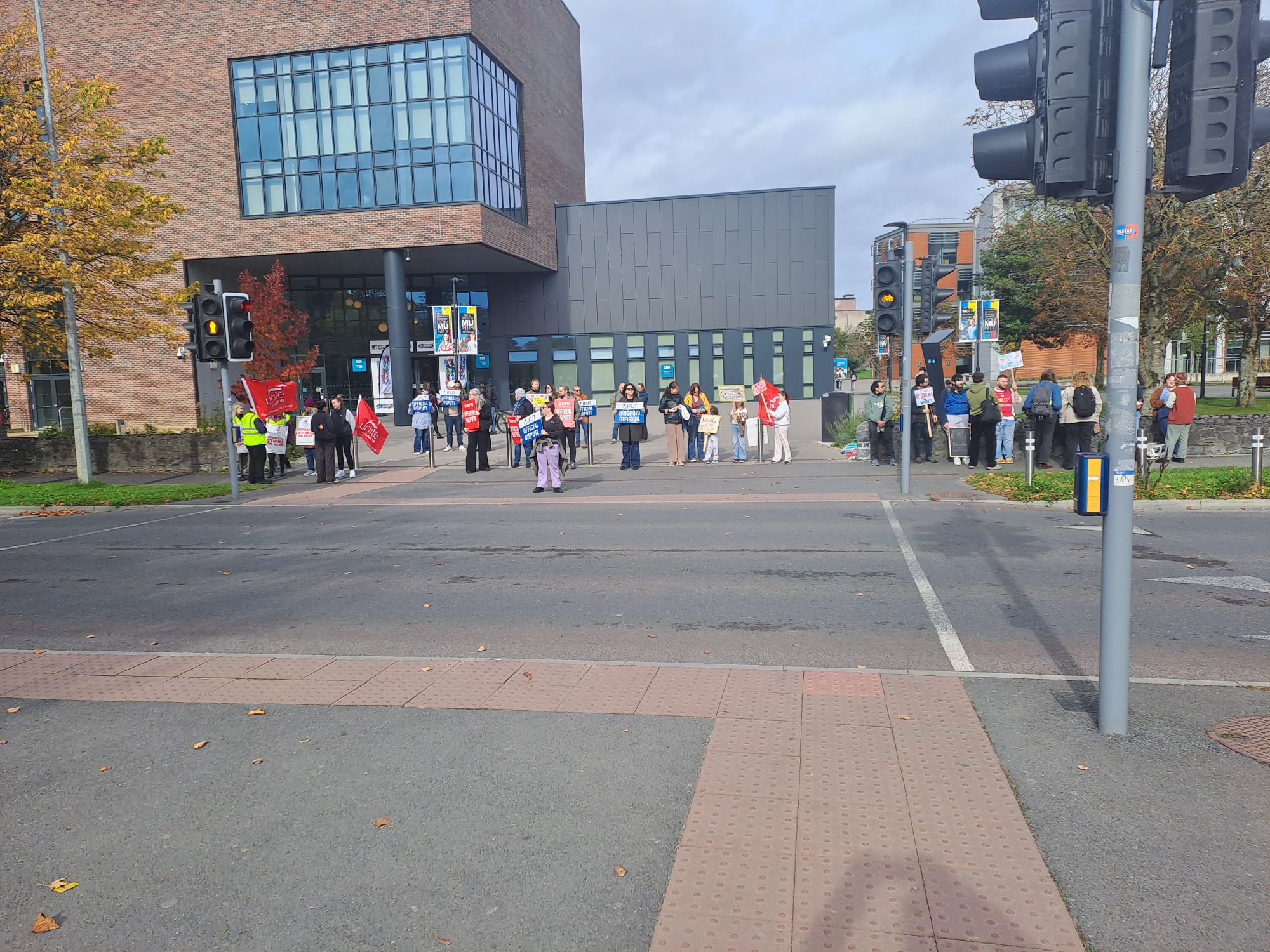
I was a little apprehensive when I made my way early this morning to Maynooth University Campus because I wasn’t sure how strong the turnout would be on the picket line for today’s one-day strike. I needn’t have worried, actually, because the attendance was very good at all the locations where pickets were stationed and everyone was in good spirits.

It was a bit breezy, which made for some difficulties with flags and placards, but it was a very enjoyable day all round, with a real sense of camaraderie among the pickets as well as a very positive reaction from the general public. I lost count of the number of vehicles whose drivers honked their support as they passed the picket line! I was happy too that the whole day passed off without any significant incidents.

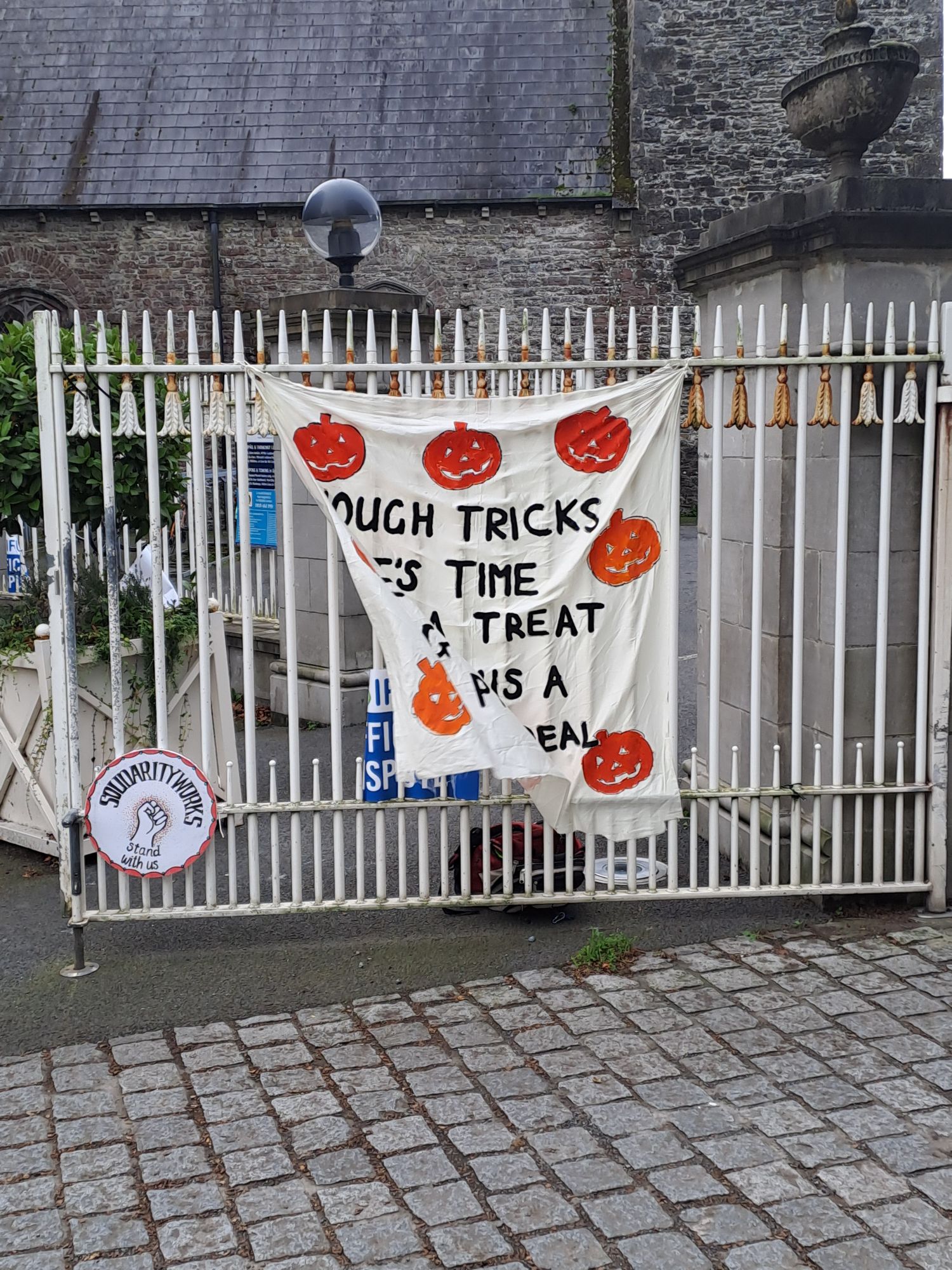
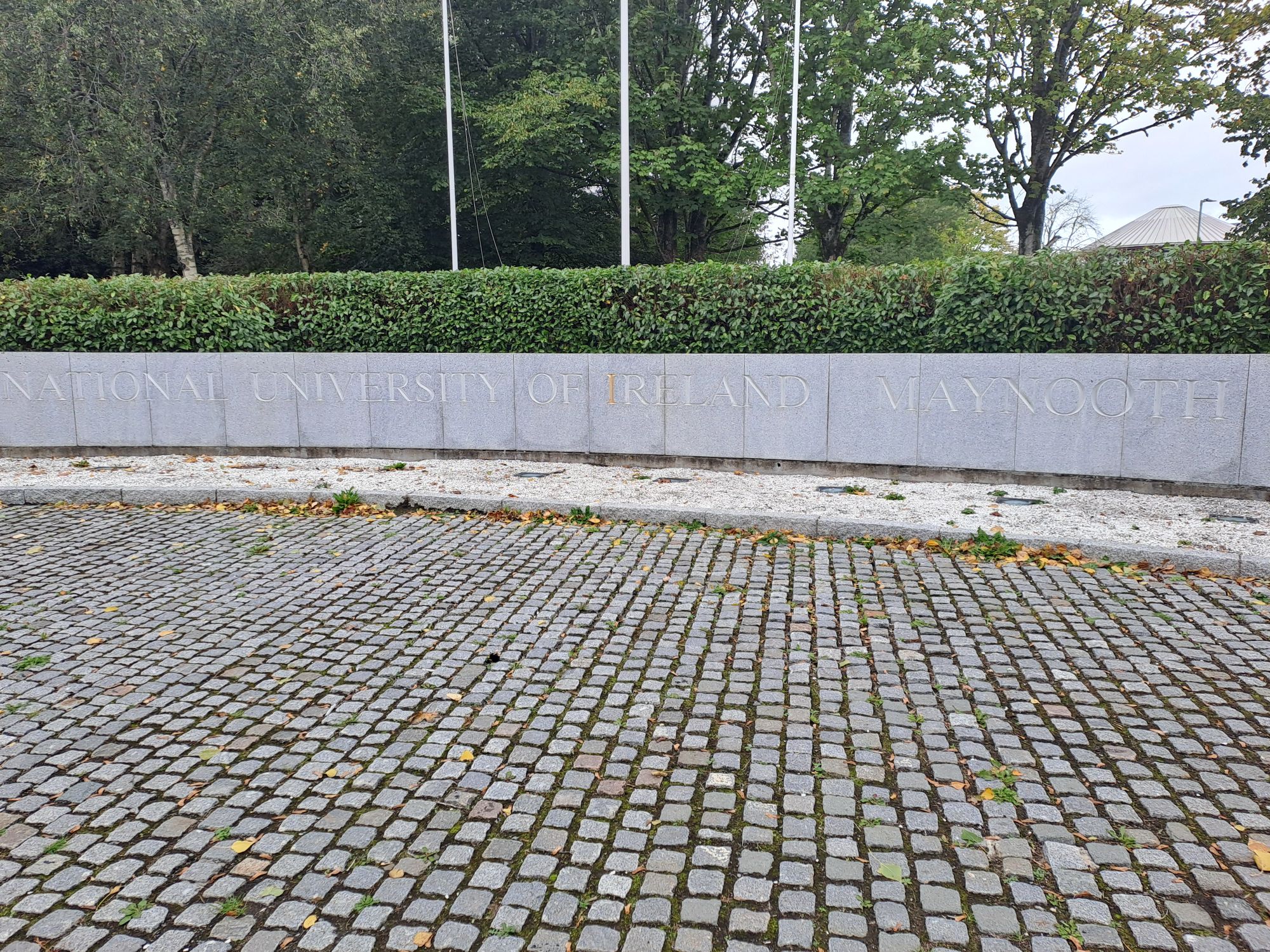
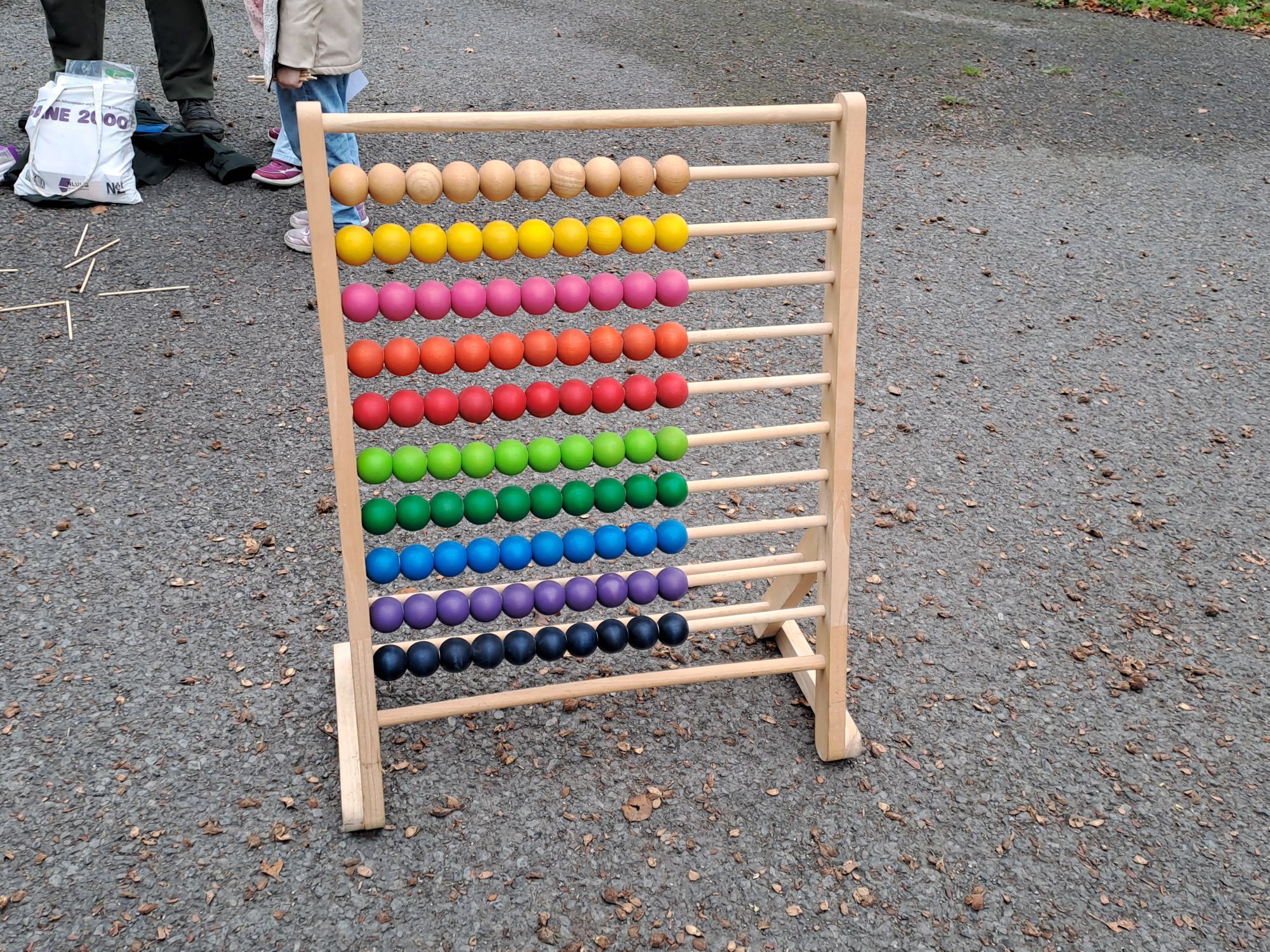
Here are a few random pictures I took, including a rare selfie.

I’ll leave it to you, dear reader, to figure out why the abacus was there!

I’d like to thank all the members of IFUT, SIPTU and Unite who turned out today and an extra thank-you goes to the members of Maynooth Students’ Union who brought us hot drinks and snacks.

As well as showing solidarity with the other public sector workers striking today, this was a very good day for building connections among people working at Maynooth. I think these will prove very important in the future, including next Wednesday when, unless the Government changes its position, we will have another 24-hour stoppage.

All in all, it was a very good day. I am, however, not to put too fine a point on it, somewhat knackered. I think an early night beckons.

Hymn for Today

Posted in Music with tags , on October 14, 2026 by telescoper

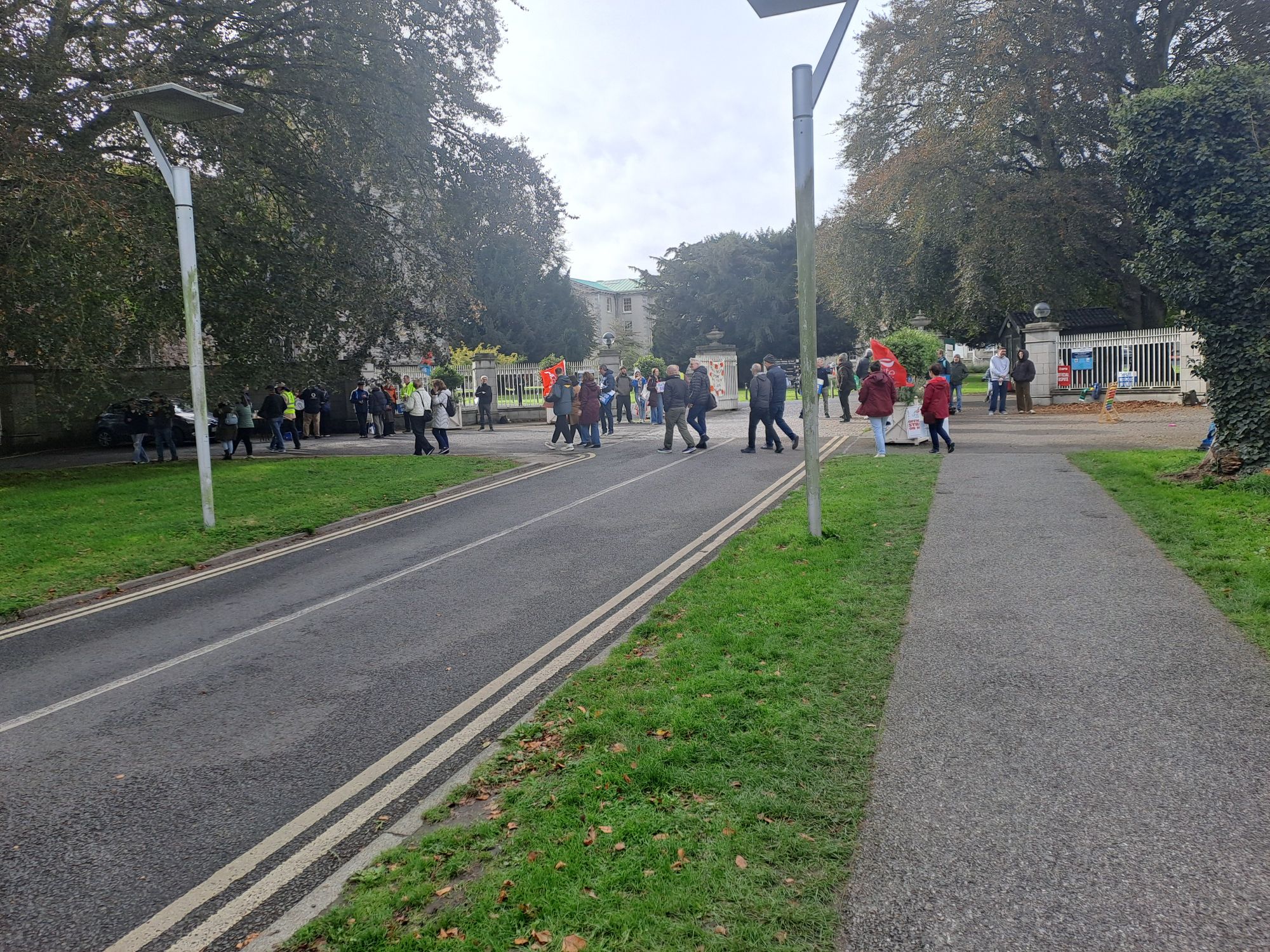
The hymn chosen for today’s service is No. 296 from Hymns Ancient and Modern For all the saints who from their labours rest. This is usually song on All Saints Day (November 1st) but is topical because of today’s public sector strike. The illustration shows an impressive picket line!