Archive for Self-Organizing Maps

Weekly Update from the Open Journal of Astrophysics 01/08/2026

Posted in OJAp Papers, Open Access, The Universe and Stuff with tags , , , , , , , , , , , , , , , , , , , , on August 1, 2026 by telescoper

It’s time once more for another Saturday update of activity at the Open Journal of Astrophysics. Since the last update we have published a further three papers, bringing the number in Volume 9 (2026) to 163 and the total so far published by OJAp up to 611.

I continue to include the posts made on our Mastodon account (on Fediscience); these announcements also show the DOI for each paper.

The first paper to report this week was published on Tuesday 28th July in the folder Cosmology and Nongalactic Astrophysics. “The Origins of the Bulk Flow” by Richard Watkins & Trajan Clark (Willamett U., USA) and Hume A Feldman (U. Kansas, USA) analyzes the origin of large-scale bulk flow using the CosmicFlows-4 catalog, finding that it is largely influenced by structures beyond 200 h-1 Mpc, challenging previous assumptions.

The overlay for this paper is here

You can find the officially accepted version on arXiv here and the announcement on Fediverse here:

Open Journal of Astrophysics

New Publication at the Open Journal of Astrophysics: "The Origins of the Bulk Flow" by Richard Watkins & Trajan Clark (Willamett U., USA) and Hume A Feldman (U. Kansas, USA).

doi.org/10.33232/001c.165870

July 28, 2026, 8:30 am 1 boosts 0 favorites

The second paper for this week, also published on Tuesday 28th July in the folder Cosmology and Nongalactic Astrophysics is: “Enhancing weak lensing redshift distribution characterization by optimizing the Dark Energy Survey Self-Organizing Map Photo-z method” by A. Campos (Carnegie Mellon U., USA) and the DES collaboration (113 authors). This study improves the Self-Organizing Map methodology for estimating redshift distribution in galaxies, notably reducing overlap between redshift bins, in preparation for the Dark Energy Survey Year 6 data.Abstractfor Enhancing weak lensing redshift distribution characterization by optimizing the Dark Energy Survey Self-Organizing Map Photo-z method.

The overlay looks like this:

The official version of the paper can be found on arXiv here and the Fediverse announcement here:

Open Journal of Astrophysics

New Publication at the Open Journal of Astrophysics: "Enhancing weak lensing redshift distribution characterization by optimizing the Dark Energy Survey Self-Organizing Map Photo-z method" by A. Campos (Carnegie Mellon U., USA) and the DES collaboration (113 authors)

doi.org/10.33232/001c.165871

July 28, 2026, 8:45 am 1 boosts 1 favorites

The third paper of the week, published on Thursday 29th July in the folder Instrumentation and Methods for Astrophysics is “The Ray Tracing Sampler: Bayesian Sampling of Neural Networks for Everyone” by Peter Behroozi of the University of Arizona (USA). This paper presents a new family of Markov Chain Monte Carlo sampling methods based on ray tracing, offering higher resilience to heating for stochastic gradients and other advantages.

The overlay for this one is here:

The final, accepted version can be found on arXiv here and the Mastodon announcement is here:

Open Journal of Astrophysics

New Publication at the Open Journal of Astrophysics: "The Ray Tracing Sampler: Bayesian Sampling of Neural Networks for Everyone" by Peter Behroozi (U. Arizona, USA)

doi.org/10.33232/001c.165932

July 29, 2026, 9:10 am 0 boosts 1 favorites

That’s all for this week. It’s been a bit slower than previous weeks no doubt because of the holiday season.
New Publication at the Open Journal of Astrophysics

Posted in OJAp Papers, Open Access, The Universe and Stuff with tags , , , , on June 13, 2023 by telescoper

It’s time to announce yet another new paper at the Open Journal of Astrophysics. This one was published on Friday 9th June.

The latest paper is the 19th paper so far in Volume 6 (2023) and the 84th in all,  so with more than half of 2023 remaining and many papers still in the pipeline we’re on track to reach a total of 100 papers by the end of 2023!

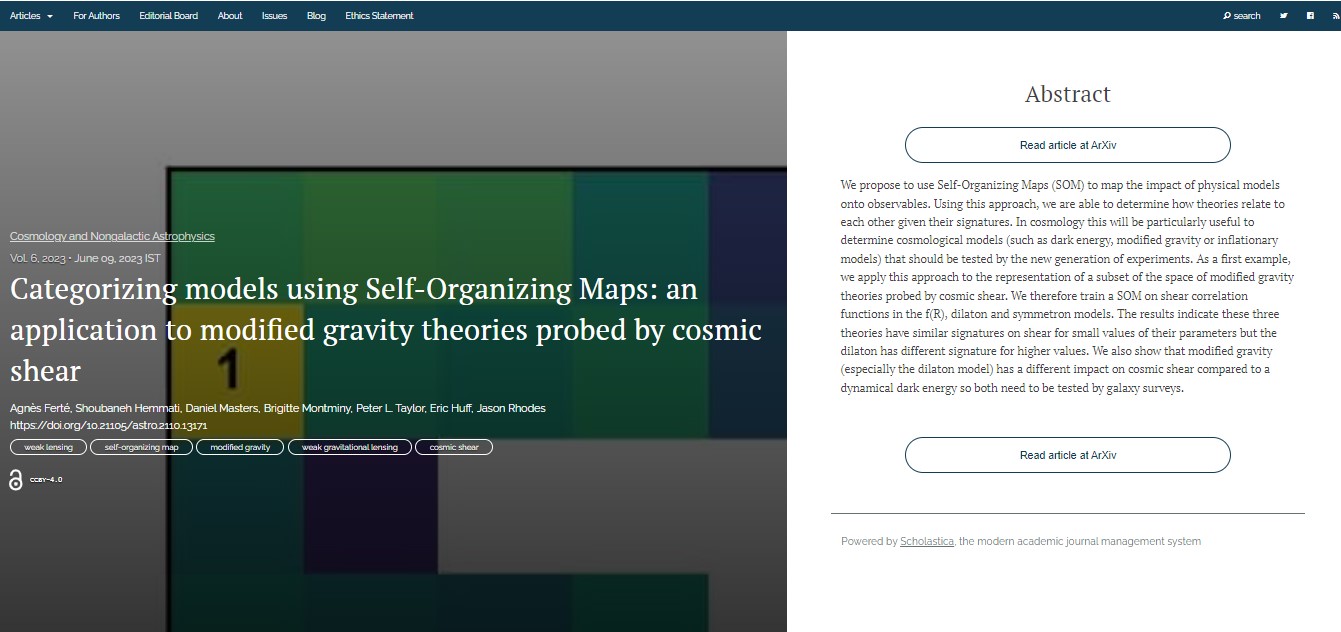
The primary classification for this paper is Cosmology and Nongalactic Astrophysics and its title is “Categorizing models using Self-Organizing Maps: an application to modified gravity theories probed by cosmic shear”. For the uninitiated, a Self-Organizing Map is a machine-learning technique that makes large-dimensional data sets easier to analyze. This paper is yet another one about weak gravitational lensing (cosmic shear), which is obviously what the cool kids do these days.

The authors are: Agnès Ferté (JPL); Shoubaneh Hemmati (IPAC); Daniel Masters (IPAC); Brigitte Montminy (JPL); Peter L. Taylor (JPL); Eric Huff (JPL);  and Jason Rhodes (JPL).

(JPL=Jet Propulsion Laboratory, IPAC= Infrared Processing & Analysis Center, both associated with California Institute of Technology, Pasadena, USA)

Here is a screen grab of the overlay which includes the  abstract:


You can click on the image of the overlay to make it larger should you wish to do so. You can find the officially accepted version of the paper on the arXiv here.

P.S. The first author tweeted about this paper: