Archive for the Open Access Category

Weekly Update at the Open Journal of Astrophysics – 08/03/2025

Posted in OJAp Papers, Open Access, The Universe and Stuff with tags , , , , , , , , , , , , , , , , , , , , on March 8, 2025 by telescoper

Time for the weekly Saturday morning update of papers published at the Open Journal of Astrophysics. Since the last update we have published four new papers, which brings the number in Volume 8 (2025) up to 25 and the total so far published by OJAp up to 260.

In chronological order of publication, the four papers published this week, with their overlays, are as follows. You can click on the images of the overlays to make them larger should you wish to do so.

The first paper to report is “Partition function approach to non-Gaussian likelihoods: information theory and state variables for Bayesian inference” by Rebecca Maria Kuntz, Heinrich von Campe, Tobias Röspel, Maximilian Philipp Herzog, and Björn Malte Schäfer, all from the University of Heidelberg (Germany). It was published on Wednesday March 5th 2025 in the folder Cosmology and NonGalactic Astrophysics and it discusses the relationship between information theory and thermodynamics with applications to Bayesian inference in the context of cosmological data sets.


You can read the officially accepted version of this paper on arXiv here.

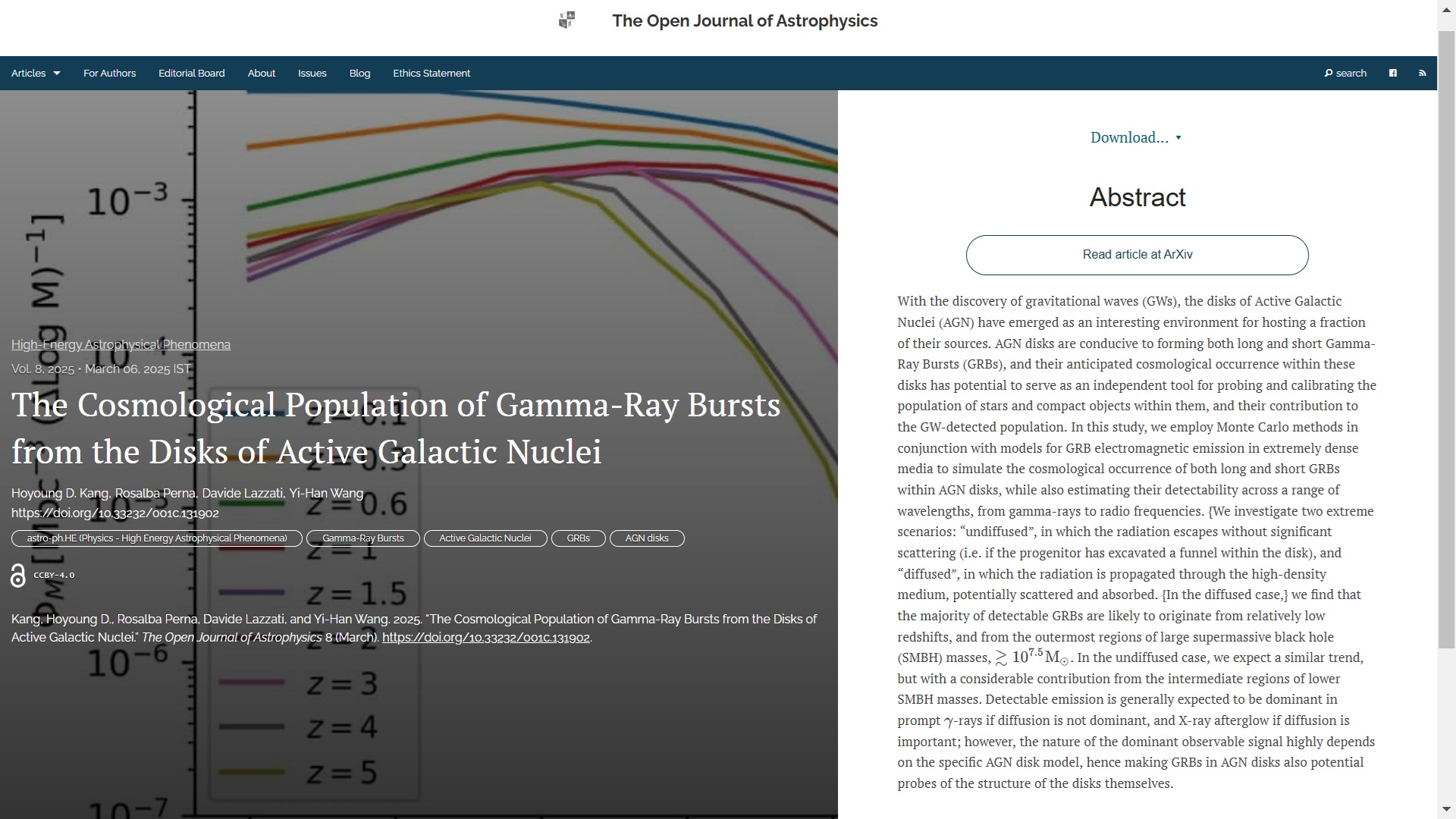
The second paper of the week  is “The Cosmological Population of Gamma-Ray Bursts from the Disks of Active Galactic Nuclei” by Hoyoung D. Kang & Rosalba Perna (Stony Brook), Davide Lazzati (Oregon State), and Yi-Han Wang (U. Nevada), all based in the USA. It was published on Thursday 6th March 2025 in the folder High-Energy Astrophysical Phenomena. The authors use models for GRB electromagnetic emission to simulate the cosmological occurrence and observational detectability of both long and short GRBs within AGN disks
You can find the officially accepted version of this paper on arXiv here.

The next two papers were published on Friday 7th March 2025.

The distribution of misalignment angles in multipolar planetary nebulae” by Ido Avitan and Noam Soker (Technion, Haifa, Israel) analyzes the statistics of measured misalignment angles in multipolar planetary nebulae implies a random three-dimensional angle distribution limited to <60 degrees. It is in the folder Solar and Stellar Astrophysics.

Here is the overlay:


The official published version can be found on the arXiv here.

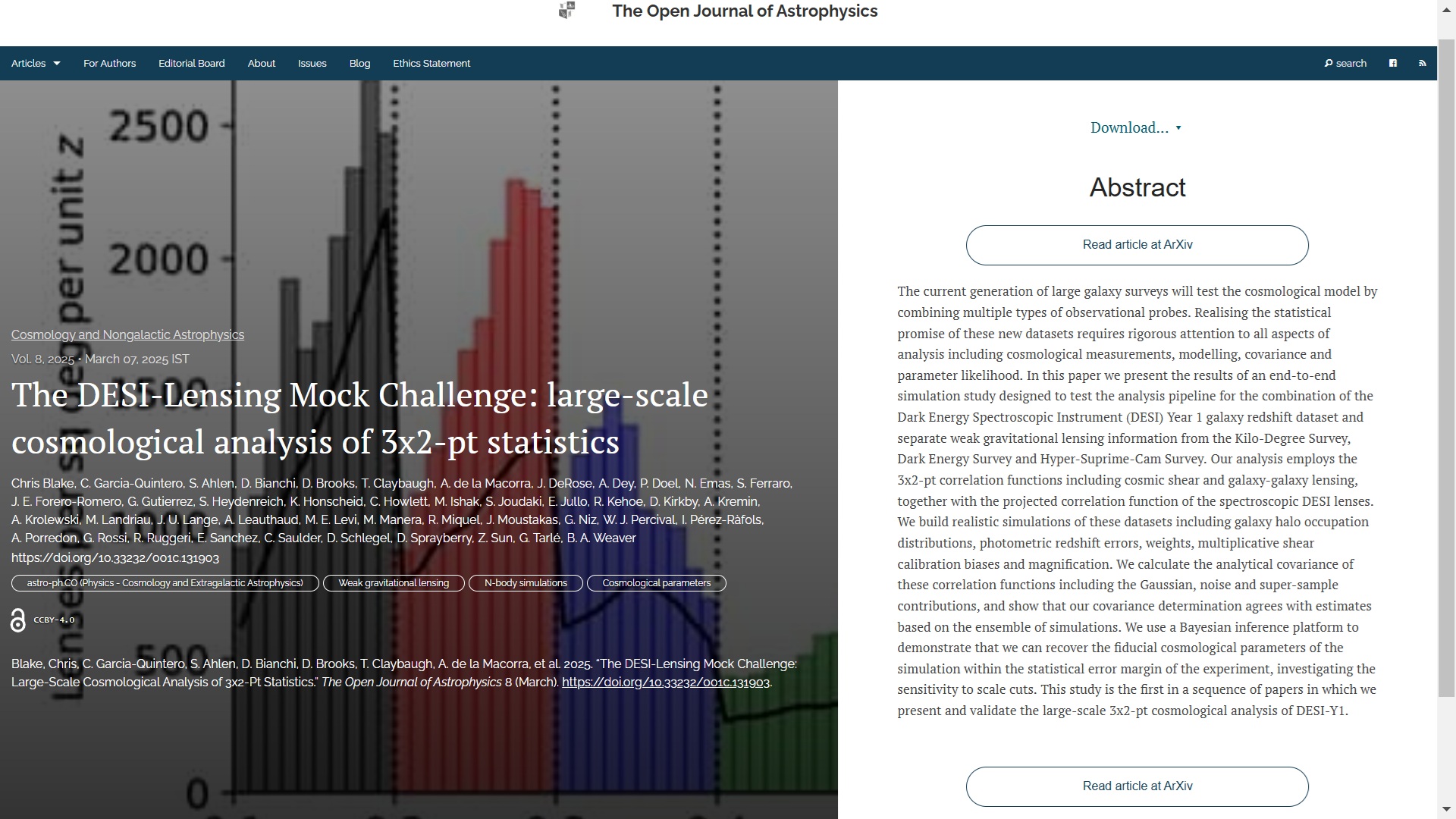
The last paper to report this week is “The DESI-Lensing Mock Challenge: large-scale cosmological analysis of 3×2-pt statistics” by Chris Blake (Swinburne, Australia) and 43 others; this is a large international collaboration and I apologize for not being able to list all the authors here!

This one is in the folder marked Cosmology and NonGalactic Astrophysics; it presents an end-to-end simulation study designed to test the analysis pipeline for the Dark Energy Spectroscopic Instrument (DESI) Year 1 galaxy redshift dataset combined with weak gravitational lensing from other surveys.

The overlay is here:
 

You can find the “final” version on arXiv here.

That’s all for this week. It’s good to see such an interesting variety of topics. I’ll do another update next Saturday

Weekly Update from the Open Journal of Astrophysics – 22/02/2025

Posted in OJAp Papers, Open Access, The Universe and Stuff with tags , , , , , , , , , , , , , , , , , , on February 22, 2025 by telescoper

It’s Saturday morning again so it’s time for an update of papers published at the Open Journal of Astrophysics. Things have picked up a bit after a quiet couple of weeks. Since the last update we have published four new papers which brings the number in Volume 8 (2025) up to 18 and the total so far published by OJAp up to 253.

In chronological order of publication, the four papers published this week, with their overlays, are as follows. You can click on the images of the overlays to make them larger should you wish to do so.

The first paper to report is in fact our 250th paper:  “Untangling Magellanic Streams” by Dennis Zaritsky (Steward Observatory), Vedant Chandra (Harvard), Charlie Conroy (Harvard), Ana Bonaca (Carnegie Observatories), Phillip A. Cargile (Harvard), and Rohan P. Naidu (MIT), all based in the USA. This paper is in the folder marked Astrophysics of Galaxies and it reports on spectroscopic study aimed at teasing out the stellar populations of different strands of the Magellanic Stream. It was published on Tuesday 18th February 2025. Here is the overlay:

You can read the officially accepted version of this paper on arXiv here.

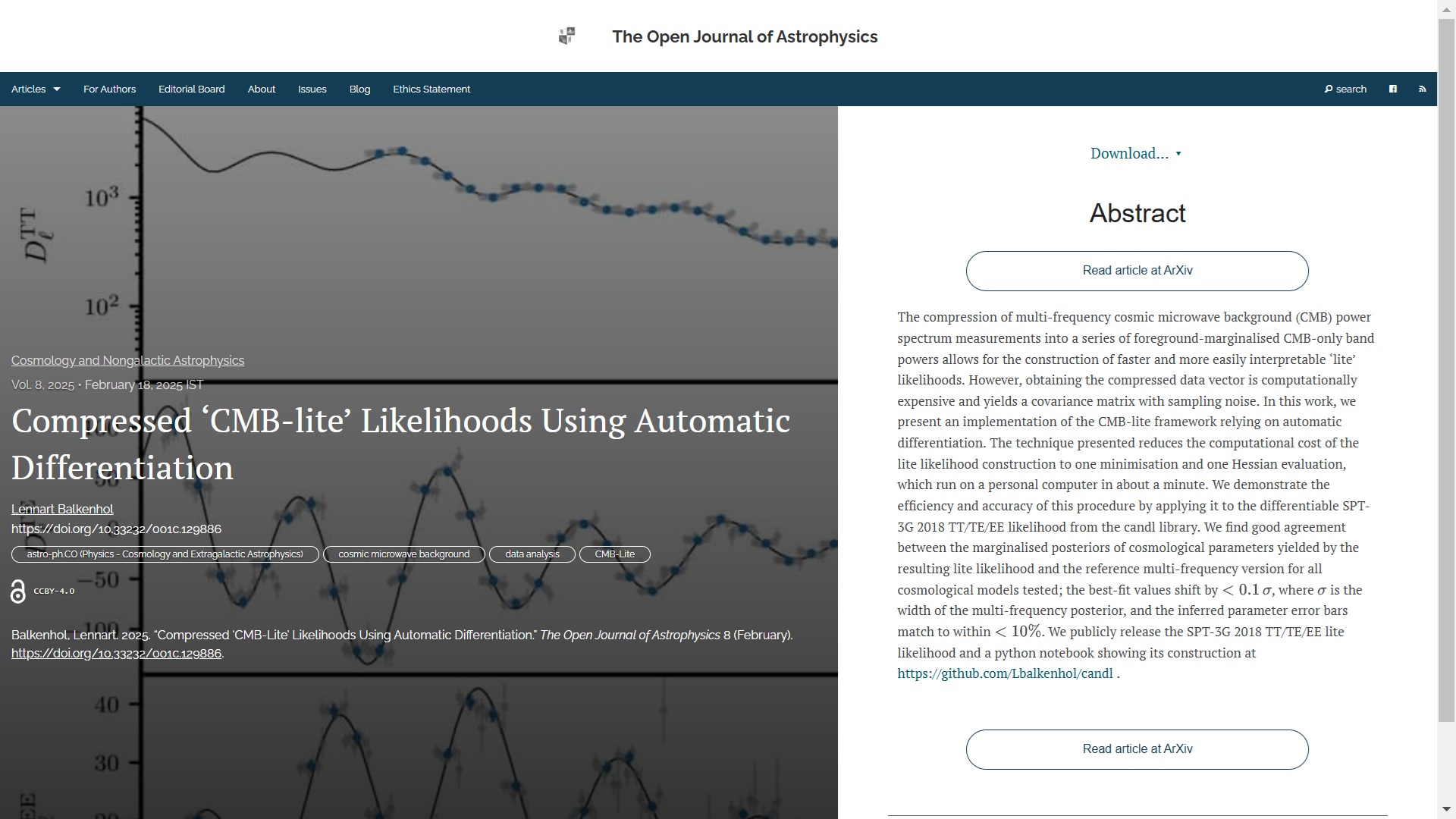
The second paper of the week  is “Compressed ‘CMB-lite’ Likelihoods Using Automatic Differentiation” by Lennart Balkenhol (Institut d’Astrophysique de Paris, France) which was one of two papers published on Wednesday 19th February. It appears in the folder Cosmology and Nongalactic Astrophysics and it describes an implementation of the CMB-lite framework relying on automatic differentiation to reduce the computational cost of the lite likelihood construction.  The overlay is here:

You can find the officially accepted version of this paper on arXiv here.

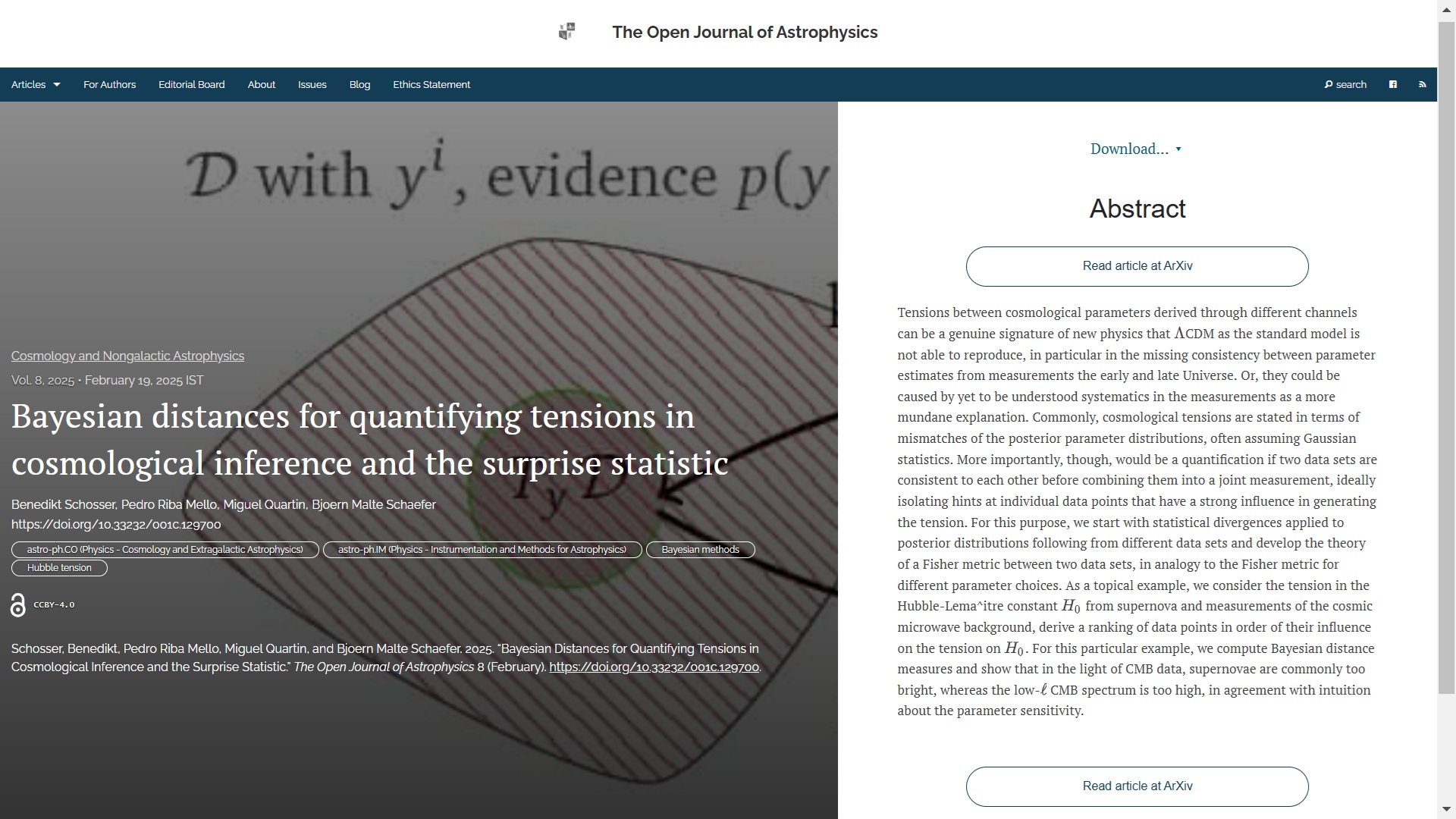
The next paper, also published on Wednesday 19th February in the folder Cosmology and Nongalactic Astrophysics is “Bayesian distances for quantifying tensions in cosmological inference and the surprise statistic” by Benedikt Schosser (Heidelberg, Germany), Pedro Riba Mello & Miguel Quartin (Rio de Janeiro, Brazil) and Bjoern Malte Schaefer (Heidelberg).  It presents a discussion of statistical divergences applied to posterior distributions following from different data sets and their use in quantifying discrepancies or tensions.

Here is the overlay:

The official published version can be found on the arXiv here.

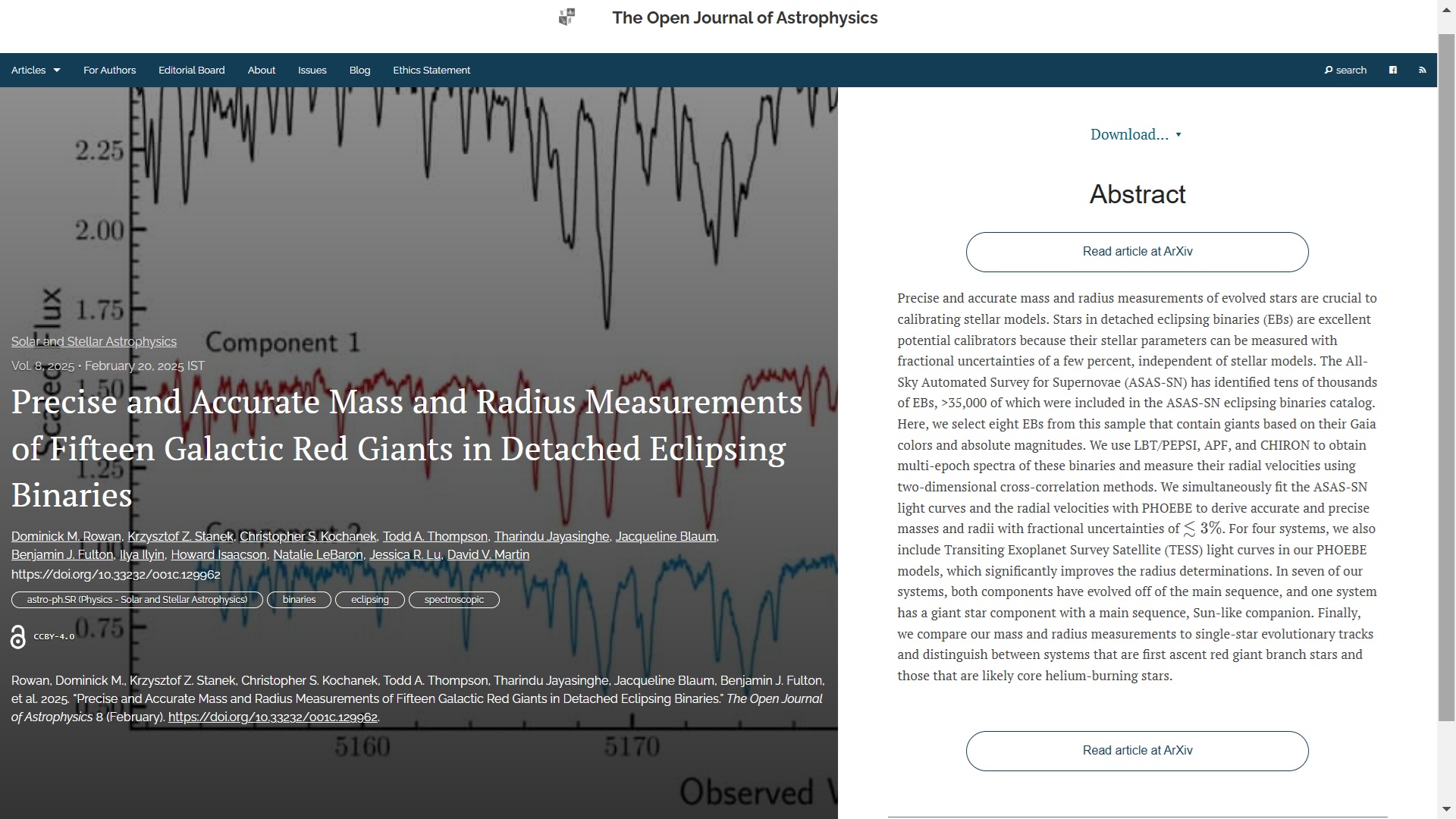
Finally in this batch we have “Precise and Accurate Mass and Radius Measurements of Fifteen Galactic Red Giants in Detached Eclipsing Binaries” by Dominick M. Rowan,  Krzysztof Z. Stanek,  Christopher S. Kochanek & Todd A. Thompson (Ohio State University), Tharindu Jayasinghe (independent researcher),  Jacqueline Blaum (UC Berkeley),  Benjamin J. Fulton (NASA/Caltech),  Ilya Ilyin (AIP Potsdam, Germany),  Howard Isaacson, Natalie LeBaron  &  Jessica R. Lu (UC Berkeley), and  David V. Martin (Tufts University, USA).  This paper was published on Thursday 20th February 2025 in the folder Solar and Stellar Astrophysics and it presents a compilation of mass and readius measurements of red giant stars obtained using spectroscopic measurements together with light curves and the eclipsing binary models obtained using PHOEBE.

The overlay is here:

You can find the “final” version on arXiv here.

That’s all for this week. I’ll do another update next Saturday.

The 250th Publication at the Open Journal of Astrophysics!

Posted in OJAp Papers, Open Access, The Universe and Stuff with tags , on February 18, 2025 by telescoper

It’s been a very busy day for various reasons so I’ll just mention that this morning I published the 250th paper at the Open Journal of Astrophysics. The lucky publication to garner this distinction is “Untangling Magellanic Streams” by Dennis Zaritsky (Steward Observatory), Vedant Chandra (Harvard), Charlie Conroy (Harvard), Ana Bonaca (Carnegie Observatories), Phillip A. Cargile (Harvard), and Rohan P. Naidu (MIT), all based in the USA. Here is the overlay

This will feature in the update on Saturday along with the other papers to be published this week, of which I expect several.

Weekly Update from the Open Journal of Astrophysics – 15/02/2025

Posted in OJAp Papers, Open Access, The Universe and Stuff with tags , , , , , , , , , , on February 15, 2025 by telescoper

Time for another quick update of papers published at the Open Journal of Astrophysics. Since the last update we have published two new papers, which brings the number in Volume 8 (2025) up to 14 and the total so far published by OJAp up to 249.

Here are quick descriptions of the two papers concerned; you can click on the images of the overlays to make them larger should you wish to do so.

First one up is “AI-assisted super-resolution cosmological simulations IV: An emulator for deterministic realizations” by Xiaowen Zhang & Patrick Lachance (Carnegie Mellon), Ankita Dasgupta (Penn State), Rupert A. C. Croft & Tiziana Di Matteo (Carnegie Mellon), Yueying Ni (Harvard), Simeon Bird (UC Riverside) and Yin Li (Shenzhen University, China).  It presents a method of achieving super-resolution to rapidly enhance low-resolution runs with statistically correct fine details to generate accurate simulations and mock observations for large galaxy surveys and was published on Monday 10th February 2025 in the folder marked Cosmology and NonGalactic Astrophysics.


You can find the officially accepted version of this paper on arXiv here.

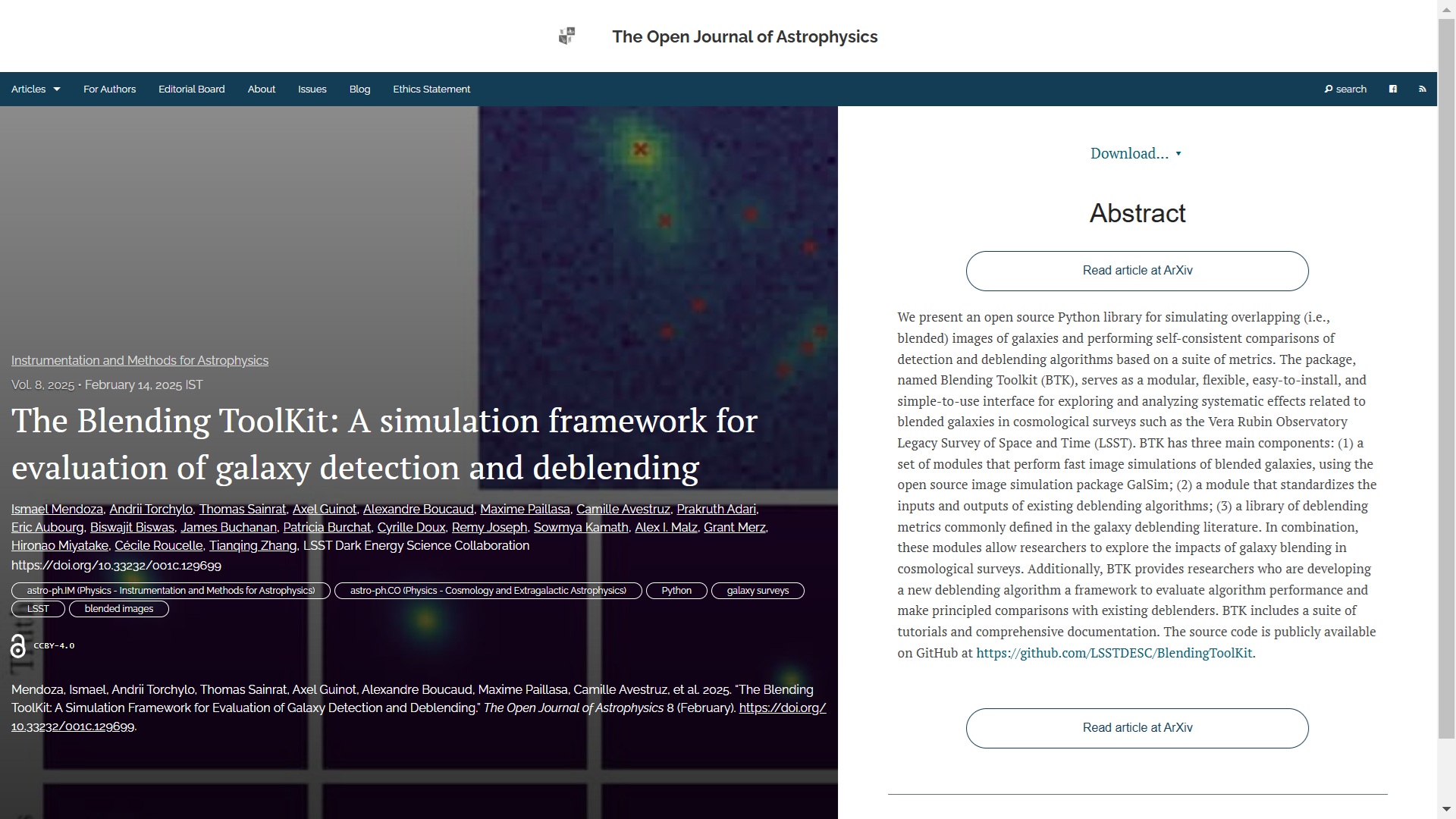
The second paper, published on Friday 14th February 2025 in the folder Instrumentation and Methods for Astrophysics is “The Blending ToolKit: A simulation framework for evaluation of galaxy detection and deblending” which describes a modular suite of Python software for exploring and analyzing systematic effects related to blended galaxy images in cosmological surveys. It was written by Ismael Mendoza (U. Michigan, Ann Arbor, USA) and 19 others, on behalf of the LSST Dark Energy Science Collaboration. I don’t have time to list all the authors here but you can find them on the overlay here:


The accepted version of this paper can be found on the arXiv here.

That’s all for this week. I’ll do another update next week, when I expect to be able to report that we have passed the 250 publication mark.

Weekly Update from the Open Journal of Astrophysics – 08/02/2025

Posted in OJAp Papers, Open Access, The Universe and Stuff with tags , , , , , , , on February 8, 2025 by telescoper

It’s Saturday morning, so once again it’s time for an update from the Open Journal of Astrophysics. Since the last update we have published one new paper, which brings the number in Volume 8 (2025) up to 12 and the total so far published by OJAp up to 247.

Galaxy evolution in the post-merger regime. III – The triggering of active galactic nuclei peaks immediately after coalescence” was written by Sara Ellison, Leonardo Ferreira, Robert Bickley & Tess Grindlay (U. Victoria, Canada), Samir Salim (Indiana U., USA), Shoshannah Byrne-Mamahit (Victoria), Shobita Satyapal (George Mason U., USA), David R. Patton (Trent U., Canada) and Jillian M. Scudder (Oberlin College, USA).  It was published on 4th February 2025 and is in the folder marked Astrophysics of Galaxies. The paper describes an investigation into the timescale of triggering of AGN activity after galaxy mergers and concluding that most occurs immediately after coalescence. 

You can find the officially accepted version of this paper on arXiv here.

That’s all for this week. I’ll have more updates next Saturday.

The Threat to the Astrophysics Data System

Posted in Open Access, The Universe and Stuff with tags , , on February 6, 2025 by telescoper

Many times on this blog (e.g. here) I have mentioned the SAO/NASA Astrophysics Data System which (for the uninitiated) is a Digital Library portal for researchers in astronomy and physics, operated by the Smithsonian Astrophysical Observatory (SAO) under a NASA grant. The ADS maintains three bibliographic databases containing more than 14.0 million records covering publications in Astronomy and Astrophysics, Physics, and (of course) the arXiv e-prints. In addition to maintaining its bibliographic corpus, the ADS tracks citations and other information, which means, that among many other things, it is an important tool for evaluating publication impact. I use it very frequently.

I’m not the only person to be worried about this, see e.g. here.

After the Trump administration’s sudden and devasting cuts to Federal science agencies such as the National Science Foundation, it seems very likely that NASA programmes will also be severely cut which calls the future of the ADS system into doubt. This facility is used by astronomers around the world and its loss would have serious consequences for the global research community. I sincerely hope that astronomical organizations around the world will get together and ensure that data is not lost and a replacement website is set up. If your’e an astronomer please put pressure on your national funders to look at this as a matter of agency. We NASA/ADS is a wonderful resource, and is not by any standards expensive to run. We will all regret it if it is lost.

Until about 5 years ago, when ADS underwent a major overhaul, there were mirror sites all around the world. These are all still listed by ADS but do not seem to be functional. At the very least these should be reactivated.

P.S. I have been asked if arXiv is under a similar threat. I don’t believe it is – yet – as it is not run by a Federal organization. We do have secure backups of all OJAp published articles, though, in case you were wondering.

Weekly Update from the Open Journal of Astrophysics – 01/02/2025

Posted in OJAp Papers, Open Access, The Universe and Stuff with tags , , , , , , , , , , , , , , , , , , on February 1, 2025 by telescoper

It’s Saturday morning, so once again it’s time for an update of papers published at the Open Journal of Astrophysics. There were no papers to report last week but since the last update we have published four new papers, which brings the number in Volume 8 (2025) up to 11 and the total so far published by OJAp up to 246.

In chronological order of publication, the four papers published this week, with their overlays, are as follows. You can click on the images of the overlays to make them larger should you wish to do so.

First one up is  “A halo model approach for mock catalogs of time-variable strong gravitational lenses” by Katsuya T. Abe & Masamune Oguri (Chiba U, Japan), Simon Birrer & Narayan Khadka (Stony Brook, USA), Philip J. Marshall (Stanford, USA), Cameron Lemon (Stockholm U., Sweden), Anupreeta More (IUCAA, India), and the LSST Dark Energy Science Collaboration. It was published on 27th January 2025 in the folder marked Cosmology and NonGalactic Astrophysics. The paper discusses how to generate mock catalogs of strongly lensed QSOs and Supernovae on galaxy-, group-, and cluster-scales based on a halo model that incorporates dark matter halos, galaxies, and subhalos.


You can find the officially accepted version of this paper on arXiv here.

This paper, also published on Monday 27th January 2025, but in the folder Astrophysics of Galaxies, is “The Soltan argument at redshift 6: UV-luminous quasars contribute less than 10% to early black hole mass growth” by Knud Jahnke (MPI Heidelberg, Germany). This paper presents an argument that almost all growth of supermassive black hole mass at z>6 does not take place in UV-luminous quasars.

Here is a screen grab of the overlay, which includes the abstract:You can find the officially accepted version of the paper on the arXiv here.

The third paper to announce, published on 29th January 2025 in the folder Cosmology and NonGalactic Astrophysics, is “A Heavy Seed Black Hole Mass Function at High Redshift – Prospects for LISA” by Joe McCaffrey & John Regan (Maynooth U., Ireland), Britton Smith (Edinburgh U., UK), John Wise (Georgia Institute of Technology, USA), Brian O’Shea (Michigan State U., USA) and Michael Norman (University of California, San Diego). This is a numerical study of the growth rates of massive black holes in the early Universe and implications for their detection via gravitational wave emission.

You can see the overlay here:


The accepted version of this paper can be found on the arXiv here.

The last paper of this batch is “Forecasting the Detection of Lyman-alpha Forest Weak Lensing from the Dark Energy Spectroscopic Instrument and Other Future Surveys” by Patrick Shaw & Rupert A. C. Croft (Carnegie Mellon U., USA) and R. Benton Metcalf (U. Bologna, Italy). This paper, published on January 30th 2025, is about extending the applicationof  Lyman-α forest weak gravitational lensing to lower angular source densities than has previously been done, with forecasts for future spectral surveys. It is in the folder marked Cosmology and NonGalactic Astrophysics.

The overlay is here


You can find the accepted version on arXiv here.

Incidentally, we currently have 121 papers under review, including 81 under a revise and resubmit request.

That’s all for this week. I’ll do another update next Saturday.

The Global Cost of “Article Processing Charges”

Posted in Open Access with tags , , on January 27, 2025 by telescoper

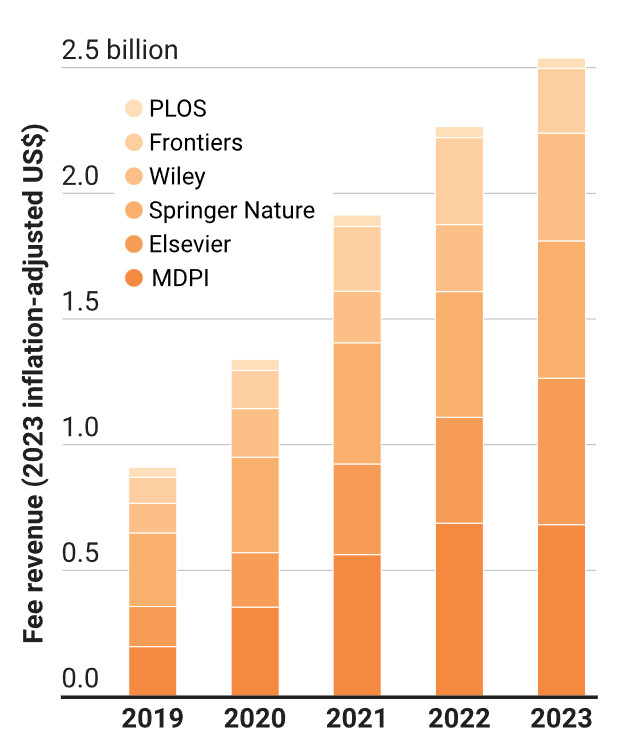
There’s an article on arXiv with the title Estimating global article processing charges paid to six publishers for open access between 2019 and 2023 and the following abstract

This study presents estimates of the global expenditure on article processing charges (APCs) paid to six publishers for open access between 2019 and 2023. APCs are fees charged for publishing in some fully open access journals (gold) and in subscription journals to make individual articles open access (hybrid). There is currently no way to systematically track institutional, national or global expenses for open access publishing due to a lack of transparency in APC prices, what articles they are paid for, or who pays them. We therefore curated and used an open dataset of annual APC list prices from Elsevier, Frontiers, MDPI, PLOS, Springer Nature, and Wiley in combination with the number of open access articles from these publishers indexed by OpenAlex to estimate that, globally, a total of $8.349 billion ($8.968 billion in 2023 US dollars) were spent on APCs between 2019 and 2023. We estimate that in 2023 MDPI ($681.6 million), Elsevier ($582.8 million) and Springer Nature ($546.6 million) generated the most revenue with APCs. After adjusting for inflation, we also show that annual spending almost tripled from $910.3 million in 2019 to $2.538 billion in 2023, that hybrid exceed gold fees, and that the median APCs paid are higher than the median listed fees for both gold and hybrid. Our approach addresses major limitations in previous efforts to estimate APCs paid and offers much needed insight into an otherwise opaque aspect of the business of scholarly publishing. We call upon publishers to be more transparent about OA fees.

Haustein et al., arXiv:2407.16551

I must have missed when it was submitted last July, but it has recently been doing the rounds on BlueSky which is how I noticed it. Here is the salient figure:

The paper estimates that over $8 billion has been wasted on “Article Processing Charges” (APCs) in the 5-year period covered. I put “Article Processing Charges” in inverted commas because, as I have said on many occasions, these fees have nothing to do with the cost of processing an article. They are simply charges levied by publishers to increase their profits.

The last sentence of the abstract “We call upon publishers to be more transparent about OA fees” is nowhere near as forceful as it should be. These charges are a scam and academia should not be feeding these parasites. A tiny fraction of that $8 billion would be enough to set up repositories similar to arXiv for all academic disciplines which would make OA publishing free to authors.

Page Charges at A&A

Posted in Euclid, Open Access with tags , , , , , on January 20, 2025 by telescoper

The journal Astronomy & Astrophysics (A&A for short) announced last week that it was increasing page charges on longer papers. The table of new charges to be implemented is here:

A&A is published on behalf of the European Southern Observatory by EDP Sciences (Édition Diffusion Presse Sciences) which began life as a joint venture of four French learned societies in science, mathematics, and medicine. The company was acquired in 2019 by  China Science Publishing & Media (which has headquarters in Beijing). Judging by its social media activity, EDP Sciences sees A&A as a flagship journal; for a list of other journals it runs see here. I gave some background on A&A here.

A&A publishes papers through a curious hybrid model called “S2O” (Subscribe to Open; not to be confused with “420”). This is not fully Open Access because it requires libraries to pay a subscription to access the journal. For this reason it is not compatible with some institutional open access policies. Unlike some journals, however, A&A does allow authors to place their papers on arXiv without restriction, so they can be read there for free. Previously A&A required authors (or their institutes) to pay “Page Charges” – essentially an Article Processing Charge (APC) – if they were not from a “member country”; this policy was introduced in 2020. Authors from a member country will now have to pay APCs to publish (if their paper exceeds the page limit) but their institutional libraries still have to pay a subscription if they are to access the paper. In other words, A&A is double-dipping.

According to A&A,

… the average length of papers has also been increasing. Too often, papers are longer than necessary, leading to increased workload for authors, referees, and editors, and hindering the reader’s ability to efficiently grasp their content. As well as needing logistical consideration, the challenges related to the journal’s growth have financial implications that must be addressed to ensure long-term sustainability.

I agree that many papers are far too long. As a journal Editor myself I know that it is much harder to find people willing to review very long papers, a fact that some authors seem reluctant to recognize. On the other hand I very much doubt that any of the funds generated by page charges will be given to the refeees who do the most important – indeed I would argue the only important – work of a journal.

If the desired effect is to reduce the number of long papers this policy may work, though I suspect authors who are incurably prolix will respond by splitting their work into several shorter papers to avoid the page charges and thereby generating even more work for the journal. I suspect however that the desired effect is really to increase revenue; so often in the context of academic publishing “sustainability” really means “profitability”. I would also bet that these charges will increase further in future.

The changing charges at A&A have widespread implications, including for the Euclid Consortium, most of whose scientific papers are published there. I’m sure the Euclid Consortium Editorial Board will discuss this development. I’m not a member of the ECEB so it would be inappropriate to comment further on publication policy so I’ll leave the discussion to them. I would say, however, that the publication process at A&A is rather slow. The main post-launch Euclid Overview paper by Mellier et al., for example, was accepted for publication in August 2024 but has still not appeared. It is, however, available on arXiv, which is all that really matters. That paper, incidentally, is over 90 pages long. According to the table above that would cost about €12,000 in page charges. It was submitted in May 2024 and accepted quite quickly but is planned to appear in a special issue Euclid on Sky the publication of which is being delayed by other papers still going through the editorial process.

(Incidentally, Mellier et al. has already acquired 157 citations despite not yet being officially published, which illustrates how little difference “official” publication is actually worth.)